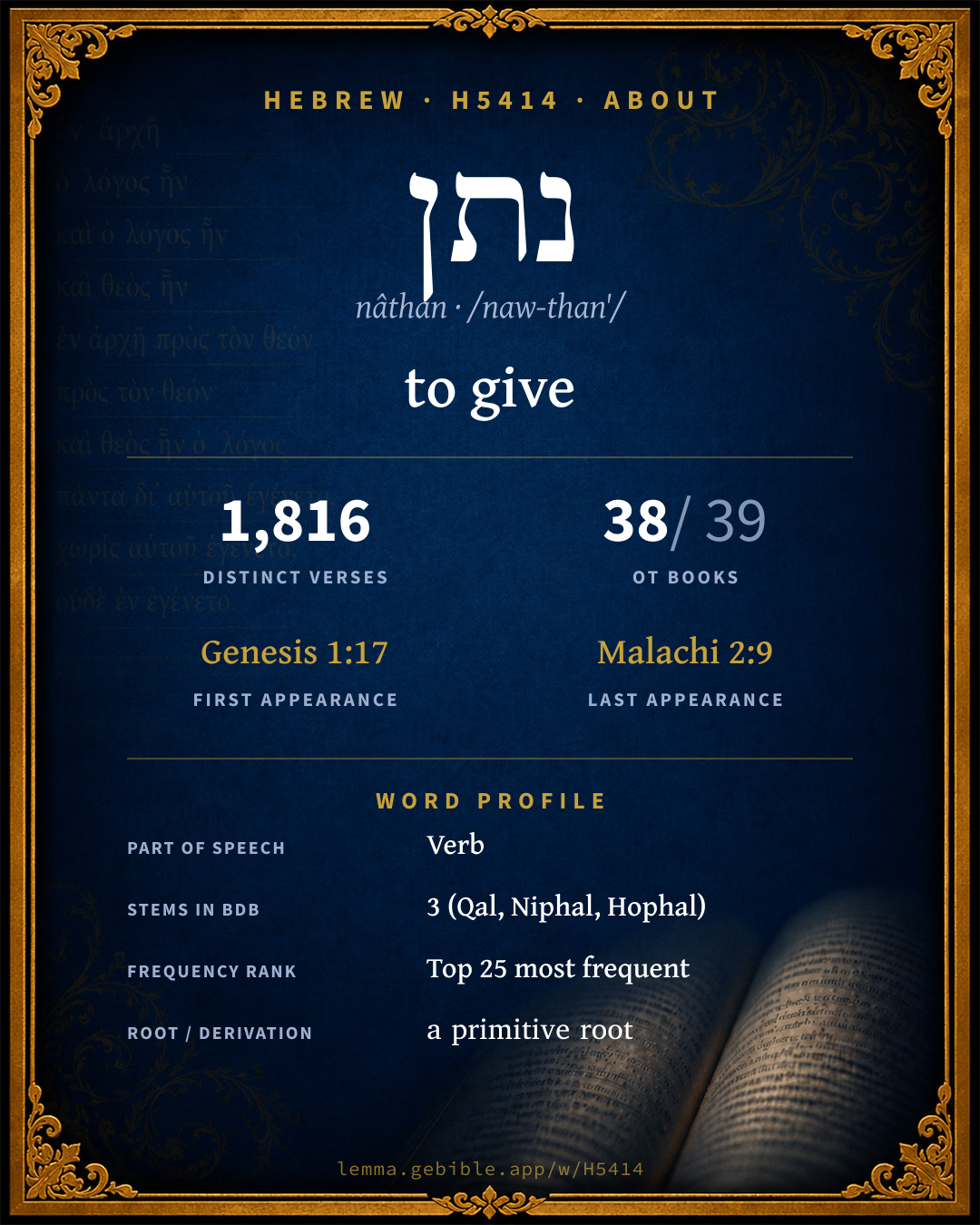
נָתַן
to give
also: put, set fuller range ↓
Full lexicon entry — Brown-Driver-Briggs (BDB)
From Brown-Driver-Briggs (BDB)
Where this word appears
See every Qal verb in the Hebrew Bible →
Grammar key — what these labels mean
Part of speech
- Verb
- An action or state-of-being word.
Stem
- Qal
- The basic, simple active stem — the plain form of the verb (“he wrote”). Here: ‘give’
- Niphal
- Usually the simple passive or reflexive of the Qal (“he was written”). Here: ‘be given to’
- Hophal
- The passive counterpart of the Hiphil (“he was caused to…”). Here: ‘be given’
- Qal Passive
- An archaic passive of the Qal, preserved in a few forms.
Form
- Perfect
- A completed action or state — Hebrew marks aspect (completeness) more than strict tense (“he wrote”).
- Sequential Imperfect
- An imperfect with prefixed waw — the standard past-narrative form (waw-consecutive imperfect).
- Imperfect
- An incomplete, ongoing, or future action (“he will / would write”).
- Sequential Perfect
- A perfect with prefixed waw continuing a preceding imperfect or command (waw-consecutive perfect).
- Infinitive Construct
- A bound verbal noun, frequently with prepositions (“to write / in writing”).
- Participle Active
- A verbal adjective expressing ongoing or characteristic action (“writing / one who writes”).
- Imperative
- A direct command (“write!”).
- Cohortative
- A first-person volitional form expressing wish or resolve (“let me / let us write”).
- Jussive
- A third- or second-person volitional form expressing wish or command (“let him write”).
- Participle Passive
- A verbal adjective expressing action received (“written”).
- Infinitive Absolute
- An unbound verbal noun, often intensifying or standing in for a finite verb.
State
- Absolute
- The independent form of a noun, not bound to a following word.
- Construct
- A noun bound to a following noun in a possessive / “of” relationship (the construct chain).
Person
- 3rd Person
- The one spoken about (“he / she / it / they”).
- 1st Person
- The speaker (“I / we”).
- 2nd Person
- The one addressed (“you”).
Gender
- Masculine
- Grammatically masculine.
- Common
- Either gender — not distinguished for this form.
- Feminine
- Grammatically feminine.
Number
- Singular
- One.
- Plural
- More than one (in Hebrew, generally three or more).
Grammatical forms 72 distinct
- Verb, Qal, Sequential Imperfect, 3rd Person, Masculine, Singular 226 times (11%)
- Verb, Qal, Perfect, 3rd Person, Masculine, Singular 220 times (11%)
- Verb, Qal, Infinitive Construct 161 times (8%)
- Verb, Qal, Perfect, 1st Person, Common, Singular 154 times (8%)
- Verb, Qal, Imperfect, 3rd Person, Masculine, Singular 141 times (7%)
- Verb, Qal, Sequential Perfect, 1st Person, Common, Singular 132 times (7%)
- Verb, Qal, Imperfect, 1st Person, Common, Singular 106 times (5%)
- Verb, Qal, Participle Active, Masculine, Singular, Absolute 100 times (5%)
+64 more forms (775 occurrences)
Parsed forms decoded from the imported morphology (morphhb / Westminster Leningrad Codex — WLC text public domain, morphhb tagging CC BY 4.0), counted across 2,015 parsed occurrences — not distinct verses.
Page 1 of 10 — showing verses 1–200 of 1,816 distinct verses where H5414 appears, across 38 books. Click any verse to open its interlinear word-by-word view. Verse text shown in the World English Bible for context — . Each verse’s Hebrew form is shown with its reference; the English is not keyword-highlighted, since the data carries no word-level English alignment. Use “Compare translations” on any verse to read it across multiple English versions. This concordance covers the Hebrew Bible; Septuagint (Greek Old Testament) occurrences are not indexed here.
Genesis 132 verses
- Genesis 1:17 וַ/יִּתֵּ֥ן conj + Qal wimpf 3ms God set them in the expanse of sky to give light to the earth,
- Genesis 1:29 נָתַ֨תִּי Qal pf 1cs God said, "Behold, I have given you every herb yielding seed, which is on the surface of all the earth, and every tree, which bears fruit yielding seed. It will be your food.
- Genesis 3:6 וַ/תִּתֵּ֧ן conj + Qal wimpf 3fs When the woman saw that the tree was good for food, and that it was a delight to the eyes, and that the tree was to be desired to make one wise, she took of the fruit of it, and ate; and she gave some to her husband with her, and he ate.
- Genesis 3:12 נָתַ֣תָּה נָֽתְנָה Qal pf 2ms Qal pf 3fs The man said, "The woman whom you gave to be with me, she gave me of the tree, and I ate."
- Genesis 4:12 תֵּת Qal inf.cs From now on, when you till the ground, it won't yield its strength to you. You shall be a fugitive and a wanderer in the earth."
- Genesis 9:2 נִתָּֽנוּ Niphal pf 3cp The fear of you and the dread of you will be on every animal of the earth, and on every bird of the sky. Everything that the ground teems with, and all the fish of the sea are delivered into your hand.
- Genesis 9:3 נָתַ֥תִּי Qal pf 1cs Every moving thing that lives will be food for you. As the green herb, I have given everything to you.
- Genesis 9:12 נֹתֵ֗ן Qal ptcp.act ms God said, "This is the token of the covenant which I make between me and you and every living creature that is with you, for perpetual generations:
- Genesis 9:13 נָתַ֖תִּי Qal pf 1cs I set my rainbow in the cloud, and it will be for a sign of a covenant between me and the earth.
- Genesis 12:7 אֶתֵּ֖ן Qal impf 1cs Yahweh appeared to Abram, and said, "I will give this land to your seed." He built an altar there to Yahweh, who appeared to him.
- Genesis 13:15 אֶתְּנֶ֑/נָּה Qal impf 1cs + sfx pers 3fs for all the land which you see, I will give to you, and to your offspring forever.
- Genesis 13:17 אֶתְּנֶֽ/נָּה Qal impf 1cs + sfx pers 3fs Arise, walk through the land in the length of it and in the breadth of it; for I will give it to you."
- Genesis 14:20 וַ/יִּתֶּן conj + Qal wimpf 3ms and blessed be God Most High, who has delivered your enemies into your hand." Abram gave him a tenth of all.
- Genesis 14:21 תֶּן Qal impv 2ms The king of Sodom said to Abram, "Give me the people, and take the goods to yourself."
- Genesis 15:2 תִּתֶּן Qal impf 2ms Abram said, "Lord Yahweh, what will you give me, seeing I go childless, and he who will inherit my estate is Eliezer of Damascus?"
- Genesis 15:3 נָתַ֖תָּה Qal pf 2ms Abram said, "Behold, to me you have given no seed: and, behold, one born in my house is my heir."
- Genesis 15:7 לָ֧/תֶת prep + Qal inf.cs He said to him, "I am Yahweh who brought you out of Ur of the Chaldees, to give you this land to inherit it."
- Genesis 15:10 וַ/יִּתֵּ֥ן conj + Qal wimpf 3ms He took him all these, and divided them in the middle, and laid each half opposite the other; but he didn't divide the birds.
- Genesis 15:18 נָתַ֨תִּי֙ Qal pf 1cs In that day Yahweh made a covenant with Abram, saying, "To your seed have I given this land, from the river of Egypt to the great river, the river Euphrates:
- Genesis 16:3 וַ/תִּתֵּ֥ן conj + Qal wimpf 3fs Sarai, Abram's wife, took Hagar the Egyptian, her handmaid, after Abram had lived ten years in the land of Canaan, and gave her to Abram her husband to be his wife.
- Genesis 16:5 נָתַ֤תִּי Qal pf 1cs Sarai said to Abram, "This wrong is your fault. I gave my handmaid into your bosom, and when she saw that she had conceived, I was despised in her eyes. Yahweh judge between me and you."
- Genesis 17:2 וְ/אֶתְּנָ֥ה conj + Qal coh 1cs I will make my covenant between me and you, and will multiply you exceedingly."
- Genesis 17:5 נְתַתִּֽי/ךָ Qal pf 1cs + sfx pers 2ms Neither will your name any more be called Abram, but your name will be Abraham; for the father of a multitude of nations have I made you.
- Genesis 17:6 וּ/נְתַתִּ֖י/ךָ conj + Qal wpf 1cs + sfx pers 2ms I will make you exceeding fruitful, and I will make nations of you. Kings will come out of you.
- Genesis 17:8 וְ/נָתַתִּ֣י conj + Qal wpf 1cs I will give to you, and to your seed after you, the land where you are traveling, all the land of Canaan, for an everlasting possession. I will be their God."
- Genesis 17:16 נָתַ֧תִּי Qal pf 1cs I will bless her, and moreover I will give you a son by her. Yes, I will bless her, and she will be a mother of nations. Kings of peoples will come from her."
- Genesis 17:20 וּ/נְתַתִּ֖י/ו conj + Qal wpf 1cs + sfx pers 3ms As for Ishmael, I have heard you. Behold, I have blessed him, and will make him fruitful, and will multiply him exceedingly. He will become the father of twelve princes, and I will make him a great nation.
- Genesis 18:7 וַ/יִּתֵּ֣ן conj + Qal wimpf 3ms Abraham ran to the herd, and fetched a tender and good calf, and gave it to the servant. He hurried to dress it.
- Genesis 18:8 וַ/יִּתֵּ֖ן conj + Qal wimpf 3ms He took butter, milk, and the calf which he had dressed, and set it before them. He stood by them under the tree, and they ate.
- Genesis 20:6 נְתַתִּ֖י/ךָ Qal pf 1cs + sfx pers 2ms God said to him in the dream, "Yes, I know that in the integrity of your heart you have done this, and I also withheld you from sinning against me. Therefore I didn't allow you to touch her.
- Genesis 20:14 וַ/יִּתֵּ֖ן conj + Qal wimpf 3ms Abimelech took sheep and oxen, men-servants and women-servants, and gave them to Abraham, and restored Sarah, his wife to him.
- Genesis 20:16 נָתַ֜תִּי Qal pf 1cs To Sarah he said, "Behold, I have given your brother a thousand pieces of silver. Behold, it is for you a covering of the eyes to all that are with you. In front of all you are vindicated."
- Genesis 21:14 וַ/יִּתֵּ֣ן conj + Qal wimpf 3ms Abraham rose up early in the morning, and took bread and a bottle of water, and gave it to Hagar, putting it on her shoulder, and gave her the child, and sent her away. She departed, and wandered in the wilderness of Beersheba.
- Genesis 21:27 וַ/יִּתֵּ֖ן conj + Qal wimpf 3ms Abraham took sheep and oxen, and gave them to Abimelech. Those two made a covenant.
- Genesis 23:4 תְּנ֨וּ Qal impv 2mp "I am a stranger and a foreigner living with you. Give me a possession of a burying-place with you, that I may bury my dead out of my sight."
- Genesis 23:9 וְ/יִתֶּן יִתְּנֶ֥/נָּה conj + Qal juss 3ms Qal juss 3ms + sfx pers 3fs that he may give me the cave of Machpelah, which he has, which is in the end of his field. For the full price let him give it to me in the midst of you for a possession of a burying-place."
- Genesis 23:11 נָתַ֣תִּי נְתַתִּ֑י/הָ נְתַתִּ֥י/הָ Qal pf 1cs Qal pf 1cs + sfx pers 3fs Qal pf 1cs + sfx pers 3fs "No, my lord, hear me. I give you the field, and I give you the cave that is in it. In the presence of the children of my people I give it to you. Bury your dead."
- Genesis 23:13 נָתַ֜תִּי Qal pf 1cs He spoke to Ephron in the audience of the people of the land, saying, "But if you will, please hear me. I will give the price of the field. Take it from me, and I will bury my dead there."
- Genesis 24:7 אֶתֵּ֖ן Qal impf 1cs Yahweh, the God of heaven, who took me from my father's house, and from the land of my birth, who spoke to me, and who swore to me, saying, 'I will give this land to your seed.' He will send his angel before you, and you shall take a wife for my son from there.
- Genesis 24:32 וַ/יִּתֵּ֨ן conj + Qal wimpf 3ms The man came into the house, and he unloaded the camels. He gave straw and provender for the camels, and water to wash his feet and the feet of the men who were with him.
- Genesis 24:35 וַ/יִּתֶּן conj + Qal wimpf 3ms Yahweh has blessed my master greatly. He has become great. He has given him flocks and herds, silver and gold, men-servants and maid-servants, and camels and donkeys.
- Genesis 24:36 וַ/יִּתֶּן conj + Qal wimpf 3ms Sarah, my master's wife, bore a son to my master when she was old. He has given all that he has to him.
- Genesis 24:41 יִתְּנוּ֙ Qal impf 3mp Then will you be clear from my oath, when you come to my relatives. If they don't give her to you, you shall be clear from my oath.'
- Genesis 24:53 וַ/יִּתֵּ֖ן נָתַ֥ן conj + Qal wimpf 3ms Qal pf 3ms The servant brought forth jewels of silver, and jewels of gold, and clothing, and gave them to Rebekah. He gave also to her brother and to her mother precious things.
- Genesis 25:5 וַ/יִּתֵּ֧ן conj + Qal wimpf 3ms Abraham gave all that he had to Isaac,
- Genesis 25:6 נָתַ֥ן Qal pf 3ms but to the sons of the concubines who Abraham had, Abraham gave gifts. He sent them away from Isaac his son, while he yet lived, eastward, to the east country.
- Genesis 25:34 נָתַ֣ן Qal pf 3ms Jacob gave Esau bread and stew of lentils. He ate and drank, rose up, and went his way. So Esau despised his birthright.
- Genesis 26:3 אֶתֵּן֙ Qal impf 1cs Sojourn in this land, and I will be with you, and will bless you. For to you, and to your seed, I will give all these lands, and I will establish the oath which I swore to Abraham your father.
- Genesis 26:4 וְ/נָתַתִּ֣י conj + Qal wpf 1cs I will multiply your seed as the stars of the sky, and will give to your seed all these lands. In your seed will all the nations of the earth be blessed,
- Genesis 27:17 וַ/תִּתֵּ֧ן conj + Qal wimpf 3fs She gave the savory food and the bread, which she had prepared, into the hand of her son Jacob.
- Genesis 27:28 וְ/יִֽתֶּן conj + Qal juss 3ms God give you of the dew of the sky, of the fatness of the earth, and plenty of grain and new wine.
- Genesis 27:37 נָתַ֤תִּי Qal pf 1cs Isaac answered Esau, "Behold, I have made him your lord, and all his brothers have I given to him for servants. With grain and new wine have I sustained him. What then will I do for you, my son?"
- Genesis 28:4 וְ/יִֽתֶּן נָתַ֥ן conj + Qal juss 3ms Qal pf 3ms and give you the blessing of Abraham, to you, and to your seed with you, that you may inherit the land where you travel, which God gave to Abraham."
- Genesis 28:13 אֶתְּנֶ֖/נָּה Qal impf 1cs + sfx pers 3fs Behold, Yahweh stood above it, and said, "I am Yahweh, the God of Abraham your father, and the God of Isaac. The land whereon you lie, to you will I give it, and to your seed.
- Genesis 28:20 וְ/נָֽתַן conj + Qal wpf 3ms Jacob vowed a vow, saying, "If God will be with me, and will keep me in this way that I go, and will give me bread to eat, and clothing to put on,
- Genesis 28:22 תִּתֶּן Qal impf 2ms then this stone, which I have set up for a pillar, will be God's house. Of all that you will give me I will surely give the tenth to you."
- Genesis 29:19 תִּתִּ֣/י מִ/תִּתִּ֥/י Qal inf.cs + sfx pers 1cs prep + Qal inf.cs + sfx pers 1cs Laban said, "It is better that I give her to you, than that I should give her to another man. Stay with me."
- Genesis 29:24 וַ/יִּתֵּ֤ן conj + Qal wimpf 3ms Laban gave Zilpah his handmaid to his daughter Leah for a handmaid.
- Genesis 29:26 לָ/תֵ֥ת prep + Qal inf.cs Laban said, "It is not done so in our place, to give the younger before the first born.
- Genesis 29:27 וְ/נִתְּנָ֨ה conj + Niphal wpf 3fs Fulfill the week of this one, and we will give you the other also for the service which you will serve with me yet seven other years."
- Genesis 29:28 וַ/יִּתֶּן conj + Qal wimpf 3ms Jacob did so, and fulfilled her week. He gave him Rachel his daughter as wife.
- Genesis 29:29 וַ/יִּתֵּ֤ן conj + Qal wimpf 3ms Laban gave to Rachel his daughter Bilhah, his handmaid, to be her handmaid.
- Genesis 29:33 וַ/יִּתֶּן conj + Qal wimpf 3ms She conceived again, and bare a son, and said, "Because Yahweh has heard that I am hated, he has therefore given me this son also." She named him Simeon.
- Genesis 30:4 וַ/תִּתֶּן conj + Qal wimpf 3fs She gave him Bilhah her handmaid as wife, and Jacob went in to her.
- Genesis 30:6 וַ/יִּתֶּן conj + Qal wimpf 3ms Rachel said, "God has judged me, and has also heard my voice, and has given me a son." Therefore called she his name Dan.
- Genesis 30:9 וַ/תִּתֵּ֥ן conj + Qal wimpf 3fs When Leah saw that she had finished bearing, she took Zilpah, her handmaid, and gave her to Jacob as a wife.
- Genesis 30:14 תְּנִי Qal impv 2fs Reuben went in the days of wheat harvest, and found mandrakes in the field, and brought them to his mother, Leah. Then Rachel said to Leah, "Please give me some of your son's mandrakes."
- Genesis 30:18 נָתַ֤ן נָתַ֥תִּי Qal pf 3ms Qal pf 1cs Leah said, "God has given me my hire, because I gave my handmaid to my husband." She named him Issachar.
- Genesis 30:26 תְּנָ֞/ה Qal impv 2ms + sfx h Give me my wives and my children for whom I have served you, and let me go: for you know my service with which I have served you."
- Genesis 30:28 וְ/אֶתֵּֽנָה conj + Qal coh 1cs He said, "Appoint me your wages, and I will give it."
- Genesis 30:31 אֶתֶּן תִתֶּן Qal impf 1cs Qal impf 2ms He said, "What shall I give you?" Jacob said, "You shall not give me anything. If you will do this thing for me, I will again feed your flock and keep it.
- Genesis 30:35 וַ/יִּתֵּ֖ן conj + Qal wimpf 3ms That day, he removed the male goats that were streaked and spotted, and all the female goats that were speckled and spotted, every one that had white in it, and all the black ones among the sheep, and gave them into the hand of his sons.
- Genesis 30:40 וַ֠/יִּתֵּן conj + Qal wimpf 3ms Jacob separated the lambs, and set the faces of the flocks toward the streaked and all the black in the flock of Laban: and he put his own droves apart, and didn't put them into Laban's flock.
- Genesis 31:7 נְתָנ֣/וֹ Qal pf 3ms + sfx pers 3ms Your father has deceived me, and changed my wages ten times, but God didn't allow him to hurt me.
- Genesis 31:9 וַ/יִּתֶּן conj + Qal wimpf 3ms Thus God has taken away the cattle of your father, and given them to me.
- Genesis 32:16 וַ/יִּתֵּן֙ conj + Qal wimpf 3ms He delivered them into the hands of his servants, every herd by itself, and said to his servants, "Pass over before me, and put a space between herd and herd."
- Genesis 34:8 תְּנ֨וּ Qal impv 2mp Hamor talked with them, saying, "The soul of my son, Shechem, longs for your daughter. Please give her to him as a wife.
- Genesis 34:9 תִּתְּנוּ Qal impf 2mp Make marriages with us. Give your daughters to us, and take our daughters for yourselves.
- Genesis 34:11 אֶתֵּֽן Qal impf 1cs Shechem said to her father and to her brothers, "Let me find favor in your eyes, and whatever you will tell me I will give.
- Genesis 34:12 וְ/אֶ֨תְּנָ֔ה וּ/תְנוּ conj + Qal coh 1cs conj + Qal impv 2mp Ask me a great amount for a dowry, and I will give whatever you ask of me, but give me the young lady as a wife."
- Genesis 34:14 לָ/תֵת֙ prep + Qal inf.cs and said to them, "We can't do this thing, to give our sister to one who is uncircumcised; for that is a reproach to us.
- Genesis 34:16 וְ/נָתַ֤נּוּ conj + Qal wpf 1cp then will we give our daughters to you, and we will take your daughters to us, and we will dwell with you, and we will become one people.
- Genesis 34:21 נִתֵּ֥ן Qal impf 1cp "These men are peaceful with us. Therefore let them live in the land and trade in it. For, behold, the land is large enough for them. Let us take their daughters to us for wives, and let us give them our daughters.
- Genesis 35:4 וַ/יִּתְּנ֣וּ conj + Qal wimpf 3mp They gave to Jacob all the foreign gods which were in their hands, and the rings which were in their ears; and Jacob hid them under the oak which was by Shechem.
- Genesis 35:12 נָתַ֛תִּי אֶתְּנֶ֑/נָּה אֶתֵּ֥ן Qal pf 1cs Qal impf 1cs + sfx pers 3fs Qal impf 1cs The land which I gave to Abraham and Isaac, I will give it to you, and to your seed after you will I give the land."
- Genesis 38:9 נְתָן Qal inf.cs Onan knew that the seed wouldn't be his; and it happened, when he went in to his brother's wife, that he spilled it on the ground, lest he should give seed to his brother.
- Genesis 38:14 נִתְּנָ֥ה Niphal pf 3fs She took off of her the garments of her widowhood, and covered herself with her veil, and wrapped herself, and sat in the gate of Enaim, which is by the way to Timnah; for she saw that Shelah was grown up, and she wasn't given to him as a wife.
- Genesis 38:16 תִּתֶּן Qal impf 2ms He turned to her by the way, and said, "Please come, let me come in to you:" for he didn't know that she was his daughter-in-law. She said, "What will you give me, that you may come in to me?"
- Genesis 38:17 תִּתֵּ֥ן Qal impf 2ms He said, "I will send you a kid of the goats from the flock." She said, "Will you give me a pledge, until you send it?"
- Genesis 38:18 אֶתֶּן וַ/יִּתֶּן Qal impf 1cs conj + Qal wimpf 3ms He said, "What pledge will I give you?" She said, "Your signet and your cord, and your staff that is in your hand." He gave them to her, and came in to her, and she conceived by him.
- Genesis 38:26 נְתַתִּ֖י/הָ Qal pf 1cs + sfx pers 3fs Judah acknowledged them, and said, "She is more righteous than I, because I didn't give her to Shelah, my son." He knew her again no more.
- Genesis 38:28 וַ/יִּתֶּן conj + Qal wimpf 3ms It happened, when she travailed, that one put out a hand: and the midwife took and tied a scarlet thread on his hand, saying, "This came out first."
- Genesis 39:4 נָתַ֥ן Qal pf 3ms Joseph found favor in his sight. He ministered to him, and he made him overseer over his house, and all that he had he put into his hand.
- Genesis 39:8 נָתַ֥ן Qal pf 3ms But he refused, and said to his master's wife, "Behold, my master doesn't know what is with me in the house, and he has put all that he has into my hand.
- Genesis 39:20 וַֽ/יִּתְּנֵ֨/הוּ֙ conj + Qal wimpf 3ms + sfx pers 3ms Joseph's master took him, and put him into the prison, the place where the king's prisoners were bound, and he was there in custody.
- Genesis 39:21 וַ/יִּתֵּ֣ן conj + Qal wimpf 3ms But Yahweh was with Joseph, and showed kindness to him, and gave him favor in the sight of the keeper of the prison.
- Genesis 39:22 וַ/יִּתֵּ֞ן conj + Qal wimpf 3ms The keeper of the prison committed to Joseph's hand all the prisoners who were in the prison. Whatever they did there, he was the doer of it.
- Genesis 40:3 וַ/יִּתֵּ֨ן conj + Qal wimpf 3ms He put them in custody in the house of the captain of the guard, into the prison, the place where Joseph was bound.
- Genesis 40:11 וָ/אֶתֵּ֥ן conj + Qal wimpf 1cs Pharaoh's cup was in my hand; and I took the grapes, and pressed them into Pharaoh's cup, and I gave the cup into Pharaoh's hand."
- Genesis 40:13 וְ/נָתַתָּ֤ conj + Qal wpf 2ms Within three more days, Pharaoh will lift up your head, and restore you to your office. You will give Pharaoh's cup into his hand, the way you did when you were his cupbearer.
- Genesis 40:21 וַ/יִּתֵּ֥ן conj + Qal wimpf 3ms He restored the chief cupbearer to his position again, and he gave the cup into Pharaoh's hand;
- Genesis 41:10 וַ/יִּתֵּ֨ן conj + Qal wimpf 3ms Pharaoh was angry with his servants, and put me in custody in the house of the captain of the guard, me and the chief baker.
- Genesis 41:41 נָתַ֣תִּי Qal pf 1cs Pharaoh said to Joseph, "Behold, I have set you over all the land of Egypt."
- Genesis 41:42 וַ/יִּתֵּ֥ן conj + Qal wimpf 3ms Pharaoh took off his signet ring from his hand, and put it on Joseph's hand, and arrayed him in robes of fine linen, and put a gold chain about his neck,
- Genesis 41:43 וְ/נָת֣וֹן conj + Qal inf.abs and he made him to ride in the second chariot which he had. They cried before him, "Bow the knee!" He set him over all the land of Egypt.
- Genesis 41:45 וַ/יִּתֶּן conj + Qal wimpf 3ms Pharaoh called Joseph's name Zaphenath-paneah; and he gave him Asenath, the daughter of Potiphera priest of On as a wife. Joseph went out over the land of Egypt.
- Genesis 41:48 וַ/יִּתֶּן נָתַ֥ן conj + Qal wimpf 3ms Qal pf 3ms He gathered up all the food of the seven years which were in the land of Egypt, and laid up the food in the cities: the food of the field, which was round about every city, he laid up in the same.
- Genesis 42:25 וְ/לָ/תֵ֥ת conj + prep + Qal inf.cs Then Joseph commanded to fill their bags with grain, and to restore every man's money into his sack, and to give them food for the way. So it done to them.
- Genesis 42:27 לָ/תֵ֥ת prep + Qal inf.cs As one of them opened his sack to give his donkey food in the lodging-place, he saw his money. Behold, it was in the mouth of his sack.
- Genesis 42:30 וַ/יִּתֵּ֣ן conj + Qal wimpf 3ms "The man, the lord of the land, spoke roughly with us, and took us for spies of the country.
- Genesis 42:34 אֶתֵּ֣ן Qal impf 1cs Bring your youngest brother to me. Then I will know that you are not spies, but that you are honest men. So I will deliver your brother to you, and you shall trade in the land.'"
- Genesis 42:37 תְּנָ֤/ה Qal impv 2ms + sfx h Reuben spoke to his father, saying, "Kill my two sons, if I don't bring him to you. Deliver him into my hand, and I will bring him to you again."
- Genesis 43:14 יִתֵּ֨ן Qal impf 3ms May God Almighty give you mercy before the man, that he may release to you your other brother and Benjamin. If I am bereaved of my children, I am bereaved."
- Genesis 43:23 נָתַ֨ן Qal pf 3ms He said, "Peace be to you. Don't be afraid. Your God, and the God of your father, has given you treasure in your sacks. I received your money." He brought Simeon out to them.
- Genesis 43:24 וַ/יִּתֶּן וַ/יִּתֵּ֥ן conj + Qal wimpf 3ms conj + Qal wimpf 3ms The man brought the men into Joseph's house, and gave them water, and they washed their feet. He gave their donkeys fodder.
- Genesis 45:2 וַ/יִּתֵּ֥ן conj + Qal wimpf 3ms He wept aloud. The Egyptians heard, and the house of Pharaoh heard.
- Genesis 45:18 וְ/אֶתְּנָ֣ה conj + Qal coh 1cs Take your father and your households, and come to me, and I will give you the good of the land of Egypt, and you will eat the fat of the land.'
- Genesis 45:21 וַ/יִּתֵּ֨ן וַ/יִּתֵּ֥ן conj + Qal wimpf 3ms conj + Qal wimpf 3ms The sons of Israel did so. Joseph gave them wagons, according to the commandment of Pharaoh, and gave them provision for the way.
- Genesis 45:22 נָתַ֛ן נָתַן֙ Qal pf 3ms Qal pf 3ms To all of them he gave each man changes of clothing, but to Benjamin he gave three hundred pieces of silver and five changes of clothing.
- Genesis 46:18 נָתַ֥ן Qal pf 3ms These are the sons of Zilpah, whom Laban gave to Leah, his daughter, and these she bore to Jacob, even sixteen souls.
- Genesis 46:25 נָתַ֥ן Qal pf 3ms These are the sons of Bilhah, whom Laban gave to Rachel, his daughter, and these she bore to Jacob: all the souls were seven.
- Genesis 47:11 וַ/יִּתֵּ֨ן conj + Qal wimpf 3ms Joseph placed his father and his brothers, and gave them a possession in the land of Egypt, in the best of the land, in the land of Rameses, as Pharaoh had commanded.
- Genesis 47:16 וְ/אֶתְּנָ֥ה conj + Qal coh 1cs Joseph said, "Give your cattle; and I will give you food for your cattle, if money fails."
- Genesis 47:17 וַ/יִּתֵּ֣ן conj + Qal wimpf 3ms They brought their cattle to Joseph, and Joseph gave them bread in exchange for the horses, and for the flocks, and for the herds, and for the donkeys: and he fed them with bread in exchange for all their cattle for that year.
- Genesis 47:19 וְ/תֶן conj + Qal impv 2ms Why should we die before your eyes, both we and our land? Buy us and our land for bread, and we and our land will be servants to Pharaoh. Give us seed, that we may live, and not die, and that the land won't be desolate."
- Genesis 47:22 נָתַ֤ן Qal pf 3ms Only he didn't buy the land of the priests, for the priests had a portion from Pharaoh, and ate their portion which Pharaoh gave them. That is why they didn't sell their land.
- Genesis 47:24 וּ/נְתַתֶּ֥ם conj + Qal wpf 2mp It will happen at the harvests, that you shall give a fifth to Pharaoh, and four parts will be your own, for seed of the field, for your food, for them of your households, and for food for your little ones."
- Genesis 48:4 וּ/נְתַתִּ֖י/ךָ וְ/נָ֨תַתִּ֜י conj + Qal wpf 1cs + sfx pers 2ms conj + Qal wpf 1cs and said to me, 'Behold, I will make you fruitful, and multiply you, and I will make of you a company of peoples, and will give this land to your seed after you for an everlasting possession.'
- Genesis 48:9 נָֽתַן Qal pf 3ms Joseph said to his father, "They are my sons, whom God has given me here." He said, "Please bring them to me, and I will bless them."
- Genesis 48:22 נָתַ֧תִּֽי Qal pf 1cs Moreover I have given to you one portion above your brothers, which I took out of the hand of the Amorite with my sword and with my bow."
- Genesis 49:20 יִתֵּ֖ן Qal impf 3ms Out of Asher his bread will be fat, He will yield royal dainties.
- Genesis 49:21 הַ/נֹּתֵ֖ן ptcl def.art + Qal ptcp.act ms "Naphtali is a doe set free, Who bears beautiful fawns.
Exodus 101 verses
- Exodus 2:9 אֶתֵּ֣ן Qal impf 1cs Pharaoh's daughter said to her, "Take this child away, and nurse him for me, and I will give you your wages." The woman took the child, and nursed it.
- Exodus 2:21 וַ/יִּתֵּ֛ן conj + Qal wimpf 3ms Moses was content to dwell with the man. He gave Moses Zipporah, his daughter.
- Exodus 3:19 יִתֵּ֥ן Qal impf 3ms I know that the king of Egypt won't give you permission to go, no, not by a mighty hand.
- Exodus 3:21 וְ/נָתַתִּ֛י conj + Qal wpf 1cs I will give this people favor in the sight of the Egyptians, and it will happen that when you go, you shall not go empty-handed.
- Exodus 5:7 לָ/תֵ֨ת prep + Qal inf.cs "You shall no longer give the people straw to make brick, as before. Let them go and gather straw for themselves.
- Exodus 5:10 נֹתֵ֥ן Qal ptcp.act ms The taskmasters of the people went out, and their officers, and they spoke to the people, saying, This is what Pharaoh says: "I will not give you straw.
- Exodus 5:16 נִתָּן֙ Niphal ptcp.act ms No straw is given to your servants, and they tell us, 'Make brick!' and, behold, your servants are beaten; but the fault is in your own people."
- Exodus 5:18 יִנָּתֵ֣ן תִּתֵּֽנּוּ Niphal impf 3ms Qal impf 2mp Go therefore now, and work, for no straw shall be given to you, yet shall you deliver the same number of bricks!"
- Exodus 5:21 לָֽ/תֶת prep + Qal inf.cs and they said to them, "May Yahweh look at you, and judge, because you have made us a stench to be abhorred in the eyes of Pharaoh, and in the eyes of his servants, to put a sword in their hand to kill us."
- Exodus 6:4 לָ/תֵ֥ת prep + Qal inf.cs I have also established my covenant with them, to give them the land of Canaan, the land of their travels, in which they lived as aliens.
- Exodus 6:8 לָ/תֵ֣ת וְ/נָתַתִּ֨י prep + Qal inf.cs conj + Qal wpf 1cs I will bring you into the land which I swore to give to Abraham, to Isaac, and to Jacob; and I will give it to you for a heritage: I am Yahweh.'"
- Exodus 7:1 נְתַתִּ֥י/ךָ Qal pf 1cs + sfx pers 2ms Yahweh said to Moses, "Behold, I have made you as God to Pharaoh; and Aaron your brother shall be your prophet.
- Exodus 7:4 וְ/נָתַתִּ֥י conj + Qal wpf 1cs But Pharaoh will not listen to you, and I will lay my hand on Egypt, and bring forth my hosts, my people the children of Israel, out of the land of Egypt by great judgments.
- Exodus 7:9 תְּנ֥וּ Qal impv 2mp "When Pharaoh speaks to you, saying, 'Perform a miracle!' then you shall tell Aaron, 'Take your rod, and cast it down before Pharaoh, that it become a serpent.'"
- Exodus 9:23 נָתַ֤ן Qal pf 3ms Moses stretched forth his rod toward the heavens, and Yahweh sent thunder, hail, and lightning flashed down to the earth. Yahweh rained hail on the land of Egypt.
- Exodus 10:25 תִּתֵּ֥ן Qal juss 2ms Moses said, "You must also give into our hand sacrifices and burnt-offerings, that we may sacrifice to Yahweh our God.
- Exodus 11:3 וַ/יִּתֵּ֧ן conj + Qal wimpf 3ms Yahweh gave the people favor in the sight of the Egyptians. Moreover the man Moses was very great in the land of Egypt, in the sight of Pharaoh's servants, and in the sight of the people.
- Exodus 12:7 וְ/נָֽתְנ֛וּ conj + Qal wpf 3cp They shall take some of the blood, and put it on the two side-posts and on the lintel, on the houses in which they shall eat it.
- Exodus 12:23 יִתֵּן֙ Qal impf 3ms For Yahweh will pass through to strike the Egyptians; and when he sees the blood on the lintel, and on the two side-posts, Yahweh will pass over the door, and will not allow the destroyer to come in to your houses to strike you.
- Exodus 12:25 יִתֵּ֧ן Qal impf 3ms It shall happen when you have come to the land which Yahweh will give you, according as he has promised, that you shall keep this service.
- Exodus 12:36 נָתַ֨ן Qal pf 3ms Yahweh gave the people favor in the sight of the Egyptians, so that they let them have what they asked. They despoiled the Egyptians.
- Exodus 13:5 לָ֣/תֶת prep + Qal inf.cs It shall be, when Yahweh shall bring you into the land of the Canaanite, and the Hittite, and the Amorite, and the Hivite, and the Jebusite, which he swore to your fathers to give you, a land flowing with milk and honey, that you shall keep this service in this month.
- Exodus 13:11 וּ/נְתָנָ֖/הּ conj + Qal wpf 3ms + sfx pers 3fs "It shall be, when Yahweh shall bring you into the land of the Canaanite, as he swore to you and to your fathers, and shall give it you,
- Exodus 16:3 יִתֵּ֨ן Qal impf 3ms and the children of Israel said to them, "We wish that we had died by the hand of Yahweh in the land of Egypt, when we sat by the flesh-pots, when we ate our fill of bread, for you have brought us out into this wilderness, to kill this whole assembly with hunger."
- Exodus 16:8 בְּ/תֵ֣ת prep + Qal inf.cs Moses said, "Now Yahweh shall give you meat to eat in the evening, and in the morning bread to satisfy you; because Yahweh hears your murmurings which you murmur against him. And who are we? Your murmurings are not against us, but against Yahweh."
- Exodus 16:15 נָתַ֧ן Qal pf 3ms When the children of Israel saw it, they said one to another, "What is it?" For they didn't know what it was. Moses said to them, "It is the bread which Yahweh has given you to eat."
- Exodus 16:29 נָתַ֣ן נֹתֵ֥ן Qal pf 3ms Qal ptcp.act ms Behold, because Yahweh has given you the Sabbath, therefore he gives you on the sixth day the bread of two days. Everyone stay in his place. Let no one go out of his place on the seventh day."
- Exodus 16:33 וְ/תֶן conj + Qal impv 2ms Moses said to Aaron, "Take a pot, and put an omer-full of manna in it, and lay it up before Yahweh, to be kept throughout your generations."
- Exodus 17:2 תְּנוּ Qal impv 2mp Therefore the people quarreled with Moses, and said, "Give us water to drink." Moses said to them, "Why do you quarrel with me? Why do you test Yahweh?"
- Exodus 18:25 וַ/יִּתֵּ֥ן conj + Qal wimpf 3ms Moses chose able men out of all Israel, and made them heads over the people, rulers of thousands, rulers of hundreds, rulers of fifties, and rulers of tens.
- Exodus 20:12 נֹתֵ֥ן Qal ptcp.act ms "Honor your father and your mother, that your days may be long in the land which Yahweh your God gives you.
- Exodus 21:4 יִתֶּן Qal impf 3ms If his master gives him a wife and she bears him sons or daughters, the wife and her children shall be her master's, and he shall go out by himself.
- Exodus 21:19 יִתֵּ֖ן Qal impf 3ms if he rises again and walks around with his staff, then he who struck him shall be cleared: only he shall pay for the loss of his time, and shall provide for his healing until he is thoroughly healed.
- Exodus 21:22 וְ/נָתַ֖ן conj + Qal wpf 3ms "If men fight and hurt a pregnant woman so that she gives birth prematurely, and yet no harm follows, he shall be surely fined as much as the woman's husband demands and the judges allow.
- Exodus 21:23 וְ/נָתַתָּ֥ה conj + Qal wpf 2ms But if any harm follows, then you must take life for life,
- Exodus 21:30 וְ/נָתַן֙ conj + Qal wpf 3ms If a ransom is laid on him, then he shall give for the redemption of his life whatever is laid on him.
- Exodus 21:32 יִתֵּן֙ Qal impf 3ms If the bull gores a man-servant or a maid-servant, thirty shekels of silver shall be given to their master, and the ox shall be stoned.
- Exodus 22:7 יִתֵּן֩ Qal impf 3ms "If a man delivers to his neighbor money or stuff to keep, and it is stolen out of the man's house; if the thief is found, he shall pay double.
- Exodus 22:10 יִתֵּן֩ Qal impf 3ms "If a man delivers to his neighbor a donkey, an ox, a sheep, or any animal to keep, and it dies or is injured, or driven away, no man seeing it;
- Exodus 22:17 לְ/תִתָּ֣/הּ prep + Qal inf.cs + sfx pers 3fs If her father utterly refuses to give her to him, he shall pay money according to the dowry of virgins.
- Exodus 22:29 תִּתֶּן Qal impf 2ms "You shall not delay to offer from your harvest and from the outflow of your presses. "You shall give the firstborn of your sons to me.
- Exodus 22:30 תִּתְּנ/וֹ Qal impf 2ms + sfx pers 3ms You shall do likewise with your oxen and with your sheep. Seven days it shall be with its mother, then on the eighth day you shall give it me.
- Exodus 23:27 וְ/נָתַתִּ֧י conj + Qal wpf 1cs I will send my terror before you, and will confuse all the people to whom you come, and I will make all your enemies turn their backs to you.
- Exodus 23:31 אֶתֵּ֣ן Qal impf 1cs I will set your border from the Red Sea even to the sea of the Philistines, and from the wilderness to the River; for I will deliver the inhabitants of the land into your hand, and you shall drive them out before you.
- Exodus 24:12 וְ/אֶתְּנָ֨ה conj + Qal coh 1cs Yahweh said to Moses, "Come up to me on the mountain, and stay here, and I will give you the tables of stone with the law and the commands that I have written, that you may teach them."
- Exodus 25:12 וְ/נָ֣תַתָּ֔ה conj + Qal wpf 2ms You shall cast four rings of gold for it, and put them in its four feet. Two rings shall be on the one side of it, and two rings on the other side of it.
- Exodus 25:16 וְ/נָתַתָּ֖ אֶתֵּ֖ן conj + Qal wpf 2ms Qal impf 1cs You shall put the testimony which I shall give you into the ark.
- Exodus 25:21 וְ/נָתַתָּ֧ תִּתֵּן֙ אֶתֵּ֖ן conj + Qal wpf 2ms Qal impf 2ms Qal impf 1cs You shall put the mercy seat on top of the ark, and in the ark you shall put the testimony that I will give you.
- Exodus 25:26 וְ/נָתַתָּ֙ conj + Qal wpf 2ms You shall make four rings of gold for it, and put the rings in the four corners that are on its four feet.
- Exodus 25:30 וְ/נָתַתָּ֧ conj + Qal wpf 2ms You shall set bread of the presence on the table before me always.
- Exodus 26:32 וְ/נָתַתָּ֣ה conj + Qal wpf 2ms You shall hang it on four pillars of acacia overlaid with gold; their hooks shall be of gold, on four sockets of silver.
- Exodus 26:33 וְ/נָתַתָּ֣ה conj + Qal wpf 2ms You shall hang up the veil under the clasps, and shall bring the ark of the testimony in there within the veil: and the veil shall separate the holy place from the most holy for you.
- Exodus 26:34 וְ/נָתַתָּ֙ conj + Qal wpf 2ms You shall put the mercy seat on the ark of the testimony in the most holy place.
- Exodus 26:35 תִּתֵּ֖ן Qal impf 2ms You shall set the table outside the veil, and the lampstand over against the table on the side of the tent toward the south: and you shall put the table on the north side.
- Exodus 27:5 וְ/נָתַתָּ֣ה conj + Qal wpf 2ms You shall put it under the ledge around the altar beneath, that the net may reach halfway up the altar.
- Exodus 28:14 וְ/נָתַתָּ֛ה conj + Qal wpf 2ms and two chains of pure gold; you make them like cords shall, of braided work: and you shall put the braided chains on the settings.
- Exodus 28:23 וְ/נָתַתָּ֗ conj + Qal wpf 2ms You shall make on the breastplate two rings of gold, and shall put the two rings on the two ends of the breastplate.
- Exodus 28:24 וְ/נָתַתָּ֗ה conj + Qal wpf 2ms You shall put the two braided chains of gold in the two rings at the ends of the breastplate.
- Exodus 28:25 תִּתֵּ֖ן וְ/נָתַתָּ֛ה Qal impf 2ms conj + Qal wpf 2ms The other two ends of the two braided chains you shall put on the two settings, and put them on the shoulder-pieces of the ephod in the forepart of it.
- Exodus 28:27 וְ/נָתַתָּ֣ה conj + Qal wpf 2ms You shall make two rings of gold, and shall put them on the two shoulder-pieces of the ephod underneath, in the forepart of it, close by the coupling of it, above the skillfully woven band of the ephod.
- Exodus 28:30 וְ/נָתַתָּ֞ conj + Qal wpf 2ms You shall put in the breastplate of judgment the Urim and the Thummim; and they shall be on Aaron's heart, when he goes in before Yahweh: and Aaron shall bear the judgment of the children of Israel on his heart before Yahweh continually.
- Exodus 29:3 וְ/נָתַתָּ֤ conj + Qal wpf 2ms You shall put them into one basket, and bring them in the basket, with the bull and the two rams.
- Exodus 29:6 וְ/נָתַתָּ֛ conj + Qal wpf 2ms and you shall set the turban on his head, and put the holy crown on the turban.
- Exodus 29:12 וְ/נָתַתָּ֛ה conj + Qal wpf 2ms You shall take of the blood of the bull, and put it on the horns of the altar with your finger; and you shall pour out all the blood at the base of the altar.
- Exodus 29:17 וְ/נָתַתָּ֥ conj + Qal wpf 2ms You shall cut the ram into its pieces, and wash its innards, and its legs, and put them with its pieces, and with its head.
- Exodus 29:20 וְ/נָֽתַתָּ֡ה conj + Qal wpf 2ms Then you shall kill the ram, and take some of its blood, and put it on the tip of the right ear of Aaron, and on the tip of the right ear of his sons, and on the thumb of their right hand, and on the big toe of their right foot, and sprinkle the blood on the altar round about.
- Exodus 30:6 וְ/נָתַתָּ֤ה conj + Qal wpf 2ms You shall put it before the veil that is by the ark of the testimony, before the mercy seat that is over the testimony, where I will meet with you.
- Exodus 30:12 וְ/נָ֨תְנ֜וּ conj + Qal wpf 3cp "When you take a census of the children of Israel, according to those who are numbered among them, then each man shall give a ransom for his soul to Yahweh, when you number them; that there be no plague among them when you number them.
About this entry
At a glance — auto-summarized from this page’s data, not written by a person. Every figure links to its source below. This summary describes the numbers; it doesn’t interpret them.
נתן (nâthan) is a Hebrew verb most often rendered “to give.” One archaism survives in the King James Version — “giveth” — where modern Bibles read “give”; see the renderings breakdown. With 1,816 verses in 38 books, it is one of the most common word in the Hebrew Bible. It first appears in Genesis 1:17. The verb spans 3 stems, from Qal to Niphal. For the data behind this summary, explore the sense tree and the renderings breakdown below.
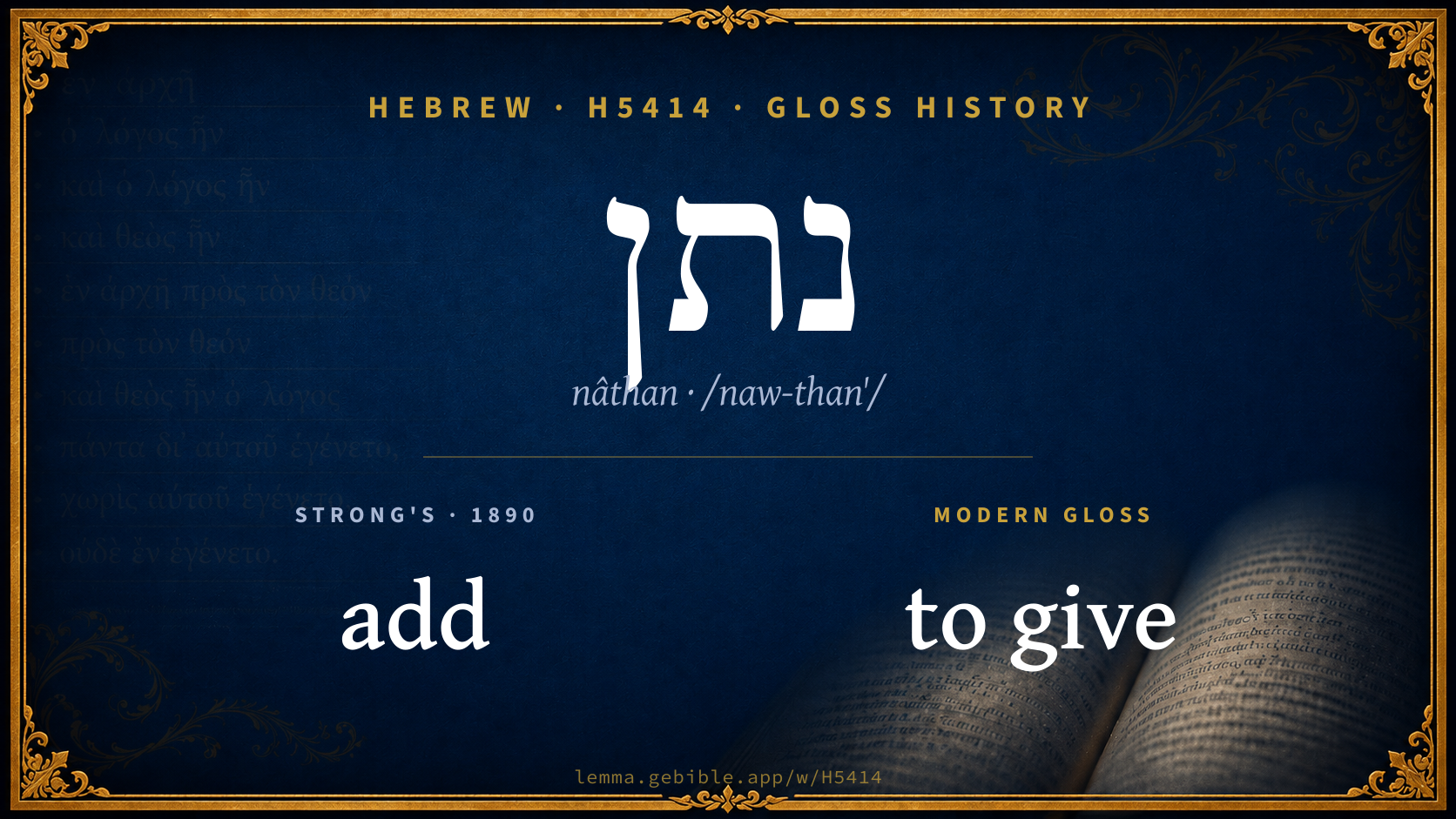
Gloss history
Strong's 1890 vs modern scholarship
About this word
Strong's H5414 catalogs a Hebrew word from the Hebrew Old Testament.
These counts are not copied from any lexicon or concordance. They are computed here, from the morphology-tagged Hebrew Old Testament. What Lemma adds →
- 1,816
- distinct verses
- The word appears in 1,816 distinct verses.
- 38 / 39
- OT books
- The word appears in 38 of 39 Old Testament books.
- #22
- by frequency
- Top 25 most frequent Hebrew words (rank 22 of 8,640 Hebrew words by occurrence).
View all 1,816 occurrences in the concordance →
Most concentrated in
- Ezekiel 189 verses 10%
- Deuteronomy 165 verses 9%
- Jeremiah 137 verses 8%
By section of the Old Testament
By traditional corpus
Conventional, traditional groupings — biblical authorship is debated, so this is a traditional corpus grouping, not an authorship claim. Each share is this word’s portion of its verses in that division of the Hebrew canon. Each figure is a share of the word’s 1,816 distinct verses.
- Prophets (Nevi'im) 803 verses · 44%
- Torah (Pentateuch) 576 verses · 32%
- Writings (Ketuvim) 437 verses · 24%
How translations render this word
Counts come from each version’s own published word-to-Strong’s tagging or interlinear alignment — an approximate guide to how each version renders this word, not a word-level alignment the data otherwise carries. Because each total is that version’s own tagged count, the per-version totals vary from one another and need not match the appearance or distinct-verse counts above. These counts may also differ from a printed concordance because Lemma counts each distinctly tagged rendering and does not collapse phrase taggings into a single head-word total. This is a fixed set of word-tagged versions (KJV, ASV, BSB, ULT) and does not change with the reading translation you choose elsewhere. Each version’s license is shown beside its name below (and on Sources).
- King James Version: Give 166×, Gave 144×, Put 83×
- American Standard Version: Give 144×, Gave 125×, Put 79×
- Berean Standard Bible: Give 115×, Gave 92×, I will give 61×
- unfoldingWord Literal Text: Give 226×, Gave 132×, And 115×
King James Version Public Domain
Renders H5414 across 2,007 tagged occurrences — most commonly:
Plus other, less common renderings. Plus 457 renderings that appear only once — usually multi-word phrases or single function words the recovered tagging swept in, not distinct renderings. Not rendered by a distinct English word in 2 further occurrences.
American Standard Version Public Domain
Renders H5414 across 2,006 tagged occurrences — most commonly:
Plus other, less common renderings. Plus 446 renderings that appear only once — usually multi-word phrases or single function words the recovered tagging swept in, not distinct renderings.
Berean Standard Bible Public Domain
Renders H5414 across 1,958 tagged occurrences — most commonly:
Plus other, less common renderings. Plus 566 renderings that appear only once — usually multi-word phrases or single function words the recovered tagging swept in, not distinct renderings. Not rendered by a distinct English word in 54 further occurrences.
unfoldingWord Literal Text CC BY-SA 4.0
Renders H5414 across 2,279 tagged occurrences — most commonly:
Plus other, less common renderings. Plus 299 renderings that appear only once — usually multi-word phrases or single function words the recovered tagging swept in, not distinct renderings.
60 senses and sub-senses in the full BDB
Hebrew verbs can shift meaning by stem (binyan): Qal is the basic action, Niphal is often passive or reflexive, Piel often intensifies or makes it factitive, and Hiphil is typically causative. The senses below are grouped under the stem BDB assigns to each. This entry also uses Hophal (the passive of Hiphil).
What do BDB’s symbols mean?
BDB uses these scholarly abbreviations:
| Symbol | Meaning |
|---|---|
| 𝔊 | the Septuagint (the ancient Greek translation, LXX) |
| 𝔙 | the Vulgate (the Latin translation) |
| 𝔖 | the Syriac version (the Peshitta) |
| 𝔗 | the Targum (the Aramaic translation) |
| ψ | the Psalms |
| √ | root (the underlying root or stem) |
| ‖ | parallel passage (a synonymous or contrasted parallel) |
| † | the dagger: every passage where the word occurs is cited |
The 60 senses and sub-senses the full Brown-Driver-Briggs lexicon distinguishes for this word, in lexicon order (not ranked by frequency), with BDB’s own verbatim wording and sub-sense lettering. Shown in Hebrew script with BDB’s own scholarly abbreviations. The condensed entry is in the Lexicon Entry tab. See also the Forms in the corpus table below.
Qal
- Pf. נ׳ Gn 24:53 +; 2 ms. נָתַ֫תָּ Ju 15:18 +, נָתַ֫תָּה Gn 3:12 +, תַּתָּה 2 S 22:41 (defended as vulg. form with aphaer. of נ׳ by Th Ges Lgb. 139 Ew§ 195 b Köi. 300 De ψ 18:41 al.; נָתַתָּה (so ‖ ψ 18:41) Ol§ 89 Sta§ 127 b Ges§ 19 i (hesitantly), Klo Bu Löhr HPS, cf. Hup-Now ψ 18:41); 2 fs. נָתַתְּ Ez 16:33, 36, נָתַתְּי v 18, sf. נְתַתִּיהוּ v 19; 1 s. נָתַ֫תִּי Ju 1:2 +, etc.; Impf. יִתֵּן Gn 43:14 +, וַיִּתֵּן 15:10 +; sf. 3 ms. יִתְּנֶ֫נּוּ Lv 5:24 Ec 2:21; 1 s. אֶתֵּן Gn 12:7 +; 1 pl. נִתֵּן 34:21 +, נִתַּן־ Ju 16:5, etc.; Imv. ms. תֵּן 2 K 4:42 +, תֶּן־ Gn 14:21, תְּנָה 1 S 2:15 +, sf. תְּנֵ֫הוּ Ne 1:11 1 Ch 21:22, תְּנֶנָּה 1 S 21:10; fs. תְּנִי Gn 30:14 +, תֵּ֑נִי Is 43:6; mpl. תְּנוּ Gn 34:8 +; Inf. abs. נָתוֹן Dt 15:10 +, נָתֹן Nu 21:2 +; cstr. נְתֹן 20:21, נְתָן־ Gn 38:9, לְתִתֵּן 1 K 6:19 (but read לָתֵת so Ol§ 224 d Ges§ 66 i Benz), תתן also 17:14 Kt (Qr תֵּת)—> these forms retained by Ew§ 238 c Köi. 305;—תֵּת Gn 4:12 +, especially לָתֵת 15:7 +, לָתֵת־ Ju 21:18, לָתֶת־ Ex 5:21 (so Ginsb, van d. H. לָתֵת־, cf. also Ki in Köi. 304 f.) +; sf. תִּתִּי Gn 29:19 +, תִּתְּךָ Dt 15:10 +, etc.; Pt. נֹתֵן Ju 21:18 +, etc.;— e.g. Genesis 24:53
- 1. give:
- a. = give personally, deliver or hand to, c. acc. rei + ל pers. 1 S 10:4; 22:10 2 K 22:10 Lv 5:16 (P) 22:14 (H) Ru 4:7 + often; in trade Pr 31:24; אֶל־ pers. Gn 21:14 (E), Je 3:8 Lv 15:14 + often; explicitly נ׳ בְּיַד Dt 24:1, 3 (bill of divorce); c. acc. rei alone Ju 5:25. e.g. 1 Samuel 10:4
- b. = bestow upon, c. acc. rei + ל pers. Gn 24:53 (J) 20:16 (E) 1:29 (P) + often; an understanding heart 1 K 3:9, 12, blessing Dt 12:15, mercy 13:18, cf. Je 16:13; 42:12; strength Dt 8:18 ψ 68:36; the sabbath Ex 16:29 (J) Ez 20:12; = procure for (לְ) one 1 S 17:10 1 K 21:7; יִתֵּן לָכֶם רַחֲמִים לִפְנֵי Gn 43:14 (J) he will give you compassion in the eyes of the man (cf. also 2 b, 3 b); give persons 46:18, 25 (P); of Levites given to (לְ) Aaron and his sons Nu 3:9 cf. 8:19, to י׳ 8:16 cf. 18:6 (all P); especially of י׳’s giving land to Abr. and his descendants Gn 15:18; 26:4 (J) 17:8 (P) Ex 6:8 (P; + מוֹרָשָׁה) + often (pt. in this sense 37 times Dt.), + לִרִשְׁתָּהּ Dt 3:18 +; אַל־תִּתֵּן לַנָּשִׁים תֵילֶ֑ךָ Pr 31:3; + מִן of source נָתַתִּי מִמֶּנָּה לְךָ בֵּן Gn 17:16 (P); c. acc. alone ψ 61:6 Ec 12:7 (רוּחַ); give something to (ל) one for (ל) sthg., in some capacity, אֶת־כָּל־אֶחָיו נ׳ לוֹ לַעֲבָדִים Gn 27:37 +; prob. also נ׳ בְּבָרוּתִי רֹאשׁ ψ 69:22 they gave, as my food, gall (בְּ essentiae), cf. supr. בְּ 7 c, Hup-Nowad loc.; acc. + inf. נ׳־לִי לֶחֶם לֶאֱכֹל וּבֶגֶד לִלְבּשׁ Gn 28:20 (J), cf. Ex 16:15 (P), Ne 9:15, 20; לֹא נ׳ לָכֶם לֵב לָדַעַת וְעֵינַיִם לִרְאוֹת וְאָזְנַיִם לִשְׁמֹעַ Dt 29:3. e.g. Genesis 24:53
- c. give woman to (ל) man as (ל) wife, Gn 29:28 (E), 34:8, 12 (J), Jos 15:16, 17 (JE), = Ju 1:12, 13 +; without 2nd ל Gn 29:19(×2) (E), Gn 38:26 Ex 2:21 (J), Gn 34:9, 14, 16 (P), Ju 15:2, 6 +; c. acc. alone, Gn 29:26 (E), 1 S 25:44. e.g. Genesis 29:28
- d. of (gracious) bestowals of various kinds: give = grant, send rain, גִּשְׁמֵיכֶם Lv 26:4 (H), מְטַר־אַרְצְכֶם Dt 11:14, מָטָר עַל־אַרְצְךָ 1 K 8:36, etc.; also of sending plague of hail Ex 9:23 (E); send herbage (עֵשֶׂב) in (בְּ) your field for (לְ) your cattle Dt 11:15; grant a remnant to (לְ) Judah Je 40:11; וְנָתַתִּי לְךָ אֶת־נַפְשְׁךָ לְשָׁלָל 45:5 and I will grant thee thy life as spoil; grant revenge (acc.) to (לְ) the king on (מִן) Saul, etc. 2 S 4:8, cf. הָאֵל הַגֹּתֵן נְקָמוֹת לִי 2 S 22:48 = ψ 18:48; other gifts Ju 15:18 (בְּיַד), 1 S 1:11 (לְ), Ru 4:13. e.g. Leviticus 26:4
- e. grant a request, שְׁאֵלָה 1 S 1:17, 27 Est 5:3 ψ 106:15 (+ ל pers.), בַּקָּשָׁה Ezr 7:6, תַּאֲוָה Pr 10:24, (רָשָׁע) מַאֲוַיֵּי ψ 140:9, תִּקְוָה Jb 6:8, מִשְׁאֲלֹת לִבֶּ֑ךָ ψ 37:4, cf. יִתֵּן י׳ לָכֶם וּמְצֶאןָ מְנוּחָה Ru 1:9. e.g. 1 Samuel 1:17
- f. מִי יִתֵּן who will give or grant, in expressions of wish = O that (I had! etc.; = Assyrian mannu inamdin JägerBAS ii. 279), especially (9 times) Jb.: c. acc. מִי־יִתֵּן עֶרֶב Dt 28:67 cf. v 67, Jb 14:4 ψ 14:7 = 53:7, 55:7 Je 9:1; c. 2 acc. כָּל־עַם י׳ נְבִיאִים Nu 11:29 (JE), lit. who will make all י׳’s people prophets? cf. Je 8:23; c. acc. + כְּ, מִי יִתֶּנְךָ כְאָח לִי Ct 8:1, cf. Jb 29:2; c. acc. + בְּ, אֶת־הָעָם הַזֶּה בְּיָדִי Ju 9:29 O that this people were in my charge! c. acc. + לְ Jb 31:35, lit. who will give to me (לִי) one hearing me? also מִי יִתְּנֵנִי Is 27:4 where sf. appar. = לִי; c. inf. מִי יִתֵּן מוּתֵנוּ Ex 16:3 (P), so 2 S 19:1, מִי יִתֵּן אֱלוֹהַּ דַּבֵּר Jb 11:5; c. impf. תָּבוֹא שֶׁאֱלָתִי Jb 6:8 O that my request might come to pass! 14:13; 31:31; impf. + וְ 19:23(×2); c. pf. יָדַעְתִּי 23:3 O that I knew! (+ וְאֶמְצָאֵהוּ); c. pf. consec. Dt 5:26†. e.g. Deuteronomy 28:67
- g. permit, c. acc. + inf., לֹא־נְתַתִּיךָ לִנְגֹּעַ אֵלֶיהָ Gn 20:6 (E), cf. 31:7 (E) Ex 3:19 (J) Nu 20:21; 21:23 (JE) + often; om. לְ Jb 9:18; c. ל pers. + inf. 2 Ch 20:10, also לֹא כֵן נ׳ לְךָ י׳ Dt 18:14 not thus hath י׳ permitted to thee; אִם־אֶתֵּן שְׁנָת לְעֵינָ֑י וגו׳ ψ 132:4 Pr 6:4; give thyself (לְ) no rest La 2:18, give him (לְ) no rest Is 62:6. e.g. Genesis 20:6
- h. = ascribe glory, etc. (acc.) to (לְ) God 1 S 6:5 Jb 36:3, especially imv. Je 13:16 Ezr 10:11 ψ 68:35 cf. 115:1 (so הָבוּ, v. יהב 4); to man 1 S 18:8(×2); unseemliness (תִּפְלָה) to God Jb 1:22. e.g. 1 Samuel 6:5
- i. = apply, devote heart to seek out, acc. + inf. Ec 1:13, 17; 8:9, 16 Dn 10:12, נ׳ לֵב לְ Ec 7:21 = attend to; conversely אֶת־כָּל־זֶה נָתַתִּי אֶל־לִבִּי Ec 9:1 = all this I set before my mind, 7:2; also (with subj. diff. from ind. obj.) מָה אֱלֹהַי נֹתֵן אֶל־לִבִּי לַעֲשׂוֹת Ne 2:12 cf. 7:5. e.g. Ecclesiastes 1:13
- j. = employ, devote money (acc.) עַל־עֲבֹדַת אֹהֶל מוֹעֵד Ex 30:16 (P). e.g. Exodus 30:16
- k. give offerings, לְי׳ Nu 18:12 (P), תְּרוּמַת י׳ Ex 30:15 (P), cf. give spoil to (לְ) י׳ Dt 20:14 (י׳ subj.); מִיָּֽדְךָ נָתַנּוּ לָ֑ךְ 1 Ch 29:14; offering to (לְ) idols Ez 6:13; especially to Moloch Lv 20:2, 4, to pass through fire to (ל) M 18:21, etc. e.g. Numbers 18:12
- l. = consecrate, dedicate to (לְ) י׳ 1 S 1:11 Ex 22:29 (E). e.g. 1 Samuel 1:11
- m. give a sign or wonder, acc. 1 K 13:3, 5, + לְ pers. Jos 2:12 (JE), with reflex. לְ Ex 7:9 (P), alm. = display, exhibit; cf. נָֽתְנוּ הֲדָרֵךְ Ez 27:10 they set forth, exhibit thy splendour; כִּי יִתֵּן בַּכּוֹס עֵינוֹ Pr 23:31 when it sheweth its sparkle in the cup. e.g. 1 Kings 13:3
- n. = pay, wages (acc., + sf.), נ׳ שְׂכָרִי Gn 30:18 (E) he hath paid my hire, Ex 2:9 (E) Dt 24:15, cf. Is 61:8; + ל pers. Je 22:13; a price, נ׳ מִכְרָם Nu 20:19 (JE), וַיִּתֵּן שְׂכָרָהּ Jon 1:3, i.e. paid his fare, passage-money; money (as) price (מחיר) 1 K 21:2, cf. נ׳ כֶּסֶף הַשָּׂדֶה Gn 23:13 (P); pay money for (ב) something Dt 14:26; wealth for (ב) love Ct 8:7; tax or rent, c. acc. rei + ל pers. Gn 47:24 (J); fine (c. id.) Ex 21:32 (E) Dt 22:29, acc. om. v 19, cf. וְנָתַן בִּפְלִלִים Ex 21:22 (v פָּלִיל), נ׳ שִׁבְתּוֹ v 19 (i.e. pay for his lost time), נ׳פִּדְיוֹן נַפְשׁוֹ v 30 (pay redemption-money; all E), cf. וְנ׳ אִישׁ כֹּפֶר נַפְשׁוֹ לְי׳ 30:12 (P); pay votive offering (c. acc. + ל) Lv 27:23 (P); a wager (c. acc. + ל) Ju 14:12, 13. e.g. Genesis 30:18
- o. c. בְּ, give for (ב) money = sell, תְּנָה־לִּי אֶת־כַּרְמְךָ בְּכֶסֶף 1 K 21:6, cf. Dt 2:28; 14:25 1 Ch 21:22;—נ׳ Ez 27 is trading term, but sometimes connexion obscure and text dub.: give wares for (בְ) 27:12 (but read prob. ך for ב 𝔊 𝔖 Co Berthol), v 13, 16 (del. 2nd ב), v 17, 19, 22 (cf., further, Co Berthol and especially Sm); נ׳ הַיֶּלֶד בַּוּוֹנָה Jo 4:3 (‖ מָכַר); ב instr., give בַּגּוֹרָל by lot Jos 21:8. e.g. 1 Kings 21:6
- p. give instead of, exchange for, c. תַּחַת Ex 21:23 (E) 1 K 21:2, 6 Is 43:4; 61:3, בְּעַד Jb 2:4. e.g. Exodus 21:23
- q. give, i.e. lend, at interest, כַּסְפּוֹ לֹא נ׳ בְּנֶשֶׁךְ Lv 25:37 ψ 15:5, so (acc. om.) Ez 18:8, 13. e.g. Leviticus 25:37
- r. = commit, entrust to, c. acc. + אֶל־ pers. Ex 22:6, 9 (E), c. ל pers. Ct 8:11, c. בְּיַד Gn 30:35; 39:4, 8, 22 (all J), 2 S 10:10. e.g. Exodus 22:6
- s. give over, deliver up, c. acc. Nu 21:3 (JE) Ju 20:13 1 S 11:12 2 S 14:7; 20:21 1 K 14:16 Ho 11:8 (‖ מִגֵּן), Mi 5:2; נ׳ בָּנָיו פְּלֵיטִים וּבְנֹתָיו בַּשְּׁבִית לְמֶלֶךְ אֱמֹרִי Nu 21:29 (JE); + ל, נ׳ פ׳ לַמָּוֶת ψ 118:18; + לִפְנֵי Dt 7:2, 23; 31:5 + (see Dr Dt. lxxxiii, No. 52, and v. further 2 b ad fin.); especially נ׳ בְּיַד, c. acc., Nu 21:34 (JE) Jos 2:24 (JE) Dt 2:24 + often e.g. Numbers 21:3
- t. yield produce, fruit, etc., especially of land, ground, Gn 4:12 (J), Lv 25:19; 26:4, 20 (all H), Dt 11:17 Is 55:10 (+ ל pers.) Zc 8:12 ψ 67:7; 85:13 cf. Ez 36:8; of tree Ez 34:27 Lv 26:4, 20 (H) ψ 1:3, + vine Jo 2:22, vine Zc 8:12; abs. root of righteous yields, יִתֵּן Pr 12:12 according to De Str (dub.; proposes to insert פְּרִי); Dy Kau Wild proposes אֵיתָן (as ψ 74:15, etc.), cf. as to sense Ew; other conj. v. Now; cf. Nu 20:8 (P) Zc 8:12 Ct 1:12; 2:13; 7:14. e.g. Genesis 4:12
- u. = occasion, produce, שֵׂכֶל טוֹב יִתֶּן־חֵ֑ן Pr 13:15 cf. 29:15, חֶרְדַּת אָדָם יִתֵּן מוֹקֵשׁ v 25 trembling before man occasioneth a snare. e.g. Proverbs 13:15
- v. requite to (לְ) a man, according to (כְּ) character 1 K 8:39 = 2 Ch 6:30 Je 17:10; 32:19 ψ 28:4(×2) c. עַל־ + כְּ Ez 7:9; c. עַל־ pers. + acc. of sin 7:3, 4, 8; 23:49 (cf. 2 b). e.g. 1 Kings 8:39
- w. = report, mention, וַיִּתֵּן אֶת־מִסְפַּר … אֶל־הַמֶּלֶךְ 2 S 24:9 he reported the number unto the king; וָאֶתְּנָה לוֹ זְמָ֑ן Ne 2:6 and I mentioned to him a time. e.g. 2 Samuel 24:9
- x. = utter, usually c. acc. קוֹל, utter a sound, lift up the voice: Je 4:16 (+ עַל against), 22:20; 48:34 La 2:7; in weeping, וַיִּתֵּן אֶת־קֹלוֹ בִּבְבִי Gn 45:2 (E), וַיִּבְכּוּ Nu 14:1 (P); + ל pers. Pr 2:3 (‖ לַבִּינָה תִּקְרָא); of wisdom Pr 1:20; 8:1 (‖ קרא); of י׳, especially in thunder of theoph. Am 1:2 2 S 22:14 (‖ יַרְעֵם), = ψ 18:14, Je 25:30 Jo 2:11; of clouds ψ 77:18, the deep Hb 3:10; of young lion’s roaring Am 3:4 Je 2:15; of birds ψ 104:12; קוֹל om., נ׳ דָּוִד … לְהֹדֹת לְי׳ 1 Ch 16:7; so of י׳’s voice in thunder, לְקוֹל תִּתּוֹ Je 10:13 (sc. קוֹלוֹ) at the sound of his uttering (his voice) = 51:16; נ׳ בְּקוֹל Je 12:8 (+ עַל־ against), of י׳ ψ 46:7, הֵן־יִתֵּן בְּקוֹלוֹ קוֹל עֹז 68:34; נ׳ with other words, אֹמֶר v 12 (of י׳); of confession, (acc. + ל pers.) Jos 7:19 (JE) Ezr 10:11. e.g. Jeremiah 4:16
- y. give = stretch out, extend, וַיִּתֶּן־יָד Gn 38:28 (J) it put out a hand; וַיִּתֵּן צַמַּרְתּוֹ אֶל־בֵּין עֲבוֹתִים (read עָבוֹת) Ez 31:10, 14 and it stretched its top amid the clouds. e.g. Genesis 38:28
- z. combinations are: יִתֵּן לְמַכֵּהוּ לֶחִ֑י La 3:30 (humiliation), cf. Is 50:6; וַיִּתְּנוּ כָתֵף סֹרָ֑רֶת Zc 7:11 (of stubbornness), so Ne 9:29 (‖ עָרְפָּם הִקְשׁוּ); also וַיִּתְּנוּ עֹרֶף 2 Ch 29:6 gave, i.e. turned (their) back (on י׳; ‖ וַיַּסֵּבּוּ פְנֵיהֶם מִמִּשְׁכַּן י׳); of compact, תְּנָה אֶת־יָדֶ֑ךָ 2 K 10:15 cf. v 15, so מִצְרַיִם נָתַנּוּ יָד La 5:6; of submission, נָֽתְנָה יָדָהּ Je 50:15 = she (Babyl.) hath surrendered; תְּנוּ יָד לְי׳ 2 Ch 30:8 = submit to י׳; more explicitly, נ׳ יָד תַּחַת שְׁלֹמֹה 1 Ch 29:24; נ׳ מָקוֹם לְ Ju 20:36 give place to (retire before); of sexual relation, אֶל־אֵשֶׁת … לֹא־תִתֵּן שְׁכָבְתְּךָ לְזָ֑רַע Lv 18:20 (H), וַיִּתֵּן אִישׁ בָּךְ אֶת־שְׁכָבְתּוֹ Nu 5:20 (P), so (בְּכָל־בְּהֵמָה) Lv 18:23 (H), cf. 20:15 (H).—יִתֵּן is taken impers. = ‘es giebt,’ there is, there are, in Jb 37:10 Pr 10:24; 13:10 by De, citing Ew§ 295 d, Now Pr 13:10 Str Frankenb (in transl., dub. in note), BaeJb in Kau; but improbable Kau Pr Di Jb, so Hi Bu Du (on Jb 37:10), reading יֻתַּן; cf. KöSynt. § 324 d β. e.g. Lamentations 3:30
- 2. Put, set, nearly = שִׂים, and sometimes ‖ with it:
- a. lit., (especially often in Ez P); c. acc. + עַל־ on, ring on hand Gn 41:42 (E), cf. Ez 16:11, helmet on head 1 S 17:38, also Je 27:2; 28:14 (in fig.), 1 K 12:4, 9 (in fig.), 18:23 (‖ שִׂים), Ex 12:7 (acc. om.), cf. 25:12, 26, 30 + often P; c. עַל־ = above Ex 25:21; 26:34 (P), = for, נ׳ גֹּרָלֹת עַל־ Lv 16:8 (P), cast lots for; = against Ez 26:8; c. אֶל־ into: ark into cart 1 S 6:8, put one in the stocks Je 29:26 (also c. עַל־ 20:2), in prison 37:18; 38:11, cf. Ex 25:16; 28:30 (P); put water upon (עַל־) sthg. into (אֶל־) vessel Nu 19:17; = toward וַיִּתֵּן פְּנֵי הַצֹּאן אֶל־עָקֹד Gn 30:40 (J; del. Ol Di al.); c. בְּ, cup into hand Gn 40:13 (E), cf. Ju 7:16, also Gn 41:48 (E), cf. 1 K 7:51, Gn 1:17 (P), 9:13 (P), 2 K 19:18, Je 27:8, נ׳ בֶּעָפָר פֶּה La 3:29 (in fig.), נָתַתִּי שִׁפְחָתִי בְּחֵיקֶ֑ךָ Gn 16:5 (J), וְנָתַתָּה בְאָזְנוֹ וּבַדֶּלֶת Dt 15:17 and thou shalt put (the awl) into his ear and into the door (pin his ear to the door); put disease into one Dt 7:15 (‖ שִׂים); inflict blemish (מוּם) on (בְּ), Lv 24:19, 20; וּכְתֹבֶת קַעֲקַע לֹא תִתְּנוּ בָּכֶם 19:28; c. בְּ + לְ, שֶׂרֶט לָנֶפֶשׁ לֹא תִתְּנוּ בִּבְשַׂרְכֶם v 28 (all H); c. לִפְנֵי before, in front of, set food before one, 2 K 4:43, 44; cf. Zc 3:9 Ez 3:20 Ex 30:6; 40:5, 6 (all P); c. בֵּין between, Ex 30:18; 40:17 (P); c. לְ, מִגְרָעוֹת נ׳ לַבַּיִת סָבִיב 1 K 6:6 he put ledges to the house; c. other preps. הָאִשָּׁה אֲשֶׁר נָתַתָּ עִמָּדִי Gn 3:16 (J), the woman whom thou hast set at my side, cf. Ex 31:6 (נ׳ אִתּוֹ; fig. of association, assistance); c. לִקְרַאת Gn 15:10 (J), lay each piece to meet its fellow; he set the sea מִכֶּתֶף הַבַּיִת 1 K 7:39; c. ה loc. put money שָׁמָּה into it 2 K 12:10, so of water Ex 30:18 (P), cf. 40:7 (שָׁם); c. 2 acc. נ׳ אוֹתוֹ בֵּית הַכְּלוּא Je 37:4 cf. v 15; put, place, abs. Ex 40:8 (P; ‖ שִׂים, cf. 26:32); set up, אֶבֶן מַשְׂכִּית בְּ Lv 26:1 (H; ‖ הֵקִים); + לְ pers., lay snare for me ψ 119:110 (in fig.). e.g. Genesis 41:42
- b. fig., in many phr.: c. עַל, put my spirit upon him Is 42:1, reproach upon one Je 23:40, blessing on Mt. Gerizim, etc., Dt 11:29, curses on enemies 30:7; impose tax upon Ne 10:33 cf. 2 K 23:33; נָתַן הוֹד עַל put majesty upon one 1 Ch 29:25 Dn 11:21 Nu 27:20 (P; מֵהוֹד; cf. ψ 21:6); so also perhaps ψ 8:2 hast set thy majesty upon (over) the heavens, cf. 𝔖 𝔙 𝔗 (read נָתַתָּה for תְּנָה, Hup De Pe Bae al.; other views v. in Thes Ew Ol Now Che We Du); = above, וּנְתָֽנְךָ עֶלְיוֹן עַל־כָּל־גּוֹיֵי הָאָרֶץ Dt 28:1 cf. 26:19; put (sthg.) over mouth Mi 3:5 (i.e. stop one’s mouth, by a gift); = against נ׳ מָצוֹר עַל־ Ez 4:2 (siege), cf. v 2b; c. אֶל־, וָאֶתְּנָה אֶת־פָּנַי אֶל־אֲדֹנָי … לְבַקֵּשׁ Dn 9:3; c. בְּ, words into mouth Dt 18:18 Je 1:9, cf. 1 K 22:23; wisdom into heart, or person, 1 K 10:24 Ex 31:6; 36:1, 2 (all P), cf. ψ 4:8; set peace in earth Lv 26:6 (H); (the idea of) perpetuity (עוֹלָם) in heart Ec 3:11; a purpose, וּלהוֹרֹת נ׳ בְּלִבּוֹ Ex 35:34 (P); וְנָתַתִּי אֶת־יָדִי בְּמִצְרַיִם Ex 7:4 (P); אַל־תִּתֵּן דָּם נָקִי בְּקֶרֶב עַמְּךָ Dt 21:8; וַיִּתֵּן חִנּוֹ בְּעֵינֵי Gn 39:21 (J), and he put his favour in the eyes of the prison-keeper (made the keeper favourable to him), cf. Ex 3:21; 11:3; 12:36 (all E; cf. also 1 b, 3 b); c. בְּ pers. = against, in phr. set my face against, oppose Ez 14:8; 15:7 Lv 17:10; 20:6 (both H); c. בֵּין, = put, i.e. make a covenant between Gn 17:2 (P), cf. Lv 26:46 (H); נ׳ אֶרֶץ לִפְנֵיכֶם i.e. place at your disposal Dt 1:8, 21 cf. 2:36; set ordinances, etc., before, לִפְנֵי (for observance), 1 K 9:6 Je 26:4; 44:10 Dn 9:10; blessings and cursings (for choice) Dt 30:1, 15, 19; נ׳ דֶּרֶךְ בְּרֹאשׁ פ׳ set or place one’s way upon his head, i.e. requite him, Ez 9:10; 11:21; 16:43; 22:31 cf. 17:19, also 1 K 8:32 = 2 Ch 6:23 + (cf. 1 v); לָתֵת נִקְמַת י׳ בְּמִדְיָן Nu 31:3 to set the vengeance of י׳ upon Midian; נ׳ ב׳ ψ 50:20 = set in, i.e. impute to (usually שִׂים ב׳). e.g. Isaiah 42:1
- c. set, appoint, c. acc. + עַל־ over, י׳ hath set a king over you 1 S 12:13 cf. Gn 41:41 (E); c. עַל־ on, נ׳ ישֵׁב עַל־כִּסְאִי 1 K 1:48; c. בְּ in = over, 1 Ch 12:9 Ne 13:4; c. לְ, Nethînîm לַעֲבֹדָה Ezr 8:20; c. acc. alone, idol-priests 2 K 23:5, prophet Je 1:5 (2 acc.), leader Nu 14:4; one instead of (תַּחַת) another 1 K 2:35. e.g. 1 Samuel 12:13
- d. = assign, designate, c. לְ: God hath assigned victim-flesh to (ל) you, in order to bear sins of people Lv 10:17, cf. Nu 18:8 (both P); cities for (ל) flight of man-slayer Nu 35:6 (P); נָתַתִּי לָכֶם עַל־הַמִּזְבֵּחַ לְכַפֵּר Lv 17:11 (H). e.g. Leviticus 10:17
- 3. Make, constitute,
- a. c. 2 acc., וְנָתַתִּי נְעָרִים שָׂרֵיהֶם Is 3:4 and I will make boys their princes, cf. Gn 17:5; Ex 7:1 (both P), ψ 18:33 (> וַיַּתֵּר in ‖ 2 S 22:33), 39:6; 69:12; 135:12, etc.; + בֵּין Jos 22:25 (P); + אֶל־ pers. וְנָתַתִּי אֶת־כָּל־אֹיְבֶיךָ אֵלֶיךָ עֹרֶף Ex 23:27 (E), and I will make all thine enemies unto thee a back, i.e. make them shew thee their back, flee from thee, so c. לְ ψ 18:41 = 2 S 22:41. e.g. Isaiah 3:4
- b. c. acc. + לְ, וְנָתַתִּי אֶת־יְרוּשָׁלַיִם לְגַלִּים Je 9:10 and I will make Jerusalem into ruin-heaps, cf. Dt 28:13; Is 42:24; Gn 17:6, 20; 48:4; Nu 5:21; Jos 17:3 (all P) +; נ׳ פ׳ לְרַחֲמִים לִפְנֵי 1 K 8:50 make persons an object of compassion before (in the eyes of), so Ne 1:11 ψ 106:46 Dn 1:9 (cf. also 1 b, 2 b); + לְ pers. for (especially Je.), וּנְתַתִּים לִזְוָעָה לְכֹל מַמְלְכוֹת הָאָרֶץ Je 15:4 and I will make them a terror for all kingdoms of the earth, cf. 24:9; 29:18; 34:17. e.g. Jeremiah 9:10
- c. c. acc. + כְּ, וְאֵת הָאֲדָזִים נ׳ כַּשִּׁקְמִים 1 K 10:27 and the cedars he made like the sycomores, i.e. as common, = 2 Ch 1:15, cf. 1 K 16:3 Ez 28:6 Lv 26:19 (H), Ru 4:11; וַיִּתֵּן אֹתָנוּ כִּמְרַגְּלִים Gn 42:30 (E), i.e. regarded, treated us as spies, but ins. בַּמִּשְׁמָר 𝔊 Ol Di Ball Holz,—אַל־תִּתֵּן אֶת־אֲמָֽתְךָ לִפְנֵי בַת בְּלִיַּעַל 1 S 1:16 difficult, (notwithstanding Jb 3:24; 4:19), read prob. כְּ (HPS), or לְ, for לִפְנֵי. e.g. 1 Kings 10:27
- d. rarely c. acc. alone: וּמִבְּנֵי יִשׂ׳ לֹא נ׳ שְׁלֹמֹה עֶבֶד 1 K 9:22 and of the sons of Israel Sol. made no slave, but read prob. לְמַם עֹבֵד (as v 21; 𝔊 A εἰς πράγμα om. B 𝔊L; cf. Klo Benz), וָאֶתֵּן עֲלֵיהֶם קְהִלָּה Ne 5:7 and I made (held) over their case a great assembly; make a decree, חֹק, ψ 148:6; perhaps also וַתִּתֵּן אֹתֹת בְּפַרְעֹה Ne 9:10 and thou didst perform signs and wonders against Pharaoh, etc. (cf. שִׂים אוֹתֹת בְּ Ex 10:2 ψ 78:43). e.g. 1 Kings 9:22
Niphal
- Pf. נִתַּן Is 9:5 +; 3 fs. נִתְּנָה Gn 38:14 +; 2 mpl. וְנִתַּתֶּם consec. Lv 26:25; 1 pl. נִתַּ֫נּוּ Ezr 9:7; Impf. יִנָּתֵן Ex 5:18 +, יִנָּ֫תֶן לוֹ 2 Ch 2:13 (Gi v. d. H. יִנָּ֫תֶן־לוֹ); Ptcp. נִתָּן 2 K 22:7; Inf. abs. הִנָּתֹן Je 32:4; 38:3; cstr. לְהִנָּתֵן Est 3:14; 8:13;— e.g. Isaiah 9:5
- 1. be given to (usually c. ל pers.):
- a. = bestowed upon Jos 24:33 (E), Ez 11:15 (+ לְמוֹרָשָׁה), 33:24 (+ id.), Jb 15:19; Ez 16:34; Nu 26:62 (P), Is 9:5, portion from sacrifice Lv 10:14 (P), glory Is 35:2, birthright 1 Ch 5:1, freedom Lv 19:20 (H). e.g. Joshua 24:33
- b. given to one (ל) for wife (ל) Gn 38:14 (J), 1 S 18:19. e.g. Genesis 38:14
- c. provided, usually c. ל Ex 5:16, 18 (J); 1 S 25:27; 2 K 25:30 = Je 52:34, Is 33:16; Ne 13:10; נ׳ מֵרֹעֶה אֶחָד Ec 12:11 they are given from one shepherd (i.e. words of wise) according to Ew De Hi-Now RüetschiKau; Wild underst. subj. of compilers. e.g. Exodus 5:16
- d. = entrusted to Je 13:20 cf. 2 Ch 2:13; c. עַל־יָדָם 2 K 22:7, בְּיַד 2 Ch 34:16. e.g. Jeremiah 13:20
- e. = be given into the power of (usually c. בְּיַד), especially of city (kg., people) given into the hand of foe 2 K 18:30 (+ אֶת־ acc.), 19:10 = Is 36:15; 37:10; Je 21:10 + 18 times Je Lv Chr Dn; earth into hand of wicked Jb 9:24; in good sense Gn 9:2 (P); delivered to death (ל), unto lower world (אֶל־), Ez 31:14; given to us (ל) for devouring (ל) 35:12; חֶרֶב נ׳ Ez 32:20 delivered to the sword (del. 𝔊 𝔖 Co SgfrKau Toy); abs., of צָבָא, Dn 8:12 (al. was appointed, v. especially Dr), 11:6. e.g. 2 Kings 18:30
- f. of request, be granted to (ל), Est 2:13; 5:3 (בַּקָּשָׁה), v 6; 7:2; 9:12 (all שְׁאֵלָה), cf. 7:3 (בִּשְׁאֵלָה, בְּבַקָּשָׁה). e.g. Esther 2:13
- g. = be permitted Est 9:13 (+ inf.). e.g. Esther 9:13
- h. = be issued, published (of royal decree), abs. Est 3:5, 14; 4:8; 8:13, 14; 9:14; of law given בְּיַד מֹשֶׁה Ne 10:30. e.g. Esther 3:5
- i. = be uttered, נ׳ שְׁאוֹן קוֹלָם Je 51:55 (of stormers of Babylon). e.g. Jeremiah 51:55
- j. be assigned for (ל), Ez 47:11. e.g. Ezekiel 47:11
- 2. Be put, set:
- a. lit., crown בְּרֹאשׁ Est 6:8; of personif. folly נ׳ הַסֶּכֶל בַּמְּרוֹמִים Ec 10:6. e.g. Esther 6:8
- b. in imagery of Ezek. נ׳ … בְּיַרְכְּתֵי־בוֹר Ez 32:23, c. אֵת (with) v 29, c. בְּתוֹךְ v 25, vine put (cast) לָאֵשׁ לְאָכְלָה Ez 15:4 into the fire for consuming; fig. of terror נ׳ בארץ 32:25. e.g. Ezekiel 32:23
- c. = be made, בֶּן־אָדָם חָצִיר יִנָּתֵן Is 51:12. e.g. Isaiah 51:12
- d. = be inflicted, of blemish (מוּם) Lv 24:20 (c. בְּ pers.). e.g. Leviticus 24:20
Hophal
- (or Qal pass. Ges§ 53 u) Impf. יֻתַּן 1 K 2:21 + 5 times + 2 S 21:6 Qr (Kt ינתן); וַיֻּתַּן 2 S 18:9;— e.g. 1 Kings 2:21
- 1.
- a. be given, bestowed, abs. Nu 26:54; c. לְ pers. 2 K 5:17; Nu 32:5 (אֶת־ c. acc.; both P); in exchange for (תַּחַת) Jb 28:15. e.g. Numbers 26:54
- b. = be given to one (ל) for wife (ל) 1 K 2:21 (Abishag, אֶת־ c. acc.). e.g. 1 Kings 2:21
- c. = be given, delivered, up to (ל) 2 S 21:6. e.g. 2 Samuel 21:6
- 2. be put upon (עַלִ־) Lv 11:38 (P); of Absalom וַיֻּתַּן בֵּין הַשָּׁמַיִם וגו׳ 2 S 18:9, וַיִּתָּל (√ תלה) 𝔊 𝔖 We Dr (?), Klo Kit Bu HPS. e.g. Leviticus 11:38
Senses from the full Brown-Driver-Briggs lexicon (Brown, Driver, Briggs; Oxford 1906 — public domain), digitized via Sefaria, supplemented by the OpenScriptures HebrewLexicon (CC BY 4.0). Full attribution on Sources.
Word origin
vb. give, put, set (Ecclus נתן 44:19 + often; OHeb נתן־יהו n.pr.m. Lzb 327; NH = BH; Ph. יתן, נתן in n.pr. מתנת, etc., Lzb 292, 327; Assyrian nadânu DlHWB 450 (rarely ittan Id ib. 488); Zinj. נתן, also in n.pr., Lzb 327 Cook 84; Nab. Impf. ינתן, and n.pr.; Palm., also n.pr. Lzb l.c. Cook l.c.; 𝔗 Impf. יִתֵּן, Inf. מִתַּן; Sab. נתן Hal 154, Liḥ n.pr. נתנבעל [North-&Sem. form] DHMEpigr. Denkm. 80, No. 35; Chr Pal. Aramaic ܢܬܢ (rare) SchwallyIdiot. 58; Syriac Impf. ܢܶܬܶܠ, Inf. ܡܶܬܰܠ LindbergVergl. Sem. Gram. 93 f., but Mand. נתן NöM 52);—
— Brown-Driver-Briggs (Oxford 1906, public domain), digitized via Sefaria, supplemented by the OpenScriptures HebrewLexicon (CC BY 4.0). See Sources.
Origin: a primitive root
Jastrow Dictionary
A second Hebrew/Aramaic lexicon for comparison, covering Aramaic and post-biblical (Talmudic, Targumic, Midrashic) usage that the biblical-Hebrew BDB does not. Matched by lemma rather than by Strong’s number, so a lemma may carry more than one Jastrow headword (shown separately below), and the entries cover usage well beyond the Bible.
נָתָן
- (b. h.) pr. n. m. Nathan,
- 1. the prophet. Koh. R. to IV, 12. Midr. Till. to Ps. LI; a. fr.—2) N. the Babylonian, a Tannai. Ber. IX, 5. Tosef. Yeb. VIII, 4. B. Bath. 73ᵃ; a. fr.—3) name of several Amoraim. Y. Erub. VI, 23ᶜ bot., v. דְּרוֹמָאָה; a. e.—Y. M. Kat. III, 82ᵃ נ׳ בר אבא.—Y. Ter. VII, 44ᶜ נ׳ בר הושעיה.—Y. Ber. IV, 7ᵇ נ׳ בר טובי; a. fr.—4) N. d’Tsutsitha, a penitent. Sabb. 56ᵇ.—אבות דר׳ נ׳, v. אָב II.
נָתַן
- (b. h.) to give; to place, put. Gitt. I, 6 תֵּן גט וכ׳ give this letter of divorce to my wife. Ib. תְּנוּ גט וכ׳ give ye &c. Ib. לא יִתְּנוּ לאחר מיתה they must not deliver it after the man’s death; a. v. fr.—נשא ונ׳, v. נָשָׂא.—נ׳ עיניו ל (to put an eye upon) to intend. B. Mets. 19ᵃ, a. e. כיון שנ׳ ע׳ לגרשה as soon as he has resolved to divorce her; a. fr.—נ׳ עיניו ב (to have an eye on) to desire, think of. Ned. XI, 12 שלא תהא אשה נוֹתֶנֶת עיניה באחר lest the woman have a liking for another man. Ib. 20ᵇ שלא אֶתֵּן עיני וכ׳ lest I think of another woman. Ib. אל ישתה … ויִתֵּן וכ׳ one must not drink of one cup (have connection with one woman) and think of another; a. fr.—Esp. נ׳ עיניו בו to cast an angry eye at, to hurt by an angry look. Ber. 58ᵃ נ׳ ע׳ בו ונעשה וכ׳ he cast an eye at him and he was changed into &c., v. גַּל; Sabb. 34ᵃ; a. e.—Y. Ber. III, beg. 5ᵈ, a. fr. נוֹתן תפלין puts on T’fillin.—נ׳ טעם, v. טַעַם.—הדין נותן the conclusion ad majus gives it, it is a legitimate conclusion. Bekh. 59ᵇ, a. fr. Ib. היא הנוֹתֶנֶת (on the contrary,) it is thus we should argue.—Gen. R. s. 33 והדין נותן and it stands to reason.—Esp. נ׳ (sub. דם) to put blood on the altar, sprinkle, smear. Zeb. VIII, 4; a. fr.—[Tosef. Neg. VI, 10 נותן, v. נָתַץ.]
- to be given, put &c.; to be intended. Ned. 38ᵃ לא נִיתְּנָה תורה אלא וכ׳ the Law was given only to Moses and his descendants. Ib. וכולן נִתְּנוּ וכ׳ and all those (gates of understanding) were granted to Moses; a. fr.—Keth. 81ᵃ לא ניתנה כתובה וכ׳ the K’thubah is not intended to be collected during life-time. R. Hash. 28ᵃ מצות … נִיתְּנוּ, v. הָנָה; a. fr.—[Tosef. Ab. Zar. V (VI), 8 עד שינתן, v. נָתַץ.]—Esp. to be put on the altar, sprinkled, smeared. Zeb. VIII, 9 הנִתָּנִין למטה … בנתנין למעלה blood which must be put below (the red line) which has been mixed with blood that must be put above. Ib. 10 יִנָּתְנוּ במתן וכ׳ shall be applied four times, v. מַתָּן a. מַתָּנָה; a. fr.
- to be put. Makhsh. I, 1 בכי יוּתַּן (הרי זה) it comes under the law (Lev. XI, 38), i.e. it is a liquid which, if put on eatables, makes them susceptible of uncleanness. Ib. 2 אינן בכי יותן do not qualify for uncleanness; a. fr. e.g. Leviticus 11:38
נְתַן
- Targ. Deut. XV, 10; a. fr.—[Targ. Is. LIII, 5 ובדנתינה some ed., read: ובדניתנהי, v. נְהֵי I.].
A Dictionary of the Targumim, the Talmud Babli and Yerushalmi, and the Midrashic Literature (Marcus Jastrow; London, Luzac, 1903) — Public Domain. Digitized via Sefaria. Digitized via Sefaria. Full attribution on Sources.
Forms in the corpus
The 705 distinct written forms H5414 takes in the Hebrew Bible, most frequent first — each parse links to that stem’s occurrences in the concordance. Hebrew forms include their vowel points and cantillation, so a single lemma takes many written forms.
The 60 most common forms are shown; 645 rarer forms follow in the full concordance.
Same root — word family
Other BDB entries built from the same root as H5414, grouped by Strong’s listed origin. These share a root / origin per the lexicon — not necessarily a shared meaning. Each links to that word’s own entry.
Derived from this word
Proper names from this root
People and places named from this root — a name, not an additional meaning of the word.
- נתן Nâthân H5416 Nathan
- נתנאל Nᵉthanʼêl H5417 Nethaneel
- נתניה Nᵉthanyâh H5418 Nethaniah
- נתןמלך Nᵉthan-Melek H5419 Nathan-melech
Compare all same-root words → Showing 4 of 8 — not the complete family. 4 of the same-root words are proper names (people or places). They share a root, not necessarily a meaning.
Septuagint verse parallels
This word appears in 1,694 verses that also exist in the Greek Old Testament (Septuagint), out of the 1,816 Hebrew verses it occurs in. You can read those verses in Greek by switching the Old Testament edition to the Septuagint.
Read these verses in the Septuagint
- Genesis 1:17
- Exodus 2:9
- Leviticus 1:7
- Numbers 3:9
- Deuteronomy 1:8
- Joshua 1:2
- Judges 1:2
- Ruth 1:6
- 1 Samuel 1:4
- 2 Samuel 3:14
- 1 Kings 1:48
- 2 Kings 3:10
This is a verse-level parallel only — the same verses exist in both the Hebrew and Greek Old Testaments. No word-level Hebrew↔Greek correspondence is claimed: the data carries no such alignment, so no Greek word is shown as this Hebrew word’s translation. Coverage is not total — the Septuagint omits the deuterocanon and renumbers the Psalms, so some Hebrew verses have no direct Greek parallel.