
Esther 2:18

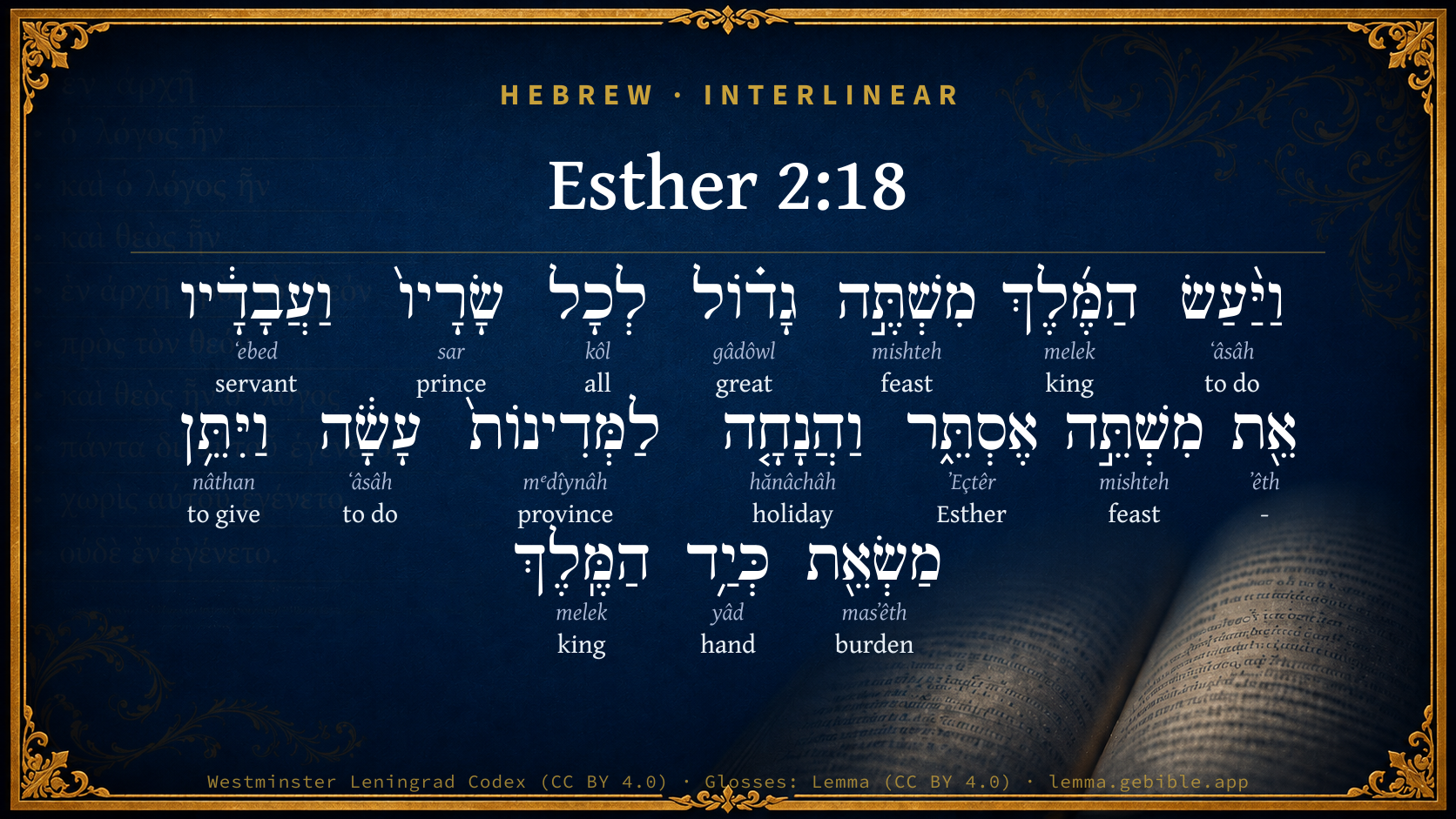
Hebrew (Westminster Leningrad Codex) Esther 2:18 appears in the Hebrew Old Testament. The text above is from the Westminster Leningrad Codex. Each word links to its Strong’s number, a concise gloss, and parsing drawn from the Open Scriptures Hebrew Bible morphology. Click any word for its full Brown-Driver-Briggs (BDB) entry.
Download image
Cite this verse

Esther 2:18 (World English Bible). Public Domain. Lemma interlinear Bible study tool, https://lemma.gebible.app/v/esther/2/18.

Show BibTeX & RIS
BibTeX
RIS
English Translation
Then the king made a great feast to all his princes and his servants, even Esther's feast; and he made a release to the provinces, and gave gifts, according to the bounty of the king.
World English Bible · Public Domain
Highlights
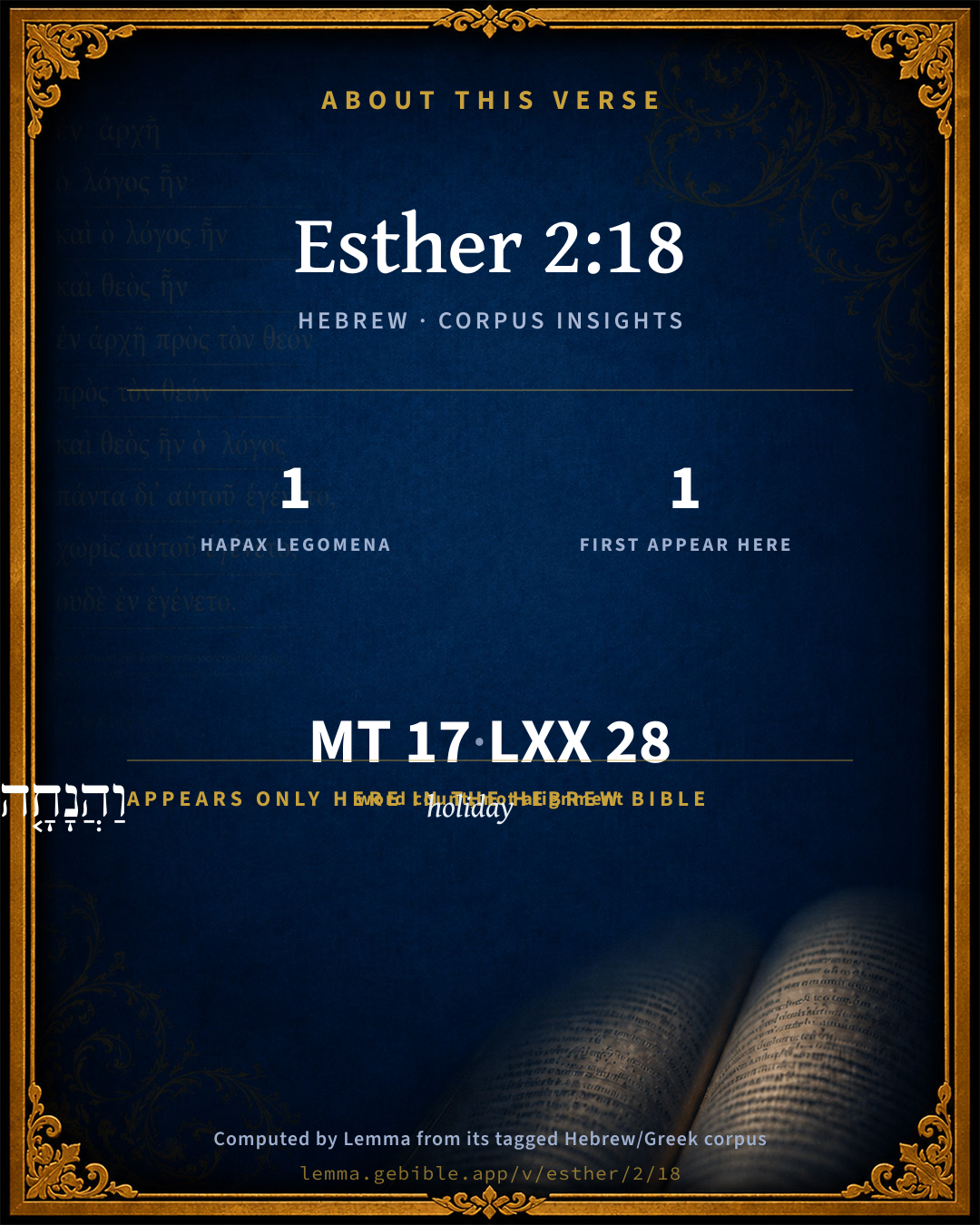
  • 1 hapax legomenon — only here in the Hebrew Bible
  • 1 first appearance in the Hebrew Bible
Full analysis ↓
Download a study sheet

One document with this verse’s original text, its word-by-word gloss line, the meaning frame, cross-references with their text, attributed commentary, and full source and license credits — printable, and it pastes into notes with its structure intact.

This verse Autodidact and up

Study sheet (.html) Plain text (.txt)

A passage Seminary Student

Up to 50 verses in one chapter. A passage sheet keeps up to 6 commentary sources and 12 cross-references per verse, in the order this page ranks them, and says so on the sheet whenever that leaves anything out. Ask for a single verse and you get the Autodidact verse sheet above.

Everything on this page stays free to read, with no account — the sheet is a download of what is already on screen, not access to it.

Want to remove ads? Support Godless Engineer
Compare translations 3

The same verse in 3 English versions, stacked beneath the original-language interlinear above. Click any original word for its lexicon entry.

Each is an independent rendering of the whole verse — the interlinear is not word-aligned to these translations.

Highlighted words mark where these versions differ — a whole-verse word diff, not a word-by-word alignment.

  • World English Bible Public Domain
    Then the king made a great feast to all his princes and his servants, even Esther's feast; and he made a release to the provinces, and gave gifts, according to the bounty of the king.
  • King James Version Public Domain
    Then the king made a great feast unto all his princes and his servants, even Esther's feast; and he made a release to the provinces, and gave gifts, according to the state of the king.
  • unfoldingWord Literal Text CC BY-SA 4.0
    And the king made a great feast for all his officials and his servants, the feast of Esther. And he made a holiday for the provinces, and he gave gifts according to the hand of the king.

unfoldingWord Literal Text — © unfoldingWord, licensed CC BY-SA 4.0. Word-aligned USFM3 via Door43 (git.door43.org/unfoldingWord/en_ult).

Versions to compare (up to 4)

3 of 4 selected

Show all 18 translations

Every available English version of this verse, each an independent rendering of the whole verse.

  • World English Bible Public Domain
    Then the king made a great feast to all his princes and his servants, even Esther's feast; and he made a release to the provinces, and gave gifts, according to the bounty of the king.
  • Berean Standard Bible Public Domain
    Then the king held a great banquet, Esther’s banquet, for all his officials and servants. He proclaimed a tax holiday in the provinces and gave gifts worthy of the king’s bounty.
  • Majority Standard Bible Public Domain
    Then the king held a great banquet, Esther’s banquet, for all his officials and servants. He proclaimed a tax holiday in the provinces and gave gifts worthy of the king’s bounty.
  • King James Version Public Domain
    Then the king made a great feast unto all his princes and his servants, even Esther's feast; and he made a release to the provinces, and gave gifts, according to the state of the king.
  • American Standard Version (1901) Public Domain
    Then the king made a great feast unto all his princes and his servants, even Esther's feast; and he made a release to the provinces, and gave gifts, according to the bounty of the king.
  • Revised Version (1885) Public Domain
    Then the king made a great feast unto all his princes and his servants, even Esther’s feast; and he made a release to the provinces, and gave gifts, according to the bounty of the king.
  • Geneva Bible (1599) Public Domain
    Then the King made a great feast vnto all his princes, and his seruants, which was the feast of Ester, and gaue rest vnto the prouinces, and gaue gifts, according to the power of a King.
  • Douay-Rheims (1899) Public Domain
    And he commanded a magnificent feast to be prepared for all the princes, and for his servants, for the marriage and wedding of Esther. And he gave rest to all the provinces, and bestowed gifts according to princely magnificence.
  • Young's Literal Translation Public Domain
    and the king maketh a great banquet to all his heads and his servants -- the banquet of Esther -- and a release to the provinces hath made, and giveth gifts as a memorial of the king.
  • Literal Standard Version CC BY-SA 4.0
    and the king makes a great banquet to all his heads and his servants—the banquet of Esther—and has made a release to the provinces, and gives gifts as a memorial of the king.
  • Unlocked Literal Bible CC BY-SA 4.0
    The king gave a great feast for all his officials and his servants, “Esther's feast,” and he granted relief from taxation to the provinces. He also gave gifts with royal generosity.
  • unfoldingWord Literal Text CC BY-SA 4.0
    And the king made a great feast for all his officials and his servants, the feast of Esther. And he made a holiday for the provinces, and he gave gifts according to the hand of the king.
  • Darby Bible Public Domain
    And the king made a great feast to all his princes and his servants, Esther's feast; and he made a release to the provinces, and gave presents according to the king's bounty.
  • World Messianic Bible Public Domain
    Then the king made a great feast for all his princes and his servants, even Esther’s feast; and he proclaimed a holiday in the provinces, and gave gifts according to the king’s bounty.
  • Webster's Bible Public Domain
    Then the king made a great feast to all his princes and his servants, even Esther's feast; and he made a release to the provinces, and gave gifts, according to the state of the king.
  • Free Bible Version CC BY-SA 4.0
    The king gave a great feast for all his officials and administrators—Esther's feast. He also declared it a holiday throughout the provinces and distributed generous gifts.
  • Bible in Basic English Public Domain
    Then the king gave a great feast for all his captains and his servants, even Esther's feast; and he gave orders through all the divisions of his kingdom for a day of rest from work, and gave wealth from his store.
  • JPS Tanakh (1917) Public Domain
    Then the king made a great feast unto all his princes and his servants, even Esther's feast; and he made a release to the provinces, and gave gifts, according to the bounty of the king.

Literal Standard Version (2020), Covenant Press — licensed CC BY-SA 4.0. Text via the HelloAO Bible API (eBible.org). Unlocked Literal Bible (unfoldingWord) — licensed CC BY-SA 4.0. Text via the HelloAO Bible API (eBible.org). unfoldingWord Literal Text — © unfoldingWord, licensed CC BY-SA 4.0. Word-aligned USFM3 via Door43 (git.door43.org/unfoldingWord/en_ult). Free Bible Version, Dr. Jonathan Gallagher — licensed CC BY-SA 4.0. Text via the HelloAO Bible API (eBible.org).

Word by word

More ways to search: Search by grammar → Find every occurrence → Compare this word →

Practice this passage: Drill this verse → Learn its vocabulary →

וַהֲנָחָ֤ה
hănâchâh
H2010
“and · holiday”
Conjunction + Noun, Common, Feminine, Singular, Absolute
Part of Speech
Conjunction + Noun
Type
Common
Gender
Feminine
Number
Singular
State
Absolute
Full BDB Definition

Origin: from H5117

TWOT: 1323d

a day of rest, holiday, a giving of rest, holiday making
  1. וַיַּ֨עַשׂ ʻâsâh H6213 “and · to do” Conjunction + Verb, Qal, Sequential Imperfect, 3rd Person, Masculine, Singular
  2. הַמֶּ֜לֶךְ melek H4428 “the · king” Particle, Definite Article + Noun, Common, Masculine, Singular, Absolute
  3. מִשְׁתֶּ֣ה mishteh H4960 “feast” Noun, Common, Masculine, Singular, Absolute
  4. גָד֗וֹל gâdôwl H1419 “great” Adjective, Adjective, Masculine, Singular, Absolute
  5. לְכָל kôl H3605 “to/for · all of” Preposition + Noun, Common, Masculine, Singular, Construct
  6. שָׂרָיו֙ sar H8269 “princes · his” Noun, Common, Masculine, Plural, Construct + Suffix, Personal, 3rd Person, Masculine, Singular
  7. וַעֲבָדָ֔יו ʻebed H5650 “and · servants · his” Conjunction + Noun, Common, Masculine, Plural, Construct + Suffix, Personal, 3rd Person, Masculine, Singular
  8. אֵ֖ת ʼêth H853 “-” Particle, Direct Object
  9. מִשְׁתֵּ֣ה mishteh H4960 “feast of” Noun, Common, Masculine, Singular, Construct
  10. אֶסְתֵּ֑ר ʼEçtêr H635 “Esther” Noun, Proper
  11. לַמְּדִינוֹת֙ mᵉdîynâh H4082 “to/for the · provinces” Preposition, Determined + Noun, Common, Feminine, Plural, Absolute
  12. עָשָׂ֔ה ʻâsâh H6213 “to do” Verb, Qal, Perfect, 3rd Person, Masculine, Singular
  13. וַיִּתֵּ֥ן nâthan H5414 “and · to give” Conjunction + Verb, Qal, Sequential Imperfect, 3rd Person, Masculine, Singular
  14. מַשְׂאֵ֖ת masʼêth H4864 “burden” Noun, Common, Feminine, Singular, Absolute
  15. כְּיַ֥ד yâd H3027 “like/as · hand of” Preposition + Noun, Common, Both, Singular, Construct
  16. הַמֶּֽלֶךְ melek H4428 “the · king” Particle, Definite Article + Noun, Common, Masculine, Singular, Absolute

About this verse

These counts appear in no published source. They are computed here, from the morphology-tagged text and Lemma’s own curated glosses. What Lemma adds →

17
words
14
distinct lemmas
Historical
section

Notable vocabulary

1 hapax legomenon — a word that appears only here in the entire Hebrew Bible:

  • וַהֲנָחָ֤ה holiday H2010

First appearance in Scripture

This word makes its first canonical appearance in the Hebrew Bible here:

  • וַהֲנָחָ֤ה holiday H2010

Shared distinctive vocabulary

מַשְׂאֵ֖ת burden H4864 occurs in 14 verses of the Hebrew Bible. Also found in:

Grammatical profile

  • 3 verbs
  • 12 nouns
  • 1 adjective
  • 1 particle

Verb forms

  • וַיַּ֨עַשׂ Qal · Sequential Imperfect
  • עָשָׂ֔ה Qal · Perfect
  • וַיִּתֵּ֥ן Qal · Sequential Imperfect

Repetition

Words recur within this verse — often emphatic in Hebrew:

  • וַיַּ֨עַשׂ to do H6213 ×2
  • הַמֶּ֜לֶךְ king H4428 ×2
  • מִשְׁתֶּ֣ה feast H4960 ×2

Hebrew & Septuagint length

In English translation the verse runs 35 words from the Hebrew and 36 from the Septuagint (LXX English) — closely comparable.

A rough comparison of the two English renderings, which tokenize alike — not a word-level alignment.

Word counts can differ between the Hebrew and the Greek without any difference in meaning — e.g. the Hebrew direct-object marker אֵת has no separate Greek word, and Greek often adds the article ὁ.

In the original languages it is 17 Hebrew tokens and 28 Greek tokens — but the two are counted differently (Hebrew bundles its prefixes and suffixes into one token; the Greek is in lemma form), so that isn’t a like-for-like length.

Cross-references

13

Topical passages linked to Esther 2:18 in the Treasury of Scripture Knowledge — connected by theme and wording, ordered by reader-vote popularity; previews shown in the World English Bible.

  • Genesis 29:22 Laban gathered together all the men of the place, and made a feast.
  • Judges 14:10–17 His father went down to the woman: and Samson made there a feast; for so used the young men to do.
  • 1 Samuel 25:8 Ask your young men, and they will tell you: therefore let the young men find favor in your eyes; for we come in a good day. Please give whatever comes to your hand, to your servants, and to your son David.
  • Nehemiah 8:11 So the Levites stilled all the people, saying, Hold your peace, for the day is holy; neither be you grieved.
  • Esther 1:3–5 in the third year of his reign, he made a feast to all his princes and his servants; the power of Persia and Media, the nobles and princes of the provinces, being before him;
  • Esther 1:7 They gave them drink in vessels of gold (the vessels being diverse one from another), and royal wine in abundance, according to the bounty of the king.
  • Esther 9:22 as the days in which the Jews had rest from their enemies, and the month which was turned to them from sorrow to gladness, and from mourning into a good day; that they should make them days of feasting and gladness, and of sending portions one to another, and gifts to the needy.
  • Song of Solomon 3:11 Go forth, you daughters of Zion, and see king Solomon, With the crown with which his mother has crowned him, In the day of his weddings, In the day of the gladness of his heart. Lover
  • Matthew 22:2 "The Kingdom of Heaven is like a certain king, who made a marriage feast for his son,
  • Luke 14:8 "When you are invited by anyone to a marriage feast, don't sit in the best seat, since perhaps someone more honorable than you might be invited by him,
  • Revelation 11:10 Those who dwell on the earth rejoice over them, and they will be glad. They will give gifts to one another, because these two prophets tormented those who dwell on the earth.
  • Song of Solomon 5:1 I have come into my garden, my sister, my bride. I have gathered my myrrh with my spice; I have eaten my honeycomb with my honey; I have drunk my wine with my milk. Friends Eat, friends! Drink, yes, drink abundantly, beloved. Beloved
  • Revelation 19:9 He said to me, "Write, 'Blessed are those who are invited to the marriage supper of the Lamb.'" He said to me, "These are true words of God."

Cross-references courtesy of OpenBible.info (CC BY 4.0).

Hebrew and Greek witnesses Masoretic Hebrew ↔ Greek Septuagint

The same verse in the two great witnesses to the Old Testament, shown verse-for-verse.

These are two independent witnesses, not word-aligned to each other, and the Septuagint is shown in lemma (dictionary) form.

Hebrew Esther 2:18 Masoretic · Westminster Leningrad Codex

וַיַּ֨עַשׂ הַמֶּ֜לֶךְ מִשְׁתֶּ֣ה גָד֗וֹל לְכָל שָׂרָיו֙ וַעֲבָדָ֔יו אֵ֖ת מִשְׁתֵּ֣ה אֶסְתֵּ֑ר וַהֲנָחָ֤ה לַמְּדִינוֹת֙ עָשָׂ֔ה וַיִּתֵּ֥ן מַשְׂאֵ֖ת כְּיַ֥ד הַמֶּֽלֶךְ

Then the king made a great feast to all his princes and his servants, even Esther's feast; and he made a release to the provinces, and gave gifts, according to the bounty of the king.

World English Bible · Public Domain

Greek LXX Esther 2:18 Septuagint · lemma form

καί ποιέω ὁ βασιλεύς πότος πᾶς ὁ φίλος αὐτός καί ὁ δύναμις ἐπί ἡμέρα ἑπτά καί ὑψόω ὁ γάμος εσθηρ καί ἄφεσις ποιέω ὁ ὑπό ὁ βασιλεία αὐτός

And the king made a banquet for all his friends and great men for seven days, and he highly celebrated the marriage of Esther; and he made a release to those who were under his dominion.

LXX2012 (modern English Septuagint) · Public Domain

On this verse, Haydock's Catholic Bible Commentary discusses the Septuagint’s reading. Read the note in Commentary ↓

Hebrew: Westminster Leningrad Codex (CC BY 4.0). Greek: Septuagint (public domain); English from LXX2012 (modern English Septuagint) (Public Domain). How the Septuagint differs from the Hebrew →

Commentary

Notes on Esther 2:18 from classic Christian and Jewish commentators (each source and its license shown beneath its notes). The classic Christian expositions comment on the surrounding passage and are grouped to its opening verse, so a note may address several verses; the Jewish commentaries on the Tanakh (Rashi and others) are per-verse, so they appear only where the commentator wrote on this verse.

Lemma curates 59 commentaries, every one of them public domain or Creative Commons licensed, each selected and text-cleaned for this edition rather than reprinted as found. About our sources →

Trapp's Complete Commentary

John Trapp

Est 2:18 Then the king made a great feast unto all his princes and his servants, [even] Esther’s feast; and he made a release to the provinces, and gave gifts, according to the state of the king.

Ver. 18. Then the king made a great feast] Feasts are never more in season than at the recovery of the lost rib. {See Trapp on "Gen 29:22"}

Unto all his princes and his servants] So did Mauritius, the emperor of Greece, when he married Constantina (Niceph. 1. 18, c. 8), and Henry III, emperor of Germany, when he married Agnes, daughter to the prince of Pictavia, at Ingelheim; whither when a great sort of players, fiddlers, jesters, and magicians resorted, he not only sent them away without reward, but also without meat and drink, which he liberally bestowed upon the poor. Funcc. ad annum 1044.

Even Esther’s feast] So he called it, to testify his great affection and respect toward his spouse. This is no warrant for that Popish custom, of dedicating feasts to the honour of saints; or for that heathenish practice, in some places amongst us, of keeping wakes.

And he made a release to the provinces] That is, he caused it to be kept holiday, as Josephus hath it. Or rather he granted to his subjects a relaxation, or freedom from their taxes, tributes, and public payments, for a time at least, that thereby the new queen might get favour and authority among them, and all men might wish them much joy and happiness, that the loins of the people might bless their prince and his marriage for this breathing and intermission; when as formerly his exactors received from his subjects no less sums of curses than of coin, to maintain his luxury.

And gave gifts] Such as Xenophon reckoneth up, bracelets, chains of gold, garments, horses with rich trappings, dishes from his own table, &c. (Cyropaed. 1. 8). This was kingly, this was god-like, Jas 1:5. His son, Artaxerxes Longimarius, was wont to say, that he had therefore one hand longer than another (μακροχειρ), that he might be readier to give than to receive. Of Cyrus it is said, that he took more content in giving than receiving, Dιδους μαλλον η κτωμενος ηδετο (Xenoph.). Of Stephen, king of Hungary, and of Oswald, king of England, that their right hands did not rot off for a long while after they were dead, because oft stretched out in giving gifts, and dealing alms. Christ received that he might give, Psa 68:18 Eph 4:8. And held it more blessed to give than to receive, Act 20:35. Be wise now, therefore, O ye kings, &c.; by your bounty and liberality the people shall be obliged, the state fenced, virtue encouraged, misery relieved: that you have secured. For,

Extra fortunam est quicquid donatur amicis:

Quas dederis solas, semper habebis opes (Martial).

According to the state of the king] Not pinchingly and sparingly, but bountifully, and as became a king; as Alexander the Great, when he sent his tutor a ship full of frankincense; and when a poor man asked him for an alms, he gave him a city, which when the poor man started at and made strange of, Alexander said unto him, Non quaero quid te accipere decent, sed quid me dare, The question is not what thou shouldest receive, but what it beseemeth me to give (Sen. de Benef. 1. 2, c. 16). And thus is the marriage of Esther solemnized with state and pomp suitable; thus is God’s promise made by Jeremiah fulfilled, that if Jechoniah would not stand out against Nebuchadnezzar, but yield up the city, and go into captivity, it should be well with him and the people in the land of their captivity. It was so with him, Jer 52:31; it was so likewise with Esther, Daniel, and many others by their means. And why? God will not suffer his faithfulness to fail, nor alter the word that is gone out of his mouth, Psa 89:33.

John Trapp, A Commentary or Exposition upon All the Books of the Old and New Testament (1647–1656) — public domain. Text from a community e-Sword module.

Joseph Benson's Commentary

Est 2:18. And he made a release to the provinces — According to Herodotus, it was customary for the Persian kings, upon their accession to the throne, to remit the tribute which was due to them from all their cities; and Ahasuerus, on this occasion, out of his abundant joy, remitted some tax, or part of a tax, then due, which he did that every body might rejoice with him.

Joseph Benson's Commentary on the Old and New Testaments (1811–1818) — public domain. Text from a community e-Sword module.

Tyndale Open Study Notes

Tyndale Open Resources

2:18 he gave a great banquet in Esther’s honor: Now the king honored his wife instead of putting her on display (cp. 1:11). • declaring a public holiday: The Hebrew word translated “public holiday” (hanakhah) is related to the verb that means “rest” (nukh). The book as a whole describes how the Jewish people obtained rest from the threats of their enemies (see 9:16-22).

Tyndale Open Study Notes — © Tyndale Open Resources, licensed CC BY-SA 4.0. Text via the HelloAO Bible API.

Geneva Bible (1599)

Geneva Bible translators

That is, great and magnificent.

That is, made for her sake.

He released their tribute.

Geneva Bible (1599) marginal notes — public domain. Text via Bolls.life.

Adam Clarke's Commentary

Verse 18. Made a release to the provinces] Remitted some kind of tribute or impost, in honour of Esther, at her coronation, as our kings generally do when they are crowned, ordering a discharge from prison of many who are confined for minor offenses. As it was the custom of the Persian kings to give their queens something like what is called with us the aurum reginae, "queen gold," which was a tenth of all fines, c., above what was given to the king (for they gave them such a city to buy them clothes, another for their hair, a third for their necklaces, a fourth for their pearls, c.) it is probable that, on this occasion, Esther so wishing, he relieved those cities and provinces which had before paid this queen gold from all these expenses; and this would tend greatly to make the queen popular.

Adam Clarke's Commentary on the Bible (1810–1826) — public domain. Text from a community e-Sword/MySword module.

Ellicott's Commentary for English Readers

(18) Release.—Literally, rest. The word only occurs here: it may refer either to a release from tribute or from military service, probably the former. Either, however, would have been consistent with Persian usage. (See Herod, iii. 67, 6:59.)

A Bible Commentary for English Readers, edited by Charles John Ellicott (1878–1897) — public domain. Text from a community e-Sword module.

The Cambridge Bible for Schools and Colleges

gen. ed. J. J. S. Perowne

18. a release] Heb. a rest, an exemption for a certain time from taxation and from military service. Such e.g. had been granted by the Pseudo-Smerdis on his usurpation (Herod. iii. 67).

gifts] The Heb. word was used in older times for a portion of food sent from the table (Gen_43:34; 2Sa_11:8), and afterwards for a contribution or tax imposed for sacred purposes (2Ch_24:6), or a present such as largess from a superior (Jer_40:5 and here).

according to the bounty of the king] See on Est_1:7.

The Cambridge Bible for Schools and Colleges (gen. ed. J. J. S. Perowne; Cambridge University Press, 1878–1918) — public domain. Text from a community e-Sword module.

John Gill's Exposition

Then the king made a great feast unto all his princes and servants, even Esther's feast,.... A feast to all his nobles, courtiers, and ministers of state, on account of his marriage with Esther; which, according to the Greek version, was held seven days; but, according to Josephus, it lasted a whole month (t):

and he made a release to the provinces; of taxes and tribute due to him, as was the custom of the kings of Persia when they came to the throne, as Herodotus (u) relates; so Smerdis the magus, that mounted the throne after Cambyses, pretending to be his brother, released them for three years to come (w); and Grotius says kings used to do it at their marriage, but gives no instance of it:

and gave gifts: according to the latter Targum, to the provinces, all of them, that he might be sure that the people of Esther shared his favours, who were as yet unknown; but rather these gifts were given to his nobles, or it may be to Esther; so the former Targum,"he gave to her a gift and portion:"

according to the state of the king; his royal ability and munificence, and suitable to his grandeur; and it was usual with the Persian kings to give to their wives whole cities for one thing or another, as for necklaces, hair laces, shoes, &c. (x); Socrates (y) speaks of a whole country in Persia called the "Queen's girdle", and another her "Headdress".

(t) Ut supra. (Antiqu. l. 11. c. 6. sect. 2.) (u) Erato, sive, l. 6. c. 59. (w) Thalia, sive, l. 3. c. 67. (x) Herodot. Euterpe, sive, l. 2. c. 98. Cicero in Verrem, l. 3. Orat. 8. (y) In Plat. Alcibiad.

John Gill's Exposition of the Whole Bible (1746–1763) — public domain (CC PDM 1.0). Text via the HelloAO Bible API.

Albert Barnes' Notes on the Bible

A release - Either remission of taxation, or of military service, or of both.

Albert Barnes' Notes on the Bible (1834–1885) — public domain. Text from a community e-Sword/MySword module.

Haydock's Catholic Bible Commentary

Servants. Septuagint add, "seven days, and he magnified the nuptials of Esther." (Haydock) --- Rest, from labour. (Calmet) --- Septuagint, "remission to all his subjects," of tribute, as was sometimes done. (Herodotus iii. 66.) (Tirinus) (Calmet) --- Gifts, on Esther. (Chaldean) (Malvenda)

George Leo Haydock (1774–1849), Haydock's Catholic Family Bible and Commentary, 1859 edition — public domain. Excludes Psalms (Douay-Rheims chapter numbering differs from Protestant) and Deuterocanonical books (Catholic canon only).

Matthew Poole's English Annotations

He made a release to the provinces, i.e. he took off a good part of those heavy taxes which the Persian kings laid upon their people.

Matthew Poole's English Annotations on the Holy Bible (1683–1685) — public domain. Text from a community e-Sword/MySword module.

Whedon's Commentary on the Bible

Daniel D. Whedon

18. Esther’s feast — A banquet to her honour; to celebrate her election to Vashti’s place.

Made a release to the provinces — Usually understood as a release from tribute. Septuagint has αφεσιν; Vulgate, requiem. The Hebrew word הנחה, which occurs nowhere else, comes from a root which means to rest, and may, therefore, properly denote a respite from taxation. The Persian kings were wont to remit the arrears of tribute due at the time of their accession, (Herod., 3:67; 6:59,) and Xerxes may have thought it wise to grant such a release just after the disastrous Grecian war.

According to the state of the king — The feast, the release, and the gifts, were all in keeping with true kingly munificence.

Daniel D. Whedon (gen. ed.), Commentary on the Old and New Testaments (1874–1909) — public domain. Text from a community e-Sword module.

The Pulpit Commentary

Then the king made a great feast. As Persian kings were in the habit of doing on every joyful occasion. Even Esther"s feast. It seems to be meant that the feast was one which continued to be spoken about, and which was commonly known under this title. And he made a release to the provinces. As the Pseudo-Smerdis had done when he usurped the throne (Herod., 3:67). A "release" was an exemption from taxation, or from military service, or from both, for a specified period. And gave gifts, according to the state of the king. Literally, that is, "in right royal fashion". (see Est_1:7) The practice of making presents, so common in the East at all times, was much in vogue among the Persians, and was practised especially by the monarchs (Herod., 1:136; 3:135; 7:26; Xen., "Cyrop.," 8:2, et seq.; " Anab.," 1:9, etc.).

Release and gifts.

Esther"s marriage was celebrated in a manner intended and fitted to impress the nation with a sense of the favour and honour with which she was regarded by the "great king." There was a great feast at Susa, that the metropolis might have an opportunity of honouring the new queen. And throughout the kingdom there took place, according to the command of Ahasuerus, such celebrations and observances as were in accordance with Oriental customs. Particularly are mentioned the releases or remissions it may be presumed from taxation or military service; and the gifts probably of robes, and in some cases of jewels. We may regard these tokens of kingly favour as emblematic of the blessings provided by Divine mercy in the gospel of Christ for the sinful and needy children of men.

I The heavenly King favours us, sinners and spiritual bondsmen, with RELEASE AND REMISSION.

1. From the service of Satan.

1. From the thraldom and punishment of sin.

2. By the redemption of his Son, Jesus Christ.

II The heavenly King bestows upon us, his subjects, NUMEROUS AND PRICELESS GIFTS.

1. As the condition and means of all other benefactions regard himwho is "the unspeakable Gift.

2. The gift of the Holy Ghost.

3. The gift of eternal life.

4. Remember that all the bounties of Divine providence come to usas proofs of the Father"s love, and through the mediation of Christ.

Practical lessons:

1. Spiritual liberty is provided and offered; the prison doors are opened. Goye free.

2. Spiritual bounty is at your disposal; "all things are yours." Take andrejoice in the manifold gifts of God.

The Pulpit Commentary (1880–1919), ed. H.D.M. Spence-Jones & Joseph S. Exell — public domain. Text from a community e-Sword module.

Rashi

Rabbi Shlomo Yitzchaki (Rashi)

and he granted a release In her honor, he released them from the tax that was [levied] upon them.

and gave gifts He sent them gifts, and everything was in order to entice her, perhaps she would tell her nationality. But nevertheless—Esther would not tell.

Rashi on the Tanakh — English translations: “The Judaica Press complete Tanach with Rashi, translated by A. J. Rosenberg” (CC BY 4.0); “Pentateuch with Rashi's commentary by M. Rosenbaum and A.M. Silbermann, 1929-1934” (public domain); “The Metsudah Tanach series, Lakewood, N.J” (CC BY 4.0); and “The Book of Joshua, Metsudah Publications, 1997” (CC BY 4.0). Text via Sefaria.

Lesson kit

Teaching starters — assembled from the data on this page, not authored interpretation. Every prompt links to the verse data it draws on. Edit before teaching.

Esther, in the Historical, opens this verse with 17 words (14 distinct Hebrew lemmas). Its most distinctive word is hănâchâh (“holiday”). A historical commentator’s framing appears above. Read the whole chapter for the surrounding context.

Discussion questions

  1. What does “holiday” (hănâchâh) contribute to the verse as a whole?
  2. This verse holds 1 word here found nowhere else in the Hebrew Bible. What might the rare word draw attention to?
  3. The word “holiday” first appears here in Scripture. What is being introduced at this debut?
  4. Genesis 43:34 shares the word «burden» with this verse. How do the two illuminate each other?
  5. “to do” occurs 2× in this one verse. What is the effect of the repetition?
  6. These translations render this verse differently; the difference is in the English rendering, not the original. What questions does that raise?
  7. The verb «וַיַּ֨עַשׂ» is Qal Sequential Imperfect. How does its form color the action?
  8. Reading how Trapp's Complete Commentary and Joseph Benson's Commentary read this verse, where do the two commentators agree and where do they part?

Things to notice

  • 1 word in this verse appears nowhere else in the Hebrew Bible.
  • 1 word makes its first canonical appearance in Scripture here.
  • This verse counts 17 Hebrew ↔ 28 Greek words.
  • These translations choose different wording for 10 words in this verse.
  • “to do” occurs 2× in this single verse.

Reading settings

Reading text

Shown beneath each verse's original-language words.

Old Testament
Old Testament edition

Read the OT as the Masoretic Hebrew (MT) or the Greek Septuagint (LXX).

English shown for the Greek Septuagint (in the Hebrew ↔ Greek comparison).

Comparing translations? Open the Compare panel on any verse page to stack up to four side by side.