
Exodus 22:6

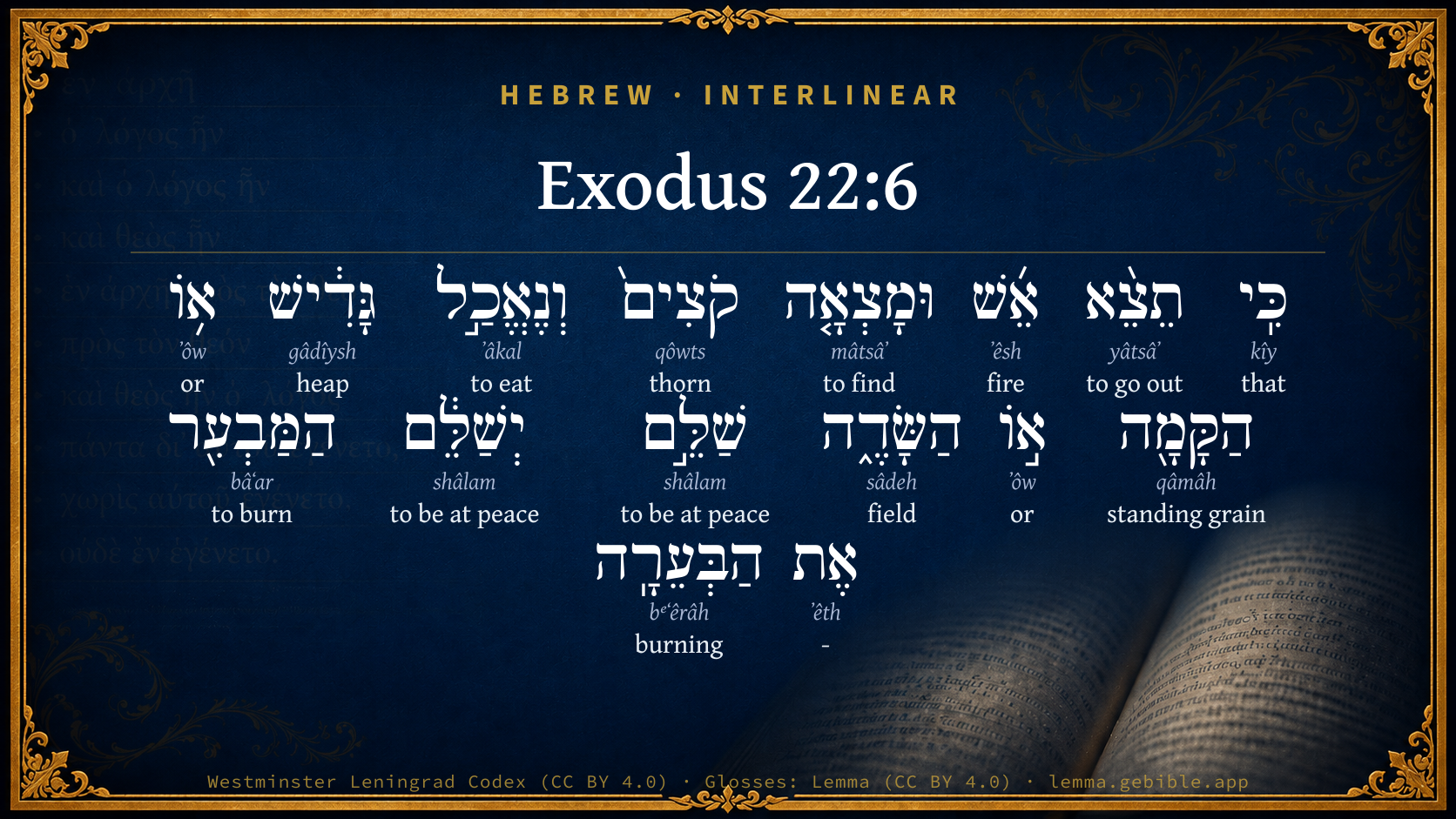
Hebrew (Westminster Leningrad Codex) Exodus 22:6 appears in the Hebrew Old Testament. The text above is from the Westminster Leningrad Codex. Each word links to its Strong’s number, a concise gloss, and parsing drawn from the Open Scriptures Hebrew Bible morphology. Click any word for its full Brown-Driver-Briggs (BDB) entry.
Download image
Cite this verse

Exodus 22:6 (World English Bible). Public Domain. Lemma interlinear Bible study tool, https://lemma.gebible.app/v/exodus/22/6.

Show BibTeX & RIS
BibTeX
RIS
English Translation
"If fire breaks out, and catches in thorns so that the shocks of grain, or the standing grain, or the field are consumed; he who kindled the fire shall surely make restitution.
World English Bible · Public Domain
Highlights
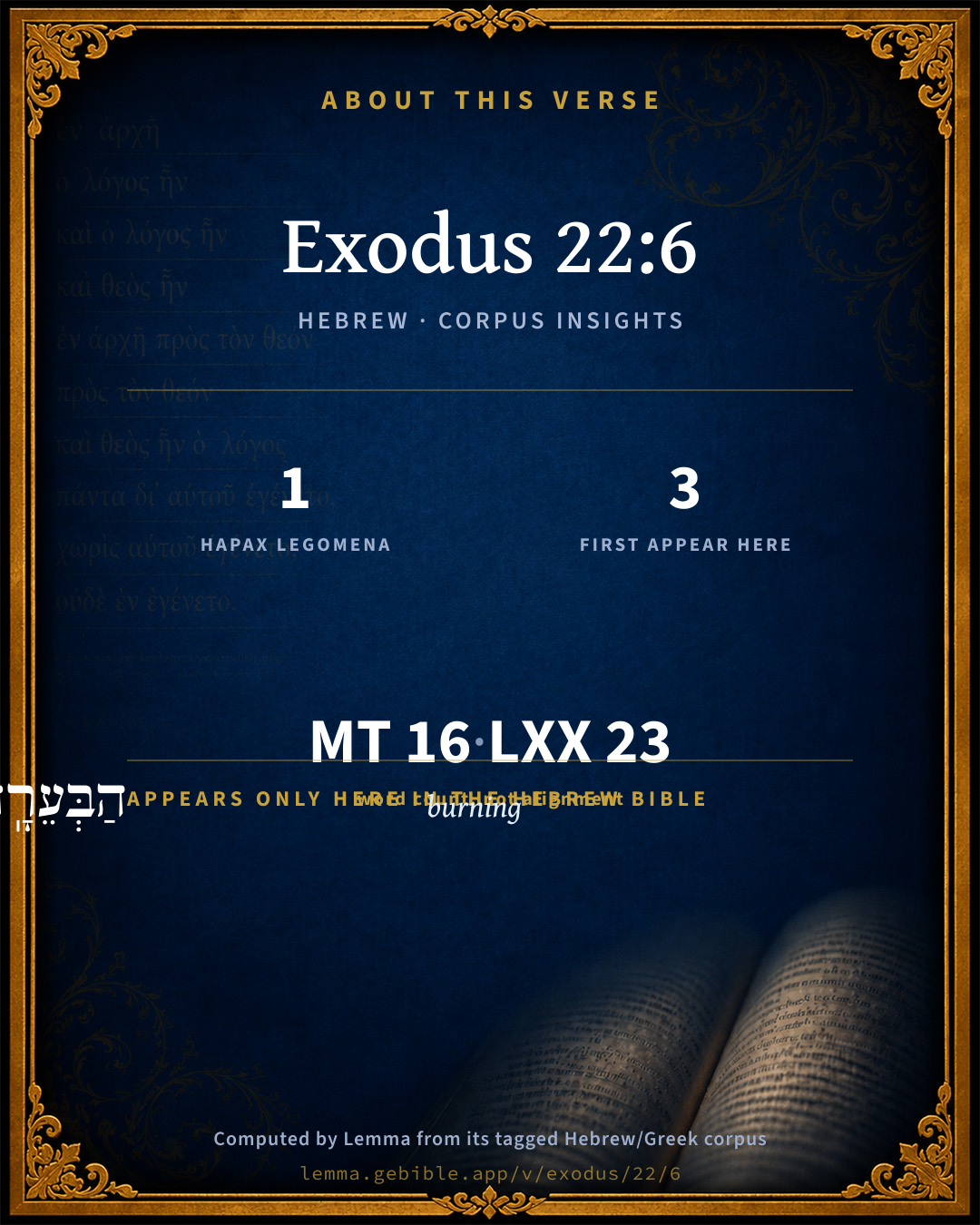
  • 1 hapax legomenon — only here in the Hebrew Bible
  • 3 first appearances in the Hebrew Bible
Full analysis ↓
Download a study sheet

One document with this verse’s original text, its word-by-word gloss line, the meaning frame, cross-references with their text, attributed commentary, and full source and license credits — printable, and it pastes into notes with its structure intact.

This verse Autodidact and up

Study sheet (.html) Plain text (.txt)

A passage Seminary Student

Up to 50 verses in one chapter. A passage sheet keeps up to 6 commentary sources and 12 cross-references per verse, in the order this page ranks them, and says so on the sheet whenever that leaves anything out. Ask for a single verse and you get the Autodidact verse sheet above.

Everything on this page stays free to read, with no account — the sheet is a download of what is already on screen, not access to it.

Want to remove ads? Support Godless Engineer
Compare translations 3

The same verse in 3 English versions, stacked beneath the original-language interlinear above. Click any original word for its lexicon entry.

Each is an independent rendering of the whole verse — the interlinear is not word-aligned to these translations.

Highlighted words mark where these versions differ — a whole-verse word diff, not a word-by-word alignment.

  • World English Bible Public Domain
    "If fire breaks out, and catches in thorns so that the shocks of grain, or the standing grain, or the field are consumed; he who kindled the fire shall surely make restitution.
  • King James Version Public Domain
    If fire break out, and catch in thorns, so that the stacks of corn, or the standing corn, or the field, be consumed therewith; he that kindled the fire shall surely make restitution.
  • unfoldingWord Literal Text CC BY-SA 4.0
    If a fire breaks out and spreads in thorns and stacked grain or the standing grain or a field is consumed, the fire starter shall surely compensate.

unfoldingWord Literal Text — © unfoldingWord, licensed CC BY-SA 4.0. Word-aligned USFM3 via Door43 (git.door43.org/unfoldingWord/en_ult).

Versions to compare (up to 4)

3 of 4 selected

Show all 18 translations

Every available English version of this verse, each an independent rendering of the whole verse.

  • World English Bible Public Domain
    "If fire breaks out, and catches in thorns so that the shocks of grain, or the standing grain, or the field are consumed; he who kindled the fire shall surely make restitution.
  • Berean Standard Bible Public Domain
    If a fire breaks out and spreads to thornbushes so that it consumes stacked or standing grain, or the whole field, the one who started the fire must make full restitution.
  • Majority Standard Bible Public Domain
    If a fire breaks out and spreads to thornbushes so that it consumes stacked or standing grain, or the whole field, the one who started the fire must make full restitution.
  • King James Version Public Domain
    If fire break out, and catch in thorns, so that the stacks of corn, or the standing corn, or the field, be consumed therewith; he that kindled the fire shall surely make restitution.
  • American Standard Version (1901) Public Domain
    If fire break out, and catch in thorns, so that the shocks of grain, or the standing grain, or the field are consumed; he that kindled the fire shall surely make restitution.
  • Revised Version (1885) Public Domain
    If fire break out, and catch in thorns, so that the shocks of corn, or the standing corn, or the field, be consumed; he that kindled the fire shall surely make restitution.
  • Geneva Bible (1599) Public Domain
    If fire breake out, and catche in ye thornes, and the stackes of corne, or the standing corne, or the fielde be consumed, he that kindled the fire shall make full restitution.
  • Douay-Rheims (1899) Public Domain
    If a fire breaking out light upon thorns, and catch stacks of corn, or corn standing in the fields, he that kindled the fire shall make good the loss.
  • Young's Literal Translation Public Domain
    `When fire goeth forth, and hath found thorns, and a stack, or the standing corn, or the field, hath been consumed, he who causeth the burning doth certainly repay.
  • Literal Standard Version CC BY-SA 4.0
    When fire goes forth and has found thorns, and a stack, or the standing grain, or the field has been consumed, he who causes the burning certainly repays.
  • Unlocked Literal Bible CC BY-SA 4.0
    If a fire breaks out and spreads in thorns so that stacked grain, or standing grain, or a field is consumed, the one who started the fire must surely make restitution.
  • unfoldingWord Literal Text CC BY-SA 4.0
    If a fire breaks out and spreads in thorns and stacked grain or the standing grain or a field is consumed, the fire starter shall surely compensate.
  • Darby Bible Public Domain
    -- If fire break out, and seize the thorns, and the stacks of corn, or the standing corn, or the field be consumed, he that kindled the fire shall fully make it good.
  • World Messianic Bible Public Domain
    “If fire breaks out, and catches in thorns so that the shocks of grain, or the standing grain, or the field are consumed; he who kindled the fire shall surely make restitution.
  • Webster's Bible Public Domain
    If fire shall break out, and catch in thorns, so that the stacks of corn, or the standing corn, or the field shall be consumed; he that kindled the fire shall surely make restitution.
  • Free Bible Version CC BY-SA 4.0
    If a fire is started and it spreads to thorn bushes and then burns stacked or standing grain, or even the whole field, the person who started the fire must pay full compensation.
  • Bible in Basic English Public Domain
    If there is a fire and the flames get to the thorns at the edge of the field, causing destruction of the cut grain or of the living grain, or of the field, he who made the fire will have to make up for the damage.
  • JPS Tanakh (1917) Public Domain
    (22-5) If fire break out, and catch in thorns, so that the shocks of corn, or the standing corn, or the field are consumed; he that kindled the fire shall surely make restitution.

Literal Standard Version (2020), Covenant Press — licensed CC BY-SA 4.0. Text via the HelloAO Bible API (eBible.org). Unlocked Literal Bible (unfoldingWord) — licensed CC BY-SA 4.0. Text via the HelloAO Bible API (eBible.org). unfoldingWord Literal Text — © unfoldingWord, licensed CC BY-SA 4.0. Word-aligned USFM3 via Door43 (git.door43.org/unfoldingWord/en_ult). Free Bible Version, Dr. Jonathan Gallagher — licensed CC BY-SA 4.0. Text via the HelloAO Bible API (eBible.org).

Word by word

More ways to search: Search by grammar → Find every occurrence → Compare this word →

Practice this passage: Drill this verse → Learn its vocabulary →

הַבְּעֵרָֽה
bᵉʻêrâh
H1200
“the · burning”
Particle, Definite Article + Noun, Common, Feminine, Singular, Absolute
Part of Speech
Particle + Noun
Type
Common
Gender
Feminine
Number
Singular
State
Absolute
Full BDB Definition

Origin: from H1197

TWOT: 263a

burning, fire
  1. כִּֽי kîy H3588 “that” Conjunction
  2. תֵצֵ֨א yâtsâʼ H3318 “to go out” Verb, Qal, Imperfect, 3rd Person, Feminine, Singular
  3. אֵ֜שׁ ʼêsh H784 “fire” Noun, Common, Both, Singular, Absolute
  4. וּמָצְאָ֤ה mâtsâʼ H4672 “and · to find” Conjunction + Verb, Qal, Sequential Perfect, 3rd Person, Feminine, Singular
  5. קֹצִים֙ qôwts H6975 “thorns” Noun, Common, Masculine, Plural, Absolute
  6. וְנֶאֱכַ֣ל ʼâkal H398 “and · to eat” Conjunction + Verb, Niphal, Perfect, 3rd Person, Masculine, Singular
  7. גָּדִ֔ישׁ gâdîysh H1430 “heap” Noun, Common, Masculine, Singular, Absolute
  8. א֥וֹ ʼôw H176 “or” Conjunction
  9. הַקָּמָ֖ה qâmâh H7054 “the · standing grain” Particle, Definite Article + Noun, Common, Feminine, Singular, Absolute
  10. א֣וֹ ʼôw H176 “or” Conjunction
  11. הַשָּׂדֶ֑ה sâdeh H7704 “the · field” Particle, Definite Article + Noun, Common, Masculine, Singular, Absolute
  12. שַׁלֵּ֣ם shâlam H7999 “to be at peace” Verb, Piel, Infinitive Absolute
  13. יְשַׁלֵּ֔ם shâlam H7999 “to be at peace” Verb, Piel, Imperfect, 3rd Person, Masculine, Singular
  14. הַמַּבְעִ֖ר bâʻar H1197 “the · burning” Particle, Definite Article + Verb, Hiphil, Participle Active, Masculine, Singular, Absolute
  15. אֶת ʼêth H853 “-” Particle, Direct Object

About this verse

These counts appear in no published source. They are computed here, from the morphology-tagged text and Lemma’s own curated glosses. What Lemma adds →

16
words
14
distinct lemmas
Pentateuch
section

Notable vocabulary

1 hapax legomenon — a word that appears only here in the entire Hebrew Bible:

  • הַבְּעֵרָֽה burning H1200

First appearance in Scripture

These words make their first canonical appearance in the Hebrew Bible here:

  • גָּדִ֔ישׁ heap H1430
  • הַקָּמָ֖ה standing grain H7054
  • הַבְּעֵרָֽה burning H1200

Shared distinctive vocabulary

גָּדִ֔ישׁ heap H1430 occurs in 4 verses of the Hebrew Bible. Also found in:

Grammatical profile

  • 6 verbs
  • 6 nouns
  • 3 conjunctions
  • 1 particle

Verb forms

  • תֵצֵ֨א Qal · Imperfect
  • וּמָצְאָ֤ה Qal · Sequential Perfect
  • וְנֶאֱכַ֣ל Niphal · Perfect
  • שַׁלֵּ֣ם Piel · Infinitive Absolute
  • יְשַׁלֵּ֔ם Piel · Imperfect
  • הַמַּבְעִ֖ר Hiphil · Participle Active

Repetition

Words recur within this verse — often emphatic in Hebrew:

  • שַׁלֵּ֣ם to be at peace H7999 ×2
  • א֥וֹ or H176 ×2

Hebrew & Septuagint length

In English translation the verse runs 32 words from the Hebrew and 31 from the Septuagint (LXX English) — closely comparable.

A rough comparison of the two English renderings, which tokenize alike — not a word-level alignment.

Word counts can differ between the Hebrew and the Greek without any difference in meaning — e.g. the Hebrew direct-object marker אֵת has no separate Greek word, and Greek often adds the article ὁ.

In the original languages it is 16 Hebrew tokens and 23 Greek tokens — but the two are counted differently (Hebrew bundles its prefixes and suffixes into one token; the Greek is in lemma form), so that isn’t a like-for-like length.

Cross-references

5

Topical passages linked to Exodus 22:6 in the Treasury of Scripture Knowledge — connected by theme and wording, ordered by reader-vote popularity; previews shown in the World English Bible.

  • Exodus 22:9 For every matter of trespass, whether it be for ox, for donkey, for sheep, for clothing, or for any kind of lost thing, about which one says, 'This is mine,' the cause of both parties shall come before God. He whom God condemns shall pay double to his neighbor.
  • Exodus 21:33–34 "If a man opens a pit, or if a man digs a pit and doesn't cover it, and a bull or a donkey falls into it,
  • Exodus 22:12 But if it is stolen from him, he shall make restitution to the owner of it.
  • Judges 15:4–5 Samson went and caught three hundred foxes, and took firebrands, and turned tail to tail, and put a firebrand in the midst between every two tails.
  • 2 Samuel 14:30–31 Therefore he said to his servants, Behold, Joab's field is near mine, and he has barley there; go and set it on fire. Absalom's servants set the field on fire.

Cross-references courtesy of OpenBible.info (CC BY 4.0).

Hebrew and Greek witnesses Masoretic Hebrew ↔ Greek Septuagint

The same verse in the two great witnesses to the Old Testament, shown verse-for-verse.

These are two independent witnesses, not word-aligned to each other, and the Septuagint is shown in lemma (dictionary) form.

Hebrew Exodus 22:6 Masoretic · Westminster Leningrad Codex

כִּֽי תֵצֵ֨א אֵ֜שׁ וּמָצְאָ֤ה קֹצִים֙ וְנֶאֱכַ֣ל גָּדִ֔ישׁ א֥וֹ הַקָּמָ֖ה א֣וֹ הַשָּׂדֶ֑ה שַׁלֵּ֣ם יְשַׁלֵּ֔ם הַמַּבְעִ֖ר אֶת הַבְּעֵרָֽה

"If fire breaks out, and catches in thorns so that the shocks of grain, or the standing grain, or the field are consumed; he who kindled the fire shall surely make restitution.

World English Bible · Public Domain

Greek LXX Exodus 22:6 Septuagint · lemma form

ἐάν δέ τις δίδωμι ὁ πλησίον ἀργύριον ἤ σκεῦος φυλάσσω καί κλέπτω ἐκ ὁ οἰκία ὁ ἄνθρωπος ἐάν εὑρίσκω ὁ κλέπτω ἀποτίνω διπλοῦς

And if fire have gone forth and caught thorns, and should also set on fire threshing-floors or ears of corn or a field, he that kindled the fire shall make compensation.

LXX2012 (modern English Septuagint) · Public Domain

Hebrew: Westminster Leningrad Codex (CC BY 4.0). Greek: Septuagint (public domain); English from LXX2012 (modern English Septuagint) (Public Domain). How the Septuagint differs from the Hebrew →

Targum (Aramaic paraphrase)

2

The Targum is the ancient Jewish Aramaic paraphrase of the Hebrew Scriptures — an interpretive translation, not the Hebrew text itself. Onkelos (literal) and Pseudo-Jonathan (expansive) render the Torah, and Jonathan the Prophets. Coverage is partial: where no permissively-licensed English translation exists for a verse, only the Aramaic is shown. This is verse-level text, not a word-by-word alignment to the Hebrew.

  1. Targum Onkelos Torah (Genesis–Deuteronomy)
    אֲרֵי יִתֵּן גְבַר לְחַבְרֵהּ כְּסַף אוֹ מָנִין לְמִטַר וְיִתְגַנְבוּן מִבֵּית גַבְרָא אִם יִשְׁתְּכַח גַנָבָא יְשַׁלֵם עַל חַד תְּרֵין:

    (no public-domain English translation for this verse)

    Targum Onkelos — Aramaic: “Onkelos Genesis” (public domain); “Onkelos Exodus” (public domain); “Onkelos Leviticus” (public domain); “Onkelos Numbers” (public domain); “Onkelos Deuteronomy” (public domain). English: “Sefaria Community Translation” (CC0 1.0 (public-domain dedication)); “J.W. Etheridge. The Targums of Onkelos and Jonathan Ben Uzziel on the Pentateuch. London: Longmans, Green, 1862” (public domain). Text via Sefaria.

  2. Targum Pseudo-Jonathan Torah (Genesis–Deuteronomy)
    אֲרוּם יִתֵּן גְּבַר לְחַבְרֵיהּ כְּסַף אוֹ מָאנִין לְמִנְטַר בְּלָא אֲגַר נְטִיר וּמִתְגַנְבִין מִן בֵּית גְּבַר אִין מִשְׁתְּכַּח גַּנְבָא אִיהוּ מְשַׁלֵּם עַל חַד תְּרֵין

    When a man confideth to his neighbour silver, or vessels to keep, without recompense for the care, and they be stolen from the man's house,

    Targum Pseudo-Jonathan — Aramaic: “Targum Jonathan on Genesis” (public domain); “Targum Jonathan on Exodus” (public domain); “Targum Jonathan on Leviticus” (public domain); “Targum Jonathan on Numbers” (public domain); “Targum Jonathan on Deuteronomy” (public domain). English: “The Targum of Jonathan ben Uzziel, trans. J. W. Etheridge, London, 1862” (public domain). Text via Sefaria.

Commentary

Notes on Exodus 22:6 from classic Christian and Jewish commentators (each source and its license shown beneath its notes). The classic Christian expositions comment on the surrounding passage and are grouped to its opening verse, so a note may address several verses; the Jewish commentaries on the Tanakh (Rashi and others) are per-verse, so they appear only where the commentator wrote on this verse.

Lemma curates 59 commentaries, every one of them public domain or Creative Commons licensed, each selected and text-cleaned for this edition rather than reprinted as found. About our sources →

John Gill's Exposition

If fire break out,.... Even though of itself, as Jarchi interprets it:

and catch in thorns a thorn hedge or fence, with which cornfields might be en closed:

so that the stacks of corn, or the standing corn, or the field, be consumed therewith; whether it be corn cut down, bound up in sheaves, and laid up in heaps or stacks, or whether it be yet growing, and not fully ripe, at least not cut down, or any other fruits of the field; if the fire that takes the thorns which are near them should reach to those, and kindle upon them and destroy them:

he that kindleth the fire, shall surely make restitution: that is, though he kindles the fire upon his own ground, yet being careless of it, it breaks out without his intention and design, and catches hold on a thorn hedge between him and his neighbour's field, and so spreads itself to the corn there, whether standing or in stacks, or to other fruits either lying or growing there; now, though he did not kindle the fire in the corn, and among the stacks or heaps of fruit in his neighbours field, yet, for his carelessness in not looking after the fire he had kindled in his own field, he was to make good all the damages his neighbour sustained hereby: the Jewish canons relating to this affair are these;"if a man kindles a fire by the hands of a deaf man, or a fool, or a child, he is free by human judgment, but he is bound by the judgment of heaven (that is, to make restitution); if he kindles it by the hand of a knowing and understanding man, he is bound; one brings fire and another "afterwards" brings wood, he that brings the wood is bound; one brings wood and another "afterwards" brings fire, he that brings the fire is bound; "after that", another comes and blows the flame (or fire), he is bound; "but if" the wind blows it they are all free; he that kindles fire and it consumes wood or stones, or dust, he is bound, as it is said, Exo 22:6 "if fire break out", &c. if the fire passes over a fence four cubits high, or a public road, or a river, he is free (n);''those two things last mentioned, feeding on another man's field and fire, with the ox and the pit, observed in the preceding chapter, are with the Misnic doctors (o), the four fathers' fountains, or sources of damages.

(n) Bartenora in Misn. Gittin, c. 5. sect. 4. (o) Ib. c. 1. sect. 1.

John Gill's Exposition of the Whole Bible (1746–1763) — public domain (CC PDM 1.0). Text via the HelloAO Bible API.

Trapp's Complete Commentary

John Trapp

Exo 22:6 If fire break out, and catch in thorns, so that the stacks of corn, or the standing corn, or the field, be consumed [therewith]; he that kindled the fire shall surely make restitution.

Ver. 6. Or the field.] The stubble.

John Trapp, A Commentary or Exposition upon All the Books of the Old and New Testament (1647–1656) — public domain. Text from a community e-Sword module.

The Biblical Illustrator

Joseph S. Exell

Exo_22:6

If fire break out.

Responsibility for actions

In the twenty-second chapter of Exodus the rights of property are defended, and the text before us may be considered as the law of fire insurance under the Mosaic dispensation. The law was a constant lesson to the people on their vast responsibility for the consequences of their conduct. Gods law thus showed that Omnipotence identified itself with every just claim, and would insist on compensation for every wrong inflicted.

I. This ancient law brings into view the general doctrine of liability for the consequences of our actions and neglect. Nothing is more difficult than to raise in most mens minds a vivid sense of the widespreading results of their own character and conduct. They readily acknowledge the responsibility of others, but not their own. Men never take so modest a view of their own individuality, as when the object is to set forth the insignificance of their own contribution to the evil that is in the world. But such calculations are founded on a gross delusion. The most commonplace sinner has a power of mischief in him which might sadden the blessed as they look at it.

II. The dormant sense of liability for the consequences of our conduct ought surely to be awakened by considering how we hold other men responsible in common life.

II. The right conception of judgment to come is the bringing to the consciousness of the finite the knowledge of the infinite in this regard. This, hast thou done. He who subverts the faith or the conscience of one soul subverts in effect the faith and conscience of all souls, and their blood will I require at the watchmans hand.

IV. These considerations should impress the mind with a new sense of the infinite bearings of our thoughts, words, and actions; and should make us swift to hear, slow to speak, slow to wrath. Let to-day be the day of salvation by becoming the day of judgment, for if we would judge ourselves, we should not be condemned with the world. (E. White.)

The penalty of carelessness

Learn--

1. To be careful of your neighbours material, intellectual, and spiritual interests, and do not damage them by a careless word or action.

2. In order that these interests may not be invaded, put a strong check on those loose and vagrant so-called interests of your own.

3. In order to prevent any possibility of the transgression of these interests, see that those passions of avarice, envy, and revenge which cause so much mischief in the world, are quenched.

4. If these interests are invaded, render a frank, manly, and ample restitution.

(1) Confess your fault.

(2) In the case of loss make it up.

(3) In the case of injury to character, let the acknowledgment be co-extensive with the slander.

(4) Let those who have been injured forgive as they hope to be forgiven. (J. W. Burn.)

No trifling with bread

This is right. The Bible really builds upon granite bases; there is nothing merely fanciful in this legislation. This is sound common-sense, and common-sense in the long run wins the esteem and confidence of the world. No man may trifle with bread. Bad enough to burn down any kind of property; but to consume stacks of corn is to commit murder with both hands; to light the standing corn when it waves in the fields is to thrust a knife, not into one heart, but into the very life of society. How can restitution be made? It cannot be made. You cannot replace corn; money bears no relation to corn; corn is not an arithmetical quantity. Destroyed bread is destroyed life. Who destroys bread? He who makes poison of it; he who turns it into a drink that takes away the reason and deposes the conscience of men. He who holds back the bread-stuff until the time of famine that he may increase his own riches by an enhanced market value is not a political economist, unless, under such circumstances, a political economist is a heartless murderer. And if it is wicked to set fire to corn, is it a light or frivolous matter to set fire to convictions, faiths--the bread-stuff of the soul? Is he guiltless who takes away the bread of life, the bread sent down from heaven? Is he a pardonable incendiary who burns down the altar which was a stairway to the light, or reduces to ashes the Church which was a refuge in the day of storm? (J. Parker, D. D.)

Who kindled the fire

This statute had a peculiar necessity in such a hot, dry country as Palestine, where there was a peculiar danger from accidental conflagrations. If a man burned over his stubble field, it was necessary, before the dry grass was lighted, to see that the wind was in the right quarter, and every precaution taken that the flames should not kindle upon the property of a neighbour. The sound principle that underlies this law is that men must suffer for the evil they do through thoughtless recklessness, as well as for what they do with malicious intent.

1. If I invite a group of young men in my house to surround a card-table, I may simply design to furnish them an hours amusement. But perhaps a lust for gambling may lie latent in some young mans breast, and I may quicken it into life by my offer of a temptation. There is fire in that pack of cards. And I deliberately place that fire amid the inflammable passions of that youthful breast. On me rest the consequences of that act, as well as upon him whom I lead into temptation. The motive does not alter the result by one iota.

2. Among social virtues none is more popular than that of hospitality. When bountifully practised toward the needy, it rises to the dignity of a Christian grace. And ordinary hospitalities may be set to the credit of a generous spirit. But here is the master or mistress of a house who spread their table with a lavish provision for the entertainment of their evening guests. Among the abundant viands of that table the lady of the house places the choicest brands of Madeira wine, and on a side-board she sets out a huge bowl of inviting punch. And among the invited guests of the evening comes a man who has promised the wife of his early love that be will never again yield to his awful appetite, and turn their sweet home into a hell. He sees the tempter in that accursed punch-bowl, and is pressed very courteously to take a glass. The fire catches in the dry thorns in an instant. He drinks. He goes reeling into his own door that night, and his whole household is in a flame of excitement and terror, and agony and shame. Now, who kindled that fire? Let her who put the bottle to her neighbours lips make answer.

3. The artillery of this Divine law against incendiarism has a wide range. It is pointed against that social nuisance, the slanderer. Behold how great a matter his little fire kindleth. The utterance of evil reports may be well likened to playing with fire.

4. This law against incendiarism applies to every utterance of spiritual error and infidelity. He who utters a devilish suggestion to corrupt the innocence of chastity sets fire to passion, and becomes the incendiary of a soul. He who scatters a pernicious literature comes under the same condemnation. He who sows scepticism, by tongue or pen, sets fire to the standing corn of righteous opinion. Beware how you play with the sparks of falsehood. Beware how you play with the fire of wicked suggestion, that may kindle a blaze of sin in anothers heart. (T. L. Cuyler, D. D.)

The Biblical Illustrator, edited by Joseph S. Exell (c. 1880s–1900s) — public domain. Text from a community e-Sword module.

Joseph Benson's Commentary

Exo 22:6. He that designed only the burning of thorns might become accessary to the burning of corn, and should not be held guiltless. If the fire did mischief, he that kindled it must answer for it, though it could not be proved that he designed the mischief. Men must suffer for their carelessness, as well as for their malice. It will make us very careful of ourselves, if we consider that we are accountable, not only for the hurt we do, but for the hurt we occasion through inadvertency.

Joseph Benson's Commentary on the Old and New Testaments (1811–1818) — public domain. Text from a community e-Sword module.

Jamieson, Fausset & Brown

Robert Jamieson, A. R. Fausset & David Brown

If fire break out, and catch in thorns--This refers to the common practice in the East of setting fire to the dry grass before the fall of the autumnal rains, which prevents the ravages of vermin, and is considered a good preparation of the ground for the next crop. The very parched state of the herbage and the long droughts of summer, make the kindling of a fire an operation often dangerous, and always requiring caution from its liability to spread rapidly.

stacks--or as it is rendered "shocks" (Jdg 15:5; Job 5:26), means simply a bundle of loose sheaves.

Jamieson, Fausset & Brown — Commentary Critical and Explanatory on the Whole Bible (1871) — public domain (CC PDM 1.0). Text via the HelloAO Bible API.

Adam Clarke's Commentary

Verse 6. If fire break out] Mr. Harmer observes that it is a common custom in the east to set the dry herbage on fire before the autumnal rains, which fires, for want of care, often do great damage: and in countries where great drought prevails, and the herbage is generally parched, great caution was peculiarly necessary; and a law to guard against such evils, and to punish inattention and neglect, was highly expedient. See Harmer's Observat., vol. iii., p. 310, &c.

Adam Clarke's Commentary on the Bible (1810–1826) — public domain. Text from a community e-Sword/MySword module.

Ellicott's Commentary for English Readers

(6) If fire break out, and catch in thorns.—In the East, as elsewhere—e.g., Italy (Virg. Georg., i. 84) and England—it is customary at certain seasons to burn the weeds and other refuse of a farm, which, is collected for the purpose into heaps, and then set on fire. Such fires may spread, especially in the dry East, if care be not taken, and cause extensive damage to the crops, or even the corn-heaps of a neighbour. The loss in such cases was to fall on the man who lit the fire.

A Bible Commentary for English Readers, edited by Charles John Ellicott (1878–1897) — public domain. Text from a community e-Sword module.

The Cambridge Bible for Schools and Colleges

gen. ed. J. J. S. Perowne

6. Damage done by fire spreading accidentally to another man’s field. In this case compensation according to the damage done in sufficient, as no blame, or malice, attaches to the person who kindled the fire.

break out] lit. go forth (Num_21:28), i.e. spread from the place in which it originated—being blown, for instance, by the wind. Contrast in v. 5 let the burning spread, viz. through culpable neglect.

thorns] such as were used to form a ‘hedge’ about fields (cf. Isa_5:5 a, Sir_28:24).

The Cambridge Bible for Schools and Colleges (gen. ed. J. J. S. Perowne; Cambridge University Press, 1878–1918) — public domain. Text from a community e-Sword module.

Matthew Poole's English Annotations

He that kindled the five, whether wilfully for such a purpose, or carelessly in such a time or place as was dangerous.

He shall surely make restitution; which if he were not able to do, it is probable he was to be sold for it, as in like cases was provided.

Matthew Poole's English Annotations on the Holy Bible (1683–1685) — public domain. Text from a community e-Sword/MySword module.

The Pulpit Commentary

If fire break out. It is usual in the East (as in England) to burn the weeds on a farm at certain seasons of the year. When this is done, there is always a danger, in the dry parched-up Eastern lands, of the fire spreading, and carotid watch has to be kept. If this watch were neglected, a neighbour"s sheaves or standing corn might be seriously damaged or even destroyed. The law punished such carelessness, by requiring the man who had kindled the fire to make restitution.

The Pulpit Commentary (1880–1919), ed. H.D.M. Spence-Jones & Joseph S. Exell — public domain. Text from a community e-Sword module.

John Wesley's Explanatory Notes

He that designed only the burning of thorns might become accessary to the burning of corn, and should not be held guiltless. If the fire did mischief, he that kindled it must answer for it, though it could not be proved that he designed the mischief. Men must suffer for their carelessness, as well as for their malice. It will make us very careful of ourselves, if we consider that we are accountable not only for the hurt we do, but for the hurt we occasion through inadvertency.

John Wesley, Explanatory Notes Upon the Whole Bible (1754–1765) — public domain. Text via the GEBible commentary corpus.

unfoldingWord translationNotes

Door43 World Missions Community

If a fire breaks out and spreads in thorns

"If someone starts a fire and it spreads in thorns"

spreads in thorns

"moves along the ground through dry plants"

stacked grain

This is grain that has been cut and tied in bundles. "bundled grain" or "harvested grain"

standing grain

This is grain that has not been cut, but it is ready to be harvested.

a field is consumed

"fire consumes a field" or "fire destroys a field"

must surely make restitution

"must certainly pay for the grain that the fire destroyed"

translationWords

grain

consume

unfoldingWord translationNotes — © Distant Shores Media and the Door43 World Missions Community, licensed CC BY-SA 4.0. Source: git.door43.org/Door43/en_tn.

Rashi

Rabbi Shlomo Yitzchaki (Rashi)

וגנב מבית האיש AND IT BE STOLEN OUT OF THE MAN’S HOUSE — i. e. according to his statement),

אם ימצה הגנב ישלם IF THE THIEF BE FOUND HE — the thief — SHALL PAY שנים DOUBLE to the owner (to the bailor not to the bailee) (Bava Kamma 63b).

Rashi on the Tanakh — English translations: “The Judaica Press complete Tanach with Rashi, translated by A. J. Rosenberg” (CC BY 4.0); “Pentateuch with Rashi's commentary by M. Rosenbaum and A.M. Silbermann, 1929-1934” (public domain); “The Metsudah Tanach series, Lakewood, N.J” (CC BY 4.0); and “The Book of Joshua, Metsudah Publications, 1997” (CC BY 4.0). Text via Sefaria.

Ramban (Nachmanides)

Rabbi Moshe ben Nachman (Ramban / Nachmanides)

IF A MAN DELIVER UNTO HIS NEIGHBOR MONEY OR VESSELS TO KEEP. This section [Verses 6-8] speaks of an unpaid guardian, therefore He has freed him from payment in case the money or vessels are lost or stolen, as is the Tradition of our Rabbis. Scripture mentioned it without specifying what the case is because those who guard money or vessels generally do so without reward. The second section [Verses 9-12] speaking of a paid guardian mentions an ass, or an ox, or a sheep, or any beast, because it is the customary way to give over cattle into the hands of shepherds who pasture them for payment.

AND IT BE STOLEN OUT OF THE MAN’S HOUSE. Rashi explained it as meaning that it was stolen out of the man’s house “according to his statement,” meaning that this is what the unpaid guardian claims. stolen, for then how could Scripture say in the next verse that if the thief was not found, the guardian must swear, since it is admitted that it was stolen from him? Hence the verse must mean that he claims it was stolen. Scholars have brought parallel cases in Scripture [as proof to Rashi’s explanation]. Thus: If there arise in the midst of thee a prophet; Hananiah the son of Azzur the prophet, for he is not referred to by that epithet [“prophet”] as a true description, but only because he claimed to be so. But there is no need for this. For Scripture is stating that if it was really stolen out of the man’s house and the thief be found, he shall pay double; and if the thief be not found, they shall come to court and the guardian shall swear concerning the stolen article whether he have not put his hand unto his neighbor’s goods, and he whom the court condemns as the thief of this article shall pay double, as the court will not convict anyone and make him pay double unless he stole it, since the law of twofold restitution applies only to a thief, as He said above, If the theft be found in his hand alive… he shall pay double.

Ramban (Nachmanides) on the Tanakh — English translation: “Commentary on the Torah by Ramban (Nachmanides). Translated and annotated by Charles B. Chavel. New York, Shilo Pub. House, 1971-1976” (CC BY 4.0). Text via Sefaria.

Lesson kit

Teaching starters — assembled from the data on this page, not authored interpretation. Every prompt links to the verse data it draws on. Edit before teaching.

Exodus, in the Pentateuch, opens this verse with 16 words (14 distinct Hebrew lemmas). Its most distinctive word is bᵉʻêrâh (“burning”). A historical commentator’s framing appears above. Read the whole chapter for the surrounding context.

Discussion questions

  1. How does “burning” (bᵉʻêrâh) shape what this verse is saying?
  2. This verse holds 1 word here found nowhere else in the Hebrew Bible. What might the rare word draw attention to?
  3. 3 words here appear for the first time in Scripture. What is being introduced at this debut?
  4. Judges 15:5 shares the word «heap» with this verse. How do the two illuminate each other?
  5. “to be at peace” occurs 2× in this one verse. What is the effect of the repetition?
  6. These translations render this verse differently; the difference is in the English rendering, not the original. What questions does that raise?
  7. The verb «תֵצֵ֨א» is Qal Imperfect. How does its form color the action?
  8. Reading how John Gill's Exposition and Trapp's Complete Commentary read this verse, where do the two commentators agree and where do they part?

Things to notice

  • 1 word in this verse appears nowhere else in the Hebrew Bible.
  • 3 words make their first canonical appearance in Scripture here.
  • This verse counts 16 Hebrew ↔ 23 Greek words.
  • These translations choose different wording for 17 words in this verse.
  • “to be at peace” occurs 2× in this single verse.

Reading settings

Reading text

Shown beneath each verse's original-language words.

Old Testament
Old Testament edition

Read the OT as the Masoretic Hebrew (MT) or the Greek Septuagint (LXX).

English shown for the Greek Septuagint (in the Hebrew ↔ Greek comparison).

Comparing translations? Open the Compare panel on any verse page to stack up to four side by side.