Genesis 34:12

Hebrew (Westminster Leningrad Codex) Genesis 34:12 appears in the Hebrew Old Testament. The text above is from the Westminster Leningrad Codex. Each word links to its Strong’s number, a concise gloss, and parsing drawn from the Open Scriptures Hebrew Bible morphology. Click any word for its full Brown-Driver-Briggs (BDB) entry.
Download image
Cite this verse

Genesis 34:12 (World English Bible). Public Domain. Lemma interlinear Bible study tool, https://lemma.gebible.app/v/genesis/34/12.

Show BibTeX & RIS
BibTeX
RIS
English Translation
Ask me a great amount for a dowry, and I will give whatever you ask of me, but give me the young lady as a wife."
World English Bible · Public Domain
Highlights
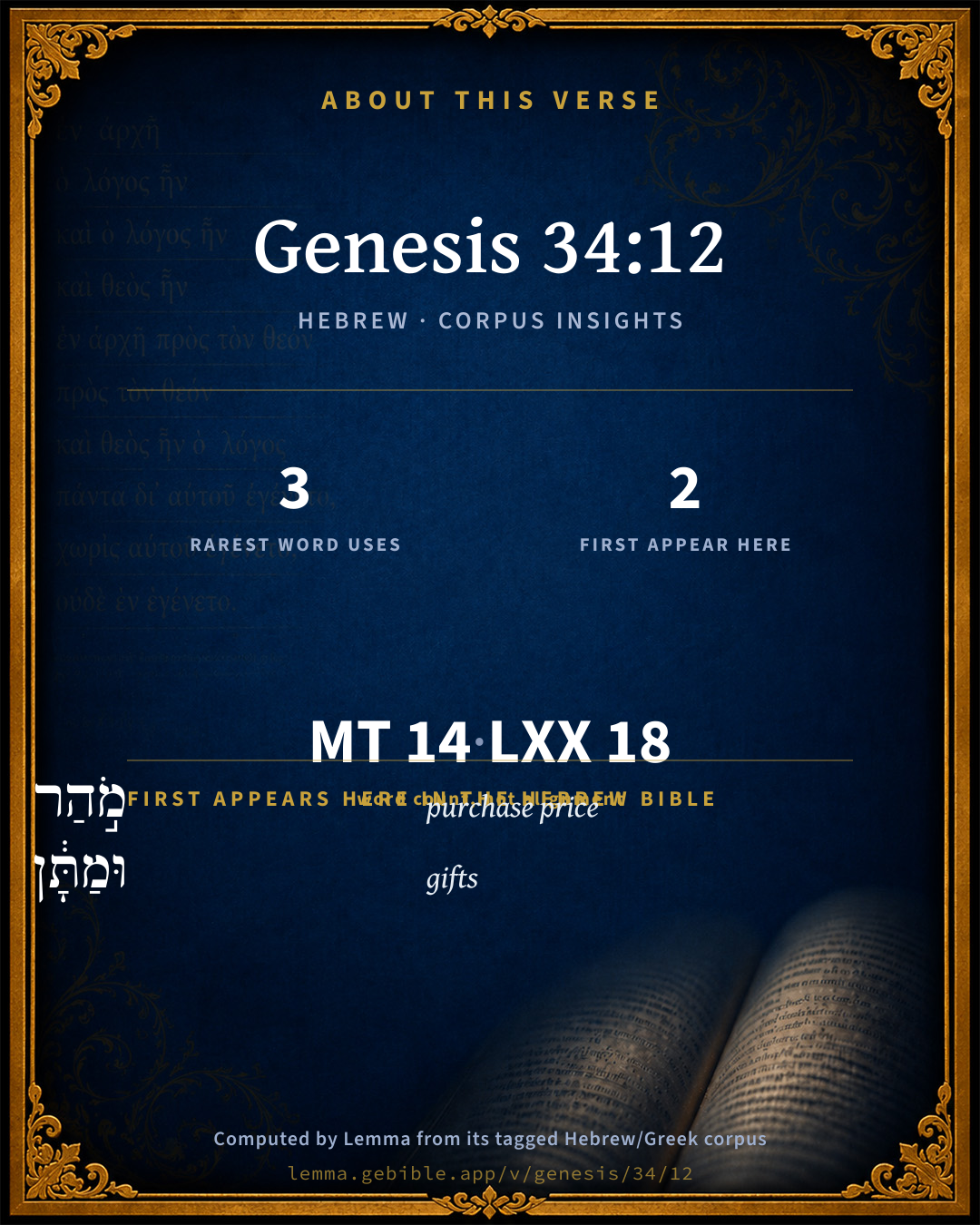
  • 2 first appearances in the Hebrew Bible
Full analysis ↓
Download a study sheet

One document with this verse’s original text, its word-by-word gloss line, the meaning frame, cross-references with their text, attributed commentary, and full source and license credits — printable, and it pastes into notes with its structure intact.

This verse Autodidact and up

Study sheet (.html) Plain text (.txt)

A passage Seminary Student

Up to 50 verses in one chapter. A passage sheet keeps up to 6 commentary sources and 12 cross-references per verse, in the order this page ranks them, and says so on the sheet whenever that leaves anything out. Ask for a single verse and you get the Autodidact verse sheet above.

Everything on this page stays free to read, with no account — the sheet is a download of what is already on screen, not access to it.

Want to remove ads? Support Godless Engineer
Compare translations 3

The same verse in 3 English versions, stacked beneath the original-language interlinear above. Click any original word for its lexicon entry.

Each is an independent rendering of the whole verse — the interlinear is not word-aligned to these translations.

Highlighted words mark where these versions differ — a whole-verse word diff, not a word-by-word alignment.

  • World English Bible Public Domain
    Ask me a great amount for a dowry, and I will give whatever you ask of me, but give me the young lady as a wife."
  • King James Version Public Domain
    Ask me never so much dowry and gift, and I will give according as ye shall say unto me: but give me the damsel to wife.
  • unfoldingWord Literal Text CC BY-SA 4.0
    Increase greatly the dowry and gift for me, and I will give according to what you say to me. Then give the young woman to me as a wife.”

unfoldingWord Literal Text — © unfoldingWord, licensed CC BY-SA 4.0. Word-aligned USFM3 via Door43 (git.door43.org/unfoldingWord/en_ult).

Versions to compare (up to 4)

3 of 4 selected

Show all 18 translations

Every available English version of this verse, each an independent rendering of the whole verse.

  • World English Bible Public Domain
    Ask me a great amount for a dowry, and I will give whatever you ask of me, but give me the young lady as a wife."
  • Berean Standard Bible Public Domain
    Demand a high dowry and an expensive gift, and I will give you whatever you ask. Only give me the girl as my wife!”
  • Majority Standard Bible Public Domain
    Demand a high dowry and an expensive gift, and I will give you whatever you ask. Only give me the girl as my wife!”
  • King James Version Public Domain
    Ask me never so much dowry and gift, and I will give according as ye shall say unto me: but give me the damsel to wife.
  • American Standard Version (1901) Public Domain
    Ask me never so much dowry and gift, and I will give according as ye shall say unto me: but give me the damsel to wife.
  • Revised Version (1885) Public Domain
    Ask me never so much dowry and gift, and I will give according as ye shall say unto me: but give me the damsel to wife.
  • Geneva Bible (1599) Public Domain
    Aske of me abundantly both dowrie and giftes, and I will giue as ye appoint me, so that ye giue me the maide to wife.
  • Douay-Rheims (1899) Public Domain
    Raise the dowery,, and ask gifts, and I will gladly give what you shall demand: only give me this damsel to wife.
  • Young's Literal Translation Public Domain
    multiply on me exceedingly dowry and gift, and I give as ye say unto me, and give to me the young person for a wife.'
  • Literal Standard Version CC BY-SA 4.0
    multiply on me dowry and gift exceedingly, and I give as you say to me, and give to me the young person for a wife.”
  • Unlocked Literal Bible CC BY-SA 4.0
    Ask me for as great a bride price and gift as you will, and I will give whatever you say to me, but give me the young woman as a wife.”
  • unfoldingWord Literal Text CC BY-SA 4.0
    Increase greatly the dowry and gift for me, and I will give according to what you say to me. Then give the young woman to me as a wife.”
  • Darby Bible Public Domain
    Impose on me very much as dowry and gift, and I will give according as ye shall say to me; but give me the maiden as wife.
  • World Messianic Bible Public Domain
    Ask me a great amount for a dowry, and I will give whatever you ask of me, but give me the young lady as a wife.”
  • Webster's Bible Public Domain
    Ask me never so much dower and gift, and I will give according as ye shall say to me: but give me the damsel for a wife.
  • Free Bible Version CC BY-SA 4.0
    You can set the bride price as high as you like, and I'll pay it along with all the gifts I'll give. Just let me have the girl so I can marry her.”
  • Bible in Basic English Public Domain
    However great you make the bride-price and payment, I will give it; only let me have the girl for my wife.
  • JPS Tanakh (1917) Public Domain
    Ask me never so much dowry and gift, and I will give according as ye shall say unto me; but give me the damsel to wife.'

Literal Standard Version (2020), Covenant Press — licensed CC BY-SA 4.0. Text via the HelloAO Bible API (eBible.org). Unlocked Literal Bible (unfoldingWord) — licensed CC BY-SA 4.0. Text via the HelloAO Bible API (eBible.org). unfoldingWord Literal Text — © unfoldingWord, licensed CC BY-SA 4.0. Word-aligned USFM3 via Door43 (git.door43.org/unfoldingWord/en_ult). Free Bible Version, Dr. Jonathan Gallagher — licensed CC BY-SA 4.0. Text via the HelloAO Bible API (eBible.org).

Word by word

More ways to search: Search by grammar → Find every occurrence → Compare this word →

Practice this passage: Drill this verse → Learn its vocabulary →

מֹ֣הַר
môhar
H4119
“purchase price”
Noun, Common, Masculine, Singular, Absolute
Part of Speech
Noun
Type
Common
Gender
Masculine
Number
Singular
State
Absolute
Full BDB Definition

Origin: from H4117

TWOT: 1153a

purchase price for wife, wedding money
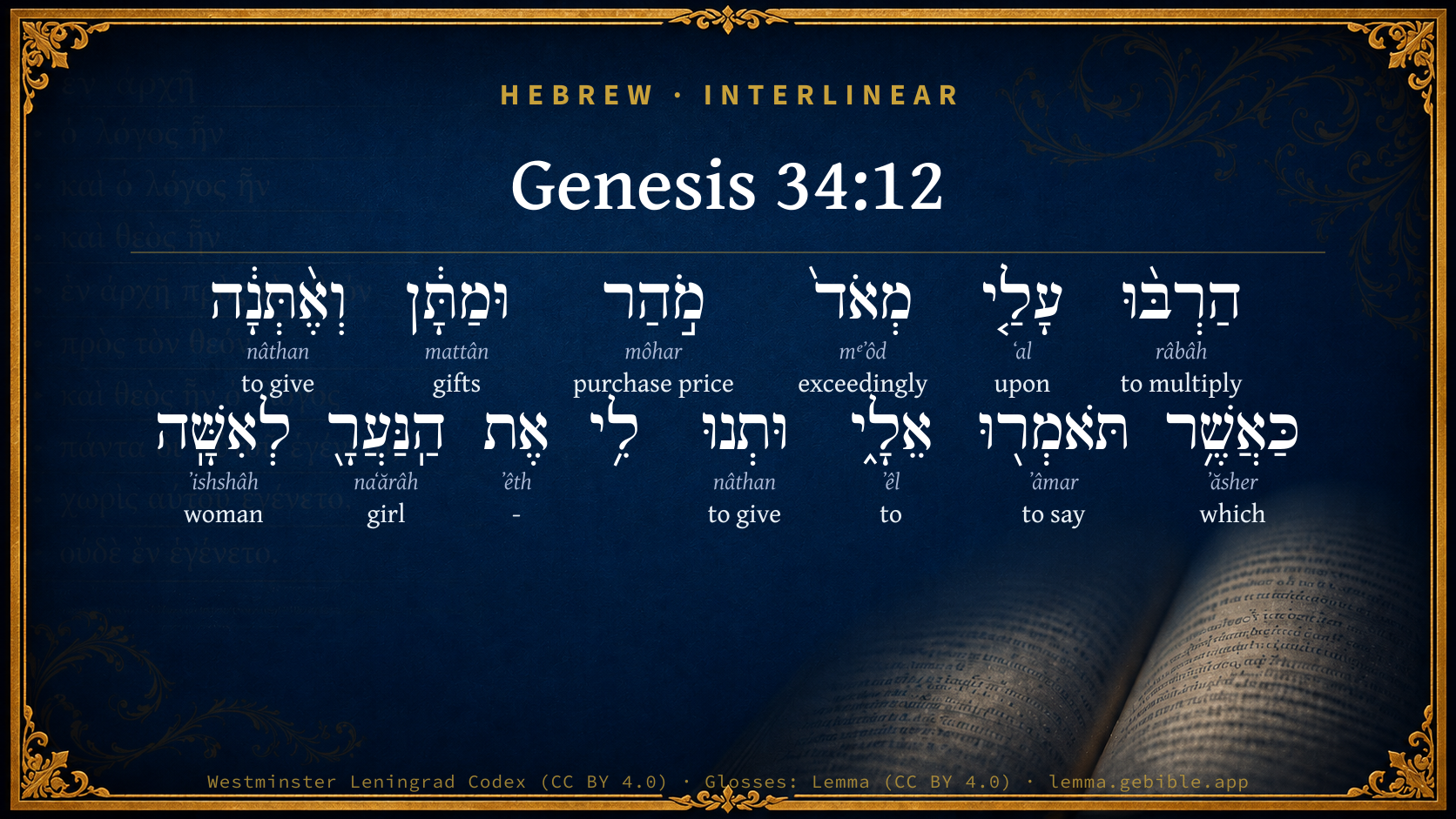
  1. הַרְבּ֨וּ râbâh H7235 “multiply” Verb, Hiphil, Imperative, 2nd Person, Masculine, Plural
  2. עָלַ֤י ʻal H5921 “upon · me” Preposition + Suffix, Personal, 1st Person, Common, Singular
  3. מְאֹד֙ mᵉʼôd H3966 “exceedingly” Adverb
  4. וּמַתָּ֔ן mattân H4976 “and · gifts” Conjunction + Noun, Common, Masculine, Singular, Absolute
  5. וְאֶ֨תְּנָ֔ה nâthan H5414 “and · to give” Conjunction + Verb, Qal, Cohortative, 1st Person, Common, Singular
  6. כַּאֲשֶׁ֥ר ʼăsher H834 “like/as · which” Preposition + Particle, Relative
  7. תֹּאמְר֖וּ ʼâmar H559 “to say” Verb, Qal, Imperfect, 2nd Person, Masculine, Plural
  8. אֵלָ֑י ʼêl H413 “to · me” Preposition + Suffix, Personal, 1st Person, Common, Singular
  9. וּתְנוּ nâthan H5414 “and · give” Conjunction + Verb, Qal, Imperative, 2nd Person, Masculine, Plural
  10. אֶת ʼêth H853 “-” Particle, Direct Object
  11. הַֽנַּעֲרָ֖ naʻărâh H5291 “the · girl” Particle, Definite Article + Noun, Common, Feminine, Singular, Absolute
  12. לְאִשָּֽׁה ʼishshâh H802 “to/for · woman” Preposition + Noun, Common, Feminine, Singular, Absolute

About this verse

These counts appear in no published source. They are computed here, from the morphology-tagged text and Lemma’s own curated glosses. What Lemma adds →

14
words
12
distinct lemmas
Pentateuch
section

Notable vocabulary

The rarest word here is מֹ֣הַר purchase price H4119 — appearing just 3 times in the whole Hebrew Bible.

First appearance in Scripture

These words make their first canonical appearance in the Hebrew Bible here:

  • מֹ֣הַר purchase price H4119
  • וּמַתָּ֔ן gifts H4976

Shared distinctive vocabulary

מֹ֣הַר purchase price H4119 occurs in 3 verses of the Hebrew Bible. Also found in:

Grammatical profile

  • 4 verbs
  • 4 nouns
  • 3 prepositions
  • 1 adverb
  • 2 particles

Verb forms

  • הַרְבּ֨וּ Hiphil · Imperative
  • וְאֶ֨תְּנָ֔ה Qal · Cohortative
  • תֹּאמְר֖וּ Qal · Imperfect
  • וּתְנוּ Qal · Imperative

Repetition

A word recurs within this verse — often emphatic in Hebrew:

  • וְאֶ֨תְּנָ֔ה to give H5414 ×2

Hebrew & Septuagint length

In English translation the verse runs 26 words from the Hebrew and 28 from the Septuagint (LXX English) — closely comparable.

A rough comparison of the two English renderings, which tokenize alike — not a word-level alignment.

Word counts can differ between the Hebrew and the Greek without any difference in meaning — e.g. the Hebrew direct-object marker אֵת has no separate Greek word, and Greek often adds the article ὁ.

In the original languages it is 14 Hebrew tokens and 18 Greek tokens — but the two are counted differently (Hebrew bundles its prefixes and suffixes into one token; the Greek is in lemma form), so that isn’t a like-for-like length.

Cross-references

9

Topical passages linked to Genesis 34:12 in the Treasury of Scripture Knowledge — connected by theme and wording, ordered by reader-vote popularity; previews shown in the World English Bible.

  • Exodus 22:16–17 "If a man entices a virgin who isn't pledged to be married, and lies with her, he shall surely pay a dowry for her to be his wife.
  • Genesis 24:53 The servant brought forth jewels of silver, and jewels of gold, and clothing, and gave them to Rebekah. He gave also to her brother and to her mother precious things.
  • Genesis 29:18 Jacob loved Rachel. He said, "I will serve you seven years for Rachel, your younger daughter."
  • Genesis 31:41 These twenty years have I been in your house. I served you fourteen years for your two daughters, and six years for your flock, and you have changed my wages ten times.
  • Deuteronomy 22:28–29 If a man find a lady who is a virgin, who is not pledged to be married, and lay hold on her, and lie with her, and they be found;
  • 1 Samuel 18:25–27 Saul said, Thus shall you tell David, The king desires no dowry except one hundred foreskins of the Philistines, to be avenged of the king's enemies. Now Saul thought to make David fall by the hand of the Philistines.
  • 2 Samuel 3:14 David sent messengers to Ish-bosheth, Saul's son, saying, Deliver me my wife Michal, whom I pledged to be married to me for one hundred foreskins of the Philistines.
  • Matthew 14:17 They told him, "We only have here five loaves and two fish."
  • Hosea 3:2 So I bought her for myself for fifteen pieces of silver and a homer and a half of barley.

Cross-references courtesy of OpenBible.info (CC BY 4.0).

Hebrew and Greek witnesses Masoretic Hebrew ↔ Greek Septuagint

The same verse in the two great witnesses to the Old Testament, shown verse-for-verse.

These are two independent witnesses, not word-aligned to each other, and the Septuagint is shown in lemma (dictionary) form.

Hebrew Genesis 34:12 Masoretic · Westminster Leningrad Codex

הַרְבּ֨וּ עָלַ֤י מְאֹד֙ מֹ֣הַר וּמַתָּ֔ן וְאֶ֨תְּנָ֔ה כַּאֲשֶׁ֥ר תֹּאמְר֖וּ אֵלָ֑י וּתְנוּ לִ֥י אֶת הַֽנַּעֲרָ֖ לְאִשָּֽׁה

Ask me a great amount for a dowry, and I will give whatever you ask of me, but give me the young lady as a wife."

World English Bible · Public Domain

Greek LXX Genesis 34:12 Septuagint · lemma form

πληθύνω ὁ φερνή σφόδρα καί δίδωμι καθότι ἄν εἶπον ἐγώ καί δίδωμι ἐγώ ὁ παῖς οὗτος εἰς γυνή

Multiply your demand of dowry very much, and I will give accordingly as you⌃ shall say to me, only you⌃ shall give me this damsel for a wife.

LXX2012 (modern English Septuagint) · Public Domain

Hebrew: Westminster Leningrad Codex (CC BY 4.0). Greek: Septuagint (public domain); English from LXX2012 (modern English Septuagint) (Public Domain). How the Septuagint differs from the Hebrew →

Targum (Aramaic paraphrase)

2

The Targum is the ancient Jewish Aramaic paraphrase of the Hebrew Scriptures — an interpretive translation, not the Hebrew text itself. Onkelos (literal) and Pseudo-Jonathan (expansive) render the Torah, and Jonathan the Prophets. Coverage is partial: where no permissively-licensed English translation exists for a verse, only the Aramaic is shown. This is verse-level text, not a word-by-word alignment to the Hebrew.

  1. Targum Onkelos Torah (Genesis–Deuteronomy)
    אַסְגוּ עָלַי לַחֲדָא מוֹהֲרִין וּמַתְּנָן וְאֶתֵּן כְּמָא דִּי תֵימְרוּן לִי וְהָבוּ לִי יָת עוּלֶמְתָּא:לאִנְתּוּ

    (no public-domain English translation for this verse)

    Targum Onkelos — Aramaic: “Onkelos Genesis” (public domain); “Onkelos Exodus” (public domain); “Onkelos Leviticus” (public domain); “Onkelos Numbers” (public domain); “Onkelos Deuteronomy” (public domain). English: “Sefaria Community Translation” (CC0 1.0 (public-domain dedication)); “J.W. Etheridge. The Targums of Onkelos and Jonathan Ben Uzziel on the Pentateuch. London: Longmans, Green, 1862” (public domain). Text via Sefaria.

  2. Targum Pseudo-Jonathan Torah (Genesis–Deuteronomy)
    אַסְגוּ עָלַי לַחֲדָא מוֹהֲרָא וּמַתְּנָא וְאִיתֵּין הֵיכְמָא דְתֵימְרוּן לִי וִיהָבוּ לִי יַת רִיבָא לְאִנְתּוּ

    Multiply upon me greatly dowry and gift, and I will give as you shall tell me; only give me the damsel to wife.

    Targum Pseudo-Jonathan — Aramaic: “Targum Jonathan on Genesis” (public domain); “Targum Jonathan on Exodus” (public domain); “Targum Jonathan on Leviticus” (public domain); “Targum Jonathan on Numbers” (public domain); “Targum Jonathan on Deuteronomy” (public domain). English: “The Targum of Jonathan ben Uzziel, trans. J. W. Etheridge, London, 1862” (public domain). Text via Sefaria.

Commentary

Notes on Genesis 34:12 from classic Christian and Jewish commentators (each source and its license shown beneath its notes). The classic Christian expositions comment on the surrounding passage and are grouped to its opening verse, so a note may address several verses; the Jewish commentaries on the Tanakh (Rashi and others) are per-verse, so they appear only where the commentator wrote on this verse.

Lemma curates 59 commentaries, every one of them public domain or Creative Commons licensed, each selected and text-cleaned for this edition rather than reprinted as found. About our sources →

Trapp's Complete Commentary

John Trapp

Gen 34:12 Ask me never so much dowry and gift, and I will give according as ye shall say unto me: but give me the damsel to wife.

Ver. 12. {See Trapp on "Gen 34:11"}

John Trapp, A Commentary or Exposition upon All the Books of the Old and New Testament (1647–1656) — public domain. Text from a community e-Sword module.

Joseph Benson's Commentary

Gen 34:12-13. Ask me never so much dowry and gift — Dowry to her for her portion, according to the ancient custom of men’s buying their wives, Exo 22:17; and gift to you, either for reparation of the past injury, or in testimony of my respect to you, and desire of her. The sons of Jacob answered deceitfully — Pretending and promising marriages with them upon that condition, which they never intended.

Joseph Benson's Commentary on the Old and New Testaments (1811–1818) — public domain. Text from a community e-Sword module.

Geneva Bible (1599)

Geneva Bible translators

Hebrew, multiply greatly the dowry.

Geneva Bible (1599) marginal notes — public domain. Text via Bolls.life.

Jamieson, Fausset & Brown

Robert Jamieson, A. R. Fausset & David Brown

Ask me never so much dowry and gift--The gift refers to the presents made at betrothal, both to the bride elect and her relations (compare Gen 24:53), the dowry to a suitable settlement upon her.

Jamieson, Fausset & Brown — Commentary Critical and Explanatory on the Whole Bible (1871) — public domain (CC PDM 1.0). Text via the HelloAO Bible API.

Adam Clarke's Commentary

Verse 12. Ask me never so much dowry] See Clarke on Ge 29:20, c. See the law relative to this, Ex 22:16-17.

Adam Clarke's Commentary on the Bible (1810–1826) — public domain. Text from a community e-Sword/MySword module.

Ellicott's Commentary for English Readers

(12) Dowry and gift.—The word rendered dowry (mohar) is the price paid to the parents and relatives of the bride, though taking the form of a present. The gift (matthan) was the present made by the bridegroom to the bride herself. Besides this, her relatives were expected to give her presents, and with some tribes of Arabs it is usual even to make over to her the dowry.

A Bible Commentary for English Readers, edited by Charles John Ellicott (1878–1897) — public domain. Text from a community e-Sword module.

The Cambridge Bible for Schools and Colleges

gen. ed. J. J. S. Perowne

12. dowry and gift] The “dowry,” or mohar, is the present made to the parents or relations, cf. Gen_24:53; Exo_22:16; 1Sa_18:25. The rendering “dowry” hardly, therefore, gives the correct idea to English readers. The “gift,” on the other hand, was the present made by the bridegroom to the bride, as in Gen_24:53, Gen_29:18. In Exo_22:16, as in the present passage, the “dowry” is a payment to the parents as “compensation” for wrong, as well as “purchase-money” for the wife; cf. Deu_22:28-29.

The Cambridge Bible for Schools and Colleges (gen. ed. J. J. S. Perowne; Cambridge University Press, 1878–1918) — public domain. Text from a community e-Sword module.

John Gill's Exposition

Ask me never so much dowry and gift,.... Or "multiply them exceedingly" (i), fix them at as high a rate as may be thought fit; the "dowry" was what a man gave to a woman at her marriage; for in those times and countries, instead of a man having a portion with his wife, as with us in our times, he gave one to his wife, or to her parents for her; and especially in after times this was used, and became a law in Israel, in the case of a vitiated virgin, see Exo 22:16; and "the gift" was either of jewels and clothes to the women, or of such like precious things to her brethren and friends, see Gen 24:53,

and I will give according as ye shall say unto me; determine among yourselves whatever shall be the dowry and gift, and it shall be punctually observed:

but give me the damsel to wife; only agree to that, and I care not what is required of me.

(i) "multiplicate super me admodum", Drusius, Schmidt.

John Gill's Exposition of the Whole Bible (1746–1763) — public domain (CC PDM 1.0). Text via the HelloAO Bible API.

Haydock's Catholic Bible Commentary

Dowry for Dina. --- Gifts for her parents and brothers, chap. xxiv. 53. (Calmet)

George Leo Haydock (1774–1849), Haydock's Catholic Family Bible and Commentary, 1859 edition — public domain. Excludes Psalms (Douay-Rheims chapter numbering differs from Protestant) and Deuterocanonical books (Catholic canon only).

Matthew Poole's English Annotations

Dowry to her for her portion, according to the ancient custom of men’s buying their wives; of which see Exo 22:17; and

gift to you, either for reparation of the past injury, or in testimony of my respect to you, and desire of her, as Gen 24:53.

Matthew Poole's English Annotations on the Holy Bible (1683–1685) — public domain. Text from a community e-Sword/MySword module.

Rashi

Rabbi Shlomo Yitzchaki (Rashi)

מהר DOWRY, refers to the Ketuba (the sum settled by the husband on his wife as set forth in the Ketuba — the marriage contract (Genesis Rabbah 80:7).

Rashi on the Tanakh — English translations: “The Judaica Press complete Tanach with Rashi, translated by A. J. Rosenberg” (CC BY 4.0); “Pentateuch with Rashi's commentary by M. Rosenbaum and A.M. Silbermann, 1929-1934” (public domain); “The Metsudah Tanach series, Lakewood, N.J” (CC BY 4.0); and “The Book of Joshua, Metsudah Publications, 1997” (CC BY 4.0). Text via Sefaria.

Ramban (Nachmanides)

Rabbi Moshe ben Nachman (Ramban / Nachmanides)

‘MOHAR’ (DOWRY) ‘UMATAN’ (AND GIFT). Mohar [refers to the bridal gifts given at the time of] the marriage-contract which is given to maidens, as it is written, according to the dowry of virgins, these being the presents which the young men send to the maidens whom they marry. Umatan are garments or silver and gold which the groom sends to her father and her brothers. In Bereshith Rabbah the Rabbis said: “Mohar is parnon (the wife’s settlement); matan is parapurnon (the additional settlement above the usual dowry),” these being in the language of the Jerusalem Talmud “the regular dowry” and “the usufruct estate,” that is to say, that which he gives her of his properties to be accounted as if she had brought them from her father’s house, the produce of which belongs to him.The reason for this conciliatory gesture is in order that they willingly give her to him as a wife, as the maiden did not consent to him and she steadily protested and cried. This is the sense of the verse, And he spoke comfortingly unto the damsel. Therefore Shechem said, Take me this young maiden to wife, as she was already in his house and in his power, and he feared not her brothers because he was the prince of the country and how could they take her by force out of his house? Now Shechem’s great desire was because the maiden was very beautiful. However, Scripture did not narrate her beauty as it did in the case of Sarah, Rebekah and Rachel because it did not want to mention that which was to her a stumbling-block of iniquity, while Scripture speaks only in praise of the righteous women but not of this one. Similarly, Scripture does not mention what happened to her after her rescue from Shechem’s house. In line with the simple meaning of Scripture she stayed with her brothers, “shut up, living as widows,” as she was considered defiled in their sight, as it is written, Because he had defiled Dinah their sister. Our Rabbis have differed on this matter. The most feasible opinion is that of he who says that Simeon took her, and upon her death, he buried her in the land of Canaan, this being in agreement with what we have said, i.e., that she was with him in his house as a widow, and she went down with them to Egypt, and there she died but was buried in the Land of Israel. Her grave is known by tradition to this day as being in the city of Arbel with the grave of Nitai the Arbelite. It is possible that Simeon brought up her remains from Egypt out of pity for her while the Israelites were still in Egypt or that the children of Israel brought them up together with the bones of her brothers — all the tribes — just as our Rabbis have mentioned.

Ramban (Nachmanides) on the Tanakh — English translation: “Commentary on the Torah by Ramban (Nachmanides). Translated and annotated by Charles B. Chavel. New York, Shilo Pub. House, 1971-1976” (CC BY 4.0). Text via Sefaria.

Lesson kit

Teaching starters — assembled from the data on this page, not authored interpretation. Every prompt links to the verse data it draws on. Edit before teaching.

Genesis, in the Pentateuch, opens this verse with 14 words (12 distinct Hebrew lemmas). Its most distinctive word is môhar (“purchase price”). A historical commentator’s framing appears above. Read the whole chapter for the surrounding context.

Discussion questions

  1. What does “purchase price” (môhar) contribute to the verse as a whole?
  2. 2 words here appear for the first time in Scripture. What is being introduced at this debut?
  3. Exodus 22:17 shares the word «purchase price» with this verse. How do the two illuminate each other?
  4. “to give” occurs 2× in this one verse. What is the effect of the repetition?
  5. These translations render this verse differently; the difference is in the English rendering, not the original. What questions does that raise?
  6. The verb «הַרְבּ֨וּ» is Hiphil Imperative. How does its form color the action?
  7. Reading how Trapp's Complete Commentary and Joseph Benson's Commentary read this verse, where do the two commentators agree and where do they part?

Things to notice

Reading settings

Reading text

Shown beneath each verse's original-language words.

Old Testament
Old Testament edition

Read the OT as the Masoretic Hebrew (MT) or the Greek Septuagint (LXX).

English shown for the Greek Septuagint (in the Hebrew ↔ Greek comparison).

Comparing translations? Open the Compare panel on any verse page to stack up to four side by side.