Genesis 48:22

Hebrew (Westminster Leningrad Codex) Genesis 48:22 appears in the Hebrew Old Testament. The text above is from the Westminster Leningrad Codex. Each word links to its Strong’s number, a concise gloss, and parsing drawn from the Open Scriptures Hebrew Bible morphology. Click any word for its full Brown-Driver-Briggs (BDB) entry.
Download image
Cite this verse

Genesis 48:22 (World English Bible). Public Domain. Lemma interlinear Bible study tool, https://lemma.gebible.app/v/genesis/48/22.

Show BibTeX & RIS
BibTeX
RIS
English Translation
Moreover I have given to you one portion above your brothers, which I took out of the hand of the Amorite with my sword and with my bow."
World English Bible · Public Domain
Download a study sheet

One document with this verse’s original text, its word-by-word gloss line, the meaning frame, cross-references with their text, attributed commentary, and full source and license credits — printable, and it pastes into notes with its structure intact.

This verse Autodidact and up

Study sheet (.html) Plain text (.txt)

A passage Seminary Student

Up to 50 verses in one chapter. A passage sheet keeps up to 6 commentary sources and 12 cross-references per verse, in the order this page ranks them, and says so on the sheet whenever that leaves anything out. Ask for a single verse and you get the Autodidact verse sheet above.

Everything on this page stays free to read, with no account — the sheet is a download of what is already on screen, not access to it.

Want to remove ads? Support Godless Engineer
Compare translations 3

The same verse in 3 English versions, stacked beneath the original-language interlinear above. Click any original word for its lexicon entry.

Each is an independent rendering of the whole verse — the interlinear is not word-aligned to these translations.

Highlighted words mark where these versions differ — a whole-verse word diff, not a word-by-word alignment.

  • World English Bible Public Domain
    Moreover I have given to you one portion above your brothers, which I took out of the hand of the Amorite with my sword and with my bow."
  • King James Version Public Domain
    Moreover I have given to thee one portion above thy brethren, which I took out of the hand of the Amorite with my sword and with my bow.
  • unfoldingWord Literal Text CC BY-SA 4.0
    And I give you Shechem, one above your brothers, which I took from the hand of the Amorite with my sword and with my bow.”

unfoldingWord Literal Text — © unfoldingWord, licensed CC BY-SA 4.0. Word-aligned USFM3 via Door43 (git.door43.org/unfoldingWord/en_ult).

Versions to compare (up to 4)

3 of 4 selected

Show all 18 translations

Every available English version of this verse, each an independent rendering of the whole verse.

  • World English Bible Public Domain
    Moreover I have given to you one portion above your brothers, which I took out of the hand of the Amorite with my sword and with my bow."
  • Berean Standard Bible Public Domain
    And to you, as one who is above your brothers, I give the ridge of land that I took from the Amorites with my sword and bow.”
  • Majority Standard Bible Public Domain
    And to you, as one who is above your brothers, I give the ridge of land that I took from the Amorites with my sword and bow.”
  • King James Version Public Domain
    Moreover I have given to thee one portion above thy brethren, which I took out of the hand of the Amorite with my sword and with my bow.
  • American Standard Version (1901) Public Domain
    Moreover I have given to thee one portion above thy brethren, which I took out of the hand of the Amorite with my sword and with my bow.
  • Revised Version (1885) Public Domain
    Moreover I have given to thee one portion above thy brethren, which I took out of the hand of the Amorite with my sword and with my bow.
  • Geneva Bible (1599) Public Domain
    Moreouer, I haue giuen vnto thee one portion aboue thy brethren, which I gate out of the hand of the Amorite by my sworde and by my bowe.
  • Douay-Rheims (1899) Public Domain
    I give thee a portion above thy brethren, which I took out of the hand of the Amorrhite a with my sword and bow.
  • Young's Literal Translation Public Domain
    and I -- I have given to thee one portion above thy brethren, which I have taken out of the hand of the Amorite by my sword and by my bow.'
  • Literal Standard Version CC BY-SA 4.0
    and I have given to you one portion above your brothers, which I have taken out of the hand of the Amorite by my sword and by my bow.”
  • Unlocked Literal Bible CC BY-SA 4.0
    To you, as one who is above your brothers, I give to you the mountain slope that I took from the Amorites with my sword and my bow.”
  • unfoldingWord Literal Text CC BY-SA 4.0
    And I give you Shechem, one above your brothers, which I took from the hand of the Amorite with my sword and with my bow.”
  • Darby Bible Public Domain
    And *I* have given to thee one tract [of land] above thy brethren, which I took out of the hand of the Amorite with my sword and with my bow.
  • World Messianic Bible Public Domain
    Moreover I have given to you one portion above your brothers, which I took out of the hand of the Amorite with my sword and with my bow.”
  • Webster's Bible Public Domain
    Moreover I have given to thee one portion above thy brethren, which I took out of the hand of the Amorite with my sword and with my bow.
  • Free Bible Version CC BY-SA 4.0
    I'm also giving you something in addition to what I'm giving your brothers—the piece of land on the mountain slope of Shechem that I took from the Amorites with my sword and bow.”
  • Bible in Basic English Public Domain
    And I have given you more than your brothers, even Shechem as your heritage, which I took from the Amorites with my sword and my bow.
  • JPS Tanakh (1917) Public Domain
    Moreover I have given to thee one portion above thy brethren, which I took out of the hand of the Amorite with my sword and with my bow.'

Literal Standard Version (2020), Covenant Press — licensed CC BY-SA 4.0. Text via the HelloAO Bible API (eBible.org). Unlocked Literal Bible (unfoldingWord) — licensed CC BY-SA 4.0. Text via the HelloAO Bible API (eBible.org). unfoldingWord Literal Text — © unfoldingWord, licensed CC BY-SA 4.0. Word-aligned USFM3 via Door43 (git.door43.org/unfoldingWord/en_ult). Free Bible Version, Dr. Jonathan Gallagher — licensed CC BY-SA 4.0. Text via the HelloAO Bible API (eBible.org).

Word by word

More ways to search: Search by grammar → Find every occurrence → Compare this word →

Practice this passage: Drill this verse → Learn its vocabulary →

שְׁכֶ֥ם
shᵉkem
H7926
“shoulder”
Noun, Common, Masculine, Singular, Absolute
Part of Speech
Noun
Type
Common
Gender
Masculine
Number
Singular
State
Absolute
Full BDB Definition

Origin: from H7925

TWOT: 2386a

shoulder, back - shoulder, shoulder-blade - back (in general)
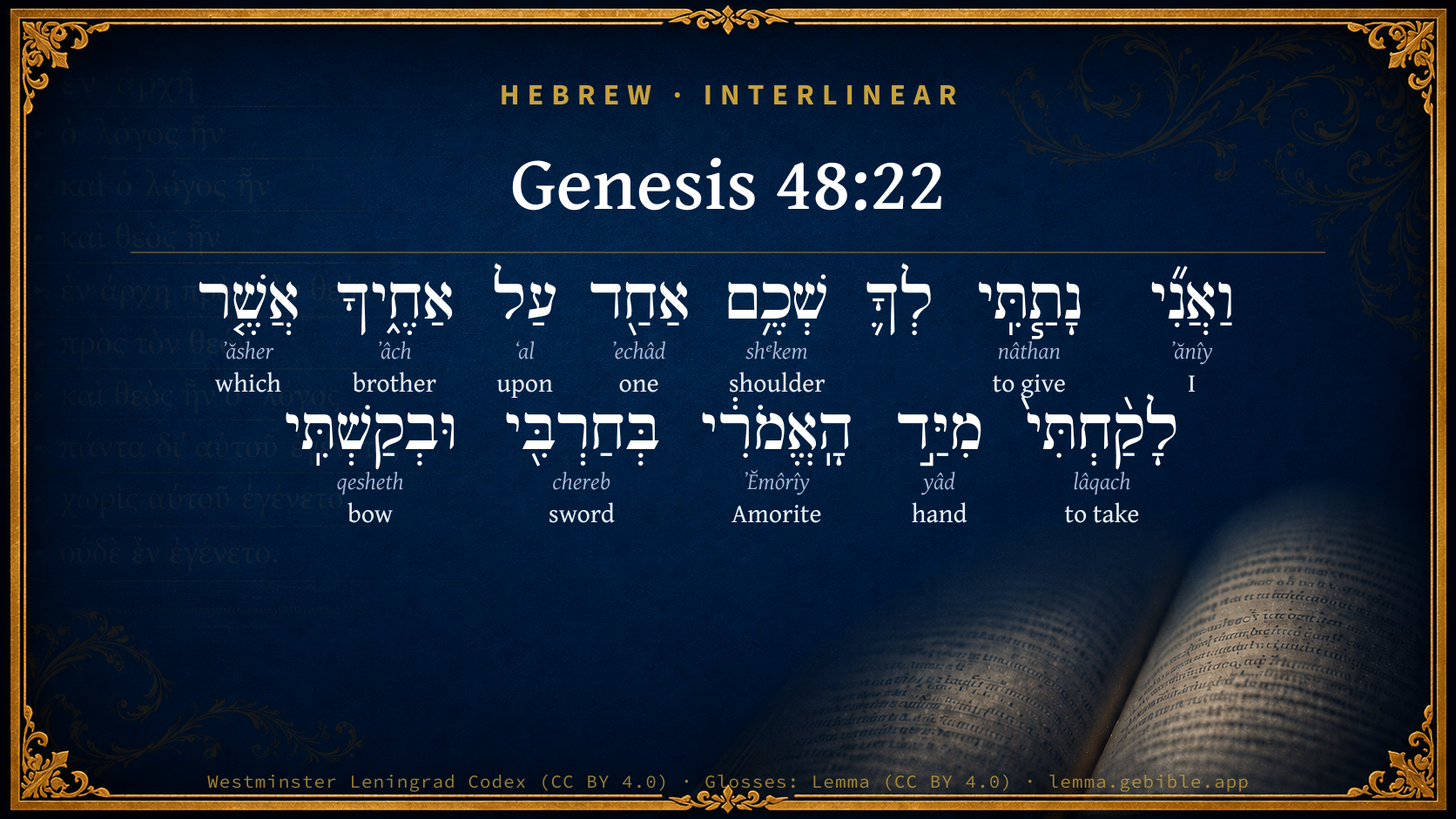
  1. וַאֲנִ֞י ʼănîy H589 “and · I” Conjunction + Pronoun, Personal, 1st Person, Common, Singular
  2. נָתַ֧תִּֽי nâthan H5414 “to give” Verb, Qal, Perfect, 1st Person, Common, Singular
  3. אַחַ֖ד ʼechâd H259 “one” Adjective, Cardinal number, Masculine, Singular, Absolute
  4. עַל ʻal H5921 “upon” Preposition
  5. אַחֶ֑יךָ ʼâch H251 “brothers · your” Noun, Common, Masculine, Plural, Construct + Suffix, Personal, 2nd Person, Masculine, Singular
  6. אֲשֶׁ֤ר ʼăsher H834 “which” Particle, Relative
  7. לָקַ֨חְתִּי֙ lâqach H3947 “to take” Verb, Qal, Perfect, 1st Person, Common, Singular
  8. מִיַּ֣ד yâd H3027 “from · hand of” Preposition + Noun, Common, Both, Singular, Construct
  9. הָֽאֱמֹרִ֔י ʼĔmôrîy H567 “the · Amorite” Particle, Definite Article + Noun, Gentilic, Masculine, Singular, Absolute
  10. בְּחַרְבִּ֖י chereb H2719 “in/at · sword · my” Preposition + Noun, Common, Feminine, Singular, Construct + Suffix, Personal, 1st Person, Common, Singular
  11. וּבְקַשְׁתִּֽי qesheth H7198 “and · in/at · bow · my” Conjunction + Preposition + Noun, Common, Feminine, Singular, Construct + Suffix, Personal, 1st Person, Common, Singular

About this verse

These counts appear in no published source. They are computed here, from the morphology-tagged text and Lemma’s own curated glosses. What Lemma adds →

13
words
12
distinct lemmas
Pentateuch
section

Notable vocabulary

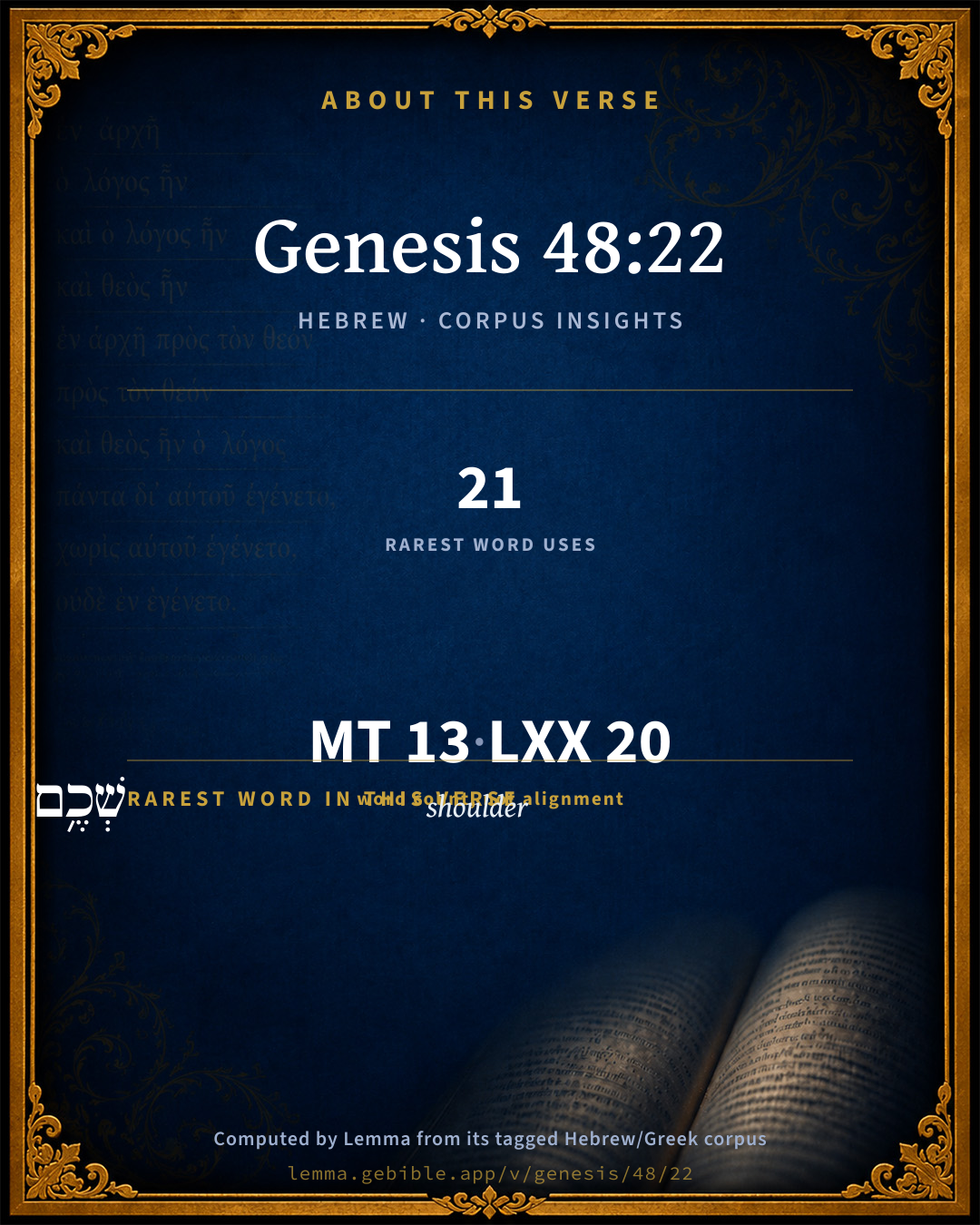
The rarest word here is שְׁכֶ֥ם shoulder H7926 — appearing just 21 times in the whole Hebrew Bible.

Shared distinctive vocabulary

שְׁכֶ֥ם shoulder H7926 occurs in 21 verses of the Hebrew Bible. Also found in:

Grammatical profile

  • 2 verbs
  • 6 nouns
  • 1 adjective
  • 1 pronoun
  • 2 prepositions
  • 1 particle

Verb forms

  • נָתַ֧תִּֽי Qal · Perfect
  • לָקַ֨חְתִּי֙ Qal · Perfect

Hebrew & Septuagint length

In English translation the verse runs 28 words from the Hebrew and 27 from the Septuagint (LXX English) — closely comparable.

A rough comparison of the two English renderings, which tokenize alike — not a word-level alignment.

Word counts can differ between the Hebrew and the Greek without any difference in meaning — e.g. the Hebrew direct-object marker אֵת has no separate Greek word, and Greek often adds the article ὁ.

In the original languages it is 13 Hebrew tokens and 20 Greek tokens — but the two are counted differently (Hebrew bundles its prefixes and suffixes into one token; the Greek is in lemma form), so that isn’t a like-for-like length.

Cross-references

11

Topical passages linked to Genesis 48:22 in the Treasury of Scripture Knowledge — connected by theme and wording, ordered by reader-vote popularity; previews shown in the World English Bible.

  • John 4:5 So he came to a city of Samaria, called Sychar, near the parcel of ground that Jacob gave to his son, Joseph.
  • Joshua 24:32 The bones of Joseph, which the children of Israel brought up out of Egypt, buried they in Shechem, in the parcel of ground which Jacob bought of the sons of Hamor the father of Shechem for a hundred pieces of money: and they became the inheritance of the children of Joseph.
  • 1 Chronicles 5:2 For Judah prevailed above his brothers, and of him came the prince; but the birthright was Joseph's:)
  • Genesis 15:16 In the fourth generation they will come here again, for the iniquity of the Amorite is not yet full."
  • Genesis 33:19 He bought the parcel of ground, where he had spread his tent, at the hand of the children of Hamor, Shechem's father, for one hundred pieces of money.
  • Genesis 34:28 They took their flocks, their herds, their donkeys, that which was in the city, that which was in the field;
  • Deuteronomy 21:17 but he shall acknowledge the firstborn, the son of the hated, by giving him a double portion of all that he has; for he is the beginning of his strength; the right of the firstborn is his.
  • Joshua 17:14–18 The children of Joseph spoke to Joshua, saying, Why have you given me but one lot and one part for an inheritance, seeing I am a great people, because hitherto Yahweh has blessed me?
  • Judges 11:23 So now Yahweh, the God of Israel, has dispossessed the Amorites from before his people Israel, and should you possess them?
  • Amos 2:9 Yet I destroyed the Amorite before them, Whose height was like the height of the cedars, And he was strong as the oaks; Yet I destroyed his fruit from above, and his roots from beneath.
  • Ezekiel 47:13 Thus says the Lord Yahweh: This shall be the border, by which you shall divide the land for inheritance according to the twelve tribes of Israel: Joseph [shall have two] portions.

Cross-references courtesy of OpenBible.info (CC BY 4.0).

Hebrew and Greek witnesses Masoretic Hebrew ↔ Greek Septuagint

The same verse in the two great witnesses to the Old Testament, shown verse-for-verse.

These are two independent witnesses, not word-aligned to each other, and the Septuagint is shown in lemma (dictionary) form.

Hebrew Genesis 48:22 Masoretic · Westminster Leningrad Codex

וַאֲנִ֞י נָתַ֧תִּֽי לְךָ֛ שְׁכֶ֥ם אַחַ֖ד עַל אַחֶ֑יךָ אֲשֶׁ֤ר לָקַ֨חְתִּי֙ מִיַּ֣ד הָֽאֱמֹרִ֔י בְּחַרְבִּ֖י וּבְקַשְׁתִּֽי

Moreover I have given to you one portion above your brothers, which I took out of the hand of the Amorite with my sword and with my bow."

World English Bible · Public Domain

Greek LXX Genesis 48:22 Septuagint · lemma form

ἐγώ δέ δίδωμι σύ σικιμ ἐξαιρετός ὑπέρ ὁ ἀδελφός σύ ὅς λαμβάνω ἐκ χείρ ἀμορραῖος ἐν μάχαιρα ἐγώ καί τόξον

And I give to you Sicima, a select portion above your brethren, which I took out of the hand of the Amorites with my sword and bow.

LXX2012 (modern English Septuagint) · Public Domain

On this verse, The Cambridge Bible for Schools and Colleges discusses the Septuagint’s reading. Read the note in Commentary ↓

Hebrew: Westminster Leningrad Codex (CC BY 4.0). Greek: Septuagint (public domain); English from LXX2012 (modern English Septuagint) (Public Domain). How the Septuagint differs from the Hebrew →

Targum (Aramaic paraphrase)

2

The Targum is the ancient Jewish Aramaic paraphrase of the Hebrew Scriptures — an interpretive translation, not the Hebrew text itself. Onkelos (literal) and Pseudo-Jonathan (expansive) render the Torah, and Jonathan the Prophets. Coverage is partial: where no permissively-licensed English translation exists for a verse, only the Aramaic is shown. This is verse-level text, not a word-by-word alignment to the Hebrew.

  1. Targum Onkelos Torah (Genesis–Deuteronomy)
    וַאֲנָא יְהָבִית לָךְ חוּלַק חַד יַתִּיר עַל אַחָיךְ דִּי נְסֵיבִית מִידָא דֶאֱמוֹרָאָה בִּצְלוֹתִי וּבְבָעוּתִי

    (no public-domain English translation for this verse)

    Targum Onkelos — Aramaic: “Onkelos Genesis” (public domain); “Onkelos Exodus” (public domain); “Onkelos Leviticus” (public domain); “Onkelos Numbers” (public domain); “Onkelos Deuteronomy” (public domain). English: “Sefaria Community Translation” (CC0 1.0 (public-domain dedication)); “J.W. Etheridge. The Targums of Onkelos and Jonathan Ben Uzziel on the Pentateuch. London: Longmans, Green, 1862” (public domain). Text via Sefaria.

  2. Targum Pseudo-Jonathan Torah (Genesis–Deuteronomy)
    וַאֲנָא הָא יְהָבִית לָךְ יַת קַרְתָּא דִשְׁכֶם חוּלַק חָד לְמַתָּנָא יַתִּיר עַל אָחָךְ דִי נְסֵיבִית מִידֵיהוֹן דֶאֱמוֹרָאֵי בְּעִידָן דִי עַלְתוֹן לְגַוָוהּ וְקָמִית וְסַיְיעִית יַתְכוֹן בְּסַיְיפִי וּבְקַשְׁתִּי

    and I, behold, I have given to thee the city of Shekem, one portion for a gift above thy brethren, which I took from the hand of the Amoraee at the time that you went into the midst of it, and I arose and helped you with my sword and with my bow.

    Targum Pseudo-Jonathan — Aramaic: “Targum Jonathan on Genesis” (public domain); “Targum Jonathan on Exodus” (public domain); “Targum Jonathan on Leviticus” (public domain); “Targum Jonathan on Numbers” (public domain); “Targum Jonathan on Deuteronomy” (public domain). English: “The Targum of Jonathan ben Uzziel, trans. J. W. Etheridge, London, 1862” (public domain). Text via Sefaria.

Commentary

Notes on Genesis 48:22 from classic Christian and Jewish commentators (each source and its license shown beneath its notes). The classic Christian expositions comment on the surrounding passage and are grouped to its opening verse, so a note may address several verses; the Jewish commentaries on the Tanakh (Rashi and others) are per-verse, so they appear only where the commentator wrote on this verse.

Lemma curates 59 commentaries, every one of them public domain or Creative Commons licensed, each selected and text-cleaned for this edition rather than reprinted as found. About our sources →

Trapp's Complete Commentary

John Trapp

Gen 48:22 Moreover I have given to thee one portion above thy brethren, which I took out of the hand of the Amorite with my sword and with my bow.

Ver. 22. I have given thee one portion.] Joseph had the double portion, as Judah the dignity, from Reuben; who had forfeited both by his incest. And here it appeareth that the right of the firstborn to a double portion was in force and in use before that law; {Deu 21:17} as was also the Sabbath, circumcision, and the raising up seed to a deceased brother.

With my sword and with my bow.] That is, With the warlike weapons of my sons, Simeon and Levi, whose victory he ascribeth to himself; not as it was wickedly got by his sons, for so he disavows and detests it, {Gen 49:5} but as by a miracle from heaven, the Canaanites were held in from revenging that slaughter, and made to fear his force and valour. The Chaldee Paraphrast expounds it metaphorically; I took it with my sword and my bow; hoc est, oratione et deprecatione mea, saith he; by my prayer and supplication. Prayers, indeed, are bornbardae et instrumenta bellica Christianorum, saith Luther; a Christian’s best arms and ammunition. The Jesuits pretend and protest that they have no other weapons or ways to work, but preces et lachrymas. Whereas it is too well known that they are the greatest incendiaries and boutefeux of Christendom, and their faction a most agile sharp sword, whose blade is sheathed at pleasure in the bowels of every commonwealth; but the handle reacheth to Rome and Spain.

John Trapp, A Commentary or Exposition upon All the Books of the Old and New Testament (1647–1656) — public domain. Text from a community e-Sword module.

Joseph Benson's Commentary

Gen 48:22. I have given to thee one portion above thy brethren — This seems to have been the parcel of ground near Shechem, which Jacob purchased of Hamor, the prince of the country, (Gen 33:19,) and which, it is probable, he took or recovered with his sword and bow, that is, by force of arms, from the Amorites, who had seized on it after his removal to another part of Canaan, although this is not mentioned in Scripture. This parcel of ground he gave to Joseph, as is mentioned, Joh 4:5, of whose sons we find it was the inheritance, Jos 17:1; Jos 20:7. And in it Joseph’s bones were buried, which perhaps Jacob had an eye to as much as to any thing in this settlement. It may sometimes be both just and prudent to give some children portions above the rest; but a grave is that which we can most count upon as our own in this earth.

Joseph Benson's Commentary on the Old and New Testaments (1811–1818) — public domain. Text from a community e-Sword module.

Tyndale Open Study Notes

Tyndale Open Resources

48:22 Joseph was later buried at Shechem (Josh 24:32) as a sign that he possessed this bequeathed extra portion (Hebrew shekem) of land. Jacob had apparently conquered this area though the occasion is not mentioned elsewhere.

Tyndale Open Study Notes — © Tyndale Open Resources, licensed CC BY-SA 4.0. Text via the HelloAO Bible API.

Geneva Bible (1599)

Geneva Bible translators

By my children whom God spared for my sake.

Geneva Bible (1599) marginal notes — public domain. Text via Bolls.life.

Jamieson, Fausset & Brown

Robert Jamieson, A. R. Fausset & David Brown

moreover I have given to thee one portion above thy brethren--This was near Shechem (Gen 33:18; Joh 4:5; also Jos 16:1; Jos 20:7). And it is probable that the Amorites, having seized upon it during one of his frequent absences, the patriarch, with the united forces of his tribe, recovered it from them by his sword and his bow.

Next: Genesis Chapter 49

Jamieson, Fausset & Brown — Commentary Critical and Explanatory on the Whole Bible (1871) — public domain (CC PDM 1.0). Text via the HelloAO Bible API.

Adam Clarke's Commentary

Verse 22. Moreover I have given to thee one portion] שכם אחד shechem achad, one shechem or one shoulder. We have already seen the transactions between Jacob and his family on one part, and Shechem and the sons of Hamor on the other. See Ge 33:18-19, and Ge 34:1-31. As he uses the word shechem here, I think it likely that he alludes to the purchase of the field or parcel of ground mentioned Ge 33:18-19. It has been supposed that this parcel of ground, which Jacob bought from Shechem, had been taken from him by the Amorites, and that he afterwards had recovered it by his sword and by his bow, i. e., by force of arms. Shechem appears to have fallen to the lot of Joseph's sons; (see Jos 17:1, and Jos 20:7); and in our Lord's time there was a parcel of ground near to Sychar or Shechem which was still considered as that portion which Jacob gave to his son Joseph, Joh 4:5; and on the whole it was probably the same that Jacob bought for a hundred pieces of money, Ge 33:18-19. But how it could be said that he took this out of the hand of the Amorite with his sword and his bow, we cannot tell. Many attempts have been made to explain this abstruse verse, but they have all hitherto been fruitless. Jacob's words were no doubt perfectly well understood by Joseph, and probably alluded to some transaction that is not now on record; and it is much safer for us to confess our ignorance, than to hazard conjecture after conjecture on a subject of which we can know nothing certainly.

1. ON filial respect to aged and destitute parents we have already had occasion to speak; see Ge 48:11. The duty of children to their parents only ceases when the parents are laid in their graves, and this duty is the next in order and importance to the duty we owe to God. No circumstances can alter its nature or lessen its importance; Honour thy father and thy mother is the sovereign, everlasting command of God. While the relations of parent and child exist, this commandment will be in full force.

2. The Redeeming Angel, the Messenger of the covenant, in his preserving and saving influence, is invoked by dying Jacob to be the protector and Saviour of Ephraim and Manasseh, Ge 48:16. With what advantage and effect can a dying parent recommend the Lord Jesus to his children, who can testify with his last breath that this Jesus has redeemed him from all evil! Reader, canst thou call Christ thy Redeemer? Hast thou, through him, recovered the forfeited inheritance? Or dost thou expect redemption from all evil by any other means? Through him, and him alone, God will redeem thee from all thy sins; and as thou knowest not what a moment may bring forth, thou hast not a moment to lose. Thou hast sinned, and there is no name given under heaven among men whereby thou canst be saved but Jesus Christ. Acquaint thyself now with him, and be at peace, and thereby good shall come unto thee.

3. We find that the patriarchs ever held the promised land in the most sacred point of view. It was God's gift to them; it was confirmed by a covenant that spoke of and referred to better things. We believe that this land typified the rest which remains for the people of God, and can we be indifferent to the excellence of this rest! A patriarch could not die in peace, however distant from this land, without an assurance that his bones should be laid in it. How can we live, how can we die comfortably, without the assurance that our lives are hid with Christ in God, and that we shall dwell in his presence for ever? There remains a rest for the people of God, and only for the people of God; for those alone who love, serve, reverence, and obey him, in his Son Jesus Christ, shall ever enjoy it.

Adam Clarke's Commentary on the Bible (1810–1826) — public domain. Text from a community e-Sword/MySword module.

John Calvin's Commentaries

22. I have given to thee one portion. In order to increase the confidence of his son Joseph, Jacob here assigns him a portion beyond his proper lot. Some expound the passage otherwise; as if he called him a double heir in his two sons, thus honoring him with one portion more than the rest. But there is no doubt that he means a certain territory. And John, (John 4:5,) removes all controversy; for, speaking of the field adjoining Sychar, which before was called Shechem, says, it was that which Jacob gave to his son Joseph. And, in the last chapter of Joshua, (Joshua 24:32,) it is said to have come into the possession of the sons of Joseph. But in the word שכם(shechem,) which among the Hebrews signifies a part, allusion is made to the proper name of the place. But here a question arises; how can he say that he had obtained the field by his sword and by his bow, which he had purchased with money, as is stated before, (Genesis 33:19,) and is again recorded in the above mentioned chapter of Joshua? Seeing, however, that only a small portion of the field, where he might pitch his tents, was bought, I do not doubt that here he comprised a much greater space. For we may easily calculate, from the price, how small a portion of land he possessed, before the destruction of the city. He gives, therefore, now to his son Joseph, not only the place of his tent, which had cost a hundred pieces of silver, but the field which had been the common of the city of Sychar. But it remains to inquire how he may be said to have obtained it by his sword, whereas the inhabitants had been wickedly and cruelly slain by Simon and Levi. How then could it be acquired by the right of conquest, from those against whom war had been unjustly brought; or rather, against whom, without any war, the most cruel perfidy had been practiced? Jerome resorts to allegory, saying that the field was obtained by money, which is called strength, or justice. Others suppose a prolepsis, as if Jacob was speaking of a future acquisition of the land: a meaning which, though I do not reject, seems yet somewhat forced. I rather incline to this interpretation: first, that he wished to testify that he had taken nothing by means of his two sons Simon and Levi; who, having raged like robbers, were not lawful conquerors, and had never obtained a single foot of land, after the perpetration of the slaughter. For, so far were they from gaining anything, that they compelled their father to fly; nor would escape have been possible, unless they had been delivered by miracle. When, however, Jacob strips them of their empty title, he transfers this right of victory to himself, as being divinely granted to him. For though he always held their wickedness in abhorrence, and will show his detestation of it in the next chapter Genesis 49:1; yet, because they had armed his whole household, they fought as under his auspices. Gladly would he have preserved the citizens of Shechem, a design which he was not able to accomplish; yet he appropriates to himself the land left empty and deserted by their destruction, because, for his sake, God had spared the murderers.

John Calvin's Commentaries (1540-1563) — public domain. Text from the Calvin Translation Society English edition (1840s-50s) via the Christian Classics Ethereal Library (ccel.org). Calvin's coverage is partial (roughly two-thirds of the Bible); uncommented books and verses are honest gaps, never fabricated. The 19th-century editor's footnotes and remarks are omitted so the notes are faithfully Calvin's own voice.

Ellicott's Commentary for English Readers

(22) One portion.—Heb., one Shechem. In favour of this being the town of Shechem is the fact that it did belong to Jacob (Gen_37:12, where see Note); also that Joseph’s embalmed body was deposited there (see Jos_24:32, where the land is said to have been bought for a hundred kesitas); and, lastly, the testimony of Joh_4:5, where a parcel of ground at Sychar, close to Shechem, is identified with the ground given by Jacob to Joseph. On the other hand, one Shechem is an unnatural way of describing a town. Shechem also means, as we have seen (Gen_12:6), the shoulder, and Abul-walid, in his Lexicon, quoting this place, says that both the Hebrews and Arabs gave this name to any elevated strip of ground. This is confirmed by Num_34:11, &c., though the word actually used, chatef, is different. Probably, therefore, there was a play upon words in calling this plot of hill-ground Shechem, and not chatef’, but made with the intention of showing that the town of Shechem was the portion really signified. But what is meant by “Jacob having taken it out of the hand of the Amorite by his sword and his bow”? Shechem was strictly a town of the Hivites, but as they were but a feeble tribe, the term Amorite may be used to give greater glory to the exploit. In Gen_15:16, the Amorites, literally mountaineers, are described as owners of the whole country, and probably it was a term loosely applied to all the inhabitants of the uplands, though occasionally used with a more definite meaning (Gen_15:21). As Jacob so strongly condemns the conduct of Simeon and Levi (Gen_49:5-7), he can scarcely refer to their exploit, and therefore commentators generally suppose that he used the words prophetically, meaning, “which my descendants will, centuries hence, conquer for themselves with their swords and bows.” But this is, to take the words of Holy Scripture in a non-natural sense. Jacob was the owner of a strip of this “shoulder-land” in a way in which he was not the owner of any other portion of land in Canaan, except the cave of Machpelah; and we find him sending his cattle to pasture there when he was himself dwelling far away (Gen_37:12). And it is quite possible that, after the inhuman treatment of the Hivites at Shechem, the Amorites did gather themselves together to avenge the Wrong, but were deterred by the threatening position taken up by Jacob, or even repulsed in an attack. The latter supposition would best harmonise with the fact that “a mighty terror fell upon all the cities round about” (Gen_35:5), and also with the exultant spirit in which Jacob, a pre-eminently peaceful and timid man, here alludes to the one military exploit of his life.

A Bible Commentary for English Readers, edited by Charles John Ellicott (1878–1897) — public domain. Text from a community e-Sword module.

The Cambridge Bible for Schools and Colleges

gen. ed. J. J. S. Perowne

22. portion] Heb. shechem, “shoulder,” i.e. mountain slope. This unusual expression (not elsewhere used in O.T.) for a “ridge,” “saddle,” or “shoulder,” of a hill, is here employed as a play upon the proper name “Shechem.” LXX σίκιμα ἐξαίρετον; Lat. unam partem. The allusion may no longer be clear; but it evidently refers to the city of Shechem, and has some bearing upon its subsequent position as a principal city in the tribe of Ephraim, and as the site of Joseph’s burial-place.

above thy brethren] As if the distribution of other portions had already been made.

which I took … Amorite] This allusion to a conquest of Shechem by Jacob has nothing to correspond with it in the earlier narrative. In Gen_33:19 Jacob purchases a parcel of ground at Shechem. In ch. 34 his sons massacre the Shechemites; but on that occasion Jacob condemns their action (cf. Gen_34:30), and departs to dwell elsewhere. Probably we have here some quite distinct tradition of a conquest of Shechem by Jacob, which is connected with a feat of arms. In Jos_24:32 it is combined with the purchase of ground in Gen_33:19. The survival of that tradition appears in St Joh_4:5.

with my sword and with my bow] In order to avoid the appearance of warlike activity on the part of the peaceful patriarchs, Targ. Onkelos renders “with my prayer and entreaty.” We may compare the strange paraphrase of Jerome, “dabo tibi Sicimam quam emi in fortitudine mea, hoc est, in pecunia quam multo labore et sudore quaesivi” (Quaest. ed. Lagarde, p. 66). For Abraham as a warrior, see chap. 14.

The Cambridge Bible for Schools and Colleges (gen. ed. J. J. S. Perowne; Cambridge University Press, 1878–1918) — public domain. Text from a community e-Sword module.

John Gill's Exposition

Moreover, I have given to thee one portion above thy brethren,.... The word for "portion" is "Shechem", and which some take to be, not an appellative, as we do, but the name of a city, even Shechem; so the Targum of Jonathan and Jarchi interpret it; and though that is not directly meant, yet there is a reference had to it, and it seems to be enigmatically understood; for this portion or parcel spoken of was near to Shechem, and not only that, but the city itself, and all the adjacent country, came to the lot of Ephraim, and were possessed by that tribe:

which I took out of the hand of the Amorite with my sword and with my bow; not referring, as some think, to the taking and spoiling of the city of Shechem by his sons, and so said to be done by him in them; for Jacob would never make that his act and deed, which he so much abhorred and detested, and still did, as appears by what he says of it in the following chapter; nor was this taken from the Amorite, but from the Hivite, and not by his sword and bow, whether taken literally or metaphorically, and so interpreted of his prayer and supplication, as by Onkelos; but he was so far from assisting in that affair by supplication, that his imprecations fell on Levi and Simeon, for that fact of theirs: if this is to be understood of the city of Shechem, what Aben Ezra and Ben Gersom propose seems most agreeable, that this is said by way of anticipation, the past tense being put for the future; Jacob, under a spirit of prophecy, foreseeing and declaring that his sons, and he in his sons in future time, would take it out of the hands of the Amorites, the principal of the Canaanitish nations, and then it should be given to Joseph's seed; but the first and special regard is to the part or parcel of ground which lay near Shechem; and this Jacob is said to take by his sword and bow, which some interpret of his money, which were his arms and defence, and which he had got by much labour; and if it could be proved that his money was marked with a sword and bow upon it, as the Persian Darics were with an archer with his bow and arrow, and therefore called sagittaries or archers (u), it would countenance this sense; though even then it could not with propriety be said that he by this means obtained it of the Amorite, since he bought it of the children of Hamor the Hivite; but it seems more likely, that after Jacob departed from Shechem to Hebron, the Amorite came and seized on this parcel of ground; which he hearing of, went with his sons and servants, and recovered it out of their hands by his sword and bow; though this warlike action of his is nowhere recorded in Scripture, the Jewish writers (w) say, that Jacob and his sons had very grievous war with the Amorites on account of the slaughter and captivity of the Shechemites: by giving to Joseph this portion above his brethren, it appears that the birthright was become his, he having the double portion, and indeed all that Jacob had of his own in the land of Canaan; and hence Joseph's bones were buried here, it being his own ground; see Jos 24:32.

(u) Vid. Heidegger. Hist. Patriarch. tom. 2. Exercit. 22. sect. 12. p. 690. (w) Shalshalet Hakabala, fol. 5. 1.

Next: Genesis Chapter 49

John Gill's Exposition of the Whole Bible (1746–1763) — public domain (CC PDM 1.0). Text via the HelloAO Bible API.

Haydock's Catholic Bible Commentary

Thee. In thy posterity; and particularly in Ephraim, to whose lot it shall fall, a portion. Hebrew shecem; which the Septuagint explain of the city, or field near it, which Jacob had formerly purchased; and which, being wrested from him after he had left that country, by the Amorrhites, he recovered by the sword. (Masius.) --- The particulars of this transaction are not given in Scripture. (Menochius) --- The children of Joseph buried their father in this field, Josue xxiv. 32. There also was Jacob’s well, John iv. 5. We have already observed, that Jacob restored whatever his sons had taken unjustly from the unhappy Sichemites, chap. xxxiv. 30. --- Sword and bow, is understood by St. Jerome and Onkelos in a spiritual sense, to denote his justice and earnest prayer, by which he merited the divine protection; (Calmet) or it may mean the money, which he had procured with hard labour. (St. Jerome, q. Heb.)

George Leo Haydock (1774–1849), Haydock's Catholic Family Bible and Commentary, 1859 edition — public domain. Excludes Psalms (Douay-Rheims chapter numbering differs from Protestant) and Deuterocanonical books (Catholic canon only).

Matthew Poole's English Annotations

i.e. I do now give to thee the right, and I do prophetically give, and God will really and actually give unto thy son Ephraim, or his and posterity, who shall possess this part over above that portion which shall fall to him by lot. This was all the land which Jacob had in Canaan, which he here gives to Joseph, partly, in testimony of his great affection and obligation to him; partly, as a sign that he did confirm the right of the first-born upon him; and partly, for the confirmation of the faith of Joseph and his brethren, and to oblige them to set up their rest no where but in Canaan.

One portion: the Hebrew word is Shechem, which word indeed signifies a shoulder, as Gen 9:23, and is here put for a part of land which is choice and good, as the shoulder is among the parts of the body. See 1Sa 9:24. And he useth this word, that by allusion he might signify what place he speaks of, even Shechem, as may further appear by comparing Jos 24:32; Joh 4:5. Yea, some would have Shechem here to be the proper name of the place, which might be if the word one were not added to it.

This place is understood, either,

1. Of the future conquest of the land of the Amorites or Canaanities by his posterity, which he here ascribes to himself, and speaks of it in the past time, as of a thing already done, as the manner of the prophets is. But Jacob would not attribute that to his sword, which his posterity deny to be done by their sword, Psa 44:3. And it is manifest that Jacob here speaks of that which was his by a special title, and which in a peculiar manner he gave to Joseph. Or,

2. Of the city and territory of Shechem, whose inhabitants were rooted out by Simeon and Levi, and whose land being void was possessed by Jacob. And this is said to be got by Jacob’s sword and bow, because it was got with the sword and bow of his sons Simeon and Levi, and a great number of his family, who doubtless were associated with them in this expedition. But it is not likely that he would take to himself that which he declares his utter abhorrence of, Gen 34:30; 49:5,6, or that he should call that

his sword and his bow here which he calls instruments of cruelty in Simeon’s and Levi’s hands, Gen 49:5. Or,

3. Which seems the truest, of that land in the territory of Shechem, which Jacob bought of Hamor, Gen 33:19, which is said to be got by his sword and bow, either,

1. Properly, because he did by force of arms expel those Amorites, who upon his retirement from those parts, after the slaughter of the Shechemites, had invaded his lands, though this story be not elsewhere recorded; as many things are mentioned by the by in some one place of Scripture, without any particular account of the circumstances of them, either there or elsewhere, as Gen 36:24; Deu 2:9-11; Jos 24:11. And though Jacob was a man of peace, yet his sons were warriors; and they by his permission might drive out, by their arms, those straggling Canaanites which had taken possession of his purchase, Jacob being the more willing to recover his right herein, because it was an earnest of his future possession of the whole land. And the neighbouring Canaanites would not concern themselves in the defence of the invaders, both because they were convinced of the right of Jacob’s cause, and because they were overruled by Divine Providence, in which Jacob trusted, and of which he had ample experience. Or,

2. Metaphorically, i.e. by his money, which he calls his sword and his bow, not only because money is answerable to the sword and the bow, and all other things, Ecc 10:19, and is a defence, Ecc 7:12, and therefore may well be so called, even as prayers and tears are called the arms of the church, because they serve for the same purpose that arms do against their enemies; but also and principally by way of opposition to the sword and bow of his cruel sons. So the sense may be this, I have given to thee one portion, or one Shechem, not the city of Shechem, which Simeon and Levi took from the hand of the Amorite with their sword and their bow, but a part of the territory of Shechem which I took or received from the hand of the Amorite by my sword and my bow, i.e. by my money, whereby I purchased it.

Matthew Poole's English Annotations on the Holy Bible (1683–1685) — public domain. Text from a community e-Sword/MySword module.

Whedon's Commentary on the Bible

Daniel D. Whedon

22. I have given to thee one portion — The word rendered portion is shechem, (שׁכם, shoulder,) and may have been employed with some allusion to the town of this name, which was situated in the hill country of Ephraim, (Jos_20:7,) and the place near which Joseph’s bones were buried. Jos_24:32. Here was the “parcel of a field” which Jacob purchased of Hamor, the father of Shechem. Gen_33:19. And this in later tradition was understood to be “the parcel of ground which Jacob gave to his son Joseph.” Joh_4:5. But this tract, acquired by peaceable purchase, could not have been spoken of by Jacob as having been taken out of the hand of the Amorite with my sword and with my bow. We have no record of any such forcible acquisition of land by the patriarchs. “Any conquest of territory,” says Delitzsch, “would have been entirely at variance with the character of the patriarchal history, which consisted in the renunciation of all reliance upon human power, and a devoted trust in the God of the promises.” Nor could Jacob have here referred to the vengeful slaughter of the Shechemites by Simeon and Levi, (Gen_34:25-29,) which he ever reprobated as accursed and cruel, (Gen_34:30; Gen_49:5-7.) Rationalistic critics, who regard this whole narrative as a prophetic fiction written after the conquest of Canaan, explain it as an invention to account for or justify the double tribe-territory held by the house of Joseph, and find its historical basis in Jos_17:14-18. But a later writer, inventing such a prophetic fiction, would not have used the preterite verb-forms, I have given, and I took; but rather, I give… what thou shalt take, or what thy sons shall take. The contest shows the aged patriarch to be speaking with his eye upon the future, and calling things that are not as though they were. The promise of the land of Canaan had been made so repeatedly to the patriarchs (comp. Gen_48:4) that it now rises up as an accomplished fact in Jacob’s prophetic vision, and is spoken of accordingly. The iniquity of the Amorite was not yet full, (see chap. 15:16,) but its punishment is a foregone conclusion in the Divine mind. A like use of the prophetic perfect may be seen in the prophecy concerning Ishmael. Chap. 17:20. Jacob here identifies himself with his descendants, and speaks as doing in person what his posterity will certainly accomplish in the after time.

Daniel D. Whedon (gen. ed.), Commentary on the Old and New Testaments (1874–1909) — public domain. Text from a community e-Sword module.

The Pulpit Commentary

Moreover (literally, and) I have given or, I give (Keil), I will give (Kalisch), the preterit being used prophetically as a future, or even as a present, the event being regarded, from its certainty, as already accomplished. It is thus not absolutely clear that Jacob here alludes to any past transaction in his own personal historyto thee one portion literally, one shoulder, or ridge, or elevated tract of land, unam pattern (Vulgate), with which agree several of the ancient versions (Onkelos, Syriac)above thy brethren, which I took or take (Keil), or shall take (Kalisch)out of the hand of the Amorite a general name for the inhabitants of Canaan ( vide Gen_15:16) with my sword and with my bow. As Scripture has preserved no account of any military exploit in the history of Jacob such as is here described, the patriarch"s language has been understood as referring to the plot of ground at Shoe. hem which Jacob purchased of Hamor the father of Shechem, (Gen_33:19) and as signifying either that he had captured it by sword and bow, in the sense that his sons at the head of his armed retainers had put the inhabitants of the town to the sword, and so taken possession of the entire district (Calvin, Rosenm Murphy); or that, though he had peacefully paid for it, he yet required at a subsequent period to recover it by force of arms from the Canaanites (Lawson, Bush, Wordsworth); or that after the terrible tragedy at Shechem, when God put a fear upon the surrounding cities, Jacob and his sons stood in the gate of Shechem in the armed expectation of a hostile attack, and so may be said to have taken it by sword and bow (Rabbi Solomon, Lyra, Willet). It seems, however, better to regard the words as a prophetic utterance pointing forward to the conquest of Canaan, which Jacob here represents himself, in the persons of his descendants, as taking from the Amorites by means of sword and bow, and as intimating that the tribes of Ephraim and Manasseh would receive a double portion of the inheritance, the word being probably designed to convey a hint that the tract to be in future assigned to Joseph"s descendants would be the region round about the ancient city Shechem (Ainsworth, Keil, Kalisch, Lunge, &c.). ;

The Pulpit Commentary (1880–1919), ed. H.D.M. Spence-Jones & Joseph S. Exell — public domain. Text from a community e-Sword module.

John Wesley's Explanatory Notes

He bestowed one portion upon him above his brethren. The lands bequeathed are described to be those which he took out of the hand of the Amorite with his sword and with his bow. He purchased them first, Josh. xxiv, 32, and it seems was afterwards disseized of them by the Amorites, but retook them by the sword, repelling force by force, and recovering his right by violence when he could not otherwise recover it. These lands he settled upon Joseph. Mention is made of this grant, John iv, 5. Pursuant to it, this parcel of ground was given to the tribe of Ephraim as their right, and the lot was never cast upon it: and in it Joseph's bones were buried, which perhaps Jacob had an eye to as much as to any thing in this settlement. It may sometimes be both just and prudent to give some children portions above the rest: but a grave is that which we can most count upon as our own in this earth.

John Wesley, Explanatory Notes Upon the Whole Bible (1754–1765) — public domain. Text via the GEBible commentary corpus.

Rashi

Rabbi Shlomo Yitzchaki (Rashi)

ואני נתתי לך MOREOVER I HAVE GIVEN TO THEE — Because you will take the trouble to engage in my burial “I” give you an inheritance in which you will be buried. And which was this? Shechem, as it is said, (Joshua 24:32) “And the bones of Joseph which the children of Israel brought up out of Egypt, buried they in Shechem”.

שכם אחד על אחיך Jacob meant by the word שכם the actual city of Shechem and said: this shall be to you one portion additional to what you will receive together with your brothers.

בחרבי ובקשתי WITH MY SWORD AND WITH MY BOW — When Simeon and Levi slew the inhabitants of Shechem all the surrounding nations gathered together to join in battle against them and Jacob girded on his weapons to war against them (cf. Genesis Rabbah 80:10) Another explanation of this verse: שכם אחד ONE PORTION [ABOVE THY BRETHREN] — this refers to the birthright (Genesis Rabbah 97:6): that Joseph’s children should receive two portions when Canaan would be divided amongst the tribes (cf. Deuteronomy 60:17; Joseph therefore was to be regarded as the first-born). The word שכם signifies portion. “For thou wilt make them שכם” i.e. thou wilt place my enemies before me in portions (thou wilt scatter them before me); (Deuteronomy 60:8) “I will divide שכם the portion”; (Hosea 6:9) “on the way they murder שכמה” i.e. each man kills someone as his own portion; (Zephaniah 3:9) “to serve him as though they were all but one portion (שכם)” i.e. to serve him unitedly.

אשר לקחתי מיד האמרי WHICH I TOOK OUT OF THE HAND OF THE AMORITE—out of the hand of Esau whose deeds were like those of an Amorite (Genesis Rabbah 97:6). Another interpretation of אמורי in reference to Esau is: he used to ensnare his father by the words (אמרי) of his mouth (cf. Rashi on Genesis 25:7).

בחרבי ובקשתי that is, by means of his spiritual weapons: his wisdom and his prayer (“בַּקָשָׁתִי” cf. The Targumim and Bava Batra 123a).

Rashi on the Tanakh — English translations: “The Judaica Press complete Tanach with Rashi, translated by A. J. Rosenberg” (CC BY 4.0); “Pentateuch with Rashi's commentary by M. Rosenbaum and A.M. Silbermann, 1929-1934” (public domain); “The Metsudah Tanach series, Lakewood, N.J” (CC BY 4.0); and “The Book of Joshua, Metsudah Publications, 1997” (CC BY 4.0). Text via Sefaria.

Ramban (Nachmanides)

Rabbi Moshe ben Nachman (Ramban / Nachmanides)

MOREOVER I HAVE GIVEN TO THEE ONE PORTION ABOVE THY BRETHREN. After he had blessed Joseph’s children and made them two tribes, he returned to Joseph and said to him: “Behold, I die; but G-d will be with you in exile in order to save you from all trouble, and you will increase and multiply exceedingly, and He will bring you back to the land of your fathers to inherit it. I have already given you the one portion in my power to bestow — namely, the portion of the birthright — to be yours above that of your brothers, right from the day that I took it out of the hand of the Amorite with my sword and with my bow.” All this is a conciliation to Joseph and a manifestation of his love for him, for he informed him that he gave him the birthright, meaning that his sons will henceforth be blessed by becoming two tribes, also in the banners which were assigned in the desert, and in the dedication of the Tabernacle by the princes of the tribes., Chapter 7. He also gave him his portion in the inheritance which he would acquire when the children of Israel will conquer the Land by sword and bow and war. Jacob thus told him: “I have done for you all the good which I was able to do for you as long as it was in my power to do it.” Jacob’s right in the Land was but one portion for he had no right to divest any of his sons of his inheritance. Only the birthright was his to give to whomever he pleased, and it was to Joseph that he gave it.

OUT OF THE HAND OF THE AMORITE. The meaning of this is that Israel first took the Land from the hand of the Amorite. Sichon and Og were two Amorite kings, and the first great war in the conquest of the Land took place between the children of Joseph and the Amorites. This was the war of Joshua with the Amorites, and it was in the course of the war with them that the great miracle took place, as it is written, Then spoke Joshua to the Eternal in the day when the Eternal delivered up the Amorites before the children of Israel, etc. And it was out of the hand of the Amorites that the children of Joseph took their portion and inheritance in the Land, as it is written, And the children of Machir the son of Menasheh went to Gilead, and took it, and dispossessed the Amorites that were there. The children of Ephraim likewise inherited in the territory of the Amorites, as it is written, But the Amorites were resolved to dwell in Har-cheres, in Ayalon, and in Shaalbin; yet the hand of the house of Joseph prevailed, so that they became tributary.

WITH MY SWORD AND WITH MY BOW. The meaning thereof is that the Land was captured by them only through the sword and bow. This alludes to that which Scripture states, There was not a city that made peace with the children of Israel, save the Hivites the inhabitants of Gibeon; they took all in battle. For it was of the Eternal to harden their hearts, to come against Israel in battle, that they might be utterly destroyed. He attributes the sword and bow to himself. for it was his merit which waged war for them and fought on their behalf, not they themselves, even as the verse states it, For not by their own sword did they get the land in possession, neither did their own arm save them, but Thy right hand, and Thine arm, and the light of Thy countenance, because Thou wast favorable unto them. This is a reference to the merit of the patriarchs, for by way of the truth, Thy right hand [is a reference to the merit of] Abraham, Thine arm to that of Isaac, and the light of Thy countenance to that of Jacob.It further appears reasonable to me that Jacob did as the prophets later on were wont to do. He inclined his hand with a sword towards the land of the Amorites and cast arrows there to symbolize that the land would be captured by his children, even as Elisha did: And he laid his hands upon the king’s hands, and Elisha said, Shoot; and he shot. Now even though Scripture does not relate it here, it is alluded to in this verse. It is possible that this is the meaning of Jacob’s saying, lakachti (I took), for from that moment on the Land was taken for his sons.

Ramban (Nachmanides) on the Tanakh — English translation: “Commentary on the Torah by Ramban (Nachmanides). Translated and annotated by Charles B. Chavel. New York, Shilo Pub. House, 1971-1976” (CC BY 4.0). Text via Sefaria.

Radak

Rabbi David Kimhi (Radak)

שכם, another word meaning חלק. The word occurs in the same sense in Psalms 21,13 כי תשיתמו שכם, as well as in Tzefania 3,9 ולעבדו שכם אחד.

אשר לקחתי מיד האמורי, as if the Torah had written this in the future tense, i.e. “which I am going to take from the Emorite.” It is quite common for the past tense to be employed instead of the future tense. When reporting prophecies, Scripture very frequently resorts to describing something in the future as if it had already taken place. [presumably in order to strengthen the belief of the reader in such prophecies, positive ones, to the fulfillment of which one looks forward. Ed.]

When Yaakov said: לקחתי, “I will take or I took,” he did not refer to his own person but to the extension of himself, his children or offspring. The same is true also when he said: ובחרבי ובקשתי, “and with my sword and with my bow.” He referred to the sword and bow used by the members of the tribes of Ephrayim and Menashe in the conquest during the days of Joshua. Although we read in the Book of Joshua 24,12 לא בחרבך ולא בקשתך, that Joshua is reminding the Jewish people that their victory was not due to their prowess in the martial arts, our sages already explained that Joshua did not mean to deny the facts, but to deny faulty interpretations of the facts, by not giving the credit for their success to G’d’s help, or in this case, for the assistance of the merit of their illustrious ancestor Yaakov. This is not the only time in Scripture that we encounter such apparently enigmatic statements. We read in Samuel II 22,3 that David speaks of G’d being “my shield, my fortress and my refuge.” Any fool can understand that David did not consider G’d as an invisible shield, seeing he had refused to use one in his fight against Goliath, for instance. He indicated that without G’d’s help, even if holding a shield in his hand, such a shield would have been powerless to protect him.

When Yaakov made reference to האמורי, he did so merely because this tribe was the most ferocious and powerful among all the Canaanite tribes Joshua faced. We find this confirmed in Amos 2,9 ואנכי השמדתי את האמורי מפניהם אשר כגובה הארזים גבהו, “and I have destroyed the Emorite before them, whose stature was as tall as the cedar’s and who was as stout as the oak, etc.” According to Bereshit Rabbah end of chapter 96 as quoted by Rashi, Yaakov had referred to the city of Shechem, Yaakov telling Joseph that the city in which he would eventually be buried would be part of his tribal territory. The word לקחתי is also understood by the Midrash as in the past tense, and as referring to what had happened there at the time. Shimon and Levi, Yaakov’s sons, had conquered that city, and the Emorite and the Hittite are two different names for the same tribe.

Radak on the Tanakh — English translations: “Sefaria Community Translation” (CC0 1.0 (public-domain dedication)); “Eliyahu Munk, HaChut Hameshulash” (CC BY 4.0); “Rabbi Mike Feuer, Jerusalem Anthology” (CC BY 4.0); and “R. David Kimhi on the first book of Psalms, Translated by R.G. Finch, London, 1919” (public domain). Text via Sefaria.

Lesson kit

Teaching starters — assembled from the data on this page, not authored interpretation. Every prompt links to the verse data it draws on. Edit before teaching.

Genesis, in the Pentateuch, opens this verse with 13 words (12 distinct Hebrew lemmas). Its most distinctive word is shᵉkem (“shoulder”). A historical commentator’s framing appears above. Read the whole chapter for the surrounding context.

Discussion questions

  1. What does “shoulder” (shᵉkem) contribute to the verse as a whole?
  2. Genesis 9:23 shares the word «shoulder» with this verse. How do the two illuminate each other?
  3. These translations render this verse differently. What is at stake in choosing one wording over another?
  4. The verb «נָתַ֧תִּֽי» is Qal Perfect. How does its form color the action?
  5. Reading how Trapp's Complete Commentary and Joseph Benson's Commentary read this verse, where do the two commentators agree and where do they part?

Things to notice

Reading settings

Reading text

Shown beneath each verse's original-language words.

Old Testament
Old Testament edition

Read the OT as the Masoretic Hebrew (MT) or the Greek Septuagint (LXX).

English shown for the Greek Septuagint (in the Hebrew ↔ Greek comparison).

Comparing translations? Open the Compare panel on any verse page to stack up to four side by side.