
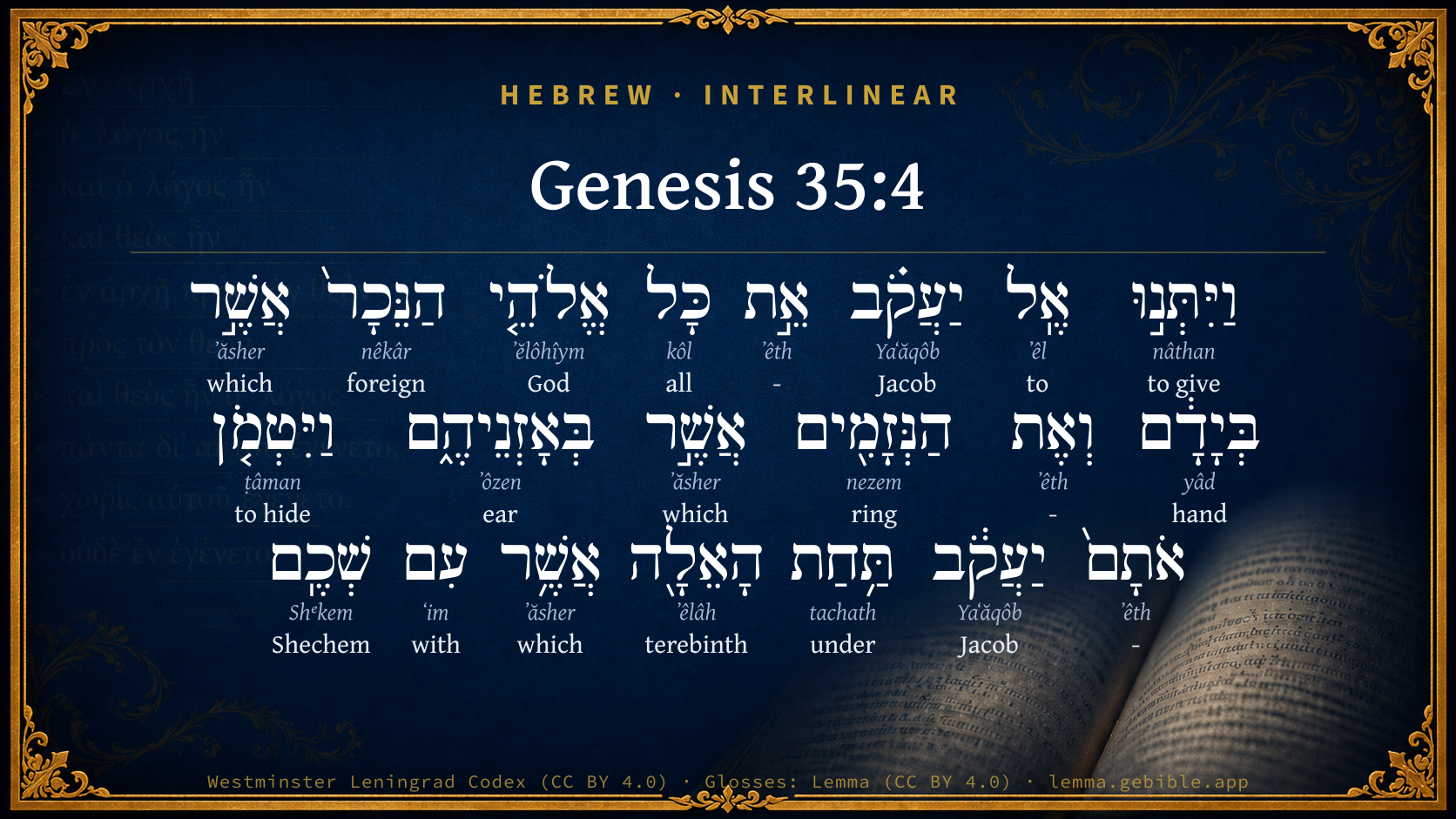
Genesis 35:4

Hebrew (Westminster Leningrad Codex) Genesis 35:4 appears in the Hebrew Old Testament. The text above is from the Westminster Leningrad Codex. Each word links to its Strong’s number, a concise gloss, and parsing drawn from the Open Scriptures Hebrew Bible morphology. Click any word for its full Brown-Driver-Briggs (BDB) entry.
Download image
Cite this verse

Genesis 35:4 (World English Bible). Public Domain. Lemma interlinear Bible study tool, https://lemma.gebible.app/v/genesis/35/4.

Show BibTeX & RIS
BibTeX
RIS
English Translation
They gave to Jacob all the foreign gods which were in their hands, and the rings which were in their ears; and Jacob hid them under the oak which was by Shechem.
World English Bible · Public Domain
Highlights
  • 2 first appearances in the Hebrew Bible
Full analysis ↓
Download a study sheet

One document with this verse’s original text, its word-by-word gloss line, the meaning frame, cross-references with their text, attributed commentary, and full source and license credits — printable, and it pastes into notes with its structure intact.

This verse Autodidact and up

Study sheet (.html) Plain text (.txt)

A passage Seminary Student

Up to 50 verses in one chapter. A passage sheet keeps up to 6 commentary sources and 12 cross-references per verse, in the order this page ranks them, and says so on the sheet whenever that leaves anything out. Ask for a single verse and you get the Autodidact verse sheet above.

Everything on this page stays free to read, with no account — the sheet is a download of what is already on screen, not access to it.

Want to remove ads? Support Godless Engineer
Compare translations 3

The same verse in 3 English versions, stacked beneath the original-language interlinear above. Click any original word for its lexicon entry.

Each is an independent rendering of the whole verse — the interlinear is not word-aligned to these translations.

Highlighted words mark where these versions differ — a whole-verse word diff, not a word-by-word alignment.

  • World English Bible Public Domain
    They gave to Jacob all the foreign gods which were in their hands, and the rings which were in their ears; and Jacob hid them under the oak which was by Shechem.
  • King James Version Public Domain
    And they gave unto Jacob all the strange gods which were in their hand, and all their earrings which were in their ears; and Jacob hid them under the oak which was by Shechem.
  • unfoldingWord Literal Text CC BY-SA 4.0
    So they gave to Jacob all the foreign gods that in their hand and the rings that in their ears, and Jacob hid them under the terebinth tree that by Shechem.

unfoldingWord Literal Text — © unfoldingWord, licensed CC BY-SA 4.0. Word-aligned USFM3 via Door43 (git.door43.org/unfoldingWord/en_ult).

Versions to compare (up to 4)

3 of 4 selected

Show all 18 translations

Every available English version of this verse, each an independent rendering of the whole verse.

  • World English Bible Public Domain
    They gave to Jacob all the foreign gods which were in their hands, and the rings which were in their ears; and Jacob hid them under the oak which was by Shechem.
  • Berean Standard Bible Public Domain
    So they gave Jacob all their foreign gods and all their earrings, and Jacob buried them under the oak near Shechem.
  • Majority Standard Bible Public Domain
    So they gave Jacob all their foreign gods and all their earrings, and Jacob buried them under the oak near Shechem.
  • King James Version Public Domain
    And they gave unto Jacob all the strange gods which were in their hand, and all their earrings which were in their ears; and Jacob hid them under the oak which was by Shechem.
  • American Standard Version (1901) Public Domain
    And they gave unto Jacob all the foreign gods which were in their hand, and the rings which were in their ears; and Jacob hid them under the oak which was by Shechem.
  • Revised Version (1885) Public Domain
    And they gave unto Jacob all the strange gods which were in their hand, and the rings which were in their ears; and Jacob hid them under the oak which was by Shechem.
  • Geneva Bible (1599) Public Domain
    And they gaue vnto Iaakob all the strange gods, which were in their hands, and all their earings which were in their eares, and Iaakob hidde them vnder an oke, which was by Shechem.
  • Douay-Rheims (1899) Public Domain
    So they gave him all the strange gods they had, and the earrings which were in their ears: and he buried them under the turpentine tree, that is behind the city of Sichem.
  • Young's Literal Translation Public Domain
    And they give unto Jacob all the gods of the stranger that `are' in their hand, and the rings that `are' in their ears, and Jacob hideth them under the oak which `is' by Shechem;
  • Literal Standard Version CC BY-SA 4.0
    And they give to Jacob all the gods of the stranger that [are] in their hand, and the rings that [are] in their ears, and Jacob hides them under the oak which [is] by Shechem;
  • Unlocked Literal Bible CC BY-SA 4.0
    So they gave to Jacob all the foreign gods that were in their hand, and the rings that were in their ears. Jacob buried them under the oak that was near Shechem.
  • unfoldingWord Literal Text CC BY-SA 4.0
    So they gave to Jacob all the foreign gods that in their hand and the rings that in their ears, and Jacob hid them under the terebinth tree that by Shechem.
  • Darby Bible Public Domain
    And they gave to Jacob all the strange gods that were in their hand, and the rings that were in their ears, and Jacob hid them under the terebinth that [is] by Shechem.
  • World Messianic Bible Public Domain
    They gave to Jacob all the foreign gods which were in their hands, and the rings which were in their ears; and Jacob hid them under the oak which was by Shechem.
  • Webster's Bible Public Domain
    And they gave to Jacob all the strange gods which were in their hand, and the ear-rings which were in their ears; and Jacob hid them under the oak which was by Shechem.
  • Free Bible Version CC BY-SA 4.0
    They handed over to Jacob all the pagan idols they had, as well as their earrings, and he buried them under the oak tree at Shechem.
  • Bible in Basic English Public Domain
    Then they gave to Jacob all the strange gods which they had, and the rings which were in their ears; and Jacob put them away under the holy tree at Shechem.
  • JPS Tanakh (1917) Public Domain
    And they gave unto Jacob all the foreign gods which were in their hand, and the rings which were in their ears; and Jacob hid them under the terebinth which was by Shechem.

Literal Standard Version (2020), Covenant Press — licensed CC BY-SA 4.0. Text via the HelloAO Bible API (eBible.org). Unlocked Literal Bible (unfoldingWord) — licensed CC BY-SA 4.0. Text via the HelloAO Bible API (eBible.org). unfoldingWord Literal Text — © unfoldingWord, licensed CC BY-SA 4.0. Word-aligned USFM3 via Door43 (git.door43.org/unfoldingWord/en_ult). Free Bible Version, Dr. Jonathan Gallagher — licensed CC BY-SA 4.0. Text via the HelloAO Bible API (eBible.org).

Word by word

More ways to search: Search by grammar → Find every occurrence → Compare this word →

Practice this passage: Drill this verse → Learn its vocabulary →

הָאֵלָ֖ה
ʼêlâh
H424
“the · terebinth”
Particle, Definite Article + Noun, Common, Feminine, Singular, Absolute
Part of Speech
Particle + Noun
Type
Common
Gender
Feminine
Number
Singular
State
Absolute
Full BDB Definition

Origin: from H352

TWOT: 45h

terebinth, terebinth tree - valley where David killed Goliath
  1. וַיִּתְּנ֣וּ nâthan H5414 “and · to give” Conjunction + Verb, Qal, Sequential Imperfect, 3rd Person, Masculine, Plural
  2. אֶֽל ʼêl H413 “to” Preposition
  3. יַעֲקֹ֗ב Yaʻăqôb H3290 “Jacob” Noun, Proper
  4. אֵ֣ת ʼêth H853 “-” Particle, Direct Object
  5. כָּל kôl H3605 “all of” Noun, Common, Masculine, Singular, Construct
  6. אֱלֹהֵ֤י ʼĕlôhîym H430 “God(s) of” Noun, Common, Masculine, Plural, Construct
  7. הַנֵּכָר֙ nêkâr H5236 “the · foreign” Particle, Definite Article + Noun, Common, Masculine, Singular, Absolute
  8. אֲשֶׁ֣ר ʼăsher H834 “which” Particle, Relative
  9. בְּיָדָ֔ם yâd H3027 “in/at · hand · their” Preposition + Noun, Common, Both, Singular, Construct + Suffix, Personal, 3rd Person, Masculine, Plural
  10. וְאֶת ʼêth H853 “and · -” Conjunction + Particle, Direct Object
  11. הַנְּזָמִ֖ים nezem H5141 “the · rings” Particle, Definite Article + Noun, Common, Masculine, Plural, Absolute
  12. אֲשֶׁ֣ר ʼăsher H834 “which” Particle, Relative
  13. בְּאָזְנֵיהֶ֑ם ʼôzen H241 “in/at · ears · their” Preposition + Noun, Common, Feminine, Dual, Construct + Suffix, Personal, 3rd Person, Masculine, Plural
  14. וַיִּטְמֹ֤ן ṭâman H2934 “and · to hide” Conjunction + Verb, Qal, Sequential Imperfect, 3rd Person, Masculine, Singular
  15. אֹתָם֙ ʼêth H853 “- · them” Particle, Direct Object + Suffix, Personal, 3rd Person, Masculine, Plural
  16. יַעֲקֹ֔ב Yaʻăqôb H3290 “Jacob” Noun, Proper
  17. תַּ֥חַת tachath H8478 “under” Preposition
  18. אֲשֶׁ֥ר ʼăsher H834 “which” Particle, Relative
  19. עִם ʻim H5973 “with” Preposition
  20. שְׁכֶֽם Shᵉkem H7927 “Shechem” Noun, Proper

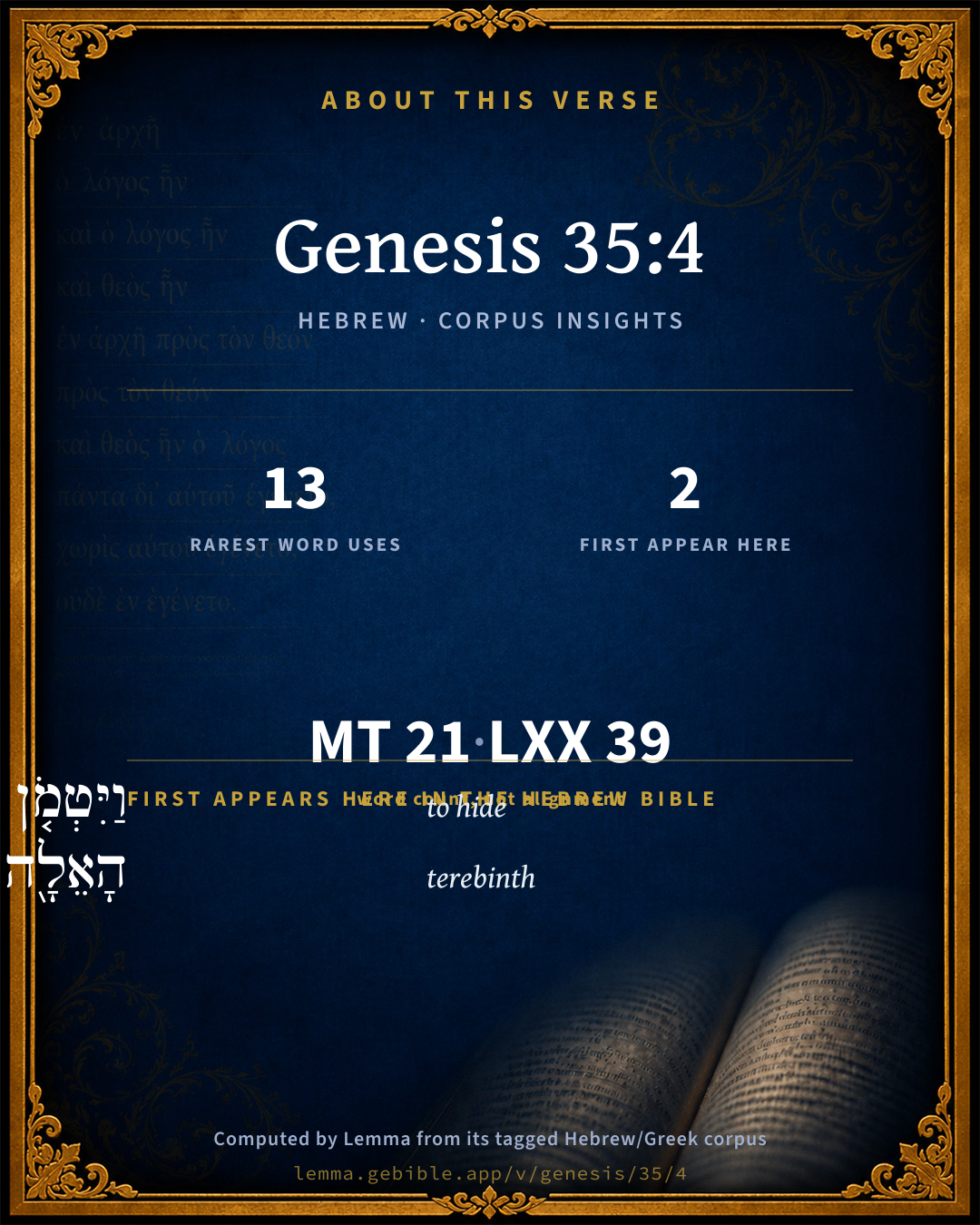
About this verse

These counts appear in no published source. They are computed here, from the morphology-tagged text and Lemma’s own curated glosses. What Lemma adds →

21
words
16
distinct lemmas
Pentateuch
section

Notable vocabulary

The rarest word here is הָאֵלָ֖ה terebinth H424 — appearing just 13 times in the whole Hebrew Bible.

First appearance in Scripture

These words make their first canonical appearance in the Hebrew Bible here:

  • וַיִּטְמֹ֤ן to hide H2934
  • הָאֵלָ֖ה terebinth H424

Shared distinctive vocabulary

הָאֵלָ֖ה terebinth H424 occurs in 12 verses of the Hebrew Bible. Also found in:

Grammatical profile

  • 2 verbs
  • 10 nouns
  • 3 prepositions
  • 6 particles

Verb forms

  • וַיִּתְּנ֣וּ Qal · Sequential Imperfect
  • וַיִּטְמֹ֤ן Qal · Sequential Imperfect

Repetition

Words recur within this verse — often emphatic in Hebrew:

  • יַעֲקֹ֗ב Jacob H3290 ×2
  • אֲשֶׁ֣ר which H834 ×3

Hebrew & Septuagint length

In English translation the verse runs 32 words from the Hebrew and 39 from the Septuagint (LXX English) — closely comparable.

A rough comparison of the two English renderings, which tokenize alike — not a word-level alignment.

Word counts can differ between the Hebrew and the Greek without any difference in meaning — e.g. the Hebrew direct-object marker אֵת has no separate Greek word, and Greek often adds the article ὁ.

In the original languages it is 21 Hebrew tokens and 39 Greek tokens — but the two are counted differently (Hebrew bundles its prefixes and suffixes into one token; the Greek is in lemma form), so that isn’t a like-for-like length.

Cross-references

10

Topical passages linked to Genesis 35:4 in the Treasury of Scripture Knowledge — connected by theme and wording, ordered by reader-vote popularity; previews shown in the World English Bible.

  • Judges 9:6 All the men of Shechem assembled themselves together, and all the house of Millo, and went and made Abimelech king, by the oak of the pillar that was in Shechem.
  • Exodus 32:2–4 Aaron said to them, "Take off the golden rings, which are in the ears of your wives, of your sons, and of your daughters, and bring them to me."
  • Exodus 32:20 He took the calf which they had made, and burnt it with fire, ground it to powder, and scattered it on the water, and made the children of Israel drink of it.
  • Deuteronomy 7:25 The engraved images of their gods shall you burn with fire: you shall not covet the silver or the gold that is on them, nor take it to you, lest you be snared therein; for it is an abomination to Yahweh your God.
  • Judges 8:24–27 Gideon said to them, I would make a request of you, that you would give me every man the ear-rings of his spoil. (For they had golden ear-rings, because they were Ishmaelites.)
  • Isaiah 30:22 You shall defile the overlaying of your engraved images of silver, and the plating of your molten images of gold: you shall cast them away as an unclean thing; you shall tell it, Get you hence.
  • Isaiah 2:20 In that day, men shall cast away their idols of silver, And their idols of gold, Which have been made for themselves to worship, To the moles and to the bats;
  • Hosea 2:13 I will visit on her the days of the Baals, To which she burned incense, When she decked herself with her earrings and her jewels, And went after her lovers, And forgot me," says Yahweh.
  • Deuteronomy 7:5 But thus shall you deal with them: you shall break down their altars, and dash in pieces their pillars, and hew down their Asherim, and burn their engraved images with fire.
  • Joshua 24:25–26 So Joshua made a covenant with the people that day, and set them a statute and an ordinance in Shechem.

Cross-references courtesy of OpenBible.info (CC BY 4.0).

Hebrew and Greek witnesses Masoretic Hebrew ↔ Greek Septuagint

The same verse in the two great witnesses to the Old Testament, shown verse-for-verse.

These are two independent witnesses, not word-aligned to each other, and the Septuagint is shown in lemma (dictionary) form.

Hebrew Genesis 35:4 Masoretic · Westminster Leningrad Codex

וַיִּתְּנ֣וּ אֶֽל יַעֲקֹ֗ב אֵ֣ת כָּל אֱלֹהֵ֤י הַנֵּכָר֙ אֲשֶׁ֣ר בְּיָדָ֔ם וְאֶת הַנְּזָמִ֖ים אֲשֶׁ֣ר בְּאָזְנֵיהֶ֑ם וַיִּטְמֹ֤ן אֹתָם֙ יַעֲקֹ֔ב תַּ֥חַת הָאֵלָ֖ה אֲשֶׁ֥ר עִם שְׁכֶֽם

They gave to Jacob all the foreign gods which were in their hands, and the rings which were in their ears; and Jacob hid them under the oak which was by Shechem.

World English Bible · Public Domain

Greek LXX Genesis 35:4 Septuagint · lemma form

καί δίδωμι ὁ ἰακώβ ὁ θεός ὁ ἀλλότριος ὅς εἰμί ἐν ὁ χείρ αὐτός καί ὁ ἐνώτιον ὁ ἐν ὁ οὖς αὐτός καί κατακρύπτω αὐτός ἰακώβ ὑπό ὁ τερέβινθος ὁ ἐν σικιμος καί ἀποὀλλύω αὐτός ἕως ὁ σήμερον ἡμέρα

And they gave to Jacob the strange gods, which were in their hands, and the ear-rings which were in their ears, and Jacob hid them under the turpentine tree which is in Secima, and destroyed them to this day.

LXX2012 (modern English Septuagint) · Public Domain

On this verse, Haydock's Catholic Bible Commentary discusses the Septuagint’s reading. Read the note in Commentary ↓

Hebrew: Westminster Leningrad Codex (CC BY 4.0). Greek: Septuagint (public domain); English from LXX2012 (modern English Septuagint) (Public Domain). How the Septuagint differs from the Hebrew →

Targum (Aramaic paraphrase)

2

The Targum is the ancient Jewish Aramaic paraphrase of the Hebrew Scriptures — an interpretive translation, not the Hebrew text itself. Onkelos (literal) and Pseudo-Jonathan (expansive) render the Torah, and Jonathan the Prophets. Coverage is partial: where no permissively-licensed English translation exists for a verse, only the Aramaic is shown. This is verse-level text, not a word-by-word alignment to the Hebrew.

  1. Targum Onkelos Torah (Genesis–Deuteronomy)
    וִיהָבוּ לְיַעֲקֹב יָת כָּל טַעֲוַת עַמְמַיָּא דִי בִידֵיהוֹן וְיָת קָדָשַׁיָּא דִי בְאֻדְנֵיהוֹן וְטַּמַּר יָתְהוֹן יַעֲקֹב תְּחוֹת בָּטְמָא דִי עִם שְׁכֶם

    (no public-domain English translation for this verse)

    Targum Onkelos — Aramaic: “Onkelos Genesis” (public domain); “Onkelos Exodus” (public domain); “Onkelos Leviticus” (public domain); “Onkelos Numbers” (public domain); “Onkelos Deuteronomy” (public domain). English: “Sefaria Community Translation” (CC0 1.0 (public-domain dedication)); “J.W. Etheridge. The Targums of Onkelos and Jonathan Ben Uzziel on the Pentateuch. London: Longmans, Green, 1862” (public domain). Text via Sefaria.

  2. Targum Pseudo-Jonathan Torah (Genesis–Deuteronomy)
    וּמְסָרוּ בְּיַד יַעֲקב יַת כָּל טַעֲוַת עַמְמַיָא דְבִידֵיהוֹן דְדַבָּרוּ מִן טַעֲוַות שְׁכֶם וְיַת קָדָשַׁיָא דַהֲווֹ בְּאוּדְנֵיהוֹן דְיַתְבֵי קַרְתָּא דִשְׁכֶם דַהֲוָה צַיָיר בְּהוֹן דְמוּת פּוּסְלֵיהּ וְטָמַר יַתְהוֹן יַעֲקב תְּחוֹת בּוּטְמָא דִסְמִיכָא לְקַרְתָּא דִשְׁכֶם

    And they delivered into Jakob's hand all the idols of the people which were in their hands which they had taken from the temple of Shekem, and the jewels that had been in the ears of the inhabitants of the city of Shekem, in which was portrayed the likeness of their images; and Jakob hid them under the terebinth that was near to the city of Shekem.

    Targum Pseudo-Jonathan — Aramaic: “Targum Jonathan on Genesis” (public domain); “Targum Jonathan on Exodus” (public domain); “Targum Jonathan on Leviticus” (public domain); “Targum Jonathan on Numbers” (public domain); “Targum Jonathan on Deuteronomy” (public domain). English: “The Targum of Jonathan ben Uzziel, trans. J. W. Etheridge, London, 1862” (public domain). Text via Sefaria.

Commentary

Notes on Genesis 35:4 from classic Christian and Jewish commentators (each source and its license shown beneath its notes). The classic Christian expositions comment on the surrounding passage and are grouped to its opening verse, so a note may address several verses; the Jewish commentaries on the Tanakh (Rashi and others) are per-verse, so they appear only where the commentator wrote on this verse.

Lemma curates 59 commentaries, every one of them public domain or Creative Commons licensed, each selected and text-cleaned for this edition rather than reprinted as found. About our sources →

Trapp's Complete Commentary

John Trapp

Gen 35:4 And they gave unto Jacob all the strange gods which [were] in their hand, and [all their] earrings which [were] in their ears; and Jacob hid them under the oak which [was] by Shechem.

Ver. 4. And they gave unto Jacob.] Now they were in danger of destruction, they would do anything. So those false Israelites, when God "slew them, then they sought him." {Psa 78:34} So many, when they are deadly sick, are wondrous good; as William Rufus, who vowed, upon his recovery, to see all vacancies furnished. {a} In the sweating sickness, so long as the ferventness of the plague lasted, there was crying, Peccavi, peccavi: the ministers were sought for in every corner - You must come to nay lord, you must come to my lady, &c. {b} The walnut tree is most fruitful when most beaten. Fish thrive best in cold and salt waters. The most plentiful summer follows upon the hardest winter. David was never so tender as when hunted like a partridge; nor Jonah so watchful, prayerful, as in the whale’s belly. {c} When men suffer for their sin, {Lam 3:39; Lam 3:41} hands and hearts and all are lift up to heaven, that before were as "without God in the world," and thought they could do well enough without him. A lethargy is commonly cured by a fever; worms killed with aloes; so are crawling lusts by bitter afflictions. Israel under the cross, will "defile" the idols that they had deified; {Isa 30:22} and after that they were captives in Babylon, they could never be drawn to that sin, whatever they suffered for their refusal, as under Antiochus. I end, with St Ambrose: Beata anima, quae est instar domus Iacobi, in qua nulla simulachra, nulla effigies vanitatis: Blessed is that soul, that, like Jacob’s house, hath no idol in it.

{a} Daniel’s Chro., fol. 58.

{b} Dike, Of Deceitf., p. 217.

{c} Vigilabat in ceto, qui stertebat in navi.

John Trapp, A Commentary or Exposition upon All the Books of the Old and New Testament (1647–1656) — public domain. Text from a community e-Sword module.

Joseph Benson's Commentary

Gen 35:4. They gave unto Jacob all the strange gods — Rather, the gods of the stranger; and all their ear-rings — Either because they had been abused to idolatry and superstition, and were therefore to be destroyed, (Deuteronomy 7:57 and Deu 12:3,) or for fear they should be so abused.

For the Holy Scriptures insinuate, and other writers expressly affirm, that divers heathen nations did wear ear-rings for the honour of their idols, and with the representations or ensigns of their idols engraven upon them, such as the rings and vessels mentioned by Maimonides, marked with the image of the sun and moon. Jacob hid them under the oak — In a place only known to himself. It is probable they were first melted or broken.

Joseph Benson's Commentary on the Old and New Testaments (1811–1818) — public domain. Text from a community e-Sword module.

Geneva Bible (1599)

Geneva Bible translators

For therein was some sign of superstition, as in tablets and Agnus deis.

Geneva Bible (1599) marginal notes — public domain. Text via Bolls.life.

Jamieson, Fausset & Brown

Robert Jamieson, A. R. Fausset & David Brown

they gave unto Jacob all the strange gods . . . and earrings--Strange gods, the "seraphim" (compare Gen 31:30), as well, perhaps, as other idols acquired among the Shechemite spoil--earrings of various forms, sizes, and materials, which are universally worn in the East, and, then as now, connected with incantation and idolatry (compare Hos 2:13). The decided tone which Jacob now assumed was the probable cause of the alacrity with which those favorite objects of superstition were surrendered.

Jacob hid them under the oak--or terebinth--a towering tree, which, like all others of the kind, was a striking object in the scenery of Palestine; and beneath which, at Shechem, the patriarch had pitched his tent. He hid the images and amulets, delivered to him by his Mesopotamian dependents, at the root of this tree. The oak being deemed a consecrated tree, to bury them at its root was to deposit them in a place where no bold hand would venture to disturb the ground; and hence it was called from this circumstance--"the plain of Meonenim"--that is, "the oak of enchantments" (Jdg 9:37); and from the great stone which Joshua set up--"the oak of the pillar" (Jdg 9:6).

Jamieson, Fausset & Brown — Commentary Critical and Explanatory on the Whole Bible (1871) — public domain (CC PDM 1.0). Text via the HelloAO Bible API.

Adam Clarke's Commentary

Verse 4. And - ear-rings which were in their ears] Whether these rings were in the ears of the gods, or in those of Jacob's family, we may rest assured that they were not mere ornaments, but served for superstitious purposes. Ear-rings were certainly worn as amulets and charms, first consecrated to some god, or formed under some constellation, on which magical characters and images were drawn. A very ancient and beautiful one of this kind brought from Egypt, cut out of a solid piece of cornelian, now lies before me. It was evidently intended for the ear, as the opening is too small for any human finger; and it is engraved all over with strange characters and images, which prove that it was intended for a talisman or amulet. It seems to be such a one as St. Augustine describes, Epist. 73, which was suspended from the tip of the ears both of men and women, not for the purpose of ornament, but through an execrable superstition, for the service of demons. "Execranda superstitio ligaturarum, in quibus etiam inaures virorum in summis ex una parte auriculis suspensae deputantur, non ad placendum hominibus, sed ad serviendum daemonibus." See Clarke on Ge 24:22.

Adam Clarke's Commentary on the Bible (1810–1826) — public domain. Text from a community e-Sword/MySword module.

John Calvin's Commentaries

4. And they gave unto Jacob. Though the holy man had his house in suitable subordination; yet as all yielded such prompt obedience to his command by casting away their idols, I doubt not that they were influenced by the fear of danger. Whence also we infer how important it is for us to be aroused from slumber by suffering. For we know how pertinacious and rebellious is superstition. If, in a peaceful and joyous state of affairs, Jacob had given any such command, the greater part of his family would have fraudulently concealed their idols: some, perhaps, would have obstinately refused to surrender them; but now the hand of God urges them, and with ready minds they quickly repent. It is also probable, that, according to the circumstances of the time, Jacob preached to them concerning the righteous judgment of God, to inspire them with fear. When he commands them to cleanse themselves, it is as if he had said, Hitherto ye have been defiled before the Lord; now, seeing that he has regarded us so mercifully, wash out this filth, lest he should again avert his face from us. It seems, however, absurd, that Jacob should have buried the idols under an oak, and not rather have broken them in pieces and consumed them in the fire, as we read that Moses did with the golden calves, (Exodus 32:20,) and Hezekiah with the brazen serpent, (2 Kings 18:4.) The fact is not thus related without reason: but the infirmity of Jacob is touched upon, because he had not been sufficiently provident against the future. And perhaps the Lord punished his previous excessive connivance and want of firmness, by depriving him of prudence or courage. Yet God accepted his obedience, although it had some remainder of defect, knowing that it was the design of the holy man to remove idols from his family, and, in token of his detestation, to bury them in the earth. The earrings were doubtless badges of superstition; as at this day innumerable trifles are seen in the Papacy, by which impiety displays itself.

John Calvin's Commentaries (1540-1563) — public domain. Text from the Calvin Translation Society English edition (1840s-50s) via the Christian Classics Ethereal Library (ccel.org). Calvin's coverage is partial (roughly two-thirds of the Bible); uncommented books and verses are honest gaps, never fabricated. The 19th-century editor's footnotes and remarks are omitted so the notes are faithfully Calvin's own voice.

Ellicott's Commentary for English Readers

(4) Earrings.—Earrings seem to have been worn not so much for ornament as for superstitious purposes, being regarded as talismans or amulets. Hence it was from their earrings that Aaron made the golden calf (Exo_32:2-4).

The oak.—Not Abraham’s oak-grove (Gen_12:6), referred to probably in Jdg_9:6; Jdg_9:37—the Hebrew word in these three places being êlôn—but that under which Joshua set up his pillar of witness (Jos_24:26), the tree being in both these places called allâh, or êlâh, a terebinth.

A Bible Commentary for English Readers, edited by Charles John Ellicott (1878–1897) — public domain. Text from a community e-Sword module.

The Cambridge Bible for Schools and Colleges

gen. ed. J. J. S. Perowne

4. in their hand] i.e. in their possession.

the rings … ears] The rings mentioned were probably not simple earrings as in Gen_24:22, but rings worn as charms, and amulets, having symbols of heathen deities. Cf. Hos_2:13.

the oak] R.V. marg. terebinth. It is noteworthy that Joshua, under the same “oak” of Shechem (Jos_24:26), testified against the primitive worship of strange gods; cf. Jos_24:2; Jos_24:14; Jos_24:23. For the “terebinth,” cf. Gen_12:6. The same sacred tree is possibly mentioned in Jdg_9:6.

The Cambridge Bible for Schools and Colleges (gen. ed. J. J. S. Perowne; Cambridge University Press, 1878–1918) — public domain. Text from a community e-Sword module.

John Gill's Exposition

They gave unto Jacob all the strange gods which were in their hands,.... Whether in the hands of his servants or of the captives taken at Shechem, or in the hands of his sons, who had them along with the spoil they took there; so the Targum of Jonathan,"they delivered, into the hand of Jacob all the idols of the people which were in their hands, which they had took of the idols of Shechem:"

and all their earrings which were in their ears; not the earrings that women wore in common, such as Abraham's servant gave to Rebekah, and which Jacob's wives might wear, for such were not unlawful; but either which were worn in the ears of the strange gods or idols; for such used, it seems, according to some writers, to be decorated and ornamented after that manner; or rather in the ears of the idolaters themselves, worn by them in a superstitious way, having the images of these idols on them: so the Targum of Jonathan,"and the earrings which were in the ears of the inhabitants of the city of Shechem, in which were formed the likeness of their idols:"

and Jacob hid them under the oak which was by Shechem; that is, the idols, which, after he had broke to pieces, perhaps, he dug a hole under an oak, and there buried them, that they might be no more made use of in an idolatrous way; and he chose to put them under an oak, because it is a tree which often stands many years before it is cut down, and besides was used for religious purposes, and had in great veneration, and therefore seldom felled. Those idols seem not to be made of anything valuable, perhaps of wood or stone, for had they been of gold or silver, Jacob would doubtless have melted them, and converted them to other uses, and not have buried them under ground. The Jews (t) say, that the idol Jacob hid under the oak was in the form of a dove, which the Samaritans after some time found, and set it on the top of Mount Gerizim. Some take this oak to be the same with that mentioned in Jos 24:26; but of that there can be no certainty, since Jacob, as it is highly probable, laid these images alone, and never intended any should know anything of them where they were.

(t) Shalshalet Hakabala, fol. 3. 2.

John Gill's Exposition of the Whole Bible (1746–1763) — public domain (CC PDM 1.0). Text via the HelloAO Bible API.

Haydock's Catholic Bible Commentary

And the ear-rings. Hebrew, hanezamim; such as had been consecrated to some idol, and adorned the ears of those false but gaudy deities. (Menochius) --- Men and women used them likewise, as phylacteries or talismans, to which many superstitious virtues were attributed. (St. Augustine, ep. 73, ad Posid. 9, iii. in Gen.; Ezechiel xvi. 12; Proverbs xxv.; Exodus xxxv.; Judges viii. (Calmet) --- The turpentine tree; or "an oak tree," as the Hebrew haela means also. Septuagint adds, "and he destroyed them till this present day;" which seems intended to refute the story of their being found and adored by the Samaritans, or employed by Solomon when he built the temple. Jacob buried them privately. (Calmet) See Deuteronomy vii. 5.

George Leo Haydock (1774–1849), Haydock's Catholic Family Bible and Commentary, 1859 edition — public domain. Excludes Psalms (Douay-Rheims chapter numbering differs from Protestant) and Deuterocanonical books (Catholic canon only).

Matthew Poole's English Annotations

Either because they had been abused to idolatry and superstition at Shechem, or elsewhere, and therefore were to be destroyed according to God's command, now signified to Jacob, and afterwards delivered to his posterity, Deu 7:5; 12:3; or for fear they should be so abused. For the Scripture seems to insinuate, and other writers expressly affirm, that divers heathen people did wear earrings for the honour of their idols, and with the representations or ensigns of their idols engraven upon them. See Jdg 8:24. After he had melted or broken them, (which seems probable from parallel instances, as Exo 32:20; 2Ki 18:4),

Jacob hid them under a certain oak, though not known to his family which it was. He chose that place, either as most proper to put monuments of idolatry under those trees which were so much and so generally abused to idolatry, as oaks especially were, Isa 1:29; or as the safest place, where they were likely to remain longest hid, because the heathen had a veneration for oaks, and therefore would not cut them down, nor dig them up, nor do any thing which had a tendency that way.

Matthew Poole's English Annotations on the Holy Bible (1683–1685) — public domain. Text from a community e-Sword/MySword module.

Whedon's Commentary on the Bible

Daniel D. Whedon

4. Earrings — These appear to have been used as amulets and charms, and used with superstitious reverence, even as the teraphim.

Hid them under the oak — Perhaps the same ancient tree or grove mentioned in Gen_12:6. This was ever regarded as a sacred spot in Israel. Comp. Jos_24:26. The proper disposal of these strange gods was to bury them as dead nothings. Isa_41:24; 1Co_8:4.

Daniel D. Whedon (gen. ed.), Commentary on the Old and New Testaments (1874–1909) — public domain. Text from a community e-Sword module.

The Pulpit Commentary

And they gave mate Jacob all the strange gods Rosenm thinks these must have been many, since the historian would not otherwise have used the term lKowhich were in their hand (i.e. which they possessed), and all their earrings which were in their ears; i.e. those employed for purposes of idolatrous worship, which were often covered with allegorical figures and mysterious sentences, and supposed to be endowed with a talismanic virtue (Jud_1:8:21; Isa_3:20; Hos_2:13) and Jacob hid them having probably first destroyed them, since they do not appear to have been ever after sought for or resumed by the parties who gave them up (Hughes)under the oak which was by Shechem. Whether the oak, or terebinth, under which Abraham once pitched his tent, (Gen_12:6) that beneath whose shade Joshua afterwards erected his memorial pillar, (Jos_24:26) the oak of the sorcerers, (Jud_1:9:37) and the oakof the pillar at Shechem (Jud_1:9:6) were all the tree under which Jacob buried the images and earrings cannot with certainty be determined, though the probability is that they were.

The Pulpit Commentary (1880–1919), ed. H.D.M. Spence-Jones & Joseph S. Exell — public domain. Text from a community e-Sword module.

John Wesley's Explanatory Notes

And they gave to Jacob - His servants, and even the retainers to his family, gave him all the strange gods, and the ear-rings they wore either as charms, or to the honour of their gods. Jacob took care to bury their images, we may suppose, in some place unknown to them, that they might not afterwards find and return to them.

John Wesley, Explanatory Notes Upon the Whole Bible (1754–1765) — public domain. Text via the GEBible commentary corpus.

unfoldingWord translationNotes

Door43 World Missions Community

So they gave

"so everyone in Jacob's household gave" or "so all of his family and servants gave"

that were in their hand

Here "in their hand" stands for what they own. AT: "that were in their possession" or "that they had" (See: Metonymy)

the rings that were in their ears

"their earrings." Possible meanings are 1) the gold in the earrings could have been used to make more idols or 2) they took these earrings from the city of Shechem after they attacked it and killed all the people. The earrings would have reminded them of their sin.

God made panic to fall on the cities

God causing the people of the cities to be afraid of Jacob and his family is spoken of as if panic were an object that fell on the cities. The abstract noun "panic" can be stated as "afraid." AT: "God made the people in the surrounding cities afraid of Jacob and those with him" (See: Metaphor and Abstract Nouns)

on the cities

Here "cities" stands for the people who live in the cities. (See: Metonymy)

the sons of Jacob

It is implied that no one attacked anyone in Jacob's family. But two of the sons, Simeon and Levi had attacked the Canaanites relatives of Shechem after he seized and slept with Jacob's daughter. Jacob was afraid they would seek revenge in Genesis 34:30. AT: "Jacob's family" or "Jacob's household" (See: Assumed Knowledge and Implicit Information)

translationWords

Jacob

false god

bury

oak

Shechem

unfoldingWord translationNotes — © Distant Shores Media and the Door43 World Missions Community, licensed CC BY-SA 4.0. Source: git.door43.org/Door43/en_tn.

Rashi

Rabbi Shlomo Yitzchaki (Rashi)

האלה THE TEREBINTH — a kind of tree that bears no fruit.

עם שכם means by Shechem.

Rashi on the Tanakh — English translations: “The Judaica Press complete Tanach with Rashi, translated by A. J. Rosenberg” (CC BY 4.0); “Pentateuch with Rashi's commentary by M. Rosenbaum and A.M. Silbermann, 1929-1934” (public domain); “The Metsudah Tanach series, Lakewood, N.J” (CC BY 4.0); and “The Book of Joshua, Metsudah Publications, 1997” (CC BY 4.0). Text via Sefaria.

Ramban (Nachmanides)

Rabbi Moshe ben Nachman (Ramban / Nachmanides)

AND JACOB HID THEM. An idol and the things that pertain to it are not in the category of objects that require burial and for which burial suffices, but instead they are to be crumbled up and scattered to the wind or thrown into the sea. It appears to me that the sons of Jacob did not take the idols and the things that pertain to them from Shechem until they had been nullified and had thus become permissible to them, for a heathen can nullify an idol against its worshipper’s will, 52b. thus making it permissible to them. Jacob, however, for the sake of the purity of holy things, commanded that they remove it so that they should be fit to worship G-d and sacrifice before Him, just as He had commanded them concerning immersion and the changing of garments. Burial was thus sufficient for the idols, and therefore he hid them under the terebinth in a location which will neither be tilled nor sown.

Ramban (Nachmanides) on the Tanakh — English translation: “Commentary on the Torah by Ramban (Nachmanides). Translated and annotated by Charles B. Chavel. New York, Shilo Pub. House, 1971-1976” (CC BY 4.0). Text via Sefaria.

Radak

Rabbi David Kimhi (Radak)

ויטמן, he did not leave them above ground so as not to become the indirect cause of someone retrieving the items and using them in an idolatrous fashion.

אשר עם שכם, near Shechem; we have a similar construction involving the preposition עם in 25,11 וישב יצחק עם באר לחי רואי, “Yitzchok settled near the place named Beer Lachay Ro-i.

Radak on the Tanakh — English translations: “Sefaria Community Translation” (CC0 1.0 (public-domain dedication)); “Eliyahu Munk, HaChut Hameshulash” (CC BY 4.0); “Rabbi Mike Feuer, Jerusalem Anthology” (CC BY 4.0); and “R. David Kimhi on the first book of Psalms, Translated by R.G. Finch, London, 1919” (public domain). Text via Sefaria.

Lesson kit

Teaching starters — assembled from the data on this page, not authored interpretation. Every prompt links to the verse data it draws on. Edit before teaching.

Genesis, in the Pentateuch, opens this verse with 21 words (16 distinct Hebrew lemmas). Its most distinctive word is ʼêlâh (“terebinth”). A historical commentator’s framing appears above. Read the whole chapter for the surrounding context.

Discussion questions

  1. What does “terebinth” (ʼêlâh) contribute to the verse as a whole?
  2. 2 words here appear for the first time in Scripture. What is being introduced at this debut?
  3. Judges 6:11 shares the word «terebinth» with this verse. How do the two illuminate each other?
  4. “Jacob” occurs 2× in this one verse. What is the effect of the repetition?
  5. The translations on this page render this verse differently — a whole-verse word diff, not a word-by-word alignment. What might account for the different wordings?
  6. The verb «וַיִּתְּנ֣וּ» is Qal Sequential Imperfect. How does its form color the action?
  7. Reading how Trapp's Complete Commentary and Joseph Benson's Commentary read this verse, where do the two commentators agree and where do they part?

Things to notice

Reading settings

Reading text

Shown beneath each verse's original-language words.

Old Testament
Old Testament edition

Read the OT as the Masoretic Hebrew (MT) or the Greek Septuagint (LXX).

English shown for the Greek Septuagint (in the Hebrew ↔ Greek comparison).

Comparing translations? Open the Compare panel on any verse page to stack up to four side by side.