
Exodus 17:2

Hebrew (Westminster Leningrad Codex) Exodus 17:2 appears in the Hebrew Old Testament. The text above is from the Westminster Leningrad Codex. Each word links to its Strong’s number, a concise gloss, and parsing drawn from the Open Scriptures Hebrew Bible morphology. Click any word for its full Brown-Driver-Briggs (BDB) entry.
Download image
Cite this verse

Exodus 17:2 (World English Bible). Public Domain. Lemma interlinear Bible study tool, https://lemma.gebible.app/v/exodus/17/2.

Show BibTeX & RIS
BibTeX
RIS
English Translation
Therefore the people quarreled with Moses, and said, "Give us water to drink." Moses said to them, "Why do you quarrel with me? Why do you test Yahweh?"
World English Bible · Public Domain
Download a study sheet

One document with this verse’s original text, its word-by-word gloss line, the meaning frame, cross-references with their text, attributed commentary, and full source and license credits — printable, and it pastes into notes with its structure intact.

This verse Autodidact and up

Study sheet (.html) Plain text (.txt)

A passage Seminary Student

Up to 50 verses in one chapter. A passage sheet keeps up to 6 commentary sources and 12 cross-references per verse, in the order this page ranks them, and says so on the sheet whenever that leaves anything out. Ask for a single verse and you get the Autodidact verse sheet above.

Everything on this page stays free to read, with no account — the sheet is a download of what is already on screen, not access to it.

Want to remove ads? Support Godless Engineer
Compare translations 3

The same verse in 3 English versions, stacked beneath the original-language interlinear above. Click any original word for its lexicon entry.

Each is an independent rendering of the whole verse — the interlinear is not word-aligned to these translations.

Highlighted words mark where these versions differ — a whole-verse word diff, not a word-by-word alignment.

  • World English Bible Public Domain
    Therefore the people quarreled with Moses, and said, "Give us water to drink." Moses said to them, "Why do you quarrel with me? Why do you test Yahweh?"
  • King James Version Public Domain
    Wherefore the people did chide with Moses, and said, Give us water that we may drink. And Moses said unto them, Why chide ye with me? wherefore do ye tempt the LORD?
  • unfoldingWord Literal Text CC BY-SA 4.0
    And the people quarreled with Moses, and they said, “Give us water to drink.” And Moses said to them, “Why are you quarreling with me? Why do you test Yahweh?”

unfoldingWord Literal Text — © unfoldingWord, licensed CC BY-SA 4.0. Word-aligned USFM3 via Door43 (git.door43.org/unfoldingWord/en_ult).

Versions to compare (up to 4)

3 of 4 selected

Show all 18 translations

Every available English version of this verse, each an independent rendering of the whole verse.

  • World English Bible Public Domain
    Therefore the people quarreled with Moses, and said, "Give us water to drink." Moses said to them, "Why do you quarrel with me? Why do you test Yahweh?"
  • Berean Standard Bible Public Domain
    So the people contended with Moses, “Give us water to drink.” “Why do you contend with me?” Moses replied. “Why do you test the LORD?”
  • Majority Standard Bible Public Domain
    So the people contended with Moses, “Give us water to drink.” “Why do you contend with me?” Moses replied. “Why do you test the LORD?”
  • King James Version Public Domain
    Wherefore the people did chide with Moses, and said, Give us water that we may drink. And Moses said unto them, Why chide ye with me? wherefore do ye tempt the LORD?
  • American Standard Version (1901) Public Domain
    Wherefore the people stove with Moses, and said, Give us water that we may drink. And Moses said unto them, Why strive ye with me? Wherefore do ye tempt Jehovah?
  • Revised Version (1885) Public Domain
    Wherefore the people strove with Moses, and said, Give us water that we may drink. And Moses said unto them, Why strive ye with me? wherefore do ye tempt the LORD?
  • Geneva Bible (1599) Public Domain
    Wherefore the people contended with Moses, and sayde, Giue vs water that we may drinke. And Moses sayde vnto them, Why contende yee with me? wherefore do ye tempt the Lord?
  • Douay-Rheims (1899) Public Domain
    And they chode with Moses, and said: Give us water, that we may drink. And Moses answered them: Why chide you with me? Wherefore do you tempt the Lord?
  • Young's Literal Translation Public Domain
    and the people strive with Moses, and say, `Give us water, and we drink.' And Moses saith to them, `What? -- ye strive with me, what? -- ye try Jehovah?'
  • Literal Standard Version CC BY-SA 4.0
    and the people strive with Moses, and say, “Give us water, and we drink.” And Moses says to them, “Why do you strive with me? Why do you try YHWH?”
  • Unlocked Literal Bible CC BY-SA 4.0
    So the people blamed Moses for their situation and said, “Give us water to drink.” Moses said, “Why do you quarrel with me? Why do you test Yahweh?”
  • unfoldingWord Literal Text CC BY-SA 4.0
    And the people quarreled with Moses, and they said, “Give us water to drink.” And Moses said to them, “Why are you quarreling with me? Why do you test Yahweh?”
  • Darby Bible Public Domain
    And the people contended with Moses, and said, Give us water, that we may drink! And Moses said to them, Why do ye dispute with me? Why do ye tempt Jehovah?
  • World Messianic Bible Public Domain
    Therefore the people quarreled with Moses, and said, “Give us water to drink.” Moses said to them, “Why do you quarrel with me? Why do you test the LORD?”
  • Webster's Bible Public Domain
    Wherefore the people contended with Moses, and said, Give us water that we may drink. And Moses said to them, Why chide you with me? why do ye tempt the LORD?
  • Free Bible Version CC BY-SA 4.0
    Some of them came and complained to Moses, saying, “Give us water to drink!” “Why are you complaining to me?” Moses asked. “Why are you trying to challenge the Lord?”
  • Bible in Basic English Public Domain
    So the people were angry with Moses, and said, Give us water for drinking. And Moses said, Why are you angry with me? and why do you put God to the test?
  • JPS Tanakh (1917) Public Domain
    Wherefore the people strove with Moses, and said: 'Give us water that we may drink.' And Moses said unto them: 'Why strive ye with me? wherefore do ye try the LORD?'

Literal Standard Version (2020), Covenant Press — licensed CC BY-SA 4.0. Text via the HelloAO Bible API (eBible.org). Unlocked Literal Bible (unfoldingWord) — licensed CC BY-SA 4.0. Text via the HelloAO Bible API (eBible.org). unfoldingWord Literal Text — © unfoldingWord, licensed CC BY-SA 4.0. Word-aligned USFM3 via Door43 (git.door43.org/unfoldingWord/en_ult). Free Bible Version, Dr. Jonathan Gallagher — licensed CC BY-SA 4.0. Text via the HelloAO Bible API (eBible.org).

Word by word

More ways to search: Search by grammar → Find every occurrence → Compare this word →

Practice this passage: Drill this verse → Learn its vocabulary →

תְּנַסּ֖וּן
nâçâh
H5254
“to test”
Verb, Piel, Imperfect, 2nd Person, Masculine, Plural + Suffix, n
Part of Speech
Verb
Stem
Piel
Form
Imperfect
Person
2nd Person
Gender
Masculine
Number
Plural
Full BDB Definition

Origin: a primitive root

TWOT: 1373

to test, try, prove, tempt, assay, put to the proof or test - (Piel) - to test, try - to attempt, assay, try - to test, try, prove, tempt
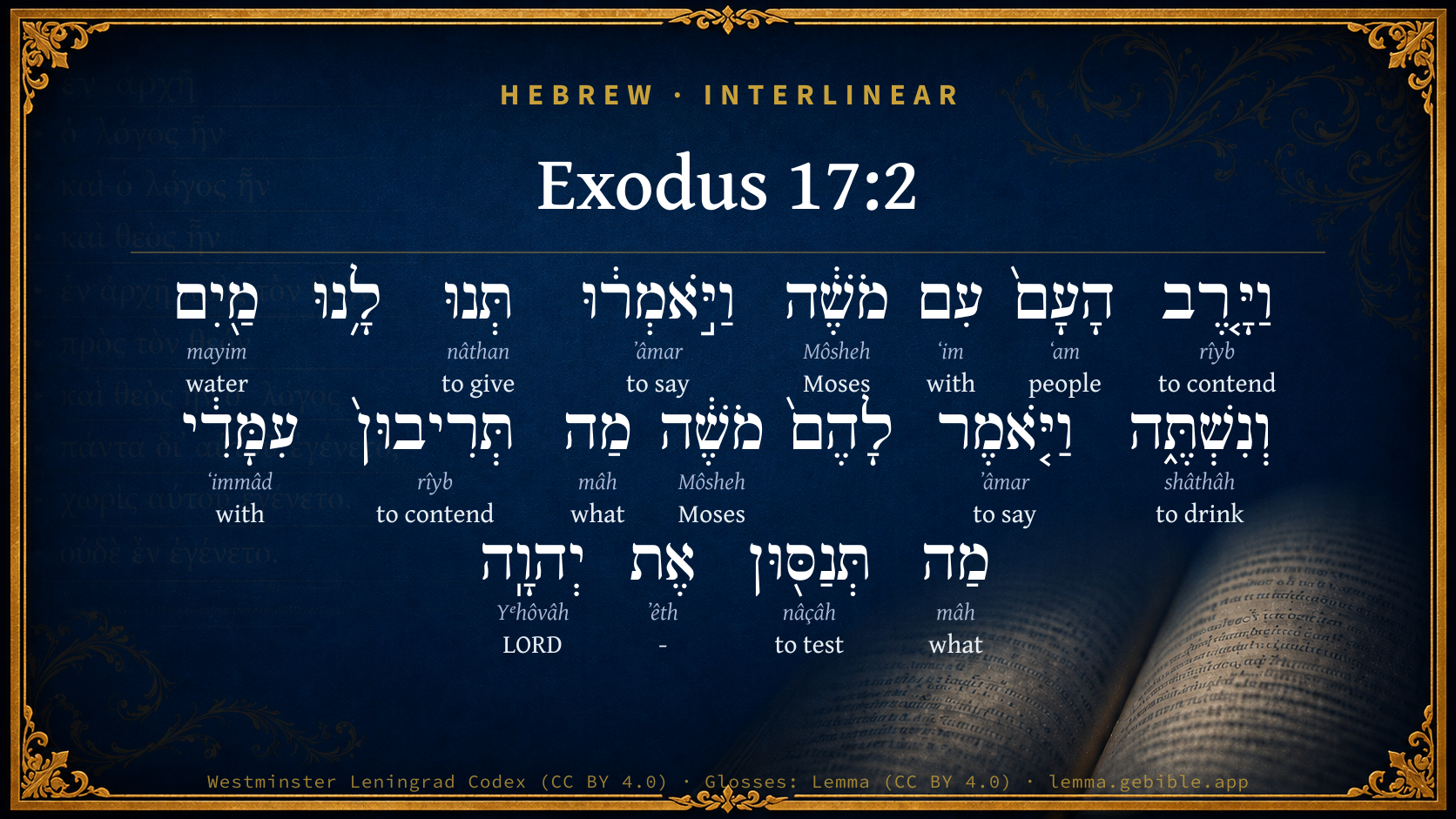
  1. וַיָּ֤רֶב rîyb H7378 “and · to contend” Conjunction + Verb, Qal, Sequential Imperfect, 3rd Person, Masculine, Singular
  2. הָעָם֙ ʻam H5971 “the · people” Particle, Definite Article + Noun, Common, Masculine, Singular, Absolute
  3. עִם ʻim H5973 “with” Preposition
  4. מֹשֶׁ֔ה Môsheh H4872 “Moses” Noun, Proper
  5. וַיֹּ֣אמְר֔וּ ʼâmar H559 “and · to say” Conjunction + Verb, Qal, Sequential Imperfect, 3rd Person, Masculine, Plural
  6. תְּנוּ nâthan H5414 “give” Verb, Qal, Imperative, 2nd Person, Masculine, Plural
  7. מַ֖יִם mayim H4325 “water(s)” Noun, Common, Masculine, Plural, Absolute
  8. וְנִשְׁתֶּ֑ה shâthâh H8354 “and · to drink” Conjunction + Verb, Qal, Imperfect, 1st Person, Common, Plural
  9. וַיֹּ֤אמֶר ʼâmar H559 “and · to say” Conjunction + Verb, Qal, Sequential Imperfect, 3rd Person, Masculine, Singular
  10. מֹשֶׁ֔ה Môsheh H4872 “Moses” Noun, Proper
  11. מַה mâh H4100 “what” Particle, Interrogative
  12. תְּרִיבוּן֙ rîyb H7378 “to contend” Verb, Qal, Imperfect, 2nd Person, Masculine, Plural + Suffix, n
  13. עִמָּדִ֔י ʻimmâd H5978 “with · me” Preposition + Suffix, Personal, 1st Person, Common, Singular
  14. מַה mâh H4100 “what” Particle, Interrogative
  15. אֶת ʼêth H853 “-” Particle, Direct Object
  16. יְהוָֽה Yᵉhôvâh H3068 “LORD” Noun, Proper

About this verse

These counts appear in no published source. They are computed here, from the morphology-tagged text and Lemma’s own curated glosses. What Lemma adds →

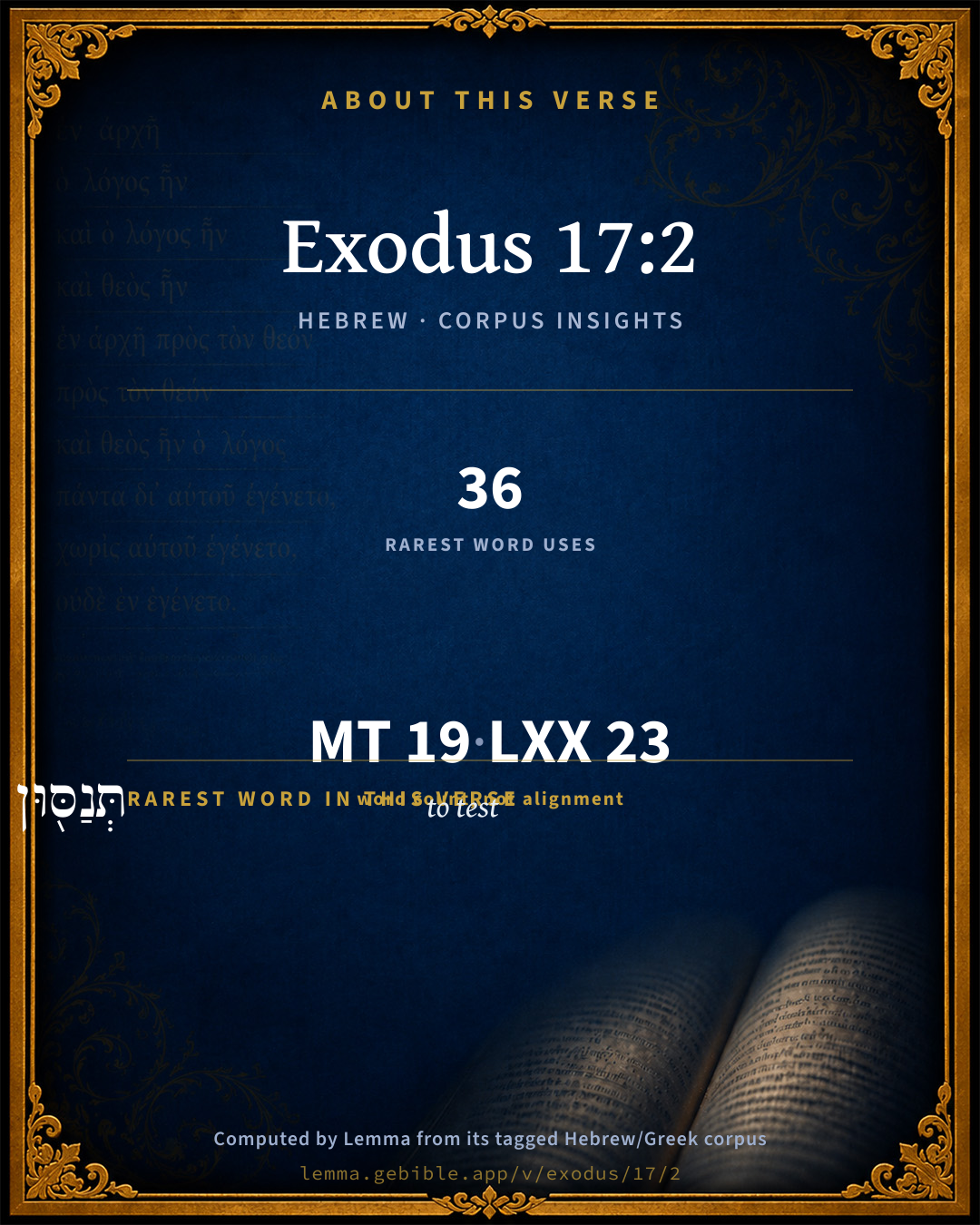
19
words
13
distinct lemmas
Pentateuch
section

Shared distinctive vocabulary

תְּנַסּ֖וּן to test H5254 occurs in 34 verses of the Hebrew Bible. Also found in:

Grammatical profile

  • 7 verbs
  • 5 nouns
  • 4 prepositions
  • 3 particles

Verb forms

  • וַיָּ֤רֶב Qal · Sequential Imperfect
  • וַיֹּ֣אמְר֔וּ Qal · Sequential Imperfect
  • תְּנוּ Qal · Imperative
  • וְנִשְׁתֶּ֑ה Qal · Imperfect
  • וַיֹּ֤אמֶר Qal · Sequential Imperfect
  • תְּרִיבוּן֙ Qal · Imperfect
  • תְּנַסּ֖וּן Piel · Imperfect

Repetition

Words recur within this verse — often emphatic in Hebrew:

  • וַיָּ֤רֶב to contend H7378 ×2
  • מֹשֶׁ֔ה Moses H4872 ×2
  • וַיֹּ֣אמְר֔וּ to say H559 ×2
  • מַה what H4100 ×2

Hebrew & Septuagint length

In English translation the verse runs 28 words from the Hebrew and 29 from the Septuagint (LXX English) — closely comparable.

A rough comparison of the two English renderings, which tokenize alike — not a word-level alignment.

Word counts can differ between the Hebrew and the Greek without any difference in meaning — e.g. the Hebrew direct-object marker אֵת has no separate Greek word, and Greek often adds the article ὁ.

In the original languages it is 19 Hebrew tokens and 23 Greek tokens — but the two are counted differently (Hebrew bundles its prefixes and suffixes into one token; the Greek is in lemma form), so that isn’t a like-for-like length.

Cross-references

28

Topical passages linked to Exodus 17:2 in the Treasury of Scripture Knowledge — connected by theme and wording, ordered by reader-vote popularity; previews shown in the World English Bible.

  • Psalms 78:18 They tempted God in their heart By asking food according to their desire.
  • Deuteronomy 6:16 You shall not tempt Yahweh your God, as you tempted him in Massah.
  • Psalms 78:41 They turned again and tempted God, And provoked the Holy One of Israel.
  • 1 Corinthians 10:9 Neither let us test the Lord, as some of them tested, and perished by the serpents.
  • Isaiah 7:12 But Ahaz said, "I will not ask, neither will I tempt Yahweh."
  • Hebrews 3:9 Where your fathers tested me by proving me, And saw my works for forty years.
  • Numbers 20:2–5 There was no water for the congregation: and they assembled themselves together against Moses and against Aaron.
  • Numbers 21:5 The people spoke against God, and against Moses, Why have you brought us up out of Egypt to die in the wilderness? for there is no bread, and there is no water; and our soul loathes this light bread.
  • Psalms 95:9 When your fathers tempted me, Tested me, and saw my work.
  • Matthew 4:7 Jesus said to him, "Again, it is written, 'You shall not test the Lord, your God.'"
  • Acts 15:10 Now therefore why do you tempt God, that you should put a yoke on the neck of the disciples which neither our fathers nor we were able to bear?
  • Exodus 14:11–12 They said to Moses, "Because there were no graves in Egypt, have you taken us away to die in the wilderness? Why have you treated us this way, to bring us forth out of Egypt?
  • Exodus 17:7 He called the name of the place Massah, and Meribah, because the children of Israel quarreled, and because they tested Yahweh, saying, "Is Yahweh among us, or not?"
  • Numbers 14:22 because all those men who have seen my glory, and my signs, which I worked in Egypt and in the wilderness, yet have tempted me these ten times, and have not listened to my voice;
  • Psalms 78:56 Yet they tempted and rebelled against the Most High God, And didn't keep his testimonies;
  • Psalms 106:14 But gave in to craving in the desert, And tested God in the wasteland.
  • Malachi 3:15 Now we call the proud happy; yes, those who work wickedness are built up; yes, they tempt God, and escape.'
  • Luke 4:12 Jesus answering, said to him, "It has been said, 'You shall not tempt the Lord your God.'"
  • Acts 5:9 But Peter asked her, "How is it that you have agreed together to tempt the Spirit of the Lord? Behold, the feet of those who have buried your husband are at the door, and they will carry you out."
  • Exodus 15:24 The people murmured against Moses, saying, "What shall we drink?"
  • Exodus 16:2–3 The whole congregation of the children of Israel murmured against Moses and against Aaron in the wilderness;
  • Luke 15:12 The younger of them said to his father, 'Father, give me my share of your property.' He divided his livelihood between them.
  • Genesis 30:1–2 When Rachel saw that she bore Jacob no children, Rachel envied her sister. She said to Jacob, "Give me children, or else I will die."
  • Exodus 5:21 and they said to them, "May Yahweh look at you, and judge, because you have made us a stench to be abhorred in the eyes of Pharaoh, and in the eyes of his servants, to put a sword in their hand to kill us."
  • Numbers 11:4–6 The mixed multitude that was among them lusted exceedingly: and the children of Israel also wept again, and said, Who shall give us flesh to eat?
  • Numbers 14:2 All the children of Israel murmured against Moses and against Aaron: and the whole congregation said to them, Would that we had died in the land of Egypt! or would that we had died in this wilderness!
  • 1 Samuel 8:6 But the thing displeased Samuel, when they said, Give us a king to judge us. Samuel prayed to Yahweh.
  • Matthew 16:1–3 The Pharisees and Sadducees came, and testing him, asked him to show them a sign from heaven.

Cross-references courtesy of OpenBible.info (CC BY 4.0).

Hebrew and Greek witnesses Masoretic Hebrew ↔ Greek Septuagint

The same verse in the two great witnesses to the Old Testament, shown verse-for-verse.

These are two independent witnesses, not word-aligned to each other, and the Septuagint is shown in lemma (dictionary) form.

Hebrew Exodus 17:2 Masoretic · Westminster Leningrad Codex

וַיָּ֤רֶב הָעָם֙ עִם מֹשֶׁ֔ה וַיֹּ֣אמְר֔וּ תְּנוּ לָ֥נוּ מַ֖יִם וְנִשְׁתֶּ֑ה וַיֹּ֤אמֶר לָהֶם֙ מֹשֶׁ֔ה מַה תְּרִיבוּן֙ עִמָּדִ֔י מַה תְּנַסּ֖וּן אֶת יְהוָֽה

Therefore the people quarreled with Moses, and said, "Give us water to drink." Moses said to them, "Why do you quarrel with me? Why do you test Yahweh?"

World English Bible · Public Domain

Greek LXX Exodus 17:2 Septuagint · lemma form

καί λοιδορέω ὁ λαός πρός μωυσῆς λέγω δίδωμι ἐγώ ὕδωρ ἵνα πίνω καί εἶπον αὐτός μωυσῆς τίς λοιδορέω ἐγώ καί τίς πειράζω κύριος

And the people reviled Moses, saying, Give us water, that we may drink; and Moses said to them, Why do you⌃ revile me, and why tempt you⌃ the Lord?

LXX2012 (modern English Septuagint) · Public Domain

Hebrew: Westminster Leningrad Codex (CC BY 4.0). Greek: Septuagint (public domain); English from LXX2012 (modern English Septuagint) (Public Domain). How the Septuagint differs from the Hebrew →

Targum (Aramaic paraphrase)

2

The Targum is the ancient Jewish Aramaic paraphrase of the Hebrew Scriptures — an interpretive translation, not the Hebrew text itself. Onkelos (literal) and Pseudo-Jonathan (expansive) render the Torah, and Jonathan the Prophets. Coverage is partial: where no permissively-licensed English translation exists for a verse, only the Aramaic is shown. This is verse-level text, not a word-by-word alignment to the Hebrew.

  1. Targum Onkelos Torah (Genesis–Deuteronomy)
    וּנְצָא עַמָא עִם משֶׁה וַאֲמָרוּ הָבוּ לָנָא מַיָא וְנִשְׁתֵּי וַאֲמַר לְהוֹן משֶׁה מָא אַתּוּן נָצָן עִמִי מָא מְנַסוּן אַתּוּן קֳדָם יְיָ:

    (no public-domain English translation for this verse)

    Targum Onkelos — Aramaic: “Onkelos Genesis” (public domain); “Onkelos Exodus” (public domain); “Onkelos Leviticus” (public domain); “Onkelos Numbers” (public domain); “Onkelos Deuteronomy” (public domain). English: “Sefaria Community Translation” (CC0 1.0 (public-domain dedication)); “J.W. Etheridge. The Targums of Onkelos and Jonathan Ben Uzziel on the Pentateuch. London: Longmans, Green, 1862” (public domain). Text via Sefaria.

  2. Targum Pseudo-Jonathan Torah (Genesis–Deuteronomy)
    וְנָצוּ רַשִׁיעֵי עַמָא עִם משֶׁה וְאָמָרוּ הַב לָן מוֹי וְנִשְׁתֵּי וַאֲמַר לְהוֹן משֶׁה מַה נָּצַן אַתּוּן עִמִּי וּמַה מְנַסֵן אַתּוּן קֳדָם יְיָ

    And the wicked of the people contended with Mosheh, and said, Give us water, that we may drink. And Mosheh said to them, Why contend you with me? and why tempt you before the Lord?

    Targum Pseudo-Jonathan — Aramaic: “Targum Jonathan on Genesis” (public domain); “Targum Jonathan on Exodus” (public domain); “Targum Jonathan on Leviticus” (public domain); “Targum Jonathan on Numbers” (public domain); “Targum Jonathan on Deuteronomy” (public domain). English: “The Targum of Jonathan ben Uzziel, trans. J. W. Etheridge, London, 1862” (public domain). Text via Sefaria.

Commentary

Notes on Exodus 17:2 from classic Christian and Jewish commentators (each source and its license shown beneath its notes). The classic Christian expositions comment on the surrounding passage and are grouped to its opening verse, so a note may address several verses; the Jewish commentaries on the Tanakh (Rashi and others) are per-verse, so they appear only where the commentator wrote on this verse.

Lemma curates 59 commentaries, every one of them public domain or Creative Commons licensed, each selected and text-cleaned for this edition rather than reprinted as found. About our sources →

Trapp's Complete Commentary

John Trapp

Exo 17:2 Wherefore the people did chide with Moses, and said, Give us water that we may drink. And Moses said unto them, Why chide ye with me? wherefore do ye tempt the LORD?

Ver. 2. The people did chide with Moses.] As they did before for bread. And as thirst is the more eager appetite, so they are more eager and earnest for water than they were for bread.

Wherefore do ye tempt the Lord?] viz., Whether he be amongst you and be able by miracle to relieve you.

John Trapp, A Commentary or Exposition upon All the Books of the Old and New Testament (1647–1656) — public domain. Text from a community e-Sword module.

Joseph Benson's Commentary

Exo 17:2. Wherefore do ye tempt the Lord? — By distrusting his power, providence, and faithfulness, upon such a small occasion; by refusing to submit to his will, and to wait upon him in humble fervent prayer for relief; and instead thereof quarrelling with me, as if it were my fault that you want water, and by murmuring against God under my name.

Joseph Benson's Commentary on the Old and New Testaments (1811–1818) — public domain. Text from a community e-Sword module.

Tyndale Open Study Notes

Tyndale Open Resources

17:2 testing the Lord is explained in 17:7. They doubted that God was really with them or cared for them, and they demanded that he prove his presence and care. God invites a test based on faith (“I do believe, but help me overcome my unbelief,” Mark 9:24), but he abhors a test based on doubt (i.e., I don’t believe, and I think God should prove himself to me, as in John 6:30). The test based on doubt makes us the judge and God the defendant.

Tyndale Open Study Notes — © Tyndale Open Resources, licensed CC BY-SA 4.0. Text via the HelloAO Bible API.

Geneva Bible (1599)

Geneva Bible translators

Why distrust you God? why look ye not for succor of him without murmuring against us?

Geneva Bible (1599) marginal notes — public domain. Text via Bolls.life.

Jamieson, Fausset & Brown

Robert Jamieson, A. R. Fausset & David Brown

the people did chide with Moses, and said, Give us water that we may drink, &c.--The want of water was a privation, the severity of which we cannot estimate, and it was a great trial to the Israelites, but their conduct on this new occasion was outrageous; it amounted even to "a tempting of the Lord." It was an opposition to His minister, a distrust of His care, an indifference to His kindness, an unbelief in His providence, a trying of His patience and fatherly forbearance.

Jamieson, Fausset & Brown — Commentary Critical and Explanatory on the Whole Bible (1871) — public domain (CC PDM 1.0). Text via the HelloAO Bible API.

Adam Clarke's Commentary

Verse 2. Why chide ye with me?] God is your leader, complain to him; Wherefore do ye tempt the Lord? As he is your leader, all your murmurings against me he considers as directed against himself; why therefore do ye tempt him? Has he not given you sufficient proofs that he can destroy his enemies and support his friends? And is he not among you to do you good? Ex 17:7. Why therefore do ye doubt his power and goodness, and thus provoke him to treat you as his enemies?

Adam Clarke's Commentary on the Bible (1810–1826) — public domain. Text from a community e-Sword/MySword module.

Ellicott's Commentary for English Readers

(2) The people did chide.—Water is scanty along the route by which we have supposed Rephidim to have been reached. Such a supply as the people may have brought with them from Elim would have been exhausted. They would have looked forward to Rephidim both for their immediate necessity and for replenishing their water-skins. They would be suffering both from thirst and disappointment. The needs of their children and their cattle (Exo_17:3) would be an aggravation of their pain. They would see no hope in the future. Under the circumstances we cannot be surprised at their “chiding.” Nothing but a very lively faith, or an utter resignation to the will of God, could have made a people patient and submissive in such an extremity.

Give us water.—It was not faith that spoke in these words, but wrath. They had no belief that Moses could give them water, and “were almost ready to stone” him (Exo_17:4).

A Bible Commentary for English Readers, edited by Charles John Ellicott (1878–1897) — public domain. Text from a community e-Sword module.

The Cambridge Bible for Schools and Colleges

gen. ed. J. J. S. Perowne

2. Wherefore] the Heb. is simply And.

strove, i.e. disputed, expostulated. The word means properly to argue a case in a court of law; but it is often used more generally. Cf. as here, in the similar narrative, Num_20:3; Num_20:13; also Gen_26:20-22; Gen_31:36 (‘chode’), Jdg_11:25. (Not the word so rendered in Exo_2:13, Exo_21:22, which means to quarrel or fight.)

why [as just before] do ye put Jehovah to the proof?] by doubting, viz. (v. 7) whether He is really in your midst (cf. Num_11:20; Num_14:14), and able to supply your needs. Tempt is a misleading rendering: for to ‘tempt,’ in modern English, has acquired the sense of provoking or enticing a person in order that he may act in a particular way: whereas the Heb. nissâh is a neutral word, and means to test or prove a person to see whether he will act in a particular way (Exo_16:4), or whether the character he bears is well established (1Ki_10:1). God thus ‘proves’ a person, or puts him to the test, when He subjects him to a trial, to ascertain what his character is, or whether his loyalty to Him is sincere (Exo_16:4, Deu_8:2; Deu_13:3; cf. Gen_22:1, Exo_15:25; Exo_20:20 : so the ‘temptations’ of Deu_4:34; Deu_7:19; Deu_29:3 are really trials, or provings, of Pharaoh’s disposition and purpose); and men test or ‘prove’ God when they act as if questioning, and so challenging Him to give proof of, His word, or promise, or ability to help; so here and v. 7 (cf. Deu_6:16, Psa_95:9), Num_14:22, Psa_78:18 (see v. 19 f.), Psa_78:41; Psa_78:56, Psa_106:14, cf. Isa_7:12 : in all these passages ‘tempt’ obscures the meaning.

If the analysis of the ch., adopted above, is correct, this clause will have stood originally after v. 3.

The Cambridge Bible for Schools and Colleges (gen. ed. J. J. S. Perowne; Cambridge University Press, 1878–1918) — public domain. Text from a community e-Sword module.

John Gill's Exposition

Wherefore the people did chide with Moses,.... Contended with him by words, expostulating with him in a very angry and indecent manner for bringing them thither; loading him with reproaches and calumnies, wrangling and quarrelling with him, and using him very ill, giving hard words and bad language:

and said, give us water, that we may drink; directing their speech both to Moses and Aaron, as the word "give" (g) being in the plural number shows; which was requiring that of them which only God could do and signifying as if they were under obligation to do it for them, since they had brought them out of Egypt, and had the care of them; and having seen so many miracles wrought by them, might conclude it was in their power to get them water when they pleased: had they desired them to pray to God for them, to give them water, and exercised faith on him, that he would provide for them, they had done well; which they might reasonably conclude he would, who had brought them out of Egypt, led them through the Red sea, had sweetened the waters at Marah for them, conducted them to fountains of water at Elim, and had rained flesh and bread about their tents in the wilderness of Sin, and still continued the manna with them:

and Moses said unto them, why chide ye with me? as if it was I that brought you hither, whereas it is the Lord that goes before you in the pillar of cloud and fire, and as if I kept water from you, or could give it you at pleasure; how unreasonable, as well as how ungenerous is it in you to chide with me on this account

wherefore do you tempt the Lord? the Lord Christ, as appears from Co1 10:9 who with the Father and Spirit is the one Jehovah; him they tempted or tried; they tried whether he was present with them or not, Exo 17:7, they tried his power, whether he could give them water in a dry and desert land; and they tried his patience by chiding with his servants, and showing so much distrust of his power and providence, of his goodness and faithfulness; and by their wretched ingratitude and rebellion they tempted him to work a miracle for them.

(g) "Date", Pagninus, Montanus, &c.

John Gill's Exposition of the Whole Bible (1746–1763) — public domain (CC PDM 1.0). Text via the HelloAO Bible API.

Albert Barnes' Notes on the Bible

Tempt the Lord - It is a general characteristic of the Israelites that the miracles, which met each need as it arose, failed to produce a habit of faith: but the severity of the trial, the faintness and anguish of thirst in the burning desert, must not be overlooked in appreciating their conduct.

Albert Barnes' Notes on the Bible (1834–1885) — public domain. Text from a community e-Sword/MySword module.

Haydock's Catholic Bible Commentary

Chode, quarrelled and murmured. (Haydock) --- Tempt, requiring a miracle, ver. 7.

George Leo Haydock (1774–1849), Haydock's Catholic Family Bible and Commentary, 1859 edition — public domain. Excludes Psalms (Douay-Rheims chapter numbering differs from Protestant) and Deuterocanonical books (Catholic canon only).

Matthew Poole's English Annotations

By distrusting God’s power, and providence, and faithfulness, and goodness, upon such a small occasion, by refusing to submit to God’s will, and to wait upon him by humble and fervent prayers for relief, and instead thereof quarrelling with me, as if it were my fault, and murmuring against God under my name.

Matthew Poole's English Annotations on the Holy Bible (1683–1685) — public domain. Text from a community e-Sword/MySword module.

The Pulpit Commentary

The people did chide. i.e. "quarrelled," made open murmurs and complaint as before frequently. (Exo_14:11, 12 15:24 16:2, 3) Give us water. As Moses had already given them flesh (the quails) and bread (the manna), so it perhaps seemed to the people easy that he should give them such a common thing as water. Stanley notices (p. 70) that the wadys suggest the idea of water, and make its absence the more intolerable they are "exactly like rivers," with "torrent bed, and banks, and clefts inthe rock for tributary streams, and at times even rushes and shrubs fringing their course signs of "water, water everywhere, yet not a drop to drink." Wherefore do ye tempt the Lord ? To "tempt the Lord" is to try his patience by want of faith, to arouse his anger, to provoke him to punish us. It was the special sin of the Israelites during the whole period of their sojourn in the wilderness. They "tempted and provoked the most high; (Psa_78:56) "provoked him to anger with their inventions", (Psa_106:29) "murmured in their tents" (ib, 25), "provoked him at the sea" (ib, 7), "tempted him in the desert" (ib, 14). God"s long-suffering, notwithstanding all, is simply amazing!

The Pulpit Commentary (1880–1919), ed. H.D.M. Spence-Jones & Joseph S. Exell — public domain. Text from a community e-Sword module.

Rashi

Rabbi Shlomo Yitzchaki (Rashi)

מה תנסון TO WHY DO YE TRY [THE LORD] by saying, “Will He be able to give us water in an arid land?”

Rashi on the Tanakh — English translations: “The Judaica Press complete Tanach with Rashi, translated by A. J. Rosenberg” (CC BY 4.0); “Pentateuch with Rashi's commentary by M. Rosenbaum and A.M. Silbermann, 1929-1934” (public domain); “The Metsudah Tanach series, Lakewood, N.J” (CC BY 4.0); and “The Book of Joshua, Metsudah Publications, 1997” (CC BY 4.0). Text via Sefaria.

Lesson kit

Teaching starters — assembled from the data on this page, not authored interpretation. Every prompt links to the verse data it draws on. Edit before teaching.

Exodus, in the Pentateuch, opens this verse with 19 words (13 distinct Hebrew lemmas). Its most distinctive word is nâçâh (“to test”). A historical commentator’s framing appears above. Read the whole chapter for the surrounding context.

Discussion questions

  1. What does “to test” (nâçâh) contribute to the verse as a whole?
  2. Genesis 22:1 shares the word «to test» with this verse. How do the two illuminate each other?
  3. “to contend” occurs 2× in this one verse. What is the effect of the repetition?
  4. These translations render this verse differently; the difference is in the English rendering, not the original. What questions does that raise?
  5. The verb «וַיָּ֤רֶב» is Qal Sequential Imperfect. How does its form color the action?
  6. Reading how Trapp's Complete Commentary and Joseph Benson's Commentary read this verse, where do the two commentators agree and where do they part?

Things to notice

Reading settings

Reading text

Shown beneath each verse's original-language words.

Old Testament
Old Testament edition

Read the OT as the Masoretic Hebrew (MT) or the Greek Septuagint (LXX).

English shown for the Greek Septuagint (in the Hebrew ↔ Greek comparison).

Comparing translations? Open the Compare panel on any verse page to stack up to four side by side.