Exodus 40:18

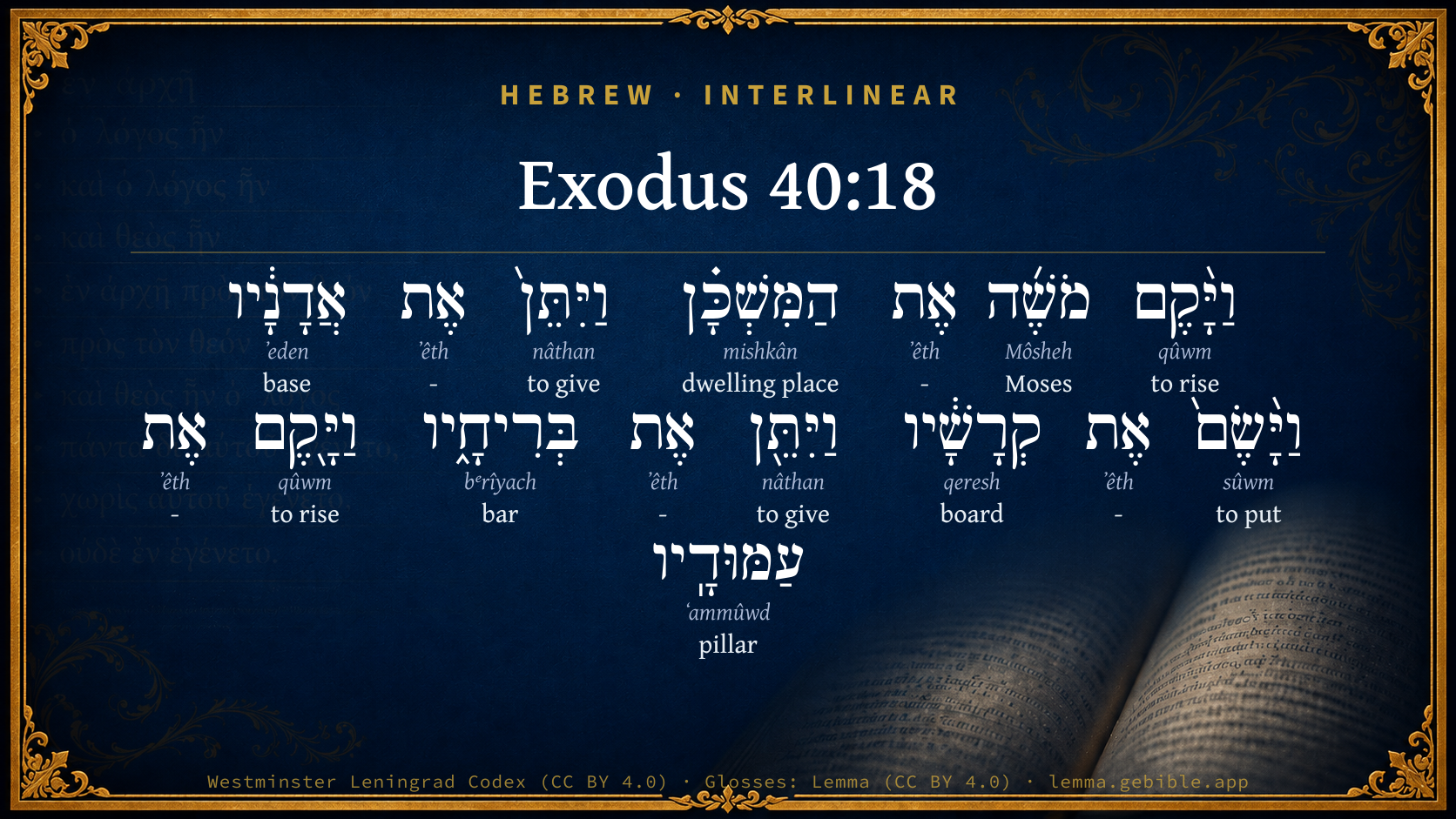
Hebrew (Westminster Leningrad Codex) Exodus 40:18 appears in the Hebrew Old Testament. The text above is from the Westminster Leningrad Codex. Each word links to its Strong’s number, a concise gloss, and parsing drawn from the Open Scriptures Hebrew Bible morphology. Click any word for its full Brown-Driver-Briggs (BDB) entry.
Download image
Cite this verse

Exodus 40:18 (World English Bible). Public Domain. Lemma interlinear Bible study tool, https://lemma.gebible.app/v/exodus/40/18.

Show BibTeX & RIS
BibTeX
RIS
English Translation
Moses raised up the tent, and laid its sockets, and set up the boards of it, and put in the bars of it, and raised up its pillars.
World English Bible · Public Domain
Download a study sheet

One document with this verse’s original text, its word-by-word gloss line, the meaning frame, cross-references with their text, attributed commentary, and full source and license credits — printable, and it pastes into notes with its structure intact.

This verse Autodidact and up

Study sheet (.html) Plain text (.txt)

A passage Seminary Student

Up to 50 verses in one chapter. A passage sheet keeps up to 6 commentary sources and 12 cross-references per verse, in the order this page ranks them, and says so on the sheet whenever that leaves anything out. Ask for a single verse and you get the Autodidact verse sheet above.

Everything on this page stays free to read, with no account — the sheet is a download of what is already on screen, not access to it.

Want to remove ads? Support Godless Engineer
Compare translations 3

The same verse in 3 English versions, stacked beneath the original-language interlinear above. Click any original word for its lexicon entry.

Each is an independent rendering of the whole verse — the interlinear is not word-aligned to these translations.

Highlighted words mark where these versions differ — a whole-verse word diff, not a word-by-word alignment.

  • World English Bible Public Domain
    Moses raised up the tent, and laid its sockets, and set up the boards of it, and put in the bars of it, and raised up its pillars.
  • King James Version Public Domain
    And Moses reared up the tabernacle, and fastened his sockets, and set up the boards thereof, and put in the bars thereof, and reared up his pillars.
  • unfoldingWord Literal Text CC BY-SA 4.0
    And Moses raised up the Dwelling and placed its bases and set up its frames and placed its bars and set up its pillars.

unfoldingWord Literal Text — © unfoldingWord, licensed CC BY-SA 4.0. Word-aligned USFM3 via Door43 (git.door43.org/unfoldingWord/en_ult).

Versions to compare (up to 4)

3 of 4 selected

Show all 18 translations

Every available English version of this verse, each an independent rendering of the whole verse.

  • World English Bible Public Domain
    Moses raised up the tent, and laid its sockets, and set up the boards of it, and put in the bars of it, and raised up its pillars.
  • Berean Standard Bible Public Domain
    When Moses set up the tabernacle, he laid its bases, positioned its frames, inserted its crossbars, and set up its posts.
  • Majority Standard Bible Public Domain
    When Moses set up the tabernacle, he laid its bases, positioned its frames, inserted its crossbars, and set up its posts.
  • King James Version Public Domain
    And Moses reared up the tabernacle, and fastened his sockets, and set up the boards thereof, and put in the bars thereof, and reared up his pillars.
  • American Standard Version (1901) Public Domain
    And Moses reared up the tabernacle, and laid its sockets, and set up the boards thereof, and put in the bars thereof, and reared up its pillars.
  • Revised Version (1885) Public Domain
    And Moses reared up the tabernacle, and laid its sockets, and set up the boards thereof, and put in the bars thereof, and reared up its pillars.
  • Geneva Bible (1599) Public Domain
    Then Moses reared vp the Tabernacle and fastened his sockets, and set vp the boardes thereof, and put in the barres of it, and reared vp his pillars.
  • Douay-Rheims (1899) Public Domain
    And he put the testimony in the ark, thrusting bars underneath, and the oracle above.
  • Young's Literal Translation Public Domain
    and Moses raiseth up the tabernacle, and setteth its sockets, and placeth its boards, and placeth its bars, and raiseth its pillars,
  • Literal Standard Version CC BY-SA 4.0
    and Moses raises up the Dwelling Place, and sets its sockets, and places its boards, and places its bars, and raises its pillars,
  • Unlocked Literal Bible CC BY-SA 4.0
    Moses set up the tabernacle, put its bases in place, set up its frames, attached its bars, and set up its pillars and posts.
  • unfoldingWord Literal Text CC BY-SA 4.0
    And Moses raised up the Dwelling and placed its bases and set up its frames and placed its bars and set up its pillars.
  • Darby Bible Public Domain
    And Moses set up the tabernacle, and put in its bases, and fixed its boards, and put in its bars, and set up its pillars.
  • World Messianic Bible Public Domain
    Moses raised up the tabernacle, and laid its sockets, and set up its boards, and put in its bars, and raised up its pillars.
  • Webster's Bible Public Domain
    And Moses reared up the tabernacle, and fastened its sockets, and set up its boards, and put in its bars, and reared up its pillars.
  • Free Bible Version CC BY-SA 4.0
    When Moses put up the Tabernacle, he placed its stands, attached its frames, connected its crossbars, and erected its posts.
  • Bible in Basic English Public Domain
    Moses put up the House; placing its bases in position and lifting up its uprights, putting in the rods and planting the pillars in their places;
  • JPS Tanakh (1917) Public Domain
    And Moses reared up the tabernacle, and laid its sockets, and set up the boards thereof, and put in the bars thereof, and reared up its pillars.

Literal Standard Version (2020), Covenant Press — licensed CC BY-SA 4.0. Text via the HelloAO Bible API (eBible.org). Unlocked Literal Bible (unfoldingWord) — licensed CC BY-SA 4.0. Text via the HelloAO Bible API (eBible.org). unfoldingWord Literal Text — © unfoldingWord, licensed CC BY-SA 4.0. Word-aligned USFM3 via Door43 (git.door43.org/unfoldingWord/en_ult). Free Bible Version, Dr. Jonathan Gallagher — licensed CC BY-SA 4.0. Text via the HelloAO Bible API (eBible.org).

Word by word

More ways to search: Search by grammar → Find every occurrence → Compare this word →

Practice this passage: Drill this verse → Learn its vocabulary →

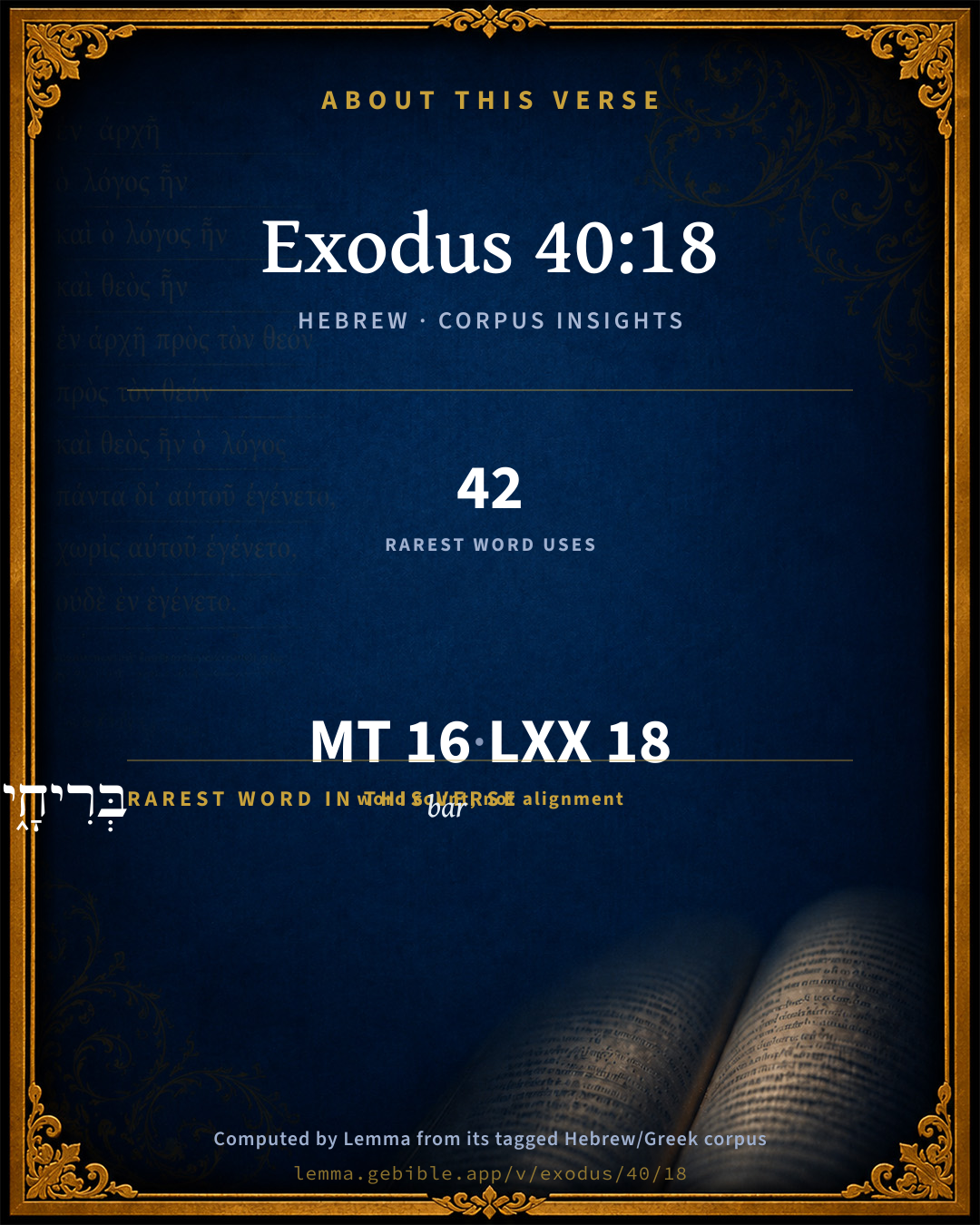
בְּרִיחָ֑יו
bᵉrîyach
H1280
“bars · his”
Noun, Common, Masculine, Plural, Construct + Suffix, Personal, 3rd Person, Masculine, Singular
Part of Speech
Noun
Type
Common
Gender
Masculine
Number
Plural
State
Construct
Full BDB Definition

Origin: from H1272

TWOT: 284b

bar - of wood - of city gates - of tribulation, a fortress, of the earth as a prison (figuratively)
  1. וַיָּ֨קֶם qûwm H6965 “and · to rise” Conjunction + Verb, Hiphil, Sequential Imperfect, 3rd Person, Masculine, Singular
  2. מֹשֶׁ֜ה Môsheh H4872 “Moses” Noun, Proper
  3. אֶת ʼêth H853 “-” Particle, Direct Object
  4. הַמִּשְׁכָּ֗ן mishkân H4908 “the · dwelling place” Particle, Definite Article + Noun, Common, Masculine, Singular, Absolute
  5. וַיִּתֵּן֙ nâthan H5414 “and · to give” Conjunction + Verb, Qal, Sequential Imperfect, 3rd Person, Masculine, Singular
  6. אֶת ʼêth H853 “-” Particle, Direct Object
  7. אֲדָנָ֔יו ʼeden H134 “bases · his” Noun, Common, Masculine, Plural, Construct + Suffix, Personal, 3rd Person, Masculine, Singular
  8. וַיָּ֨שֶׂם֙ sûwm H7760 “and · to put” Conjunction + Verb, Qal, Sequential Imperfect, 3rd Person, Masculine, Singular
  9. אֶת ʼêth H853 “-” Particle, Direct Object
  10. קְרָשָׁ֔יו qeresh H7175 “boards · his” Noun, Common, Masculine, Plural, Construct + Suffix, Personal, 3rd Person, Masculine, Singular
  11. וַיִּתֵּ֖ן nâthan H5414 “and · to give” Conjunction + Verb, Qal, Sequential Imperfect, 3rd Person, Masculine, Singular
  12. אֶת ʼêth H853 “-” Particle, Direct Object
  13. וַיָּ֖קֶם qûwm H6965 “and · to rise” Conjunction + Verb, Hiphil, Sequential Imperfect, 3rd Person, Masculine, Singular
  14. אֶת ʼêth H853 “-” Particle, Direct Object
  15. עַמּוּדָֽיו ʻammûwd H5982 “pillars · his” Noun, Common, Masculine, Plural, Construct + Suffix, Personal, 3rd Person, Masculine, Singular

About this verse

These counts appear in no published source. They are computed here, from the morphology-tagged text and Lemma’s own curated glosses. What Lemma adds →

16
words
10
distinct lemmas
Pentateuch
section

Shared distinctive vocabulary

בְּרִיחָ֑יו bar H1280 occurs in 37 verses of the Hebrew Bible. Also found in:

Grammatical profile

  • 5 verbs
  • 6 nouns
  • 5 particles

Verb forms

  • וַיָּ֨קֶם Hiphil · Sequential Imperfect
  • וַיִּתֵּן֙ Qal · Sequential Imperfect
  • וַיָּ֨שֶׂם֙ Qal · Sequential Imperfect
  • וַיִּתֵּ֖ן Qal · Sequential Imperfect
  • וַיָּ֖קֶם Hiphil · Sequential Imperfect

Repetition

Words recur within this verse — often emphatic in Hebrew:

  • וַיָּ֨קֶם to rise H6965 ×2
  • וַיִּתֵּן֙ to give H5414 ×2

Hebrew & Septuagint length

In English translation the verse runs 28 words from the Hebrew and 23 from the Septuagint (LXX English) — closely comparable.

A rough comparison of the two English renderings, which tokenize alike — not a word-level alignment.

Word counts can differ between the Hebrew and the Greek without any difference in meaning — e.g. the Hebrew direct-object marker אֵת has no separate Greek word, and Greek often adds the article ὁ.

In the original languages it is 16 Hebrew tokens and 18 Greek tokens — but the two are counted differently (Hebrew bundles its prefixes and suffixes into one token; the Greek is in lemma form), so that isn’t a like-for-like length.

Cross-references

12

Topical passages linked to Exodus 40:18 in the Treasury of Scripture Knowledge — connected by theme and wording, ordered by reader-vote popularity; previews shown in the World English Bible.

  • Exodus 26:15–30 "You shall make the boards for the tent of acacia wood, standing up.
  • Exodus 36:20–34 He made the boards for the tent of acacia wood, standing up.
  • Exodus 40:2 "On the first day of the first month you shall raise up the tent of the Tent of Meeting.
  • Leviticus 26:11 I will set my tent among you: and my soul won't abhor you.
  • Isaiah 33:24 The inhabitant shall not say, I am sick: the people who dwell therein shall be forgiven their iniquity.
  • Ezekiel 37:27–28 My tent also shall be with them; and I will be their God, and they shall be my people.
  • Matthew 16:18 I also tell you that you are Peter, and on this rock I will build my assembly, and the gates of Hades will not prevail against it.
  • Galatians 4:4 But when the fullness of the time came, God sent out his Son, born to a woman, born under the law,
  • 1 Timothy 3:15 but if I wait long, that you may know how men ought to behave themselves in the house of God, which is the assembly of the living God, the pillar and ground of the truth.
  • 1 Peter 1:5 who by the power of God are guarded through faith for a salvation ready to be revealed in the last time.
  • Revelation 21:3 I heard a loud voice out of heaven saying, "Behold, God's dwelling is with people, and he will dwell with them, and they will be his people, and God himself will be with them as their God.
  • John 1:14 The Word became flesh, and lived among us. We saw his glory, such glory as of the one and only Son of the Father, full of grace and truth.

Cross-references courtesy of OpenBible.info (CC BY 4.0).

Hebrew and Greek witnesses Masoretic Hebrew ↔ Greek Septuagint

The same verse in the two great witnesses to the Old Testament, shown verse-for-verse.

These are two independent witnesses, not word-aligned to each other, and the Septuagint is shown in lemma (dictionary) form.

Hebrew Exodus 40:18 Masoretic · Westminster Leningrad Codex

וַיָּ֨קֶם מֹשֶׁ֜ה אֶת הַמִּשְׁכָּ֗ן וַיִּתֵּן֙ אֶת אֲדָנָ֔יו וַיָּ֨שֶׂם֙ אֶת קְרָשָׁ֔יו וַיִּתֵּ֖ן אֶת בְּרִיחָ֑יו וַיָּ֖קֶם אֶת עַמּוּדָֽיו

Moses raised up the tent, and laid its sockets, and set up the boards of it, and put in the bars of it, and raised up its pillars.

World English Bible · Public Domain

Greek LXX Exodus 40:18 Septuagint · lemma form

καί ἵστημι μωυσῆς ὁ σκηνή καί ἐπιτίθημι ὁ κεφαλίς καί δια ἐνβάλλω ὁ μοχλός καί ἵστημι ὁ στῦλος

And Moses set up the tabernacle, and put on the capitals, and put the bars into their places, and set up the posts.

LXX2012 (modern English Septuagint) · Public Domain

Hebrew: Westminster Leningrad Codex (CC BY 4.0). Greek: Septuagint (public domain); English from LXX2012 (modern English Septuagint) (Public Domain). How the Septuagint differs from the Hebrew →

Targum (Aramaic paraphrase)

2

The Targum is the ancient Jewish Aramaic paraphrase of the Hebrew Scriptures — an interpretive translation, not the Hebrew text itself. Onkelos (literal) and Pseudo-Jonathan (expansive) render the Torah, and Jonathan the Prophets. Coverage is partial: where no permissively-licensed English translation exists for a verse, only the Aramaic is shown. This is verse-level text, not a word-by-word alignment to the Hebrew.

  1. Targum Onkelos Torah (Genesis–Deuteronomy)
    וַאֲקֵם משֶׁה יָת מַשְׁכְּנָא וִיהַב יָת סַמְכוֹהִי וְשַׁוִי יָת דַפּוֹהִי וִיהַב יָת עַבְרוֹהִי וַאֲקֵם יָת עַמוּדוֹהִי:

    (no public-domain English translation for this verse)

    Targum Onkelos — Aramaic: “Onkelos Genesis” (public domain); “Onkelos Exodus” (public domain); “Onkelos Leviticus” (public domain); “Onkelos Numbers” (public domain); “Onkelos Deuteronomy” (public domain). English: “Sefaria Community Translation” (CC0 1.0 (public-domain dedication)); “J.W. Etheridge. The Targums of Onkelos and Jonathan Ben Uzziel on the Pentateuch. London: Longmans, Green, 1862” (public domain). Text via Sefaria.

  2. Targum Pseudo-Jonathan Torah (Genesis–Deuteronomy)
    וְאָקִים משֶׁה יַת מַשְׁכְּנָא וִיהַב יַת חוֹמְרוֹי וְשַׁוִּי יַת לוּחוֹי וִיהַב יַת נַגְרוֹי וְאָקִים יַת עַמּוּדוֹי

    And Mosheh reared the tabernacle, and placed its bases, and set its boards, and placed its bars, and reared its pillars.

    Targum Pseudo-Jonathan — Aramaic: “Targum Jonathan on Genesis” (public domain); “Targum Jonathan on Exodus” (public domain); “Targum Jonathan on Leviticus” (public domain); “Targum Jonathan on Numbers” (public domain); “Targum Jonathan on Deuteronomy” (public domain). English: “The Targum of Jonathan ben Uzziel, trans. J. W. Etheridge, London, 1862” (public domain). Text via Sefaria.

Commentary

Notes on Exodus 40:18 from classic Christian and Jewish commentators (each source and its license shown beneath its notes). The classic Christian expositions comment on the surrounding passage and are grouped to its opening verse, so a note may address several verses; the Jewish commentaries on the Tanakh (Rashi and others) are per-verse, so they appear only where the commentator wrote on this verse.

Lemma curates 59 commentaries, every one of them public domain or Creative Commons licensed, each selected and text-cleaned for this edition rather than reprinted as found. About our sources →

Ellicott's Commentary for English Readers

(18) Moses . . . fastened his sockets.—The stability of the Tabernacle must have depended almost entirely upon the sockets. These were of some considerable weight (Exo_38:27), but they cannot by their mere weight have sustained the fabric in an upright position. It is reasonable to suppose that they were let into the ground to a depth of some feet. The erection necessarily commenced with this operation.

Set up the boards.—When the sockets had been firmly fixed, the upright boards and tiie pillars were inserted into them by means of the “tenons” in which they terminated, and so stood erect. The coupling by “bars” rivetted the three walls into one firm and compact structure.

A Bible Commentary for English Readers, edited by Charles John Ellicott (1878–1897) — public domain. Text from a community e-Sword module.

The Cambridge Bible for Schools and Colleges

gen. ed. J. J. S. Perowne

18. See v. 2b, Exo_26:30.

The Cambridge Bible for Schools and Colleges (gen. ed. J. J. S. Perowne; Cambridge University Press, 1878–1918) — public domain. Text from a community e-Sword module.

John Gill's Exposition

And he took and put the testimony into the ark,.... The ten commands, called the "testimony", because they testified and declared what was the will of God with respect to things to be done, or not done. The Targum of Jonathan says, he put the broken pieces of the tables into it; but what became of them, or were done with them, we nowhere read; and it does not appear that any other, but those that Moses hewed by the order of God, were put into the ark; see Deu 10:1.

and set the staves on the ark; that it might be ready to be carried whenever a remove was necessary:

and put the mercy seat above upon the ark; together with the cherubim.

John Gill's Exposition of the Whole Bible (1746–1763) — public domain (CC PDM 1.0). Text via the HelloAO Bible API.

Haydock's Catholic Bible Commentary

Testimony, or tables of the law. The pagans enclosed various symbolical figures, cakes, &c., in their mystic arks. (Clement of Alexandria) But how different were they from the sacred records of religion! (Calmet)

George Leo Haydock (1774–1849), Haydock's Catholic Family Bible and Commentary, 1859 edition — public domain. Excludes Psalms (Douay-Rheims chapter numbering differs from Protestant) and Deuterocanonical books (Catholic canon only).

The Pulpit Commentary

Fastened his sockets. Rather, "placed its sockets." The "sockets" or "bases" appear to have been simply laid on the flat sand of the desert, not "fastened" to it in any way. They were heavy masses of metal and would remain where they were placed. His pillars. The pillars that supported the "veil," and also those at the east end, where the entrance was.

Vers. 18-33. The sanctification of material things.

Objections are raised to the entire idea of a holiness in things. Holiness, it is said, being a personal quality, cannot reside in things, or be communicated to them, or be rightly predicated of them. God is holy; angels are holy; some men are holy; but nothing else. To imagine a holiness in things is superstition. This is to effect a complete severance of matter from spirit to dig an abyss between them to regard them as asymptotes, which cannot ever touch one the other. But if God became incarnate, if "the Word was made flesh", (Joh_1:14) then that matter which constituted the body of Christ, most certainly became holy. And if that matter, why not other matter? Why not the food which he "blessed and brake, and gave to his disciples"? Why not the drink which he called "his blood"? If there is a contact between matter and spirit, and some spirits are holy, then it is readily intelligible that the matter which comes into contact with them may be, in a certain sense, holy also. And this is, beyond all doubt, the language of the Scriptures. We hear of "holy ground", (Exo_3:5) "holy places", (Exo_26:33) "holy garments", (Exo_28:2) "holy oil", (Exo_30:31) "a holy perfume" (ib, 35), etc. Things material may become holy in various ways, e.g.

I BY BEING TAKEN INTO GOD. Christ took our nature upon him, joined for ever the Manhood to the Eternal Godhead, and so gave to his own body an eternal sanctification of the highest possible kind, which renders it most holy.

II BY BEING BROUGHT INTO CONTACT WITH HIM. The Cross of Christ, the crown of thorns, the nails, the soldier"s spear, the raiment, the vesture, the napkin which was about his head when in the grave, became hallowed by association with him, and must ever be regarded by all Christians as holy. If the garment shown at Treves were indeed what it professes to be a garment once worn by Christ it would well deserve the name, by which it is commonly called, of the "holy coat." As it is, we have no sufficient evidence of any existing piece of matter, that it ever came into contact with our Lord"s blessed body; but, if we had, any such piece of matter would be "holy.

III BY DESIGNATION FOR A HOLY PURPOSE. It is in this way especially that buildings, garments, vessels, cloths, and the like, are "holy." They are intended for and serve a holy purpose are employed in the worship or service of Almighty God. It is felt on all hands that such things ought to be set apart from secular uses, reserved for the sacred end to which they have been designated, and applied to that only. Now, in cases of this kind, it does not appear to be inappropriate that the designation should be by a material act; and certainly no more significant act than anointing with oil is possible. For oil is symbolical of the Holy Spirit; and as it is by the Holy Spirit that individuals are sanctified, not only personally but officially, so as to be media of grace to others, so it may well be conceived that even inanimate things may become channels of grace and blessing to men, through an effluence from the same Spirit. The Holy Spirit does not disdain all contact with matter. At the beginning of creation he "moved," or rather brooded, "upon the face of the waters". (Gen_1:2) At the baptism of Jesus, the Spirit was seen "descending like a dove, and lighting on him". (Mat_4:16) At Pentecost he showed himself in the form of "tongues of fire". (Act_2:3) In every consecration it is quite possible that he may bear a part, though in general he shrouds himself, and does not let his presence be perceived.

The Pulpit Commentary (1880–1919), ed. H.D.M. Spence-Jones & Joseph S. Exell — public domain. Text from a community e-Sword module.

Lesson kit

Teaching starters — assembled from the data on this page, not authored interpretation. Every prompt links to the verse data it draws on. Edit before teaching.

Exodus, in the Pentateuch, opens this verse with 16 words (10 distinct Hebrew lemmas). Its most distinctive word is bᵉrîyach (“bar”). A historical commentator’s framing appears above. Read the whole chapter for the surrounding context.

Discussion questions

  1. What does “bar” (bᵉrîyach) contribute to the verse as a whole?
  2. How does Exodus 26:26, which shares the word «bar», read alongside this verse?
  3. What does the repetition of “to rise” (2× in this one verse) do in this verse?
  4. These translations render this verse differently. What is at stake in choosing one wording over another?
  5. «וַיָּ֨קֶם» is a Hiphil Sequential Imperfect verb. How does that grammatical form shape the action described?
  6. Compare how Ellicott's Commentary for English Readers and The Cambridge Bible for Schools and Colleges read this verse. Where do they agree or differ?

Things to notice

Reading settings

Reading text

Shown beneath each verse's original-language words.

Old Testament
Old Testament edition

Read the OT as the Masoretic Hebrew (MT) or the Greek Septuagint (LXX).

English shown for the Greek Septuagint (in the Hebrew ↔ Greek comparison).

Comparing translations? Open the Compare panel on any verse page to stack up to four side by side.