
Genesis 3:12

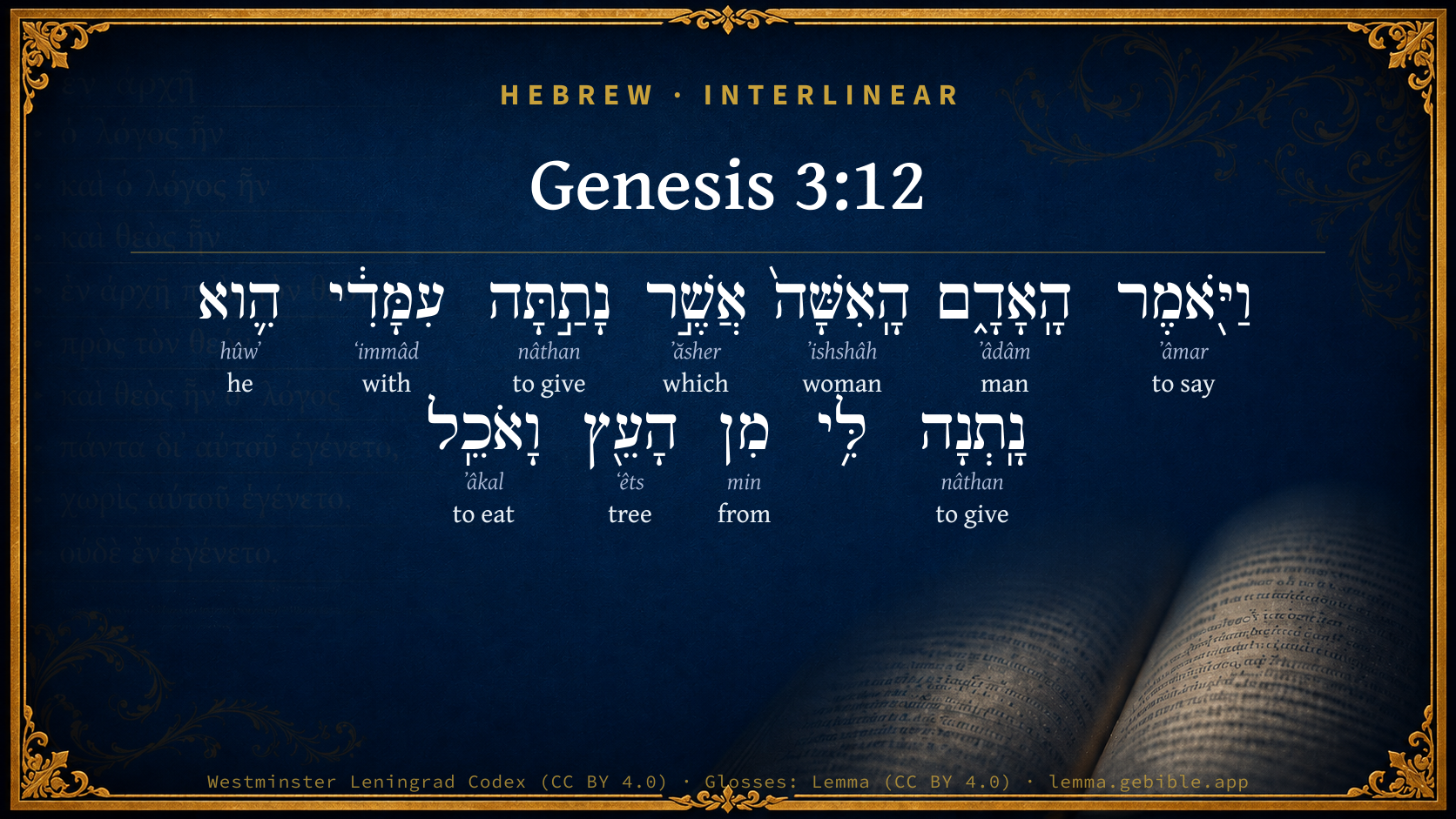
Hebrew (Westminster Leningrad Codex) Genesis 3:12 appears in the Hebrew Old Testament. The text above is from the Westminster Leningrad Codex. Each word links to its Strong’s number, a concise gloss, and parsing drawn from the Open Scriptures Hebrew Bible morphology. Click any word for its full Brown-Driver-Briggs (BDB) entry.
Download image
Cite this verse

Genesis 3:12 (World English Bible). Public Domain. Lemma interlinear Bible study tool, https://lemma.gebible.app/v/genesis/3/12.

Show BibTeX & RIS
BibTeX
RIS
English Translation
The man said, "The woman whom you gave to be with me, she gave me of the tree, and I ate."
World English Bible · Public Domain
Highlights
  • 1 first appearance in the Hebrew Bible
Full analysis ↓
Download a study sheet

One document with this verse’s original text, its word-by-word gloss line, the meaning frame, cross-references with their text, attributed commentary, and full source and license credits — printable, and it pastes into notes with its structure intact.

This verse Autodidact and up

Study sheet (.html) Plain text (.txt)

A passage Seminary Student

Up to 50 verses in one chapter. A passage sheet keeps up to 6 commentary sources and 12 cross-references per verse, in the order this page ranks them, and says so on the sheet whenever that leaves anything out. Ask for a single verse and you get the Autodidact verse sheet above.

Everything on this page stays free to read, with no account — the sheet is a download of what is already on screen, not access to it.

Want to remove ads? Support Godless Engineer
Compare translations 3

The same verse in 3 English versions, stacked beneath the original-language interlinear above. Click any original word for its lexicon entry.

Each is an independent rendering of the whole verse — the interlinear is not word-aligned to these translations.

Highlighted words mark where these versions differ — a whole-verse word diff, not a word-by-word alignment.

  • World English Bible Public Domain
    The man said, "The woman whom you gave to be with me, she gave me of the tree, and I ate."
  • King James Version Public Domain
    And the man said, The woman whom thou gavest to be with me, she gave me of the tree, and I did eat.
  • unfoldingWord Literal Text CC BY-SA 4.0
    Then the man said, “The woman whom you gave with me, she gave me from the tree, and I ate.”

unfoldingWord Literal Text — © unfoldingWord, licensed CC BY-SA 4.0. Word-aligned USFM3 via Door43 (git.door43.org/unfoldingWord/en_ult).

Versions to compare (up to 4)

3 of 4 selected

Show all 18 translations

Every available English version of this verse, each an independent rendering of the whole verse.

  • World English Bible Public Domain
    The man said, "The woman whom you gave to be with me, she gave me of the tree, and I ate."
  • Berean Standard Bible Public Domain
    And the man answered, “The woman whom You gave me, she gave me fruit from the tree, and I ate it.”
  • Majority Standard Bible Public Domain
    And the man answered, “The woman whom You gave me, she gave me fruit from the tree, and I ate it.”
  • King James Version Public Domain
    And the man said, The woman whom thou gavest to be with me, she gave me of the tree, and I did eat.
  • American Standard Version (1901) Public Domain
    And the man said, The woman whom thou gavest to be with me, she gave me of the tree, and I did eat.
  • Revised Version (1885) Public Domain
    And the man said, The woman whom thou gavest to be with me, she gave me of the tree, and I did eat.
  • Geneva Bible (1599) Public Domain
    Then the man saide, The woman which thou gauest to be with me, she gaue me of the tree, and I did eate.
  • Douay-Rheims (1899) Public Domain
    And Adam said: The woman, whom thou gavest me to be my companion, gave me of the tree, and I did eat.
  • Young's Literal Translation Public Domain
    and the man saith, `The woman whom Thou didst place with me -- she hath given to me of the tree -- and I do eat.'
  • Literal Standard Version CC BY-SA 4.0
    And the man says, “The woman whom You placed with me—she has given to me from the tree, and I eat.”
  • Unlocked Literal Bible CC BY-SA 4.0
    The man said, “The woman whom you gave to be with me, she gave me fruit from the tree, and I ate it.”
  • unfoldingWord Literal Text CC BY-SA 4.0
    Then the man said, “The woman whom you gave with me, she gave me from the tree, and I ate.”
  • Darby Bible Public Domain
    And Man said, The woman, whom thou hast given [to be] with me, she gave me of the tree, and I ate.
  • World Messianic Bible Public Domain
    The man said, “The woman whom you gave to be with me, she gave me fruit from the tree, and I ate it.”
  • Webster's Bible Public Domain
    And the man said, The woman, whom thou gavest to be with me, she gave me of the tree, and I ate.
  • Free Bible Version CC BY-SA 4.0
    “It was the woman you gave me who gave me the fruit from the tree, and I ate it,” Adam replied.
  • Bible in Basic English Public Domain
    And the man said, The woman whom you gave to be with me, she gave me the fruit of the tree and I took it.
  • JPS Tanakh (1917) Public Domain
    And the man said: 'The woman whom Thou gavest to be with me, she gave me of the tree, and I did eat.'

Literal Standard Version (2020), Covenant Press — licensed CC BY-SA 4.0. Text via the HelloAO Bible API (eBible.org). Unlocked Literal Bible (unfoldingWord) — licensed CC BY-SA 4.0. Text via the HelloAO Bible API (eBible.org). unfoldingWord Literal Text — © unfoldingWord, licensed CC BY-SA 4.0. Word-aligned USFM3 via Door43 (git.door43.org/unfoldingWord/en_ult). Free Bible Version, Dr. Jonathan Gallagher — licensed CC BY-SA 4.0. Text via the HelloAO Bible API (eBible.org).

Word by word

More ways to search: Search by grammar → Find every occurrence → Compare this word →

Practice this passage: Drill this verse → Learn its vocabulary →

עִמָּדִ֔י
ʻimmâd
H5978
“with · me”
Preposition + Suffix, Personal, 1st Person, Common, Singular
Part of Speech
Preposition
Full BDB Definition

Origin: prol for H5973

TWOT: 1640b

with
  1. וַיֹּ֖אמֶר ʼâmar H559 “and · to say” Conjunction + Verb, Qal, Sequential Imperfect, 3rd Person, Masculine, Singular
  2. הָֽאָדָ֑ם ʼâdâm H120 “the · man” Particle, Definite Article + Noun, Common, Masculine, Singular, Absolute
  3. הָֽאִשָּׁה֙ ʼishshâh H802 “the · woman” Particle, Definite Article + Noun, Common, Feminine, Singular, Absolute
  4. אֲשֶׁ֣ר ʼăsher H834 “which” Particle, Relative
  5. נָתַ֣תָּה nâthan H5414 “to give” Verb, Qal, Perfect, 2nd Person, Masculine, Singular
  6. הִ֛וא hûwʼ H1931 “he” Pronoun, Personal, 3rd Person, Feminine, Singular
  7. נָֽתְנָה nâthan H5414 “to give” Verb, Qal, Perfect, 3rd Person, Feminine, Singular
  8. מִן min H4480 “from” Preposition
  9. הָעֵ֖ץ ʻêts H6086 “the · tree” Particle, Definite Article + Noun, Common, Masculine, Singular, Absolute
  10. וָאֹכֵֽל ʼâkal H398 “and · to eat” Conjunction + Verb, Qal, Sequential Imperfect, 1st Person, Common, Singular

About this verse

These counts appear in no published source. They are computed here, from the morphology-tagged text and Lemma’s own curated glosses. What Lemma adds →

12
words
10
distinct lemmas
Pentateuch
section

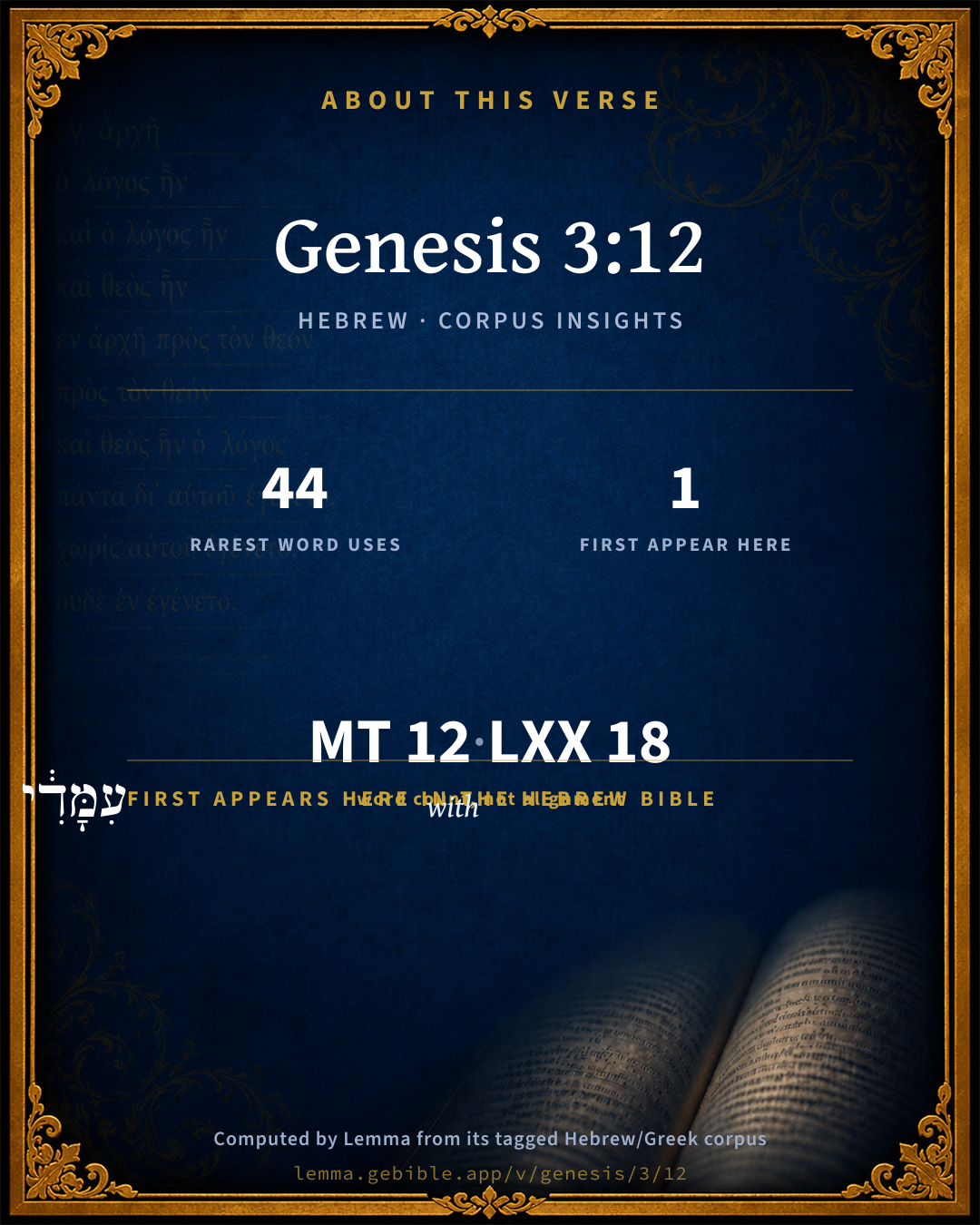
First appearance in Scripture

This word makes its first canonical appearance in the Hebrew Bible here:

  • עִמָּדִ֔י with H5978

Shared distinctive vocabulary

עִמָּדִ֔י with H5978 occurs in 44 verses of the Hebrew Bible. Also found in:

Grammatical profile

  • 4 verbs
  • 3 nouns
  • 1 pronoun
  • 3 prepositions
  • 1 particle

Verb forms

  • וַיֹּ֖אמֶר Qal · Sequential Imperfect
  • נָתַ֣תָּה Qal · Perfect
  • נָֽתְנָה Qal · Perfect
  • וָאֹכֵֽל Qal · Sequential Imperfect

Repetition

A word recurs within this verse — often emphatic in Hebrew:

  • נָתַ֣תָּה to give H5414 ×2

Hebrew & Septuagint length

In English translation the verse runs 21 words from the Hebrew and 20 from the Septuagint (LXX English) — closely comparable.

A rough comparison of the two English renderings, which tokenize alike — not a word-level alignment.

Word counts can differ between the Hebrew and the Greek without any difference in meaning — e.g. the Hebrew direct-object marker אֵת has no separate Greek word, and Greek often adds the article ὁ.

In the original languages it is 12 Hebrew tokens and 18 Greek tokens — but the two are counted differently (Hebrew bundles its prefixes and suffixes into one token; the Greek is in lemma form), so that isn’t a like-for-like length.

Cross-references

11

Topical passages linked to Genesis 3:12 in the Treasury of Scripture Knowledge — connected by theme and wording, ordered by reader-vote popularity; previews shown in the World English Bible.

  • Proverbs 28:13 He who conceals his sins doesn't prosper, But whoever confesses and renounces them finds mercy.
  • James 1:13–15 Let no man say when he is tempted, "I am tempted by God," for God can't be tempted by evil, and he himself tempts no one.
  • Job 31:33 If like Adam I have covered my transgressions, By hiding my iniquity in my heart,
  • Romans 10:3 For being ignorant of God's righteousness, and seeking to establish their own righteousness, they didn't subject themselves to the righteousness of God.
  • Genesis 2:18 Yahweh God said, "It is not good that the man should be alone; I will make him a helper suitable for him."
  • 1 Samuel 15:20–24 Saul said to Samuel, Yes, I have obeyed the voice of Yahweh, and have gone the way which Yahweh sent me, and have brought Agag the king of Amalek, and have utterly destroyed the Amalekites.
  • Proverbs 19:3 The foolishness of man subverts his way; His heart rages against Yahweh.
  • Luke 10:29 But he, desiring to justify himself, asked Jesus, "Who is my neighbor?"
  • Genesis 2:20 The man gave names to all cattle, and to the birds of the sky, and to every animal of the field; but for man there was not found a helper suitable for him.
  • Genesis 2:22 He made the rib, which Yahweh God had taken from the man, into a woman, and brought her to the man.
  • Exodus 32:21–24 Moses said to Aaron, "What did these people do to you, that you have brought a great sin on them?"

Cross-references courtesy of OpenBible.info (CC BY 4.0).

Hebrew and Greek witnesses Masoretic Hebrew ↔ Greek Septuagint

The same verse in the two great witnesses to the Old Testament, shown verse-for-verse.

These are two independent witnesses, not word-aligned to each other, and the Septuagint is shown in lemma (dictionary) form.

Hebrew Genesis 3:12 Masoretic · Westminster Leningrad Codex

וַיֹּ֖אמֶר הָֽאָדָ֑ם הָֽאִשָּׁה֙ אֲשֶׁ֣ר נָתַ֣תָּה עִמָּדִ֔י הִ֛וא נָֽתְנָה לִּ֥י מִן הָעֵ֖ץ וָאֹכֵֽל

The man said, "The woman whom you gave to be with me, she gave me of the tree, and I ate."

World English Bible · Public Domain

Greek LXX Genesis 3:12 Septuagint · lemma form

καί εἶπον ὁ αδαμ ὁ γυνή ὅς δίδωμι μετά ἐγώ οὗτος ἐγώ δίδωμι ἀπό ὁ ξύλον καί ἐσθίω

And Adam said, The woman whom you gave to be with me—she gave me of the tree and I ate.

LXX2012 (modern English Septuagint) · Public Domain

Hebrew: Westminster Leningrad Codex (CC BY 4.0). Greek: Septuagint (public domain); English from LXX2012 (modern English Septuagint) (Public Domain). How the Septuagint differs from the Hebrew →

Targum (Aramaic paraphrase)

2

The Targum is the ancient Jewish Aramaic paraphrase of the Hebrew Scriptures — an interpretive translation, not the Hebrew text itself. Onkelos (literal) and Pseudo-Jonathan (expansive) render the Torah, and Jonathan the Prophets. Coverage is partial: where no permissively-licensed English translation exists for a verse, only the Aramaic is shown. This is verse-level text, not a word-by-word alignment to the Hebrew.

  1. Targum Onkelos Torah (Genesis–Deuteronomy)
    וַאֲמַר הָאָדָם אִתְּתָא דִּיהַבְתָּ עִמִּי הִיא יַהֲבַת לִי מִן אִילָנָא וַאֲכָלִית

    (no public-domain English translation for this verse)

    Targum Onkelos — Aramaic: “Onkelos Genesis” (public domain); “Onkelos Exodus” (public domain); “Onkelos Leviticus” (public domain); “Onkelos Numbers” (public domain); “Onkelos Deuteronomy” (public domain). English: “Sefaria Community Translation” (CC0 1.0 (public-domain dedication)); “J.W. Etheridge. The Targums of Onkelos and Jonathan Ben Uzziel on the Pentateuch. London: Longmans, Green, 1862” (public domain). Text via Sefaria.

  2. Targum Pseudo-Jonathan Torah (Genesis–Deuteronomy)
    וַאֲמַר אָדָם אִיתְּתָא דִיהַבְתְּ גַבַּיי הִיא יַהֲבַת לִי מִן פֵּירֵי אִילָנָא וַאֲכָלִית

    And Adam said, The woman whom Thou gavest to be with me, she gave me of the fruit of the tree, and I did eat.

    Targum Pseudo-Jonathan — Aramaic: “Targum Jonathan on Genesis” (public domain); “Targum Jonathan on Exodus” (public domain); “Targum Jonathan on Leviticus” (public domain); “Targum Jonathan on Numbers” (public domain); “Targum Jonathan on Deuteronomy” (public domain). English: “The Targum of Jonathan ben Uzziel, trans. J. W. Etheridge, London, 1862” (public domain). Text via Sefaria.

Commentary

Notes on Genesis 3:12 from classic Christian and Jewish commentators (each source and its license shown beneath its notes). The classic Christian expositions comment on the surrounding passage and are grouped to its opening verse, so a note may address several verses; the Jewish commentaries on the Tanakh (Rashi and others) are per-verse, so they appear only where the commentator wrote on this verse.

Lemma curates 59 commentaries, every one of them public domain or Creative Commons licensed, each selected and text-cleaned for this edition rather than reprinted as found. About our sources →

Trapp's Complete Commentary

John Trapp

Gen 3:12 And the man said, The woman whom thou gavest [to be] with me, she gave me of the tree, and I did eat.

Ver. 12. The woman whom thou gavest.] Here he rejects the fault upon the woman, and, through her, upon God, who gave her to be with him, or before him; or such another as himself (with reference to that Kenegdo,){ Gen 2:20} or a help meet for him. This she might have been to him, had he been (as he ought to her) a manly guide in the way to heaven. He should have rebuked her, as Job did his wicked wife, for transgressing God’s law and tempting him to the like. Then had her sin been personal, resting upon herself, and gone no further, had not he hearkened to her voice. But he not only did thus, but instead of agnising his fault, seeks to transfer it upon God; that, since he could not be like unto God in the divinity, which he aimed at, he might make God like unto himself in iniquity; which was to fill up the measure of his sin, that wrath might have come upon him to the utmost, but that God’s mercy was then, and is still, over all his own good, and our bad, works.

John Trapp, A Commentary or Exposition upon All the Books of the Old and New Testament (1647–1656) — public domain. Text from a community e-Sword module.

Tyndale Open Study Notes

Tyndale Open Resources

3:12 It was the woman you gave me: Rather than confessing, the man became evasive. He blamed the woman for giving him the fruit and God for giving him the woman.

Tyndale Open Study Notes — © Tyndale Open Resources, licensed CC BY-SA 4.0. Text via the HelloAO Bible API.

Geneva Bible (1599)

Geneva Bible translators

His wickedness and lack of true repentance appeareth in this that he burdeneth God with his fault, because he had given him a wife.

Geneva Bible (1599) marginal notes — public domain. Text via Bolls.life.

Jamieson, Fausset & Brown

Robert Jamieson, A. R. Fausset & David Brown

The woman . . . gave me--He blames God [CALVIN]. As the woman had been given him for his companion and help, he had eaten of the tree from love to her; and perceiving she was ruined, was determined not to survive her [M'KNIGHT].

Jamieson, Fausset & Brown — Commentary Critical and Explanatory on the Whole Bible (1871) — public domain (CC PDM 1.0). Text via the HelloAO Bible API.

Adam Clarke's Commentary

Verse 12. And the man said, c.] We have here some farther proofs of the fallen state of man, and that the consequences of that state extend to his remotest posterity. 1. On the question, Hast thou eaten of the tree? Adam is obliged to acknowledge his transgression but he does this in such a way as to shift off the blame from himself, and lay it upon God and upon the woman! This woman whom THOU didst give to be with me, עמדי immadi, to be my companion, (for so the word is repeatedly used,) she gave me, and I did eat. I have no farther blame in this transgression; I did not pluck the fruit; she took it and gave it to me. 2. When the woman is questioned she lays the blame upon God and the serpent, (nachash.) The serpent beguiled me, and I did eat. Thou didst make him much wiser than thou didst make me, and therefore my simplicity and ignorance were overcome by his superior wisdom and subtlety; I can have no fault here, the fault is his, and his who made him so wise and me so ignorant. Thus we find that, while the eyes of their body were opened to see their degraded state, the eyes of their understanding were closed, so that they could not see the sinfulness of sin; and at the same time their hearts were hardened through its deceitfulness. In this also their posterity copy their example. How few ingenuously confess their own sin! They see not their guilt. They are continually making excuses for their crimes; the strength and subtlety of the tempter, the natural weakness of their own minds, the unfavourable circumstances in which they were placed, c., &c., are all pleaded as excuses for their sins, and thus the possibility of repentance is precluded for till a man take his sin to himself, till he acknowledge that he alone is guilty, he cannot be humbled, and consequently cannot be saved. Reader, till thou accuse thyself, and thyself only, and feel that thou alone art responsible for all thy iniquities, there is no hope of thy salvation.

Adam Clarke's Commentary on the Bible (1810–1826) — public domain. Text from a community e-Sword/MySword module.

John Calvin's Commentaries

12. The woman whom thou gavest to be with me. The boldness of Adam now more clearly betrays itself; for, so far from being subdued, he breaks forth into coarser blasphemy. He had before been tacitly expostulating with God; now he begins openly to contend with him, and triumphs as one who has broken through all barriers. Whence we perceive what a refractory and indomitable creature man began to be when he became alienated from God; for a lively picture of corrupt nature is presented to us in Adam from the moment of his revolt.

‘Every one,’ says James, ‘is tempted by his own concupiscence,’ (James 1:14;)

and even Adam, not otherwise than knowingly and willingly, had set himself, as a rebel, against God. Yet, just as if conscious of no evil, he puts his wife as the guilty party in his place. ‘Therefore I have eaten,’ he says, ‘because she gave.’ And not content with this, he brings, at the same time, an accusation against God; objecting that the wife, who had brought ruin upon him, had been given by God. We also, trained in the same school of original sin, are too ready to resort to subterfuges of the same kind; but to no purpose; for howsoever incitements and instigations from other quarters may impel us, yet the unbelief which seduces us from obedience to God is within us; the pride is within which brings forth contempt.

John Calvin's Commentaries (1540-1563) — public domain. Text from the Calvin Translation Society English edition (1840s-50s) via the Christian Classics Ethereal Library (ccel.org). Calvin's coverage is partial (roughly two-thirds of the Bible); uncommented books and verses are honest gaps, never fabricated. The 19th-century editor's footnotes and remarks are omitted so the notes are faithfully Calvin's own voice.

Ellicott's Commentary for English Readers

(12, 13) She gave me . . . —There is again in Adam the same passiveness which we noticed on Gen_3:6. He has little sense of responsibility, and no feeling that he had a duty towards Eve, and ought to have watched over her, and helped her when tempted. It is a mistake to suppose that he wished to shift the blame, first upon Eve, and then upon God, who had given her to him; rather, he recapitulates the history, as if, in his view, it was a matter of course that he should act as he had done (see on Gen_3:20), and as if he had no sense that there was any blame whatever attaching to any one. His conscience still seems utterly unmoved. Far nobler is the woman’s answer. She acknowledges that she had been led astray, and, under the influence of the serpent’s deceit, had broken God’s commandment.

A Bible Commentary for English Readers, edited by Charles John Ellicott (1878–1897) — public domain. Text from a community e-Sword module.

The Cambridge Bible for Schools and Colleges

gen. ed. J. J. S. Perowne

12. The woman, &c.] The man, unable to deny the charge, seeks to excuse himself by laying the blame primarily on the woman, and secondarily on Jehovah Himself, for having given him the woman as his companion. Guilt makes the man first a coward, and then insolent.

The Cambridge Bible for Schools and Colleges (gen. ed. J. J. S. Perowne; Cambridge University Press, 1878–1918) — public domain. Text from a community e-Sword module.

John Gill's Exposition

And the man said,.... Not being able any longer to conceal the truth, though he shifts off the blame as much as possible from himself:

the woman whom thou gavest to be with me: to be his wife and his companion, to be an help meet unto him, and share with him in the blessings of paradise, to assist in civil and domestic affairs, and join with him in acts of religion and devotion:

she gave me of the tree, and I did eat; she first ate of it herself, through the solicitations of the serpent, and then she persuaded me to eat of it; and accordingly I did, I own it. By this answer Adam endeavours to cast the blame partly upon his wife, and partly upon God; though in what he said he told the truth, and what was matter of fact, yet it carries this innuendo, that if it had not been for his wife he had never ate of it, which was a foolish excuse; for he, being her head and husband, should have taught her better, and been more careful to have prevented her eating of this fruit, and should have dissuaded her from it, and have reproved her for it, instead of following her example, and taking it from her hands: and more than this he tacitly reflects upon God, that he had given him a woman, who, instead of being an help meet to him, had helped to ruin him; and that if he had not given him this woman, he had never done what he had: but at this rate a man may find fault with God for the greatest blessings and mercies of life bestowed on him, which are abused by him, and so aggravate his condemnation.

John Gill's Exposition of the Whole Bible (1746–1763) — public domain (CC PDM 1.0). Text via the HelloAO Bible API.

Matthew Poole's English Annotations

I have eaten, not by my own choice and inclination, but by the persuasion of this woman, whom thou gavest to be with me, as a meet help, a faithful friend, and constant companion, supposing that it was not good for me to be alone, which the event shows would have been much better for me. Thus Adam excuseth himself, and chargeth God foolishly with his sin.

I did eat, out of complacency to her, not from any evil design against thee.

Matthew Poole's English Annotations on the Holy Bible (1683–1685) — public domain. Text from a community e-Sword/MySword module.

Whedon's Commentary on the Bible

Daniel D. Whedon

12. The woman whom thou gavest to be with me — Observe the natural effort of a fallen nature to excuse its own guilt by casting the blame on another. And not only is the woman blamed, but a sinister reflection on Jehovah himself appears in the words whom thou gavest to be with me.

This woman by my side, whom thou gavest to be my companion and helper, she has been the occasion of my eating the forbidden fruit.

Daniel D. Whedon (gen. ed.), Commentary on the Old and New Testaments (1874–1909) — public domain. Text from a community e-Sword module.

unfoldingWord translationNotes

Door43 World Missions Community

What is this you have done?

God already knew what the woman had done. When he asked this question, he was giving her the opportunity to tell him about it, and he was expressing his disappointment with what she had done. Many languages use rhetorical questions for scolding or rebuking. If possible, use a form that expresses this disappointment. It can also be translated as a statement. AT: "You have done a terrible thing." (See: Rhetorical Question)

translationWords

Lord Yahweh

serpent

deceive

unfoldingWord translationNotes — © Distant Shores Media and the Door43 World Missions Community, licensed CC BY-SA 4.0. Source: git.door43.org/Door43/en_tn.

Rashi

Rabbi Shlomo Yitzchaki (Rashi)

אשר נתת עמדי WHOM THOU GAVEST TO BE WITH ME — Here he showed his ingratitude (Avodah Zarah 5b).

Rashi on the Tanakh — English translations: “The Judaica Press complete Tanach with Rashi, translated by A. J. Rosenberg” (CC BY 4.0); “Pentateuch with Rashi's commentary by M. Rosenbaum and A.M. Silbermann, 1929-1934” (public domain); “The Metsudah Tanach series, Lakewood, N.J” (CC BY 4.0); and “The Book of Joshua, Metsudah Publications, 1997” (CC BY 4.0). Text via Sefaria.

Ramban (Nachmanides)

Rabbi Moshe ben Nachman (Ramban / Nachmanides)

THE WOMAN WHOM THOU GAVEST TO BE WITH ME. The sense of it is to say: “The woman whom Thy Honor Himself gave me for a help, she gave me of the tree, and I thought that whatever she says to me is a help and benefit to me.” This is why He said when meting out his punishment, Because thou hast hearkened unto the voice of thy wife, meaning “You should not have transgressed My commandment on account of her advice.” Our Rabbis have called Adam “ungrateful” for this remark. By this they mean to explain that the sense of his answer was: “Thou caused me this stumbling for Thou gavest me a woman as a help, and she counselled me to do evil.” ) In this he spoke ungratefully.

Ramban (Nachmanides) on the Tanakh — English translation: “Commentary on the Torah by Ramban (Nachmanides). Translated and annotated by Charles B. Chavel. New York, Shilo Pub. House, 1971-1976” (CC BY 4.0). Text via Sefaria.

Radak

Rabbi David Kimhi (Radak)

ויאמר...האשה אשר נתת עמדי, he meant to say that “You G’d are the cause of my sin, seeing that You have given me such a woman who seduced me to eat from the tree.”

Radak on the Tanakh — English translations: “Sefaria Community Translation” (CC0 1.0 (public-domain dedication)); “Eliyahu Munk, HaChut Hameshulash” (CC BY 4.0); “Rabbi Mike Feuer, Jerusalem Anthology” (CC BY 4.0); and “R. David Kimhi on the first book of Psalms, Translated by R.G. Finch, London, 1919” (public domain). Text via Sefaria.

Lesson kit

Teaching starters — assembled from the data on this page, not authored interpretation. Every prompt links to the verse data it draws on. Edit before teaching.

Genesis, in the Pentateuch, opens this verse with 12 words (10 distinct Hebrew lemmas). Its most distinctive word is ʻimmâd (“with”). A historical commentator’s framing appears above. Read the whole chapter for the surrounding context.

Discussion questions

  1. How does “with” (ʻimmâd) shape what this verse is saying?
  2. The word “with” first appears here in Scripture. What is being introduced at this debut?
  3. Genesis 19:19 shares the word «with» with this verse. How do the two illuminate each other?
  4. “to give” occurs 2× in this one verse. What is the effect of the repetition?
  5. These translations render this verse differently; the difference is in the English rendering, not the original. What questions does that raise?
  6. The verb «וַיֹּ֖אמֶר» is Qal Sequential Imperfect. How does its form color the action?
  7. Reading how Trapp's Complete Commentary and Tyndale Open Study Notes read this verse, where do the two commentators agree and where do they part?

Things to notice

Reading settings

Reading text

Shown beneath each verse's original-language words.

Old Testament
Old Testament edition

Read the OT as the Masoretic Hebrew (MT) or the Greek Septuagint (LXX).

English shown for the Greek Septuagint (in the Hebrew ↔ Greek comparison).

Comparing translations? Open the Compare panel on any verse page to stack up to four side by side.