Genesis 38:28

Hebrew (Westminster Leningrad Codex) Genesis 38:28 appears in the Hebrew Old Testament. The text above is from the Westminster Leningrad Codex. Each word links to its Strong’s number, a concise gloss, and parsing drawn from the Open Scriptures Hebrew Bible morphology. Click any word for its full Brown-Driver-Briggs (BDB) entry.
Download image
Cite this verse

Genesis 38:28 (World English Bible). Public Domain. Lemma interlinear Bible study tool, https://lemma.gebible.app/v/genesis/38/28.

Show BibTeX & RIS
BibTeX
RIS
English Translation
It happened, when she travailed, that one put out a hand: and the midwife took and tied a scarlet thread on his hand, saying, "This came out first."
World English Bible · Public Domain
Highlights
  • 1 first appearance in the Hebrew Bible
Full analysis ↓
Download a study sheet

One document with this verse’s original text, its word-by-word gloss line, the meaning frame, cross-references with their text, attributed commentary, and full source and license credits — printable, and it pastes into notes with its structure intact.

This verse Autodidact and up

Study sheet (.html) Plain text (.txt)

A passage Seminary Student

Up to 50 verses in one chapter. A passage sheet keeps up to 6 commentary sources and 12 cross-references per verse, in the order this page ranks them, and says so on the sheet whenever that leaves anything out. Ask for a single verse and you get the Autodidact verse sheet above.

Everything on this page stays free to read, with no account — the sheet is a download of what is already on screen, not access to it.

Want to remove ads? Support Godless Engineer
Compare translations 3

The same verse in 3 English versions, stacked beneath the original-language interlinear above. Click any original word for its lexicon entry.

Each is an independent rendering of the whole verse — the interlinear is not word-aligned to these translations.

Highlighted words mark where these versions differ — a whole-verse word diff, not a word-by-word alignment.

  • World English Bible Public Domain
    It happened, when she travailed, that one put out a hand: and the midwife took and tied a scarlet thread on his hand, saying, "This came out first."
  • King James Version Public Domain
    And it came to pass, when she travailed, that the one put out his hand: and the midwife took and bound upon his hand a scarlet thread, saying, This came out first.
  • unfoldingWord Literal Text CC BY-SA 4.0
    And it happened, as she was giving birth, then put out a hand, and the midwife took a scarlet thread and tied on his hand, saying, “This came out first.”

unfoldingWord Literal Text — © unfoldingWord, licensed CC BY-SA 4.0. Word-aligned USFM3 via Door43 (git.door43.org/unfoldingWord/en_ult).

Versions to compare (up to 4)

3 of 4 selected

Show all 17 translations

Every available English version of this verse, each an independent rendering of the whole verse.

  • World English Bible Public Domain
    It happened, when she travailed, that one put out a hand: and the midwife took and tied a scarlet thread on his hand, saying, "This came out first."
  • Berean Standard Bible Public Domain
    And as she was giving birth, one of them put out his hand; so the midwife took a scarlet thread and tied it around his wrist. “This one came out first,” she announced.
  • Majority Standard Bible Public Domain
    And as she was giving birth, one of them put out his hand; so the midwife took a scarlet thread and tied it around his wrist. “This one came out first,” she announced.
  • King James Version Public Domain
    And it came to pass, when she travailed, that the one put out his hand: and the midwife took and bound upon his hand a scarlet thread, saying, This came out first.
  • American Standard Version (1901) Public Domain
    And it came to pass, when she travailed, that one put out a hand: and the midwife took and bound upon his hand a scarlet thread, saying, This came out first.
  • Revised Version (1885) Public Domain
    And it came to pass, when she travailed, that one put out a hand: and the midwife took and bound upon his hand a scarlet thread, saying, This came out first.
  • Geneva Bible (1599) Public Domain
    And when she was in trauell, the one put out his hand: and the midwife tooke and bound a red threde about his hand, saying, This is come out first.
  • Young's Literal Translation Public Domain
    and it cometh to pass in her bearing, that `one' giveth out a hand, and the midwife taketh and bindeth on his hand a scarlet thread, saying, `This hath come out first.'
  • Literal Standard Version CC BY-SA 4.0
    and it comes to pass in her bearing, that [one] gives out a hand, and the midwife takes and binds on his hand a scarlet thread, saying, “This has come out first.”
  • Unlocked Literal Bible CC BY-SA 4.0
    It came about as she was giving birth one put out a hand, and the midwife took a scarlet thread and tied it on his hand and said, “This one came out first.”
  • unfoldingWord Literal Text CC BY-SA 4.0
    And it happened, as she was giving birth, then put out a hand, and the midwife took a scarlet thread and tied on his hand, saying, “This came out first.”
  • Darby Bible Public Domain
    And it came to pass when she brought forth, that one stretched out [his] hand, and the midwife took it and bound round his hand a scarlet thread, saying, This came out first.
  • World Messianic Bible Public Domain
    When she travailed, one put out a hand, and the midwife took and tied a scarlet thread on his hand, saying, “This came out first.”
  • Webster's Bible Public Domain
    And it came to pass when she travailed, that the one put out his hand; and the midwife took and bound upon his hand a scarlet thread, saying, This came out first.
  • Free Bible Version CC BY-SA 4.0
    One baby put out his hand, and the midwife tied a scarlet thread around his wrist and said, “This one came out first.”
  • Bible in Basic English Public Domain
    And while she was in the act of giving birth, one of them put out his hand; and the woman who was with her put a red thread round his hand, saying, This one came out first.
  • JPS Tanakh (1917) Public Domain
    And it came to pass, when she travailed, that one put out a hand; and the midwife took and bound upon his hand a scarlet thread, saying: 'This came out first.'

Literal Standard Version (2020), Covenant Press — licensed CC BY-SA 4.0. Text via the HelloAO Bible API (eBible.org). Unlocked Literal Bible (unfoldingWord) — licensed CC BY-SA 4.0. Text via the HelloAO Bible API (eBible.org). unfoldingWord Literal Text — © unfoldingWord, licensed CC BY-SA 4.0. Word-aligned USFM3 via Door43 (git.door43.org/unfoldingWord/en_ult). Free Bible Version, Dr. Jonathan Gallagher — licensed CC BY-SA 4.0. Text via the HelloAO Bible API (eBible.org).

Word by word

More ways to search: Search by grammar → Find every occurrence → Compare this word →

Practice this passage: Drill this verse → Learn its vocabulary →

שָׁנִי֙
shânîy
H8144
“scarlet”
Noun, Common, Masculine, Singular, Absolute
Part of Speech
Noun
Type
Common
Gender
Masculine
Number
Singular
State
Absolute
Full BDB Definition

Origin: of uncertain derivation

TWOT: 2420a

scarlet, crimson - properly, the insect 'coccus ilicis', the dried body of the female yielding colouring matter from which is made the dye used for cloth to colour it scarlet or crimson
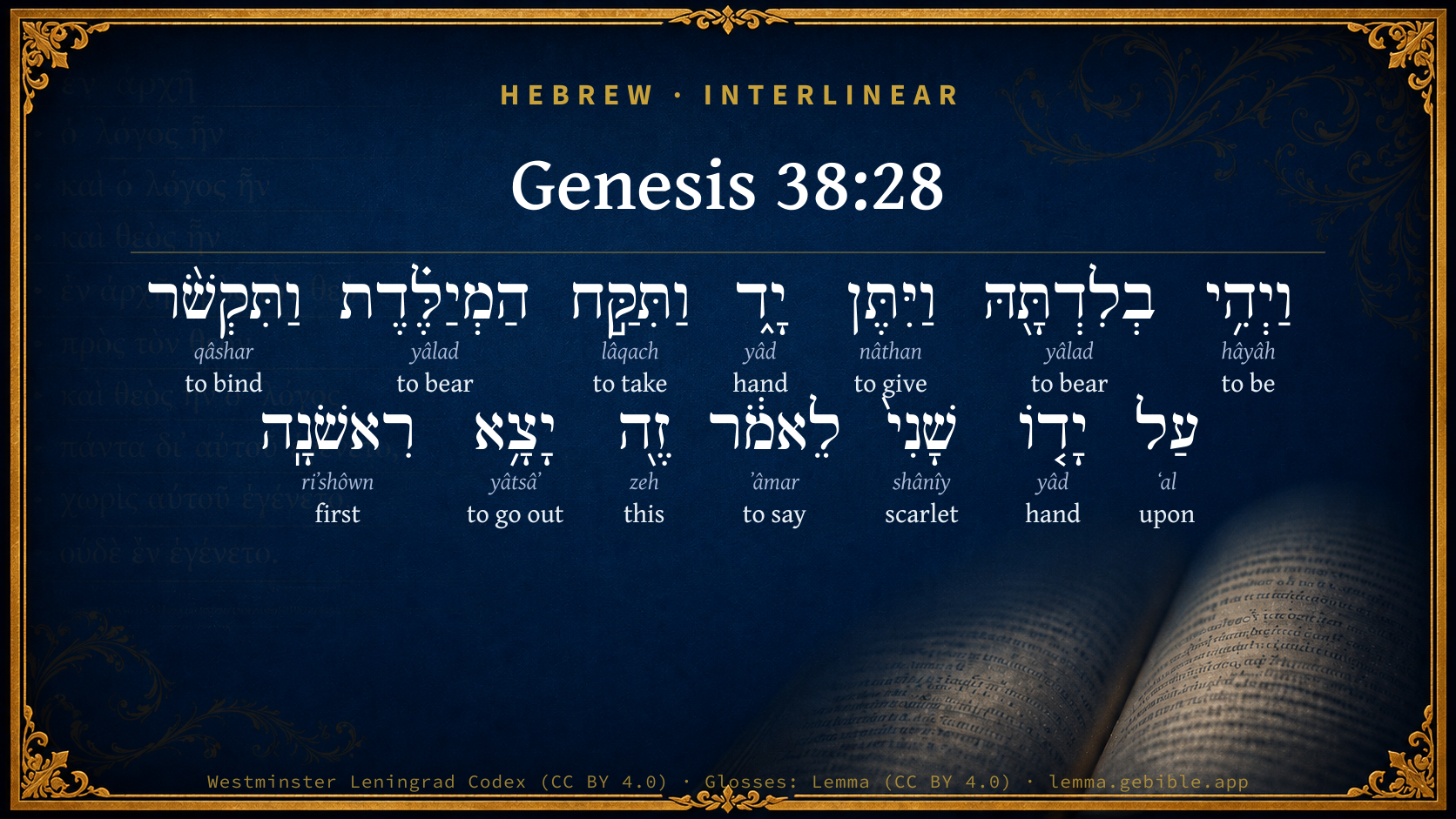
  1. וַיְהִ֥י hâyâh H1961 “and · to be” Conjunction + Verb, Qal, Sequential Imperfect, 3rd Person, Masculine, Singular
  2. בְלִדְתָּ֖הּ yâlad H3205 “in/at · to bear · her” Preposition + Verb, Qal, Infinitive Construct + Suffix, Personal, 3rd Person, Feminine, Singular
  3. וַיִּתֶּן nâthan H5414 “and · to give” Conjunction + Verb, Qal, Sequential Imperfect, 3rd Person, Masculine, Singular
  4. יָ֑ד yâd H3027 “hand” Noun, Common, Both, Singular, Absolute
  5. וַתִּקַּ֣ח lâqach H3947 “and · to take” Conjunction + Verb, Qal, Sequential Imperfect, 3rd Person, Feminine, Singular
  6. הַמְיַלֶּ֗דֶת yâlad H3205 “the · bearing” Particle, Definite Article + Verb, Piel, Participle Active, Feminine, Singular, Absolute
  7. וַתִּקְשֹׁ֨ר qâshar H7194 “and · to bind” Conjunction + Verb, Qal, Sequential Imperfect, 3rd Person, Feminine, Singular
  8. עַל ʻal H5921 “upon” Preposition
  9. יָד֤וֹ yâd H3027 “hand · his” Noun, Common, Both, Singular, Construct + Suffix, Personal, 3rd Person, Masculine, Singular
  10. לֵאמֹ֔ר ʼâmar H559 “to say” Preposition + Verb, Qal, Infinitive Construct
  11. זֶ֖ה zeh H2088 “this” Pronoun, Demonstrative, Masculine, Singular
  12. יָצָ֥א yâtsâʼ H3318 “to go out” Verb, Qal, Perfect, 3rd Person, Masculine, Singular
  13. רִאשֹׁנָֽה riʼshôwn H7223 “first” Adjective, Ordinal number, Masculine, Singular, Absolute

About this verse

These counts appear in no published source. They are computed here, from the morphology-tagged text and Lemma’s own curated glosses. What Lemma adds →

14
words
12
distinct lemmas
Pentateuch
section

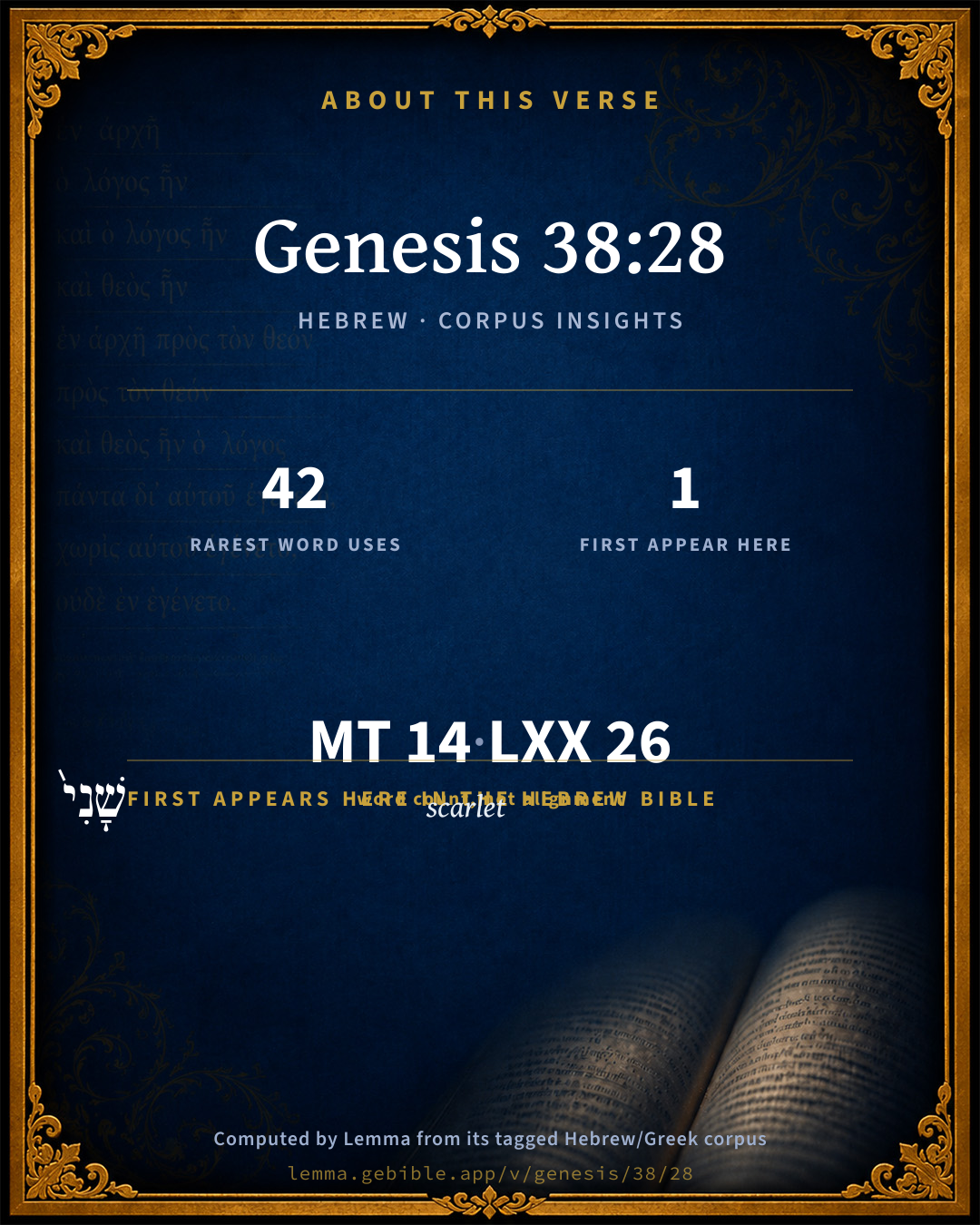
First appearance in Scripture

This word makes its first canonical appearance in the Hebrew Bible here:

  • שָׁנִי֙ scarlet H8144

Shared distinctive vocabulary

שָׁנִי֙ scarlet H8144 occurs in 42 verses of the Hebrew Bible. Also found in:

Grammatical profile

  • 8 verbs
  • 3 nouns
  • 1 adjective
  • 1 pronoun
  • 1 preposition

Verb forms

  • וַיְהִ֥י Qal · Sequential Imperfect
  • בְלִדְתָּ֖הּ Qal · Infinitive Construct
  • וַיִּתֶּן Qal · Sequential Imperfect
  • וַתִּקַּ֣ח Qal · Sequential Imperfect
  • הַמְיַלֶּ֗דֶת Piel · Participle Active
  • וַתִּקְשֹׁ֨ר Qal · Sequential Imperfect
  • לֵאמֹ֔ר Qal · Infinitive Construct
  • יָצָ֥א Qal · Perfect

Repetition

Words recur within this verse — often emphatic in Hebrew:

  • בְלִדְתָּ֖הּ to bear H3205 ×2
  • יָ֑ד hand H3027 ×2

Hebrew & Septuagint length

In English translation the verse runs 28 words from the Hebrew and 37 from the Septuagint (LXX English) — closely comparable.

A rough comparison of the two English renderings, which tokenize alike — not a word-level alignment.

Word counts can differ between the Hebrew and the Greek without any difference in meaning — e.g. the Hebrew direct-object marker אֵת has no separate Greek word, and Greek often adds the article ὁ.

In the original languages it is 14 Hebrew tokens and 26 Greek tokens — but the two are counted differently (Hebrew bundles its prefixes and suffixes into one token; the Greek is in lemma form), so that isn’t a like-for-like length.

Hebrew and Greek witnesses Masoretic Hebrew ↔ Greek Septuagint

The same verse in the two great witnesses to the Old Testament, shown verse-for-verse.

These are two independent witnesses, not word-aligned to each other, and the Septuagint is shown in lemma (dictionary) form.

Hebrew Genesis 38:28 Masoretic · Westminster Leningrad Codex

וַיְהִ֥י בְלִדְתָּ֖הּ וַיִּתֶּן יָ֑ד וַתִּקַּ֣ח הַמְיַלֶּ֗דֶת וַתִּקְשֹׁ֨ר עַל יָד֤וֹ שָׁנִי֙ לֵאמֹ֔ר זֶ֖ה יָצָ֥א רִאשֹׁנָֽה

It happened, when she travailed, that one put out a hand: and the midwife took and tied a scarlet thread on his hand, saying, "This came out first."

World English Bible · Public Domain

Greek LXX Genesis 38:28 Septuagint · lemma form

γίγνομαι δέ ἐν ὁ τίκτω αὐτός ὁ εἷς προ ἐκφέρω ὁ χείρ λαμβάνω δέ ὁ μαῖα δέω ἐπί ὁ χείρ αὐτός κόκκινος λέγω οὗτος ἐκἔρχομαι πρότερος

And it came to pass as she was bringing forth, one thrust forth his hand, and the midwife having taken hold of it, bound upon his hand a scarlet thread, saying, This one shall come out first.

LXX2012 (modern English Septuagint) · Public Domain

Hebrew: Westminster Leningrad Codex (CC BY 4.0). Greek: Septuagint (public domain); English from LXX2012 (modern English Septuagint) (Public Domain). How the Septuagint differs from the Hebrew →

Targum (Aramaic paraphrase)

2

The Targum is the ancient Jewish Aramaic paraphrase of the Hebrew Scriptures — an interpretive translation, not the Hebrew text itself. Onkelos (literal) and Pseudo-Jonathan (expansive) render the Torah, and Jonathan the Prophets. Coverage is partial: where no permissively-licensed English translation exists for a verse, only the Aramaic is shown. This is verse-level text, not a word-by-word alignment to the Hebrew.

  1. Targum Onkelos Torah (Genesis–Deuteronomy)
    וַהֲוָה בְּמֵילְדַהּ וִיהַב יְדָא וּנְסִיבַת חַיְתָא וּקְטָרַת עַל יְדֵהּ זְהוֹרִיתָא לְמֵימַר דֵּין נְפַק קַדְמָאָה

    (no public-domain English translation for this verse)

    Targum Onkelos — Aramaic: “Onkelos Genesis” (public domain); “Onkelos Exodus” (public domain); “Onkelos Leviticus” (public domain); “Onkelos Numbers” (public domain); “Onkelos Deuteronomy” (public domain). English: “Sefaria Community Translation” (CC0 1.0 (public-domain dedication)); “J.W. Etheridge. The Targums of Onkelos and Jonathan Ben Uzziel on the Pentateuch. London: Longmans, Green, 1862” (public domain). Text via Sefaria.

  2. Targum Pseudo-Jonathan Torah (Genesis–Deuteronomy)
    וַהֲוָה בְּמוֹלְדָהּ וּפָשַׁט יוֹלְדָא יַת יְדֵיהּ וּנְסִיבַת חַיְיתָא וּקְטָרַת עַל יְדֵיהּ חוּט זְהוֹרִי לְמֵימָר דֵין נְפַק בְּקַדְמֵיתָא

    And it was in being born that the child stretched forth his hand; and the midwife took it, and bound it with a scarlet thread, saying, This came the first.

    Targum Pseudo-Jonathan — Aramaic: “Targum Jonathan on Genesis” (public domain); “Targum Jonathan on Exodus” (public domain); “Targum Jonathan on Leviticus” (public domain); “Targum Jonathan on Numbers” (public domain); “Targum Jonathan on Deuteronomy” (public domain). English: “The Targum of Jonathan ben Uzziel, trans. J. W. Etheridge, London, 1862” (public domain). Text via Sefaria.

Commentary

Notes on Genesis 38:28 from classic Christian and Jewish commentators (each source and its license shown beneath its notes). The classic Christian expositions comment on the surrounding passage and are grouped to its opening verse, so a note may address several verses; the Jewish commentaries on the Tanakh (Rashi and others) are per-verse, so they appear only where the commentator wrote on this verse.

Lemma curates 59 commentaries, every one of them public domain or Creative Commons licensed, each selected and text-cleaned for this edition rather than reprinted as found. About our sources →

Joseph Benson's Commentary

Gen 38:28-29. When she travailed — It should seem the birth was hard to the mother, by which she was corrected for her sin: the children also, like Jacob and Esau, struggled for the birthright, and Pharez, who got it, is ever named first, and from him Christ descended. He had his name from his breaking forth before his brother: this breach be upon thee — The Jews, as Zarah, bid fair for the birthright, and were marked, as it were, with a scarlet thread, as those that came first; but the Gentiles, like Pharez, or a son of violence, got the start of them, by that violence which the kingdom of heaven suffers, and attained to the righteousness which the Jews came short of: yet when the fulness of time is come, all Israel shall be saved. Both these sons are named in the genealogy of our Saviour, Mat 1:3, to perpetuate the story, as an instance of the humiliation of our Lord Jesus.

Joseph Benson's Commentary on the Old and New Testaments (1811–1818) — public domain. Text from a community e-Sword module.

Adam Clarke's Commentary

Verse 28. The midwife - bound upon his hand a scarlet thread] The binding of the scarlet thread about the wrist of the child whose arm appeared first in the birth, serves to show us how solicitously the privileges of the birthright were preserved. Had not this caution been taken by the midwife, Pharez would have had the right of primogeniture to the prejudice of his elder brother Zarah. And yet Pharez is usually reckoned in the genealogical tables before Zarah; and from him, not Zarah, does the line of our Lord proceed. See Mt 1:3. Probably the two brothers, as being twins, were conjoined in the privileges belonging to the birthright.

Adam Clarke's Commentary on the Bible (1810–1826) — public domain. Text from a community e-Sword/MySword module.

John Gill's Exposition

And it came to pass as he drew back his hand,.... Into the "uterus" again:

that, behold, his brother came out; out of his mother's womb, and so was properly born first:

and she said; either Tamar, or rather, her midwife:

how hast thou broken forth? it was astonishing to her how it could be, having never met with the like in her practice before; she could not imagine how it was possible for him to come forth first, when his brother lay in the way of him, and nearest the birth, as appeared by his putting out his hand:

this breach be upon thee; if any damage comes either to the mother or to the brother, and so carries in it the nature of an imprecation; or rather, that the memory of so strange an event might be preserved, she imposed a name on him that should continue it:

therefore his name was called Pharez: or "therefore he called", &c. (k); Judah called his name Pharez, agreeably to what the midwife had related. From him, in a line of succession, sprang the Messiah, the Pharez or breaker, Mic 2:13; for the sake of which the whole history of this chapter seems to be recorded, Mat 1:3.

(k) "vocavit", Pagninus, Montanus; "ideoque vocavit", Junius & Tremellius, Piscator, Schmidt.

John Gill's Exposition of the Whole Bible (1746–1763) — public domain (CC PDM 1.0). Text via the HelloAO Bible API.

Matthew Poole's English Annotations

The midwife bound upon his hand a scarlet thread, in token of his being the first-born, which she confidently expected he would be.

This breach be upon thee, be imputed to thee, as the same phrase is taken Gen 16:5.

Matthew Poole's English Annotations on the Holy Bible (1683–1685) — public domain. Text from a community e-Sword/MySword module.

The Pulpit Commentary

And it came to pass, when she travailed, literally, in her bringing forth (cf. Gen_35:17) that the one put out his hand: literally, and it (sc. the child) gave a hand, i.e. it was an abnormal and dangerous presentationand the midwife (vide Gen_35:17) took and bound upon his hand a scarlet thread, saying, This came out first.

The Pulpit Commentary (1880–1919), ed. H.D.M. Spence-Jones & Joseph S. Exell — public domain. Text from a community e-Sword module.

John Wesley's Explanatory Notes

It should seem the birth was hard to the mother, by which she was corrected for her sin: the children also, like Jacob and Esau, struggled for the birth-right, and Pharez who got it, is ever named first, and from him Christ descended. He had his name from his breaking forth before his brother; this breach be upon thee - The Jews, as Zarah, bid fair for the birth-right, and were marked with a scarlet thread, as those that come out first; but the Gentiles, like Pharez, or a son of violence got the start of them, by that violence which the kingdom of heaven suffers, and attained to the righteousness which the Jews came short of: yet when the fulness of time is come, all Israel shall be saved. Both these sons are named in the genealogy of our saviour, Matt. i, 3, to perpetuate the story, as an instance of the humiliation of our Lord Jesus.

John Wesley, Explanatory Notes Upon the Whole Bible (1754–1765) — public domain. Text via the GEBible commentary corpus.

Rashi

Rabbi Shlomo Yitzchaki (Rashi)

ויתן יד THE ONE PUT OUT HIS HAND — one stretched forth his hand outside, and after she had bound the scarlet thread upon his hand he drew it back.

Rashi on the Tanakh — English translations: “The Judaica Press complete Tanach with Rashi, translated by A. J. Rosenberg” (CC BY 4.0); “Pentateuch with Rashi's commentary by M. Rosenbaum and A.M. Silbermann, 1929-1934” (public domain); “The Metsudah Tanach series, Lakewood, N.J” (CC BY 4.0); and “The Book of Joshua, Metsudah Publications, 1997” (CC BY 4.0). Text via Sefaria.

Radak

Rabbi David Kimhi (Radak)

ויהי בלדתה ויתן יד, one of them stuck his hand out of his mother’s womb, signaling that he wanted out. Seeing that he did not succeed, he withdrew his hand.

ותקח המילדת, she took hold of his hand before he could withdraw it. ותקשור על ידו שני, as a sign who had been first.

Radak on the Tanakh — English translations: “Sefaria Community Translation” (CC0 1.0 (public-domain dedication)); “Eliyahu Munk, HaChut Hameshulash” (CC BY 4.0); “Rabbi Mike Feuer, Jerusalem Anthology” (CC BY 4.0); and “R. David Kimhi on the first book of Psalms, Translated by R.G. Finch, London, 1919” (public domain). Text via Sefaria.

Lesson kit

Teaching starters — assembled from the data on this page, not authored interpretation. Every prompt links to the verse data it draws on. Edit before teaching.

Genesis, in the Pentateuch, opens this verse with 14 words (12 distinct Hebrew lemmas). Its most distinctive word is shânîy (“scarlet”). A historical commentator’s framing appears above. Read the whole chapter for the surrounding context.

Discussion questions

  1. The word shânîy carries the sense “scarlet.” How does it shape the verse?
  2. This is the first place “scarlet” appears in Scripture (first appears here). What does its debut here establish?
  3. How does Genesis 38:30, which shares the word «scarlet», read alongside this verse?
  4. What does the repetition of “to bear” (2× in this one verse) do in this verse?
  5. These translations render this verse differently. What is at stake in choosing one wording over another?
  6. «וַיְהִ֥י» is a Qal Sequential Imperfect verb. How does that grammatical form shape the action described?
  7. Compare how Joseph Benson's Commentary and Adam Clarke's Commentary read this verse. Where do they agree or differ?

Things to notice

Reading settings

Reading text

Shown beneath each verse's original-language words.

Old Testament
Old Testament edition

Read the OT as the Masoretic Hebrew (MT) or the Greek Septuagint (LXX).

English shown for the Greek Septuagint (in the Hebrew ↔ Greek comparison).

Comparing translations? Open the Compare panel on any verse page to stack up to four side by side.