
Genesis 43:14

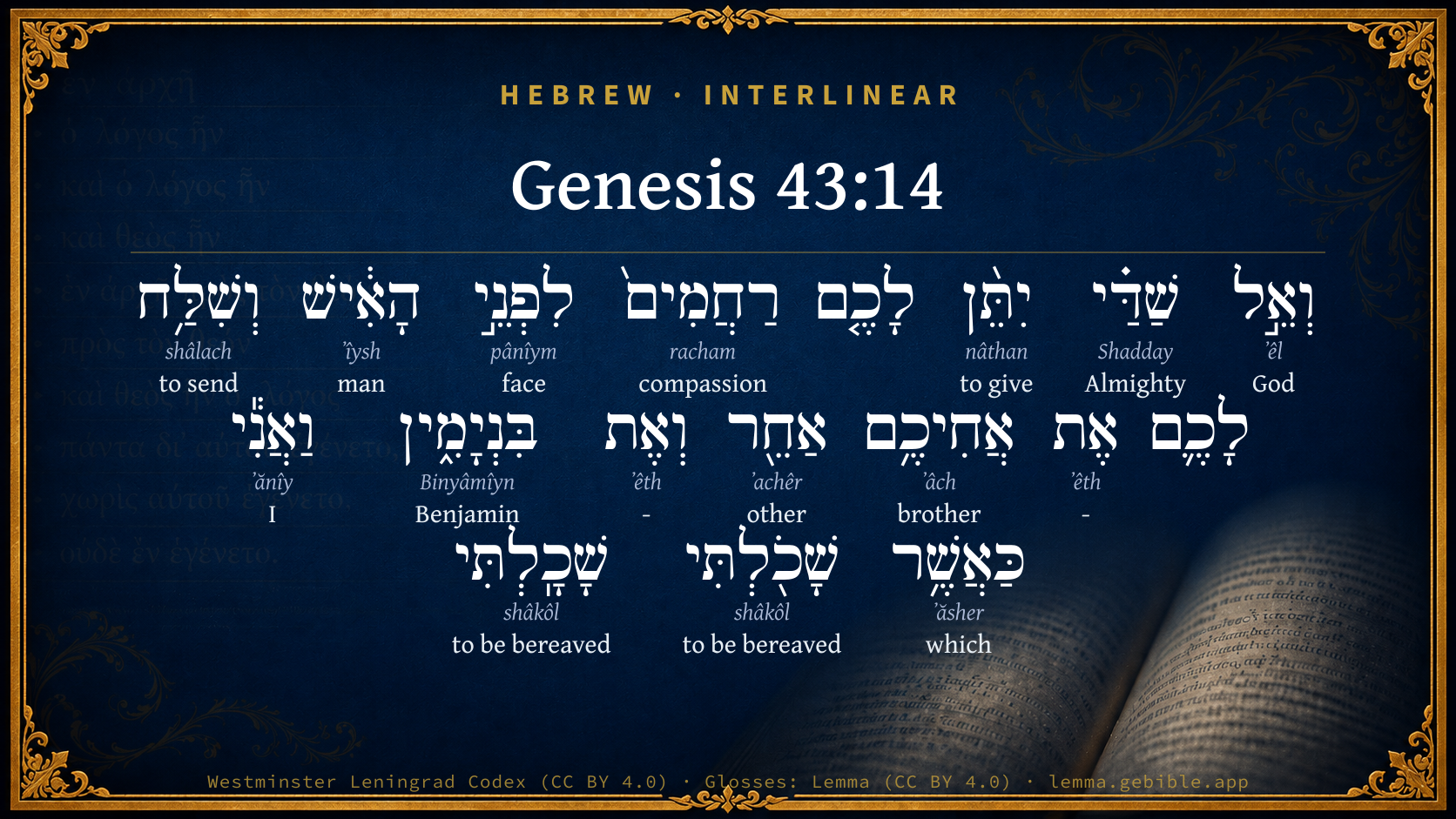
Hebrew (Westminster Leningrad Codex) Genesis 43:14 appears in the Hebrew Old Testament. The text above is from the Westminster Leningrad Codex. Each word links to its Strong’s number, a concise gloss, and parsing drawn from the Open Scriptures Hebrew Bible morphology. Click any word for its full Brown-Driver-Briggs (BDB) entry.
Download image
Cite this verse

Genesis 43:14 (World English Bible). Public Domain. Lemma interlinear Bible study tool, https://lemma.gebible.app/v/genesis/43/14.

Show BibTeX & RIS
BibTeX
RIS
English Translation
May God Almighty give you mercy before the man, that he may release to you your other brother and Benjamin. If I am bereaved of my children, I am bereaved."
World English Bible · Public Domain
Highlights
  • 1 first appearance in the Hebrew Bible
Full analysis ↓
Download a study sheet

One document with this verse’s original text, its word-by-word gloss line, the meaning frame, cross-references with their text, attributed commentary, and full source and license credits — printable, and it pastes into notes with its structure intact.

This verse Autodidact and up

Study sheet (.html) Plain text (.txt)

A passage Seminary Student

Up to 50 verses in one chapter. A passage sheet keeps up to 6 commentary sources and 12 cross-references per verse, in the order this page ranks them, and says so on the sheet whenever that leaves anything out. Ask for a single verse and you get the Autodidact verse sheet above.

Everything on this page stays free to read, with no account — the sheet is a download of what is already on screen, not access to it.

Want to remove ads? Support Godless Engineer
Compare translations 3

The same verse in 3 English versions, stacked beneath the original-language interlinear above. Click any original word for its lexicon entry.

Each is an independent rendering of the whole verse — the interlinear is not word-aligned to these translations.

Highlighted words mark where these versions differ — a whole-verse word diff, not a word-by-word alignment.

  • World English Bible Public Domain
    May God Almighty give you mercy before the man, that he may release to you your other brother and Benjamin. If I am bereaved of my children, I am bereaved."
  • King James Version Public Domain
    And God Almighty give you mercy before the man, that he may send away your other brother, and Benjamin. If I be bereaved of my children, I am bereaved.
  • unfoldingWord Literal Text CC BY-SA 4.0
    And may God Almighty give you mercies before the man, and may he send your other brother and Benjamin with you. And I, if I am bereaved, I am bereaved.”

unfoldingWord Literal Text — © unfoldingWord, licensed CC BY-SA 4.0. Word-aligned USFM3 via Door43 (git.door43.org/unfoldingWord/en_ult).

Versions to compare (up to 4)

3 of 4 selected

Show all 18 translations

Every available English version of this verse, each an independent rendering of the whole verse.

  • World English Bible Public Domain
    May God Almighty give you mercy before the man, that he may release to you your other brother and Benjamin. If I am bereaved of my children, I am bereaved."
  • Berean Standard Bible Public Domain
    May God Almighty grant you mercy before the man, that he may release your other brother along with Benjamin. As for me, if I am bereaved, I am bereaved.”
  • Majority Standard Bible Public Domain
    May God Almighty grant you mercy before the man, that he may release your other brother along with Benjamin. As for me, if I am bereaved, I am bereaved.”
  • King James Version Public Domain
    And God Almighty give you mercy before the man, that he may send away your other brother, and Benjamin. If I be bereaved of my children, I am bereaved.
  • American Standard Version (1901) Public Domain
    and God Almighty give you mercy before the man, that he may release unto you your other brother and Benjamin. And if I be bereaved of my children, I am bereaved.
  • Revised Version (1885) Public Domain
    and God Almighty give you mercy before the man, that he may release unto you your other brother and Benjamin. And if I be bereaved of my children, I am bereaved.
  • Geneva Bible (1599) Public Domain
    And God almightie giue you mercie in the sight of the man, that hee may deliuer you your other brother, and Beniamin: but I shall be robbed of my childe, as I haue bene.
  • Douay-Rheims (1899) Public Domain
    And may my almighty Bod make him favourable to you; and send back with you your brother, whom he keepeth, and this Benjamin: and as for me I shall be desolate without children.
  • Young's Literal Translation Public Domain
    and God Almighty give to you mercies before the man, so that he hath sent to you your other brother and Benjamin; and I, when I am bereaved -- I am bereaved.'
  • Literal Standard Version CC BY-SA 4.0
    and God Almighty give to you mercies before the man, so that he has sent to you your other brother and Benjamin; and I, when I am bereaved—I am bereaved.”
  • Unlocked Literal Bible CC BY-SA 4.0
    May God Almighty give you mercy before the man, so that he may release to you your other brother and Benjamin. If I am bereaved of my children, I am bereaved.”
  • unfoldingWord Literal Text CC BY-SA 4.0
    And may God Almighty give you mercies before the man, and may he send your other brother and Benjamin with you. And I, if I am bereaved, I am bereaved.”
  • Darby Bible Public Domain
    And the Almighty ùGod give you mercy before the man, that he may send away your other brother and Benjamin! And I, if I be bereaved of children, am bereaved.
  • World Messianic Bible Public Domain
    May God Almighty give you mercy before the man, that he may release to you your other brother and Benjamin. If I am bereaved of my children, I am bereaved.”
  • Webster's Bible Public Domain
    \\43:15\\And the men took that present, and they took double money in their hand, and Benjamin; and arose, and went down to Egypt, and stood before Joseph.
  • Free Bible Version CC BY-SA 4.0
    May God Almighty make the man treat you kindly so when you come before him he'll release your other brother and send Benjamin back. As for me, if I am to lose all my children, then so be it.”
  • Bible in Basic English Public Domain
    So they took what their father said for the man, and twice as much money in their hands, and Benjamin, and went on their journey to Egypt, and came before Joseph.
  • JPS Tanakh (1917) Public Domain
    and God Almighty give you mercy before the man, that he may release unto you your other brother and Benjamin. And as for me, if I be bereaved of my children, I am bereaved.'

Literal Standard Version (2020), Covenant Press — licensed CC BY-SA 4.0. Text via the HelloAO Bible API (eBible.org). Unlocked Literal Bible (unfoldingWord) — licensed CC BY-SA 4.0. Text via the HelloAO Bible API (eBible.org). unfoldingWord Literal Text — © unfoldingWord, licensed CC BY-SA 4.0. Word-aligned USFM3 via Door43 (git.door43.org/unfoldingWord/en_ult). Free Bible Version, Dr. Jonathan Gallagher — licensed CC BY-SA 4.0. Text via the HelloAO Bible API (eBible.org).

Word by word

More ways to search: Search by grammar → Find every occurrence → Compare this word →

Practice this passage: Drill this verse → Learn its vocabulary →

שָׁכֹ֖לְתִּי
shâkôl
H7921
“to be bereaved”
Verb, Qal, Perfect, 1st Person, Common, Singular
Part of Speech
Verb
Stem
Qal
Form
Perfect
Person
1st Person
Gender
Common
Number
Singular
Full BDB Definition

Origin: a primitive root

TWOT: 2385

to be bereaved, make childless, miscarry - (Qal) to be bereaved - (Piel) - to make childless - to cause barrenness, show barrenness or abortion - to miscarry - (Hiphil) miscarrying (participle)
  1. וְאֵ֣ל ʼêl H410 “and · God” Conjunction + Noun, Proper
  2. שַׁדַּ֗י Shadday H7706 “Almighty” Noun, Proper
  3. יִתֵּ֨ן nâthan H5414 “to give” Verb, Qal, Imperfect, 3rd Person, Masculine, Singular
  4. רַחֲמִים֙ racham H7356 “compassion” Noun, Common, Masculine, Plural, Absolute
  5. לִפְנֵ֣י pânîym H6440 “to/for · face(s) of” Preposition + Noun, Common, Both, Plural, Construct
  6. הָאִ֔ישׁ ʼîysh H376 “the · man” Particle, Definite Article + Noun, Common, Masculine, Singular, Absolute
  7. וְשִׁלַּ֥ח shâlach H7971 “and · to send” Conjunction + Verb, Piel, Sequential Perfect, 3rd Person, Masculine, Singular
  8. אֶת ʼêth H853 “-” Particle, Direct Object
  9. אֲחִיכֶ֥ם ʼâch H251 “brother · your” Noun, Common, Masculine, Singular, Construct + Suffix, Personal, 2nd Person, Masculine, Plural
  10. אַחֵ֖ר ʼachêr H312 “other” Adjective, Adjective, Masculine, Singular, Absolute
  11. וְאֶת ʼêth H853 “and · -” Conjunction + Particle, Direct Object
  12. בִּנְיָמִ֑ין Binyâmîyn H1144 “Benjamin” Noun, Proper
  13. וַאֲנִ֕י ʼănîy H589 “and · I” Conjunction + Pronoun, Personal, 1st Person, Common, Singular
  14. כַּאֲשֶׁ֥ר ʼăsher H834 “like/as · which” Preposition + Particle, Relative
  15. שָׁכָֽלְתִּי shâkôl H7921 “to be bereaved” Verb, Qal, Perfect, 1st Person, Common, Singular

About this verse

These counts appear in no published source. They are computed here, from the morphology-tagged text and Lemma’s own curated glosses. What Lemma adds →

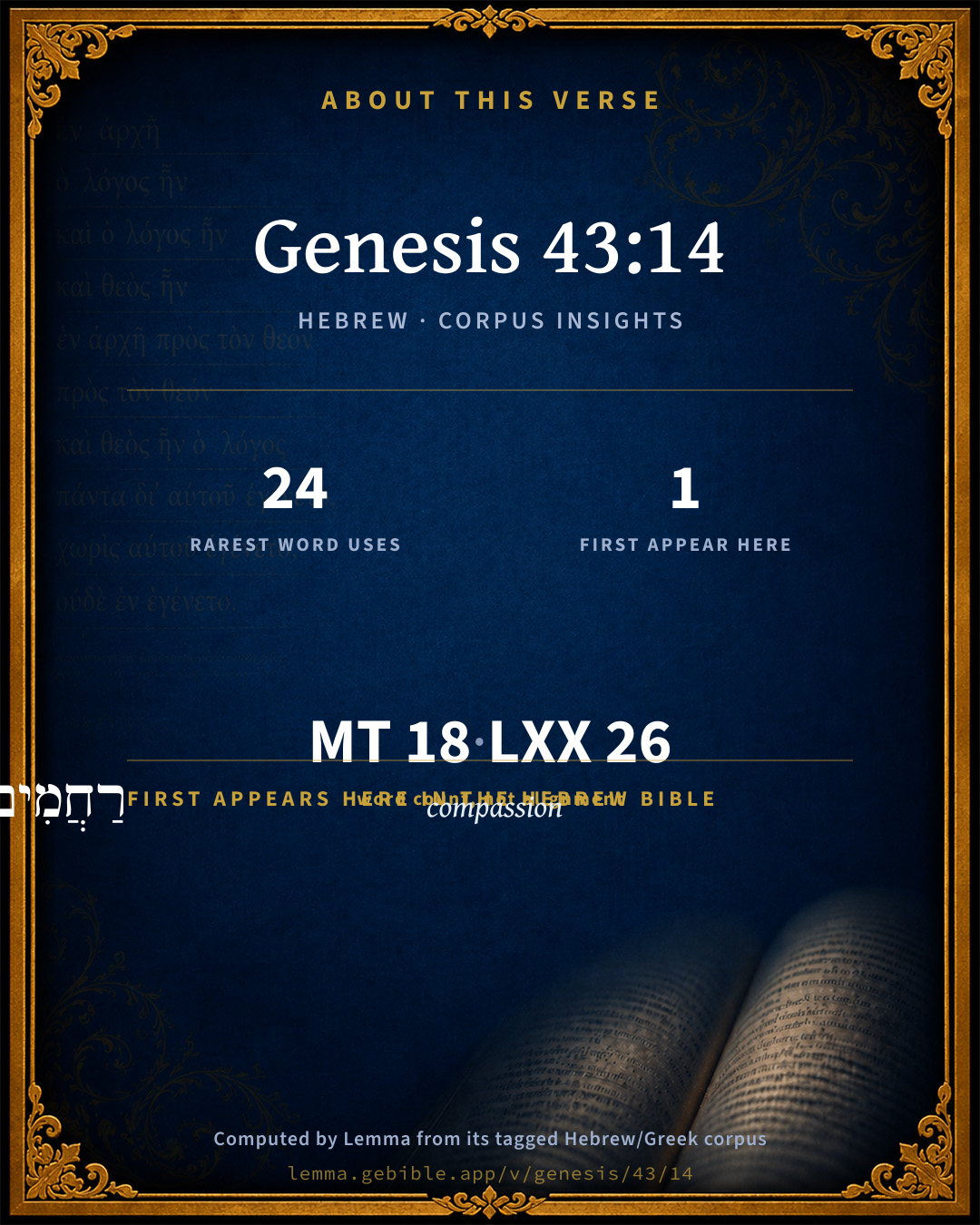
18
words
14
distinct lemmas
Pentateuch
section

Notable vocabulary

The rarest word here is שָׁכֹ֖לְתִּי to be bereaved H7921 — appearing just 24 times in the whole Hebrew Bible.

First appearance in Scripture

This word makes its first canonical appearance in the Hebrew Bible here:

  • רַחֲמִים֙ compassion H7356

Shared distinctive vocabulary

שָׁכֹ֖לְתִּי to be bereaved H7921 occurs in 22 verses of the Hebrew Bible. Also found in:

Grammatical profile

  • 4 verbs
  • 7 nouns
  • 1 adjective
  • 1 pronoun
  • 2 prepositions
  • 3 particles

Verb forms

  • יִתֵּ֨ן Qal · Imperfect
  • וְשִׁלַּ֥ח Piel · Sequential Perfect
  • שָׁכֹ֖לְתִּי Qal · Perfect
  • שָׁכָֽלְתִּי Qal · Perfect

Repetition

A word recurs within this verse — often emphatic in Hebrew:

  • שָׁכֹ֖לְתִּי to be bereaved H7921 ×2

Hebrew & Septuagint length

In English translation the verse runs 30 words from the Hebrew and 30 from the Septuagint (LXX English) — the same length.

A rough comparison of the two English renderings, which tokenize alike — not a word-level alignment.

Word counts can differ between the Hebrew and the Greek without any difference in meaning — e.g. the Hebrew direct-object marker אֵת has no separate Greek word, and Greek often adds the article ὁ.

In the original languages it is 18 Hebrew tokens and 26 Greek tokens — but the two are counted differently (Hebrew bundles its prefixes and suffixes into one token; the Greek is in lemma form), so that isn’t a like-for-like length.

Cross-references

26

Topical passages linked to Genesis 43:14 in the Treasury of Scripture Knowledge — connected by theme and wording, ordered by reader-vote popularity; previews shown in the World English Bible.

  • Esther 4:16 Go, gather together all the Jews who are present in Shushan, and fast you for me, and neither eat nor drink three days, night or day: I also and my maidens will fast in like manner; and so will I go in to the king, which is not according to the law: and if I perish, I perish.
  • Genesis 17:1 When Abram was ninety-nine years old, Yahweh appeared to Abram, and said to him, "I am God Almighty. Walk before me, and be blameless.
  • Acts 21:14 When he would not be persuaded, we ceased, saying, "The Lord's will be done."
  • Genesis 22:14 Abraham called the name of that place Yahweh-Jireh. As it is said to this day, "In Yahweh's mountain it will be provided.
  • Nehemiah 1:11 Lord, I beg you, let now your ear be attentive to the prayer of your servant, and to the prayer of your servants, who delight to fear your name; and please prosper your servant this day, and grant him mercy in the sight of this man. Now I was cup bearer to the king.
  • Proverbs 16:7 When a man's ways please Yahweh, He makes even his enemies to be at peace with him.
  • Genesis 35:11 God said to him, "I am God Almighty. Be fruitful and multiply. A nation and a company of nations will be from you, and kings will come out of your loins.
  • Genesis 39:21 But Yahweh was with Joseph, and showed kindness to him, and gave him favor in the sight of the keeper of the prison.
  • Psalms 37:5–7 Commit your way to Yahweh. Trust also in him, and he will do this:
  • Psalms 100:5 For Yahweh is good. His loving kindness endures forever, His faithfulness to all generations.
  • Psalms 119:41 Let your loving kindness also come to me, Yahweh, Your salvation, according to your word.
  • Proverbs 1:1 The proverbs of Solomon, the son of David, king of Israel:
  • Isaiah 49:13 Sing, heavens; and be joyful, earth; and break forth into singing, mountains: for Yahweh has comforted his people, and will have compassion on his afflicted.
  • Acts 7:10 and delivered him out of all his afflictions, and gave him favor and wisdom before Pharaoh, king of Egypt. He made him governor over Egypt and all his house.
  • Genesis 28:3 May God Almighty bless you, and make you fruitful, and multiply you, that you may be a company of peoples,
  • Genesis 32:11–28 Please deliver me from the hand of my brother, from the hand of Esau: for I fear him, lest he come and strike me, and the mothers with the children.
  • Genesis 42:24 He turned himself about from them, and wept, and he returned to them, and spoke to them, and took Simeon from among them, and bound him before their eyes.
  • Genesis 42:36 Jacob, their father, said to them, "You have bereaved me of my children! Joseph is no more, Simeon is no more, and you want to take Benjamin away. All these things are against me."
  • Ezra 7:27 Blessed be Yahweh, the God of our fathers, who has put such a thing as this in the king's heart, to beautify the house of Yahweh which is in Jerusalem;
  • Luke 1:50 His mercy is for generations of generations on those who fear him.
  • 1 Timothy 1:2 to Timothy, my true child in faith: Grace, mercy, and peace, from God our Father and Christ Jesus our Lord.
  • 1 Timothy 1:16 However, for this cause I obtained mercy, that in me first, Jesus Christ might display all his patience, for an example of those who were going to believe in him for eternal life.
  • Titus 1:4 to Titus, my true child according to a common faith: Grace, mercy, and peace from God the Father and the Lord Jesus Christ our Savior.
  • 2 John 1:3 Grace, mercy, and peace will be with us, from God the Father, and from the Lord Jesus Christ, the Son of the Father, in truth and love.
  • Psalms 85:7 Show us your loving kindness, Yahweh. Grant us your salvation.
  • Proverbs 21:1 The king's heart is in Yahweh's hand like the watercourses. He turns it wherever he desires.

Cross-references courtesy of OpenBible.info (CC BY 4.0).

Hebrew and Greek witnesses Masoretic Hebrew ↔ Greek Septuagint

The same verse in the two great witnesses to the Old Testament, shown verse-for-verse.

These are two independent witnesses, not word-aligned to each other, and the Septuagint is shown in lemma (dictionary) form.

Hebrew Genesis 43:14 Masoretic · Westminster Leningrad Codex

וְאֵ֣ל שַׁדַּ֗י יִתֵּ֨ן לָכֶ֤ם רַחֲמִים֙ לִפְנֵ֣י הָאִ֔ישׁ וְשִׁלַּ֥ח לָכֶ֛ם אֶת אֲחִיכֶ֥ם אַחֵ֖ר וְאֶת בִּנְיָמִ֑ין וַאֲנִ֕י כַּאֲשֶׁ֥ר שָׁכֹ֖לְתִּי שָׁכָֽלְתִּי

May God Almighty give you mercy before the man, that he may release to you your other brother and Benjamin. If I am bereaved of my children, I am bereaved."

World English Bible · Public Domain

Greek LXX Genesis 43:14 Septuagint · lemma form

ὁ δέ θεός ἐγώ δίδωμι σύ χάρις ἐναντίον ὁ ἄνθρωπος καί ἀποστέλλω ὁ ἀδελφός σύ ὁ εἷς καί ὁ βενιαμίν ἐγώ μέν γάρ καθά ἀτέκνόω ἀτέκνόω

And my God give you favor in the sight of the man, and send away your other brother, and Benjamin, for I accordingly as I have been bereaved, am bereaved.

LXX2012 (modern English Septuagint) · Public Domain

On this verse, Haydock's Catholic Bible Commentary discusses the Septuagint’s reading. Read the note in Commentary ↓

Hebrew: Westminster Leningrad Codex (CC BY 4.0). Greek: Septuagint (public domain); English from LXX2012 (modern English Septuagint) (Public Domain). How the Septuagint differs from the Hebrew →

Targum (Aramaic paraphrase)

2

The Targum is the ancient Jewish Aramaic paraphrase of the Hebrew Scriptures — an interpretive translation, not the Hebrew text itself. Onkelos (literal) and Pseudo-Jonathan (expansive) render the Torah, and Jonathan the Prophets. Coverage is partial: where no permissively-licensed English translation exists for a verse, only the Aramaic is shown. This is verse-level text, not a word-by-word alignment to the Hebrew.

  1. Targum Onkelos Torah (Genesis–Deuteronomy)
    וְאֵל שַׁדַּי יִתֵּן לְכוֹן רַחֲמִין קֳדָם גַּבְרָא וְיִפְטַר לְכוֹן יָת אֲחוּכוֹן אָחֳרָנָא וְיָת בִּנְיָמִין וַאֲנָא כְּמָא דְּאִתְכֵּלִית תְּכֵלִית

    (no public-domain English translation for this verse)

    Targum Onkelos — Aramaic: “Onkelos Genesis” (public domain); “Onkelos Exodus” (public domain); “Onkelos Leviticus” (public domain); “Onkelos Numbers” (public domain); “Onkelos Deuteronomy” (public domain). English: “Sefaria Community Translation” (CC0 1.0 (public-domain dedication)); “J.W. Etheridge. The Targums of Onkelos and Jonathan Ben Uzziel on the Pentateuch. London: Longmans, Green, 1862” (public domain). Text via Sefaria.

  2. Targum Pseudo-Jonathan Torah (Genesis–Deuteronomy)
    וְאֵל שַׁדַי יִתֵּן לְכוֹן רַחֲמִין קֳדָם גַבְרָא וְיִפְטוֹר לְכוֹן יַת אֲחוּכוֹן חוֹרָנָא וְיַת בִּנְיָמִין וַאֲנָא הָא כְּבַר אִתְבַּשְרִית בְּרוּחַ קוּדְשָׁא אֲרוּם אִין אִיתְכְּלִית עַל יוֹסֵף אִיתְכַּל עַל שִׁמְעוֹן וְעַל בִּנְיָמִין

    and God the Almighty give you mercies before the man, that he may release to you your other brother, and Benjamin: and I, behold, I am now certified by the Holy Spirit that if I am bereaved of Joseph, I shall also be bereaved of Shimeon and of Benjamin.

    Targum Pseudo-Jonathan — Aramaic: “Targum Jonathan on Genesis” (public domain); “Targum Jonathan on Exodus” (public domain); “Targum Jonathan on Leviticus” (public domain); “Targum Jonathan on Numbers” (public domain); “Targum Jonathan on Deuteronomy” (public domain). English: “The Targum of Jonathan ben Uzziel, trans. J. W. Etheridge, London, 1862” (public domain). Text via Sefaria.

Commentary

Notes on Genesis 43:14 from classic Christian and Jewish commentators (each source and its license shown beneath its notes). The classic Christian expositions comment on the surrounding passage and are grouped to its opening verse, so a note may address several verses; the Jewish commentaries on the Tanakh (Rashi and others) are per-verse, so they appear only where the commentator wrote on this verse.

Lemma curates 59 commentaries, every one of them public domain or Creative Commons licensed, each selected and text-cleaned for this edition rather than reprinted as found. About our sources →

Trapp's Complete Commentary

John Trapp

Gen 43:14 And God Almighty give you mercy before the man, that he may send away your other brother, and Benjamin. If I be bereaved [of my children], I am bereaved.

Ver. 14. And God Almighty give you mercy.] Heb., Give you bowels, the seat of mercy. Here God not only grants Jacob’s prayer, but fulfils his counsel, gives him the very particular he prays for. {Gen 43:30} Joseph’s "bowels yearned upon Benjamin."

If I be bereaved, I am bereaved.] This is like that of Esther, committing herself and her attempt to God, "If I perish, I perish"; {Est 4:16} and like that of those saints in the Acts, "The will of the Lord be done"; which is, saith one, Vox vere Christianorum. Jacob prays for Benjamin’s safety, but will be content his own will be crossed, so that God’s will may be accomplished. This is the right way of praying; this is to "draw near with a true heart." {Heb 10:22} Hypocrites seek God only out of self-love; which is as little pleasing to him, as if a woman should strive to content her husband, not out of love to him, but to another.

John Trapp, A Commentary or Exposition upon All the Books of the Old and New Testament (1647–1656) — public domain. Text from a community e-Sword module.

Joseph Benson's Commentary

Gen 43:14. God Almighty give you mercy before the man! — Jacob had formerly turned an angry brother into a kind one with a present and a prayer, and here he betakes himself to the same tried method. Those that would find mercy with men must seek it of God. He concludes all with this, If I be bereaved of my children, I am bereaved — If I must part with them thus, one after another, I acquiesce, and say, The will of the Lord be done.

Joseph Benson's Commentary on the Old and New Testaments (1811–1818) — public domain. Text from a community e-Sword module.

Geneva Bible (1599)

Geneva Bible translators

Our chief trust ought to be in God, and not in worldly means.

He speaketh these words not so much of despair, as to make his sons more careful to bring again their brother.

Geneva Bible (1599) marginal notes — public domain. Text via Bolls.life.

Jamieson, Fausset & Brown

Robert Jamieson, A. R. Fausset & David Brown

God Almighty give you mercy before the man--Jacob is here committing them all to the care of God and, resigned to what appears a heavy trial, prays that it may be overruled for good.

Jamieson, Fausset & Brown — Commentary Critical and Explanatory on the Whole Bible (1871) — public domain (CC PDM 1.0). Text via the HelloAO Bible API.

Adam Clarke's Commentary

Verse 14. This verse may be literally translated thus: "And God, the all-sufficient, shall give you tender mercies before the man, and send to you your other brother, and Benjamin; and I, as I shall be childless, so I shall be childless." That is, I will submit to this privation, till God shall restore my children. It appears that this verse is spoken prophetically; and that God at this time gave Jacob a supernatural evidence that his children should be restored.

Adam Clarke's Commentary on the Bible (1810–1826) — public domain. Text from a community e-Sword/MySword module.

John Calvin's Commentaries

14. If I be bereaved. Jacob may seem here to be hardly consistent with himself; for, if the prayer which Moses has just related, was the effect of faith, he ought to have been more calm; and, at least, to have given occasion to the manifestation of the grace of God. But he appears to cut himself off from every ground of confidence, when he supposes that nothing is left for him but bereavement. It is like the speech of a man in despair, “I shall remain bereaved as I am.” As if truly he had prayed in vain; or had feignedly professed that the remedy was in the hand of God. If, however, we observe to whom his speech was directed, the solution is easy. It is by no means doubtful that he stood firmly on the promise which had been given to him, and therefore he would hope for some fruit of his prayers; yet he wished deeply to affect his sons, in order that they might take greater care of their brother. For, it was in no common manner that Benjamin was intrusted to their protection, when they saw their father altogether overcome and almost lifeless with grief, until he should receive his son again in safety. Interpreters, however, expound these words variously. Some think that he complained, because now he was about to be entirely bereaved. To others, the meaning seems to be, that nothing worse could happen; since he had lost Joseph, whom he had preferred to all the rest. Others are disposed to mark a double bereavement, as if he had said, “I have lost two sons, and now a third follows them.” But what, if we should thus interpret the words, “I see what is my condition; I am a most wretched old man; my house, which lately was filled with people, I find almost deserted.” So that, in general terms, he is deploring the loss of all his sons, and is not speaking of a part only. Moreover, it was his design to inspire his sons with a degree of solicitude which should cause them to attend to their duty with greater fidelity and diligence.

John Calvin's Commentaries (1540-1563) — public domain. Text from the Calvin Translation Society English edition (1840s-50s) via the Christian Classics Ethereal Library (ccel.org). Calvin's coverage is partial (roughly two-thirds of the Bible); uncommented books and verses are honest gaps, never fabricated. The 19th-century editor's footnotes and remarks are omitted so the notes are faithfully Calvin's own voice.

Ellicott's Commentary for English Readers

(14) God Almighty.—Heb., El Shaddai, the name by which Abraham’s covenant (Gen_17:1) was renewed to Jacob (Gen_35:11).

If I be bereaved . . . —An expression of pious resignation, united with heartfelt anguish. The inserted words of my children lessen the pathos of the patriarch’s ejaculation, which literally is “and I, if I am bereaved, I am bereaved.”

A Bible Commentary for English Readers, edited by Charles John Ellicott (1878–1897) — public domain. Text from a community e-Sword module.

The Cambridge Bible for Schools and Colleges

gen. ed. J. J. S. Perowne

14. God Almighty] Heb. El Shaddai. See note on Gen_17:1. Unless inserted by the Compiler, this is the only occurrence of this Sacred Name in JE (see note on Gen_49:23, which is earlier than JE). Jacob gives his parting blessing. Notice the emphasis on Benjamin’s name, and the reference to Simeon (E).

give you mercy] Cf. the parallel expression in Neh_1:11. Lat. facial vobis eum placabilem gives the general meaning.

if I be bereaved] or, “according as I am bereaved.” Jacob is resigned, he is ready mournfully to acquiesce in the Divine will. His forebodings are gloomy. Cf. Gen_42:36. His expectation of the worst result heightens the interest of the story, as the crisis is evidently approaching.

The Cambridge Bible for Schools and Colleges (gen. ed. J. J. S. Perowne; Cambridge University Press, 1878–1918) — public domain. Text from a community e-Sword module.

John Gill's Exposition

And the men took the present,.... Their father directed them to:

and they took double money in their hand; besides what they found in their sacks mouths, which they also carried with them:

and Benjamin; they took him likewise with their father's leave:

and rose up, and went down to Egypt, and stood before Joseph; presented themselves to him, and their petitions for more corn, as well as to answer to any questions that should be asked them.

John Gill's Exposition of the Whole Bible (1746–1763) — public domain (CC PDM 1.0). Text via the HelloAO Bible API.

Haydock's Catholic Bible Commentary

Desolate. Hebrew and Septuagint, "Since I am deprived of my children, I am deprived of my children:" I must submit.

George Leo Haydock (1774–1849), Haydock's Catholic Family Bible and Commentary, 1859 edition — public domain. Excludes Psalms (Douay-Rheims chapter numbering differs from Protestant) and Deuterocanonical books (Catholic canon only).

Matthew Poole's English Annotations

An expression whereby he submits himself and children to God’s will and providence, whatever the issue shall be. Compare Est 4:16. Or thus, As I have been already

bereaved of some of my dearest children, so I shall be bereaved of the rest, and I shall be left solitary; and if this be my portion, God’s will be done.

Matthew Poole's English Annotations on the Holy Bible (1683–1685) — public domain. Text from a community e-Sword/MySword module.

Whedon's Commentary on the Bible

Daniel D. Whedon

14. God Almighty — Hebrews, El Shaddai. Jacob uses the divine name so sacredly associated with the covenant and promises. Compare Gen_17:1; Gen_35:11.

Daniel D. Whedon (gen. ed.), Commentary on the Old and New Testaments (1874–1909) — public domain. Text from a community e-Sword module.

John Wesley's Explanatory Notes

God almighty give you mercy before the man! - Jacob had formerly turned an angry brother into a kind one with a present and a prayer, and here he betakes himself to the same tried method. Those that would find mercy with men must seek it of God. He concludes all with this, if I be bereaved of my children, I am bereaved - If I must part with them thus one after another, I acquiesce and say, The will of the Lord be done.

John Wesley, Explanatory Notes Upon the Whole Bible (1754–1765) — public domain. Text via the GEBible commentary corpus.

Keil & Delitzsch

C. F. Keil & F. Delitzsch

Thus Israel let his sons go with the blessing, "God Almighty give you mercy before the man, that he may liberate to you your other brother (Simeon) and Benjamin;" and with this resigned submission to the will of God, "And I, if I am bereaved, I am bereaved," i.e., if I am to lose my children, let it be so! For this mode of expression, cf. Est 4:16 and Kg2 7:4. שׁכּלתּי with the pausal a, answering to the feelings of the speaker, which is frequently used for o; e.g., טרף for יטרף, Gen 49:27.

Keil & Delitzsch — Biblical Commentary on the Old Testament (1861–1891) — public domain (CC PDM 1.0). Text via the HelloAO Bible API. (Old Testament only.)

Rashi

Rabbi Shlomo Yitzchaki (Rashi)

ואל שדי AND GOD ALMIGHTY — Now you lack nothing except prayer, and therefore I pray for you (Genesis Rabbah 91:11).

אל שדי God שֶׁ-דַּי who gives plenteous mercy and in whose hand is sufficient power to give — may He give you mercy. This is the real meaning of the words. A Midrashic explanation is: He who said to the Universe, “Enough!”, may He say “Enough!” to my troubles. I have had no rest since my youth — trouble through Laban, trouble through Esau, the trouble of Rachel, the trouble of Dinah, the trouble of Joseph, the trouble of Simeon, the trouble of Benjamin (Genesis Rabbah 92:1).

ושלח לכם means AND MAY HE RELEASE UNTO YOU, as the Targum renders it — may He release him from his bonds. It has the same meaning as (Exodus 21:26) “He shall let him go, יְשַׁלְּחֶנוּ (Piel) free”. It would not have been correct to translate it in the Targum by “and may he send to you your other brother”, because, as a matter of fact, they were going there where he was.

את אחיכם YOUR BROTHER — This refers to Simeon.

אחר THE OTHER ONE — The spirit of prophecy was diffused upon him so that he included Joseph also (Genesis Rabbah 92:3).

ואני AND AS FOR ME — until you return I shall feel myself bereaved of my children being in constant suspense.

כאשר שכלתי means EVEN AS I AM BEREAVED of Joseph and of Simeon

שכלתי I SHALL BE BEREAVED of Benjamin.

Rashi on the Tanakh — English translations: “The Judaica Press complete Tanach with Rashi, translated by A. J. Rosenberg” (CC BY 4.0); “Pentateuch with Rashi's commentary by M. Rosenbaum and A.M. Silbermann, 1929-1934” (public domain); “The Metsudah Tanach series, Lakewood, N.J” (CC BY 4.0); and “The Book of Joshua, Metsudah Publications, 1997” (CC BY 4.0). Text via Sefaria.

Ramban (Nachmanides)

Rabbi Moshe ben Nachman (Ramban / Nachmanides)

THAT HE MAY SEND AWAY YOUR OTHER BROTHER, AND BENJAMIN. In line with the literal interpretation of Scripture, it would seem that Simeon was not a favorite of his father because of the Shechem affair. This was why he did not say, “My son Simeon, and Benjamin,” as he would not mention him by name, and as he left him in Egypt for a long time. Indeed, had there been food in his house, he would not yet have sent Benjamin, and he would have left him [Simeon] in Egypt.Now Rashi wrote, “The other one: the spirit of prophecy was enkindled within Jacob so as to include Joseph.” In Bereshith Rabbah they also said: “That he may send away your brother: this refers to Joseph. The other one: this refers to Simeon.” This is correct, for at the moment of prayer, Jacob directed his heart to pray in a general manner for the other one [Joseph] also, for perhaps he is still alive.There in Bereshith Rabbah, the Rabbis expounded on the verse in yet another way, saying, “Rabbi Yehoshua ben Levi interpreted the verse as alluding to the exiles: And G-d Almighty give you compassion before the man — this is a reference to the Holy One, blessed be He, as it is said, The Eternal is a man of war, and it is written, And He gave them compassion before their captors. That he may send away your brother — this alludes to the Ten Tribes exiled by the Assyrians. The other one, and Benjamin — this refers to the exile of Judah and Benjamin. And as for me, bereaved by the First Destruction [brought about by the Babylonians], I am bereaved by the Second Destruction [caused by the Romans], but no more will I be bereaved.” This is the language of the Rabbis, may their memory be blessed.The intent of this text is to suggest that Jacob’s going down to Egypt alludes to our present exile at the hand of Edom, as I will explain,. and the prophet [Jacob] saw this matter at its very inception, and so he prayed about it in a general way, which was applicable to the moment as well as to the future. This verse, according to their interpretation, contains a great mystic thought. Jacob was saying: “And G-d Almighty, by the Divine attribute of justice, give you the compassion that is before Him,” meaning that “He should direct you upward from the Divine attribute of justice to that of compassion.” The student versed in the mystic teachings of the Torah will understand.

AND AS FOR ME, AS I AM BEREAVED, I AM BEREAVED. “And as for me, until you return I shall be bereaved because of doubt. As I am bereaved of Joseph and Simeon, I am bereaved of Benjamin.” These are the words of Rashi.The correct interpretation is that Jacob is saying that “you can no longer add to my bereavement as I am already bereaved.” He thus consoled himself about everything that came upon him by his great suffering for Joseph. In a similar sense is the verse, And as I perish, I perish, meaning “I have already perished, ). and if the king will slay me he will not add to my destruction.”

Ramban (Nachmanides) on the Tanakh — English translation: “Commentary on the Torah by Ramban (Nachmanides). Translated and annotated by Charles B. Chavel. New York, Shilo Pub. House, 1971-1976” (CC BY 4.0). Text via Sefaria.

Radak

Rabbi David Kimhi (Radak)

ושלח, he will release Shimon to you from his imprisonment.

כאשר שכלתי שכלתי, seeing the subject matter is being repeated, Yaakov changed the wording he used, something that is standard procedure in Scriptures, as we pointed out previously. (21,1) The first word shakolti is from a passive mode, whereas the second word shakalti is an active mode. What he meant was: “what can I do if some mishap will befall one of you, just as I have already had to endure the bereavement of Joseph having been lost. I may have to make peace with the idea of losing anyone of you due to whatever mishap will befall him. [The first word refers to the past, when it had never occurred to Yaakov that something might happen to Joseph; hence it is described as something in which Yaakov views himself as having been totally passive. If something were to happen now, he could not view himself as a totally passive bystander, seeing he had agonised about the very fact that it might happen. Therefore, according to the author, the active mode is justified here. Ed.]

Radak on the Tanakh — English translations: “Sefaria Community Translation” (CC0 1.0 (public-domain dedication)); “Eliyahu Munk, HaChut Hameshulash” (CC BY 4.0); “Rabbi Mike Feuer, Jerusalem Anthology” (CC BY 4.0); and “R. David Kimhi on the first book of Psalms, Translated by R.G. Finch, London, 1919” (public domain). Text via Sefaria.

Lesson kit

Teaching starters — assembled from the data on this page, not authored interpretation. Every prompt links to the verse data it draws on. Edit before teaching.

Genesis, in the Pentateuch, opens this verse with 18 words (14 distinct Hebrew lemmas). Its most distinctive word is shâkôl (“to be bereaved”). A historical commentator’s framing appears above. Read the whole chapter for the surrounding context.

Discussion questions

  1. The word shâkôl carries the sense “to be bereaved.” How does it shape the verse?
  2. The word “compassion” first appears here in Scripture. What is being introduced at this debut?
  3. Genesis 27:45 shares the word «to be bereaved» with this verse. How do the two illuminate each other?
  4. “to be bereaved” occurs 2× in this one verse. What is the effect of the repetition?
  5. These translations render this verse differently; the difference is in the English rendering, not the original. What questions does that raise?
  6. The verb «יִתֵּ֨ן» is Qal Imperfect. How does its form color the action?
  7. Reading how Trapp's Complete Commentary and Joseph Benson's Commentary read this verse, where do the two commentators agree and where do they part?

Things to notice

Reading settings

Reading text

Shown beneath each verse's original-language words.

Old Testament
Old Testament edition

Read the OT as the Masoretic Hebrew (MT) or the Greek Septuagint (LXX).

English shown for the Greek Septuagint (in the Hebrew ↔ Greek comparison).

Comparing translations? Open the Compare panel on any verse page to stack up to four side by side.