
1 Kings 9:22

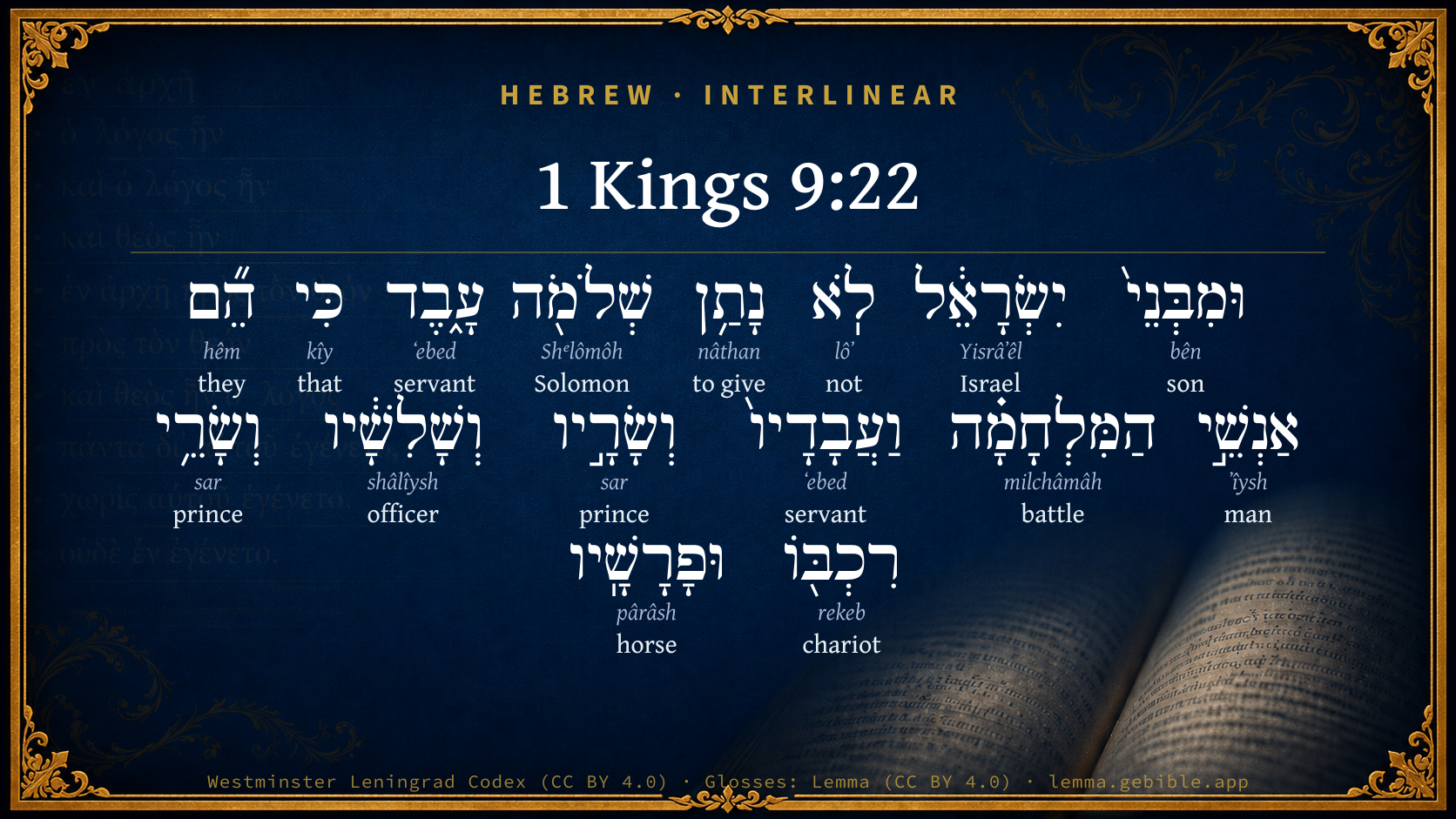
Hebrew (Westminster Leningrad Codex) 1 Kings 9:22 appears in the Hebrew Old Testament. The text above is from the Westminster Leningrad Codex. Each word links to its Strong’s number, a concise gloss, and parsing drawn from the Open Scriptures Hebrew Bible morphology. Click any word for its full Brown-Driver-Briggs (BDB) entry.
Download image
Cite this verse

1 Kings 9:22 (World English Bible). Public Domain. Lemma interlinear Bible study tool, https://lemma.gebible.app/v/1-kings/9/22.

Show BibTeX & RIS
BibTeX
RIS
English Translation
But of the children of Israel did Solomon make no bondservants; but they were the men of war, and his servants, and his princes, and his captains, and rulers of his chariots and of his horsemen.
World English Bible · Public Domain
Download a study sheet

One document with this verse’s original text, its word-by-word gloss line, the meaning frame, cross-references with their text, attributed commentary, and full source and license credits — printable, and it pastes into notes with its structure intact.

This verse Autodidact and up

Study sheet (.html) Plain text (.txt)

A passage Seminary Student

Up to 50 verses in one chapter. A passage sheet keeps up to 6 commentary sources and 12 cross-references per verse, in the order this page ranks them, and says so on the sheet whenever that leaves anything out. Ask for a single verse and you get the Autodidact verse sheet above.

Everything on this page stays free to read, with no account — the sheet is a download of what is already on screen, not access to it.

Want to remove ads? Support Godless Engineer
Compare translations 3

The same verse in 3 English versions, stacked beneath the original-language interlinear above. Click any original word for its lexicon entry.

Each is an independent rendering of the whole verse — the interlinear is not word-aligned to these translations.

Highlighted words mark where these versions differ — a whole-verse word diff, not a word-by-word alignment.

  • World English Bible Public Domain
    But of the children of Israel did Solomon make no bondservants; but they were the men of war, and his servants, and his princes, and his captains, and rulers of his chariots and of his horsemen.
  • King James Version Public Domain
    But of the children of Israel did Solomon make no bondmen: but they were men of war, and his servants, and his princes, and his captains, and rulers of his chariots, and his horsemen.
  • unfoldingWord Literal Text CC BY-SA 4.0
    But from the sons of Israel Solomon did not make a servant, for they the men of war and his servants and his commanders and his captains and the commanders of his chariotry and his horsemen.

unfoldingWord Literal Text — © unfoldingWord, licensed CC BY-SA 4.0. Word-aligned USFM3 via Door43 (git.door43.org/unfoldingWord/en_ult).

Versions to compare (up to 4)

3 of 4 selected

Show all 18 translations

Every available English version of this verse, each an independent rendering of the whole verse.

  • World English Bible Public Domain
    But of the children of Israel did Solomon make no bondservants; but they were the men of war, and his servants, and his princes, and his captains, and rulers of his chariots and of his horsemen.
  • Berean Standard Bible Public Domain
    But Solomon did not consign any of the Israelites to slavery, because they were his men of war, his servants, his officers, his captains, and the commanders of his chariots and cavalry.
  • Majority Standard Bible Public Domain
    But Solomon did not consign any of the Israelites to slavery, because they were his men of war, his servants, his officers, his captains, and the commanders of his chariots and cavalry.
  • King James Version Public Domain
    But of the children of Israel did Solomon make no bondmen: but they were men of war, and his servants, and his princes, and his captains, and rulers of his chariots, and his horsemen.
  • American Standard Version (1901) Public Domain
    But of the children of Israel did Solomon make no bondservants; but they were the men of war, and his servants, and his princes, and his captains, and rulers of his chariots and of his horsemen.
  • Revised Version (1885) Public Domain
    But of the children of Israel did Solomon make no bondservants: but they were the men of war, and his servants, and his princes, and his captains, and rulers of his chariots and of his horsemen.
  • Geneva Bible (1599) Public Domain
    But of the children of Israel did Salomon make no bondmen: but they were men of warre and his seruants, and his princes, and his captaines, and rulers of his charets and his horsemen.
  • Douay-Rheims (1899) Public Domain
    But of the children of Israel Solomon made not any to be bondmen, but they were men of war, and his servants, and his princes, and captains, and overseers of the chariots and horses.
  • Young's Literal Translation Public Domain
    And out of the sons of Israel Solomon hath not appointed a servant, for they `are' the men of war, and his servants, and his heads, and his captains, and the heads of his chariots, and his horsemen.
  • Literal Standard Version CC BY-SA 4.0
    And Solomon has not appointed a servant out of the sons of Israel, for they [are] the men of war, and his servants, and his heads, and his captains, and the heads of his chariots, and his horsemen.
  • Unlocked Literal Bible CC BY-SA 4.0
    However, Solomon made no forced laborers of the people of Israel. Instead, they became his soldiers and his servants, his officials, and his officers and commanders of his chariot forces and his horsemen.
  • unfoldingWord Literal Text CC BY-SA 4.0
    But from the sons of Israel Solomon did not make a servant, for they the men of war and his servants and his commanders and his captains and the commanders of his chariotry and his horsemen.
  • Darby Bible Public Domain
    But of the children of Israel did Solomon make no bondmen; but they were men of war, and his servants, and his chiefs, and his captains, and captains of his chariots, and his horsemen.
  • World Messianic Bible Public Domain
    But of the children of Israel Solomon made no bondservants; but they were the men of war, his servants, his princes, his captains, and rulers of his chariots and of his horsemen.
  • Webster's Bible Public Domain
    But of the children of Israel did Solomon make no bond-men: but they were men of war, and his servants, and his princes, and his captains, and rulers of his chariots, and his horsemen.
  • Free Bible Version CC BY-SA 4.0
    But Solomon did not enslave any of the Israelites. They were his soldiers, officials, commanders, captains, chariot commanders, and horsemen.
  • Bible in Basic English Public Domain
    But Solomon did not put the children of Israel to forced work; they were the men of war, his servants, his captains, and his chiefs, captains of his war-carriages and of his horsemen.
  • JPS Tanakh (1917) Public Domain
    But of the children of Israel did Solomon make no bondservants; but they were the men of war, and his servants, and his princes, and his captains, and rulers of his chariots and of his horsemen.

Literal Standard Version (2020), Covenant Press — licensed CC BY-SA 4.0. Text via the HelloAO Bible API (eBible.org). Unlocked Literal Bible (unfoldingWord) — licensed CC BY-SA 4.0. Text via the HelloAO Bible API (eBible.org). unfoldingWord Literal Text — © unfoldingWord, licensed CC BY-SA 4.0. Word-aligned USFM3 via Door43 (git.door43.org/unfoldingWord/en_ult). Free Bible Version, Dr. Jonathan Gallagher — licensed CC BY-SA 4.0. Text via the HelloAO Bible API (eBible.org).

Word by word

More ways to search: Search by grammar → Find every occurrence → Compare this word →

Practice this passage: Drill this verse → Learn its vocabulary →

וְשָׁלִשָׁ֔יו
shâlîysh
H7991
“and · officers · his”
Conjunction + Noun, Common, Masculine, Plural, Construct + Suffix, Personal, 3rd Person, Masculine, Singular
Part of Speech
Conjunction + Noun
Type
Common
Gender
Masculine
Number
Plural
State
Construct
Full BDB Definition

Origin: from H7969

TWOT: 2403e , 2403f , 2403g

third part - name of a measure - a musical instrument - maybe three-stringed, triangular shape, or three-barred - perhaps a sistrum or triangle - shield carrier, adjutant, officer, captain
  1. וּמִבְּנֵי֙ bên H1121 “and · from · sons of” Conjunction + Preposition + Noun, Common, Masculine, Plural, Construct
  2. יִשְׂרָאֵ֔ל Yisrâʼêl H3478 “Israel” Noun, Proper
  3. לֹֽא lôʼ H3808 “not” Particle, Negative
  4. נָתַ֥ן nâthan H5414 “to give” Verb, Qal, Perfect, 3rd Person, Masculine, Singular
  5. שְׁלֹמֹ֖ה Shᵉlômôh H8010 “Solomon” Noun, Proper
  6. עָ֑בֶד ʻebed H5650 “servant” Noun, Common, Masculine, Singular, Absolute
  7. כִּי kîy H3588 “that” Conjunction
  8. הֵ֞ם hêm H1992 “they” Pronoun, Personal, 3rd Person, Masculine, Plural
  9. אַנְשֵׁ֣י ʼîysh H376 “men of” Noun, Common, Masculine, Plural, Construct
  10. הַמִּלְחָמָ֗ה milchâmâh H4421 “the · battle” Particle, Definite Article + Noun, Common, Feminine, Singular, Absolute
  11. וַעֲבָדָיו֙ ʻebed H5650 “and · servants · his” Conjunction + Noun, Common, Masculine, Plural, Construct + Suffix, Personal, 3rd Person, Masculine, Singular
  12. וְשָׂרָ֣יו sar H8269 “and · princes · his” Conjunction + Noun, Common, Masculine, Plural, Construct + Suffix, Personal, 3rd Person, Masculine, Singular
  13. וְשָׂרֵ֥י sar H8269 “and · princes of” Conjunction + Noun, Common, Masculine, Plural, Construct
  14. רִכְבּ֖וֹ rekeb H7393 “chariot · his” Noun, Common, Masculine, Singular, Construct + Suffix, Personal, 3rd Person, Masculine, Singular
  15. וּפָרָשָֽׁיו pârâsh H6571 “and · horses · his” Conjunction + Noun, Common, Masculine, Plural, Construct + Suffix, Personal, 3rd Person, Masculine, Singular

About this verse

These counts appear in no published source. They are computed here, from the morphology-tagged text and Lemma’s own curated glosses. What Lemma adds →

16
words
14
distinct lemmas
Historical
section

Notable vocabulary

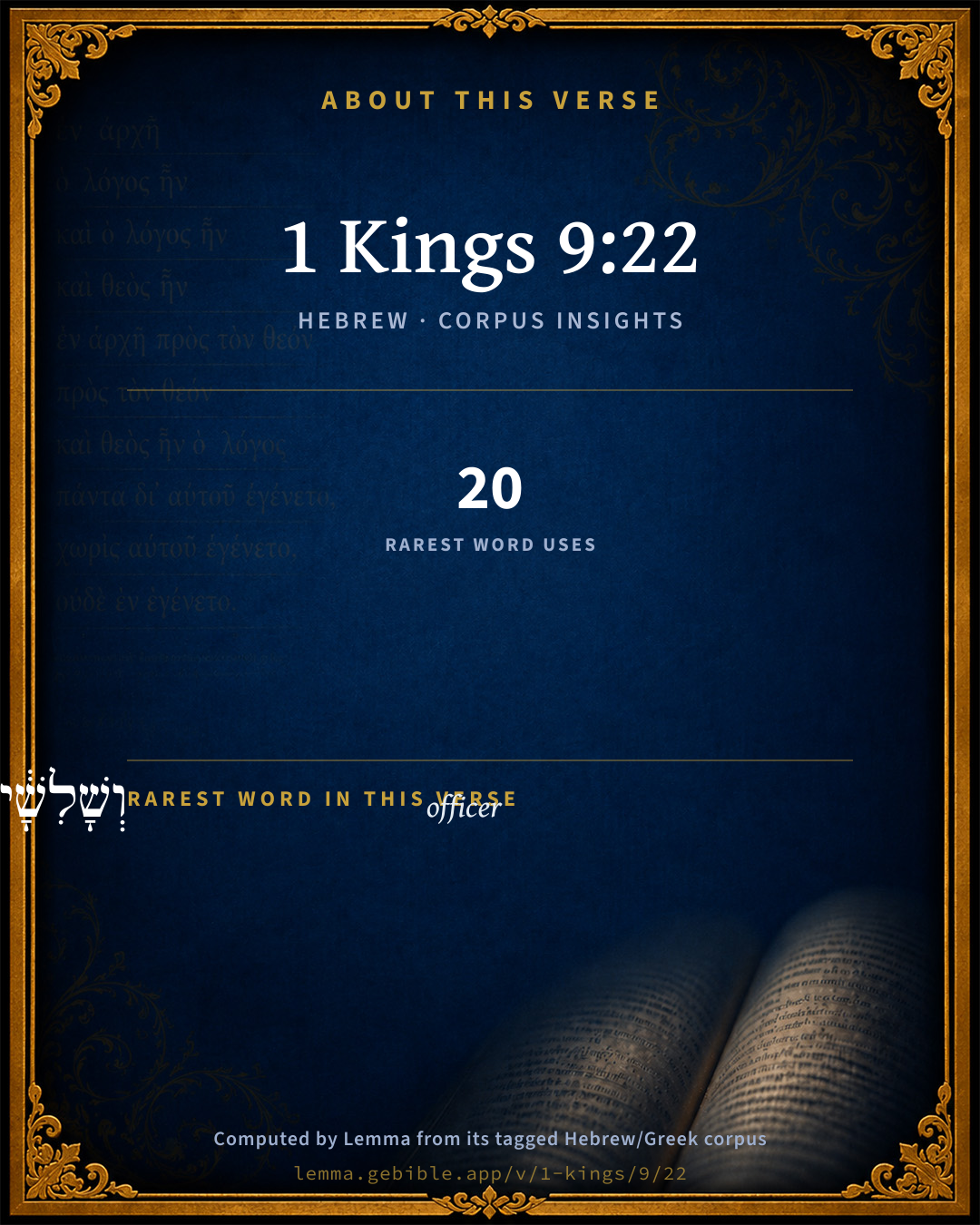
The rarest word here is וְשָׁלִשָׁ֔יו officer H7991 — appearing just 20 times in the whole Hebrew Bible.

Shared distinctive vocabulary

וְשָׁלִשָׁ֔יו officer H7991 occurs in 18 verses of the Hebrew Bible. Also found in:

Grammatical profile

  • 1 verb
  • 12 nouns
  • 1 pronoun
  • 1 conjunction
  • 1 particle

Verb forms

  • נָתַ֥ן Qal · Perfect

Repetition

Words recur within this verse — often emphatic in Hebrew:

  • עָ֑בֶד servant H5650 ×2
  • וְשָׂרָ֣יו prince H8269 ×2

Cross-references

4

Topical passages linked to 1 Kings 9:22 in the Treasury of Scripture Knowledge — connected by theme and wording, ordered by reader-vote popularity; previews shown in the World English Bible.

  • Leviticus 25:39 "'If your brother has grown poor among you, and sells himself to you; you shall not make him to serve as a slave.
  • 1 Samuel 8:11–12 He said, This will be the manner of the king who shall reign over you: he will take your sons, and appoint them to him, for his chariots, and to be his horsemen; and they shall run before his chariots;
  • 1 Kings 4:1–27 King Solomon was king over all Israel.
  • 2 Chronicles 8:9–10 But of the children of Israel did Solomon make no servants for his work; but they were men of war, and chief of his captains, and rulers of his chariots and of his horsemen.

Cross-references courtesy of OpenBible.info (CC BY 4.0).

Hebrew and Greek witnesses Masoretic Hebrew ↔ Greek Septuagint

The same verse in the two great witnesses to the Old Testament, shown verse-for-verse.

These are two independent witnesses, not word-aligned to each other, and the Septuagint is shown in lemma (dictionary) form.

Hebrew 1 Kings 9:22 Masoretic · Westminster Leningrad Codex

וּמִבְּנֵי֙ יִשְׂרָאֵ֔ל לֹֽא נָתַ֥ן שְׁלֹמֹ֖ה עָ֑בֶד כִּי הֵ֞ם אַנְשֵׁ֣י הַמִּלְחָמָ֗ה וַעֲבָדָיו֙ וְשָׂרָ֣יו וְשָׁלִשָׁ֔יו וְשָׂרֵ֥י רִכְבּ֖וֹ וּפָרָשָֽׁיו

But of the children of Israel did Solomon make no bondservants; but they were the men of war, and his servants, and his princes, and his captains, and rulers of his chariots and of his horsemen.

World English Bible · Public Domain

On this verse, The Pulpit Commentary discusses the Septuagint’s reading. Read the note in Commentary ↓

Hebrew: Westminster Leningrad Codex (CC BY 4.0). Greek: Septuagint (public domain); English from a public-domain English Septuagint. How the Septuagint differs from the Hebrew →

Targum (Aramaic paraphrase)

1

The Targum is the ancient Jewish Aramaic paraphrase of the Hebrew Scriptures — an interpretive translation, not the Hebrew text itself. Onkelos (literal) and Pseudo-Jonathan (expansive) render the Torah, and Jonathan the Prophets. Coverage is partial: where no permissively-licensed English translation exists for a verse, only the Aramaic is shown. This is verse-level text, not a word-by-word alignment to the Hebrew.

  1. Targum Jonathan Prophets (Joshua–Malachi)
    וּמִבְּנֵי יִשְׂרָאֵל לָא יְהַב שְׁלֹמֹה לְמֶהֱוֵי פַלָחִין אֲרֵי אִינוּן גְבַר עָבְדֵי קְרָבָא וְעַבְדוֹהִי וְרַבְרְבָנוֹהִי וְגִבָּרוֹהִי וְרַבָּנֵי רְתִיכוֹהִי וּפָרָשׁוֹהִי:

    (no public-domain English translation for this verse)

    Targum Jonathan — Aramaic: “Mikraot Gedolot” (public domain). English: “Sefaria Community Translation” (CC0 1.0 (public-domain dedication)); “London "Chaldee Paraphrase," 1871” (public domain). Text via Sefaria.

Commentary

Notes on 1 Kings 9:22 from classic Christian and Jewish commentators (each source and its license shown beneath its notes). The classic Christian expositions comment on the surrounding passage and are grouped to its opening verse, so a note may address several verses; the Jewish commentaries on the Tanakh (Rashi and others) are per-verse, so they appear only where the commentator wrote on this verse.

Lemma curates 59 commentaries, every one of them public domain or Creative Commons licensed, each selected and text-cleaned for this edition rather than reprinted as found. About our sources →

Trapp's Complete Commentary

John Trapp

1Ki 9:22 But of the children of Israel did Solomon make no bondmen: but they [were] men of war, and his servants, and his princes, and his captains, and rulers of his chariots, and his horsemen.

Ver. 22. Did Solomon make no bondmen.] Yet were they discontented at his government: and ten whole tribes at once cast off his son and successor, choosing Jeroboam for their king.

John Trapp, A Commentary or Exposition upon All the Books of the Old and New Testament (1647–1656) — public domain. Text from a community e-Sword module.

Joseph Benson's Commentary

1Ki 9:22-23. Of the children of Israel did Solomon make no bond-men — He spared them, and did not employ them in any servile labours about his public works, but put them into nobler offices, as it here follows. They were men of war — Which was accounted an honourable employment. And his servants — Officers in his court. And his princes — Governors of provinces. And his captains, &c. — Commanders of his guards. Five hundred and fifty — In 2Ch 8:10, they are said to be but two hundred and fifty. But perhaps the meaning there is, that there were two hundred and fifty set over those that wrought in the temple; the rest probably being employed in overseeing his public works in other places. And it must be observed also, that there were far greater numbers employed when the temple work was carried on with great speed.

Joseph Benson's Commentary on the Old and New Testaments (1811–1818) — public domain. Text from a community e-Sword module.

Ellicott's Commentary for English Readers

(22) No bondmen.—This exemption, however it may have continued in theory, must virtually have been set aside in the later days of Solomon. (See 1Ki_12:4.) They are here described as occupying the position of a dominant race—as warriors, servants about the person of the king, princes, and officers in the array—like the free vassals under a feudal monarchy. But as the absolute power of the king increased, and with it, perhaps, the wealth and arrogance of his favourites and greater officers, the condition of the Israelites at large might be removed from serfship more in name than in reality. Even the subject races might be played of against them, as against the Macedonians in the later years of Alexander the Great, when his royalty passed into something like a true Oriental despotism. Certainly, in later times we find, both from the history and the prophetical books, that there was such a thing as serf ship of the poor to the princes. (Jer_34:8-11; Neh_5:11.)

A Bible Commentary for English Readers, edited by Charles John Ellicott (1878–1897) — public domain. Text from a community e-Sword module.

The Cambridge Bible for Schools and Colleges

gen. ed. J. J. S. Perowne

22. But of the children of Israel did Solomon make no bondman] This must be read in the light of chap. 1Ki_5:13. There we are told of Solomon’s levy upon all Israel. But the 30,000 men there spoken of had duty forced on them only for a month at a time. Ten thousand served for one month, and were two months at home before their turn for service came round again. Moreover, when the work for which they were enrolled came to an end they were free. It may also be that in the course of 20 years Solomon changed his system, especially if he saw that his people were beginning to find his yoke heavy. But the Canaanite levy was continuous ‘unto this day.’

his servants] i.e. His officers. The position of the word between ‘men of war’ and ‘princes’ shews that the service here spoken of was a service of dignity. They were such ‘servants’ as are spoken of in 2Sa_8:7 “And David took the shields of gold that were on the servants of Hadadezer.’

The Cambridge Bible for Schools and Colleges (gen. ed. J. J. S. Perowne; Cambridge University Press, 1878–1918) — public domain. Text from a community e-Sword module.

John Gill's Exposition

But Pharaoh's daughter came up out of the city of David,.... Where he placed her when he first married her, until he had finished his buildings, Kg1 3:1, which being done he brought her from thence unto her house, which Solomon had built for her; the reason of which is given, not only because it was the house of David, but because it was holy by the ark being there for some time; and therefore he did not judge it proper that his wife, an Egyptian woman, and sometimes in her impurity, should dwell there; see Ch2 8:11,

then did he build Millo: this being particularly repeated from Kg1 9:15, and following upon what is said of Pharaoh's daughter, has led many Jewish writers to conclude her house was built at Millo; and indeed, without supposing this, it is hard to conceive why it should be observed here; the Targum on Ch2 8:11 calls her name Bithiah.

John Gill's Exposition of the Whole Bible (1746–1763) — public domain (CC PDM 1.0). Text via the HelloAO Bible API.

Albert Barnes' Notes on the Bible

Comparing this with 1Ki 5:13-14, it would seem that a modified service of forced labor for one-third of each year was not regarded as reducing those who were subject to it to the condition of bondmen.

Albert Barnes' Notes on the Bible (1834–1885) — public domain. Text from a community e-Sword/MySword module.

Haydock's Catholic Bible Commentary

Bondmen. Paralipomenon, To serve in the king’s works; for they were warriors, &c. The natural subjects performed the more honourable offices. (Haydock) --- Strangers pay tribute, Matthew xvii. 24. Sesostris, king of Egypt, caused many temples to be erected after his expeditions, with this inscription: "No native laboured on them." (Diodorus i.)

George Leo Haydock (1774–1849), Haydock's Catholic Family Bible and Commentary, 1859 edition — public domain. Excludes Psalms (Douay-Rheims chapter numbering differs from Protestant) and Deuterocanonical books (Catholic canon only).

Whedon's Commentary on the Bible

Daniel D. Whedon

22. His servants — Holding positions of honourable trust in the court or in the royal service, and so distinguished from bondslaves.

Captains — Shalishim. See note on 2Sa_23:8.

Rulers of his chariots, and his horsemen — The word horsemen here, as in 1Ki_9:19, should be rendered steeds, or cavalry, and the rulers of the chariots and cavalry were the chief officers in these departments of the army.

Daniel D. Whedon (gen. ed.), Commentary on the Old and New Testaments (1874–1909) — public domain. Text from a community e-Sword module.

The Pulpit Commentary

But of the children of Israel did Solomon make no bondmen see however 1Ki_5:13, 1Ki_5:18. This service, though compulsory, was not servile. Bondage was forbidden; Lev_25:39. The levy were treated as hired servants and had wages but they were men of war, and his servants cf. 1Ki_1:9. Not only "officials of the war department" (Bahr) but officers of every kind, and his princes these were the heads both of the military and civil services, and his captains Heb. wyv; liv; LXX trwtatai. Exo_14:7 Exo_15:4; 2Sa_23:8; 2Ki_9:25 2Ki_10:25, etc. These third men were really "a noble rank of soldiers who fought from chariots" (Gesen.) each of which would seem to have held three men, one of whom drove, while two fought: thence used of the bodyguard of kings. That they formed a corps, and were not literally "captains," is clear from 1Sa_23:8, etc. and rulers of his chariots, and his horsemen.

The Pulpit Commentary (1880–1919), ed. H.D.M. Spence-Jones & Joseph S. Exell — public domain. Text from a community e-Sword module.

unfoldingWord translationNotes

Door43 World Missions Community

Solomon made no forced laborers of the people of Israel

"Solomon did not force the people of Israel to labor"

translationWords

Solomon

servant

commander

chariot

unfoldingWord translationNotes — © Distant Shores Media and the Door43 World Missions Community, licensed CC BY-SA 4.0. Source: git.door43.org/Door43/en_tn.

Lesson kit

Teaching starters — assembled from the data on this page, not authored interpretation. Every prompt links to the verse data it draws on. Edit before teaching.

1 Kings, in the Historical, opens this verse with 16 words (14 distinct Hebrew lemmas). Its most distinctive word is shâlîysh (“officer”). A historical commentator’s framing appears above. Read the whole chapter for the surrounding context.

Discussion questions

  1. How does “officer” (shâlîysh) shape what this verse is saying?
  2. Exodus 14:7 shares the word «officer» with this verse. How do the two illuminate each other?
  3. “servant” occurs 2× in this one verse. What is the effect of the repetition?
  4. The translations on this page render this verse differently — a whole-verse word diff, not a word-by-word alignment. What might account for the different wordings?
  5. The verb «נָתַ֥ן» is Qal Perfect. How does its form color the action?
  6. Reading how Trapp's Complete Commentary and Joseph Benson's Commentary read this verse, where do the two commentators agree and where do they part?

Things to notice

Reading settings

Reading text

Shown beneath each verse's original-language words.

Old Testament
Old Testament edition

Read the OT as the Masoretic Hebrew (MT) or the Greek Septuagint (LXX).

English shown for the Greek Septuagint (in the Hebrew ↔ Greek comparison).

Comparing translations? Open the Compare panel on any verse page to stack up to four side by side.