Numbers 3:9

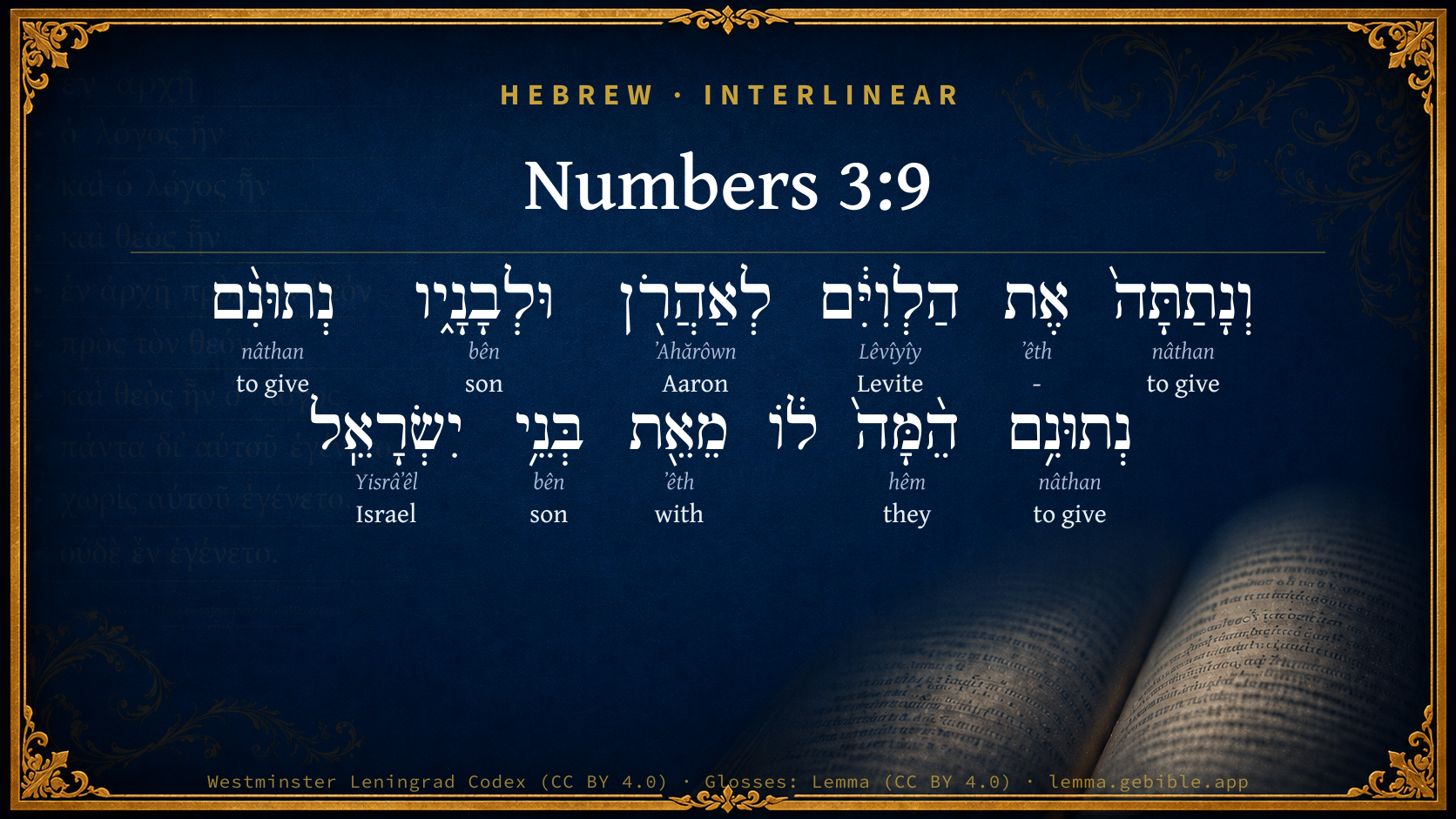
Hebrew (Westminster Leningrad Codex) Numbers 3:9 appears in the Hebrew Old Testament. The text above is from the Westminster Leningrad Codex. Each word links to its Strong’s number, a concise gloss, and parsing drawn from the Open Scriptures Hebrew Bible morphology. Click any word for its full Brown-Driver-Briggs (BDB) entry.
Download image
Cite this verse

Numbers 3:9 (World English Bible). Public Domain. Lemma interlinear Bible study tool, https://lemma.gebible.app/v/numbers/3/9.

Show BibTeX & RIS
BibTeX
RIS
English Translation
You shall give the Levites to Aaron and to his sons. They are wholly given to him on the behalf of the children of Israel.
World English Bible · Public Domain
Download a study sheet

One document with this verse’s original text, its word-by-word gloss line, the meaning frame, cross-references with their text, attributed commentary, and full source and license credits — printable, and it pastes into notes with its structure intact.

This verse Autodidact and up

Study sheet (.html) Plain text (.txt)

A passage Seminary Student

Up to 50 verses in one chapter. A passage sheet keeps up to 6 commentary sources and 12 cross-references per verse, in the order this page ranks them, and says so on the sheet whenever that leaves anything out. Ask for a single verse and you get the Autodidact verse sheet above.

Everything on this page stays free to read, with no account — the sheet is a download of what is already on screen, not access to it.

Want to remove ads? Support Godless Engineer
Compare translations 3

The same verse in 3 English versions, stacked beneath the original-language interlinear above. Click any original word for its lexicon entry.

Each is an independent rendering of the whole verse — the interlinear is not word-aligned to these translations.

Highlighted words mark where these versions differ — a whole-verse word diff, not a word-by-word alignment.

  • World English Bible Public Domain
    You shall give the Levites to Aaron and to his sons. They are wholly given to him on the behalf of the children of Israel.
  • King James Version Public Domain
    And thou shalt give the Levites unto Aaron and to his sons: they are wholly given unto him out of the children of Israel.
  • unfoldingWord Literal Text CC BY-SA 4.0
    And you shall give the Levites to Aaron and to his sons. They given, given to him from with the sons of Israel.

unfoldingWord Literal Text — © unfoldingWord, licensed CC BY-SA 4.0. Word-aligned USFM3 via Door43 (git.door43.org/unfoldingWord/en_ult).

Versions to compare (up to 4)

3 of 4 selected

Show all 18 translations

Every available English version of this verse, each an independent rendering of the whole verse.

  • World English Bible Public Domain
    You shall give the Levites to Aaron and to his sons. They are wholly given to him on the behalf of the children of Israel.
  • Berean Standard Bible Public Domain
    Assign the Levites to Aaron and his sons; they have been given exclusively to him from among the Israelites.
  • Majority Standard Bible Public Domain
    Assign the Levites to Aaron and his sons; they have been given exclusively to him from among the Israelites.
  • King James Version Public Domain
    And thou shalt give the Levites unto Aaron and to his sons: they are wholly given unto him out of the children of Israel.
  • American Standard Version (1901) Public Domain
    And thou shalt give the Levites unto Aaron and to his sons: they are wholly given unto him on the behalf of the children of Israel.
  • Revised Version (1885) Public Domain
    And thou shalt give the Levites unto Aaron and to his sons: they are wholly given unto him on the behalf of the children of Israel.
  • Geneva Bible (1599) Public Domain
    And thou shalt giue the Leuites vnto Aaron and to his sonnes: for they are giuen him freely from among the children of Israel.
  • Douay-Rheims (1899) Public Domain
    And thou shalt give the Levites for a gift,
  • Young's Literal Translation Public Domain
    and thou hast given the Levites to Aaron and to his sons; they are surely given to him out of the sons of Israel.
  • Literal Standard Version CC BY-SA 4.0
    and you have given the Levites to Aaron and to his sons; they are surely given to him out of the sons of Israel.
  • Unlocked Literal Bible CC BY-SA 4.0
    You must give the Levites to Aaron and his sons. They are wholly given to help him serve the people of Israel.
  • unfoldingWord Literal Text CC BY-SA 4.0
    And you shall give the Levites to Aaron and to his sons. They given, given to him from with the sons of Israel.
  • Darby Bible Public Domain
    And thou shalt give the Levites to Aaron and to his sons: they are wholly given to him out of the children of Israel.
  • World Messianic Bible Public Domain
    You shall give the Levites to Aaron and to his sons. They are wholly given to him on the behalf of the children of Israel.
  • Webster's Bible Public Domain
    And thou shalt give the Levites to Aaron and to his sons: they are wholly given to him out of the children of Israel.
  • Free Bible Version CC BY-SA 4.0
    The Levites are to work exclusively for Aaron and his sons because this is their assignment among the Israelites.
  • Bible in Basic English Public Domain
    Give the Levites to Aaron and his sons; so that they may be his without question from among the children of Israel.
  • JPS Tanakh (1917) Public Domain
    And thou shalt give the Levites unto Aaron and to his sons; they are wholly given unto him from the children of Israel.

Literal Standard Version (2020), Covenant Press — licensed CC BY-SA 4.0. Text via the HelloAO Bible API (eBible.org). Unlocked Literal Bible (unfoldingWord) — licensed CC BY-SA 4.0. Text via the HelloAO Bible API (eBible.org). unfoldingWord Literal Text — © unfoldingWord, licensed CC BY-SA 4.0. Word-aligned USFM3 via Door43 (git.door43.org/unfoldingWord/en_ult). Free Bible Version, Dr. Jonathan Gallagher — licensed CC BY-SA 4.0. Text via the HelloAO Bible API (eBible.org).

Word by word

More ways to search: Search by grammar → Find every occurrence → Compare this word →

Practice this passage: Drill this verse → Learn its vocabulary →

הַלְוִיִּ֔ם
Lêvîyîy
H3881
“the · Levites”
Particle, Definite Article + Noun, Gentilic, Masculine, Plural, Absolute
Part of Speech
Particle + Noun
Type
Gentilic
Gender
Masculine
Number
Plural
State
Absolute
Full BDB Definition

Origin: patronymically from H3878

TWOT: None

Levite = see Levi " joined to" - the descendants of Levi, the 3rd son of Jacob by Leah - the tribe descended from Levi specially set aside by God for His service
  1. וְנָתַתָּה֙ nâthan H5414 “and · to give” Conjunction + Verb, Qal, Sequential Perfect, 2nd Person, Masculine, Singular
  2. אֶת ʼêth H853 “-” Particle, Direct Object
  3. לְאַהֲרֹ֖ן ʼAhărôwn H175 “to/for · Aaron” Preposition + Noun, Proper
  4. וּלְבָנָ֑יו bên H1121 “and · to/for · sons · his” Conjunction + Preposition + Noun, Common, Masculine, Plural, Construct + Suffix, Personal, 3rd Person, Masculine, Singular
  5. נְתוּנִ֨ם nâthan H5414 “given” Verb, Qal, Participle Passive, Masculine, Plural, Absolute
  6. נְתוּנִ֥ם nâthan H5414 “given” Verb, Qal, Participle Passive, Masculine, Plural, Absolute
  7. הֵ֨מָּה֙ hêm H1992 “they” Pronoun, Personal, 3rd Person, Masculine, Plural
  8. מֵאֵ֖ת ʼêth H854 “from · with” Preposition + Preposition
  9. בְּנֵ֥י bên H1121 “sons of” Noun, Common, Masculine, Plural, Construct
  10. יִשְׂרָאֵֽל Yisrâʼêl H3478 “Israel” Noun, Proper

About this verse

These counts appear in no published source. They are computed here, from the morphology-tagged text and Lemma’s own curated glosses. What Lemma adds →

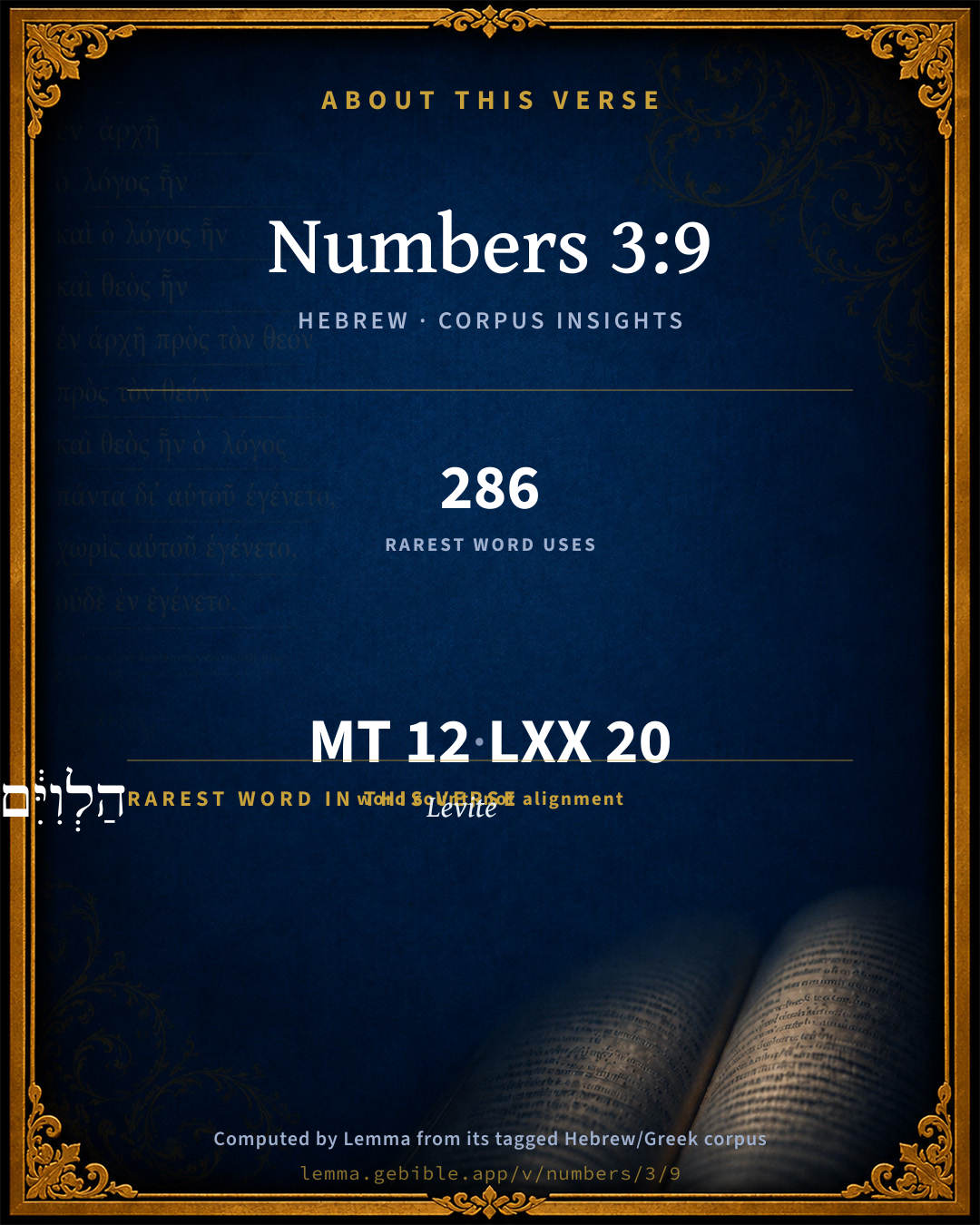
12
words
8
distinct lemmas
Pentateuch
section

Grammatical profile

  • 3 verbs
  • 5 nouns
  • 1 pronoun
  • 2 prepositions
  • 1 particle

Verb forms

  • וְנָתַתָּה֙ Qal · Sequential Perfect
  • נְתוּנִ֨ם Qal · Participle Passive
  • נְתוּנִ֥ם Qal · Participle Passive

Repetition

Words recur within this verse — often emphatic in Hebrew:

  • וְנָתַתָּה֙ to give H5414 ×3
  • וּלְבָנָ֑יו son H1121 ×2

Hebrew & Septuagint length

In English translation the verse runs 25 words from the Hebrew and 27 from the Septuagint (LXX English) — closely comparable.

A rough comparison of the two English renderings, which tokenize alike — not a word-level alignment.

Word counts can differ between the Hebrew and the Greek without any difference in meaning — e.g. the Hebrew direct-object marker אֵת has no separate Greek word, and Greek often adds the article ὁ.

In the original languages it is 12 Hebrew tokens and 20 Greek tokens — but the two are counted differently (Hebrew bundles its prefixes and suffixes into one token; the Greek is in lemma form), so that isn’t a like-for-like length.

Cross-references

4

Topical passages linked to Numbers 3:9 in the Treasury of Scripture Knowledge — connected by theme and wording, ordered by reader-vote popularity; previews shown in the World English Bible.

  • Numbers 8:19 I have given the Levites as a gift to Aaron and to his sons from among the children of Israel, to do the service of the children of Israel in the Tent of Meeting, and to make atonement for the children of Israel; that there be no plague among the children of Israel, when the children of Israel come near to the sanctuary."
  • Numbers 18:6–7 I, behold, I have taken your brothers the Levites from among the children of Israel: to you they are a gift, given to Yahweh, to do the service of the tent of meeting.
  • Ephesians 4:8 Therefore he says, "When he ascended on high, he led captivity captive, and gave gifts to men."
  • Ephesians 4:11 He gave some to be apostles; and some, prophets; and some, evangelists; and some, shepherds and teachers;

Cross-references courtesy of OpenBible.info (CC BY 4.0).

Hebrew and Greek witnesses Masoretic Hebrew ↔ Greek Septuagint

The same verse in the two great witnesses to the Old Testament, shown verse-for-verse.

These are two independent witnesses, not word-aligned to each other, and the Septuagint is shown in lemma (dictionary) form.

Hebrew Numbers 3:9 Masoretic · Westminster Leningrad Codex

וְנָתַתָּה֙ אֶת הַלְוִיִּ֔ם לְאַהֲרֹ֖ן וּלְבָנָ֑יו נְתוּנִ֨ם נְתוּנִ֥ם הֵ֨מָּה֙ ל֔וֹ מֵאֵ֖ת בְּנֵ֥י יִשְׂרָאֵֽל

You shall give the Levites to Aaron and to his sons. They are wholly given to him on the behalf of the children of Israel.

World English Bible · Public Domain

Greek LXX Numbers 3:9 Septuagint · lemma form

καί δίδωμι ὁ λευίτης ἀαρών καί ὁ υἱός αὐτός ὁ ἱερεύς δόμα δίδωμι οὗτος ἐγώ εἰμί ἀπό ὁ υἱός ἰσραήλ

And you shall give the Levites to Aaron, and to his sons the priests; they are given for a gift to me of the children of Israel.

LXX2012 (modern English Septuagint) · Public Domain

On this verse, The Cambridge Bible for Schools and Colleges discusses the Septuagint’s reading. Read the note in Commentary ↓

Hebrew: Westminster Leningrad Codex (CC BY 4.0). Greek: Septuagint (public domain); English from LXX2012 (modern English Septuagint) (Public Domain). How the Septuagint differs from the Hebrew →

Targum (Aramaic paraphrase)

2

The Targum is the ancient Jewish Aramaic paraphrase of the Hebrew Scriptures — an interpretive translation, not the Hebrew text itself. Onkelos (literal) and Pseudo-Jonathan (expansive) render the Torah, and Jonathan the Prophets. Coverage is partial: where no permissively-licensed English translation exists for a verse, only the Aramaic is shown. This is verse-level text, not a word-by-word alignment to the Hebrew.

  1. Targum Onkelos Torah (Genesis–Deuteronomy)
    וְתִתֵּן יָת לֵוָאֵי לְאַהֲרֹן וְלִבְנוֹהִי מְסִירִין יְהִיבִין אִנוּן לֵהּ מִן בְּנֵי יִשְׂרָאֵל

    (no public-domain English translation for this verse)

    Targum Onkelos — Aramaic: “Onkelos Genesis” (public domain); “Onkelos Exodus” (public domain); “Onkelos Leviticus” (public domain); “Onkelos Numbers” (public domain); “Onkelos Deuteronomy” (public domain). English: “Sefaria Community Translation” (CC0 1.0 (public-domain dedication)); “J.W. Etheridge. The Targums of Onkelos and Jonathan Ben Uzziel on the Pentateuch. London: Longmans, Green, 1862” (public domain). Text via Sefaria.

  2. Targum Pseudo-Jonathan Torah (Genesis–Deuteronomy)
    וְתִתֵּן יַת לֵיוָאֵי לְאַהֲרן וְלִבְנוֹי מַתָּנָה הִינוּן יְהִיבִין וּמְסִירִין לֵיהּ מִלְוַת בְּנֵי יִשְרָאֵל

    And I have given the Levites unto Aharon and his sons; a gift are they given and delivered to him from among the sons of Israel;

    Targum Pseudo-Jonathan — Aramaic: “Targum Jonathan on Genesis” (public domain); “Targum Jonathan on Exodus” (public domain); “Targum Jonathan on Leviticus” (public domain); “Targum Jonathan on Numbers” (public domain); “Targum Jonathan on Deuteronomy” (public domain). English: “The Targum of Jonathan ben Uzziel, trans. J. W. Etheridge, London, 1862” (public domain). Text via Sefaria.

Commentary

Notes on Numbers 3:9 from classic Christian and Jewish commentators (each source and its license shown beneath its notes). The classic Christian expositions comment on the surrounding passage and are grouped to its opening verse, so a note may address several verses; the Jewish commentaries on the Tanakh (Rashi and others) are per-verse, so they appear only where the commentator wrote on this verse.

Lemma curates 59 commentaries, every one of them public domain or Creative Commons licensed, each selected and text-cleaned for this edition rather than reprinted as found. About our sources →

Trapp's Complete Commentary

John Trapp

Num 3:9 And thou shalt give the Levites unto Aaron and to his sons: they [are] wholly given unto him out of the children of Israel.

Ver. 9. They are wholly given unto him.] Heb. They are given, they are given. So the ministers of the gospel are called "gifts"; {Eph 4:8; Eph 4:11} honoraries; such as Christ bestowed upon his Church at the day of his coronation, and solemn inauguration into his throne, at his wonderful ascension.

John Trapp, A Commentary or Exposition upon All the Books of the Old and New Testament (1647–1656) — public domain. Text from a community e-Sword module.

Geneva Bible (1599)

Geneva Bible translators

Aaron’s sons the Priests served in the Sanctuary in praying for the people and offering sacrifice: the Levites served for the inferior uses of the same.

Geneva Bible (1599) marginal notes — public domain. Text via Bolls.life.

Jamieson, Fausset & Brown

Robert Jamieson, A. R. Fausset & David Brown

they are wholly given unto him out of the children of Israel, &c.--The priests hold the place of God, and the Levites are the servants of God in the obedience they render to the priests.

Jamieson, Fausset & Brown — Commentary Critical and Explanatory on the Whole Bible (1871) — public domain (CC PDM 1.0). Text via the HelloAO Bible API.

Ellicott's Commentary for English Readers

(9) They are wholly given unto him.—Hebrew, Given, given are they to him. This repetition of the word nethunim (given) is emphatic. The same repetition occurs in Num_8:16, where the Levites are represented as “wholly given” to the Lord instead of the firstborn; and in Num_3:19 of that chapter, as in Num_3:12 of this chapter, they are represented as being given by Him to Aaron and his sons. The word nethunim must not be confounded with Nethinim, the name given at a later date (1Ch_9:2; Ezr_2:43; Neh_3:26; Neh_3:31) to the Gibeonites, who were made “hewers of wood and drawers of water for the congregation and for the altar of the Lord” (Jos_9:27). The tribe of Levi had proved themselves the most zealous for the honour of the Lord at the time of the worship of the golden calf (Exo_32:26-29), and it was then that Moses gave them the charge to consecrate themselves (literally, to fill their hands, comp. Num_3:3 of this chapter) to the Lord. There was, therefore, a special reason for the selection of this tribe, independently of the fact that Moses and Aaron (and consequently the priests, as the descendants of Aaron) belonged to it.

A Bible Commentary for English Readers, edited by Charles John Ellicott (1878–1897) — public domain. Text from a community e-Sword module.

The Cambridge Bible for Schools and Colleges

gen. ed. J. J. S. Perowne

9. wholly given unto him] i.e. to Aaron. In Num_8:16-19, it is explained that they are first given to Jehovah, and by Him given to the priests; cf. Num_18:6. In the present passage LXX. and Sam. read unto me, which is possibly correct. The Heb. rendered ‘wholly given’ is nethûnîm nethûnîm. i.e. ‘given, given.’ In the time of Ezra there was a class of temple slaves inferior to the Levites, and mostly foreigners, who were known as the Nethînîm, meaning ‘the given.’ It seems probable that at a later time these slaves rose in status and importance, and became identified with the Levites. And the passages which speak of the Levites as ‘given’ are an attempt to supply an origin for the name. See art. ‘Nethinim’ in Hastings’ DB. iii. 519. Ryle, Common Ezra and Neh., p. 28.

on the behalf of] Lit. as marg. ‘from.’ The Israelites handed over to the priests a whole tribe from among their number.

The Cambridge Bible for Schools and Colleges (gen. ed. J. J. S. Perowne; Cambridge University Press, 1878–1918) — public domain. Text from a community e-Sword module.

John Gill's Exposition

And thou shalt give the Levites unto Aaron and to his sons,.... To be their ministers and servants:

they are wholly given unto him out of the children of Israel: even all of them entirely, none excepted; the whole tribe which were not in the priestly office; those were separated from the rest of the tribes of Israel, and appointed for the service of the priests: or they were "given, given" (q); which is repeated not only to show that they were wholly given, as we render it, but to denote the certainty of it, that they were really given; and especially to declare the freeness of the gift; the priests had them as free gifts, nor did they pay them any thing for, their service; they were maintained another way, namely, by the tithes of the people; and indeed the priests received a tithe out of the tithe of the Levites; so far were they from contributing any thing to their support, or in consideration of the service they did them.

(q) "dati, dati", Pagninus, Montanus, Vatablus, Drusius.

John Gill's Exposition of the Whole Bible (1746–1763) — public domain (CC PDM 1.0). Text via the HelloAO Bible API.

Matthew Poole's English Annotations

Given unto him, to attend upon him and observe his orders, and ease him of part of his burden in things hereafter mentioned.

Matthew Poole's English Annotations on the Holy Bible (1683–1685) — public domain. Text from a community e-Sword/MySword module.

Whedon's Commentary on the Bible

Daniel D. Whedon

9. 10. Wholly given — The Hebrew repeats nethunim, given, to emphasize it. They are to be like good soldiers, not entangling themselves in secular affairs for personal aggrandizement or pleasure. As ample provision will be made for their support out of the offerings and tithes, so they are to render an undivided service to Jehovah, to Aaron, and to the congregation. The Levites, the nethunim, must be carefully distinguished from the nethinim, the condemned Gibeonites. Jos_9:27.

The stranger — Non-Levite. See Num_1:51, note.

Daniel D. Whedon (gen. ed.), Commentary on the Old and New Testaments (1874–1909) — public domain. Text from a community e-Sword module.

The Pulpit Commentary

They are wholly given unto him. The word nethunim (wholly given) is emphatic here, and in Num_8:16. As the whole house of Israel at large, so especially (for a reason which will presently appear) the tribe of Levi belonged absolutely to God; and he, as absolutely, made them over to Aaron and the priests for the service of his sanctuary. Cf. Eph_4:11, "gave some apostles," etc. The Levites, as gifts from God (nethunim) to their brethren the priests, must be distinguished from the nethinim or serfs of foreign extraction given by the congregation to the Levites to do their most menial work for them. (Jos_9:27)

The Pulpit Commentary (1880–1919), ed. H.D.M. Spence-Jones & Joseph S. Exell — public domain. Text from a community e-Sword module.

John Wesley's Explanatory Notes

Given to him - To attend upon him and observe his orders, and ease him of his burden.

John Wesley, Explanatory Notes Upon the Whole Bible (1754–1765) — public domain. Text via the GEBible commentary corpus.

unfoldingWord translationNotes

Door43 World Missions Community

You must give

"You" refers to Moses.

They are wholly given

This can be stated in active form. AT: "I have given them entirely" (See: Active or Passive)

any foreigner who comes near must be put to death

This can be stated in active form. AT: "you must kill any foreigner who comes near" or "any foreigner who comes near must die" (See: Active or Passive)

but any foreigner who comes near

The full meaning of this statement can be made explicit. AT: "but any foreigner who comes near the tabernacle" (See: Assumed Knowledge and Implicit Information)

translationWords

Aaron

servant

appoint

priest

alien

die

unfoldingWord translationNotes — © Distant Shores Media and the Door43 World Missions Community, licensed CC BY-SA 4.0. Source: git.door43.org/Door43/en_tn.

Rashi

Rabbi Shlomo Yitzchaki (Rashi)

נתונים המה לו THEY ARE GIVEN UNTO HIM as a help.

מאת בני ישראל has the same meaning as FROM AMONG THE MIDST OF (מתוך) THE CHILDREN OF ISRAEL, that is to say, they have been set aside from among the rest of the congregation for this purpose by a decree of the Omnipresent, and it is He who gave them (the Levites) to him, as it is said (Numbers 8:19) “And “I” have given the Levites as a gift [to Aaron]”.

Rashi on the Tanakh — English translations: “The Judaica Press complete Tanach with Rashi, translated by A. J. Rosenberg” (CC BY 4.0); “Pentateuch with Rashi's commentary by M. Rosenbaum and A.M. Silbermann, 1929-1934” (public domain); “The Metsudah Tanach series, Lakewood, N.J” (CC BY 4.0); and “The Book of Joshua, Metsudah Publications, 1997” (CC BY 4.0). Text via Sefaria.

Lesson kit

Teaching starters — assembled from the data on this page, not authored interpretation. Every prompt links to the verse data it draws on. Edit before teaching.

Numbers, in the Pentateuch, opens this verse with 12 words (8 distinct Hebrew lemmas). Its most distinctive word is Lêvîyîy (“Levite”). A historical commentator’s framing appears above. Read the whole chapter for the surrounding context.

Discussion questions

  1. What does “Levite” (Lêvîyîy) contribute to the verse as a whole?
  2. Numbers 8:19 shares this passage’s theme. How do the two illuminate each other?
  3. “to give” occurs 3× in this one verse. What is the effect of the repetition?
  4. These translations render this verse differently; the difference is in the English rendering, not the original. What questions does that raise?
  5. The verb «וְנָתַתָּה֙» is Qal Sequential Perfect. How does its form color the action?
  6. Reading how Trapp's Complete Commentary and Geneva Bible (1599) read this verse, where do the two commentators agree and where do they part?

Things to notice

Reading settings

Reading text

Shown beneath each verse's original-language words.

Old Testament
Old Testament edition

Read the OT as the Masoretic Hebrew (MT) or the Greek Septuagint (LXX).

English shown for the Greek Septuagint (in the Hebrew ↔ Greek comparison).

Comparing translations? Open the Compare panel on any verse page to stack up to four side by side.