
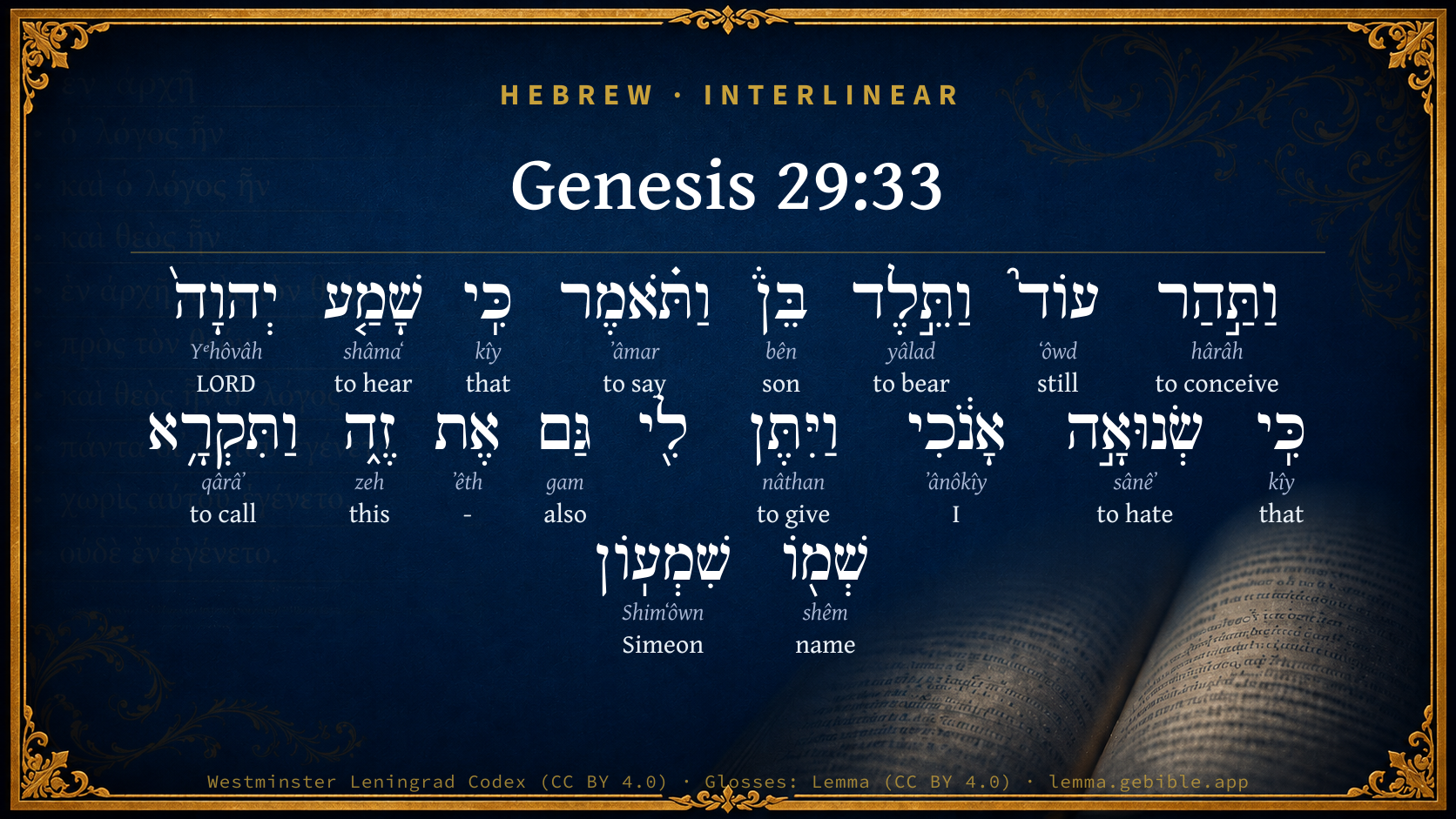
Genesis 29:33

Hebrew (Westminster Leningrad Codex) Genesis 29:33 appears in the Hebrew Old Testament. The text above is from the Westminster Leningrad Codex. Each word links to its Strong’s number, a concise gloss, and parsing drawn from the Open Scriptures Hebrew Bible morphology. Click any word for its full Brown-Driver-Briggs (BDB) entry.
Download image
Cite this verse

Genesis 29:33 (World English Bible). Public Domain. Lemma interlinear Bible study tool, https://lemma.gebible.app/v/genesis/29/33.

Show BibTeX & RIS
BibTeX
RIS
English Translation
She conceived again, and bare a son, and said, "Because Yahweh has heard that I am hated, he has therefore given me this son also." She named him Simeon.
World English Bible · Public Domain
Highlights
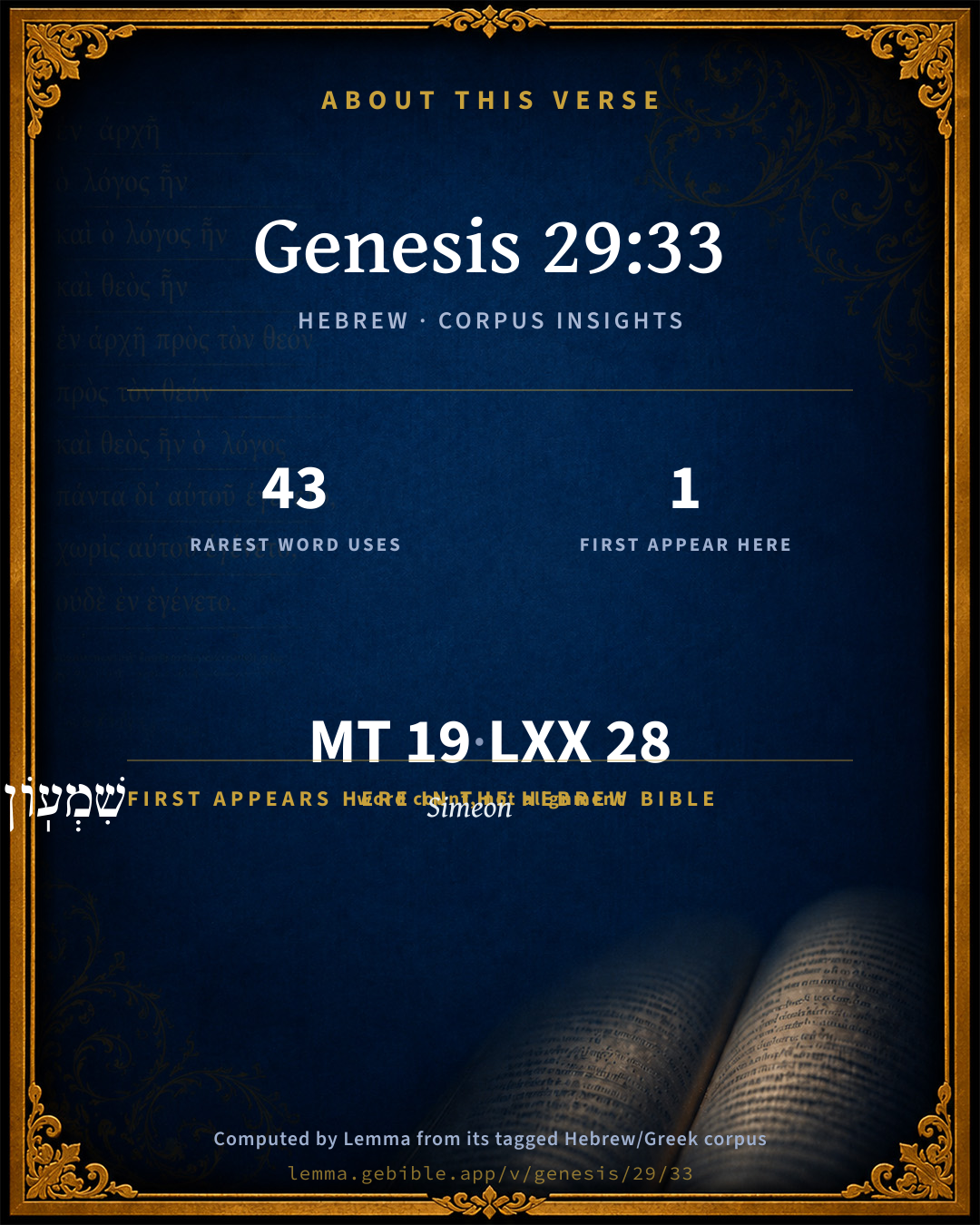
  • 1 first appearance in the Hebrew Bible
Full analysis ↓
Download a study sheet

One document with this verse’s original text, its word-by-word gloss line, the meaning frame, cross-references with their text, attributed commentary, and full source and license credits — printable, and it pastes into notes with its structure intact.

This verse Autodidact and up

Study sheet (.html) Plain text (.txt)

A passage Seminary Student

Up to 50 verses in one chapter. A passage sheet keeps up to 6 commentary sources and 12 cross-references per verse, in the order this page ranks them, and says so on the sheet whenever that leaves anything out. Ask for a single verse and you get the Autodidact verse sheet above.

Everything on this page stays free to read, with no account — the sheet is a download of what is already on screen, not access to it.

Want to remove ads? Support Godless Engineer
Compare translations 3

The same verse in 3 English versions, stacked beneath the original-language interlinear above. Click any original word for its lexicon entry.

Each is an independent rendering of the whole verse — the interlinear is not word-aligned to these translations.

Highlighted words mark where these versions differ — a whole-verse word diff, not a word-by-word alignment.

  • World English Bible Public Domain
    She conceived again, and bare a son, and said, "Because Yahweh has heard that I am hated, he has therefore given me this son also." She named him Simeon.
  • King James Version Public Domain
    And she conceived again, and bare a son; and said, Because the LORD hath heard I was hated, he hath therefore given me this son also: and she called his name Simeon.
  • unfoldingWord Literal Text CC BY-SA 4.0
    Then she conceived again and bore a son, and she said, “Because Yahweh heard that I am hated, then he gave to me this also.” So she called his name Simeon.

unfoldingWord Literal Text — © unfoldingWord, licensed CC BY-SA 4.0. Word-aligned USFM3 via Door43 (git.door43.org/unfoldingWord/en_ult).

Versions to compare (up to 4)

3 of 4 selected

Show all 18 translations

Every available English version of this verse, each an independent rendering of the whole verse.

  • World English Bible Public Domain
    She conceived again, and bare a son, and said, "Because Yahweh has heard that I am hated, he has therefore given me this son also." She named him Simeon.
  • Berean Standard Bible Public Domain
    Again she conceived and gave birth to a son, and she said, “Because the LORD has heard that I am unloved, He has given me this son as well.” So she named him Simeon.
  • Majority Standard Bible Public Domain
    Again she conceived and gave birth to a son, and she said, “Because the LORD has heard that I am unloved, He has given me this son as well.” So she named him Simeon.
  • King James Version Public Domain
    And she conceived again, and bare a son; and said, Because the LORD hath heard I was hated, he hath therefore given me this son also: and she called his name Simeon.
  • American Standard Version (1901) Public Domain
    And she conceived again, and bare a son: and said, Because Jehovah hath heard that I am hated, he hath therefore given me this `son' also. And she called his name Simeon.
  • Revised Version (1885) Public Domain
    And she conceived again, and bare a son; and said, Because the LORD hath heard that I am hated, he hath therefore given me this son also: and she called his name Simeon.
  • Geneva Bible (1599) Public Domain
    And she conceiued againe and bare a sonne, and sayde, Because the Lord heard that I was hated, he hath therefore giuen me this sonne also, and she called his name Simeon.
  • Douay-Rheims (1899) Public Domain
    And again she conceived and bore a son, and said: Because the Lord heard that I was despised, he hath given this also to me: and she called his name Simeon.
  • Young's Literal Translation Public Domain
    And she conceiveth again, and beareth a son, and saith, `Because Jehovah hath heard that I `am' the hated one, He also giveth to me even this `one';' and she calleth his name Simeon.
  • Literal Standard Version CC BY-SA 4.0
    And she conceives again, and bears a son, and says, “Because YHWH has heard that I [am] the hated one, He also gives to me even this [one]”; and she calls his name Simeon.
  • Unlocked Literal Bible CC BY-SA 4.0
    Then she conceived again and bore a son. She said, “Because Yahweh has heard that I am unloved, he has therefore given me this son also,” and she called his name Simeon.
  • unfoldingWord Literal Text CC BY-SA 4.0
    Then she conceived again and bore a son, and she said, “Because Yahweh heard that I am hated, then he gave to me this also.” So she called his name Simeon.
  • Darby Bible Public Domain
    And she again conceived, and bore a son, and said, Because Jehovah has heard that I am hated, he has therefore given me this one also; and she called his name Simeon.
  • World Messianic Bible Public Domain
    She conceived again, and bore a son, and said, “Because the LORD has heard that I am hated, he has therefore given me this son also.” She named him Simeon.
  • Webster's Bible Public Domain
    And she conceived again, and bore a son; and said, Because the LORD hath heard that I was hated, he hath therefore given me this son also: and she called his name Simeon.
  • Free Bible Version CC BY-SA 4.0
    Then Leah became pregnant again, and had another son. She said, “The Lord has heard that I'm not loved so he gave me this son.” So she named him Simeon.
  • Bible in Basic English Public Domain
    Then she became with child again, and gave birth to a son; and said, Because it has come to the Lord's ears that I am not loved, he has given me this son in addition: and she gave him the name Simeon.
  • JPS Tanakh (1917) Public Domain
    And she conceived again, and bore a son; and said: 'Because the LORD hath heard that I am hated, He hath therefore given me this son also.' And she called his name Simeon.

Literal Standard Version (2020), Covenant Press — licensed CC BY-SA 4.0. Text via the HelloAO Bible API (eBible.org). Unlocked Literal Bible (unfoldingWord) — licensed CC BY-SA 4.0. Text via the HelloAO Bible API (eBible.org). unfoldingWord Literal Text — © unfoldingWord, licensed CC BY-SA 4.0. Word-aligned USFM3 via Door43 (git.door43.org/unfoldingWord/en_ult). Free Bible Version, Dr. Jonathan Gallagher — licensed CC BY-SA 4.0. Text via the HelloAO Bible API (eBible.org).

Word by word

More ways to search: Search by grammar → Find every occurrence → Compare this word →

Practice this passage: Drill this verse → Learn its vocabulary →

וַתַּ֣הַר
hârâh
H2029
“and · to conceive”
Conjunction + Verb, Qal, Sequential Imperfect, 3rd Person, Feminine, Singular
Part of Speech
Conjunction + Verb
Stem
Qal
Form
Sequential Imperfect
Person
3rd Person
Gender
Feminine
Number
Singular
Full BDB Definition

Origin: a primitive root

TWOT: 515

to conceive, become pregnant, bear, be with child, be conceived, progenitor - (Qal) to conceive, become pregnant - (Pual) to be conceived - (Poel) to conceive, contrive, devise
  1. עוֹד֮ ʻôwd H5750 “still” Adverb
  2. וַתֵּ֣לֶד yâlad H3205 “and · to bear” Conjunction + Verb, Qal, Sequential Imperfect, 3rd Person, Feminine, Singular
  3. בֵּן֒ bên H1121 “son” Noun, Common, Masculine, Singular, Absolute
  4. וַתֹּ֗אמֶר ʼâmar H559 “and · to say” Conjunction + Verb, Qal, Sequential Imperfect, 3rd Person, Feminine, Singular
  5. כִּֽי kîy H3588 “that” Conjunction
  6. שָׁמַ֤ע shâmaʻ H8085 “to hear” Verb, Qal, Perfect, 3rd Person, Masculine, Singular
  7. יְהוָה֙ Yᵉhôvâh H3068 “LORD” Noun, Proper
  8. כִּֽי kîy H3588 “that” Conjunction
  9. שְׂנוּאָ֣ה sânêʼ H8130 “hated” Verb, Qal, Participle Passive, Feminine, Singular, Absolute
  10. אָנֹ֔כִי ʼânôkîy H595 “I” Pronoun, Personal, 1st Person, Common, Singular
  11. וַיִּתֶּן nâthan H5414 “and · to give” Conjunction + Verb, Qal, Sequential Imperfect, 3rd Person, Masculine, Singular
  12. גַּם gam H1571 “also” Particle, Accusative
  13. אֶת ʼêth H853 “-” Particle, Direct Object
  14. זֶ֑ה zeh H2088 “this” Pronoun, Demonstrative, Masculine, Singular
  15. וַתִּקְרָ֥א qârâʼ H7121 “and · to call” Conjunction + Verb, Qal, Sequential Imperfect, 3rd Person, Feminine, Singular
  16. שְׁמ֖וֹ shêm H8034 “name · his” Noun, Common, Masculine, Singular, Construct + Suffix, Personal, 3rd Person, Masculine, Singular
  17. שִׁמְעֽוֹן Shimʻôwn H8095 “Simeon” Noun, Proper

About this verse

These counts appear in no published source. They are computed here, from the morphology-tagged text and Lemma’s own curated glosses. What Lemma adds →

19
words
17
distinct lemmas
Pentateuch
section

First appearance in Scripture

This word makes its first canonical appearance in the Hebrew Bible here:

  • שִׁמְעֽוֹן Simeon H8095

Shared distinctive vocabulary

וַתַּ֣הַר to conceive H2029 occurs in 42 verses of the Hebrew Bible. Also found in:

Grammatical profile

  • 7 verbs
  • 4 nouns
  • 2 pronouns
  • 1 preposition
  • 2 conjunctions
  • 1 adverb
  • 2 particles

Verb forms

  • וַתַּ֣הַר Qal · Sequential Imperfect
  • וַתֵּ֣לֶד Qal · Sequential Imperfect
  • וַתֹּ֗אמֶר Qal · Sequential Imperfect
  • שָׁמַ֤ע Qal · Perfect
  • שְׂנוּאָ֣ה Qal · Participle Passive
  • וַיִּתֶּן Qal · Sequential Imperfect
  • וַתִּקְרָ֥א Qal · Sequential Imperfect

Repetition

A word recurs within this verse — often emphatic in Hebrew:

  • כִּֽי that H3588 ×2

Hebrew & Septuagint length

In English translation the verse runs 29 words from the Hebrew and 37 from the Septuagint (LXX English) — closely comparable.

A rough comparison of the two English renderings, which tokenize alike — not a word-level alignment.

Word counts can differ between the Hebrew and the Greek without any difference in meaning — e.g. the Hebrew direct-object marker אֵת has no separate Greek word, and Greek often adds the article ὁ.

In the original languages it is 19 Hebrew tokens and 28 Greek tokens — but the two are counted differently (Hebrew bundles its prefixes and suffixes into one token; the Greek is in lemma form), so that isn’t a like-for-like length.

Cross-references

9

Topical passages linked to Genesis 29:33 in the Treasury of Scripture Knowledge — connected by theme and wording, ordered by reader-vote popularity; previews shown in the World English Bible.

  • Genesis 34:25 It happened on the third day, when they were sore, that two of Jacob's sons, Simeon and Levi, Dinah's brothers, each took his sword, came upon the unsuspecting city, and killed all the males.
  • Genesis 30:6 Rachel said, "God has judged me, and has also heard my voice, and has given me a son." Therefore called she his name Dan.
  • Genesis 30:8 Rachel said, "With mighty wrestlings have I wrestled with my sister, and have prevailed." She named him Naphtali.
  • Genesis 30:18 Leah said, "God has given me my hire, because I gave my handmaid to my husband." She named him Issachar.
  • Genesis 30:20 Leah said, "God has endowed me with a good dowry. Now my husband will live with me, because I have borne him six sons." She named him Zebulun.
  • Genesis 34:30 Jacob said to Simeon and Levi, "You have troubled me, to make me odious to the inhabitants of the land, among the Canaanites and the Perizzites. I am few in number. They will gather themselves together against me and strike me, and I will be destroyed, I and my house."
  • Genesis 35:23 The sons of Leah: Reuben (Jacob's firstborn), Simeon, Levi, Judah, Issachar, and Zebulun.
  • Genesis 42:24 He turned himself about from them, and wept, and he returned to them, and spoke to them, and took Simeon from among them, and bound him before their eyes.
  • Genesis 49:5–6 "Simeon and Levi are brothers; Weapons of violence are their swords.

Cross-references courtesy of OpenBible.info (CC BY 4.0).

Hebrew and Greek witnesses Masoretic Hebrew ↔ Greek Septuagint

The same verse in the two great witnesses to the Old Testament, shown verse-for-verse.

These are two independent witnesses, not word-aligned to each other, and the Septuagint is shown in lemma (dictionary) form.

Hebrew Genesis 29:33 Masoretic · Westminster Leningrad Codex

וַתַּ֣הַר עוֹד֮ וַתֵּ֣לֶד בֵּן֒ וַתֹּ֗אמֶר כִּֽי שָׁמַ֤ע יְהוָה֙ כִּֽי שְׂנוּאָ֣ה אָנֹ֔כִי וַיִּתֶּן לִ֖י גַּם אֶת זֶ֑ה וַתִּקְרָ֥א שְׁמ֖וֹ שִׁמְעֽוֹן

She conceived again, and bare a son, and said, "Because Yahweh has heard that I am hated, he has therefore given me this son also." She named him Simeon.

World English Bible · Public Domain

Greek LXX Genesis 29:33 Septuagint · lemma form

καί συνλαμβάνω πάλιν λεια καί τίκτω υἱός δεύτερος ὁ ἰακώβ καί εἶπον ὅτι ἀκούω κύριος ὅτι μισέω καί προςδίδωμι ἐγώ καί οὗτος καλέω δέ ὁ ὄνομα αὐτός συμεων

And she conceived again, and bore a second son to Jacob; and she said, Because the Lord has heard that I am hated, he has given to me this one also; and she called his name, Simeon.

LXX2012 (modern English Septuagint) · Public Domain

Hebrew: Westminster Leningrad Codex (CC BY 4.0). Greek: Septuagint (public domain); English from LXX2012 (modern English Septuagint) (Public Domain). How the Septuagint differs from the Hebrew →

Targum (Aramaic paraphrase)

2

The Targum is the ancient Jewish Aramaic paraphrase of the Hebrew Scriptures — an interpretive translation, not the Hebrew text itself. Onkelos (literal) and Pseudo-Jonathan (expansive) render the Torah, and Jonathan the Prophets. Coverage is partial: where no permissively-licensed English translation exists for a verse, only the Aramaic is shown. This is verse-level text, not a word-by-word alignment to the Hebrew.

  1. Targum Onkelos Torah (Genesis–Deuteronomy)
    וְעַדִּיאַת עוֹד וִילִידַת בָּר וַאֲמֶרֶת אֲרֵי שְׁמִיעַ קֳדָם יְיָ אֲרֵי שְׂנִיאֲתָא אֲנָא וִיהַב לִי אַף יָת דֵּין וּקְרַת שְׁמֵהּ שִׁמְעוֹן

    (no public-domain English translation for this verse)

    Targum Onkelos — Aramaic: “Onkelos Genesis” (public domain); “Onkelos Exodus” (public domain); “Onkelos Leviticus” (public domain); “Onkelos Numbers” (public domain); “Onkelos Deuteronomy” (public domain). English: “Sefaria Community Translation” (CC0 1.0 (public-domain dedication)); “J.W. Etheridge. The Targums of Onkelos and Jonathan Ben Uzziel on the Pentateuch. London: Longmans, Green, 1862” (public domain). Text via Sefaria.

  2. Targum Pseudo-Jonathan Torah (Genesis–Deuteronomy)
    וְאִתְעַבָּרַת תּוּב וִילֵידַת בַּר וְאַמְרַת אֲרוּם שְׁמִיעַ קֳדָם יְיָ אֲרוּם שָנֵיתָא אָנָא וִיהַב לִי אוּף יַת דֵין וְהֵיכְדֵין יִשְׁתְּמַע קֳדָמוֹי קָלְהוֹן דְבָנַי כַּד יְהוֹן מִשְׁתַּעְבְּדִין בְּמִצְרַיִם וּקְרַת שְׁמֵיהּ שִׁמְעוֹן

    And she conceived again, and bare a son. And she said, Because it was heard before the Lord that I was hated, and He gave me this also: and so will be heard before Him the voice of my children when they shall be enslaved in Mizraim. And she called his name Shimeon.

    Targum Pseudo-Jonathan — Aramaic: “Targum Jonathan on Genesis” (public domain); “Targum Jonathan on Exodus” (public domain); “Targum Jonathan on Leviticus” (public domain); “Targum Jonathan on Numbers” (public domain); “Targum Jonathan on Deuteronomy” (public domain). English: “The Targum of Jonathan ben Uzziel, trans. J. W. Etheridge, London, 1862” (public domain). Text via Sefaria.

Commentary

Notes on Genesis 29:33 from classic Christian and Jewish commentators (each source and its license shown beneath its notes). The classic Christian expositions comment on the surrounding passage and are grouped to its opening verse, so a note may address several verses; the Jewish commentaries on the Tanakh (Rashi and others) are per-verse, so they appear only where the commentator wrote on this verse.

Lemma curates 59 commentaries, every one of them public domain or Creative Commons licensed, each selected and text-cleaned for this edition rather than reprinted as found. About our sources →

Trapp's Complete Commentary

John Trapp

Gen 29:33 And she conceived again, and bare a son; and said, Because the LORD hath heard that I [was] hated, he hath therefore given me this [son] also: and she called his name Simeon.

Ver. 33. And she conceived again.] God usually heapeth his favours upon those whom others slight, and look aloof on.

John Trapp, A Commentary or Exposition upon All the Books of the Old and New Testament (1647–1656) — public domain. Text from a community e-Sword module.

Tyndale Open Study Notes

Tyndale Open Resources

29:33 Leah named her second son Simeon. The name suggests that she had cried out to the Lord and was heard (cp. 16:11).

Tyndale Open Study Notes — © Tyndale Open Resources, licensed CC BY-SA 4.0. Text via the HelloAO Bible API.

Adam Clarke's Commentary

Verse 33. She called his name Simeon.] שמעון shimon, hearing; i.e., God had blessed her with another son, because he had heard that she was hated - loved less than Rachel was.

Adam Clarke's Commentary on the Bible (1810–1826) — public domain. Text from a community e-Sword/MySword module.

The Cambridge Bible for Schools and Colleges

gen. ed. J. J. S. Perowne

33. heard] Heb. shama; cf. Gen_16:11.

Simeon] Heb. Shimeon. The meaning of this name is very likely that of an animal, “the hyaena”; cf. the Arabic sim‘, the hybrid offspring of the hyaena and the female wolf.

The Cambridge Bible for Schools and Colleges (gen. ed. J. J. S. Perowne; Cambridge University Press, 1878–1918) — public domain. Text from a community e-Sword module.

John Gill's Exposition

And she conceived again, and bare a son,.... A third time, as soon as she well could after the former birth:

and said, now this time will my husband be joined to me; in greater affection and stronger ties of love, and cleave unto her:

because I have born him three sons; which she considered as a threefold cord, binding his affections to her, which could not be easily broke:

and therefore was his name called Levi; which signifies "joined"; from him the Levites sprung, and had their name.

John Gill's Exposition of the Whole Bible (1746–1763) — public domain (CC PDM 1.0). Text via the HelloAO Bible API.

Haydock's Catholic Bible Commentary

Despised, or the hated wife, Deuteronomy xxi. 15. --- Simeon, "hearing or obedient."

George Leo Haydock (1774–1849), Haydock's Catholic Family Bible and Commentary, 1859 edition — public domain. Excludes Psalms (Douay-Rheims chapter numbering differs from Protestant) and Deuterocanonical books (Catholic canon only).

Matthew Poole's English Annotations

The Lord hath heard, i.e. perceived or understood; hearing being oft put for understanding.

Matthew Poole's English Annotations on the Holy Bible (1683–1685) — public domain. Text from a community e-Sword/MySword module.

Whedon's Commentary on the Bible

Daniel D. Whedon

33. Simeon — Which means a hearing. Jehovah first looked; then he heard. Still she feels bitterly the lack of a husband’s love. Her use of the word hated in this verse illustrates the peculiar meaning of that term. Comp. Gen_29:30.

Daniel D. Whedon (gen. ed.), Commentary on the Old and New Testaments (1874–1909) — public domain. Text from a community e-Sword module.

The Pulpit Commentary

And she conceived again, and bare a son (probably the following year); and said, Because the Lord hath heard that I was hated (the birth of Reuben had obviously not answered Leah"s expectations in increasing Jacob"s love), he hath therefore given me this son also (She faith and piety of Leah are as conspicuous as her affection for Jacob): and she called his name Simeoni.e. Hearing, because God had heard that she was hated (ut supra).

The Pulpit Commentary (1880–1919), ed. H.D.M. Spence-Jones & Joseph S. Exell — public domain. Text from a community e-Sword module.

unfoldingWord translationNotes

Door43 World Missions Community

Then she conceived

"Then Leah became pregnant"

bore a son

"gave birth to a son"

Yahweh has heard that I am unloved

This can be stated in active form. AT: "Yahweh has heard that my husband does not love me" (See: Active or Passive)

she called his name Simeon

Translators may also add a footnote that says "The name Simeon means 'heard.'" (See: How to Translate Names)

will my husband be attached to me

"my husband will embrace me"

I have borne him three sons

"I have given birth to three sons for him"

his name was called Levi

Translators may also add a footnote that says "The name Levi means 'attached.'" (See: How to Translate Names)

translationWords

conceive

Simeon

Levi

unfoldingWord translationNotes — © Distant Shores Media and the Door43 World Missions Community, licensed CC BY-SA 4.0. Source: git.door43.org/Door43/en_tn.

Radak

Rabbi David Kimhi (Radak)

'ותהר עוד כי שמע ה, He heard my prayer and my plea.

Radak on the Tanakh — English translations: “Sefaria Community Translation” (CC0 1.0 (public-domain dedication)); “Eliyahu Munk, HaChut Hameshulash” (CC BY 4.0); “Rabbi Mike Feuer, Jerusalem Anthology” (CC BY 4.0); and “R. David Kimhi on the first book of Psalms, Translated by R.G. Finch, London, 1919” (public domain). Text via Sefaria.

Lesson kit

Teaching starters — assembled from the data on this page, not authored interpretation. Every prompt links to the verse data it draws on. Edit before teaching.

Genesis, in the Pentateuch, opens this verse with 19 words (17 distinct Hebrew lemmas). Its most distinctive word is hârâh (“to conceive”). A historical commentator’s framing appears above. Read the whole chapter for the surrounding context.

Discussion questions

  1. The word hârâh carries the sense “to conceive.” How does it shape the verse?
  2. This is the first place “Simeon” appears in Scripture (first appears here). What does its debut here establish?
  3. How does Genesis 4:1, which shares the word «to conceive», read alongside this verse?
  4. What does the repetition of “that” (2× in this one verse) do in this verse?
  5. These translations render this verse differently. What is at stake in choosing one wording over another?
  6. «וַתַּ֣הַר» is a Qal Sequential Imperfect verb. How does that grammatical form shape the action described?
  7. Compare how Trapp's Complete Commentary and Tyndale Open Study Notes read this verse. Where do they agree or differ?

Things to notice

Reading settings

Reading text

Shown beneath each verse's original-language words.

Old Testament
Old Testament edition

Read the OT as the Masoretic Hebrew (MT) or the Greek Septuagint (LXX).

English shown for the Greek Septuagint (in the Hebrew ↔ Greek comparison).

Comparing translations? Open the Compare panel on any verse page to stack up to four side by side.