
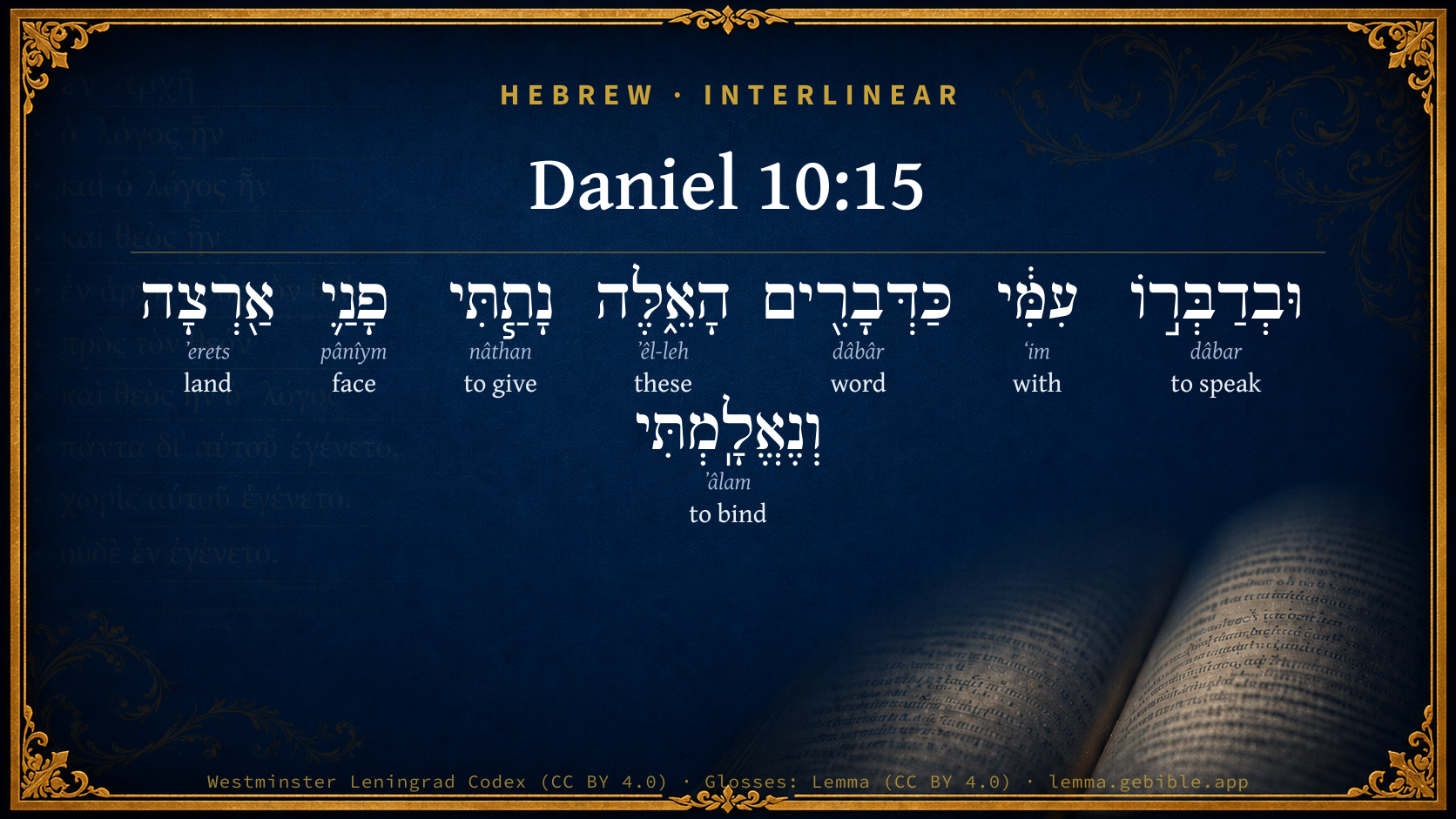
Daniel 10:15

Hebrew (Westminster Leningrad Codex) Daniel 10:15 appears in the Hebrew Old Testament. The text above is from the Westminster Leningrad Codex. Each word links to its Strong’s number, a concise gloss, and parsing drawn from the Open Scriptures Hebrew Bible morphology. Click any word for its full Brown-Driver-Briggs (BDB) entry.
Download image
Cite this verse

Daniel 10:15 (World English Bible). Public Domain. Lemma interlinear Bible study tool, https://lemma.gebible.app/v/daniel/10/15.

Show BibTeX & RIS
BibTeX
RIS
English Translation
and when he had spoken to me according to these words, I set my face toward the ground, and was mute.
World English Bible · Public Domain
Download a study sheet

One document with this verse’s original text, its word-by-word gloss line, the meaning frame, cross-references with their text, attributed commentary, and full source and license credits — printable, and it pastes into notes with its structure intact.

This verse Autodidact and up

Study sheet (.html) Plain text (.txt)

A passage Seminary Student

Up to 50 verses in one chapter. A passage sheet keeps up to 6 commentary sources and 12 cross-references per verse, in the order this page ranks them, and says so on the sheet whenever that leaves anything out. Ask for a single verse and you get the Autodidact verse sheet above.

Everything on this page stays free to read, with no account — the sheet is a download of what is already on screen, not access to it.

Want to remove ads? Support Godless Engineer
Compare translations 3

The same verse in 3 English versions, stacked beneath the original-language interlinear above. Click any original word for its lexicon entry.

Each is an independent rendering of the whole verse — the interlinear is not word-aligned to these translations.

Highlighted words mark where these versions differ — a whole-verse word diff, not a word-by-word alignment.

  • World English Bible Public Domain
    and when he had spoken to me according to these words, I set my face toward the ground, and was mute.
  • King James Version Public Domain
    And when he had spoken such words unto me, I set my face toward the ground, and I became dumb.
  • unfoldingWord Literal Text CC BY-SA 4.0
    While he was speaking to me according to these words, I turned my face toward the ground and was unable to speak.

unfoldingWord Literal Text — © unfoldingWord, licensed CC BY-SA 4.0. Word-aligned USFM3 via Door43 (git.door43.org/unfoldingWord/en_ult).

Versions to compare (up to 4)

3 of 4 selected

Show all 18 translations

Every available English version of this verse, each an independent rendering of the whole verse.

  • World English Bible Public Domain
    and when he had spoken to me according to these words, I set my face toward the ground, and was mute.
  • Berean Standard Bible Public Domain
    While he was speaking these words to me, I set my face toward the ground and became speechless.
  • Majority Standard Bible Public Domain
    While he was speaking these words to me, I set my face toward the ground and became speechless.
  • King James Version Public Domain
    And when he had spoken such words unto me, I set my face toward the ground, and I became dumb.
  • American Standard Version (1901) Public Domain
    and when he had spoken unto me according to these words, I set my face toward the ground, and was dumb.
  • Revised Version (1885) Public Domain
    and when he had spoken unto me according to these words, I set my face toward the ground, and was dumb.
  • Geneva Bible (1599) Public Domain
    And when he spake these wordes vnto me, I set my face towarde the grounde, and helde my tongue.
  • Douay-Rheims (1899) Public Domain
    And when he was speaking such words to me, I cast down my countenance to the ground, and held my peace.
  • Young's Literal Translation Public Domain
    `And when he speaketh with me about these things, I have set my face toward the earth, and have been silent;
  • Literal Standard Version CC BY-SA 4.0
    And when he speaks with me about these things, I have set my face toward the earth, and have been silent;
  • Unlocked Literal Bible CC BY-SA 4.0
    While he was speaking to me using these words, I turned my face toward the ground and was unable to speak.
  • unfoldingWord Literal Text CC BY-SA 4.0
    While he was speaking to me according to these words, I turned my face toward the ground and was unable to speak.
  • Darby Bible Public Domain
    And as he was speaking with me according to these words, I set my face toward the ground, and I became dumb.
  • World Messianic Bible Public Domain
    When he had spoken these words to me, I set my face toward the ground and was mute.
  • Webster's Bible Public Domain
    And when he had spoken such words to me, I set my face towards the ground, and I became dumb.
  • Free Bible Version CC BY-SA 4.0
    As he told me this I remained there with my face to the ground and couldn't say a word.
  • Bible in Basic English Public Domain
    And after he had said these words to me, I kept my face turned to the earth and was unable to say anything.
  • JPS Tanakh (1917) Public Domain
    And when he had spoken unto me according to these words, I set my face toward the ground, and was dumb.

Literal Standard Version (2020), Covenant Press — licensed CC BY-SA 4.0. Text via the HelloAO Bible API (eBible.org). Unlocked Literal Bible (unfoldingWord) — licensed CC BY-SA 4.0. Text via the HelloAO Bible API (eBible.org). unfoldingWord Literal Text — © unfoldingWord, licensed CC BY-SA 4.0. Word-aligned USFM3 via Door43 (git.door43.org/unfoldingWord/en_ult). Free Bible Version, Dr. Jonathan Gallagher — licensed CC BY-SA 4.0. Text via the HelloAO Bible API (eBible.org).

Word by word

More ways to search: Search by grammar → Find every occurrence → Compare this word →

Practice this passage: Drill this verse → Learn its vocabulary →

וְנֶאֱלָֽמְתִּי
ʼâlam
H481
“and · to bind”
Conjunction + Verb, Niphal, Perfect, 1st Person, Common, Singular
Part of Speech
Conjunction + Verb
Stem
Niphal
Form
Perfect
Person
1st Person
Gender
Common
Number
Singular
Full BDB Definition

Origin: a primitive root

TWOT: 102

to bind - (Niphal) - to be dumb - to be bound - (Piel) binding (participle)
  1. וּבְדַבְּר֣וֹ dâbar H1696 “and · in/at · to speak · him” Conjunction + Preposition + Verb, Piel, Infinitive Construct + Suffix, Personal, 3rd Person, Masculine, Singular
  2. עִמִּ֔י ʻim H5973 “with · me” Preposition + Suffix, Personal, 1st Person, Common, Singular
  3. כַּדְּבָרִ֖ים dâbâr H1697 “like/as the · words” Preposition, Determined + Noun, Common, Masculine, Plural, Absolute
  4. הָאֵ֑לֶּה ʼêl-leh H428 “the · these” Particle, Definite Article + Pronoun, Demonstrative, Common, Plural
  5. נָתַ֧תִּי nâthan H5414 “to give” Verb, Qal, Perfect, 1st Person, Common, Singular
  6. פָנַ֛י pânîym H6440 “face(s) · my” Noun, Common, Both, Plural, Construct + Suffix, Personal, 1st Person, Common, Singular
  7. אַ֖רְצָה ʼerets H776 “land · toward” Noun, Common, Both, Singular, Absolute + Suffix, Demonstrative

About this verse

These counts appear in no published source. They are computed here, from the morphology-tagged text and Lemma’s own curated glosses. What Lemma adds →

8
words
8
distinct lemmas
Prophets
section

Notable vocabulary

The rarest word here is וְנֶאֱלָֽמְתִּי to bind H481 — appearing just 9 times in the whole Hebrew Bible.

Shared distinctive vocabulary

וְנֶאֱלָֽמְתִּי to bind H481 occurs in 9 verses of the Hebrew Bible. Also found in:

Grammatical profile

  • 3 verbs
  • 3 nouns
  • 1 pronoun
  • 1 preposition

Verb forms

  • וּבְדַבְּר֣וֹ Piel · Infinitive Construct
  • נָתַ֧תִּי Qal · Perfect
  • וְנֶאֱלָֽמְתִּי Niphal · Perfect

Hebrew & Septuagint length

In English translation the verse runs 21 words from the Hebrew and 24 from the Septuagint (LXX English) — closely comparable.

A rough comparison of the two English renderings, which tokenize alike — not a word-level alignment.

Word counts can differ between the Hebrew and the Greek without any difference in meaning — e.g. the Hebrew direct-object marker אֵת has no separate Greek word, and Greek often adds the article ὁ.

Cross-references

5

Topical passages linked to Daniel 10:15 in the Treasury of Scripture Knowledge — connected by theme and wording, ordered by reader-vote popularity; previews shown in the World English Bible.

  • Ezekiel 24:27 In that day shall your mouth be opened to him who is escaped, and you shall speak, and be no more mute: so shall you be a sign to them; and they shall know that I am Yahweh.
  • Luke 1:20 Behold, you will be silent and not able to speak, until the day that these things will happen, because you didn't believe my words, which will be fulfilled in their proper time."
  • Daniel 8:18 Now as he was speaking with me, I fell into a deep sleep with my face toward the ground; but he touched me, and set me upright.
  • Daniel 10:9 Yet heard I the voice of his words; and when I heard the voice of his words, then was I fallen into a deep sleep on my face, with my face toward the ground.
  • Ezekiel 33:22 Now the hand of Yahweh had been on me in the evening, before he who was escaped came; and he had opened my mouth, until he came to me in the morning; and my mouth was opened, and I was no more mute.

Cross-references courtesy of OpenBible.info (CC BY 4.0).

Hebrew and Greek witnesses Masoretic Hebrew ↔ Greek Septuagint

The same verse in the two great witnesses to the Old Testament, shown verse-for-verse.

These are two independent witnesses, not word-aligned to each other, and the Septuagint is shown in lemma (dictionary) form.

Hebrew Daniel 10:15 Masoretic · Westminster Leningrad Codex

וּבְדַבְּר֣וֹ עִמִּ֔י כַּדְּבָרִ֖ים הָאֵ֑לֶּה נָתַ֧תִּי פָנַ֛י אַ֖רְצָה וְנֶאֱלָֽמְתִּי

and when he had spoken to me according to these words, I set my face toward the ground, and was mute.

World English Bible · Public Domain

Greek LXX Daniel 10:15 Septuagint · lemma form

καί ἐν ὁ αὐτός λαλέω μετά ἐγώ ὁ πρόσταγμα οὗτος δίδωμι ὁ πρόσωπον ἐγώ ἐπί ὁ γῆ καί σιωπάω

And when he had spoken with me according to these words, I turned my face to the ground, and was pricked in the heart.

LXX2012 (modern English Septuagint) · Public Domain

Hebrew: Westminster Leningrad Codex (CC BY 4.0). Greek: Septuagint (public domain); English from LXX2012 (modern English Septuagint) (Public Domain). How the Septuagint differs from the Hebrew →

Commentary

Notes on Daniel 10:15 from classic Christian and Jewish commentators (each source and its license shown beneath its notes). The classic Christian expositions comment on the surrounding passage and are grouped to its opening verse, so a note may address several verses; the Jewish commentaries on the Tanakh (Rashi and others) are per-verse, so they appear only where the commentator wrote on this verse.

Lemma curates 59 commentaries, every one of them public domain or Creative Commons licensed, each selected and text-cleaned for this edition rather than reprinted as found. About our sources →

Trapp's Complete Commentary

John Trapp

Dan 10:15 And when he had spoken such words unto me, I set my face toward the ground, and I became dumb.

Ver. 15. I set my face toward the ground, and I became dumb.] Coharrui totus, et vex faucibus haesit. See how deeply God’s darlings are again affected at the hearing of his holy Word. {Hab 3:16}

John Trapp, A Commentary or Exposition upon All the Books of the Old and New Testament (1647–1656) — public domain. Text from a community e-Sword module.

Joseph Benson's Commentary

Dan 10:15-17. I set my face toward the ground — The fear with which Daniel had been struck at the sight of the angel Michael still continued in some degree, so that he was afraid to look up at this angel, or to speak to him. And behold, one like the similitude of the sons of men — Daniel, gathering courage to look up, perceived that the angel Gabriel had not that angelic form, or brightness, which Michael appeared in, Dan 10:5, but that he was in a human form. Gabriel, then advancing, and touching Daniel’s lips, gave him the power of utterance, as he had before (Dan 10:11) of standing on his feet. Then I opened my mouth, and said unto him that stood before me — This angel stood upon the earth near Daniel, not above the waters of the river, as the person did whose appearance was so glorious, Dan 10:5. By the vision my sorrows are turned upon me — By beholding thee, although in a human form, I am greatly affected, or terrified. For how can the servant of this my lord talk, &c. — How can thy servant, a poor mortal man, maintain a discourse with a person of such rank and dignity? see Noldius, p. 353. The words may be translated thus: How can the servant of this my lord talk with that my lord? that is, with the other person that first appeared to me with so majestic a presence, at whose sight I was perfectly confounded, Dan 10:5-9. Straightway there remained no strength in me — As soon as ever I saw him, all my strength went from me, and I could not support myself. Neither is there — Or rather, was there, breath left in me — I fell breathless in a swoon.

Joseph Benson's Commentary on the Old and New Testaments (1811–1818) — public domain. Text from a community e-Sword module.

Jamieson, Fausset & Brown

Robert Jamieson, A. R. Fausset & David Brown

face toward the ground--in humble reverence (Gen 19:1).

dumb--with overwhelming awe.

Jamieson, Fausset & Brown — Commentary Critical and Explanatory on the Whole Bible (1871) — public domain (CC PDM 1.0). Text via the HelloAO Bible API.

Adam Clarke's Commentary

Verse 15. I set my face toward the ground] He was standing upright, Da 10:11, and he now bent his body in reverence, and looked down upon the ground.

And became dumb.] Found himself unable to speak.

Adam Clarke's Commentary on the Bible (1810–1826) — public domain. Text from a community e-Sword/MySword module.

John Calvin's Commentaries

Daniel again signifies by these words that he was so inspired by reverence for the angel as to be unable to stand. This tends to recommend the prophecy to our notice, — to shew us how the holy Prophet was not only instructed by the angel, but to confirm what he will afterwards record in the 11th chapter, and free it from all doubt. Lastly, he enables us to confide in the angel’s words, which were not uttered in an ordinary way, but were so obviously divine as to cast Daniel headlong upon the earth. In my judgment those expounders of the phrase, he became dumb, are in error when they refer it to his repenting of his prophetic office, through supposing his prayers to have been disregarded. This is much too forced, because the Prophet expresses nothing more than his seizure by fear, causing both his feet and his tongue to refuse their usual duties. Thus he was apparently carried beyond himself. By becoming prostrate on the ground, he manifested his reverence, and by becoming dumb displayed his astonishment. I have already briefly explained the object of all these assertions — to prove to us how the angel was adorned with his own attributes, and what full authority should be assigned to his words. It follows: —

John Calvin's Commentaries (1540-1563) — public domain. Text from the Calvin Translation Society English edition (1840s-50s) via the Christian Classics Ethereal Library (ccel.org). Calvin's coverage is partial (roughly two-thirds of the Bible); uncommented books and verses are honest gaps, never fabricated. The 19th-century editor's footnotes and remarks are omitted so the notes are faithfully Calvin's own voice.

Ellicott's Commentary for English Readers

(15) I set my face.—The conduct of Daniel described in this verse is not to be ascribed to his fear, for that had been already driven away (Dan_10:12), but to his reverence for the majestic person who was before him, and to the gratitude that he felt for the answer to his prayer. (Comp. Dan_9:3-4.)

A Bible Commentary for English Readers, edited by Charles John Ellicott (1878–1897) — public domain. Text from a community e-Sword module.

The Cambridge Bible for Schools and Colleges

gen. ed. J. J. S. Perowne

15. In spite of the command not to fear (Dan_10:12), and the encouraging nature of the words which followed (especially Dan_10:12), Daniel does not recover his composure; and is only gradually reassured in the sequel (Dan_10:16-19).

I set …, and was dumb] As yet, he stood with his eyes fixed on the ground, dreading to look up and speechless.

The Cambridge Bible for Schools and Colleges (gen. ed. J. J. S. Perowne; Cambridge University Press, 1878–1918) — public domain. Text from a community e-Sword module.

John Gill's Exposition

And when he had spoken such words unto me,.... As before related, concerning the contest between him and the prince of Persia; and especially concerning what would befall the people of the Jews in the latter day:

I set my face toward the ground; not being able to look up; his eyes were fixed upon the earth like one confounded and thunderstruck, filled with amazement and wonder:

and I became dumb; not able to speak a word, as is the case of persons sometimes in surprise, or through excess of any of the passions: this arose either from the majesty of the angel; or rather from the nature and importance of the things he said; or from a consciousness of his own impurity, and so of his unworthiness to converse with so exalted a creature, and to be favoured with such secrets. The Arabic version is, "and I supplicated"; very wrongly.

John Gill's Exposition of the Whole Bible (1746–1763) — public domain (CC PDM 1.0). Text via the HelloAO Bible API.

Albert Barnes' Notes on the Bible

And when he had spoken such words ... - Daniel was naturally overcome by the communication which had been made to him. The manner in which the prayer was answered seems to have been entirely different from what he had expected. The presence of a heavenly being; the majesty of his appearance; the assurance that he gave that he had come to answer his prayer; and the fact that he had important revelations to make respecting the future, overcame him, and he laid his face upon the ground in silence. Is there any one of us who would not be awed into profound silence if a heavenly messenger should stand before us to disclose what was to occur to us, to our families, to our friends, to our country, in far-distant years?

Albert Barnes' Notes on the Bible (1834–1885) — public domain. Text from a community e-Sword/MySword module.

Matthew Poole's English Annotations

He was not yet quite free of all his fear, of which we heard, Dan 10:9; haply this pressed him down the more, when he considered the majesty of the angel, the greatness of the vision, and his own frailty; this transported him with astonishment; and above all, that he saw so much of God in it, in his favour to him and his poor church.

Matthew Poole's English Annotations on the Holy Bible (1683–1685) — public domain. Text from a community e-Sword/MySword module.

Whedon's Commentary on the Bible

Daniel D. Whedon

15. Daniel drops his eyes — which had previously been uplifted in hope (Dan_10:11-12) — and becomes speechless with grief because of the delay of this complete deliverance, which (from the study of Jeremiah’s writings) he had been led to believe would immediately follow the end of the Babylonish captivity.

Daniel D. Whedon (gen. ed.), Commentary on the Old and New Testaments (1874–1909) — public domain. Text from a community e-Sword module.

The Pulpit Commentary

And when he had spoken such words unto me, I set my face toward the ground, and I became dumb. The versions agree with the above. I set my face toward the ground does not mean that Daniel again fell prostrate, but that his eyes naturally sought the ground. And I became dumb. Not to be regarded as equivalent to "I remained silent," though there is nothing in the narrative to indicate that Daniel had been speaking; he may have had the sensation of paralyzed vocal cords. Certainly the verb alam means "to be dumb," although, as with ourselves, this phrase dots not mean always physiological dumbness, but simply a silence which, from shyness or fear, one is unable to break. This is the meaning the versions attach to it. The opinion we indicate finds support in the dumbness of Zacharias, the father of John Baptist, after Gabriel appeared to him, and, still more, in what is related in the following verse.

The Pulpit Commentary (1880–1919), ed. H.D.M. Spence-Jones & Joseph S. Exell — public domain. Text from a community e-Sword module.

John Wesley's Explanatory Notes

I set my face - I prostrated myself upon the earth. And I became dumb - Thro' astonishment.

John Wesley, Explanatory Notes Upon the Whole Bible (1754–1765) — public domain. Text via the GEBible commentary corpus.

Keil & Delitzsch

C. F. Keil & F. Delitzsch

In these verses it is further related how Daniel was gradually raised up and made capable of receiving the revelation of God. The communication of the angel hitherto had not fully gained this object. Daniel "stood trembling," but he could not yet speak. With his face bent towards the earth he was as yet speechless. Then one having the likeness of a man touched his lips, whereby he received the power of speech, and could address him who stood before him, and utter the complaint: "By the vision anguish, i.e., violent terror, has fallen upon me: woes are turned upon me." For this style of speech cf. Sa1 4:19, and for the matter itself, cf. Isa 21:3; Isa 13:8. For the following כּח עצרתּי ולא (and I have no strength, Dan 10:16), cf. Dan 10:8.

Keil & Delitzsch — Biblical Commentary on the Old Testament (1861–1891) — public domain (CC PDM 1.0). Text via the HelloAO Bible API. (Old Testament only.)

Lesson kit

Teaching starters — assembled from the data on this page, not authored interpretation. Every prompt links to the verse data it draws on. Edit before teaching.

Daniel, in the Prophets, opens this verse with 8 words (8 distinct Hebrew lemmas). Its most distinctive word is ʼâlam (“to bind”). A historical commentator’s framing appears above. Read the whole chapter for the surrounding context.

Discussion questions

  1. How does “to bind” (ʼâlam) shape what this verse is saying?
  2. Genesis 37:7 shares the word «to bind» with this verse. How do the two illuminate each other?
  3. These translations render this verse differently; the difference is in the English rendering, not the original. What questions does that raise?
  4. The verb «וּבְדַבְּר֣וֹ» is Piel Infinitive Construct. How does its form color the action?
  5. Reading how Trapp's Complete Commentary and Joseph Benson's Commentary read this verse, where do the two commentators agree and where do they part?

Things to notice

Reading settings

Reading text

Shown beneath each verse's original-language words.

Old Testament
Old Testament edition

Read the OT as the Masoretic Hebrew (MT) or the Greek Septuagint (LXX).

English shown for the Greek Septuagint (in the Hebrew ↔ Greek comparison).

Comparing translations? Open the Compare panel on any verse page to stack up to four side by side.