Genesis 30:18

Hebrew (Westminster Leningrad Codex) Genesis 30:18 appears in the Hebrew Old Testament. The text above is from the Westminster Leningrad Codex. Each word links to its Strong’s number, a concise gloss, and parsing drawn from the Open Scriptures Hebrew Bible morphology. Click any word for its full Brown-Driver-Briggs (BDB) entry.
Download image
Cite this verse

Genesis 30:18 (World English Bible). Public Domain. Lemma interlinear Bible study tool, https://lemma.gebible.app/v/genesis/30/18.

Show BibTeX & RIS
BibTeX
RIS
English Translation
Leah said, "God has given me my hire, because I gave my handmaid to my husband." She named him Issachar.
World English Bible · Public Domain
Highlights
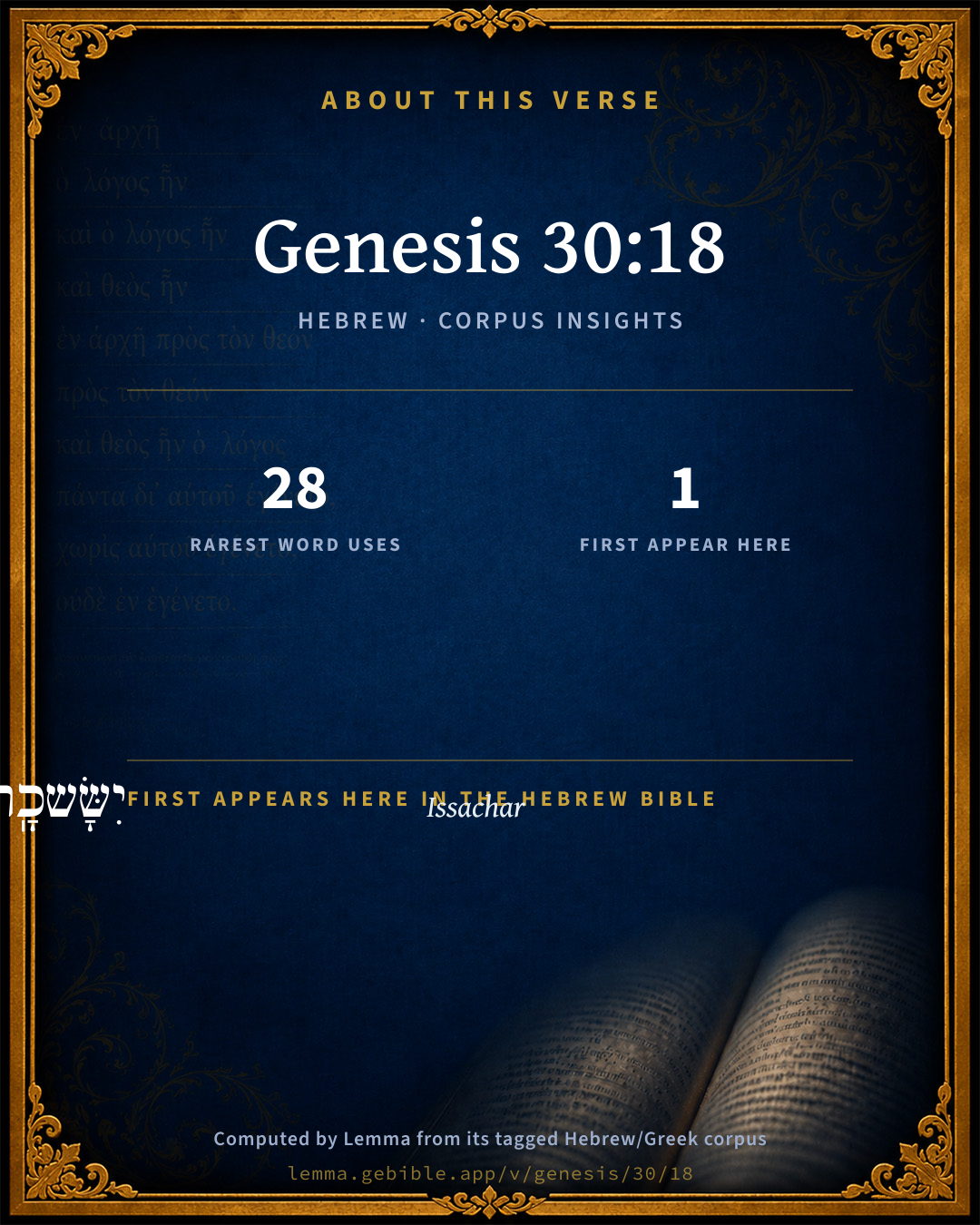
  • 1 first appearance in the Hebrew Bible
Full analysis ↓
Download a study sheet

One document with this verse’s original text, its word-by-word gloss line, the meaning frame, cross-references with their text, attributed commentary, and full source and license credits — printable, and it pastes into notes with its structure intact.

This verse Autodidact and up

Study sheet (.html) Plain text (.txt)

A passage Seminary Student

Up to 50 verses in one chapter. A passage sheet keeps up to 6 commentary sources and 12 cross-references per verse, in the order this page ranks them, and says so on the sheet whenever that leaves anything out. Ask for a single verse and you get the Autodidact verse sheet above.

Everything on this page stays free to read, with no account — the sheet is a download of what is already on screen, not access to it.

Want to remove ads? Support Godless Engineer
Compare translations 3

The same verse in 3 English versions, stacked beneath the original-language interlinear above. Click any original word for its lexicon entry.

Each is an independent rendering of the whole verse — the interlinear is not word-aligned to these translations.

Highlighted words mark where these versions differ — a whole-verse word diff, not a word-by-word alignment.

  • World English Bible Public Domain
    Leah said, "God has given me my hire, because I gave my handmaid to my husband." She named him Issachar.
  • King James Version Public Domain
    And Leah said, God hath given me my hire, because I have given my maiden to my husband: and she called his name Issachar.
  • unfoldingWord Literal Text CC BY-SA 4.0
    Then Leah said, “God has given my reward because I gave my maidservant to my husband.” So she called his name Issachar.

unfoldingWord Literal Text — © unfoldingWord, licensed CC BY-SA 4.0. Word-aligned USFM3 via Door43 (git.door43.org/unfoldingWord/en_ult).

Versions to compare (up to 4)

3 of 4 selected

Show all 18 translations

Every available English version of this verse, each an independent rendering of the whole verse.

  • World English Bible Public Domain
    Leah said, "God has given me my hire, because I gave my handmaid to my husband." She named him Issachar.
  • Berean Standard Bible Public Domain
    Then Leah said, “God has rewarded me for giving my maidservant to my husband.” So she named him Issachar.
  • Majority Standard Bible Public Domain
    Then Leah said, “God has rewarded me for giving my maidservant to my husband.” So she named him Issachar.
  • King James Version Public Domain
    And Leah said, God hath given me my hire, because I have given my maiden to my husband: and she called his name Issachar.
  • American Standard Version (1901) Public Domain
    And Leah said, God hath given me my hire, because I gave my handmaid to my husband: and she called his name Issachar.
  • Revised Version (1885) Public Domain
    And Leah said, God hath given me my hire, because I gave my handmaid to my husband: and she called his name Issachar.
  • Geneva Bible (1599) Public Domain
    Then said Leah, God hath giuen me my reward, because I gaue my mayde to my husband, and she called his name Issachar.
  • Douay-Rheims (1899) Public Domain
    And said: God hath given me a reward, because I gave my handmaid to my husband. And she called his name Issachar.
  • Young's Literal Translation Public Domain
    and Leah saith, `God hath given my hire, because I have given my maid-servant to my husband;' and she calleth his name Issachar.
  • Literal Standard Version CC BY-SA 4.0
    and Leah says, “God has given my hire, because I have given my maidservant to my husband”; and she calls his name Issachar.
  • Unlocked Literal Bible CC BY-SA 4.0
    Leah said, “God has given me my wages, because I gave my servant woman to my husband.” She called his name Issachar.
  • unfoldingWord Literal Text CC BY-SA 4.0
    Then Leah said, “God has given my reward because I gave my maidservant to my husband.” So she called his name Issachar.
  • Darby Bible Public Domain
    And Leah said, God has given me my hire, because I have given my maidservant to my husband; and she called his name Issachar.
  • World Messianic Bible Public Domain
    Leah said, “God has given me my hire, because I gave my servant to my husband.” She named him Issachar.
  • Webster's Bible Public Domain
    And Leah said, God hath given me my hire, because I have given my maiden to my husband: and she called his name Issachar.
  • Free Bible Version CC BY-SA 4.0
    Leah said, “The Lord has rewarded me for giving my personal maid to my husband.” So she named him Issachar.
  • Bible in Basic English Public Domain
    Then Leah said, God has made payment to me for giving my servant-girl to my husband: so she gave her son the name Issachar.
  • JPS Tanakh (1917) Public Domain
    And Leah said: 'God hath given me my hire, because I gave my handmaid to my husband. And she called his name Issachar.

Literal Standard Version (2020), Covenant Press — licensed CC BY-SA 4.0. Text via the HelloAO Bible API (eBible.org). Unlocked Literal Bible (unfoldingWord) — licensed CC BY-SA 4.0. Text via the HelloAO Bible API (eBible.org). unfoldingWord Literal Text — © unfoldingWord, licensed CC BY-SA 4.0. Word-aligned USFM3 via Door43 (git.door43.org/unfoldingWord/en_ult). Free Bible Version, Dr. Jonathan Gallagher — licensed CC BY-SA 4.0. Text via the HelloAO Bible API (eBible.org).

Word by word

More ways to search: Search by grammar → Find every occurrence → Compare this word →

Practice this passage: Drill this verse → Learn its vocabulary →

שְׂכָרִ֔י
sâkâr
H7939
“wages · my”
Noun, Common, Masculine, Singular, Construct + Suffix, Personal, 1st Person, Common, Singular
Part of Speech
Noun
Type
Common
Gender
Masculine
Number
Singular
State
Construct
Full BDB Definition

Origin: from H7936

TWOT: 2264 . 1b

hire, wages - wages - reward, pay - fare, fee, passage-money
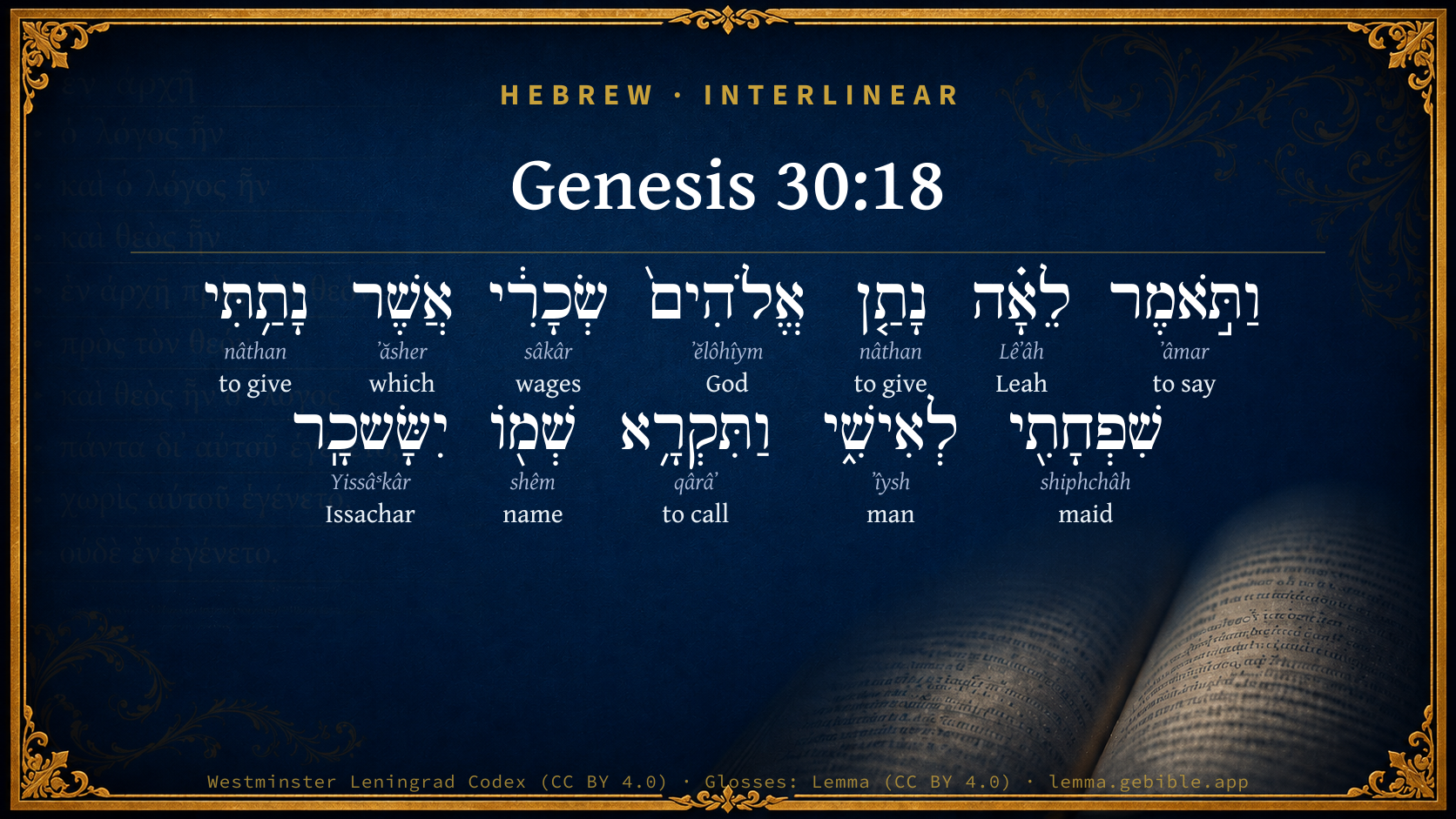
  1. וַתֹּ֣אמֶר ʼâmar H559 “and · to say” Conjunction + Verb, Qal, Sequential Imperfect, 3rd Person, Feminine, Singular
  2. לֵאָ֗ה Lêʼâh H3812 “Leah” Noun, Proper
  3. נָתַ֤ן nâthan H5414 “to give” Verb, Qal, Perfect, 3rd Person, Masculine, Singular
  4. אֱלֹהִים֙ ʼĕlôhîym H430 “God(s)” Noun, Common, Masculine, Plural, Absolute
  5. אֲשֶׁר ʼăsher H834 “which” Particle, Relative
  6. נָתַ֥תִּי nâthan H5414 “to give” Verb, Qal, Perfect, 1st Person, Common, Singular
  7. שִׁפְחָתִ֖י shiphchâh H8198 “maid · my” Noun, Common, Feminine, Singular, Construct + Suffix, Personal, 1st Person, Common, Singular
  8. לְאִישִׁ֑י ʼîysh H376 “to/for · man · my” Preposition + Noun, Common, Masculine, Singular, Construct + Suffix, Personal, 1st Person, Common, Singular
  9. וַתִּקְרָ֥א qârâʼ H7121 “and · to call” Conjunction + Verb, Qal, Sequential Imperfect, 3rd Person, Feminine, Singular
  10. שְׁמ֖וֹ shêm H8034 “name · his” Noun, Common, Masculine, Singular, Construct + Suffix, Personal, 3rd Person, Masculine, Singular
  11. יִשָּׂשכָֽר Yissâˢkâr H3485 “Issachar” Noun, Proper

About this verse

These counts appear in no published source. They are computed here, from the morphology-tagged text and Lemma’s own curated glosses. What Lemma adds →

12
words
11
distinct lemmas
Pentateuch
section

First appearance in Scripture

This word makes its first canonical appearance in the Hebrew Bible here:

  • יִשָּׂשכָֽר Issachar H3485

Shared distinctive vocabulary

שְׂכָרִ֔י wages H7939 occurs in 25 verses of the Hebrew Bible. Also found in:

Grammatical profile

  • 4 verbs
  • 7 nouns
  • 1 particle

Verb forms

  • וַתֹּ֣אמֶר Qal · Sequential Imperfect
  • נָתַ֤ן Qal · Perfect
  • נָתַ֥תִּי Qal · Perfect
  • וַתִּקְרָ֥א Qal · Sequential Imperfect

Repetition

A word recurs within this verse — often emphatic in Hebrew:

  • נָתַ֤ן to give H5414 ×2

Hebrew & Septuagint length

In English translation the verse runs 20 words from the Hebrew and 26 from the Septuagint (LXX English) — closely comparable.

A rough comparison of the two English renderings, which tokenize alike — not a word-level alignment.

Word counts can differ between the Hebrew and the Greek without any difference in meaning — e.g. the Hebrew direct-object marker אֵת has no separate Greek word, and Greek often adds the article ὁ.

Cross-references

5

Topical passages linked to Genesis 30:18 in the Treasury of Scripture Knowledge — connected by theme and wording, ordered by reader-vote popularity; previews shown in the World English Bible.

  • Genesis 35:23 The sons of Leah: Reuben (Jacob's firstborn), Simeon, Levi, Judah, Issachar, and Zebulun.
  • Genesis 46:13 The sons of Issachar: Tola, Puvah, Iob, and Shimron.
  • Genesis 49:14–15 "Issachar is a strong donkey, Lying down between the saddlebags.
  • Deuteronomy 33:18 Of Zebulun he said, Rejoice, Zebulun, in your going out; Issachar, in your tents.
  • 1 Chronicles 12:32 Of the children of Issachar, men who had understanding of the times, to know what Israel ought to do, the heads of them were two hundred; and all their brothers were at their commandment.

Cross-references courtesy of OpenBible.info (CC BY 4.0).

Hebrew and Greek witnesses Masoretic Hebrew ↔ Greek Septuagint

The same verse in the two great witnesses to the Old Testament, shown verse-for-verse.

These are two independent witnesses, not word-aligned to each other, and the Septuagint is shown in lemma (dictionary) form.

Hebrew Genesis 30:18 Masoretic · Westminster Leningrad Codex

וַתֹּ֣אמֶר לֵאָ֗ה נָתַ֤ן אֱלֹהִים֙ שְׂכָרִ֔י אֲשֶׁר נָתַ֥תִּי שִׁפְחָתִ֖י לְאִישִׁ֑י וַתִּקְרָ֥א שְׁמ֖וֹ יִשָּׂשכָֽר

Leah said, "God has given me my hire, because I gave my handmaid to my husband." She named him Issachar.

World English Bible · Public Domain

Greek LXX Genesis 30:18 Septuagint · lemma form

καί εἶπον λεια δίδωμι ὁ θεός ὁ μισθός ἐγώ ἀντί ὅς δίδωμι ὁ παιδίσκη ἐγώ ὁ ἀνήρ ἐγώ καί καλέω ὁ ὄνομα αὐτός ισσαχαρ ὅς εἰμί μισθός

And Lea said, God has given me my reward, because I gave my maid to my husband; and she called his name Issachar, which is, Reward.

LXX2012 (modern English Septuagint) · Public Domain

Hebrew: Westminster Leningrad Codex (CC BY 4.0). Greek: Septuagint (public domain); English from LXX2012 (modern English Septuagint) (Public Domain). How the Septuagint differs from the Hebrew →

Targum (Aramaic paraphrase)

2

The Targum is the ancient Jewish Aramaic paraphrase of the Hebrew Scriptures — an interpretive translation, not the Hebrew text itself. Onkelos (literal) and Pseudo-Jonathan (expansive) render the Torah, and Jonathan the Prophets. Coverage is partial: where no permissively-licensed English translation exists for a verse, only the Aramaic is shown. This is verse-level text, not a word-by-word alignment to the Hebrew.

  1. Targum Onkelos Torah (Genesis–Deuteronomy)
    וַאֲמֶרֶת לֵאָה יְהַב יְיָ אַגְרִי דִּי יְהָבִית אַמְתִי לְבַעְלִי וּקְרַת שְׁמֵהּ יִשָּׂשׂכָר

    (no public-domain English translation for this verse)

    Targum Onkelos — Aramaic: “Onkelos Genesis” (public domain); “Onkelos Exodus” (public domain); “Onkelos Leviticus” (public domain); “Onkelos Numbers” (public domain); “Onkelos Deuteronomy” (public domain). English: “Sefaria Community Translation” (CC0 1.0 (public-domain dedication)); “J.W. Etheridge. The Targums of Onkelos and Jonathan Ben Uzziel on the Pentateuch. London: Longmans, Green, 1862” (public domain). Text via Sefaria.

  2. Targum Pseudo-Jonathan Torah (Genesis–Deuteronomy)
    וַאֲמַרַת לֵאָה יְהַב יְיָ אַגְרִי דִיהָבַת אַמְתִי לְבַעֲלִי וְהֵיכְדֵין עֲתִידִין בְּנוֹי לְקַבָּלָא אֲגַר טַב עַל דְאִינוּן עַסִיקִין בְּאוֹרַיְיתָא וּקְרָא יַת שְׁמֵיהּ יִשָשׁכָר

    And Leah said, The Lord hath given me my reward, for that I gave my handmaid to my husband; even so shall his children receive a good reward, because they will occupy themselves with the law. And she called his name Issakar.

    Targum Pseudo-Jonathan — Aramaic: “Targum Jonathan on Genesis” (public domain); “Targum Jonathan on Exodus” (public domain); “Targum Jonathan on Leviticus” (public domain); “Targum Jonathan on Numbers” (public domain); “Targum Jonathan on Deuteronomy” (public domain). English: “The Targum of Jonathan ben Uzziel, trans. J. W. Etheridge, London, 1862” (public domain). Text via Sefaria.

Commentary

Notes on Genesis 30:18 from classic Christian and Jewish commentators (each source and its license shown beneath its notes). The classic Christian expositions comment on the surrounding passage and are grouped to its opening verse, so a note may address several verses; the Jewish commentaries on the Tanakh (Rashi and others) are per-verse, so they appear only where the commentator wrote on this verse.

Lemma curates 59 commentaries, every one of them public domain or Creative Commons licensed, each selected and text-cleaned for this edition rather than reprinted as found. About our sources →

The Cambridge Bible for Schools and Colleges

gen. ed. J. J. S. Perowne

18. hire] Heb. sâchâr = “wages,” “reward.”

Issachar] The name receives a twofold explanation, in its derivation from sâchâr: (1) as the passive of the verb, in the sense of “he shall be hired or rewarded”; (2) as the combination of îsh, “man,” and sâchâr, “hire,” i.e. “a man of hire.” In Gen_30:16 Leah “hires” Jacob with the mandrakes given to Rachel; in Gen_30:18 she calls Issachar the “hire” or wage, which she receives for giving Zilpah to Jacob.

The Cambridge Bible for Schools and Colleges (gen. ed. J. J. S. Perowne; Cambridge University Press, 1878–1918) — public domain. Text from a community e-Sword module.

Trapp's Complete Commentary

John Trapp

Gen 30:18 And Leah said, God hath given me my hire, because I have given my maiden to my husband: and she called his name Issachar.

Ver. 18. God hath given me my hire.] Wherein she was much mistaken, as having not her "senses exercised to discern good and evil." Here she rejoiceth in that for which she should have repented; and was in the common error of measuring and judging of things by the success; {a} as if God were not many times angry with men, though they outwardly prosper. Thus Dionysius, after the spoils of an idol temple, finding the winds favourable, Lo, said he, how the gods approve of sacrilege!

{a} Foelix scelus virtus vocatur . - Cicero, De Divin., lib. ii.

John Trapp, A Commentary or Exposition upon All the Books of the Old and New Testament (1647–1656) — public domain. Text from a community e-Sword module.

Tyndale Open Study Notes

Tyndale Open Resources

30:18 The name Issachar captures the sense of Jacob’s being hired (30:16) and of the Lord’s rewarding Leah (Hebrew sekari, “my hire”).

Tyndale Open Study Notes — © Tyndale Open Resources, licensed CC BY-SA 4.0. Text via the HelloAO Bible API.

Geneva Bible (1599)

Geneva Bible translators

Instead of acknowledging her fault, she boasteth as if God had rewarded her therefore.

Geneva Bible (1599) marginal notes — public domain. Text via Bolls.life.

Adam Clarke's Commentary

Verse 18. God hath given me my hire] שכרי sechari. And she called his name Issachar, יששכר, This word is compounded of יש yesh, IS, and שכר sachar, WAGES, from שכר sachar, to content, satisfy, saturate; hence a satisfaction or compensation for work done, &c.

Adam Clarke's Commentary on the Bible (1810–1826) — public domain. Text from a community e-Sword/MySword module.

Ellicott's Commentary for English Readers

(18) Issachar.—Heb., there is hire. As is so often the case in Hebrew names, there is a double play in the word: for, first, it alluded to the strange fact that Jacob had been hired of Rachel by the mandrakes; but, secondly, Leah gives it a higher meaning, “for God,” she says, “hath given me my hire.” In her eyes the birth of her fifth son was a Divine reward for the self-sacrifice involved in giving her maid to Jacob, and which had been followed by years of neglect of herself. As, too, it is said that “God hearkened unto Leah,” we may feel sure that she had prayed for God’s blessing upon her re-union with her husband; for Calvin’s objection that prayer would scarcely accompany such odious courses has little weight. Leah and Rachel were uneducated and untrained country women, whose sole anxiety was to have offspring. Leah was the most religious and best disciplined of the two; and the shame ideally was that she should have been forced thus to buy her husband’s attentions.

A Bible Commentary for English Readers, edited by Charles John Ellicott (1878–1897) — public domain. Text from a community e-Sword module.

John Gill's Exposition

And afterwards she bare a daughter,.... Which some writers, as Aben Ezra observes, say, was at the same birth with Zebulun, a twin with him; but being said to be afterwards shows the contrary:

and called her name Dinah; which signifies "judgment": perhaps she may have some reference to the first son of Bilhah, Rachel's handmaid, whom she called Dan, a name of the same signification; intimating as if it was a clear case that judgment went on her side; and that by the number of children she had, it was plain God had determined in her favour.

John Gill's Exposition of the Whole Bible (1746–1763) — public domain (CC PDM 1.0). Text via the HelloAO Bible API.

Haydock's Catholic Bible Commentary

Issachar, "the reward of the man, or husband." (Calmet) --- She might allude also to the reward she had obtained for her mandrakes. (Haydock)

George Leo Haydock (1774–1849), Haydock's Catholic Family Bible and Commentary, 1859 edition — public domain. Excludes Psalms (Douay-Rheims chapter numbering differs from Protestant) and Deuterocanonical books (Catholic canon only).

Matthew Poole's English Annotations

Thus she mistakes the answer of her prayers for a recompence of her error.

Matthew Poole's English Annotations on the Holy Bible (1683–1685) — public domain. Text from a community e-Sword/MySword module.

Whedon's Commentary on the Bible

Daniel D. Whedon

18. God hath given me my hire — Leah, of higher spiritual nature than Rachel, relies on God more than on any love potions, and she has her reward, and she gives her new-born son a name, Issachar, which means, there is a reward.

Daniel D. Whedon (gen. ed.), Commentary on the Old and New Testaments (1874–1909) — public domain. Text from a community e-Sword module.

The Pulpit Commentary

And Leah said, God Elohim; a proof of the lower religious consciousness into which Leah had fallen (Hengstenberg), though perhaps on the above hypothesis an evidence of her piety and faith (Keil, Lange)hath given me my hire, because I have given my maiden to my husband:i.e. as a reward for my self-denial (Keil, Murphy); an exclamation in which appears Leah"s love for Jacob (Lange), if not also a tacit acknowledgment that she had her fears lest she may have sinned in asking him to wed Zilpah (Rosenmand she called his name Issachar is Reward," or "There is Hire;" containing a double allusion to her hire of Jacob and her reward for Zilpah

The Pulpit Commentary (1880–1919), ed. H.D.M. Spence-Jones & Joseph S. Exell — public domain. Text from a community e-Sword module.

Radak

Rabbi David Kimhi (Radak)

ותאמר, seeing that she had stopped bearing children and had given her maidservant to Yaakov in her stead, she thought that she had been rewarded for this by G’d (for two reasons; 1) for helping her husband to father more children so that his indulging in sexual intercourse with a woman who could not provide him with children would not be accounted as mere physical gratification. 2) for having done her maidservant a great favour to become able to mother the children of such a righteous man as Yaakov. For both of these reasons she expressed the hope that G’d would reward her. When she subsequently indeed bore children for Yaakov again herself, she considered this as her reward from G’d and thanked Him for it. She made certain that her son’s name reflected her feeling of gratitude by naming him יששכר.

Radak on the Tanakh — English translations: “Sefaria Community Translation” (CC0 1.0 (public-domain dedication)); “Eliyahu Munk, HaChut Hameshulash” (CC BY 4.0); “Rabbi Mike Feuer, Jerusalem Anthology” (CC BY 4.0); and “R. David Kimhi on the first book of Psalms, Translated by R.G. Finch, London, 1919” (public domain). Text via Sefaria.

Lesson kit

Teaching starters — assembled from the data on this page, not authored interpretation. Every prompt links to the verse data it draws on. Edit before teaching.

Genesis, in the Pentateuch, opens this verse with 12 words (11 distinct Hebrew lemmas). Its most distinctive word is sâkâr (“wages”). A historical commentator’s framing appears above. Read the whole chapter for the surrounding context.

Discussion questions

  1. The word sâkâr carries the sense “wages.” How does it shape the verse?
  2. The word “Issachar” first appears here in Scripture. What is being introduced at this debut?
  3. Genesis 15:1 shares the word «wages» with this verse. How do the two illuminate each other?
  4. “to give” occurs 2× in this one verse. What is the effect of the repetition?
  5. These translations render this verse differently; the difference is in the English rendering, not the original. What questions does that raise?
  6. The verb «וַתֹּ֣אמֶר» is Qal Sequential Imperfect. How does its form color the action?
  7. Reading how The Cambridge Bible for Schools and Colleges and Trapp's Complete Commentary read this verse, where do the two commentators agree and where do they part?

Things to notice

  • 1 word makes its first canonical appearance in Scripture here.
  • These translations choose different wording for 13 words in this verse.
  • “to give” occurs 2× in this single verse.
  • 11 distinct Hebrew lemmas span 12 words in this verse.

Reading settings

Reading text

Shown beneath each verse's original-language words.

Old Testament
Old Testament edition

Read the OT as the Masoretic Hebrew (MT) or the Greek Septuagint (LXX).

English shown for the Greek Septuagint (in the Hebrew ↔ Greek comparison).

Comparing translations? Open the Compare panel on any verse page to stack up to four side by side.