Exodus 22:29

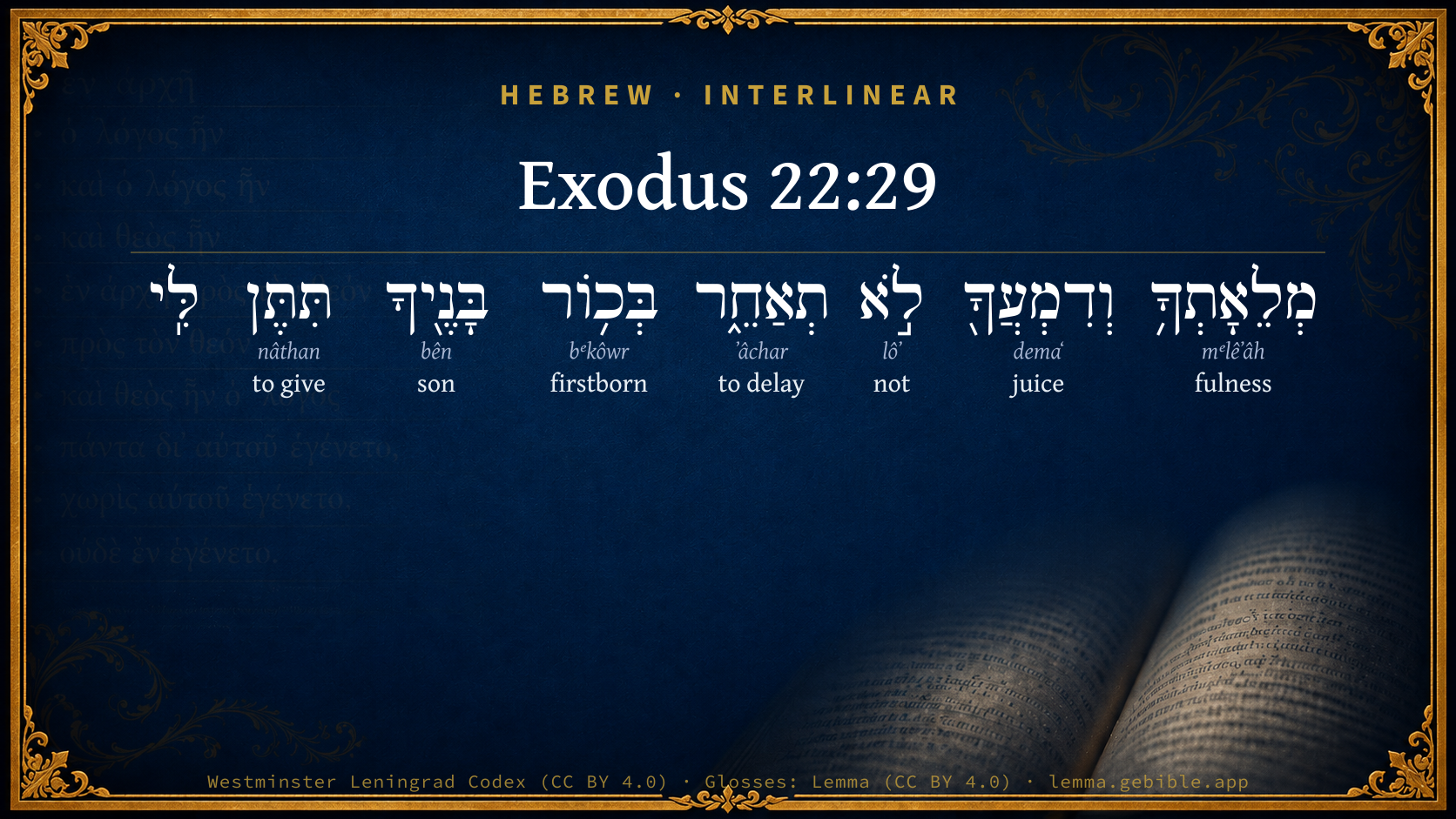
Hebrew (Westminster Leningrad Codex) Exodus 22:29 appears in the Hebrew Old Testament. The text above is from the Westminster Leningrad Codex. Each word links to its Strong’s number, a concise gloss, and parsing drawn from the Open Scriptures Hebrew Bible morphology. Click any word for its full Brown-Driver-Briggs (BDB) entry.
Download image
Cite this verse

Exodus 22:29 (World English Bible). Public Domain. Lemma interlinear Bible study tool, https://lemma.gebible.app/v/exodus/22/29.

Show BibTeX & RIS
BibTeX
RIS
English Translation
"You shall not delay to offer from your harvest and from the outflow of your presses. "You shall give the firstborn of your sons to me.
World English Bible · Public Domain
Highlights
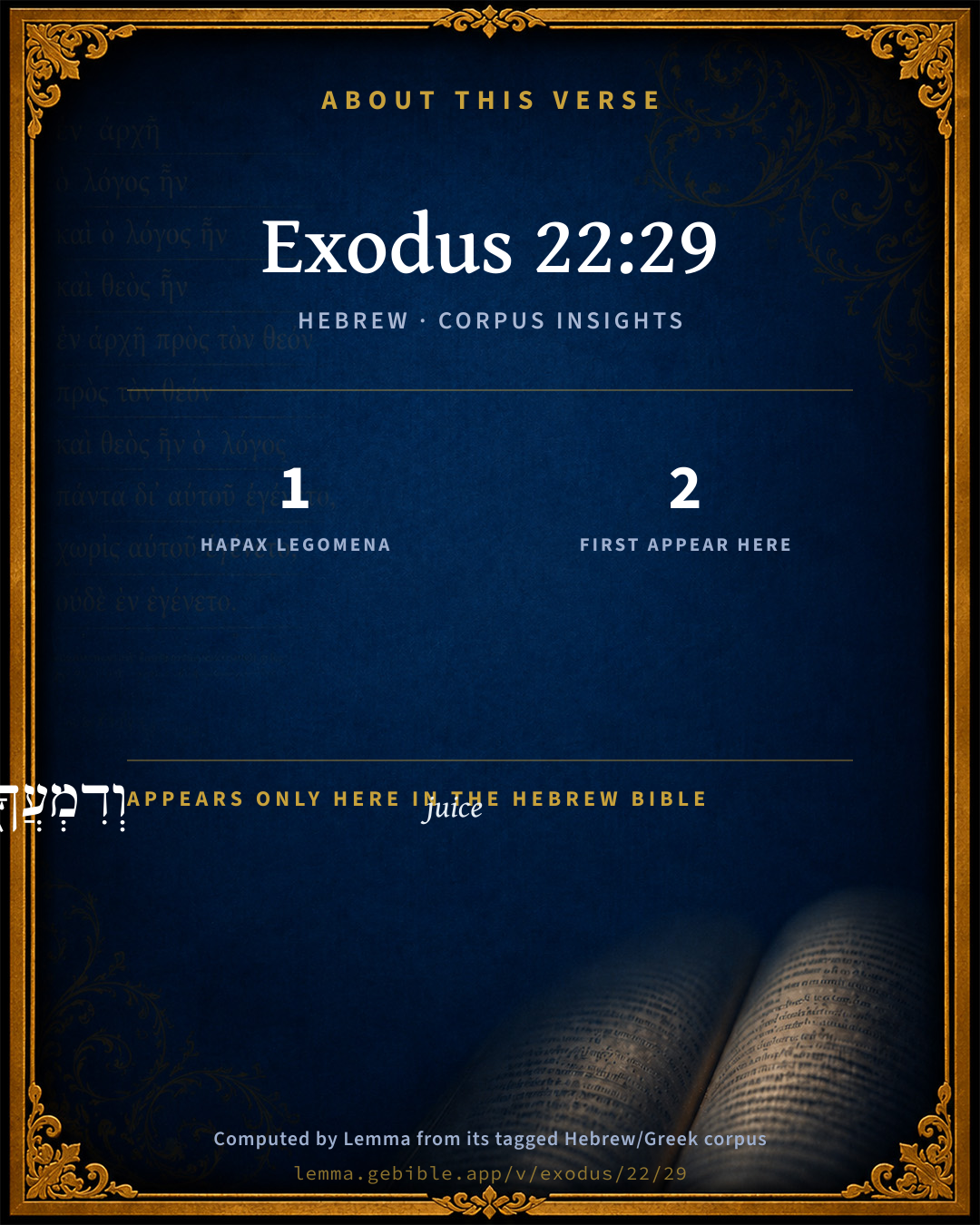
  • 1 hapax legomenon — only here in the Hebrew Bible
  • 2 first appearances in the Hebrew Bible
Full analysis ↓
Download a study sheet

One document with this verse’s original text, its word-by-word gloss line, the meaning frame, cross-references with their text, attributed commentary, and full source and license credits — printable, and it pastes into notes with its structure intact.

This verse Autodidact and up

Study sheet (.html) Plain text (.txt)

A passage Seminary Student

Up to 50 verses in one chapter. A passage sheet keeps up to 6 commentary sources and 12 cross-references per verse, in the order this page ranks them, and says so on the sheet whenever that leaves anything out. Ask for a single verse and you get the Autodidact verse sheet above.

Everything on this page stays free to read, with no account — the sheet is a download of what is already on screen, not access to it.

Want to remove ads? Support Godless Engineer
Compare translations 3

The same verse in 3 English versions, stacked beneath the original-language interlinear above. Click any original word for its lexicon entry.

Each is an independent rendering of the whole verse — the interlinear is not word-aligned to these translations.

Highlighted words mark where these versions differ — a whole-verse word diff, not a word-by-word alignment.

  • World English Bible Public Domain
    "You shall not delay to offer from your harvest and from the outflow of your presses. "You shall give the firstborn of your sons to me.
  • King James Version Public Domain
    Thou shalt not delay to offer the first of thy ripe fruits, and of thy liquors: the firstborn of thy sons shalt thou give unto me.
  • unfoldingWord Literal Text CC BY-SA 4.0
    You shall not hold back from your full harvest or your presses. You shall give the firstborn of your sons to me.

unfoldingWord Literal Text — © unfoldingWord, licensed CC BY-SA 4.0. Word-aligned USFM3 via Door43 (git.door43.org/unfoldingWord/en_ult).

Versions to compare (up to 4)

3 of 4 selected

Show all 18 translations

Every available English version of this verse, each an independent rendering of the whole verse.

  • World English Bible Public Domain
    "You shall not delay to offer from your harvest and from the outflow of your presses. "You shall give the firstborn of your sons to me.
  • Berean Standard Bible Public Domain
    You must not hold back offerings from your granaries or vats. You are to give Me the firstborn of your sons.
  • Majority Standard Bible Public Domain
    You must not hold back offerings from your granaries or vats. You are to give Me the firstborn of your sons.
  • King James Version Public Domain
    Thou shalt not delay to offer the first of thy ripe fruits, and of thy liquors: the firstborn of thy sons shalt thou give unto me.
  • American Standard Version (1901) Public Domain
    Thou shalt not delay to offer of thy harvest, and of the outflow of thy presses. The first-born of thy sons shalt thou give unto me.
  • Revised Version (1885) Public Domain
    Thou shalt not delay to offer of the abundance of thy fruits, and of thy liquors. The firstborn of thy sons shalt thou give unto me.
  • Geneva Bible (1599) Public Domain
    Thine abundance and thy licour shalt thou not keepe backe. The first borne of thy sonnes shalt thou giue me.
  • Douay-Rheims (1899) Public Domain
    Thou shalt not delay to pay thy tithes and thy firstfruits: thou shalt give the firstborn of thy sons to me.
  • Young's Literal Translation Public Domain
    `Thy fulness and thy liquids thou dost not delay; the first-born of thy sons thou dost give to Me;
  • Literal Standard Version CC BY-SA 4.0
    You do not delay your fullness and your liquids; you give the firstborn of your sons to Me;
  • Unlocked Literal Bible CC BY-SA 4.0
    You must not hold back offerings from your harvest or your winepresses. You must give to me the firstborn of your sons.
  • unfoldingWord Literal Text CC BY-SA 4.0
    You shall not hold back from your full harvest or your presses. You shall give the firstborn of your sons to me.
  • Darby Bible Public Domain
    -- Thou shalt not delay the fulness of thy [threshing-floor] and the outflow of thy [winepress]. The firstborn of thy sons shalt thou give unto me.
  • World Messianic Bible Public Domain
    “You shall not delay to offer from your harvest and from the outflow of your presses. “You shall give the firstborn of your sons to me.
  • Webster's Bible Public Domain
    Thou shalt not delay to offer the first of thy ripe fruits, and of thy liquors: the first-born of thy sons shalt thou give to me.
  • Free Bible Version CC BY-SA 4.0
    You must not hold on to the required offerings of your produce, olive oil, and wine. You must give me the firstborn of your sons.
  • Bible in Basic English Public Domain
    Do not keep back your offerings from the wealth of your grain and your vines. The first of your sons you are to give to me.
  • JPS Tanakh (1917) Public Domain
    (22-28) Thou shalt not delay to offer of the fulness of thy harvest, and of the outflow of thy presses. The first-born of thy sons shalt thou give unto Me.

Literal Standard Version (2020), Covenant Press — licensed CC BY-SA 4.0. Text via the HelloAO Bible API (eBible.org). Unlocked Literal Bible (unfoldingWord) — licensed CC BY-SA 4.0. Text via the HelloAO Bible API (eBible.org). unfoldingWord Literal Text — © unfoldingWord, licensed CC BY-SA 4.0. Word-aligned USFM3 via Door43 (git.door43.org/unfoldingWord/en_ult). Free Bible Version, Dr. Jonathan Gallagher — licensed CC BY-SA 4.0. Text via the HelloAO Bible API (eBible.org).

Word by word

More ways to search: Search by grammar → Find every occurrence → Compare this word →

Practice this passage: Drill this verse → Learn its vocabulary →

About this verse

These counts appear in no published source. They are computed here, from the morphology-tagged text and Lemma’s own curated glosses. What Lemma adds →

8
words
7
distinct lemmas
Pentateuch
section

Notable vocabulary

1 hapax legomenon — a word that appears only here in the entire Hebrew Bible:

  • וְדִמְעֲךָ֖ juice H1831

First appearance in Scripture

These words make their first canonical appearance in the Hebrew Bible here:

  • מְלֵאָתְךָ֥ fulness H4395
  • וְדִמְעֲךָ֖ juice H1831

Shared distinctive vocabulary

מְלֵאָתְךָ֥ fulness H4395 occurs in 8 verses of the Hebrew Bible. Also found in:

Grammatical profile

  • 2 verbs
  • 4 nouns
  • 1 preposition
  • 1 particle

Verb forms

  • תְאַחֵ֑ר Piel · Imperfect
  • תִּתֶּן Qal · Imperfect

Hebrew & Septuagint length

In English translation the verse runs 26 words from the Hebrew and 24 from the Septuagint (LXX English) — closely comparable.

A rough comparison of the two English renderings, which tokenize alike — not a word-level alignment.

Word counts can differ between the Hebrew and the Greek without any difference in meaning — e.g. the Hebrew direct-object marker אֵת has no separate Greek word, and Greek often adds the article ὁ.

Cross-references

14

Topical passages linked to Exodus 22:29 in the Treasury of Scripture Knowledge — connected by theme and wording, ordered by reader-vote popularity; previews shown in the World English Bible.

  • Exodus 13:2 "Sanctify to me all of the firstborn, whatever opens the womb among the children of Israel, both of man and of animal. It is mine."
  • Exodus 23:16 And the feast of harvest, the first fruits of your labors, which you sow in the field: and the feast of harvest, at the end of the year, when you gather in your labors out of the field.
  • Exodus 23:19 The first of the first fruits of your ground you shall bring into the house of Yahweh your God. "You shall not boil a kid in its mother's milk.
  • Deuteronomy 26:2–10 that you shall take of the first of all the fruit of the ground, which you shall bring in from your land that Yahweh your God gives you; and you shall put it in a basket, and shall go to the place which Yahweh your God shall choose, to cause his name to dwell there.
  • James 1:18 Of his own will he brought us forth by the word of truth, that we should be a kind of first fruits of his creatures.
  • Proverbs 3:9–10 Honor Yahweh with your substance, With the first fruits of all your increase:
  • Romans 8:23 Not only so, but ourselves also, who have the first fruits of the Spirit, even we ourselves groan within ourselves, waiting for adoption, the redemption of our body.
  • Exodus 13:12 that you shall set apart to Yahweh all that opens the womb, and every firstborn which you have that comes from an animal. The males shall be Yahweh's.
  • Exodus 34:19 All that opens the womb is mine; and all your cattle that is male, the firstborn of cow and sheep.
  • Micah 7:1 Misery is mine! Indeed, I am like one who gathers the summer fruits, as gleanings of the vinyard: There is no cluster of grapes to eat. My soul desires to eat the early fig.
  • Matthew 6:33 But seek first God's Kingdom, and his righteousness; and all these things will be given to you as well.
  • 2 Kings 4:42 There came a man from Baal Shalishah, and brought the man of God bread of the first fruits, twenty loaves of barley, and fresh ears of grain in his sack. He said, Give to the people, that they may eat.
  • 2 Chronicles 31:5 As soon as the commandment came abroad, the children of Israel gave in abundance the first fruits of grain, new wine, and oil, and honey, and of all the increase of the field; and the tithe of all things brought they in abundantly.
  • Ezekiel 20:40 For in my holy mountain, in the mountain of the height of Israel, says the Lord Yahweh, there shall all the house of Israel, all of them, serve me in the land: there will I accept them, and there will I require your offerings, and the first fruits of your offerings, with all your holy things.

Cross-references courtesy of OpenBible.info (CC BY 4.0).

Hebrew and Greek witnesses Masoretic Hebrew ↔ Greek Septuagint

The same verse in the two great witnesses to the Old Testament, shown verse-for-verse.

These are two independent witnesses, not word-aligned to each other, and the Septuagint is shown in lemma (dictionary) form.

Hebrew Exodus 22:29 Masoretic · Westminster Leningrad Codex

מְלֵאָתְךָ֥ וְדִמְעֲךָ֖ לֹ֣א תְאַחֵ֑ר בְּכ֥וֹר בָּנֶ֖יךָ תִּתֶּן לִּֽי

"You shall not delay to offer from your harvest and from the outflow of your presses. "You shall give the firstborn of your sons to me.

World English Bible · Public Domain

Greek LXX Exodus 22:29 Septuagint · lemma form

οὕτως ποιέω ὁ μόσχος σύ καί ὁ πρόβατον σύ καί ὁ ὑποζύγιον σύ ἑπτά ἡμέρα εἰμί ὑπό ὁ μήτηρ ὁ δέ ὄγδοος ἡμέρα ἀποδίδωμι ἐγώ αὐτός

You shall not keep back the first fruits of your threshing floor and press. The firstborn of your sons you shall give to me.

LXX2012 (modern English Septuagint) · Public Domain

On this verse, The Cambridge Bible for Schools and Colleges discusses the Septuagint’s reading. Read the note in Commentary ↓

Hebrew: Westminster Leningrad Codex (CC BY 4.0). Greek: Septuagint (public domain); English from LXX2012 (modern English Septuagint) (Public Domain). How the Septuagint differs from the Hebrew →

Targum (Aramaic paraphrase)

2

The Targum is the ancient Jewish Aramaic paraphrase of the Hebrew Scriptures — an interpretive translation, not the Hebrew text itself. Onkelos (literal) and Pseudo-Jonathan (expansive) render the Torah, and Jonathan the Prophets. Coverage is partial: where no permissively-licensed English translation exists for a verse, only the Aramaic is shown. This is verse-level text, not a word-by-word alignment to the Hebrew.

  1. Targum Onkelos Torah (Genesis–Deuteronomy)
    כֵּן תַּעְבֵּד לְתוֹרָךְ לְעָנָךְ שִׁבְעָא יוֹמִין יְהֵי עִם אִמֵהּ בְּיוֹמָא תְמִינָאָה תִּפְרְשִׁנֵהּ קֳדָמָי:

    (no public-domain English translation for this verse)

    Targum Onkelos — Aramaic: “Onkelos Genesis” (public domain); “Onkelos Exodus” (public domain); “Onkelos Leviticus” (public domain); “Onkelos Numbers” (public domain); “Onkelos Deuteronomy” (public domain). English: “Sefaria Community Translation” (CC0 1.0 (public-domain dedication)); “J.W. Etheridge. The Targums of Onkelos and Jonathan Ben Uzziel on the Pentateuch. London: Longmans, Green, 1862” (public domain). Text via Sefaria.

  2. Targum Pseudo-Jonathan Torah (Genesis–Deuteronomy)
    הֵיכְדֵין תַּעֲבֵד לְבוּכְרֵי תוֹרָךְ וְעָנָךְ שַׁבְעָא יוֹמִין יְהֵי יֵינִיק בָּתַר אִימֵיהּ וּבְיוֹמָא תְּמִינָאָה תַּפְרִישִׁינֵיהּ קֳדָמַי

    So shalt thou do with the firstlings of thy oxen and sheep; seven days it shall be suckled by its mother, and on the eighth day thou shalt separate it before Me.

    Targum Pseudo-Jonathan — Aramaic: “Targum Jonathan on Genesis” (public domain); “Targum Jonathan on Exodus” (public domain); “Targum Jonathan on Leviticus” (public domain); “Targum Jonathan on Numbers” (public domain); “Targum Jonathan on Deuteronomy” (public domain). English: “The Targum of Jonathan ben Uzziel, trans. J. W. Etheridge, London, 1862” (public domain). Text via Sefaria.

Commentary

Notes on Exodus 22:29 from classic Christian and Jewish commentators (each source and its license shown beneath its notes). The classic Christian expositions comment on the surrounding passage and are grouped to its opening verse, so a note may address several verses; the Jewish commentaries on the Tanakh (Rashi and others) are per-verse, so they appear only where the commentator wrote on this verse.

Lemma curates 59 commentaries, every one of them public domain or Creative Commons licensed, each selected and text-cleaned for this edition rather than reprinted as found. About our sources →

Trapp's Complete Commentary

John Trapp

Exo 22:29 Thou shalt not delay [to offer] the first of thy ripe fruits, and of thy liquors: the firstborn of thy sons shalt thou give unto me.

Ver. 29. Theft shalt not delay.] True obedience is prompt and present, ready and speedy, without demurs and consults. "Wings, and wind in their wings." {Zec 5:9}

John Trapp, A Commentary or Exposition upon All the Books of the Old and New Testament (1647–1656) — public domain. Text from a community e-Sword module.

The Biblical Illustrator

Joseph S. Exell

Exo_22:29-30

The firstborn.

First fruits to God

God asks for nothing that we have not to give. He asks that we will give to Him of what He has given to us, that we will put to its true and highest use what He for that end has bestowed. We cannot give fruit that we do not bear, or that is green and unripe, but only that which is fresh and mature, waiting to be gathered in.

I. God asks for the first ripe fruits of our education. The wise mans education is never finished. To cease to learn is to cease to grow; to cease to grow is to decay in force and faculty. Yet there is a special sense in which education ceases. The youth leaves school, the scholar the university, the apprentice is out of his time. Then we have to think and act for ourselves, and use the knowledge we have acquired. We have to face the great questions that concern mans life and destiny. Then God asks from us the first ripe fruits of our education in the use of our intelligence and feeling and conscience. He asks us to face these great questions; to think soberly and ponder the path of our feet.

II. God asks from us the first ripe fruits of our toil. The Jews gave this in kind--from flock, vineyard, or field. We give an equivalent--money. The first money earned is the first-fruits of toil. From that lay by something for God.

III. God asks from us the first ripe fruits of our conversion. I have often seen a child so overcome with an unexpected gift that he has forgotten to say Thank you, but surely Christ does not expect such forgetfulness from those whom He has snatched from the burning.

IV. Then there are some first-fruits of experience which God commands us to offer to Him. I have learned by experience is the confession sometimes of self-convicted folly, sometimes of grateful wonder. How near have we been to spiritual death! How well hidden the pitfalls under our feet! How strong the arms that have held us up! How wonderful the consolations! How sweet the grace of the Divine! So experience enriches the soil in which we are planted to produce a lustier and richer growth. Now to offer to God the first ripe fruits of experience is surely to learn and profit by its lessons. It is to remember; to take warning; to know our own selves--our peculiar weaknesses and danger; it is to trust God more and self less; to look for larger answers to prayer, and more wonderful vindications of faith.

V. Does not God want those lovely and precious fruits which grow on the household vine? The only true dedication of children to God is that Christian nurture which leads to their dedicating themselves. (R. B. Brindley.)

.

The Biblical Illustrator, edited by Joseph S. Exell (c. 1880s–1900s) — public domain. Text from a community e-Sword module.

Joseph Benson's Commentary

Exo 22:29. The firstborn of thy sons shalt thou give unto me — And much more reason have we to give ourselves and all we have to God, who spared not his own Son, but delivered him up for us all. The first ripe of their corn they must not delay to offer; there is danger if we delay our duty, lest we wholly omit it; and by slipping the first opportunity in expectation of another, we suffer Satan to cheat us of all our time.

Joseph Benson's Commentary on the Old and New Testaments (1811–1818) — public domain. Text from a community e-Sword module.

Geneva Bible (1599)

Geneva Bible translators

Thine abundance of thy corn, oil and wine.

Geneva Bible (1599) marginal notes — public domain. Text via Bolls.life.

Adam Clarke's Commentary

Verse 29. The first of thy ripe fruits] This offering was a public acknowledgment of the bounty and goodness of God, who had given them their proper seed time, the first and the latter rain, and the appointed weeks of harvest.

From the practice of the people of God the heathens borrowed a similar one, founded on the same reason. The following passage from Censorinus, De Die Natali, is beautiful, and worthy of the deepest attention: -

Illi enim (majores nostri) qui alimenta, patriam, lucem, se denique ipsos deorum dono habebant, ex omnibus aliquid diis sacrabant, magis adeo, ut se gratos approbarent, quam quod deos arbitrarentur hoc indigere. Itaque cum perceperant fruges, antequam vescerentur, Diis libare instituerunt: et cum agros atque urbes, deorum munera, possiderent, partem quandam templis sacellisque, ubi eos colerent, dicavere.

"Our ancestors, who held their food, their country, the light, and all that they possessed, from the bounty of the gods, consecrated to them a part of all their property, rather as a token of their gratitude, than from a conviction that the gods needed any thing. Therefore as soon as the harvest was got in, before they had tasted of the fruits, they appointed libations to be made to the gods. And as they held their fields and cities as gifts from their gods, they consecrated a certain part for temples and shrines, where they might worship them."

Pliny is express on the same point, who attests that the Romans never tasted either their new corn or wine, till the priests had offered the FIRST-FRUITS to the gods. Ac ne degustabant quidem, novas fruges aut vina, antequam sacerdotes PRIMITIAS LIBASSENT. Hist. Nat., lib. xviii., c. 2.

Horace bears the same testimony, and shows that his countrymen offered, not only their first-fruits, but the choicest of all their fruits, to the Lares or household gods; and he shows also the wickedness of those who sent these as presents to the rich, before the gods had been thus honoured: -

---Dulcia poma,

Et quoscumque feret cultus tibi fundus honores,

Ante Larem gustet venerabilior Lare dives.

Sat., lib. ii., s. v., ver. 12.

"What your garden yields,

The choicest honours of your cultured fields,

To him be sacrificed, and let him taste,

Before your gods, the vegetable feast."

DUNKIN.

And to the same purpose Tibullus, in one of the most beautiful of his elegies: -

Et quodcumque mihi pomum novus educat annus,

Libatum agricolae ponitur ante deo.

Flava Ceres, tibi sit nostro de rure corona

Spicea, quae templi pendeat ante fores.

Eleg., lib. i., eleg. i. ver. 13.

"My grateful fruits, the earliest of the year,

Before the rural god shall daily wait.

From Ceres' gifts I'll cull each browner ear,

And hang a wheaten wreath before her gate."

GRAINGER.

The same subject he touches again in the fifth elegy of the same book, where he specifies the different offerings made for the produce of the fields, of the flocks, and of the vine, ver. 27: -

Illa deo sciet agricolae pro vitibus uvam,

Pro segete spicas, pro grege ferre dapem.

"With pious care will load each rural shrine,

For ripen'd crops a golden sheaf assign,

Cates for my fold, rich clusters for my wine.

Id.-See Calmet.

These quotations will naturally recall to our memory the offerings of Cain and Abel, mentioned Ge 4:3-4.

The rejoicings at our harvest-home are distorted remains of that gratitude which our ancestors, with all the primitive inhabitants of the earth, expressed to God with appropriate signs and ceremonies. Is it not possible to restore, in some goodly form, a custom so pure, so edifying, and so becoming? There is a laudable custom, observed by some pious people, of dedicating a new house to God by prayer, &c., which cannot be too highly commended.

Adam Clarke's Commentary on the Bible (1810–1826) — public domain. Text from a community e-Sword/MySword module.

Ellicott's Commentary for English Readers

(29) The first of thy ripe fruits.—Heb., of thy fulness. “Firstfruits” were the spontaneous tribute of natural piety among almost all nations. They were called by the Greeks ἀπαρχαί, by the Romans primitive. Abel’s offering (Gen_4:4) was one of the “firstlings of his flock,” and Cain’s probably one of firstfruits. In the present passage it is assumed that firstfruits are due, and the stress is laid upon offering them promptly, without “delay.” Delay would show a grudging spirit.

Of thy liquors.—As wine and oil. (Compare Neh_10:37; Neh_10:39.)

The firstborn of thy sons.—See the Note on Exo_13:2; and on the means of redeeming firstborn sons, see Exo_13:13, and Num. 17:15, 16.

A Bible Commentary for English Readers, edited by Charles John Ellicott (1878–1897) — public domain. Text from a community e-Sword module.

The Cambridge Bible for Schools and Colleges

gen. ed. J. J. S. Perowne

29–31. A group of fundamental ceremonial injunctions. Jehovah’s customary due from the first annual produce of the threshing-floor and the wine-press to be promptly paid: firstborn males, both of men and animals, to be given to Him; flesh torn of beasts not to be eaten. The laws are stated here tersely and generally: more detailed, and sometimes discrepant, regulations are given in the later codes.

29a. thy fulness and thy trickling thou shalt not delay] A paraphrase is a necessity for English idiom: but it obliterates the characteristic curtness of the original. The two substantives are paraphrased by LXX., no doubt correctly, by ‘the firstfruits of thy threshing-floor and of thy wine-press.’ Both expressions are, however, peculiar, and no doubt archaic. ‘Fulness’ is used similarly in Num_18:27 (P) ‘like the fulness [in the parallel, v. 30, ‘increase,’ ‘produce’] from the wine-vat, and the corn from the threshing-floor’ (offered viz. by the Israelites as tithe): it seems to mean properly full yield (RVm. abundance)—here of the newly threshed corn, as in Nu. l.c. of the freshly expressed grape-juice. Naturally it does not signify here the whole yield of the year, but only that part of it which was offered to Jehovah as ‘firstfruits’ (cf. Exo_23:16; Exo_23:19). ‘Trickling’ (the masc. of the ordinary Heb. word for ‘tear’), whatever the true explanation of the expression may be1[190], pretty clearly denotes the freshly extracted juice of the grape (tirôsh, ‘must’),—perhaps also (but see footnote) of the olive (yiẓhâr, ‘fresh oil’) as well.

[190] Lane, Arab. Lex. p. 913, cites the expression ‘tear of the vine’ for wine; and A. R. S. Kennedy (EB. iv. 5314, s.v. Wine and Strong Drink) refers to the Spanish lagrima, ‘tear,’ the name for wine made from grape-juice which has exuded from the grapes without pressure. Such wine has always been considered superior to that made from juice extracted by treading the grapes; and as this method of obtaining grape-juice is mentioned in the Mishnah, and is still practised in Syria,—the grapes being laid out for some days on a mishtâḥ, or ‘spreading-place,’ from which the exuding juice trickled down into the wine-vat (see ibid.),—it is possible that the choice juice so obtained is what is here meant. If this explanation is correct, however, ‘oil’ will not have been included in the term; and the inclusion of this in the firstfruits (Deu_18:4, &c.) will not have taken place till later.

The dedication to the deity of a portion of the new produce of the year is a widely prevalent custom. ‘Primitive peoples often partake of the new corn sacramentally, because they suppose it to be instinct with a divine spirit of life. At a later age, when the fruits of the earth are conceived as created rather than as animated by divinity, the new fruits are no longer partaken of sacramentally; but a portion of them is presented as a thank-offering to the divine beings who are supposed to have produced them.… Till the firstfruits have been presented to the deity, people are not at liberty to eat of the new crops’ (Frazer, The Golden Bough,2 ii. 459, with numerous examples, pp. 318–340, 459–471, some excerpted by Dr Gray, Numbers, p. 225 f.). Cf. Lev_23:14 a (H), Deu_26:1-11.

29b, 30. Like the firstfruits of the soil, the firstborn of men and animals are also to be given to Jehovah. This principle has been laid down before, Exo_13:1-2 (P), 11–16 (J): see on Exo_13:1-2, and p. 409.

shalt thou give unto me] how it is to be given is not stated: exactly the same expression is used in v. 30 of animals (which were sacrificed). The principle is formulated in general terms, which must have been interpreted in the light of the usage of the time: how it was understood in practice is stated by J (Exo_13:13 b = Exo_34:20 b).

30. The firstling of a cow or sheep to be given to Jehovah on the eighth day after birth. The ‘eighth day’ agrees with the general principle (Lev_22:27 H), that no animal might be offered in sacrifice till it was of that age. The present law evidently presupposes a plurality of local sanctuaries (cf. on Exo_20:24): a journey to Jerusalem, every time that a firstling of cow or sheep was born, would naturally be out of the question. In Dt. (Deu_15:19 f.) no age-limit is prescribed, but the firstlings are to be taken ‘year by year,’—i.e. no doubt mostly, as cattle in Arabia chiefly yean in spring (p. 411; Rel. Sem.2[191] 465), at Maẓẓoth,—to the central sanctuary, and eaten there at a sacred meal by the owner and his household: the older usage has thus been accommodated to the later principle of a single sanctuary. Nothing is said here about the firstlings of unclean animals: see in J Exo_13:13 a = Exo_34:20 a.

[191] W. R. Smith, The Religion of the Semites, ed. 2, 1894.

31a. Flesh torn by wild beasts not to be eaten.

holy men] ‘Holy’ is a word with a history; and the ideas expressed by it in the OT. do not appear to have been always the same. ‘Its connotation would seem to have been at first physical and ceremonial, and to have become gradually more and more ethical and spiritual’ (Sanday-Headlam on Rom_1:7). Originally, like all such words, it had naturally a physical sense, now completely lost both in Heb. and in the other Semitic languages, but conjectured to have been that of separation. In actual usage it expresses the idea of belonging to deity, whether of the character of deity itself (cf. on Exo_15:11), or of the character of men or things as belonging to Him: as the conception of deity became elevated and purified, the idea expressed by ‘holy’ became elevated and purified likewise, till at last it expressed the idea of most absolute purity and sanctity. Here the context shews that it must be used in one of its lower senses: it is followed by a command, not to shun and abhor every kind of evil, for instance, or to be morally pure or saintly, but by the purely ceremonial command not to eat flesh torn by beasts: the ‘holiness’ is thus not moral, but ritual. In Deu_7:6; Deu_14:2; Deu_26:19, it is used in a higher sense: for it is in each case connected with some prohibition of idolatry or superstition, or an exhortation to obey Jehovah’s moral commands. See farther, on the idea of Holiness, Sanday-Headlam, l.c.; A. B. Davidson, Theol. of OT., pp. 144–160; Skinner, art. Holiness in DB.; Simcox, art. Clean and Unclean in EB.

and flesh in the field, a torn animal, ye shall not eat] The Heb. is not very natural; and perhaps, with LXX. (who express ‘flesh torn of beasts’ alone), Budde, Bä., we should read simply, ‘and the flesh of a torn animal ye shall not eat,’ regarding בשדה ‘in the field’ as a dittograph of בשר ‘flesh.’ For ṭerçphâh, ‘that which is torn (by wild beasts),’ or ‘a torn animal,’ see v. 13, Gen_31:39. With the present law, comp. Lev_17:15 (P), where lustrations are prescribed for those who have eaten either nebhçlâh (‘a carcase,’ ‘that which dieth of itself’) or ṭerçphâh, but neither is in so many words prohibited as food1[192], and Deu_14:21, where the eating of nebhçlâh is prohibited, but nothing is said about ṭerçphâh. The reason of both prohibitions is doubtless to be found in the fact that such flesh had not been properly drained of blood (Deu_12:16; Deu_12:23, &c.).

[192] Both were prohibited absolutely to priests (Lev_22:8; Eze_44:31; cf. Eze_4:14).

The Cambridge Bible for Schools and Colleges (gen. ed. J. J. S. Perowne; Cambridge University Press, 1878–1918) — public domain. Text from a community e-Sword module.

John Gill's Exposition

And ye shall be holy men unto me,.... They were so by God's act of election, not special and particular, but general and national; choosing and separating them to be an holy people to him, above all the people on the face of the earth, and in a ceremonial sense they observing laws and appointments of God of this kind; which is the sense here intended, as appears by what follows: all men, and so these Israelites, ought to be holy in a moral sense, and some are holy in a spiritual and evangelical sense, being made holy by the Spirit of God; of these the Apostle Peter speaks, in allusion to this, and such like passages, Pe1 2:9.

neither shall ye eat any flesh that is torn of beasts in the field; or in the house, as Jarchi notes; but the Scripture, as he observes, speaks of the place where it is more usual for beasts to tear, and so Aben Ezra; otherwise what is torn elsewhere, or by whatsoever accident it is bruised and maimed, was not to be eaten: ye shall cast it to the dogs: for even a stranger was not to eat of it, or if he did he was unclean, and was obliged to wash his clothes, and bathe himself, Lev 17:15 and yet Jarchi interprets this figuratively of such as are like dogs, meaning the Gentiles, whom the Jews used to call so, see Mat 15:26. An Heathen poet gives instructions perfectly agreeable to this law;"do not (says he) eat flesh fed upon by beasts, but leave the remains to the swift dogs (o).''

(o) &c. Phocylides, ver. 136, 137.

Next: Exodus Chapter 23

John Gill's Exposition of the Whole Bible (1746–1763) — public domain (CC PDM 1.0). Text via the HelloAO Bible API.

Albert Barnes' Notes on the Bible

The offering of firstfruits appears to have been a custom of primitive antiquity and was connected with the earliest acts of sacrifice. See Gen 4:3-4. The references to it here and in Exo 23:19 had probably been handed down from patriarchal times. The specific law relating to the firstborn of living creatures was brought out in a strong light in connection with the deliverance from Egypt Exo 13:2, Exo 13:12-13; compare Exo 23:19; Lev 22:27; Deu 26:2-11; Neh 10:35.

The first of thy ripe fruits, and of thy liquors - See the margin. The rendering of our King James Bible is a paraphrase.

Albert Barnes' Notes on the Bible (1834–1885) — public domain. Text from a community e-Sword/MySword module.

Haydock's Catholic Bible Commentary

Tithes. Hebrew, "thy plentitude, (first-fruits and tithes) and thy tears;" (or liquors distilled form odoriferous trees) in a word, all that is most excellent. Censorinus (de die nat.) says, excellently well: "They who acknowledged that they had received food, a country, light, and even their very persons, from the bounty of the gods, failed not to consecrate a part of all to the gods,....to the temples and chapels, where they worshipped them." (Calmet)

George Leo Haydock (1774–1849), Haydock's Catholic Family Bible and Commentary, 1859 edition — public domain. Excludes Psalms (Douay-Rheims chapter numbering differs from Protestant) and Deuterocanonical books (Catholic canon only).

Matthew Poole's English Annotations

Thou shalt not delay beyond the times appointed, lest this delay grow to a total neglect. And delay may here be put for neglect, as that word is used, Deu 7:10; 23:21; Hab 2:3; which may seem to be favoured by the following clause, which commands the giving or offering of the first-born without any mention of the hastening or delaying of it.

Thy ripe fruits, Heb thy fulness; and whereas this word is sometimes applied to seed or corn, as Num 18:27, and sometimes to the vintage, as Deu 22:9, the circumstances must determine, as it doth in like cases, how it must be taken; which here seem to restrain it to dry fruits, as corn, &c., because it is opposed to

liquors; and so all sorts of fruits are comprehended here. Unless you will make this a usual figure called hendyadis, as judgment and justice, Deu 16:18, is put for judgment of justice, or just judgment; so here the fulness and liquors, for the fulness of thy liquors; and so this may be one kind mentioned for all the rest, than which nothing more frequent.

Shalt thou give unto me, not in kind, but by a price of redemption to be paid to me in their stead.

Matthew Poole's English Annotations on the Holy Bible (1683–1685) — public domain. Text from a community e-Sword/MySword module.

Whedon's Commentary on the Bible

Daniel D. Whedon

29. First of thy ripe fruits, and of thy liquors — Literally, thy fulness and thy tear thou shalt not delay. The first full or ripe produce, and the droppings of oil and wine as pressed from the fruit, are intended. The offering to God of firstfruits and firstlings was a custom of most remote antiquity, (comp. Gen_4:3-4,) and a most appropriate exhibition of gratitude and of a sense of dependence.

The firstborn of thy sons — See notes on Exo_13:2.

Daniel D. Whedon (gen. ed.), Commentary on the Old and New Testaments (1874–1909) — public domain. Text from a community e-Sword module.

The Pulpit Commentary

Vers. 29, 30. Law concerning first-fruits. God required as first-fruits from his people,

1. The first-born of their children;

2. The firstborn of all their cattle; and

3. The first of all the produce of their lands, whether wet or dry; wine, oil, grain of all kinds, and fruits. The first-born of their children were to be redeemed by a money payment; (Num_3:46-48) but the rest was to be offered in sacrifice. The phrase, "thou shalt not delay," implies that there would be reluctance to comply with this obligation, and that the offering would be continually put off. In Nehemiah"s time the entire custom had at one period fallen into disuse. (Neh_10:35, Neh_10:36) The first of thy ripe fruits. Literally, "thy fulness." The paraphrase of the A.V. no doubt gives the true meaning. The first-born of thy sons, Compare above, Exo_13:2, Exo_13:12.

Vers. 29-31. Jehovah"s dues.

These, as part of the law"s righteousness, are to be faithfully rendered. Let us not forget, when reflecting on what is due from man to man, to reflect also on what is due from man to God. When inwardly boasting of conscientiousness in rendering to every man his own, let us ask if we have been equally scrupulous in the discharge of our obligations to our Maker. In all spheres of life God claims of our first and best. (see on Exo_13:2, Exo_13:12) God"s highest due is that we be "holy." The precept in ver. 31 is connected with the prohibition to eat flesh with the blood in it. J.O.

The Pulpit Commentary (1880–1919), ed. H.D.M. Spence-Jones & Joseph S. Exell — public domain. Text from a community e-Sword module.

John Wesley's Explanatory Notes

The first-born of thy sons shalt thou give unto me - And much more reason have we to give ourselves and all we have to God, who spared not his own Son, but delivered him up for us all. The first ripe of their corn they must not delay to offer; there is danger if we delay our duty, lest we wholly omit it; and by slipping the first opportunity in expectation of another, we suffer Satan to cheat us of all our time.

John Wesley, Explanatory Notes Upon the Whole Bible (1754–1765) — public domain. Text via the GEBible commentary corpus.

Keil & Delitzsch

C. F. Keil & F. Delitzsch

"Thy fulness and thy flowing thou shalt not delay (to Me)." מלאה fulness, signifies the produce of corn (Deu 22:9); and דּמע (lit., tear, flowing, liquor stillans), which only occurs here, is a poetical epithet for the produce of the press, both wine and oil (cf. δάκρυον τῶν δένδρων, lxx; arborum lacrimae, Plin. 11:6). The meaning is correctly given by the lxx: ἀπαρχὰς ἅλωνος καὶ ληνοῦ σοῦ. That the command not to delay and not to withhold the fulness, etc., relates to the offering of the first-fruits of the field and vineyard, as is more fully defined in Exo 23:19 and Deu 26:2-11, is evident from what follows, in which the law given at the exodus from Egypt, with reference to the sanctification of the first-born of man and beast (Exo 13:2, Exo 13:12), is repeated and incorporated in the rights of Israel, inasmuch as the adoption of the first-born on the part of Jehovah was a perpetual guarantee to the whole nation of the right of covenant fellowship. (On the rule laid down in Exo 22:30, see Lev 22:27.)

Keil & Delitzsch — Biblical Commentary on the Old Testament (1861–1891) — public domain (CC PDM 1.0). Text via the HelloAO Bible API. (Old Testament only.)

unfoldingWord translationNotes

Door43 World Missions Community

You must not hold back offerings

This can be stated in a positive form. AT: "You must bring all of your offerings" (See: Double Negatives)

give to me the firstborn of your sons

"dedicate your firstborn sons to me"

do the same with

"dedicate to me the firstborn of"

For seven days

This can be written as a numeral. AT: "For 7 days after they are born" (See: Numbers)

the eighth day

This can be written as a numeral. AT: "day number 8" (See: Numbers)

give them to me

"dedicate them to me"

translationWords

sacrifice

harvest

winepress

firstborn

set apart

unfoldingWord translationNotes — © Distant Shores Media and the Door43 World Missions Community, licensed CC BY-SA 4.0. Source: git.door43.org/Door43/en_tn.

Rashi

Rabbi Shlomo Yitzchaki (Rashi)

שבעת ימים יהיה עם אמו SEVEN DAYS IT SHALL BE WITH ITS DAM — This is an admonition for the priest (for the Israelite himself does not sacrifice the firstborn animal) that if he wishes to bring his offering of this at an earlier date (i.e. in the case of the Israelite having given it to him before the thirtieth or fiftieth day) he is not allowed to offer it before it is eight days old because it is then “short in time” (i. e. too young for sacrifice; cf. Leviticus 22:27).

ביום השמיני תתנו לי ON THE EIGHTH DAY THOU SHALT GIVE IT ME — One might think that it is obligatory to offer it on that day! Scripture, however, uses here the words “eighth day” and uses them again later on, (Leviticus 22:27) “and from the eighth day and henceforth it shall be favourably accepted”, in order to suggest an analogy. Now what is the meaning of the “eighth day” mentioned in the latter passage? It intends to declare the first-born fit for sacrifice from the eighth day and henceforth (i. e. it is intended to fix the earliest possible time on which it may be sacrificed). This, too, in the purpose of the word שמיני used here: to declare it fit for sacrifice from the eighth day and henceforth. The text therefore implies: “on the eighth day thou mayest give it to Me” (and not “thou shalt give it to Me”) (Mekhilta).

Rashi on the Tanakh — English translations: “The Judaica Press complete Tanach with Rashi, translated by A. J. Rosenberg” (CC BY 4.0); “Pentateuch with Rashi's commentary by M. Rosenbaum and A.M. Silbermann, 1929-1934” (public domain); “The Metsudah Tanach series, Lakewood, N.J” (CC BY 4.0); and “The Book of Joshua, Metsudah Publications, 1997” (CC BY 4.0). Text via Sefaria.

Lesson kit

Teaching starters — assembled from the data on this page, not authored interpretation. Every prompt links to the verse data it draws on. Edit before teaching.

Exodus, in the Pentateuch, opens this verse with 8 words (7 distinct Hebrew lemmas). Its most distinctive word is demaʻ (“juice”). A historical commentator’s framing appears above. Read the whole chapter for the surrounding context.

Discussion questions

  1. What does “juice” (demaʻ) contribute to the verse as a whole?
  2. 1 word here appears nowhere else in the Hebrew Bible. Why might the author reach for such rare wording?
  3. 2 words make their first appearance in Scripture here. What does this debut establish?
  4. How does Numbers 18:27, which shares the word «fulness», read alongside this verse?
  5. These translations render this verse differently. What is at stake in choosing one wording over another?
  6. «תְאַחֵ֑ר» is a Piel Imperfect verb. How does that grammatical form shape the action described?
  7. Compare how Trapp's Complete Commentary and The Biblical Illustrator read this verse. Where do they agree or differ?

Things to notice

  • 1 word in this verse appears nowhere else in the Hebrew Bible.
  • 2 words make their first canonical appearance in Scripture here.
  • These translations choose different wording for 14 words in this verse.
  • 7 distinct Hebrew lemmas span 8 words in this verse.

Reading settings

Reading text

Shown beneath each verse's original-language words.

Old Testament
Old Testament edition

Read the OT as the Masoretic Hebrew (MT) or the Greek Septuagint (LXX).

English shown for the Greek Septuagint (in the Hebrew ↔ Greek comparison).

Comparing translations? Open the Compare panel on any verse page to stack up to four side by side.