
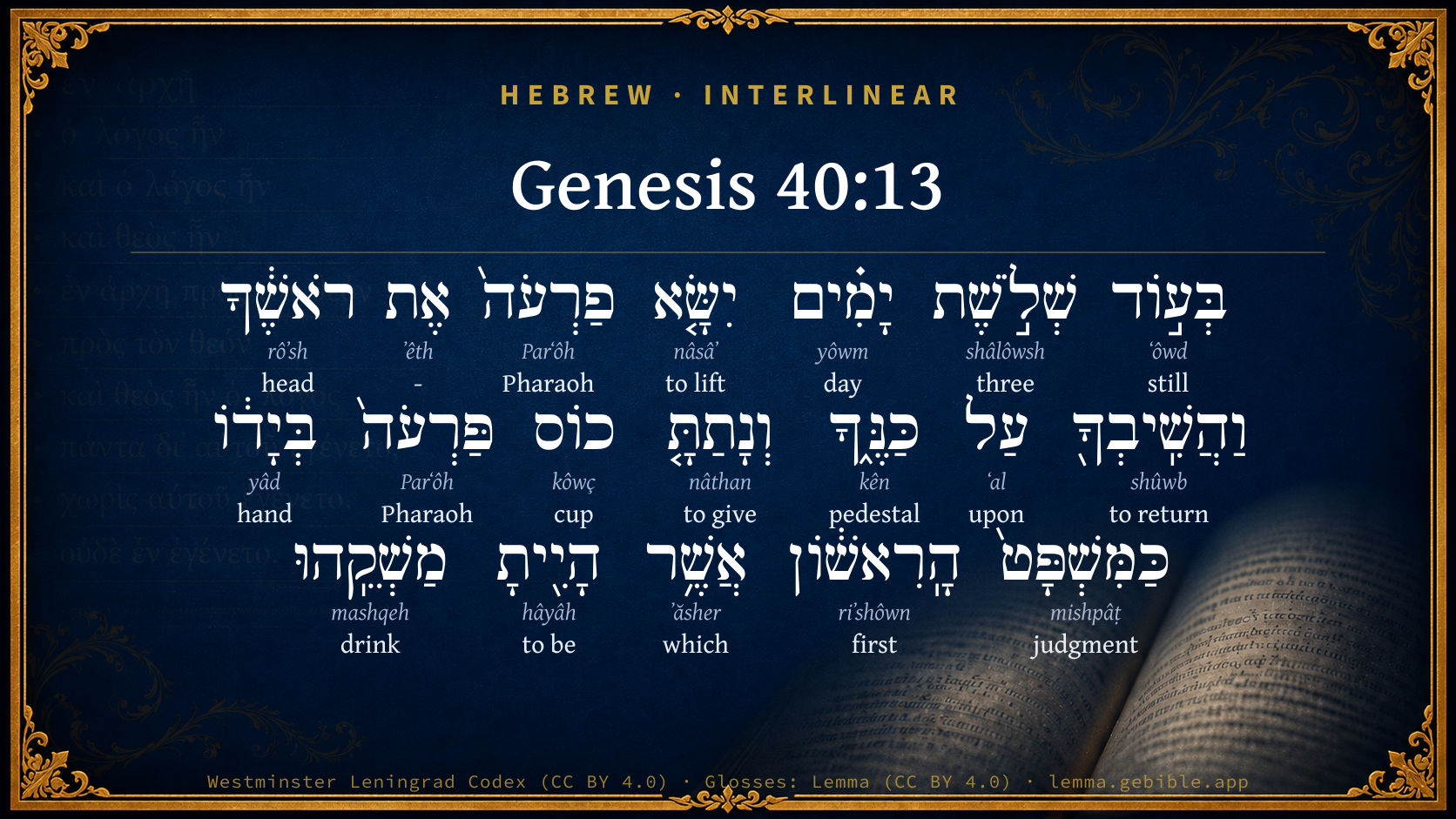
Genesis 40:13

Hebrew (Westminster Leningrad Codex) Genesis 40:13 appears in the Hebrew Old Testament. The text above is from the Westminster Leningrad Codex. Each word links to its Strong’s number, a concise gloss, and parsing drawn from the Open Scriptures Hebrew Bible morphology. Click any word for its full Brown-Driver-Briggs (BDB) entry.
Download image
Cite this verse

Genesis 40:13 (World English Bible). Public Domain. Lemma interlinear Bible study tool, https://lemma.gebible.app/v/genesis/40/13.

Show BibTeX & RIS
BibTeX
RIS
English Translation
Within three more days, Pharaoh will lift up your head, and restore you to your office. You will give Pharaoh's cup into his hand, the way you did when you were his cupbearer.
World English Bible · Public Domain
Highlights
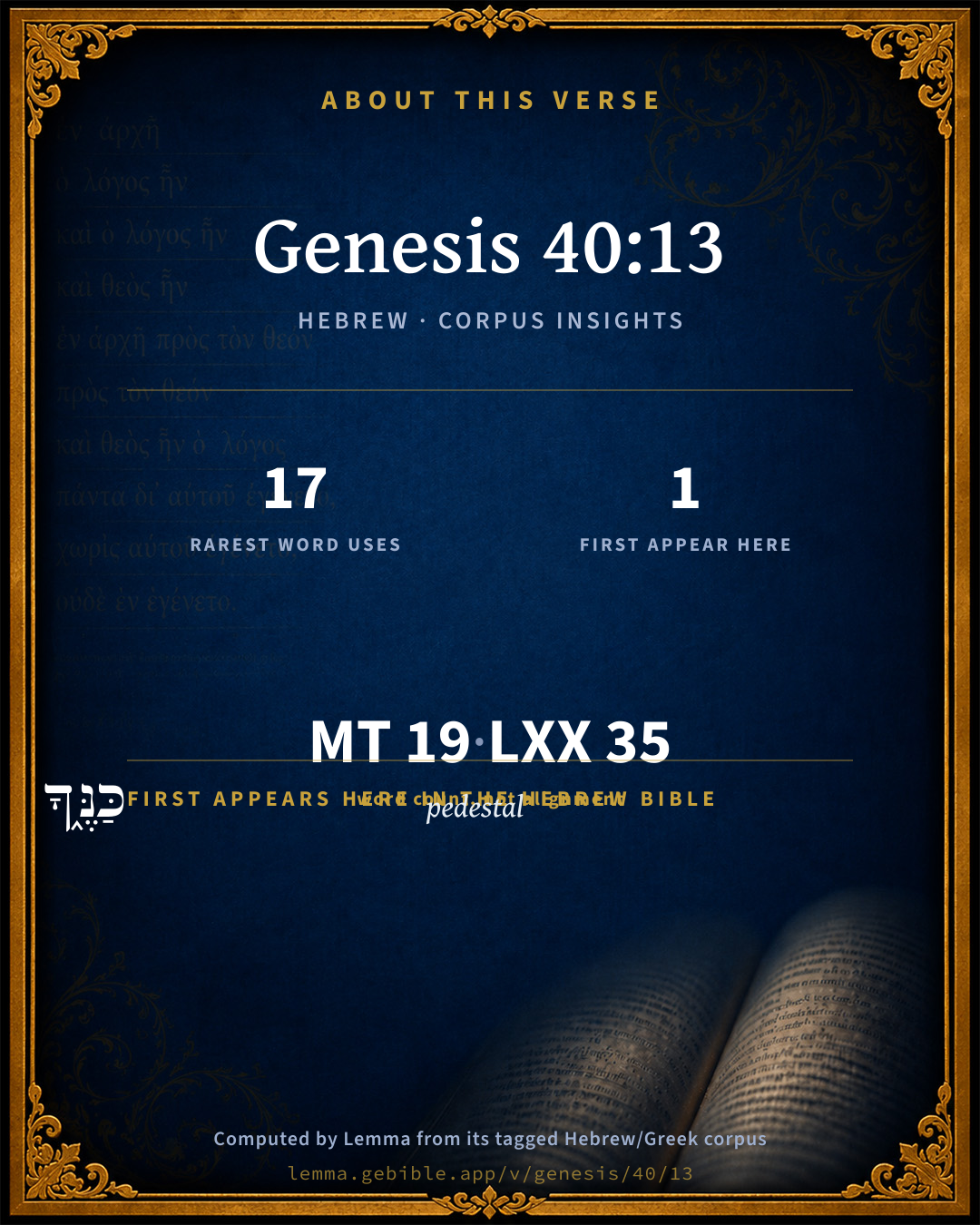
  • 1 first appearance in the Hebrew Bible
Full analysis ↓
Download a study sheet

One document with this verse’s original text, its word-by-word gloss line, the meaning frame, cross-references with their text, attributed commentary, and full source and license credits — printable, and it pastes into notes with its structure intact.

This verse Autodidact and up

Study sheet (.html) Plain text (.txt)

A passage Seminary Student

Up to 50 verses in one chapter. A passage sheet keeps up to 6 commentary sources and 12 cross-references per verse, in the order this page ranks them, and says so on the sheet whenever that leaves anything out. Ask for a single verse and you get the Autodidact verse sheet above.

Everything on this page stays free to read, with no account — the sheet is a download of what is already on screen, not access to it.

Want to remove ads? Support Godless Engineer
Compare translations 3

The same verse in 3 English versions, stacked beneath the original-language interlinear above. Click any original word for its lexicon entry.

Each is an independent rendering of the whole verse — the interlinear is not word-aligned to these translations.

Highlighted words mark where these versions differ — a whole-verse word diff, not a word-by-word alignment.

  • World English Bible Public Domain
    Within three more days, Pharaoh will lift up your head, and restore you to your office. You will give Pharaoh's cup into his hand, the way you did when you were his cupbearer.
  • King James Version Public Domain
    Yet within three days shall Pharaoh lift up thine head, and restore thee unto thy place: and thou shalt deliver Pharaoh's cup into his hand, after the former manner when thou wast his butler.
  • unfoldingWord Literal Text CC BY-SA 4.0
    Within three days Pharaoh will lift up your head and restore you to your position, and you will put Pharaoh’s cup into his hand, according to the former custom when you were his cupbearer.

unfoldingWord Literal Text — © unfoldingWord, licensed CC BY-SA 4.0. Word-aligned USFM3 via Door43 (git.door43.org/unfoldingWord/en_ult).

Versions to compare (up to 4)

3 of 4 selected

Show all 18 translations

Every available English version of this verse, each an independent rendering of the whole verse.

  • World English Bible Public Domain
    Within three more days, Pharaoh will lift up your head, and restore you to your office. You will give Pharaoh's cup into his hand, the way you did when you were his cupbearer.
  • Berean Standard Bible Public Domain
    Within three days Pharaoh will lift up your head and restore your position. You will put Pharaoh’s cup in his hand, just as you did when you were his cupbearer.
  • Majority Standard Bible Public Domain
    Within three days Pharaoh will lift up your head and restore your position. You will put Pharaoh’s cup in his hand, just as you did when you were his cupbearer.
  • King James Version Public Domain
    Yet within three days shall Pharaoh lift up thine head, and restore thee unto thy place: and thou shalt deliver Pharaoh's cup into his hand, after the former manner when thou wast his butler.
  • American Standard Version (1901) Public Domain
    within yet three days shall Pharaoh lift up thy head, and restore thee unto thine office: and thou shalt give Pharaoh's cup into his hand, after the former manner when thou wast his butler.
  • Revised Version (1885) Public Domain
    within yet three days shall Pharaoh lift up thine head, and restore thee unto thine office: and thou shalt give Pharaoh’s cup into his hand, after the former manner when thou wast his butler.
  • Geneva Bible (1599) Public Domain
    Within three dayes shall Pharaoh lift vp thine head, and restore thee vnto thine office, and thou shalt giue Pharaohs cup into his hand after the olde maner, when thou wast his butler.
  • Douay-Rheims (1899) Public Domain
    After which Pharao will remember thy service, and will restore thee to thy former place: and thou shah present him the cup according to thy office, as before thou wast wont to do.
  • Young's Literal Translation Public Domain
    yet, within three days doth Pharaoh lift up thy head, and hath put thee back on thy station, and thou hast given the cup of Pharaoh into his hand, according to the former custom when thou wast his butler.
  • Literal Standard Version CC BY-SA 4.0
    yet, within three days Pharaoh lifts up your head, and has put you back on your station, and you have given the cup of Pharaoh into his hand, according to the former custom when you were his butler.
  • Unlocked Literal Bible CC BY-SA 4.0
    Within three days Pharaoh will lift up your head and restore you to your office. You will put Pharaoh's cup into his hand, just as when you were his cupbearer.
  • unfoldingWord Literal Text CC BY-SA 4.0
    Within three days Pharaoh will lift up your head and restore you to your position, and you will put Pharaoh’s cup into his hand, according to the former custom when you were his cupbearer.
  • Darby Bible Public Domain
    In yet three days will Pharaoh lift up thy head and restore thee to thy place, and thou shalt deliver Pharaoh's cup into his hand, after the former manner when thou wast his cup-bearer.
  • World Messianic Bible Public Domain
    Within three more days, Pharaoh will lift up your head, and restore you to your office. You will give Pharaoh’s cup into his hand, the way you did when you were his cup bearer.
  • Webster's Bible Public Domain
    Yet within three days shall Pharaoh lift up thy head, and restore thee to thy place: and thou shalt deliver Pharaoh's cup into his hand, after the former manner when thou wast his butler.
  • Free Bible Version CC BY-SA 4.0
    In three days' time Pharaoh will take you out of prison and give you back your job, and you will hand Pharaoh his cup as you used to.
  • Bible in Basic English Public Domain
    After three days Pharaoh will give you honour, and put you back into your place, and you will give him his cup as you did before, when you were his wine-servant.
  • JPS Tanakh (1917) Public Domain
    within yet three days shall Pharaoh lift up thy head, and restore thee unto thine office; and thou shalt give Pharaoh's cup into his hand, after the former manner when thou wast his butler.

Literal Standard Version (2020), Covenant Press — licensed CC BY-SA 4.0. Text via the HelloAO Bible API (eBible.org). Unlocked Literal Bible (unfoldingWord) — licensed CC BY-SA 4.0. Text via the HelloAO Bible API (eBible.org). unfoldingWord Literal Text — © unfoldingWord, licensed CC BY-SA 4.0. Word-aligned USFM3 via Door43 (git.door43.org/unfoldingWord/en_ult). Free Bible Version, Dr. Jonathan Gallagher — licensed CC BY-SA 4.0. Text via the HelloAO Bible API (eBible.org).

Word by word

More ways to search: Search by grammar → Find every occurrence → Compare this word →

Practice this passage: Drill this verse → Learn its vocabulary →

כַּנֶּ֑ךָ
kên
H3653
“pedestal · your”
Noun, Common, Masculine, Singular, Construct + Suffix, Personal, 2nd Person, Masculine, Singular
Part of Speech
Noun
Type
Common
Gender
Masculine
Number
Singular
State
Construct
Full BDB Definition

Origin: the same as H3651 , used as a noun

TWOT: 998a

base, stand, pedestal, office, foot, place, estate - base, pedestal - office, place
  1. בְּע֣וֹד ʻôwd H5750 “in/at · still” Preposition + Adverb
  2. שְׁלֹ֣שֶׁת shâlôwsh H7969 “three” Adjective, Cardinal number, Masculine, Singular, Construct
  3. יָמִ֗ים yôwm H3117 “days” Noun, Common, Masculine, Plural, Absolute
  4. יִשָּׂ֤א nâsâʼ H5375 “to lift” Verb, Qal, Imperfect, 3rd Person, Masculine, Singular
  5. פַרְעֹה֙ Parʻôh H6547 “Pharaoh” Noun, Proper
  6. אֶת ʼêth H853 “-” Particle, Direct Object
  7. רֹאשֶׁ֔ךָ rôʼsh H7218 “head · your” Noun, Common, Masculine, Singular, Construct + Suffix, Personal, 2nd Person, Masculine, Singular
  8. וַהֲשִֽׁיבְךָ֖ shûwb H7725 “and · to return · you” Conjunction + Verb, Hiphil, Sequential Perfect, 3rd Person, Masculine, Singular + Suffix, Personal, 2nd Person, Masculine, Singular
  9. עַל ʻal H5921 “upon” Preposition
  10. וְנָתַתָּ֤ nâthan H5414 “and · to give” Conjunction + Verb, Qal, Sequential Perfect, 2nd Person, Masculine, Singular
  11. כוֹס kôwç H3563 “cup of” Noun, Common, Feminine, Singular, Construct
  12. פַּרְעֹה֙ Parʻôh H6547 “Pharaoh” Noun, Proper
  13. בְּיָד֔וֹ yâd H3027 “in/at · hand · his” Preposition + Noun, Common, Both, Singular, Construct + Suffix, Personal, 3rd Person, Masculine, Singular
  14. כַּמִּשְׁפָּט֙ mishpâṭ H4941 “like/as the · judgment” Preposition, Determined + Noun, Common, Masculine, Singular, Absolute
  15. הָֽרִאשׁ֔וֹן riʼshôwn H7223 “the · first” Particle, Definite Article + Adjective, Ordinal number, Masculine, Singular, Absolute
  16. אֲשֶׁ֥ר ʼăsher H834 “which” Particle, Relative
  17. הָיִ֖יתָ hâyâh H1961 “to be” Verb, Qal, Perfect, 2nd Person, Masculine, Singular
  18. מַשְׁקֵֽהוּ mashqeh H4945 “drink · his” Noun, Common, Masculine, Singular, Construct + Suffix, Personal, 3rd Person, Masculine, Singular

About this verse

These counts appear in no published source. They are computed here, from the morphology-tagged text and Lemma’s own curated glosses. What Lemma adds →

19
words
18
distinct lemmas
Pentateuch
section

Notable vocabulary

The rarest word here is כַּנֶּ֑ךָ pedestal H3653 — appearing just 17 times in the whole Hebrew Bible.

First appearance in Scripture

This word makes its first canonical appearance in the Hebrew Bible here:

  • כַּנֶּ֑ךָ pedestal H3653

Shared distinctive vocabulary

כַּנֶּ֑ךָ pedestal H3653 occurs in 17 verses of the Hebrew Bible. Also found in:

Grammatical profile

  • 4 verbs
  • 9 nouns
  • 2 adjectives
  • 1 preposition
  • 1 adverb
  • 2 particles

Verb forms

  • יִשָּׂ֤א Qal · Imperfect
  • וַהֲשִֽׁיבְךָ֖ Hiphil · Sequential Perfect
  • וְנָתַתָּ֤ Qal · Sequential Perfect
  • הָיִ֖יתָ Qal · Perfect

Repetition

A word recurs within this verse — often emphatic in Hebrew:

  • פַרְעֹה֙ Pharaoh H6547 ×2

Hebrew & Septuagint length

In English translation the verse runs 33 words from the Hebrew and 44 from the Septuagint (LXX English) — closely comparable.

A rough comparison of the two English renderings, which tokenize alike — not a word-level alignment.

Word counts can differ between the Hebrew and the Greek without any difference in meaning — e.g. the Hebrew direct-object marker אֵת has no separate Greek word, and Greek often adds the article ὁ.

In the original languages it is 19 Hebrew tokens and 35 Greek tokens — but the two are counted differently (Hebrew bundles its prefixes and suffixes into one token; the Greek is in lemma form), so that isn’t a like-for-like length.

Cross-references

5

Topical passages linked to Genesis 40:13 in the Treasury of Scripture Knowledge — connected by theme and wording, ordered by reader-vote popularity; previews shown in the World English Bible.

  • 2 Kings 25:27 It happened in the seven and thirtieth year of the captivity of Jehoiachin king of Judah, in the twelfth month, on the seven and twentieth day of the month, that Evilmerodach king of Babylon, in the year that he began to reign, did lift up the head of Jehoiachin king of Judah out of prison;
  • Psalms 3:3 But you, Yahweh, are a shield around me, My glory, and the one who lifts up my head.
  • Jeremiah 52:31 It happened in the seven and thirtieth year of the captivity of Jehoiachin king of Judah, in the twelfth month, in the five and twentieth day of the month, that Evilmerodach king of Babylon, in the [first] year of his reign, lifted up the head of Jehoiachin king of Judah, and brought him forth out of prison;
  • Genesis 7:4 In seven days, I will cause it to rain on the earth for forty days and forty nights. Every living thing that I have made, I will destroy from the surface of the ground."
  • Genesis 40:19–22 Within three more days, Pharaoh will lift up your head from off you, and will hang you on a tree; and the birds will eat your flesh from off you."

Cross-references courtesy of OpenBible.info (CC BY 4.0).

Hebrew and Greek witnesses Masoretic Hebrew ↔ Greek Septuagint

The same verse in the two great witnesses to the Old Testament, shown verse-for-verse.

These are two independent witnesses, not word-aligned to each other, and the Septuagint is shown in lemma (dictionary) form.

Hebrew Genesis 40:13 Masoretic · Westminster Leningrad Codex

בְּע֣וֹד שְׁלֹ֣שֶׁת יָמִ֗ים יִשָּׂ֤א פַרְעֹה֙ אֶת רֹאשֶׁ֔ךָ וַהֲשִֽׁיבְךָ֖ עַל כַּנֶּ֑ךָ וְנָתַתָּ֤ כוֹס פַּרְעֹה֙ בְּיָד֔וֹ כַּמִּשְׁפָּט֙ הָֽרִאשׁ֔וֹן אֲשֶׁ֥ר הָיִ֖יתָ מַשְׁקֵֽהוּ

Within three more days, Pharaoh will lift up your head, and restore you to your office. You will give Pharaoh's cup into his hand, the way you did when you were his cupbearer.

World English Bible · Public Domain

Greek LXX Genesis 40:13 Septuagint · lemma form

ἔτι τρεῖς ἡμέρα καί μιμνήσκω φαραώ ὁ ἀρχή σύ καί ἀπο καταἵστημι σύ ἐπί ὁ ἀρχιοινοχοΐα σύ καί δίδωμι ὁ ποτήριον φαραώ εἰς ὁ χείρ αὐτός κατά ὁ ἀρχή σύ ὁ πρότερος ὡς εἰμί οἰνοχόος

Yet three days and Pharao shall remember your office, and he shall restore you to your place of chief cupbearer, and you shall give the cup of Pharao into his hand, according to your former high place, as you were wont to be cupbearer.

LXX2012 (modern English Septuagint) · Public Domain

Hebrew: Westminster Leningrad Codex (CC BY 4.0). Greek: Septuagint (public domain); English from LXX2012 (modern English Septuagint) (Public Domain). How the Septuagint differs from the Hebrew →

Targum (Aramaic paraphrase)

2

The Targum is the ancient Jewish Aramaic paraphrase of the Hebrew Scriptures — an interpretive translation, not the Hebrew text itself. Onkelos (literal) and Pseudo-Jonathan (expansive) render the Torah, and Jonathan the Prophets. Coverage is partial: where no permissively-licensed English translation exists for a verse, only the Aramaic is shown. This is verse-level text, not a word-by-word alignment to the Hebrew.

  1. Targum Onkelos Torah (Genesis–Deuteronomy)
    בְּסוֹף תְּלָתָא יוֹמִין יִדְכַּר פַּרְעֹה יָת רֵישָׁךְ וִיתֵיבִנָּךְ עַל שִׁמּוּשָׁךְ וְתִתֵּן כַּסָּא דְפַרְעֹה בִּידֵהּ כְּהִלְכְתָא קַדְמָאָה דִּי הֲוֵיתָא מַשְׁקֵי לֵהּ

    (no public-domain English translation for this verse)

    Targum Onkelos — Aramaic: “Onkelos Genesis” (public domain); “Onkelos Exodus” (public domain); “Onkelos Leviticus” (public domain); “Onkelos Numbers” (public domain); “Onkelos Deuteronomy” (public domain). English: “Sefaria Community Translation” (CC0 1.0 (public-domain dedication)); “J.W. Etheridge. The Targums of Onkelos and Jonathan Ben Uzziel on the Pentateuch. London: Longmans, Green, 1862” (public domain). Text via Sefaria.

  2. Targum Pseudo-Jonathan Torah (Genesis–Deuteronomy)
    בְּסוֹף תְּלָתֵי יוֹמִין יֵיעוּל קֳדָם פַּרְעה דוּכְרָנָךְ וְיָרִים יַת רֵישָׁךְ בִּיקָר וִיתֵבִינָךְ עַל שִׁמוּשָׁךְ וְתִתֵּן כַּסָא דְפַרְעה בִּידֵיהּ כְּהִלְכָתָא קַדְמָאָה דַהֲוִית מְזוֹגֵיהּ

    At the end of three days the memory of thee will come before Pharoh and he will lift up thy head with honour, and restore thee to thy service, and thou wilt give the cup of Pharoh into his hand, according to thy former custom in pouring out for him.

    Targum Pseudo-Jonathan — Aramaic: “Targum Jonathan on Genesis” (public domain); “Targum Jonathan on Exodus” (public domain); “Targum Jonathan on Leviticus” (public domain); “Targum Jonathan on Numbers” (public domain); “Targum Jonathan on Deuteronomy” (public domain). English: “The Targum of Jonathan ben Uzziel, trans. J. W. Etheridge, London, 1862” (public domain). Text via Sefaria.

Commentary

Notes on Genesis 40:13 from classic Christian and Jewish commentators (each source and its license shown beneath its notes). The classic Christian expositions comment on the surrounding passage and are grouped to its opening verse, so a note may address several verses; the Jewish commentaries on the Tanakh (Rashi and others) are per-verse, so they appear only where the commentator wrote on this verse.

Lemma curates 59 commentaries, every one of them public domain or Creative Commons licensed, each selected and text-cleaned for this edition rather than reprinted as found. About our sources →

Trapp's Complete Commentary

John Trapp

Gen 40:13 Yet within three days shall Pharaoh lift up thine head, and restore thee unto thy place: and thou shalt deliver Pharaoh’s cup into his hand, after the former manner when thou wast his butler.

Ver. 13. Yet within three days.] Joseph foresaw the time of the butler’s deliverance; he knew not the time of his own. In good hope he was, that now he should have been delivered, upon the restoration of the butler, and his intercession for him; but he was fain to stay two years longer; "till the time that God’s word came: the word of the Lord tried him"; {Psa 105:19} by trying, as in a fire, his faith and patience in afflictions.

John Trapp, A Commentary or Exposition upon All the Books of the Old and New Testament (1647–1656) — public domain. Text from a community e-Sword module.

Joseph Benson's Commentary

Gen 40:13. Lift up thy head — Raise thee from thy state of dejection and sorrow, and advance thee to thy former dignity; for in this sense, the same phrase is used, 2Ki 25:27, and Psa 110:7. The expression, however, may be rendered, shall reckon thy head, that is, thy name or person, namely, among his servants, which interpretation seems to agree better with the verse where the same phrase is used also of the chief baker who was hanged. It is supposed to refer to a custom which the kings of Egypt, and probably other governors observed, of having the names of all their servants called over on their birthdays, and at other set times; when such as were judged to be guilty of great crimes were struck off the list and punished, and the less guilty were pardoned, and if they had been imprisoned, were released and restored to their former trusts and offices.

Joseph Benson's Commentary on the Old and New Testaments (1811–1818) — public domain. Text from a community e-Sword module.

Geneva Bible (1599)

Geneva Bible translators

Hebrew, place.

Geneva Bible (1599) marginal notes — public domain. Text via Bolls.life.

The Cambridge Bible for Schools and Colleges

gen. ed. J. J. S. Perowne

13. lift up thine head] i.e. “will lift it up with favour,” as in 2Ki_25:27; Jer_52:31. The “countenance,” which is sad, or in trouble, hangs down and needs to be lifted up: see note on Gen_4:6-7. As the phrase is also used of “the chief baker” in an unfavourable sense (Gen_40:19-20), it might conceivably be employed for the official notice of release to a prisoner, either for pardon or for punishment. But this is not probable; see note on Gen_40:19.

The Cambridge Bible for Schools and Colleges (gen. ed. J. J. S. Perowne; Cambridge University Press, 1878–1918) — public domain. Text from a community e-Sword module.

John Gill's Exposition

Yet within three days shall Pharaoh lift up thine head,.... The Targum of Jonathan adds, with glory; and the sense is, either that Pharaoh would raise him up from the low estate in which he now was, to the same exalted station in which he had been before; or that he would reckon and number him among his servants, when he should take a catalogue of them, or make a new list, so Jarchi and Aben Ezra; and this phrase is used of taking the sum of persons, or the number of them, and is so rendered, Exo 30:12; the allusion is thought to be to a custom used by great personages, to have the names of their servants called over on a certain day, as Pharaoh perhaps used to do on his birthday, Gen 40:20; when they struck out of the list or put into it whom they pleased, and pardoned or punished such as had offended; and this sense is the rather inclined to, because Pharaoh is said to lift up the head of both the butler and the baker, Gen 40:20; yet it may be observed, that the phrases used by Joseph concerning them differ; for of the baker he says, "Pharaoh shall lift up thy head from off thee", Gen 40:19; wherefore, though the heads of them both were lift up, yet in a different sense: the one was lifted up to the gallows, and the other to his former dignity, as follows:

and restore thee unto thy place: to his office in ministering: to Pharaoh as his cup bearer:

and thou shalt deliver Pharaoh's cup into his hand, after the former manner when thou wast his butler; which was signified in the dream, by squeezing the grapes into Pharaoh's cup he had in his hand, and gave unto him.

John Gill's Exposition of the Whole Bible (1746–1763) — public domain (CC PDM 1.0). Text via the HelloAO Bible API.

Matthew Poole's English Annotations

Lift up thine head, i.e. advance thee to thy former dignity. So that phrase is used 2Ki 25:27; Psa 110:7. Or, reckon thy head, i.e. thy name or thy person, to wit, among his servants, which is added, Gen 40:20. According to the custom, which was this: at set times governors of families used to take an account of their servants, and to have the names of their servants read to them, and they either left them in the catalogue, or put any of them out, as they saw fit, and inflicted such further punishments upon any of them as they deserved. This seems the truer interpretation, because it is said that Pharaoh lifted up the head of his butler, and of his baker, Gen 40:20, and therefore the phrase must be so expounded, as to agree equally to both.

Matthew Poole's English Annotations on the Holy Bible (1683–1685) — public domain. Text from a community e-Sword/MySword module.

Whedon's Commentary on the Bible

Daniel D. Whedon

13. Lift up thine head — Lift it up from its present degradation in prison and in sadness. Comp. Gen_40:19, note.

Daniel D. Whedon (gen. ed.), Commentary on the Old and New Testaments (1874–1909) — public domain. Text from a community e-Sword module.

Rashi

Rabbi Shlomo Yitzchaki (Rashi)

ישא פרעה את ראשך PHARAOH SHALL LIFT UP THY HEAD — The words נשא ראש denote to count (cf. Exodus 30:12). When he musters his other servants to wait upon him during the meal he will count you also among them.

כנך means THY POST and thy place.

Rashi on the Tanakh — English translations: “The Judaica Press complete Tanach with Rashi, translated by A. J. Rosenberg” (CC BY 4.0); “Pentateuch with Rashi's commentary by M. Rosenbaum and A.M. Silbermann, 1929-1934” (public domain); “The Metsudah Tanach series, Lakewood, N.J” (CC BY 4.0); and “The Book of Joshua, Metsudah Publications, 1997” (CC BY 4.0). Text via Sefaria.

Sforno

Rabbi Ovadia Sforno

As was your previous practice. Before you became an official.

When you were his butler. When you used to serve him personally — Pharaoh will have you do this to demonstrate that you are again in his favor.

Sforno on the Tanakh — English translation: “Yalkut, Sifsei Chachomim Chumash, Metsudah Publications, 2009” (CC BY 4.0). Text via Sefaria.

Radak

Rabbi David Kimhi (Radak)

ישא פרעה את ראשך, he will elevate your head. The verb is appropriate as the head of the cup-bearer while in prison was held low, he dared not hold up his head.

והשיבך, the letter ו has the vowel patach, as opposed to Deuteronomy 28,68 והשיבך ה' מצרים, “G’d will bring you back to Egypt.” [compare Rash’bam on verse 13 above where he explains the meaning of the difference. Ed.]

Radak on the Tanakh — English translations: “Sefaria Community Translation” (CC0 1.0 (public-domain dedication)); “Eliyahu Munk, HaChut Hameshulash” (CC BY 4.0); “Rabbi Mike Feuer, Jerusalem Anthology” (CC BY 4.0); and “R. David Kimhi on the first book of Psalms, Translated by R.G. Finch, London, 1919” (public domain). Text via Sefaria.

Lesson kit

Teaching starters — assembled from the data on this page, not authored interpretation. Every prompt links to the verse data it draws on. Edit before teaching.

Genesis, in the Pentateuch, opens this verse with 19 words (18 distinct Hebrew lemmas). Its most distinctive word is kên (“pedestal”). A historical commentator’s framing appears above. Read the whole chapter for the surrounding context.

Discussion questions

  1. How does “pedestal” (kên) shape what this verse is saying?
  2. The word “pedestal” first appears here in Scripture. What is being introduced at this debut?
  3. Genesis 41:13 shares the word «pedestal» with this verse. How do the two illuminate each other?
  4. “Pharaoh” occurs 2× in this one verse. What is the effect of the repetition?
  5. These translations render this verse differently; the difference is in the English rendering, not the original. What questions does that raise?
  6. The verb «יִשָּׂ֤א» is Qal Imperfect. How does its form color the action?
  7. Reading how Trapp's Complete Commentary and Joseph Benson's Commentary read this verse, where do the two commentators agree and where do they part?

Things to notice

Reading settings

Reading text

Shown beneath each verse's original-language words.

Old Testament
Old Testament edition

Read the OT as the Masoretic Hebrew (MT) or the Greek Septuagint (LXX).

English shown for the Greek Septuagint (in the Hebrew ↔ Greek comparison).

Comparing translations? Open the Compare panel on any verse page to stack up to four side by side.