
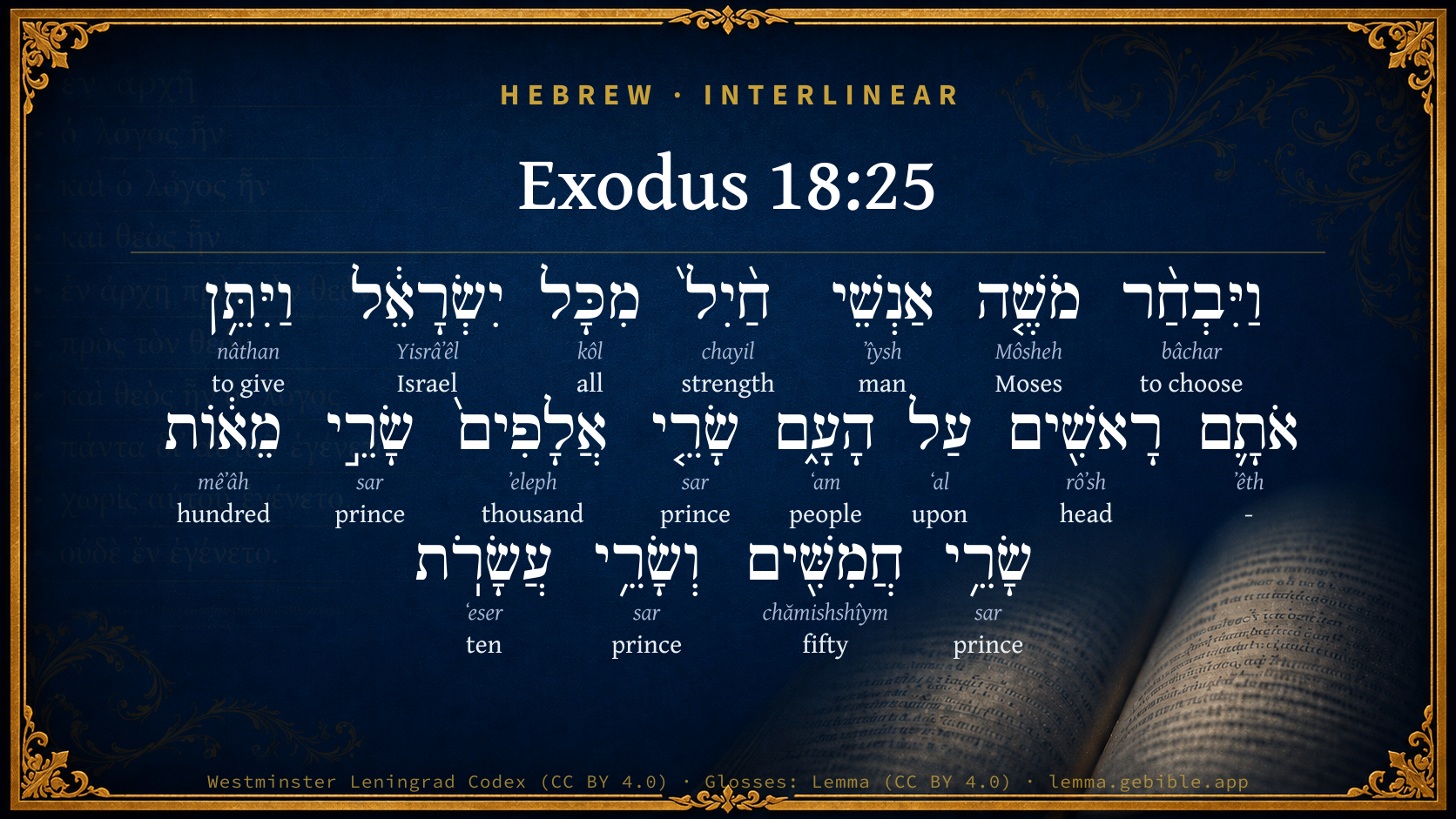
Exodus 18:25

Hebrew (Westminster Leningrad Codex) Exodus 18:25 appears in the Hebrew Old Testament. The text above is from the Westminster Leningrad Codex. Each word links to its Strong’s number, a concise gloss, and parsing drawn from the Open Scriptures Hebrew Bible morphology. Click any word for its full Brown-Driver-Briggs (BDB) entry.
Download image
Cite this verse

Exodus 18:25 (World English Bible). Public Domain. Lemma interlinear Bible study tool, https://lemma.gebible.app/v/exodus/18/25.

Show BibTeX & RIS
BibTeX
RIS
English Translation
Moses chose able men out of all Israel, and made them heads over the people, rulers of thousands, rulers of hundreds, rulers of fifties, and rulers of tens.
World English Bible · Public Domain
Download a study sheet

One document with this verse’s original text, its word-by-word gloss line, the meaning frame, cross-references with their text, attributed commentary, and full source and license credits — printable, and it pastes into notes with its structure intact.

This verse Autodidact and up

Study sheet (.html) Plain text (.txt)

A passage Seminary Student

Up to 50 verses in one chapter. A passage sheet keeps up to 6 commentary sources and 12 cross-references per verse, in the order this page ranks them, and says so on the sheet whenever that leaves anything out. Ask for a single verse and you get the Autodidact verse sheet above.

Everything on this page stays free to read, with no account — the sheet is a download of what is already on screen, not access to it.

Want to remove ads? Support Godless Engineer
Compare translations 3

The same verse in 3 English versions, stacked beneath the original-language interlinear above. Click any original word for its lexicon entry.

Each is an independent rendering of the whole verse — the interlinear is not word-aligned to these translations.

Highlighted words mark where these versions differ — a whole-verse word diff, not a word-by-word alignment.

  • World English Bible Public Domain
    Moses chose able men out of all Israel, and made them heads over the people, rulers of thousands, rulers of hundreds, rulers of fifties, and rulers of tens.
  • King James Version Public Domain
    And Moses chose able men out of all Israel, and made them heads over the people, rulers of thousands, rulers of hundreds, rulers of fifties, and rulers of tens.
  • unfoldingWord Literal Text CC BY-SA 4.0
    And Moses chose men of ability from all Israel, and he appointed them heads over the people, leaders of thousands, leaders of hundreds, leaders of fifties, and leaders of tens.

unfoldingWord Literal Text — © unfoldingWord, licensed CC BY-SA 4.0. Word-aligned USFM3 via Door43 (git.door43.org/unfoldingWord/en_ult).

Versions to compare (up to 4)

3 of 4 selected

Show all 18 translations

Every available English version of this verse, each an independent rendering of the whole verse.

  • World English Bible Public Domain
    Moses chose able men out of all Israel, and made them heads over the people, rulers of thousands, rulers of hundreds, rulers of fifties, and rulers of tens.
  • Berean Standard Bible Public Domain
    So Moses chose capable men from all Israel and made them heads over the people as leaders of thousands, of hundreds, of fifties, and of tens.
  • Majority Standard Bible Public Domain
    So Moses chose capable men from all Israel and made them heads over the people as leaders of thousands, of hundreds, of fifties, and of tens.
  • King James Version Public Domain
    And Moses chose able men out of all Israel, and made them heads over the people, rulers of thousands, rulers of hundreds, rulers of fifties, and rulers of tens.
  • American Standard Version (1901) Public Domain
    And Moses chose able men out of all Israel, and made them heads over the people, rulers of thousands, rulers of hundreds, rulers of fifties, and rulers of tens.
  • Revised Version (1885) Public Domain
    And Moses chose able men out of all Israel, and made them heads over the people, rulers of thousands, rulers of hundreds, rulers of fifties, and rulers of tens.
  • Geneva Bible (1599) Public Domain
    And Moses chose men of courage out of all Israel, and made them heads ouer the people, rulers ouer thousandes, rulers ouer hundreths, rulers ouer fifties, and rulers ouer tennes.
  • Douay-Rheims (1899) Public Domain
    And choosing able men out of all Israel, he appointed them rulers of the people, rulers over thousands, and over hundreds, and over fifties, and over tens.
  • Young's Literal Translation Public Domain
    and Moses chooseth men of ability out of all Israel, and maketh them chiefs over the people, heads of thousands, heads of hundreds, heads of fifties, and heads of tens,
  • Literal Standard Version CC BY-SA 4.0
    and Moses chooses men of ability out of all Israel, and makes them chiefs over the people [for] heads of thousands, heads of hundreds, heads of fifties, and heads of tens,
  • Unlocked Literal Bible CC BY-SA 4.0
    Moses chose capable men from all Israel and made them heads over the people, leaders in charge of thousands, hundreds, fifties, and tens.
  • unfoldingWord Literal Text CC BY-SA 4.0
    And Moses chose men of ability from all Israel, and he appointed them heads over the people, leaders of thousands, leaders of hundreds, leaders of fifties, and leaders of tens.
  • Darby Bible Public Domain
    And Moses chose able men out of all Israel, and made them heads over the people, chiefs of thousands, chiefs of hundreds, chiefs of fifties, and chiefs of tens.
  • World Messianic Bible Public Domain
    Moses chose able men out of all Israel, and made them heads over the people, rulers of thousands, rulers of hundreds, rulers of fifties, and rulers of tens.
  • Webster's Bible Public Domain
    And Moses chose able men out of all Israel, and made them heads over the people, rulers of thousands, rulers of hundreds, rulers of fifties, and rulers of tens.
  • Free Bible Version CC BY-SA 4.0
    So Moses chose competent men from all of Israel and put them in charge of the people as leaders of thousands, hundreds, fifties, and tens.
  • Bible in Basic English Public Domain
    And he made selection of able men out of all Israel, and made them heads over the people, captains of thousands, captains of hundreds and of fifties and of tens.
  • JPS Tanakh (1917) Public Domain
    And Moses chose able men out of all Israel, and made them heads over the people, rulers of thousands, rulers of hundreds, rulers of fifties, and rulers of tens.

Literal Standard Version (2020), Covenant Press — licensed CC BY-SA 4.0. Text via the HelloAO Bible API (eBible.org). Unlocked Literal Bible (unfoldingWord) — licensed CC BY-SA 4.0. Text via the HelloAO Bible API (eBible.org). unfoldingWord Literal Text — © unfoldingWord, licensed CC BY-SA 4.0. Word-aligned USFM3 via Door43 (git.door43.org/unfoldingWord/en_ult). Free Bible Version, Dr. Jonathan Gallagher — licensed CC BY-SA 4.0. Text via the HelloAO Bible API (eBible.org).

Word by word

More ways to search: Search by grammar → Find every occurrence → Compare this word →

Practice this passage: Drill this verse → Learn its vocabulary →

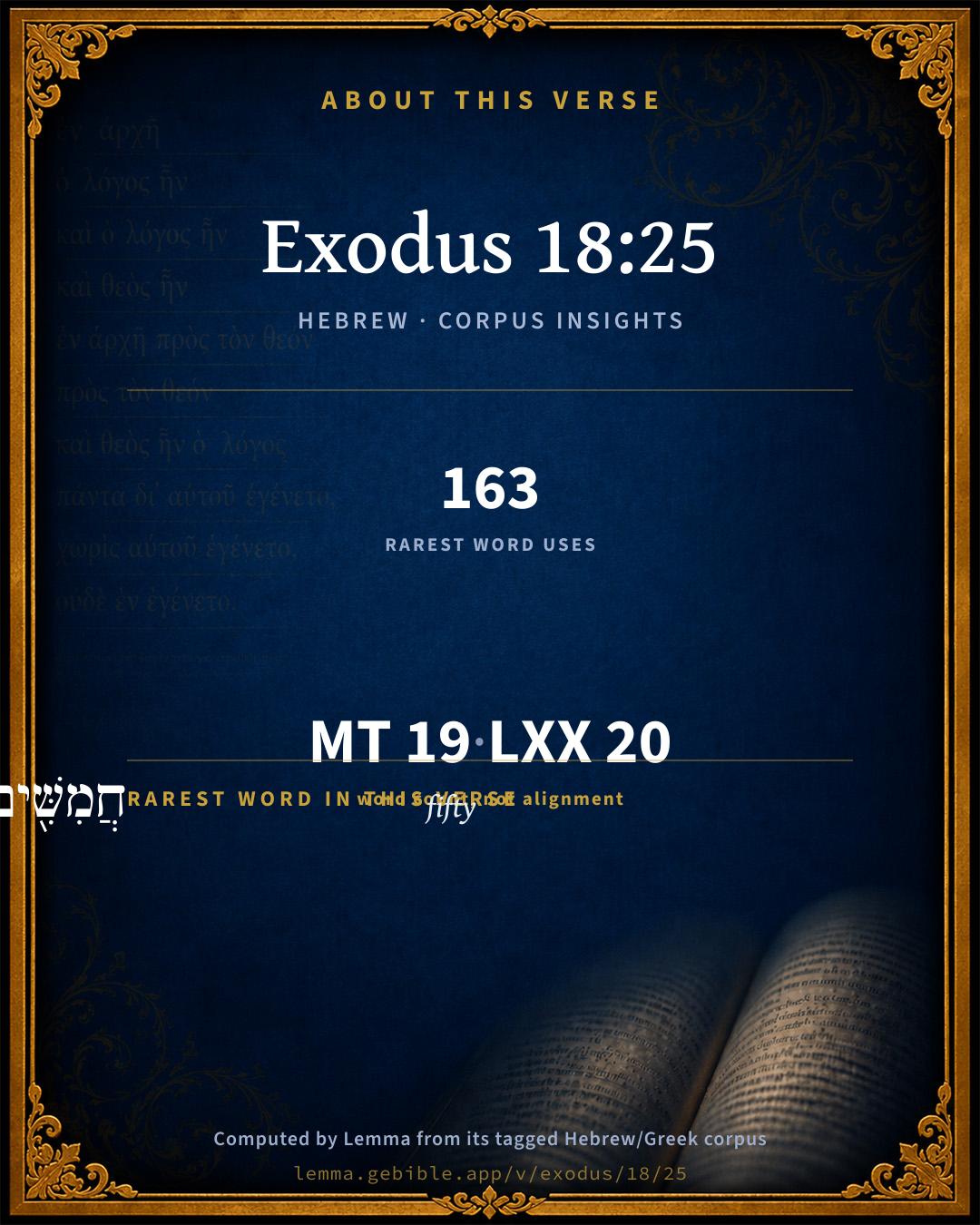
חֲמִשִּׁ֖ים
chămishshîym
H2572
“fifty”
Adjective, Cardinal number, Both, Plural, Absolute
Part of Speech
Adjective
Type
Cardinal number
Gender
Both
Number
Plural
State
Absolute
Full BDB Definition

Origin: multiple of H2568

TWOT: TWOT- 686c

fifty - fifty (cardinal number) - a multiple of fifty (with other numbers) - fiftieth (ordinal number)
  1. וַיִּבְחַ֨ר bâchar H977 “and · to choose” Conjunction + Verb, Qal, Sequential Imperfect, 3rd Person, Masculine, Singular
  2. מֹשֶׁ֤ה Môsheh H4872 “Moses” Noun, Proper
  3. אַנְשֵׁי ʼîysh H376 “men of” Noun, Common, Masculine, Plural, Construct
  4. חַ֨יִל֙ chayil H2428 “strength” Noun, Common, Masculine, Singular, Absolute
  5. מִכָּל kôl H3605 “from · all of” Preposition + Noun, Common, Masculine, Singular, Construct
  6. יִשְׂרָאֵ֔ל Yisrâʼêl H3478 “Israel” Noun, Proper
  7. וַיִּתֵּ֥ן nâthan H5414 “and · to give” Conjunction + Verb, Qal, Sequential Imperfect, 3rd Person, Masculine, Singular
  8. אֹתָ֛ם ʼêth H853 “- · them” Particle, Direct Object + Suffix, Personal, 3rd Person, Masculine, Plural
  9. רָאשִׁ֖ים rôʼsh H7218 “heads” Noun, Common, Masculine, Plural, Absolute
  10. עַל ʻal H5921 “upon” Preposition
  11. הָעָ֑ם ʻam H5971 “the · people” Particle, Definite Article + Noun, Common, Masculine, Singular, Absolute
  12. שָׂרֵ֤י sar H8269 “princes of” Noun, Common, Masculine, Plural, Construct
  13. אֲלָפִים֙ ʼeleph H505 “thousand” Adjective, Cardinal number, Both, Plural, Absolute
  14. שָׂרֵ֣י sar H8269 “princes of” Noun, Common, Masculine, Plural, Construct
  15. מֵא֔וֹת mêʼâh H3967 “hundred” Adjective, Cardinal number, Both, Plural, Absolute
  16. שָׂרֵ֥י sar H8269 “princes of” Noun, Common, Masculine, Plural, Construct
  17. וְשָׂרֵ֥י sar H8269 “and · princes of” Conjunction + Noun, Common, Masculine, Plural, Construct
  18. עֲשָׂרֹֽת ʻeser H6235 “ten” Adjective, Cardinal number, Masculine, Plural, Absolute

About this verse

These counts appear in no published source. They are computed here, from the morphology-tagged text and Lemma’s own curated glosses. What Lemma adds →

19
words
16
distinct lemmas
Pentateuch
section

Grammatical profile

  • 2 verbs
  • 11 nouns
  • 4 adjectives
  • 1 preposition
  • 1 particle

Verb forms

  • וַיִּבְחַ֨ר Qal · Sequential Imperfect
  • וַיִּתֵּ֥ן Qal · Sequential Imperfect

Repetition

A word recurs within this verse — often emphatic in Hebrew:

  • שָׂרֵ֤י prince H8269 ×4

Hebrew & Septuagint length

In English translation the verse runs 28 words from the Hebrew and 32 from the Septuagint (LXX English) — closely comparable.

A rough comparison of the two English renderings, which tokenize alike — not a word-level alignment.

Word counts can differ between the Hebrew and the Greek without any difference in meaning — e.g. the Hebrew direct-object marker אֵת has no separate Greek word, and Greek often adds the article ὁ.

In the original languages it is 19 Hebrew tokens and 20 Greek tokens — but the two are counted differently (Hebrew bundles its prefixes and suffixes into one token; the Greek is in lemma form), so that isn’t a like-for-like length.

Cross-references

3

Topical passages linked to Exodus 18:25 in the Treasury of Scripture Knowledge — connected by theme and wording, ordered by reader-vote popularity; previews shown in the World English Bible.

  • Deuteronomy 1:15 So I took the heads of your tribes, wise men, and known, and made them heads over you, captains of thousands, and captains of hundreds, and captains of fifties, and captains of tens, and officers, according to your tribes.
  • Exodus 18:21 Moreover you shall provide out of all the people able men, such as fear God: men of truth, hating unjust gain; and place such over them, to be rulers of thousands, rulers of hundreds, rulers of fifties, and rulers of tens.
  • Acts 6:5 These words pleased the whole multitude. They chose Stephen, a man full of faith and of the Holy Spirit, Philip, Prochorus, Nicanor, Timon, Parmenas, and Nicolaus, a proselyte of Antioch;

Cross-references courtesy of OpenBible.info (CC BY 4.0).

Hebrew and Greek witnesses Masoretic Hebrew ↔ Greek Septuagint

The same verse in the two great witnesses to the Old Testament, shown verse-for-verse.

These are two independent witnesses, not word-aligned to each other, and the Septuagint is shown in lemma (dictionary) form.

Hebrew Exodus 18:25 Masoretic · Westminster Leningrad Codex

וַיִּבְחַ֨ר מֹשֶׁ֤ה אַנְשֵׁי חַ֨יִל֙ מִכָּל יִשְׂרָאֵ֔ל וַיִּתֵּ֥ן אֹתָ֛ם רָאשִׁ֖ים עַל הָעָ֑ם שָׂרֵ֤י אֲלָפִים֙ שָׂרֵ֣י מֵא֔וֹת שָׂרֵ֥י חֲמִשִּׁ֖ים וְשָׂרֵ֥י עֲשָׂרֹֽת

Moses chose able men out of all Israel, and made them heads over the people, rulers of thousands, rulers of hundreds, rulers of fifties, and rulers of tens.

World English Bible · Public Domain

Greek LXX Exodus 18:25 Septuagint · lemma form

καί ἐπιλέγω μωυσῆς ἀνήρ δυνατός ἀπό πᾶς ἰσραήλ καί ποιέω αὐτός ἐπί αὐτός χιλίαρχος καί ἑκατόνταρχος καί πεντηκόνταρχος καί δεκάδαρχος

And Moses chose out able men out of all Israel, and he made them captains of thousands and captains of hundreds, and captains of fifties and captains of tens over the people.

LXX2012 (modern English Septuagint) · Public Domain

On this verse, Haydock's Catholic Bible Commentary discusses the Septuagint’s reading. Read the note in Commentary ↓

Hebrew: Westminster Leningrad Codex (CC BY 4.0). Greek: Septuagint (public domain); English from LXX2012 (modern English Septuagint) (Public Domain). How the Septuagint differs from the Hebrew →

Targum (Aramaic paraphrase)

2

The Targum is the ancient Jewish Aramaic paraphrase of the Hebrew Scriptures — an interpretive translation, not the Hebrew text itself. Onkelos (literal) and Pseudo-Jonathan (expansive) render the Torah, and Jonathan the Prophets. Coverage is partial: where no permissively-licensed English translation exists for a verse, only the Aramaic is shown. This is verse-level text, not a word-by-word alignment to the Hebrew.

  1. Targum Onkelos Torah (Genesis–Deuteronomy)
    וּבְחַר משֶׁה גֻבְרִין דְחֵילָא מִכָּל יִשְׂרָאֵל וּמַנִי יָתְהוֹן רֵישִׁין עַל עַמָא רַבָּנֵי אַלְפִין רַבָּנֵי מָאוָתָא רַבָּנֵי חַמְשִׁין וְרַבָּנֵי עִשׂוֹרְיָתָא:

    (no public-domain English translation for this verse)

    Targum Onkelos — Aramaic: “Onkelos Genesis” (public domain); “Onkelos Exodus” (public domain); “Onkelos Leviticus” (public domain); “Onkelos Numbers” (public domain); “Onkelos Deuteronomy” (public domain). English: “Sefaria Community Translation” (CC0 1.0 (public-domain dedication)); “J.W. Etheridge. The Targums of Onkelos and Jonathan Ben Uzziel on the Pentateuch. London: Longmans, Green, 1862” (public domain). Text via Sefaria.

  2. Targum Pseudo-Jonathan Torah (Genesis–Deuteronomy)
    וּבְחַר משֶׁה גִיבָּרֵי חֵילָא מִכָּל יִשְרָאֵל וּמַנֵי יַתְהוֹן רֵישִׁין עַל עַמָא רַבָּנֵי אַלְפִין שִׁית מְאָה רַבָּנֵי מַאֲוָותָא שִׁית אַלְפִין רַבָּנֵי חוּמְשִׁין תְּרֵיסַר אַלְפִין וְרַבָּנֵי עִישׁוֹרְיָיתָא שִׁית רִבְוָון

    And Mosheh selected able men from all Israel, and appointed them chief, over the people, rabbans of thousands, six hundred; rabbans of hundreds, six thousand; rabbans of fifties, twelve thousand; and rabbans of tens, six Myriads.

    Targum Pseudo-Jonathan — Aramaic: “Targum Jonathan on Genesis” (public domain); “Targum Jonathan on Exodus” (public domain); “Targum Jonathan on Leviticus” (public domain); “Targum Jonathan on Numbers” (public domain); “Targum Jonathan on Deuteronomy” (public domain). English: “The Targum of Jonathan ben Uzziel, trans. J. W. Etheridge, London, 1862” (public domain). Text via Sefaria.

Commentary

Notes on Exodus 18:25 from classic Christian and Jewish commentators (each source and its license shown beneath its notes). The classic Christian expositions comment on the surrounding passage and are grouped to its opening verse, so a note may address several verses; the Jewish commentaries on the Tanakh (Rashi and others) are per-verse, so they appear only where the commentator wrote on this verse.

Lemma curates 59 commentaries, every one of them public domain or Creative Commons licensed, each selected and text-cleaned for this edition rather than reprinted as found. About our sources →

Trapp's Complete Commentary

John Trapp

Exo 18:25 And Moses chose able men out of all Israel, and made them heads over the people, rulers of thousands, rulers of hundreds, rulers of fifties, and rulers of tens.

Ver. 25. And Moses chose.] Not without the people’s consent. {Deu 1:13-14}

John Trapp, A Commentary or Exposition upon All the Books of the Old and New Testament (1647–1656) — public domain. Text from a community e-Sword module.

John Gill's Exposition

And they judged the people at all seasons,.... Any day in the week, or any time in the day, whenever there was any occasion for them, and cases were brought before them:

the hard cases they brought unto Moses; that is, the judges brought them to Moses when such came before them which were too hard for them, it was difficult to them to determine rightly about them, then they brought them to be heard and decided by him; for the judges, and not the people, best knew when a case was hard or easy to determine:

but every small matter they judged themselves; and gave it as they saw was most agreeable to justice and equity, and did not trouble Moses with it; by which means he was eased of a great deal of business and fatigue, which was Jethro's view in giving the advice he did.

John Gill's Exposition of the Whole Bible (1746–1763) — public domain (CC PDM 1.0). Text via the HelloAO Bible API.

Haydock's Catholic Bible Commentary

Tens. The Samaritan copy here inserts, from Deuteronomy i. 9 to 19, where this is related at greater length. The Septuagint also add to the other officers, the Grammatoeisagogeis, or Shoterim, mentioned in the same place, as lectors or scribes, whose business it perhaps was to present written requests.

George Leo Haydock (1774–1849), Haydock's Catholic Family Bible and Commentary, 1859 edition — public domain. Excludes Psalms (Douay-Rheims chapter numbering differs from Protestant) and Deuterocanonical books (Catholic canon only).

Matthew Poole's English Annotations

Moses chose them not solely, but together with the people, as appears from Deu 1:13.

Matthew Poole's English Annotations on the Holy Bible (1683–1685) — public domain. Text from a community e-Sword/MySword module.

The Pulpit Commentary

Moses chose able men. It appears from Deu_1:13, that instead of selecting the men himself, which would have been an invidious task, Moses directed their nomination by the people, and only reserved to himself the investing them with their authority. Heads over the people. From the time of their appointment, the "rulers" were not merely judges, but "heads" of their respective companies, with authority over them on the march, and command in the battle-field. (Num_31:14) Thus the organisation was at once civil and military.

The Pulpit Commentary (1880–1919), ed. H.D.M. Spence-Jones & Joseph S. Exell — public domain. Text from a community e-Sword module.

Keil & Delitzsch

C. F. Keil & F. Delitzsch

The judges chosen were arranged as chiefs (שׂרים) over thousands, hundreds, fifties, and tens, after the analogy of the military organization of the people on their march (Num 31:14), in such a manner, however, that this arrangement was linked on to the natural division of the people into tribes, families, etc. (see my Archologie, 140). For it is evident that the decimal division was not made in an arbitrary manner according to the number of heads, from the fact that, on the one hand, the judges were chosen from the heads of their tribes and according to their tribes (Deu 1:13); and on the other hand, the larger divisions of the tribes, viz., the families (mishpachoth), were also called thousands (Num 1:15; Num 10:4; Jos 22:14, etc.), just because the number of their heads of families would generally average about a thousand; so that in all probability the hundreds, fifties, and tens denote smaller divisions of the nation, in which there were about this number of fathers. Thus in Arabic, for example, "the ten" is a term used to signify a family (cf. Hengstenberg, Dissertations v. ii. 343, and my Arch. 149). The difference between the harder or greater matters and the smaller matters consisted in this: questions which there was not definite law to decide were great or hard; whereas, on the other hand, those which could easily be decided from existing laws or general principles of equity were simple or small. (Vide Joh. Selden de Synedriis i. c. 16, in my Arch. 149, Not. 3, where the different views are discussed respecting the relative positions and competency of the various judges, about which there is no precise information given in the law.) So far as the total number of judges is concerned, all that can be affirmed with certainty is, that the estimated number of 600 judges over thousands, 6000 over hundreds, 12,000 over fifties, and 60,000 over tens, in all 78,600 judges, which is given by Grotius and in the Talmud, and according to which there must have been a judge for every seven adults, is altogether erroneous (cf. J. Selden l.c. pp. 339ff.). For if the thousands answered to the families (Mishpachoth), there cannot have been a thousand males in every one; and in the same way the hundreds, etc., are not to be understood as consisting of precisely that number of persons, but as larger or smaller family groups, the numerical strength of which we do not know. And even if we did know it, or were able to estimate it, this would furnish no criterion by which to calculate the number of the judges, for the text does not affirm that every one of these larger or smaller family groups had a judge of its own; in fact, the contrary may rather be inferred, from the fact that, according to Deu 1:15, the judges were chosen out of the heads of the tribes, so that the number of judges must have been smaller than that of the heads, and can hardly therefore have amounted to many hundreds, to say nothing of many thousands.

Keil & Delitzsch — Biblical Commentary on the Old Testament (1861–1891) — public domain (CC PDM 1.0). Text via the HelloAO Bible API. (Old Testament only.)

Lesson kit

Teaching starters — assembled from the data on this page, not authored interpretation. Every prompt links to the verse data it draws on. Edit before teaching.

Exodus, in the Pentateuch, opens this verse with 19 words (16 distinct Hebrew lemmas). Its most distinctive word is chămishshîym (“fifty”). A historical commentator’s framing appears above. Read the whole chapter for the surrounding context.

Discussion questions

  1. What does “fifty” (chămishshîym) contribute to the verse as a whole?
  2. Deuteronomy 1:15 shares this passage’s theme. How do the two illuminate each other?
  3. “prince” occurs 4× in this one verse. What is the effect of the repetition?
  4. These translations render this verse differently; the difference is in the English rendering, not the original. What questions does that raise?
  5. The verb «וַיִּבְחַ֨ר» is Qal Sequential Imperfect. How does its form color the action?
  6. Reading how Trapp's Complete Commentary and John Gill's Exposition read this verse, where do the two commentators agree and where do they part?

Things to notice

Reading settings

Reading text

Shown beneath each verse's original-language words.

Old Testament
Old Testament edition

Read the OT as the Masoretic Hebrew (MT) or the Greek Septuagint (LXX).

English shown for the Greek Septuagint (in the Hebrew ↔ Greek comparison).

Comparing translations? Open the Compare panel on any verse page to stack up to four side by side.