Genesis 9:3

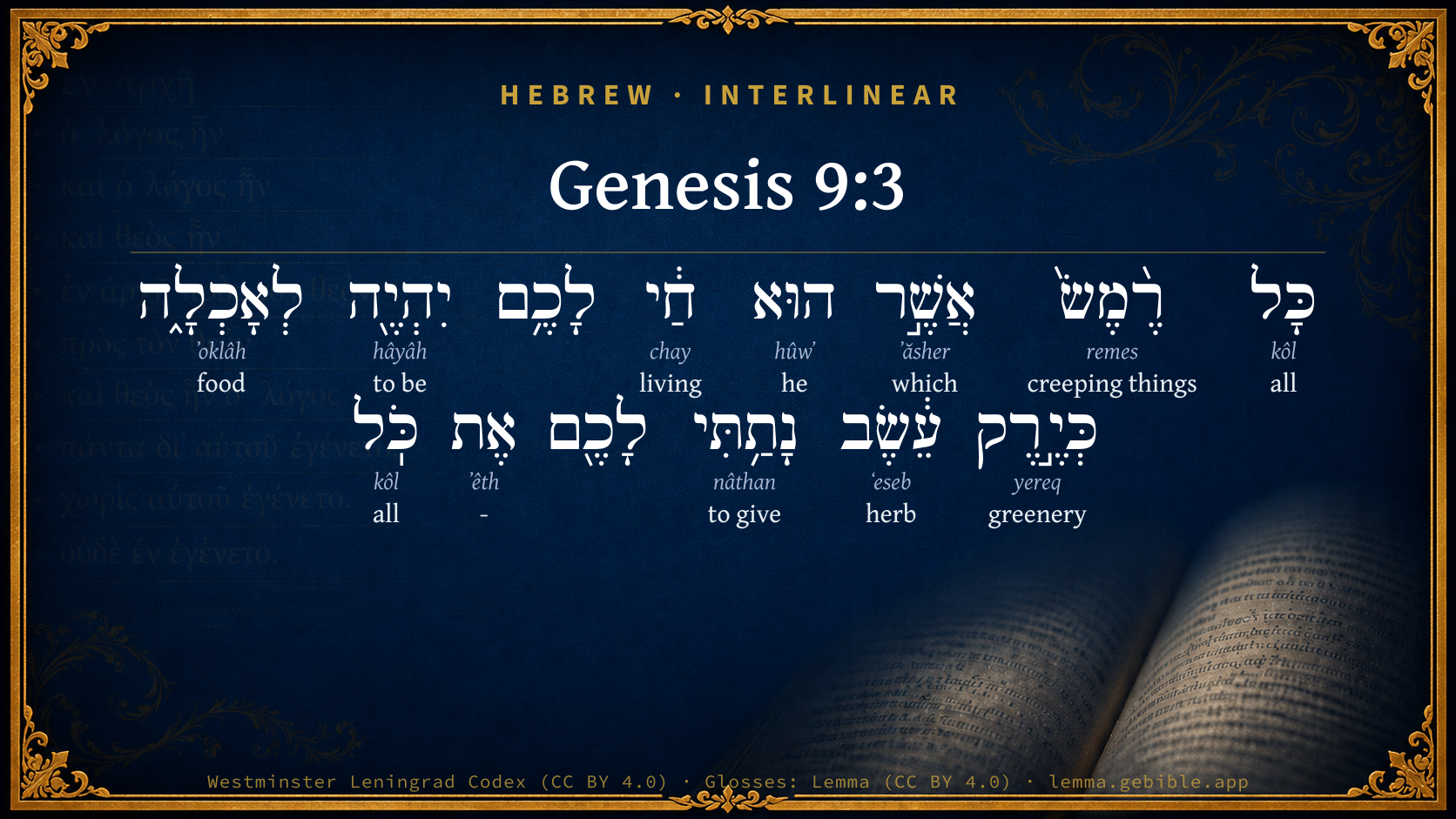
Hebrew (Westminster Leningrad Codex) Genesis 9:3 appears in the Hebrew Old Testament. The text above is from the Westminster Leningrad Codex. Each word links to its Strong’s number, a concise gloss, and parsing drawn from the Open Scriptures Hebrew Bible morphology. Click any word for its full Brown-Driver-Briggs (BDB) entry.
Download image
Cite this verse

Genesis 9:3 (World English Bible). Public Domain. Lemma interlinear Bible study tool, https://lemma.gebible.app/v/genesis/9/3.

Show BibTeX & RIS
BibTeX
RIS
English Translation
Every moving thing that lives will be food for you. As the green herb, I have given everything to you.
World English Bible · Public Domain
Download a study sheet

One document with this verse’s original text, its word-by-word gloss line, the meaning frame, cross-references with their text, attributed commentary, and full source and license credits — printable, and it pastes into notes with its structure intact.

This verse Autodidact and up

Study sheet (.html) Plain text (.txt)

A passage Seminary Student

Up to 50 verses in one chapter. A passage sheet keeps up to 6 commentary sources and 12 cross-references per verse, in the order this page ranks them, and says so on the sheet whenever that leaves anything out. Ask for a single verse and you get the Autodidact verse sheet above.

Everything on this page stays free to read, with no account — the sheet is a download of what is already on screen, not access to it.

Want to remove ads? Support Godless Engineer
Compare translations 3

The same verse in 3 English versions, stacked beneath the original-language interlinear above. Click any original word for its lexicon entry.

Each is an independent rendering of the whole verse — the interlinear is not word-aligned to these translations.

Highlighted words mark where these versions differ — a whole-verse word diff, not a word-by-word alignment.

  • World English Bible Public Domain
    Every moving thing that lives will be food for you. As the green herb, I have given everything to you.
  • King James Version Public Domain
    Every moving thing that liveth shall be meat for you; even as the green herb have I given you all things.
  • unfoldingWord Literal Text CC BY-SA 4.0
    Every moving creature that lives will be for you for food. Just as the green plants, I give you everything.

unfoldingWord Literal Text — © unfoldingWord, licensed CC BY-SA 4.0. Word-aligned USFM3 via Door43 (git.door43.org/unfoldingWord/en_ult).

Versions to compare (up to 4)

3 of 4 selected

Show all 18 translations

Every available English version of this verse, each an independent rendering of the whole verse.

  • World English Bible Public Domain
    Every moving thing that lives will be food for you. As the green herb, I have given everything to you.
  • Berean Standard Bible Public Domain
    Everything that lives and moves will be food for you; just as I gave you the green plants, I now give you all things.
  • Majority Standard Bible Public Domain
    Everything that lives and moves will be food for you; just as I gave you the green plants, I now give you all things.
  • King James Version Public Domain
    Every moving thing that liveth shall be meat for you; even as the green herb have I given you all things.
  • American Standard Version (1901) Public Domain
    Every moving thing that liveth shall be food for you; As the green herb have I given you all.
  • Revised Version (1885) Public Domain
    Every moving thing that liveth shall be food for you; as the green herb have I given you all.
  • Geneva Bible (1599) Public Domain
    Euery thing that moueth and liueth, shall be meate for you: as the greene herbe, haue I giuen you all things.
  • Douay-Rheims (1899) Public Domain
    And every thing that moveth and liveth shall be meat for you: even as the green herbs have I delivered them all to you:
  • Young's Literal Translation Public Domain
    Every creeping thing that is alive, to you it is for food; as the green herb I have given to you the whole;
  • Literal Standard Version CC BY-SA 4.0
    Every creeping thing that is alive, to you it is for food; as the green herb I have given to you the whole;
  • Unlocked Literal Bible CC BY-SA 4.0
    Every moving thing that lives will be food for you. Just as I gave you the green plants, I now give you everything.
  • unfoldingWord Literal Text CC BY-SA 4.0
    Every moving creature that lives will be for you for food. Just as the green plants, I give you everything.
  • Darby Bible Public Domain
    Every moving thing that liveth shall be food for you: as the green herb I give you everything.
  • World Messianic Bible Public Domain
    Every moving thing that lives will be food for you. As I gave you the green herb, I have given everything to you.
  • Webster's Bible Public Domain
    Every moving thing that liveth shall be food for you; even as the green herb have I given you all things:
  • Free Bible Version CC BY-SA 4.0
    Every living creature that moves will be food for you, as well as all the green plants.
  • Bible in Basic English Public Domain
    Every living and moving thing will be food for you; I give them all to you as before I gave you all green things.
  • JPS Tanakh (1917) Public Domain
    Every moving thing that liveth shall be for food for you; as the green herb have I given you all.

Literal Standard Version (2020), Covenant Press — licensed CC BY-SA 4.0. Text via the HelloAO Bible API (eBible.org). Unlocked Literal Bible (unfoldingWord) — licensed CC BY-SA 4.0. Text via the HelloAO Bible API (eBible.org). unfoldingWord Literal Text — © unfoldingWord, licensed CC BY-SA 4.0. Word-aligned USFM3 via Door43 (git.door43.org/unfoldingWord/en_ult). Free Bible Version, Dr. Jonathan Gallagher — licensed CC BY-SA 4.0. Text via the HelloAO Bible API (eBible.org).

Word by word

More ways to search: Search by grammar → Find every occurrence → Compare this word →

Practice this passage: Drill this verse → Learn its vocabulary →

כְּיֶ֣רֶק
yereq
H3418
“like/as · greenery”
Preposition + Noun, Common, Masculine, Singular, Absolute
Part of Speech
Preposition + Noun
Type
Common
Gender
Masculine
Number
Singular
State
Absolute
Full BDB Definition

Origin: from H3417 (in the sense of vacuity of colour)

TWOT: 918a

green, greenness, green plants, greenery
  1. כָּל kôl H3605 “all of” Noun, Common, Masculine, Singular, Construct
  2. רֶ֨מֶשׂ֙ remes H7431 “creeping things” Noun, Common, Masculine, Singular, Absolute
  3. אֲשֶׁ֣ר ʼăsher H834 “which” Particle, Relative
  4. הוּא hûwʼ H1931 “he” Pronoun, Personal, 3rd Person, Masculine, Singular
  5. חַ֔י chay H2416 “living” Adjective, Adjective, Masculine, Singular, Absolute
  6. יִהְיֶ֖ה hâyâh H1961 “to be” Verb, Qal, Imperfect, 3rd Person, Masculine, Singular
  7. לְאָכְלָ֑ה ʼoklâh H402 “to/for · food” Preposition + Noun, Common, Feminine, Singular, Absolute
  8. עֵ֔שֶׂב ʻeseb H6212 “herb” Noun, Common, Masculine, Singular, Absolute
  9. נָתַ֥תִּי nâthan H5414 “to give” Verb, Qal, Perfect, 1st Person, Common, Singular
  10. אֶת ʼêth H853 “-” Particle, Direct Object
  11. כֹּֽל kôl H3605 “all” Noun, Common, Masculine, Singular, Absolute

About this verse

These counts appear in no published source. They are computed here, from the morphology-tagged text and Lemma’s own curated glosses. What Lemma adds →

14
words
11
distinct lemmas
Pentateuch
section

Notable vocabulary

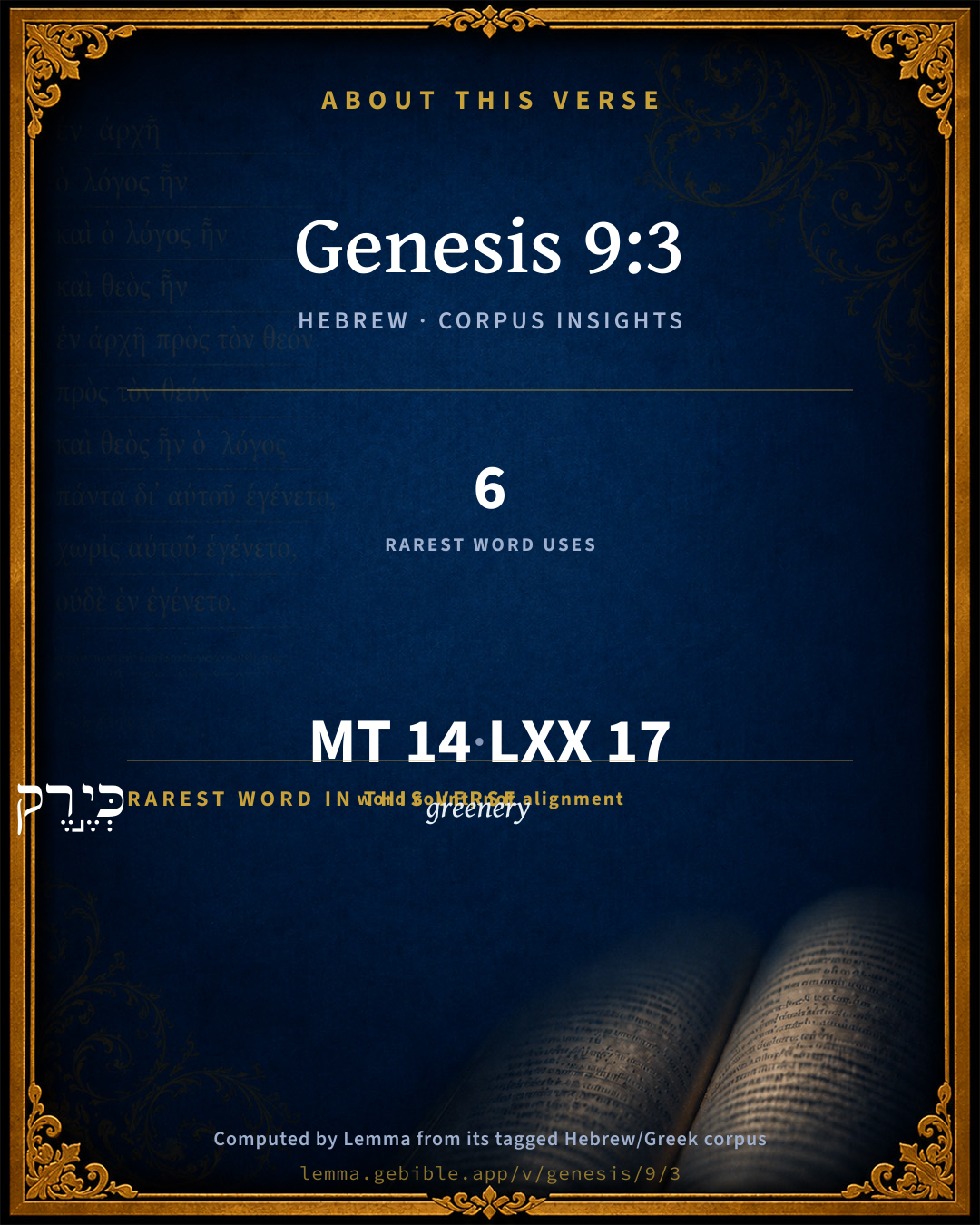
The rarest word here is כְּיֶ֣רֶק greenery H3418 — appearing just 6 times in the whole Hebrew Bible.

Shared distinctive vocabulary

כְּיֶ֣רֶק greenery H3418 occurs in 6 verses of the Hebrew Bible. Also found in:

Grammatical profile

  • 2 verbs
  • 6 nouns
  • 1 adjective
  • 1 pronoun
  • 2 prepositions
  • 2 particles

Verb forms

  • יִהְיֶ֖ה Qal · Imperfect
  • נָתַ֥תִּי Qal · Perfect

Repetition

A word recurs within this verse — often emphatic in Hebrew:

Hebrew & Septuagint length

In English translation the verse runs 20 words from the Hebrew and 23 from the Septuagint (LXX English) — closely comparable.

A rough comparison of the two English renderings, which tokenize alike — not a word-level alignment.

Word counts can differ between the Hebrew and the Greek without any difference in meaning — e.g. the Hebrew direct-object marker אֵת has no separate Greek word, and Greek often adds the article ὁ.

In the original languages it is 14 Hebrew tokens and 17 Greek tokens — but the two are counted differently (Hebrew bundles its prefixes and suffixes into one token; the Greek is in lemma form), so that isn’t a like-for-like length.

Cross-references

17

Topical passages linked to Genesis 9:3 in the Treasury of Scripture Knowledge — connected by theme and wording, ordered by reader-vote popularity; previews shown in the World English Bible.

  • Romans 14:14 I know, and am persuaded in the Lord Jesus, that nothing is unclean of itself; except that to him who considers anything to be unclean, to him it is unclean.
  • Deuteronomy 12:15 Notwithstanding, you may kill and eat flesh within all your gates, after all the desire of your soul, according to the blessing of Yahweh your God which he has given you: the unclean and the clean may eat of it, as of the gazelle, and as of the hart.
  • Colossians 2:21–22 "Don't handle, nor taste, nor touch"
  • 1 Timothy 4:3–5 forbidding marriage and commanding to abstain from foods which God created to be received with thanksgiving by those who believe and know the truth.
  • 1 Corinthians 10:31 Whether therefore you eat, or drink, or whatever you do, do all to the glory of God.
  • 1 Corinthians 10:25–26 Whatever is sold in the butcher shop, eat, asking no question for the sake of conscience,
  • Colossians 2:16 Let no man therefore judge you in eating, or in drinking, or with respect to a feast day or a new moon or a Sabbath day,
  • Psalms 104:14–15 He causes the grass to grow for the cattle, And plants for man to cultivate, That he may bring forth food out of the earth:
  • Acts 10:12–15 in which were all kinds of four-footed animals of the earth, wild animals, reptiles, and birds of the sky.
  • 1 Corinthians 10:23 "All things are lawful for me," but not all things are profitable. "All things are lawful for me," but not all things build up.
  • Genesis 1:29–30 God said, "Behold, I have given you every herb yielding seed, which is on the surface of all the earth, and every tree, which bears fruit yielding seed. It will be your food.
  • Leviticus 11:1–47 Yahweh spoke to Moses and to Aaron, saying to them,
  • Leviticus 22:8 That which dies of itself, or is torn by animals, he shall not eat, defiling himself by it. I am Yahweh.
  • Romans 14:3 Don't let him who eats despise him who doesn't eat. Don't let him who doesn't eat judge him who eats, for God has received him.
  • Romans 14:17 for the Kingdom of God is not eating and drinking, but righteousness, peace, and joy in the Holy Spirit.
  • Romans 14:20 Don't overthrow God's work for food's sake. All things indeed are clean, however it is evil for that man who creates a stumbling block by eating.

Cross-references courtesy of OpenBible.info (CC BY 4.0).

Hebrew and Greek witnesses Masoretic Hebrew ↔ Greek Septuagint

The same verse in the two great witnesses to the Old Testament, shown verse-for-verse.

These are two independent witnesses, not word-aligned to each other, and the Septuagint is shown in lemma (dictionary) form.

Hebrew Genesis 9:3 Masoretic · Westminster Leningrad Codex

כָּל רֶ֨מֶשׂ֙ אֲשֶׁ֣ר הוּא חַ֔י לָכֶ֥ם יִהְיֶ֖ה לְאָכְלָ֑ה כְּיֶ֣רֶק עֵ֔שֶׂב נָתַ֥תִּי לָכֶ֖ם אֶת כֹּֽל

Every moving thing that lives will be food for you. As the green herb, I have given everything to you.

World English Bible · Public Domain

Greek LXX Genesis 9:3 Septuagint · lemma form

καί πᾶς ἑρπετόν ὅς εἰμί ζάω σύ εἰμί εἰς βρῶσις ὡς λάχανον χόρτος δίδωμι σύ ὁ πᾶς

And every reptile which is living shall be to you for meat, I have given all things to you as the green herbs.

LXX2012 (modern English Septuagint) · Public Domain

Hebrew: Westminster Leningrad Codex (CC BY 4.0). Greek: Septuagint (public domain); English from LXX2012 (modern English Septuagint) (Public Domain). How the Septuagint differs from the Hebrew →

Targum (Aramaic paraphrase)

2

The Targum is the ancient Jewish Aramaic paraphrase of the Hebrew Scriptures — an interpretive translation, not the Hebrew text itself. Onkelos (literal) and Pseudo-Jonathan (expansive) render the Torah, and Jonathan the Prophets. Coverage is partial: where no permissively-licensed English translation exists for a verse, only the Aramaic is shown. This is verse-level text, not a word-by-word alignment to the Hebrew.

  1. Targum Onkelos Torah (Genesis–Deuteronomy)
    כָּל רִחֲשָׁא דְּהוּא חַי לְכוֹן יְהֵי לְמֵיכָל כִּירוֹק עִשְׂבָּא יְהָבִית לְכוֹן יָת כֹּלָּא

    Every moving thing that liveth, for you it shall be to eat; as the green herb I have given you the whole.

    Targum Onkelos — Aramaic: “Onkelos Genesis” (public domain); “Onkelos Exodus” (public domain); “Onkelos Leviticus” (public domain); “Onkelos Numbers” (public domain); “Onkelos Deuteronomy” (public domain). English: “Sefaria Community Translation” (CC0 1.0 (public-domain dedication)); “J.W. Etheridge. The Targums of Onkelos and Jonathan Ben Uzziel on the Pentateuch. London: Longmans, Green, 1862” (public domain). Text via Sefaria.

  2. Targum Pseudo-Jonathan Torah (Genesis–Deuteronomy)
    כָּל רִיחֲשָׁא דְהוּא חַי דִלְכוֹן יְהֵי לְמֵיכַל כִּירוֹק עִסְבָּא יְהָבִית לְכוֹן יַת כּוֹלָא

    Every moving thing which liveth to you shall be for food: as the green herb have I given to you the whole.

    Targum Pseudo-Jonathan — Aramaic: “Targum Jonathan on Genesis” (public domain); “Targum Jonathan on Exodus” (public domain); “Targum Jonathan on Leviticus” (public domain); “Targum Jonathan on Numbers” (public domain); “Targum Jonathan on Deuteronomy” (public domain). English: “The Targum of Jonathan ben Uzziel, trans. J. W. Etheridge, London, 1862” (public domain). Text via Sefaria.

Commentary

Notes on Genesis 9:3 from classic Christian and Jewish commentators (each source and its license shown beneath its notes). The classic Christian expositions comment on the surrounding passage and are grouped to its opening verse, so a note may address several verses; the Jewish commentaries on the Tanakh (Rashi and others) are per-verse, so they appear only where the commentator wrote on this verse.

Lemma curates 59 commentaries, every one of them public domain or Creative Commons licensed, each selected and text-cleaned for this edition rather than reprinted as found. About our sources →

Trapp's Complete Commentary

John Trapp

Gen 9:3 Every moving thing that liveth shall be meat for you; even as the green herb have I given you all things.

Ver. 3. Every moving thing that liveth shall be meat for you.] God of his goodness grants here to mankind, after the flood, the use of flesh and wine, that the new and much weakened world might have new and more strengthening nourishment. For it is not to be doubted but that, by the deluge, a great decay was wrought both in the earth with its fruits, and also in man’s nature. Various ridges and scars, as it were, of God’s wrath and malediction abided and appeared in the earth. Sundry maladies also and infirmities befell man’s body, not felt before the flood. God therefore in great mercy provides, penum quoddam et pharmacopolium mundo senescenti ,{ a} new food and physic for the languishing world. "Every moving thing that liveth," &c., only, that as the green herb have I given you all things; that is, as you may use them as freely as you used to do herbs, so you must use them soberly, and without curiosity; taking such things as are at hand, and eating to live, not living to eat, as the rich glutton, that fared deliciously every day: -

“ Ingluvies, et tempestas, barathrumque macelli .” - Horat.

{a} Flac. Illyric.

John Trapp, A Commentary or Exposition upon All the Books of the Old and New Testament (1647–1656) — public domain. Text from a community e-Sword module.

Joseph Benson's Commentary

Gen 9:3. Every moving thing — Which is wholesome and fit for food, shall be meat for you: That liveth — This may be added to exclude the use of those creatures which died of themselves, or were killed by wild beasts. These, which were afterward expressly forbidden to be eaten, (see Exo 22:31, Lev 22:8,) may here be forbidden implicitly. Hitherto man had been confined to feed only upon the products of the earth, fruits, herbs, and roots, and all sorts of corn and milk; such was the first grant, Gen 1:29. But the flood having perhaps washed away much of the virtue of the earth, and so rendered its fruits less pleasing, and less nourishing, God now enlarged the grant, and allowed man to eat flesh, which perhaps man himself never thought of till now. The Jewish doctors speak so often of the seven precepts of Noah, which they say were to be observed by all nations, that it may not be amiss to set them down here.

The first was against the worship of idols: the second against blasphemy; and requires to bless the name of God: the third against murder: the fourth against incest and all uncleanness: the fifth against theft and rapine: the sixth required the administration of justice: the seventh was against eating flesh with life. The Jews required the observation of these from the proselytes of the gate. But the precepts here given, all concern the life of man. Man must not prejudice his own life by eating that food which is unwholesome and prejudicial to his health.

Joseph Benson's Commentary on the Old and New Testaments (1811–1818) — public domain. Text from a community e-Sword module.

Geneva Bible (1599)

Geneva Bible translators

By this permission man may with a good conscience use the creatures of God for his necessity.

Geneva Bible (1599) marginal notes — public domain. Text via Bolls.life.

Jamieson, Fausset & Brown

Robert Jamieson, A. R. Fausset & David Brown

Every moving thing that liveth shall be meat for you--The third part concerns the means of sustaining life; man was for the first time, it would seem, allowed the use of animal food, but the grant was accompanied with one restriction.

Jamieson, Fausset & Brown — Commentary Critical and Explanatory on the Whole Bible (1871) — public domain (CC PDM 1.0). Text via the HelloAO Bible API.

Adam Clarke's Commentary

Verse 3. Every moving thing - shall be meat] There is no positive evidence that animal food was ever used before the flood. Noah had the first grant of this kind, and it has been continued to all his posterity ever since. It is not likely that this grant would have been now made if some extraordinary alteration had not taken place in the vegetable world, so as to render its productions less nutritive than they were before; and probably such a change in the constitution of man as to render a grosser and higher diet necessary. We may therefore safely infer that the earth was less productive after the flood than it was before, and that the human constitution was greatly impaired by the alterations which had taken place through the whole economy of nature. Morbid debility, induced by an often unfriendly state of the atmosphere, with sore and long-continued labour, would necessarily require a higher nutriment than vegetables could supply. That this was the case appears sufficiently clear from the grant of animal food, which, had it not been indispensably necessary, had not been made. That the constitution of man was then much altered appears in the greatly contracted lives of the postdiluvians; yet from the deluge to the day of Abraham the lives of several of the patriarchs amounted to some hundreds of years; but this was the effect of a peculiar providence, that the new world might be the more speedily repeopled.

Adam Clarke's Commentary on the Bible (1810–1826) — public domain. Text from a community e-Sword/MySword module.

John Calvin's Commentaries

3. Every moving thing that liveth shall be meat for you. The Lord proceeds further, and grants animals for food to men, that they may eat their flesh. And because Moses now first relates that this right was given to men, nearly all commentators infer, that it was not lawful for man to eat flesh before the deluge, but that the natural fruits of the earth were his only food. But the argument is not sufficiently firm. For I hold to this principle; that God here does not bestow on men more than he had previously given, but only restores what had been taken away, that they might again enter on the possession of those good things from which they had been excluded. For since they had before offered sacrifices to God, and were also permitted to kill wild beasts, from the hides and skins of which, they might make for themselves garments and tents, I do not see what obligation should prevent them from the eating of flesh. But since it is of little consequence what opinion is held, I affirm nothing on the subject. This ought justly to be deemed by us of greater importance, that to eat the flesh of animals is granted to us by the kindness of God; that we do not seize upon what our appetite desires, as robbers do, nor yet tyrannically shed the innocent blood of cattle; but that we only take what is offered to us by the hand of the Lord. We have heard what Paul says, that we are at liberty to eat what we please, only we do it with the assurance of conscience, but that he who imagines anything to be unclean, to him it is unclean, (Romans 14:14.) And whence has this happened to man, that he should eat whatever food he pleased before God, with a tranquil mind, and not with unbridled license, except from his knowing, that it has been divinely delivered into his hand by the right of donation? Wherefore, (the same Paul being witness,) the word of God sanctifies the creatures, that we may purely and lawfully feed on them, (1 Timothy 4:5.) Let the adage be utterly rejected which says, ‘that no one can feed and refresh his body with a morsel of bread, without, at the same time, defiling his soul.’ Therefore it is not to be doubted, that the Lord designed to confirm our faith, when he expressly declares by Moses, that he gave to man the free use of flesh, so that we might not eat it with a doubtful and trembling conscience. At the same time, however, he invites us to thanksgiving. On this account also, Paul adds “prayer” to the “word,” in defining the method of sanctification in the passage recently cited.

And now we must firmly retain the liberty given us by the Lord, which he designed to be recorded as on public tables. For, by this word, he addresses all the posterity of Noah, and renders this gift common to all ages. And why is this done, but that the faithful may boldly assert their right to that which, they know, has proceeded from God as its Author? For it is an insupportable tyranny, when God, the Creator of all things, has laid open to us the earth and the air, in order that we may thence take food as from his storehouse, for these to be shut up from us by mortal man, who is not able to create even a snail or a fly. I do not speak of external prohibition; but I assert, that atrocious injury is done to God, when we give such license to men as to allow them to pronounce that unlawful which God designs to be lawful, and to bind consciences which the word of God sets free, with their fictitious laws. The fact that God prohibited his ancient people from the use of unclean animals, seeing that exception was but temporary, is here passed over by Moses.

John Calvin's Commentaries (1540-1563) — public domain. Text from the Calvin Translation Society English edition (1840s-50s) via the Christian Classics Ethereal Library (ccel.org). Calvin's coverage is partial (roughly two-thirds of the Bible); uncommented books and verses are honest gaps, never fabricated. The 19th-century editor's footnotes and remarks are omitted so the notes are faithfully Calvin's own voice.

The Cambridge Bible for Schools and Colleges

gen. ed. J. J. S. Perowne

3. Every moving thing] P assumes here that all animals are capable of furnishing food for man, and that there is no distinction between “clean” and “unclean” in the pre-Mosaic dispensation.

as the green herb] See note on Gen_1:30. As, at the Creation, God said of the whole vegetable world, that it should be man’s food (“to you it shall be for meat,” Gen_1:29), so, now, He declares that the whole animal world shall be food for man. As He gave the vegetable, so now He gives the animal, life to man. But this gift is accompanied with two prohibitions.

The Cambridge Bible for Schools and Colleges (gen. ed. J. J. S. Perowne; Cambridge University Press, 1878–1918) — public domain. Text from a community e-Sword module.

John Gill's Exposition

Every moving thing that liveth shall be meat for you,.... That is, every beast, fowl, and fish, without exception; for though there was a difference at this time of clean and unclean creatures with respect to sacrifice, yet not with respect to food; every creature of God was good then, as it is now, and it was left to man's reason and judgment what to make use of, as would be most conducive to his health, and agreeable to his taste: and though there was a distinction afterwards made under the Levitical dispensation among the Jews, who were forbid the use of some creatures; yet they themselves say (k), that all unclean beasts will be clean in the world to come, in the times of the Messiah, as they were to the sons of Noah, and refer to this text in proof of it; the only exception in the text is, that they must be living creatures which are taken, and used for food; not such as die of themselves, or are torn to pieces by wild beasts, but such as are taken alive, and killed in a proper manner:

even as the green herb have I given you all things; as every green herb was given for meat to Adam originally, without any exception, Gen 1:29 so every living creature, without exception, was given to Noah and his sons for food. Some think, and it is a general opinion, that this was a new grant, that man had no right before to eat flesh, nor did he; and it is certain it is not before expressed, but it may be included in the general grant of power and dominion over the creatures made to Adam; and since what is before observed is only a renewal of former grants, this may be considered in the same light; or otherwise the dominion over the creatures first granted to Adam will be reduced to a small matter, if he had no right nor power to kill and eat them; besides, in so large a space of time as 1600 years and upwards, the world must have been overstocked with creatures, if they were not used for such a purpose; nor will Abel's offering the firstling and fattest of his flock appear so praiseworthy, when it made no difference with him, if he ate not of them, whether they were fat or lean; and who will deny that there were peace offerings before the flood, which the offerer always ate of? to which may be added the luxury of men before the flood, who thereby were given to impure and carnal lusts; and our Lord expressly says of the men of that age, that they were "eating and drinking", living in a voluptuous manner, which can hardly be accounted for, if they lived only on herbs, see Luk 17:22 though it must be owned, that it was a common notion of poets and philosophers (l), that men in the golden age, as they call it, did not eat flesh, but lived on herbs and fruit.

(k) In Bereshit Rabba, apud Ainsworth in loc. (l) Pythagoras, apud Ovid. Metamorph. l. 15. Fab. 2. Porphyr. de abstinentia, l. 4. sect. 2.

John Gill's Exposition of the Whole Bible (1746–1763) — public domain (CC PDM 1.0). Text via the HelloAO Bible API.

Haydock's Catholic Bible Commentary

Meat. The more religious, at least, had hitherto abstained from flesh, being content with herbs, &c.: which had been expressly granted. Now, the salt waters of the deluge had vitiated the earth, its plants were no longer so nutritive. (Menochius) --- God gives leave to eat flesh meat, but with some restriction, that we may still learn to obey. (Worthington)

George Leo Haydock (1774–1849), Haydock's Catholic Family Bible and Commentary, 1859 edition — public domain. Excludes Psalms (Douay-Rheims chapter numbering differs from Protestant) and Deuterocanonical books (Catholic canon only).

Matthew Poole's English Annotations

Every moving thing which is wholesome and fit for food, and clean; an exception to be gathered both from the nature of the thing, and from the distinction of clean and unclean beasts, mentioned before and afterwards.

That liveth. This is added to exclude the use of those creatures which either died of themselves, or were killed by wild beasts, which is here forbidden implicitly, and afterwards expressly. See Exo 22:31; Lev 22:8.

Shall be meat for you: it is not a command that we must, but a permission that we may eat of them. A grant possibly given before the flood, but now expressed, either because the former allowance might seem to be forfeited, or because as men now grew more infirm and needed better nourishment, so the earth was grown more feeble by the flood, and its fruits yielded less and worse nourishment.

I have given you all things: understand this with the limitation above-mentioned. The green herbs were given before, Gen 1:29.

Matthew Poole's English Annotations on the Holy Bible (1683–1685) — public domain. Text from a community e-Sword/MySword module.

Whedon's Commentary on the Bible

Daniel D. Whedon

3. Meat for you — Animal food is here granted to man. It may have been used before, but is now for the first time expressly permitted. Man is permitted freely to eat whatever he desires in the vegetable and animal creation.

Daniel D. Whedon (gen. ed.), Commentary on the Old and New Testaments (1874–1909) — public domain. Text from a community e-Sword module.

The Pulpit Commentary

Every obviously admitting of "exceptions to be gathered both from the nature of the case and from the distinction of clean and unclean beasts mentioned before and afterwards" (Poole)moving thing that liveth clearly excluding such as had died of themselves or been slain by other beasts (cf. Exo_22:31; Lev_22:8) shall be meat for you. Literally, to you it shall be for meat. Though the distinction between unclean and clean animals as to food, afterwards laid clown in the Mosaic code, (Lev_11:1-31) is not mentioned here, it does not follow that it was either unknown to the writer or unpracticed by the men before the Flood. Even as the green herb have I given you all things. An allusion to; Gen_1:29 (Rosenm Bush) but vide infra. The relation of this verse to the former has been understood as signifying

1. That animal food was expressly prohibited before the Flood, and now for the first time permitted (Mercerus, Rosenm Candlish, Clarke, Murphy, Jamieson, Wordsworth, Kalisch) the ground being that such appears the obvious import of the sacred writer s language.

2. That, though permitted from the first, it was not used till postdiluvian times, when men were explicitly directed to partake of it by God (Theodoret, Chrysostom, Aquinas, Luther, Pererius) the reason being that prior to the Flood the fruits of the earth were more nutritious and better adapted for the sustenance of man"s physical frame, propter excellentem terrae bonitatem praestantemque vim alimenti quod fructus terrae suppeditabant homini, while after it such a change passed upon the vegetable productions of the ground as to render them less capable of supporting the growing feebleness of the body, invalidam ad bene alendum hominem (Petetins).

1. That whether permitted or not prior to the Flood, it was used, and is here for the first time formally allowed (Keil, Alford, "Speaker"s Commentary"); in support of which opinion it may be urged that the general tendency of subsequent Divine legislation, until the fullness of the

2. times, was ever in the direction of concession to the infirmities or necessities of human nature (cf. Mat_19:8) The opinion, however, which appears to be the best supported is

3. That animal food was permitted before the fall, and that the grant is h ere expressly renewed (Justin Martyr, Calvin, Willet, Bush, Macdonald, Lange, Quarry). The grounds for this opinion are

(1) That the language of Gen_1:29 does not explicitly forbid the use of animal food.

(2) That science demonstrates the existence of carnivorous animals prior to the appearance of man, and yet vegetable products alone were assigned for their food.

(3) That shortly after the fall animals were slain by Divine direction for sacrifice, and probably also for food at least this latter supposition is by no means an unwarrantable inference from. Gen_4:4 (q.v.)

(4) That the words, "as the green herb," even if they implied the existence of a previous restriction, do not refer to Gen_1:29, but to Gen_1:30, the green herb in the latter verse being contrasted with the food of man in Gen_1:29. Solomon Glass thus correctly indicates the connection and the sense: "ut viridem herbam (illis) sic illa omnia dedi vobis" ("Sacr. Phil," lib. 3. tr. 2, c. 22:2).

(5) That a sufficient reason for mentioning the grant of animal food in this connection may be found in the subjoined restriction, without assuming the existence of any previous limitation.

The Pulpit Commentary (1880–1919), ed. H.D.M. Spence-Jones & Joseph S. Exell — public domain. Text from a community e-Sword module.

John Wesley's Explanatory Notes

Every moving thing that liveth shall be meat for you - Hitherto man had been confined to feed only upon the products of the earth, fruits, herbs and roots, and all sorts of corn and milk; so was the first grant, chap. i, 29. But the flood having perhaps washed away much of the virtue of the earth, and so rendered its fruits less pleasing, and less nourishing, God now enlarged the grant, and allowed man to eat flesh, which perhaps man himself never thought of 'till now. The precepts and provisos of this charter are no less kind and gracious, and instances of God's goodwill to man. The Jewish doctors speak so often of the seven precepts of Noah, or of the sons of Noah, which they say were to be observed by all nations, that it may not be amiss to set them down. The first against the worship of idols. The second against blasphemy, and requiring to bless the name of God. The third against murder. The fourth against incest and all uncleanness. The fifth against theft and rapine. The sixth requiring the administration of justice. The seventh against eating flesh with the life. These the Jews required the observation of, from the proselytes of the gate. But the precepts here given, all concern the life of man. Man must not prejudice his own life by eating that food which is unwholsome, and prejudicial to his health.

John Wesley, Explanatory Notes Upon the Whole Bible (1754–1765) — public domain. Text via the GEBible commentary corpus.

Keil & Delitzsch

C. F. Keil & F. Delitzsch

"Every moving thing that liveth shall be food for you; even as the green of the herb have I given you all (את־כּל = חכּל)." These words do not affirm that man then first began to eat animal food, but only that God then for the first time authorized, or allowed him to do, what probably he had previously done in opposition to His will. "Only flesh in its soul, its blood (דמו in apposition to בּנפשׁו), shall ye not eat;" i.e., flesh in which there is still blood, because the soul of the animal is in the blood. The prohibition applies to the eating of flesh with blood in it, whether of living animals, as is the barbarous custom in Abyssinia, or of slaughtered animals from which the blood has not been properly drained at death. This prohibition presented, on the one hand, a safeguard against harshness and cruelty; and contained, on the other, "an undoubted reference to the sacrifice of animals, which was afterwards made the subject of command, and in which it was the blood especially that was offered, as the seat and soul of life (see note on Lev 17:11, Lev 17:14); so that from this point of view sacrifice denotes the surrender of one's own inmost life, of the very essence of life, to God" (Ziegler). Allusion is made to the first again in the still further limitation given in Gen 9:5 : "and only (ואך) your blood, with regard to your souls (ל indicative of reference to an individual object, Ewald, 310a), will I seek (demand or avenge, cf. Psa 9:13) from the hand of every beast, and from the hand of man, from the hand of every one, his brother;" i.e., from every man, whoever he may be, because he is his (the slain man's) brother, inasmuch as all men are brethren. The life of man was thus made secure against animals as well as men. God would avenge or inflict punishment for every murder, - not directly, however, as He promised to do in the case of Cain, but indirectly by giving the command, "Whoso sheddeth man's blood, by man shall his blood be shed," and thus placing in the hand of man His own judicial power. "This was the first command," says Luther, "having reference to the temporal sword. By these words temporal government was established, and the sword placed in its hand by God." It is true the punishment of the murderer is enjoined upon "man" universally; but as all the judicial relations and ordinances of the increasing race were rooted in those of the family, and grew by a natural process out of that, the family relations furnished of themselves the norm for the closer definition of the expression "man." Hence the command does not sanction revenge, but lays the foundation for the judicial rights of the divinely appointed "powers that be" (Rom 13:1). This is evident from the reason appended: "for in the image of God made He man." If murder was to be punished with death because it destroyed the image of God in man, it is evident that the infliction of the punishment was not to be left to the caprice of individuals, but belonged to those alone who represent the authority and majesty of God, i.e., the divinely appointed rulers, who for that very reason are called Elohim in Psa 82:6. This command then laid the foundation for all civil government,

(Note: Hic igitur fons est, ex quo manat totum just civile et just gentium. Nam si Deus concedit homini potestatem super vitam et mortem, profecto etiam concedit potestatem super id, quod minus est, ut sunt fortunae, familia, uxor, liberi, servi, agri; Haec omnia vult certorum hominum potestati esse obnoxia Deus, ut reos puniant. Luther.)

and formed a necessary complement to that unalterable continuance of the order of nature which had been promised to the human race for its further development. If God on account of the innate sinfulness of man would no more bring an exterminating judgment upon the earthly creation, it was necessary that by commands and authorities He should erect a barrier against the supremacy of evil, and thus lay the foundation for a well-ordered civil development of humanity, in accordance with the words of the blessing, which are repeated in Gen 9:7, as showing the intention and goal of this new historical beginning.

Keil & Delitzsch — Biblical Commentary on the Old Testament (1861–1891) — public domain (CC PDM 1.0). Text via the HelloAO Bible API. (Old Testament only.)

unfoldingWord translationNotes

Door43 World Missions Community

General Information:

God continues speaking to Noah and his sons.

life ... blood

Translators may add a footnote such as this: "The blood is a symbol for life." They may also add a footnote that says something like this: "God was commanding people not to eat meat while the blood was still in it. They had to drain out the blood first."

translationWords

life

blood

unfoldingWord translationNotes — © Distant Shores Media and the Door43 World Missions Community, licensed CC BY-SA 4.0. Source: git.door43.org/Door43/en_tn.

Rashi

Rabbi Shlomo Yitzchaki (Rashi)

לכם יהיה לאכלה SHALL BE FOOD FOR YOU — For I did not permit Adam Harishon to eat meat, but green herbs alone; but lo you — even as the green herbs that I gave the full use of to Adam Harishon — do I give everything (Sanhedrin 59b).

Rashi on the Tanakh — English translations: “The Judaica Press complete Tanach with Rashi, translated by A. J. Rosenberg” (CC BY 4.0); “Pentateuch with Rashi's commentary by M. Rosenbaum and A.M. Silbermann, 1929-1934” (public domain); “The Metsudah Tanach series, Lakewood, N.J” (CC BY 4.0); and “The Book of Joshua, Metsudah Publications, 1997” (CC BY 4.0). Text via Sefaria.

Ramban (Nachmanides)

Rabbi Moshe ben Nachman (Ramban / Nachmanides)

EVERY ‘REMES’ (MOVING THING) THAT LIVETH. This refers to cattle, beasts and fowl — and also the fish in the sea — since all of them are called “moving things,” just as it is written: Every living creature ‘haromeseth’ (that creepeth) wherewith the waters swarmed.

Ramban (Nachmanides) on the Tanakh — English translation: “Commentary on the Torah by Ramban (Nachmanides). Translated and annotated by Charles B. Chavel. New York, Shilo Pub. House, 1971-1976” (CC BY 4.0). Text via Sefaria.

Radak

Rabbi David Kimhi (Radak)

כל רמש אשר הוא חי, the word אשר which follows the word רמש lacks the connecting letter ו. This is not something unique, seeing we find it in Chabakuk 3,11 שמש ירח, “sun and moon,” instead of שמש וירח, or in Exodus 1,1 ראובן שמעון, instead of ראובן ושמעון, and many other such examples. אשר הוא חי, these words refer to the fish. It is also possible to understand these words as if the letter ו had not been omitted at all, so that the word רמש would be a collective term for all living creatures (as in Genesis 1,21) so that the additional words אשר הוא חי, would compare living creatures now to vegetation in Genesis 1,30 when G’d permitted only ירק עשב, the higher ranking plants as food for the human species. The fruit of the trees in the Garden of Eden were also included in the term ירק עשב, seeing that man had been permitted to eat any plant that grew out of the earth. I explained the meaning of those words on Genesis 1,11

Radak on the Tanakh — English translations: “Sefaria Community Translation” (CC0 1.0 (public-domain dedication)); “Eliyahu Munk, HaChut Hameshulash” (CC BY 4.0); “Rabbi Mike Feuer, Jerusalem Anthology” (CC BY 4.0); and “R. David Kimhi on the first book of Psalms, Translated by R.G. Finch, London, 1919” (public domain). Text via Sefaria.

Lesson kit

Teaching starters — assembled from the data on this page, not authored interpretation. Every prompt links to the verse data it draws on. Edit before teaching.

Genesis, in the Pentateuch, opens this verse with 14 words (11 distinct Hebrew lemmas). Its most distinctive word is yereq (“greenery”). A historical commentator’s framing appears above. Read the whole chapter for the surrounding context.

Discussion questions

  1. The word yereq carries the sense “greenery.” How does it shape the verse?
  2. Genesis 1:30 shares the word «greenery» with this verse. How do the two illuminate each other?
  3. “all” occurs 2× in this one verse. What is the effect of the repetition?
  4. The translations on this page render this verse differently — a whole-verse word diff, not a word-by-word alignment. What might account for the different wordings?
  5. The verb «יִהְיֶ֖ה» is Qal Imperfect. How does its form color the action?
  6. Reading how Trapp's Complete Commentary and Joseph Benson's Commentary read this verse, where do the two commentators agree and where do they part?

Things to notice

Reading settings

Reading text

Shown beneath each verse's original-language words.

Old Testament
Old Testament edition

Read the OT as the Masoretic Hebrew (MT) or the Greek Septuagint (LXX).

English shown for the Greek Septuagint (in the Hebrew ↔ Greek comparison).

Comparing translations? Open the Compare panel on any verse page to stack up to four side by side.