
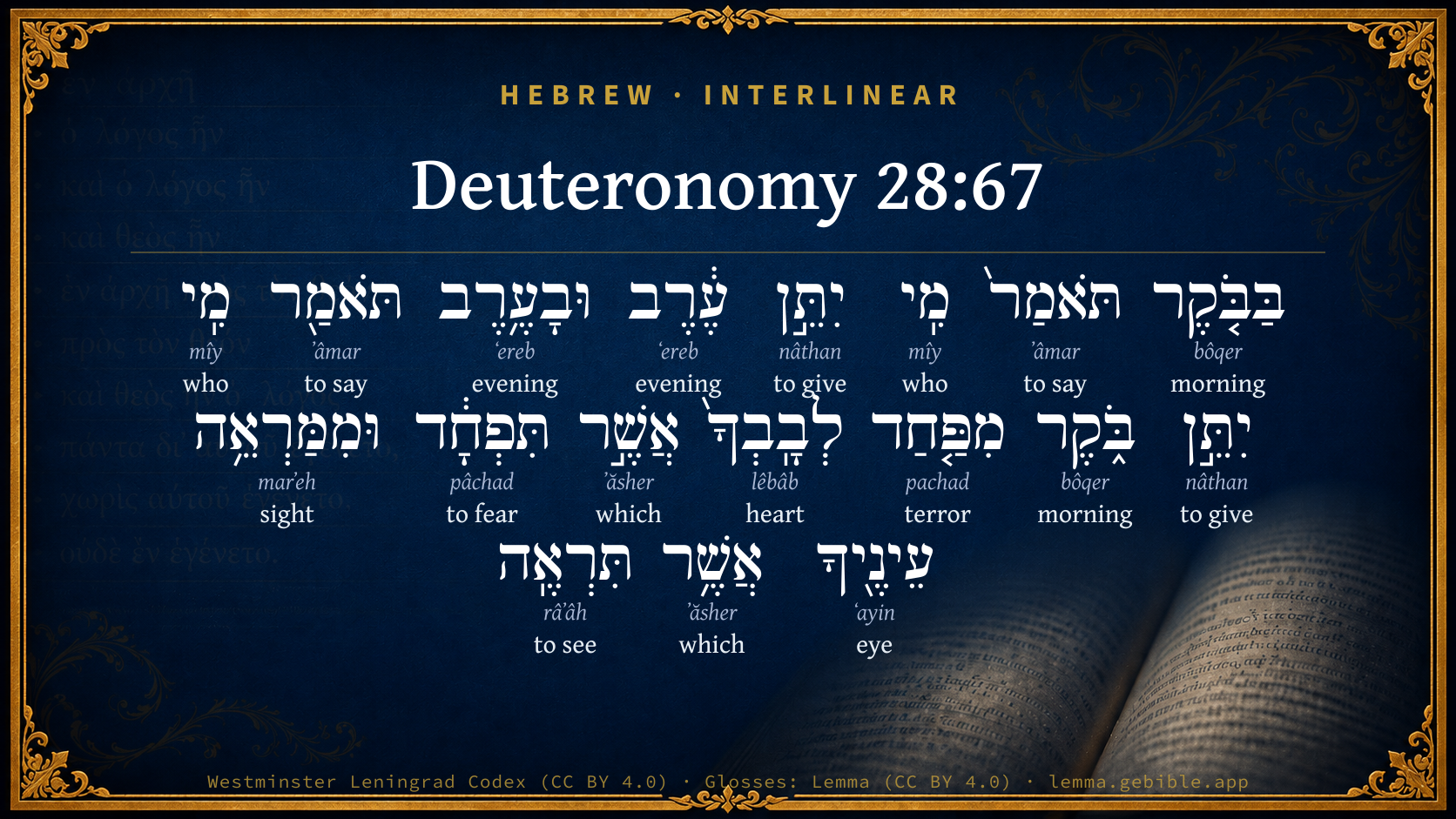
Deuteronomy 28:67

Hebrew (Westminster Leningrad Codex) Deuteronomy 28:67 appears in the Hebrew Old Testament. The text above is from the Westminster Leningrad Codex. Each word links to its Strong’s number, a concise gloss, and parsing drawn from the Open Scriptures Hebrew Bible morphology. Click any word for its full Brown-Driver-Briggs (BDB) entry.
Download image
Cite this verse

Deuteronomy 28:67 (World English Bible). Public Domain. Lemma interlinear Bible study tool, https://lemma.gebible.app/v/deuteronomy/28/67.

Show BibTeX & RIS
BibTeX
RIS
English Translation
In the morning you shall say, Would it were even! and at even you shall say, Would it were morning! for the fear of your heart which you shall fear, and for the sight of your eyes which you shall see.
World English Bible · Public Domain
Download a study sheet

One document with this verse’s original text, its word-by-word gloss line, the meaning frame, cross-references with their text, attributed commentary, and full source and license credits — printable, and it pastes into notes with its structure intact.

This verse Autodidact and up

Study sheet (.html) Plain text (.txt)

A passage Seminary Student

Up to 50 verses in one chapter. A passage sheet keeps up to 6 commentary sources and 12 cross-references per verse, in the order this page ranks them, and says so on the sheet whenever that leaves anything out. Ask for a single verse and you get the Autodidact verse sheet above.

Everything on this page stays free to read, with no account — the sheet is a download of what is already on screen, not access to it.

Want to remove ads? Support Godless Engineer
Compare translations 3

The same verse in 3 English versions, stacked beneath the original-language interlinear above. Click any original word for its lexicon entry.

Each is an independent rendering of the whole verse — the interlinear is not word-aligned to these translations.

Highlighted words mark where these versions differ — a whole-verse word diff, not a word-by-word alignment.

  • World English Bible Public Domain
    In the morning you shall say, Would it were even! and at even you shall say, Would it were morning! for the fear of your heart which you shall fear, and for the sight of your eyes which you shall see.
  • King James Version Public Domain
    In the morning thou shalt say, Would God it were even! and at even thou shalt say, Would God it were morning! for the fear of thine heart wherewith thou shalt fear, and for the sight of thine eyes which thou shalt see.
  • unfoldingWord Literal Text CC BY-SA 4.0
    In the morning you will say, ‘Who gives evening?’ and in the evening you will say, ‘Who gives morning?’ because of the fear in your hearts that you fear and the view of your eyes that you will see.

unfoldingWord Literal Text — © unfoldingWord, licensed CC BY-SA 4.0. Word-aligned USFM3 via Door43 (git.door43.org/unfoldingWord/en_ult).

Versions to compare (up to 4)

3 of 4 selected

Show all 18 translations

Every available English version of this verse, each an independent rendering of the whole verse.

  • World English Bible Public Domain
    In the morning you shall say, Would it were even! and at even you shall say, Would it were morning! for the fear of your heart which you shall fear, and for the sight of your eyes which you shall see.
  • Berean Standard Bible Public Domain
    In the morning you will say, ‘If only it were evening!’ and in the evening you will say, ‘If only it were morning!’—because of the dread in your hearts of the terrifying sights you will see.
  • Majority Standard Bible Public Domain
    In the morning you will say, ‘If only it were evening!’ and in the evening you will say, ‘If only it were morning!’—because of the dread in your hearts of the terrifying sights you will see.
  • King James Version Public Domain
    In the morning thou shalt say, Would God it were even! and at even thou shalt say, Would God it were morning! for the fear of thine heart wherewith thou shalt fear, and for the sight of thine eyes which thou shalt see.
  • American Standard Version (1901) Public Domain
    In the morning thou shalt say, Would it were even! and at even thou shalt say, Would it were morning! for the fear of thy heart which thou shalt fear, and for the sight of thine eyes which thou shalt see.
  • Revised Version (1885) Public Domain
    in the morning thou shalt say, Would God it were even! and at even thou shalt say, Would God it were morning! for the fear of thine heart which thou shalt fear, and for the sight of thine eyes which thou shalt see.
  • Geneva Bible (1599) Public Domain
    In the morning thou shalt say, Woulde God it were euening, and at the euening thou shalt say, Would God it were morning, for ye feare of thine heart, which thou shalt feare, and for the sight of thine eyes, which thou shalt see.
  • Douay-Rheims (1899) Public Domain
    In the morning thou shalt say: Who will grant me evening? and at evening: Who will grant me morning? for the fearfulness of thy heart, wherewith thou shalt be terrified, and for those things which thou shalt see with thy eyes.
  • Young's Literal Translation Public Domain
    in the morning thou sayest, O that it were evening! and in the evening thou sayest, O that it were morning! from the fear of thy heart, with which thou art afraid, and from the sight of thine eyes which thou seest.
  • Literal Standard Version CC BY-SA 4.0
    in the morning you say, O that it were evening! And in the evening you say, O that it were morning! (From the fear of your heart, with which you are afraid, and from the sight of your eyes which you see.)
  • Unlocked Literal Bible CC BY-SA 4.0
    In the morning you will say, 'I wish it were evening!' and in the evening you will say, 'I wish it were morning!' because of the fear in your hearts and the things your eyes will have to see.
  • unfoldingWord Literal Text CC BY-SA 4.0
    In the morning you will say, ‘Who gives evening?’ and in the evening you will say, ‘Who gives morning?’ because of the fear in your hearts that you fear and the view of your eyes that you will see.
  • Darby Bible Public Domain
    In the morning thou shalt say, Would that it were even! and in the evening thou shalt say, Would that it were morning! through the fright of thy heart wherewith thou shalt be in terror, and through the sight of thine eyes which thou shalt see.
  • World Messianic Bible Public Domain
    In the morning you will say, “I wish it were evening!” and at evening you will say, “I wish it were morning!” for the fear of your heart which you will fear, and for the sights which your eyes will see.
  • Webster's Bible Public Domain
    In the morning thou shalt say, O that it were evening, and at evening thou shalt say, O that it were morning! for the fear of thy heart with which thou shalt fear, and for the sight of thy eyes which thou shalt see.
  • Free Bible Version CC BY-SA 4.0
    In the morning you'll say, “I wish it was evening!” and in the evening you'll say, “I wish it was morning!” because you're so frightened by the terrifying things you see.
  • Bible in Basic English Public Domain
    In the morning you will say, If only it was evening! And at evening you will say, If only morning would come! Because of the fear in your hearts and the things which your eyes will see.
  • JPS Tanakh (1917) Public Domain
    In the morning thou shalt say: 'Would it were even!' and at even thou shalt say: 'Would it were morning!' for the fear of thy heart which thou shalt fear, and for the sight of thine eyes which thou shalt see.

Literal Standard Version (2020), Covenant Press — licensed CC BY-SA 4.0. Text via the HelloAO Bible API (eBible.org). Unlocked Literal Bible (unfoldingWord) — licensed CC BY-SA 4.0. Text via the HelloAO Bible API (eBible.org). unfoldingWord Literal Text — © unfoldingWord, licensed CC BY-SA 4.0. Word-aligned USFM3 via Door43 (git.door43.org/unfoldingWord/en_ult). Free Bible Version, Dr. Jonathan Gallagher — licensed CC BY-SA 4.0. Text via the HelloAO Bible API (eBible.org).

Word by word

More ways to search: Search by grammar → Find every occurrence → Compare this word →

Practice this passage: Drill this verse → Learn its vocabulary →

תִּפְחָ֔ד
pâchad
H6342
“to fear”
Verb, Qal, Imperfect, 2nd Person, Masculine, Singular
Part of Speech
Verb
Stem
Qal
Form
Imperfect
Person
2nd Person
Gender
Masculine
Number
Singular
Full BDB Definition

Origin: a primitive root

TWOT: 1756

to fear, tremble, revere, dread, be in awe or dread - (Qal) - to be in dread - to be in awe - (Piel) to be in great dread - (Hiphil) to cause to dread
  1. בַּבֹּ֤קֶר bôqer H1242 “in/at the · morning” Preposition, Determined + Noun, Common, Masculine, Singular, Absolute
  2. תֹּאמַר֙ ʼâmar H559 “to say” Verb, Qal, Imperfect, 2nd Person, Masculine, Singular
  3. מִֽי mîy H4310 “who” Particle, Interrogative
  4. יִתֵּ֣ן nâthan H5414 “to give” Verb, Qal, Imperfect, 3rd Person, Masculine, Singular
  5. עֶ֔רֶב ʻereb H6153 “evening” Noun, Common, Masculine, Singular, Absolute
  6. וּבָעֶ֥רֶב ʻereb H6153 “and · in/at the · evening” Conjunction + Preposition, Determined + Noun, Common, Masculine, Singular, Absolute
  7. תֹּאמַ֖ר ʼâmar H559 “to say” Verb, Qal, Imperfect, 2nd Person, Masculine, Singular
  8. מִֽי mîy H4310 “who” Particle, Interrogative
  9. יִתֵּ֣ן nâthan H5414 “to give” Verb, Qal, Imperfect, 3rd Person, Masculine, Singular
  10. בֹּ֑קֶר bôqer H1242 “morning” Noun, Common, Masculine, Singular, Absolute
  11. מִפַּ֤חַד pachad H6343 “from · terror of” Preposition + Noun, Common, Masculine, Singular, Construct
  12. לְבָֽבְךָ֙ lêbâb H3824 “heart · your” Noun, Common, Masculine, Singular, Construct + Suffix, Personal, 2nd Person, Masculine, Singular
  13. אֲשֶׁ֣ר ʼăsher H834 “which” Particle, Relative
  14. וּמִמַּרְאֵ֥ה marʼeh H4758 “and · from · sight of” Conjunction + Preposition + Noun, Common, Masculine, Singular, Construct
  15. עֵינֶ֖יךָ ʻayin H5869 “eyes · your” Noun, Common, Both, Dual, Construct + Suffix, Personal, 2nd Person, Masculine, Singular
  16. אֲשֶׁ֥ר ʼăsher H834 “which” Particle, Relative
  17. תִּרְאֶֽה râʼâh H7200 “to see” Verb, Qal, Imperfect, 2nd Person, Masculine, Singular

About this verse

These counts appear in no published source. They are computed here, from the morphology-tagged text and Lemma’s own curated glosses. What Lemma adds →

18
words
12
distinct lemmas
Pentateuch
section

Notable vocabulary

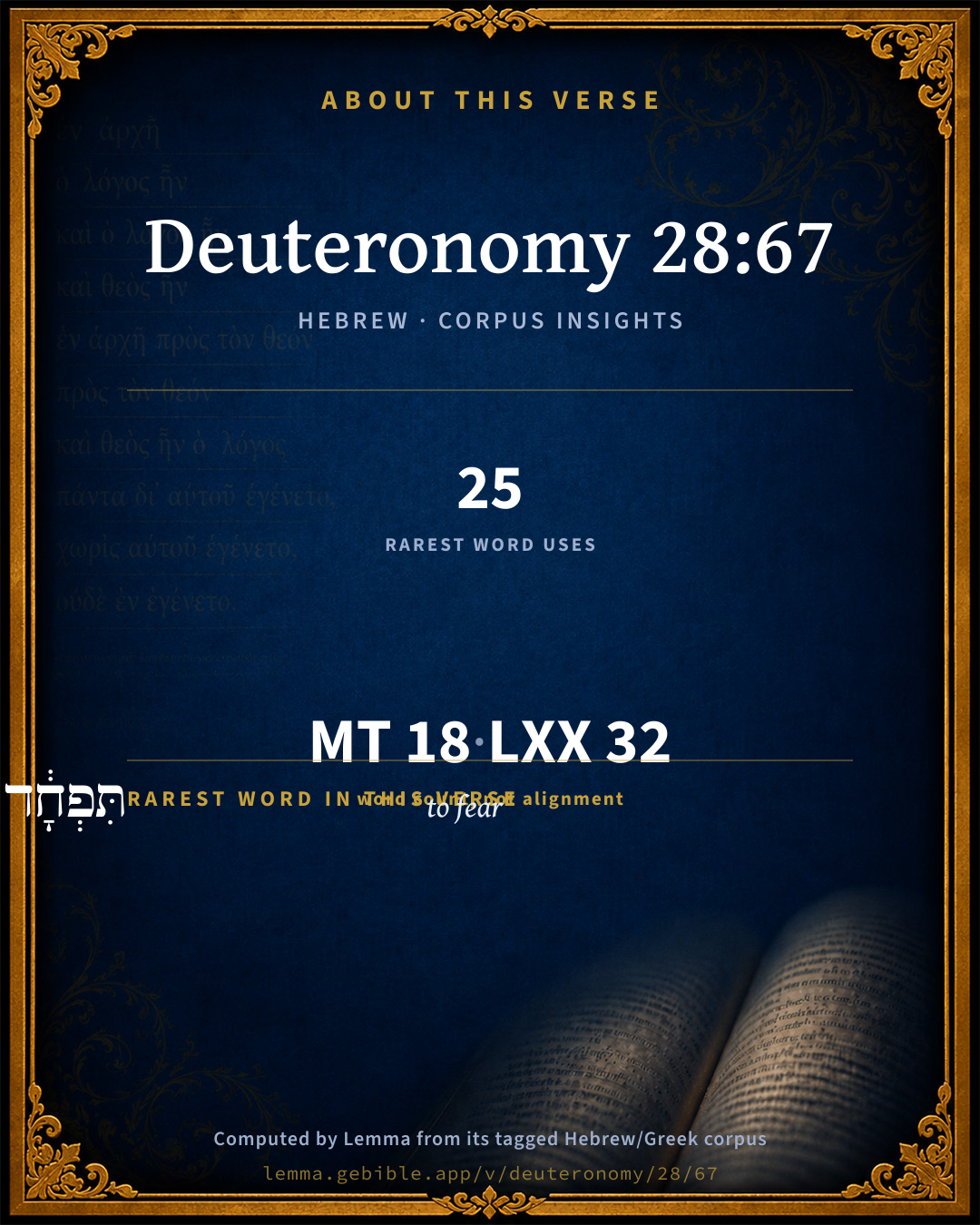
The rarest word here is תִּפְחָ֔ד to fear H6342 — appearing just 25 times in the whole Hebrew Bible.

Shared distinctive vocabulary

תִּפְחָ֔ד to fear H6342 occurs in 25 verses of the Hebrew Bible. Also found in:

Grammatical profile

  • 6 verbs
  • 8 nouns
  • 4 particles

Verb forms

  • תֹּאמַר֙ Qal · Imperfect
  • יִתֵּ֣ן Qal · Imperfect
  • תֹּאמַ֖ר Qal · Imperfect
  • יִתֵּ֣ן Qal · Imperfect
  • תִּפְחָ֔ד Qal · Imperfect
  • תִּרְאֶֽה Qal · Imperfect

Repetition

Words recur within this verse — often emphatic in Hebrew:

  • בַּבֹּ֤קֶר morning H1242 ×2
  • תֹּאמַר֙ to say H559 ×2
  • יִתֵּ֣ן to give H5414 ×2
  • עֶ֔רֶב evening H6153 ×2
  • מִֽי who H4310 ×2
  • אֲשֶׁ֣ר which H834 ×2

Hebrew & Septuagint length

In English translation the verse runs 41 words from the Hebrew and 43 from the Septuagint (LXX English) — closely comparable.

A rough comparison of the two English renderings, which tokenize alike — not a word-level alignment.

Word counts can differ between the Hebrew and the Greek without any difference in meaning — e.g. the Hebrew direct-object marker אֵת has no separate Greek word, and Greek often adds the article ὁ.

In the original languages it is 18 Hebrew tokens and 32 Greek tokens — but the two are counted differently (Hebrew bundles its prefixes and suffixes into one token; the Greek is in lemma form), so that isn’t a like-for-like length.

Cross-references

3

Topical passages linked to Deuteronomy 28:67 in the Treasury of Scripture Knowledge — connected by theme and wording, ordered by reader-vote popularity; previews shown in the World English Bible.

  • Deuteronomy 28:34 so that you shall be mad for the sight of your eyes which you shall see.
  • Job 7:3–4 So am I made to possess months of misery, Wearisome nights are appointed to me.
  • Revelation 9:6 In those days people will seek death, and will in no way find it. They will desire to die, and death will flee from them.

Cross-references courtesy of OpenBible.info (CC BY 4.0).

Hebrew and Greek witnesses Masoretic Hebrew ↔ Greek Septuagint

The same verse in the two great witnesses to the Old Testament, shown verse-for-verse.

These are two independent witnesses, not word-aligned to each other, and the Septuagint is shown in lemma (dictionary) form.

Hebrew Deuteronomy 28:67 Masoretic · Westminster Leningrad Codex

בַּבֹּ֤קֶר תֹּאמַר֙ מִֽי יִתֵּ֣ן עֶ֔רֶב וּבָעֶ֥רֶב תֹּאמַ֖ר מִֽי יִתֵּ֣ן בֹּ֑קֶר מִפַּ֤חַד לְבָֽבְךָ֙ אֲשֶׁ֣ר תִּפְחָ֔ד וּמִמַּרְאֵ֥ה עֵינֶ֖יךָ אֲשֶׁ֥ר תִּרְאֶֽה

In the morning you shall say, Would it were even! and at even you shall say, Would it were morning! for the fear of your heart which you shall fear, and for the sight of your eyes which you shall see.

World English Bible · Public Domain

Greek LXX Deuteronomy 28:67 Septuagint · lemma form

ὁ πρωΐ εἶπον πῶς ἄν γίγνομαι ἑσπέρα καί ὁ ἑσπέρα εἶπον πῶς ἄν γίγνομαι πρωΐ ἀπό ὁ φόβος ὁ καρδία σύ ὅς φοβέω καί ἀπό ὁ ὅραμα ὁ ὀφθαλμός σύ ὅς ὁράω

In the morning you shall say, Would it were evening! and in the evening you shall say, Would it were morning! for the fear of your heart with which you shall fear, and for the sights of your eyes which you shall see.

LXX2012 (modern English Septuagint) · Public Domain

Hebrew: Westminster Leningrad Codex (CC BY 4.0). Greek: Septuagint (public domain); English from LXX2012 (modern English Septuagint) (Public Domain). How the Septuagint differs from the Hebrew →

Targum (Aramaic paraphrase)

2

The Targum is the ancient Jewish Aramaic paraphrase of the Hebrew Scriptures — an interpretive translation, not the Hebrew text itself. Onkelos (literal) and Pseudo-Jonathan (expansive) render the Torah, and Jonathan the Prophets. Coverage is partial: where no permissively-licensed English translation exists for a verse, only the Aramaic is shown. This is verse-level text, not a word-by-word alignment to the Hebrew.

  1. Targum Onkelos Torah (Genesis–Deuteronomy)
    בְּצַפְרָא תֵימַר מָן יִתֵּן רַמְשָׁא וּבְרַמְשָׁא תֵימַר מָן יִתֵּן צַפְרָא מִתַּוְהוּת לִבָּךְ דִי תְהֵי תָוֵה וּמֵחֵזוּ עֵינָיךְ דִי תְהֵי חָזֵי

    (no public-domain English translation for this verse)

    Targum Onkelos — Aramaic: “Onkelos Genesis” (public domain); “Onkelos Exodus” (public domain); “Onkelos Leviticus” (public domain); “Onkelos Numbers” (public domain); “Onkelos Deuteronomy” (public domain). English: “Sefaria Community Translation” (CC0 1.0 (public-domain dedication)); “J.W. Etheridge. The Targums of Onkelos and Jonathan Ben Uzziel on the Pentateuch. London: Longmans, Green, 1862” (public domain). Text via Sefaria.

  2. Targum Pseudo-Jonathan Torah (Genesis–Deuteronomy)
    בְּצַפְרָא תֶהֱווֹן אָמְרִין לְוַאי דִיהֵי רַמְשָׁא דְעָקַן מְאַרְכָן שְׁעֵי יוֹמָא בְּאַפֵּיכוֹן וּבְרַמְשָׁא תֶּהֱווֹן אָמְרִין לְוַאי דִיהֵי צַפְרָא דְעָקַן מְאַרְכָן שְׁעֵי לֵילְיָא בְּאַפֵּיכוֹן מִתַּוְוהִית לִבְּכוֹן דְתֶהֱווֹן תַּוָון וּמִן מֵחְמֵי עֵינֵיכוֹן דְאַתּוּן חַמְיָין פּוּרְעֲנוּתָא וְדַחֲלוּן

    In the morning you will say, O that it were evening! for afflictions will make the hours of the day longer before you; and at evening you will say, O that it were morning! for afflictions will make the hours of the night longer before you, because of the terror of your heart; for you will be in stupor by a vision of your eyes, which you will see for punishment, and be terrified.

    Targum Pseudo-Jonathan — Aramaic: “Targum Jonathan on Genesis” (public domain); “Targum Jonathan on Exodus” (public domain); “Targum Jonathan on Leviticus” (public domain); “Targum Jonathan on Numbers” (public domain); “Targum Jonathan on Deuteronomy” (public domain). English: “The Targum of Jonathan ben Uzziel, trans. J. W. Etheridge, London, 1862” (public domain). Text via Sefaria.

Commentary

Notes on Deuteronomy 28:67 from classic Christian and Jewish commentators (each source and its license shown beneath its notes). The classic Christian expositions comment on the surrounding passage and are grouped to its opening verse, so a note may address several verses; the Jewish commentaries on the Tanakh (Rashi and others) are per-verse, so they appear only where the commentator wrote on this verse.

Lemma curates 59 commentaries, every one of them public domain or Creative Commons licensed, each selected and text-cleaned for this edition rather than reprinted as found. About our sources →

Trapp's Complete Commentary

John Trapp

Deu 28:67 In the morning thou shalt say, Would God it were even! and at even thou shalt say, Would God it were morning! for the fear of thine heart wherewith thou shalt fear, and for the sight of thine eyes which thou shalt see.

Ver. 67. Would God it were even.] A graphical description of misery. Compare Job 7:3-4.

John Trapp, A Commentary or Exposition upon All the Books of the Old and New Testament (1647–1656) — public domain. Text from a community e-Sword module.

The Biblical Illustrator

Joseph S. Exell

Deu_28:67

Would God it were even!

Sufferings of the Israelites

This chapter is an awful communication: it threatens the Israelites with every conceivable evil if they departed from serving the Lord their God; it leaves them absolutely without hope unless they turned with all their hearts, and repented them of their disobedience.

So the Israelites entered Canaan and took the lands of the heathen into possession, not without much to sober their prides and to make them not high minded, but fear. The severe judgments spoken of ill this chapter declare also another great law of Gods providence, that to whomsoever much is given, of him shall much be required. It was because the Israelites were Gods redeemed people, because He had borne them on eagles wings and brought them to Himself; because He had made known to them His will, and promised them the possession of a goodly land, flowing with milk and honey; it was for these very reasons that their punishment was to be so severe if they at last abused all the mercies which had been shown to them. For theirs was to be no sudden destruction, to come upon them and sweep them away forever: it was a long and lingering misery, to endure for many generations, like the bush which burned, but was not consumed. We know that Ammon, Amalek, Moab, Assyria, and Babylon have long since utterly perished; the three former, indeed, so long ago, that profane history does not notice them; its beginnings are later than their end. But Israel still exists as a nation, however scattered and degraded; they have gone through for ages a long train of oppressions, visited on them merely because they were Jews. Nay, even yet the end is not; however much their condition is bettered, still, taking them the world through, they have even now much to bear; their hope is still deferred, and as far as their national prospects are concerned, the morning dawns on them with no comfort, the evening descends upon them and brings no rest. This is one remarkable part in their history; and there is another which deserves notice. It is declared in this chapter that amongst the other evils they should suffer for disobedience, they should endure so long a siege from their enemies as to suffer the worst extremities of famine (Deu_28:56). Now, this has, in fact, befallen them twice over. Of the siege of Jerusalem by Nebuchadnezzar we have, indeed, no particulars given; it is only said, in general terms, that after the city had been besieged for eighteen months the famine prevailed in it, and there was no bread for the people of the land, so that the king and all the fighting men endeavoured to escape out of the town as the only resource left them. But of the second siege, by Titus and the Romans, we have the full particulars from Josephus, a Jew, who lived at the time, and had the best authority for the facts which he relates. And he mentions it as a horror unheard of amongst Greeks or barbarians, that a mother, named Mary, the daughter of Eleazar, from the country beyond Jordan, was known to have killed her own child for her food, and to have publicly confessed what she had done. Now, we know that the horrors of war have been felt by many nations; but such an extremity of suffering occurring twice in the course of its history, and under circumstances so similar, as in the two sieges of Jerusalem, there is hardly another nation, so far as I am aware, that has experienced. Indeed, the history of the calamities of the last siege of Jerusalem, as given by Josephus, is well worthy of our attentive consideration: it is a full comment on our Lords words (Luk_23:28; Luk_23:30; Mat_24:22). Eleven hundred thousand Jews perished in the course of the siege, by the sword, by pestilence, or by famine. I do not believe that the history of the world contains any record of such a destruction within so short a time, and within the walls of a single city. I said that this dreadful story was well worth our studying; and it is so for this reason. These miseries, greater than any which history mentions, fell upon Gods Church, upon His chosen people, with whom He was in covenant, to whom He had revealed His name, while all the rest of the world lay in darkness. To us, each of us, belongs in the strictest sense the warning of the text. For us, each of us,--if we do fail of the grace of God, if Christ has died for us in vain, if, being called by His name, we are not walking in His Spirit,--there is reserved a misery of which, indeed, the words of the text are no more than a feeble picture. There is a state in which they who are condemned to it shall forever say: In the morning would God it were even, etc. There is a state in which the tender and delicate woman shall hate those whom once she most loved; in which they who lived together hero in friendship wherein God was no party, will have their eyes evil against one another forever. For when selfishness has wrought its perfect work, and the soul is utterly lost, there love is perished forever, and the intercourse between such persons can be only one of mutual reproaches and suspicion and hatred. An eternal restlessness and eternal evil passions mark the everlasting portion of the enemies of God; just as an eternal rest and a never-ending life of love and peace are reserved for those who remain to the end His true children. (T. Arnold, D. D.)

.

The Biblical Illustrator, edited by Joseph S. Exell (c. 1880s–1900s) — public domain. Text from a community e-Sword module.

Ellicott's Commentary for English Readers

(67) Thou shalt say.—The Talmud expounds this of the constant increase of trouble. Yesterday evening this morning was longed for. To-day the trouble is more terrible, and every hour adds to the curse. But the description in the text needs nothing to augment its horrors.

A Bible Commentary for English Readers, edited by Charles John Ellicott (1878–1897) — public domain. Text from a community e-Sword module.

The Cambridge Bible for Schools and Colleges

gen. ed. J. J. S. Perowne

67. Cp. Job_7:4 and above Deu_28:34.

There were two sides to Israel’s life in exile. Jeremiah (Jer_29:4 ff.) advised the exiles in Babylon to settle down quietly into their new conditions and prosper as they could. This many of them did so thoroughly that it was difficult, if not impossible, to move them to return to Judaea. But a passage like Psalms 137 gives the other side, which this section of D predicts in such terrible detail. On the whole, it seems that the section was written previous to the Babylonian Exile. There is nothing in it hostile to a pre-exilic date.

The Cambridge Bible for Schools and Colleges (gen. ed. J. J. S. Perowne; Cambridge University Press, 1878–1918) — public domain. Text from a community e-Sword module.

Whedon's Commentary on the Bible

Daniel D. Whedon

67. In the morning thou shalt say, etc. — In constant dread of what day or night may bring forth. Comp. Job_7:4. Luther says, “I have never seen a passage which describes more clearly the misery of a guilty conscience in words and thoughts so fitting and appropriate. For this is just the way in which a man is affected who knows that God is offended.

Daniel D. Whedon (gen. ed.), Commentary on the Old and New Testaments (1874–1909) — public domain. Text from a community e-Sword module.

unfoldingWord translationNotes

Door43 World Missions Community

General Information:

Moses speaks to the Israelites as if they were one man, so the words "you" and "your" here are singular. (See: Forms of You)

because of the fear in your hearts

This is an idiom. AT: "because of the fear you are feeling" (See: Idiom)

the things your eyes will have to see

Here "eyes" refers to the whole person. AT: "the terrifying things I will force you to see" (See: Synecdoche and Assumed Knowledge and Implicit Information)

I had said

Here "I" refers to Yahweh.

translationWords

fear

heart

Egypt

adversary

servant

unfoldingWord translationNotes — © Distant Shores Media and the Door43 World Missions Community, licensed CC BY-SA 4.0. Source: git.door43.org/Door43/en_tn.

Rashi

Rabbi Shlomo Yitzchaki (Rashi)

בבקר תאמר מי יתן ערב IN THE MORNING THOU SHALT SAY, WOULD IT WERE EVEN! — i.e. would that it were again yesterday evening,

ובערב תאמר מי יתן בקר AND AT EVEN THOU SHALT SAY, WOULD IT WERE MORNING! — i.e. the morning of today, because the misery will constantly grow more severe, and the curse of each hour will be greater than that of the preceding (cf. Sotah 49a).

Rashi on the Tanakh — English translations: “The Judaica Press complete Tanach with Rashi, translated by A. J. Rosenberg” (CC BY 4.0); “Pentateuch with Rashi's commentary by M. Rosenbaum and A.M. Silbermann, 1929-1934” (public domain); “The Metsudah Tanach series, Lakewood, N.J” (CC BY 4.0); and “The Book of Joshua, Metsudah Publications, 1997” (CC BY 4.0). Text via Sefaria.

Lesson kit

Teaching starters — assembled from the data on this page, not authored interpretation. Every prompt links to the verse data it draws on. Edit before teaching.

Deuteronomy, in the Pentateuch, opens this verse with 18 words (12 distinct Hebrew lemmas). Its most distinctive word is pâchad (“to fear”). A historical commentator’s framing appears above. Read the whole chapter for the surrounding context.

Discussion questions

  1. The word pâchad carries the sense “to fear.” How does it shape the verse?
  2. Deuteronomy 28:66 shares the word «to fear» with this verse. How do the two illuminate each other?
  3. “morning” occurs 2× in this one verse. What is the effect of the repetition?
  4. These translations render this verse differently. What is at stake in choosing one wording over another?
  5. The verb «תֹּאמַר֙» is Qal Imperfect. How does its form color the action?
  6. Reading how Trapp's Complete Commentary and The Biblical Illustrator read this verse, where do the two commentators agree and where do they part?

Things to notice

Reading settings

Reading text

Shown beneath each verse's original-language words.

Old Testament
Old Testament edition

Read the OT as the Masoretic Hebrew (MT) or the Greek Septuagint (LXX).

English shown for the Greek Septuagint (in the Hebrew ↔ Greek comparison).

Comparing translations? Open the Compare panel on any verse page to stack up to four side by side.