
Genesis 30:31

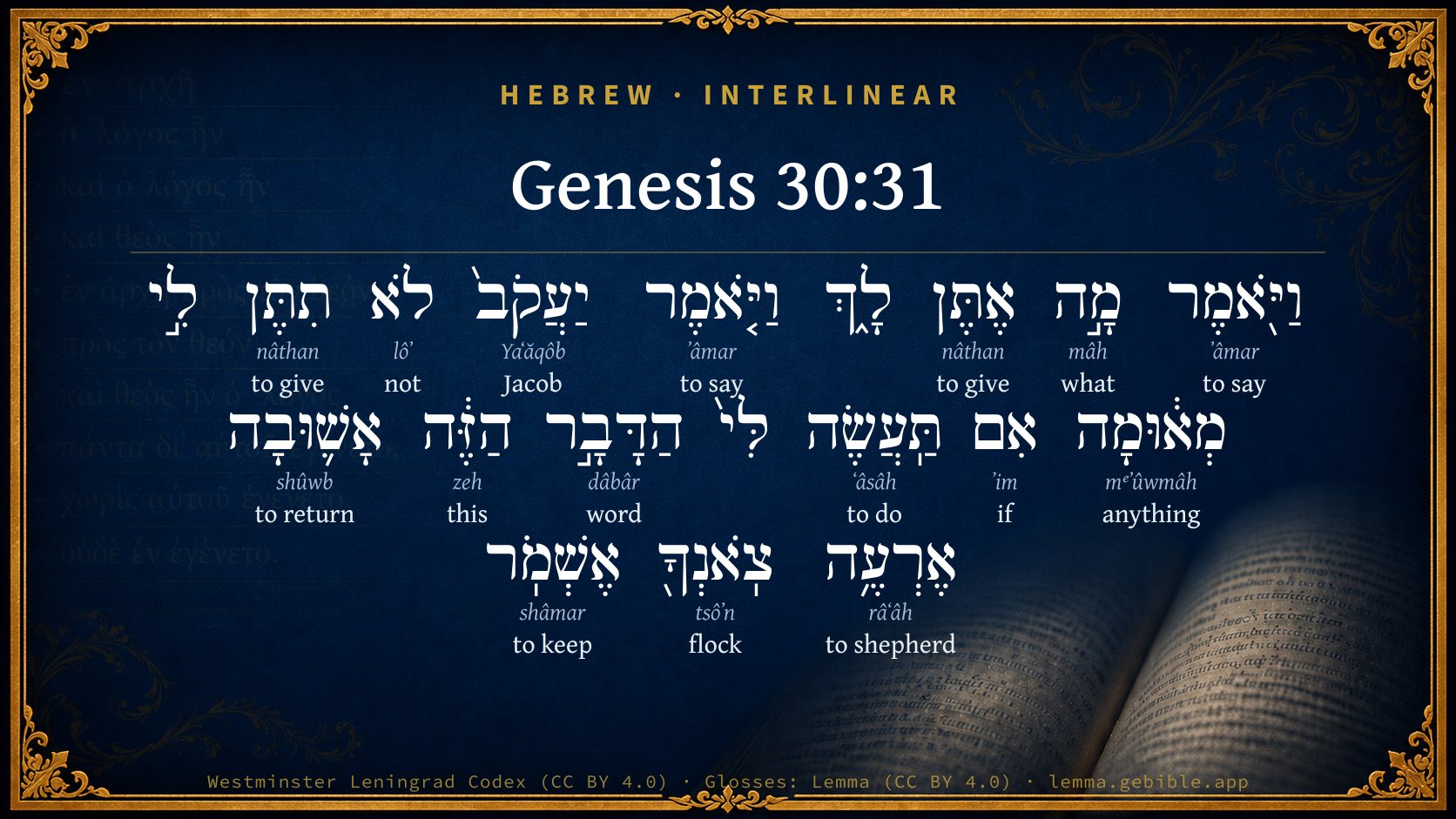
Hebrew (Westminster Leningrad Codex) Genesis 30:31 appears in the Hebrew Old Testament. The text above is from the Westminster Leningrad Codex. Each word links to its Strong’s number, a concise gloss, and parsing drawn from the Open Scriptures Hebrew Bible morphology. Click any word for its full Brown-Driver-Briggs (BDB) entry.
Download image
Cite this verse

Genesis 30:31 (World English Bible). Public Domain. Lemma interlinear Bible study tool, https://lemma.gebible.app/v/genesis/30/31.

Show BibTeX & RIS
BibTeX
RIS
English Translation
He said, "What shall I give you?" Jacob said, "You shall not give me anything. If you will do this thing for me, I will again feed your flock and keep it.
World English Bible · Public Domain
Download a study sheet

One document with this verse’s original text, its word-by-word gloss line, the meaning frame, cross-references with their text, attributed commentary, and full source and license credits — printable, and it pastes into notes with its structure intact.

This verse Autodidact and up

Study sheet (.html) Plain text (.txt)

A passage Seminary Student

Up to 50 verses in one chapter. A passage sheet keeps up to 6 commentary sources and 12 cross-references per verse, in the order this page ranks them, and says so on the sheet whenever that leaves anything out. Ask for a single verse and you get the Autodidact verse sheet above.

Everything on this page stays free to read, with no account — the sheet is a download of what is already on screen, not access to it.

Want to remove ads? Support Godless Engineer
Compare translations 3

The same verse in 3 English versions, stacked beneath the original-language interlinear above. Click any original word for its lexicon entry.

Each is an independent rendering of the whole verse — the interlinear is not word-aligned to these translations.

Highlighted words mark where these versions differ — a whole-verse word diff, not a word-by-word alignment.

  • World English Bible Public Domain
    He said, "What shall I give you?" Jacob said, "You shall not give me anything. If you will do this thing for me, I will again feed your flock and keep it.
  • King James Version Public Domain
    And he said, What shall I give thee? And Jacob said, Thou shalt not give me any thing: if thou wilt do this thing for me, I will again feed and keep thy flock.
  • unfoldingWord Literal Text CC BY-SA 4.0
    Then he said, “What should I give to you?” And Jacob said, “Do not give anything to me. If you will do this thing for me, I will continue tending your flock watching over:

unfoldingWord Literal Text — © unfoldingWord, licensed CC BY-SA 4.0. Word-aligned USFM3 via Door43 (git.door43.org/unfoldingWord/en_ult).

Versions to compare (up to 4)

3 of 4 selected

Show all 18 translations

Every available English version of this verse, each an independent rendering of the whole verse.

  • World English Bible Public Domain
    He said, "What shall I give you?" Jacob said, "You shall not give me anything. If you will do this thing for me, I will again feed your flock and keep it.
  • Berean Standard Bible Public Domain
    “What can I give you?” Laban asked. “You do not need to give me anything,” Jacob replied. “If you do this one thing for me, I will keep on shepherding and keeping your flocks.
  • Majority Standard Bible Public Domain
    “What can I give you?” Laban asked. “You do not need to give me anything,” Jacob replied. “If you do this one thing for me, I will keep on shepherding and keeping your flocks.
  • King James Version Public Domain
    And he said, What shall I give thee? And Jacob said, Thou shalt not give me any thing: if thou wilt do this thing for me, I will again feed and keep thy flock.
  • American Standard Version (1901) Public Domain
    And he said, What shall I give thee? And Jacob said, Thou shalt not give me aught: if thou wilt do this thing for me, I will again feed thy flock and keep it.
  • Revised Version (1885) Public Domain
    And he said, What shall I give thee? And Jacob said, Thou shalt not give me aught: if thou wilt do this thing for me, I will again feed thy flock and keep it.
  • Geneva Bible (1599) Public Domain
    Then he saide, What shall I giue thee? And Iaakob answered, Thou shalt giue mee nothing at all: if thou wilt doe this thing for mee, I will returne, feede, and keepe thy sheepe.
  • Douay-Rheims (1899) Public Domain
    And Laban said: What shall I give thee? But he said: I require nothing: but if thou wilt do what I demand, I will feed, and keep thy sheep again.
  • Young's Literal Translation Public Domain
    And he saith, `What do I give to thee?' And Jacob saith, `Thou dost not give me anything; if thou do for me this thing, I turn back; I have delight; thy flock I watch;
  • Literal Standard Version CC BY-SA 4.0
    And he says, “What do I give to you?” And Jacob says, “You do not give me anything; if you do this thing for me, I turn back; I have delight; I watch your flock;
  • Unlocked Literal Bible CC BY-SA 4.0
    So Laban said, “What will I pay you?” Jacob said, “You will not give me anything. If you will do this thing for me, I will again feed your flock and keep it.
  • unfoldingWord Literal Text CC BY-SA 4.0
    Then he said, “What should I give to you?” And Jacob said, “Do not give anything to me. If you will do this thing for me, I will continue tending your flock watching over:
  • Darby Bible Public Domain
    And he said, What shall I give thee? And Jacob said, Thou shalt not give me anything. If thou doest this for me, I will again feed [and] keep thy flock:
  • World Messianic Bible Public Domain
    Laban said, “What shall I give you?” Jacob said, “You shall not give me anything. If you will do this thing for me, I will again feed your flock and keep it.
  • Webster's Bible Public Domain
    And he said, What shall I give thee? And Jacob said, Thou shalt not give me any thing; if thou wilt do this thing for me, I will again feed and keep thy flock:
  • Free Bible Version CC BY-SA 4.0
    “Well, what do you propose I give you?” Laban asked again. “You don't have to give me anything,” Jacob replied. “If you want to do something for me, then how about this: I'll go on looking after your flocks, making sure they're fed.
  • Bible in Basic English Public Domain
    And Laban said, What am I to give you? And Jacob said, Do not give me anything; but I will again take up the care of your flock if you will only do this for me:
  • JPS Tanakh (1917) Public Domain
    And he said: 'What shall I give thee?' And Jacob said: 'Thou shalt not give me aught; if thou wilt do this thing for me, I will again feed thy flock and keep it.

Literal Standard Version (2020), Covenant Press — licensed CC BY-SA 4.0. Text via the HelloAO Bible API (eBible.org). Unlocked Literal Bible (unfoldingWord) — licensed CC BY-SA 4.0. Text via the HelloAO Bible API (eBible.org). unfoldingWord Literal Text — © unfoldingWord, licensed CC BY-SA 4.0. Word-aligned USFM3 via Door43 (git.door43.org/unfoldingWord/en_ult). Free Bible Version, Dr. Jonathan Gallagher — licensed CC BY-SA 4.0. Text via the HelloAO Bible API (eBible.org).

Word by word

More ways to search: Search by grammar → Find every occurrence → Compare this word →

Practice this passage: Drill this verse → Learn its vocabulary →

מְא֔וּמָה
mᵉʼûwmâh
H3972
“anything”
Noun, Common, Feminine, Singular, Absolute
Part of Speech
Noun
Type
Common
Gender
Feminine
Number
Singular
State
Absolute
Full BDB Definition

Origin: apparently a form of H3971

TWOT: 1136

anything
  1. וַיֹּ֖אמֶר ʼâmar H559 “and · to say” Conjunction + Verb, Qal, Sequential Imperfect, 3rd Person, Masculine, Singular
  2. מָ֣ה mâh H4100 “what” Particle, Interrogative
  3. אֶתֶּן nâthan H5414 “to give” Verb, Qal, Imperfect, 1st Person, Common, Singular
  4. וַיֹּ֤אמֶר ʼâmar H559 “and · to say” Conjunction + Verb, Qal, Sequential Imperfect, 3rd Person, Masculine, Singular
  5. יַעֲקֹב֙ Yaʻăqôb H3290 “Jacob” Noun, Proper
  6. לֹא lôʼ H3808 “not” Particle, Negative
  7. תִתֶּן nâthan H5414 “to give” Verb, Qal, Imperfect, 2nd Person, Masculine, Singular
  8. אִם ʼim H518 “if” Conjunction
  9. תַּֽעֲשֶׂה ʻâsâh H6213 “to do” Verb, Qal, Imperfect, 2nd Person, Masculine, Singular
  10. הַדָּבָ֣ר dâbâr H1697 “the · word” Particle, Definite Article + Noun, Common, Masculine, Singular, Absolute
  11. הַזֶּ֔ה zeh H2088 “the · this” Particle, Definite Article + Pronoun, Demonstrative, Masculine, Singular
  12. אָשׁ֛וּבָה shûwb H7725 “to return” Verb, Qal, Cohortative, 1st Person, Common, Singular
  13. אֶרְעֶ֥ה râʻâh H7462 “to shepherd” Verb, Qal, Imperfect, 1st Person, Common, Singular
  14. צֹֽאנְךָ֖ tsôʼn H6629 “flock · your” Noun, Common, Both, Singular, Construct + Suffix, Personal, 2nd Person, Masculine, Singular
  15. אֶשְׁמֹֽר shâmar H8104 “to keep” Verb, Qal, Imperfect, 1st Person, Common, Singular

About this verse

These counts appear in no published source. They are computed here, from the morphology-tagged text and Lemma’s own curated glosses. What Lemma adds →

19
words
14
distinct lemmas
Pentateuch
section

Shared distinctive vocabulary

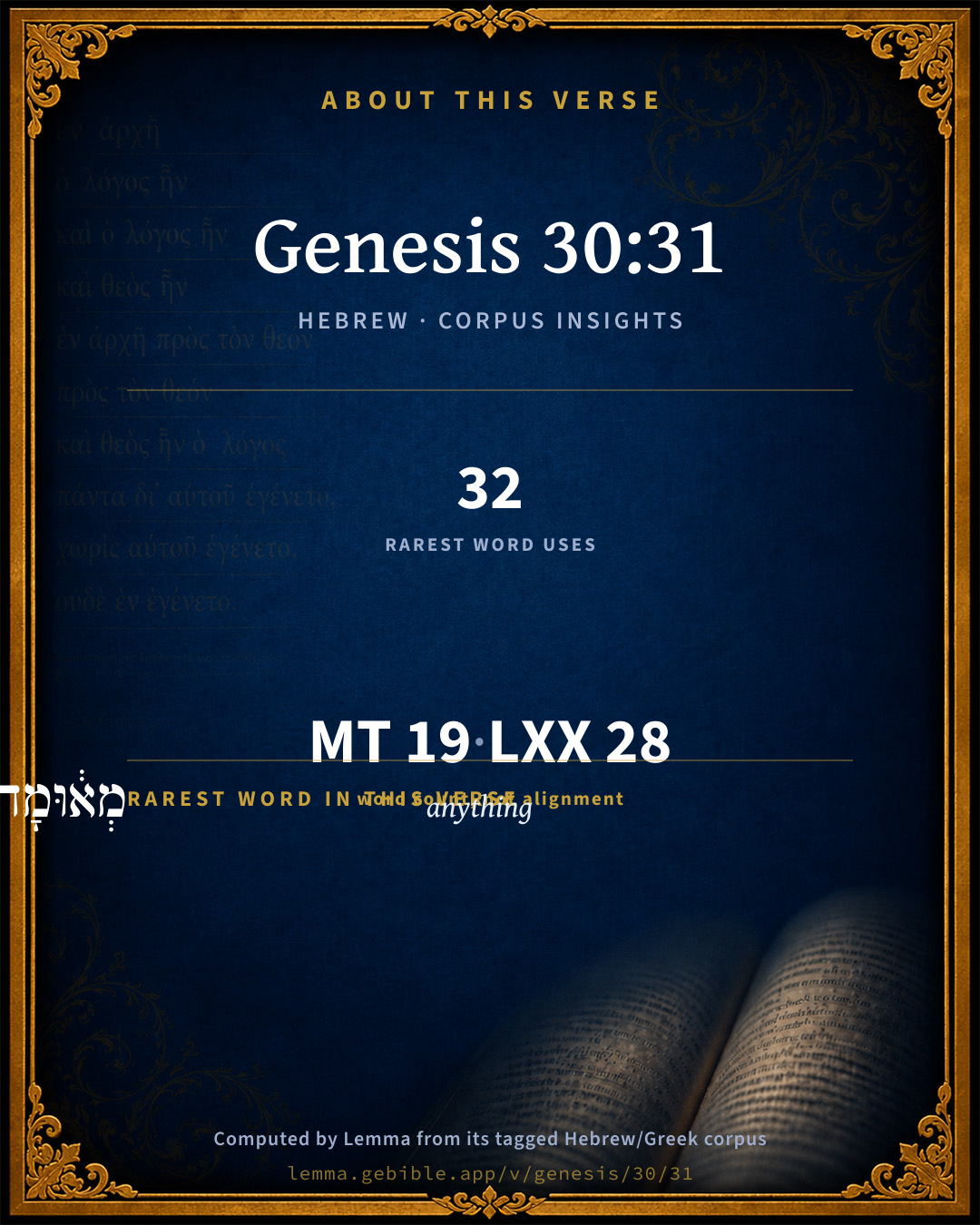
מְא֔וּמָה anything H3972 occurs in 32 verses of the Hebrew Bible. Also found in:

Grammatical profile

  • 8 verbs
  • 4 nouns
  • 1 pronoun
  • 3 prepositions
  • 1 conjunction
  • 2 particles

Verb forms

  • וַיֹּ֖אמֶר Qal · Sequential Imperfect
  • אֶתֶּן Qal · Imperfect
  • וַיֹּ֤אמֶר Qal · Sequential Imperfect
  • תִתֶּן Qal · Imperfect
  • תַּֽעֲשֶׂה Qal · Imperfect
  • אָשׁ֛וּבָה Qal · Cohortative
  • אֶרְעֶ֥ה Qal · Imperfect
  • אֶשְׁמֹֽר Qal · Imperfect

Repetition

Words recur within this verse — often emphatic in Hebrew:

  • וַיֹּ֖אמֶר to say H559 ×2
  • אֶתֶּן to give H5414 ×2

Hebrew & Septuagint length

In English translation the verse runs 32 words from the Hebrew and 38 from the Septuagint (LXX English) — closely comparable.

A rough comparison of the two English renderings, which tokenize alike — not a word-level alignment.

Word counts can differ between the Hebrew and the Greek without any difference in meaning — e.g. the Hebrew direct-object marker אֵת has no separate Greek word, and Greek often adds the article ὁ.

In the original languages it is 19 Hebrew tokens and 28 Greek tokens — but the two are counted differently (Hebrew bundles its prefixes and suffixes into one token; the Greek is in lemma form), so that isn’t a like-for-like length.

Cross-references

3

Topical passages linked to Genesis 30:31 in the Treasury of Scripture Knowledge — connected by theme and wording, ordered by reader-vote popularity; previews shown in the World English Bible.

  • 2 Samuel 21:4–6 The Gibeonites said to him, It is no matter of silver or gold between us and Saul, or his house; neither is it for us to put any man to death in Israel. He said, What you shall say, that will I do for you.
  • Psalms 118:8 It is better to take refuge in Yahweh, Than to put confidence in man.
  • Hebrews 13:5 Be free from the love of money, content with such things as you have, for he has said, "I will in no way leave you, neither will I in any way forsake you."

Cross-references courtesy of OpenBible.info (CC BY 4.0).

Hebrew and Greek witnesses Masoretic Hebrew ↔ Greek Septuagint

The same verse in the two great witnesses to the Old Testament, shown verse-for-verse.

These are two independent witnesses, not word-aligned to each other, and the Septuagint is shown in lemma (dictionary) form.

Hebrew Genesis 30:31 Masoretic · Westminster Leningrad Codex

וַיֹּ֖אמֶר מָ֣ה אֶתֶּן לָ֑ךְ וַיֹּ֤אמֶר יַעֲקֹב֙ לֹא תִתֶּן לִ֣י מְא֔וּמָה אִם תַּֽעֲשֶׂה לִּי֙ הַדָּבָ֣ר הַזֶּ֔ה אָשׁ֛וּבָה אֶרְעֶ֥ה צֹֽאנְךָ֖ אֶשְׁמֹֽר

He said, "What shall I give you?" Jacob said, "You shall not give me anything. If you will do this thing for me, I will again feed your flock and keep it.

World English Bible · Public Domain

Greek LXX Genesis 30:31 Septuagint · lemma form

καί εἶπον αὐτός λαβαν τίς σύ δίδωμι εἶπον δέ αὐτός ἰακώβ οὐ δίδωμι ἐγώ οὐδείς ἐάν ποιέω ἐγώ ὁ ῥῆμα οὗτος πάλιν ποιμαίνω ὁ πρόβατον σύ καί φυλάσσω

And Laban said to him, What shall I give you? and Jacob said to him, You shall not give me anything; if you will do this thing for me, I will again tend your flocks and keep them.

LXX2012 (modern English Septuagint) · Public Domain

Hebrew: Westminster Leningrad Codex (CC BY 4.0). Greek: Septuagint (public domain); English from LXX2012 (modern English Septuagint) (Public Domain). How the Septuagint differs from the Hebrew →

Targum (Aramaic paraphrase)

2

The Targum is the ancient Jewish Aramaic paraphrase of the Hebrew Scriptures — an interpretive translation, not the Hebrew text itself. Onkelos (literal) and Pseudo-Jonathan (expansive) render the Torah, and Jonathan the Prophets. Coverage is partial: where no permissively-licensed English translation exists for a verse, only the Aramaic is shown. This is verse-level text, not a word-by-word alignment to the Hebrew.

  1. Targum Onkelos Torah (Genesis–Deuteronomy)
    וַאֲמַר מָה אֶתֵּן לָךְ וַאֲמַר יַעֲקֹב לָא תִתֶּן לִי מִדַּעַם אִם תַּעְבֶּד לִי פִּתְגָּמָא הָדֵין אֱתוּב אֶרְעֵי עָנָךְ אֶטָּר

    (no public-domain English translation for this verse)

    Targum Onkelos — Aramaic: “Onkelos Genesis” (public domain); “Onkelos Exodus” (public domain); “Onkelos Leviticus” (public domain); “Onkelos Numbers” (public domain); “Onkelos Deuteronomy” (public domain). English: “Sefaria Community Translation” (CC0 1.0 (public-domain dedication)); “J.W. Etheridge. The Targums of Onkelos and Jonathan Ben Uzziel on the Pentateuch. London: Longmans, Green, 1862” (public domain). Text via Sefaria.

  2. Targum Pseudo-Jonathan Torah (Genesis–Deuteronomy)
    וַאֲמַר מָה אֶתֵּן לָךְ וַאֲמַר יַעֲקב לָא תִתֵּן לִי מִדַעַם אוֹחְרָן אִין תַּעֲבֵיד לִי פִתְגָמָא הָדֵין אֵיתוּב אֶרְעֵי עָנָךְ אֶטַר

    And he said, What shall I give thee? And Jakob said, Thou shalt not give me anything else, (but) do me this thing, and I will return and pasture thy flock, and keep them.

    Targum Pseudo-Jonathan — Aramaic: “Targum Jonathan on Genesis” (public domain); “Targum Jonathan on Exodus” (public domain); “Targum Jonathan on Leviticus” (public domain); “Targum Jonathan on Numbers” (public domain); “Targum Jonathan on Deuteronomy” (public domain). English: “The Targum of Jonathan ben Uzziel, trans. J. W. Etheridge, London, 1862” (public domain). Text via Sefaria.

Commentary

Notes on Genesis 30:31 from classic Christian and Jewish commentators (each source and its license shown beneath its notes). The classic Christian expositions comment on the surrounding passage and are grouped to its opening verse, so a note may address several verses; the Jewish commentaries on the Tanakh (Rashi and others) are per-verse, so they appear only where the commentator wrote on this verse.

Lemma curates 59 commentaries, every one of them public domain or Creative Commons licensed, each selected and text-cleaned for this edition rather than reprinted as found. About our sources →

Trapp's Complete Commentary

John Trapp

Gen 30:31 And he said, What shall I give thee? And Jacob said, Thou shalt not give me any thing: if thou wilt do this thing for me, I will again feed [and] keep thy flock:

Ver. 31. What shall I give thee?] Solent multum quaerere, qui cupiunt parum dare . But Laban would know his price, that he might be out of his pain.

John Trapp, A Commentary or Exposition upon All the Books of the Old and New Testament (1647–1656) — public domain. Text from a community e-Sword module.

Jamieson, Fausset & Brown

Robert Jamieson, A. R. Fausset & David Brown

Jacob said, Thou shalt not give me any thing--A new agreement was made, the substance of which was, that he was to receive remuneration in the usual way, but on certain conditions which Jacob specified.

Jamieson, Fausset & Brown — Commentary Critical and Explanatory on the Whole Bible (1871) — public domain (CC PDM 1.0). Text via the HelloAO Bible API.

John Calvin's Commentaries

31. Thou shalt not give me anything. The antithesis between this and the preceding clause is to be noticed. For Jacob does not demand for himself certain and definite wages; but he treats with Laban, on this condition, that he shall receive whatever offspring may be brought forth by the sheep and goats of a pure and uniform color, which shall prove to be party-coloured and spotted. There is indeed some obscurity in the words. For, at first, Jacob seems to require for himself the spotted sheep as a present reward. But from the thirty-third verse (Genesis 30:33) another sense may be gathered: namely, that Jacob would suffer whatever was variegated in the flock to be separated and delivered to the sons of Laban to be fed; but that he himself would retain the unspotted sheep and goats. And certainly it would be absurd that Jacob should now claim part of the flock for himself, when he had just confessed, that hitherto he had made no gain. Moreover, the gain thus acquired would have been more than was just; and there was no hope that this could be obtained from Laban. A question however arises, by what hope, or by what counsel bad Jacob been induced to propose this condition? A little afterwards, Moses will relate that he had used cunning, in order that party-coloured and spotted lambs might be brought forth by the pure flock; but in the following chapter he more fully declares that Jacob had been divinely instructed thus to act (Genesis 31:1.) Therefore, although it was improbable in itself that this agreement should prove useful to the holy man, he yet obeys the celestial oracle, and wishes to be enriched in no other manner than according to the will of God. But Laban was dealt with according to his own disposition; for he eagerly caught at what seemed advantageous to himself, but God disappointed his shameful cupidity.

John Calvin's Commentaries (1540-1563) — public domain. Text from the Calvin Translation Society English edition (1840s-50s) via the Christian Classics Ethereal Library (ccel.org). Calvin's coverage is partial (roughly two-thirds of the Bible); uncommented books and verses are honest gaps, never fabricated. The 19th-century editor's footnotes and remarks are omitted so the notes are faithfully Calvin's own voice.

John Gill's Exposition

And he removed that day the he goats that were ringstraked and spotted,.... That had strakes of a different colour from the rest on their shoulders, thighs, logs, or feet, or in any part of the body: the word here used stands in the room of that before translated "speckled"; this Laban did, as the context shows; he went about it immediately at the motion of Jacob, with which he was pleased:

and all the she goats that were speckled and spotted; so that there might be neither male nor female of those mixed colours; this he did to prevent any generation of them:

and everyone that had some white in it; any white spot in it, as the Targum of Jonathan; that is, everyone of the brown or black colour, that had any white in it:

and all the brown among the sheep: that were entirely so:

and, gave them into the hands of his sons; not the sons of Jacob, as some in Aben Ezra; for they were not fit for the care of a flock, the eldest son, Reuben, not being seven years of age; but the sons of Laban, who were now grown up and fit for such service.

John Gill's Exposition of the Whole Bible (1746–1763) — public domain (CC PDM 1.0). Text via the HelloAO Bible API.

Haydock's Catholic Bible Commentary

Nothing. I am willing to depart with my family towards my father. But if I must stay, these are my terms. (Haydock) --- I require no certain wages, committing myself entirely to what Providence shall send. (Salien.)

George Leo Haydock (1774–1849), Haydock's Catholic Family Bible and Commentary, 1859 edition — public domain. Excludes Psalms (Douay-Rheims chapter numbering differs from Protestant) and Deuterocanonical books (Catholic canon only).

The Pulpit Commentary

And he (Laban, unwilling to part with so profitable an assistant) said, What shall I give thee? He was apparently prepared to detain Jacob at his own terms. And Jacob said, Thou shalt not give me anything. Jacob did not design to serve Laban gratuitously, but chose rather to trust God than Laban for recompense (Wordsworth, Gosman in Lange); or he may have meant that he would have no wages of Laban"s setting, but only of his own proposing (Hughes). If thou wilt do this thing for me (accede to this stipulation), I will again feed and keep thy flock literally, I will turn, I will tend thy flock, I will keep (sc. 2).

The Pulpit Commentary (1880–1919), ed. H.D.M. Spence-Jones & Joseph S. Exell — public domain. Text from a community e-Sword module.

unfoldingWord translationNotes

Door43 World Missions Community

What will I pay you

"What can I pay you" or "What can I give you." This can be made more explicit. AT: "What can I pay you so that you stay and work for me" (See: Assumed Knowledge and Implicit Information)

If you will do this thing for me

The connecting word "But" can be used at the beginning to show that what Jacob is about to say contrasts with what he just said. AT: "But if you will do this thing for me" (See: Connecting Words)

this thing

The phrase "this thing" refers to what Jacob will propose in verse 32.

feed your flock and keep it

"feed and take care of your flock"

removing from it every speckled and spotted sheep, and every black one among the sheep, and the spotted and speckled among the goats

"and remove every sheep with spots, every black sheep, and every goat with spots"

These will be my wages

"This will be the cost of keeping me here"

translationWords

flocks

ewe

goat

unfoldingWord translationNotes — © Distant Shores Media and the Door43 World Missions Community, licensed CC BY-SA 4.0. Source: git.door43.org/Door43/en_tn.

Radak

Rabbi David Kimhi (Radak)

ויאמר, Lavan said that he wanted him, Yaakov, to stay with him, asking:?מה אתן לך, as your wages?

לא תתן לי מאומה, do not give me anything as fixed salary as my reward; my wages shall be in the nature of something that accrues to me coincidentally as an act of kindness by G’d, not as a sign of goodwill from you, diminishing what was yours. If you agree to these terms, אשובה ארעה צאנך שמור, I will once again tend your flocks as I used to do.

Radak on the Tanakh — English translations: “Sefaria Community Translation” (CC0 1.0 (public-domain dedication)); “Eliyahu Munk, HaChut Hameshulash” (CC BY 4.0); “Rabbi Mike Feuer, Jerusalem Anthology” (CC BY 4.0); and “R. David Kimhi on the first book of Psalms, Translated by R.G. Finch, London, 1919” (public domain). Text via Sefaria.

Lesson kit

Teaching starters — assembled from the data on this page, not authored interpretation. Every prompt links to the verse data it draws on. Edit before teaching.

Genesis, in the Pentateuch, opens this verse with 19 words (14 distinct Hebrew lemmas). Its most distinctive word is mᵉʼûwmâh (“anything”). A historical commentator’s framing appears above. Read the whole chapter for the surrounding context.

Discussion questions

  1. How does “anything” (mᵉʼûwmâh) shape what this verse is saying?
  2. How does Genesis 22:12, which shares the word «anything», read alongside this verse?
  3. What does the repetition of “to say” (2× in this one verse) do in this verse?
  4. These translations render this verse differently; the difference is in the English rendering, not the original. What questions does that raise?
  5. «וַיֹּ֖אמֶר» is a Qal Sequential Imperfect verb. How does that grammatical form shape the action described?
  6. Compare how Trapp's Complete Commentary and Jamieson, Fausset & Brown read this verse. Where do they agree or differ?

Things to notice

Reading settings

Reading text

Shown beneath each verse's original-language words.

Old Testament
Old Testament edition

Read the OT as the Masoretic Hebrew (MT) or the Greek Septuagint (LXX).

English shown for the Greek Septuagint (in the Hebrew ↔ Greek comparison).

Comparing translations? Open the Compare panel on any verse page to stack up to four side by side.