Genesis 38:26

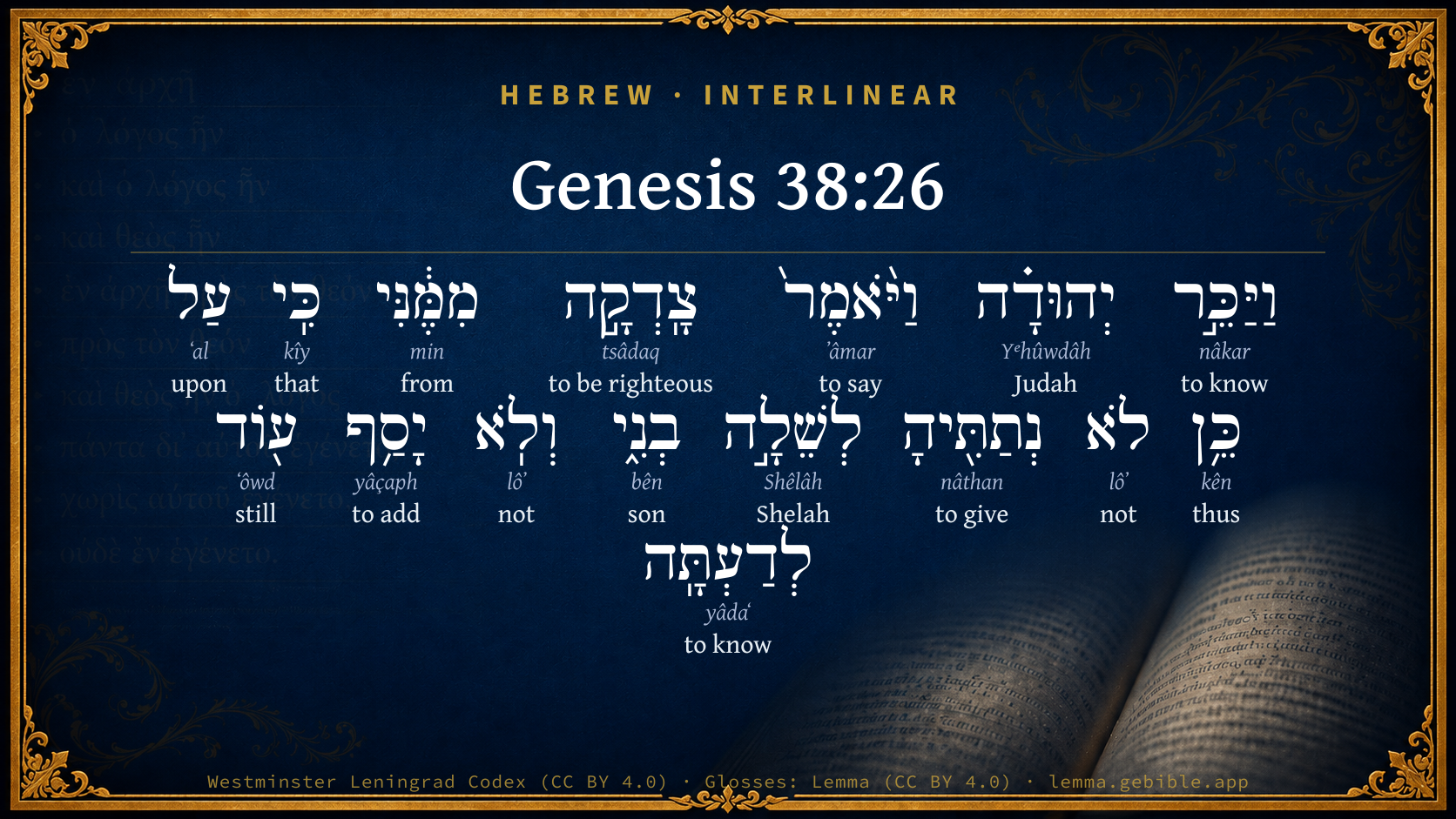
Hebrew (Westminster Leningrad Codex) Genesis 38:26 appears in the Hebrew Old Testament. The text above is from the Westminster Leningrad Codex. Each word links to its Strong’s number, a concise gloss, and parsing drawn from the Open Scriptures Hebrew Bible morphology. Click any word for its full Brown-Driver-Briggs (BDB) entry.
Download image
Cite this verse

Genesis 38:26 (World English Bible). Public Domain. Lemma interlinear Bible study tool, https://lemma.gebible.app/v/genesis/38/26.

Show BibTeX & RIS
BibTeX
RIS
English Translation
Judah acknowledged them, and said, "She is more righteous than I, because I didn't give her to Shelah, my son." He knew her again no more.
World English Bible · Public Domain
Highlights
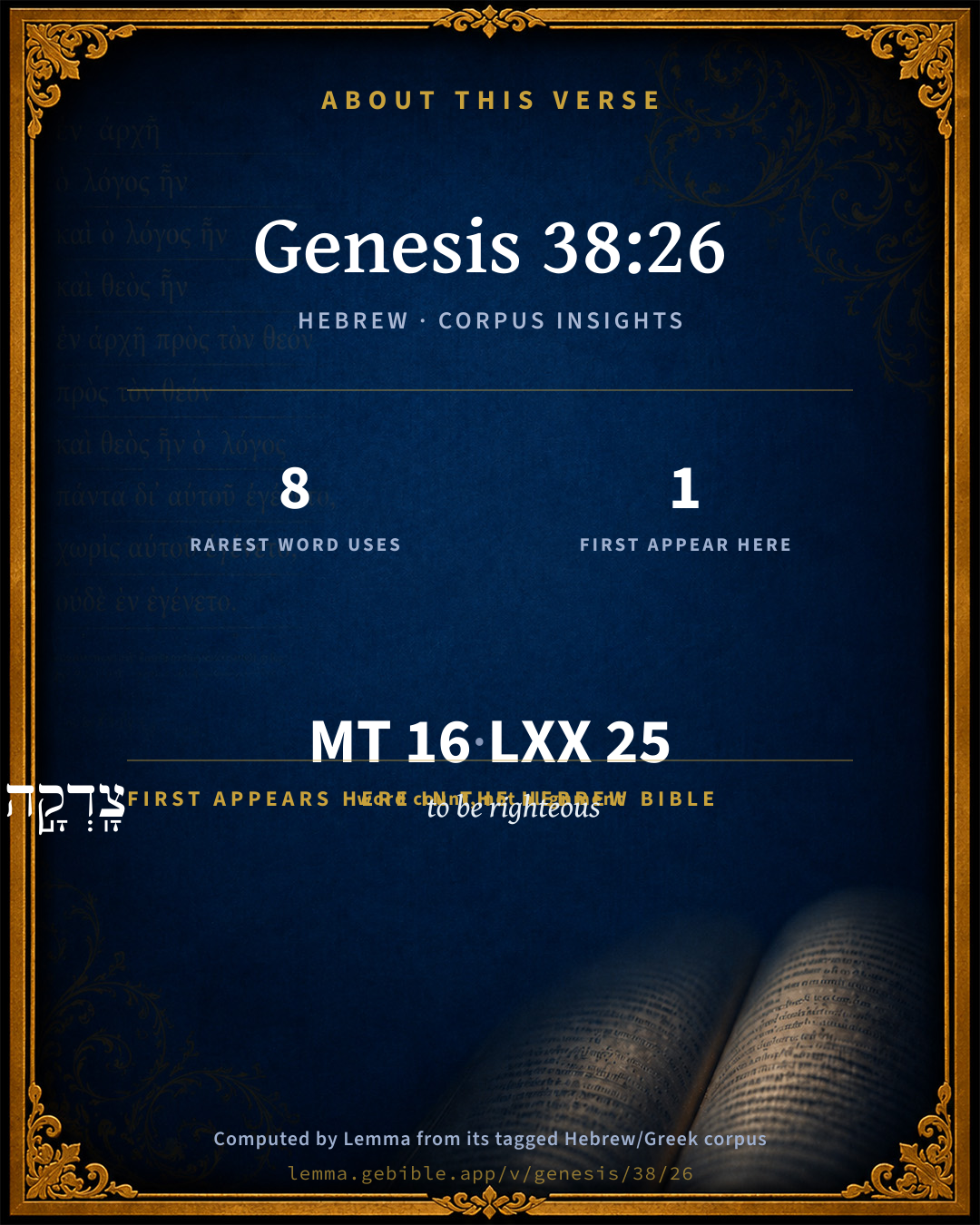
  • 1 first appearance in the Hebrew Bible
Full analysis ↓
Download a study sheet

One document with this verse’s original text, its word-by-word gloss line, the meaning frame, cross-references with their text, attributed commentary, and full source and license credits — printable, and it pastes into notes with its structure intact.

This verse Autodidact and up

Study sheet (.html) Plain text (.txt)

A passage Seminary Student

Up to 50 verses in one chapter. A passage sheet keeps up to 6 commentary sources and 12 cross-references per verse, in the order this page ranks them, and says so on the sheet whenever that leaves anything out. Ask for a single verse and you get the Autodidact verse sheet above.

Everything on this page stays free to read, with no account — the sheet is a download of what is already on screen, not access to it.

Want to remove ads? Support Godless Engineer
Compare translations 3

The same verse in 3 English versions, stacked beneath the original-language interlinear above. Click any original word for its lexicon entry.

Each is an independent rendering of the whole verse — the interlinear is not word-aligned to these translations.

Highlighted words mark where these versions differ — a whole-verse word diff, not a word-by-word alignment.

  • World English Bible Public Domain
    Judah acknowledged them, and said, "She is more righteous than I, because I didn't give her to Shelah, my son." He knew her again no more.
  • King James Version Public Domain
    And Judah acknowledged them, and said, She hath been more righteous than I; because that I gave her not to Shelah my son. And he knew her again no more.
  • unfoldingWord Literal Text CC BY-SA 4.0
    And Judah identified and said, “She is more righteous than I, because I did not give her to Shelah my son!” And he did not continue to know her more.

unfoldingWord Literal Text — © unfoldingWord, licensed CC BY-SA 4.0. Word-aligned USFM3 via Door43 (git.door43.org/unfoldingWord/en_ult).

Versions to compare (up to 4)

3 of 4 selected

Show all 17 translations

Every available English version of this verse, each an independent rendering of the whole verse.

  • World English Bible Public Domain
    Judah acknowledged them, and said, "She is more righteous than I, because I didn't give her to Shelah, my son." He knew her again no more.
  • Berean Standard Bible Public Domain
    Judah recognized the items and said, “She is more righteous than I, since I did not give her to my son Shelah.” And he did not have relations with her again.
  • Majority Standard Bible Public Domain
    Judah recognized the items and said, “She is more righteous than I, since I did not give her to my son Shelah.” And he did not have relations with her again.
  • King James Version Public Domain
    And Judah acknowledged them, and said, She hath been more righteous than I; because that I gave her not to Shelah my son. And he knew her again no more.
  • American Standard Version (1901) Public Domain
    And Judah acknowledged them, and said, She is more righteous than I; forasmuch as I gave her not to Shelah my son. And he knew her again no more.
  • Revised Version (1885) Public Domain
    And Judah acknowledged them, and said, She is more righteous than I; forasmuch as I gave her not to Shelah my son. And he knew her again no more.
  • Geneva Bible (1599) Public Domain
    Then Iudah knewe them, and said, She is more righteous then I: for she hath done it because I gaue her not to Shelah my sonne. So he lay with her no more.
  • Young's Literal Translation Public Domain
    And Judah discerneth and saith, `She hath been more righteous than I, because that I did not give her to Shelah my son;' and he hath not added to know her again.
  • Literal Standard Version CC BY-SA 4.0
    And Judah discerns and says, “She has been more righteous than I, because that I did not give her to my son Shelah”; and he has not added to know her again.
  • Unlocked Literal Bible CC BY-SA 4.0
    Judah recognized them and said, “She is more righteous than I am, since I did not give her as a wife to Shelah, my son.” He did not sleep with her again.
  • unfoldingWord Literal Text CC BY-SA 4.0
    And Judah identified and said, “She is more righteous than I, because I did not give her to Shelah my son!” And he did not continue to know her more.
  • Darby Bible Public Domain
    And Judah acknowledged [them], and said, She is more righteous than I, because I have not given her to Shelah my son. And he knew her again no more.
  • World Messianic Bible Public Domain
    Judah acknowledged them, and said, “She is more righteous than I, because I didn’t give her to Shelah, my son.” He knew her again no more.
  • Webster's Bible Public Domain
    And Judah acknowledged them, and said She hath been more righteous than I; because that I gave her not to Shelah my son: and he knew her again no more.
  • Free Bible Version CC BY-SA 4.0
    Judah recognized them right away and said, “She has honored the law more than I have, because I didn't give her in marriage to my son Shelah.” He didn't sleep with Tamar again.
  • Bible in Basic English Public Domain
    Then Judah said openly that they were his, and said, She is more upright than I am, for I did not give her to Shelah my son. And he had no more connection with her.
  • JPS Tanakh (1917) Public Domain
    And Judah acknowledged them, and said: 'She is more righteous than I; forasmuch as I gave her not to Shelah my son.' And he knew her again no more.

Literal Standard Version (2020), Covenant Press — licensed CC BY-SA 4.0. Text via the HelloAO Bible API (eBible.org). Unlocked Literal Bible (unfoldingWord) — licensed CC BY-SA 4.0. Text via the HelloAO Bible API (eBible.org). unfoldingWord Literal Text — © unfoldingWord, licensed CC BY-SA 4.0. Word-aligned USFM3 via Door43 (git.door43.org/unfoldingWord/en_ult). Free Bible Version, Dr. Jonathan Gallagher — licensed CC BY-SA 4.0. Text via the HelloAO Bible API (eBible.org).

Word by word

More ways to search: Search by grammar → Find every occurrence → Compare this word →

Practice this passage: Drill this verse → Learn its vocabulary →

לְשֵׁלָ֣ה
Shêlâh
H7956
“to/for · Shelah”
Preposition + Noun, Proper
Part of Speech
Preposition + Noun
Type
Proper
Full BDB Definition

Origin: the same as H7596 (shortened)

TWOT: None

Shelah = "a petition" - the youngest son of Judah
  1. וַיַּכֵּ֣ר nâkar H5234 “and · to know” Conjunction + Verb, Hiphil, Sequential Imperfect, 3rd Person, Masculine, Singular
  2. יְהוּדָ֗ה Yᵉhûwdâh H3063 “Judah” Noun, Proper
  3. וַיֹּ֨אמֶר֙ ʼâmar H559 “and · to say” Conjunction + Verb, Qal, Sequential Imperfect, 3rd Person, Masculine, Singular
  4. צָֽדְקָ֣ה tsâdaq H6663 “to be righteous” Verb, Qal, Perfect, 3rd Person, Feminine, Singular
  5. מִמֶּ֔נִּי min H4480 “from · me” Preposition + Suffix, Personal, 1st Person, Common, Singular
  6. כִּֽי kîy H3588 “that” Conjunction
  7. עַל ʻal H5921 “upon” Preposition
  8. כֵּ֥ן kên H3651 “thus” Particle, Demonstrative
  9. לֹא lôʼ H3808 “not” Particle, Negative
  10. נְתַתִּ֖יהָ nâthan H5414 “to give · her” Verb, Qal, Perfect, 1st Person, Common, Singular + Suffix, Personal, 3rd Person, Feminine, Singular
  11. בְנִ֑י bên H1121 “son · my” Noun, Common, Masculine, Singular, Construct + Suffix, Personal, 1st Person, Common, Singular
  12. וְלֹֽא lôʼ H3808 “and · not” Conjunction + Particle, Negative
  13. יָסַ֥ף yâçaph H3254 “to add” Verb, Qal, Perfect, 3rd Person, Masculine, Singular
  14. ע֖וֹד ʻôwd H5750 “still” Adverb
  15. לְדַעְתָּֽה yâdaʻ H3045 “to know · her” Preposition + Verb, Qal, Infinitive Construct + Suffix, Personal, 3rd Person, Feminine, Singular

About this verse

These counts appear in no published source. They are computed here, from the morphology-tagged text and Lemma’s own curated glosses. What Lemma adds →

16
words
15
distinct lemmas
Pentateuch
section

Notable vocabulary

The rarest word here is לְשֵׁלָ֣ה Shelah H7956 — appearing just 8 times in the whole Hebrew Bible.

First appearance in Scripture

This word makes its first canonical appearance in the Hebrew Bible here:

  • צָֽדְקָ֣ה to be righteous H6663

Shared distinctive vocabulary

לְשֵׁלָ֣ה Shelah H7956 occurs in 8 verses of the Hebrew Bible. Also found in:

Grammatical profile

  • 6 verbs
  • 3 nouns
  • 2 prepositions
  • 1 conjunction
  • 1 adverb
  • 3 particles

Verb forms

  • וַיַּכֵּ֣ר Hiphil · Sequential Imperfect
  • וַיֹּ֨אמֶר֙ Qal · Sequential Imperfect
  • צָֽדְקָ֣ה Qal · Perfect
  • נְתַתִּ֖יהָ Qal · Perfect
  • יָסַ֥ף Qal · Perfect
  • לְדַעְתָּֽה Qal · Infinitive Construct

Repetition

A word recurs within this verse — often emphatic in Hebrew:

Hebrew & Septuagint length

In English translation the verse runs 26 words from the Hebrew and 28 from the Septuagint (LXX English) — closely comparable.

A rough comparison of the two English renderings, which tokenize alike — not a word-level alignment.

Word counts can differ between the Hebrew and the Greek without any difference in meaning — e.g. the Hebrew direct-object marker אֵת has no separate Greek word, and Greek often adds the article ὁ.

In the original languages it is 16 Hebrew tokens and 25 Greek tokens — but the two are counted differently (Hebrew bundles its prefixes and suffixes into one token; the Greek is in lemma form), so that isn’t a like-for-like length.

Cross-references

18

Topical passages linked to Genesis 38:26 in the Treasury of Scripture Knowledge — connected by theme and wording, ordered by reader-vote popularity; previews shown in the World English Bible.

  • 1 Samuel 24:17 He said to David, You are more righteous than I; for you have rendered to me good, whereas I have rendered to you evil.
  • John 8:9 They, when they heard it, being convicted by their conscience, went out one by one, beginning from the oldest, even to the last. Jesus was left alone with the woman where she was, in the middle.
  • Titus 2:11–12 For the grace of God has appeared, bringing salvation to all men,
  • 1 Peter 4:2–3 that you no longer should live the rest of your time in the flesh for the lusts of men, but for the will of God.
  • Genesis 4:1 The man knew Eve his wife. She conceived, and gave birth to Cain, and said, "I have gotten a man with Yahweh's help."
  • Genesis 37:33 He recognized it, and said, "It is my son's coat. An evil animal has devoured him. Joseph is without doubt torn in pieces."
  • Genesis 38:14 She took off of her the garments of her widowhood, and covered herself with her veil, and wrapped herself, and sat in the gate of Enaim, which is by the way to Timnah; for she saw that Shelah was grown up, and she wasn't given to him as a wife.
  • 2 Samuel 16:22 So they spread Absalom a tent on the top of the house; and Absalom went in to his father's concubines in the sight of all Israel.
  • 2 Samuel 20:3 David came to his house at Jerusalem; and the king took the ten women his concubines, whom he had left to keep the house, and put them in custody, and provided them with sustenance, but didn't go in to them. So they were shut up to the day of their death, living in widowhood.
  • 2 Samuel 24:17 David spoke to Yahweh when he saw the angel who struck the people, and said, Behold, I have sinned, and I have done perversely; but these sheep, what have they done? Please let your hand be against me, and against my father's house.
  • Job 4:5 But now it is come to you, and you faint; It touches you, and you are troubled.
  • Job 34:31–32 "For has any said to God, 'I am guilty, but I will not offend any more.
  • Job 40:5 I have spoken once, and I will not answer; Yes, twice, but I will proceed no further."
  • Ezekiel 16:52 You also, bear you your own shame, in that you have given judgment for your sisters; through your sins that you have committed more abominable than they, they are more righteous that you: yes, be also confounded, and bear your shame, in that you have justified your sisters.
  • Habakkuk 1:13 You who have purer eyes than to see evil, and who cannot look on perversity, why do you tolerate those who deal treacherously, and keep silent when the wicked swallows up the man who is more righteous than he,
  • Matthew 3:8 Therefore bring forth fruit worthy of repentance!
  • Romans 3:19 Now we know that whatever things the law says, it speaks to those who are under the law, that every mouth may be closed, and all the world may be brought under the judgment of God.
  • Romans 13:12 The night is far gone, and the day is near. Let's therefore throw off the works of darkness, and let's put on the armor of light.

Cross-references courtesy of OpenBible.info (CC BY 4.0).

Hebrew and Greek witnesses Masoretic Hebrew ↔ Greek Septuagint

The same verse in the two great witnesses to the Old Testament, shown verse-for-verse.

These are two independent witnesses, not word-aligned to each other, and the Septuagint is shown in lemma (dictionary) form.

Hebrew Genesis 38:26 Masoretic · Westminster Leningrad Codex

וַיַּכֵּ֣ר יְהוּדָ֗ה וַיֹּ֨אמֶר֙ צָֽדְקָ֣ה מִמֶּ֔נִּי כִּֽי עַל כֵּ֥ן לֹא נְתַתִּ֖יהָ לְשֵׁלָ֣ה בְנִ֑י וְלֹֽא יָסַ֥ף ע֖וֹד לְדַעְתָּֽה

Judah acknowledged them, and said, "She is more righteous than I, because I didn't give her to Shelah, my son." He knew her again no more.

World English Bible · Public Domain

Greek LXX Genesis 38:26 Septuagint · lemma form

ἐπιγιγνώσκω δέ ἰούδας καί εἶπον δικαιόω θαμαρ ἤ ἐγώ ὅς εἵνεκεν οὐ δίδωμι αὐτός σηλωμ ὁ υἱός ἐγώ καί οὐ προςτίθημι ἔτι ὁ γιγνώσκω αὐτός

And Judas knew them, and said, Thamar is cleared rather than I, forasmuch as I gave her not to Selom my son: and he knew her not again.

LXX2012 (modern English Septuagint) · Public Domain

Hebrew: Westminster Leningrad Codex (CC BY 4.0). Greek: Septuagint (public domain); English from LXX2012 (modern English Septuagint) (Public Domain). How the Septuagint differs from the Hebrew →

Targum (Aramaic paraphrase)

2

The Targum is the ancient Jewish Aramaic paraphrase of the Hebrew Scriptures — an interpretive translation, not the Hebrew text itself. Onkelos (literal) and Pseudo-Jonathan (expansive) render the Torah, and Jonathan the Prophets. Coverage is partial: where no permissively-licensed English translation exists for a verse, only the Aramaic is shown. This is verse-level text, not a word-by-word alignment to the Hebrew.

  1. Targum Onkelos Torah (Genesis–Deuteronomy)
    וְאִשְׁתְּמוֹדַע יְהוּדָה וַאֲמַר זַכָּאָה מִנִּי מְעַדְּיָא אֲרֵי עַל כֵּן לָא יְהָבִתַּהּ לְשֵׁלָה בְרִי וְלָא אוֹסִיף עוֹד לְמִידְעַהּ

    (no public-domain English translation for this verse)

    Targum Onkelos — Aramaic: “Onkelos Genesis” (public domain); “Onkelos Exodus” (public domain); “Onkelos Leviticus” (public domain); “Onkelos Numbers” (public domain); “Onkelos Deuteronomy” (public domain). English: “Sefaria Community Translation” (CC0 1.0 (public-domain dedication)); “J.W. Etheridge. The Targums of Onkelos and Jonathan Ben Uzziel on the Pentateuch. London: Longmans, Green, 1862” (public domain). Text via Sefaria.

  2. Targum Pseudo-Jonathan Torah (Genesis–Deuteronomy)
    וְאַכֵּר יְהוּדָה וַאֲמַר זַכְיָא הִיא תָמָר מִינִי אִתְעַבָּרַת וּבְרַת קָלָא נַפְלַת מִשְׁמַיָיא וַאֲמַרַת דְמִן קֳדָמַי הֲוָה פִּתְגָמָא וְאִשְׁתְּזָבוּ תַּרְוֵיהוֹם מִן דִינָא וַאֲמַר בְּגִין דְלָא יְהַבְתָּהּ לְשֵׁלָה בְּרִי אִירַע יָתִי כְּדוֹן וְלָא אוֹסֵף תּוּב לְמֵידְעָהּ בְּמִשְׁכְּבָא

    And Jehuda, acknowledged and said, Tamar is innocent; she is with child by me. And the Bath kol fell from heaven, and said, From before Me was this thing done, and let both be delivered from judgment. And Jehuda said, Because I gave her not to Shela my son, hath this happened to me. But he added not to know her again.

    Targum Pseudo-Jonathan — Aramaic: “Targum Jonathan on Genesis” (public domain); “Targum Jonathan on Exodus” (public domain); “Targum Jonathan on Leviticus” (public domain); “Targum Jonathan on Numbers” (public domain); “Targum Jonathan on Deuteronomy” (public domain). English: “The Targum of Jonathan ben Uzziel, trans. J. W. Etheridge, London, 1862” (public domain). Text via Sefaria.

Commentary

Notes on Genesis 38:26 from classic Christian and Jewish commentators (each source and its license shown beneath its notes). The classic Christian expositions comment on the surrounding passage and are grouped to its opening verse, so a note may address several verses; the Jewish commentaries on the Tanakh (Rashi and others) are per-verse, so they appear only where the commentator wrote on this verse.

Lemma curates 59 commentaries, every one of them public domain or Creative Commons licensed, each selected and text-cleaned for this edition rather than reprinted as found. About our sources →

Trapp's Complete Commentary

John Trapp

Gen 38:26 And Judah acknowledged [them], and said, She hath been more righteous than I; because that I gave her not to Shelah my son. And he knew her again no more.

Ver. 26. She hath been more righteous than I.] A free confession, joined with confusion of his sin; for he knew her no more. This was, to "confess and forsake sin," as Solomon hath it. {Pro 28:13} Not like that of Saul; "I have sinned, yet honour me before the people": {1Sa 15:30} or that of those in the wilderness; "We have sinned; we will go up": they might as well have said, We have sinned, we will sin. {Deu 1:41} The worser sort of Papists will say, When we have sinned, we must confess; and when we have confessed, we must sin again, that we may also confess again, and make work for new indulgences and jubilees; making account of confessing, as drunkards do of vomiting. {a} But true confession goes along with hatred, care, apology.

{a} Sandys’s Relation of West. Relig., sec. 8.

John Trapp, A Commentary or Exposition upon All the Books of the Old and New Testament (1647–1656) — public domain. Text from a community e-Sword module.

Joseph Benson's Commentary

Gen 38:26. And Judah acknowledged them — His guilty conscience and the horror of so foul a fact, together with the sudden surprise, forced him to make an immediate and ingenuous confession. She hath been more righteous than I — This he says because he had broken his word with her in withholding Shelah from her, whom he had promised; whereas she had kept her faith with him, and had lived as a widow honestly; besides, she had committed the fact out of desire to have a child, he to satisfy his lust. She was, however, more guilty than he in another respect, as having knowingly committed both adultery and incest, when he designed neither. And he knew her again no more — Thus showing the sincerity of his confession, by forsaking the sin confessed, the only sure way of showing it.

Joseph Benson's Commentary on the Old and New Testaments (1811–1818) — public domain. Text from a community e-Sword module.

Tyndale Open Study Notes

Tyndale Open Resources

38:26 She is more righteous than I am: Judah acknowledged that he had shirked his responsibility to provide an heir. It was sinful for Judah to go to a prostitute, but Tamar had a legal right to be the mother of Judah’s child and had acted on that right. In the book of Ruth, the elders analogously blessed the marriage of Boaz and Ruth, praying that God would make Ruth like Tamar (Ruth 4:12; cp. Matt 1:3, 5).

Tyndale Open Study Notes — © Tyndale Open Resources, licensed CC BY-SA 4.0. Text via the HelloAO Bible API.

Geneva Bible (1599)

Geneva Bible translators

For the horror of the sin condemned him.

That is, she ought rather to accuse me than I her.

Geneva Bible (1599) marginal notes — public domain. Text via Bolls.life.

Adam Clarke's Commentary

Verse 26. She hath been more righteous than I] It is probable that Tamar was influenced by no other motive than that which was common to all the Israelitish women, the desire to have children who might be heirs of the promise made to Abraham, &c. And as Judah had obliged her to continue in her widowhood under the promise of giving her his son Shelah when he should be of age, consequently his refusing or delaying to accomplish this promise was a breach of truth, and an injury done to Tamar.

Adam Clarke's Commentary on the Bible (1810–1826) — public domain. Text from a community e-Sword/MySword module.

John Calvin's Commentaries

26. And Judah acknowledged them. The open reproach of Tamar proceeded from the desire of revenge. She does not seek an interview with her father-in-law, for the purpose of appeasing his mind; but, with a deliberate contempt of death, she demands him as the companion of her doom. That Judah immediately acknowledges his fault, is a proof of his honesty; for we see with how many fallacies nearly all are wont to cover their sins, until they are dragged to the light, and all means of denying their guilt have failed. Here, though no one is present who could extort a confession, by force or threats, Judah voluntarily stoops to make one, and takes the greater share of the blame to himself. Yet, seeing that, in confessing his fault, he is now silent respecting punishment; we hence infer, that they who are rigid in censuring others, are much more pliant in forgiving themselves. In this, therefore, we ought to imitate him; that, without rack or torture, truth should so far prevail with us, that we should not be ashamed to confess, before the whole world, those sins with which God charges us. But we must avoid his partiality; lest, while we are harsh towards others, we should spare ourselves. This narrative also teaches us the importance of not condemning any one unheard; not only because it is better that the innocent should be absolved than that a guilty person should perish, but also, because a defense brings many things to light, which sometimes render a change in the form of judgment necessary.

She hath been more righteous than I. The expression is not strictly proper; for he does not simply approve of Tamar’s conduct; but speaks comparatively, as if he would say, that he had been, unjustly and without cause, angry against a woman, by whom he himself might rather have been accused. Moreover, by the result, it appears how tardily the world proceeds in exacting punishment for crimes, where no private person stands forward to avenge his own injury. An atrocious and horrible crime had been committed; as long as Judah thought himself aggrieved, he pressed on with vehemence, and the door of judgment was opened. But now, when the accusation is withdrawn, both escape; though certainly it was the duty of all to rise up against them. Moses however intimates that Judah was sincerely penitent; because “he knew” his daughter-in-law “again no more.” He also confirms what I have said before, that by nature men are imbued with a great horror of such a crime. For whence did it arise, that he abstained from intercourse with Tamar, unless he judged naturally, that it was infamous for a father-in-law to be connected with his daughter-in-law? Whoever attempts to destroy the distinction which nature dictates, between what is base and what is honorable, engages, like the giants, in open war with God.

John Calvin's Commentaries (1540-1563) — public domain. Text from the Calvin Translation Society English edition (1840s-50s) via the Christian Classics Ethereal Library (ccel.org). Calvin's coverage is partial (roughly two-thirds of the Bible); uncommented books and verses are honest gaps, never fabricated. The 19th-century editor's footnotes and remarks are omitted so the notes are faithfully Calvin's own voice.

The Cambridge Bible for Schools and Colleges

gen. ed. J. J. S. Perowne

26. more righteous] Judah acknowledges that Tamar had a claim upon the observance of marriage customs, and that he had done wrong in neglecting her, and in ignoring the sacred obligations of tribal “levirate” marriage, upon which depended the very existence of an Oriental community. The Heb. verb means “to be right, to have right on one’s side”; and Judah’s words might be rendered “she is in her rights as against me” (cf. Davidson’s Theology of the O.T., p. 267).

The Cambridge Bible for Schools and Colleges (gen. ed. J. J. S. Perowne; Cambridge University Press, 1878–1918) — public domain. Text from a community e-Sword module.

John Gill's Exposition

And it came to pass in the time of her travail,.... When her time to bring forth was come, and her pains were on her, and her midwife with her:

that, behold, twins were in her womb; which the midwife could discover before the birth of either.

John Gill's Exposition of the Whole Bible (1746–1763) — public domain (CC PDM 1.0). Text via the HelloAO Bible API.

Haydock's Catholic Bible Commentary

Juster. For Juda had been guilty of injustice; and had thus exposed her to the danger of following a life of lewdness. (Haydock) --- She remained a widow afterwards, as she was now rendered unfit to be married either to Juda or Sela. The latter married another woman, Numbers xxvi. 19. (Calmet) --- While Juda was engaged in this unlawful commerce, and yielded to the temptation, Joseph was triumphing over a much greater temptation, in rejecting the solicitations of his master’s wife. (Haydock)

George Leo Haydock (1774–1849), Haydock's Catholic Family Bible and Commentary, 1859 edition — public domain. Excludes Psalms (Douay-Rheims chapter numbering differs from Protestant) and Deuterocanonical books (Catholic canon only).

Matthew Poole's English Annotations

His guilty conscience, and the horror of so foul a fact, together with his sudden surprisal, forced him to an ingenuous confession, whereas he might have used many pretences and evasions, which would easily have prevailed with such partial judges.

She hath been more righteous than I. She was more unchaste, because she knowingly committed adultery and incest, when he designed neither; but he was more unjust, because he was the cause of her sin, both by withholding Shelah from her, who was hers both by right and by Judah’s promise, and by whom her chastity should have been preserved; and by his solicitation and encouragement of her to the sin.

He knew her again no more; showing the sincerity of his confession by his forsaking of the sin confessed. See Job 34:32. And it may be probably concluded, that he neither knew her nor any other woman afterward, because there is no mention of any child which he had after this time.

Matthew Poole's English Annotations on the Holy Bible (1683–1685) — public domain. Text from a community e-Sword/MySword module.

Whedon's Commentary on the Bible

Daniel D. Whedon

26. More righteous than I — “Judah not only saw his guilt, but he confessed it also, and showed, both by this confession and also by the fact that he had no further conjugal intercourse with Tamar, an earnest endeavour to conquer the lusts of the flesh, and to guard against the sin into which he had fallen. And because he thus humbled himself, God gave him grace, and not only exalted him to be the chief of the house of Israel, but blessed the children that were begotten in sin.” — Keil.

Daniel D. Whedon (gen. ed.), Commentary on the Old and New Testaments (1874–1909) — public domain. Text from a community e-Sword module.

The Pulpit Commentary

And Judah acknowledged (or discerned, ut supra, i.e. recognized) them, and said, She hath been more righteous than I; though Tamer was far from innocent (vide vex. 16), she was by no means as culpable as Judah because that (KeAlAyKi, for, for this cause, i.e. that so it might hap, pen to me: vide (Gen_18:5) I gave her not to Shelah my son. And (in token of his penitence) he knew her again no more.

The Pulpit Commentary (1880–1919), ed. H.D.M. Spence-Jones & Joseph S. Exell — public domain. Text from a community e-Sword module.

Rashi

Rabbi Shlomo Yitzchaki (Rashi)

צדקה SHE IS RIGHTEOUS (right) in what she has said

ממני FROM ME is she with child. Our Rabbis, of blessed memory, explained this to mean that a Bath-kol came forth and said the word ממני — from Me and by My agency have these things happened: because she proved herself a modest woman whilst in her father-in-law’s house I have ordained that kings shall be descended from her, and I have already ordained that I would raise up kings in Israel from the tribe of Judah (Genesis Rabbah 85:11) (therefore I have brought it about that these two persons who are to be the ancestors of kings should unite to become so).

כי על כן לא נתתיה BECAUSE THAT I GAVE HER NOT — For (כי) she has acted rightly, because (על כן) I did not give her to Shelah, my son.

ולא יסף עוד AND HE KNEW HER AGAIN NO MORE — Some explain that ולא יסף means he did not continue to know her (Sifrei Bamidbar 88): others explain that it means he did not cease to know her (Sotah 10b). An exactly similar instance occurs in reference to Eldad and Medad (Numbers 11:25), where ולא יספו which some translate “and they did not continue to prophesy” is translated in the Targum by “and they did not cease to prophesy”.

Rashi on the Tanakh — English translations: “The Judaica Press complete Tanach with Rashi, translated by A. J. Rosenberg” (CC BY 4.0); “Pentateuch with Rashi's commentary by M. Rosenbaum and A.M. Silbermann, 1929-1934” (public domain); “The Metsudah Tanach series, Lakewood, N.J” (CC BY 4.0); and “The Book of Joshua, Metsudah Publications, 1997” (CC BY 4.0). Text via Sefaria.

Ramban (Nachmanides)

Rabbi Moshe ben Nachman (Ramban / Nachmanides)

SHE IS RIGHTEOUS FROM ME. “She is righteous in her words. From me is she with child. Our Rabbis expounded that a bath kol (a Divine voice) came forth and said the word mimeni, i.e., ‘From Me and from My authority did these events unfold.’” This is Rashi’s language.The correct interpretation is that it is similar to the verses: Men more righteous and better than he; And he [Saul] said to David, Thou art more righteous than I; for thou hast rendered unto me good, whereas I have rendered unto thee evil. Here too the meaning is: “She is more righteous than I, for she acted righteously and I am the one who sinned against her by not giving her my son Shelah.” The purport of the statement is that Shelah was the brother-in-law, [hence he was the first designated to marry her], and if he did not wish to take her as his wife, his father is next in line to act as the redeemer, as I have explained above when I discussed the law of marrying a childless brother’s widow.

AND HE KNEW HER AGAIN NO MORE (‘v’lo yasaph’). After having established progeny for his children, he did not wish to be with her again even though this was dependent upon his wish as she was not forbidden to him, being, in fact, considered as his wife, as is the law when the widow of a childless man has relations with a relative. This is the reason for the explanation given by a certain Sage, who explains the verse as saying, “And he did not cease to know her,” since here the expression used is, v’lo yasaph, and elsewhere it is written, A great voice ‘v’lo yasaph’. [with a kamatz], meaning “and it did not cease,” or “it did not diminish in strength,” unlike the human voice which decreases and eventually stops completely. Here also the identical expression, v’lo yasaph [with a patach], means “and he did not cease.”

Ramban (Nachmanides) on the Tanakh — English translation: “Commentary on the Torah by Ramban (Nachmanides). Translated and annotated by Charles B. Chavel. New York, Shilo Pub. House, 1971-1976” (CC BY 4.0). Text via Sefaria.

Radak

Rabbi David Kimhi (Radak)

צדקה ממני; she is more righteous than I, for I had declared her guilty of being burned to death while she was innocent, seeing she is pregnant from me and has not acted like a harlot. Our sages in Makkot 23 as well as in Bereshit Rabbah 85,12 say that there are basically three locations where the Holy Spirit,רוח הקודש, was manifest [was needed to confirm a verdict. Ed.] One was the court of Shem, son of Noach. This is based on the word ממני in our verse not meaning “than me, Yehudah,” but “from Me, G’d.” [although Shem himself was no longer alive at the time Tamar’s trial came up, his grandson Ever, probably in conjunction with others maintained the court he had founded, which was administering the seven Noachide (universal laws for all of mankind) laws at the time. Ed.] The sages understand that when the verdict was passed on Tamar a heavenly voice was heard saying that Tamar’s pregnancy by Yehudah had been decreed by G.d, “from Me.” The second such instance was in the court conducted by the prophet Samuel. They base this on Samuel I 12,5 ויאמר עד, G’d confirming that the prophet had dealt fairly with the whole people during his being the supreme authority, before a King was appointed. Without this confirmation we only had his word for it. The third example was the court of King Solomon, during the famous trial of two women claiming a live baby as her own and the dead one as belonging to her adversary. (Kings I 3,27.) A heavenly voice confirmed Solomon’s verdict [which from a purely halachic point of view was quite unsubstantiated. Ed.] The words היא אמו, “she is his mother,” then were not said by Solomon but by G’d. G’d’s confirmation of Tamat’s innocence was needed as people could have argued that while it was true that she had slept with Yehudah, who was to say that other men had not also slept with her and that she was actually pregnant by someone else? The Talmud concludes by citing the heavenly voice as saying ממך יצאו כבושים, “secrets unknown to others are revealed by Me.” [according to Rashi on Makkot 23 the fact that in due course Tamar’s and Yehudah’s son became the forerunner of the Davidic dynasty proved that the seed she had carried was that of Yehudah, both Tamar and Yehudah being of Royal descent, -Tamar as the daughter of Malki Tzedek King of Shalem, and Yehudah by dint of the destiny predicted for him by his father on his deathbed.] There is a variant reading which says that as a result of Yehudah’s admission, G’d decided to appoint him as the founder of the future Davidic dynasties, and that the line ונכבשה הארץ לפניכם, “the land will become conquered before you,” in Numbers 32,29 is addressed to the leading tribe, Yehudah. This is based on the wordכבושים in the Talmud being read as ממך יצאו כובשים, “that conquerors will emerge from your loins.”

כי על כן לא נתתיה, as if the Torah had written כי על כן שלא נתתיה, “because I did not give her, etc., she has done this, i.e. pretended to be a harlot, because I did not give her to my son Shelah.” We find a similar construction in Exodus 13,8 בעבור זה עשה ה' לי, “on account of this (that I observe the commandment mentioned) G’d has done this for me” (taken me out of Egypt).”

ולא יסף עוד לדעתה, he did not sleep with her again seeing that even this time the act had been unintentional and in a manner not appropriate to her status. It is demeaning for a socially highly placed individual to sleep with a harlot. For Yehudah to have done so again would have been demeaning for him [as she would always be aware that the first time he had done this was in order to merely gratify a biological urge. Ed.] In the Targum we find two different versions regarding the meaning of the words ולא יסף עוד לדעתה. The second version is that Yehudah never stopped sleeping with Tamar, i.e. he treated her as his wife in every respect from then on. The reason why the Torah told us about all these details and how the seed of Yehudah became mingled with that of Ruth the Moabite, as well as how King Solomon was the son of Bat Sheva whose marriage to David did not exactly come about in a normal manner, is to show that the hand of G’d had been at work in all of these situations. G’d’s design had been that the Kingdom of Israel should be David’s on a hereditary basis forever [whenever there would be independent kings, not appointed by conquerors of the Jewish people. Ed.] The somewhat flawed lineage in Jewish kings is G’d’s device to prevent such kings from becoming proud of their pure ancestry, and considering themselves ”ancestrally“ superior to their peers. [perhaps the advice of the Shulchan Aruch that when appointing public officials of high rank one should select someone with a “skeleton in his closet,” a קופת שרצים, is based on the flaws in the ancestry of the Davidic dynasty. Ed.]

Radak on the Tanakh — English translations: “Sefaria Community Translation” (CC0 1.0 (public-domain dedication)); “Eliyahu Munk, HaChut Hameshulash” (CC BY 4.0); “Rabbi Mike Feuer, Jerusalem Anthology” (CC BY 4.0); and “R. David Kimhi on the first book of Psalms, Translated by R.G. Finch, London, 1919” (public domain). Text via Sefaria.

Lesson kit

Teaching starters — assembled from the data on this page, not authored interpretation. Every prompt links to the verse data it draws on. Edit before teaching.

Genesis, in the Pentateuch, opens this verse with 16 words (15 distinct Hebrew lemmas). Its most distinctive word is Shêlâh (“Shelah”). A historical commentator’s framing appears above. Read the whole chapter for the surrounding context.

Discussion questions

  1. What does “Shelah” (Shêlâh) contribute to the verse as a whole?
  2. This is the first place “to be righteous” appears in Scripture (first appears here). What does its debut here establish?
  3. How does Genesis 38:5, which shares the word «Shelah», read alongside this verse?
  4. What does the repetition of “not” (2× in this one verse) do in this verse?
  5. These translations render this verse differently. What is at stake in choosing one wording over another?
  6. «וַיַּכֵּ֣ר» is a Hiphil Sequential Imperfect verb. How does that grammatical form shape the action described?
  7. Compare how Trapp's Complete Commentary and Joseph Benson's Commentary read this verse. Where do they agree or differ?

Things to notice

Reading settings

Reading text

Shown beneath each verse's original-language words.

Old Testament
Old Testament edition

Read the OT as the Masoretic Hebrew (MT) or the Greek Septuagint (LXX).

English shown for the Greek Septuagint (in the Hebrew ↔ Greek comparison).

Comparing translations? Open the Compare panel on any verse page to stack up to four side by side.