
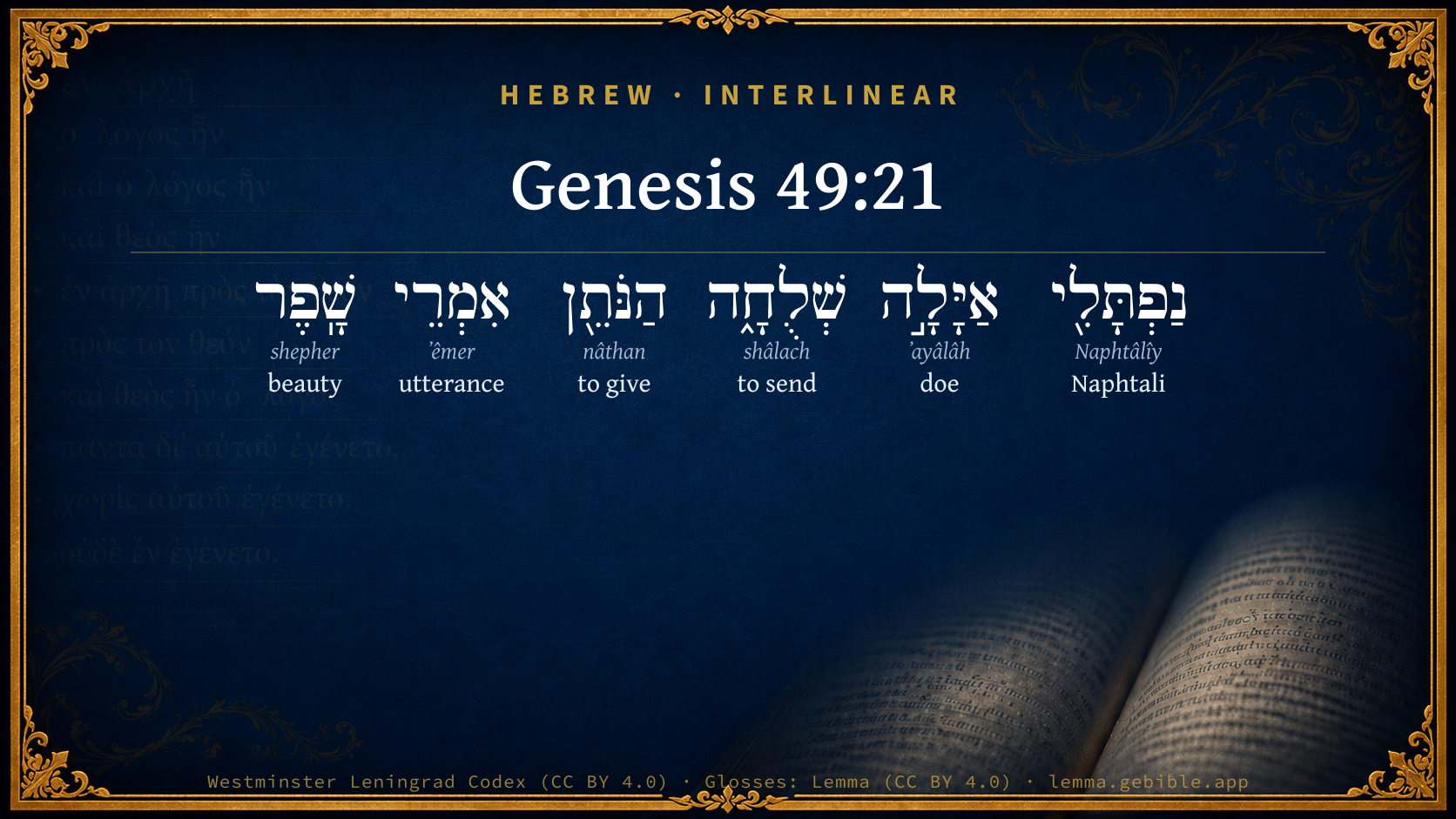
Genesis 49:21

Hebrew (Westminster Leningrad Codex) Genesis 49:21 appears in the Hebrew Old Testament. The text above is from the Westminster Leningrad Codex. Each word links to its Strong’s number, a concise gloss, and parsing drawn from the Open Scriptures Hebrew Bible morphology. Click any word for its full Brown-Driver-Briggs (BDB) entry.
Download image
Cite this verse

Genesis 49:21 (World English Bible). Public Domain. Lemma interlinear Bible study tool, https://lemma.gebible.app/v/genesis/49/21.

Show BibTeX & RIS
BibTeX
RIS
English Translation
"Naphtali is a doe set free, Who bears beautiful fawns.
World English Bible · Public Domain
Highlights
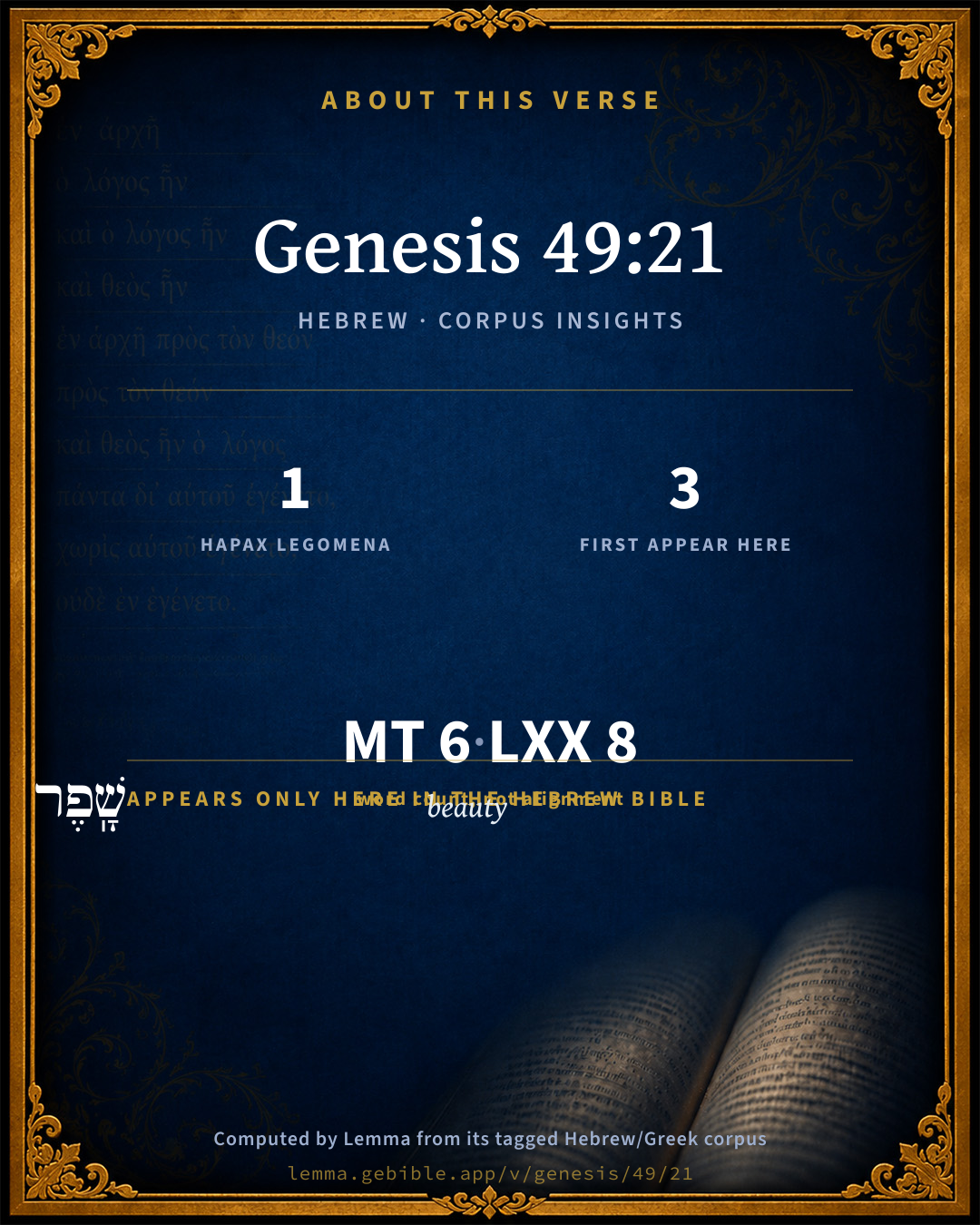
  • 1 hapax legomenon — only here in the Hebrew Bible
  • 3 first appearances in the Hebrew Bible
Full analysis ↓
Download a study sheet

One document with this verse’s original text, its word-by-word gloss line, the meaning frame, cross-references with their text, attributed commentary, and full source and license credits — printable, and it pastes into notes with its structure intact.

This verse Autodidact and up

Study sheet (.html) Plain text (.txt)

A passage Seminary Student

Up to 50 verses in one chapter. A passage sheet keeps up to 6 commentary sources and 12 cross-references per verse, in the order this page ranks them, and says so on the sheet whenever that leaves anything out. Ask for a single verse and you get the Autodidact verse sheet above.

Everything on this page stays free to read, with no account — the sheet is a download of what is already on screen, not access to it.

Want to remove ads? Support Godless Engineer
Compare translations 3

The same verse in 3 English versions, stacked beneath the original-language interlinear above. Click any original word for its lexicon entry.

Each is an independent rendering of the whole verse — the interlinear is not word-aligned to these translations.

Highlighted words mark where these versions differ — a whole-verse word diff, not a word-by-word alignment.

  • World English Bible Public Domain
    "Naphtali is a doe set free, Who bears beautiful fawns.
  • King James Version Public Domain
    Naphtali is a hind let loose: he giveth goodly words.
  • unfoldingWord Literal Text CC BY-SA 4.0
    Naphtali a doe that is let loose. He gives words of beauty. ts\*

unfoldingWord Literal Text — © unfoldingWord, licensed CC BY-SA 4.0. Word-aligned USFM3 via Door43 (git.door43.org/unfoldingWord/en_ult).

Versions to compare (up to 4)

3 of 4 selected

Show all 18 translations

Every available English version of this verse, each an independent rendering of the whole verse.

  • World English Bible Public Domain
    "Naphtali is a doe set free, Who bears beautiful fawns.
  • Berean Standard Bible Public Domain
    Naphtali is a doe set free that bears beautiful fawns.
  • Majority Standard Bible Public Domain
    Naphtali is a doe set free that bears beautiful fawns.
  • King James Version Public Domain
    Naphtali is a hind let loose: he giveth goodly words.
  • American Standard Version (1901) Public Domain
    Naphtali is a hind let loose: He giveth goodly words.
  • Revised Version (1885) Public Domain
    Naphtali is a hind let loose: He giveth goodly words.
  • Geneva Bible (1599) Public Domain
    Naphtali shalbe a hinde let goe, giuing goodly wordes.
  • Douay-Rheims (1899) Public Domain
    Gad, being girded, shall fight before him: and he himself shall be girded backward.
  • Young's Literal Translation Public Domain
    Naphtali `is' a hind sent away, Who is giving beauteous young ones.
  • Literal Standard Version CC BY-SA 4.0
    Naphtali [is] a doe sent away, || Who is giving beautiful young ones.
  • Unlocked Literal Bible CC BY-SA 4.0
    Naphtali is a doe let loose; he will have beautiful fawns.
  • unfoldingWord Literal Text CC BY-SA 4.0
    Naphtali a doe that is let loose. He gives words of beauty. ts\*
  • Darby Bible Public Domain
    Naphtali is a hind let loose; He giveth goodly words.
  • World Messianic Bible Public Domain
    “Naphtali is a doe set free, who bears beautiful fawns.
  • Webster's Bible Public Domain
    Naphtali is a hind let loose: he giveth goodly words.
  • Free Bible Version CC BY-SA 4.0
    Naphtali is a deer that's free to run; it gives birth to beautiful fawns.
  • Bible in Basic English Public Domain
    Naphtali is a roe let loose, giving fair young ones.
  • JPS Tanakh (1917) Public Domain
    Naphtali is a hind let loose: he giveth goodly words.

Literal Standard Version (2020), Covenant Press — licensed CC BY-SA 4.0. Text via the HelloAO Bible API (eBible.org). Unlocked Literal Bible (unfoldingWord) — licensed CC BY-SA 4.0. Text via the HelloAO Bible API (eBible.org). unfoldingWord Literal Text — © unfoldingWord, licensed CC BY-SA 4.0. Word-aligned USFM3 via Door43 (git.door43.org/unfoldingWord/en_ult). Free Bible Version, Dr. Jonathan Gallagher — licensed CC BY-SA 4.0. Text via the HelloAO Bible API (eBible.org).

Word by word

More ways to search: Search by grammar → Find every occurrence → Compare this word →

Practice this passage: Drill this verse → Learn its vocabulary →

About this verse

These counts appear in no published source. They are computed here, from the morphology-tagged text and Lemma’s own curated glosses. What Lemma adds →

6
words
6
distinct lemmas
Pentateuch
section

Notable vocabulary

1 hapax legomenon — a word that appears only here in the entire Hebrew Bible:

  • שָֽׁפֶר beauty H8233

First appearance in Scripture

These words make their first canonical appearance in the Hebrew Bible here:

  • אַיָּלָ֣ה doe H355
  • אִמְרֵי utterance H561
  • שָֽׁפֶר beauty H8233

Shared distinctive vocabulary

אַיָּלָ֣ה doe H355 occurs in 8 verses of the Hebrew Bible. Also found in:

Grammatical profile

  • 2 verbs
  • 4 nouns

Verb forms

  • שְׁלֻחָ֑ה Qal · Participle Passive
  • הַנֹּתֵ֖ן Qal · Participle Active

Hebrew & Septuagint length

In English translation the verse runs 10 words from the Hebrew and 10 from the Septuagint (LXX English) — the same length.

A rough comparison of the two English renderings, which tokenize alike — not a word-level alignment.

Word counts can differ between the Hebrew and the Greek without any difference in meaning — e.g. the Hebrew direct-object marker אֵת has no separate Greek word, and Greek often adds the article ὁ.

In the original languages it is 6 Hebrew tokens and 8 Greek tokens — but the two are counted differently (Hebrew bundles its prefixes and suffixes into one token; the Greek is in lemma form), so that isn’t a like-for-like length.

Cross-references

9

Topical passages linked to Genesis 49:21 in the Treasury of Scripture Knowledge — connected by theme and wording, ordered by reader-vote popularity; previews shown in the World English Bible.

  • Deuteronomy 33:23 Of Naphtali he said, Naphtali, satisfied with favor, Full with the blessing of Yahweh, Possess you the west and the south.
  • Genesis 30:8 Rachel said, "With mighty wrestlings have I wrestled with my sister, and have prevailed." She named him Naphtali.
  • Genesis 46:24 The sons of Naphtali: Jahzeel, Guni, Jezer, and Shillem.
  • Joshua 19:32–39 The sixth lot came out for the children of Naphtali, even for the children of Naphtali according to their families.
  • Judges 4:6 She sent and called Barak the son of Abinoam out of Kedesh-naphtali, and said to him, Hasn't Yahweh, the God of Israel, commanded, [saying], Go and draw to Mount Tabor, and take with you ten thousand men of the children of Naphtali and of the children of Zebulun?
  • Judges 4:10 Barak called Zebulun and Naphtali together to Kedesh; and there went up ten thousand men at his feet: and Deborah went up with him.
  • Judges 5:18 Zebulun was a people that jeopardized their lives to the death, Naphtali, on the high places of the field.
  • Psalms 18:33–34 He makes my feet like deer's feet, And sets me on my high places.
  • Matthew 4:15–16 "The land of Zebulun and the land of Naphtali, Toward the sea, beyond the Jordan, Galilee of the Gentiles,

Cross-references courtesy of OpenBible.info (CC BY 4.0).

Hebrew and Greek witnesses Masoretic Hebrew ↔ Greek Septuagint

The same verse in the two great witnesses to the Old Testament, shown verse-for-verse.

These are two independent witnesses, not word-aligned to each other, and the Septuagint is shown in lemma (dictionary) form.

Hebrew Genesis 49:21 Masoretic · Westminster Leningrad Codex

נַפְתָּלִ֖י אַיָּלָ֣ה שְׁלֻחָ֑ה הַנֹּתֵ֖ן אִמְרֵי שָֽׁפֶר

"Naphtali is a doe set free, Who bears beautiful fawns.

World English Bible · Public Domain

Greek LXX Genesis 49:21 Septuagint · lemma form

νεφθαλι στέλεχος ἀναἵημι ἐπιδίδωμι ἐν ὁ γένημα κάλλος

Nephthalim is a spreading stem, bestowing beauty on its fruit.

LXX2012 (modern English Septuagint) · Public Domain

On this verse, Ellicott's Commentary for English Readers discusses the Septuagint’s reading. Read the note in Commentary ↓

Hebrew: Westminster Leningrad Codex (CC BY 4.0). Greek: Septuagint (public domain); English from LXX2012 (modern English Septuagint) (Public Domain). How the Septuagint differs from the Hebrew →

Targum (Aramaic paraphrase)

2

The Targum is the ancient Jewish Aramaic paraphrase of the Hebrew Scriptures — an interpretive translation, not the Hebrew text itself. Onkelos (literal) and Pseudo-Jonathan (expansive) render the Torah, and Jonathan the Prophets. Coverage is partial: where no permissively-licensed English translation exists for a verse, only the Aramaic is shown. This is verse-level text, not a word-by-word alignment to the Hebrew.

  1. Targum Onkelos Torah (Genesis–Deuteronomy)
    נַפְתָּלִי בְּאַרַע טָבָא יִתְרְמֵי עַדְבֵהּ וְאַחְסַנְתֵּהּ תְּהֵי מְעַבְּדָא פֵירִין יְהוֹן מוֹדַן וּמְבָרְכִין עֲלֵיהוֹן

    (no public-domain English translation for this verse)

    Targum Onkelos — Aramaic: “Onkelos Genesis” (public domain); “Onkelos Exodus” (public domain); “Onkelos Leviticus” (public domain); “Onkelos Numbers” (public domain); “Onkelos Deuteronomy” (public domain). English: “Sefaria Community Translation” (CC0 1.0 (public-domain dedication)); “J.W. Etheridge. The Targums of Onkelos and Jonathan Ben Uzziel on the Pentateuch. London: Longmans, Green, 1862” (public domain). Text via Sefaria.

  2. Targum Pseudo-Jonathan Torah (Genesis–Deuteronomy)
    נַפְתָּלִי עַזְגַד קָלִיל דָמֵי לְאַיְילָא דְרָהִיט עַל שִׁינֵי טוּרַיָיא מְבַשֵר בְּשׁוּרַן טָבָן הוּא בִּשַר דְעַד כְּדוֹן יוֹסֵף קַיֵים וְהוּא אִזְדַרַז וַאֲזַל לְמִצְרַיִם וְאַיְיתִי אוֹנִיתָא דַחֲקִיל כְּפִילְתָּא דְלֵית בָּהּ לְעֵשָו חוּלְקָא וְכַד הֲוָה פָּתַח פּוּמֵיהּ בִּכְנִשְׁתָּא דְיִשְרָאֵל לִמְשַׁבְּחָא מִבְחַר מִכָּל לִשְׁנַיָא

    Naphatali is a swift messenger, like a hind that runneth on the tops of the mountains, bringing good tidings: he it was who announced that Joseph was living; he it was who hasteneth to go into Mizraim, and bring the contract of the double field in which Esau had no portion; and when he shall open his mouth in the congregation of Israel to give praise, he shall be the chosen of all tongues.

    Targum Pseudo-Jonathan — Aramaic: “Targum Jonathan on Genesis” (public domain); “Targum Jonathan on Exodus” (public domain); “Targum Jonathan on Leviticus” (public domain); “Targum Jonathan on Numbers” (public domain); “Targum Jonathan on Deuteronomy” (public domain). English: “The Targum of Jonathan ben Uzziel, trans. J. W. Etheridge, London, 1862” (public domain). Text via Sefaria.

Commentary

Notes on Genesis 49:21 from classic Christian and Jewish commentators (each source and its license shown beneath its notes). The classic Christian expositions comment on the surrounding passage and are grouped to its opening verse, so a note may address several verses; the Jewish commentaries on the Tanakh (Rashi and others) are per-verse, so they appear only where the commentator wrote on this verse.

Lemma curates 59 commentaries, every one of them public domain or Creative Commons licensed, each selected and text-cleaned for this edition rather than reprinted as found. About our sources →

Trapp's Complete Commentary

John Trapp

Gen 49:21 Naphtali [is] a hind let loose: he giveth goodly words.

Ver. 21. Naphtali is a hind let loose.] Swift of foot; and which, when it flieth, looketh behind it, saith the Chaldee Paraphrast on Son 8:14. This was fulfilled in Barak of this tribe, who "went up on his feet" against Sisera’s iron chariots, {Jdg 4:6; Jdg 4:10; Jdg 4:15-16} which were first a terror, and afterwards a scorn, as Vegetius {a} saith of chariots, armed with scythes and hooks. Origen observes, that in all the victories God gave his people in Canaan, he never used the help of horses. The adversaries, both Egyptians and Canaanites, had chariots and horses: not so Israel. A horse is a warlike creature, full of terror, {Job 39:19 Pro 21:31} so swift, that the Persians, as Pausanias {b} hath it, dedicates him to their god the sun; as the swiftest creature, to the swiftest god. But what saith David? "A horse is a vain thing for safety." {Psa 33:17} And to the same purpose, Solomon: "A horse is prepared for the day of battle; but," when all is done, "salvation is of the Lord." {Pro 21:31} This, Barak, with his friend Deborah, found, and celebrated in that famous song. {Jdg 5:1-31}

He giveth goodly words.] In the aforesaid song, Christ also began to utter his words of grace in the land of Naphtali. {Mat 4:13} And this is the reason, that as, of the children by Leah’s side, Judah obtained the first place among those that were sealed, {Rev 7:5} because Christ sprang of him; so, of those on Rachel’s side, Naphtali is first named, because there he dwelt at Capernaum where he had hired a house and preached, ut ubique superemineat Christi praerogativa, saith a learned interpreter, {c} Compare with this text Deu 33:23, and then observe, that good words do ingratiate with God and men.

{a} Veget., lib. i. cap. 24.

{b} ωαπερ ταχιστον τω ταχυρατω θεων. - Paus.

{c} Medes, in Apocalyps.

John Trapp, A Commentary or Exposition upon All the Books of the Old and New Testament (1647–1656) — public domain. Text from a community e-Sword module.

The Biblical Illustrator

Joseph S. Exell

Gen_49:21

Naphtali

The blessing of Naphtali

In Gad we have the Christian, soldier fighting the good fight of faith, and more than conqueror over all foes.

In Asher we have the Christian living upon Christ, and giving out Christ to others. In Naphtali we have the Christian enjoying his liberty and freedom and happiness in Christ, and testifying of Christ to others. In Joseph we have the Christian bringing forth much fruit from abiding in Christ, the well of living waters, and also showing forth that fruit to all around. As we look at these passages, we find they are a chain. Each one is a link depending upon the other. You must fight the good fight of faith if you would enjoy Christ as the fatness of the Living Bread; and the enjoyment of Christ brings with it true liberty and freedom; and there must be all these, with the addition that you must abide in Christ, the roots of your life ever drawing from the well of living waters, if you are to bring forth much fruit. It is surely not without design that the Holy Spirit has placed these passages thus in this consecutive order. May we dwell upon them continually in this light, and test our souls by this Divine standard. Our subject now is the third of these four passages--the tribe of Naphtali. He is brought before us under a most striking symbol--that of a hart or gazelle let loose. It brings before us the liberty and exultation of the soul in its new sphere of existence. It has been let loose from its prison-house of sin, and darkness, and misery. Its prison-doors have been flung wide open by the great Emancipator, Christ Jesus the Lord. Its debt has been fully paid. All its guilt, and sin, and transgression has been cancelled by the blood of Christ. Let loose! No other word in the English language could so fitly express the effect of the grand redemption-work of Christ (see Isa 2Co_5:17; Gal_6:1; Joh_11:44). Turning again to Jacobs blessing on this tribe, we see another truth: He giveth goodly words. It is so always. St. Paul says, Let the word of Christ dwell in you richly in all wisdom: teaching and admonishing one another: in psalms, and hymns, and spiritual songs singing with grace in your hearts to the Lord. Asher lived upon the fatness of the Bread of Life, and as a result gave out royal dainties. Naphtali is satisfied with favour and full of the blessing of the Lord, and so gives out goodly words. Joseph is a bough, whose roots go down into the Well of Living Waters, and so brings forth much fruit. Royal dainties, goodly words, much fruit. Out of the fulness of the heart the mouth speaketh. Let us only be living upon and abiding in Christ, and such will ever be our testimony. It is not dainties, but royal dainties; not words, but goodly words; not fruit, but much fruit. Oh, reader! this is the kind of life God asks for! This is the Christianity we need. Not your just Christians and no more. No; God wants a high order of Christianity. Royal dainties, goodly words, much fruit--mark it well! Not only to be engaged in the work of the Lord, but abounding in it; nay, more, always abounding in it. (F. Whitfield, M. A.)

The Biblical Illustrator, edited by Joseph S. Exell (c. 1880s–1900s) — public domain. Text from a community e-Sword module.

Joseph Benson's Commentary

Gen 49:21. Naphtali is a hind let loose — Those of this tribe were, as the loosened hind, zealous for their liberty, and yet affable and courteous, their language refined, and they complaisant, giving goodly words. Among God’s Israel there is to be found a great variety of dispositions, yet all contributing to the beauty and strength of the body. He closes with the blessings of his best-beloved sons, Joseph and Benjamin: with these he will breathe his last.

Joseph Benson's Commentary on the Old and New Testaments (1811–1818) — public domain. Text from a community e-Sword module.

Tyndale Open Study Notes

Tyndale Open Resources

49:21 Naphtali, like a doe, would be a free mountain people (cp. Judg 5:18). The tribe settled in the hilly region northwest of the Sea of Galilee.

Tyndale Open Study Notes — © Tyndale Open Resources, licensed CC BY-SA 4.0. Text via the HelloAO Bible API.

Geneva Bible (1599)

Geneva Bible translators

Overcoming more by fair words than by force.

Geneva Bible (1599) marginal notes — public domain. Text via Bolls.life.

John Calvin's Commentaries

21. Naphtali. Some think that in the tribe of Naphtali fleetness is commended; I rather approve another meaning, namely, that it will guard and defend itself by eloquence and suavity of words, rather than by force of arms. It is, however, no despicable virtue to soothe ferocious minds, and to appease excited anger, by bland and gentle discourse; or if any offense has been stirred up, to allay it by a similar artifice. He therefore assigns this praise to the sons of Naphtali, that they shall rather study to fortify themselves by humanity, by sweet words, and by the arts of peace, then by the defense of arms. He compares them to a hind let loose, which having been taken in hunting, is not put to death, but is rather cherished with delicacies.

John Calvin's Commentaries (1540-1563) — public domain. Text from the Calvin Translation Society English edition (1840s-50s) via the Christian Classics Ethereal Library (ccel.org). Calvin's coverage is partial (roughly two-thirds of the Bible); uncommented books and verses are honest gaps, never fabricated. The 19th-century editor's footnotes and remarks are omitted so the notes are faithfully Calvin's own voice.

Ellicott's Commentary for English Readers

(21) Naphtali.—Gad had been described as moving slowly in war, and allowing himself to be surprised by hordes of plunderers, whom, nevertheless, as soon as he has collected his forces, he repels and pursues with vigour. Naphtali, on the contrary, is light and active, moving rapidly like “a hind let loose;” or, literally, sent forth, like the scouts or van of an army. And thus he brings back “goodly words”—Heb., words of pleasure—that is, trustworthy intelligence to guide the army in its motions. Another translation has been proposed, which has the support of the LXX.: “Naphtali is a spreading terebinth, which shoots forth goodly branches.” It retains the consonants of the Hebrew text, but gives them different vowels.

A Bible Commentary for English Readers, edited by Charles John Ellicott (1878–1897) — public domain. Text from a community e-Sword module.

The Cambridge Bible for Schools and Colleges

gen. ed. J. J. S. Perowne

21. Naphtali] It is doubtful whether the simile applied to this tribe is that of “a hind” or “a terebinth tree.” The comparisons in the song are for the most part taken from animals, e.g. the lion of Judah, the ass of Issachar, the serpent of Dan, the wolf of Benjamin. On the other hand, Joseph is compared to a vine.

a hind let loose] Lat. cervus emissus, an image of swiftness and grace in movement, associated with the thought of open and extensive country. For the idea of freedom expressed in “let loose,” cf. Job_39:5, “who hath sent out the wild ass free, or who hath loosed the bands of the wild ass?”

He giveth goodly words] A sudden change in the description, referring apparently to the tribe’s reputation for eloquence; but the transition to such a subject seems scarcely probable. The rendering “goodly lambs” is suggested, but the translation “lambs” cannot be supported from the O.T., and gives, at the best, a very prosaic sense.

By a different vocalization an entirely different turn is given to the verse. “Naphtali is a tall shoot of terebinth, one that putteth forth goodly topmost branches.” “Topmost branches” would then be metaphorical for “leaders” like Barak (Jdg_4:5), but this rendering is very questionable; though it may explain LXX Νεφθαλεὶ στέλεχος ἀνειμένον ἐπιδιδοὺς ἐν τῷ γεννήματι κάλλος.

The Cambridge Bible for Schools and Colleges (gen. ed. J. J. S. Perowne; Cambridge University Press, 1878–1918) — public domain. Text from a community e-Sword module.

John Gill's Exposition

The archers have sorely grieved him, and shot at him, and hated him. His brethren who grieved him with their ill usage, shot out bitter words against him, and hated him for his dreams, and because his father loved him; and they could not speak peaceably to him, they mocked at him, conspired to kill him, stripped him of his clothes, cast him into a pit, and then sold him; in all which he was a type of Christ, as used by the Jews. His mistress also, and Satan by her, grieved him with her temptations and solicitations to sin, which were as fiery darts shot at him; but being resisted, her impure love was turned into hatred to him, and she shot her lies, calumnies, and reproaches, as so many darts at him; and, as the Targum of Jonathan, the magicians of Egypt, who envied him for his superior knowledge, and perhaps many others in Pharaoh's court, who were displeased at his preferments, might bring accusations to Pharaoh against him, out of hatred to him; and Satan and his principalities and powers, whose temptations are compared to fiery darts, are not to be exempted, which they shoot at and grieve the people of God, who are hated by them. Perhaps reference may be had to the wars of the posterity of Joseph under Joshua, who was of the tribe of Ephraim, with the Canaanites.

The archers have sorely grieved him, and shot at him, and hated him. His brethren who grieved him with their ill usage, shot out bitter words against him, and hated him for his dreams, and because his father loved him; and they could not speak peaceably to him, they mocked at him, conspired to kill him, stripped him of his clothes, cast him into a pit, and then sold him; in all which he was a type of Christ, as used by the Jews. His mistress also, and Satan by her, grieved him with her temptations and solicitations to sin, which were as fiery darts shot at him; but being resisted, her impure love was turned into hatred to him, and she shot her lies, calumnies, and reproaches, as so many darts at him; and, as the Targum of Jonathan, the magicians of Egypt, who envied him for his superior knowledge, and perhaps many others in Pharaoh's court, who were displeased at his preferments, might bring accusations to Pharaoh against him, out of hatred to him; and Satan and his principalities and powers, whose temptations are compared to fiery darts, are not to be exempted, which they shoot at and grieve the people of God, who are hated by them. Perhaps reference may be had to the wars of the posterity of Joseph under Joshua, who was of the tribe of Ephraim, with the Canaanites.

Genesis 49:24

gen 49:24

gen 49:24

gen 49:24But his bow abode in strength,.... For as his enemies were archers, and had bows and arrows, so had he, and repelled force by force; but then his bow and arrows were of a different sort, the virtues and graces that he was possessed of, as innocence and integrity, chastity, fortitude, wisdom, prudence and patience, faith, hope, and the like, which remained unmoved, and in their full exercise, notwithstanding the powerful attacks made upon them; and so his posterity were unmoved and unshaken, and stood firm and undaunted, notwithstanding the powerful enemies they had to deal with, until they were wholly subdued:

and the arms of his hands were made strong by the hands of the mighty God of Jacob; so that he held his bow, and drew it with great strength against his enemies, as an archer being used to the bow, his nerves become strong, and he is not weakened by drawing it, nor weary of using it; but Joseph had not his strength of himself, but from the Lord, the mighty One, that had strengthened his father Jacob, and supported him under all his trouble: saints, like Joseph, have their strength, as well as their righteousness, in and from Christ; and when they are weak in themselves, they are strong in him, to exercise grace and perform duty:

from thence is the shepherd, the stone of Israel; from Jacob descended Joseph; or from the God of Jacob it was that Joseph through divine Providence was sent into Egypt to be as a shepherd, to feed his father's family, and as a stone to uphold and support it; in which he was a type of Christ, the great and good Shepherd of the flock, and the stone that is laid in Zion, on which the whole spiritual Israel of God is built; the foundation stone on which they are laid, and are safe, and the corner stone which knits them together. And some think that Christ is principally meant, who in his office capacity was from the mighty God of Jacob, a Shepherd of his providing and appointing, and a stone of his laying; and so Nachmahides says, the stone here made mention of is the same as in Psa 118:22.

John Gill's Exposition of the Whole Bible (1746–1763) — public domain (CC PDM 1.0). Text via the HelloAO Bible API.

Haydock's Catholic Bible Commentary

A hart. Barach was of this tribe, and seemed rather timid, till he was encouraged by Debora; and his victory gave occasion to that beautiful hymn, Judges v. (Calmet)

George Leo Haydock (1774–1849), Haydock's Catholic Family Bible and Commentary, 1859 edition — public domain. Excludes Psalms (Douay-Rheims chapter numbering differs from Protestant) and Deuterocanonical books (Catholic canon only).

Matthew Poole's English Annotations

A hind let loose; not pursued by hunters, nor shut up in some little enclosure, but wholly left to its own freedom, to feed upon the best pastures: see Deu 33:23. Or, free from the yoke which they, together with the other tribes, did bear in Egypt; free from its former restraints, which make it run away more swiftly. So it may note their nimbleness and expedition, either in encountering enemies, or in avoiding dangers. See Jdg 4:6,10; 5:18. Or, like a tame hind left to its liberty, in which the owner takes delight, as Pro 5:19; for he seems to be commended rather for arts of peace than war. And this may note, that his temper and Conversation was civil, obliging, and amiable; which sense the next words favour. His speeches and discourses with others are fair, and friendly, and winning. It is not strange that this tribe was generally of a sweeter disposition than others, seeing it is commonly observed that there is a great difference in the tempers of people of divers provinces or cities bordering one upon another. But this verse may be otherwise rendered according to the opinion of a late learned writer:

Naphtali is a tree (so the Hebrew word signifies, only jod is inserted here, as it is in the same word, Isa 1:29; 61:3) shot forth, or spread forth, ( into many branches; for the Hebrew verb shalach is oft used concerning trees, and their shooting forth of branches, as Psa 80:11; Eze 17:6; 31:5) sending forth goodly branches; the word imre, which is by others rendered words, here signifying branches, as either the same word, or one coming from the same root, and consisting of the same radical letters, is taken Isa 17:6,9. And it is usual in the Hebrew language for two words coming from the same root to exchange their significations. And this interpretation is favoured by the ancient interpreters, the LXX., and one of the Arabic manuscripts, which make Naphtali here to be compared to a goodly tree bringing forth excellent fruit.

Matthew Poole's English Annotations on the Holy Bible (1683–1685) — public domain. Text from a community e-Sword/MySword module.

Whedon's Commentary on the Bible

Daniel D. Whedon

21. A hind sent forth — The image is that of a beautiful hind or gazelle running loose and in perfect freedom upon its native heights. The agility and prowess of this tribe are nobly celebrated in Deborah’s song.

Giver of sayings of beauty — The elegance and beauty of the hind suggests that the tribe so compared might naturally have had an elegant taste for sayings of beauty; elegant proverbs and songs. As the tribe of Zebulun developed ready writers, (Jdg_5:14,) so Naphtali, perhaps, became noted for elegant speakers. This seems to be the general sense of the verse; but we know too little of the subsequent history and character of the tribe to enable us to define more particularly. Several critics, following the Septuagint, render: “Naphtali is a spreading tree, which puts forth goodly branches.” But this is scarcely tenable.

Daniel D. Whedon (gen. ed.), Commentary on the Old and New Testaments (1874–1909) — public domain. Text from a community e-Sword module.

The Pulpit Commentary

Naphtaii is a hind let loose: he giveth goodly words. The LXX, followed by Dathe, Michaelis, Ewald, Bohlen, and others, read, Naphtali is a tall terebinth, that putteth forth beautiful boughs; but the word hlya signifies a hind or gazelle, and is here employed, along with the qualifying epithet hj; luV, let loose, running freely (Keil), or graceful (Kalisch), to depict Naphtali as a beautiful and agile warrior. In the appended clause he is represented as possessing in addition the capacity of "giving words of beauty," in which may be detected an allusion to the development in eloquence and song which afterwards took place in that northern tribe. (Jud 4:6-9 5:1-31)

The Pulpit Commentary (1880–1919), ed. H.D.M. Spence-Jones & Joseph S. Exell — public domain. Text from a community e-Sword module.

John Wesley's Explanatory Notes

Naphtali is a hind let loose - Those of this tribe were, as the loosen'd hind, zealous for their liberty, and yet affable and courteous, their language refined, and they complaisant, giving goodly words. Among God's Israel there is to be found a great variety of dispositions, yet all contributing to the beauty and strength of the body. He closes with the blessings of his best beloved sons, Joseph and Benjamin, with these he will breathe his last.

John Wesley, Explanatory Notes Upon the Whole Bible (1754–1765) — public domain. Text via the GEBible commentary corpus.

Keil & Delitzsch

C. F. Keil & F. Delitzsch

"Naphtali is a hind let loose, who giveth goodly words." The hind or gazelle is a simile of a warrior who is skilful and swift in his movements (Sa2 2:18; Ch1 12:8, cf. Psa 18:33; Hab 3:19). שׁלהה here is neither hunted, nor stretched out or grown slim; but let loose, running freely about (Job 39:5). The meaning and allusion are obscure, since nothing further is known of the history of the tribe of Naphtali, than that Naphtali obtained a great victory under Barak in association with Zebulun over the Canaanitish king Jabin, which the prophetess Deborah commemorated in her celebrated song (Judg 4 and 5). If the first half of the verse be understood as referring to the independent possession of a tract of land, upon which Naphtali moved like a hind in perfect freedom, the interpretation of Masius (on Josh 19) is certainly the correct one: "Sicut cervus emissus et liber in herbosa et fertili terra exultim ludit, ita et in sua fertili sorte ludet et excultabit Nephtali." But the second half of the verse can hardly refer to "beautiful sayings and songs, in which the beauty and fertility of their home were displayed." It is far better to keep, as Vatablius does, to the general thought: tribus Naphtali erit fortissima, elegantissima et agillima et erit facundissima.

Keil & Delitzsch — Biblical Commentary on the Old Testament (1861–1891) — public domain (CC PDM 1.0). Text via the HelloAO Bible API. (Old Testament only.)

Rashi

Rabbi Shlomo Yitzchaki (Rashi)

אילה שלחה is symbolical of the valley of Gennesareth which ripens its fruits very quickly, just as a hind runs rapidly (Genesis Rabbah 99:12). אילה שלחה means A HIND LET LOOSE that it may run where it pleases.

הנותן אמרי שפר Understand this as the Targum does: They (the people of Naphtali) will give thanks to and will praise God for them (for the fruits). Another explanation of the verse is: He prophesied about the war with Sisera, with regard to which Scripture says, (Judges 4:6) “and take with thee ten thousand men of the children of Naphtali etc.” — and they marched thither most rapidly. There, too, is the expression שלח used: (v.15) “into the valley they rushed (שלח) at his feet”.

הנתן אמרי שפר HE GIVETH SAYINGS OF PLEASANTNESS — Due to them (to the ten thousand men of Naphtali) Deborah and Barak sang the song of praise (Judges ch. 5). Our Teachers explained the verse as an allusion to what happened on the day when Jacob was buried, when Esau claimed the cave of Machpelah. They were compelled to delay the burial whilst Naphtali ran rapidly back to Egypt and brought the title-deed of the cave etc. as is related in Treatise Sotah 13a. The words in the Targum יתרמי עדביה mean “his lot shall fall”, so that the second half of the verse would mean according to the Targum, “he will give thanks for his lot with pleasing words and with praise”.

Rashi on the Tanakh — English translations: “The Judaica Press complete Tanach with Rashi, translated by A. J. Rosenberg” (CC BY 4.0); “Pentateuch with Rashi's commentary by M. Rosenbaum and A.M. Silbermann, 1929-1934” (public domain); “The Metsudah Tanach series, Lakewood, N.J” (CC BY 4.0); and “The Book of Joshua, Metsudah Publications, 1997” (CC BY 4.0). Text via Sefaria.

Ramban (Nachmanides)

Rabbi Moshe ben Nachman (Ramban / Nachmanides)

NAPHTALI IS A HIND SENT FORTH. It was a custom among the rulers of countries to send hinds to one another, and this was the manner in which it was done: Hinds which were born in the territory of the king of the north country would be raised in the palaces of the king of the south country. They would attach a written message to its horns, and it would run speedily and return to its original habitat, and in this way the king of the north country would be apprised of the news. This is the meaning of the phrase, He giveth goodly words, meaning that he is a dispatched hind sent who bears good tidings.This practice is known, and it is mentioned in the Jerusalem Talmud, in Tractate Shevi’ith: “They said, ‘If they go they will return, and if you wish to prove it, bring deer and send them to a land far away, and in the end they will return.’ He did so. He brought deer and covered their horns with silver and sent them to Africa, and at the end of thirteen years they returned to their place.” That is, they freed them after thirteen years, and they returned at once. The analogy is that Naphtali is satisfied with favor, and full with all good things, and from him tidings will come forth to all Israel that his land has produced fruits abundantly, even as our Rabbis have mentioned concerning the fruits of Gennesareth.

Ramban (Nachmanides) on the Tanakh — English translation: “Commentary on the Torah by Ramban (Nachmanides). Translated and annotated by Charles B. Chavel. New York, Shilo Pub. House, 1971-1976” (CC BY 4.0). Text via Sefaria.

Radak

Rabbi David Kimhi (Radak)

נפתלי אילה שלוחה, Yaakov prophesied regarding the extraordinary salvation which would accrue to Israel thanks to a single man from the tribe of Naftali, Barak, the commander of the forces who defeated Siserah at the river Kishon, putting to flight an army boasting 900 armoured vehicles. Seeing that he would be assisted by the prophetess Devorah, his being fleet-footed is not credited only to him, and the word describing this is in the feminine gender, ayalah, instead of ayal. Barak had refused to attack unless Devorah would be with him. This is also why Yaakov said שלוחה, again in the feminine mode, to allude to Devorah’s role in the battle. It sounds as if Devorah had been dispatched by G’d to hasten Barak’s coming to a decision, seeing he had been so hesitant to join battle with Siserah. Concerning the song of thanksgiving composed by Devorah after that battle (Judges chapter 5), Yaakov describes that song as אמרי שפר,”words of beautiful poetry.”

Radak on the Tanakh — English translations: “Sefaria Community Translation” (CC0 1.0 (public-domain dedication)); “Eliyahu Munk, HaChut Hameshulash” (CC BY 4.0); “Rabbi Mike Feuer, Jerusalem Anthology” (CC BY 4.0); and “R. David Kimhi on the first book of Psalms, Translated by R.G. Finch, London, 1919” (public domain). Text via Sefaria.

Lesson kit

Teaching starters — assembled from the data on this page, not authored interpretation. Every prompt links to the verse data it draws on. Edit before teaching.

Genesis, in the Pentateuch, opens this verse with 6 words (6 distinct Hebrew lemmas). Its most distinctive word is shepher (“beauty”). A historical commentator’s framing appears above. Read the whole chapter for the surrounding context.

Discussion questions

  1. What does “beauty” (shepher) contribute to the verse as a whole?
  2. This verse holds 1 word here found nowhere else in the Hebrew Bible. What might the rare word draw attention to?
  3. 3 words here appear for the first time in Scripture. What is being introduced at this debut?
  4. 2 Samuel 22:34 shares the word «doe» with this verse. How do the two illuminate each other?
  5. The translations on this page render this verse differently — a whole-verse word diff, not a word-by-word alignment. What might account for the different wordings?
  6. The verb «שְׁלֻחָ֑ה» is Qal Participle Passive. How does its form color the action?
  7. Reading how Trapp's Complete Commentary and The Biblical Illustrator read this verse, where do the two commentators agree and where do they part?

Things to notice

Reading settings

Reading text

Shown beneath each verse's original-language words.

Old Testament
Old Testament edition

Read the OT as the Masoretic Hebrew (MT) or the Greek Septuagint (LXX).

English shown for the Greek Septuagint (in the Hebrew ↔ Greek comparison).

Comparing translations? Open the Compare panel on any verse page to stack up to four side by side.