
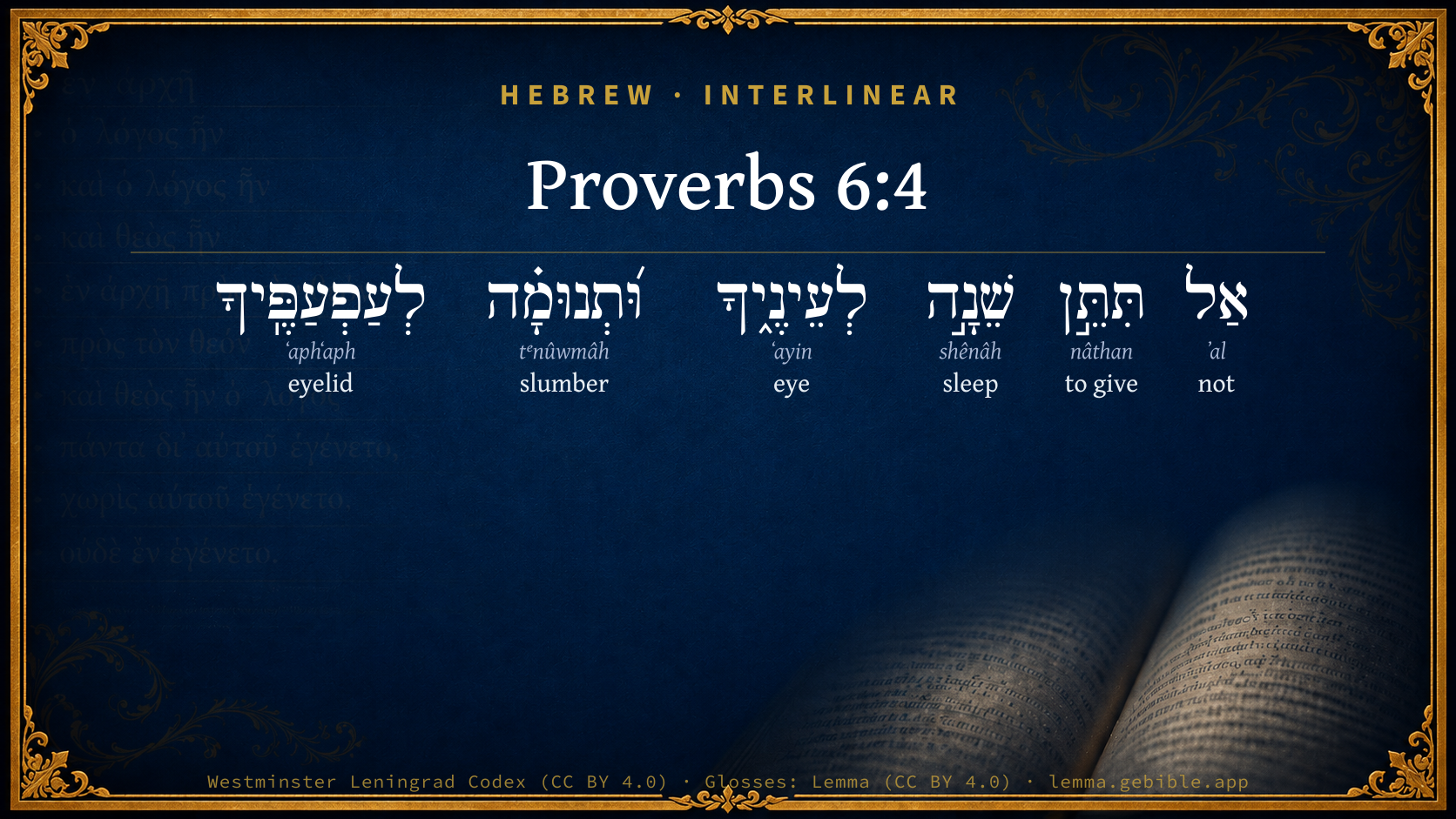
Proverbs 6:4

Hebrew (Westminster Leningrad Codex) Proverbs 6:4 appears in the Hebrew Old Testament. The text above is from the Westminster Leningrad Codex. Each word links to its Strong’s number, a concise gloss, and parsing drawn from the Open Scriptures Hebrew Bible morphology. Click any word for its full Brown-Driver-Briggs (BDB) entry.
Download image
Cite this verse

Proverbs 6:4 (World English Bible). Public Domain. Lemma interlinear Bible study tool, https://lemma.gebible.app/v/proverbs/6/4.

Show BibTeX & RIS
BibTeX
RIS
English Translation
Give no sleep to your eyes, Nor slumber to your eyelids.
World English Bible · Public Domain
Download a study sheet

One document with this verse’s original text, its word-by-word gloss line, the meaning frame, cross-references with their text, attributed commentary, and full source and license credits — printable, and it pastes into notes with its structure intact.

This verse Autodidact and up

Study sheet (.html) Plain text (.txt)

A passage Seminary Student

Up to 50 verses in one chapter. A passage sheet keeps up to 6 commentary sources and 12 cross-references per verse, in the order this page ranks them, and says so on the sheet whenever that leaves anything out. Ask for a single verse and you get the Autodidact verse sheet above.

Everything on this page stays free to read, with no account — the sheet is a download of what is already on screen, not access to it.

Want to remove ads? Support Godless Engineer
Compare translations 3

The same verse in 3 English versions, stacked beneath the original-language interlinear above. Click any original word for its lexicon entry.

Each is an independent rendering of the whole verse — the interlinear is not word-aligned to these translations.

Highlighted words mark where these versions differ — a whole-verse word diff, not a word-by-word alignment.

  • World English Bible Public Domain
    Give no sleep to your eyes, Nor slumber to your eyelids.
  • King James Version Public Domain
    Give not sleep to thine eyes, nor slumber to thine eyelids.
  • unfoldingWord Literal Text CC BY-SA 4.0
    Do not give sleep to your eyes and slumber to your eyelids.

unfoldingWord Literal Text — © unfoldingWord, licensed CC BY-SA 4.0. Word-aligned USFM3 via Door43 (git.door43.org/unfoldingWord/en_ult).

Versions to compare (up to 4)

3 of 4 selected

Show all 18 translations

Every available English version of this verse, each an independent rendering of the whole verse.

  • World English Bible Public Domain
    Give no sleep to your eyes, Nor slumber to your eyelids.
  • Berean Standard Bible Public Domain
    Allow no sleep to your eyes or slumber to your eyelids.
  • Majority Standard Bible Public Domain
    Allow no sleep to your eyes or slumber to your eyelids.
  • King James Version Public Domain
    Give not sleep to thine eyes, nor slumber to thine eyelids.
  • American Standard Version (1901) Public Domain
    Give not sleep to thine eyes, Nor slumber to thine eyelids;
  • Revised Version (1885) Public Domain
    Give not sleep to thine eyes, nor slumber to thine eyelids.
  • Geneva Bible (1599) Public Domain
    Giue no sleepe to thine eyes, nor slumber to thine eyelids.
  • Douay-Rheims (1899) Public Domain
    Give not sleep to thy eyes, neither let thy eyelids slumber.
  • Young's Literal Translation Public Domain
    Give not sleep to thine eyes, And slumber to thine eyelids,
  • Literal Standard Version CC BY-SA 4.0
    Do not give sleep to your eyes, || And slumber to your eyelids,
  • Unlocked Literal Bible CC BY-SA 4.0
    Give your eyes no sleep and your eyelids no slumber.
  • unfoldingWord Literal Text CC BY-SA 4.0
    Do not give sleep to your eyes and slumber to your eyelids.
  • Darby Bible Public Domain
    Give not sleep to thine eyes, nor slumber to thine eyelids:
  • World Messianic Bible Public Domain
    Give no sleep to your eyes, nor slumber to your eyelids.
  • Webster's Bible Public Domain
    Give not sleep to thy eyes, nor slumber to thy eyelids.
  • Free Bible Version CC BY-SA 4.0
    Don't delay, saying that you'll sleep on it. Don't rest until you've done it.
  • Bible in Basic English Public Domain
    Give no sleep to your eyes, or rest to them;
  • JPS Tanakh (1917) Public Domain
    Give not sleep to thine eyes, nor slumber to thine eyelids.

Literal Standard Version (2020), Covenant Press — licensed CC BY-SA 4.0. Text via the HelloAO Bible API (eBible.org). Unlocked Literal Bible (unfoldingWord) — licensed CC BY-SA 4.0. Text via the HelloAO Bible API (eBible.org). unfoldingWord Literal Text — © unfoldingWord, licensed CC BY-SA 4.0. Word-aligned USFM3 via Door43 (git.door43.org/unfoldingWord/en_ult). Free Bible Version, Dr. Jonathan Gallagher — licensed CC BY-SA 4.0. Text via the HelloAO Bible API (eBible.org).

Word by word

More ways to search: Search by grammar → Find every occurrence → Compare this word →

Practice this passage: Drill this verse → Learn its vocabulary →

About this verse

These counts appear in no published source. They are computed here, from the morphology-tagged text and Lemma’s own curated glosses. What Lemma adds →

6
words
6
distinct lemmas
Wisdom
section

Notable vocabulary

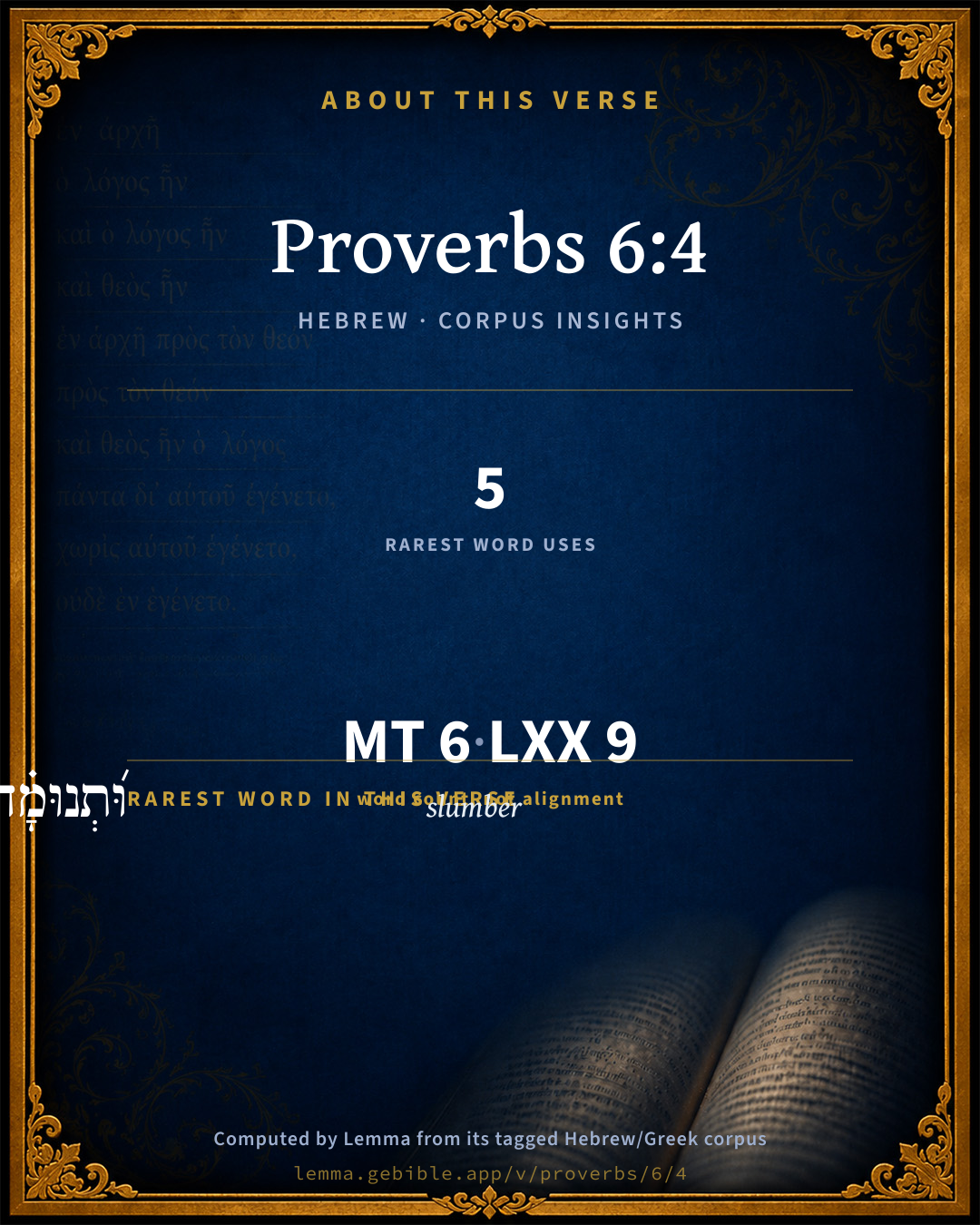
The rarest word here is וּ֝תְנוּמָ֗ה slumber H8572 — appearing just 5 times in the whole Hebrew Bible.

Shared distinctive vocabulary

וּ֝תְנוּמָ֗ה slumber H8572 occurs in 5 verses of the Hebrew Bible. Also found in:

Grammatical profile

  • 1 verb
  • 4 nouns
  • 1 particle

Verb forms

  • תִּתֵּ֣ן Qal · Jussive

Hebrew & Septuagint length

In English translation the verse runs 11 words from the Hebrew and 11 from the Septuagint (LXX English) — the same length.

A rough comparison of the two English renderings, which tokenize alike — not a word-level alignment.

Word counts can differ between the Hebrew and the Greek without any difference in meaning — e.g. the Hebrew direct-object marker אֵת has no separate Greek word, and Greek often adds the article ὁ.

In the original languages it is 6 Hebrew tokens and 9 Greek tokens — but the two are counted differently (Hebrew bundles its prefixes and suffixes into one token; the Greek is in lemma form), so that isn’t a like-for-like length.

Cross-references

5

Topical passages linked to Proverbs 6:4 in the Treasury of Scripture Knowledge — connected by theme and wording, ordered by reader-vote popularity; previews shown in the World English Bible.

  • Psalms 132:4 I will not give sleep to my eyes, Or slumber to my eyelids;
  • Proverbs 6:10–11 A little sleep, a little slumber, A little folding of the hands to sleep:
  • Mark 13:35–36 Watch therefore, for you don't know when the lord of the house is coming, whether at evening, or at midnight, or when the rooster crows, or in the morning;
  • Ecclesiastes 9:10 Whatever your hand finds to do, do it with your might; for there is no work, nor device, nor knowledge, nor wisdom, in Sheol, where you are going.
  • Matthew 24:17–18 Let him who is on the housetop not go down to take out things that are in his house.

Cross-references courtesy of OpenBible.info (CC BY 4.0).

Hebrew and Greek witnesses Masoretic Hebrew ↔ Greek Septuagint

The same verse in the two great witnesses to the Old Testament, shown verse-for-verse.

These are two independent witnesses, not word-aligned to each other, and the Septuagint is shown in lemma (dictionary) form.

Hebrew Proverbs 6:4 Masoretic · Westminster Leningrad Codex

אַל תִּתֵּ֣ן שֵׁנָ֣ה לְעֵינֶ֑יךָ וּ֝תְנוּמָ֗ה לְעַפְעַפֶּֽיךָ

Give no sleep to your eyes, Nor slumber to your eyelids.

World English Bible · Public Domain

Greek LXX Proverbs 6:4 Septuagint · lemma form

μή δίδωμι ὕπνος σός ὄμμα μηδέ ἐπινυστάζω σός βλέφαρον

Give not sleep to your eyes, nor slumber with your eyelids;

LXX2012 (modern English Septuagint) · Public Domain

Hebrew: Westminster Leningrad Codex (CC BY 4.0). Greek: Septuagint (public domain); English from LXX2012 (modern English Septuagint) (Public Domain). How the Septuagint differs from the Hebrew →

Commentary

Notes on Proverbs 6:4 from classic Christian and Jewish commentators (each source and its license shown beneath its notes). The classic Christian expositions comment on the surrounding passage and are grouped to its opening verse, so a note may address several verses; the Jewish commentaries on the Tanakh (Rashi and others) are per-verse, so they appear only where the commentator wrote on this verse.

Lemma curates 59 commentaries, every one of them public domain or Creative Commons licensed, each selected and text-cleaned for this edition rather than reprinted as found. About our sources →

Trapp's Complete Commentary

John Trapp

Pro 6:4 Give not sleep to thine eyes, nor slumber to thine eyelids.

Ver. 4. Give not sleep to thine eyes, &c.] Augustus wondered at a certain knight in Rome, that owed much, and yet could sleep securely; and when this knight died, he sent to buy his bed, as supposing there was something more than ordinary in it, to procure sleep. {a} The opportunity of liberty and thriving is to be well husbanded, lest some storm arising from the cruelty of creditors, or mutability of outward things, overwhelm a man with debt and danger, as the whirlwind doth the unwary traveller upon the Alps with snow. Now if such care be taken that we run not rashly in debt to men, how much more to God! If to undertake for others be so dangerous, how should we pray with that godly man Augustine, From my "other men’s sins" good Lord deliver me! If we are so to humble ourselves to our fellow creatures in this case, how much more should we "humble ourselves under the mighty hand of God, that he may lift us up in due season!" {Jas 4:10} If this is to be done without delay, where the danger reacheth but to the outward man, how much more speed and earnestness should be used in making peace with God, whose wrath is a fire that burns as low as hell, and getting the black lines of our sins drawn over with the red lines of his Son’s blood; and so utterly razed out of the book of his remembrance!

{a} Dio.

John Trapp, A Commentary or Exposition upon All the Books of the Old and New Testament (1647–1656) — public domain. Text from a community e-Sword module.

Jamieson, Fausset & Brown

Robert Jamieson, A. R. Fausset & David Brown

The danger requires promptness.

Jamieson, Fausset & Brown — Commentary Critical and Explanatory on the Whole Bible (1871) — public domain (CC PDM 1.0). Text via the HelloAO Bible API.

John Gill's Exposition

Give not sleep to thine eyes, nor slumber to thine eyelids. Until the above things are done; which denotes of what consequence and importance they are; and that persons in such circumstances should not be careless, dilatory, and unconcerned; but should use great diligence, and leave no stone unturned, or method untried, to extricate themselves; see Psa 132:4.

.

Proverbs 6:5

pro 6:5

pro 6:5

pro 6:5Deliver thyself as a roe from the hand of the hunter,.... As such a creature, which is very swift, when it is got into the hand of the hunter, will strive and struggle to get out; so should a man try all ways and means to get out of his suretyship engagements, especially when he finds himself liable to danger by it; this he should do "immediately" and "out of hand" (g), as the phrase here used sometimes signifies with the Jewish writers;

and as a bird from the hand of the fowler; another metaphor, signifying the same thing.

(g) "statim", De Dieu; "subito", Noldius, p. 859. No. 1630. "ilico, repente", so some in Eliae Tishbi, p. 143.

John Gill's Exposition of the Whole Bible (1746–1763) — public domain (CC PDM 1.0). Text via the HelloAO Bible API.

Matthew Poole's English Annotations

To wit, until thou hast taken care for the discharge of this obligation. Be not secure, nor negligent, nor dilatory in this matter.

Matthew Poole's English Annotations on the Holy Bible (1683–1685) — public domain. Text from a community e-Sword/MySword module.

Whedon's Commentary on the Bible

Daniel D. Whedon

4, 5. Give not sleep, etc. — Meaning that he should urge the heedless debtor to fulfil his obligations before it is too late — before the creditor commences a judicial process. (Zockler.)

Roe — See on Pro_5:19.

Daniel D. Whedon (gen. ed.), Commentary on the Old and New Testaments (1874–1909) — public domain. Text from a community e-Sword module.

The Pulpit Commentary

This verse carries on the thought one step further. The appeal to the friend is not to be confined to one spasmodic effort and then relinquished. He is to be followed up pertinaciously and continually, with unwearied diligence, until prevailed upon to fulfil his engagements. Of this unwearied energy in the pursuit of an object in which cue is deeply interested, compare David"s resolution, "I will not give sleep to mine eyes, or slumber to mine eyelids, until I find out a place for the Lord, a habitation for the mighty God of Jacob". (Psa_132:4, Psa_132:5)

The Pulpit Commentary (1880–1919), ed. H.D.M. Spence-Jones & Joseph S. Exell — public domain. Text from a community e-Sword module.

John Wesley's Explanatory Notes

Give not sleep - Until thou hast taken care for the discharge of this obligation.

John Wesley, Explanatory Notes Upon the Whole Bible (1754–1765) — public domain. Text via the GEBible commentary corpus.

unfoldingWord translationNotes

Door43 World Missions Community

Give your eyes no sleep and your eyelids no slumber

"Do not let your eyes sleep; do not let your eyelids slumber." These two phrases mean the same thing and are repeated to emphasize how important it is not to be lazy. It is also stated negatively for even more emphasis. AT: "Stay awake, and do what you can" (See: Parallelism and Litotes)

your eyes ... your eyelids

This is a figure of speech using parts of your face to mean your whole body. AT: "yourself ... yourself" (See: Synecdoche)

Save yourself like a gazelle from the hand of the hunter

"Escape from your neighbor like a gazelle that flees from a hunter"

gazelle

This is a big, lean animal that eats grass and that people often hunt for meat. It is famous for running away quickly.

from the hand of the hunter

The hand of the hunter refers to the hunter's control. AT: "from the control of the hunter" (See: Metonymy)

like a bird from the hand of the fowler

"and escape like a bird that flies away from a bird-hunter"

unfoldingWord translationNotes — © Distant Shores Media and the Door43 World Missions Community, licensed CC BY-SA 4.0. Source: git.door43.org/Door43/en_tn.

Lesson kit

Teaching starters — assembled from the data on this page, not authored interpretation. Every prompt links to the verse data it draws on. Edit before teaching.

Proverbs, in the Wisdom, opens this verse with 6 words (6 distinct Hebrew lemmas). Its most distinctive word is tᵉnûwmâh (“slumber”). A historical commentator’s framing appears above. Read the whole chapter for the surrounding context.

Discussion questions

  1. The word tᵉnûwmâh carries the sense “slumber.” How does it shape the verse?
  2. How does Job 33:15, which shares the word «slumber», read alongside this verse?
  3. These translations render this verse differently. What is at stake in choosing one wording over another?
  4. «תִּתֵּ֣ן» is a Qal Jussive verb. How does that grammatical form shape the action described?
  5. Compare how Trapp's Complete Commentary and Jamieson, Fausset & Brown read this verse. Where do they agree or differ?

Things to notice

Reading settings

Reading text

Shown beneath each verse's original-language words.

Old Testament
Old Testament edition

Read the OT as the Masoretic Hebrew (MT) or the Greek Septuagint (LXX).

English shown for the Greek Septuagint (in the Hebrew ↔ Greek comparison).

Comparing translations? Open the Compare panel on any verse page to stack up to four side by side.