
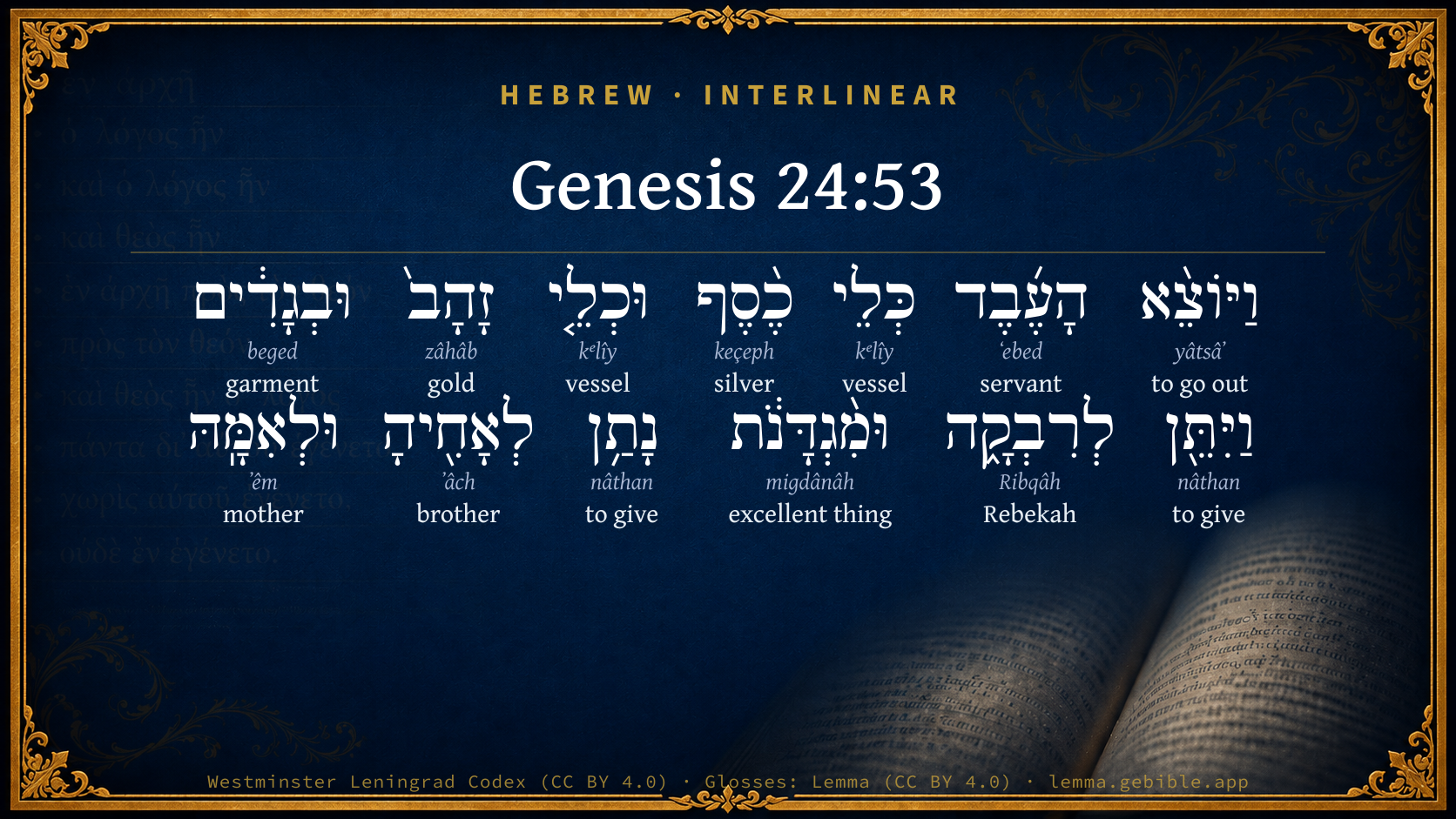
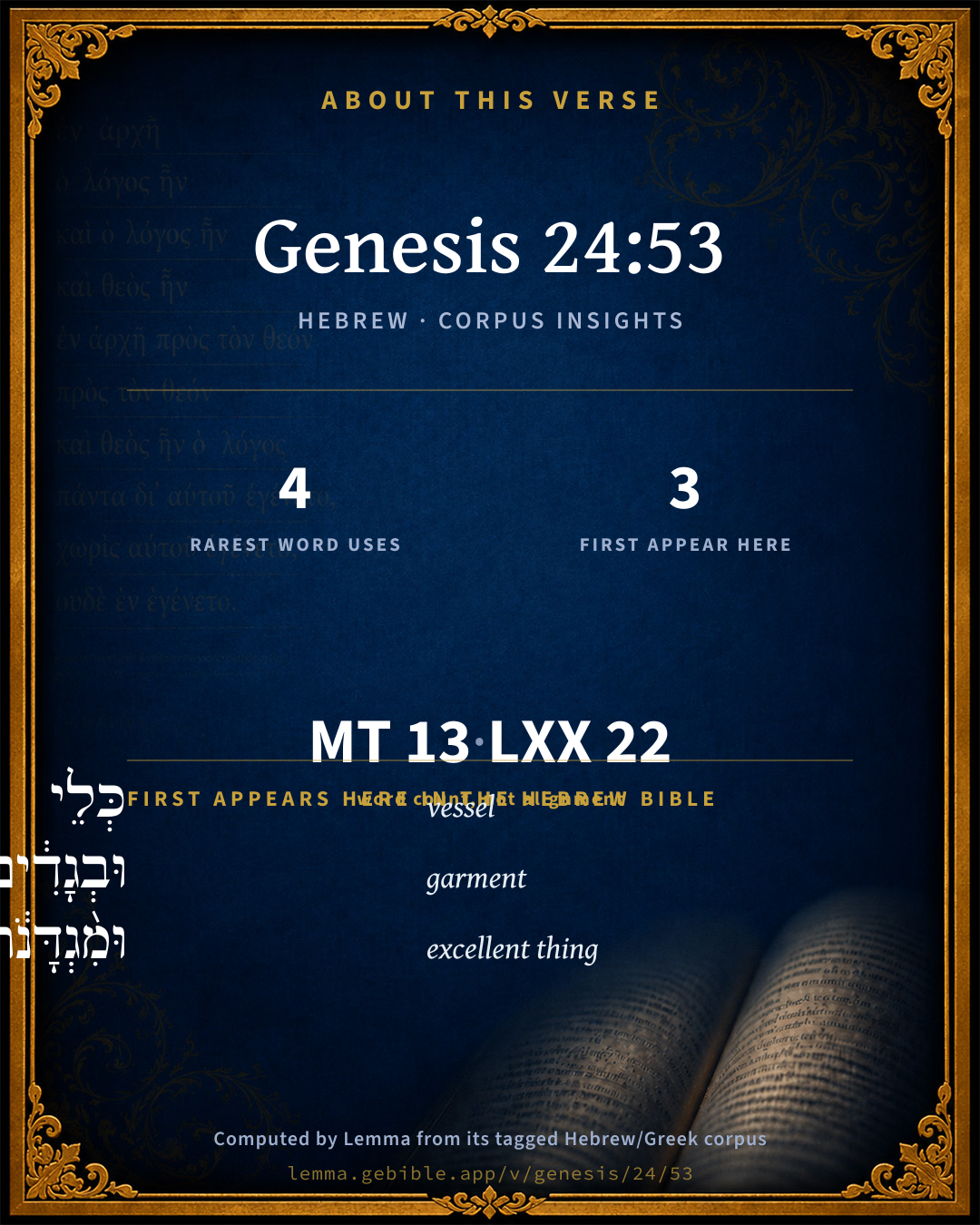
Genesis 24:53

Hebrew (Westminster Leningrad Codex) Genesis 24:53 appears in the Hebrew Old Testament. The text above is from the Westminster Leningrad Codex. Each word links to its Strong’s number, a concise gloss, and parsing drawn from the Open Scriptures Hebrew Bible morphology. Click any word for its full Brown-Driver-Briggs (BDB) entry.
Download image
Cite this verse

Genesis 24:53 (World English Bible). Public Domain. Lemma interlinear Bible study tool, https://lemma.gebible.app/v/genesis/24/53.

Show BibTeX & RIS
BibTeX
RIS
English Translation
The servant brought forth jewels of silver, and jewels of gold, and clothing, and gave them to Rebekah. He gave also to her brother and to her mother precious things.
World English Bible · Public Domain
Highlights
  • 3 first appearances in the Hebrew Bible
Full analysis ↓
Download a study sheet

One document with this verse’s original text, its word-by-word gloss line, the meaning frame, cross-references with their text, attributed commentary, and full source and license credits — printable, and it pastes into notes with its structure intact.

This verse Autodidact and up

Study sheet (.html) Plain text (.txt)

A passage Seminary Student

Up to 50 verses in one chapter. A passage sheet keeps up to 6 commentary sources and 12 cross-references per verse, in the order this page ranks them, and says so on the sheet whenever that leaves anything out. Ask for a single verse and you get the Autodidact verse sheet above.

Everything on this page stays free to read, with no account — the sheet is a download of what is already on screen, not access to it.

Want to remove ads? Support Godless Engineer
Compare translations 3

The same verse in 3 English versions, stacked beneath the original-language interlinear above. Click any original word for its lexicon entry.

Each is an independent rendering of the whole verse — the interlinear is not word-aligned to these translations.

Highlighted words mark where these versions differ — a whole-verse word diff, not a word-by-word alignment.

  • World English Bible Public Domain
    The servant brought forth jewels of silver, and jewels of gold, and clothing, and gave them to Rebekah. He gave also to her brother and to her mother precious things.
  • King James Version Public Domain
    And the servant brought forth jewels of silver, and jewels of gold, and raiment, and gave them to Rebekah: he gave also to her brother and to her mother precious things.
  • unfoldingWord Literal Text CC BY-SA 4.0
    Then the servant brought out jewelry of silver and jewelry of gold, and clothing, and gave them to Rebekah. And he gave valuable things to her brother and to her mother.

unfoldingWord Literal Text — © unfoldingWord, licensed CC BY-SA 4.0. Word-aligned USFM3 via Door43 (git.door43.org/unfoldingWord/en_ult).

Versions to compare (up to 4)

3 of 4 selected

Show all 18 translations

Every available English version of this verse, each an independent rendering of the whole verse.

  • World English Bible Public Domain
    The servant brought forth jewels of silver, and jewels of gold, and clothing, and gave them to Rebekah. He gave also to her brother and to her mother precious things.
  • Berean Standard Bible Public Domain
    Then he brought out jewels of silver and gold, and articles of clothing, and he gave them to Rebekah. He also gave precious gifts to her brother and her mother.
  • Majority Standard Bible Public Domain
    Then he brought out jewels of silver and gold, and articles of clothing, and he gave them to Rebekah. He also gave precious gifts to her brother and her mother.
  • King James Version Public Domain
    And the servant brought forth jewels of silver, and jewels of gold, and raiment, and gave them to Rebekah: he gave also to her brother and to her mother precious things.
  • American Standard Version (1901) Public Domain
    And the servant brought forth jewels of silver, and jewels of gold, and raiment, and gave them to Rebekah. He gave also to her brother and to her mother precious things.
  • Revised Version (1885) Public Domain
    And the servant brought forth jewels of silver, and jewels of gold, and raiment, and gave them to Rebekah: he gave also to her brother and to her mother precious things.
  • Geneva Bible (1599) Public Domain
    Then the seruant tooke foorth iewels of siluer, and iewels of golde, and raiment, and gaue to Rebekah: also vnto her brother and to her mother he gaue gifts.
  • Douay-Rheims (1899) Public Domain
    And bringing forth vessels of silver and gold, and garments, he gave them to Rebecca for a present. He offered gifts also to her brothers, and to her mother.
  • Young's Literal Translation Public Domain
    and the servant taketh out vessels of silver, and vessels of gold, and garments, and giveth to Rebekah; precious things also he hath given to her brother and to her mother.
  • Literal Standard Version CC BY-SA 4.0
    and the servant takes out vessels of silver, and vessels of gold, and garments, and gives to Rebekah; precious things also he has given to her brother and to her mother.
  • Unlocked Literal Bible CC BY-SA 4.0
    The servant brought out articles of silver and articles of gold, and clothing, and gave them to Rebekah. He also gave precious gifts to her brother and to her mother.
  • unfoldingWord Literal Text CC BY-SA 4.0
    Then the servant brought out jewelry of silver and jewelry of gold, and clothing, and gave them to Rebekah. And he gave valuable things to her brother and to her mother.
  • Darby Bible Public Domain
    And the servant brought forth silver articles, and gold articles, and clothing, and he gave [them] to Rebecca; and he gave to her brother, and to her mother, precious things.
  • World Messianic Bible Public Domain
    The servant brought out jewels of silver, and jewels of gold, and clothing, and gave them to Rebekah. He also gave precious things to her brother and her mother.
  • Webster's Bible Public Domain
    And the servant brought forth jewels of silver, and jewels of gold, and raiment, and gave them to Rebekah: He gave also to her brother and to her mother precious things.
  • Free Bible Version CC BY-SA 4.0
    Then he unpacked silver and gold jewelry and expensive clothes and gave them to Rebekah. He also gave valuable presents to her brother and her mother.
  • Bible in Basic English Public Domain
    Then he took jewels of silver and jewels of gold and fair robes and gave them to Rebekah: and he gave things of value to her mother and her brother.
  • JPS Tanakh (1917) Public Domain
    And the servant brought forth jewels of silver, and jewels of gold, and raiment, and gave them to Rebekah; he gave also to her brother and to her mother precious things.

Literal Standard Version (2020), Covenant Press — licensed CC BY-SA 4.0. Text via the HelloAO Bible API (eBible.org). Unlocked Literal Bible (unfoldingWord) — licensed CC BY-SA 4.0. Text via the HelloAO Bible API (eBible.org). unfoldingWord Literal Text — © unfoldingWord, licensed CC BY-SA 4.0. Word-aligned USFM3 via Door43 (git.door43.org/unfoldingWord/en_ult). Free Bible Version, Dr. Jonathan Gallagher — licensed CC BY-SA 4.0. Text via the HelloAO Bible API (eBible.org).

Word by word

More ways to search: Search by grammar → Find every occurrence → Compare this word →

Practice this passage: Drill this verse → Learn its vocabulary →

וּמִ֨גְדָּנֹ֔ת
migdânâh
H4030
“and · excellent things”
Conjunction + Noun, Common, Feminine, Plural, Absolute
Part of Speech
Conjunction + Noun
Type
Common
Gender
Feminine
Number
Plural
State
Absolute
Full BDB Definition

Origin: from the same as H4022

TWOT: 1144b

choice thing, excellent thing
  1. וַיּוֹצֵ֨א yâtsâʼ H3318 “and · to go out” Conjunction + Verb, Hiphil, Sequential Imperfect, 3rd Person, Masculine, Singular
  2. הָעֶ֜בֶד ʻebed H5650 “the · servant” Particle, Definite Article + Noun, Common, Masculine, Singular, Absolute
  3. כְּלֵי kᵉlîy H3627 “vessels of” Noun, Common, Masculine, Plural, Construct
  4. כֶ֨סֶף keçeph H3701 “silver” Noun, Common, Masculine, Singular, Absolute
  5. וּכְלֵ֤י kᵉlîy H3627 “and · vessels of” Conjunction + Noun, Common, Masculine, Plural, Construct
  6. זָהָב֙ zâhâb H2091 “gold” Noun, Common, Masculine, Singular, Absolute
  7. וּבְגָדִ֔ים beged H899 “and · garments” Conjunction + Noun, Common, Masculine, Plural, Absolute
  8. וַיִּתֵּ֖ן nâthan H5414 “and · to give” Conjunction + Verb, Qal, Sequential Imperfect, 3rd Person, Masculine, Singular
  9. לְרִבְקָ֑ה Ribqâh H7259 “to/for · Rebekah” Preposition + Noun, Proper
  10. נָתַ֥ן nâthan H5414 “to give” Verb, Qal, Perfect, 3rd Person, Masculine, Singular
  11. לְאָחִ֖יהָ ʼâch H251 “to/for · brother · her” Preposition + Noun, Common, Masculine, Singular, Construct + Suffix, Personal, 3rd Person, Feminine, Singular
  12. וּלְאִמָּֽהּ ʼêm H517 “and · to/for · mother · her” Conjunction + Preposition + Noun, Common, Feminine, Singular, Construct + Suffix, Personal, 3rd Person, Feminine, Singular

About this verse

These counts appear in no published source. They are computed here, from the morphology-tagged text and Lemma’s own curated glosses. What Lemma adds →

13
words
11
distinct lemmas
Pentateuch
section

Notable vocabulary

The rarest word here is וּמִ֨גְדָּנֹ֔ת excellent thing H4030 — appearing just 4 times in the whole Hebrew Bible.

First appearance in Scripture

These words make their first canonical appearance in the Hebrew Bible here:

  • כְּלֵי vessel H3627
  • וּבְגָדִ֔ים garment H899
  • וּמִ֨גְדָּנֹ֔ת excellent thing H4030

Shared distinctive vocabulary

וּמִ֨גְדָּנֹ֔ת excellent thing H4030 occurs in 4 verses of the Hebrew Bible. Also found in:

Grammatical profile

  • 3 verbs
  • 10 nouns

Verb forms

  • וַיּוֹצֵ֨א Hiphil · Sequential Imperfect
  • וַיִּתֵּ֖ן Qal · Sequential Imperfect
  • נָתַ֥ן Qal · Perfect

Repetition

Words recur within this verse — often emphatic in Hebrew:

  • כְּלֵי vessel H3627 ×2
  • וַיִּתֵּ֖ן to give H5414 ×2

Hebrew & Septuagint length

In English translation the verse runs 30 words from the Hebrew and 27 from the Septuagint (LXX English) — closely comparable.

A rough comparison of the two English renderings, which tokenize alike — not a word-level alignment.

Word counts can differ between the Hebrew and the Greek without any difference in meaning — e.g. the Hebrew direct-object marker אֵת has no separate Greek word, and Greek often adds the article ὁ.

In the original languages it is 13 Hebrew tokens and 22 Greek tokens — but the two are counted differently (Hebrew bundles its prefixes and suffixes into one token; the Greek is in lemma form), so that isn’t a like-for-like length.

Cross-references

10

Topical passages linked to Genesis 24:53 in the Treasury of Scripture Knowledge — connected by theme and wording, ordered by reader-vote popularity; previews shown in the World English Bible.

  • Genesis 24:10 The servant took ten camels, of his master's camels, and departed, having all goodly things of his master's in his hand. He arose, and went to Mesopotamia, to the city of Nahor.
  • Genesis 24:22 It happened, as the camels had done drinking, that the man took a golden ring of half a shekel weight, and two bracelets for her hands of ten shekels weight of gold,
  • Exodus 3:22 But every woman shall ask of her neighbor, and of her who visits her house, jewels of silver, jewels of gold, and clothing; and you shall put them on your sons, and on your daughters. You shall despoil the Egyptians.
  • Exodus 11:2 Speak now in the ears of the people, and let them ask every man of his neighbor, and every woman of her neighbor, jewels of silver, and jewels of gold."
  • Exodus 12:35 The children of Israel did according to the word of Moses; and they asked of the Egyptians jewels of silver, and jewels of gold, and clothing.
  • Deuteronomy 33:13–16 Of Joseph he said, Blessed of Yahweh be his land, For the precious things of the heavens, for the dew, For the deep that couches beneath,
  • 2 Chronicles 21:3 Their father gave them great gifts, of silver, and of gold, and of precious things, with fortified cities in Judah: but the kingdom gave he to Jehoram, because he was the firstborn.
  • Ezra 1:6 All those who were round about them strengthened their hands with vessels of silver, with gold, with goods, and with animals, and with precious things, besides all that was willingly offered.
  • Song of Solomon 4:13 Your shoots are an orchard of pomegranates, with precious fruits: Henna with spikenard plants,
  • Isaiah 39:2 Hezekiah was glad of them, and shown them the house of his precious things, the silver, and the gold, and the spices, and the precious oil, and all the house of his armor, and all that was found in his treasures: there was nothing in his house, nor in all his dominion, that Hezekiah didn't show them.

Cross-references courtesy of OpenBible.info (CC BY 4.0).

Hebrew and Greek witnesses Masoretic Hebrew ↔ Greek Septuagint

The same verse in the two great witnesses to the Old Testament, shown verse-for-verse.

These are two independent witnesses, not word-aligned to each other, and the Septuagint is shown in lemma (dictionary) form.

Hebrew Genesis 24:53 Masoretic · Westminster Leningrad Codex

וַיּוֹצֵ֨א הָעֶ֜בֶד כְּלֵי כֶ֨סֶף וּכְלֵ֤י זָהָב֙ וּבְגָדִ֔ים וַיִּתֵּ֖ן לְרִבְקָ֑ה וּמִ֨גְדָּנֹ֔ת נָתַ֥ן לְאָחִ֖יהָ וּלְאִמָּֽהּ

The servant brought forth jewels of silver, and jewels of gold, and clothing, and gave them to Rebekah. He gave also to her brother and to her mother precious things.

World English Bible · Public Domain

Greek LXX Genesis 24:53 Septuagint · lemma form

καί ἐκφέρω ὁ παῖς σκεῦος ἀργυροῦς καί χρύσεος καί ἱματισμός δίδωμι ρεβεκκα καί δῶρον δίδωμι ὁ ἀδελφός αὐτός καί ὁ μήτηρ αὐτός

And the servant having brought forth jewels of silver and gold and raiment, gave them to Rebecca, and gave gifts to her brother, and to her mother.

LXX2012 (modern English Septuagint) · Public Domain

On this verse, The Cambridge Bible for Schools and Colleges discusses the Septuagint’s reading. Read the note in Commentary ↓

Hebrew: Westminster Leningrad Codex (CC BY 4.0). Greek: Septuagint (public domain); English from LXX2012 (modern English Septuagint) (Public Domain). How the Septuagint differs from the Hebrew →

Targum (Aramaic paraphrase)

2

The Targum is the ancient Jewish Aramaic paraphrase of the Hebrew Scriptures — an interpretive translation, not the Hebrew text itself. Onkelos (literal) and Pseudo-Jonathan (expansive) render the Torah, and Jonathan the Prophets. Coverage is partial: where no permissively-licensed English translation exists for a verse, only the Aramaic is shown. This is verse-level text, not a word-by-word alignment to the Hebrew.

  1. Targum Onkelos Torah (Genesis–Deuteronomy)
    וְאַפֵּק עַבְדָּא מָנִין דִּכְסַף וּמָנִין דִּדְהַב וּלְבוּשִׁין וִיהַב לְרִבְקָה וּמִגְדָּנִין יְהַב לַאֲחוּהָא וּלְאִמַּהּ

    (no public-domain English translation for this verse)

    Targum Onkelos — Aramaic: “Onkelos Genesis” (public domain); “Onkelos Exodus” (public domain); “Onkelos Leviticus” (public domain); “Onkelos Numbers” (public domain); “Onkelos Deuteronomy” (public domain). English: “Sefaria Community Translation” (CC0 1.0 (public-domain dedication)); “J.W. Etheridge. The Targums of Onkelos and Jonathan Ben Uzziel on the Pentateuch. London: Longmans, Green, 1862” (public domain). Text via Sefaria.

  2. Targum Pseudo-Jonathan Torah (Genesis–Deuteronomy)
    וְהַנְפַק עַבְדָא מָנִין דִכְסַף וּמָנִין דִדְהַב וּלְבוּשִׁין וִיהַב לְרִבְקָה וְדוֹרוֹנִין יְהַב לְאָחוּהָא וּלְאִמָהּ

    And the servant brought forth vessels of silver and of gold, and vestments, and gave them to Rivekah; and presents give he to her brother and to her mother.

    Targum Pseudo-Jonathan — Aramaic: “Targum Jonathan on Genesis” (public domain); “Targum Jonathan on Exodus” (public domain); “Targum Jonathan on Leviticus” (public domain); “Targum Jonathan on Numbers” (public domain); “Targum Jonathan on Deuteronomy” (public domain). English: “The Targum of Jonathan ben Uzziel, trans. J. W. Etheridge, London, 1862” (public domain). Text via Sefaria.

Commentary

Notes on Genesis 24:53 from classic Christian and Jewish commentators (each source and its license shown beneath its notes). The classic Christian expositions comment on the surrounding passage and are grouped to its opening verse, so a note may address several verses; the Jewish commentaries on the Tanakh (Rashi and others) are per-verse, so they appear only where the commentator wrote on this verse.

Lemma curates 59 commentaries, every one of them public domain or Creative Commons licensed, each selected and text-cleaned for this edition rather than reprinted as found. About our sources →

Trapp's Complete Commentary

John Trapp

Gen 24:53 And the servant brought forth jewels of silver, and jewels of gold, and raiment, and gave [them] to Rebekah: he gave also to her brother and to her mother precious things.

Ver. 53. And gave them to Rebekah: he gave also.] Note, that the custom was then, to give gifts to the bride and her friends. Now it is otherwise. Yet in Hungary their women have no portion, they say, {a} but a new coat at their wedding. Moris est apud Thraces (saith Solinus, cap. 14), ut nupturae non parentum arbitratu transeant ad matiros; sed quae prae coeteris specie valent, subhastari volunt; et licentia taxationis admissa, non moribus nubunt, sed proemiis.

{a} Heyl., Geog.

John Trapp, A Commentary or Exposition upon All the Books of the Old and New Testament (1647–1656) — public domain. Text from a community e-Sword module.

Tyndale Open Study Notes

Tyndale Open Resources

24:53 The servant gave expensive gifts to Rebekah, her mother, and her brother to conclude the arrangements.

Tyndale Open Study Notes — © Tyndale Open Resources, licensed CC BY-SA 4.0. Text via the HelloAO Bible API.

Jamieson, Fausset & Brown

Robert Jamieson, A. R. Fausset & David Brown

And the servant brought forth jewels of silver, and . . . gold--These are the usual articles, with money, that form a woman's dowry among the pastoral tribes. Rebekah was betrothed and accompanied the servant to Canaan.

Jamieson, Fausset & Brown — Commentary Critical and Explanatory on the Whole Bible (1871) — public domain (CC PDM 1.0). Text via the HelloAO Bible API.

Adam Clarke's Commentary

Verse 53. Jewels of silver, and jewels of gold] The word כלי keley, which we here translate jewels signifies properly vessels or instruments; and those presented by Eliezer might have been of various kinds. What he had given before, Ge 24:22, was in token of respect, what he gave now appears to have been in the way of dowry.

Precious things.] מגדנת migdanoth. This word is used to express exquisite fruits or delicacies, De 33:13-16; precious plants or flowers, Cant. Son 4:16; Son 7:13. But it may mean gifts in general, though rather of an inferior kind to those mentioned above.

Adam Clarke's Commentary on the Bible (1810–1826) — public domain. Text from a community e-Sword/MySword module.

Ellicott's Commentary for English Readers

(53) Jewels of silver, and jewels of gold.—Heb., vessels. In ancient times a wife had to be bought (Gen_34:12), and the presents given were not mere ornaments and jewellery, but articles of substantial use and value. Quickly indeed in a country of such ceremonial politeness the purchase took a more honourable form, but Orientals do not let their courtesy interfere with their interests, and the relatives would take care that the freewill offerings did not fall below the usual standard. These went partly to the bride, and partly to her relatives: and as they are described here as going exclusively to the brother and mother, Jewish tradition has invented the story that Bethuel was ill at the time, and died on the day of the servant’s arrival. But the manner in which Isaac speaks of him in Gen_28:2 does not allow us to suppose that he was either dead at the time of her departure, or that he was a person of no ability or importance. Possibly, therefore, polygamy had led to the custom of the purchase presents going to the mother’s tent.

A Bible Commentary for English Readers, edited by Charles John Ellicott (1878–1897) — public domain. Text from a community e-Sword module.

The Cambridge Bible for Schools and Colleges

gen. ed. J. J. S. Perowne

53. jewels … silver … gold … raiment] The word “jewels” in the original is indefinite, and might be rendered “vessels,” as LXX σκεύη and Lat. vasa. The servant’s first act is to ratify the betrothal by making the betrothal gifts to the bride. Oriental custom required that, at the betrothal, gifts should be made to the parents or nearest representative relations of the bride. Mention of marriage gifts (mohar) to the bride’s family is found also in Gen_34:12; Exo_22:16-17; Deu_22:19; 1Sa_18:25. The custom must be regarded as a remnant of still earlier times, when the bride was purchased, and the marriage ceremony consisted chiefly of a financial transaction. In this verse, the “precious things,” given by the servant to Rebekah’s brother and mother, constitute the customary mohar to the bride’s family. This custom is also mentioned in the Code of Hammurabi, §§ 159–161.

It is noticeable that the “precious things” are given, not to Rebekah’s father, Bethuel, but to her brother and mother. This is an important point in favour of the view, mentioned above, that Bethuel’s name in Gen_24:50 is an interpolation (see note on Gen_24:15).

The Cambridge Bible for Schools and Colleges (gen. ed. J. J. S. Perowne; Cambridge University Press, 1878–1918) — public domain. Text from a community e-Sword module.

John Gill's Exposition

And they called Rebekah,.... Or ordered her to be called by one of the servants:

and said unto her, wilt thou go with this man? that is, directly; the question was not about her marriage of Isaac, that was agreed upon, and she had doubtless given her consent, and which she tacitly did by accepting of the presents, but about taking the journey immediately:

and she said, I will go; the note of Jarchi is,"of myself, and even if you are not willing,''which seems to make her answer rude, as well as resolute; but it must be interpreted consistent with her decent and modest behaviour, and as expressive of her agreeing to go with the man directly, having no manner of objection on her mind to it; but on the contrary found a strong inclination to it, and was determined on it; and perhaps was under a divine impulse, which strongly wrought upon her, and caused her to be so willing to leave her own people, and her father's house.

John Gill's Exposition of the Whole Bible (1746–1763) — public domain (CC PDM 1.0). Text via the HelloAO Bible API.

Haydock's Catholic Bible Commentary

Present. Thus ratifying what he had already done, (ver. 22,) and obtaining full consent, both of the virgin, and of her father and brother.

George Leo Haydock (1774–1849), Haydock's Catholic Family Bible and Commentary, 1859 edition — public domain. Excludes Psalms (Douay-Rheims chapter numbering differs from Protestant) and Deuterocanonical books (Catholic canon only).

Matthew Poole's English Annotations

The precious fruits of the land from which he came; see Deu 33:13, &c.; or in general, other rare and excellent things. In those days men gave portions for their wives, as now they have portions with them.

Matthew Poole's English Annotations on the Holy Bible (1683–1685) — public domain. Text from a community e-Sword/MySword module.

Whedon's Commentary on the Bible

Daniel D. Whedon

53. Jewels of silver — Rather, vessels of silver. Costly presents from the great accumulations of Abraham, amassed through many years. Comp. Gen_13:2; Gen_20:16.

Precious things — Choice gifts of various kinds, such as he knew would be pleasing.

Daniel D. Whedon (gen. ed.), Commentary on the Old and New Testaments (1874–1909) — public domain. Text from a community e-Sword module.

The Pulpit Commentary

Vers. 53, 54. And the servant brought forth jewels literally, vessels (skeuh, LXX.), the idea being that of things finished or completed; from hlK to finish (cf. Gen_31:37 Gen_45:20) of silver, and jewels (or vessels) of gold, and raiment, covering garments, e.g. the outer robes of Orientals; (Gen_20:11, Gen_20:12, Gen_20:13, 15 41:42) especially precious ones (1Ki_22:10) and gave them to Rebekah as betrothal presents, which are absolutely essential, and usually given with much ceremony before witnesses (vide "Land and Book," p. 593). He gave also to her brother and to her mother (here mentioned for the first time) precious things, tnOD; gmi from dg,m, precious, occurring only elsewhere in 2Ch_21:3 and Eze_1:6; both times as here, in connection with gold and silver probably describes valuable articles in general. And (having thus formally concluded the engagement) they did eat and drink, i.e. partook of the victims which had been set before them at an earlierstage (ver. 33)he and the men that were with him, and tarried all night; literally, and passed the night (cf. Gen_19:2 Gen_24:25) and they rose up in the morning (indicative of alacrity and zeal), and he said, Send me away unto my master being impatient to report to Abraham the success of his expedition.

The Pulpit Commentary (1880–1919), ed. H.D.M. Spence-Jones & Joseph S. Exell — public domain. Text from a community e-Sword module.

Rashi

Rabbi Shlomo Yitzchaki (Rashi)

ומגדנות PRECIOUS THINGS — it has the same meaning as מגדים (cf. Song 7:14) “precious fruits״, for he had brought with him various kinds of fruit from the land of Israel (Genesis Rabbah 60:11).

Rashi on the Tanakh — English translations: “The Judaica Press complete Tanach with Rashi, translated by A. J. Rosenberg” (CC BY 4.0); “Pentateuch with Rashi's commentary by M. Rosenbaum and A.M. Silbermann, 1929-1934” (public domain); “The Metsudah Tanach series, Lakewood, N.J” (CC BY 4.0); and “The Book of Joshua, Metsudah Publications, 1997” (CC BY 4.0). Text via Sefaria.

Radak

Rabbi David Kimhi (Radak)

ויוצא, seeing that Rivkah had been given to him, he produced more silver, gold, and clothing.

ומגדנות, this word includes anything of value, including exotic fruit and fancy garments. The word appears also in Chronicles II 32,23 in a similar sense.

לאחיה ולאמה, for they were the mainstay of the household, Betuel being old and frail. According to an aggadic interpretation (Bereshit Rabbah 60,12) based on Lavan speaking instead of his father, he had died suddenly as he intended to raise obstacles to the marriage.

Radak on the Tanakh — English translations: “Sefaria Community Translation” (CC0 1.0 (public-domain dedication)); “Eliyahu Munk, HaChut Hameshulash” (CC BY 4.0); “Rabbi Mike Feuer, Jerusalem Anthology” (CC BY 4.0); and “R. David Kimhi on the first book of Psalms, Translated by R.G. Finch, London, 1919” (public domain). Text via Sefaria.

Lesson kit

Teaching starters — assembled from the data on this page, not authored interpretation. Every prompt links to the verse data it draws on. Edit before teaching.

Genesis, in the Pentateuch, opens this verse with 13 words (11 distinct Hebrew lemmas). Its most distinctive word is migdânâh (“excellent thing”). A historical commentator’s framing appears above. Read the whole chapter for the surrounding context.

Discussion questions

  1. What does “excellent thing” (migdânâh) contribute to the verse as a whole?
  2. 3 words here appear for the first time in Scripture. What is being introduced at this debut?
  3. 2 Chronicles 21:3 shares the word «excellent thing» with this verse. How do the two illuminate each other?
  4. “vessel” occurs 2× in this one verse. What is the effect of the repetition?
  5. These translations render this verse differently. What is at stake in choosing one wording over another?
  6. The verb «וַיּוֹצֵ֨א» is Hiphil Sequential Imperfect. How does its form color the action?
  7. Reading how Trapp's Complete Commentary and Tyndale Open Study Notes read this verse, where do the two commentators agree and where do they part?

Things to notice

Reading settings

Reading text

Shown beneath each verse's original-language words.

Old Testament
Old Testament edition

Read the OT as the Masoretic Hebrew (MT) or the Greek Septuagint (LXX).

English shown for the Greek Septuagint (in the Hebrew ↔ Greek comparison).

Comparing translations? Open the Compare panel on any verse page to stack up to four side by side.