
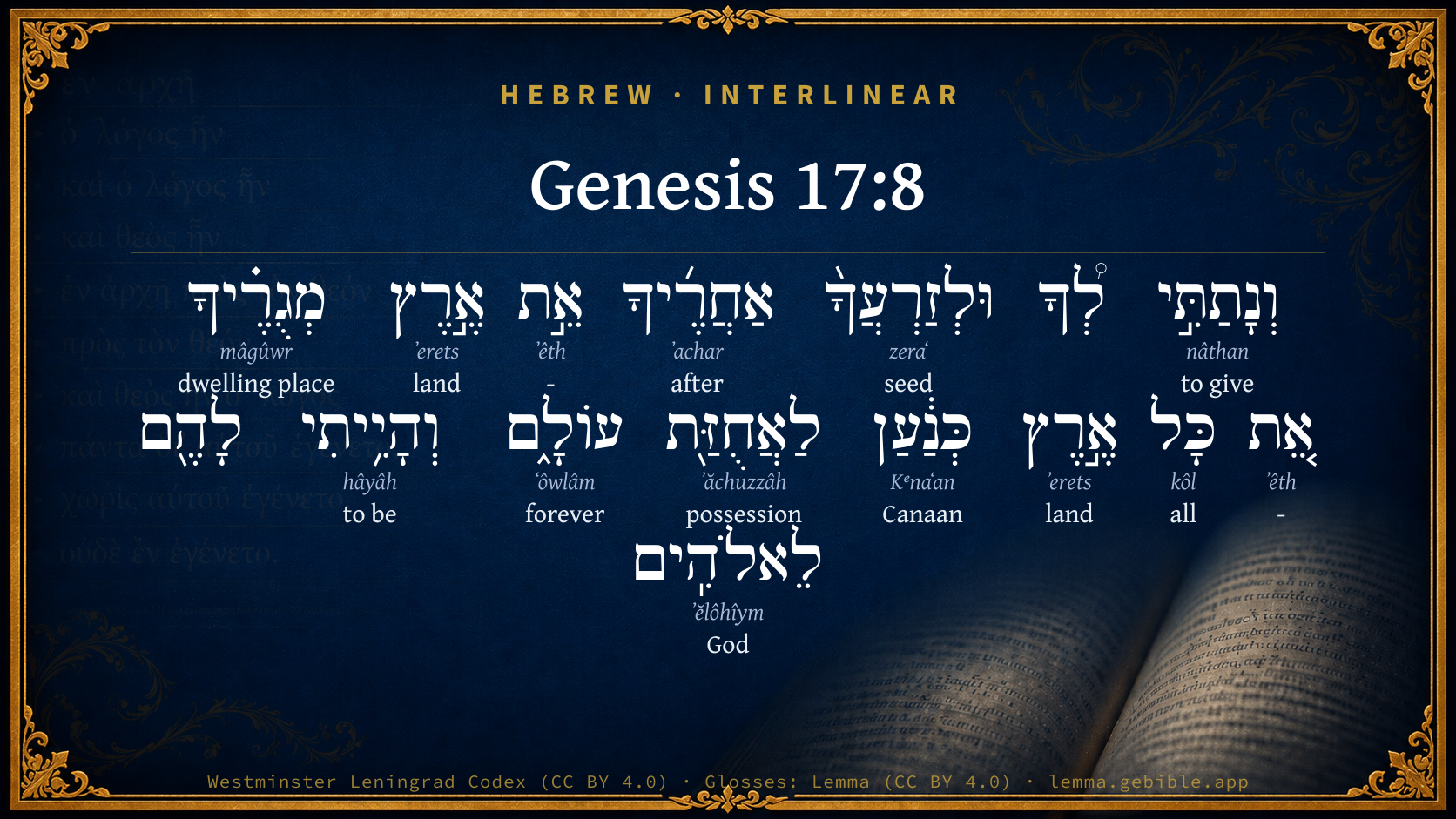
Genesis 17:8

Hebrew (Westminster Leningrad Codex) Genesis 17:8 appears in the Hebrew Old Testament. The text above is from the Westminster Leningrad Codex. Each word links to its Strong’s number, a concise gloss, and parsing drawn from the Open Scriptures Hebrew Bible morphology. Click any word for its full Brown-Driver-Briggs (BDB) entry.
Download image
Cite this verse

Genesis 17:8 (World English Bible). Public Domain. Lemma interlinear Bible study tool, https://lemma.gebible.app/v/genesis/17/8.

Show BibTeX & RIS
BibTeX
RIS
English Translation
I will give to you, and to your seed after you, the land where you are traveling, all the land of Canaan, for an everlasting possession. I will be their God."
World English Bible · Public Domain
Highlights
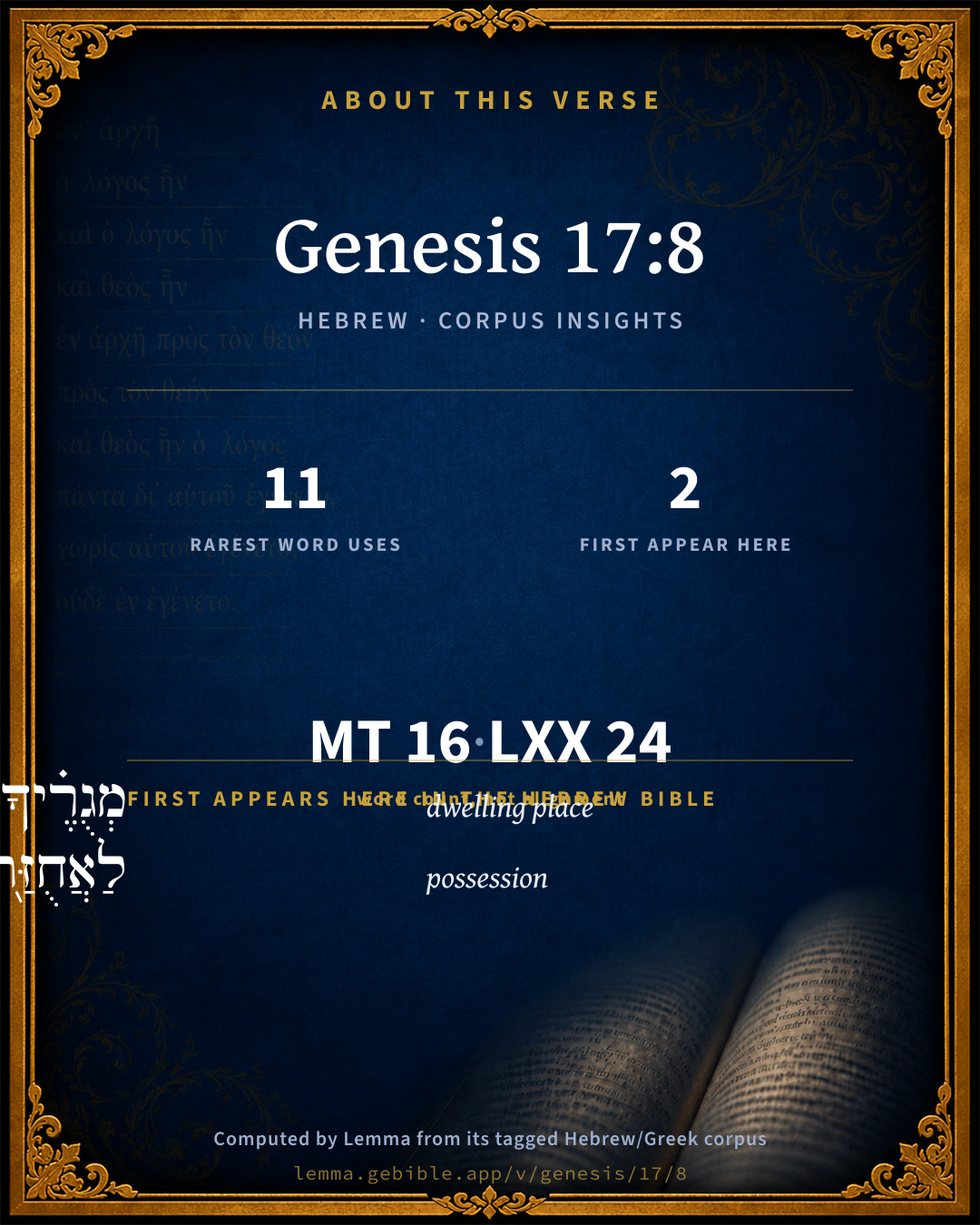
  • 2 first appearances in the Hebrew Bible
Full analysis ↓
Download a study sheet

One document with this verse’s original text, its word-by-word gloss line, the meaning frame, cross-references with their text, attributed commentary, and full source and license credits — printable, and it pastes into notes with its structure intact.

This verse Autodidact and up

Study sheet (.html) Plain text (.txt)

A passage Seminary Student

Up to 50 verses in one chapter. A passage sheet keeps up to 6 commentary sources and 12 cross-references per verse, in the order this page ranks them, and says so on the sheet whenever that leaves anything out. Ask for a single verse and you get the Autodidact verse sheet above.

Everything on this page stays free to read, with no account — the sheet is a download of what is already on screen, not access to it.

Want to remove ads? Support Godless Engineer
Compare translations 3

The same verse in 3 English versions, stacked beneath the original-language interlinear above. Click any original word for its lexicon entry.

Each is an independent rendering of the whole verse — the interlinear is not word-aligned to these translations.

Highlighted words mark where these versions differ — a whole-verse word diff, not a word-by-word alignment.

  • World English Bible Public Domain
    I will give to you, and to your seed after you, the land where you are traveling, all the land of Canaan, for an everlasting possession. I will be their God."
  • King James Version Public Domain
    And I will give unto thee, and to thy seed after thee, the land wherein thou art a stranger, all the land of Canaan, for an everlasting possession; and I will be their God.
  • unfoldingWord Literal Text CC BY-SA 4.0
    And I will give to you and to your offspring after you the land of your sojournings, all the land of Canaan, as an eternal possession, and I will be God to them.”

unfoldingWord Literal Text — © unfoldingWord, licensed CC BY-SA 4.0. Word-aligned USFM3 via Door43 (git.door43.org/unfoldingWord/en_ult).

Versions to compare (up to 4)

3 of 4 selected

Show all 18 translations

Every available English version of this verse, each an independent rendering of the whole verse.

  • World English Bible Public Domain
    I will give to you, and to your seed after you, the land where you are traveling, all the land of Canaan, for an everlasting possession. I will be their God."
  • Berean Standard Bible Public Domain
    And to you and your descendants I will give the land where you are residing—all the land of Canaan—as an eternal possession; and I will be their God.”
  • Majority Standard Bible Public Domain
    And to you and your descendants I will give the land where you are residing—all the land of Canaan—as an eternal possession; and I will be their God.”
  • King James Version Public Domain
    And I will give unto thee, and to thy seed after thee, the land wherein thou art a stranger, all the land of Canaan, for an everlasting possession; and I will be their God.
  • American Standard Version (1901) Public Domain
    And I will give unto thee, and to thy seed after thee, the land of thy sojournings, all the land of Canaan, for an everlasting possession; and I will be their God.
  • Revised Version (1885) Public Domain
    And I will give unto thee, and to thy seed after thee, the land of thy sojournings, all the land of Canaan, for an everlasting possession; and I will be their God.
  • Geneva Bible (1599) Public Domain
    And I will giue thee and thy seede after thee the land, wherein thou art a stranger, euen all the land of Canaan, for an euerlasting possession, and I will be their God.
  • Douay-Rheims (1899) Public Domain
    And I will give to thee, and to thy seed, the land of thy sojournment, all the land of Chanaan for a perpetual possession, and I will be their God.
  • Young's Literal Translation Public Domain
    and I have given to thee, and to thy seed after thee, the land of thy sojournings, the whole land of Canaan, for a possession age-during, and I have become their God.'
  • Literal Standard Version CC BY-SA 4.0
    and I have given to you, and to your seed after you, the land of your sojournings, the whole land of Canaan, for a continuous possession, and I have become their God.”
  • Unlocked Literal Bible CC BY-SA 4.0
    I will give to you, and to your descendants after you, the land where you have been living, all the land of Canaan, for an everlasting possession, and I will be their God.”
  • unfoldingWord Literal Text CC BY-SA 4.0
    And I will give to you and to your offspring after you the land of your sojournings, all the land of Canaan, as an eternal possession, and I will be God to them.”
  • Darby Bible Public Domain
    And I give to thee, and to thy seed after thee, the land of thy sojourning, all the land of Canaan, for an everlasting possession; and I will be a God to them.
  • World Messianic Bible Public Domain
    I will give to you, and to your offspring after you, the land where you are traveling, all the land of Canaan, for an everlasting possession. I will be their God.”
  • Webster's Bible Public Domain
    And I will give to thee, and to thy seed after thee, the land in which thou art a stranger, all the land of Canaan, for an everlasting possession; and I will be their God.
  • Free Bible Version CC BY-SA 4.0
    I will give you and your descendants the whole country of Canaan—where you've been living as a foreigner—as land to own forever, and I will be their God.”
  • Bible in Basic English Public Domain
    And to you and to your seed after you, I will give the land in which you are living, all the land of Canaan for an eternal heritage; and I will be their God.
  • JPS Tanakh (1917) Public Domain
    And I will give unto thee, and to thy seed after thee, the land of thy sojournings, all the land of Canaan, for an everlasting possession; and I will be their God.'

Literal Standard Version (2020), Covenant Press — licensed CC BY-SA 4.0. Text via the HelloAO Bible API (eBible.org). Unlocked Literal Bible (unfoldingWord) — licensed CC BY-SA 4.0. Text via the HelloAO Bible API (eBible.org). unfoldingWord Literal Text — © unfoldingWord, licensed CC BY-SA 4.0. Word-aligned USFM3 via Door43 (git.door43.org/unfoldingWord/en_ult). Free Bible Version, Dr. Jonathan Gallagher — licensed CC BY-SA 4.0. Text via the HelloAO Bible API (eBible.org).

Word by word

More ways to search: Search by grammar → Find every occurrence → Compare this word →

Practice this passage: Drill this verse → Learn its vocabulary →

מְגֻרֶ֗יךָ
mâgûwr
H4033
“dwelling places · your”
Noun, Common, Masculine, Plural, Construct + Suffix, Personal, 2nd Person, Masculine, Singular
Part of Speech
Noun
Type
Common
Gender
Masculine
Number
Plural
State
Construct
Full BDB Definition

Origin: from H1481 in the sense lodging

TWOT: 330c

sojourning place, dwelling-place, sojourning - dwelling-place - sojourning, lifetime
  1. וְנָתַתִּ֣י nâthan H5414 “and · to give” Conjunction + Verb, Qal, Sequential Perfect, 1st Person, Common, Singular
  2. וּלְזַרְעֲךָ֨ zeraʻ H2233 “and · to/for · seed · your” Conjunction + Preposition + Noun, Common, Masculine, Singular, Construct + Suffix, Personal, 2nd Person, Masculine, Singular
  3. אַחֲרֶ֜יךָ ʼachar H310 “after · you” Preposition + Suffix, Personal, 2nd Person, Masculine, Singular
  4. אֵ֣ת ʼêth H853 “-” Particle, Direct Object
  5. אֶ֣רֶץ ʼerets H776 “land of” Noun, Common, Both, Singular, Construct
  6. אֵ֚ת ʼêth H853 “-” Particle, Direct Object
  7. כָּל kôl H3605 “all of” Noun, Common, Masculine, Singular, Construct
  8. אֶ֣רֶץ ʼerets H776 “land of” Noun, Common, Both, Singular, Construct
  9. כְּנַ֔עַן Kᵉnaʻan H3667 “Canaan” Noun, Proper
  10. לַאֲחֻזַּ֖ת ʼăchuzzâh H272 “to/for · possession of” Preposition + Noun, Common, Feminine, Singular, Construct
  11. עוֹלָ֑ם ʻôwlâm H5769 “forever” Noun, Common, Masculine, Singular, Absolute
  12. וְהָיִ֥יתִי hâyâh H1961 “and · to be” Conjunction + Verb, Qal, Sequential Perfect, 1st Person, Common, Singular
  13. לֵאלֹהִֽים ʼĕlôhîym H430 “to/for · God(s)” Preposition + Noun, Common, Masculine, Plural, Absolute

About this verse

These counts appear in no published source. They are computed here, from the morphology-tagged text and Lemma’s own curated glosses. What Lemma adds →

16
words
12
distinct lemmas
Pentateuch
section

Notable vocabulary

The rarest word here is מְגֻרֶ֗יךָ dwelling place H4033 — appearing just 11 times in the whole Hebrew Bible.

First appearance in Scripture

These words make their first canonical appearance in the Hebrew Bible here:

  • מְגֻרֶ֗יךָ dwelling place H4033
  • לַאֲחֻזַּ֖ת possession H272

Shared distinctive vocabulary

מְגֻרֶ֗יךָ dwelling place H4033 occurs in 10 verses of the Hebrew Bible. Also found in:

Grammatical profile

  • 2 verbs
  • 9 nouns
  • 3 prepositions
  • 2 particles

Verb forms

  • וְנָתַתִּ֣י Qal · Sequential Perfect
  • וְהָיִ֥יתִי Qal · Sequential Perfect

Repetition

A word recurs within this verse — often emphatic in Hebrew:

  • אֶ֣רֶץ land H776 ×2

Hebrew & Septuagint length

In English translation the verse runs 31 words from the Hebrew and 35 from the Septuagint (LXX English) — closely comparable.

A rough comparison of the two English renderings, which tokenize alike — not a word-level alignment.

Word counts can differ between the Hebrew and the Greek without any difference in meaning — e.g. the Hebrew direct-object marker אֵת has no separate Greek word, and Greek often adds the article ὁ.

In the original languages it is 16 Hebrew tokens and 24 Greek tokens — but the two are counted differently (Hebrew bundles its prefixes and suffixes into one token; the Greek is in lemma form), so that isn’t a like-for-like length.

Cross-references

24

Topical passages linked to Genesis 17:8 in the Treasury of Scripture Knowledge — connected by theme and wording, ordered by reader-vote popularity; previews shown in the World English Bible.

  • Leviticus 26:12 I will walk among you, and will be your God, and you will be my people.
  • Genesis 12:7 Yahweh appeared to Abram, and said, "I will give this land to your seed." He built an altar there to Yahweh, who appeared to him.
  • Psalms 105:11 Saying, "To you I will give the land of Canaan, The lot of your inheritance;"
  • Exodus 6:7 and I will take you to me for a people, and I will be to you a God; and you shall know that I am Yahweh your God, who brings you out from under the burdens of the Egyptians.
  • Genesis 13:15 for all the land which you see, I will give to you, and to your offspring forever.
  • Deuteronomy 14:2 For you are a holy people to Yahweh your God, and Yahweh has chosen you to be a people for his own possession, above all peoples who are on the face of the earth.
  • Deuteronomy 26:18 and Yahweh has declared you this day to be a people for his own possession, as he has promised you, and that you should keep all his commandments;
  • Deuteronomy 29:13 that he may establish you this day to himself for a people, and that he may be to you a God, as he spoke to you, and as he swore to your fathers, to Abraham, to Isaac, and to Jacob.
  • Genesis 28:4 and give you the blessing of Abraham, to you, and to your seed with you, that you may inherit the land where you travel, which God gave to Abraham."
  • Genesis 13:17 Arise, walk through the land in the length of it and in the breadth of it; for I will give it to you."
  • Genesis 23:4 "I am a stranger and a foreigner living with you. Give me a possession of a burying-place with you, that I may bury my dead out of my sight."
  • Deuteronomy 4:37 Because he loved your fathers, therefore he chose their seed after them, and brought you out with his presence, with his great power, out of Egypt;
  • Psalms 105:9 The covenant which he made with Abraham, His oath to Isaac,
  • Genesis 15:7–21 He said to him, "I am Yahweh who brought you out of Ur of the Chaldees, to give you this land to inherit it."
  • Genesis 48:4 and said to me, 'Behold, I will make you fruitful, and multiply you, and I will make of you a company of peoples, and will give this land to your seed after you for an everlasting possession.'
  • Exodus 40:15 You shall anoint them, as you anointed their father, that they may minister to me in the priest's office. Their anointing shall be to them for an everlasting priesthood throughout their generations.
  • Numbers 25:13 and it shall be to him, and to his seed after him, the covenant of an everlasting priesthood; because he was jealous for his God, and made atonement for the children of Israel.
  • Deuteronomy 32:8 When the Most High gave to the nations their inheritance, When he separated the children of men, He set the bounds of the peoples According to the number of the children of Israel.
  • 2 Samuel 23:5 Most assuredly my house is not so with God; Yet he has made with me an everlasting covenant, Ordered in all things, and sure: For it is all my salvation, and all [my] desire, Although he doesn't make it grow.
  • Exodus 21:6 then his master shall bring him to God, and shall bring him to the door or to the door-post, and his master shall bore his ear through with an awl, and he shall serve him for ever.
  • Exodus 31:16–17 Therefore the children of Israel shall keep the Sabbath, to observe the Sabbath throughout their generations, for a perpetual covenant.
  • Leviticus 16:34 "This shall be an everlasting statute for you, to make atonement for the children of Israel once in the year because of all their sins." It was done as Yahweh commanded Moses.
  • Psalms 103:17 But Yahweh's loving kindness is from everlasting to everlasting with those who fear him, His righteousness to children's children;
  • Hebrews 9:15 For this reason he is the mediator of a new covenant, since a death has occurred for the redemption of the transgressions that were under the first covenant, that those who have been called may receive the promise of the eternal inheritance.

Cross-references courtesy of OpenBible.info (CC BY 4.0).

Hebrew and Greek witnesses Masoretic Hebrew ↔ Greek Septuagint

The same verse in the two great witnesses to the Old Testament, shown verse-for-verse.

These are two independent witnesses, not word-aligned to each other, and the Septuagint is shown in lemma (dictionary) form.

Hebrew Genesis 17:8 Masoretic · Westminster Leningrad Codex

וְנָתַתִּ֣י לְ֠ךָ וּלְזַרְעֲךָ֨ אַחֲרֶ֜יךָ אֵ֣ת אֶ֣רֶץ מְגֻרֶ֗יךָ אֵ֚ת כָּל אֶ֣רֶץ כְּנַ֔עַן לַאֲחֻזַּ֖ת עוֹלָ֑ם וְהָיִ֥יתִי לָהֶ֖ם לֵאלֹהִֽים

I will give to you, and to your seed after you, the land where you are traveling, all the land of Canaan, for an everlasting possession. I will be their God."

World English Bible · Public Domain

Greek LXX Genesis 17:8 Septuagint · lemma form

καί δίδωμι σύ καί ὁ σπέρμα σύ μετά σύ ὁ γῆ ὅς παραοἰκέω πᾶς ὁ γῆ χανααν εἰς κατάσχεσις αἰώνιος καί εἰμί αὐτός θεός

And I will give to you and to your seed after you the land wherein you sojourn, even all the land of Chanaan for an everlasting possession, and I will be to them a God.

LXX2012 (modern English Septuagint) · Public Domain

Hebrew: Westminster Leningrad Codex (CC BY 4.0). Greek: Septuagint (public domain); English from LXX2012 (modern English Septuagint) (Public Domain). How the Septuagint differs from the Hebrew →

Targum (Aramaic paraphrase)

2

The Targum is the ancient Jewish Aramaic paraphrase of the Hebrew Scriptures — an interpretive translation, not the Hebrew text itself. Onkelos (literal) and Pseudo-Jonathan (expansive) render the Torah, and Jonathan the Prophets. Coverage is partial: where no permissively-licensed English translation exists for a verse, only the Aramaic is shown. This is verse-level text, not a word-by-word alignment to the Hebrew.

  1. Targum Onkelos Torah (Genesis–Deuteronomy)
    וְאֶתֵּן לָךְ וְלִבְנָיךְ בַּתְרָךְ יָת אַרְעָא תּוֹתָבוּתָךְ יָת כָּל אַרְעָא דִכְנַעַן לְאַחֲסָנַת עָלָם וְאֱהֶוֵי לְהוֹן לֵאלָהָא

    (no public-domain English translation for this verse)

    Targum Onkelos — Aramaic: “Onkelos Genesis” (public domain); “Onkelos Exodus” (public domain); “Onkelos Leviticus” (public domain); “Onkelos Numbers” (public domain); “Onkelos Deuteronomy” (public domain). English: “Sefaria Community Translation” (CC0 1.0 (public-domain dedication)); “J.W. Etheridge. The Targums of Onkelos and Jonathan Ben Uzziel on the Pentateuch. London: Longmans, Green, 1862” (public domain). Text via Sefaria.

  2. Targum Pseudo-Jonathan Torah (Genesis–Deuteronomy)
    וְאֶתֵּן לָךְ וְלִבְנָךְ בַּתְרָךְ יַת אֲרַע תּוֹתָבוּתָךְ יַת כָּל אַרְעָא דִכְנָעַן לְאַחֲסָנַת עֲלָם וֶאֶהֱוֵי לְהוֹן לֶאֱלָהָא

    And I will give to thee and to thy sons after thee the land of thy habitation, all the land of Kenaan, for an everlasting possession: and I will be to them Eloha.

    Targum Pseudo-Jonathan — Aramaic: “Targum Jonathan on Genesis” (public domain); “Targum Jonathan on Exodus” (public domain); “Targum Jonathan on Leviticus” (public domain); “Targum Jonathan on Numbers” (public domain); “Targum Jonathan on Deuteronomy” (public domain). English: “The Targum of Jonathan ben Uzziel, trans. J. W. Etheridge, London, 1862” (public domain). Text via Sefaria.

Commentary

Notes on Genesis 17:8 from classic Christian and Jewish commentators (each source and its license shown beneath its notes). The classic Christian expositions comment on the surrounding passage and are grouped to its opening verse, so a note may address several verses; the Jewish commentaries on the Tanakh (Rashi and others) are per-verse, so they appear only where the commentator wrote on this verse.

Lemma curates 59 commentaries, every one of them public domain or Creative Commons licensed, each selected and text-cleaned for this edition rather than reprinted as found. About our sources →

Trapp's Complete Commentary

John Trapp

Gen 17:8 And I will give unto thee, and to thy seed after thee, the land wherein thou art a stranger, all the land of Canaan, for an everlasting possession; and I will be their God.

Ver. 8. All the land of Canaan, for an everlasting possession.] And yet now, for their inexpiable guilt, in putting to death the Lord of life, they are utterly dispossessed of that pleasant land. In Jerusalem itself there are not to be found a hundred households of Jews. {a} Adrian the emperor drove them utterly out of Judea, and commanded them by proclamation not so much as to look toward it, from any tower or high mountain. {b} Yea, long before this, the Lord, for their wickedness, counted them but usurpers, and called them "sojourners in that land." {Eze 20:38; Eze 11:15} If men forfeit their privileges, God may, at his pleasure, take the forfeiture, and disprivilege them, as he did Saul, and Judas, who "by transgression fell" from his office, "that he might go to his own place". {Act 1:25}

I will be their God.] This is a singular comfort for all believing parents. Their greatest care is for their poor little ones, what they shall do another day: why, cast them upon God, their God as well as thine: for is not tie in covenant with them too? It would be a great stay of mind, if God should say to us for our children, as David said to Mephibosheth, or to Barzillai, of his son Chimham, "Chimham shall go over with me, and will I do to him that which shall seem good unto thee; and whatsoever thou shalt require of me, that will I do for, thee," {2Sa 19:38} Behold, God saith all this, and more to us, when he saith, "I will be a God to thee, and to thy seed after thee." I remember a sweet passage of Mr Saunders the martyr in a letter to his wife: "Though we do shortly depart hence, and leave our poor infant, to our seeming, at all adventures, yet shall he have our gracious God to be his God: for so hath he said - and he cannot lie; - ‘I will be thy God, and of thy seed.’ Yea, if you leave him in the wilderness, destitute of all helps, being called of God to do his will, either to die for the confession of Christ, or any work of obedience; that God, which heard the cry of the little poor infant of Hagar, and did succour it, will do the like to the children of you, or any other fearing him, and trusting in him." {c}

{a} Brerewood.

{b} Funccius.

{c} Act. and Mon., fol. 1364

John Trapp, A Commentary or Exposition upon All the Books of the Old and New Testament (1647–1656) — public domain. Text from a community e-Sword module.

Joseph Benson's Commentary

Gen 17:8. And I will give thee Canaan for an everlasting possession — As a type of heaven, that everlasting rest which remains for the people of God. This is that better country to which Abraham had an eye, and the grant of which was that which answered the vast extent of that promise, that God would be to them a God; so that if God had not designed this, he would have been ashamed to be called their God, Heb 11:16. As the land of Canaan was secured to the seed of Abraham, according to the flesh; so heaven is secured to all his spiritual seed for a possession truly everlasting. The offer of this eternal life is made in the word, and the earnest of it is given to all believers.

Joseph Benson's Commentary on the Old and New Testaments (1811–1818) — public domain. Text from a community e-Sword module.

Jamieson, Fausset & Brown

Robert Jamieson, A. R. Fausset & David Brown

I will give unto thee . . . the land--It had been previously promised to Abraham and his posterity (Gen 15:18). Here it is promised as an "everlasting possession," and was, therefore, a type of heaven, "the better country" (Heb 11:16).

Jamieson, Fausset & Brown — Commentary Critical and Explanatory on the Whole Bible (1871) — public domain (CC PDM 1.0). Text via the HelloAO Bible API.

Adam Clarke's Commentary

Verse 8. Everlasting possession] Here עולם olam appears to be used in its accommodated meaning, and signifies the completion of the Divine counsel in reference to a particular period or dispensation. And it is literally true that the Israelites possessed the land of Canaan till the Mosaic dispensation was terminated in the complete introduction of that of the Gospel. But as the spiritual and temporal covenants are both blended together, and the former was pointed out and typified by the latter, hence the word even here may be taken in its own proper meaning, that of ever-during, or eternal; because the spiritual blessings pointed out by the temporal covenant shall have no end. And hence it is immediately added, I will be their God, not for a time, certainly, but for ever and ever. See Clarke on Ge 21:33.

Adam Clarke's Commentary on the Bible (1810–1826) — public domain. Text from a community e-Sword/MySword module.

The Cambridge Bible for Schools and Colleges

gen. ed. J. J. S. Perowne

8. the land of thy sojournings] This is explained to be “all the land of Canaan.” The word “sojournings” denotes “residences of a stranger” (cf. Gen_15:13). The stranger (gêr) has no fixed possession in a land. The land where he has been a stranger is now promised to become his settled possession. The promise, therefore, reverses Abraham’s present position. The land will be no longer one of “sojourning” (megûrîm), but a “possession” (aḥuzzah). Cf. Gen_28:4, Gen_36:7, Gen_37:1, Gen_47:9; Exo_6:4 (all in the P narrative). For “everlasting possession,” see Gen_48:4 (P).

The Cambridge Bible for Schools and Colleges (gen. ed. J. J. S. Perowne; Cambridge University Press, 1878–1918) — public domain. Text from a community e-Sword module.

John Gill's Exposition

And I will give unto thee, and to thy seed after thee,.... To him in right, and to them in possession, and for an inheritance:

the land wherein thou art a stranger; or "the land of sojournings" or "pilgrimages" (l), which were many; for he often removed from place to place, and sometimes sojourned in one place, and sometimes in another:

all the land of Canaan, for an everlasting possession; this respects only the natural seed of Abraham, and those in the line of Isaac and Jacob, to whom this land was given to hold for ever, in case they were obedient to the will of God; and therefore whenever they were disobedient, they were carried captive from it, as they are at this day; but when they shall be converted, they will return to this land and possess it to the end of the world; and which was a figure of the heavenly inheritance, which is an eternal one, and will be enjoyed by all his spiritual seed to all eternity:

and I will be their God; as he was to all the natural seed of Abraham in a spiritual sense, to whom the adoption belonged, and whom he chose and separated as a peculiar people to himself, and bestowed in providence many peculiar favours upon them, both in a civil and religious way; and as he is to all his spiritual seed in an evangelic sense, to whom he stands in the relation of their covenant God and Father in Christ, in whom he blesses them with all spiritual blessings, and will continue to be so unto death, and to all eternity.

(l) "terram peregrinationum tuarum", Pagninus, Montanus, &c.

John Gill's Exposition of the Whole Bible (1746–1763) — public domain (CC PDM 1.0). Text via the HelloAO Bible API.

Matthew Poole's English Annotations

And to thy seed; unto thee, not in thy own person, but in thy seed. See Gen 13:15,17.

For an everlasting possession; upon condition of their obedience to God, as is oft expressed; wherein seeing they so notoriously failed, it is no wonder if they possessed it but a little while, as the prophet complains, Isa 63:18.

Matthew Poole's English Annotations on the Holy Bible (1683–1685) — public domain. Text from a community e-Sword/MySword module.

The Pulpit Commentary

And I will give unto thee, and to thy seed after thee, the land wherein thou art a stranger, literally, of thy sojournings (Gen_12:9; Act_7:5; Heb_11:9) all the land of Canaan (vide, Gen_10:19) for an everlasting possession. Literally, for a possession of eternity; i.e. the earthly Canaan should be retained by them so long as the arrangement then instituted should continue, provided always they complied with the conditions of the covenant; and the heavenly Canaan should be the inheritance of Abraham"s spiritual children forever. (vide Gen_9:16 Gen_13:15) And I will be their God. Literally, to them for Elohim (vide supra).

The Pulpit Commentary (1880–1919), ed. H.D.M. Spence-Jones & Joseph S. Exell — public domain. Text from a community e-Sword module.

John Wesley's Explanatory Notes

And I will give thee Canaan for an everlasting possession - God had before promised this land to Abraham and his seed, ver. 18. But here, it is promised for an everlasting possession, as a type of heaven, that everlasting rest which remains for the people of God. This is that better country to which Abraham had an eye, and the grant of which was that which answered the vast extent of that promise, that God would be to them a God; so that if God had not designed this, he would have been ashamed to be called their God, Heb. xi, 16. As the land of Canaan was secured to the seed of Abraham, according to the flesh; so heaven is secured to all his spiritual seed for a possession truly everlasting. The offer of this eternal life is made in the word, and confirmed by the sacraments, to all that are under the external administration of the covenant, and the earnest of it is given to all believers.

John Wesley, Explanatory Notes Upon the Whole Bible (1754–1765) — public domain. Text via the GEBible commentary corpus.

Rashi

Rabbi Shlomo Yitzchaki (Rashi)

לאחזת עולם FOR AN EVERLASTING POSSESSION — and there I will be your God; but whoever resides outside the land is as if he has no God (Ketubot 110b).

Rashi on the Tanakh — English translations: “The Judaica Press complete Tanach with Rashi, translated by A. J. Rosenberg” (CC BY 4.0); “Pentateuch with Rashi's commentary by M. Rosenbaum and A.M. Silbermann, 1929-1934” (public domain); “The Metsudah Tanach series, Lakewood, N.J” (CC BY 4.0); and “The Book of Joshua, Metsudah Publications, 1997” (CC BY 4.0). Text via Sefaria.

Radak

Rabbi David Kimhi (Radak)

ונתתי... את ארץ מגורך, a reference to the locations in which Avraham had dwelled, not only these but the whole of the land of Canaan.

לאחוזת עולם, even though the Jewish people would be exiled from that country for a period of time, it would remain their eternal heritage. They would return to that land and G'd would be their G'd.

Radak on the Tanakh — English translations: “Sefaria Community Translation” (CC0 1.0 (public-domain dedication)); “Eliyahu Munk, HaChut Hameshulash” (CC BY 4.0); “Rabbi Mike Feuer, Jerusalem Anthology” (CC BY 4.0); and “R. David Kimhi on the first book of Psalms, Translated by R.G. Finch, London, 1919” (public domain). Text via Sefaria.

Lesson kit

Teaching starters — assembled from the data on this page, not authored interpretation. Every prompt links to the verse data it draws on. Edit before teaching.

Genesis, in the Pentateuch, opens this verse with 16 words (12 distinct Hebrew lemmas). Its most distinctive word is mâgûwr (“dwelling place”). A historical commentator’s framing appears above. Read the whole chapter for the surrounding context.

Discussion questions

  1. How does “dwelling place” (mâgûwr) shape what this verse is saying?
  2. 2 words here appear for the first time in Scripture. What is being introduced at this debut?
  3. Genesis 28:4 shares the word «dwelling place» with this verse. How do the two illuminate each other?
  4. “land” occurs 2× in this one verse. What is the effect of the repetition?
  5. The translations on this page render this verse differently — a whole-verse word diff, not a word-by-word alignment. What might account for the different wordings?
  6. The verb «וְנָתַתִּ֣י» is Qal Sequential Perfect. How does its form color the action?
  7. Reading how Trapp's Complete Commentary and Joseph Benson's Commentary read this verse, where do the two commentators agree and where do they part?

Things to notice

Reading settings

Reading text

Shown beneath each verse's original-language words.

Old Testament
Old Testament edition

Read the OT as the Masoretic Hebrew (MT) or the Greek Septuagint (LXX).

English shown for the Greek Septuagint (in the Hebrew ↔ Greek comparison).

Comparing translations? Open the Compare panel on any verse page to stack up to four side by side.