
Exodus 25:12

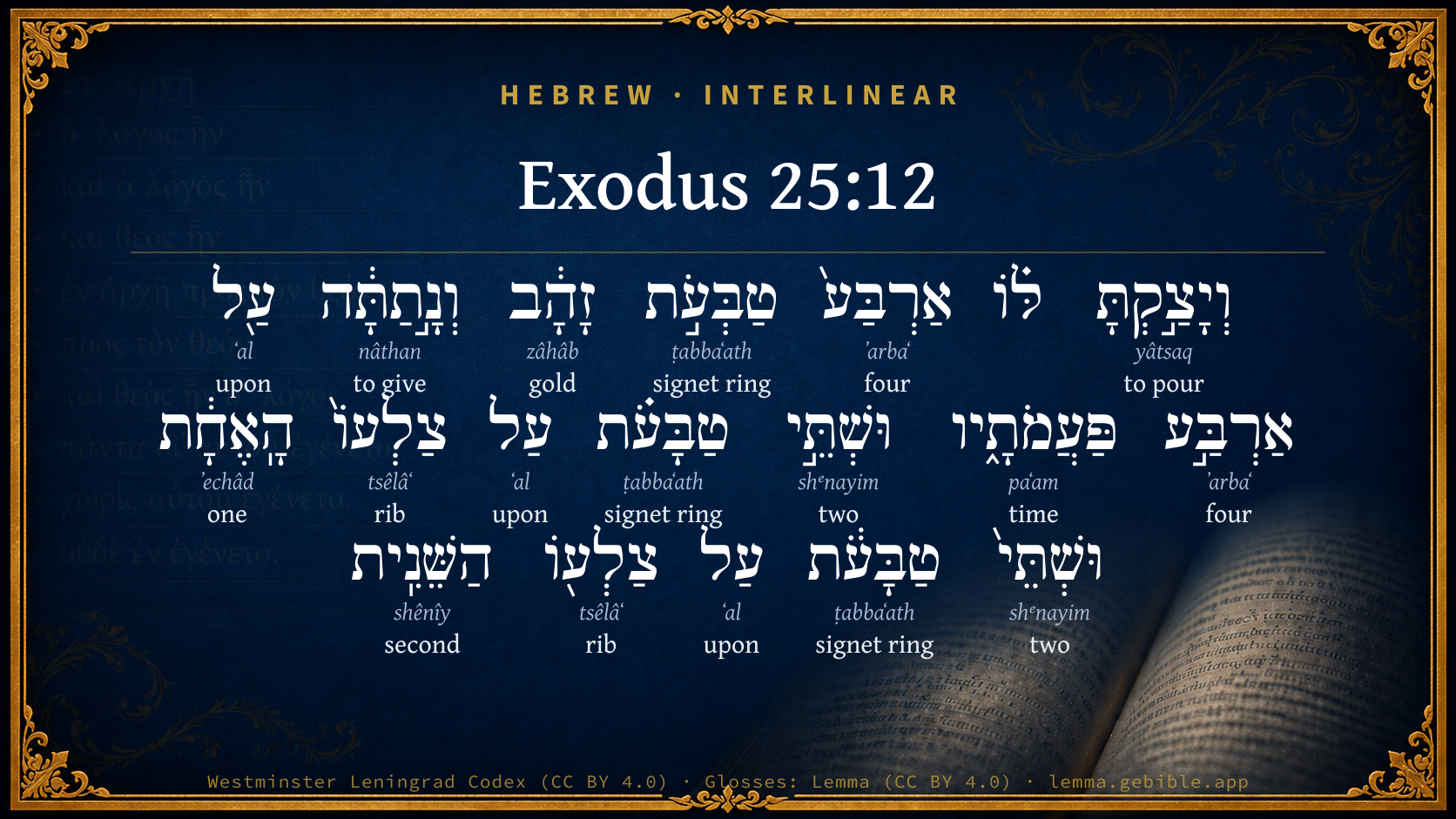
Hebrew (Westminster Leningrad Codex) Exodus 25:12 appears in the Hebrew Old Testament. The text above is from the Westminster Leningrad Codex. Each word links to its Strong’s number, a concise gloss, and parsing drawn from the Open Scriptures Hebrew Bible morphology. Click any word for its full Brown-Driver-Briggs (BDB) entry.
Download image
Cite this verse

Exodus 25:12 (World English Bible). Public Domain. Lemma interlinear Bible study tool, https://lemma.gebible.app/v/exodus/25/12.

Show BibTeX & RIS
BibTeX
RIS
English Translation
You shall cast four rings of gold for it, and put them in its four feet. Two rings shall be on the one side of it, and two rings on the other side of it.
World English Bible · Public Domain
Download a study sheet

One document with this verse’s original text, its word-by-word gloss line, the meaning frame, cross-references with their text, attributed commentary, and full source and license credits — printable, and it pastes into notes with its structure intact.

This verse Autodidact and up

Study sheet (.html) Plain text (.txt)

A passage Seminary Student

Up to 50 verses in one chapter. A passage sheet keeps up to 6 commentary sources and 12 cross-references per verse, in the order this page ranks them, and says so on the sheet whenever that leaves anything out. Ask for a single verse and you get the Autodidact verse sheet above.

Everything on this page stays free to read, with no account — the sheet is a download of what is already on screen, not access to it.

Want to remove ads? Support Godless Engineer
Compare translations 3

The same verse in 3 English versions, stacked beneath the original-language interlinear above. Click any original word for its lexicon entry.

Each is an independent rendering of the whole verse — the interlinear is not word-aligned to these translations.

Highlighted words mark where these versions differ — a whole-verse word diff, not a word-by-word alignment.

  • World English Bible Public Domain
    You shall cast four rings of gold for it, and put them in its four feet. Two rings shall be on the one side of it, and two rings on the other side of it.
  • King James Version Public Domain
    And thou shalt cast four rings of gold for it, and put them in the four corners thereof; and two rings shall be in the one side of it, and two rings in the other side of it.
  • unfoldingWord Literal Text CC BY-SA 4.0
    And you shall cast four rings of gold for it and put on its four feet: two rings on its one side and two rings on its second side.

unfoldingWord Literal Text — © unfoldingWord, licensed CC BY-SA 4.0. Word-aligned USFM3 via Door43 (git.door43.org/unfoldingWord/en_ult).

Versions to compare (up to 4)

3 of 4 selected

Show all 18 translations

Every available English version of this verse, each an independent rendering of the whole verse.

  • World English Bible Public Domain
    You shall cast four rings of gold for it, and put them in its four feet. Two rings shall be on the one side of it, and two rings on the other side of it.
  • Berean Standard Bible Public Domain
    Cast four gold rings for it and fasten them to its four feet, two rings on one side and two on the other.
  • Majority Standard Bible Public Domain
    Cast four gold rings for it and fasten them to its four feet, two rings on one side and two on the other.
  • King James Version Public Domain
    And thou shalt cast four rings of gold for it, and put them in the four corners thereof; and two rings shall be in the one side of it, and two rings in the other side of it.
  • American Standard Version (1901) Public Domain
    And thou shalt cast four rings of gold for it, and put them in the four feet thereof; and two rings shall be on the one side of it, and two rings on the other side of it.
  • Revised Version (1885) Public Domain
    And thou shalt cast four rings of gold for it, and put them in the four feet thereof; and two rings shall be on the one side of it, and two rings on the other side of it.
  • Geneva Bible (1599) Public Domain
    And thou shalt cast foure rings of golde for it, and put them in the foure corners thereof: that is, two rings shalbe on the one side of it, and two rings on the other side thereof.
  • Douay-Rheims (1899) Public Domain
    And four golden rings, which thou shall put at the four corners of the ark: let two rings be on the one side, and two on the other.
  • Young's Literal Translation Public Domain
    `And thou hast cast for it four rings of gold, and hast put `them' on its four feet, even two rings on its one side, and two rings on its second side;
  • Literal Standard Version CC BY-SA 4.0
    And you have cast four rings of gold for it, and have put [them] on its four feet, even two rings on its one side, and two rings on its second side;
  • Unlocked Literal Bible CC BY-SA 4.0
    You must cast four rings of gold for it, and put them on the ark's four feet, with two rings on one side of it, and two rings on the other side.
  • unfoldingWord Literal Text CC BY-SA 4.0
    And you shall cast four rings of gold for it and put on its four feet: two rings on its one side and two rings on its second side.
  • Darby Bible Public Domain
    And cast four rings of gold for it, and put [them] at the four corners thereof, that two rings may be upon the one side thereof and two rings upon the other side thereof.
  • World Messianic Bible Public Domain
    You shall cast four rings of gold for it, and put them in its four feet. Two rings shall be on the one side of it, and two rings on the other side of it.
  • Webster's Bible Public Domain
    And thou shalt cast four rings of gold for it, and put them in its four corners; and two rings shall be in the one side of it, and two rings in the other side of it.
  • Free Bible Version CC BY-SA 4.0
    Cast four gold rings and attach them to its four feet, two on one side and two on the other.
  • Bible in Basic English Public Domain
    And make four rings of gold for it, to be fixed on its four feet, two rings on one side of it and two on the other.
  • JPS Tanakh (1917) Public Domain
    And thou shalt cast four rings of gold for it, and put them in the four feet thereof; and two rings shall be on the one side of it, and two rings on the other side of it.

Literal Standard Version (2020), Covenant Press — licensed CC BY-SA 4.0. Text via the HelloAO Bible API (eBible.org). Unlocked Literal Bible (unfoldingWord) — licensed CC BY-SA 4.0. Text via the HelloAO Bible API (eBible.org). unfoldingWord Literal Text — © unfoldingWord, licensed CC BY-SA 4.0. Word-aligned USFM3 via Door43 (git.door43.org/unfoldingWord/en_ult). Free Bible Version, Dr. Jonathan Gallagher — licensed CC BY-SA 4.0. Text via the HelloAO Bible API (eBible.org).

Word by word

More ways to search: Search by grammar → Find every occurrence → Compare this word →

Practice this passage: Drill this verse → Learn its vocabulary →

צַלְעוֹ֙
tsêlâʻ
H6763
“rib · his”
Noun, Common, Both, Singular, Construct + Suffix, Personal, 3rd Person, Masculine, Singular
Part of Speech
Noun
Type
Common
Gender
Both
Number
Singular
State
Construct
Full BDB Definition

Origin: from H6760

TWOT: 1924a

side, rib, beam - rib (of man) - rib (of hill, ridge, etc) - side-chambers or cells (of temple structure) - rib, plank, board (of cedar or fir) - leaves (of door) - side (of ark)
  1. וְיָצַ֣קְתָּ yâtsaq H3332 “and · to pour” Conjunction + Verb, Qal, Sequential Perfect, 2nd Person, Masculine, Singular
  2. אַרְבַּע֙ ʼarbaʻ H702 “four” Adjective, Cardinal number, Feminine, Singular, Absolute
  3. טַבְּעֹ֣ת ṭabbaʻath H2885 “signet rings of” Noun, Common, Feminine, Plural, Construct
  4. זָהָ֔ב zâhâb H2091 “gold” Noun, Common, Masculine, Singular, Absolute
  5. וְנָ֣תַתָּ֔ה nâthan H5414 “and · to give” Conjunction + Verb, Qal, Sequential Perfect, 2nd Person, Masculine, Singular
  6. עַ֖ל ʻal H5921 “upon” Preposition
  7. אַרְבַּ֣ע ʼarbaʻ H702 “four” Adjective, Cardinal number, Feminine, Singular, Absolute
  8. פַּעֲמֹתָ֑יו paʻam H6471 “times · his” Noun, Common, Feminine, Plural, Construct + Suffix, Personal, 3rd Person, Masculine, Singular
  9. וּשְׁתֵּ֣י shᵉnayim H8147 “and · two” Conjunction + Adjective, Cardinal number, Feminine, Dual, Construct
  10. טַבָּעֹ֗ת ṭabbaʻath H2885 “signet rings” Noun, Common, Feminine, Plural, Absolute
  11. עַל ʻal H5921 “upon” Preposition
  12. הָֽאֶחָ֔ת ʼechâd H259 “the · one” Particle, Definite Article + Adjective, Cardinal number, Feminine, Singular, Absolute
  13. וּשְׁתֵּי֙ shᵉnayim H8147 “and · two” Conjunction + Adjective, Cardinal number, Feminine, Dual, Construct
  14. טַבָּעֹ֔ת ṭabbaʻath H2885 “signet rings” Noun, Common, Feminine, Plural, Absolute
  15. עַל ʻal H5921 “upon” Preposition
  16. צַלְע֖וֹ tsêlâʻ H6763 “rib · his” Noun, Common, Both, Singular, Construct + Suffix, Personal, 3rd Person, Masculine, Singular
  17. הַשֵּׁנִֽית shênîy H8145 “the · second” Particle, Definite Article + Adjective, Ordinal number, Feminine, Singular, Absolute

About this verse

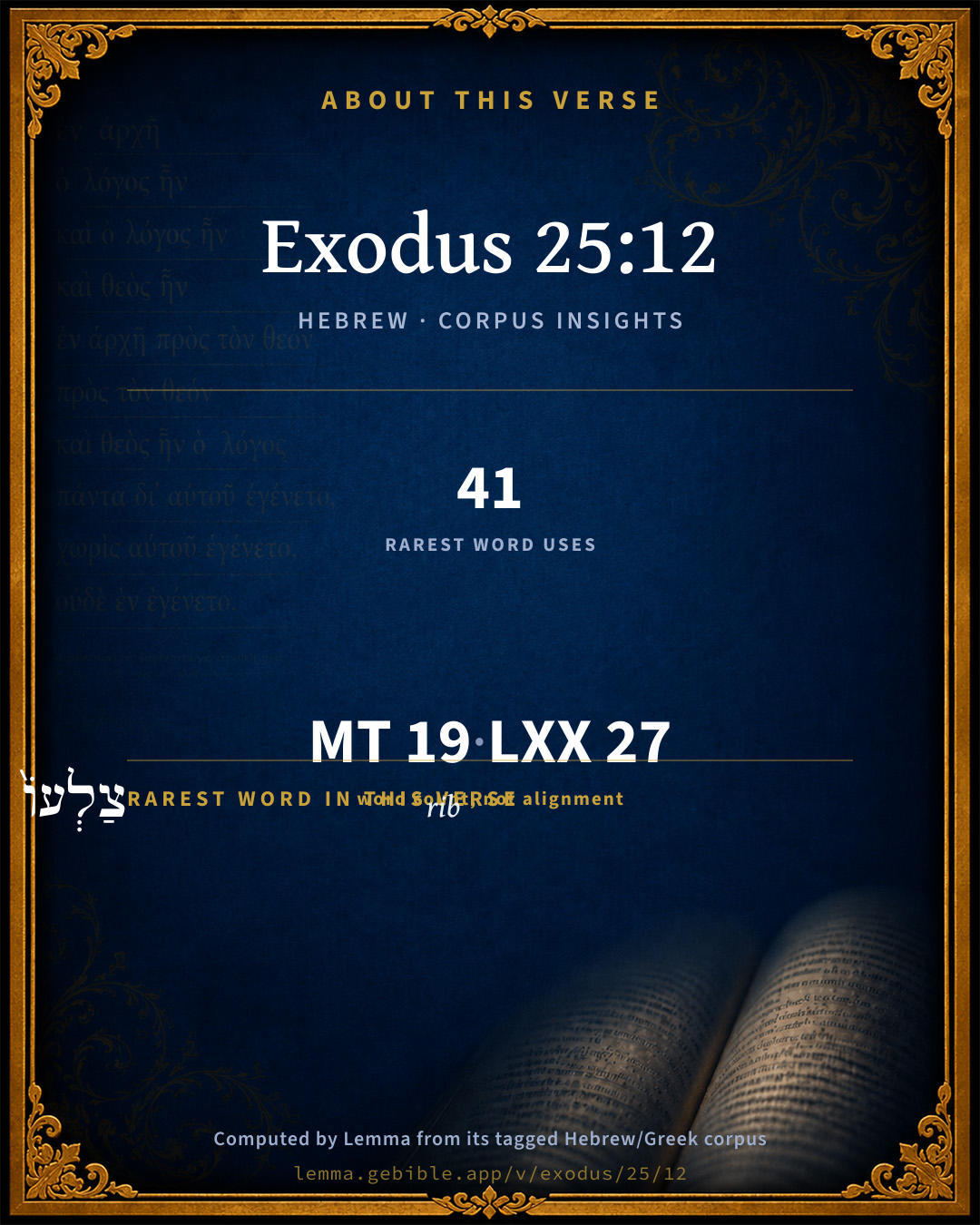
These counts appear in no published source. They are computed here, from the morphology-tagged text and Lemma’s own curated glosses. What Lemma adds →

19
words
11
distinct lemmas
Pentateuch
section

Shared distinctive vocabulary

צַלְעוֹ֙ rib H6763 occurs in 32 verses of the Hebrew Bible. Also found in:

Grammatical profile

  • 2 verbs
  • 7 nouns
  • 6 adjectives
  • 4 prepositions

Verb forms

  • וְיָצַ֣קְתָּ Qal · Sequential Perfect
  • וְנָ֣תַתָּ֔ה Qal · Sequential Perfect

Repetition

Words recur within this verse — often emphatic in Hebrew:

  • טַבְּעֹ֣ת signet ring H2885 ×3
  • עַ֖ל upon H5921 ×3
  • אַרְבַּע֙ four H702 ×2
  • וּשְׁתֵּ֣י two H8147 ×2
  • צַלְעוֹ֙ rib H6763 ×2

Hebrew & Septuagint length

In English translation the verse runs 35 words from the Hebrew and 30 from the Septuagint (LXX English) — closely comparable.

A rough comparison of the two English renderings, which tokenize alike — not a word-level alignment.

Word counts can differ between the Hebrew and the Greek without any difference in meaning — e.g. the Hebrew direct-object marker אֵת has no separate Greek word, and Greek often adds the article ὁ.

In the original languages it is 19 Hebrew tokens and 27 Greek tokens — but the two are counted differently (Hebrew bundles its prefixes and suffixes into one token; the Greek is in lemma form), so that isn’t a like-for-like length.

Cross-references

6

Topical passages linked to Exodus 25:12 in the Treasury of Scripture Knowledge — connected by theme and wording, ordered by reader-vote popularity; previews shown in the World English Bible.

  • Exodus 25:15 The poles shall be in the rings of the ark. They shall not be taken from it.
  • Exodus 37:5 He put the poles into the rings on the sides of the ark, to bear the ark.
  • Exodus 25:26 You shall make four rings of gold for it, and put the rings in the four corners that are on its four feet.
  • Exodus 26:29 You shall overlay the boards with gold, and make their rings of gold for places for the bars: and you shall overlay the bars with gold.
  • Exodus 27:7 Its poles shall be put into the rings, and the poles shall be on the two sides of the altar, when carrying it.
  • Exodus 38:7 He put the poles into the rings on the sides of the altar, with which to carry it. He made it hollow with planks.

Cross-references courtesy of OpenBible.info (CC BY 4.0).

Hebrew and Greek witnesses Masoretic Hebrew ↔ Greek Septuagint

The same verse in the two great witnesses to the Old Testament, shown verse-for-verse.

These are two independent witnesses, not word-aligned to each other, and the Septuagint is shown in lemma (dictionary) form.

Hebrew Exodus 25:12 Masoretic · Westminster Leningrad Codex

וְיָצַ֣קְתָּ לּ֗וֹ אַרְבַּע֙ טַבְּעֹ֣ת זָהָ֔ב וְנָ֣תַתָּ֔ה עַ֖ל אַרְבַּ֣ע פַּעֲמֹתָ֑יו וּשְׁתֵּ֣י טַבָּעֹ֗ת עַל צַלְעוֹ֙ הָֽאֶחָ֔ת וּשְׁתֵּי֙ טַבָּעֹ֔ת עַל צַלְע֖וֹ הַשֵּׁנִֽית

You shall cast four rings of gold for it, and put them in its four feet. Two rings shall be on the one side of it, and two rings on the other side of it.

World English Bible · Public Domain

Greek LXX Exodus 25:12 Septuagint · lemma form

καί ἐλαύνω αὐτός τέσσαρες δακτύλιος χρυσοῦς καί ἐπιτίθημι ἐπί ὁ τέσσαρες κλίτος δύο δακτύλιος ἐπί ὁ κλίτος ὁ εἷς καί δύο δακτύλιος ἐπί ὁ κλίτος ὁ δεύτερος

And you shall cast for it four golden rings, and shall put them on the four sides; two rings on the one side, and two rings on the other side.

LXX2012 (modern English Septuagint) · Public Domain

Hebrew: Westminster Leningrad Codex (CC BY 4.0). Greek: Septuagint (public domain); English from LXX2012 (modern English Septuagint) (Public Domain). How the Septuagint differs from the Hebrew →

Targum (Aramaic paraphrase)

2

The Targum is the ancient Jewish Aramaic paraphrase of the Hebrew Scriptures — an interpretive translation, not the Hebrew text itself. Onkelos (literal) and Pseudo-Jonathan (expansive) render the Torah, and Jonathan the Prophets. Coverage is partial: where no permissively-licensed English translation exists for a verse, only the Aramaic is shown. This is verse-level text, not a word-by-word alignment to the Hebrew.

  1. Targum Onkelos Torah (Genesis–Deuteronomy)
    וְתַתִּיךְ לֵהּ אַרְבַּע עִזְקָן דִדְהַב וְתִתֵּן עַל אַרְבַּע זִוְיָתֵהּ וְתַרְתֵּין עִזְקָן עַל סִטְרֵהּ חַד וְתַרְתֵּן עִזְקָן עַל סִטְרֵהּ תִּנְיֵתָא:

    (no public-domain English translation for this verse)

    Targum Onkelos — Aramaic: “Onkelos Genesis” (public domain); “Onkelos Exodus” (public domain); “Onkelos Leviticus” (public domain); “Onkelos Numbers” (public domain); “Onkelos Deuteronomy” (public domain). English: “Sefaria Community Translation” (CC0 1.0 (public-domain dedication)); “J.W. Etheridge. The Targums of Onkelos and Jonathan Ben Uzziel on the Pentateuch. London: Longmans, Green, 1862” (public domain). Text via Sefaria.

  2. Targum Pseudo-Jonathan Torah (Genesis–Deuteronomy)
    וְתַתִּיךְ לֵיהּ אַרְבַּע עִזְקַן דִּדְהַב וְתִתֵּן עַל אַרְבַּע אִיזְתַוְודוֹי וְתַרְתֵּין עִזְקַן עַל צִיטְרֵיהּ חָד וְתַרְתֵּין עִיזְקַן עַל צִיטְרֵיהּ תִּנְיָינָא

    And thou shalt cast for it four rings of gold, and set them upon its four corners; two rings for one side, and two rings for the second side.

    Targum Pseudo-Jonathan — Aramaic: “Targum Jonathan on Genesis” (public domain); “Targum Jonathan on Exodus” (public domain); “Targum Jonathan on Leviticus” (public domain); “Targum Jonathan on Numbers” (public domain); “Targum Jonathan on Deuteronomy” (public domain). English: “The Targum of Jonathan ben Uzziel, trans. J. W. Etheridge, London, 1862” (public domain). Text via Sefaria.

Commentary

Notes on Exodus 25:12 from classic Christian and Jewish commentators (each source and its license shown beneath its notes). The classic Christian expositions comment on the surrounding passage and are grouped to its opening verse, so a note may address several verses; the Jewish commentaries on the Tanakh (Rashi and others) are per-verse, so they appear only where the commentator wrote on this verse.

Lemma curates 59 commentaries, every one of them public domain or Creative Commons licensed, each selected and text-cleaned for this edition rather than reprinted as found. About our sources →

Trapp's Complete Commentary

John Trapp

Exo 25:12 And thou shalt cast four rings of gold for it, and put [them] in the four corners thereof; and two rings [shall be] in the one side of it, and two rings in the other side of it.

Ver. 12, 13. And thou shalt cast four rings, &c.] These staff rings were to continue upon the ark; the Kohathites’ shoulders felt wherefore. But "God helped them to bear the ark"; {1Ch 15:26} and so he doth still his gospel ministers.

John Trapp, A Commentary or Exposition upon All the Books of the Old and New Testament (1647–1656) — public domain. Text from a community e-Sword module.

Tyndale Open Study Notes

Tyndale Open Resources

25:12-15 The carrying poles were there so that no one would touch this representation of God’s devastating holiness. Later, a death occurred when someone instinctively reached out to steady the Ark as it was being moved from one place to another (see 2 Sam 6:6-7).

Tyndale Open Study Notes — © Tyndale Open Resources, licensed CC BY-SA 4.0. Text via the HelloAO Bible API.

Geneva Bible (1599)

Geneva Bible translators

Or, feet.

Geneva Bible (1599) marginal notes — public domain. Text via Bolls.life.

Jamieson, Fausset & Brown

Robert Jamieson, A. R. Fausset & David Brown

rings--staples for the poles, with which it was to be carried from place to place.

Jamieson, Fausset & Brown — Commentary Critical and Explanatory on the Whole Bible (1871) — public domain (CC PDM 1.0). Text via the HelloAO Bible API.

Ellicott's Commentary for English Readers

(12) Four rings of gold.—Though the ark was not to be carried in procession, like Egyptian arks, yet it would have to be carried when the Israelites resumed their journeyings. The four rings were made to receive the two “staves” or poles by which the ark was to be borne at such times on the shoulders of the priests (Exo_25:13-14).

In the four corners thereof.—Literally, at the four feet thereof. The rings were to be affixed, not at the four upper corners of the chest, but at the four bottom corners, in order that the ark, when carried on men’s shoulders, might be elevated above them, and so be in no danger of coming in contact with the bearers’ persons. The arrangement might seem to endanger the equilibrium of the ark when carried; but as Kalisch observes, “the smallness of the dimensions of the ark rendered its safe transportation, even with the rings at its feet, not impossible.”

A Bible Commentary for English Readers, edited by Charles John Ellicott (1878–1897) — public domain. Text from a community e-Sword module.

The Cambridge Bible for Schools and Colleges

gen. ed. J. J. S. Perowne

12. in] on, i.e. fasten them on to.

feet] short supports for the ark. Not the word used in v. 26.

on the one side, &c.] It is not stated whether the longer or the shorter sides are meant. The former are commonly thought of: but if the writer thought that the Divine throne should always face in the direction in which it was borne (v. 14), the latter will have been intended (DB. iv. 665b; cf. 1Ki_8:8). ‘Rib’(marg.) fig. for side occurs also v. 14, Exo_26:20; Exo_26:26-27; Exo_26:35, Exo_27:7, 2Sa_16:13 al.

The Cambridge Bible for Schools and Colleges (gen. ed. J. J. S. Perowne; Cambridge University Press, 1878–1918) — public domain. Text from a community e-Sword module.

John Gill's Exposition

And thou shalt cast four rings of gold for it,.... For which a mould was to be made, and the gold being melted was poured into it, and so the rings were fashioned:

and put them in the corners thereof; or, "in its feet", as Aben Ezra, though Jarchi says it had no feet; but as the word used so signifies always, it is more probable it had feet; and the rather, that it might not stand upon the ground, but on feet, as chests and coffers usually do:

and two rings shall be in the one side of it, and two rings in the other side of it; Jarchi says, at the upper corners, near the mercy seat were they placed, two on one side and two on the other, at the breadth of the ark; but it is more likely they were fixed in the lower part of it, as Ramban, at the feet of it; and in the length of the ark, as Josephus writes (m).

(m) Antiqu. l. 3. c. 6. sect. 5

John Gill's Exposition of the Whole Bible (1746–1763) — public domain (CC PDM 1.0). Text via the HelloAO Bible API.

Matthew Poole's English Annotations

In the four corners; in the middle of each corner, for conveniency of carriage. See 1Ki 7:30.

Matthew Poole's English Annotations on the Holy Bible (1683–1685) — public domain. Text from a community e-Sword/MySword module.

Whedon's Commentary on the Bible

Daniel D. Whedon

12-15. Rings… staves — The position of these is seen in the cut, and the whole, as wont to be carried by the priests, is shown in the following cut.

Daniel D. Whedon (gen. ed.), Commentary on the Old and New Testaments (1874–1909) — public domain. Text from a community e-Sword module.

The Pulpit Commentary

Four rings of gold. These rings were to be fixed, not at the upper, but at the lower corners of the chest, which are called pa"amoth, literally "feet" or "bases." The object was, no doubt, that no part of the chest should come in contact with the persons of the priests when carrying it (see ver. 14). As Kalisch notes, "the smallness of the dimensions of the ark rendered its safe transportation, even with the rings at its feet, not impossible."

The Pulpit Commentary (1880–1919), ed. H.D.M. Spence-Jones & Joseph S. Exell — public domain. Text from a community e-Sword module.

unfoldingWord translationNotes

Door43 World Missions Community

General Information:

Yahweh continues to tell Moses what the people must do.

cast four rings of gold

Casting was a process in which gold was melted, poured into a mold that was in the shape of a ring, and then allowed to harden.

in order to carry the ark

"so that you can carry the ark"

translationWords

gold

ark of the covenant

acacia

unfoldingWord translationNotes — © Distant Shores Media and the Door43 World Missions Community, licensed CC BY-SA 4.0. Source: git.door43.org/Door43/en_tn.

Rashi

Rabbi Shlomo Yitzchaki (Rashi)

ויצקת — a term used of casting metal, as the Targum has it.

פעמתיו — Understand this as the Targum renders it: ON ITS CORNERS. It was on the upper corners near to the cover that the rings were placed — two on one side of the ark and two on the other along the breadth of the ark, and the staves were put into them (the rings). The length of the ark thus formed a space of two cubits and a half between one stave and the other so that two men who were carrying the ark could walk with ease between on the same side. Thus is it explained in Treatise Menachot in the section beginning with the words, "Shtei HaLehem" (Menachot 98b).

שתי הלחם ושתי טבעות על צלעו האחת AND TWO RINGS IN THE ONE SIDE OF IT — These are the very four rings spoken of in the beginning of the verse but here Scripture explains to you where they were fixed. This ו of the word ושתי (the first time the word occurs here) is really redundant and the interpretation is as though it read, שתי טבעת (see Note on Exodus 24:12). Since however the ו is there you may make it fit in thus: and two of these rings shall be on the one side of it and two on the other side thereof.

צלעו means THE SIDE OF IT.

Rashi on the Tanakh — English translations: “The Judaica Press complete Tanach with Rashi, translated by A. J. Rosenberg” (CC BY 4.0); “Pentateuch with Rashi's commentary by M. Rosenbaum and A.M. Silbermann, 1929-1934” (public domain); “The Metsudah Tanach series, Lakewood, N.J” (CC BY 4.0); and “The Book of Joshua, Metsudah Publications, 1997” (CC BY 4.0). Text via Sefaria.

Ramban (Nachmanides)

Rabbi Moshe ben Nachman (Ramban / Nachmanides)

AND THOU SHALT CAST FOUR RINGS OF GOLD FOR IT, AND PUT THEM IN THE FOUR ‘PA’AMOTHAV’ (CORNERS THEREOF). “The word pa’amothav is to be understood as the Targum rendered it: ‘corners thereof.’ It was on the upper corners near to the cover of the ark that the rings were placed. And two rings shall be on the one side of it, and two rings on the other side of it. These are the very four rings which are mentioned at the beginning of the verse, but here Scripture explains that two of these rings were placed on one side [and the other two on the other side].” Thus did Rashi explain, and he explained it well. But I do not know why Rashi wrote that “on the upper corners near to the cover” the rings were placed. For in that case, the weight [of the ark and the tables of law hanging down from the staves] would be very much heavier. Moreover, the respectful way is that the ark be lifted up, resting high upon the shoulders of the priests [when carrying it].Rabbi Abraham ibn Ezra wrote: “I have searched in all Scripture and I have not found the term pa’am to mean ‘corner’ but only ‘foot.’ Thus: How beautiful are p’amayich’ (thy feet); the feet of the poor, ‘pa’amei’ (the feet of) the needy. Therefore I felt bound to explain that the ark had feet to it [upon which it rested].” And so Ibn Ezra explained the meaning of the verse to be that there were altogether eight rings, the four bottom ones according to that different version that Ramban’s questions on Ibn Ezra can be understood. Principally Ramban differs with three points that Ibn Ezra made: 1. That there were eight rings to the ark; 2. that the staves for carrying the ark were inserted in the upper rings; 3. that the ark had feet. — It is on this second point that the texts differ. It must then be remembered that Ramban is directing his criticism on Ibn Ezra holding that it was the upper rings that were for carriage. Ramban’s opinion is that the lower rings were for the insertion of the staves with which the ark was carried. Ramban will also differ with Ibn Ezra on the other two points. being those through which the staves were inserted to carry the ark with, whilst the four upper rings were purely for ornamental purposes. His words are, however, not at all correct. For if, as he said, pa’am means foot, then Scripture is commanding that the rings should be in the lower corners upon which the ark rests, and these bottom corners are called “feet” because the Sacred Language adapts all forms according to the image of man. Thus it calls the upper part of any object rosh (head), and the bottom part regel (foot). [Accordingly there is no need to say as did Ibn Ezra that the ark had feet to it upon which it rested, since Scripture calls the bottom corners “feet.”] And this is indeed true, that the rings for the purpose of carriage were at the bottom corners, and the ark was thus lifted up above the staves, as I have explained above.But in my opinion pa’am does not mean “foot” but is a term meaning “step.” How beautiful are ‘p’amayich’ — your steps. This usage is similar to the phrase in the Talmud: “How beautiful are the steps of this maiden.” Similarly: why tarry ‘pa’amei’ (the steps of) his chariots? The word pa’amothav here is Scripture’s reference to the steps of the priests that carry the ark, thus hinting at two things: that the rings be in the corners right at the bottom, near the seat of the ark, and that the whole length of the ark should interpose between the two rings. For, assuming that the length of the ark was placed in an east-west position, then there were two rings on its north side, one at the eastern head and one at the western, and likewise two rings on the south side of the ark [similarly placed], and the steps of the priests moved between the rings with their faces towards one another. In the Mishnah of the Tabernacle, Note 209. — In the Holy of Holies the length of the ark was in a north-south position i.e., to the width of the holy place while the width of the ark was in an east-west position i.e., to the length of the holy place (Mishneh Torah, Hilchoth Beth Habchirah 3:13). When carrying the ark they carried it face to face, with their backs turned outward, and their faces set towards the ark (ibid. Hilchoth Klei Hamikdash 2:13). A reference to this point is found here in the text of Ramban. we have learned: “There were four gold rings affixed in the ark, two to the north thereof and two to the south, and in them the staves were inserted and were never moved therefrom etc.”

Ramban (Nachmanides) on the Tanakh — English translation: “Commentary on the Torah by Ramban (Nachmanides). Translated and annotated by Charles B. Chavel. New York, Shilo Pub. House, 1971-1976” (CC BY 4.0). Text via Sefaria.

Lesson kit

Teaching starters — assembled from the data on this page, not authored interpretation. Every prompt links to the verse data it draws on. Edit before teaching.

Exodus, in the Pentateuch, opens this verse with 19 words (11 distinct Hebrew lemmas). Its most distinctive word is tsêlâʻ (“rib”). A historical commentator’s framing appears above. Read the whole chapter for the surrounding context.

Discussion questions

  1. How does “rib” (tsêlâʻ) shape what this verse is saying?
  2. Genesis 2:21 shares the word «rib» with this verse. How do the two illuminate each other?
  3. “signet ring” occurs 3× in this one verse. What is the effect of the repetition?
  4. These translations render this verse differently. What is at stake in choosing one wording over another?
  5. The verb «וְיָצַ֣קְתָּ» is Qal Sequential Perfect. How does its form color the action?
  6. Reading how Trapp's Complete Commentary and Tyndale Open Study Notes read this verse, where do the two commentators agree and where do they part?

Things to notice

Reading settings

Reading text

Shown beneath each verse's original-language words.

Old Testament
Old Testament edition

Read the OT as the Masoretic Hebrew (MT) or the Greek Septuagint (LXX).

English shown for the Greek Septuagint (in the Hebrew ↔ Greek comparison).

Comparing translations? Open the Compare panel on any verse page to stack up to four side by side.