
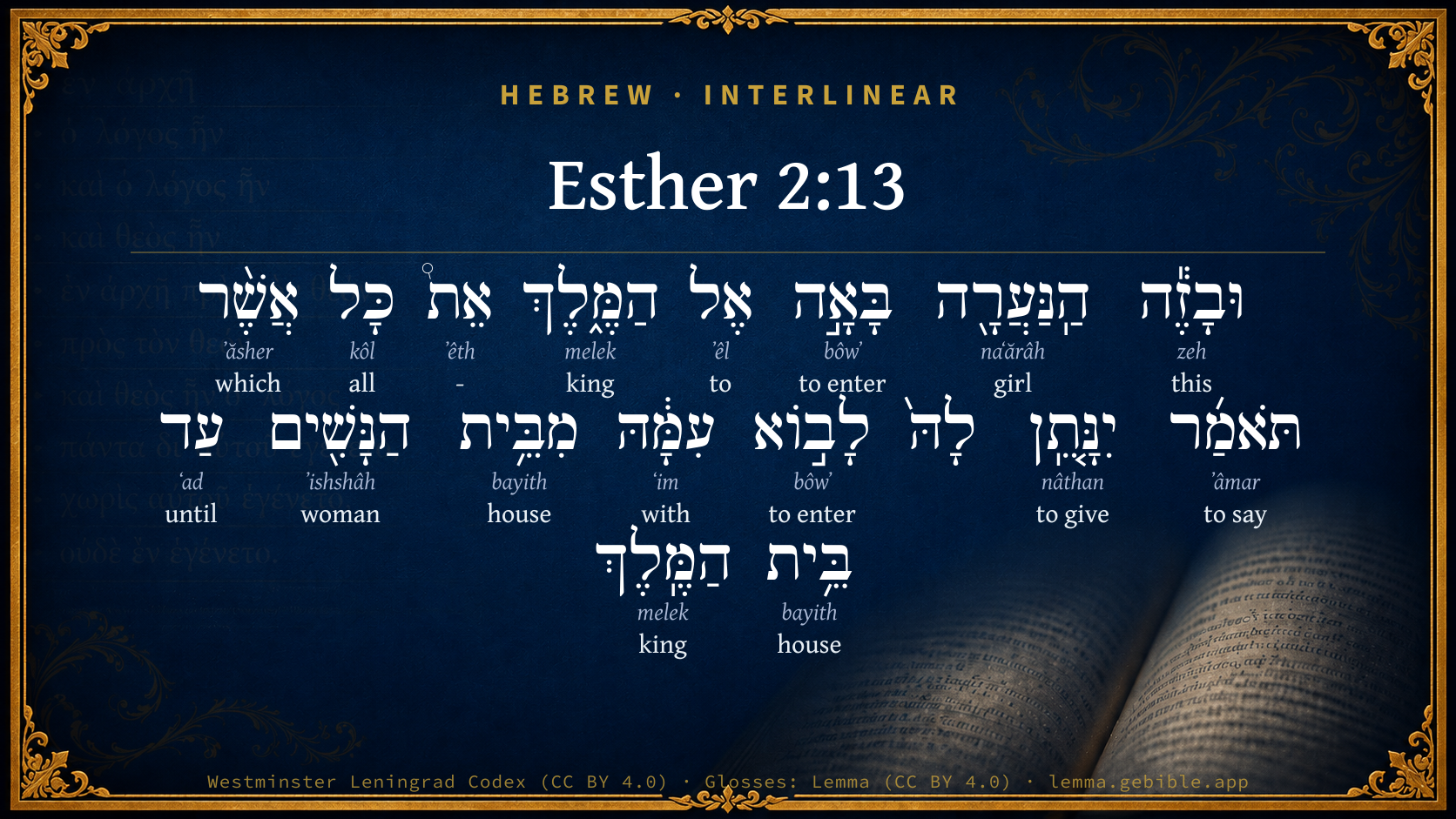
Esther 2:13

Hebrew (Westminster Leningrad Codex) Esther 2:13 appears in the Hebrew Old Testament. The text above is from the Westminster Leningrad Codex. Each word links to its Strong’s number, a concise gloss, and parsing drawn from the Open Scriptures Hebrew Bible morphology. Click any word for its full Brown-Driver-Briggs (BDB) entry.
Download image
Cite this verse

Esther 2:13 (World English Bible). Public Domain. Lemma interlinear Bible study tool, https://lemma.gebible.app/v/esther/2/13.

Show BibTeX & RIS
BibTeX
RIS
English Translation
then in this wise came the maiden to the king: whatever she desired was given her to go with her out of the house of the women to the king's house.
World English Bible · Public Domain
Download a study sheet

One document with this verse’s original text, its word-by-word gloss line, the meaning frame, cross-references with their text, attributed commentary, and full source and license credits — printable, and it pastes into notes with its structure intact.

This verse Autodidact and up

Study sheet (.html) Plain text (.txt)

A passage Seminary Student

Up to 50 verses in one chapter. A passage sheet keeps up to 6 commentary sources and 12 cross-references per verse, in the order this page ranks them, and says so on the sheet whenever that leaves anything out. Ask for a single verse and you get the Autodidact verse sheet above.

Everything on this page stays free to read, with no account — the sheet is a download of what is already on screen, not access to it.

Want to remove ads? Support Godless Engineer
Compare translations 3

The same verse in 3 English versions, stacked beneath the original-language interlinear above. Click any original word for its lexicon entry.

Each is an independent rendering of the whole verse — the interlinear is not word-aligned to these translations.

Highlighted words mark where these versions differ — a whole-verse word diff, not a word-by-word alignment.

  • World English Bible Public Domain
    then in this wise came the maiden to the king: whatever she desired was given her to go with her out of the house of the women to the king's house.
  • King James Version Public Domain
    Then thus came every maiden unto the king; whatsoever she desired was given her to go with her out of the house of the women unto the king's house.
  • unfoldingWord Literal Text CC BY-SA 4.0
    Then at this, the young woman would go to the king. Anything that she said would be given to her, to go with her from the house of women to the house of the king.

unfoldingWord Literal Text — © unfoldingWord, licensed CC BY-SA 4.0. Word-aligned USFM3 via Door43 (git.door43.org/unfoldingWord/en_ult).

Versions to compare (up to 4)

3 of 4 selected

Show all 18 translations

Every available English version of this verse, each an independent rendering of the whole verse.

  • World English Bible Public Domain
    then in this wise came the maiden to the king: whatever she desired was given her to go with her out of the house of the women to the king's house.
  • Berean Standard Bible Public Domain
    When the young woman would go to the king, she was given whatever she requested to take with her from the harem to the king’s palace.
  • Majority Standard Bible Public Domain
    When the young woman would go to the king, she was given whatever she requested to take with her from the harem to the king’s palace.
  • King James Version Public Domain
    Then thus came every maiden unto the king; whatsoever she desired was given her to go with her out of the house of the women unto the king's house.
  • American Standard Version (1901) Public Domain
    then in this wise came the maiden unto the king: whatsoever she desired was given her to go with her out of the house of the women unto the king's house.
  • Revised Version (1885) Public Domain
    then in this wise came the maiden unto the king, whatsoever she desired was given her to go with her out of the house of the women unto the king’s house.
  • Geneva Bible (1599) Public Domain
    And thus went the maides vnto the King) whatsoeuer she required, was giuen her, to go with her out of the womens house vnto ye kings house.
  • Douay-Rheims (1899) Public Domain
    And when they were going in to the king, whatsoever they asked to adorn themselves they received: and being decked out, as it pleased them, they passed from the chamber of the women to the king's chamber.
  • Young's Literal Translation Public Domain
    and with this the young woman hath come in unto the king, all that she saith is given to her, to go in with her, out of the house of the women, unto the house of the king;
  • Literal Standard Version CC BY-SA 4.0
    and with this the young woman has come in to the king, all that she says is given to her to go in with her out of the house of the women to the house of the king;
  • Unlocked Literal Bible CC BY-SA 4.0
    when a young woman went to the king, whatever she desired was given to her from the house of the women, for her to take to the palace.
  • unfoldingWord Literal Text CC BY-SA 4.0
    Then at this, the young woman would go to the king. Anything that she said would be given to her, to go with her from the house of women to the house of the king.
  • Darby Bible Public Domain
    and thus came the maiden in unto the king), whatever she desired was given her to go with her out of the house of the women to the king's house.
  • World Messianic Bible Public Domain
    The young woman then came to the king like this: whatever she desired was given her to go with her out of the women’s house to the king’s house.
  • Webster's Bible Public Domain
    Then thus came every maiden to the king; whatever she desired was given her to go with her out of the house of the women to the king's house.
  • Free Bible Version CC BY-SA 4.0
    When it was time for the young woman to go to the king, she was given whatever she asked for to take with her from the harem to the king's palace.
  • Bible in Basic English Public Domain
    And in this way the girl went in to the king; whatever she had a desire for was given to her to take with her from the women's house into the house of the king.
  • JPS Tanakh (1917) Public Domain
    when then the maiden came unto the king, whatsoever she desired was given her to go with her out of the house of the women unto the king's house.

Literal Standard Version (2020), Covenant Press — licensed CC BY-SA 4.0. Text via the HelloAO Bible API (eBible.org). Unlocked Literal Bible (unfoldingWord) — licensed CC BY-SA 4.0. Text via the HelloAO Bible API (eBible.org). unfoldingWord Literal Text — © unfoldingWord, licensed CC BY-SA 4.0. Word-aligned USFM3 via Door43 (git.door43.org/unfoldingWord/en_ult). Free Bible Version, Dr. Jonathan Gallagher — licensed CC BY-SA 4.0. Text via the HelloAO Bible API (eBible.org).

Word by word

More ways to search: Search by grammar → Find every occurrence → Compare this word →

Practice this passage: Drill this verse → Learn its vocabulary →

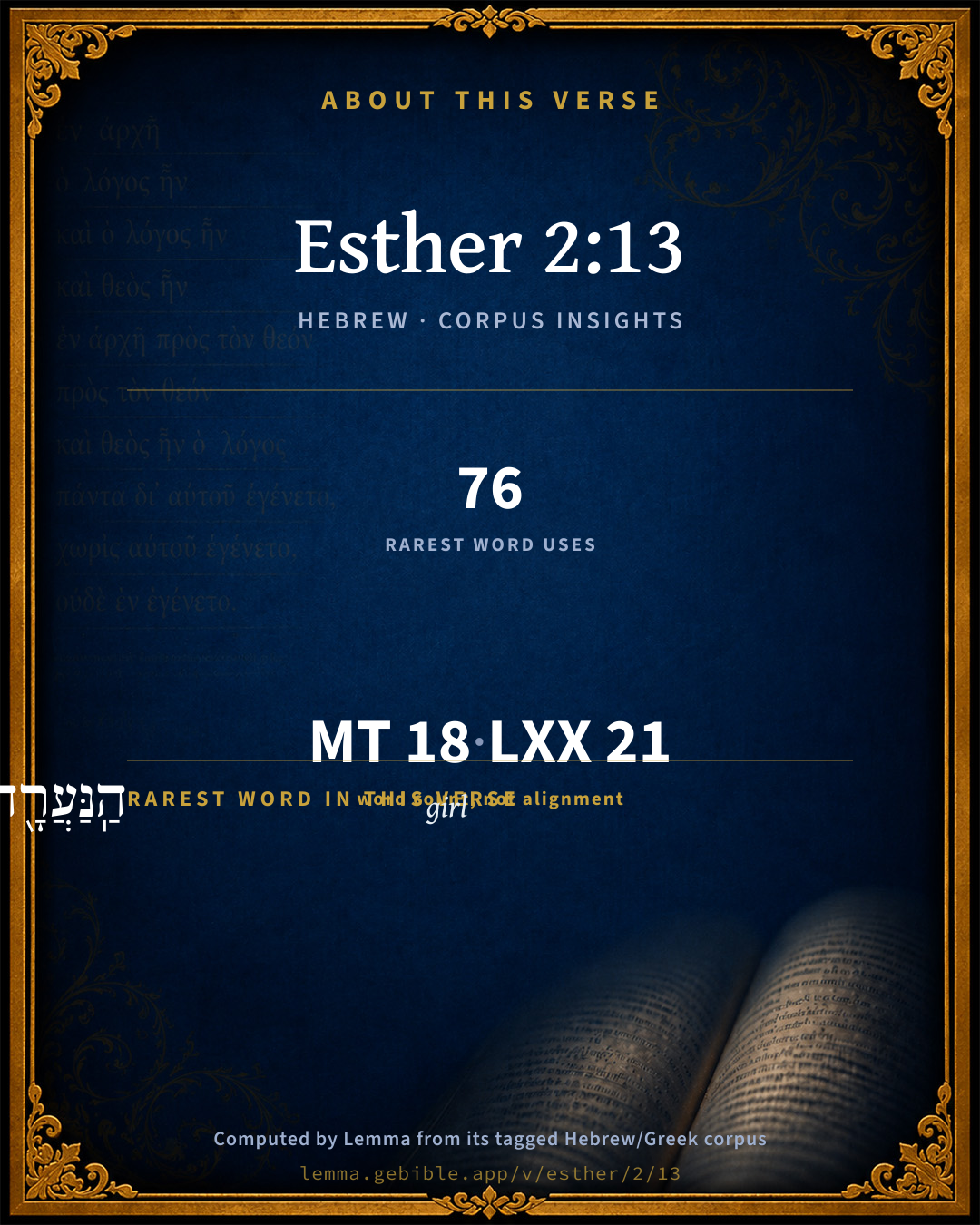
הַֽנַּעֲרָ֖ה
naʻărâh
H5291
“the · girl”
Particle, Definite Article + Noun, Common, Feminine, Singular, Absolute
Part of Speech
Particle + Noun
Type
Common
Gender
Feminine
Number
Singular
State
Absolute
Full BDB Definition

Origin: from H5288

TWOT: 1389c

girl, damsel, female servant - girl, damsel, little girl - of young woman, marriageable young woman, concubine, prostitute - maid, female attendant, female servant
  1. וּבָזֶ֕ה zeh H2088 “and · in/at · this” Conjunction + Preposition + Pronoun, Demonstrative, Masculine, Singular
  2. בָּאָ֣ה bôwʼ H935 “entering” Verb, Qal, Participle Active, Feminine, Singular, Absolute
  3. אֶל ʼêl H413 “to” Preposition
  4. הַמֶּ֑לֶךְ melek H4428 “the · king” Particle, Definite Article + Noun, Common, Masculine, Singular, Absolute
  5. אֵת֩ ʼêth H853 “-” Particle, Direct Object
  6. כָּל kôl H3605 “all” Noun, Common, Masculine, Singular, Absolute
  7. אֲשֶׁ֨ר ʼăsher H834 “which” Particle, Relative
  8. תֹּאמַ֜ר ʼâmar H559 “to say” Verb, Qal, Imperfect, 3rd Person, Feminine, Singular
  9. יִנָּ֤תֵֽן nâthan H5414 “to give” Verb, Niphal, Imperfect, 3rd Person, Masculine, Singular
  10. לָב֣וֹא bôwʼ H935 “to enter” Preposition + Verb, Qal, Infinitive Construct
  11. עִמָּ֔הּ ʻim H5973 “with · her” Preposition + Suffix, Personal, 3rd Person, Feminine, Singular
  12. מִבֵּ֥ית bayith H1004 “from · house of” Preposition + Noun, Common, Masculine, Singular, Construct
  13. הַנָּשִׁ֖ים ʼishshâh H802 “the · women” Particle, Definite Article + Noun, Common, Feminine, Plural, Absolute
  14. עַד ʻad H5704 “until” Preposition
  15. בֵּ֥ית bayith H1004 “house of” Noun, Common, Masculine, Singular, Construct
  16. הַמֶּֽלֶךְ melek H4428 “the · king” Particle, Definite Article + Noun, Common, Masculine, Singular, Absolute

About this verse

These counts appear in no published source. They are computed here, from the morphology-tagged text and Lemma’s own curated glosses. What Lemma adds →

18
words
14
distinct lemmas
Historical
section

Grammatical profile

  • 4 verbs
  • 7 nouns
  • 1 pronoun
  • 4 prepositions
  • 2 particles

Verb forms

  • בָּאָ֣ה Qal · Participle Active
  • תֹּאמַ֜ר Qal · Imperfect
  • יִנָּ֤תֵֽן Niphal · Imperfect
  • לָב֣וֹא Qal · Infinitive Construct

Repetition

Words recur within this verse — often emphatic in Hebrew:

  • בָּאָ֣ה to enter H935 ×2
  • הַמֶּ֑לֶךְ king H4428 ×2
  • מִבֵּ֥ית house H1004 ×2

Hebrew & Septuagint length

In English translation the verse runs 31 words from the Hebrew and 35 from the Septuagint (LXX English) — closely comparable.

A rough comparison of the two English renderings, which tokenize alike — not a word-level alignment.

Word counts can differ between the Hebrew and the Greek without any difference in meaning — e.g. the Hebrew direct-object marker אֵת has no separate Greek word, and Greek often adds the article ὁ.

In the original languages it is 18 Hebrew tokens and 21 Greek tokens — but the two are counted differently (Hebrew bundles its prefixes and suffixes into one token; the Greek is in lemma form), so that isn’t a like-for-like length.

Hebrew and Greek witnesses Masoretic Hebrew ↔ Greek Septuagint

The same verse in the two great witnesses to the Old Testament, shown verse-for-verse.

These are two independent witnesses, not word-aligned to each other, and the Septuagint is shown in lemma (dictionary) form.

Hebrew Esther 2:13 Masoretic · Westminster Leningrad Codex

וּבָזֶ֕ה הַֽנַּעֲרָ֖ה בָּאָ֣ה אֶל הַמֶּ֑לֶךְ אֵת֩ כָּל אֲשֶׁ֨ר תֹּאמַ֜ר יִנָּ֤תֵֽן לָהּ֙ לָב֣וֹא עִמָּ֔הּ מִבֵּ֥ית הַנָּשִׁ֖ים עַד בֵּ֥ית הַמֶּֽלֶךְ

then in this wise came the maiden to the king: whatever she desired was given her to go with her out of the house of the women to the king's house.

World English Bible · Public Domain

Greek LXX Esther 2:13 Septuagint · lemma form

καί τότε εἰςπορεύομαι πρός ὁ βασιλεύς καί ὅς ἐάν λέγω παραδίδωμι αὐτός συν εἰςἔρχομαι αὐτός ἀπό ὁ γυναικών ἕως ὁ βασίλειον

And then the damsel goes in to the king; and the officer to whoever he shall give the command, will bring her to come in with him from the women's apartment to the king's chamber.

LXX2012 (modern English Septuagint) · Public Domain

Hebrew: Westminster Leningrad Codex (CC BY 4.0). Greek: Septuagint (public domain); English from LXX2012 (modern English Septuagint) (Public Domain). How the Septuagint differs from the Hebrew →

Commentary

Notes on Esther 2:13 from classic Christian and Jewish commentators (each source and its license shown beneath its notes). The classic Christian expositions comment on the surrounding passage and are grouped to its opening verse, so a note may address several verses; the Jewish commentaries on the Tanakh (Rashi and others) are per-verse, so they appear only where the commentator wrote on this verse.

Lemma curates 59 commentaries, every one of them public domain or Creative Commons licensed, each selected and text-cleaned for this edition rather than reprinted as found. About our sources →

Trapp's Complete Commentary

John Trapp

Est 2:13 Then thus came [every] maiden unto the king; whatsoever she desired was given her to go with her out of the house of the women unto the king’s house.

Ver. 13. Then thus came every maiden to the king] Thus prepared, anointed, appointed, &c., rejoicing in that whereof they had reason rather to repent, as too many do now-a-days, while they go dancing to hell in their bolts.

Whatsoever she desired was given her] Omne quod dicebat, was but ask and have; so lavish is lust, and so foolish are men to bestow cost upon so hard a reckoning.

Unto the king’s house] Ad regis cubiculum, saith the old interpreter, to the king’s bed chamber.

John Trapp, A Commentary or Exposition upon All the Books of the Old and New Testament (1647–1656) — public domain. Text from a community e-Sword module.

Joseph Benson's Commentary

Est 2:13. Thus came every maiden unto the king — Thus purified and prepared, and thus furnished and attended, as it follows. Whatsoever she desired was given her — For ornament, or by way of attendance. And it should be observed, that every one whom the king took to his bed was his wife of a lower rank, as Hagar was Abraham’s; so that it would have been no sin or dishonour to Esther, though she had not been made queen.

Joseph Benson's Commentary on the Old and New Testaments (1811–1818) — public domain. Text from a community e-Sword module.

Geneva Bible (1599)

Geneva Bible translators

What apparel she asked of the eunuch, that was he bound to give her.

Geneva Bible (1599) marginal notes — public domain. Text via Bolls.life.

Adam Clarke's Commentary

Verse 13. Whatsoever she desired] When any of the young women were called to go to the king, it appears that it was an ordinance that whatever kind of dress stuff, colour, jewels, &c., they thought best to set off their persons, and render them more engaging, should be given them.

Adam Clarke's Commentary on the Bible (1810–1826) — public domain. Text from a community e-Sword/MySword module.

The Cambridge Bible for Schools and Colleges

gen. ed. J. J. S. Perowne

13. then in this wise] better than then thus of A.V., as marking more forcibly the commencement of the apodosis, answering to the somewhat distant ‘Now when’ at the beginning of Est_2:12.

The Cambridge Bible for Schools and Colleges (gen. ed. J. J. S. Perowne; Cambridge University Press, 1878–1918) — public domain. Text from a community e-Sword module.

John Gill's Exposition

Then thus came every virgin unto the king,.... When her twelve months were up, and she was purified in the manner before observed:

whatsoever she desired was given her to go with her out of the house of the women unto the king's house; whatever she commanded the chamberlain was obliged to furnish her with, or grant it to her, whether for ornament, as jewels, rich apparel, &c. or for attendance; whatever prince or peer she required to accompany her to the king, was to be obtained for her, as the Targum: and everything for mirth, all kinds of songs, or instruments of music, as Jarchi.

John Gill's Exposition of the Whole Bible (1746–1763) — public domain (CC PDM 1.0). Text via the HelloAO Bible API.

Matthew Poole's English Annotations

Then thus; thus purified and prepared; and thus as it follows.

Whatsoever she desired, for ornament, or by way of attendance.

Matthew Poole's English Annotations on the Holy Bible (1683–1685) — public domain. Text from a community e-Sword/MySword module.

Whedon's Commentary on the Bible

Daniel D. Whedon

13. Whatsoever she desired — In the way of jewels, ornaments, or dress. “No doubt,” says Rawlinson, “the virgins generally took the opportunity — one that would occur but once in their lives — to load themselves with precious ornaments of various kinds, necklaces, bracelets, earrings, anklets, and the like.”

Daniel D. Whedon (gen. ed.), Commentary on the Old and New Testaments (1874–1909) — public domain. Text from a community e-Sword module.

The Pulpit Commentary

Then thus came every maiden, etc. Rather, "And when each maiden came thus purified to the king, whatever she asked was given her," etc. The whole verse is one sentence. The meaning is, that on quitting the house of the women for the king"s apartments, each maiden was entitled to demand anything that she liked in the way of dress or ornament, and it had to be given her.

The Pulpit Commentary (1880–1919), ed. H.D.M. Spence-Jones & Joseph S. Exell — public domain. Text from a community e-Sword module.

John Wesley's Explanatory Notes

Desired - For ornament, or by way of attendance. And it should be observed, that every one whom the king took to his bed, was his wife of a lower rank, as Hagar was Abraham's, so that it would have been no sin or dishonour to Esther, though she had not been made queen.

John Wesley, Explanatory Notes Upon the Whole Bible (1754–1765) — public domain. Text via the GEBible commentary corpus.

Rashi

Rabbi Shlomo Yitzchaki (Rashi)

whatever she would request any entertainment or types of music.

Rashi on the Tanakh — English translations: “The Judaica Press complete Tanach with Rashi, translated by A. J. Rosenberg” (CC BY 4.0); “Pentateuch with Rashi's commentary by M. Rosenbaum and A.M. Silbermann, 1929-1934” (public domain); “The Metsudah Tanach series, Lakewood, N.J” (CC BY 4.0); and “The Book of Joshua, Metsudah Publications, 1997” (CC BY 4.0). Text via Sefaria.

Lesson kit

Teaching starters — assembled from the data on this page, not authored interpretation. Every prompt links to the verse data it draws on. Edit before teaching.

Esther, in the Historical, opens this verse with 18 words (14 distinct Hebrew lemmas). Its most distinctive word is naʻărâh (“girl”). A historical commentator’s framing appears above. Read the whole chapter for the surrounding context.

Discussion questions

  1. What does “girl” (naʻărâh) contribute to the verse as a whole?
  2. What does the repetition of “to enter” (2× in this one verse) do in this verse?
  3. The translations on this page render this verse differently — a whole-verse word diff, not a word-by-word alignment. What might account for the different wordings?
  4. «בָּאָ֣ה» is a Qal Participle Active verb. How does that grammatical form shape the action described?
  5. Compare how Trapp's Complete Commentary and Joseph Benson's Commentary read this verse. Where do they agree or differ?

Things to notice

Reading settings

Reading text

Shown beneath each verse's original-language words.

Old Testament
Old Testament edition

Read the OT as the Masoretic Hebrew (MT) or the Greek Septuagint (LXX).

English shown for the Greek Septuagint (in the Hebrew ↔ Greek comparison).

Comparing translations? Open the Compare panel on any verse page to stack up to four side by side.