Genesis 15:2

Hebrew (Westminster Leningrad Codex) Genesis 15:2 appears in the Hebrew Old Testament. The text above is from the Westminster Leningrad Codex. Each word links to its Strong’s number, a concise gloss, and parsing drawn from the Open Scriptures Hebrew Bible morphology. Click any word for its full Brown-Driver-Briggs (BDB) entry.
Download image
Cite this verse

Genesis 15:2 (World English Bible). Public Domain. Lemma interlinear Bible study tool, https://lemma.gebible.app/v/genesis/15/2.

Show BibTeX & RIS
BibTeX
RIS
English Translation
Abram said, "Lord Yahweh, what will you give me, seeing I go childless, and he who will inherit my estate is Eliezer of Damascus?"
World English Bible · Public Domain
Highlights Full analysis ↓
Download a study sheet

One document with this verse’s original text, its word-by-word gloss line, the meaning frame, cross-references with their text, attributed commentary, and full source and license credits — printable, and it pastes into notes with its structure intact.

This verse Autodidact and up

Study sheet (.html) Plain text (.txt)

A passage Seminary Student

Up to 50 verses in one chapter. A passage sheet keeps up to 6 commentary sources and 12 cross-references per verse, in the order this page ranks them, and says so on the sheet whenever that leaves anything out. Ask for a single verse and you get the Autodidact verse sheet above.

Everything on this page stays free to read, with no account — the sheet is a download of what is already on screen, not access to it.

Want to remove ads? Support Godless Engineer
Compare translations 3

The same verse in 3 English versions, stacked beneath the original-language interlinear above. Click any original word for its lexicon entry.

Each is an independent rendering of the whole verse — the interlinear is not word-aligned to these translations.

Highlighted words mark where these versions differ — a whole-verse word diff, not a word-by-word alignment.

  • World English Bible Public Domain
    Abram said, "Lord Yahweh, what will you give me, seeing I go childless, and he who will inherit my estate is Eliezer of Damascus?"
  • King James Version Public Domain
    And Abram said, LORD God, what wilt thou give me, seeing I go childless, and the steward of my house is this Eliezer of Damascus?
  • unfoldingWord Literal Text CC BY-SA 4.0
    But Abram said, “My Lord Yahweh, what will you give to me, since I go childless, and the son of the inheritance of my house the Damascan, Eliezer?”

unfoldingWord Literal Text — © unfoldingWord, licensed CC BY-SA 4.0. Word-aligned USFM3 via Door43 (git.door43.org/unfoldingWord/en_ult).

Versions to compare (up to 4)

3 of 4 selected

Show all 18 translations

Every available English version of this verse, each an independent rendering of the whole verse.

  • World English Bible Public Domain
    Abram said, "Lord Yahweh, what will you give me, seeing I go childless, and he who will inherit my estate is Eliezer of Damascus?"
  • Berean Standard Bible Public Domain
    But Abram replied, “O Lord GOD, what can You give me, since I remain childless, and the heir of my house is Eliezer of Damascus?”
  • Majority Standard Bible Public Domain
    But Abram replied, “O Lord GOD, what can You give me, since I remain childless, and the heir of my house is Eliezer of Damascus?”
  • King James Version Public Domain
    And Abram said, LORD God, what wilt thou give me, seeing I go childless, and the steward of my house is this Eliezer of Damascus?
  • American Standard Version (1901) Public Domain
    And Abram said, O Lord Jehovah, what wilt thou give me, seeing I go childless, and he that shall be possessor of my house is Eliezer of Damascus?
  • Revised Version (1885) Public Domain
    And Abram said, O Lord GOD, what wilt thou give me, seeing I go childless, and he that shall be possessor of my house is Dammesek Eliezer?
  • Geneva Bible (1599) Public Domain
    And Abram said, O Lord God, what wilt thou giue me, seeing I goe childlesse, and the steward of mine house is this Eliezer of Damascus?
  • Douay-Rheims (1899) Public Domain
    And Abram said: Lord God, what wilt thou give me? I shall go without children: and the son of the steward of my house is this Damascus Eliezer.
  • Young's Literal Translation Public Domain
    And Abram saith, `Lord Jehovah, what dost Thou give to me, and I am going childless? and an acquired son in my house is Demmesek Eliezer.'
  • Literal Standard Version CC BY-SA 4.0
    And Abram says, “Lord YHWH, what do You give to me, and I am going childless? And an acquired son in my house is Demmesek Eliezer.”
  • Unlocked Literal Bible CC BY-SA 4.0
    Abram said, “Lord Yahweh, what will you give me, since I continue childless, and the heir of my house is Eliezer of Damascus?”
  • unfoldingWord Literal Text CC BY-SA 4.0
    But Abram said, “My Lord Yahweh, what will you give to me, since I go childless, and the son of the inheritance of my house the Damascan, Eliezer?”
  • Darby Bible Public Domain
    And Abram said, Lord Jehovah, what wilt thou give me? seeing I go childless, and the steward of my house is this Eliezer of Damascus.
  • World Messianic Bible Public Domain
    Abram said, “Lord GOD, what will you give me, since I go childless, and he who will inherit my estate is Eliezer of Damascus?”
  • Webster's Bible Public Domain
    And Abram said, Lord GOD, what wilt thou give me, seeing I go childless, and the steward of my house is this Eliezer of Damascus?
  • Free Bible Version CC BY-SA 4.0
    But Abram replied, “Lord God, what good is whatever you give me? I don't have any children, and the heir to all that I have is Eliezer of Damascus.”
  • Bible in Basic English Public Domain
    And Abram said, What will you give me? for I have no child and this Eliezer of Damascus will have all my wealth after me.
  • JPS Tanakh (1917) Public Domain
    And Abram said: 'O Lord GOD, what wilt Thou give me, seeing I go hence childless, and he that shall be possessor of my house is Eliezer of Damascus?'

Literal Standard Version (2020), Covenant Press — licensed CC BY-SA 4.0. Text via the HelloAO Bible API (eBible.org). Unlocked Literal Bible (unfoldingWord) — licensed CC BY-SA 4.0. Text via the HelloAO Bible API (eBible.org). unfoldingWord Literal Text — © unfoldingWord, licensed CC BY-SA 4.0. Word-aligned USFM3 via Door43 (git.door43.org/unfoldingWord/en_ult). Free Bible Version, Dr. Jonathan Gallagher — licensed CC BY-SA 4.0. Text via the HelloAO Bible API (eBible.org).

Word by word

More ways to search: Search by grammar → Find every occurrence → Compare this word →

Practice this passage: Drill this verse → Learn its vocabulary →

מֶ֣שֶׁק
mesheq
H4943
“possession of”
Noun, Common, Masculine, Singular, Construct
Part of Speech
Noun
Type
Common
Gender
Masculine
Number
Singular
State
Construct
Full BDB Definition

Origin: from an unused root meaning to hold

TWOT: 1261a

acquisition, possession, son of possession, heir
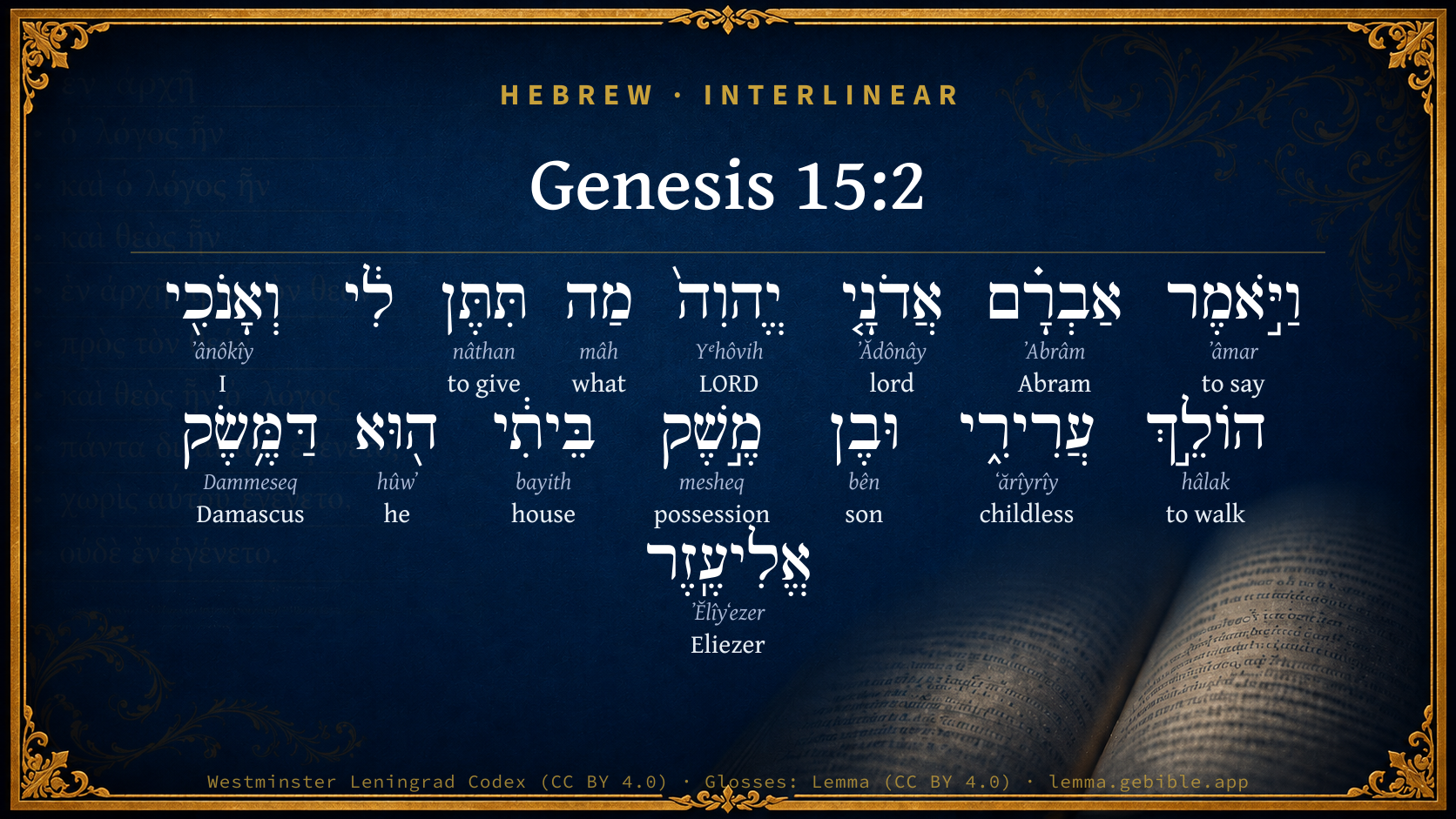
  1. וַיֹּ֣אמֶר ʼâmar H559 “and · to say” Conjunction + Verb, Qal, Sequential Imperfect, 3rd Person, Masculine, Singular
  2. אַבְרָ֗ם ʼAbrâm H87 “Abram” Noun, Proper
  3. אֲדֹנָ֤י ʼĂdônây H136 “Lord · my” Noun, Common, Masculine, Plural, Construct + Suffix, Personal, 1st Person, Common, Singular
  4. יֱהוִה֙ Yᵉhôvih H3069 “LORD” Noun, Proper
  5. מַה mâh H4100 “what” Particle, Interrogative
  6. תִּתֶּן nâthan H5414 “to give” Verb, Qal, Imperfect, 2nd Person, Masculine, Singular
  7. וְאָנֹכִ֖י ʼânôkîy H595 “and · I” Conjunction + Pronoun, Personal, 1st Person, Common, Singular
  8. הוֹלֵ֣ךְ hâlak H1980 “walking” Verb, Qal, Participle Active, Masculine, Singular, Absolute
  9. עֲרִירִ֑י ʻărîyrîy H6185 “childless” Adjective, Adjective, Masculine, Singular, Absolute
  10. וּבֶן bên H1121 “and · son of” Conjunction + Noun, Common, Masculine, Singular, Construct
  11. בֵּיתִ֔י bayith H1004 “house · my” Noun, Common, Masculine, Singular, Construct + Suffix, Personal, 1st Person, Common, Singular
  12. ה֖וּא hûwʼ H1931 “he” Pronoun, Personal, 3rd Person, Masculine, Singular
  13. דַּמֶּ֥שֶׂק Dammeseq H1834 “Damascus” Noun, Proper
  14. אֱלִיעֶֽזֶר ʼĔlîyʻezer H461 “Eliezer” Noun, Proper

About this verse

These counts appear in no published source. They are computed here, from the morphology-tagged text and Lemma’s own curated glosses. What Lemma adds →

16
words
15
distinct lemmas
Pentateuch
section

Notable vocabulary

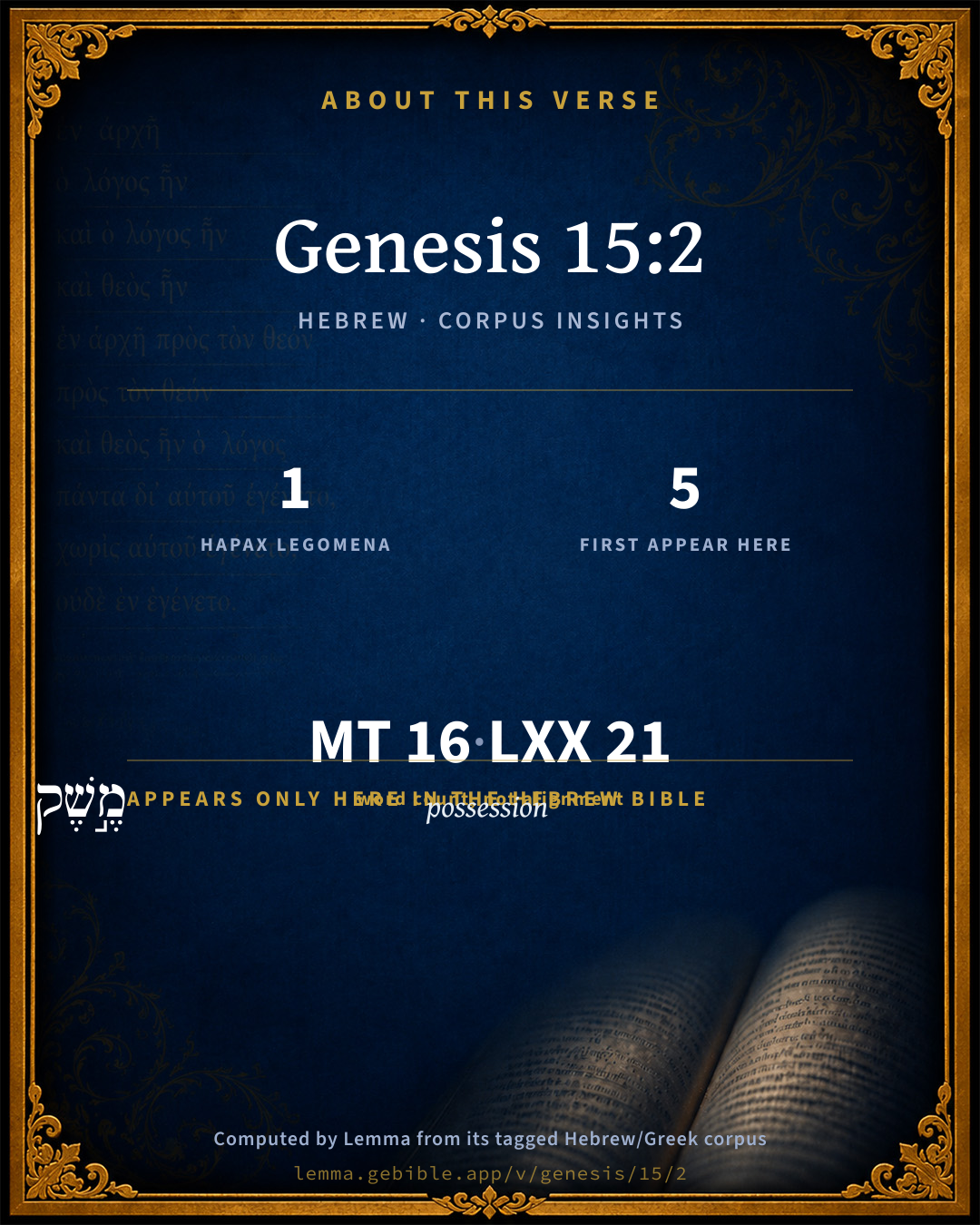
1 hapax legomenon — a word that appears only here in the entire Hebrew Bible:

  • מֶ֣שֶׁק possession H4943

First appearance in Scripture

These words make their first canonical appearance in the Hebrew Bible here:

  • אֲדֹנָ֤י lord H136
  • יֱהוִה֙ LORD H3069
  • עֲרִירִ֑י childless H6185
  • מֶ֣שֶׁק possession H4943
  • אֱלִיעֶֽזֶר Eliezer H461

Shared distinctive vocabulary

עֲרִירִ֑י childless H6185 occurs in 4 verses of the Hebrew Bible. Also found in:

Grammatical profile

  • 3 verbs
  • 8 nouns
  • 1 adjective
  • 2 pronouns
  • 1 preposition
  • 1 particle

Verb forms

  • וַיֹּ֣אמֶר Qal · Sequential Imperfect
  • תִּתֶּן Qal · Imperfect
  • הוֹלֵ֣ךְ Qal · Participle Active

Hebrew & Septuagint length

In English translation the verse runs 24 words from the Hebrew and 34 from the Septuagint (LXX English) — the Septuagint runs noticeably longer here. See the side-by-side →

A rough comparison of the two English renderings, which tokenize alike — not a word-level alignment.

Word counts can differ between the Hebrew and the Greek without any difference in meaning — e.g. the Hebrew direct-object marker אֵת has no separate Greek word, and Greek often adds the article ὁ.

In the original languages it is 16 Hebrew tokens and 21 Greek tokens — but the two are counted differently (Hebrew bundles its prefixes and suffixes into one token; the Greek is in lemma form), so that isn’t a like-for-like length.

Cross-references

11

Topical passages linked to Genesis 15:2 in the Treasury of Scripture Knowledge — connected by theme and wording, ordered by reader-vote popularity; previews shown in the World English Bible.

  • Genesis 25:21 Isaac entreated Yahweh for his wife, because she was barren. Yahweh was entreated by him, and Rebekah his wife conceived.
  • Genesis 12:1–3 Now Yahweh said to Abram, "Get out of your country, and from your relatives, and from your father's house, to the land that I will show you.
  • 1 Samuel 1:11 She vowed a vow, and said, Yahweh of hosts, if you will indeed look on the affliction of your handmaid, and remember me, and not forget your handmaid, but will give to your handmaid a man-child, then I will give him to Yahweh all the days of his life, and there shall no razor come on his head.
  • Acts 7:5 He gave him no inheritance in it, no, not so much as to set his foot on. He promised that he would give it to him for a possession, and to his seed after him, when he still had no child.
  • Genesis 24:2 Abraham said to his servant, the elder of his house, who ruled over all that he had, "Please put your hand under my thigh.
  • Genesis 24:10 The servant took ten camels, of his master's camels, and departed, having all goodly things of his master's in his hand. He arose, and went to Mesopotamia, to the city of Nahor.
  • Genesis 43:19 They came near to the steward of Joseph's house, and they spoke to him at the door of the house,
  • Genesis 44:1 He commanded the steward of his house, saying, "Fill the men's sacks with food, as much as they can carry, and put every man's money in his sack's mouth.
  • Psalms 127:3 Behold, children are a heritage of Yahweh. The fruit of the womb is his reward.
  • Proverbs 17:2 A servant who deals wisely will rule over a son who causes shame, And shall have a part in the inheritance among the brothers.
  • Isaiah 56:5 To them will I give in my house and within my walls a memorial and a name better than of sons and of daughters; I will give them an everlasting name, that shall not be cut off.

Cross-references courtesy of OpenBible.info (CC BY 4.0).

Hebrew and Greek witnesses Masoretic Hebrew ↔ Greek Septuagint

The same verse in the two great witnesses to the Old Testament, shown verse-for-verse.

Here the Septuagint runs noticeably longer than the Hebrew — LXX2012 (modern English Septuagint) 34 words vs World English Bible 24. A rough length comparison of the two English translations, not a word-level alignment — read both below.

These are two independent witnesses, not word-aligned to each other, and the Septuagint is shown in lemma (dictionary) form.

Hebrew Genesis 15:2 Masoretic · Westminster Leningrad Codex

וַיֹּ֣אמֶר אַבְרָ֗ם אֲדֹנָ֤י יֱהוִה֙ מַה תִּתֶּן לִ֔י וְאָנֹכִ֖י הוֹלֵ֣ךְ עֲרִירִ֑י וּבֶן מֶ֣שֶׁק בֵּיתִ֔י ה֖וּא דַּמֶּ֥שֶׂק אֱלִיעֶֽזֶר

Abram said, "Lord Yahweh, what will you give me, seeing I go childless, and he who will inherit my estate is Eliezer of Damascus?"

World English Bible · Public Domain

Greek LXX Genesis 15:2 Septuagint · lemma form

λέγω δέ αβραμ δεσπότης τίς ἐγώ δίδωμι ἐγώ δέ ἀπολύω ἄτεκνος ὁ δέ υἱός μασεκ ὁ οἰκογενής ἐγώ οὗτος δαμασκός ελιεζερ

And Abram said, Master and Lord, what will you give me? whereas I am departing without a child, but the son of Masek my home-born female slave, this Eliezer of Damascus is my heir.

LXX2012 (modern English Septuagint) · Public Domain

On this verse, Matthew Henry's Commentary discusses the Septuagint’s reading. Read the note in Commentary ↓

Hebrew: Westminster Leningrad Codex (CC BY 4.0). Greek: Septuagint (public domain); English from LXX2012 (modern English Septuagint) (Public Domain). How the Septuagint differs from the Hebrew →

Targum (Aramaic paraphrase)

2

The Targum is the ancient Jewish Aramaic paraphrase of the Hebrew Scriptures — an interpretive translation, not the Hebrew text itself. Onkelos (literal) and Pseudo-Jonathan (expansive) render the Torah, and Jonathan the Prophets. Coverage is partial: where no permissively-licensed English translation exists for a verse, only the Aramaic is shown. This is verse-level text, not a word-by-word alignment to the Hebrew.

  1. Targum Onkelos Torah (Genesis–Deuteronomy)
    וַאֲמַר אַבְרָם יְיָ אֱלֹהִים מַה תִּתֶּן לִי וַאֲנָא אָזֵיל בְּלָא וְלָד וּבַר פַּרְנָסָא הָדֵין דִבְּבֵיתִי הוּא דַמַשְׂקָאָה אֱלִיעֶזֶר

    (no public-domain English translation for this verse)

    Targum Onkelos — Aramaic: “Onkelos Genesis” (public domain); “Onkelos Exodus” (public domain); “Onkelos Leviticus” (public domain); “Onkelos Numbers” (public domain); “Onkelos Deuteronomy” (public domain). English: “Sefaria Community Translation” (CC0 1.0 (public-domain dedication)); “J.W. Etheridge. The Targums of Onkelos and Jonathan Ben Uzziel on the Pentateuch. London: Longmans, Green, 1862” (public domain). Text via Sefaria.

  2. Targum Pseudo-Jonathan Torah (Genesis–Deuteronomy)
    וַאֲמַר אַבְרָם יְיָ אֱלהִים סַגְיָן בִּרְכוֹתָא יְהַבְתְּ לִי וְסַגִין אִית קֳדָמָךְ לְמִתַּן לִי בְּרַם מַה הַנְיָיא אִית לִי דַאֲנָא עָבִיר מִן עַלְמָא בְּלָא בְנִין וֶאֱלִיעֶזֶר בַּר פַּרְנָסַת בֵּיתִי דְעַל יְדוֹי אִתְעֲבִידוּ לִי נִיסִין בְּדַרְמָשֶק מִסְכֵּי לְמֵירַת יָתִי

    And Abram said, Lord God, great blessings hast Thou given me, and great (are they which it is) before Thee to give me: nevertheless, what profit is to me, when I pass from the world without children, and Eliezer the manager (bar pharnasath, the son of sustenance) of my house, by whose hands signs were wrought for (or to) me in Darmasek, expects to be my heir?

    Targum Pseudo-Jonathan — Aramaic: “Targum Jonathan on Genesis” (public domain); “Targum Jonathan on Exodus” (public domain); “Targum Jonathan on Leviticus” (public domain); “Targum Jonathan on Numbers” (public domain); “Targum Jonathan on Deuteronomy” (public domain). English: “The Targum of Jonathan ben Uzziel, trans. J. W. Etheridge, London, 1862” (public domain). Text via Sefaria.

Commentary

Notes on Genesis 15:2 from classic Christian and Jewish commentators (each source and its license shown beneath its notes). The classic Christian expositions comment on the surrounding passage and are grouped to its opening verse, so a note may address several verses; the Jewish commentaries on the Tanakh (Rashi and others) are per-verse, so they appear only where the commentator wrote on this verse.

Lemma curates 59 commentaries, every one of them public domain or Creative Commons licensed, each selected and text-cleaned for this edition rather than reprinted as found. About our sources →

Matthew Henry's Commentary

We have here the assurance given to Abram of a numerous offspring which should descend from him, in which observe,

I. Abram's repeated complaint, Gen 15:2, Gen 15:3. This was that which gave occasion to this promise. The great affliction that sat heavy upon Abram was the want of a child; and the complaint of this he here pours out before the Lord, and shows before him his trouble, Psa 142:2. Note, Though we must never complain of God, yet we have leave to complain to him, and to be large and particular in the statement of our grievances; and it is some ease to a burdened spirit to open its case to a faithful and compassionate friend: such a friend God is, whose ear is always open. Now his complaint is four-fold: - 1. That he had no child (Gen 15:3): Behold, to me thou hast given no seed; not only no son, but no seed; if he had had a daughter, from her the promised Messiah might have come, who was to be the seed of the woman; but he had neither son nor daughter. He seems to lay an emphasis on that, to me. His neighbours were full of children, his servants had children born in his house. "But to me," he complains, "thou hast given none;" and yet God had told him he should be a favourite above all. Note, Those that are written childless must see God writing them so. Again, God often withholds those temporal comforts from his own children which he gives plentifully to others that are strangers to him. 2. That he was never likely to have any, intimated in that I go, or "I am going, childless, going into years, going down the hill apace; nay, I am going out of the world, going the way of all the earth. I die childless," so the Septuagint, "I leave the world, and leave no child behind me." 3. That his servants were for the present and were likely to be to him instead of sons. While he lived, the steward of his house was Eliezer of Damascus; to him he committed the care of his family and estate, who might be faithful, but only as a servant, not as a son. When he died, one born in his house would be his heir, and would bear rule over all that for which he had laboured, Ecc 2:18, Ecc 2:19, Ecc 2:21. God had already told him that he would make of him a great nation (Gen 12:2), and his seed as the dust of the earth (Gen 13:16); but he had left him in doubt whether it should be his seed begotten or his seed adopted, by a son of his loins or only a son of his house. "Now, Lord," says Abram, "if it be only an adopted son it must be one of my servants, which will reflect disgrace upon the promised seed, that is to descend from him." Note, While promised mercies are delayed our unbelief and impatience are apt to conclude them denied. 4. That the want of a son was so great a trouble to him that it took away the comfort of all his enjoyments: "Lord, what wilt thou give me? All is nothing to me, if I have not a son." Now, If we suppose that Abram looked no further than a temporal comfort, this complaint was culpable. God had, by his providence, given him some good things, and more by his promise; and yet Abram makes no account of them, because he has not a son. It did very ill become the father of the faithful to say, What wilt thou give me, seeing I go childless, immediately after God had said, I am thy shield, and thy exceedingly great reward. Note, Those do not rightly value the advantages of their covenant-relation to God and interest in him who do not think them sufficient whatever. But, (2.) If we suppose that Abram, herein, had a eye to the promised seed, the importunity of his desire was very commendable: all was nothing to him, if he had not the earnest of that great blessing, and an assurance of his relation to the Messiah, of which God had already encouraged him to maintain the expectation. He has wealth, and victory, and honour; but, while he is kept in the dark about the main matter, it is all nothing to him. Note, Till we have some comfortable evidence of our interest in Christ and the new covenant, we should not rest satisfied with any thing else. "This, and the other, I have; but what will all this avail me, if I go Christless?" Yet thus far the complaint was culpable, that there was some diffidence of the promise at the bottom of it, and a weariness of waiting God's time. Note, True believers sometimes find it hard to reconcile God's promises and his providences, when they seem to disagree.

II. God's gracious answer to this complaint. To the first part of the complaint (Gen 15:2) God gave no immediate answer, because there was something of fretfulness in it; but, when he renews his address somewhat more calmly (Gen 15:3), God answered him graciously. Note, If we continue instant in prayer, and yet pray with a humble submission to the divine will, we shall not seek in vain. 1. God gave him an express promise of a son, Gen 15:4. This that is born in thy house shall not be thy heir, as thou fearest, but one that shall come forth out of thy own bowels shall be thy heir. Note, (1.) God makes heirs; he says, "This shall not, and this shall;" and whatever men devise and design, in settling their estates, God's counsel shall stand. (2.) God is often better to us than our own fears, and gives the mercy we had long despaired of. 2. To affect him the more with this promise, he took him out, and showed him the stars (this vision being early in the morning, before day), and then tells him, So shall thy seed be, Gen 15:5. (1.) So numerous; the stars seem innumerable to a common eye: Abram feared he should have no child at all, but God assured him that the descendants from his loins should be so many as not to be numbered. (2.) So illustrious, resembling the stars in splendour; for to them pertained the glory, Rom 9:4. Abram's seed, according to his flesh, were like the dust of the earth (Gen 13:16), but his spiritual seed are like the stars of heaven, not only numerous, but glorious, and very precious.

III. Abram's firm belief of the promise God now made him, and God's favourable acceptance of his faith, Gen 15:6. 1. He believed in the Lord, that is, he believed the truth of that promise which God had now made him, resting upon the irresistible power and the inviolable faithfulness of him that made it. Hath he spoken, and shall he not make it good? Note, Those who would have the comfort of the promises must mix faith with the promises. See how the apostle magnifies this faith of Abram, and makes it a standing example, Rom 4:19-21. He was not weak in faith; he staggered not at the promise; he was strong in faith; he was fully persuaded. The Lord work such a faith in every one of us! Some think that his believing in the Lord respected, not only the Lord promising, but the Lord promised, the Lord Jesus, the Mediator of the new covenant. He believed in him, that is, received and embraced the divine revelation concerning him, and rejoiced to see his day, though at so great a distance, Joh 8:56. 2. God counted it to him for righteousness; that is, upon the score of this he was accepted of God, and, as the rest of the patriarchs, by faith he obtained witness that he was righteous, Heb 11:4. This is urged in the New Testament to prove that we are justified by faith without the works of the law (Rom 4:3; Gal 3:6); for Abram was so justified while he was yet uncircumcised. If Abram, that was so rich in good works was not justified by them, but by his faith, much less can we, that are so poor in them. This faith, which was imputed to Abram for righteousness, had lately struggled with unbelief (Gen 15:2), and, coming off a conqueror, it was thus crowned, thus honoured. Note, A fiducial practical acceptance of, and dependence upon, God's promise of grace and glory, in and through Christ, is that which, according to the tenour of the new covenant, gives us a right to all the blessings contained in that promise. All believers are justified as Abram was, and it was his faith that was counted to him for righteousness.

Matthew Henry's Commentary on the Whole Bible (1708–1710) — public domain (CC PDM 1.0). Text via the HelloAO Bible API.

Trapp's Complete Commentary

John Trapp

Gen 15:2 And Abram said, Lord GOD, what wilt thou give me, seeing I go childless, and the steward of my house [is] this Eliezer of Damascus?

Ver. 2. Lord God, what wilt thou give me, &c.] Dominator Iehovah. Adonai cum Camets sonat Dominator . A stately style. We must magnify God when we have got him into our hearts, and enlarge his room there when we conceive of him, as much as may be: do our utmost, and then say, Claudicat ingenium, delirat linguaque, mensque .{ a}

Seeing I go childless.] He had no great joy of his former victory, or the present promise, because childless. His mouth was so out of taste with the sense of his want that he could relish no comfort. This was his fault, and is often ours: like children, if we have not that piece we would have, we grow sullen, and will have none. Had not God been to Abram instead of ten children? Is he not all in all to his?

And the steward of my house.] Filius discursitationis, vel derelictionis domus meae . He that now runs about my business, and to whom I am likely to leave all. A faithful steward he was, and fearing God, {Gen 24:2-3, &c.} and therefore might look not to live long in a low place. {Pro 22:29}

This Eliezer of Damascus.] Or Eliazar, as Exo 6:25. Whence Lazarus, said in the parable to be in Abraham’s bosom, {Luk 16:23} as dear to him, and set next him in heaven.

{a} Lucret.

John Trapp, A Commentary or Exposition upon All the Books of the Old and New Testament (1647–1656) — public domain. Text from a community e-Sword module.

The Biblical Illustrator

Joseph S. Exell

Gen_15:2-3

To me Thou hast given no seed

Abrams fear

God had given Abram everything but a child, and therefore it seemed to him that all this flow of Gods love was running into a pool where it could only stand still.

And Abram told God his fear in plain words. How true it is that we can say things in the dark that we dare not say in the light! For a long time Abram wanted to say this, but the light was too strong: he knew he would stammer and blush in the daytime, so he hid the fear in his heart. But now it is evening tide! The shadows are about, and the stars are coming! O sweet eventide, what words we have spoken in its dewy quietness--words that would have been out of place in the glare of open day. How the voice has become low, and the heart has told what was deepest and tenderest, sending it out as a dove that would find another soul to rest in! It was so that Abram talked to God in the vision that came at star time. He said, I have no child; all my goods are in the hands of a steward, a true enough servant, but still not a son; what is to become of all these tokens of Thy love? and whilst he was talking the stars came out more and more, all of them--millions of silvery eyes, throng upon throng, glowing overhead, sparkling over the distant hills, glittering in the east, throbbing like hearts on the western horizon, the singing Pleiades, the mighty Arcturus and his sons, Venus and Mars, and the Milky Way (names unknown then), there they were, angels talking in light, servants watching the Kings city. It was in that the Lord said to Abram, Look up; and Abram looked; and God said, Count them; and Abram said, My Lord, who can count that host? And the Lord said, So shall thy seed be. (J. Parker, D. D.)

The Biblical Illustrator, edited by Joseph S. Exell (c. 1880s–1900s) — public domain. Text from a community e-Sword module.

Scofield Reference Notes

C. I. Scofield

1 "Lord" (Heb. Adon, Adonai)

(1) The primary meaning of Adon, Adonai, is Master, and it is applied in the Old Testament Scriptures both to Deity and to man. The latter instances are distinguished in the English version by the omission of the capital. As applied to man, the word is used of two relationships; master and husband Gen 24:9; Gen 24:10; Gen 24:12 "master" may illustrate the former; Gen 18:12 "lord," the latter). Both these relationships exist between Christ and the believer Joh 13:13 "master"; 2Co 11:2; 2Co 11:3 "husband").

(2) Two principles inhere in the relation of master and servant:

(a) the Master’s right to implicit obedience Joh 13:13; Mat 23:10; Luk 6:46

(b) the servant’s right to direction in service Isa 6:8-11

Clear distinction in the use of the divine names is illustrated in Exo 4:10-12. Moses feels his weakness and incompetency, and "Moses said unto the Lord Jehovah, O my Lord Adonai, I am not eloquent," etc. Since service is in question, Moses appropriately addresses Jehovah as Lord. But now power is in question, and it not the Lord (Adonai) but Jehovah (Lord) who answers (referring to creation power)--"and Jehovah said unto him, Who hath made man’s mouth?. . Now therefore go, and I will be with thy mouth." The same distinction in Jos 7:8-11. See, for other names of Deity:

(See Scofield "Gen 1:1") See Scofield "Gen 2:4" Gen 2:7 See Scofield "Gen 14:18" See Scofield "Gen 15:2" See Scofield "Gen 17:1" See Scofield "Gen 21:33" See Scofield "1Sa 1:3"

2 "Lord God" (Heb. Adonai Jehovah). When used distinctively, this compound name, while gathering into one the special meanings of each

(See Scofield "Gen 2:4") See Scofield "Gen 15:2"

will be found to emphasize the Adonai rather than the Jehovah character of Deity. (The following passages may suffice to illustrate this:) Gen 15:2; Gen 15:8; Deu 3:24; Deu 9:26; Jos 7:7; Jdg 6:22; Jdg 16:28; 2Sa 7:18-20,; 2Sa 7:28; 2Sa 7:29; 1Ki 2:26; Psa 69:6; Psa 71:5; Isa 7:7

See, for other names of Deity:

(See Scofield "Gen 1:1") See Scofield "Gen 2:4"

Gen 2:7

(See Scofield "Gen 14:18") See Scofield "Gen 15:2" See Scofield "Gen 17:1" See Scofield "Gen 21:33" See Scofield "1Sa 1:3"

The Scofield Reference Bible (1917 edition), notes by C. I. Scofield — public domain. Text from a community e-Sword module.

Tyndale Open Study Notes

Tyndale Open Resources

15:2-3 Using a wordplay, Abram expressed his concern that Eliezer of Damascus (Hebrew dammeseq), a man in Abram’s household, would be his heir (Hebrew ben-mesheq, “son of possession”), as was customary when there was no son.

Tyndale Open Study Notes — © Tyndale Open Resources, licensed CC BY-SA 4.0. Text via the HelloAO Bible API.

Geneva Bible (1599)

Geneva Bible translators

His fear was not only lest he should not have children, but lest the promise of the blessed seed should not be accomplished in him.

Geneva Bible (1599) marginal notes — public domain. Text via Bolls.life.

Jamieson, Fausset & Brown

Robert Jamieson, A. R. Fausset & David Brown

Lord God, what wilt thou give?--To his mind the declaration, "I am thy exceeding great reward" [Gen 15:1], had but one meaning, or was viewed but in one particular light, as bearing on the fulfilment of the promise, and he was still experiencing the sickness of hope deferred.

Jamieson, Fausset & Brown — Commentary Critical and Explanatory on the Whole Bible (1871) — public domain (CC PDM 1.0). Text via the HelloAO Bible API.

Adam Clarke's Commentary

Verse 2. What wilt thou give me, seeing I go childless] The anxiety of the Asiatics to have offspring is intense and universal. Among the Hindoos the want of children renders all other blessings of no esteem. See Ward.

And the steward of my house] Abram, understanding the promise as relating to that person who was to spring from his family, in whom all the nations of the earth should be blessed, expresses his surprise that there should be such a promise, and yet he is about to die childless! How then can the promise be fulfilled, when, far from a spiritual seed, he has not even a person in his family that has a natural right to his property, and that a stranger is likely to be his heir? This seems to be the general sense of the passage; but who this steward of his house, this Eliezer of Damascus, was, commentators are not agreed. The translation of the Septuagint is at least curious: Ὁδε υἱος Μασεκ της οικολενους μου, οὑτος Δαμασκος Ελιεζερ. The son of Masek my homeborn maid, this Eliezer of Damascus, is my heir; which intimates that they supposed משק meshek, which we translate steward, to have been the name of a female slave, born in the family of Abram, of whom was born this Eliezer, who on account of the country either of his father or mother, was called a Damascene or one of Damascus. It is extremely probable that our Lord has this passage in view in his parable of the rich man and Lazarus, Lu 16:19. From the name Eliezer, by leaving out the first letter, Liezer is formed, which makes Lazarus in the New Testament, the person who, from an abject and distressed state, was raised to lie in the bosom of Abraham in paradise.

Adam Clarke's Commentary on the Bible (1810–1826) — public domain. Text from a community e-Sword/MySword module.

John Calvin's Commentaries

2. And Abram said, Lord God. The Hebrew text has יחוה אדונת (Adonai Jehovah.) From which appellation it is inferred that some special mark of divine glory was stamped upon the vision; so that Abram, having no doubt respecting its author, confidently broke out in this expression. For since Satan is a wonderful adept at deceiving, and deludes men with so many wiles in the name of God, it was necessary that some sure and notable distinction should appear in true and heavenly oracles, which would not suffer the faith and the minds of the holy fathers to waver. Therefore in the vision of which mention is made, the majesty of the God of Abram was manifested, which would suffice for the confirmation of his faith. Not that God appeared as he really is, but only so far as he might be comprehended by the human mind. But Abram, in overlooking a promise so glorious, in complaining that he is childless, and in murmuring against God, for having hitherto given him no seed, seems to conduct himself with little modesty. What was more desirable than to be received under God’s protection, and to be happy in the enjoyment of Him? The objection, therefore, which Abram raised, when disparaging the incomparable benefit offered to him, and refusing to rest contented until he receives offspring, appears to be wanting in reverence. Yet the liberty which he took admits of excuse; first, because the Lord permits us to pour into his bosom those cares by which we are tormented, and those troubles with which we are oppressed. Secondly, the design of the complaint is to be considered; for he does not simply declare that he is solitary, but, seeing that the effect of all the promises depended upon his seed, he does, not improperly, require that a pledge so necessary should be given him. For if the benediction and salvation of the world was not to be hoped for except through his seed; when that principal point seemed to fail him, it is not to be wondered at, that other things should seem to vanish from his sight, or should at least not appease his mind, nor satisfy his wishes. And this is the very reason why God not only regards with favor the complaint of his servant, but immediately gives a propitious answer to his prayer. Moses indeed ascribes to Abram that affection which is naturally inherent in us all; but this is no proof that Abram did not look higher when he so earnestly desired to be the progenitor of an heir. And certainly these promises had not faded from his recollection; ‘To thy seed will I give this land,’ and ‘In thy seed shall all nations be blessed;’ the former of which promises is so annexed to all the rest, that if it be taken away, all confidence in them would perish; while the latter promise contains in it the whole gratuitous pledge of salvation. Therefore Abram rightly includes in it, every thing which God had promised.

I go childless. The language is metaphorical. We know that our life is like a race. Abram, seeing he was of advanced age, says that he has so far proceeded, that little of his course still remains. ‘Now,’ he says, ‘I am come near the goal; and the course of my life being finished, I shall die childless.’ He adds, for the sake of aggravating the indignity, ‘that a foreigner would be his heir.’ For I do not doubt that Damascus is the name of his country, and not the proper name of his mother, as some falsely suppose; as if he had said, ‘Not one of my own relatives will be my heir, but a Syrian from Damascus.’ For, perhaps, Abram had bought him in Mesopotamia. He also calls him the son of משק(mesek,) concerning the meaning of which word grammarians are not agreed. Some derive it from שקק (shakak,) which means to run to and fro, and translate it, steward or superintendent, because he who sustains the care of a large house, runs hither and thither in attending to his business. Others derive it from שוק (shook,) and render it cup-bearer, which seems to me incongruous. I rather adopt a different translation, namely, that he was called the son of the deserted house, (filius derelictionis), because משק mashak sometimes signifies to leave. Yet I do not conceive him to be so called because Abram was about to leave all things to him; but because Abram himself had no hope left in any other. It is therefore (in my judgment) just as if he called him the son of a house destitute of children, because this was a proof of a deserted and barren house, that the inheritance was devolving upon a foreigner who would occupy the empty and deserted place. He afterwards contemptuously calls him his servant, or his home-born slave, ‘the son of my house (he says) will be my heir.’ He thus speaks in contempt, as if he would say, ‘My condition is wretched, who shall not have even a freeman for my successor.’ It is however asked, how he could be both a Damascene and a home-born slave of Abram? There are two solutions of the difficulty, either that he was called the son of the house, not because he was born, but only because he was educated in it; or, that he sprang from Damascus, because his father was from Syria.

John Calvin's Commentaries (1540-1563) — public domain. Text from the Calvin Translation Society English edition (1840s-50s) via the Christian Classics Ethereal Library (ccel.org). Calvin's coverage is partial (roughly two-thirds of the Bible); uncommented books and verses are honest gaps, never fabricated. The 19th-century editor's footnotes and remarks are omitted so the notes are faithfully Calvin's own voice.

Ellicott's Commentary for English Readers

(2) Lord God.—Not Jehovah Elohim, but Lord Jehovah, “Lord” being the ordinary title of respect. Usually Jehovah takes the vowels of ‘donai, “lord,” but as the two words occur here together, it takes the vowels of Elohim, whence the translation in our version, in obedience to a superstition of the Jews (Gen_4:1).

What wilt thou give me?—There is a slight tone of complaint in these words. Jehovah promised Abram a “reward great exceedingly.” He answers that no reward can really be great so long as he has no heir.

I go childless.—Either, I am going to my grave childless (Psa_39:13), or better, I continue to be, pass my days, in childlessness.

The steward of my house.—Heb., the benmeshek of my house. Ben-meshek is generally explained as meaning “the son of possession,” that is, the possessor, owner of my. house when I die. Other authorities derive meshek from a verb signifying “to run about,” as if it was Eliezer’s business to go to and fro in execution of Abram’s orders. The term is rare, and has evidently been chosen for the play of words upon Dammesek= Damascus. Perhaps this may also explain the last words, which literally are, he is Damascus Eliezer. Grammatically it should have been, “he is the Damascene Eliezer,” but this would have spoiled the assonance between ben-meshek (probably pronounced bemmeshek) and Dammesek.

A Bible Commentary for English Readers, edited by Charles John Ellicott (1878–1897) — public domain. Text from a community e-Sword module.

The Cambridge Bible for Schools and Colleges

gen. ed. J. J. S. Perowne

2. Lord God] God = Heb. Jehovah, as in other places where it is put in capitals. “Adonai Jehovah”: this combination of sacred names occurs only here, Gen_15:8, and Deu_3:24; Deu_9:26, in the Pentateuch. It is, however, not uncommon in the prophetical writings; and is especially frequent in Ezekiel. The Hebrew student will notice that the sacred name JHVH receives here the vowel points “e” “o” “i” of Elohim, because the word “Adonai,” whose pronunciation it generally receives, immediately precedes it. Where the full word “Adonai” precedes JHVH, the Jewish scribes, in order to prevent profane repetition of the word “Adonai,” punctuate and pronounce JHVH as if it were “Elohim”; hence they would read here Adonai Elohim, not Adonai Adonai.

seeing I go childless] R.V. marg. go hence. LXX ἀπολύομαι, Lat. ego vadam. “I go” is generally understood to mean here, “I depart this life.” Cf. “Lord, now lettest thou thy servant depart,” Luk_2:29 (νῦν ἀπολύεις τὸν δοῦλόν σου, δέσποτα). But it might mean, “I take my ordinary path in life, childless.”

The misfortune of having no children was acutely felt by the Israelite: see Num_27:4, “Why should the name of our father be taken away from among his family, because he had no son?”

possessor of my house] i.e. my heir.

The conclusion of this verse, in the original, gives no sense. The R.V. probably furnishes the general meaning. The confusion is apparent in LXX, ὁ δὲ υἱὸς Μάσεκ τῆς οἰκογενοῦς μου, οὗτος Δαμασκὸς Ἐλιέζερ = “And the son of Masek, my slave born in the house, this is Damascus Eliezer.”

Dammesek Eliezer] R.V. marg., Targum of Onkelos, and Syriac, have Eliezer the Damascene. The text is corrupt. Literally the sentence runs: “and the son of the possession of my house is Damascus Eliezer.” Dammesek is the usual Hebrew word for “Damascus.” Attempts to restore the text have not been successful.

Ball conjectures, “And he who will possess my house is a Damascene, Eliezer.” Eliezer is probably the same as the faithful servant of Abram mentioned in Gen_24:2, where the name is not given. The possible reference to Damascus in this verse gave rise to the traditions connecting Abram with the conquest of Damascus; see Josephus (Ant. i. 7, 2), quoting Nicolaus of Damascus, who wrote in the days of Herod the Great; cf. note on Gen_12:5.

The Cambridge Bible for Schools and Colleges (gen. ed. J. J. S. Perowne; Cambridge University Press, 1878–1918) — public domain. Text from a community e-Sword module.

John Gill's Exposition

And Abram said, Lord God, what wilt thou give me, seeing I go childless,.... As if he should say, what signifies what thou givest me of temporal blessings, if thou withholdest from me the blessing of a child; from whom it might be hoped and believed would spring the promised Messiah, in whom all nations of the earth shall be blessed. All my wealth and riches, victories and honours, are of no avail to me, while I am deprived of this favour; and since I am advanced in years, and going the way of all the earth; or out of the world, as the Targums of Jonathan and Jerusalem paraphrase it, and which is the sense of the word in many places, see Jos 23:14. Should I depart from hence childless, as I am like to do, what pleasure can I take in them, and comfort from them, when I have none to inherit them?

and the steward of my house is this Eliezer of Damascus; who was his head servant, perhaps the same with him in Gen 24:2 called the eldest servant of his house, who had the care of it, of providing food for it, and supplying with it, and giving to everyone their portion in due season. Some render it, "the son of leaving my house" (y); to whom he left the care of his house, and should leave the administration of all things in it after his death, making him heir should he die childless; and so it may be supplied, "he Eliezer of Damascus is" or "shall be my heir". Strange and various are the fancies of the Jewish writers concerning this Eliezer; the Targum of Jonathan on Gen 14:14 calls him the son of Nimrod; others say he was the grandson of Nimrod, and others, a servant of his, who gave him to Abram for a servant; and when Isaac married Rebekah he was made free, and through Abram's influence became a king, and was Og king of Bashan (z); and others say he was Canaan the son of Ham (a); and others again, that he was Lot, who was very desirous of being Abram's heir (b): but with neither of these wilt this description of him agree, who is said to be of Damascus; either he was born there, or his parents, one or other, were from thence, who very probably were Abram's servants; and this Eliezer was born in his house, as seems from Gen 15:3, or the words may be rendered Damascus Eliezer (c), that is, Damascus the son of Eliezer; so that Eliezer was his father's name, and Damascus the proper name of this servant: and some say Damascus was built by him, and had its name from him, which is not likely, since we read of it before, and it is ascribed to another builder; see Gill on Gen 14:15. Indeed Justin (d) says it had its name from a king of it, so called; but who, according to him, was much more ancient than Abram, whom he also makes to be a king of Damascus: after King Damascus, he says, was Azelus, then Adores, and Abram and Israel were kings in that place. And Nicolas of Damascus (e) relates, that Abram reigned at Damascus, when with an army he came out of the land of Chaldea, beyond Babylon; and that the name of Abram was still famous in the region of Damascus, and a certain village was shown, called Abram's habitation: and the Jewish writers say (f), that the servants of Abram built Damascus, and he reigned over it: that Abram lived there some time seems reasonable from this Eliezer, who was born in his house, being called Eliezer of Damascus; for which no other reason can well be assigned than his being born there, which must be therefore when Abram dwelt there, since he was born in his house; and this might be the foundation of the above traditions.

(y) "is cui relinquetur domus mea", Junius & Tremellius; Heb. "filius derelictionis domus meae", Piscator; so Joseph Kimchi and Abendana. (z) Pirke Eliezer, c. 16. (a) Shalshalet Hakabala, fol. 2. 1. (b) Bereshit Rabba, sect. 43. fol. 39. 1. (c) "Damascus Eliezer", V. L. Pagninus, Montanus, Cocceius. (d) E Trogo, l. 36. c. 2. (e) Apud Euseb. Evangel. Praepar. l. 90. c. 16. p. 417. (f) Shalshalet Hakabala, fol. 77. 1.

John Gill's Exposition of the Whole Bible (1746–1763) — public domain (CC PDM 1.0). Text via the HelloAO Bible API.

Haydock's Catholic Bible Commentary

I shall go. To what purpose should I heap up riches, since I have no son to inherit them? Abram knew that God had promised him a numerous posterity; but he was not apprized how this was to be verified, and whether he was to adopt some other for his son and heir. Therefore, he asks modestly, how he out to understand the promise. --- And the son, &c. Hebrew is differently rendered, "and the steward of my house, this Eliezer of Damascus." We know not whether Eliezer or Damascus be the proper name. The Septuagint have "the son of Mesech, my handmaid, this Eliezer of Damascus." Most people suppose, that Damascus was the son of Eliezer, the steward. The sentence is left unfinished, and must be supplied from the following verse, shall be my heir. The son of the steward, filius procurationis, may mean the steward himself, as the son of perdition denotes the person lost. (Calmet)

George Leo Haydock (1774–1849), Haydock's Catholic Family Bible and Commentary, 1859 edition — public domain. Excludes Psalms (Douay-Rheims chapter numbering differs from Protestant) and Deuterocanonical books (Catholic canon only).

Matthew Poole's English Annotations

What pleasure can I take in any other gifts, so long as thou dost withhold from me that great and promised gift of that blessed and blessing Seed, in the giving of whom thy honour and the world's happiness is so highly concerned? Gen 12:3.

Seeing I go childless; either,

1. I pass the time of my life, going on and growing in years, and hastening to my long home. Or,

2. I die, i.e. am about to die, or likely to die.

Going is ofttimes put for dying, as 1Ch 17:11, compared with 2Sa 7:12; Job 10:21; 14:20; Mat 26:24. What good will the world do me, if I have no heir to possess it? If God lose the glory of his truth in making good his promise, and I lose the comfort of my long hoped-for child, and that such a child the effect of a Divine promise, one out of whose loins he must come, in whom all nations shall be blessed?

The steward of my house; Heb. The son of the care, or government, or management of my house, i.e. he who manageth the affairs of my house. A usual Hebraism, as captives are called children of captivity, Ezr 4:1, and afflicted persons, children of affliction, Pro 31:5. Others read the verse thus,

And the steward of my house, this Eliezer of Damascus, understand, shall be my heir; which words may easily be supplied out of Gen 15:3. And such supplements of a word or short sentence out of a member or verse either foregoing or following, are frequent in Scripture, as Num 24:22; Zec 14:18; Neh 5:2; Hab 2:3; Eph 2:1.

Damascus may be the name either of a man, or of a place so called.

Matthew Poole's English Annotations on the Holy Bible (1683–1685) — public domain. Text from a community e-Sword/MySword module.

Whedon's Commentary on the Bible

Daniel D. Whedon

2. Abram said — Abram’s words here betray a sort of doubt and some trouble.

Lord God — Hebrews, Adonai Jehovah, words occurring in this connexion here for the first time. The same combination of the words occur elsewhere in the Pentateuch only at Gen_15:8; Deu_3:24, and Gen_9:26; and in all these instances the words are a direct address to God.

What wilt thou give me — What is that “great reward” to be? All the riches of the earth are worthless to me without an heir.

I go childless — The expression may mean either, I continue childless, that is, go on in life without issue; or, I go forth childless; that is, as one of the Targums has it, go forth out of the world without an heir.

The steward of my house — Hebrews, A son of possession of my house. The one who would have the possessions of my house, on my decease, would be my principal servant, and overseer of my entire household.

This Eliezer of Damascus — Hebrews, this Damascus Eliezer; or, he of Damascus, Eliezer. This Eliezer is commonly supposed to be the eldest servant of Abram’s house mentioned in Gen_24:2, and the supposition is every way probable. When Abram departed from Haran and came into the land of Canaan he would naturally have passed through Damascus. An old tradition related by Nicolaus of Damascus, (see Josephus, Ant. 1:7,) associates the Hebrew patriarch with that city, and this Eliezer may have been born in Abram’s household while he tarried in or near Damascus, and thence have been known afterward as the Damascene. Kitto’s notion, (see Kitto’s Cyc.,) that he was a relative of Abram nearer than Lot, and therefore first heir to his possessions, seems far-fetched, and altogether unnecessary. The patriarchal law of inheritance seems to have preferred the members of the household before any other relations. The Mosaic law of inheritance (Num_27:8-11) was a later institution; but even if prevalent in Abram’s time, it applied to landed estates rather than moveable possessions. Abram was now utterly cut off from native land and kindred, and not yet owning a foot of land, he would not contemplate the passing over of his flocks and herds and other riches to any but his own dependents.

Daniel D. Whedon (gen. ed.), Commentary on the Old and New Testaments (1874–1909) — public domain. Text from a community e-Sword module.

The Pulpit Commentary

Ver. 2. And Abram said, Lord God. Adonai Jehovah; the first use of these terms in combination, the second, which usually has the vowel-points of the first, being here written with the vocalization of Elohim. Adonai, an older plural form of Adonim, pluralis excellentive (Gesenius), though by some the termination is regarded as a suffix (Ewald, Furst), is a term descriptive of the Divine sovereignty, from adan = dun, or din, to rule or judge; connected with which is the Phoenician aden, an honorary epithet of deity, and recognized as such in Deu_10:17. (vide Furst, "Hebrew Lexicon," sub voce) What wilt thou give me, seeing I go literally, and I going ejgw deomai (LXX, Jonathan); ex hac vita discedam (Rosenm but this, though the word "go" is sometimes used in the sense of "die", (Psa_39:1-4) does not seem necessarychildless solitary, desolate, hence devoid of offspring, as in Leviticus Lev_20:20, Lev_20:21; Jer_22:30 and the steward Ben-Meshek; either

(1) the son of running (from shakak, to run) = filius dis-cursitatis, i.e. the steward who attends to my domestic affairs (Onkelos, Drusius); or, and with greater probability,

(2) the son of possession (from mashak, to hold), . i.e. the possessor of my house, or heir of my property (Gesenius, Furst, Delitzsch, Keel, Halisch)of my house is this Eliezer of Damascus. Literally, Dammesek Eliezer. The paronomasia of this utterance is apparent, and was obviously designed to impart a touch of pathos to the patriarch s grief by ienting out the coincidence that the Ben-shek of his house was either Dammesek (Damascus) in the person of Eliezer (Delitzsch, Keil), or the Damascene Eliezer (Onkelos, Syriac, Aben Ezra, Calvin, Lange, Murphy), or Dammesek-Eliezer as one word (Kalisch).

The Pulpit Commentary (1880–1919), ed. H.D.M. Spence-Jones & Joseph S. Exell — public domain. Text from a community e-Sword module.

Rashi

Rabbi Shlomo Yitzchaki (Rashi)

הולך ערירי I GO CHILDLESS — Menachem ben Seruk explained it (ערירי) as meaning heir, and another example of it is (Malachi 2:12) ער ועונה “son and grandsonערירי — (״ then would mean “without child or heir” being an example of a word that has two opposite meanings, just as you say (Job 31:12) “and it would תשרש all my increase” — meaning it would tear up its roots, and the same word might also mean to take root. So, too, the meaning of ערירי is “without a child” although ער means “a child”. old French désenfanté; English childless. It, however, seems to me that the word ער in ער ועונה is of the same derivation as the same word in (Song 5:2). ולבי ער “and my heart awaketh”, whereas ערירי has the meaning of destroyed (a childless person being “demolished” so far as his memory in future generations is concerned; cf. Rashi on Genesis 16:2). Similarly (Psalms 137:7) ערו ערו “Rase it, rase it”; (Habakkuk 3:13) ערות יסוד “destroying the foundation”, and (Jeremiah 51:58) ערער תתערער “shall be utterly destroyed” and (Zephaniah 2:14) כי ארזה ערה “for the cedar-work thereof shall be destroyed”.

ובן משק ביתי AND THE STEWARD OF MY HOUSE — Explain it as the Targum has it, “the man of my household”, meaning the man by whose orders all my household is fed. Similarly, (Genesis 41:40) “And according to thy word shall all my people be fed (ישק)” — so that it signifies my administrator.

If, however, I had a son, my son would be in charge of my affairs. דמשק OF DAMASCUS — According to the Targum he was of Damascus, but according to the Midrashic explanation (Genesis Rabbah 44:9) he bore this designation because he had pursued the kings as far as Damascus. In the Talmud (Yoma 28b) they explained it as an abbreviation of דולה ומשקה “One who drew up and gave to drink to others of the edifying waters of instruction given by his Teacher.

Rashi on the Tanakh — English translations: “The Judaica Press complete Tanach with Rashi, translated by A. J. Rosenberg” (CC BY 4.0); “Pentateuch with Rashi's commentary by M. Rosenbaum and A.M. Silbermann, 1929-1934” (public domain); “The Metsudah Tanach series, Lakewood, N.J” (CC BY 4.0); and “The Book of Joshua, Metsudah Publications, 1997” (CC BY 4.0). Text via Sefaria.

Ramban (Nachmanides)

Rabbi Moshe ben Nachman (Ramban / Nachmanides)

AND ABRAM SAID, O LORD ETERNAL, WHAT WILT THOU GIVE ME? “Behold, Thou hast saved me from the kings, but Thou hast not assured me against extinction. Thou hast only said that Thou wilt give me great reward, but what can my reward be without children?”Now it had not occurred to Abraham that this great reward would be in the World to Come for there is no necessity for such a promise; every servant of G-d will find life in the hereafter before him. But in this world there are righteous men, unto whom it happened according to the work of the wicked. It is for this reason that the righteous have need of assurance. Moreover, very great implies that he will merit both worlds with all the best therein without any punishment whatever as befits the really righteous people. Moreover, an assurance is given for that which a person fears. [Hence, he needed no assurance concerning the hereafter. But he feared being childless; therefore G-d] rejoined and explained that His assurance included that he should not fear this either, as He will make his children as the stars of heaven for multitude. You may ask: Has it not been told to Abraham already, For all the land which thou seest, to thee will I give it, and to thy seed forever. And I will make thy seed as the dust of the earth, and so, how could Abraham now say, Since I go childless…lo, my household slave will be mine heir? And why did he not believe in the first prophecy, as he would believe in this [second one which G-d will now relate to him?] The answer is that the righteous ones have no trust in themselves, fearing they might have sinned in error. Thus it is written At one instant I may speak concerning a nation, and concerning a kingdom, to build and plant it; but if that nation turn and do evil before Me, then I repent of the good. Now when Abraham saw himself advanced in years and the first prophecy concerning him had not yet been fulfilled, he thought that his sins had withheld that good from him., 5:25. And perhaps he now feared that he would be punished for the people that he killed in the war, as our Rabbis have said. They have expressed a similar thought in Bereshith Rabbah:, 76:2. “Then Jacob was greatly afraid and was distressed. From this we derive the principle that there is no assurance for the righteous ones in this world, etc.”

WHAT WILT THOU GIVE ME, SINCE I ‘HOLECH’ (GO) CHILDLESS? They have explained the word holech as meaning “I die childless,” even as is the meaning of that word in the verse, For man is ‘holech’ (going) to his eternal home. here refers to death, so in the words of Abraham it has the same connotation.The correct interpretation appears to me to be that at first he [Abraham] complained: “What can my reward be since I have no children and I go as a vagrant and vagabond alone in a strange land, like a tamarisk in the desert, no one going out, and no one coming in in my house except Eliezer, a stranger that I brought to me from Damascus, not from my family, and not from my country.” Then Abraham said, “Behold, to me Thou hast given no seed as Thou hast promised me, and lo my household slave, the one mentioned, will be mine heir, as I am old without child, and my time will come to die childless. I am thus punished, having lost the reward which Thou hast promised me at first.”

Ramban (Nachmanides) on the Tanakh — English translation: “Commentary on the Torah by Ramban (Nachmanides). Translated and annotated by Charles B. Chavel. New York, Shilo Pub. House, 1971-1976” (CC BY 4.0). Text via Sefaria.

Radak

Rabbi David Kimhi (Radak)

ויאמר אברם א-רני ה' מה תתן לי, the first attribute for G’d is spelled with the letter א-ד, an attribute, adjective, whereas the second name of G’d is the name used to describe the Essence of G’d, what we call Hashem for short. The adjective precedes the noun it describes in order to make clear that the adjective (G’d’s attribute) is in a construct mode of the noun (Essence) and not vice versa. It is not possible to convert the name of G’d the Essence into an adjective mode. If, nonetheless, we encounter such formulations on occasions, when it appears as if G’d’s name (the Essence) has been used as if it were an adjective, this merely reflects the way in which human beings use such terms, i.e. the fault is man’s not the Torah’s.

?מה תתן לי, Avram’s question did not relate to what G’d would give him as a reward in the hereafter, rather he wondered what meaningful reward there could be for him on earth seeing he had no children. Any reward in this life in the absence of children to leave it to, he considered meaningless. His reward would only be consumed by others, not related to him.

ערירי, “childless,” as rendered by Onkelos. If a member of my household will inherit me, even if it is my servant who is faithful to me, and a willing disciple, You have said to me “to you and to your descendants I will give it.”

ובן משק ביתי, he will become my heir, if I will not have a biological heir. He is, after all, completely at home in my house.

משק, the root of the word is שקק, is grammatically parallel to such words as מכס, whose root is כסס, the meaning of the word is מן השוק, i.e. someone who comes and goes, not someone whose roots are in my house. The root occurs in that sense in Proverbs 28,15 דוב שוקק, “a prowling bear.” Both the roots כסס and שקק describe similar activities.

דמשק אליעזר. It is possible that the letter י at the end of the word דמשק, i.e. דמשקי is missing here. If so, the meaning is “Eliezer, the man from Damascus, etc.” It would be similar to שבט המנשה being described in Deut 29,7 as שבט המנשי. We also have variations such as משפחת הימנה whereas in the same verse we have משפחת הישוי, with the letter י at the end instead of the letter ה. (compare Numbers 26,44) Onkelos also translates it in this sense when writing דמשקאה “from Damascus.” It is also possible that the servant’s name was Damessek when he came to Avram, and that his master changed his name to Eliezer, seeing that this is a Hebrew name. He was referred to by either name on different occasions. In that event, Avram was saying that if my heir were to be at least somebody belonging to my family it would not be so bad, but I will not even have an heir from my family, but a stranger from Damascus. Seeing that Avram felt that badly about such a prospect, he repeated, i.e. he continued harping on this subject still further in verse 3 saying:

Radak on the Tanakh — English translations: “Sefaria Community Translation” (CC0 1.0 (public-domain dedication)); “Eliyahu Munk, HaChut Hameshulash” (CC BY 4.0); “Rabbi Mike Feuer, Jerusalem Anthology” (CC BY 4.0); and “R. David Kimhi on the first book of Psalms, Translated by R.G. Finch, London, 1919” (public domain). Text via Sefaria.

Lesson kit

Teaching starters — assembled from the data on this page, not authored interpretation. Every prompt links to the verse data it draws on. Edit before teaching.

Genesis, in the Pentateuch, opens this verse with 16 words (15 distinct Hebrew lemmas). Its most distinctive word is mesheq (“possession”). The Greek Septuagint runs longer here. A historical commentator’s framing appears above. Read the whole chapter for the surrounding context.

Discussion questions

  1. How does “possession” (mesheq) shape what this verse is saying?
  2. This verse holds 1 word here found nowhere else in the Hebrew Bible. What might the rare word draw attention to?
  3. 5 words here appear for the first time in Scripture. What is being introduced at this debut?
  4. Leviticus 20:20 shares the word «childless» with this verse. How do the two illuminate each other?
  5. Compared with the Hebrew, the Septuagint runs longer here. What questions does that raise?
  6. These translations render this verse differently. What is at stake in choosing one wording over another?
  7. The verb «וַיֹּ֣אמֶר» is Qal Sequential Imperfect. How does its form color the action?
  8. Reading how Matthew Henry's Commentary and Trapp's Complete Commentary read this verse, where do the two commentators agree and where do they part?

Things to notice

Reading settings

Reading text

Shown beneath each verse's original-language words.

Old Testament
Old Testament edition

Read the OT as the Masoretic Hebrew (MT) or the Greek Septuagint (LXX).

English shown for the Greek Septuagint (in the Hebrew ↔ Greek comparison).

Comparing translations? Open the Compare panel on any verse page to stack up to four side by side.