
Exodus 25:30

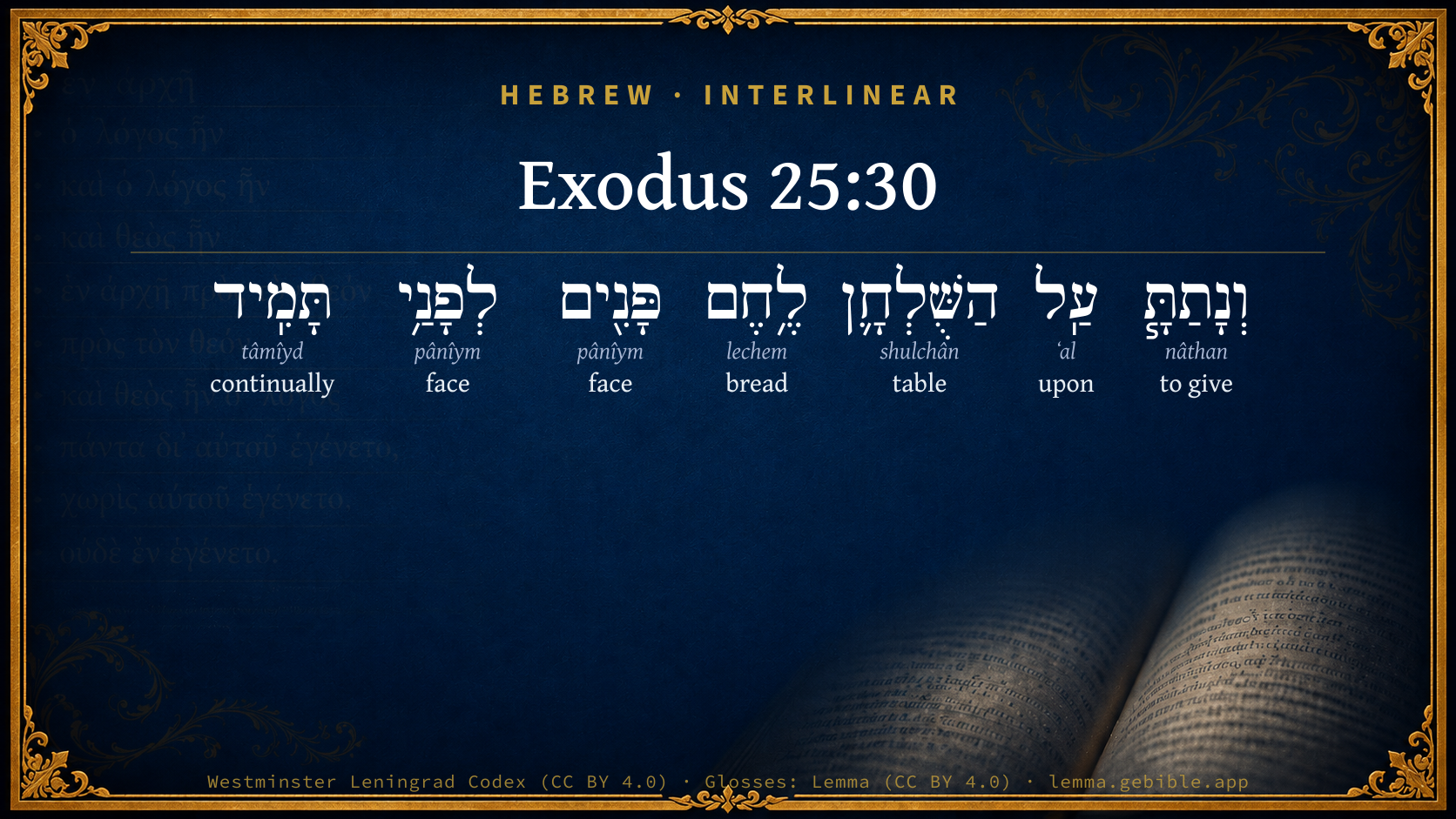
Hebrew (Westminster Leningrad Codex) Exodus 25:30 appears in the Hebrew Old Testament. The text above is from the Westminster Leningrad Codex. Each word links to its Strong’s number, a concise gloss, and parsing drawn from the Open Scriptures Hebrew Bible morphology. Click any word for its full Brown-Driver-Briggs (BDB) entry.
Download image
Cite this verse

Exodus 25:30 (World English Bible). Public Domain. Lemma interlinear Bible study tool, https://lemma.gebible.app/v/exodus/25/30.

Show BibTeX & RIS
BibTeX
RIS
English Translation
You shall set bread of the presence on the table before me always.
World English Bible · Public Domain
Highlights
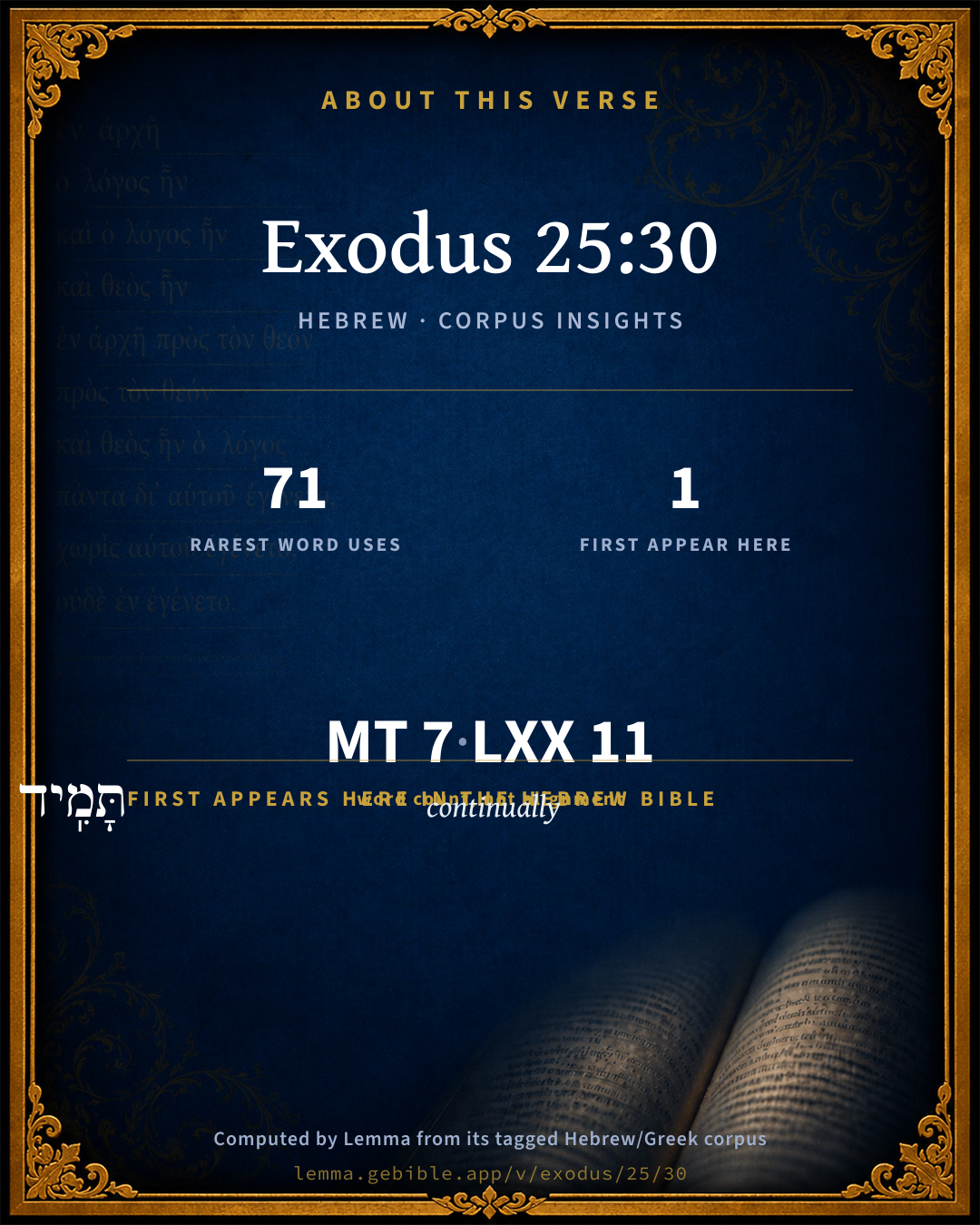
  • 1 first appearance in the Hebrew Bible
Full analysis ↓
Download a study sheet

One document with this verse’s original text, its word-by-word gloss line, the meaning frame, cross-references with their text, attributed commentary, and full source and license credits — printable, and it pastes into notes with its structure intact.

This verse Autodidact and up

Study sheet (.html) Plain text (.txt)

A passage Seminary Student

Up to 50 verses in one chapter. A passage sheet keeps up to 6 commentary sources and 12 cross-references per verse, in the order this page ranks them, and says so on the sheet whenever that leaves anything out. Ask for a single verse and you get the Autodidact verse sheet above.

Everything on this page stays free to read, with no account — the sheet is a download of what is already on screen, not access to it.

Want to remove ads? Support Godless Engineer
Compare translations 3

The same verse in 3 English versions, stacked beneath the original-language interlinear above. Click any original word for its lexicon entry.

Each is an independent rendering of the whole verse — the interlinear is not word-aligned to these translations.

Highlighted words mark where these versions differ — a whole-verse word diff, not a word-by-word alignment.

  • World English Bible Public Domain
    You shall set bread of the presence on the table before me always.
  • King James Version Public Domain
    And thou shalt set upon the table showbread before me always.
  • unfoldingWord Literal Text CC BY-SA 4.0
    And you shall continually put the bread of faces on the table before my face.

unfoldingWord Literal Text — © unfoldingWord, licensed CC BY-SA 4.0. Word-aligned USFM3 via Door43 (git.door43.org/unfoldingWord/en_ult).

Versions to compare (up to 4)

3 of 4 selected

Show all 18 translations

Every available English version of this verse, each an independent rendering of the whole verse.

  • World English Bible Public Domain
    You shall set bread of the presence on the table before me always.
  • Berean Standard Bible Public Domain
    And place the Bread of the Presence on the table before Me at all times.
  • Majority Standard Bible Public Domain
    And place the Bread of the Presence on the table before Me at all times.
  • King James Version Public Domain
    And thou shalt set upon the table showbread before me always.
  • American Standard Version (1901) Public Domain
    And thou shalt set upon the table showbread before me alway.
  • Revised Version (1885) Public Domain
    And thou shalt set upon the table shewbread before me alway.
  • Geneva Bible (1599) Public Domain
    And thou shalt set vpon the Table shewe bread before me continually.
  • Douay-Rheims (1899) Public Domain
    And thou shalt set upon the table loaves of proposition in my sight always.
  • Young's Literal Translation Public Domain
    and thou hast put on the table bread of the presence before Me continually.
  • Literal Standard Version CC BY-SA 4.0
    and you have put Bread of the Presentation on the table before Me continually.
  • Unlocked Literal Bible CC BY-SA 4.0
    You must regularly set the bread of the presence on the table before me.
  • unfoldingWord Literal Text CC BY-SA 4.0
    And you shall continually put the bread of faces on the table before my face.
  • Darby Bible Public Domain
    And thou shalt set upon the table shewbread before me continually.
  • World Messianic Bible Public Domain
    You shall set bread of the presence on the table before me always.
  • Webster's Bible Public Domain
    And thou shalt set upon the table show-bread before me always.
  • Free Bible Version CC BY-SA 4.0
    Place the Bread of the Presence on the table so it is always in my presence.
  • Bible in Basic English Public Domain
    And on the table at all times you are to keep my holy bread.
  • JPS Tanakh (1917) Public Domain
    And thou shalt set upon the table showbread before Me alway.

Literal Standard Version (2020), Covenant Press — licensed CC BY-SA 4.0. Text via the HelloAO Bible API (eBible.org). Unlocked Literal Bible (unfoldingWord) — licensed CC BY-SA 4.0. Text via the HelloAO Bible API (eBible.org). unfoldingWord Literal Text — © unfoldingWord, licensed CC BY-SA 4.0. Word-aligned USFM3 via Door43 (git.door43.org/unfoldingWord/en_ult). Free Bible Version, Dr. Jonathan Gallagher — licensed CC BY-SA 4.0. Text via the HelloAO Bible API (eBible.org).

Word by word

More ways to search: Search by grammar → Find every occurrence → Compare this word →

Practice this passage: Drill this verse → Learn its vocabulary →

About this verse

These counts appear in no published source. They are computed here, from the morphology-tagged text and Lemma’s own curated glosses. What Lemma adds →

7
words
6
distinct lemmas
Pentateuch
section

First appearance in Scripture

This word makes its first canonical appearance in the Hebrew Bible here:

  • תָּמִֽיד continually H8548

Grammatical profile

  • 1 verb
  • 5 nouns
  • 1 preposition

Verb forms

  • וְנָתַתָּ֧ Qal · Sequential Perfect

Repetition

A word recurs within this verse — often emphatic in Hebrew:

  • פָּנִ֖ים face H6440 ×2

Hebrew & Septuagint length

In English translation the verse runs 13 words from the Hebrew and 12 from the Septuagint (LXX English) — closely comparable.

A rough comparison of the two English renderings, which tokenize alike — not a word-level alignment.

Word counts can differ between the Hebrew and the Greek without any difference in meaning — e.g. the Hebrew direct-object marker אֵת has no separate Greek word, and Greek often adds the article ὁ.

In the original languages it is 7 Hebrew tokens and 11 Greek tokens — but the two are counted differently (Hebrew bundles its prefixes and suffixes into one token; the Greek is in lemma form), so that isn’t a like-for-like length.

Cross-references

11

Topical passages linked to Exodus 25:30 in the Treasury of Scripture Knowledge — connected by theme and wording, ordered by reader-vote popularity; previews shown in the World English Bible.

  • Leviticus 24:5–9 "You shall take fine flour, and bake twelve cakes of it: two tenth parts of an ephah shall be in one cake.
  • Matthew 12:4 how he entered into the house of God, and ate the show bread, which was not lawful for him to eat, neither for those who were with him, but only for the priests?
  • Exodus 39:36 the table, all its vessels, the show bread,
  • Exodus 35:13 the table with its poles and all its vessels, and the show bread;
  • Numbers 4:7 On the table of show bread they shall spread a blue cloth, and put on it the dishes, the spoons, the bowls, and the cups with which to pour out; and the continual bread shall be on it.
  • 1 Samuel 21:6 So the priest gave him holy [bread]; for there was no bread there but the show bread, that was taken from before Yahweh, to put hot bread in the day when it was taken away.
  • 1 Chronicles 9:32 Some of their brothers, of the sons of the Kohathites, were over the show bread, to prepare it every Sabbath.
  • 1 Chronicles 23:29 for the show bread also, and for the fine flour for a meal-offering, whether of unleavened wafers, or of that which is baked in the pan, or of that which is soaked, and for all manner of measure and size;
  • 2 Chronicles 13:11 and they burn to Yahweh every morning and every evening burnt offerings and sweet incense: the show bread also [set they] in order on the pure table; and the lampstand of gold with the lamps of it, to burn every evening: for we keep the charge of Yahweh our God; but you have forsaken him.
  • Malachi 1:7 You offer polluted bread on my altar. You say, 'How have we polluted you?' In that you say, 'Yahweh's table contemptible.'
  • Malachi 1:12 "But you profane it, in that you say, 'Yahweh's table is polluted, and its fruit, even its food, is contemptible.'

Cross-references courtesy of OpenBible.info (CC BY 4.0).

Hebrew and Greek witnesses Masoretic Hebrew ↔ Greek Septuagint

The same verse in the two great witnesses to the Old Testament, shown verse-for-verse.

These are two independent witnesses, not word-aligned to each other, and the Septuagint is shown in lemma (dictionary) form.

Hebrew Exodus 25:30 Masoretic · Westminster Leningrad Codex

וְנָתַתָּ֧ עַֽל הַשֻּׁלְחָ֛ן לֶ֥חֶם פָּנִ֖ים לְפָנַ֥י תָּמִֽיד

You shall set bread of the presence on the table before me always.

World English Bible · Public Domain

Greek LXX Exodus 25:30 Septuagint · lemma form

καί ἐπιτίθημι ἐπί ὁ τράπεζα ἄρτος ἐνώπιος ἐναντίον ἐγώ διά πᾶς

And you shall set upon the table show bread before me continually.

LXX2012 (modern English Septuagint) · Public Domain

On this verse, The Cambridge Bible for Schools and Colleges discusses the Septuagint’s reading. Read the note in Commentary ↓

Hebrew: Westminster Leningrad Codex (CC BY 4.0). Greek: Septuagint (public domain); English from LXX2012 (modern English Septuagint) (Public Domain). How the Septuagint differs from the Hebrew →

Targum (Aramaic paraphrase)

2

The Targum is the ancient Jewish Aramaic paraphrase of the Hebrew Scriptures — an interpretive translation, not the Hebrew text itself. Onkelos (literal) and Pseudo-Jonathan (expansive) render the Torah, and Jonathan the Prophets. Coverage is partial: where no permissively-licensed English translation exists for a verse, only the Aramaic is shown. This is verse-level text, not a word-by-word alignment to the Hebrew.

  1. Targum Onkelos Torah (Genesis–Deuteronomy)
    וְתִתֵּן עַל פָּתוֹרָא לְחֵם אַפַּיָא קֳדָמַי תְּדִירָא:

    (no public-domain English translation for this verse)

    Targum Onkelos — Aramaic: “Onkelos Genesis” (public domain); “Onkelos Exodus” (public domain); “Onkelos Leviticus” (public domain); “Onkelos Numbers” (public domain); “Onkelos Deuteronomy” (public domain). English: “Sefaria Community Translation” (CC0 1.0 (public-domain dedication)); “J.W. Etheridge. The Targums of Onkelos and Jonathan Ben Uzziel on the Pentateuch. London: Longmans, Green, 1862” (public domain). Text via Sefaria.

  2. Targum Pseudo-Jonathan Torah (Genesis–Deuteronomy)
    וּתְסַדֵּר עַל פְּתוֹרָא לַחֲמָא גַוָואָה קֳדָמַי תְּדִירָא

    And upon the table thou shalt set in order the interior bread before Me continually.

    Targum Pseudo-Jonathan — Aramaic: “Targum Jonathan on Genesis” (public domain); “Targum Jonathan on Exodus” (public domain); “Targum Jonathan on Leviticus” (public domain); “Targum Jonathan on Numbers” (public domain); “Targum Jonathan on Deuteronomy” (public domain). English: “The Targum of Jonathan ben Uzziel, trans. J. W. Etheridge, London, 1862” (public domain). Text via Sefaria.

Commentary

Notes on Exodus 25:30 from classic Christian and Jewish commentators (each source and its license shown beneath its notes). The classic Christian expositions comment on the surrounding passage and are grouped to its opening verse, so a note may address several verses; the Jewish commentaries on the Tanakh (Rashi and others) are per-verse, so they appear only where the commentator wrote on this verse.

Lemma curates 59 commentaries, every one of them public domain or Creative Commons licensed, each selected and text-cleaned for this edition rather than reprinted as found. About our sources →

Trapp's Complete Commentary

John Trapp

Exo 25:30 And thou shalt set upon the table shewbread before me alway.

Ver. 30. Show bread.] {See Trapp on "Mat 12:4"}

John Trapp, A Commentary or Exposition upon All the Books of the Old and New Testament (1647–1656) — public domain. Text from a community e-Sword module.

Joseph Benson's Commentary

Exo 25:30. Thou shalt set upon the table the show bread — Hebrew, Bread of the face or presence, because it was set before the ark, where God was peculiarly present. We call it show bread, because it was showed, or exhibited before God upon the sacred table, as a national weekly oblation, in the name of all the twelve tribes, for the loaves were twelve in number, and being an offering to God were to be eaten only by the priests in the holy place, Lev 24:5-9. Every loaf must have been of considerable size, since two-tenth deals, or two homers of flour were used for each, which are about six quarts English. This bread, set in two rows, six loaves in a row, was designed to be a thankful acknowledgment of God’s goodness to them in giving them their daily bread, a token of their communion with God, this bread on God’s table being made of the same corn with the bread on their own tables. And it was a type of the spiritual provision which is made in the church, by the gospel of Christ, for all that are made priests to our God.

Joseph Benson's Commentary on the Old and New Testaments (1811–1818) — public domain. Text from a community e-Sword module.

MacLaren's Expositions of Holy Scripture

Alexander MacLaren

Exodus

THE BREAD OF THE PRESENCE

Exo 25:30.

I suspect that to many readers the term ‘shew-bread’ conveys little more meaning than if the Hebrew words had been lifted over into our version. The original expression, literally rendered, is ‘bread of the face’; or, as the Revised Version has it in the margin, ‘presence bread,’ and the meaning of that singular designation is paraphrased and explained in my text: ‘Thou shalt set upon the table, bread of the presence before Me always.’ It was bread, then, which was laid in the presence of God. The directions with regard to it may be very briefly stated. Every Sabbath the priests laid upon the table which stood on one side of the Altar of Incense, in the Inner Court, two piles of loaves, on each of which piles was placed a pan of incense. They lay there for a week, being replaced by fresh ones on the coming Sabbath.

The Altar of Incense in the middle symbolised the thought that the priestly life, which was the life of the nation, and is the life of the Christian both individually and collectively, is to be centrally and essentially a life of prayer. On one side of it stood the great golden lamp which, in like manner, declared that the activities of the priestly life, which was the life of Israel, and is the life of the Christian individually and collectively, is to be, in its manward aspect, a light for the world. On the other side of the Altar of Incense stood this table with its loaves. What does it say about the life of the priest, the Church, and the individual Christian? That is the question that I wish to try to answer here; and in doing so let me first ask you to look at the thing itself, and then to consider its connection with the other two articles in connection with which it made a threefold oneness.

I. Let me deal with this singular provision of the ancient ritual by itself alone.

Bread is a product at once of God’s gift and of man’s work. In the former aspect, He ‘leaves not Himself without witness, in that,’ in the yearly miracle of the harvest, ‘He gives us bread from Heaven, and fruitful seasons, filling our hearts with food and gladness’; in the latter, considered as a product of man’s activity, agriculture is, if not the first, at all events in settled communities the prime, form of human industry. The farmer and the baker begin the series of man’s industries. So that these loaves were fitly taken as representatives of all kinds of human industry and their products, and as such were consecrated to God. That is the broad significance of this institution, which, as we shall have to see, links itself with the other two conceptions of the priestly life in its Godward and in its manward aspect. Now the first thing that is suggested, therefore, is the plain obligation, which is also a blessed privilege, for all men who are priests of God by faith in, and union with, the great High Priest, that they lay all their activities as an offering before God. The loaves in their very place on that table, right in front of the veil that parted the Inner Court from the inmost of all, where the Shekinah shone, and the Cherubim bowed in worship, tell us that in some sense they, too, were an offering, and that the table was an altar. Their sacrificial character is emphasised by the fact that upon the top of each of the piles there was laid a pan of incense.

So, then, the whole was an offering of Israel’s activities and its results to God. And we, Christian men and women, have to make an offering of all our active life, and all its products. That thought opens up many considerations, one or two of which I ask leave to touch briefly. First, then, if my active life is to be an offering to God, that means that I am to surrender myself. And that surrender means three things: first that in all my daily work I am to set Him before me as my end; second, that in all my daily work I am to set Him before me as my law; third, that in all my daily work I am to set Him before me as my power. As for the first, whatever a man does for any motive other, and with any end less, than God and His Glory, that act, beautiful as it may be in other respects, loses its supreme beauty, and falls short of perfect nobleness, just in the measure in which other motives, or other ends, than this supreme one, are permitted to dominate it. I do not contend for such an impossible suppression of myself as that my own blessedness and the like shall be in no manner my end, but I do maintain this, that in good old language, ‘Man’s chief end is to glorify God,’ and that anything which I do, unless it is motived by this regard to Him as its ‘chief end,’ loses its noblest consecration, and is degraded from its loftiest beauty. The Altar sanctifies, and not only sanctifies but ennobles, the gift. That which has in it the taint of self-regard so pronouncedly and dominantly as that God is shut out, is like some vegetation down in low levels at the bottom of a vale, which never has the sun to shine upon it. But let it rise as some tree above the brushwood until its topmost branches are in the light, and then it is glorified. To live to self is ignoble and mean; to live for others is higher and nobler. But highest and noblest of all is to offer the loaves to God, and to make Him the end of all our activities.

Again, there is another consideration, bearing on another region in which the assertive self is only too apt to spoil all work. And that is, that if our activities are offerings to God, this means that His supreme Will is to be our law, and that we obey His commands and accept His appointments in quiet submission. The tranquillity of heart, the accumulation of power, which come to men when they, from the depths, say, ‘Not my will but Thine be done’; ‘Speak, Lord! for Thy servant heareth,’ cannot be too highly stated. There is no such charm to make life quiet and strong as the submission of the will to God’s providences, and the swift obedience of the will to God’s commandments. And whilst to make self my end mars what else is beautiful, making self my law mars it even more.

Further, we offer our activities to God when we fall back upon Him as our one power, and say, ‘Perfect Thy strength in my weakness.’ He that goes out into the world to do his daily work, of whatsoever sort it is-you in your little sphere, or I in mine-in dependence upon himself, is sure to be defeated. He that says ‘we have no strength against this great multitude that cometh against us, but our eyes are unto Thee,’ will, sooner or later, be able to go back with joy, and say, ‘the Lord hath done great things for us, whereof we are glad.’ The man that goes into the fight like that foolish prime minister of France under the Empire, ‘with a light heart.’ will very soon find his Sedan, and have shamefully to surrender. Brethren, these three things, making God the end of my work; making God’s will the law of my work; making God’s strength the power of my work; these are the ways by which we, too, can bring our little pile of barley bread, and lay it upon that table.

Again, this consecration of life’s activities is to be carried out by treating their products, as well as themselves, as offerings to God. The loaves were the results of human activity. They were also the products of divine gifts elaborated by human effort. And both things are true about all the bread that you and I have been able to make for the satisfaction of our desires, or the sustenance of our strength-it comes ultimately from the gift of God. In regard to this consecration of the product of our activities, as well as of our activities themselves, I have but two words to offer, and the one is, let us see to it that we consecrate our enjoyment of God’s gifts by bringing that enjoyment, as well as the activities which He has blessed to produce it, into His presence. That table bore the symbols of the grateful recognition of God’s mercies by the people. And when our hearts are glad, and our ‘bosom’s lord sits lightly on his throne,’ we have special need to take care that our joy be not godless, nor our enjoyment of His gifts be without reference to Himself. ‘Ah,’ you say, ‘that is a threadbare commonplace.’ Yes, it is, dear friends; it is a commonplace just because it is needful at every turn, if we are to make our lives what they ought to be.

May I say another thing? and that is, that the loaves that were laid within the Sanctuary were not intended to be separated from the others that were eaten in the tents, nor were they meant to be a kind of purchasing of an indulgence, or of a right, by surrendering a little, to the godless and selfish enjoyment of the rest of the batch, or of the rest of the harvest. Let us apply that to our money, which is one of the products of our activities; and not fancy, as a great many people do, that what we give as a subscription to some benevolent or religious institution buys for us the right to spend all the rest selfishly. That is another commonplace, very threadbare and very feeble, when we speak it, but with claws and teeth in it that will lay hold of us, when we try to put it in practice. The enjoyments and the products of our daily activities are to be offered to God.

Still further, this table with its burden has suggestions that as Christians we are bound to bring all our work to Him for His judgment upon it. The loaves were laid right in front of the veil, behind which blazed the light of His presence. And that meant that they were laid before ‘those pure eyes and perfect judgment of all-judging’ God. Whether we bring our activities there or no, of course in a very real and solemn sense they are there. But what I desire to insist upon now is how important, for the nobleness and purity of our daily lives, it is that we should be in the continual habit of realising to ourselves the thought that whatever we do, we do before His Face. The Roman Catholics talk about ‘the practice of the presence of God.’ One does not like the phrase, but all true religion will practise what is meant by it. And for us it should be as joyous to think, ‘Thou God seest me,’ as it is for a child to play or work with a quiet heart, because it knows that its mother is sitting somewhere not very far off and watching that no harm comes to it. That thought of being in His presence would be for us a tonic, and a test. How it would pull us up in many a meanness, and keep our feet from wandering into many forbidden ways, if there came like a blaze of light into our hearts the thought: ‘Thou God seest me!’ There are many of our activities, I am afraid, which we should not like to put down on that table. Can you think of any in your lives that you would be rather ashamed to lay there, and say to Him, ‘Judge Thou this’? Then do not do it. That is a brief, but a very stringent, easily applied, and satisfactory test of a great many doubtful things. If you cannot take them into the Inner Court, and lay them down there, and say, ‘Look, Lord! this is my baking,’ be sure that they are made, not of wholesome flour, but of poisoned grain, and that there is death in them.

Further, this table, with its homely burden of twelve poor loaves, may suggest to us how the simplest, smallest, most secular of our activities is a fit offering to Him. The loaves were not out of place amidst the sanctities of the spot, nor did they seem to be incongruous with the golden altar and the golden lamp-stand, and yet they were but twelve loaves. The poorest of our works is fit to be carried within the shrine, and laid upon His altar. We may be sure that He delights even in the meanest and humblest of them, if only we take them to Him and say: ‘All things come of Thee, and of Thine own have we given Thee.’ Ah! there are a great many strange things in Christ’s treasury. Mothers will hoard up trifles that belonged to their children, which everybody else thinks worthless. Jesus Christ has in His storehouse a ‘cup of cold water,’ the widows’ mites, and many another thing that the world counts of no value, and He recognises as precious. There is an old story about some great emperor making a progress through his dominions, where he had been receiving precious gifts from cities and nobles, and as the gay cortège was passing a poor cottage, the peasant-owner came out with a coarse earthenware cup filled with spring water in his hand, and offered it to his overlord as the only gift that he could give. The king accepted it, and ennobled him on the spot. Take your barley loaves to Christ, and He will lay them up in His storehouse.

II. Now I need only say a word or two about the other aspect of this table of shew-bread, taken with the other two articles in conjunction with which it formed a unity.

The lamp and the table go together. They are both offshoots from the altar in the middle. That is to say, your lives will not shine before men unless your activities are offered to God. The smallest taint of making self your end, your law, or your strength, mingling with your lives, and manifest in their actions, will dim the light which shines from them, and men will be very quick to find out and say, ‘He calls himself a Christian; but he lives for himself.’ Neither the light, which is the radiance of a Christian life manwards, can be sustained without the offering of the life in its depths to God, nor can the activities of the life be acceptably offered to Him, unless the man that offers them ‘lets his light shine before men.’ The lamp and the table must go together.

The lamp and the table must together be offshoots from the altar. If there be not in the centre of the life aspiration after Him in the depths of the heart, communion with Him in the silent places of the soul, then there will be little brightness in the life to ray out amongst men, and there will be little consecration of the activities to be laid before God. The reason why the manifold bustle and busy-ness of the Christian Church today sows so much and reaps so little, lies mainly here, that they have forgotten to a large extent how the altar in the centre must give the oil for the lamp to shine, and the grain to be made into the loaves. And, on the other hand, the altar in the middle needs both its flanking accompaniments. For the Christian life is to be no life of cloistered devotion and heavenward aspiration only or mainly, but is to manifest its still devotion and its heavenward aspiration by the consecration of its activities to God, and the raying of them out into a darkened world. The service of man is the service of God, for lamp and table are offshoots of the altar. But the service of God is the basis of the best service of man, for the altar stands between the lamp and the table.

So, brethren, let us blend these three aspects into a unity, the Altar, the Lamp, the Table, and so shall we minister aright, and men will call us the ‘priests of the Most High God,’ till we pass within the veil where, better than the best of us here can do, we shall be able to unite still communion and active service, and shine as the sun in the Kingdom of our Father. ‘His servants shall serve Him’ with priestly ministrations, ‘and shall see His face, and His name shall be in their foreheads.’

Alexander MacLaren, Expositions of Holy Scripture (1904–1910) — public domain. Text from a community e-Sword module.

Jamieson, Fausset & Brown

Robert Jamieson, A. R. Fausset & David Brown

showbread--literally, presence bread, so called because it was constantly exhibited before the Lord, or because the bread of His presence, like the angel of His presence, pointed symbolically to Christ. It consisted of twelve unleavened loaves, said traditionally to have been laid in piles of six each. This bread was designed to be a symbol of the full and never-failing provision which is made in the Church for the spiritual sustenance and refreshment of God's people.

Jamieson, Fausset & Brown — Commentary Critical and Explanatory on the Whole Bible (1871) — public domain (CC PDM 1.0). Text via the HelloAO Bible API.

Adam Clarke's Commentary

Verse 30. Shew-bread] לחם פנים lechem panim literally, bread of faces; so called, either because they were placed before the presence or face of God in the sanctuary, or because they were made square, as the Jews will have it. It is probable that they were in the form or cubes or hexaedrons, each side presenting the same appearance; and hence the Jews might suppose they were called the bread or loaves of faces: but the Hebrew text seems to intimate that they were called the bread of faces, פנים panim, because, as the Lord says, they were set לפני lephanai, before my FACE. These loaves or cakes were twelve, representing, as is generally supposed, the twelve tribes of Israel. They were in two rows of six each. On the top of each row there was a golden dish with frankincense, which was burned before the Lord, as a memorial, at the end of the week, when the old loaves were removed and replaced by new ones, the priests taking the former for their domestic use.

It is more difficult to ascertain the use of these, or what they represented, than almost any other emblem in the whole Jewish economy. Many have conjectured their meaning, and I feel no disposition to increase their number by any addition of my own. The note on Ex 25:23, from Dr. Cudworth, appears to me more rational than any thing else I have met with. The tabernacle was God's house, and in it he had his table, his bread, his wine, candlestick, &c., to show them that he had taken up his dwelling among them. See Clarke on Ex 25:23.

Adam Clarke's Commentary on the Bible (1810–1826) — public domain. Text from a community e-Sword/MySword module.

Ellicott's Commentary for English Readers

(30) Thou shalt set upon the table shewbread before me alway.—For a detailed account of the arrangement of the shewbread see Lev_24:5-9. The Hebrew expression translated “shewbread” is literally, “bread of face,” or “bread of presence”—bread, that is, which was set forth always before the presence of God.

A Bible Commentary for English Readers, edited by Charles John Ellicott (1878–1897) — public domain. Text from a community e-Sword module.

The Cambridge Bible for Schools and Colleges

gen. ed. J. J. S. Perowne

30. shewbread] This rend. is first found in Tindale’s version of Heb_9:2 (1526), being derived by him apparently from Luther’s Schaubrot (1522). Though, however, a possible paraphrase of the expression used by Jerome (see below), it does not correctly represent the expression used here, which is undoubtedly Presence-bread (RVm.), i.e. bread set out in Jehovah’s presence, and designed originally as His food. The custom of presenting food on a table as an oblation to a god was widely diffused among ancient peoples: it will be sufficient to instance the lectisternia of the Romans, the similar custom abundantly attested for Assyria, even with the use of 12 loaves (EB. iv. 4116; KAT.3[203] 600), the tables which the idolatrous Israelites laid out for Gad, the god of fortune (Isa_65:11), Bar_4:30, and the story of Bel and the Dragon. The gods were supposed to require food and drink; and reverence towards them naturally took the form of supplying their needs. These were the ideas out of which no doubt the Heb. institution originated; but in the light of the higher religion of Israel the ‘continual bread’ (Num_4:7) acquired, we may be sure, a higher significance, and was regarded as a standing acknowledgement on the part of (Lev_24:8 RVm.) the children of Israel that Jehovah was the giver of their daily bread. See further on the Presence-bread (which is here mentioned only incidentally) the notes on Lev_24:5-9; Kennedy in DB. iv. 495 ff., 663; Jewish Encycl. art. Showbread; Edersheim, The Temple and its ministry, p. Exo 155 f. (with quotations from the Mishna). The antiquity of the institution is attested by the familiar incident, 1Sa_21:4-6.

[203] Die Keilinschriften und das A T., 1903, by H. Zimmern (pp. 345–653) and H. Winckler (pp. 1–342).

The post-exilic name of the Presence-bread—derived from the fact that the twelve large flat oblong cakes of which it consisted were arranged on the table in two piles (Lev_24:6)—was Bread set out (lit. Bread of arrangement), 1Ch_9:32; 1Ch_23:29 al. (cf. on Exo_40:4). This was rendered by LXX. οἱ ἄρτοι τῆς προθέσεως, ‘the loaves of setting before’ (viz. before God: cf. προτίθημι, to ‘set before,’ of a meal), whence the NT. expression ὁ ἄρτος τῆς προθέσεως, Mat_12:4 al. (for ἡ πρ. τῶν ἄρτων Heb_9:2, see 2Ch_13:11 LXX.). Jerome’s panes propositionis is simply a lit. translation of the LXX. rend.; and this, understood as ‘loaves of exhibition,’ no doubt suggested to Luther his Schaubrot, whence our shewbread.

31–40 (cf. Exo_37:17-24). The golden candlestick or lampstand. This consisted of a central stem, resting on feet, with three branches turned upwards and outwards on each side, the stem and branches being ornamented by the gold, at suitable distances, being beaten into the shape of the calyx and corolla of the almond-flower. The whole was of pure beaten gold, a talent (96 lb.) of the metal being employed in its construction. There were seven lamps, corresponding to the central stem and the six branches, which it was the duty of the priests to take off and trim daily, and to replace in the evening (Exo Exo_27:21, Exo_30:8).

The Cambridge Bible for Schools and Colleges (gen. ed. J. J. S. Perowne; Cambridge University Press, 1878–1918) — public domain. Text from a community e-Sword module.

John Gill's Exposition

And six branches shall come out of the sides of it,.... Out of the trunk or shaft, being beaten out of it:

three branches of the candlestick out of one side, and three branches of the candlestick out of the other side; Jarchi takes what we render the "shaft" to be the lower part of the candlestick, from whence three feet went out below; and the "branch" or "cane", for it is in the singular number in the preceding verse, he takes to be the middle branch or trunk, that went up from the middle of the foot upwards, and upon it was the middle lamp, in the form of a censer, to pour oil into the midst of it; and the six branches went out from the sides of that, here and there drawn obliquely, and went up to the height of the candlestick, which is the middle branch or cane; and they went up from the midst of that middle cane, one above another, the lowermost long, and that above it shorter than that, and the uppermost shorter than that; for the height of the tops of them were equal to the height of the middle cane, that is, the seventh, from whence the six went out.

John Gill's Exposition of the Whole Bible (1746–1763) — public domain (CC PDM 1.0). Text via the HelloAO Bible API.

Haydock's Catholic Bible Commentary

Loaves. There were 12, containing each six pints of flour, made up in a square form, without leaven. They were placed in two rows, one above the other, and were kept separate by plates of gold. (Calmet) See Leviticus xxiv. 5.

George Leo Haydock (1774–1849), Haydock's Catholic Family Bible and Commentary, 1859 edition — public domain. Excludes Psalms (Douay-Rheims chapter numbering differs from Protestant) and Deuterocanonical books (Catholic canon only).

Matthew Poole's English Annotations

Heb. Bread of faces, or of the presence, so called, because it was constantly placed in God’s presence. This bread was divided into twelve loaves, one for every tribe; and they were in their name presented to God in the nature of an offering, as the frankincense shows, as a public acknowledgment that they received all their bread or food, both corporal and spiritual, from God’s hand, and were to use it as in God’s presence

Matthew Poole's English Annotations on the Holy Bible (1683–1685) — public domain. Text from a community e-Sword/MySword module.

Whedon's Commentary on the Bible

Daniel D. Whedon

30. Showbread before me always — The showbread (Hebrews פנים לחם, bread of faces,) was so called from its being designed to lie as a meat-offering continually before the face of Jehovah. The manner of making this bread, and of arranging it upon the table in two piles of six cakes each, is described in Lev_24:5-9, and is also shown in the above cut. The twelve cakes or loaves undoubtedly represented the twelve tribes of Israel as offered in holy consecration perpetually before Jehovah.

Daniel D. Whedon (gen. ed.), Commentary on the Old and New Testaments (1874–1909) — public domain. Text from a community e-Sword module.

The Pulpit Commentary

Thou shalt set upon the table shew-bread before me alway. Here we have at once the object of the table, and its name, explained. The table was to have set upon it continually twelve loaves, or cakes, of bread, (Lev_24:5) which were to be renewed weekly on the sabbath-day (ibid. ver. 8), the stale loaves being at the same time consumed by the priests in the holy place. These twelve loaves or cakes were to constitute a continual thank-offering to God from the twelve tribes of Israel in return for the bless-Lugs of life and sustenance which they received from him. The bread was called "bread of face," or "bread of presence," because it was set before the "face" or "presence" of God, which dwelt in the holy of holies. The Septuagint renders the phrase by artoi ejnwpioi "loaves that are face to face St. Matthew by artoi thv proqesewv, "loaves of setting-forth whence the Schaubrode of Luther, and our "shew-bread," which is a paraphrase rather than a translation.

The Pulpit Commentary (1880–1919), ed. H.D.M. Spence-Jones & Joseph S. Exell — public domain. Text from a community e-Sword module.

Keil & Delitzsch

C. F. Keil & F. Delitzsch

Bread of the face (פּנים לחם), the mode of preparing and placing which is described in Lev 24:5., was to lie continually before (לפני) Jehovah. These loaves were called "bread of the face" (shew-bread), because they were to lie before the face of Jehovah as a meat-offering presented by the children of Israel (Lev 24:8), not as food for Jehovah, but as a symbol of the spiritual food which Israel was to prepare (Joh 6:27, cf. Joh 4:32, Joh 4:34), a figurative representation of the calling it had received from God; so that bread and wine, which stood upon the table by the side of the loaves, as the fruit of the labour bestowed by Israel upon the soil of its inheritance, were a symbol of its spiritual labour in the kingdom of God, the spiritual vineyard of its Lord.

Keil & Delitzsch — Biblical Commentary on the Old Testament (1861–1891) — public domain (CC PDM 1.0). Text via the HelloAO Bible API. (Old Testament only.)

Scofield Reference Notes

C. I. Scofield

shewbread

Showbread, type of Christ, the Bread of God, nourisher of the Christian’s life as a believer-priest 1Pe 2:9; Rev 1:6. In Joh 6:33-58 our Lord has more in mind the manna, that food which "came down"; but all typical meanings of "bread" are there gathered into His words. The manna is the life-giving Christ; the showbread, the life-sustaining Christ. The showbread typifies Christ as the "corn of wheat" Joh 12:24 ground in the mill of suffering Joh 12:27 and brought into the fire of judgment Joh 12:31-33. We, as priests, by faith feed upon Him as having undergone that in our stead and for our sakes. It is meditation upon Christ, as in Heb 12:2; Heb 12:3.

The Scofield Reference Bible (1917 edition), notes by C. I. Scofield — public domain. Text from a community e-Sword module.

Rashi

Rabbi Shlomo Yitzchaki (Rashi)

לחם הפנים SHEW-BREAD (lit., bread of faces) — It was so called because it had “faces” (פנים) as I have explained (v. 29). The number of loaves and the way they were set in piles are fully explained in the Sidrah אמר אל הכהנים (Leviticus 24:5—9).

Rashi on the Tanakh — English translations: “The Judaica Press complete Tanach with Rashi, translated by A. J. Rosenberg” (CC BY 4.0); “Pentateuch with Rashi's commentary by M. Rosenbaum and A.M. Silbermann, 1929-1934” (public domain); “The Metsudah Tanach series, Lakewood, N.J” (CC BY 4.0); and “The Book of Joshua, Metsudah Publications, 1997” (CC BY 4.0). Text via Sefaria.

Ramban (Nachmanides)

Rabbi Moshe ben Nachman (Ramban / Nachmanides)

LECHEM PANIM’ (SHOWBREAD). “It is called lechem panim [which literally means ‘bread of faces’] because it had ‘faces’ [surfaces] looking in both directions towards the sides of the House [Tabernacle or Sanctuary]. The loaf was set lengthwise across the breadth of the table with its sides standing up exactly in a line with the edge of the table.” This is the language of Rashi. This conforms with the language of the Mishnah: “Ben Zoma says: lechem panim — [it is so called] because it is to have surfaces” [looking in both directions]. But all this is in accordance with the opinion of the Sage, 94 b). who says: “How did they make the showbread? Like a case broken open.” ). The figure thus is: ⌴. But according to the Sage ). who says that it was shaped “like a rocking boat,” ). The figure is: V. then it could not have been [called lechem panim because of the parallel surfaces looking in both directions, as it had none]! And Rabbi Abraham ibn Ezra wrote that it is called lechem panim because it is before Me always. meaning “face” is thus explained by l’phanai tamid (before Me always): it is lechem panim literally: “bread of the face” because it is before Me always.By way of the Truth, [the mystic lore of the Cabala], when you will understand the word l’phanai (before Me) you will understand its name [i.e., why it is called “the bread of panim”] and its secret, for because of that [the table] was placed on the north side [of the Tabernacle], seeing that the blessing of the Eternal maketh rich, similar to what is said, in every place where I cause My name to be mentioned I will come unto thee and bless thee. I have already alluded to this., 20:3. — So explained in Bachya.Where shall be found the wisdom embodied in the candelabrum, its cups and knops and flowers, seeing that it is so hidden from the eyes of all living! But as to the reason for its being of beaten work, with the six branches coming out of the seventh, and upon them the lamp of G-d and all [six lamps] to give light over against it — all this you can understand from our words that we have written in another place. (Verse 36), symbolizing a perfect Unity, with the lamp of G-d, alluding to the Supreme One, above them. This is the intent of the saying of the Sages that Moses found difficulty with the candelabrum.

Ramban (Nachmanides) on the Tanakh — English translation: “Commentary on the Torah by Ramban (Nachmanides). Translated and annotated by Charles B. Chavel. New York, Shilo Pub. House, 1971-1976” (CC BY 4.0). Text via Sefaria.

Lesson kit

Teaching starters — assembled from the data on this page, not authored interpretation. Every prompt links to the verse data it draws on. Edit before teaching.

Exodus, in the Pentateuch, opens this verse with 7 words (6 distinct Hebrew lemmas). Its most distinctive word is shulchân (“table”). A historical commentator’s framing appears above. Read the whole chapter for the surrounding context.

Discussion questions

  1. What does “table” (shulchân) contribute to the verse as a whole?
  2. The word “continually” first appears here in Scripture. What is being introduced at this debut?
  3. Leviticus 24:5–9 shares this passage’s theme. How do the two illuminate each other?
  4. “face” occurs 2× in this one verse. What is the effect of the repetition?
  5. The translations on this page render this verse differently — a whole-verse word diff, not a word-by-word alignment. What might account for the different wordings?
  6. The verb «וְנָתַתָּ֧» is Qal Sequential Perfect. How does its form color the action?
  7. Reading how Trapp's Complete Commentary and Joseph Benson's Commentary read this verse, where do the two commentators agree and where do they part?

Things to notice

Reading settings

Reading text

Shown beneath each verse's original-language words.

Old Testament
Old Testament edition

Read the OT as the Masoretic Hebrew (MT) or the Greek Septuagint (LXX).

English shown for the Greek Septuagint (in the Hebrew ↔ Greek comparison).

Comparing translations? Open the Compare panel on any verse page to stack up to four side by side.