Genesis 41:43

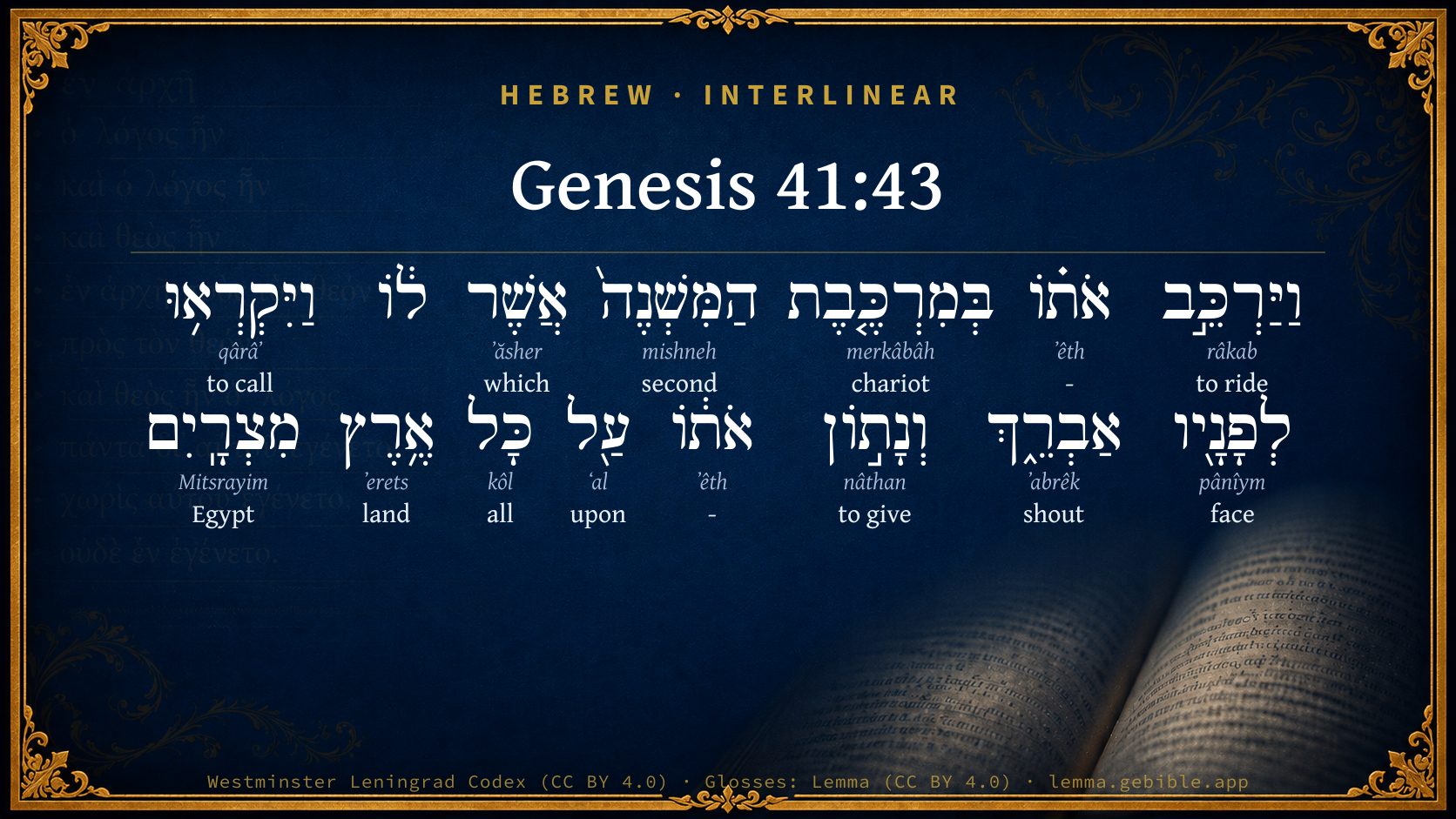
Hebrew (Westminster Leningrad Codex) Genesis 41:43 appears in the Hebrew Old Testament. The text above is from the Westminster Leningrad Codex. Each word links to its Strong’s number, a concise gloss, and parsing drawn from the Open Scriptures Hebrew Bible morphology. Click any word for its full Brown-Driver-Briggs (BDB) entry.
Download image
Cite this verse

Genesis 41:43 (World English Bible). Public Domain. Lemma interlinear Bible study tool, https://lemma.gebible.app/v/genesis/41/43.

Show BibTeX & RIS
BibTeX
RIS
English Translation
and he made him to ride in the second chariot which he had. They cried before him, "Bow the knee!" He set him over all the land of Egypt.
World English Bible · Public Domain
Highlights
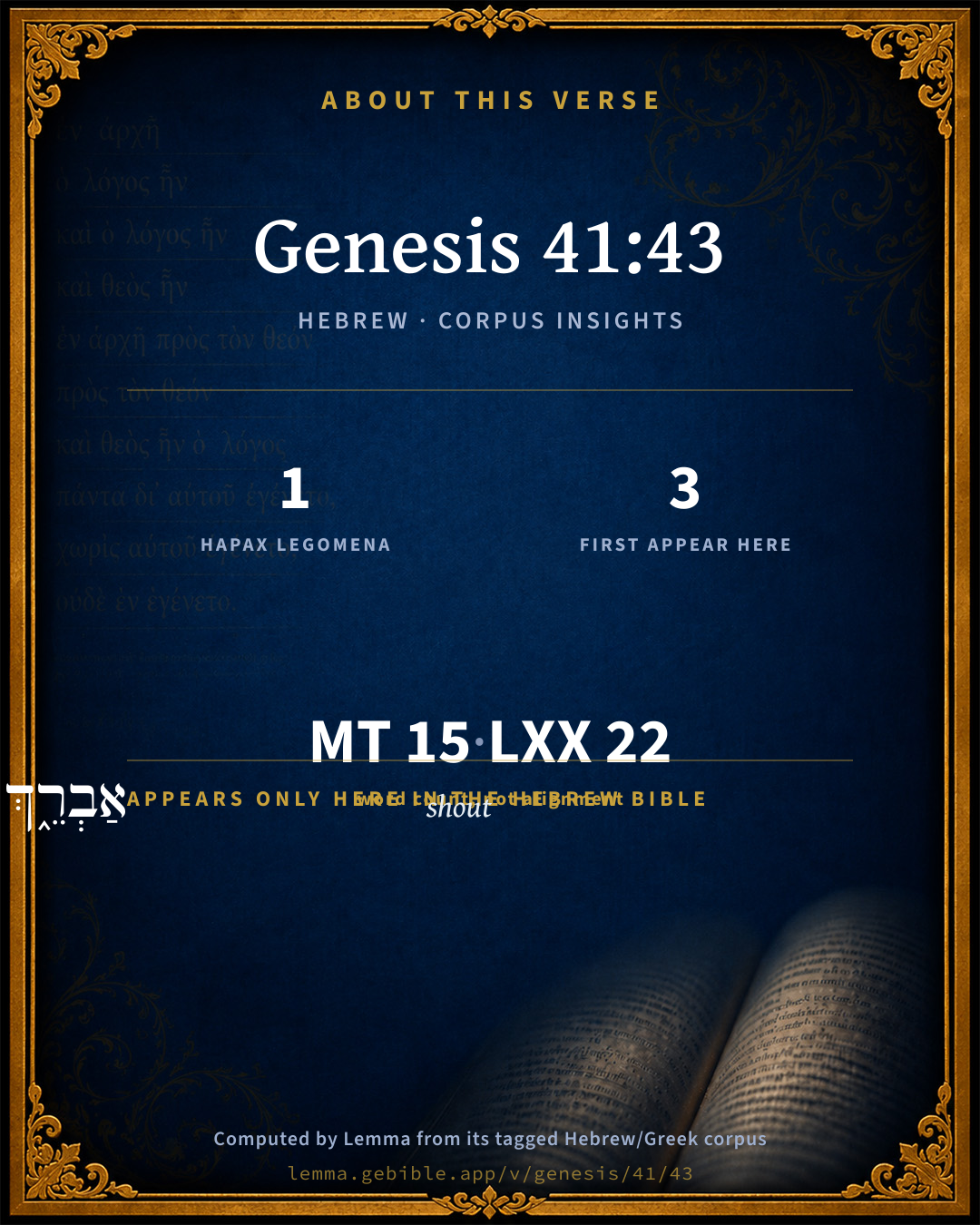
  • 1 hapax legomenon — only here in the Hebrew Bible
  • 3 first appearances in the Hebrew Bible
Full analysis ↓
Download a study sheet

One document with this verse’s original text, its word-by-word gloss line, the meaning frame, cross-references with their text, attributed commentary, and full source and license credits — printable, and it pastes into notes with its structure intact.

This verse Autodidact and up

Study sheet (.html) Plain text (.txt)

A passage Seminary Student

Up to 50 verses in one chapter. A passage sheet keeps up to 6 commentary sources and 12 cross-references per verse, in the order this page ranks them, and says so on the sheet whenever that leaves anything out. Ask for a single verse and you get the Autodidact verse sheet above.

Everything on this page stays free to read, with no account — the sheet is a download of what is already on screen, not access to it.

Want to remove ads? Support Godless Engineer
Compare translations 3

The same verse in 3 English versions, stacked beneath the original-language interlinear above. Click any original word for its lexicon entry.

Each is an independent rendering of the whole verse — the interlinear is not word-aligned to these translations.

Highlighted words mark where these versions differ — a whole-verse word diff, not a word-by-word alignment.

  • World English Bible Public Domain
    and he made him to ride in the second chariot which he had. They cried before him, "Bow the knee!" He set him over all the land of Egypt.
  • King James Version Public Domain
    And he made him to ride in the second chariot which he had; and they cried before him, Bow the knee: and he made him ruler over all the land of Egypt.
  • unfoldingWord Literal Text CC BY-SA 4.0
    Then he had him ride in the second chariot that to him, and they shouted before him, “Bow down!” So he put him over all the land of Egypt.

unfoldingWord Literal Text — © unfoldingWord, licensed CC BY-SA 4.0. Word-aligned USFM3 via Door43 (git.door43.org/unfoldingWord/en_ult).

Versions to compare (up to 4)

3 of 4 selected

Show all 18 translations

Every available English version of this verse, each an independent rendering of the whole verse.

  • World English Bible Public Domain
    and he made him to ride in the second chariot which he had. They cried before him, "Bow the knee!" He set him over all the land of Egypt.
  • Berean Standard Bible Public Domain
    He had Joseph ride in his second chariot, with men calling out before him, “Bow the knee!” So he placed him over all the land of Egypt.
  • Majority Standard Bible Public Domain
    He had Joseph ride in his second chariot, with men calling out before him, “Bow the knee!” So he placed him over all the land of Egypt.
  • King James Version Public Domain
    And he made him to ride in the second chariot which he had; and they cried before him, Bow the knee: and he made him ruler over all the land of Egypt.
  • American Standard Version (1901) Public Domain
    and he made him to ride in the second chariot which he had; and they cried before him, Bow the knee: and he set him over all the land of Egypt.
  • Revised Version (1885) Public Domain
    and he made him to ride in the second chariot which he had; and they cried before him, Bow the knee: and he set him over all the land of Egypt.
  • Geneva Bible (1599) Public Domain
    So he set him vpon the best charet that hee had, saue one: and they cryed before him, Abrech, and placed him ouer all the land of Egypt.
  • Douay-Rheims (1899) Public Domain
    And again Pharao said to Joseph: Behold, I have appointed thee over the whole land of Egypt.
  • Young's Literal Translation Public Domain
    and causeth him to ride in the second chariot which he hath, and they proclaim before him, `Bow the knee!' and -- to put him over all the land of Egypt.
  • Literal Standard Version CC BY-SA 4.0
    and causes him to ride in the second chariot which he has, and they proclaim before him, “Bow the knee!” And [he] set him over all the land of Egypt.
  • Unlocked Literal Bible CC BY-SA 4.0
    He had him ride in the second chariot which he possessed. Men shouted before him, “Bend the knee.” Pharaoh put him over all the land of Egypt.
  • unfoldingWord Literal Text CC BY-SA 4.0
    Then he had him ride in the second chariot that to him, and they shouted before him, “Bow down!” So he put him over all the land of Egypt.
  • Darby Bible Public Domain
    And he caused him to ride in the second chariot that he had; and they cried before him, Bow the knee! and he set him over all the land of Egypt.
  • World Messianic Bible Public Domain
    He made him ride in the second chariot which he had. They cried before him, “Bow the knee!” He set him over all the land of Egypt.
  • Webster's Bible Public Domain
    And he made him to ride in the second chariot which he had: and they cried before him, Bow the knee: and he made him ruler over all the land of Egypt.
  • Free Bible Version CC BY-SA 4.0
    He had Joseph ride in the chariot designated for his second-in-command while his attendants went ahead, shouting, “Bow down!” This is how Pharaoh gave Joseph authority over all of Egypt.
  • Bible in Basic English Public Domain
    And he made him take his seat in the second of his carriages; and they went before him crying, Make way! So he made him ruler over all the land of Egypt.
  • JPS Tanakh (1917) Public Domain
    And he made him to ride in the second chariot which he had; and they cried before him: 'Abrech'; and he set him over all the land of Egypt.

Literal Standard Version (2020), Covenant Press — licensed CC BY-SA 4.0. Text via the HelloAO Bible API (eBible.org). Unlocked Literal Bible (unfoldingWord) — licensed CC BY-SA 4.0. Text via the HelloAO Bible API (eBible.org). unfoldingWord Literal Text — © unfoldingWord, licensed CC BY-SA 4.0. Word-aligned USFM3 via Door43 (git.door43.org/unfoldingWord/en_ult). Free Bible Version, Dr. Jonathan Gallagher — licensed CC BY-SA 4.0. Text via the HelloAO Bible API (eBible.org).

Word by word

More ways to search: Search by grammar → Find every occurrence → Compare this word →

Practice this passage: Drill this verse → Learn its vocabulary →

אַבְרֵ֑ךְ
ʼabrêk
H86
“shout”
Adverb
Part of Speech
Adverb
Full BDB Definition

Origin: probably an Egyptian word meaning kneel

TWOT: 14

(meaning dubious) - a shout made to announce Joseph's chariot - command - bow
  1. וַיַּרְכֵּ֣ב râkab H7392 “and · to ride” Conjunction + Verb, Hiphil, Sequential Imperfect, 3rd Person, Masculine, Singular
  2. אֹת֗וֹ ʼêth H853 “- · him” Particle, Direct Object + Suffix, Personal, 3rd Person, Masculine, Singular
  3. בְּמִרְכֶּ֤בֶת merkâbâh H4818 “in/at · chariot of” Preposition + Noun, Common, Feminine, Singular, Construct
  4. הַמִּשְׁנֶה֙ mishneh H4932 “the · second” Particle, Definite Article + Noun, Common, Masculine, Singular, Absolute
  5. אֲשֶׁר ʼăsher H834 “which” Particle, Relative
  6. וַיִּקְרְא֥וּ qârâʼ H7121 “and · to call” Conjunction + Verb, Qal, Sequential Imperfect, 3rd Person, Masculine, Plural
  7. לְפָנָ֖יו pânîym H6440 “to/for · face(s) · his” Preposition + Noun, Common, Both, Plural, Construct + Suffix, Personal, 3rd Person, Masculine, Singular
  8. וְנָת֣וֹן nâthan H5414 “and · to give” Conjunction + Verb, Qal, Infinitive Absolute
  9. אֹת֔וֹ ʼêth H853 “- · him” Particle, Direct Object + Suffix, Personal, 3rd Person, Masculine, Singular
  10. עַ֖ל ʻal H5921 “upon” Preposition
  11. כָּל kôl H3605 “all of” Noun, Common, Masculine, Singular, Construct
  12. אֶ֥רֶץ ʼerets H776 “land of” Noun, Common, Both, Singular, Construct
  13. מִצְרָֽיִם Mitsrayim H4714 “Egypt” Noun, Proper

About this verse

These counts appear in no published source. They are computed here, from the morphology-tagged text and Lemma’s own curated glosses. What Lemma adds →

15
words
13
distinct lemmas
Pentateuch
section

Notable vocabulary

1 hapax legomenon — a word that appears only here in the entire Hebrew Bible:

  • אַבְרֵ֑ךְ shout H86

First appearance in Scripture

These words make their first canonical appearance in the Hebrew Bible here:

  • בְּמִרְכֶּ֤בֶת chariot H4818
  • הַמִּשְׁנֶה֙ second H4932
  • אַבְרֵ֑ךְ shout H86

Shared distinctive vocabulary

הַמִּשְׁנֶה֙ second H4932 occurs in 34 verses of the Hebrew Bible. Also found in:

Grammatical profile

  • 3 verbs
  • 6 nouns
  • 2 prepositions
  • 1 adverb
  • 3 particles

Verb forms

  • וַיַּרְכֵּ֣ב Hiphil · Sequential Imperfect
  • וַיִּקְרְא֥וּ Qal · Sequential Imperfect
  • וְנָת֣וֹן Qal · Infinitive Absolute

Hebrew & Septuagint length

In English translation the verse runs 29 words from the Hebrew and 27 from the Septuagint (LXX English) — closely comparable.

A rough comparison of the two English renderings, which tokenize alike — not a word-level alignment.

Word counts can differ between the Hebrew and the Greek without any difference in meaning — e.g. the Hebrew direct-object marker אֵת has no separate Greek word, and Greek often adds the article ὁ.

In the original languages it is 15 Hebrew tokens and 22 Greek tokens — but the two are counted differently (Hebrew bundles its prefixes and suffixes into one token; the Greek is in lemma form), so that isn’t a like-for-like length.

Cross-references

8

Topical passages linked to Genesis 41:43 in the Treasury of Scripture Knowledge — connected by theme and wording, ordered by reader-vote popularity; previews shown in the World English Bible.

  • Genesis 45:8 So now it wasn't you who sent me here, but God, and he has made me a father to Pharaoh, lord of all his house, and ruler over all the land of Egypt.
  • Genesis 45:26 They told him, saying, "Joseph is still alive, and he is ruler over all the land of Egypt." His heart fainted, for he didn't believe them.
  • Acts 7:10 and delivered him out of all his afflictions, and gave him favor and wisdom before Pharaoh, king of Egypt. He made him governor over Egypt and all his house.
  • Genesis 42:30 "The man, the lord of the land, spoke roughly with us, and took us for spies of the country.
  • Genesis 42:33 The man, the lord of the land, said to us, 'Hereby will I know that you are honest men. Leave one of your brothers with me, and take grain for the famine of your houses, and go your way.
  • Philippians 2:10 that at the name of Jesus every knee should bow, of those in heaven, those on earth, and those under the earth,
  • Genesis 42:6 Joseph was the governor over the land. It was he who sold to all the people of the land. Joseph's brothers came, and bowed themselves down to him with their faces to the earth.
  • Esther 6:8–9 let royal clothing be brought which the king uses to wear, and the horse that the king rides on, and on the head of which a crown royal is set:

Cross-references courtesy of OpenBible.info (CC BY 4.0).

Hebrew and Greek witnesses Masoretic Hebrew ↔ Greek Septuagint

The same verse in the two great witnesses to the Old Testament, shown verse-for-verse.

These are two independent witnesses, not word-aligned to each other, and the Septuagint is shown in lemma (dictionary) form.

Hebrew Genesis 41:43 Masoretic · Westminster Leningrad Codex

וַיַּרְכֵּ֣ב אֹת֗וֹ בְּמִרְכֶּ֤בֶת הַמִּשְׁנֶה֙ אֲשֶׁר ל֔וֹ וַיִּקְרְא֥וּ לְפָנָ֖יו אַבְרֵ֑ךְ וְנָת֣וֹן אֹת֔וֹ עַ֖ל כָּל אֶ֥רֶץ מִצְרָֽיִם

and he made him to ride in the second chariot which he had. They cried before him, "Bow the knee!" He set him over all the land of Egypt.

World English Bible · Public Domain

Greek LXX Genesis 41:43 Septuagint · lemma form

καί ἀναβιβάζω αὐτός ἐπί ὁ ἅρμα ὁ δεύτερος ὁ αὐτός καί κηρύσσω ἔμπροσθεν αὐτός κῆρυξ καί καταἵστημι αὐτός ἐπί ὅλος γῆ αἴγυπτος

And he mounted him on the second of his chariots, and a herald made proclamation before him; and he set him over all the land of Egypt.

LXX2012 (modern English Septuagint) · Public Domain

On this verse, The Cambridge Bible for Schools and Colleges discusses the Septuagint’s reading. Read the note in Commentary ↓

Hebrew: Westminster Leningrad Codex (CC BY 4.0). Greek: Septuagint (public domain); English from LXX2012 (modern English Septuagint) (Public Domain). How the Septuagint differs from the Hebrew →

Targum (Aramaic paraphrase)

2

The Targum is the ancient Jewish Aramaic paraphrase of the Hebrew Scriptures — an interpretive translation, not the Hebrew text itself. Onkelos (literal) and Pseudo-Jonathan (expansive) render the Torah, and Jonathan the Prophets. Coverage is partial: where no permissively-licensed English translation exists for a verse, only the Aramaic is shown. This is verse-level text, not a word-by-word alignment to the Hebrew.

  1. Targum Onkelos Torah (Genesis–Deuteronomy)
    וְאַרְכֵּיב יָתֵהּ בִּרְתִכָּא תִנְיֵתָא (נ''י תִנְיָנָא) דִּי לֵהּ וְאַכְרִיזוּ קֳדָמוֹהִי דֵּין אַבָּא לְמַלְכָּא וּמַנִּי יָתֵהּ עַל כָּל אַרְעָא דְמִצְרָיִם

    (no public-domain English translation for this verse)

    Targum Onkelos — Aramaic: “Onkelos Genesis” (public domain); “Onkelos Exodus” (public domain); “Onkelos Leviticus” (public domain); “Onkelos Numbers” (public domain); “Onkelos Deuteronomy” (public domain). English: “Sefaria Community Translation” (CC0 1.0 (public-domain dedication)); “J.W. Etheridge. The Targums of Onkelos and Jonathan Ben Uzziel on the Pentateuch. London: Longmans, Green, 1862” (public domain). Text via Sefaria.

  2. Targum Pseudo-Jonathan Torah (Genesis–Deuteronomy)
    וְאַרְכֵּיב יָתֵיהּ בִּרְתִיכָא תִּנְיֵיתָא דִלְפַרְעה וַהֲווֹ מְקַלְסִין לִקְדָמוֹי דֵין אַבָּא לְמַלְכָּא רַב בְּחָכְמָתָא וְרַכִּיךְ בִּשְׁנַיָיא וּמָנֵי יָתֵיהּ סַרְכָן עַל כָּל אַרְעָא דְמִצְרַיִם

    and made him ride in the second chariot of Pharoh; and they chanted before him, This is the Father of the king; Great in wisdom, few in years. And he appointed him prince over all the land of Mizraim.

    Targum Pseudo-Jonathan — Aramaic: “Targum Jonathan on Genesis” (public domain); “Targum Jonathan on Exodus” (public domain); “Targum Jonathan on Leviticus” (public domain); “Targum Jonathan on Numbers” (public domain); “Targum Jonathan on Deuteronomy” (public domain). English: “The Targum of Jonathan ben Uzziel, trans. J. W. Etheridge, London, 1862” (public domain). Text via Sefaria.

Commentary

Notes on Genesis 41:43 from classic Christian and Jewish commentators (each source and its license shown beneath its notes). The classic Christian expositions comment on the surrounding passage and are grouped to its opening verse, so a note may address several verses; the Jewish commentaries on the Tanakh (Rashi and others) are per-verse, so they appear only where the commentator wrote on this verse.

Lemma curates 59 commentaries, every one of them public domain or Creative Commons licensed, each selected and text-cleaned for this edition rather than reprinted as found. About our sources →

Trapp's Complete Commentary

John Trapp

Gen 41:43 And he made him to ride in the second chariot which he had; and they cried before him, Bow the knee: and he made him [ruler] over all the land of Egypt.

Ver. 43. Bow the knee.] Or, Tender father, because he was young in years, but old in wisdom, μειρακιογιρων, as Micarius was called. Not the ancient are wise, but the wise ancient.

John Trapp, A Commentary or Exposition upon All the Books of the Old and New Testament (1647–1656) — public domain. Text from a community e-Sword module.

Tyndale Open Study Notes

Tyndale Open Resources

41:43-44 Pharaoh made Joseph second-in-command; all the people had to submit to him. Cp. Ps 105:16-22.

Tyndale Open Study Notes — © Tyndale Open Resources, licensed CC BY-SA 4.0. Text via the HelloAO Bible API.

Geneva Bible (1599)

Geneva Bible translators

Hebrew, second chariot.

In sign of honor: which word some expound, tender father, or father of the king, or kneel down.

Geneva Bible (1599) marginal notes — public domain. Text via Bolls.life.

Jamieson, Fausset & Brown

Robert Jamieson, A. R. Fausset & David Brown

they cried before him, Bow the knee--abrech, an Egyptian term, not referring to prostration, but signifying, according to some, "father" (compare Gen 45:8); according to others, "native prince"--that is, proclaimed him naturalized, in order to remove all popular dislike to him as a foreigner.

Jamieson, Fausset & Brown — Commentary Critical and Explanatory on the Whole Bible (1871) — public domain (CC PDM 1.0). Text via the HelloAO Bible API.

Adam Clarke's Commentary

Verse 43. He made him to ride in the second chariot] That which usually followed the king's chariot in public ceremonies.

Bow the knee] אברך abrech, which we translate bow the knee, and which we might as well translate any thing else, is probably an Egyptian word, the signification of which is utterly unknown. If we could suppose it to be a Hebrew word, it might be considered as compounded of אב ab, father, and רך rach, tender; for Joseph might be denominated a father, because of his care over the people, and the provision he was making for their preservation; and tender because of his youth. Or it may be compounded of אב ab, father, and ברך barech, blessing, the latter ב beth being easily lost in the preceding one; and Joseph might have this epithet as well as the other, on account of the care he was taking to turn aside the heavy curse of the seven years of famine, by accumulating the blessings of the seven years of plenty. Besides, father seems to have been a name of office, and probably father of the king or father of Pharaoh might signify the same as the king's minister among us; see on Ge 45:8. But if it be an Egyptian word, it is vain to look for its signification in Hebrew.

Adam Clarke's Commentary on the Bible (1810–1826) — public domain. Text from a community e-Sword/MySword module.

Ellicott's Commentary for English Readers

(43) In the second chariot.—The object of this procession was to display Joseph to the people as their new governor. The Pharaoh, probably, took the chief part in this parade, riding in the first chariot of state.

Bow the knee.—Heb., abrech. Canon Cook explains this as meaning rejoice, be happy. It is in the imperative singular, and is addressed by the people to Joseph; for it is said “they cried before him,” that is, the multitude, and not a herald. Naturally, therefore, it is in the singular, as the vivat rex of the Middle Ages, or vive le roi now. The similarity of sound with habrech, bow the knee, is a mere chance and as this word also is singular, it must be addressed to Joseph, and not to the people.

A Bible Commentary for English Readers, edited by Charles John Ellicott (1878–1897) — public domain. Text from a community e-Sword module.

The Cambridge Bible for Schools and Colleges

gen. ed. J. J. S. Perowne

43. the second chariot] It has been objected that horses and chariots first appear in Egyptian inscriptions in the 18th Dynasty (1580–1350 b.c.). But they were introduced into use in Egypt under the rule of the Hyksos (13th to 17th Dynasty). The Egyptian word for “chariot,” mrkbt, is borrowed from the Semitic. The “second” would be the next best to Pharaoh’s. Joseph might not ride in Pharaoh’s chariot.

Bow the knee] Heb. abrech. The meaning of the word has been much disputed. It was omitted by the LXX; but the meaning “bow the knee” appears in the Lat. ut genuflecterent, and in Aquila. Jerome prefers the extraordinary rendering “tender father”: ’âb being the Hebrew for “father,” rêkh for “tender” or “delicate,” he explains that it is thus signified, how in wisdom Joseph was the father of all, but in age a tender youth.

There seems, at present, to be no solution of the puzzle offered by the word Abrech. Spiegelberg suggests that it is the transliteration of the Egyptian ’b r-k, equivalent to “Attention!,” or the “O yes, O yes,” of the crier. The Egyptian abu-rek, “thy command is our desire,” i.e. “at thy service,” was conjectured by Lepage Renouf.

The Cambridge Bible for Schools and Colleges (gen. ed. J. J. S. Perowne; Cambridge University Press, 1878–1918) — public domain. Text from a community e-Sword module.

John Gill's Exposition

And Joseph was thirty years old when he stood before Pharaoh king of Egypt,.... Interpreting his dreams, and had such honour conferred upon him as to be made his prime minister; from whence it appears that Joseph had now been thirteen years in Egypt, partly in Potiphar's house, and partly in prison, since he was seventeen years of age when he was sold thither, see Gen 37:2,

and Joseph went out from the presence of Pharaoh; from standing before him, and ministering to him as his counsellor and chief statesman, or he went out from his court and palace for a while:

and went throughout all the land of Egypt: this seems to be a second tour; before he went to survey the land, and pitch upon the most proper places for granaries to lay up store of corn in; and now he went through it, to gather in and give directions about it, and see it performed, for the years of plenty were now begun.

John Gill's Exposition of the Whole Bible (1746–1763) — public domain (CC PDM 1.0). Text via the HelloAO Bible API.

Haydock's Catholic Bible Commentary

Second chariot. On public occasions the king was followed by an empty chariot, (2 Paralipomenon xxxv. 24,) or the chariot here spoken of, was destined for the person who was next in dignity to the king. (Calmet) --- That all, &c. Hebrew, "crying Abroc," which Aquila explains in the same sense as the Vulgate. Others think it is an exclamation of joy, (Grotius) like huzza! (Haydock) or it may mean father of the king, or tender father, chap. xlv. 8.

George Leo Haydock (1774–1849), Haydock's Catholic Family Bible and Commentary, 1859 edition — public domain. Excludes Psalms (Douay-Rheims chapter numbering differs from Protestant) and Deuterocanonical books (Catholic canon only).

Matthew Poole's English Annotations

In the second chariot; in the king’s second chariot, that he might be known and owned to be the next person to the king in power and dignity. Compare 2Ch 35:24; Est 6:8; 10:3; Dan 5:29.

Bow the knee: they commanded all that passed by him, or came to him, to show their reverent respect to him in this manner: compare Est 3:2. Others, tender father, to signify that he was to be owned as the father of the country, because by his prudence and care he had provided for them all, and saved them from utter ruin.

Matthew Poole's English Annotations on the Holy Bible (1683–1685) — public domain. Text from a community e-Sword/MySword module.

Whedon's Commentary on the Bible

Daniel D. Whedon

43. Second chariot — Probably meaning the chariot second in majesty and splendour to that in which the king himself rode. In royal procession, Joseph would thus ride in the chariot which followed next after the king.

Bow the knee — אברךְ. This seems to be equivalent to הברךְ, the Hiphil imperative of the Hebrew ברךְ, but most critics regard it as an Egyptian word. The Sept. renders it by κηρυξ, herald; the Targum makes it equivalent to אב רךְ, tender father; Syriac, father and ruler. Gesenius suggests, that though the word be of Egyptian origin, the Hebrew writer so changed and inflected it that it might have a Hebrew sound to be referred to a Hebrew etymology. Canon Cook, editor of the Speaker’s Commentary, in his essay on Egyptian words found in the Pentateuch, explains it as the emphatic imperative of a verb ab, which is a word specially used in public demonstrations of rejoicing, and to be understood as addressed by the people to Joseph, not as a word of command made to the people. אברךְ, abrech, would then mean rejoice, or all hail, after the manner and in the spirit of the French, vive le roi, or the English, long live the king. Accordingly we should render: And they (the people) cried before him, Hail to thee!

Daniel D. Whedon (gen. ed.), Commentary on the Old and New Testaments (1874–1909) — public domain. Text from a community e-Sword module.

Keil & Delitzsch

C. F. Keil & F. Delitzsch

He then had him driven in the second chariot, the chariot which followed immediately upon the king's state-carriage; that is to say, he directed a solemn procession to be made through the city, in which they (heralds) cried before him אברך (i.e., bow down), - an Egyptian word, which has been pointed by the Masorites according to the Hiphil or Aphel of בּרך. In Coptic it is abork, projicere, with the signs of the imperative and the second person. Thus he placed him over all Egypt. ונתון inf. absol. as a continuation of the finite verb (vid., Exo 8:11; Lev 25:14, etc.).

Keil & Delitzsch — Biblical Commentary on the Old Testament (1861–1891) — public domain (CC PDM 1.0). Text via the HelloAO Bible API. (Old Testament only.)

Rashi

Rabbi Shlomo Yitzchaki (Rashi)

במרכבת המשנה means — the chariot second in order to his chariot — that which drove next to his own.

אברך Render this as the Targum does: “This is the father (counsellor) of the king”. In Aramaic (some editions read in Roman i.e. Latin) רך means king (rex). Thus in the chapter beginning with השותפין (Bava Batra 4a) we have: “neither a noble (ריכא) nor the son of a noble (ריכא)”. In the Midrash (Sifré Devarim 1:1) Rabbi Judah explained: אברך is appellation for Joseph who was אב “a father” in wisdom and רך “tender” in years. Whereupon Rabbi Jose the son of a woman of Damascus said to him: “How much longer will you pervert for us the meaning of Scripture? The word אברך can only be connected with the word ברכים knees (i.e. “Bend the knee”), for all came in and went forth only by his permission, just as it states “and he set him [over all the land of Egypt]”.

Rashi on the Tanakh — English translations: “The Judaica Press complete Tanach with Rashi, translated by A. J. Rosenberg” (CC BY 4.0); “Pentateuch with Rashi's commentary by M. Rosenbaum and A.M. Silbermann, 1929-1934” (public domain); “The Metsudah Tanach series, Lakewood, N.J” (CC BY 4.0); and “The Book of Joshua, Metsudah Publications, 1997” (CC BY 4.0). Text via Sefaria.

Ramban (Nachmanides)

Rabbi Moshe ben Nachman (Ramban / Nachmanides)

‘B’MIRKEVETH’ (IN THE CHARIOT) ‘HAMISHNEH.’ I.e., in the chariot second to his own chariot, which travelled next to his own. Thus the language of Rashi.Now according to this interpretation, the word hamishneh refers to the noun, [“chariot,” meaning that this was the chariot of second rank]. The same applies in the verses: the priests ‘hamishneh’ (of the second order); ‘eth mishnei’ (a copy) of this Torah. The correct interpretation is that the word mishneh is adjectival, of he who was second in rank. just as: And I shall be to you ‘l’mishneh’ (as a second one); For Mordecai the Jew was ‘mishneh’ (the second) unto king Ahaseurus. Similarly, the expression, keseph mishneh, (the money of the mishneh) is adjectival and is to be understood as “the money of the ‘second’ purchase.” Now the grammarians. have already brought a proof to this thesis here, and in the other three cases mentioned, (see Notes 70-72), all have the meaning ascribed to them by Ramban. since in all these cases the letter nun in the word mishneh is vocalized with a segol, [which does not indicate the construct state as would tzeirei], while mishnei hatorah and all nouns are vocalized with a tzeirei, as is the rule in the construct state. The sense of the present verse is that the king had a chariot known to be his, even as it is said, And the horse which the king rideth upon, and there was another chariot known to be for his second in rank, and another one for the third in rank.

Ramban (Nachmanides) on the Tanakh — English translation: “Commentary on the Torah by Ramban (Nachmanides). Translated and annotated by Charles B. Chavel. New York, Shilo Pub. House, 1971-1976” (CC BY 4.0). Text via Sefaria.

Sforno

Rabbi Ovadia Sforno

Avreich. This is derived from the word berech — “knee” — that is, they ordered the crowds to bend the knee before him.

He thus placed him. He caused the people to accept Yoseif’s authority.

Sforno on the Tanakh — English translation: “Yalkut, Sifsei Chachomim Chumash, Metsudah Publications, 2009” (CC BY 4.0). Text via Sefaria.

Radak

Rabbi David Kimhi (Radak)

במרכבת המשנה, in the carriage reserved for the second highest official of the land.

אברך. The letter א in this word appears here in lieu of the letter ה and is part of the infinitive as in ונתון אותו, in other words: it is appropriate to bend one’s knee before this person and to raise him to be ruler over the land of Egypt. Alternatively, the meaning could be that the letter א refers to the respective person (anyone) announcing at the approach of Joseph’s coach that those who were still a distance away before he passed them should get down on their knees to pay their respects anticipating his passing. ונתון אותו, and everyone agreed that this person deserved to be given control of the whole land of Egypt.

Radak on the Tanakh — English translations: “Sefaria Community Translation” (CC0 1.0 (public-domain dedication)); “Eliyahu Munk, HaChut Hameshulash” (CC BY 4.0); “Rabbi Mike Feuer, Jerusalem Anthology” (CC BY 4.0); and “R. David Kimhi on the first book of Psalms, Translated by R.G. Finch, London, 1919” (public domain). Text via Sefaria.

Lesson kit

Teaching starters — assembled from the data on this page, not authored interpretation. Every prompt links to the verse data it draws on. Edit before teaching.

Genesis, in the Pentateuch, opens this verse with 15 words (13 distinct Hebrew lemmas). Its most distinctive word is ʼabrêk (“shout”). A historical commentator’s framing appears above. Read the whole chapter for the surrounding context.

Discussion questions

  1. What does “shout” (ʼabrêk) contribute to the verse as a whole?
  2. This verse holds 1 word here found nowhere else in the Hebrew Bible. What might the rare word draw attention to?
  3. 3 words here appear for the first time in Scripture. What is being introduced at this debut?
  4. Genesis 43:12 shares the word «second» with this verse. How do the two illuminate each other?
  5. These translations render this verse differently. What is at stake in choosing one wording over another?
  6. The verb «וַיַּרְכֵּ֣ב» is Hiphil Sequential Imperfect. How does its form color the action?
  7. Reading how Trapp's Complete Commentary and Tyndale Open Study Notes read this verse, where do the two commentators agree and where do they part?

Things to notice

Reading settings

Reading text

Shown beneath each verse's original-language words.

Old Testament
Old Testament edition

Read the OT as the Masoretic Hebrew (MT) or the Greek Septuagint (LXX).

English shown for the Greek Septuagint (in the Hebrew ↔ Greek comparison).

Comparing translations? Open the Compare panel on any verse page to stack up to four side by side.