
Exodus 21:19

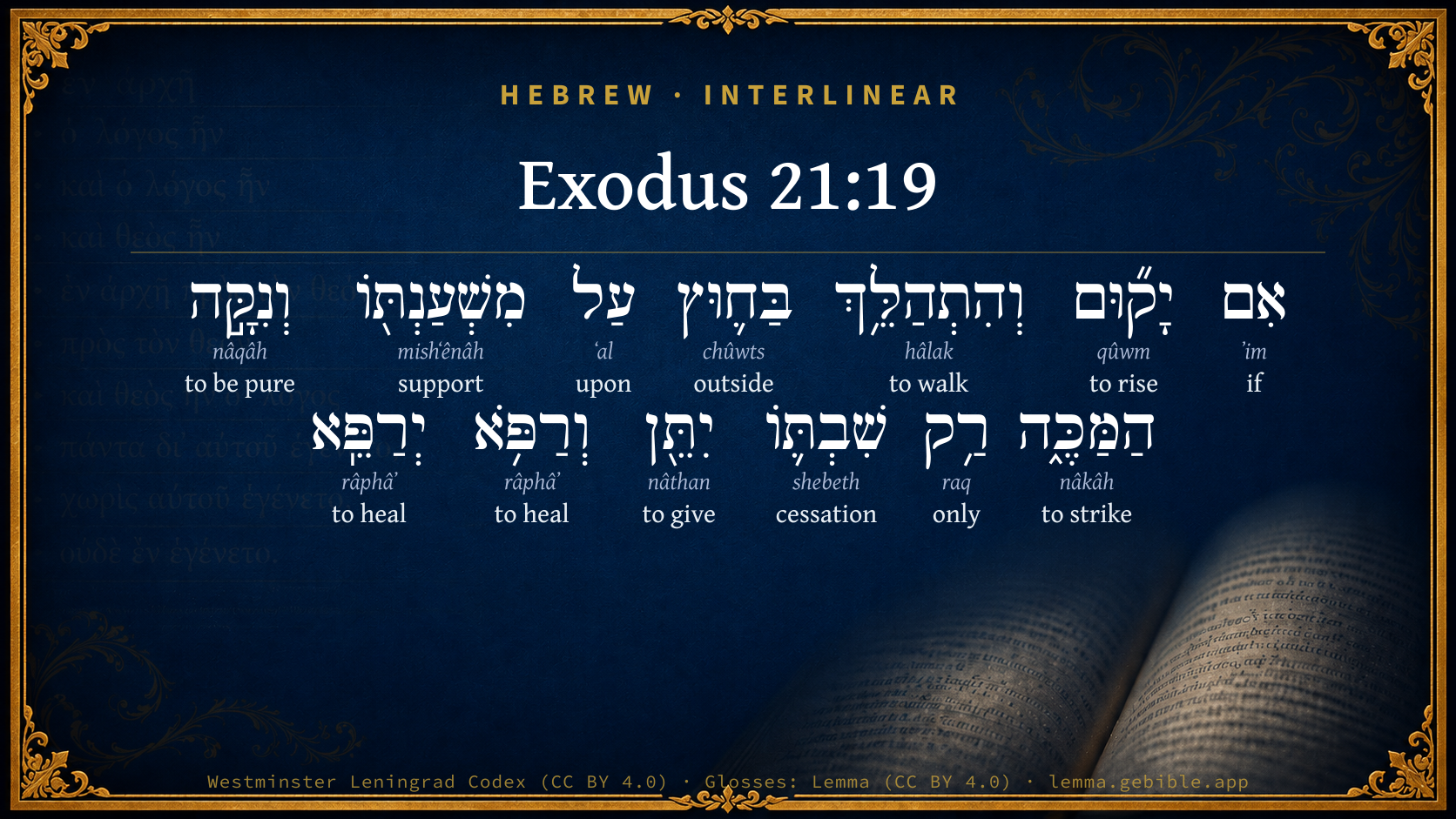
Hebrew (Westminster Leningrad Codex) Exodus 21:19 appears in the Hebrew Old Testament. The text above is from the Westminster Leningrad Codex. Each word links to its Strong’s number, a concise gloss, and parsing drawn from the Open Scriptures Hebrew Bible morphology. Click any word for its full Brown-Driver-Briggs (BDB) entry.
Download image
Cite this verse

Exodus 21:19 (World English Bible). Public Domain. Lemma interlinear Bible study tool, https://lemma.gebible.app/v/exodus/21/19.

Show BibTeX & RIS
BibTeX
RIS
English Translation
if he rises again and walks around with his staff, then he who struck him shall be cleared: only he shall pay for the loss of his time, and shall provide for his healing until he is thoroughly healed.
World English Bible · Public Domain
Highlights
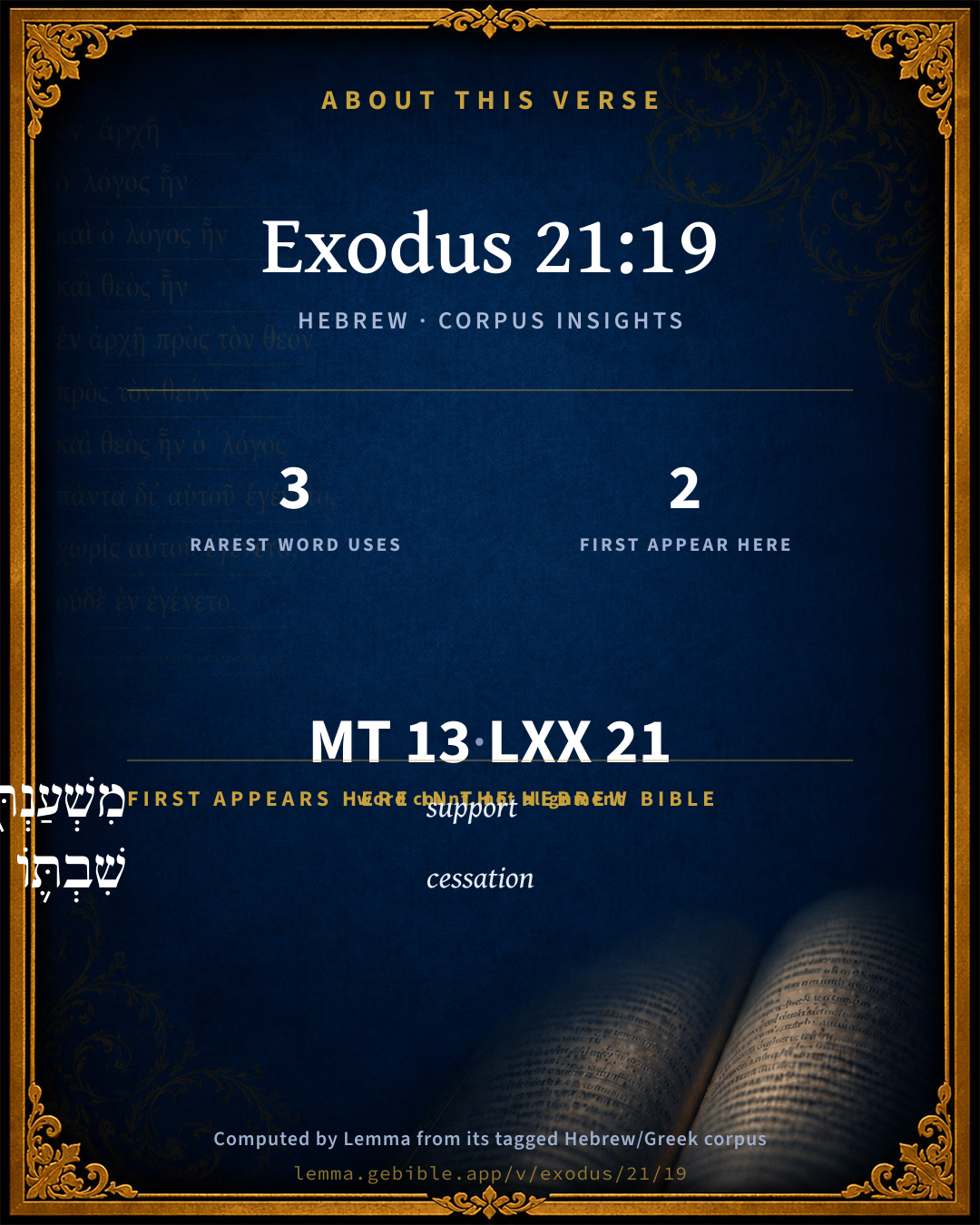
  • 2 first appearances in the Hebrew Bible
Full analysis ↓
Download a study sheet

One document with this verse’s original text, its word-by-word gloss line, the meaning frame, cross-references with their text, attributed commentary, and full source and license credits — printable, and it pastes into notes with its structure intact.

This verse Autodidact and up

Study sheet (.html) Plain text (.txt)

A passage Seminary Student

Up to 50 verses in one chapter. A passage sheet keeps up to 6 commentary sources and 12 cross-references per verse, in the order this page ranks them, and says so on the sheet whenever that leaves anything out. Ask for a single verse and you get the Autodidact verse sheet above.

Everything on this page stays free to read, with no account — the sheet is a download of what is already on screen, not access to it.

Want to remove ads? Support Godless Engineer
Compare translations 3

The same verse in 3 English versions, stacked beneath the original-language interlinear above. Click any original word for its lexicon entry.

Each is an independent rendering of the whole verse — the interlinear is not word-aligned to these translations.

Highlighted words mark where these versions differ — a whole-verse word diff, not a word-by-word alignment.

  • World English Bible Public Domain
    if he rises again and walks around with his staff, then he who struck him shall be cleared: only he shall pay for the loss of his time, and shall provide for his healing until he is thoroughly healed.
  • King James Version Public Domain
    If he rise again, and walk abroad upon his staff, then shall he that smote him be quit: only he shall pay for the loss of his time, and shall cause him to be thoroughly healed.
  • unfoldingWord Literal Text CC BY-SA 4.0
    if he rises and walks about in the outdoors on his staff, then the striker is free. He only shall pay for his sitting and for his complete healing.

unfoldingWord Literal Text — © unfoldingWord, licensed CC BY-SA 4.0. Word-aligned USFM3 via Door43 (git.door43.org/unfoldingWord/en_ult).

Versions to compare (up to 4)

3 of 4 selected

Show all 18 translations

Every available English version of this verse, each an independent rendering of the whole verse.

  • World English Bible Public Domain
    if he rises again and walks around with his staff, then he who struck him shall be cleared: only he shall pay for the loss of his time, and shall provide for his healing until he is thoroughly healed.
  • Berean Standard Bible Public Domain
    then the one who struck him shall go unpunished, as long as the other can get up and walk around outside with his staff. Nevertheless, he must compensate the man for his lost work and see that he is completely healed.
  • Majority Standard Bible Public Domain
    then the one who struck him shall go unpunished, as long as the other can get up and walk around outside with his staff. Nevertheless, he must compensate the man for his lost work and see that he is completely healed.
  • King James Version Public Domain
    If he rise again, and walk abroad upon his staff, then shall he that smote him be quit: only he shall pay for the loss of his time, and shall cause him to be thoroughly healed.
  • American Standard Version (1901) Public Domain
    if he rise again, and walk abroad upon his staff, then shall he that smote him be quit: only he shall pay for the loss of his time, and shall cause him to be thoroughly healed.
  • Revised Version (1885) Public Domain
    if he rise again, and walk abroad upon his staff, then shall he that smote him be quit: only he shall pay for the loss of his time, and shall cause him to be thoroughly healed.
  • Geneva Bible (1599) Public Domain
    If hee rise againe and walke without vpon his staffe, then shall he that smote him go quite, saue onely hee shall beare his charges for his resting, and shall pay for his healing.
  • Douay-Rheims (1899) Public Domain
    If he rise again and walk abroad upon his staff, he that struck him shall be quit, yet so that he make restitution for his work, and for his expenses upon the physicians.
  • Young's Literal Translation Public Domain
    if he rise, and hath gone up and down without on his staff, then hath the smiter been acquitted; only his cessation he giveth, and he is thoroughly healed.
  • Literal Standard Version CC BY-SA 4.0
    if he rises, and has gone up and down outside on his staff, then the striker has been acquitted; he only gives [for] his cessation, and he is thoroughly healed.
  • Unlocked Literal Bible CC BY-SA 4.0
    then if he recovers and is able to walk about using his staff, the man who struck him must pay for the loss of his time; he must also pay for his complete recovery. But that man is not guilty of murder.
  • unfoldingWord Literal Text CC BY-SA 4.0
    if he rises and walks about in the outdoors on his staff, then the striker is free. He only shall pay for his sitting and for his complete healing.
  • Darby Bible Public Domain
    -- if he rise, and walk abroad upon his staff, then shall he that struck [him] be guiltless; only he shall pay [for] the loss of his time, and shall cause [him] to be thoroughly healed.
  • World Messianic Bible Public Domain
    if he rises again and walks around with his staff, then he who struck him shall be cleared; only he shall pay for the loss of his time, and shall provide for his healing until he is thoroughly healed.
  • Webster's Bible Public Domain
    If he shall rise again, and walk abroad upon his staff, then shall he that smote him be quit: only he shall pay for the loss of his time, and shall cause him to be thoroughly healed.
  • Free Bible Version CC BY-SA 4.0
    and then gets up and walks around outside with his walking stick, then the one who hit him won't be punished. Even so, he must still compensate the man for the time lost from his work and make sure that he's completely healed.
  • Bible in Basic English Public Domain
    If he is able to get up again and go about with a stick, the other will be let off; only he will have to give him payment for the loss of his time, and see that he is cared for till he is well.
  • JPS Tanakh (1917) Public Domain
    if he rise again, and walk abroad upon his staff, then shall he that smote him be quit; only he shall pay for the loss of his time, and shall cause him to be thoroughly healed.

Literal Standard Version (2020), Covenant Press — licensed CC BY-SA 4.0. Text via the HelloAO Bible API (eBible.org). Unlocked Literal Bible (unfoldingWord) — licensed CC BY-SA 4.0. Text via the HelloAO Bible API (eBible.org). unfoldingWord Literal Text — © unfoldingWord, licensed CC BY-SA 4.0. Word-aligned USFM3 via Door43 (git.door43.org/unfoldingWord/en_ult). Free Bible Version, Dr. Jonathan Gallagher — licensed CC BY-SA 4.0. Text via the HelloAO Bible API (eBible.org).

Word by word

More ways to search: Search by grammar → Find every occurrence → Compare this word →

Practice this passage: Drill this verse → Learn its vocabulary →

שִׁבְתּ֛וֹ
shebeth
H7674
“cessation · his”
Noun, Common, Feminine, Singular, Construct + Suffix, Personal, 3rd Person, Masculine, Singular
Part of Speech
Noun
Type
Common
Gender
Feminine
Number
Singular
State
Construct
Full BDB Definition

Origin: from H7673

TWOT: 2323a

cessation, a sitting still - meaning dubious
  1. אִם ʼim H518 “if” Conjunction
  2. יָק֞וּם qûwm H6965 “to rise” Verb, Qal, Imperfect, 3rd Person, Masculine, Singular
  3. וְהִתְהַלֵּ֥ךְ hâlak H1980 “and · to walk” Conjunction + Verb, Hithpael, Sequential Perfect, 3rd Person, Masculine, Singular
  4. בַּח֛וּץ chûwts H2351 “in/at the · outside” Preposition, Determined + Noun, Common, Masculine, Singular, Absolute
  5. עַל ʻal H5921 “upon” Preposition
  6. מִשְׁעַנְתּ֖וֹ mishʻênâh H4938 “support · his” Noun, Common, Feminine, Singular, Construct + Suffix, Personal, 3rd Person, Masculine, Singular
  7. וְנִקָּ֣ה nâqâh H5352 “and · to be pure” Conjunction + Verb, Niphal, Sequential Perfect, 3rd Person, Masculine, Singular
  8. הַמַּכֶּ֑ה nâkâh H5221 “the · striking” Particle, Definite Article + Verb, Hiphil, Participle Active, Masculine, Singular, Absolute
  9. רַ֥ק raq H7535 “only” Particle, Accusative
  10. יִתֵּ֖ן nâthan H5414 “to give” Verb, Qal, Imperfect, 3rd Person, Masculine, Singular
  11. וְרַפֹּ֥א râphâʼ H7495 “and · to heal” Conjunction + Verb, Piel, Infinitive Absolute
  12. יְרַפֵּֽא râphâʼ H7495 “to heal” Verb, Piel, Imperfect, 3rd Person, Masculine, Singular

About this verse

These counts appear in no published source. They are computed here, from the morphology-tagged text and Lemma’s own curated glosses. What Lemma adds →

13
words
12
distinct lemmas
Pentateuch
section

Notable vocabulary

The rarest word here is שִׁבְתּ֛וֹ cessation H7674 — appearing just 3 times in the whole Hebrew Bible.

First appearance in Scripture

These words make their first canonical appearance in the Hebrew Bible here:

  • מִשְׁעַנְתּ֖וֹ support H4938
  • שִׁבְתּ֛וֹ cessation H7674

Shared distinctive vocabulary

שִׁבְתּ֛וֹ cessation H7674 occurs in 3 verses of the Hebrew Bible. Also found in:

Grammatical profile

  • 7 verbs
  • 3 nouns
  • 1 preposition
  • 1 conjunction
  • 1 particle

Verb forms

  • יָק֞וּם Qal · Imperfect
  • וְהִתְהַלֵּ֥ךְ Hithpael · Sequential Perfect
  • וְנִקָּ֣ה Niphal · Sequential Perfect
  • הַמַּכֶּ֑ה Hiphil · Participle Active
  • יִתֵּ֖ן Qal · Imperfect
  • וְרַפֹּ֥א Piel · Infinitive Absolute
  • יְרַפֵּֽא Piel · Imperfect

Repetition

A word recurs within this verse — often emphatic in Hebrew:

  • וְרַפֹּ֥א to heal H7495 ×2

Hebrew & Septuagint length

In English translation the verse runs 39 words from the Hebrew and 30 from the Septuagint (LXX English) — closely comparable.

A rough comparison of the two English renderings, which tokenize alike — not a word-level alignment.

Word counts can differ between the Hebrew and the Greek without any difference in meaning — e.g. the Hebrew direct-object marker אֵת has no separate Greek word, and Greek often adds the article ὁ.

In the original languages it is 13 Hebrew tokens and 21 Greek tokens — but the two are counted differently (Hebrew bundles its prefixes and suffixes into one token; the Greek is in lemma form), so that isn’t a like-for-like length.

Cross-references

2

Topical passages linked to Exodus 21:19 in the Treasury of Scripture Knowledge — connected by theme and wording, ordered by reader-vote popularity; previews shown in the World English Bible.

  • 2 Samuel 3:29 let it fall on the head of Joab, and on all his father's house; and let there not fail from the house of Joab one who has an issue, or who is a leper, or who leans on a staff, or who falls by the sword, or who lacks bread.
  • Zechariah 8:4 Thus says Yahweh of Hosts: "Old men and old women will again dwell in the streets of Jerusalem, every man with his staff in his hand for very age.

Cross-references courtesy of OpenBible.info (CC BY 4.0).

Hebrew and Greek witnesses Masoretic Hebrew ↔ Greek Septuagint

The same verse in the two great witnesses to the Old Testament, shown verse-for-verse.

These are two independent witnesses, not word-aligned to each other, and the Septuagint is shown in lemma (dictionary) form.

Hebrew Exodus 21:19 Masoretic · Westminster Leningrad Codex

אִם יָק֞וּם וְהִתְהַלֵּ֥ךְ בַּח֛וּץ עַל מִשְׁעַנְתּ֖וֹ וְנִקָּ֣ה הַמַּכֶּ֑ה רַ֥ק שִׁבְתּ֛וֹ יִתֵּ֖ן וְרַפֹּ֥א יְרַפֵּֽא

if he rises again and walks around with his staff, then he who struck him shall be cleared: only he shall pay for the loss of his time, and shall provide for his healing until he is thoroughly healed.

World English Bible · Public Domain

Greek LXX Exodus 21:19 Septuagint · lemma form

ἐάν ἐκ ἀναἵστημι ὁ ἄνθρωπος περιπατέω ἔξω ἐπί ῥάβδος ἀθῷος εἰμί ὁ πατάσσω πλήν ὁ ἀργία αὐτός ἀποτίνω καί ὁ ἰατρεῖον

if the man arise and walk abroad on his staff, he that struck him shall be clear; only he shall pay for his loss of time, and for his healing.

LXX2012 (modern English Septuagint) · Public Domain

Hebrew: Westminster Leningrad Codex (CC BY 4.0). Greek: Septuagint (public domain); English from LXX2012 (modern English Septuagint) (Public Domain). How the Septuagint differs from the Hebrew →

Targum (Aramaic paraphrase)

2

The Targum is the ancient Jewish Aramaic paraphrase of the Hebrew Scriptures — an interpretive translation, not the Hebrew text itself. Onkelos (literal) and Pseudo-Jonathan (expansive) render the Torah, and Jonathan the Prophets. Coverage is partial: where no permissively-licensed English translation exists for a verse, only the Aramaic is shown. This is verse-level text, not a word-by-word alignment to the Hebrew.

  1. Targum Onkelos Torah (Genesis–Deuteronomy)
    אִם יְקוּם וִיהַלִיךְ בְּבָרָא עַל בּוּרְיֵהּ וִיהֵי זַכָּאָה מָחַיָא לְחוֹד בּוּטְּלָנֵהּ יִתֵּן וַאֲגַר אַסְיָא יְשַׁלֵם:

    (no public-domain English translation for this verse)

    Targum Onkelos — Aramaic: “Onkelos Genesis” (public domain); “Onkelos Exodus” (public domain); “Onkelos Leviticus” (public domain); “Onkelos Numbers” (public domain); “Onkelos Deuteronomy” (public domain). English: “Sefaria Community Translation” (CC0 1.0 (public-domain dedication)); “J.W. Etheridge. The Targums of Onkelos and Jonathan Ben Uzziel on the Pentateuch. London: Longmans, Green, 1862” (public domain). Text via Sefaria.

  2. Targum Pseudo-Jonathan Torah (Genesis–Deuteronomy)
    אִין יְקוּם מִמַּרְעֵיהּ וּמְהֲלֵךְ בְּשׁוּקָא עַל מוֹרְנִיתֵיהּ וִיהֵי זַכְיַי מַחְיָיא מִדִּין קְטוֹל לְחוֹד בּוּטְלִין עִיבִידְתֵּיהּ וְצַעֲרֵיהּ וְנִזְקֵיהּ וּבַהֲתֵיהּ יִתֵּן וַאֲגַר אַסְיָא יְשַׁלֵּם עַד דְּמִתְּסֵי

    if he rise again from his illness, and walk in the street upon his staff, he who smote him shall be acquitted from the penalty of death; only for his cessation from labour, his affliction, his injury, his disgrace, and the hire of the physician, he shall make good until he be cured.

    Targum Pseudo-Jonathan — Aramaic: “Targum Jonathan on Genesis” (public domain); “Targum Jonathan on Exodus” (public domain); “Targum Jonathan on Leviticus” (public domain); “Targum Jonathan on Numbers” (public domain); “Targum Jonathan on Deuteronomy” (public domain). English: “The Targum of Jonathan ben Uzziel, trans. J. W. Etheridge, London, 1862” (public domain). Text via Sefaria.

Commentary

Notes on Exodus 21:19 from classic Christian and Jewish commentators (each source and its license shown beneath its notes). The classic Christian expositions comment on the surrounding passage and are grouped to its opening verse, so a note may address several verses; the Jewish commentaries on the Tanakh (Rashi and others) are per-verse, so they appear only where the commentator wrote on this verse.

Lemma curates 59 commentaries, every one of them public domain or Creative Commons licensed, each selected and text-cleaned for this edition rather than reprinted as found. About our sources →

Trapp's Complete Commentary

John Trapp

Exo 21:19 If he rise again, and walk abroad upon his staff, then shall he that smote [him] be quit: only he shall pay [for] the loss of his time, and shall cause [him] to be thoroughly healed.

Ver. 19. Upon his staff.] See 2Sa 3:29 Zec 8:4.

John Trapp, A Commentary or Exposition upon All the Books of the Old and New Testament (1647–1656) — public domain. Text from a community e-Sword module.

Geneva Bible (1599)

Geneva Bible translators

By the civil Justice.

Or, losing of his time.

Geneva Bible (1599) marginal notes — public domain. Text via Bolls.life.

Adam Clarke's Commentary

Verse 19. Shall pay for the loss of his time, and shall cause him to be thoroughly healed.] This was a wise and excellent institution, and most courts of justice still regulate their decisions on such cases by this Mosaic precept.

Adam Clarke's Commentary on the Bible (1810–1826) — public domain. Text from a community e-Sword/MySword module.

Ellicott's Commentary for English Readers

(19) If he rise again, and walk abroad upon his staff.—The charge of murder was not to be kept hanging over a man indefinitely. If the injured person recovered sufficiently to leave his bed, and get about by the help of a stick, the injurer was to pay his fine and be quit of his offence, whatever might happen afterwards.

A Bible Commentary for English Readers, edited by Charles John Ellicott (1878–1897) — public domain. Text from a community e-Sword module.

The Cambridge Bible for Schools and Colleges

gen. ed. J. J. S. Perowne

19. walk abroad upon his staff] a proof of convalescence. The ‘staff’ (lit. something to lean upon) was used for help in walking (2Ki_4:29,—by Elisha): in Zec_8:4 a characteristic of old age.

be quit (lit. innocent)] If he died in his bed, the person who injured him might reasonably be held responsible for his death: if he died after the had taken his first walk, he might himself have met with some farther accident, or imprudently ventured out too soon.

only, &c.] Though he is no longer in danger of suffering the capital penalty, he must still compensate his victim for his loss of time, and pay his doctor’s bill. Cf. Ḥamm. 206; and Manu, viii. 287 (Cook, p. 254).

the loss of his time] a necessary paraphrase of the Heb. shibtô, which may be derived from either yâshab, to ‘sit down,’ or shâbath, to ‘desist,’ ‘cease’ (viz. from toil): hence the two margins.

The Cambridge Bible for Schools and Colleges (gen. ed. J. J. S. Perowne; Cambridge University Press, 1878–1918) — public domain. Text from a community e-Sword module.

John Gill's Exposition

If he rise again,.... From his bed, or from his disease, as the last mentioned Targum, recovers again, at least so far as to be able to do what follows:

and walk abroad upon his staff; if he is able to get out of his bed, and especially out of his house, and can be seen walking about in the street or in the field, though he is obliged to make use of a staff, and lean upon it, being yet weak and sickly:

then shall he that smote him be quit; from the judgment of slaying, as the Targum, he shall not be charged with manslaughter, or be found guilty of a capital crime, but discharged from that:

only shall he pay for the loss of his time; as much as he could have got in that time by his labour, from which he was obliged to cease: the Jewish writers add other things also he was to pay for, as the Targum of Jonathan, particularly; as for his pain, and for his loss of any member, and for his shame and disgrace, as well as the physician's fee, which is supposed to be included in the next clause:

and cause him to be thoroughly healed; take care that he has a physician or surgeon, and that the proper medicines be applied, and those continued until he is quite well; all which must be at the expense of the smiter.

John Gill's Exposition of the Whole Bible (1746–1763) — public domain (CC PDM 1.0). Text via the HelloAO Bible API.

Albert Barnes' Notes on the Bible

Quit - i. e. if one man injured another in a quarrel so as to oblige him to keep his bed, he was free from the liability to a criminal charge (such as might be based upon Exo 21:12): but he was required to compensate the latter for the loss of his time, and for the cost of his healing.

Albert Barnes' Notes on the Bible (1834–1885) — public domain. Text from a community e-Sword/MySword module.

Haydock's Catholic Bible Commentary

Staff, as people in health do, or even as a convalescent. In the mean time the other person was confined, and subjected to the law of retaliation, if the sick man lost either limb or life, ver. 24. (Calmet)

George Leo Haydock (1774–1849), Haydock's Catholic Family Bible and Commentary, 1859 edition — public domain. Excludes Psalms (Douay-Rheims chapter numbering differs from Protestant) and Deuterocanonical books (Catholic canon only).

Matthew Poole's English Annotations

The loss of his time, i.e. of the profit which he could or commonly did make of his time in the way of his calling.

Cause him to be thoroughly healed, i.e. pay the charges of the cure.

Matthew Poole's English Annotations on the Holy Bible (1683–1685) — public domain. Text from a community e-Sword/MySword module.

The Pulpit Commentary

If he rise again and walk upon his staff. If he recovered sufficiently to leave his bed, and get about with a stick to lean on, his hurt was not to be brought up against the injurer, though he died soon afterwards. Compensation was to be received, and the score regarded as wiped off.

The Pulpit Commentary (1880–1919), ed. H.D.M. Spence-Jones & Joseph S. Exell — public domain. Text from a community e-Sword module.

Rashi

Rabbi Shlomo Yitzchaki (Rashi)

על משענתו (lit., with that on which he relies) — i. e. his former healthy state and vigour (Mekhilta; cf. Onkelos).

ונקה המכה [WHEN HE RISES AGAIN…] HE THAT SMOTE HIM SHALL BE FREED — But could it enter your mind that this person who has not killed anyone at all should be subject to the death penalty? Why, then, is it necessary to state this? But it is intended to teach you that he is kept in prison until we discover whether the other is completely healed or not, and what the verse implies is this: when this man rises again (אם יקום) and walks in the street in his former vigour, then he who smote him shall be freed from prison, but so long as the other has not risen from the sick-bed etc. the man who smote him is not freed (Ketubot 33b; Sanhedrin 78b).

רק שבתו ONLY [HE SHALL PAY FOR] THE LOSS OF HIS TIME — i. e. for the interruption of his labour due to this illness. If, for instance, he cut off his hand or his foot, we regard the interruption of labour caused by this illness as though his occupation were that of a watchman in a cucumber field (which work can be done even by a man lacking a hand or a foot), for even after he has recovered from the illness he will not be able to do work which requires hands or feet, and indeed the value of his hand or his foot that was cut off the other has already paid to him as “damages” (נזק), as it is said, (v. 24) “hand for hand, foot for foot”. (Having compensated him already for loss of capacity as a wage-earner whole in body, it would not be right if this man has again to pay him for loss of time as though he were of full-earning capacity) (Bava Kamma 85b).

ורפא ירפא — Translate it as the Targum does: he shall pay the physician’s fee.

Rashi on the Tanakh — English translations: “The Judaica Press complete Tanach with Rashi, translated by A. J. Rosenberg” (CC BY 4.0); “Pentateuch with Rashi's commentary by M. Rosenbaum and A.M. Silbermann, 1929-1934” (public domain); “The Metsudah Tanach series, Lakewood, N.J” (CC BY 4.0); and “The Book of Joshua, Metsudah Publications, 1997” (CC BY 4.0). Text via Sefaria.

Ramban (Nachmanides)

Rabbi Moshe ben Nachman (Ramban / Nachmanides)

IF HE RISE AGAIN, AND WALKS ABROAD ‘AL MISH’ANTO’ — “in his former healthy state and vigor.” This is Rashi’s language. And Rabbi ibn Ezra said that the reason why this word [which means literally: “support”] is used, is to tell us that he must not be dependant upon others for the ability to walk, like an invalid, but must walk by himself; is “his physical strength;” according to Ibn Ezra, it is “his leaning” or “support.” Ramban will proceed to explain it in its literal sense — “on his staff.” Almost all translations follow Ramban’s interpretation. only then shall he that smote him be quit from prison.In my opinion, mish’anto is to be understood in its literal sense, [a staff], just as in the verses: every man with ‘mish’anto’ (his staff) in his hand for old age; ‘mish’eneth’ (the staff) of this bruised reed. Scripture is thus stating that if the injured person’s health improves sufficiently to enable him to go out walking as he wishes in the streets and in the broad ways with his staff, like those healed from some prolonged disabling injury, then shall he that smote him be quit; and it further teaches us that even if the injured man is careless later about his health and dies after that in his weakness, the assailant is free from the death penalty. Scripture says and he walketh abroad because it speaks of the customary way of life, for injured men who were laid up in bed do not go out walking again until their wounds have healed and they are out of danger, this being the sense of the phrase, and he walketh abroad, because if he just gets up and walks in his house on his staff, and then dies, the assailant is not free [from the death penalty].In the words of the Mechilta: “If he rise again and walketh. I might think this means within the house; Scripture therefore says, abroad. But from the word abroad I might think that even if he was wasting away [the assailant is still free from punishment]; Scripture therefore says, if he rise again.” This explanation too is very correct, that Scripture should be saying that if the injured man gets up completely from his bed and goes steadily outside — without having to go back to his bed when returning from outside, as is the way of those who continue to waste away — even though he is weak and has to lean upon a staff, the assailant shall be let off. In general all this is to be interpreted as being figurative, language expressing people’s practical conduct, and the basic rule is that he must have been assessed as being capable of recovery. This is why Onkelos translated al mish’anto: al boryeih (in his healthy state).

Scripture states, only he shall pay for the loss of his time, and shall cause him to be thoroughly healed, but it does not say, “he shall pay for the loss of his time and his medical care.” in order to tell us that he must pay the money for the doctors to heal him, and the injured person cannot demand that he should give him the compensation and he will do other things with it. Instead, the assailant must heal him under all circumstances.

Ramban (Nachmanides) on the Tanakh — English translation: “Commentary on the Torah by Ramban (Nachmanides). Translated and annotated by Charles B. Chavel. New York, Shilo Pub. House, 1971-1976” (CC BY 4.0). Text via Sefaria.

Lesson kit

Teaching starters — assembled from the data on this page, not authored interpretation. Every prompt links to the verse data it draws on. Edit before teaching.

Exodus, in the Pentateuch, opens this verse with 13 words (12 distinct Hebrew lemmas). Its most distinctive word is shebeth (“cessation”). A historical commentator’s framing appears above. Read the whole chapter for the surrounding context.

Discussion questions

  1. The word shebeth carries the sense “cessation.” How does it shape the verse?
  2. 2 words make their first appearance in Scripture here. What does this debut establish?
  3. How does Proverbs 20:3, which shares the word «cessation», read alongside this verse?
  4. What does the repetition of “to heal” (2× in this one verse) do in this verse?
  5. These translations render this verse differently; the difference is in the English rendering, not the original. What questions does that raise?
  6. «יָק֞וּם» is a Qal Imperfect verb. How does that grammatical form shape the action described?
  7. Compare how Trapp's Complete Commentary and Geneva Bible (1599) read this verse. Where do they agree or differ?

Things to notice

Reading settings

Reading text

Shown beneath each verse's original-language words.

Old Testament
Old Testament edition

Read the OT as the Masoretic Hebrew (MT) or the Greek Septuagint (LXX).

English shown for the Greek Septuagint (in the Hebrew ↔ Greek comparison).

Comparing translations? Open the Compare panel on any verse page to stack up to four side by side.