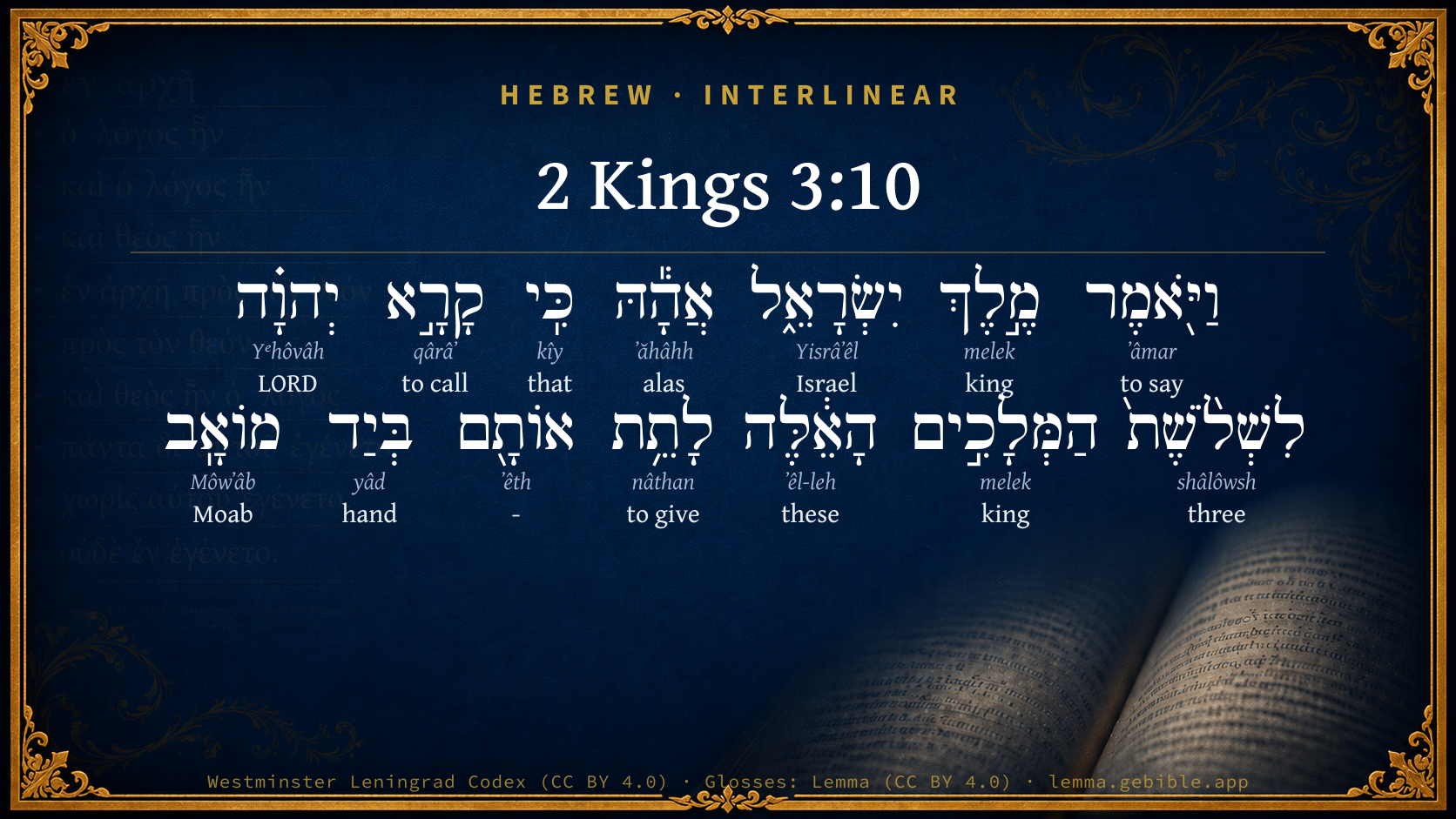
2 Kings 3:10

Hebrew (Westminster Leningrad Codex) 2 Kings 3:10 appears in the Hebrew Old Testament. The text above is from the Westminster Leningrad Codex. Each word links to its Strong’s number, a concise gloss, and parsing drawn from the Open Scriptures Hebrew Bible morphology. Click any word for its full Brown-Driver-Briggs (BDB) entry.
Download image
Cite this verse

2 Kings 3:10 (World English Bible). Public Domain. Lemma interlinear Bible study tool, https://lemma.gebible.app/v/2-kings/3/10.

Show BibTeX & RIS
BibTeX
RIS
English Translation
The king of Israel said, Alas! for Yahweh has called these three kings together to deliver them into the hand of Moab.
World English Bible · Public Domain
Download a study sheet

One document with this verse’s original text, its word-by-word gloss line, the meaning frame, cross-references with their text, attributed commentary, and full source and license credits — printable, and it pastes into notes with its structure intact.

This verse Autodidact and up

Study sheet (.html) Plain text (.txt)

A passage Seminary Student

Up to 50 verses in one chapter. A passage sheet keeps up to 6 commentary sources and 12 cross-references per verse, in the order this page ranks them, and says so on the sheet whenever that leaves anything out. Ask for a single verse and you get the Autodidact verse sheet above.

Everything on this page stays free to read, with no account — the sheet is a download of what is already on screen, not access to it.

Want to remove ads? Support Godless Engineer
Compare translations 3

The same verse in 3 English versions, stacked beneath the original-language interlinear above. Click any original word for its lexicon entry.

Each is an independent rendering of the whole verse — the interlinear is not word-aligned to these translations.

Highlighted words mark where these versions differ — a whole-verse word diff, not a word-by-word alignment.

  • World English Bible Public Domain
    The king of Israel said, Alas! for Yahweh has called these three kings together to deliver them into the hand of Moab.
  • King James Version Public Domain
    And the king of Israel said, Alas! that the LORD hath called these three kings together, to deliver them into the hand of Moab!
  • unfoldingWord Literal Text CC BY-SA 4.0
    And, the king of Israel, said, “Alas! For Yahweh has called these three kings to give them into the hand of Moab.”

unfoldingWord Literal Text — © unfoldingWord, licensed CC BY-SA 4.0. Word-aligned USFM3 via Door43 (git.door43.org/unfoldingWord/en_ult).

Versions to compare (up to 4)

3 of 4 selected

Show all 18 translations

Every available English version of this verse, each an independent rendering of the whole verse.

  • World English Bible Public Domain
    The king of Israel said, Alas! for Yahweh has called these three kings together to deliver them into the hand of Moab.
  • Berean Standard Bible Public Domain
    “Alas,” said the king of Israel, “for the LORD has summoned these three kings to deliver them into the hand of Moab!”
  • Majority Standard Bible Public Domain
    “Alas,” said the king of Israel, “for the LORD has summoned these three kings to deliver them into the hand of Moab!”
  • King James Version Public Domain
    And the king of Israel said, Alas! that the LORD hath called these three kings together, to deliver them into the hand of Moab!
  • American Standard Version (1901) Public Domain
    And the king of Israel said, Alas! for Jehovah hath called these three kings together to deliver them into the hand of Moab.
  • Revised Version (1885) Public Domain
    And the king of Israel said, Alas! for the LORD hath called these three kings together to deliver them into the hand of Moab.
  • Geneva Bible (1599) Public Domain
    Therefore the King of Israel sayde, Alas, that the Lord hath called these three Kings, to giue them into the hand of Moab.
  • Douay-Rheims (1899) Public Domain
    And the king of Israel said: Alas, alas, alas, the Lord hath gathered us three kings together, to deliver us into the hands of Moab!
  • Young's Literal Translation Public Domain
    and the king of Israel saith, `Alas, for Jehovah hath called for these three kings, to give them into the hand of Moab.'
  • Literal Standard Version CC BY-SA 4.0
    and the king of Israel says, “Aah! For YHWH has called for these three kings to give them into the hand of Moab.”
  • Unlocked Literal Bible CC BY-SA 4.0
    So the king of Israel said, “What is this? Has Yahweh called three kings to give them into the hand of Moab?”
  • unfoldingWord Literal Text CC BY-SA 4.0
    And, the king of Israel, said, “Alas! For Yahweh has called these three kings to give them into the hand of Moab.”
  • Darby Bible Public Domain
    And the king of Israel said, Alas! that Jehovah has called these three kings together, to give them into the hand of Moab!
  • World Messianic Bible Public Domain
    The king of Israel said, “Alas! For the LORD has called these three kings together to deliver them into the hand of Moab.”
  • Webster's Bible Public Domain
    And the king of Israel said, Alas! that the LORD hath called these three kings together, to deliver them into the hand of Moab!
  • Free Bible Version CC BY-SA 4.0
    “What are we doing?” complained the king of Israel. “The Lord has brought us three kings here to hand us over to the Moabites!”
  • Bible in Basic English Public Domain
    And the king of Israel said, Here is trouble: for the Lord has got these three kings together to give them into the hands of Moab.
  • JPS Tanakh (1917) Public Domain
    And the king of Israel said: 'Alas! for the LORD hath called these three kings together to deliver them into the hand of Moab.'

Literal Standard Version (2020), Covenant Press — licensed CC BY-SA 4.0. Text via the HelloAO Bible API (eBible.org). Unlocked Literal Bible (unfoldingWord) — licensed CC BY-SA 4.0. Text via the HelloAO Bible API (eBible.org). unfoldingWord Literal Text — © unfoldingWord, licensed CC BY-SA 4.0. Word-aligned USFM3 via Door43 (git.door43.org/unfoldingWord/en_ult). Free Bible Version, Dr. Jonathan Gallagher — licensed CC BY-SA 4.0. Text via the HelloAO Bible API (eBible.org).

Word by word

More ways to search: Search by grammar → Find every occurrence → Compare this word →

Practice this passage: Drill this verse → Learn its vocabulary →

אֲהָ֕הּ
ʼăhâhh
H162
“alas”
Particle, Interjection
Part of Speech
Particle
Type
Interjection
Full BDB Definition

Origin: apparently a primitive word expressing pain exclamatorily, Oh!

TWOT: 30

alas!, oh!, ah!
  1. וַיֹּ֖אמֶר ʼâmar H559 “and · to say” Conjunction + Verb, Qal, Sequential Imperfect, 3rd Person, Masculine, Singular
  2. מֶ֣לֶךְ melek H4428 “king of” Noun, Common, Masculine, Singular, Construct
  3. יִשְׂרָאֵ֑ל Yisrâʼêl H3478 “Israel” Noun, Proper
  4. כִּֽי kîy H3588 “that” Conjunction
  5. קָרָ֣א qârâʼ H7121 “to call” Verb, Qal, Perfect, 3rd Person, Masculine, Singular
  6. יְהוָ֗ה Yᵉhôvâh H3068 “LORD” Noun, Proper
  7. לִשְׁלֹ֨שֶׁת֙ shâlôwsh H7969 “to/for · three” Preposition + Adjective, Cardinal number, Masculine, Singular, Construct
  8. הַמְּלָכִ֣ים melek H4428 “the · kings” Particle, Definite Article + Noun, Common, Masculine, Plural, Absolute
  9. הָאֵ֔לֶּה ʼêl-leh H428 “the · these” Particle, Definite Article + Pronoun, Demonstrative, Common, Plural
  10. לָתֵ֥ת nâthan H5414 “to give” Preposition + Verb, Qal, Infinitive Construct
  11. אוֹתָ֖ם ʼêth H853 “- · them” Particle, Direct Object + Suffix, Personal, 3rd Person, Masculine, Plural
  12. בְּיַד yâd H3027 “in/at · hand of” Preposition + Noun, Common, Both, Singular, Construct
  13. מוֹאָֽב Môwʼâb H4124 “Moab” Noun, Proper

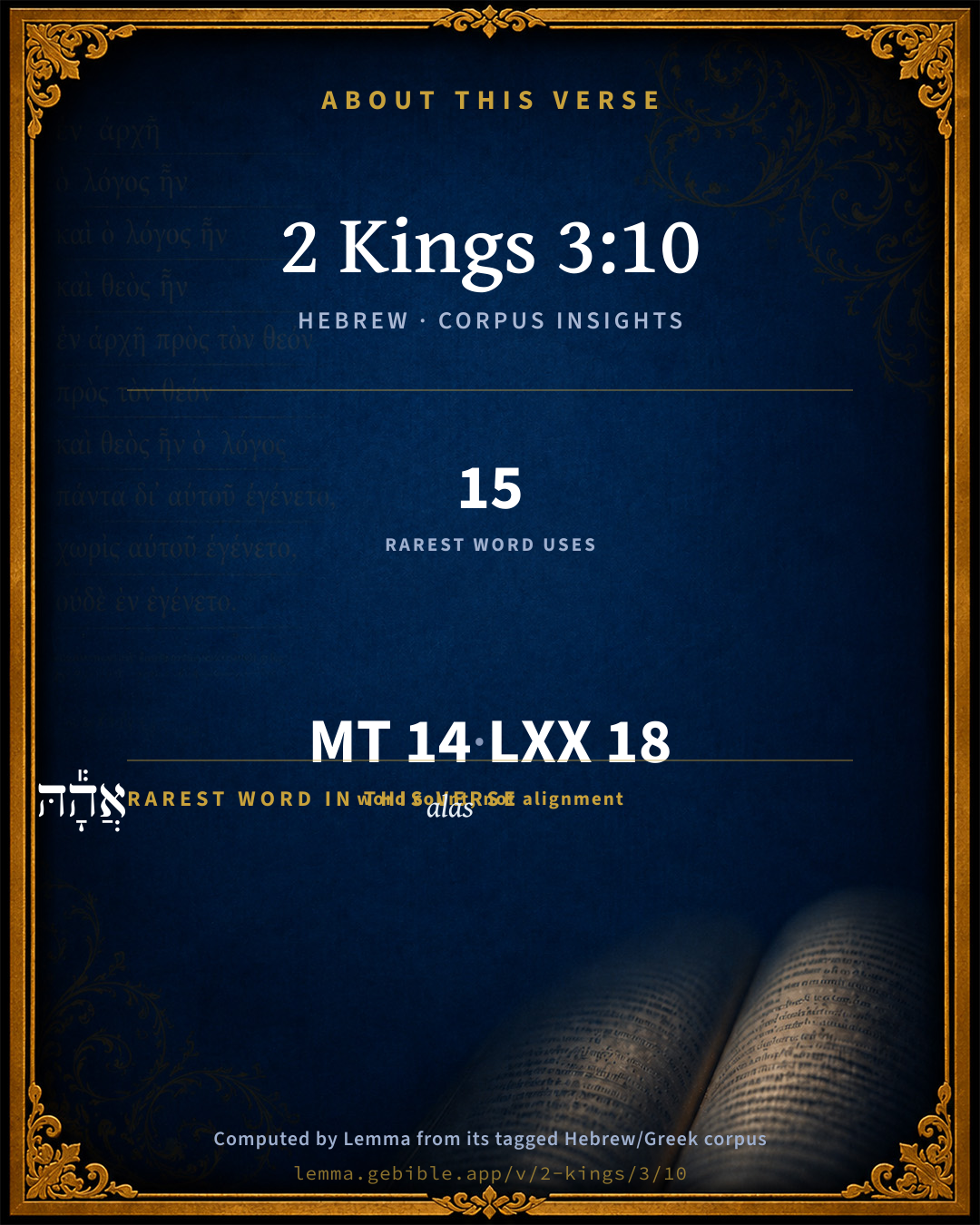
About this verse

These counts appear in no published source. They are computed here, from the morphology-tagged text and Lemma’s own curated glosses. What Lemma adds →

14
words
13
distinct lemmas
Historical
section

Notable vocabulary

The rarest word here is אֲהָ֕הּ alas H162 — appearing just 15 times in the whole Hebrew Bible.

Shared distinctive vocabulary

אֲהָ֕הּ alas H162 occurs in 15 verses of the Hebrew Bible. Also found in:

Grammatical profile

  • 3 verbs
  • 6 nouns
  • 1 adjective
  • 1 pronoun
  • 1 conjunction
  • 2 particles

Verb forms

  • וַיֹּ֖אמֶר Qal · Sequential Imperfect
  • קָרָ֣א Qal · Perfect
  • לָתֵ֥ת Qal · Infinitive Construct

Repetition

A word recurs within this verse — often emphatic in Hebrew:

  • מֶ֣לֶךְ king H4428 ×2

Hebrew & Septuagint length

In English translation the verse runs 22 words from the Hebrew and 27 from the Septuagint (LXX English) — closely comparable.

A rough comparison of the two English renderings, which tokenize alike — not a word-level alignment.

Word counts can differ between the Hebrew and the Greek without any difference in meaning — e.g. the Hebrew direct-object marker אֵת has no separate Greek word, and Greek often adds the article ὁ.

In the original languages it is 14 Hebrew tokens and 18 Greek tokens — but the two are counted differently (Hebrew bundles its prefixes and suffixes into one token; the Greek is in lemma form), so that isn’t a like-for-like length.

Cross-references

6

Topical passages linked to 2 Kings 3:10 in the Treasury of Scripture Knowledge — connected by theme and wording, ordered by reader-vote popularity; previews shown in the World English Bible.

  • Genesis 4:13 Cain said to Yahweh, "My punishment is greater than I can bear.
  • 2 Kings 6:33 While he was yet talking with them, behold, the messenger came down to him: and he said, Behold, this evil is of Yahweh; why should I wait for Yahweh any longer?
  • Psalms 78:34–36 When he killed them, then they inquired after him. They returned and sought God earnestly.
  • Proverbs 19:3 The foolishness of man subverts his way; His heart rages against Yahweh.
  • Isaiah 8:21 They shall pass through it, sore distressed and hungry; and it shall happen that when they shall be hungry, they shall fret themselves, and curse by their king and by their God, and turn their faces upward:
  • Isaiah 51:20 Your sons have fainted, they lie at the head of all the streets, as an antelope in a net; they are full of the wrath of Yahweh, the rebuke of your God.

Cross-references courtesy of OpenBible.info (CC BY 4.0).

Hebrew and Greek witnesses Masoretic Hebrew ↔ Greek Septuagint

The same verse in the two great witnesses to the Old Testament, shown verse-for-verse.

These are two independent witnesses, not word-aligned to each other, and the Septuagint is shown in lemma (dictionary) form.

Hebrew 2 Kings 3:10 Masoretic · Westminster Leningrad Codex

וַיֹּ֖אמֶר מֶ֣לֶךְ יִשְׂרָאֵ֑ל אֲהָ֕הּ כִּֽי קָרָ֣א יְהוָ֗ה לִשְׁלֹ֨שֶׁת֙ הַמְּלָכִ֣ים הָאֵ֔לֶּה לָתֵ֥ת אוֹתָ֖ם בְּיַד מוֹאָֽב

The king of Israel said, Alas! for Yahweh has called these three kings together to deliver them into the hand of Moab.

World English Bible · Public Domain

Greek LXX 2 Kings 3:10 Septuagint · lemma form

καί εἶπον ὁ βασιλεύς ἰσραήλ ὦ ὅτι καλέω κύριος ὁ τρεῖς βασιλεύς παραἔρχομαι δίδωμι αὐτός ἐν χείρ μωαβ

And the king of Israel said, Alas! that the Lord should have called the three kings on their way, to give them into the hand of Moab.

LXX2012 (modern English Septuagint) · Public Domain

Hebrew: Westminster Leningrad Codex (CC BY 4.0). Greek: Septuagint (public domain); English from LXX2012 (modern English Septuagint) (Public Domain). How the Septuagint differs from the Hebrew →

Targum (Aramaic paraphrase)

1

The Targum is the ancient Jewish Aramaic paraphrase of the Hebrew Scriptures — an interpretive translation, not the Hebrew text itself. Onkelos (literal) and Pseudo-Jonathan (expansive) render the Torah, and Jonathan the Prophets. Coverage is partial: where no permissively-licensed English translation exists for a verse, only the Aramaic is shown. This is verse-level text, not a word-by-word alignment to the Hebrew.

  1. Targum Jonathan Prophets (Joshua–Malachi)
    וַאֲמַר מַלְכָּא דְיִשְׂרָאֵל וַי אֲרֵי זַמִין יְיָ לִתְלָתָא מַלְכַיָא הָאִלֵין לְמִמְסַר יַתְהוֹן בִּידָא דְמוֹאָב:

    (no public-domain English translation for this verse)

    Targum Jonathan — Aramaic: “Mikraot Gedolot” (public domain). English: “Sefaria Community Translation” (CC0 1.0 (public-domain dedication)); “London "Chaldee Paraphrase," 1871” (public domain). Text via Sefaria.

Commentary

Notes on 2 Kings 3:10 from classic Christian and Jewish commentators (each source and its license shown beneath its notes). The classic Christian expositions comment on the surrounding passage and are grouped to its opening verse, so a note may address several verses; the Jewish commentaries on the Tanakh (Rashi and others) are per-verse, so they appear only where the commentator wrote on this verse.

Lemma curates 59 commentaries, every one of them public domain or Creative Commons licensed, each selected and text-cleaned for this edition rather than reprinted as found. About our sources →

Trapp's Complete Commentary

John Trapp

2Ki 3:10 And the king of Israel said, Alas! that the LORD hath called these three kings together, to deliver them into the hand of Moab!

Ver. 10. Alas! that the Lord hath called.] Vox est admirantis et desperantis, saith Vatablus. He seeketh to lay the blame upon the Lord: though it were himself especially that brought the army into that distress. "The wickedness of a man perverteth his way, and his heart fretteth against the Lord." {Pro 19:3}

John Trapp, A Commentary or Exposition upon All the Books of the Old and New Testament (1647–1656) — public domain. Text from a community e-Sword module.

Joseph Benson's Commentary

2Ki 3:10-11. The king of Israel said, Alas, &c. — He did not cry to God for help, but only bewailed the straits into which they were fallen; which his own guilt made him imagine God had brought to pass for their destruction. Jehoshaphat said, Is there not here a prophet — This he should have asked before, when they first undertook the expedition, as he did in a like case, (1Ki 22:5,) and for that neglect he now suffers; but better late than never: his affliction brings him to the remembrance of his former sin, and present duty. Here is Elisha, who poured water, &c. — Who was his servant: this being one office of a servant: and this office was the more necessary among the Israelites, because of the frequent washings which their law required. Probably it was by a special direction from God that Elisha followed them, unasked, unobserved. Thus does God prevent us with the blessings of his goodness, and provide for those who provide not for themselves.

Joseph Benson's Commentary on the Old and New Testaments (1811–1818) — public domain. Text from a community e-Sword module.

Adam Clarke's Commentary

Verse 10. The Lord hath called these three kings together] That is, This is a Divine judgment; God has judicially blinded us, and permitted us to take this journey to our destruction.

Adam Clarke's Commentary on the Bible (1810–1826) — public domain. Text from a community e-Sword/MySword module.

Ellicott's Commentary for English Readers

(10) That.—Omit (kî, emphatically introducing the assertion).

Together.—Omit.

A Bible Commentary for English Readers, edited by Charles John Ellicott (1878–1897) — public domain. Text from a community e-Sword module.

The Cambridge Bible for Schools and Colleges

gen. ed. J. J. S. Perowne

10. Alas, that [R.V. for] the Lord hath called] Thus R.V. conforms to the rendering of A.V. in verse 13. The lamentation is caused by what Jehoram thinks will be their fate. And the conjunction, which can be rendered ‘for’ or ‘that’ seems to be here used to express the ground for the lament. Josephus makes Jehoram cry unto God, asking of what evil they had been guilty that He had brought them thither to give them up without a battle into the hand of Moab.

The Cambridge Bible for Schools and Colleges (gen. ed. J. J. S. Perowne; Cambridge University Press, 1878–1918) — public domain. Text from a community e-Sword module.

John Gill's Exposition

And Jehoshaphat said, the word of the Lord is with him,.... To give them an answer, which he concluded from his being a servant and disciple of Elijah, whom he succeeded in his office, and of whom he had, doubtless, heard; and from his following the camp, and being in it, which he easily imagined was not to fight, but to assist by his advice and counsel, and by his prophecies, as there might be occasion for them:

so the king of Israel and Jehoshaphat and the king of Edom went down to him; descended from their chariots, and went to the tent in the camp where he was; they did not send for him to come to them, but, in honour of him, went to him themselves.

John Gill's Exposition of the Whole Bible (1746–1763) — public domain (CC PDM 1.0). Text via the HelloAO Bible API.

Matthew Poole's English Annotations

So he chargeth his calamity upon God; and not upon himself, whose sins were the true and proper causes of it.

Matthew Poole's English Annotations on the Holy Bible (1683–1685) — public domain. Text from a community e-Sword/MySword module.

The Pulpit Commentary

And the King of Israel said, Alas! that the Lord hath called these three kings together, to deliver them into the hand of Moab! Jehoram first assumes, without warrant, that the expedition is one which Jehovah has sanctioned, and then complains that it is about to fail utterly. As he had made no attempt to learn God"s will on the subject at the mouth of any prophet, he had no ground for surprise or complaint, even had the peril been as great as he supposed. God had not "called the three kings together;" they had come together of their own accord, guided by their own views of earthly policy. Yet God was not about to "deliver them into the hands of Moab," as in strict justice he might have done. He was about to deliver the three kings from their peril.

An evil conscience.

the King of Israel said, Alas! that the Lord hath called these three kings," etc.!

1. Trouble awakens the evil conscience.

2. The evil conscience takes the darkest view of the actions of God.

3. The evil conscience is glad to shelter itself by associating with others. (See excellent remarks in Krummacher.) J.O.

The Pulpit Commentary (1880–1919), ed. H.D.M. Spence-Jones & Joseph S. Exell — public domain. Text from a community e-Sword module.

Rashi

Rabbi Shlomo Yitzchaki (Rashi)

To hand them over, etc. For they will die of thirst.

Rashi on the Tanakh — English translations: “The Judaica Press complete Tanach with Rashi, translated by A. J. Rosenberg” (CC BY 4.0); “Pentateuch with Rashi's commentary by M. Rosenbaum and A.M. Silbermann, 1929-1934” (public domain); “The Metsudah Tanach series, Lakewood, N.J” (CC BY 4.0); and “The Book of Joshua, Metsudah Publications, 1997” (CC BY 4.0). Text via Sefaria.

Lesson kit

Teaching starters — assembled from the data on this page, not authored interpretation. Every prompt links to the verse data it draws on. Edit before teaching.

2 Kings, in the Historical, opens this verse with 14 words (13 distinct Hebrew lemmas). Its most distinctive word is ʼăhâhh (“alas”). A historical commentator’s framing appears above. Read the whole chapter for the surrounding context.

Discussion questions

  1. What does “alas” (ʼăhâhh) contribute to the verse as a whole?
  2. Joshua 7:7 shares the word «alas» with this verse. How do the two illuminate each other?
  3. “king” occurs 2× in this one verse. What is the effect of the repetition?
  4. These translations render this verse differently; the difference is in the English rendering, not the original. What questions does that raise?
  5. The verb «וַיֹּ֖אמֶר» is Qal Sequential Imperfect. How does its form color the action?
  6. Reading how Trapp's Complete Commentary and Joseph Benson's Commentary read this verse, where do the two commentators agree and where do they part?

Things to notice

Reading settings

Reading text

Shown beneath each verse's original-language words.

Old Testament
Old Testament edition

Read the OT as the Masoretic Hebrew (MT) or the Greek Septuagint (LXX).

English shown for the Greek Septuagint (in the Hebrew ↔ Greek comparison).

Comparing translations? Open the Compare panel on any verse page to stack up to four side by side.