
Exodus 16:8

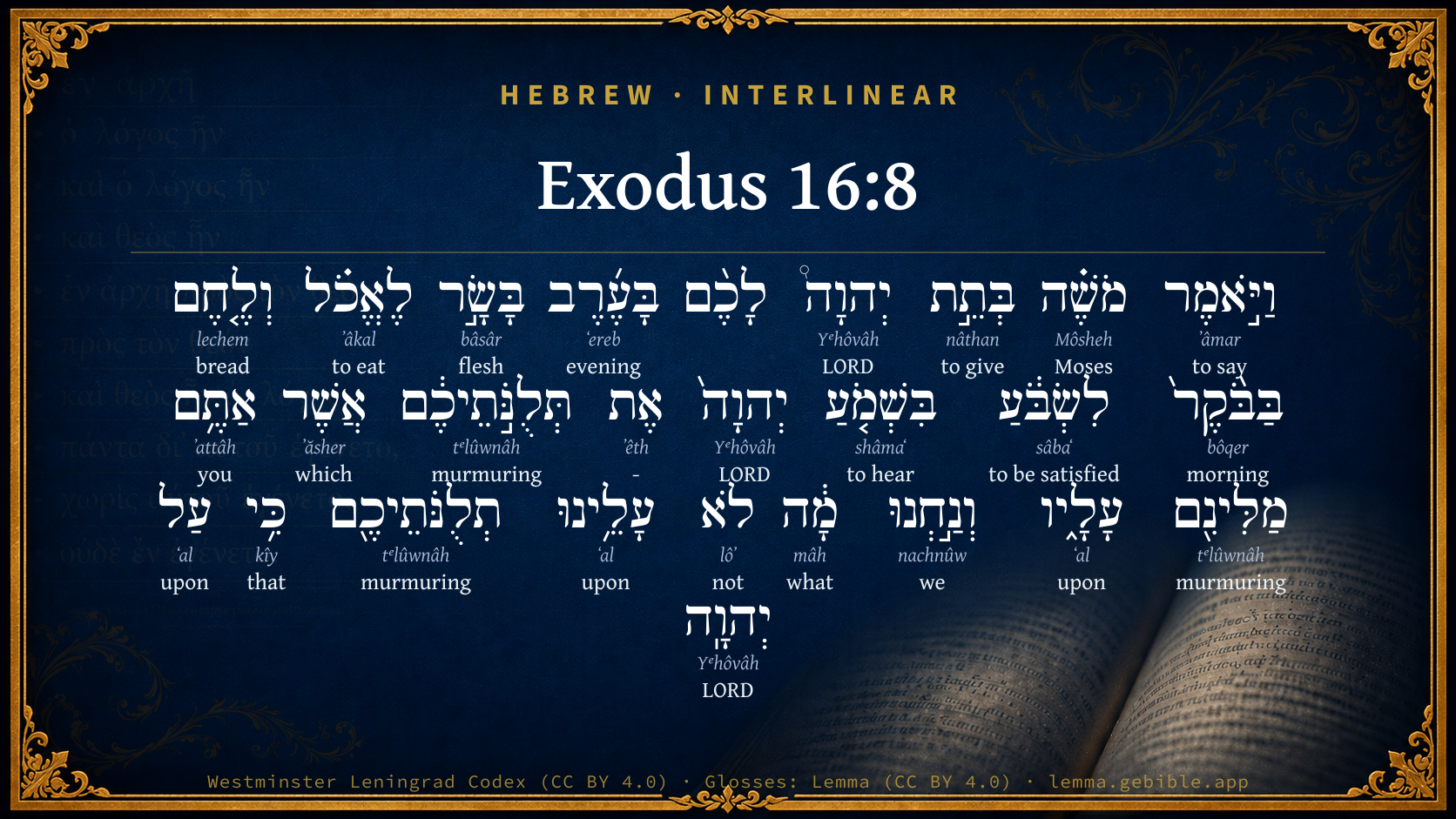
Hebrew (Westminster Leningrad Codex) Exodus 16:8 appears in the Hebrew Old Testament. The text above is from the Westminster Leningrad Codex. Each word links to its Strong’s number, a concise gloss, and parsing drawn from the Open Scriptures Hebrew Bible morphology. Click any word for its full Brown-Driver-Briggs (BDB) entry.
Download image
Cite this verse

Exodus 16:8 (World English Bible). Public Domain. Lemma interlinear Bible study tool, https://lemma.gebible.app/v/exodus/16/8.

Show BibTeX & RIS
BibTeX
RIS
English Translation
Moses said, "Now Yahweh shall give you meat to eat in the evening, and in the morning bread to satisfy you; because Yahweh hears your murmurings which you murmur against him. And who are we? Your murmurings are not against us, but against Yahweh."
World English Bible · Public Domain
Highlights
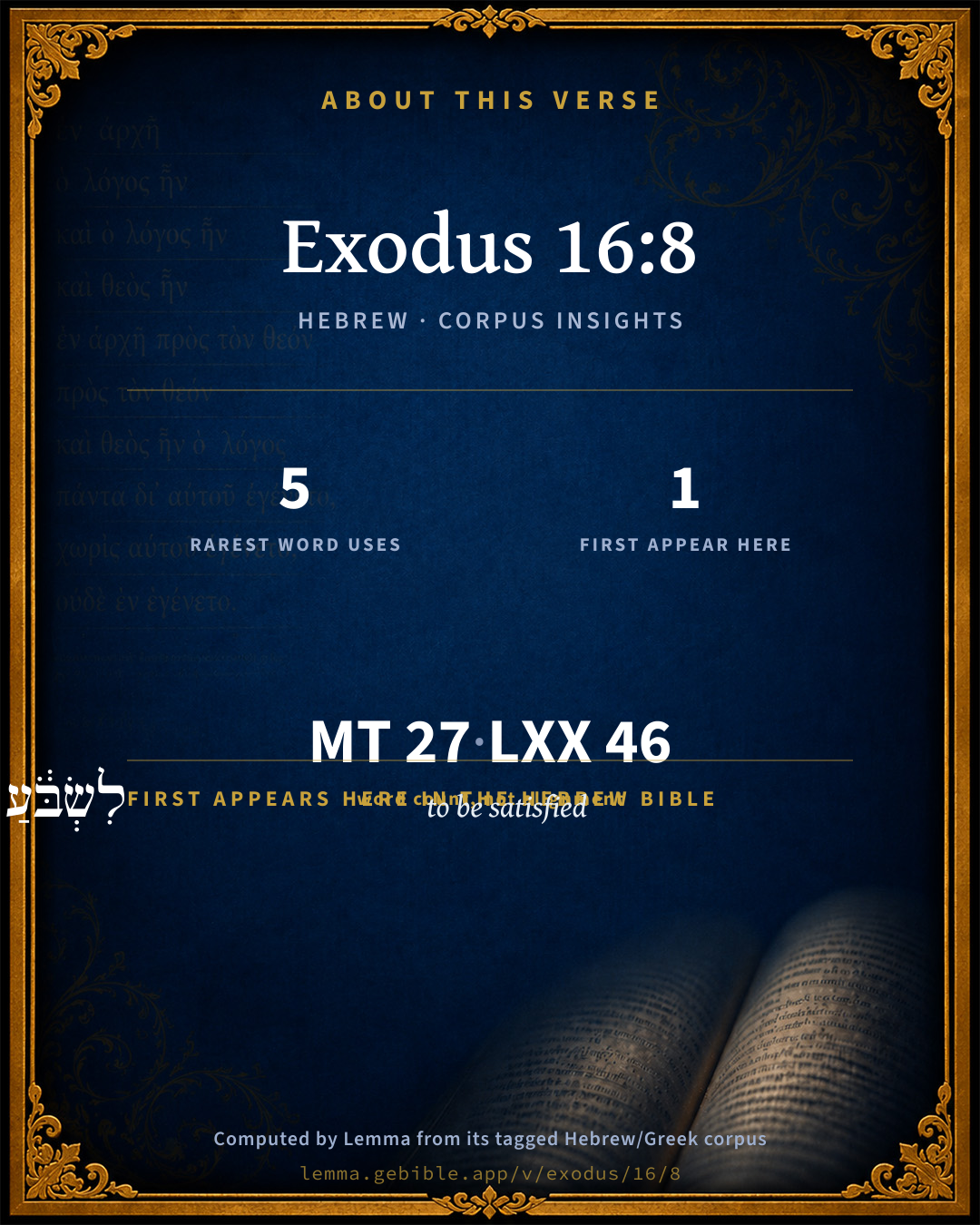
  • 1 first appearance in the Hebrew Bible
Full analysis ↓
Download a study sheet

One document with this verse’s original text, its word-by-word gloss line, the meaning frame, cross-references with their text, attributed commentary, and full source and license credits — printable, and it pastes into notes with its structure intact.

This verse Autodidact and up

Study sheet (.html) Plain text (.txt)

A passage Seminary Student

Up to 50 verses in one chapter. A passage sheet keeps up to 6 commentary sources and 12 cross-references per verse, in the order this page ranks them, and says so on the sheet whenever that leaves anything out. Ask for a single verse and you get the Autodidact verse sheet above.

Everything on this page stays free to read, with no account — the sheet is a download of what is already on screen, not access to it.

Want to remove ads? Support Godless Engineer
Compare translations 3

The same verse in 3 English versions, stacked beneath the original-language interlinear above. Click any original word for its lexicon entry.

Each is an independent rendering of the whole verse — the interlinear is not word-aligned to these translations.

Highlighted words mark where these versions differ — a whole-verse word diff, not a word-by-word alignment.

  • World English Bible Public Domain
    Moses said, "Now Yahweh shall give you meat to eat in the evening, and in the morning bread to satisfy you; because Yahweh hears your murmurings which you murmur against him. And who are we? Your murmurings are not against us, but against Yahweh."
  • King James Version Public Domain
    And Moses said, This shall be, when the LORD shall give you in the evening flesh to eat, and in the morning bread to the full; for that the LORD heareth your murmurings which ye murmur against him: and what are we? your murmurings are not against us, but against the LORD.
  • unfoldingWord Literal Text CC BY-SA 4.0
    And Moses said, “So Yahweh gives you meat to eat in the evening and bread in the morning to satiation; Yahweh is hearing your murmurings that you murmur against him. And what are we? Not against us is your murmuring, but against Yahweh.”

unfoldingWord Literal Text — © unfoldingWord, licensed CC BY-SA 4.0. Word-aligned USFM3 via Door43 (git.door43.org/unfoldingWord/en_ult).

Versions to compare (up to 4)

3 of 4 selected

Show all 18 translations

Every available English version of this verse, each an independent rendering of the whole verse.

  • World English Bible Public Domain
    Moses said, "Now Yahweh shall give you meat to eat in the evening, and in the morning bread to satisfy you; because Yahweh hears your murmurings which you murmur against him. And who are we? Your murmurings are not against us, but against Yahweh."
  • Berean Standard Bible Public Domain
    And Moses added, “The LORD will give you meat to eat this evening and bread to fill you in the morning, for He has heard your grumbling against Him. Who are we? Your grumblings are not against us but against the LORD.”
  • Majority Standard Bible Public Domain
    And Moses added, “The LORD will give you meat to eat this evening and bread to fill you in the morning, for He has heard your grumbling against Him. Who are we? Your grumblings are not against us but against the LORD.”
  • King James Version Public Domain
    And Moses said, This shall be, when the LORD shall give you in the evening flesh to eat, and in the morning bread to the full; for that the LORD heareth your murmurings which ye murmur against him: and what are we? your murmurings are not against us, but against the LORD.
  • American Standard Version (1901) Public Domain
    And Moses said, `This shall be', when Jehovah shall give you in the evening flesh to eat, and in the morning bread to the full; for that Jehovah heareth your murmurings which ye murmur against him: and what are we? your murmurings are not against us, but against Jehovah.
  • Revised Version (1885) Public Domain
    And Moses said, This shall be, when the LORD shall give you in the evening flesh to eat, and in the morning bread to the full; for that the LORD heareth your murmurings which ye murmur against him: and what are we? your murmurings are not against us, but against the LORD.
  • Geneva Bible (1599) Public Domain
    Againe Moses sayd, At euen shall the Lord giue you flesh to eate, and in the morning your fil of bread: for the Lord hath heard your murmurings, which ye murmure against him: for what are we? your murmurings are not against vs, but against the Lord.
  • Douay-Rheims (1899) Public Domain
    And Moses said: In the evening the Lord will give you flesh to eat, and in the morning bread to the full: for he hath heard your murmurings, with which you have murmured against him, for what are we? your murmuring is not against us, but against the Lord.
  • Young's Literal Translation Public Domain
    And Moses saith, `In Jehovah's giving to you in the evening flesh to eat, and bread in the morning to satiety -- in Jehovah's hearing your murmurings, which ye are murmuring against Him, and what `are' we? your murmurings `are' not against us, but against Jehovah.'
  • Literal Standard Version CC BY-SA 4.0
    And Moses says, “In YHWH’s giving to you flesh to eat in the evening, and bread in the morning to satiety—in YHWH’s hearing your murmurings, which you are murmuring against Him, and what [are] we? Your murmurings [are] not against us, but against YHWH.”
  • Unlocked Literal Bible CC BY-SA 4.0
    Moses also said, “You will know this when Yahweh gives you meat in the evening and bread in the morning to the full—for he has heard the complaints that you speak against him. Who are Aaron and I? Your complaints are not against us; they are against Yahweh.”
  • unfoldingWord Literal Text CC BY-SA 4.0
    And Moses said, “So Yahweh gives you meat to eat in the evening and bread in the morning to satiation; Yahweh is hearing your murmurings that you murmur against him. And what are we? Not against us is your murmuring, but against Yahweh.”
  • Darby Bible Public Domain
    And Moses said, When Jehovah gives you in the evening flesh to eat, and in the morning bread to the full; for Jehovah hears your murmurings which ye murmur against him... and what [are] we? your murmurings are not against us, but against Jehovah.
  • World Messianic Bible Public Domain
    Moses said, “Now the LORD will give you meat to eat in the evening, and in the morning bread to satisfy you, because the LORD hears your murmurings which you murmur against him. And who are we? Your murmurings are not against us, but against the LORD.”
  • Webster's Bible Public Domain
    And Moses said, This shall be when the LORD shall give you in the evening flesh to eat, and in the morning bread to the full; for that the LORD heareth your murmurings which ye murmur against him: And what are we? your murmurings are not against us, but against the LORD.
  • Free Bible Version CC BY-SA 4.0
    Then Moses continued, “The Lord is going to give you meat to eat this evening and as much bread as you want in the morning, for he has heard your complaints against him. Why are you complaining to us nobodies? Your complaints aren't directed against us, but against the Lord.”
  • Bible in Basic English Public Domain
    And Moses said, The Lord will give you meat for your food at evening, and in the morning bread in full measure; for your outcry against the Lord has come to his ears: for what are we? your outcry is not against us but against the Lord.
  • JPS Tanakh (1917) Public Domain
    And Moses said: 'This shall be, when the LORD shall give you in the evening flesh to eat, and in the morning bread to the full; for that the LORD heareth your murmurings which ye murmur against Him; and what are we? your murmurings are not against us, but against the LORD.'

Literal Standard Version (2020), Covenant Press — licensed CC BY-SA 4.0. Text via the HelloAO Bible API (eBible.org). Unlocked Literal Bible (unfoldingWord) — licensed CC BY-SA 4.0. Text via the HelloAO Bible API (eBible.org). unfoldingWord Literal Text — © unfoldingWord, licensed CC BY-SA 4.0. Word-aligned USFM3 via Door43 (git.door43.org/unfoldingWord/en_ult). Free Bible Version, Dr. Jonathan Gallagher — licensed CC BY-SA 4.0. Text via the HelloAO Bible API (eBible.org).

Word by word

More ways to search: Search by grammar → Find every occurrence → Compare this word →

Practice this passage: Drill this verse → Learn its vocabulary →

וְנַ֣חְנוּ
nachnûw
H5168
“and · we”
Conjunction + Pronoun, Personal, 1st Person, Common, Plural
Part of Speech
Conjunction + Pronoun
Type
Personal
Person
1st Person
Gender
Common
Number
Plural
Full BDB Definition

Origin: for H587

TWOT: 128a

we
  1. וַיֹּ֣אמֶר ʼâmar H559 “and · to say” Conjunction + Verb, Qal, Sequential Imperfect, 3rd Person, Masculine, Singular
  2. מֹשֶׁ֗ה Môsheh H4872 “Moses” Noun, Proper
  3. בְּתֵ֣ת nâthan H5414 “in/at · to give” Preposition + Verb, Qal, Infinitive Construct
  4. יְהוָה֩ Yᵉhôvâh H3068 “LORD” Noun, Proper
  5. בָּעֶ֜רֶב ʻereb H6153 “in/at the · evening” Preposition, Determined + Noun, Common, Masculine, Singular, Absolute
  6. בָּשָׂ֣ר bâsâr H1320 “flesh” Noun, Common, Masculine, Singular, Absolute
  7. לֶאֱכֹ֗ל ʼâkal H398 “to eat” Preposition + Verb, Qal, Infinitive Construct
  8. וְלֶ֤חֶם lechem H3899 “and · bread” Conjunction + Noun, Common, Both, Singular, Absolute
  9. בַּבֹּ֨קֶר֙ bôqer H1242 “in/at the · morning” Preposition, Determined + Noun, Common, Masculine, Singular, Absolute
  10. לִשְׂבֹּ֔עַ sâbaʻ H7646 “to be satisfied” Preposition + Verb, Qal, Infinitive Construct
  11. בִּשְׁמֹ֤עַ shâmaʻ H8085 “in/at · to hear” Preposition + Verb, Qal, Infinitive Construct
  12. יְהוָה֙ Yᵉhôvâh H3068 “LORD” Noun, Proper
  13. אֶת ʼêth H853 “-” Particle, Direct Object
  14. תְּלֻנֹּ֣תֵיכֶ֔ם tᵉlûwnâh H8519 “murmurings · your” Noun, Common, Feminine, Plural, Construct + Suffix, Personal, 2nd Person, Masculine, Plural
  15. אֲשֶׁר ʼăsher H834 “which” Particle, Relative
  16. אַתֶּ֥ם ʼattâh H859 “you” Pronoun, Personal, 2nd Person, Masculine, Plural
  17. מַלִּינִ֖ם tᵉlûwnâh H8519 “murmuring” Verb, Hiphil, Participle Active, Masculine, Plural, Absolute
  18. עָלָ֑יו ʻal H5921 “upon · him” Preposition + Suffix, Personal, 3rd Person, Masculine, Singular
  19. מָ֔ה mâh H4100 “what” Particle, Interrogative
  20. לֹא lôʼ H3808 “not” Particle, Negative
  21. עָלֵ֥ינוּ ʻal H5921 “upon · us” Preposition + Suffix, Personal, 1st Person, Common, Plural
  22. תְלֻנֹּתֵיכֶ֖ם tᵉlûwnâh H8519 “murmurings · your” Noun, Common, Feminine, Plural, Construct + Suffix, Personal, 2nd Person, Masculine, Plural
  23. כִּ֥י kîy H3588 “that” Conjunction
  24. עַל ʻal H5921 “upon” Preposition
  25. יְהוָֽה Yᵉhôvâh H3068 “LORD” Noun, Proper

About this verse

These counts appear in no published source. They are computed here, from the morphology-tagged text and Lemma’s own curated glosses. What Lemma adds →

27
words
20
distinct lemmas
Pentateuch
section

Notable vocabulary

The rarest word here is וְנַ֣חְנוּ we H5168 — appearing just 5 times in the whole Hebrew Bible.

First appearance in Scripture

This word makes its first canonical appearance in the Hebrew Bible here:

  • לִשְׂבֹּ֔עַ to be satisfied H7646

Shared distinctive vocabulary

וְנַ֣חְנוּ we H5168 occurs in 5 verses of the Hebrew Bible. Also found in:

Grammatical profile

  • 6 verbs
  • 10 nouns
  • 2 pronouns
  • 4 prepositions
  • 1 conjunction
  • 4 particles

Verb forms

  • וַיֹּ֣אמֶר Qal · Sequential Imperfect
  • בְּתֵ֣ת Qal · Infinitive Construct
  • לֶאֱכֹ֗ל Qal · Infinitive Construct
  • לִשְׂבֹּ֔עַ Qal · Infinitive Construct
  • בִּשְׁמֹ֤עַ Qal · Infinitive Construct
  • מַלִּינִ֖ם Hiphil · Participle Active

Repetition

Words recur within this verse — often emphatic in Hebrew:

  • יְהוָה֩ LORD H3068 ×3
  • תְּלֻנֹּ֣תֵיכֶ֔ם murmuring H8519 ×3
  • עָלָ֑יו upon H5921 ×3

Hebrew & Septuagint length

In English translation the verse runs 44 words from the Hebrew and 50 from the Septuagint (LXX English) — closely comparable.

A rough comparison of the two English renderings, which tokenize alike — not a word-level alignment.

Word counts can differ between the Hebrew and the Greek without any difference in meaning — e.g. the Hebrew direct-object marker אֵת has no separate Greek word, and Greek often adds the article ὁ.

In the original languages it is 27 Hebrew tokens and 46 Greek tokens — but the two are counted differently (Hebrew bundles its prefixes and suffixes into one token; the Greek is in lemma form), so that isn’t a like-for-like length.

Cross-references

15

Topical passages linked to Exodus 16:8 in the Treasury of Scripture Knowledge — connected by theme and wording, ordered by reader-vote popularity; previews shown in the World English Bible.

  • Romans 13:2 Therefore he who resists the authority, withstands the ordinance of God; and those who withstand will receive to themselves judgment.
  • 1 Samuel 8:7 Yahweh said to Samuel, Listen to the voice of the people in all that they tell you; for they have not rejected you, but they have rejected me, that I should not be king over them.
  • Luke 10:16 Whoever listens to you listens to me, and whoever rejects you rejects me. Whoever rejects me rejects him who sent me."
  • Numbers 14:27 How long [shall I bear] with this evil congregation, that murmur against me? I have heard the murmurings of the children of Israel, which they murmur against me.
  • 1 Thessalonians 4:8 Therefore he who rejects doesn't reject man, but God, who has also given his Holy Spirit to you.
  • Numbers 21:7 The people came to Moses, and said, We have sinned, because we have spoken against Yahweh, and against you; pray to Yahweh, that he take away the serpents from us. Moses prayed for the people.
  • Exodus 16:9 Moses said to Aaron, "Tell all the congregation of the children of Israel, 'Come near before Yahweh, for he has heard your murmurings.'"
  • Exodus 16:12 "I have heard the murmurings of the children of Israel. Speak to them, saying, 'At evening you shall eat meat, and in the morning you shall be filled with bread: and you shall know that I am Yahweh your God.'"
  • Isaiah 32:6 For the fool will speak folly, and his heart will work iniquity, to practice profanity, and to utter error against Yahweh, to make empty the soul of the hungry, and to cause the drink of the thirsty to fail.
  • Isaiah 37:29 Because of your raging against me, and because your arrogance is come up into my ears, therefore will I put my hook in your nose, and my bridle in your lips, and I will turn you back by the way by which you came.
  • Matthew 9:4 Jesus, knowing their thoughts, said, "Why do you think evil in your hearts?
  • Matthew 10:40 He who receives you receives me, and he who receives me receives him who sent me.
  • John 6:41–43 The Jews therefore murmured concerning him, because he said, "I am the bread which came down out of heaven."
  • John 13:20 Most assuredly I tell you, he who receives whomever I send, receives me; and he who receives me, receives him who sent me."
  • 1 Corinthians 10:10 Neither grumble, as some of them also grumbled, and perished by the destroyer.

Cross-references courtesy of OpenBible.info (CC BY 4.0).

Hebrew and Greek witnesses Masoretic Hebrew ↔ Greek Septuagint

The same verse in the two great witnesses to the Old Testament, shown verse-for-verse.

These are two independent witnesses, not word-aligned to each other, and the Septuagint is shown in lemma (dictionary) form.

Hebrew Exodus 16:8 Masoretic · Westminster Leningrad Codex

וַיֹּ֣אמֶר מֹשֶׁ֗ה בְּתֵ֣ת יְהוָה֩ לָכֶ֨ם בָּעֶ֜רֶב בָּשָׂ֣ר לֶאֱכֹ֗ל וְלֶ֤חֶם בַּבֹּ֨קֶר֙ לִשְׂבֹּ֔עַ בִּשְׁמֹ֤עַ יְהוָה֙ אֶת תְּלֻנֹּ֣תֵיכֶ֔ם אֲשֶׁר אַתֶּ֥ם מַלִּינִ֖ם עָלָ֑יו וְנַ֣חְנוּ מָ֔ה לֹא עָלֵ֥ינוּ תְלֻנֹּתֵיכֶ֖ם כִּ֥י עַל יְהוָֽה

Moses said, "Now Yahweh shall give you meat to eat in the evening, and in the morning bread to satisfy you; because Yahweh hears your murmurings which you murmur against him. And who are we? Your murmurings are not against us, but against Yahweh."

World English Bible · Public Domain

Greek LXX Exodus 16:8 Septuagint · lemma form

καί εἶπον μωυσῆς ἐν ὁ δίδωμι κύριος σύ ἑσπέρα κρέας ἐσθίω καί ἄρτος ὁ πρωΐ εἰς πλησμονή διά ὁ εἰςἀκούω κύριος ὁ γογγυσμός σύ ὅς σύ διαγογγύζω κατά ἐγώ ἐγώ δέ τίς εἰμί οὐ γάρ κατά ἐγώ ὁ γογγυσμός σύ εἰμί ἀλλά ἤ κατά ὁ θεός

And Moses said, This shall be when the Lord gives you in the evening flesh to eat, and bread in the morning to satiety, because the Lord has heard your murmuring, which you⌃ murmur against us: and what are we? for your murmuring is not against us, but against God.

LXX2012 (modern English Septuagint) · Public Domain

Hebrew: Westminster Leningrad Codex (CC BY 4.0). Greek: Septuagint (public domain); English from LXX2012 (modern English Septuagint) (Public Domain). How the Septuagint differs from the Hebrew →

Targum (Aramaic paraphrase)

2

The Targum is the ancient Jewish Aramaic paraphrase of the Hebrew Scriptures — an interpretive translation, not the Hebrew text itself. Onkelos (literal) and Pseudo-Jonathan (expansive) render the Torah, and Jonathan the Prophets. Coverage is partial: where no permissively-licensed English translation exists for a verse, only the Aramaic is shown. This is verse-level text, not a word-by-word alignment to the Hebrew.

  1. Targum Onkelos Torah (Genesis–Deuteronomy)
    וַאֲמַר משֶׁה בִּדְיִתֵּן יְיָ לְכוֹן בְּרַמְשָׁא בִּסְרָא לְמֵיכַל וְלַחְמָא בְּצַפְרָא לְמִסְבַּע בְּדִשְׁמִיעַן קֳדָם יְיָ יָת תֻּרְעֲמוּתְכוֹן דִי אַתּוּן מִתְרַעֲמִין עֲלוֹהִי וְנַחְנָא מָא לָא עֲלָנָא תֻּרְעֲמוּתְכוֹן אֶלָהֵן עַל מֵימְרָא דַיְיָ:

    (no public-domain English translation for this verse)

    Targum Onkelos — Aramaic: “Onkelos Genesis” (public domain); “Onkelos Exodus” (public domain); “Onkelos Leviticus” (public domain); “Onkelos Numbers” (public domain); “Onkelos Deuteronomy” (public domain). English: “Sefaria Community Translation” (CC0 1.0 (public-domain dedication)); “J.W. Etheridge. The Targums of Onkelos and Jonathan Ben Uzziel on the Pentateuch. London: Longmans, Green, 1862” (public domain). Text via Sefaria.

  2. Targum Pseudo-Jonathan Torah (Genesis–Deuteronomy)
    וַאֲמַר משֶׁה בְּדֵין תֵדְעוּן בִּדְיַזְמִין יְיָ לְכוֹן בְּרַמְשָׁא בִּישְרָא לְמֵיכוֹל וְלַחְמָא בְּצַפְרָא לְמִשְבּוֹעַ בְּדִשְׁמִיעַן קֳדָם יְיָ יַת תּוּרְעֲמוּתְכוֹן דְּאַתּוּן מִתְרַעֲמִין עֲלוֹי וַאֲנַחְנָא מָה אֲנַן חֲשִׁיבִין לָא עֲלָנָא תּוּרְעֲמַתְכוֹן אֱלָהֵן עַל מֵימְרָא דַיְיָ

    And Mosheh said, By this you shall know, when the Lord prepareth you at evening flesh to eat, and in the morning bread to satisfy, that your complainings wherewith you complain against Him are heard before the Lord. And we, what are we accounted? Your complaints are not against us, but against the Word of the Lord.

    Targum Pseudo-Jonathan — Aramaic: “Targum Jonathan on Genesis” (public domain); “Targum Jonathan on Exodus” (public domain); “Targum Jonathan on Leviticus” (public domain); “Targum Jonathan on Numbers” (public domain); “Targum Jonathan on Deuteronomy” (public domain). English: “The Targum of Jonathan ben Uzziel, trans. J. W. Etheridge, London, 1862” (public domain). Text via Sefaria.

Commentary

Notes on Exodus 16:8 from classic Christian and Jewish commentators (each source and its license shown beneath its notes). The classic Christian expositions comment on the surrounding passage and are grouped to its opening verse, so a note may address several verses; the Jewish commentaries on the Tanakh (Rashi and others) are per-verse, so they appear only where the commentator wrote on this verse.

Lemma curates 59 commentaries, every one of them public domain or Creative Commons licensed, each selected and text-cleaned for this edition rather than reprinted as found. About our sources →

Trapp's Complete Commentary

John Trapp

Exo 16:8 And Moses said, [This shall be], when the LORD shall give you in the evening flesh to eat, and in the morning bread to the full; for that the LORD heareth your murmurings which ye murmur against him: and what [are] we? your murmurings [are] not against us, but against the LORD.

Ver. 8. In the evening flesh to eat, &c.] Never was prince so served in his greatest pomp, as these rebellious Israelites. How good shall we find him then to those that please him!

John Trapp, A Commentary or Exposition upon All the Books of the Old and New Testament (1647–1656) — public domain. Text from a community e-Sword module.

Geneva Bible (1599)

Geneva Bible translators

He that contemneth God’s ministers, contemneth God himself.

Geneva Bible (1599) marginal notes — public domain. Text via Bolls.life.

Adam Clarke's Commentary

Verse 8. In the evening flesh to eat] Viz., the quails; and in the morning bread to the full, viz., the manna.

And what are we?] Only his servants, obeying his commands.

Your murmurings are not against us] For we have not brought you up from Egypt; but against the Lord, who, by his own miraculous power and goodness, has brought you out of your slavery.

Adam Clarke's Commentary on the Bible (1810–1826) — public domain. Text from a community e-Sword/MySword module.

The Cambridge Bible for Schools and Colleges

gen. ed. J. J. S. Perowne

8. ‘An explanatory gloss of the compiler on vv. 6, 7’ (Di.).

This shall be] i.e. Ye shall know and see what I have told you (v. 6 f.).

The Cambridge Bible for Schools and Colleges (gen. ed. J. J. S. Perowne; Cambridge University Press, 1878–1918) — public domain. Text from a community e-Sword module.

John Gill's Exposition

And Moses said, this shall be,.... Which supplement may be left out:

when the Lord shall give you in the evening flesh to eat; cause the quails to come up, and fall about their tents:

and in the morning bread to the full; by raining it from heaven all around them:

for that, or rather "then" (k):

the Lord heareth your murmurings which ye murmur against him; it will then appear that he has heard them, and taken notice of them, by giving them bread and flesh, they complained of the want of; and yet did not resent in a way of wrath and displeasure their murmurings, but kindly, bountifully, and in a most marvellous manner provided for them, which was acting like himself, a God gracious and merciful:

and what are we? that we should be the objects of your resentment, and be murmured at, and complained of, who had done nothing to deserve such treatment:

your murmurings are not against us, but against the Lord; not only against them, but against the Lord also; or not so much against them as against the Lord, whose messengers and ministers they were, and whom they represented, obeyed, and served; thus whatever is done to the ministers of Christ, he reckons as done to the Father, and to himself, Luk 10:16.

(k) "testabitur se audisse", Tigurine version.

John Gill's Exposition of the Whole Bible (1746–1763) — public domain (CC PDM 1.0). Text via the HelloAO Bible API.

Haydock's Catholic Bible Commentary

Lord. All rebellion against lawful authority is resented by God. (Du Hamel)

George Leo Haydock (1774–1849), Haydock's Catholic Family Bible and Commentary, 1859 edition — public domain. Excludes Psalms (Douay-Rheims chapter numbering differs from Protestant) and Deuterocanonical books (Catholic canon only).

The Pulpit Commentary

When the lord shall give you in the evening flesh to eat. Moses must have received a distinct intimation of the coming arrival of the quails, trough he has not recorded it, his desire of brevity causing him to retrench all that is not absolutely necessary for the right understanding of the narrative. It is, comparatively, seldom that he records both the Divine message and his delivery of it. In general, he places upon record either the message only, or its delivery only. Bread to the full. Compare above, verse 4; and infra, verses 12 and 18. The Lord heareth your murmurings. The latter part of this verse is, in the main, a repetition of verse 7; but it emphasises the statements of that verse, and prepares the way for what follows.

The Pulpit Commentary (1880–1919), ed. H.D.M. Spence-Jones & Joseph S. Exell — public domain. Text from a community e-Sword module.

Rashi

Rabbi Shlomo Yitzchaki (Rashi)

בשר לאכל FLESH TO EAT— but it does not add as it does in the next phrase לִשְׂבֹּעַ, “to satisfaction”; the Torah thus teaches us a rule of conduct — that one should not eat meat to satiety. And what did He see (what reason had He) that He made bread fall for them in the morning and flesh at evening? Because the bread they asked for was a proper thing to demand since it is impossible for a person to exist without bread; but meat they asked for improperly, for they had abundant cattle, and besides it was possible for them to exist without flesh. On this account He gave it to them at evening, at a time of (when it would cause them) trouble, a manner which was not favourable to them (Mekhilta; Yoma 75).

אשר אתם מלינים עליו means [YOUR MURMURINGS] WHICH YOU MAKE others who hear you murmuring MURMUR AGAINST HIM.

Rashi on the Tanakh — English translations: “The Judaica Press complete Tanach with Rashi, translated by A. J. Rosenberg” (CC BY 4.0); “Pentateuch with Rashi's commentary by M. Rosenbaum and A.M. Silbermann, 1929-1934” (public domain); “The Metsudah Tanach series, Lakewood, N.J” (CC BY 4.0); and “The Book of Joshua, Metsudah Publications, 1997” (CC BY 4.0). Text via Sefaria.

Ramban (Nachmanides)

Rabbi Moshe ben Nachman (Ramban / Nachmanides)

AND MOSES SAID: THIS SHALL BE, WHEN THE ETERNAL SHALL GIVE YOU IN THE EVENING FLESH. Moses is explaining his first statement, [recorded above in Verses 6-7]: When the Eternal shall give you in the evening flesh to eat, then ye shall know that the Eternal hath brought you out from the land of Egypt; and when He shall give you in the morning bread to the full, then ye shall see the Glory of the Eternal.

Ramban (Nachmanides) on the Tanakh — English translation: “Commentary on the Torah by Ramban (Nachmanides). Translated and annotated by Charles B. Chavel. New York, Shilo Pub. House, 1971-1976” (CC BY 4.0). Text via Sefaria.

Lesson kit

Teaching starters — assembled from the data on this page, not authored interpretation. Every prompt links to the verse data it draws on. Edit before teaching.

Exodus, in the Pentateuch, opens this verse with 27 words (20 distinct Hebrew lemmas). Its most distinctive word is nachnûw (“we”). A historical commentator’s framing appears above. Read the whole chapter for the surrounding context.

Discussion questions

  1. The word nachnûw carries the sense “we.” How does it shape the verse?
  2. This is the first place “to be satisfied” appears in Scripture (first appears here). What does its debut here establish?
  3. How does Genesis 42:11, which shares the word «we», read alongside this verse?
  4. What does the repetition of “LORD” (3× in this one verse) do in this verse?
  5. These translations render this verse differently; the difference is in the English rendering, not the original. What questions does that raise?
  6. «וַיֹּ֣אמֶר» is a Qal Sequential Imperfect verb. How does that grammatical form shape the action described?
  7. Compare how Trapp's Complete Commentary and Geneva Bible (1599) read this verse. Where do they agree or differ?

Things to notice

Reading settings

Reading text

Shown beneath each verse's original-language words.

Old Testament
Old Testament edition

Read the OT as the Masoretic Hebrew (MT) or the Greek Septuagint (LXX).

English shown for the Greek Septuagint (in the Hebrew ↔ Greek comparison).

Comparing translations? Open the Compare panel on any verse page to stack up to four side by side.