
Exodus 5:21

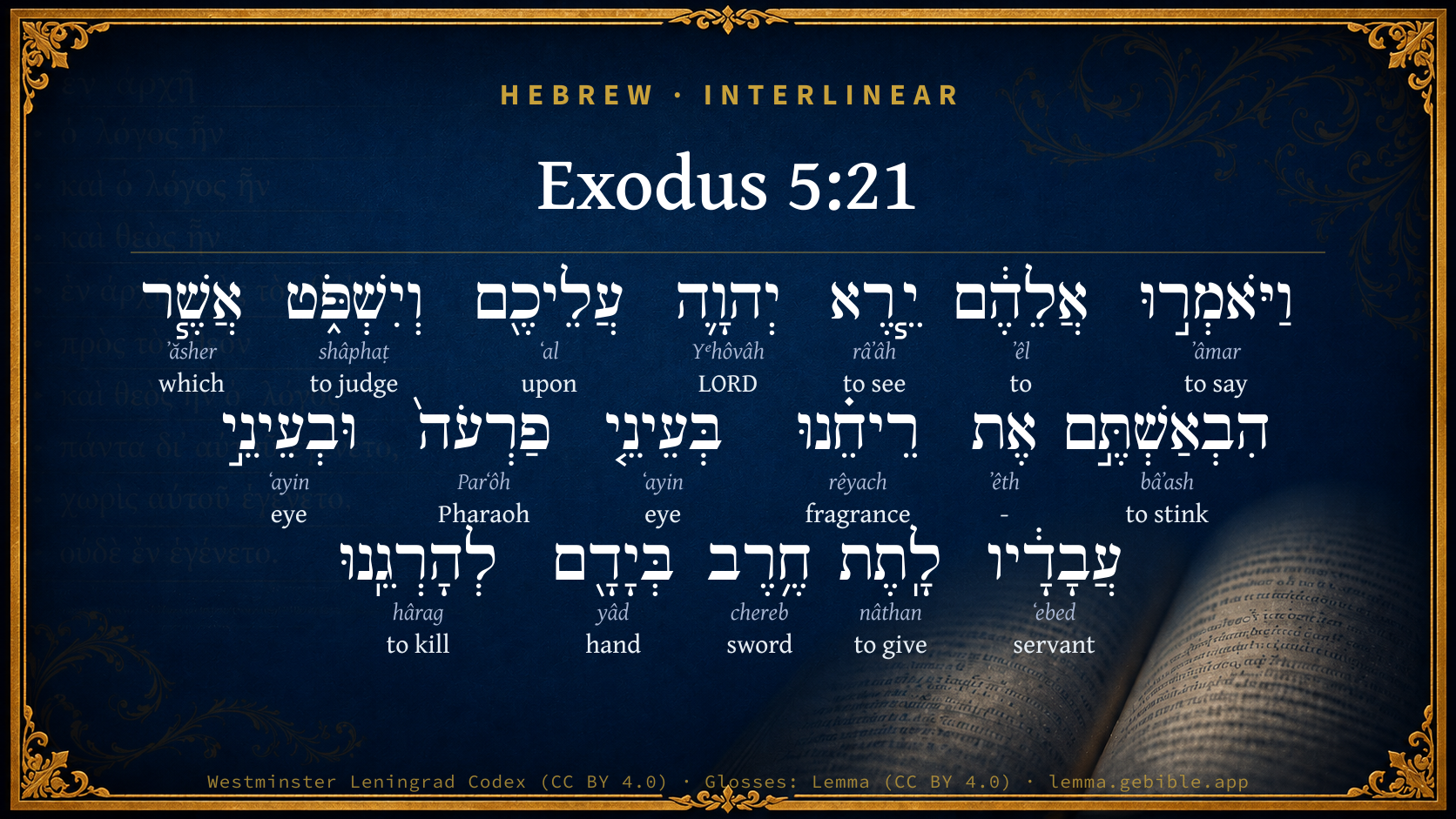
Hebrew (Westminster Leningrad Codex) Exodus 5:21 appears in the Hebrew Old Testament. The text above is from the Westminster Leningrad Codex. Each word links to its Strong’s number, a concise gloss, and parsing drawn from the Open Scriptures Hebrew Bible morphology. Click any word for its full Brown-Driver-Briggs (BDB) entry.
Download image
Cite this verse

Exodus 5:21 (World English Bible). Public Domain. Lemma interlinear Bible study tool, https://lemma.gebible.app/v/exodus/5/21.

Show BibTeX & RIS
BibTeX
RIS
English Translation
and they said to them, "May Yahweh look at you, and judge, because you have made us a stench to be abhorred in the eyes of Pharaoh, and in the eyes of his servants, to put a sword in their hand to kill us."
World English Bible · Public Domain
Download a study sheet

One document with this verse’s original text, its word-by-word gloss line, the meaning frame, cross-references with their text, attributed commentary, and full source and license credits — printable, and it pastes into notes with its structure intact.

This verse Autodidact and up

Study sheet (.html) Plain text (.txt)

A passage Seminary Student

Up to 50 verses in one chapter. A passage sheet keeps up to 6 commentary sources and 12 cross-references per verse, in the order this page ranks them, and says so on the sheet whenever that leaves anything out. Ask for a single verse and you get the Autodidact verse sheet above.

Everything on this page stays free to read, with no account — the sheet is a download of what is already on screen, not access to it.

Want to remove ads? Support Godless Engineer
Compare translations 3

The same verse in 3 English versions, stacked beneath the original-language interlinear above. Click any original word for its lexicon entry.

Each is an independent rendering of the whole verse — the interlinear is not word-aligned to these translations.

Highlighted words mark where these versions differ — a whole-verse word diff, not a word-by-word alignment.

  • World English Bible Public Domain
    and they said to them, "May Yahweh look at you, and judge, because you have made us a stench to be abhorred in the eyes of Pharaoh, and in the eyes of his servants, to put a sword in their hand to kill us."
  • King James Version Public Domain
    And they said unto them, The LORD look upon you, and judge; because ye have made our savor to be abhorred in the eyes of Pharaoh, and in the eyes of his servants, to put a sword in their hand to slay us.
  • unfoldingWord Literal Text CC BY-SA 4.0
    And they said to them, “May Yahweh look on you and judge; for you have caused our scent to stink in the eyes of Pharaoh and in the eyes of his servants, to give a sword into their hand to kill us.”

unfoldingWord Literal Text — © unfoldingWord, licensed CC BY-SA 4.0. Word-aligned USFM3 via Door43 (git.door43.org/unfoldingWord/en_ult).

Versions to compare (up to 4)

3 of 4 selected

Show all 18 translations

Every available English version of this verse, each an independent rendering of the whole verse.

  • World English Bible Public Domain
    and they said to them, "May Yahweh look at you, and judge, because you have made us a stench to be abhorred in the eyes of Pharaoh, and in the eyes of his servants, to put a sword in their hand to kill us."
  • Berean Standard Bible Public Domain
    “May the LORD look upon you and judge you,” the foremen said, “for you have made us a stench before Pharaoh and his officials; you have placed in their hand a sword to kill us!”
  • Majority Standard Bible Public Domain
    “May the LORD look upon you and judge you,” the foremen said, “for you have made us a stench before Pharaoh and his officials; you have placed in their hand a sword to kill us!”
  • King James Version Public Domain
    And they said unto them, The LORD look upon you, and judge; because ye have made our savor to be abhorred in the eyes of Pharaoh, and in the eyes of his servants, to put a sword in their hand to slay us.
  • American Standard Version (1901) Public Domain
    and they said unto them, Jehovah look upon you, and judge: because ye have made our savor to be abhorred in the eyes of Pharaoh, and in the eyes of his servants, to put a sword in their hand to slay us.
  • Revised Version (1885) Public Domain
    and they said unto them, The LORD look upon you, and judge; because ye have made our savour to be abhorred in the eyes of Pharaoh, and in the eyes of his servants, to put a sword in their hand to slay us.
  • Geneva Bible (1599) Public Domain
    To whom they said, The Lord looke vpon you and iudge: for yee haue made our sauour to stinke before Pharaoh and before his seruants, in that ye haue put a sword in their hand to slay vs.
  • Douay-Rheims (1899) Public Domain
    And they said to them: The Lord see and judge, because you have made our savour to stink before Pharao and his servants, and you have given him a sword to kill us.
  • Young's Literal Translation Public Domain
    and say unto them, `Jehovah look upon you, and judge, because ye have caused our fragrance to stink in the eyes of Pharaoh, and in the eyes of his servants -- to give a sword into their hand to slay us.'
  • Literal Standard Version CC BY-SA 4.0
    and say to them, “YHWH look on you, and judge, because you have caused our fragrance to stink in the eyes of Pharaoh, and in the eyes of his servants—to give a sword into their hand to slay us.”
  • Unlocked Literal Bible CC BY-SA 4.0
    They said to Moses and Aaron, “May Yahweh look at you and punish you, because you have made us offensive in the sight of Pharaoh and his servants. You have put a sword in their hand to kill us.”
  • unfoldingWord Literal Text CC BY-SA 4.0
    And they said to them, “May Yahweh look on you and judge; for you have caused our scent to stink in the eyes of Pharaoh and in the eyes of his servants, to give a sword into their hand to kill us.”
  • Darby Bible Public Domain
    And they said to them, Jehovah look upon you and judge, that ye have made our odour to stink in the eyes of Pharaoh, and in the eyes of his bondmen, putting a sword into their hand to kill us!
  • World Messianic Bible Public Domain
    They said to them, “May the LORD look at you and judge, because you have made us a stench to be abhorred in the eyes of Pharaoh, and in the eyes of his servants, to put a sword in their hand to kill us!”
  • Webster's Bible Public Domain
    And they said to them, The LORD look upon you, and judge; because ye have made our savor to be abhorred in the eyes of Pharaoh, and in the eyes of his servants, to put a sword in their hands to slay us.
  • Free Bible Version CC BY-SA 4.0
    and said, “May the Lord see what you have done and judge you accordingly! You have made us like a bad smell to Pharaoh and his officials. You have put a sword in their hands to kill us!”
  • Bible in Basic English Public Domain
    And they said to them, May the Lord take note of you and be your judge; for you have given Pharaoh and his servants a bad opinion of us, putting a sword in their hands for our destruction.
  • JPS Tanakh (1917) Public Domain
    and they said unto them: 'The LORD look upon you, and judge; because ye have made our savour to be abhorred in the eyes of Pharaoh, and in the eyes of his servants, to put a sword in their hand to slay us.'

Literal Standard Version (2020), Covenant Press — licensed CC BY-SA 4.0. Text via the HelloAO Bible API (eBible.org). Unlocked Literal Bible (unfoldingWord) — licensed CC BY-SA 4.0. Text via the HelloAO Bible API (eBible.org). unfoldingWord Literal Text — © unfoldingWord, licensed CC BY-SA 4.0. Word-aligned USFM3 via Door43 (git.door43.org/unfoldingWord/en_ult). Free Bible Version, Dr. Jonathan Gallagher — licensed CC BY-SA 4.0. Text via the HelloAO Bible API (eBible.org).

Word by word

More ways to search: Search by grammar → Find every occurrence → Compare this word →

Practice this passage: Drill this verse → Learn its vocabulary →

הִבְאַשְׁתֶּ֣ם
bâʼash
H887
“to stink”
Verb, Hiphil, Perfect, 2nd Person, Masculine, Plural
Part of Speech
Verb
Stem
Hiphil
Form
Perfect
Person
2nd Person
Gender
Masculine
Number
Plural
Full BDB Definition

Origin: a primitive root

TWOT: 195

to have a bad smell, stink, smell bad - (Qal) to stink, smell bad - (Niphal) - to become odious - to make oneself odious - (Hiphil) - to stink, emit a stinking odour - to cause to stink - of wickedness (figuratively) - (Hithpael) to make oneself odious - (TWOT) to abhor
  1. וַיֹּאמְר֣וּ ʼâmar H559 “and · to say” Conjunction + Verb, Qal, Sequential Imperfect, 3rd Person, Masculine, Plural
  2. אֲלֵהֶ֔ם ʼêl H413 “to · them” Preposition + Suffix, Personal, 3rd Person, Masculine, Plural
  3. יֵ֧רֶא râʼâh H7200 “to see” Verb, Qal, Imperfect, 3rd Person, Masculine, Singular
  4. יְהוָ֛ה Yᵉhôvâh H3068 “LORD” Noun, Proper
  5. עֲלֵיכֶ֖ם ʻal H5921 “upon · you” Preposition + Suffix, Personal, 2nd Person, Masculine, Plural
  6. וְיִשְׁפֹּ֑ט shâphaṭ H8199 “and · to judge” Conjunction + Verb, Qal, Imperfect, 3rd Person, Masculine, Singular
  7. אֲשֶׁ֧ר ʼăsher H834 “which” Particle, Relative
  8. אֶת ʼêth H853 “-” Particle, Direct Object
  9. רֵיחֵ֗נוּ rêyach H7381 “fragrance · our” Noun, Common, Masculine, Singular, Construct + Suffix, Personal, 1st Person, Common, Plural
  10. בְּעֵינֵ֤י ʻayin H5869 “in/at · eyes of” Preposition + Noun, Common, Both, Dual, Construct
  11. פַרְעֹה֙ Parʻôh H6547 “Pharaoh” Noun, Proper
  12. וּבְעֵינֵ֣י ʻayin H5869 “and · in/at · eyes of” Conjunction + Preposition + Noun, Common, Both, Dual, Construct
  13. עֲבָדָ֔יו ʻebed H5650 “servants · his” Noun, Common, Masculine, Plural, Construct + Suffix, Personal, 3rd Person, Masculine, Singular
  14. לָֽתֶת nâthan H5414 “to give” Preposition + Verb, Qal, Infinitive Construct
  15. חֶ֥רֶב chereb H2719 “sword” Noun, Common, Feminine, Singular, Absolute
  16. בְּיָדָ֖ם yâd H3027 “in/at · hand · their” Preposition + Noun, Common, Both, Singular, Construct + Suffix, Personal, 3rd Person, Masculine, Plural
  17. לְהָרְגֵֽנוּ hârag H2026 “to kill · us” Preposition + Verb, Qal, Infinitive Construct + Suffix, Personal, 1st Person, Common, Plural

About this verse

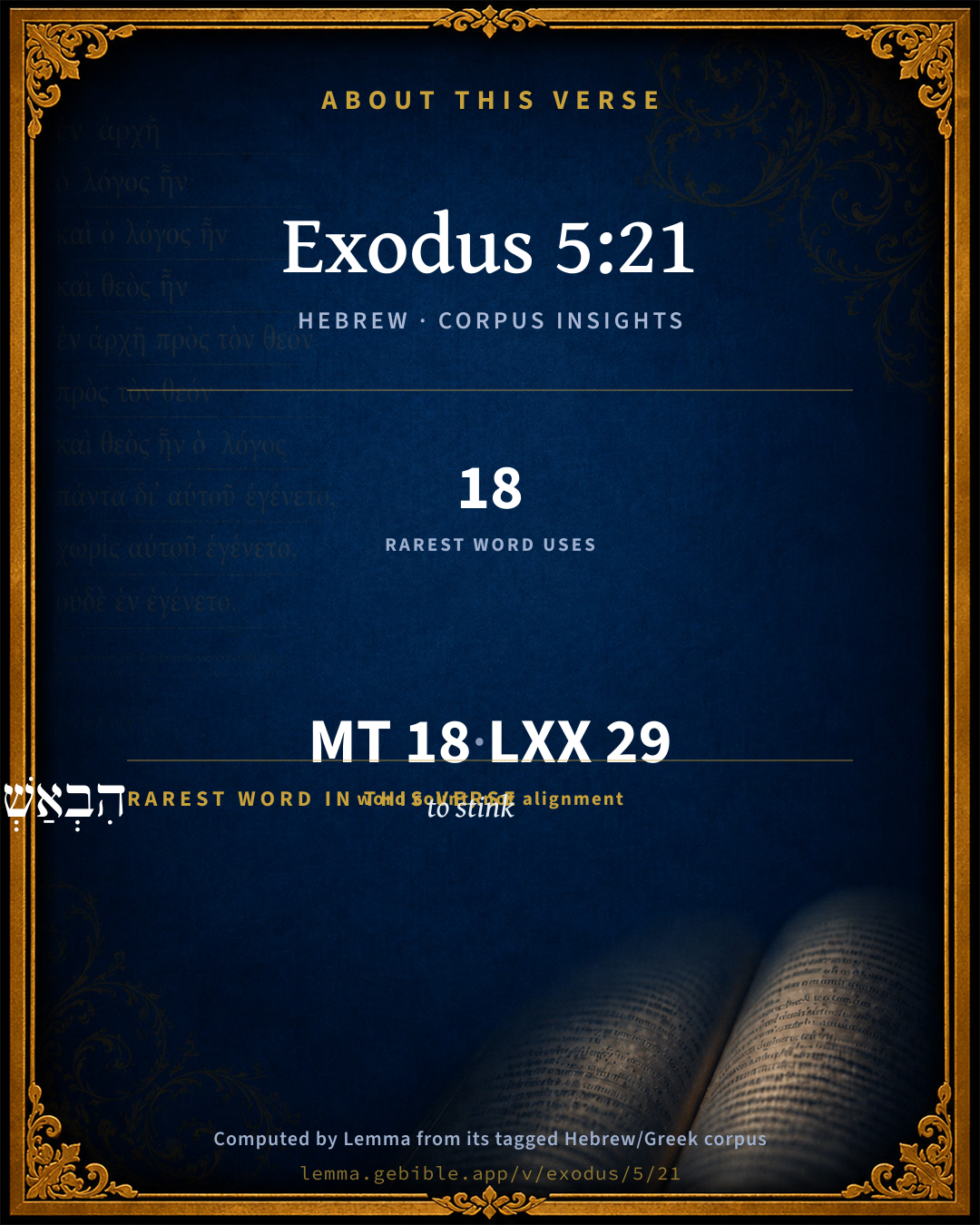
These counts appear in no published source. They are computed here, from the morphology-tagged text and Lemma’s own curated glosses. What Lemma adds →

18
words
17
distinct lemmas
Pentateuch
section

Notable vocabulary

The rarest word here is הִבְאַשְׁתֶּ֣ם to stink H887 — appearing just 18 times in the whole Hebrew Bible.

Shared distinctive vocabulary

הִבְאַשְׁתֶּ֣ם to stink H887 occurs in 17 verses of the Hebrew Bible. Also found in:

Grammatical profile

  • 6 verbs
  • 8 nouns
  • 2 prepositions
  • 2 particles

Verb forms

  • וַיֹּאמְר֣וּ Qal · Sequential Imperfect
  • יֵ֧רֶא Qal · Imperfect
  • וְיִשְׁפֹּ֑ט Qal · Imperfect
  • הִבְאַשְׁתֶּ֣ם Hiphil · Perfect
  • לָֽתֶת Qal · Infinitive Construct
  • לְהָרְגֵֽנוּ Qal · Infinitive Construct

Repetition

A word recurs within this verse — often emphatic in Hebrew:

  • בְּעֵינֵ֤י eye H5869 ×2

Hebrew & Septuagint length

In English translation the verse runs 44 words from the Hebrew and 36 from the Septuagint (LXX English) — closely comparable.

A rough comparison of the two English renderings, which tokenize alike — not a word-level alignment.

Word counts can differ between the Hebrew and the Greek without any difference in meaning — e.g. the Hebrew direct-object marker אֵת has no separate Greek word, and Greek often adds the article ὁ.

In the original languages it is 18 Hebrew tokens and 29 Greek tokens — but the two are counted differently (Hebrew bundles its prefixes and suffixes into one token; the Greek is in lemma form), so that isn’t a like-for-like length.

Cross-references

12

Topical passages linked to Exodus 5:21 in the Treasury of Scripture Knowledge — connected by theme and wording, ordered by reader-vote popularity; previews shown in the World English Bible.

  • Genesis 34:30 Jacob said to Simeon and Levi, "You have troubled me, to make me odious to the inhabitants of the land, among the Canaanites and the Perizzites. I am few in number. They will gather themselves together against me and strike me, and I will be destroyed, I and my house."
  • Genesis 16:5 Sarai said to Abram, "This wrong is your fault. I gave my handmaid into your bosom, and when she saw that she had conceived, I was despised in her eyes. Yahweh judge between me and you."
  • Exodus 6:9 Moses spoke so to the children of Israel, but they didn't listen to Moses for anguish of spirit, and for cruel bondage.
  • 1 Samuel 13:4 All Israel heard say that Saul had struck the garrison of the Philistines, and also that Israel was had in abomination with the Philistines. The people were gathered together after Saul to Gilgal.
  • 1 Samuel 27:12 Achish believed David, saying, He has made his people Israel utterly to abhor him; therefore he shall be my servant forever.
  • 2 Samuel 10:6 When the children of Ammon saw that they were become odious to David, the children of Ammon sent and hired the Syrians of Beth Rehob, and the Syrians of Zobah, twenty thousand footmen, and the king of Maacah with one thousand men, and the men of Tob twelve thousand men.
  • 1 Chronicles 19:6 When the children of Ammon saw that they had made themselves odious to David, Hanun and the children of Ammon sent one thousand talents of silver to hire them chariots and horsemen out of Mesopotamia, and out of Arammaacah, and out of Zobah.
  • Exodus 4:31 The people believed, and when they heard that Yahweh had visited the children of Israel, and that he had seen their affliction, then they bowed their heads and worshiped.
  • Exodus 14:11 They said to Moses, "Because there were no graves in Egypt, have you taken us away to die in the wilderness? Why have you treated us this way, to bring us forth out of Egypt?
  • Ecclesiastes 10:1 Dead flies cause the oil of the perfumer to send forth an evil odor; so does a little folly outweigh wisdom and honor.
  • Joel 2:20 But I will remove the northern army far away from you, And will drive it into a barren and desolate land, Its front into the eastern sea, And its back into the western sea; And its stench will come up, And its bad smell will rise." Surely he has done great things.
  • 2 Corinthians 2:15–16 For we are a sweet aroma of Christ to God, in those who are saved, and in those who perish;

Cross-references courtesy of OpenBible.info (CC BY 4.0).

Hebrew and Greek witnesses Masoretic Hebrew ↔ Greek Septuagint

The same verse in the two great witnesses to the Old Testament, shown verse-for-verse.

These are two independent witnesses, not word-aligned to each other, and the Septuagint is shown in lemma (dictionary) form.

Hebrew Exodus 5:21 Masoretic · Westminster Leningrad Codex

וַיֹּאמְר֣וּ אֲלֵהֶ֔ם יֵ֧רֶא יְהוָ֛ה עֲלֵיכֶ֖ם וְיִשְׁפֹּ֑ט אֲשֶׁ֧ר הִבְאַשְׁתֶּ֣ם אֶת רֵיחֵ֗נוּ בְּעֵינֵ֤י פַרְעֹה֙ וּבְעֵינֵ֣י עֲבָדָ֔יו לָֽתֶת חֶ֥רֶב בְּיָדָ֖ם לְהָרְגֵֽנוּ

and they said to them, "May Yahweh look at you, and judge, because you have made us a stench to be abhorred in the eyes of Pharaoh, and in the eyes of his servants, to put a sword in their hand to kill us."

World English Bible · Public Domain

Greek LXX Exodus 5:21 Septuagint · lemma form

καί εἶπον αὐτός ὁράω ὁ θεός σύ καί κρίνω ὅτι βδελύσσω ὁ ὀσμή ἐγώ ἐναντίον φαραώ καί ἐναντίον ὁ θεράπων αὐτός δίδωμι ῥομφαία εἰς ὁ χείρ αὐτός ἀποκτείνω ἐγώ

And they said to them, The Lord look upon you and judge you, for you⌃ have made our savor abominable before Pharao, and before his servants, to put a sword into his hands to kill us.

LXX2012 (modern English Septuagint) · Public Domain

Hebrew: Westminster Leningrad Codex (CC BY 4.0). Greek: Septuagint (public domain); English from LXX2012 (modern English Septuagint) (Public Domain). How the Septuagint differs from the Hebrew →

Targum (Aramaic paraphrase)

2

The Targum is the ancient Jewish Aramaic paraphrase of the Hebrew Scriptures — an interpretive translation, not the Hebrew text itself. Onkelos (literal) and Pseudo-Jonathan (expansive) render the Torah, and Jonathan the Prophets. Coverage is partial: where no permissively-licensed English translation exists for a verse, only the Aramaic is shown. This is verse-level text, not a word-by-word alignment to the Hebrew.

  1. Targum Onkelos Torah (Genesis–Deuteronomy)
    וַאֲמָרוּ לְהוֹן יִתְגְלֵי יְיָ עֲלֵיכוֹן וְיִתְפְּרַע דִי אַבְאֶשְׁתּוּן יָת רֵיחָנָא בְּעֵינֵי פַרְעֹה וּבְעֵינֵי עַבְדוֹהִי לְמִתַּן חַרְבָּא בִּידֵיהוֹן לְקַטָלוּתָנָא:

    (no public-domain English translation for this verse)

    Targum Onkelos — Aramaic: “Onkelos Genesis” (public domain); “Onkelos Exodus” (public domain); “Onkelos Leviticus” (public domain); “Onkelos Numbers” (public domain); “Onkelos Deuteronomy” (public domain). English: “Sefaria Community Translation” (CC0 1.0 (public-domain dedication)); “J.W. Etheridge. The Targums of Onkelos and Jonathan Ben Uzziel on the Pentateuch. London: Longmans, Green, 1862” (public domain). Text via Sefaria.

  2. Targum Pseudo-Jonathan Torah (Genesis–Deuteronomy)
    וַאֲמָרוּ לְהוֹן יִתְגְלֵי קֳדָם יְיָ עוּלְבָּנָנָא וּלְחוֹד יִתְפְּרַע מִנְכוֹן דְאַסְרַחֲתּוּן יַת רֵיחָנָא קֳדָם פַּרְעה וְקָדָם עַבְדוֹי דְגֵרַמְתּוּן לְמִיתַּן סַיְיפָא בִידֵיהוֹן לְמִקְטְלָנָא

    and they said to them, Our affliction is manifest before the Lord, but our punishment is from you who have made our smell offensive before Pharoh and his servants; for you have occasioned a sword to be put into their hand to kill us.

    Targum Pseudo-Jonathan — Aramaic: “Targum Jonathan on Genesis” (public domain); “Targum Jonathan on Exodus” (public domain); “Targum Jonathan on Leviticus” (public domain); “Targum Jonathan on Numbers” (public domain); “Targum Jonathan on Deuteronomy” (public domain). English: “The Targum of Jonathan ben Uzziel, trans. J. W. Etheridge, London, 1862” (public domain). Text via Sefaria.

Commentary

Notes on Exodus 5:21 from classic Christian and Jewish commentators (each source and its license shown beneath its notes). The classic Christian expositions comment on the surrounding passage and are grouped to its opening verse, so a note may address several verses; the Jewish commentaries on the Tanakh (Rashi and others) are per-verse, so they appear only where the commentator wrote on this verse.

Lemma curates 59 commentaries, every one of them public domain or Creative Commons licensed, each selected and text-cleaned for this edition rather than reprinted as found. About our sources →

Trapp's Complete Commentary

John Trapp

Exo 5:21 And they said unto them, The LORD look upon you, and judge; because ye have made our savour to be abhorred in the eyes of Pharaoh, and in the eyes of his servants, to put a sword in their hand to slay us.

Ver. 21. The Lord look upon you.] Thus we have seen dogs in a chase bark at their best friends.

John Trapp, A Commentary or Exposition upon All the Books of the Old and New Testament (1647–1656) — public domain. Text from a community e-Sword module.

Joseph Benson's Commentary

Exo 5:21. The Lord look upon you and judge — They should have humbled themselves before God, but instead of that they fly in the face of their best friends. Those that are called to public service for God and their generation, must expect to be tried not only by the threats of proud enemies, but by the unjust and unkind censures of unthinking friends. To put a sword in their hand to slay us — To give them the occasion they have long sought for.

Joseph Benson's Commentary on the Old and New Testaments (1811–1818) — public domain. Text from a community e-Sword module.

Geneva Bible (1599)

Geneva Bible translators

Read Gen. 34:30.

It is a grievous thing to the servants of God to be accused of evil, specially of their brethren, when they do as their duty requireth.

Geneva Bible (1599) marginal notes — public domain. Text via Bolls.life.

Adam Clarke's Commentary

Verse 21. The Lord look upon you, and judge] These were hasty and unkind expressions; but the afflicted must be allowed the privilege of complaining; it is all the solace that such sorrow can find; and if in such distress words are spoken which should not be justified, yet the considerate and benevolent will hear them with indulgence. God is merciful; and the stroke of this people was heavier even than their groaning.

Put a sword in their hand] Given them a pretence which they had not before, to oppress us even unto death.

Adam Clarke's Commentary on the Bible (1810–1826) — public domain. Text from a community e-Sword/MySword module.

Ellicott's Commentary for English Readers

(21) Ye have made our savour to be abhorred.—Heb., to stink. An idiom common to the Hebrews with the Egyptians (Comp. Gen_34:30; 1Sa_13:4; 2Sa_10:6, &c, with Papyr. Anastas. 1:27, 7), and very expressive. The English idiom, “to be in bad odour with a person,” is similar, but lacks the force of the Hebrew phrase.

In the eyes.—Mixed metaphors occur in all languages, and may generally be accounted for by the literal meaning of some familiar expression having come to be forgotten. In Heb., liphney, “in the face of,” and be’eyney, “in the eyes of,” were mere prepositions, having the force of “before,” “with,” “in regard to.”

A sword . . . to slay us.—This was not, perhaps, mere Oriental hyperbole. The officers may have feared that their inability to enforce the Pharaoh’s impracticable demands would ultimately lead to their execution.

A Bible Commentary for English Readers, edited by Charles John Ellicott (1878–1897) — public domain. Text from a community e-Sword module.

The Cambridge Bible for Schools and Colleges

gen. ed. J. J. S. Perowne

21. Jehovah look upon you, and judge] not leave you unheeded and unpunished, for the evil you have brought upon the people.

made our savour to be abhorred, &c.] lit. made our savour to stink; as we should say, brought us into ill odour with: cf. Gen_34:30; also, in the Heb., 1Sa_13:4, 2Sa_10:6 al.

to put, &c.] They have simply, by asking permission for the pilgrimage, given the Pharaoh an opportunity to ruin us.

The Cambridge Bible for Schools and Colleges (gen. ed. J. J. S. Perowne; Cambridge University Press, 1878–1918) — public domain. Text from a community e-Sword module.

John Gill's Exposition

And they said unto them, the Lord look upon you and judge,.... Or, "will look upon you and judge" (q); and so it is either a prediction of what would be done to them, or an imprecation on them that God would take notice of their conduct, and punish them, or at least chastise them for acting the part they had, if not wickedly, yet imprudently:

because you have made our savour to be abhorred in the eyes of Pharaoh; or to "stink" (r); they were become vile, abominable, and hateful to him, he could not bear the sight of them, and treated them as the filth and offscouring of all things; they had lost their good name, credit, and reputation with him; for leave being asked for them to go three days' journey into the wilderness, to offer sacrifice, and keep a feast, they were looked upon as a parcel of idle slothful fellows:

and in the eyes of his servants; not the taskmasters only, but his nobles, counsellors, and courtiers:

to put a sword in their hands to slay us; a proverbial expression, signifying that they by their conduct had exposed them to the utmost danger, and had given their enemies an occasion against them, and an opportunity of destroying their whole nation, under a pretence of disobedience and disloyalty.

(q) "videbit" "et judicabit", Rivet. (r) "fecisti foetere", V. L. Pagninus, Montanus, Tigurine version, Drusius.

John Gill's Exposition of the Whole Bible (1746–1763) — public domain (CC PDM 1.0). Text via the HelloAO Bible API.

Haydock's Catholic Bible Commentary

Kill us. You are the occasion of our more cruel treatment. You have made the king have a bad opinion of us. Hebrew, "you have made our savour to be abhorred in the eyes of Pharao." So Jacob said, (Genesis xxxiv. 30,) you have made me stink or become odious. Those who attempt to do a kindness, unsuccessfully, often experience a similar ingratitude, chap. xiv. 11. (Menochius) It does not appear from the original, whether the officers or Moses was coming from the king’s presence. They met in some appointed place. (Calmet)

George Leo Haydock (1774–1849), Haydock's Catholic Family Bible and Commentary, 1859 edition — public domain. Excludes Psalms (Douay-Rheims chapter numbering differs from Protestant) and Deuterocanonical books (Catholic canon only).

Matthew Poole's English Annotations

To give them what they have long sought and thirsted after, to wit, an occasion to destroy and root us out.

Matthew Poole's English Annotations on the Holy Bible (1683–1685) — public domain. Text from a community e-Sword/MySword module.

The Pulpit Commentary

They said unto them. The officers were too full of their wrongs to wait until questioned. They took the word, and, without relating the result of their interview, implied it. The Lord look upon you, and judge, they said, meaning "the Lord (Jehovah) consider your conduct, and judge it" not exactly, "condemn it and punish it" (Keil and Delitzsch) but "pass sentence on it," "judge whether it has been right or not." We make this appeal because ye have at any rate done us a great injury ye have made our savour to be abhorred in the eyes of Pharaoh. (Note the mixed metaphor, which shows- perhaps rather that "in the eyes" had lost its original meaning, and come to signify no more than "with" or "in respect of," than that the literal meaning of making a person"s savour to "stink" did not occur to the writer.) Nay, ye have done more ye have put a sword in the hand of his servants to slay us. That is to say, "ye have armed them with a weapon wherewith we expect that they will take our lives." Either they will beat us to death and death is a not infrequent result of a repeated employment of the bastinado or when they find that punishment unavailing they will execute us as traitors. On the use of the bastinado as a punishment in Egypt, see Chabas, "Melanges Egyptologiques," 3 (me) serie, vol. 1. pp. 100-6.

Ver. 21. The servants of Go d liable to reproach from friends no less than enemies,

Moses and Aaron had borne the reproaches and scoffs of Pharaoh (vers. 48) without flinching. It was natural that an enemy should revile them. Pharaoh might tax them with idleness and insincerity in religion, if he pleased. The stab did not penetrate very deep, nor cause a very grievous smart. But when their brethren turned upon them and uttered reproaches, it was different. Then the wound went to the heart; the pain was bitter, scarce endurable. It made them misdoubt themselves. Had they really not acted for the best? Had they been self-seeking, or vainglorious, or reckless, or even injudicious? Such thoughts will always occur even to the best men, if on their plans seeming to have miscarried their friends reproach them. The best men best know their own frailty, and how easy it is for man to mar God"s work by his own imperfections. It requires a very brave soul to bear up against the reproaches of friends, especially when there seems to be a ground for them. The more careful therefore should friends be not to reproach God"s servants causelessly, or unless they can point out where they have been wrong. Actions are not to be always judged by their results, or, at any rate, not by their immediate results. Moses and Aaron had done quite right; they had obeyed God; they were bound to act as they had acted. It had not pleased God to give success to their efforts as yet. The officers should have had patience, should have prayed to God for relief, but should have forborne from reproaching the innocent.

The Pulpit Commentary (1880–1919), ed. H.D.M. Spence-Jones & Joseph S. Exell — public domain. Text from a community e-Sword module.

John Wesley's Explanatory Notes

The Lord look upon you, and judge - They should have humbled themselves before God, but instead of that they fly in the face of their best friends. Those that are called to public service for God and their generation, must expect to be tried not only by the threats of proud enemies, but by the unjust and unkind censures of unthinking friends. To put a sword in their hand to slay us - To give them the occasion they have long sought for.

John Wesley, Explanatory Notes Upon the Whole Bible (1754–1765) — public domain. Text via the GEBible commentary corpus.

Keil & Delitzsch

C. F. Keil & F. Delitzsch

"Jehovah look upon you and judge" (i.e., punish you, because) "ye have made the smell of us to stink in the eyes of Pharaoh and his servants," i.e., destroyed our good name with the king and his servants, and turned it into hatred and disgust. ריח, a pleasant smell, is a figure employed for a good name or repute, and the figurative use of the word explains the connection with the eyes instead of the nose. "To give a sword into their hand to kill us." Moses and Aaron, they imagined, through their appeal to Pharaoh had made the king and his counsellors suspect them of being restless people, and so had put a weapon into their hands for their oppression and destruction. What perversity of the natural heart! They call upon God to judge, whilst by their very complaining they show that they have no confidence in God and His power to save. Moses turned (ויּשׁב Exo 5:22) to Jehovah with the question, "Why hast Thou done evil to this people," - increased their oppression by my mission to Pharaoh, and yet not delivered them? "These are not words of contumacy or indignation, but of inquiry and prayer" (Aug. quaest. 14). The question and complaint proceeded from faith, which flies to God when it cannot understand the dealings of God, to point out to Him how incomprehensible are His ways, to appeal to Him to help in the time of need, and to remove what seems opposed to His nature and His will.

Keil & Delitzsch — Biblical Commentary on the Old Testament (1861–1891) — public domain (CC PDM 1.0). Text via the HelloAO Bible API. (Old Testament only.)

Lesson kit

Teaching starters — assembled from the data on this page, not authored interpretation. Every prompt links to the verse data it draws on. Edit before teaching.

Exodus, in the Pentateuch, opens this verse with 18 words (17 distinct Hebrew lemmas). Its most distinctive word is bâʼash (“to stink”). A historical commentator’s framing appears above. Read the whole chapter for the surrounding context.

Discussion questions

  1. How does “to stink” (bâʼash) shape what this verse is saying?
  2. Genesis 34:30 shares the word «to stink» with this verse. How do the two illuminate each other?
  3. “eye” occurs 2× in this one verse. What is the effect of the repetition?
  4. These translations render this verse differently. What is at stake in choosing one wording over another?
  5. The verb «וַיֹּאמְר֣וּ» is Qal Sequential Imperfect. How does its form color the action?
  6. Reading how Trapp's Complete Commentary and Joseph Benson's Commentary read this verse, where do the two commentators agree and where do they part?

Things to notice

Reading settings

Reading text

Shown beneath each verse's original-language words.

Old Testament
Old Testament edition

Read the OT as the Masoretic Hebrew (MT) or the Greek Septuagint (LXX).

English shown for the Greek Septuagint (in the Hebrew ↔ Greek comparison).

Comparing translations? Open the Compare panel on any verse page to stack up to four side by side.