
1 Kings 13:3

Hebrew (Westminster Leningrad Codex) 1 Kings 13:3 appears in the Hebrew Old Testament. The text above is from the Westminster Leningrad Codex. Each word links to its Strong’s number, a concise gloss, and parsing drawn from the Open Scriptures Hebrew Bible morphology. Click any word for its full Brown-Driver-Briggs (BDB) entry.
Download image
Cite this verse

1 Kings 13:3 (World English Bible). Public Domain. Lemma interlinear Bible study tool, https://lemma.gebible.app/v/1-kings/13/3.

Show BibTeX & RIS
BibTeX
RIS
English Translation
He gave a sign the same day, saying, This is the sign which Yahweh has spoken: Behold, the altar shall be torn, and the ashes that are on it shall be poured out.
World English Bible · Public Domain
Download a study sheet

One document with this verse’s original text, its word-by-word gloss line, the meaning frame, cross-references with their text, attributed commentary, and full source and license credits — printable, and it pastes into notes with its structure intact.

This verse Autodidact and up

Study sheet (.html) Plain text (.txt)

A passage Seminary Student

Up to 50 verses in one chapter. A passage sheet keeps up to 6 commentary sources and 12 cross-references per verse, in the order this page ranks them, and says so on the sheet whenever that leaves anything out. Ask for a single verse and you get the Autodidact verse sheet above.

Everything on this page stays free to read, with no account — the sheet is a download of what is already on screen, not access to it.

Want to remove ads? Support Godless Engineer
Compare translations 3

The same verse in 3 English versions, stacked beneath the original-language interlinear above. Click any original word for its lexicon entry.

Each is an independent rendering of the whole verse — the interlinear is not word-aligned to these translations.

Highlighted words mark where these versions differ — a whole-verse word diff, not a word-by-word alignment.

  • World English Bible Public Domain
    He gave a sign the same day, saying, This is the sign which Yahweh has spoken: Behold, the altar shall be torn, and the ashes that are on it shall be poured out.
  • King James Version Public Domain
    And he gave a sign the same day, saying, This is the sign which the LORD hath spoken; Behold, the altar shall be rent, and the ashes that are upon it shall be poured out.
  • unfoldingWord Literal Text CC BY-SA 4.0
    And he gave a sign on that day, saying, “This the sign that Yahweh has spoken, ‘Behold, the altar will be split open, and the ash that on it will be poured out.’”

unfoldingWord Literal Text — © unfoldingWord, licensed CC BY-SA 4.0. Word-aligned USFM3 via Door43 (git.door43.org/unfoldingWord/en_ult).

Versions to compare (up to 4)

3 of 4 selected

Show all 18 translations

Every available English version of this verse, each an independent rendering of the whole verse.

  • World English Bible Public Domain
    He gave a sign the same day, saying, This is the sign which Yahweh has spoken: Behold, the altar shall be torn, and the ashes that are on it shall be poured out.
  • Berean Standard Bible Public Domain
    That day the man of God gave a sign, saying, “The LORD has spoken this sign: ‘Surely the altar will be split apart, and the ashes upon it will be poured out.’”
  • Majority Standard Bible Public Domain
    That day the man of God gave a sign, saying, “The LORD has spoken this sign: ‘Surely the altar will be split apart, and the ashes upon it will be poured out.’”
  • King James Version Public Domain
    And he gave a sign the same day, saying, This is the sign which the LORD hath spoken; Behold, the altar shall be rent, and the ashes that are upon it shall be poured out.
  • American Standard Version (1901) Public Domain
    And he gave a sign the same day, saying, This is the sign which Jehovah hath spoken: Behold, the altar shall be rent, and the ashes that are upon it shall be poured out.
  • Revised Version (1885) Public Domain
    And he gave a sign the same day, saying, This is the sign which the LORD hath spoken: Behold, the altar shall be rent, and the ashes that are upon it shall be poured out.
  • Geneva Bible (1599) Public Domain
    And he gaue a signe the same time, saying, This is the signe, that the Lord hath spoken, Behold, the altar shall rent, and the ashes that are vpon it, shall fall out.
  • Douay-Rheims (1899) Public Domain
    And he gave a sign the same day, saying: This shall be the sign, that the Lord hath spoken: Behold the altar shall be rent, and the ashes that are upon it shall be poured out.
  • Young's Literal Translation Public Domain
    And he hath given on that day a sign, saying, `This `is' the sign that Jehovah hath spoken, Lo, the altar is rent, and the ashes poured forth that `are' on it.'
  • Literal Standard Version CC BY-SA 4.0
    And he has given a sign on that day, saying, “This [is] the sign that YHWH has spoken, Behold, the altar is torn, and the ashes that [are] on it [are] poured forth.”
  • Unlocked Literal Bible CC BY-SA 4.0
    Then the man of God gave a sign the same day, saying, “This is the sign that Yahweh has spoken: 'Look, the altar will be split apart, and the ashes on it will be poured out.'”
  • unfoldingWord Literal Text CC BY-SA 4.0
    And he gave a sign on that day, saying, “This the sign that Yahweh has spoken, ‘Behold, the altar will be split open, and the ash that on it will be poured out.’”
  • Darby Bible Public Domain
    And he gave a sign the same day, saying, This is the sign that Jehovah hath spoken: Behold, the altar shall be rent, and the ashes that are upon it shall be poured out.
  • World Messianic Bible Public Domain
    He gave a sign the same day, saying, “This is the sign which the LORD has spoken: Behold, the altar will be split apart, and the ashes that are on it will be poured out.”
  • Webster's Bible Public Domain
    And he gave a sign the same day, saying, This is the sign which the LORD hath spoken; Behold, the altar shall be rent, and the ashes that are upon it shall be poured out.
  • Free Bible Version CC BY-SA 4.0
    The same day the man of God gave a sign, saying, “This is the sign to prove that the Lord has spoken. Look! The altar will be split apart, and the ashes on it will spill out.”
  • Bible in Basic English Public Domain
    The same day he gave them a sign, saying, This is the sign which the Lord has given: See, the altar will be broken and the burned waste on it overturned.
  • JPS Tanakh (1917) Public Domain
    And he gave a sign the same day saying: 'This is the sign which the LORD hath spoken: Behold, the altar shall be rent, and the ashes that are upon it shall be poured out.'

Literal Standard Version (2020), Covenant Press — licensed CC BY-SA 4.0. Text via the HelloAO Bible API (eBible.org). Unlocked Literal Bible (unfoldingWord) — licensed CC BY-SA 4.0. Text via the HelloAO Bible API (eBible.org). unfoldingWord Literal Text — © unfoldingWord, licensed CC BY-SA 4.0. Word-aligned USFM3 via Door43 (git.door43.org/unfoldingWord/en_ult). Free Bible Version, Dr. Jonathan Gallagher — licensed CC BY-SA 4.0. Text via the HelloAO Bible API (eBible.org).

Word by word

More ways to search: Search by grammar → Find every occurrence → Compare this word →

Practice this passage: Drill this verse → Learn its vocabulary →

הַדֶּ֥שֶׁן
deshen
H1880
“the · fatness”
Particle, Definite Article + Noun, Common, Masculine, Singular, Absolute
Part of Speech
Particle + Noun
Type
Common
Gender
Masculine
Number
Singular
State
Absolute
Full BDB Definition

Origin: from H1878

TWOT: 457a

fat ashes, fatness - fatness - of fertility - of blessing (figuratively) - fat ashes (ashes of victims, mixed with the fat)
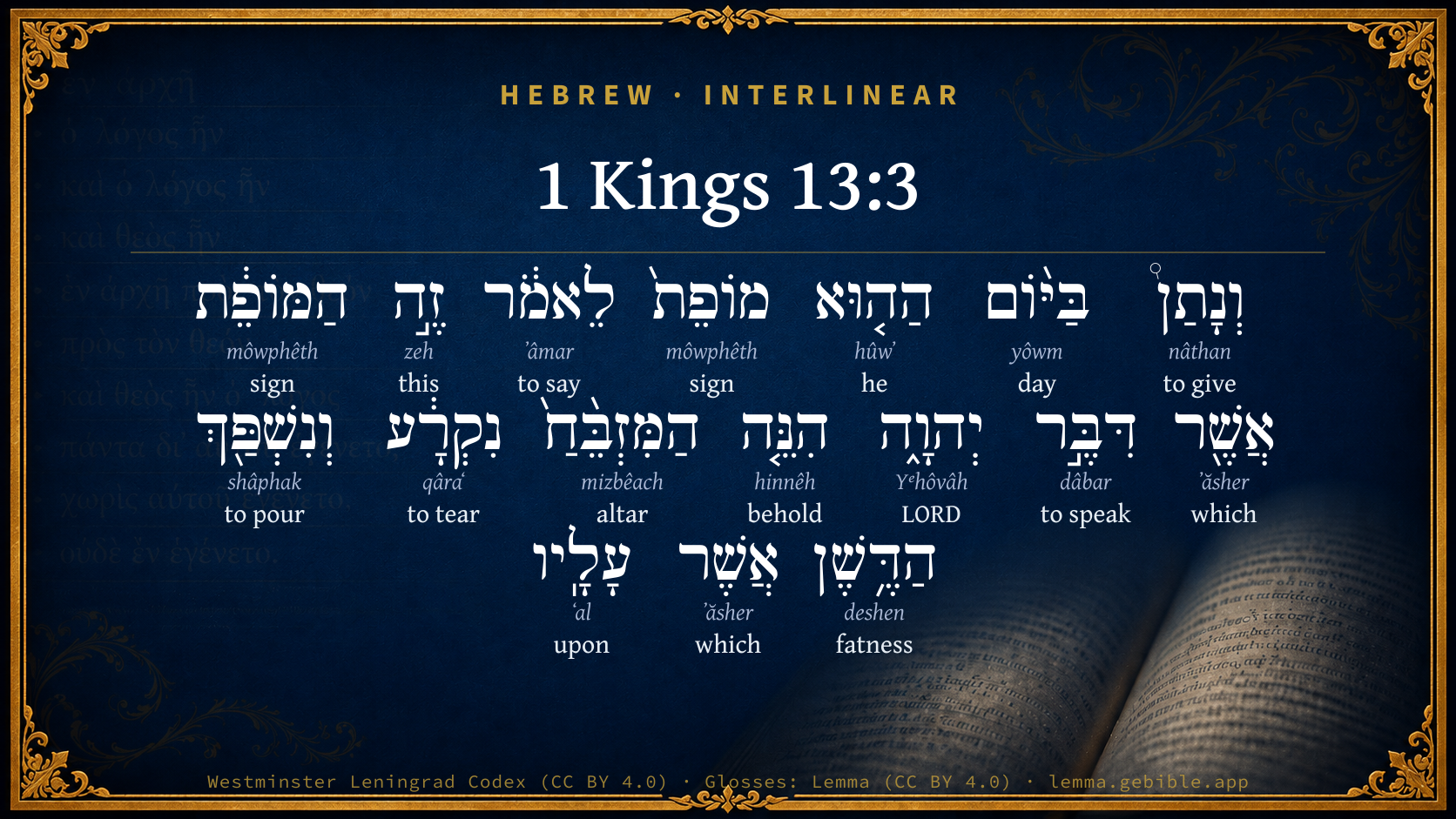
  1. וְנָתַן֩ nâthan H5414 “and · to give” Conjunction + Verb, Qal, Perfect, 3rd Person, Masculine, Singular
  2. בַּיּ֨וֹם yôwm H3117 “in/at the · day” Preposition, Determined + Noun, Common, Masculine, Singular, Absolute
  3. הַה֤וּא hûwʼ H1931 “the · he” Particle, Definite Article + Pronoun, Personal, 3rd Person, Masculine, Singular
  4. מוֹפֵת֙ môwphêth H4159 “sign” Noun, Common, Masculine, Singular, Absolute
  5. לֵאמֹ֔ר ʼâmar H559 “to say” Preposition + Verb, Qal, Infinitive Construct
  6. זֶ֣ה zeh H2088 “this” Pronoun, Demonstrative, Masculine, Singular
  7. הַמּוֹפֵ֔ת môwphêth H4159 “the · sign” Particle, Definite Article + Noun, Common, Masculine, Singular, Absolute
  8. אֲשֶׁ֖ר ʼăsher H834 “which” Particle, Relative
  9. דִּבֶּ֣ר dâbar H1696 “to speak” Verb, Piel, Perfect, 3rd Person, Masculine, Singular
  10. יְהוָ֑ה Yᵉhôvâh H3068 “LORD” Noun, Proper
  11. הִנֵּ֤ה hinnêh H2009 “behold” Particle, Demonstrative
  12. הַמִּזְבֵּ֨חַ֙ mizbêach H4196 “the · altar” Particle, Definite Article + Noun, Common, Masculine, Singular, Absolute
  13. נִקְרָ֔ע qâraʻ H7167 “to tear” Verb, Niphal, Perfect, 3rd Person, Masculine, Singular
  14. וְנִשְׁפַּ֖ךְ shâphak H8210 “and · to pour” Conjunction + Verb, Niphal, Perfect, 3rd Person, Masculine, Singular
  15. אֲשֶׁר ʼăsher H834 “which” Particle, Relative
  16. עָלָֽיו ʻal H5921 “upon · him” Preposition + Suffix, Personal, 3rd Person, Masculine, Singular

About this verse

These counts appear in no published source. They are computed here, from the morphology-tagged text and Lemma’s own curated glosses. What Lemma adds →

17
words
15
distinct lemmas
Historical
section

Notable vocabulary

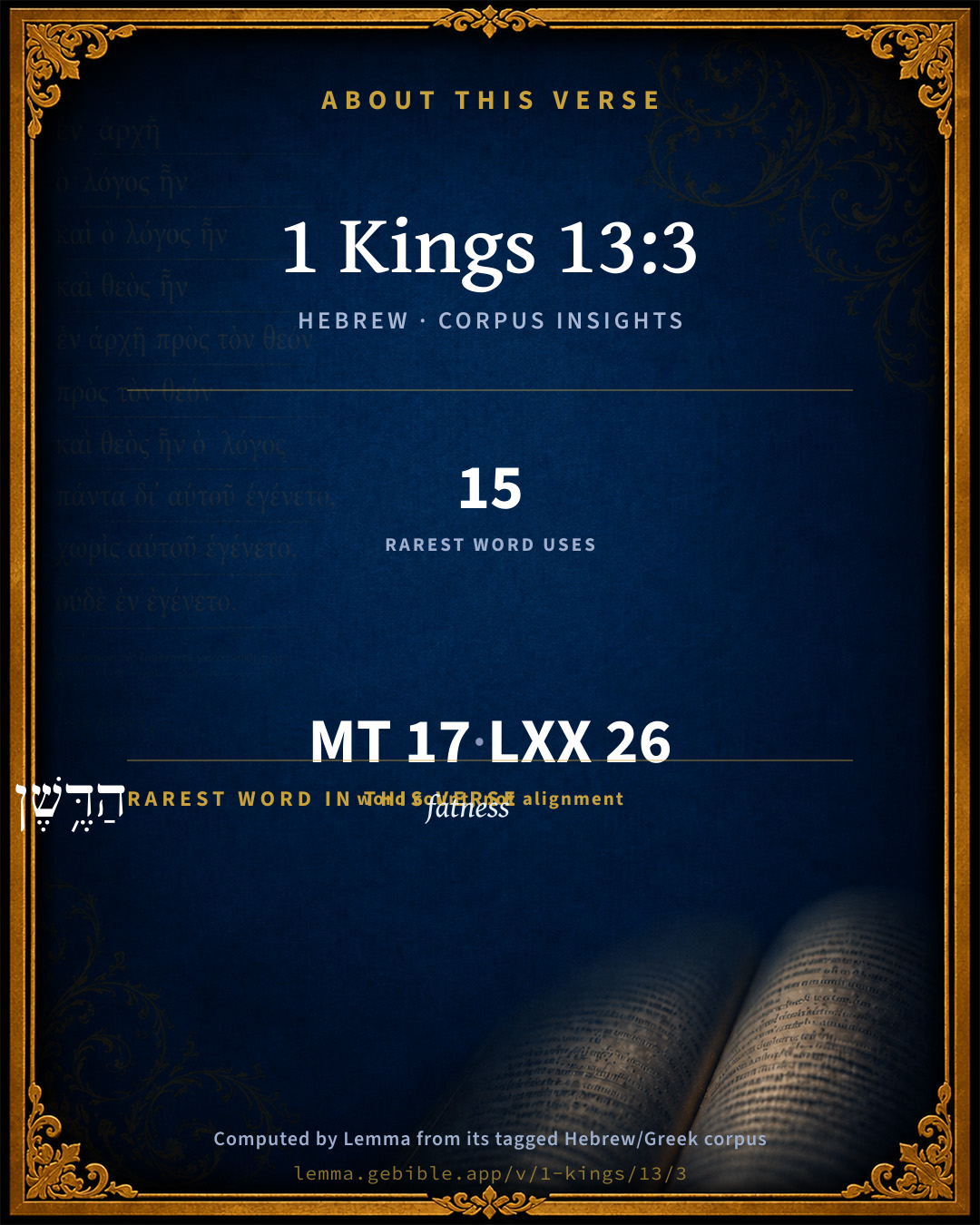
The rarest word here is הַדֶּ֥שֶׁן fatness H1880 — appearing just 15 times in the whole Hebrew Bible.

Shared distinctive vocabulary

הַדֶּ֥שֶׁן fatness H1880 occurs in 14 verses of the Hebrew Bible. Also found in:

Grammatical profile

  • 5 verbs
  • 6 nouns
  • 2 pronouns
  • 1 preposition
  • 3 particles

Verb forms

  • וְנָתַן֩ Qal · Perfect
  • לֵאמֹ֔ר Qal · Infinitive Construct
  • דִּבֶּ֣ר Piel · Perfect
  • נִקְרָ֔ע Niphal · Perfect
  • וְנִשְׁפַּ֖ךְ Niphal · Perfect

Repetition

Words recur within this verse — often emphatic in Hebrew:

  • מוֹפֵת֙ sign H4159 ×2
  • אֲשֶׁ֖ר which H834 ×2

Hebrew & Septuagint length

In English translation the verse runs 33 words from the Hebrew and 34 from the Septuagint (LXX English) — closely comparable.

A rough comparison of the two English renderings, which tokenize alike — not a word-level alignment.

Word counts can differ between the Hebrew and the Greek without any difference in meaning — e.g. the Hebrew direct-object marker אֵת has no separate Greek word, and Greek often adds the article ὁ.

In the original languages it is 17 Hebrew tokens and 26 Greek tokens — but the two are counted differently (Hebrew bundles its prefixes and suffixes into one token; the Greek is in lemma form), so that isn’t a like-for-like length.

Cross-references

14

Topical passages linked to 1 Kings 13:3 in the Treasury of Scripture Knowledge — connected by theme and wording, ordered by reader-vote popularity; previews shown in the World English Bible.

  • 1 Corinthians 1:22 For Jews ask for signs, Greeks seek after wisdom,
  • Exodus 4:3–5 He said, "Throw it on the ground." He threw it on the ground, and it became a snake; and Moses ran away from it.
  • Judges 6:17 He said to him, If now I have found favor in your sight, then show me a sign that it is you who talk with me.
  • John 2:18 The Jews therefore answered him, "What sign do you show us, seeing that you do these things?"
  • Exodus 4:8–9 "It will happen, if they will neither believe you nor listen to the voice of the first sign, that they will believe the voice of the latter sign.
  • Exodus 7:10 Moses and Aaron went in to Pharaoh, and they did so, as Yahweh had commanded: and Aaron cast down his rod before Pharaoh and before his servants, and it became a serpent.
  • Deuteronomy 13:1–3 If there arise in the midst of you a prophet, or a dreamer of dreams, and he give you a sign or a wonder,
  • 1 Samuel 2:34 This shall be the sign to you, that shall come on your two sons, on Hophni and Phinehas: in one day they shall die both of them.
  • 2 Kings 20:8 Hezekiah said to Isaiah, What shall be the sign that Yahweh will heal me, and that I shall go up to the house of Yahweh the third day?
  • Isaiah 7:11–14 "Ask a sign of Yahweh your God; ask it either in the depth, or in the height above."
  • Isaiah 38:6–8 I will deliver you and this city out of the hand of the king of Assyria; and I will defend this city.
  • Isaiah 38:22 Hezekiah also had said, What is the sign that I shall go up to the house of Yahweh?
  • Jeremiah 44:29 This shall be the sign to you, says Yahweh, that I will punish you in this place, that you may know that my words shall surely stand against you for evil:
  • Matthew 12:38–40 Then certain of the scribes and Pharisees answered, "Teacher, we want to see a sign from you."

Cross-references courtesy of OpenBible.info (CC BY 4.0).

Hebrew and Greek witnesses Masoretic Hebrew ↔ Greek Septuagint

The same verse in the two great witnesses to the Old Testament, shown verse-for-verse.

These are two independent witnesses, not word-aligned to each other, and the Septuagint is shown in lemma (dictionary) form.

Hebrew 1 Kings 13:3 Masoretic · Westminster Leningrad Codex

וְנָתַן֩ בַּיּ֨וֹם הַה֤וּא מוֹפֵת֙ לֵאמֹ֔ר זֶ֣ה הַמּוֹפֵ֔ת אֲשֶׁ֖ר דִּבֶּ֣ר יְהוָ֑ה הִנֵּ֤ה הַמִּזְבֵּ֨חַ֙ נִקְרָ֔ע וְנִשְׁפַּ֖ךְ הַדֶּ֥שֶׁן אֲשֶׁר עָלָֽיו

He gave a sign the same day, saying, This is the sign which Yahweh has spoken: Behold, the altar shall be torn, and the ashes that are on it shall be poured out.

World English Bible · Public Domain

Greek LXX 1 Kings 13:3 Septuagint · lemma form

καί δίδωμι ἐν ὁ ἡμέρα ἐκεῖνος τέρας λέγω οὗτος ὁ ῥῆμα ὅς λαλέω κύριος λέγω ἰδού ὁ θυσιαστήριον ῥήγνυμι καί ἐκχέω ὁ πιότης ὁ ἐπί αὐτός

And in that day one shall give a sign, saying, This is the word which the Lord has spoken, saying, Behold, the altar is torn, and the fatness upon it shall be poured out.

LXX2012 (modern English Septuagint) · Public Domain

On this verse, The Cambridge Bible for Schools and Colleges discusses the Septuagint’s reading. Read the note in Commentary ↓

Hebrew: Westminster Leningrad Codex (CC BY 4.0). Greek: Septuagint (public domain); English from LXX2012 (modern English Septuagint) (Public Domain). How the Septuagint differs from the Hebrew →

Targum (Aramaic paraphrase)

1

The Targum is the ancient Jewish Aramaic paraphrase of the Hebrew Scriptures — an interpretive translation, not the Hebrew text itself. Onkelos (literal) and Pseudo-Jonathan (expansive) render the Torah, and Jonathan the Prophets. Coverage is partial: where no permissively-licensed English translation exists for a verse, only the Aramaic is shown. This is verse-level text, not a word-by-word alignment to the Hebrew.

  1. Targum Jonathan Prophets (Joshua–Malachi)
    וְיִתֵּן בְּיוֹמָא הַהוּא אָתָא לְמֵימַר דָא אָתָא דִי מַלֵיל יְיָ דְתִידְעוּן דִי שַׁלְחַנִי יְיָ הָא מַדְבְּחָא מִתְבְּזַע וּמִשְׁתַּפֵּיךְ קִטְמָא דִי עֲלוֹהִי:

    (no public-domain English translation for this verse)

    Targum Jonathan — Aramaic: “Mikraot Gedolot” (public domain). English: “Sefaria Community Translation” (CC0 1.0 (public-domain dedication)); “London "Chaldee Paraphrase," 1871” (public domain). Text via Sefaria.

Commentary

Notes on 1 Kings 13:3 from classic Christian and Jewish commentators (each source and its license shown beneath its notes). The classic Christian expositions comment on the surrounding passage and are grouped to its opening verse, so a note may address several verses; the Jewish commentaries on the Tanakh (Rashi and others) are per-verse, so they appear only where the commentator wrote on this verse.

Lemma curates 59 commentaries, every one of them public domain or Creative Commons licensed, each selected and text-cleaned for this edition rather than reprinted as found. About our sources →

Trapp's Complete Commentary

John Trapp

1Ki 13:3 And he gave a sign the same day, saying, This [is] the sign which the LORD hath spoken; Behold, the altar shall be rent, and the ashes that [are] upon it shall be poured out.

Ver. 3. Behold, the altar shall be rent.] To foreshow the downfall of that idolatry. So the veil of the temple rent at Christ’s death, {Mat 27:51} to show that there was an end of the Levitical liturgy. And so, about the beginning of the Reformation by Luther, a great solid stone fell down upon a brass image of Peter in Rome, that had those words fairly embossed upon it, Tu es Petrus, &c., You are Peter &c., and so shattered it to pieces, that nothing was left legible, but only those words, Aedificabo Ecclesiam meam, I will build my Church. This might be a foretoken of Rome’s ruin: which God hath already begun, and will surely perfect.

John Trapp, A Commentary or Exposition upon All the Books of the Old and New Testament (1647–1656) — public domain. Text from a community e-Sword module.

Joseph Benson's Commentary

1Ki 13:3. He gave a sign the same day — That is, he then wrought a miracle to assure them of the truth of his prophecy. Saying, this is the sign, &c. — A proof that I speak from God, and not from myself. The altar shall be rent, &c. — This could not be effected but by the power of God, who hereby demonstrated that he had sent this prophet to speak these words which were presently fulfilled.

Joseph Benson's Commentary on the Old and New Testaments (1811–1818) — public domain. Text from a community e-Sword module.

Tyndale Open Study Notes

Tyndale Open Resources

13:3 In Levitical regulations, ashes from sacrifices at the prescribed altar were to be taken to a clean place (Lev 1:16; 6:10-11). Because Jeroboam’s altar . . . split apart, and its ashes . . . poured out, the altar and its sacrifices were rendered unclean.

Tyndale Open Study Notes — © Tyndale Open Resources, licensed CC BY-SA 4.0. Text via the HelloAO Bible API.

Geneva Bible (1599)

Geneva Bible translators

Or, be poured out.

By this sign ye shall know that the Lord hath sent me.

Geneva Bible (1599) marginal notes — public domain. Text via Bolls.life.

Adam Clarke's Commentary

Verse 3. And he gave a sign] A miracle to prove that the prophecy should be fulfilled in its season.

Adam Clarke's Commentary on the Bible (1810–1826) — public domain. Text from a community e-Sword/MySword module.

Ellicott's Commentary for English Readers

(3, 4) The sign.—Both the signs, like most miraculous signs, shadow forth plainly the thing signified. The sign, announced to secure credence to the prediction, is itself a visible type of what that prediction foretold, in the shattering of the altar and the scattering of the ashes of the burnt-offering. The sign actually given includes, besides this, the sudden withering of the king’s hand, stretched out in defiance of the prophet—an equally plain symbol of the miserable failure of his strength and policy, when opposed to the Law and the judgment of God. It should be noted that the withdrawal of this last sign of wrath, on the submission of the king and the prayer of the prophet, was apparently designed to give Jeroboam one more opportunity of repentance. The last verses of the chapter (1Ki_13:33-34) seem to imply that, but for the interposition of the old prophet of Bethel, he might still have taken that opportunity.

A Bible Commentary for English Readers, edited by Charles John Ellicott (1878–1897) — public domain. Text from a community e-Sword module.

The Cambridge Bible for Schools and Colleges

gen. ed. J. J. S. Perowne

3. And he gave a sign the same day] The sign was necessary because the event foretold was to be at so remote a date that none who were living in Jeroboam’s day would be alive to see it. Hence to assure them that it would come to pass a startling token of the power in which the prophet spake is exhibited by the rending of the altar and the scattering of what was on it in the presence of all who stood by. The word מופת rendered ‘sign’, is much more frequently used of ‘wonders’ and ‘miracles’, and it has that sense in some degree here. With this we may compare the use of τέρας as well as σημεῖον for the miracles of the New Testament.

and the ashes that are upon it] The Hebrew word, which is the same as that so often rendered ‘fatness’, applies only to the ashes of an altar, which would be mixed up with the fat of sacrifices burnt upon it. Hence the LXX. renders by ἡ πιότης ‘the fat’, or ‘fatness’.

The Cambridge Bible for Schools and Colleges (gen. ed. J. J. S. Perowne; Cambridge University Press, 1878–1918) — public domain. Text from a community e-Sword module.

John Gill's Exposition

And he gave a sign the same day, saying, this is the sign which the Lord hath spoken,.... As a confirmation of the truth of what the prophet had said, and for the proof of his being a true prophet of the Lord:

behold, the altar shall be rent; of itself, by an invisible hand, by the power of God:

and the ashes that are upon it shall be poured out; signifying it should be entirely demolished, not only shaken but destroyed, so as not to be capable of retaining the ashes on it; this was an emblem of the utter abolition of idolatry here in future times.

John Gill's Exposition of the Whole Bible (1746–1763) — public domain (CC PDM 1.0). Text via the HelloAO Bible API.

Albert Barnes' Notes on the Bible

He gave a sign - A sign of this kind - an immediate prophecy to prove the divine character of a remote prophecy - had scarcely been given before this. In the later history, however, such signs are not unfrequent (compare 2Ki 19:29; Isa 7:14-16).

The ashes ... shall be poured out - i. e., “The half-burnt remains of the offerings shall be ignominiously spilled upon the ground.”

Albert Barnes' Notes on the Bible (1834–1885) — public domain. Text from a community e-Sword/MySword module.

Haydock's Catholic Bible Commentary

Sign. This would take place immediately, to convince the king that what he had said would be accomplished. So Moses and Achaz were treated, Exodus iii. 2, 12., and Isaias vii. 14, 16. (Calmet)

George Leo Haydock (1774–1849), Haydock's Catholic Family Bible and Commentary, 1859 edition — public domain. Excludes Psalms (Douay-Rheims chapter numbering differs from Protestant) and Deuterocanonical books (Catholic canon only).

Matthew Poole's English Annotations

He gave a sign the same day, i. e. he then wrought a miracle, to assure them of the truth of his prophecy.

Matthew Poole's English Annotations on the Holy Bible (1683–1685) — public domain. Text from a community e-Sword/MySword module.

Whedon's Commentary on the Bible

Daniel D. Whedon

3. He gave a sign — He wrought a miracle as the evidence of his Divine authority — the credentials of his being Jehovah’s ambassador. “Without this sign, the prophecy of an event that did not take place for three hundred and fifty years would have wanted authority with those who knew not the utterer.” — Kitto.

Daniel D. Whedon (gen. ed.), Commentary on the Old and New Testaments (1874–1909) — public domain. Text from a community e-Sword module.

The Pulpit Commentary

And he gave a sign The Heb. tpewOm rather signifies a portent (terav, miraculum, prodigium) than a sign, the proper word for which is twOa. The word occurs repeatedly in the Pentateuch, where it is rendered wonder, or miracle, by our translators (Wordsworth). Signs had, of course, been given before (Exo_4:30 Exo_7:9; 1Sa_12:17; etc.) but hardly in such immediate attestation of a special message. From this time forward such signs are not infrequent (Isa_7:14 Isa_38:8; 2Ki_19:29) They mark the decline of faith. (Mat_12:39) As to the need at this crisis for some miraculous token, see Homiletics. The fitness of this particular sign is obvious the same day, saying, This is the sign which Rather that; r =quod. The A.V rendering hardly makes sense. Nor does it agree, as Rawlinson seems to think, with the LXX, which reads touto tohse kuriov, etc. the Lord hath spoken i.e. , by me. "This is the proof that my message is from Him, and is no idle threat." Wordsworth sees in this sign "a proof vouchsafed by God Himself to the man of Judah, as well as to Jeroboam, that he was really sent by God," etc. But surely a man who came "in the word of the Lord," and cried, "Thus saith the Lord," wanted no proof that "he was doing God"s bidding"; (see 1Co_14:22) Behold, the altar shall be rent and the ashes strictly, fat ashes. V,d,; properly, "fatness" (see Jud_1:9:9; Psa_63:5. piothv, LXX), is the fat of the sacrifice, which was burnt upon the altar, mixed with the ashes that consumed it that are upon it shall be poured out. The sign, a partial destruction of the altar, and the scattering of the sacrifice, was admirably calculated to presage its ultimate and final and ignominious overthrow. The idea favoured by Stanley ("Jewish Ch." 2:280) that this prediction was fulfilled "if not before, at least" in the time of Amos, when the altar was destroyed by an earthquake shock (Amo_9:1; cf. 3:14), does not seem to take account of ver. 5.

The Pulpit Commentary (1880–1919), ed. H.D.M. Spence-Jones & Joseph S. Exell — public domain. Text from a community e-Sword module.

John Wesley's Explanatory Notes

Gave a sign - That is, he then wrought a miracle, to assure them of the truth of his prophecy.

John Wesley, Explanatory Notes Upon the Whole Bible (1754–1765) — public domain. Text via the GEBible commentary corpus.

Rashi

Rabbi Shlomo Yitzchaki (Rashi)

And he gave on that day. The prophet [gave] a sign on the day that he prophesied, [saying,] “This is your sign, the altar will split by itself today, and the ashes will be spilled onto the ground.”

Rashi on the Tanakh — English translations: “The Judaica Press complete Tanach with Rashi, translated by A. J. Rosenberg” (CC BY 4.0); “Pentateuch with Rashi's commentary by M. Rosenbaum and A.M. Silbermann, 1929-1934” (public domain); “The Metsudah Tanach series, Lakewood, N.J” (CC BY 4.0); and “The Book of Joshua, Metsudah Publications, 1997” (CC BY 4.0). Text via Sefaria.

Lesson kit

Teaching starters — assembled from the data on this page, not authored interpretation. Every prompt links to the verse data it draws on. Edit before teaching.

1 Kings, in the Historical, opens this verse with 17 words (15 distinct Hebrew lemmas). Its most distinctive word is deshen (“fatness”). A historical commentator’s framing appears above. Read the whole chapter for the surrounding context.

Discussion questions

  1. The word deshen carries the sense “fatness.” How does it shape the verse?
  2. Leviticus 1:16 shares the word «fatness» with this verse. How do the two illuminate each other?
  3. “sign” occurs 2× in this one verse. What is the effect of the repetition?
  4. These translations render this verse differently; the difference is in the English rendering, not the original. What questions does that raise?
  5. The verb «וְנָתַן֩» is Qal Perfect. How does its form color the action?
  6. Reading how Trapp's Complete Commentary and Joseph Benson's Commentary read this verse, where do the two commentators agree and where do they part?

Things to notice

Reading settings

Reading text

Shown beneath each verse's original-language words.

Old Testament
Old Testament edition

Read the OT as the Masoretic Hebrew (MT) or the Greek Septuagint (LXX).

English shown for the Greek Septuagint (in the Hebrew ↔ Greek comparison).

Comparing translations? Open the Compare panel on any verse page to stack up to four side by side.