Exodus 25:21

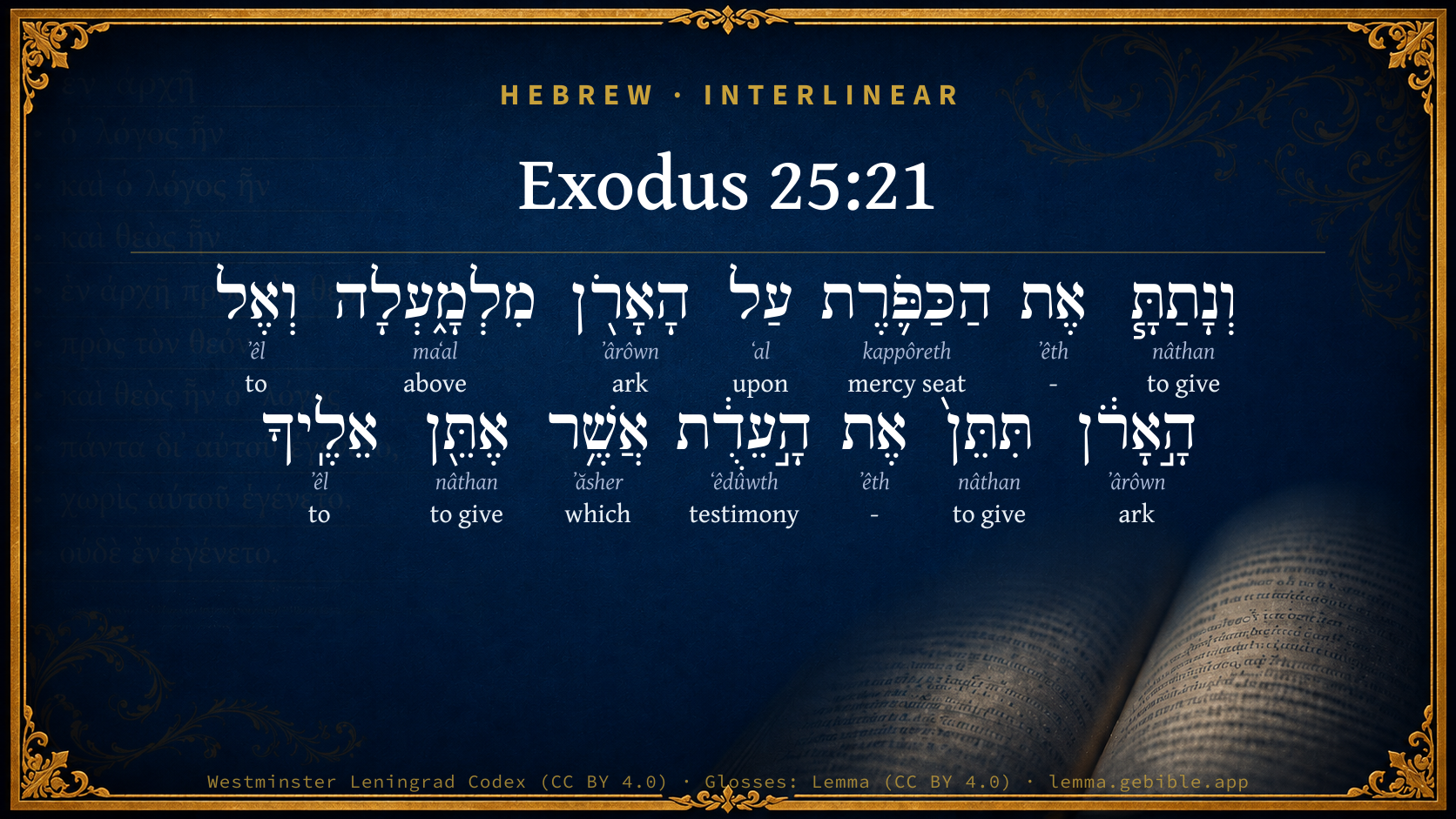
Hebrew (Westminster Leningrad Codex) Exodus 25:21 appears in the Hebrew Old Testament. The text above is from the Westminster Leningrad Codex. Each word links to its Strong’s number, a concise gloss, and parsing drawn from the Open Scriptures Hebrew Bible morphology. Click any word for its full Brown-Driver-Briggs (BDB) entry.
Download image
Cite this verse

Exodus 25:21 (World English Bible). Public Domain. Lemma interlinear Bible study tool, https://lemma.gebible.app/v/exodus/25/21.

Show BibTeX & RIS
BibTeX
RIS
English Translation
You shall put the mercy seat on top of the ark, and in the ark you shall put the testimony that I will give you.
World English Bible · Public Domain
Download a study sheet

One document with this verse’s original text, its word-by-word gloss line, the meaning frame, cross-references with their text, attributed commentary, and full source and license credits — printable, and it pastes into notes with its structure intact.

This verse Autodidact and up

Study sheet (.html) Plain text (.txt)

A passage Seminary Student

Up to 50 verses in one chapter. A passage sheet keeps up to 6 commentary sources and 12 cross-references per verse, in the order this page ranks them, and says so on the sheet whenever that leaves anything out. Ask for a single verse and you get the Autodidact verse sheet above.

Everything on this page stays free to read, with no account — the sheet is a download of what is already on screen, not access to it.

Want to remove ads? Support Godless Engineer
Compare translations 3

The same verse in 3 English versions, stacked beneath the original-language interlinear above. Click any original word for its lexicon entry.

Each is an independent rendering of the whole verse — the interlinear is not word-aligned to these translations.

Highlighted words mark where these versions differ — a whole-verse word diff, not a word-by-word alignment.

  • World English Bible Public Domain
    You shall put the mercy seat on top of the ark, and in the ark you shall put the testimony that I will give you.
  • King James Version Public Domain
    And thou shalt put the mercy seat above upon the ark; and in the ark thou shalt put the testimony that I shall give thee.
  • unfoldingWord Literal Text CC BY-SA 4.0
    And you shall put the atonement lid on the box from above, and you shall put into the box the Testimony that I give to you.

unfoldingWord Literal Text — © unfoldingWord, licensed CC BY-SA 4.0. Word-aligned USFM3 via Door43 (git.door43.org/unfoldingWord/en_ult).

Versions to compare (up to 4)

3 of 4 selected

Show all 18 translations

Every available English version of this verse, each an independent rendering of the whole verse.

  • World English Bible Public Domain
    You shall put the mercy seat on top of the ark, and in the ark you shall put the testimony that I will give you.
  • Berean Standard Bible Public Domain
    Set the mercy seat atop the ark, and put the Testimony that I will give you into the ark.
  • Majority Standard Bible Public Domain
    Set the mercy seat atop the ark and put the Testimony that I will give you into the ark.
  • King James Version Public Domain
    And thou shalt put the mercy seat above upon the ark; and in the ark thou shalt put the testimony that I shall give thee.
  • American Standard Version (1901) Public Domain
    And thou shalt put the mercy-seat above upon the ark; and in the ark thou shalt put the testimony that I shall give thee.
  • Revised Version (1885) Public Domain
    And thou shalt put the mercy-seat above upon the ark; and in the ark thou shalt put the testimony that I shall give thee.
  • Geneva Bible (1599) Public Domain
    And thou shalt put the Mercieseate aboue vpon the Arke, and in the Arke thou shalt put the Testimonie, which I will giue thee,
  • Douay-Rheims (1899) Public Domain
    In which thou shalt put the testimony that I will give thee.
  • Young's Literal Translation Public Domain
    `And thou hast put the mercy-seat on the ark above, and unto the ark thou dost put the testimony which I give unto thee;
  • Literal Standard Version CC BY-SA 4.0
    And you have put the propitiatory covering on the Ark above, and you put the Testimony which I give to you into the Ark;
  • Unlocked Literal Bible CC BY-SA 4.0
    You must put the atonement lid on top of the ark, and you must put into the ark the covenant decrees that I am giving you.
  • unfoldingWord Literal Text CC BY-SA 4.0
    And you shall put the atonement lid on the box from above, and you shall put into the box the Testimony that I give to you.
  • Darby Bible Public Domain
    And thou shalt put the mercy-seat above on the ark, and shalt put in the ark the testimony that I shall give thee.
  • World Messianic Bible Public Domain
    You shall put the mercy seat on top of the ark, and in the ark you shall put the covenant that I will give you.
  • Webster's Bible Public Domain
    And thou shalt put the mercy-seat above upon the ark; and in the ark thou shalt put the testimony that I shall give thee.
  • Free Bible Version CC BY-SA 4.0
    Place the atonement cover on top of the Ark, and put the Testimony that I'm going to give you inside the Ark.
  • Bible in Basic English Public Domain
    And put the cover over the ark, and in the ark the record which I will give you.
  • JPS Tanakh (1917) Public Domain
    And thou shalt put the ark-cover above upon the ark; and in the ark thou shalt put the testimony that I shall give thee.

Literal Standard Version (2020), Covenant Press — licensed CC BY-SA 4.0. Text via the HelloAO Bible API (eBible.org). Unlocked Literal Bible (unfoldingWord) — licensed CC BY-SA 4.0. Text via the HelloAO Bible API (eBible.org). unfoldingWord Literal Text — © unfoldingWord, licensed CC BY-SA 4.0. Word-aligned USFM3 via Door43 (git.door43.org/unfoldingWord/en_ult). Free Bible Version, Dr. Jonathan Gallagher — licensed CC BY-SA 4.0. Text via the HelloAO Bible API (eBible.org).

Word by word

More ways to search: Search by grammar → Find every occurrence → Compare this word →

Practice this passage: Drill this verse → Learn its vocabulary →

הַכַּפֹּ֛רֶת
kappôreth
H3727
“the · mercy seat”
Particle, Definite Article + Noun, Common, Feminine, Singular, Absolute
Part of Speech
Particle + Noun
Type
Common
Gender
Feminine
Number
Singular
State
Absolute
Full BDB Definition

Origin: from H3722

TWOT: 1023c

mercy-seat, place of atonement - the golden plate of propitiation on which the High Priest sprinkled the seat 7 times on the Day of Atonement symbolically reconciling Jehovah and His chosen people - the slab of gold on top of the ark of the covenant which measured 2.5 by 1.5 cubits; on it and part of it were the two golden cherubim facing each other whose outstretched wings came together above and constituted the throne of God
  1. וְנָתַתָּ֧ nâthan H5414 “and · to give” Conjunction + Verb, Qal, Sequential Perfect, 2nd Person, Masculine, Singular
  2. אֶת ʼêth H853 “-” Particle, Direct Object
  3. עַל ʻal H5921 “upon” Preposition
  4. הָאָרֹ֖ן ʼârôwn H727 “the · ark” Particle, Definite Article + Noun, Common, Both, Singular, Absolute
  5. מִלְמָ֑עְלָה maʻal H4605 “from · to/for · above · toward” Preposition + Preposition + Adverb + Suffix, Demonstrative
  6. וְאֶל ʼêl H413 “and · to” Conjunction + Preposition
  7. הָ֣אָרֹ֔ן ʼârôwn H727 “the · ark” Particle, Definite Article + Noun, Common, Both, Singular, Absolute
  8. תִּתֵּן֙ nâthan H5414 “to give” Verb, Qal, Imperfect, 2nd Person, Masculine, Singular
  9. אֶת ʼêth H853 “-” Particle, Direct Object
  10. הָ֣עֵדֻ֔ת ʻêdûwth H5715 “the · testimony” Particle, Definite Article + Noun, Common, Feminine, Singular, Absolute
  11. אֲשֶׁ֥ר ʼăsher H834 “which” Particle, Relative
  12. אֶתֵּ֖ן nâthan H5414 “to give” Verb, Qal, Imperfect, 1st Person, Common, Singular
  13. אֵלֶֽיךָ ʼêl H413 “to · you” Preposition + Suffix, Personal, 2nd Person, Masculine, Singular

About this verse

These counts appear in no published source. They are computed here, from the morphology-tagged text and Lemma’s own curated glosses. What Lemma adds →

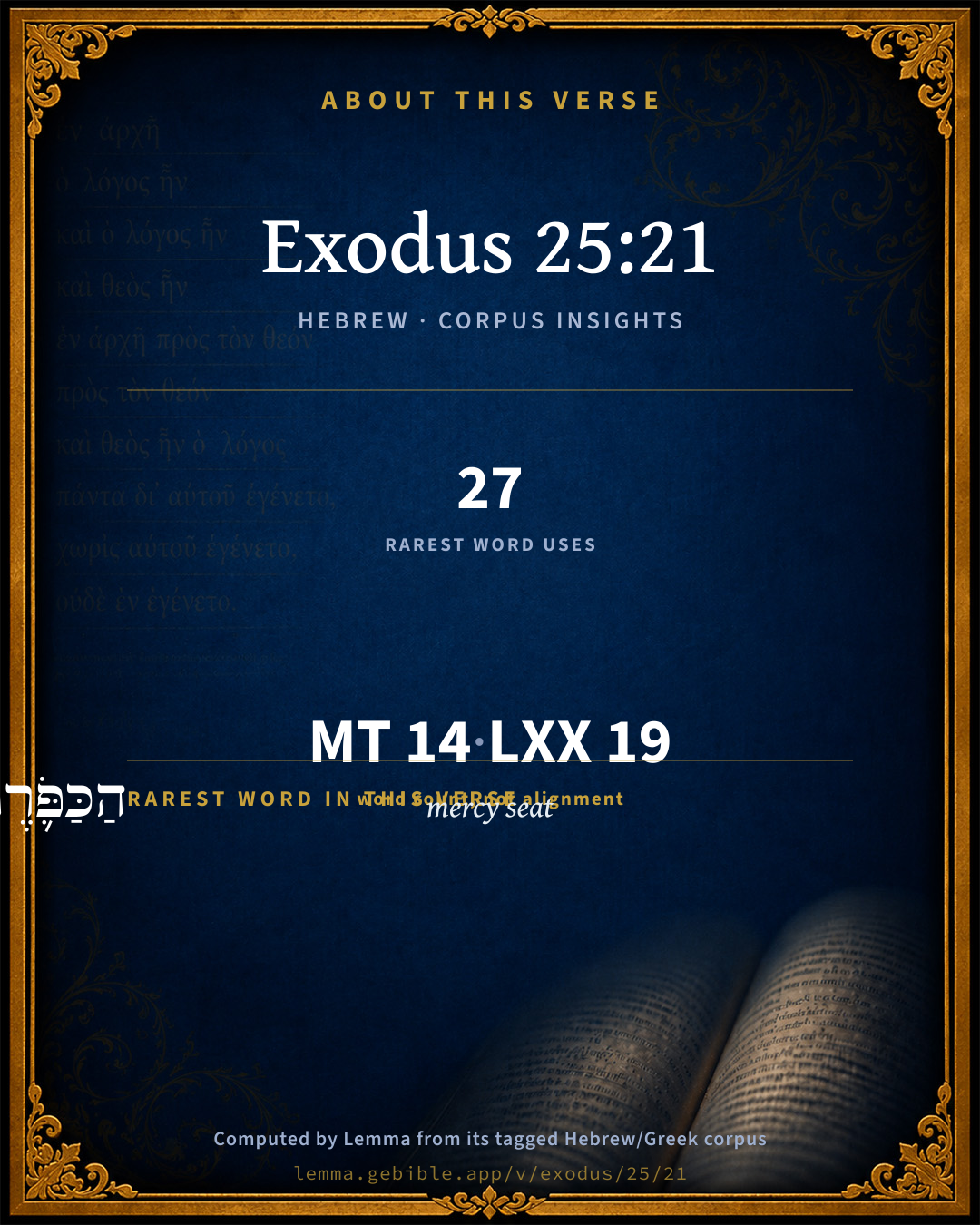
14
words
9
distinct lemmas
Pentateuch
section

Shared distinctive vocabulary

הַכַּפֹּ֛רֶת mercy seat H3727 occurs in 22 verses of the Hebrew Bible. Also found in:

Grammatical profile

  • 3 verbs
  • 4 nouns
  • 3 prepositions
  • 1 adverb
  • 3 particles

Verb forms

  • וְנָתַתָּ֧ Qal · Sequential Perfect
  • תִּתֵּן֙ Qal · Imperfect
  • אֶתֵּ֖ן Qal · Imperfect

Repetition

Words recur within this verse — often emphatic in Hebrew:

  • וְנָתַתָּ֧ to give H5414 ×3
  • הָאָרֹ֖ן ark H727 ×2
  • וְאֶל to H413 ×2

Hebrew & Septuagint length

In English translation the verse runs 25 words from the Hebrew and 24 from the Septuagint (LXX English) — closely comparable.

A rough comparison of the two English renderings, which tokenize alike — not a word-level alignment.

Word counts can differ between the Hebrew and the Greek without any difference in meaning — e.g. the Hebrew direct-object marker אֵת has no separate Greek word, and Greek often adds the article ὁ.

In the original languages it is 14 Hebrew tokens and 19 Greek tokens — but the two are counted differently (Hebrew bundles its prefixes and suffixes into one token; the Greek is in lemma form), so that isn’t a like-for-like length.

Cross-references

3

Topical passages linked to Exodus 25:21 in the Treasury of Scripture Knowledge — connected by theme and wording, ordered by reader-vote popularity; previews shown in the World English Bible.

  • Exodus 26:34 You shall put the mercy seat on the ark of the testimony in the most holy place.
  • Romans 10:4 For Christ is the fulfillment of the law for righteousness to everyone who believes.
  • Exodus 25:16–17 You shall put the testimony which I shall give you into the ark.

Cross-references courtesy of OpenBible.info (CC BY 4.0).

Hebrew and Greek witnesses Masoretic Hebrew ↔ Greek Septuagint

The same verse in the two great witnesses to the Old Testament, shown verse-for-verse.

These are two independent witnesses, not word-aligned to each other, and the Septuagint is shown in lemma (dictionary) form.

Hebrew Exodus 25:21 Masoretic · Westminster Leningrad Codex

וְנָתַתָּ֧ אֶת הַכַּפֹּ֛רֶת עַל הָאָרֹ֖ן מִלְמָ֑עְלָה וְאֶל הָ֣אָרֹ֔ן תִּתֵּן֙ אֶת הָ֣עֵדֻ֔ת אֲשֶׁ֥ר אֶתֵּ֖ן אֵלֶֽיךָ

You shall put the mercy seat on top of the ark, and in the ark you shall put the testimony that I will give you.

World English Bible · Public Domain

Greek LXX Exodus 25:21 Septuagint · lemma form

καί ἐπιτίθημι ὁ ἱλαστήριον ἐπί ὁ κιβωτός ἄνωθεν καί εἰς ὁ κιβωτός ἐνβάλλω ὁ μαρτύριον ὅς ἄν δίδωμι σύ

And you shall set the propitiatory on the ark above, and you shall put into the ark the testimonies which I shall give you.

LXX2012 (modern English Septuagint) · Public Domain

Hebrew: Westminster Leningrad Codex (CC BY 4.0). Greek: Septuagint (public domain); English from LXX2012 (modern English Septuagint) (Public Domain). How the Septuagint differs from the Hebrew →

Targum (Aramaic paraphrase)

2

The Targum is the ancient Jewish Aramaic paraphrase of the Hebrew Scriptures — an interpretive translation, not the Hebrew text itself. Onkelos (literal) and Pseudo-Jonathan (expansive) render the Torah, and Jonathan the Prophets. Coverage is partial: where no permissively-licensed English translation exists for a verse, only the Aramaic is shown. This is verse-level text, not a word-by-word alignment to the Hebrew.

  1. Targum Onkelos Torah (Genesis–Deuteronomy)
    וְתִתֵּן יָת כַּפֻּרְתָּא עַל אֲרוֹנָא מִלְעֵלָא וּבַאֲרוֹנָא תִּתֵּן יָת סַהֲדוּתָא דִי אֶתֵּן לָךְ:

    (no public-domain English translation for this verse)

    Targum Onkelos — Aramaic: “Onkelos Genesis” (public domain); “Onkelos Exodus” (public domain); “Onkelos Leviticus” (public domain); “Onkelos Numbers” (public domain); “Onkelos Deuteronomy” (public domain). English: “Sefaria Community Translation” (CC0 1.0 (public-domain dedication)); “J.W. Etheridge. The Targums of Onkelos and Jonathan Ben Uzziel on the Pentateuch. London: Longmans, Green, 1862” (public domain). Text via Sefaria.

  2. Targum Pseudo-Jonathan Torah (Genesis–Deuteronomy)
    וְתִתֵּן יַת כַּפּוּרְתָּא עַל אֲרוֹנָא מִלְעֵילָא וּבְגוֹ אֲרוֹנָא תִּתֵּן יַת לוּחֵי סַהֲדוּתָא דְאֵיתֵּן לָךְ

    And thou shalt put the mercy-seat above upon the ark, and within the ark thou shalt lay the Tables of the Testament that I will give thee.

    Targum Pseudo-Jonathan — Aramaic: “Targum Jonathan on Genesis” (public domain); “Targum Jonathan on Exodus” (public domain); “Targum Jonathan on Leviticus” (public domain); “Targum Jonathan on Numbers” (public domain); “Targum Jonathan on Deuteronomy” (public domain). English: “The Targum of Jonathan ben Uzziel, trans. J. W. Etheridge, London, 1862” (public domain). Text via Sefaria.

Commentary

Notes on Exodus 25:21 from classic Christian and Jewish commentators (each source and its license shown beneath its notes). The classic Christian expositions comment on the surrounding passage and are grouped to its opening verse, so a note may address several verses; the Jewish commentaries on the Tanakh (Rashi and others) are per-verse, so they appear only where the commentator wrote on this verse.

Lemma curates 59 commentaries, every one of them public domain or Creative Commons licensed, each selected and text-cleaned for this edition rather than reprinted as found. About our sources →

Trapp's Complete Commentary

John Trapp

Exo 25:21 And thou shalt put the mercy seat above upon the ark; and in the ark thou shalt put the testimony that I shall give thee.

Ver. 21. Above upon the ark.] The ark covering the law within it, the mercy seat upon it, and over them two cherubims covering one another, did typify Christ covering the curses of the law, in whom is the ground of all mercy; "which things the angels desire to pry into," {1Pe 1:12} as into the pattern of God’s deep wisdoms. {Eph 3:10}

John Trapp, A Commentary or Exposition upon All the Books of the Old and New Testament (1647–1656) — public domain. Text from a community e-Sword module.

The Cambridge Bible for Schools and Colleges

gen. ed. J. J. S. Perowne

21. Cf. Exo_40:20.

The Cambridge Bible for Schools and Colleges (gen. ed. J. J. S. Perowne; Cambridge University Press, 1878–1918) — public domain. Text from a community e-Sword module.

John Gill's Exposition

Thou shalt also make a table of shittim wood,.... As the sanctuary or tabernacle was an house for God to dwell in, he would have the proper furniture of an house, as a table, candlestick, &c. This table was to be in the same place with the ark and mercy seat; they were set in the holy of holies, where there were nothing else; but this in the holy place, on the north side of it, Exo 26:35 its principal use was to set the shewbread on, as after mentioned, and was typical of Christ, and communion with him, both in this life, and that to come. There is the table of the Lord, to which his people are now admitted, where he sits down with them, and they with him, to have fellowship with him in the ministration of the word and ordinances, of which he is the sum and substance; and this is very desirable and delightful, and an instance of his condescending grace, Sol 1:12, and he will have a table in his kingdom hereafter, where his saints shall eat and drink with him, in which their chief happiness will consist, Luk 22:30 This table may be considered as typical of Christ himself, for he is both table and provisions and everything to his people; and of him in both his natures; in his human nature, it being made of shittim wood, incorruptible; for though Christ died in, that nature, yet he saw no corruption, he rose again and lives for evermore; in his divine nature, by the gold it was covered with:

two cubits shall be the length thereof, and a cubit the breadth thereof, and a cubit and a half the height thereof; it was two Jewish square cubits in length, which are about six English square feet and above half, viz. ninety four inches, according to Bishop Cumberland (t). It was neither so long nor so broad as the ark by half a cubit, but was of the same height with it, being about thirty two inches high and three quarters, according to the Jewish and Egyptian cubit, which was about twenty one inches and more and was a proper height for a table; and this measure, no doubt, takes in the thickness of the table, and the height of the seat, as Jarchi and Aben Ezra observe.

(t) Ut supra. (Of Scripture Weights and Measures, ch. 2. p. 34, 36.)

John Gill's Exposition of the Whole Bible (1746–1763) — public domain (CC PDM 1.0). Text via the HelloAO Bible API.

Matthew Poole's English Annotations

Or, after thou shalt have put in the ark; for the ark was not to be opened after the covering was put upon it. The Hebrew particle vau oft signifies after that, as Jer 43:13; 51:60.

Matthew Poole's English Annotations on the Holy Bible (1683–1685) — public domain. Text from a community e-Sword/MySword module.

The Pulpit Commentary

Thou shalt put the mercy seat above the ark. Rather, "upon the ark shalt cover the ark with it." This had not been expressed previously, though the dimensions (ver. 17), compared with those of the ark (ver. 10), would naturally have suggested the idea. In the ark thou shalt put the testimony. This is a mere repetition of verse 16, marking the special importance which attached to the provision.

The Pulpit Commentary (1880–1919), ed. H.D.M. Spence-Jones & Joseph S. Exell — public domain. Text from a community e-Sword module.

Rashi

Rabbi Shlomo Yitzchaki (Rashi)

ואל הארן תתן את העדות AND IN THE ARK THOU SHALT PUT THE TESTIMONY — I do not know why this is repeated for it has already been commanded, (v. 16) “and thou shalt put the Testimony in the ark”. One may say that it intends to tell us that whilst the ark is still by itself — i. e. without the cover — he should first put the Testimony into it, and only afterwards should he put the cover on it for the first time. Thus indeed do we find: that when he (Moses) erected the Tabernacle it is stated, (Exodus 40:20) “and he [took and] put the Testimony into the ark”, and afterwards it says, “and he put the cover upon the ark above it” (cf. Talmud Yerushalmi Shekalim 6:1).

Rashi on the Tanakh — English translations: “The Judaica Press complete Tanach with Rashi, translated by A. J. Rosenberg” (CC BY 4.0); “Pentateuch with Rashi's commentary by M. Rosenbaum and A.M. Silbermann, 1929-1934” (public domain); “The Metsudah Tanach series, Lakewood, N.J” (CC BY 4.0); and “The Book of Joshua, Metsudah Publications, 1997” (CC BY 4.0). Text via Sefaria.

Ramban (Nachmanides)

Rabbi Moshe ben Nachman (Ramban / Nachmanides)

AND IN THE ARK THOU SHALT PUT THE TESTIMONY THAT I SHALL GIVE THEE. “I do not know why this is repeated, for it has already been stated [in Verse 16], And thou shalt put into the ark the Testimony which I shall give thee? One may answer that it intends to teach us that while the ark was still by itself, without its cover, he should first place the Testimony into it and then place the cover on it [for the first time]. Thus we find also when Moses set up the Tabernacle that Scripture says, And he put the Testimony into the ark, and after that it says, and he put the cover of the ark above.” This is Rashi’s language.But if this be a command [as Rashi has it], the sense thereof would rather seem to be that after he puts the cover on the ark as G-d had commanded, [he should then remove the cover and] put the Testimony into the ark, for the term “ark” applies also when there is a cover on it. Moreover, one can also ask why did Scripture repeat the phrase from between the two cherubim which are upon the ark of the Testimony, when it is known already from the preceding verses that the cherubim are upon the ark of Testimony? And what need is there to explain this again, seeing that He has already stated, from above the ark-cover, from between the two cherubim? But the explanation thereof is as follows: Because He had commanded that the cherubim shall spread out their wings on high, but had not said why they should be made altogether, and what function they should serve in the Tabernacle, and why they should be in that form, therefore He now said, and thou shalt put the ark-cover with the cherubim, for they are all one, above upon the ark, because in the ark thou shalt put the Testimony that I shall give thee, so that there be for Me a Throne of Glory, for there will I meet with thee and I will cause My Glory to dwell upon them, and I will speak with thee from above the ark-cover, from between the two cherubim because it is upon the ark of the testimony. It is thus identical with the Divine Chariot which the prophet Ezekiel saw, of which he said, This is the living creature that I saw under the G-d of Israel by the river Chebar; and I knew that they were cherubim. This is why He is called He Who sitteth upon the cherubim, for they spread out their wings on high in order to teach us that they are the Chariot who carry the Glory, just as it is said, and gold for the pattern of the chariot, even the cherubim, that spread out their wings, and covered the ark of the covenant of the Eternal, as I have mentioned.In the opinion of our Rabbis the cherubim had the forms of a human being, the word being of the Aramaic language which calls a lad ravya. In that case the letter kaf in the word k’rubim (cherubim) is not part of the root of the word, but merely serves in a comparative function [meaning “as lads”], the name indicating their substance. If you will further contemplate as to why their faces were turned one to another, and why they were of beaten work, you will be able to know that it was proper for them that they be spreading out their wings on high, for they are the throne of the Supreme One, sheltering the Testimony which is the writing of G-d. This is the meaning of the expression, the pattern of the chariot, for the cherubim which Ezekiel saw carrying the Glory are the pattern of the cherubim [on high], these being the Glory and the tipheret (beauty); and the cherubim which were in the Tabernacle and in the Sanctuary were of a likeness to them, for one higher than the high watcheth, and there are higher than they. And this is the meaning of and I knew [and not “and I saw”], for Ezekiel saw one and knew the other [on high]. This is why he said “they” [and I knew that ‘they’ were cherubim]. The student learned in the mysteries of the Cabala will understand.

Ramban (Nachmanides) on the Tanakh — English translation: “Commentary on the Torah by Ramban (Nachmanides). Translated and annotated by Charles B. Chavel. New York, Shilo Pub. House, 1971-1976” (CC BY 4.0). Text via Sefaria.

Lesson kit

Teaching starters — assembled from the data on this page, not authored interpretation. Every prompt links to the verse data it draws on. Edit before teaching.

Exodus, in the Pentateuch, opens this verse with 14 words (9 distinct Hebrew lemmas). Its most distinctive word is kappôreth (“mercy seat”). A historical commentator’s framing appears above. Read the whole chapter for the surrounding context.

Discussion questions

  1. The word kappôreth carries the sense “mercy seat.” How does it shape the verse?
  2. Exodus 25:17 shares the word «mercy seat» with this verse. How do the two illuminate each other?
  3. “to give” occurs 3× in this one verse. What is the effect of the repetition?
  4. These translations render this verse differently; the difference is in the English rendering, not the original. What questions does that raise?
  5. The verb «וְנָתַתָּ֧» is Qal Sequential Perfect. How does its form color the action?
  6. Reading how Trapp's Complete Commentary and The Cambridge Bible for Schools and Colleges read this verse, where do the two commentators agree and where do they part?

Things to notice

Reading settings

Reading text

Shown beneath each verse's original-language words.

Old Testament
Old Testament edition

Read the OT as the Masoretic Hebrew (MT) or the Greek Septuagint (LXX).

English shown for the Greek Septuagint (in the Hebrew ↔ Greek comparison).

Comparing translations? Open the Compare panel on any verse page to stack up to four side by side.