Exodus 28:14

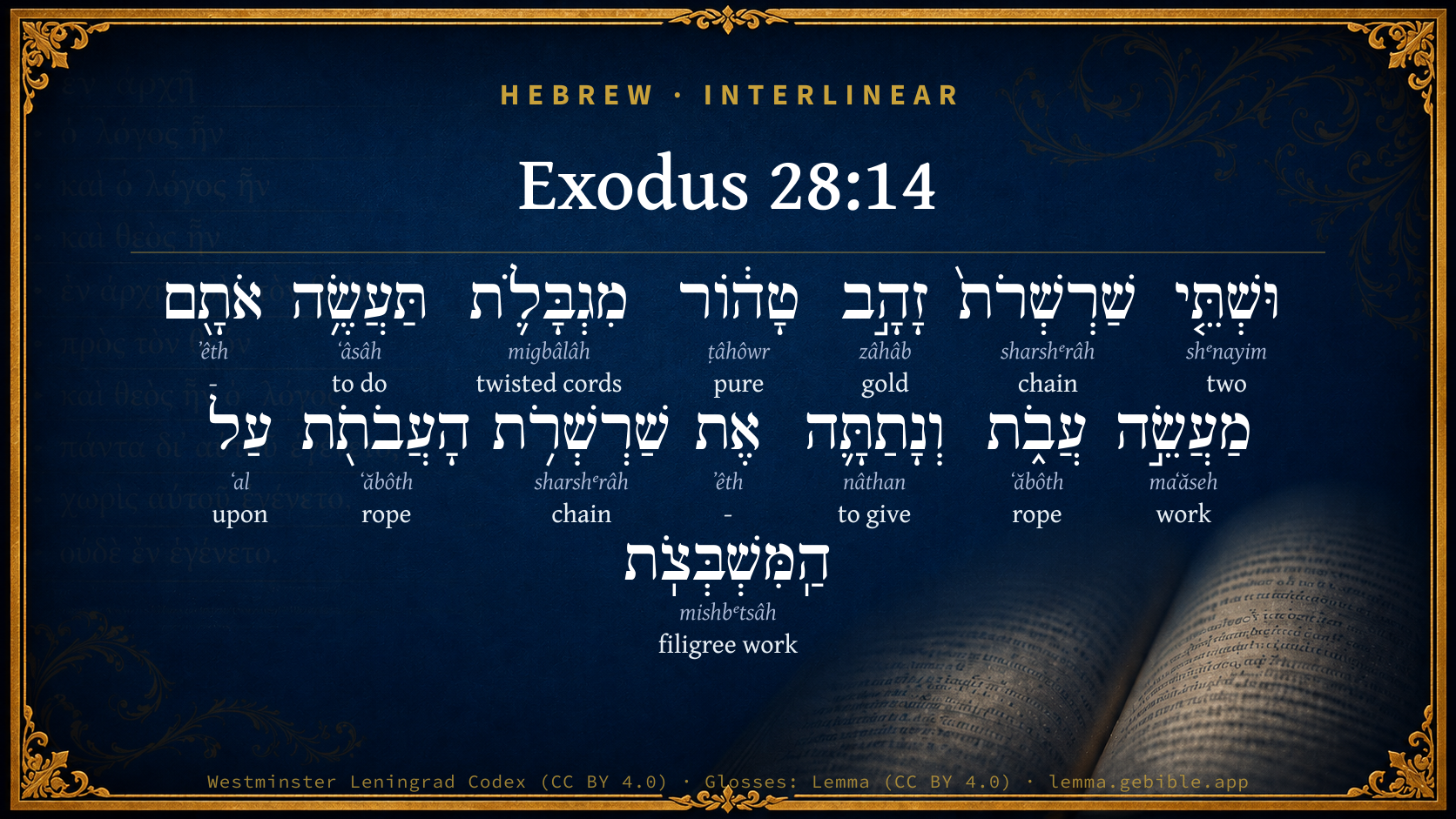
Hebrew (Westminster Leningrad Codex) Exodus 28:14 appears in the Hebrew Old Testament. The text above is from the Westminster Leningrad Codex. Each word links to its Strong’s number, a concise gloss, and parsing drawn from the Open Scriptures Hebrew Bible morphology. Click any word for its full Brown-Driver-Briggs (BDB) entry.
Download image
Cite this verse

Exodus 28:14 (World English Bible). Public Domain. Lemma interlinear Bible study tool, https://lemma.gebible.app/v/exodus/28/14.

Show BibTeX & RIS
BibTeX
RIS
English Translation
and two chains of pure gold; you make them like cords shall, of braided work: and you shall put the braided chains on the settings.
World English Bible · Public Domain
Highlights
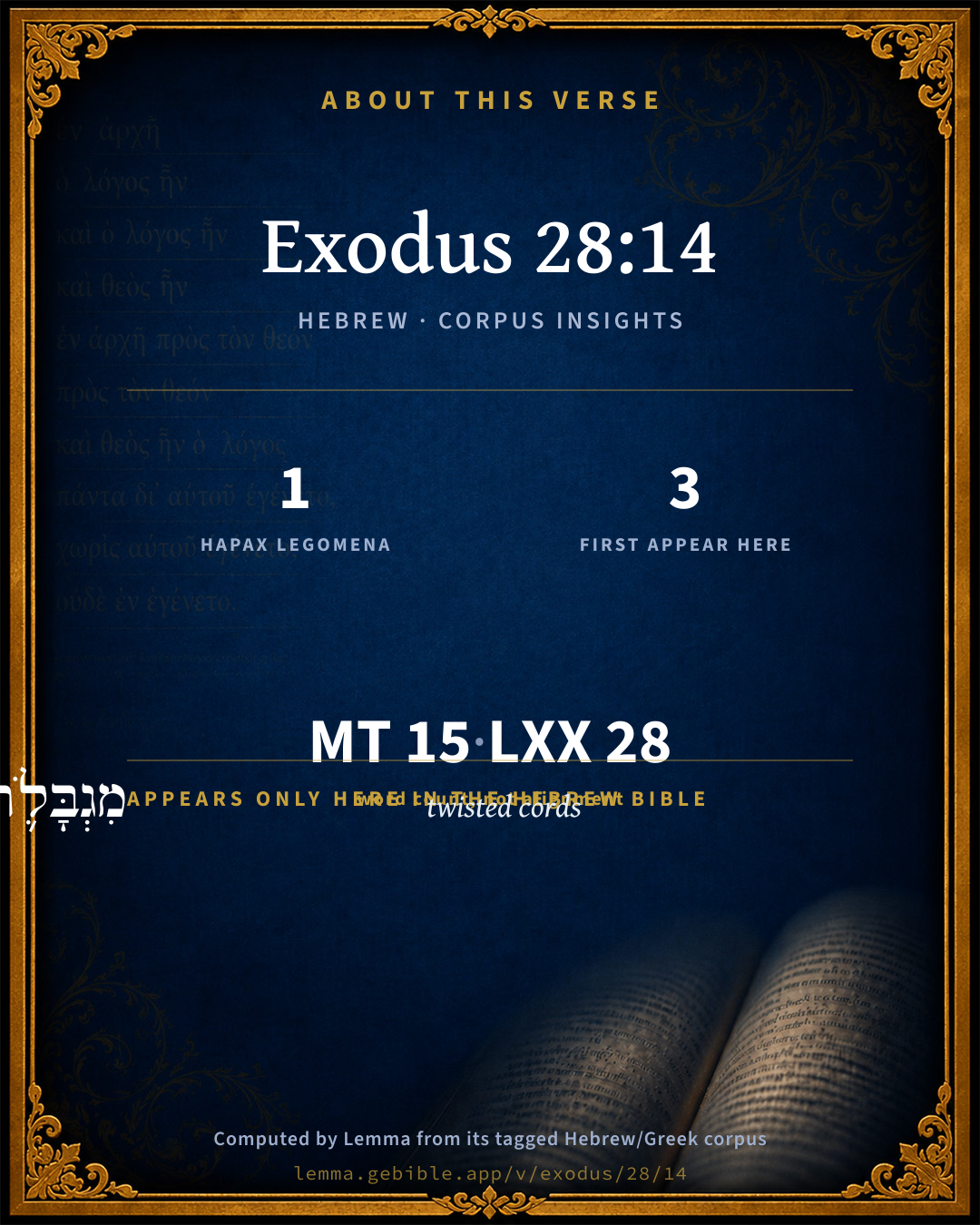
  • 1 hapax legomenon — only here in the Hebrew Bible
  • 3 first appearances in the Hebrew Bible
Full analysis ↓
Download a study sheet

One document with this verse’s original text, its word-by-word gloss line, the meaning frame, cross-references with their text, attributed commentary, and full source and license credits — printable, and it pastes into notes with its structure intact.

This verse Autodidact and up

Study sheet (.html) Plain text (.txt)

A passage Seminary Student

Up to 50 verses in one chapter. A passage sheet keeps up to 6 commentary sources and 12 cross-references per verse, in the order this page ranks them, and says so on the sheet whenever that leaves anything out. Ask for a single verse and you get the Autodidact verse sheet above.

Everything on this page stays free to read, with no account — the sheet is a download of what is already on screen, not access to it.

Want to remove ads? Support Godless Engineer
Compare translations 3

The same verse in 3 English versions, stacked beneath the original-language interlinear above. Click any original word for its lexicon entry.

Each is an independent rendering of the whole verse — the interlinear is not word-aligned to these translations.

Highlighted words mark where these versions differ — a whole-verse word diff, not a word-by-word alignment.

  • World English Bible Public Domain
    and two chains of pure gold; you make them like cords shall, of braided work: and you shall put the braided chains on the settings.
  • King James Version Public Domain
    And two chains of pure gold at the ends; of wreathed work shalt thou make them, and fasten the wreathed chains to the ouches.
  • unfoldingWord Literal Text CC BY-SA 4.0
    and two twisted chains of pure gold: you shall make them as a work of rope, and you shall attach the chains of the rope to the ornamental settings.

unfoldingWord Literal Text — © unfoldingWord, licensed CC BY-SA 4.0. Word-aligned USFM3 via Door43 (git.door43.org/unfoldingWord/en_ult).

Versions to compare (up to 4)

3 of 4 selected

Show all 18 translations

Every available English version of this verse, each an independent rendering of the whole verse.

  • World English Bible Public Domain
    and two chains of pure gold; you make them like cords shall, of braided work: and you shall put the braided chains on the settings.
  • Berean Standard Bible Public Domain
    and two chains of pure gold, made of braided cord work; and attach these chains to the settings.
  • Majority Standard Bible Public Domain
    and two chains of pure gold, made of braided cord work; and attach these chains to the settings.
  • King James Version Public Domain
    And two chains of pure gold at the ends; of wreathed work shalt thou make them, and fasten the wreathed chains to the ouches.
  • American Standard Version (1901) Public Domain
    and two chains of pure gold; like cords shalt thou make them, of wreathen work: and thou shalt put the wreathen chains on the settings.
  • Revised Version (1885) Public Domain
    and two chains of pure gold; like cords shalt thou make them, of wreathen work: and thou shalt put the wreathen chains on the ouches.
  • Geneva Bible (1599) Public Domain
    And two cheynes of fine golde at the ende, of wrethed worke shalt thou make them, and shalt fasten the wrethed cheynes vpon the bosses.
  • Douay-Rheims (1899) Public Domain
    And two little chains of the purest gold linked one to another, which thou shalt put into the hooks.
  • Young's Literal Translation Public Domain
    and two chains of pure gold, wreathed work thou dost make them, work of thick bands, and thou hast put the thick chains on the embroidered things.
  • Literal Standard Version CC BY-SA 4.0
    and you make them [with] two chains of pure gold [as] wreathed work, work of thick bands, and you have put the thick chains on the filigrees.
  • Unlocked Literal Bible CC BY-SA 4.0
    and two braided chains of pure gold like cords, and you must attach the chains to the settings.
  • unfoldingWord Literal Text CC BY-SA 4.0
    and two twisted chains of pure gold: you shall make them as a work of rope, and you shall attach the chains of the rope to the ornamental settings.
  • Darby Bible Public Domain
    and two chains of pure gold; of laced work shalt thou make them, of wreathen work, and fasten the wreathen chains to the enclosures.
  • World Messianic Bible Public Domain
    and two chains of pure gold; you shall make them like cords of braided work. You shall put the braided chains on the settings.
  • Webster's Bible Public Domain
    And two chains of pure gold at the ends; of wreathed work shalt thou make them, and fasten the wreathed chains to the ouches.
  • Free Bible Version CC BY-SA 4.0
    and two braided chains of pure gold, and fasten these chains to the settings.
  • Bible in Basic English Public Domain
    And two chains of the best gold, twisted like cords; and have the chains fixed on to the frames.
  • JPS Tanakh (1917) Public Domain
    and two chains of pure gold; of plaited thread shalt thou make them, of wreathen work; and thou shalt put the wreathen chains on the settings.

Literal Standard Version (2020), Covenant Press — licensed CC BY-SA 4.0. Text via the HelloAO Bible API (eBible.org). Unlocked Literal Bible (unfoldingWord) — licensed CC BY-SA 4.0. Text via the HelloAO Bible API (eBible.org). unfoldingWord Literal Text — © unfoldingWord, licensed CC BY-SA 4.0. Word-aligned USFM3 via Door43 (git.door43.org/unfoldingWord/en_ult). Free Bible Version, Dr. Jonathan Gallagher — licensed CC BY-SA 4.0. Text via the HelloAO Bible API (eBible.org).

Word by word

More ways to search: Search by grammar → Find every occurrence → Compare this word →

Practice this passage: Drill this verse → Learn its vocabulary →

מִגְבָּלֹ֛ת
migbâlâh
H4020
“twisted cords”
Noun, Common, Feminine, Plural, Absolute
Part of Speech
Noun
Type
Common
Gender
Feminine
Number
Plural
State
Absolute
Full BDB Definition

Origin: from H1379

TWOT: 307d

twisted, cords
  1. וּשְׁתֵּ֤י shᵉnayim H8147 “and · two” Conjunction + Adjective, Cardinal number, Feminine, Dual, Construct
  2. שַׁרְשְׁרֹת֙ sharshᵉrâh H8333 “chains of” Noun, Common, Feminine, Plural, Construct
  3. זָהָ֣ב zâhâb H2091 “gold” Noun, Common, Masculine, Singular, Absolute
  4. טָה֔וֹר ṭâhôwr H2889 “pure” Adjective, Adjective, Masculine, Singular, Absolute
  5. תַּעֲשֶׂ֥ה ʻâsâh H6213 “to do” Verb, Qal, Imperfect, 2nd Person, Masculine, Singular
  6. אֹתָ֖ם ʼêth H853 “- · them” Particle, Direct Object + Suffix, Personal, 3rd Person, Masculine, Plural
  7. מַעֲשֵׂ֣ה maʻăseh H4639 “work of” Noun, Common, Masculine, Singular, Construct
  8. עֲבֹ֑ת ʻăbôth H5688 “rope” Noun, Common, Both, Singular, Absolute
  9. וְנָתַתָּ֛ה nâthan H5414 “and · to give” Conjunction + Verb, Qal, Sequential Perfect, 2nd Person, Masculine, Singular
  10. אֶת ʼêth H853 “-” Particle, Direct Object
  11. שַׁרְשְׁרֹ֥ת sharshᵉrâh H8333 “chains” Noun, Common, Feminine, Plural, Absolute
  12. הָעֲבֹתֹ֖ת ʻăbôth H5688 “the · ropes” Particle, Definite Article + Noun, Common, Both, Plural, Absolute
  13. עַל ʻal H5921 “upon” Preposition
  14. הַֽמִּשְׁבְּצֹֽת mishbᵉtsâh H4865 “the · filigree work” Particle, Definite Article + Noun, Common, Feminine, Plural, Absolute

About this verse

These counts appear in no published source. They are computed here, from the morphology-tagged text and Lemma’s own curated glosses. What Lemma adds →

15
words
12
distinct lemmas
Pentateuch
section

Notable vocabulary

1 hapax legomenon — a word that appears only here in the entire Hebrew Bible:

  • מִגְבָּלֹ֛ת twisted cords H4020

First appearance in Scripture

These words make their first canonical appearance in the Hebrew Bible here:

  • שַׁרְשְׁרֹת֙ chain H8333
  • מִגְבָּלֹ֛ת twisted cords H4020
  • עֲבֹ֑ת rope H5688

Shared distinctive vocabulary

שַׁרְשְׁרֹת֙ chain H8333 occurs in 5 verses of the Hebrew Bible. Also found in:

Grammatical profile

  • 2 verbs
  • 8 nouns
  • 2 adjectives
  • 1 preposition
  • 2 particles

Verb forms

  • תַּעֲשֶׂ֥ה Qal · Imperfect
  • וְנָתַתָּ֛ה Qal · Sequential Perfect

Repetition

Words recur within this verse — often emphatic in Hebrew:

  • שַׁרְשְׁרֹת֙ chain H8333 ×2
  • עֲבֹ֑ת rope H5688 ×2

Hebrew & Septuagint length

In English translation the verse runs 25 words from the Hebrew and 31 from the Septuagint (LXX English) — closely comparable.

A rough comparison of the two English renderings, which tokenize alike — not a word-level alignment.

Word counts can differ between the Hebrew and the Greek without any difference in meaning — e.g. the Hebrew direct-object marker אֵת has no separate Greek word, and Greek often adds the article ὁ.

In the original languages it is 15 Hebrew tokens and 28 Greek tokens — but the two are counted differently (Hebrew bundles its prefixes and suffixes into one token; the Greek is in lemma form), so that isn’t a like-for-like length.

Cross-references

6

Topical passages linked to Exodus 28:14 in the Treasury of Scripture Knowledge — connected by theme and wording, ordered by reader-vote popularity; previews shown in the World English Bible.

  • Exodus 28:22–25 You shall make on the breastplate chains like cords, of braided work of pure gold.
  • Exodus 39:15 They made on the breastplate chains like cords, of braided work of pure gold.
  • Exodus 39:17–18 They put the two braided chains of gold in the two rings at the ends of the breastplate.
  • 1 Kings 7:17 There were nets of checker-work, and wreaths of chain-work, for the capitals which were on the top of the pillars; seven for the one capital, and seven for the other capital.
  • 2 Kings 25:17 The height of the one pillar was eighteen cubits, and a capital of brass was on it; and the height of the capital was three cubits, with network and pomegranates on the capital round about, all of brass: and like to these had the second pillar with network.
  • 2 Chronicles 4:12–13 the two pillars, and the bowls, and the two capitals which were on the top of the pillars, and the two networks to cover the two bowls of the capitals that were on the top of the pillars,

Cross-references courtesy of OpenBible.info (CC BY 4.0).

Hebrew and Greek witnesses Masoretic Hebrew ↔ Greek Septuagint

The same verse in the two great witnesses to the Old Testament, shown verse-for-verse.

These are two independent witnesses, not word-aligned to each other, and the Septuagint is shown in lemma (dictionary) form.

Hebrew Exodus 28:14 Masoretic · Westminster Leningrad Codex

וּשְׁתֵּ֤י שַׁרְשְׁרֹת֙ זָהָ֣ב טָה֔וֹר מִגְבָּלֹ֛ת תַּעֲשֶׂ֥ה אֹתָ֖ם מַעֲשֵׂ֣ה עֲבֹ֑ת וְנָתַתָּ֛ה אֶת שַׁרְשְׁרֹ֥ת הָעֲבֹתֹ֖ת עַל הַֽמִּשְׁבְּצֹֽת

and two chains of pure gold; you make them like cords shall, of braided work: and you shall put the braided chains on the settings.

World English Bible · Public Domain

Greek LXX Exodus 28:14 Septuagint · lemma form

καί ποιέω δύο κροσσωτός ἐκ χρυσίον καθαρός καταμίγνυμι ἐν ἄνθος ἔργον πλοκή καί ἐπιτίθημι ὁ κροσσωτός ὁ πλέκω ἐπί ὁ ἀσπιδίσκη κατά ὁ παρωμίς αὐτός ἐκ ὁ ἐμπρόσθιος

and you shall make two fringes of pure gold, variegated with flowers wreathen work; and you shall put the wreathen fringes on the circlets, fastening them on their shoulder-pieces in front.

LXX2012 (modern English Septuagint) · Public Domain

Hebrew: Westminster Leningrad Codex (CC BY 4.0). Greek: Septuagint (public domain); English from LXX2012 (modern English Septuagint) (Public Domain). How the Septuagint differs from the Hebrew →

Targum (Aramaic paraphrase)

2

The Targum is the ancient Jewish Aramaic paraphrase of the Hebrew Scriptures — an interpretive translation, not the Hebrew text itself. Onkelos (literal) and Pseudo-Jonathan (expansive) render the Torah, and Jonathan the Prophets. Coverage is partial: where no permissively-licensed English translation exists for a verse, only the Aramaic is shown. This is verse-level text, not a word-by-word alignment to the Hebrew.

  1. Targum Onkelos Torah (Genesis–Deuteronomy)
    וְתַרְתֵּין תִּכִּין דְהַב דְכֵי מְתַחְמָן תַּעְבֵד יָתְהוֹן עוֹבַד גְדִילוּ וְתִתֵּן יָת תִּכַּיָא גְדִילָתָא עַל מְרַמְצָתָא:

    (no public-domain English translation for this verse)

    Targum Onkelos — Aramaic: “Onkelos Genesis” (public domain); “Onkelos Exodus” (public domain); “Onkelos Leviticus” (public domain); “Onkelos Numbers” (public domain); “Onkelos Deuteronomy” (public domain). English: “Sefaria Community Translation” (CC0 1.0 (public-domain dedication)); “J.W. Etheridge. The Targums of Onkelos and Jonathan Ben Uzziel on the Pentateuch. London: Longmans, Green, 1862” (public domain). Text via Sefaria.

  2. Targum Pseudo-Jonathan Torah (Genesis–Deuteronomy)
    וְתַרְתֵּין שִׁישְׁלַן דִּדְהַב דְּכֵי מְתַחְמָן תַּעֲבֵיד יַתְהוֹן עוֹבַד קְלִיעָא וְתִתֵּן יַת שׁוֹשִׁילְתָּא קְלִיעֲתָא עַל מְרַמְצָתָא

    And two chains of pure gold, measured shalt thou make them, of twisted work, and insert the twisted chains in the sockets.

    Targum Pseudo-Jonathan — Aramaic: “Targum Jonathan on Genesis” (public domain); “Targum Jonathan on Exodus” (public domain); “Targum Jonathan on Leviticus” (public domain); “Targum Jonathan on Numbers” (public domain); “Targum Jonathan on Deuteronomy” (public domain). English: “The Targum of Jonathan ben Uzziel, trans. J. W. Etheridge, London, 1862” (public domain). Text via Sefaria.

Commentary

Notes on Exodus 28:14 from classic Christian and Jewish commentators (each source and its license shown beneath its notes). The classic Christian expositions comment on the surrounding passage and are grouped to its opening verse, so a note may address several verses; the Jewish commentaries on the Tanakh (Rashi and others) are per-verse, so they appear only where the commentator wrote on this verse.

Lemma curates 59 commentaries, every one of them public domain or Creative Commons licensed, each selected and text-cleaned for this edition rather than reprinted as found. About our sources →

Trapp's Complete Commentary

John Trapp

Exo 28:14 And two chains [of] pure gold at the ends; [of] wreathen work shalt thou make them, and fasten the wreathen chains to the ouches.

Ver. 14. Fasten. the wreathen chains.] These chains wherewith the breastplate and shoulder were tied, signified, saith one, {a} the perfect contexture of all heavenly virtues adorning Christ’s humanity; as also that true faith whereby we are girded to him.

{a} Moses Unveiled.

John Trapp, A Commentary or Exposition upon All the Books of the Old and New Testament (1647–1656) — public domain. Text from a community e-Sword module.

Geneva Bible (1599)

Geneva Bible translators

Of the bosses.

Geneva Bible (1599) marginal notes — public domain. Text via Bolls.life.

Ellicott's Commentary for English Readers

(14) Chains . . . at the ends.—Rather, chains of equal length, or, perhaps, of wreathen work.

Of wreathen work.—Heb., after the manner of a rope. Such chains are often seen round the necks of Persian officials in the Persepolitan sculptures, and appear also to have been used by the grandees of Egypt. They were composed of a number of gold wires twisted together. The chains spoken of in this place are the same as those mentioned in Exo_28:22-25. Their object was to attach the two upper corners of the breastplate to the upper part of the ephod.

A Bible Commentary for English Readers, edited by Charles John Ellicott (1878–1897) — public domain. Text from a community e-Sword module.

The Cambridge Bible for Schools and Colleges

gen. ed. J. J. S. Perowne

14. put] i.e. fasten.

The Cambridge Bible for Schools and Colleges (gen. ed. J. J. S. Perowne; Cambridge University Press, 1878–1918) — public domain. Text from a community e-Sword module.

John Gill's Exposition

And thou shall make the breastplate of judgment,.... Called a "breastplate", because worn upon the breast of the high priest; and a breastplate "of judgment", because it was to put him in mind that he should do justice and judgment in the execution of his office, and that he should have at heart the judgment of the people of Israel; and in difficult cases should ask it of God, and faithfully declare it to them: it was, with the twelve stones in it, an emblem of the church and people of God, borne upon the heart of Christ our great High Priest, who are made righteous by him, yea, the righteousness of God in him, and are called by his name, the Lord our righteousness; the judgment or government of whom is committed to him, and which he exercises, by appointing laws and ordinances for them, by constituting and qualifying persons to act under him, to explain those laws, and see them put in execution, by vindicating and protecting them, and by the open justification of them at the last day:

with cunning work, after the work of the ephod thou shall make it; wrought with divers figures in a very curious manner:

of gold, of blue, and of purple, and of scarlet, and of fine twined linen, shalt thou make it; a piece of stuff interwoven with threads of gold, or golden wires, and with threads of yarn, of blue, purple, and scarlet colours, and with threads of fine twined linen six times doubled; all which may signify the beautiful array of the saints, with the several graces of the Spirit; and especially their being clothed with fine linen, called the righteousness of the saints; that raiment of needlework, and clothing of wrought gold, the righteousness of Christ, consisting of his obedience, sufferings, and death, fitly expressed by these various colours.

John Gill's Exposition of the Whole Bible (1746–1763) — public domain (CC PDM 1.0). Text via the HelloAO Bible API.

Haydock's Catholic Bible Commentary

Linked, &c. The present Hebrew has "at the ends," migbaloth. But the Vulgate seems to have read more properly k instead of g, as in chap. xxvi. 4. (Calmet)

George Leo Haydock (1774–1849), Haydock's Catholic Family Bible and Commentary, 1859 edition — public domain. Excludes Psalms (Douay-Rheims chapter numbering differs from Protestant) and Deuterocanonical books (Catholic canon only).

Matthew Poole's English Annotations

At the ends, or, with ends; i.e. not like chains that are fastened about one’s neck or arm, which seem to have no end; but two distinct chains, with two several ends, both hanging downward: compare Exo 28:22. The Syriac render it double, others equal, or of equal length.

Matthew Poole's English Annotations on the Holy Bible (1683–1685) — public domain. Text from a community e-Sword/MySword module.

The Pulpit Commentary

At the ends. The meaning of the Hebrew word migaloth is very doubtful. Jarchi and Rosemuller approve of the rendering of our translators. Geddes, Boothroyd, and Dathe render "chains of equal length." Gesenius, Kalisch, Canon Cook, and others, believe the true meaning to be "wreathed," or "of wreathen work," so that the next clause, "after the manner of a rope," would be simply exegetic. Of wreathen work.

Literally, "after the manner of a rope." Cords of twisted gold wire were frequently used, instead of chains, by the Egyptians.

The Pulpit Commentary (1880–1919), ed. H.D.M. Spence-Jones & Joseph S. Exell — public domain. Text from a community e-Sword module.

Rashi

Rabbi Shlomo Yitzchaki (Rashi)

שרשרת זהב means CHAINS OF GOLD — the word being the same as שלשלאות (the letters ל and ר being interchangeable, as in ארמנות for אלמנות; cf. the Aramaic ארמלתא)

מגבלות means AT THE END OF THE BORDER (גבול) of the breast-plate תעשה אותם SHALT THOU MAKE THEM.

מעשה עבת OF CORD-LIKE WORK — made of plaited threads and not made of rings and hooks (somewhat like links) like those chains which are made for cisterns (to which the bucket is attached), but like those which are made for censers which are called encensiers in old French (cf. Rashi on Beitzah 22b).

ונתת את שרשרת — This means, AND THOU WILT PLACE THE CHAINS OF CORD-WORK — i. e. the chains made of cord-work — upon these settings. This is not the place where the command is laid down about making the chains nor is this the command about fixing them: the word תעשה used here does not express a command, nor does the word ונתת used here express a command, but these express the future tense. For in the chapter about the breast-plate He returns to this, and there He lays down the command about making them (v. 22) and fixing them (vv. 24—25). This is written here only to point out part of the purpose of the settings which He commanded to be made together with the ephod, and He wrote this here to tell you: these settings you will require — when you will make chains at the ends upon the breast-plate you shall put them upon these settings.

Rashi on the Tanakh — English translations: “The Judaica Press complete Tanach with Rashi, translated by A. J. Rosenberg” (CC BY 4.0); “Pentateuch with Rashi's commentary by M. Rosenbaum and A.M. Silbermann, 1929-1934” (public domain); “The Metsudah Tanach series, Lakewood, N.J” (CC BY 4.0); and “The Book of Joshua, Metsudah Publications, 1997” (CC BY 4.0). Text via Sefaria.

Lesson kit

Teaching starters — assembled from the data on this page, not authored interpretation. Every prompt links to the verse data it draws on. Edit before teaching.

Exodus, in the Pentateuch, opens this verse with 15 words (12 distinct Hebrew lemmas). Its most distinctive word is migbâlâh (“twisted cords”). A historical commentator’s framing appears above. Read the whole chapter for the surrounding context.

Discussion questions

  1. How does “twisted cords” (migbâlâh) shape what this verse is saying?
  2. 1 word here appears nowhere else in the Hebrew Bible. Why might the author reach for such rare wording?
  3. 3 words make their first appearance in Scripture here. What does this debut establish?
  4. How does Exodus 39:15, which shares the word «chain», read alongside this verse?
  5. What does the repetition of “chain” (2× in this one verse) do in this verse?
  6. These translations render this verse differently; the difference is in the English rendering, not the original. What questions does that raise?
  7. «תַּעֲשֶׂ֥ה» is a Qal Imperfect verb. How does that grammatical form shape the action described?
  8. Compare how Trapp's Complete Commentary and Geneva Bible (1599) read this verse. Where do they agree or differ?

Things to notice

  • 1 word in this verse appears nowhere else in the Hebrew Bible.
  • 3 words make their first canonical appearance in Scripture here.
  • This verse counts 15 Hebrew ↔ 28 Greek words.
  • These translations choose different wording for 15 words in this verse.
  • “chain” occurs 2× in this single verse.

Reading settings

Reading text

Shown beneath each verse's original-language words.

Old Testament
Old Testament edition

Read the OT as the Masoretic Hebrew (MT) or the Greek Septuagint (LXX).

English shown for the Greek Septuagint (in the Hebrew ↔ Greek comparison).

Comparing translations? Open the Compare panel on any verse page to stack up to four side by side.