
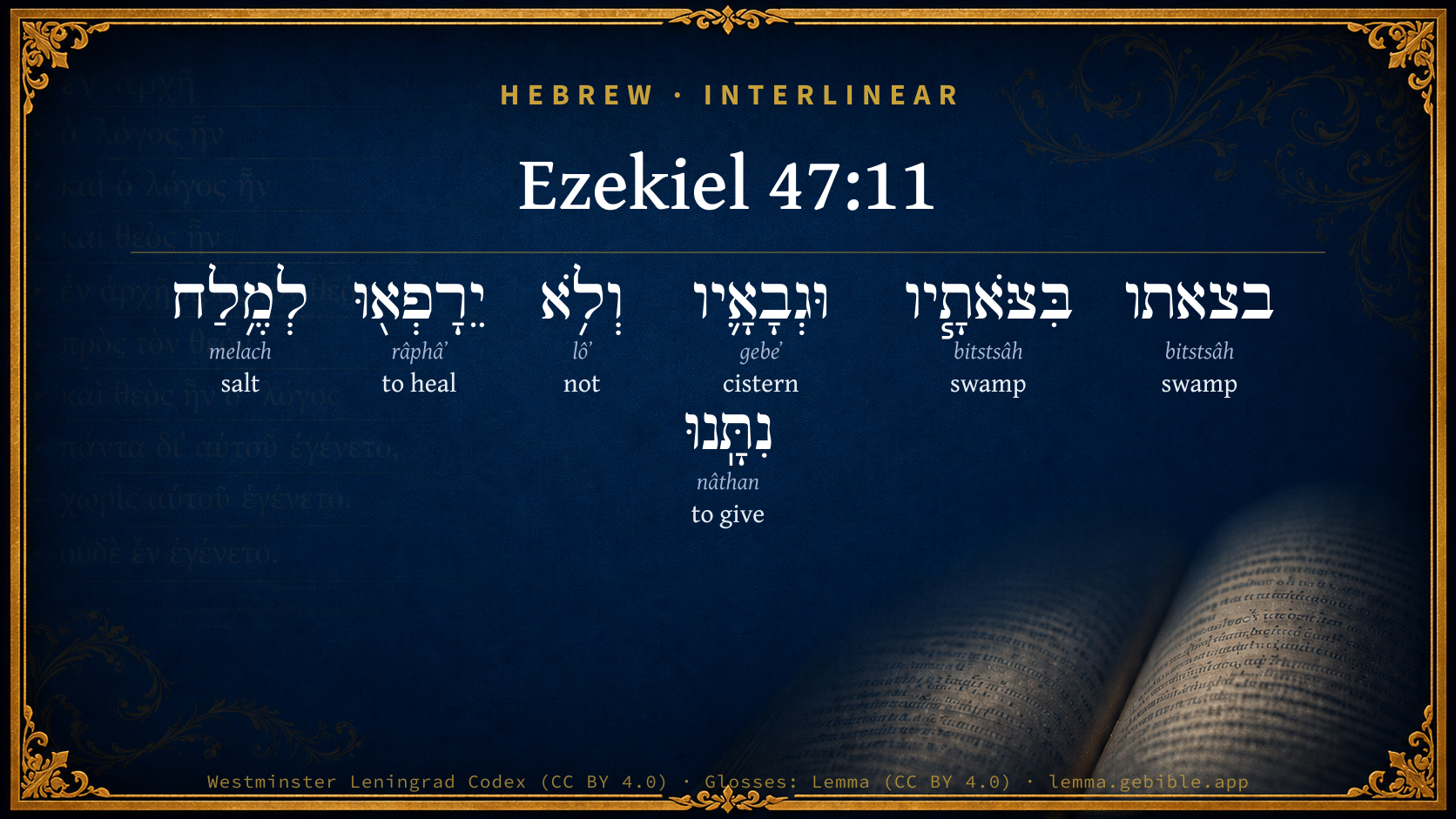
Ezekiel 47:11

Hebrew (Westminster Leningrad Codex) Ezekiel 47:11 appears in the Hebrew Old Testament. The text above is from the Westminster Leningrad Codex. Each word links to its Strong’s number, a concise gloss, and parsing drawn from the Open Scriptures Hebrew Bible morphology. Click any word for its full Brown-Driver-Briggs (BDB) entry.
Download image
Cite this verse

Ezekiel 47:11 (World English Bible). Public Domain. Lemma interlinear Bible study tool, https://lemma.gebible.app/v/ezekiel/47/11.

Show BibTeX & RIS
BibTeX
RIS
English Translation
But the miry places of it, and the marshes of it, shall not be healed; they shall be given up to salt.
World English Bible · Public Domain
Download a study sheet

One document with this verse’s original text, its word-by-word gloss line, the meaning frame, cross-references with their text, attributed commentary, and full source and license credits — printable, and it pastes into notes with its structure intact.

This verse Autodidact and up

Study sheet (.html) Plain text (.txt)

A passage Seminary Student

Up to 50 verses in one chapter. A passage sheet keeps up to 6 commentary sources and 12 cross-references per verse, in the order this page ranks them, and says so on the sheet whenever that leaves anything out. Ask for a single verse and you get the Autodidact verse sheet above.

Everything on this page stays free to read, with no account — the sheet is a download of what is already on screen, not access to it.

Want to remove ads? Support Godless Engineer
Compare translations 3

The same verse in 3 English versions, stacked beneath the original-language interlinear above. Click any original word for its lexicon entry.

Each is an independent rendering of the whole verse — the interlinear is not word-aligned to these translations.

Highlighted words mark where these versions differ — a whole-verse word diff, not a word-by-word alignment.

  • World English Bible Public Domain
    But the miry places of it, and the marshes of it, shall not be healed; they shall be given up to salt.
  • King James Version Public Domain
    But the miry places thereof and the marishes thereof shall not be healed; they shall be given to salt.
  • unfoldingWord Literal Text CC BY-SA 4.0
    But the Salt Sea’s swamps and marshes will not be made fresh; they will be for providing salt.

unfoldingWord Literal Text — © unfoldingWord, licensed CC BY-SA 4.0. Word-aligned USFM3 via Door43 (git.door43.org/unfoldingWord/en_ult).

Versions to compare (up to 4)

3 of 4 selected

Show all 18 translations

Every available English version of this verse, each an independent rendering of the whole verse.

  • World English Bible Public Domain
    But the miry places of it, and the marshes of it, shall not be healed; they shall be given up to salt.
  • Berean Standard Bible Public Domain
    But the swamps and marshes will not become fresh; they will be left for salt.
  • Majority Standard Bible Public Domain
    But the swamps and marshes will not become fresh; they will be left for salt.
  • King James Version Public Domain
    But the miry places thereof and the marishes thereof shall not be healed; they shall be given to salt.
  • American Standard Version (1901) Public Domain
    But the miry places thereof, and the marshes thereof, shall not be healed; they shall be given up to salt.
  • Revised Version (1885) Public Domain
    But the miry places thereof, and the marishes thereof, shall not be healed; they shall be given up to salt.
  • Geneva Bible (1599) Public Domain
    But the myrie places thereof, and the marises thereof shall not be wholesome: they shalbe made salt pittes.
  • Douay-Rheims (1899) Public Domain
    But on the shore thereof, and in the fenny places they shall not be healed, because they shall be turned into saltpits.
  • Young's Literal Translation Public Domain
    Its miry and its marshy places -- they are not healed; to salt they have been given up.
  • Literal Standard Version CC BY-SA 4.0
    Its miry and its marshy places—they are not healed; they have been given up to salt.
  • Unlocked Literal Bible CC BY-SA 4.0
    But the Salt Sea's swamps and marshes will not be made fresh; they will be for providing salt.
  • unfoldingWord Literal Text CC BY-SA 4.0
    But the Salt Sea’s swamps and marshes will not be made fresh; they will be for providing salt.
  • Darby Bible Public Domain
    But its marshes and its pools shall not be healed; they shall be given up to salt.
  • World Messianic Bible Public Domain
    But its swamps and marshes will not be healed. They will be given up to salt.
  • Webster's Bible Public Domain
    But its miry places and its marshes shall not be healed; they shall be given to salt.
  • Free Bible Version CC BY-SA 4.0
    However, the marshes and swampy areas won't become fresh; they will remain salty.
  • Bible in Basic English Public Domain
    The wet places and the pools will not be made sweet; they will be given up to salt.
  • JPS Tanakh (1917) Public Domain
    But the miry places thereof, and the marshes thereof, shall not be healed; they shall be given for salt.

Literal Standard Version (2020), Covenant Press — licensed CC BY-SA 4.0. Text via the HelloAO Bible API (eBible.org). Unlocked Literal Bible (unfoldingWord) — licensed CC BY-SA 4.0. Text via the HelloAO Bible API (eBible.org). unfoldingWord Literal Text — © unfoldingWord, licensed CC BY-SA 4.0. Word-aligned USFM3 via Door43 (git.door43.org/unfoldingWord/en_ult). Free Bible Version, Dr. Jonathan Gallagher — licensed CC BY-SA 4.0. Text via the HelloAO Bible API (eBible.org).

Word by word

More ways to search: Search by grammar → Find every occurrence → Compare this word →

Practice this passage: Drill this verse → Learn its vocabulary →

About this verse

These counts appear in no published source. They are computed here, from the morphology-tagged text and Lemma’s own curated glosses. What Lemma adds →

7
words
6
distinct lemmas
Prophets
section

Notable vocabulary

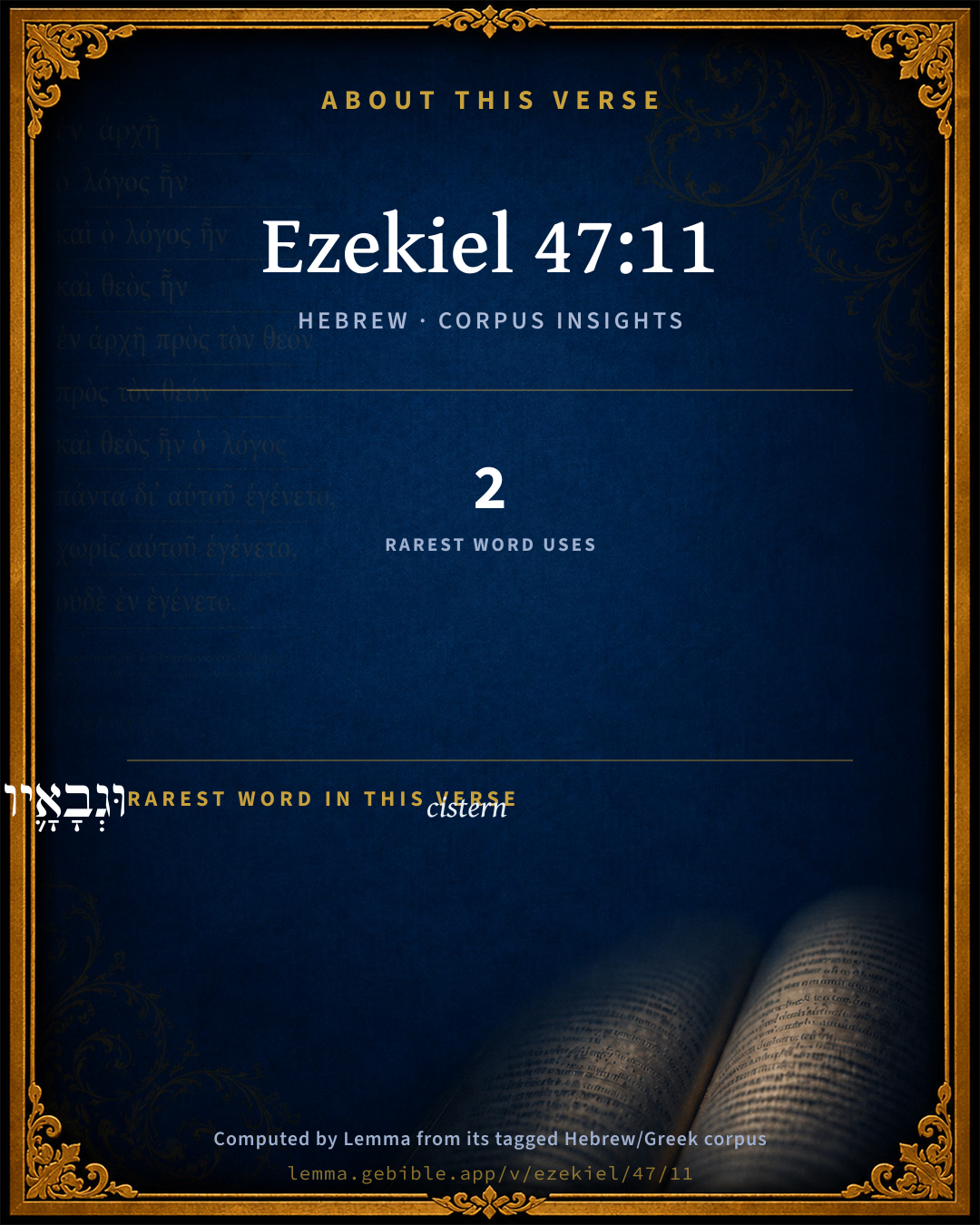
The rarest word here is וּגְבָאָ֛יו cistern H1360 — appearing just 2 times in the whole Hebrew Bible.

Shared distinctive vocabulary

וּגְבָאָ֛יו cistern H1360 occurs in 2 verses of the Hebrew Bible. Also found in:

Grammatical profile

  • 2 verbs
  • 4 nouns
  • 1 particle

Verb forms

  • יֵרָפְא֖וּ Niphal · Imperfect
  • נִתָּֽנוּ Niphal · Perfect

Repetition

A word recurs within this verse — often emphatic in Hebrew:

  • בצאתו swamp H1207 ×2

Hebrew & Septuagint length

In English translation the verse runs 22 words from the Hebrew and 29 from the Septuagint (LXX English) — closely comparable.

A rough comparison of the two English renderings, which tokenize alike — not a word-level alignment.

Word counts can differ between the Hebrew and the Greek without any difference in meaning — e.g. the Hebrew direct-object marker אֵת has no separate Greek word, and Greek often adds the article ὁ.

Cross-references

10

Topical passages linked to Ezekiel 47:11 in the Treasury of Scripture Knowledge — connected by theme and wording, ordered by reader-vote popularity; previews shown in the World English Bible.

  • Deuteronomy 29:23 [and that] the whole land of it is sulfur, and salt, [and] a burning, [that] it is not sown, nor bears, nor any grass grows therein, like the overthrow of Sodom and Gomorrah, Admah and Zeboiim, which Yahweh overthrew in his anger, and in his wrath:
  • Revelation 22:11 He who acts unjustly, let him act unjustly still. He who is filthy, let him be filthy still. He who is righteous, let him do righteousness still. He who is holy, let him be holy still."
  • Judges 9:45 Abimelech fought against the city all that day; and he took the city, and killed the people who were therein: and he beat down the city, and sowed it with salt.
  • Psalms 107:34 And a fruitful land into a salt waste, For the wickedness of those who dwell in it.
  • Jeremiah 17:6 For he shall be like the heath in the desert, and shall not see when good comes, but shall inhabit the parched places in the wilderness, a salt land and not inhabited.
  • Mark 9:48–49 'where their worm doesn't die, and the fire is not quenched.'
  • Hebrews 6:4–8 For concerning those who were once enlightened and tasted of the heavenly gift, and were made partakers of the Holy Spirit,
  • Hebrews 10:26–31 For if we sin willfully after we have received the knowledge of the truth, there remains no more a sacrifice for sins,
  • 2 Peter 2:19–22 promising them liberty, while they themselves are bondservants of corruption; for by whom a man is overcome, by the same is he also brought into bondage.
  • Revelation 21:8 But for the cowardly, unbelieving, sinners, abominable, murderers, sexually immoral, sorcerers, idolaters, and all liars, their part is in the lake that burns with fire and sulfur, which is the second death."

Cross-references courtesy of OpenBible.info (CC BY 4.0).

Hebrew and Greek witnesses Masoretic Hebrew ↔ Greek Septuagint

The same verse in the two great witnesses to the Old Testament, shown verse-for-verse.

These are two independent witnesses, not word-aligned to each other, and the Septuagint is shown in lemma (dictionary) form.

Hebrew Ezekiel 47:11 Masoretic · Westminster Leningrad Codex

בצאתו בִּצֹּאתָ֧יו וּגְבָאָ֛יו וְלֹ֥א יֵרָפְא֖וּ לְמֶ֥לַח נִתָּֽנוּ

But the miry places of it, and the marshes of it, shall not be healed; they shall be given up to salt.

World English Bible · Public Domain

Greek LXX Ezekiel 47:11 Septuagint · lemma form

καί ἐν ὁ διεκβολή αὐτός καί ἐν ὁ ἐπιστροφή αὐτός καί ἐν ὁ ὑπέραρσις αὐτός οὐ μή ὑγιάζω εἰς ἅλς δίδωμι

But at the outlet of the water, and the turn of it, and where it overflows its banks, they shall not heal at all; they are given to salt.

LXX2012 (modern English Septuagint) · Public Domain

Hebrew: Westminster Leningrad Codex (CC BY 4.0). Greek: Septuagint (public domain); English from LXX2012 (modern English Septuagint) (Public Domain). How the Septuagint differs from the Hebrew →

Targum (Aramaic paraphrase)

1

The Targum is the ancient Jewish Aramaic paraphrase of the Hebrew Scriptures — an interpretive translation, not the Hebrew text itself. Onkelos (literal) and Pseudo-Jonathan (expansive) render the Torah, and Jonathan the Prophets. Coverage is partial: where no permissively-licensed English translation exists for a verse, only the Aramaic is shown. This is verse-level text, not a word-by-word alignment to the Hebrew.

  1. Targum Jonathan Prophets (Joshua–Malachi)
    בִּצוֹהִי וּפַצִידוֹהִי לָא יִתַּסוּן לְמַחֲפּוֹרִין דִמְלַח יְהוֹן:

    (no public-domain English translation for this verse)

    Targum Jonathan — Aramaic: “Mikraot Gedolot” (public domain). English: “Sefaria Community Translation” (CC0 1.0 (public-domain dedication)); “London "Chaldee Paraphrase," 1871” (public domain). Text via Sefaria.

Commentary

Notes on Ezekiel 47:11 from classic Christian and Jewish commentators (each source and its license shown beneath its notes). The classic Christian expositions comment on the surrounding passage and are grouped to its opening verse, so a note may address several verses; the Jewish commentaries on the Tanakh (Rashi and others) are per-verse, so they appear only where the commentator wrote on this verse.

Lemma curates 59 commentaries, every one of them public domain or Creative Commons licensed, each selected and text-cleaned for this edition rather than reprinted as found. About our sources →

Trapp's Complete Commentary

John Trapp

Eze 47:11 But the miry places thereof and the marishes thereof shall not be healed; they shall be given to salt.

Ver. 11. But the miry places thereof and the marishes, shall not be healed.] Sensual souls are seldom wrought upon by the word. Behemoth (the devil) lieth in those fens and quagmires. {Job 40:21} They are void of the Spirit. {Jdg 1:18-19} They say unto God, "Depart from us," we had rather dance to the timbrel and harp; {Job 21:11} whoredom and wine, and new wine, take away their hearts. {Hos 4:11} He who had married a wife, or rather was married to her, sent word flat and plain he could not come; others excused themselves more mannerly. {Luk 14:18-20} Such persons choose to remain in the sordes filth of their sins, and so are miserable by their own election.

They shall be given to salt.] Delivered up to strong delusions, {1Th 2:15-16} vile affections, {Rom 1:26} just damnation. {Rev 22:11}

John Trapp, A Commentary or Exposition upon All the Books of the Old and New Testament (1647–1656) — public domain. Text from a community e-Sword module.

The Biblical Illustrator

Joseph S. Exell

Eze_47:11

But the miry places and the marishes thereof shall not be healed; they shall be given to salt.

The danger of a fruitless possession of religious advantages

This vision of Ezekiel unrolled the map of the progress of the Gospel. The scene on which he looked down--so dark, so sterile, so lifeless--is but a picture of the world at large, separated from the knowledge and influences of Christianity. The natural features of the one correspond to the moral features of the other; for man, untaught by revelation, or unmoved by revelation, is like the desert, uncultivated and unfruitful; or like the dead lake, devoid of spiritual activity and buoyancy, and fitted but to spread around him the poisonous exhalation of his native depravity. It is the Gospel which reclaims man from this state, which pours fertilisation on the wilderness, and healing into the distempered waters. The Gospel of our Redeemer is represented by the river, which poured itself over the panoramic world, on which the prophets eye was fixed. And we shall perceive the propriety of this emblem, if we turn our thoughts to the mystery of its origin. The prophet beheld the stream stealing forth from the threshold, but he saw not the source--the fountain from which it flowed; his eye could trace it rolling slowly from the eastern door, but he knew nothing of it till it thus opened upon his notice. All, previous to its appearance was wrapped in mystery and concealment. It is so with that wondrous development of our Gods compassion and wisdom, which we designate the Gospel of Christ. Dwelling upon this lower world, living, as it were, outside the walls of the sanctuary, we see but the revelation, the unfolding of a mighty plan which is destined to be the cause of incalculable blessedness to countless millions. We can trace its progress, and mark its footsteps, and see its marvellous results. We can cast our eye backward upon the line of bygone ages, and trace the growth and the increasing firmness of the tree from the time that it was cast a seed into the ground, till it spread its branches over many climes and many nations. And as it carried its blessings and its comforts farther and farther still, displacing barbarism and introducing civilisation, dispelling the thick darkness, and pouring out its stream of pure and golden light, we can discover the proofs and indications of its power, but we can see nothing of the fountain out of which all this issues; for that lies concealed in the sanctuary of Gods wisdom, in the dark and veiled recesses of the council halls of eternity. It lies in the depths both of the wisdom and the knowledge of God, unfathomable to the plummet, of mortal investigation. But we shall perceive the propriety of this emblem no less clearly if we consider the effects which the Gospel is calculated to produce. When the prophets eye traced the course of the sanctuary river, he saw that it carried fertility and health with its waters. He beheld wildernesses converted into gardens--a wild and cheerless waste into a second Eden. The Gospel of the Son of God is calculated to effect the same result. Already has it reclaimed a large portion of our globe from the sway of ignorance, of barbarism, of unbroken darkness, and carried along with its saving announcements the blessings of civilisation, and knowledge, and social happiness. It has proved itself powerful, not simply to confer moral renovation, but to implant the seeds and the elements of spiritual life. It is clear, from the text, that there may be spots and individuals visited by the truth, and yet unreclaimed by the truth. These are the miry places and the marishes of the vision--spots which the river has touched, but which it has not changed--which lie in their original wasteness and sterility, although the stream of improvement has flowed over them. And these may designate either nations, or communities, or individuals. It becomes, therefore, a point of importance for us to ascertain distinctly what constitutes that miry and marshy state which is so fearfully indicative of total disconnection with the saving blessings of the Gospel. The state of man by nature is one of spiritual deadness, for spiritual life forsook him when he became a rebel against God. If man would be saved, he must have this spiritual insensibility removed, and spiritual life implanted, There must come a quickening from the Holy Ghost, the author and giver of life, into the soul. The man must be made alive unto God. There must be life in the soul. The river of the sanctuary must not merely cleanse the wilderness, and wash away impurities from the surface, it must besides pour such a flood of quickening power into its bosom, as that everything where it cometh shall live. It must give you life in your spiritual desires, life in your spiritual affections, life in your spiritual duties, life in your prayers. The second effect produced by the river of life is the healing of the distempered waters. Man is not only a being dead in trespasses, and so insensible, but he is also impregnated by corruption, and so unholy. There must enter a stream of sanctifying influences into the very fountain of his innate depravity, to expel its poisons, and to heal its corruptions. And when this is done, there will be a continual aim and effort after holiness in the life and conversation. The alteration of the mind and temper and dispositions will be there, and an energy in religion will be there, and a zeal for God will be there, and the fruits of the Spirit will be there; in other words, the man or the community touched by the Gospels magic power will be Christian. But when these marks exist not, when there are no indications of a spiritual life being infused, or of a healing process having been carried forward, then, we say, the Gospel has effected nothing--it has passed over men without changing them; it has been preached to men without converting them; it has visited men without sanctifying them. And let it not for one moment be imagined that God will show Himself an unmoved spectator of all this insult offered to His mercy, of all this despite done to the Spirit of His grace. No; for such as will sit beneath the sound of a proclaimed Gospel, without being touched by its power, or healed by its virtues, the Lord has His sentence of doom. It rests not concealed in His treasury of wrath and indignation. It is already announced--it is already on record--it is at this moment entered upon the dark registries of condemnation. His own lips have spoken it--they shall be given to salt. It is a doom of deep and appalling import, for it tells of the curse of present barrenness and future destruction being poured out upon the hardened and impenitent. There are many methods by which the Lord effects this. One is by withdrawing from a heedless and obdurate people the Gospel--the ordinances of His grace--altogether. When He has made the stream to roll in its richness through it, and it will neither be healed nor quickened, shall it seem a marvellous thing if He bend the direction of the river and make it flow into other lands; if He leave spots that will not be changed, without a privilege, without one single water drop of Christian advantages? Another method by which the Lord accomplishes this decree, is by continuing to an apathetic and gainsaying people the outward ministrations of His grace, but stripping them of their faithfulness and purity. We shall allude but to one method more by which the Lord executes His doom of giving to salt a Gospel-resisting people. He continues to such a people the ministrations of His truth in all its purity and faithfulness, but He refuses to bless them to the salvation and improvement of the peoples souls. The river will flow, but it will not fructify. In such an instance of judicial retribution, there will be a flintiness, a hardihood, an insensibility, a paralysis over the hearers hearts which will resist all approaches of the truth, and fling it back, as the breakwater rolls back the tide which would irrigate the soil. (A. Boyd, M. A.)

Spiritual barrenness

I. The Gospel has not the same healing effect on all where it comes. Has the Gospel come unto me, not in word only, but in power, and in the Holy Ghost, and in much assurance, and effectually wrought to the turning me from vain idols to the living and true God (1Th_1:5)? Thus it does in all that are saved. But oh, to how many does it prove an empty sound, and who remain the same persons that they were before they heard it? They were dark and defiled, ignorant and unholy, lifeless and fruitless, and they are so still.

II. The great sin of continuing unfruitful under the Gospel, of our remaining in the same corrupt state in which it found us, and so receiving the grace of God in vain.

1. This is a reproach to the Gospel, as if it were spiritless thing, without power or efficacy to produce what it was sent for.

2. As it is a reproach to the Gospel, so also a grief to those that labour in it.

III. The greatness of the judgment for God to say of any, they shall not be healed, but be left to perpetual barrenness.

1. A soul not healed, or totally barren, is yet out of Christ: and to be doomed to perpetual barrenness, never to be healed, is forever to be excluded from Him.

2. A soul not healed, but given to perpetual barrenness, has no promise of the protection of Providence, but may be exposed to all the evils of the present life. Thus God threatens His barren vineyard with it (Isa_5:5-6).

3. They that are finally forsaken as incurable, and given up to perpetual barrenness, have not a moments security from eternal wrath.

IV. the steps by which such a judgment is brought on and how God usually proceeds to it.

1. God leaves them to a careless, indifferent spirit about what momentous things the Gospel reveals, and the concern of their souls in them.

2. Such a carelessness and indifferency is usually attended with blindness and insensibility, so as not to apprehend their disease, and mind a cure, and perceive their need of it.

3. Sometimes the waters of the sanctuary are staid, or diverted; or else, they that would not be healed by them are removed to places where they have none of the external means of knowledge and fruitfulness they once enjoyed.

4. The healing grace and influence of the Spirit may be withheld; without the help of which, the disease of the soul cannot be removed, nor its barrenness cured.

5. The Spirit being withdrawn, they may be left of God to entertain errors and to believe lies; whereby they may think themselves whole, when ready to perish, and cry Peace, peace, to themselves when sudden destruction is near (2Th_2:11).

6. Upon this, the resolution may be taken up to let them alone, that His Spirit shall not strive with them.

Application.

1. Avoid those things which lead to this, which are such as these:--

(1) Making light of the waters of the sanctuary by neglecting or careless attending.

(2) Taking up with a mere profession of religion, and attending upon the means of grace without looking to see that their end be answered in a saving change wrought within.

(3) Neglecting or opposing the convictions of conscience, and the motions of the Spirit.

(4) Setting death and judgment at too great a distance, and flattering yourselves into stupidity from a vain presumption of having many years to come.

(5) Delaying to look after a cure till another time.

(6) Being too much taken up with the body and this present world, the cares of which choke the Word, and cause it to become unfruitful.

2. Take the course necessary to prevent it.

(1) Apprehend the dangerous case you are in by nature.

(2) Attend upon the means God hath appointed in order to a cure.

(3) Be diligent in hearing, much in prayer, for the presence and influence of the Spirit, to heal, quicken, and recover you to God, and bring you into vital union to Christ. (D. Wilson.)

The sin and judgment of spiritual barrenness

I. God is pleased oftentimes in His infinite wisdom to send the preaching of the Word unto some places wherein it shall not put forth its quickening and sanctifying power and virtue upon the souls of them that hear it.

1. He doth it principally because in those places where the Word is rejected by the generality of the people, yet there may be some secret poor souls belonging to the election of grace, whom God will have gathered, and called home to Himself.

2. God doth it for a testimony against them that receive it not, and to leave them inexcusable at the last day (Mar_6:11). Let not men boast themselves in the outward enjoyment of the Word, nor rest themselves in it.

II. The souls of all men are spiritually dead, and full of woeful distempers, until they are quickened and healed by the dispensation of the Gospel. I shall not stay to mention all the particular distempers that rage in some, and that rule and reign in all, before the coming of the Gospel--as darkness, blindness, ignorance, worldly-mindedness, sensuality, hatred of God, envy and malice--which are fixed in the souls of men by presumption and self-righteousness. There is nothing in them of spiritual life or holiness, of purity or zeal, nothing that is acceptable or pleasing unto God.

III. The word of the Gospel is, in its own nature, a quickening, healing, sanctifying, saving word to them who receive it. They bring Christ along with them, the Great Physician of souls, who alone is able to cure a sin-sick soul. They bring mercy with them to pardon sinners. They bring grace with them to cure all the distempers of lusts (Isa_11:5-7; Tit_2:11-12).

IV. Where the waters of the sanctuary come, and the land is not healed, that land is given up of the Lord, to salt and barrenness forever.

1. By the coming of the healing waters of the sanctuary, I intend not the occasional preaching of a sermon, although this be sufficient to justify God in the rejection of any person or people. In the first preaching of the Gospel, the refusal of one sermon lost many their souls unto all eternity (Mat_10:12-15; Luk_10:8). But oh, the unspeakable patience of Christ to many in the world, where the Word is continued ofttimes for a very long season, and the salvation tendered therein despised! But this is that which I intend, as the rule of the dispensation mentioned: namely, when God by His providence doth cause the Word to be preached for some continuance, and to the revelation of His whole counsel--as (Act_20:27). Nor do I mean any waters, but the waters of the sanctuary; not any preaching but the preaching of the Gospel of Jesus Christ, which Paul affirms to be his work (Eph_3:8).

2. What is meant by their sinful distempers not being healed?

(1) Men are not quickened; they receive not a new spiritual life; they are not so brought to the knowledge of God.

(2) The healing of these quickened souls consists in the curing and mortifying of their sinful distempers. If men are proud, worldly, sensual, they are dead also; there is no effect of the waters of the sanctuary upon them.

3. What is the lot and portion of such persons? Why, they shall be given to salt; that is, to barrenness, fruitlessness, unprofitableness, and eternal ruin.

(1) For other Scriptures which assert the same truth, take (Pro_1:25-31; Pro_29:1; Luk_13:6; Heb_10:28-30; 2Co_2:15-16).

(2) For the degrees of rejection (Eze_10:18; Eze_11:23; Heb_6:8).

(3) The ways whereby God doth usually proceed in giving up such persons to barrenness, and so to everlasting ruin. He casts them out of His care; He will be at no more charge nor cost with them, nor about them (Heb_6:8; Eze_24:13; Jer_6:29-30). He will sometimes utterly remove the Gospel from them; turn the stream of the waters of the sanctuary, that they shall come to them no more. So He threatened the Church at Ephesus of old (Rev_2:5).

4. God doth this sometimes, though He causeth the Word to be continued unto them, by restraining the efficacy of it, that it shall not profit them. The second thing that God doth, in giving up an unhealed land unto barrenness, is His judicial hardening of them, or leaving them to hardness and impenitency, that so they may fill up the measure of their sins (Heb_6:8).

(1) Their natural blindness and ignorance shall be increased and confirmed; and that by two ways. God will send them a spirit of slumber (Rom_11:8)--that is, a great inadvertency and negligence as to the things of the Gospel that are spoken of, or preached unto them. God sends them a spirit of giddiness, causing them to err in their ways! (Isa_19:14). We have a notable instance of this judgment of God (2Th_2:10-12).

(2) Obstinacy in the will, or hardness of heart, properly so called, is in this judgment of God also (Isa_6:10; Rom_1:28).

(3) Sensuality of affections is in this judgment also (Rom_1:26).

(4) Searedness of conscience (1Ti_4:2; Eph_4:19).

Use.

1. Of exhortation. Make use of your season, that you fall not under this sore and inexpressible judgment.

(1) If you are not healed during your season, you can never be healed. If the Gospel cure you not, you must die in your sins.

(2) You know not how your day is going away, nor when it will be over.

2. To discover the miserable condition of poor creatures, that having not in their season been healed by the waters of the sanctuary, are given up of the Lord to salt and barrenness.

(1) They know not that they are so miserable.

(2) They are pleased with the condition in which they are.

(3) No man can help or relieve them. All the world cannot pull a poor creature out from under the curse of the great God.

(4) Their eternal ruin is certain, as before proved.

(5) This ruin is very sore on Gospel despisers. (J. Owen, D. D.)

Marshes

I. There are some men whom the Gospel does not bless.

1. It stagnates in them: they hear in vain; learn, but do not practise; feel, but do not decide; resolve, but do not perform.

2. It mingles with their corruptions, as clear water with the mire of the marshes.

3. It becomes food for their sins, even as rank, sour grass is produced by the stagnant waters of miry places.

4. It makes them worse and worse. The more rain, the more mire.

II. Some of these we have known.

1. The talkative man, who lives in sin, flooded with knowledge, but destitute of love.

2. Those critics who note only the faults of Christians, and are quick to dwell on them; but are false themselves.

3. Those who receive orthodox truth, and yet love the world.

4. Those who feel impressed and moved, but never obey the Word.

5. Those who are mere officials, and attend to religion in a mechanical manner.

III. Such persons are in a terrible plight.

1. Because they are not aware of it: they think it is well with them.

2. Because the ordinary means of blessing men have failed in their case.

3. In some instances the very best means have failed. A special river of gracious opportunity has flowed down to them, but its streams have visited them in vain.

4. No known means now remain.

5. Their ruin appears certain.

6. Their ruin is as terrible as it is sure.

IV. From these we may learn--

1. A lesson of warning, lest we ourselves be visibly visited by grace streams, and yet never profit thereby.

2. A lesson of arousing, lest we rest in ordinances.

3. A lesson of gratitude, if we are indeed healed by the life river, let us bless the effectual grace of God.

4. A lesson of quickening to ministers and other workers, that they may look well to the results of their labour, and not be making marshes where they wish to create fields rich with harvest. (C. H. Spurgeon.)

The Biblical Illustrator, edited by Joseph S. Exell (c. 1880s–1900s) — public domain. Text from a community e-Sword module.

Joseph Benson's Commentary

Eze 47:11. But the miry places thereof, and the marshes thereof, shall not be healed — “There shall still remain some marshes, creeks, or swamps, into which these healing waters shall not find an entrance; and these must be left incurably sterile and worthless.” — Scott. This represents the case of those countries or individuals, who either utterly reject the gospel, or, though they profess to receive it, do not obey and walk according to it, but hold the truth in unrighteousness. They shall be given to salt — The gospel is the only healing medicine for the disorders of our fallen nature, and they who will not receive it in the love of it, remain incurable, and are abandoned to final ruin. The Hebrew language often expresses irremediable barrenness and unprofitableness by being given up to salt, saltness being equivalent to barrenness in that language. When Abimelech destroyed Sichem, he sowed the ground whereon it stood with salt, to denote that it should never be cultivated or inhabited again, Jdg 9:45.

Joseph Benson's Commentary on the Old and New Testaments (1811–1818) — public domain. Text from a community e-Sword module.

Tyndale Open Study Notes

Tyndale Open Resources

47:11 The useful salt deposits previously gathered from the Dead Sea area would not be lost—the marshes and swamps would still be salty.

Tyndale Open Study Notes — © Tyndale Open Resources, licensed CC BY-SA 4.0. Text via the HelloAO Bible API.

Geneva Bible (1599)

Geneva Bible translators

That is, the wicked and reprobate.

Geneva Bible (1599) marginal notes — public domain. Text via Bolls.life.

Jamieson, Fausset & Brown

Robert Jamieson, A. R. Fausset & David Brown

marshes--marshy places. The region is known to have such pits and marshes. The Arabs take the salt collected by evaporation in these pits for their own use, and that of their flocks.

not be healed--Those not reached by the healing waters of the Gospel, through their sloth and earthly-mindedness, are given over (Rev 22:11) to their own bitterness and barrenness (as "saltness" is often employed to express, Deu 29:23; Psa 107:34; Zep 2:9); and awful example to others in the punishment they suffer (Pe2 2:6).

Jamieson, Fausset & Brown — Commentary Critical and Explanatory on the Whole Bible (1871) — public domain (CC PDM 1.0). Text via the HelloAO Bible API.

Adam Clarke's Commentary

Verse 11. The miry places] "Point out," says Calmet, "the schismatics and hereties who do not live by the Spirit of Jesus Christ, but separate from his Church; and the evil Christians who dishonour that Church, of which they are corrupt members." A description applicable to the Roman Catholic Church, that is both schismatic and heretic from the Church of Jesus Christ, which is built on the foundation of the prophets and apostles, Jesus himself being the chief corner stone; for the Church of Rome, leaving this foundation, is now built on the foundation of councils and traditions, and lying miracles; the popes in their succession being its only corner stones.

Adam Clarke's Commentary on the Bible (1810–1826) — public domain. Text from a community e-Sword/MySword module.

Ellicott's Commentary for English Readers

(11) The marishes thereof shall not be healed.—The picture of the life-giving waters would be imperfect without this exception to their effects. The Dead Sea at the southern end is very shallow, and beyond there is an extensive tract of very low land. In the season of the flood of the Jordan this is overflowed to a considerable distance, and as the river subsides, is again left bare and encrusted with salt from the evaporation of the water. This allusion, therefore, shows plainly that the prophet did not have in mind a flowing on of the river through the Arabah, or valley leading from the Dead to the Red Sea, and that the effect of the life-giving waters should cease where the waters themselves ceased to flow; at the same time, in the thing symbolised, it shows that we are not to expect, as the effect of the Gospel, a perfect and universal obedience to its teachings. Man is still left free to hear or forbear, and the world must be expected always to contain its unhealed miry and marshy places.

A Bible Commentary for English Readers, edited by Charles John Ellicott (1878–1897) — public domain. Text from a community e-Sword module.

The Cambridge Bible for Schools and Colleges

gen. ed. J. J. S. Perowne

11. The marshes around the sea shall not be sweetened, but left as beds for digging salt. The saltness of the Dead Sea is due to the strata of salt rocks which surround it.

The Cambridge Bible for Schools and Colleges (gen. ed. J. J. S. Perowne; Cambridge University Press, 1878–1918) — public domain. Text from a community e-Sword module.

John Gill's Exposition

But the miry places thereof, and the marshes thereof,.... That is, of the sea; the waters of which were healed, by the waters of the sanctuary coming into them: but the ditches and lakes, the miry and marsh ground, separate from the sea, which lay near it, and upon the borders of it,

shall not be healed; these design the reprobate part of the world, obstinate and perverse sinners, that abandon themselves to their filthy lusts, and sensual pleasures; that wallow like swine in the mire and dirt of sin; are wholly immersed in the things of this world, mind nothing but earth and earthly things, and load themselves with thick clay; whose god is their belly, and who glory in their shame: also hypocrites and apostates may be here meant, who, despising the GospeL, and the doctrines of it, put it away from them, and judge themselves unworthy of everlasting life, and so receive no benefit by it; but, on the contrary, it is the savour of death unto death unto them; see Isa 6:9,

they shall be given to salt; left to the hardness of their hearts; given up to the lusts of them; devoted to ruin and destruction and remain barren and unfruitful, as places demolished and sown with salt are; see Deu 29:23, or made an example of, as Lot's wife was; that others may learn wisdom, and shun those things that have been the cause of their ruin. The Targum is,

"its pools and lakes shall not be healed; they shall be for salt pits.''

John Gill's Exposition of the Whole Bible (1746–1763) — public domain (CC PDM 1.0). Text via the HelloAO Bible API.

Albert Barnes' Notes on the Bible

The exception, which reserves for sterility places to which the living water does not reach, probably indicates that the life and health are solely due to the stream which proceeds from beneath the throne of God. Compare Isa 57:20-21.

Albert Barnes' Notes on the Bible (1834–1885) — public domain. Text from a community e-Sword/MySword module.

Haydock's Catholic Bible Commentary

Salt, or bitumen pits. Schismatics and bad Christians, who do not live by the spirit of Christ, are meant. (Calmet)

George Leo Haydock (1774–1849), Haydock's Catholic Family Bible and Commentary, 1859 edition — public domain. Excludes Psalms (Douay-Rheims chapter numbering differs from Protestant) and Deuterocanonical books (Catholic canon only).

Matthew Poole's English Annotations

Miry places; unsound, rotten parts, that are neither sea nor yet sound ground, a proper emblem of hypocrites. The marishes; low land, sopped with the overflowings of unhealthful waters, neither fit to breed fish as the sea, nor bear trees as the land.

Shall not be healed; these waters find them and leave them corrupt and noxious.

Given to salt; left to their barrenness, or used as salt to season, by being made examples to others.

Matthew Poole's English Annotations on the Holy Bible (1683–1685) — public domain. Text from a community e-Sword/MySword module.

The Pulpit Commentary

The miry places thereof (wtaOXBi an incorrect reading for wytwOXBi, the plural with suffix of hXBi, "a marsh, or swamp," as in Job_8:11 Job_40:21) and the marshes thereof way; b; g, "its pools and sloughs", (Isa_30:14, where the term-signifies a reservoir for water, or cistern) were the low tracts of land upon the borders of the Dead Sea, which in the rainy season, when its waters overflowed, became covered with pools (see Robinson, "Bibl. Res.," 2:225). These, according to the prophet, should not be healed (better than, "and that which shall not be healed," as in the margin of the Authorized Text), obviously because the waters of the temple-river should not reach them, but should be given to salt. When the waters of the above-mentioned pools have been dried up or evaporated, they leave behind them a deposit of salt (see Robinson, "Bibl. Res.," 2:226), and Canon Driver ("Literature of the Old Testament," p. 276), following Smend, conceives that the above-named miry places and marshes in the vicinity of the Dead Sea were to be allowed to remain as they were on account of the excellent salt which they furnished. (On the supposed(!) excellence of the salt derived from the Dead Sea, Thomson"s "Land and the Book," p. 616, may be consulted.) If this, however, were the correct import of the prophet"s words, then the clause would describe an additional blessing to be enjoyed by the land, viz. that the temple-river would not be permitted to spoil its "salt-pans;" but the manifest intention of the prophet was to indicate a limitation to the life-giving influence of the river, and to signify that places and persons unvisited by its healing stream would be abandoned to incurable destruction. "To give to salt" is in Scripture never expressive of blessing, but always of judgment. (see Deu_29:23; Jud_1:9:47; Psa_107:34; Zep_2:9)

The Pulpit Commentary (1880–1919), ed. H.D.M. Spence-Jones & Joseph S. Exell — public domain. Text from a community e-Sword module.

unfoldingWord translationNotes

Door43 World Missions Community

swamps

places with shallow water and trees growing in deep mud

marshes

places with shallow water and grasses growing in deep mud

translationWords

Salt Sea

kind

fruit

sanctuary

unfoldingWord translationNotes — © Distant Shores Media and the Door43 World Missions Community, licensed CC BY-SA 4.0. Source: git.door43.org/Door43/en_tn.

Rashi

Rabbi Shlomo Yitzchaki (Rashi)

Its marshes [The marshes] of the sea, as in (Job 8:11): “Can papyrus shoot up without a marsh (בִצָה)?” This is maresc in Old French, a marsh.

and its pools [Heb. וּגְבָאָיו,] like (II Kings 3:16): “This valley will be full of pools.” The בִּצִים are the marshes around it, and the גֵבִים are ditches in which water is gathered.

will not be healed to be turned sweet. Why? Because “they will be set aside for salt [mines].”

וְלא יִרָפְאוּ This “vav” is subordinate and superfluous.

Rashi on the Tanakh — English translations: “The Judaica Press complete Tanach with Rashi, translated by A. J. Rosenberg” (CC BY 4.0); “Pentateuch with Rashi's commentary by M. Rosenbaum and A.M. Silbermann, 1929-1934” (public domain); “The Metsudah Tanach series, Lakewood, N.J” (CC BY 4.0); and “The Book of Joshua, Metsudah Publications, 1997” (CC BY 4.0). Text via Sefaria.

Lesson kit

Teaching starters — assembled from the data on this page, not authored interpretation. Every prompt links to the verse data it draws on. Edit before teaching.

Ezekiel, in the Prophets, opens this verse with 7 words (6 distinct Hebrew lemmas). Its most distinctive word is gebeʼ (“cistern”). A historical commentator’s framing appears above. Read the whole chapter for the surrounding context.

Discussion questions

  1. What does “cistern” (gebeʼ) contribute to the verse as a whole?
  2. Isaiah 30:14 shares the word «cistern» with this verse. How do the two illuminate each other?
  3. “swamp” occurs 2× in this one verse. What is the effect of the repetition?
  4. These translations render this verse differently. What is at stake in choosing one wording over another?
  5. The verb «יֵרָפְא֖וּ» is Niphal Imperfect. How does its form color the action?
  6. Reading how Trapp's Complete Commentary and The Biblical Illustrator read this verse, where do the two commentators agree and where do they part?

Things to notice

Reading settings

Reading text

Shown beneath each verse's original-language words.

Old Testament
Old Testament edition

Read the OT as the Masoretic Hebrew (MT) or the Greek Septuagint (LXX).

English shown for the Greek Septuagint (in the Hebrew ↔ Greek comparison).

Comparing translations? Open the Compare panel on any verse page to stack up to four side by side.