Genesis 18:8

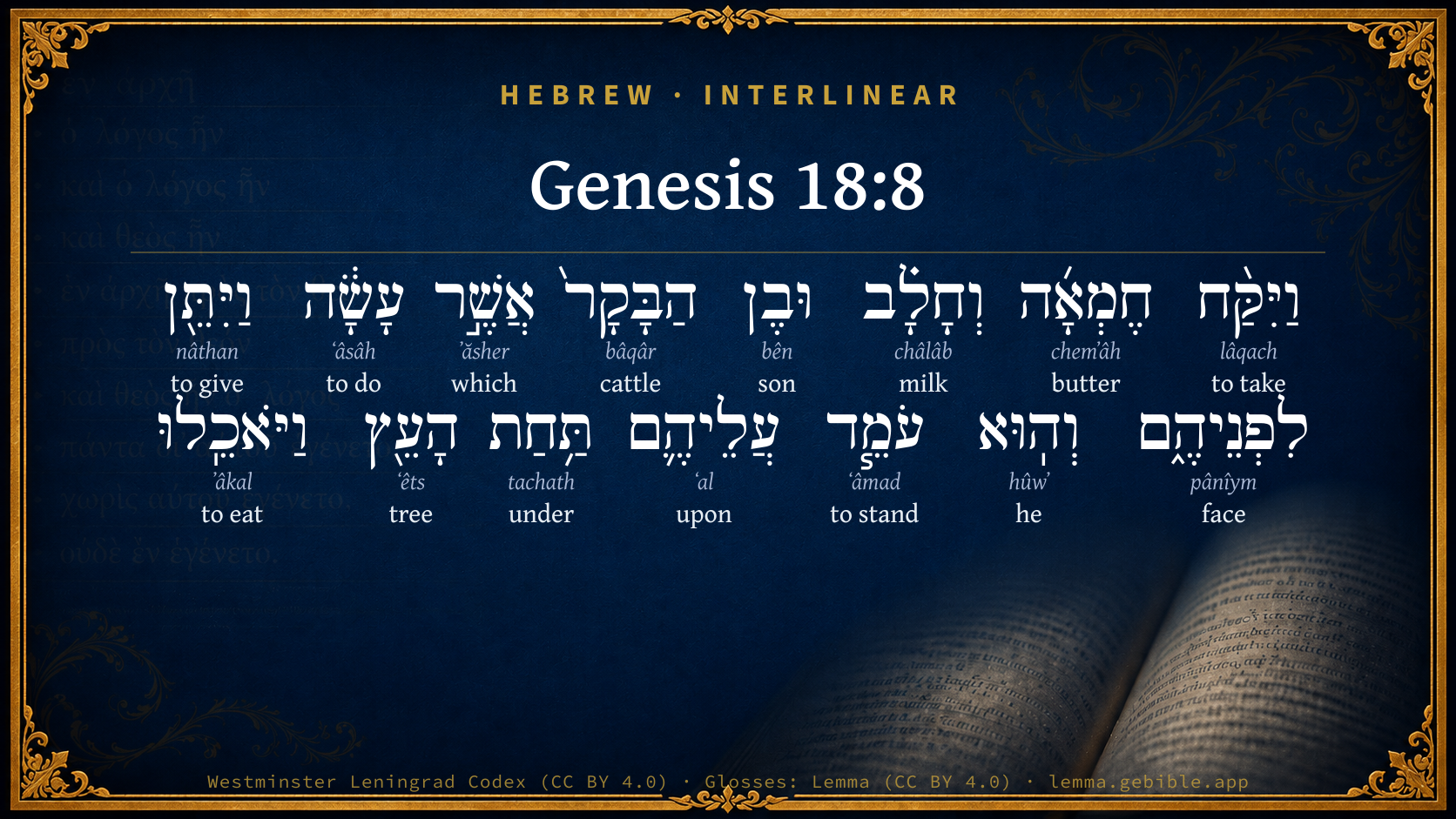
Hebrew (Westminster Leningrad Codex) Genesis 18:8 appears in the Hebrew Old Testament. The text above is from the Westminster Leningrad Codex. Each word links to its Strong’s number, a concise gloss, and parsing drawn from the Open Scriptures Hebrew Bible morphology. Click any word for its full Brown-Driver-Briggs (BDB) entry.
Download image
Cite this verse

Genesis 18:8 (World English Bible). Public Domain. Lemma interlinear Bible study tool, https://lemma.gebible.app/v/genesis/18/8.

Show BibTeX & RIS
BibTeX
RIS
English Translation
He took butter, milk, and the calf which he had dressed, and set it before them. He stood by them under the tree, and they ate.
World English Bible · Public Domain
Highlights
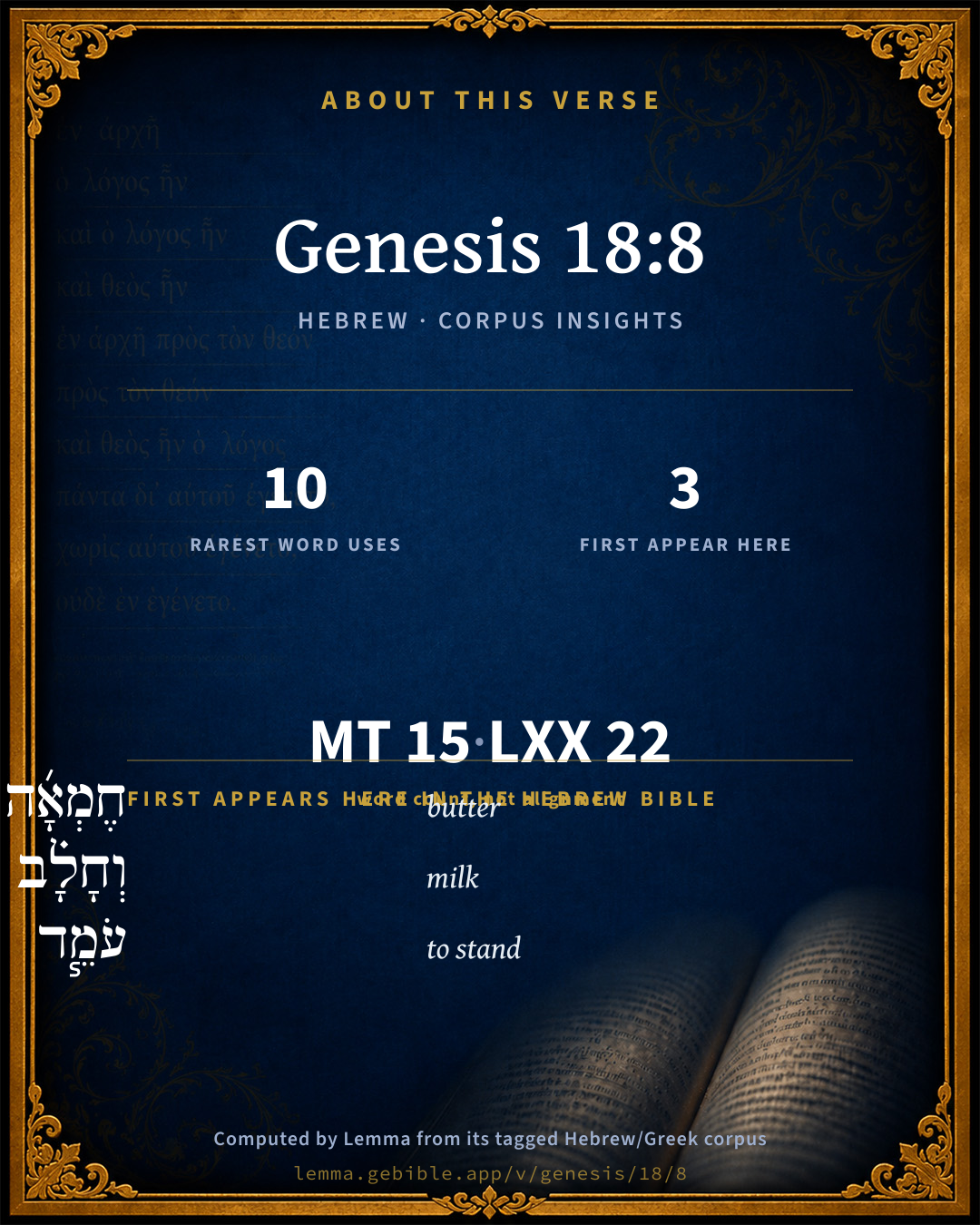
  • 3 first appearances in the Hebrew Bible
Full analysis ↓
Download a study sheet

One document with this verse’s original text, its word-by-word gloss line, the meaning frame, cross-references with their text, attributed commentary, and full source and license credits — printable, and it pastes into notes with its structure intact.

This verse Autodidact and up

Study sheet (.html) Plain text (.txt)

A passage Seminary Student

Up to 50 verses in one chapter. A passage sheet keeps up to 6 commentary sources and 12 cross-references per verse, in the order this page ranks them, and says so on the sheet whenever that leaves anything out. Ask for a single verse and you get the Autodidact verse sheet above.

Everything on this page stays free to read, with no account — the sheet is a download of what is already on screen, not access to it.

Want to remove ads? Support Godless Engineer
Compare translations 3

The same verse in 3 English versions, stacked beneath the original-language interlinear above. Click any original word for its lexicon entry.

Each is an independent rendering of the whole verse — the interlinear is not word-aligned to these translations.

Highlighted words mark where these versions differ — a whole-verse word diff, not a word-by-word alignment.

  • World English Bible Public Domain
    He took butter, milk, and the calf which he had dressed, and set it before them. He stood by them under the tree, and they ate.
  • King James Version Public Domain
    And he took butter, and milk, and the calf which he had dressed, and set it before them; and he stood by them under the tree, and they did eat.
  • unfoldingWord Literal Text CC BY-SA 4.0
    Then he took curds and milk and the calf that he had prepared, and he set it before them. Then he stood by them under the tree and they ate.

unfoldingWord Literal Text — © unfoldingWord, licensed CC BY-SA 4.0. Word-aligned USFM3 via Door43 (git.door43.org/unfoldingWord/en_ult).

Versions to compare (up to 4)

3 of 4 selected

Show all 18 translations

Every available English version of this verse, each an independent rendering of the whole verse.

  • World English Bible Public Domain
    He took butter, milk, and the calf which he had dressed, and set it before them. He stood by them under the tree, and they ate.
  • Berean Standard Bible Public Domain
    Then Abraham brought curds and milk and the calf that had been prepared, and he set them before the men and stood by them under the tree as they ate.
  • Majority Standard Bible Public Domain
    Then Abraham brought curds and milk and the calf that had been prepared, and he set them before the men and stood by them under the tree as they ate.
  • King James Version Public Domain
    And he took butter, and milk, and the calf which he had dressed, and set it before them; and he stood by them under the tree, and they did eat.
  • American Standard Version (1901) Public Domain
    And he took butter, and milk, and the calf which he had dressed, and set it before them; and he stood by them under the tree, and they did eat.
  • Revised Version (1885) Public Domain
    And he took butter, and milk, and the calf which he had dressed, and set it before them; and he stood by them under the tree, and they did eat.
  • Geneva Bible (1599) Public Domain
    And he tooke butter and milke, and the calfe, which he had prepared, and set before them, and stoode himselfe by them vnder the tree, and they did eate.
  • Douay-Rheims (1899) Public Domain
    And he himself ran to the herd, and took from thence a calf very tender and very good, and gave it to a young man: who made haste and boiled it.
  • Young's Literal Translation Public Domain
    and he taketh butter and milk, and the son of the herd which he hath prepared, and setteth before them; and he is standing by them under the tree, and they do eat.
  • Literal Standard Version CC BY-SA 4.0
    and he takes butter and milk, and the son of the herd which he has prepared, and sets before them; and he is standing by them under the tree, and they eat.
  • Unlocked Literal Bible CC BY-SA 4.0
    He took curds and milk, and the calf that had been prepared, and placed the food before them, and he stood by them under the tree while they ate.
  • unfoldingWord Literal Text CC BY-SA 4.0
    Then he took curds and milk and the calf that he had prepared, and he set it before them. Then he stood by them under the tree and they ate.
  • Darby Bible Public Domain
    And he took thick and sweet milk, and the calf that he had dressed, and set [it] before them; and he stood before them under the tree, and they ate.
  • World Messianic Bible Public Domain
    He took butter, milk, and the calf which he had dressed, and set it before them. He stood by them under the tree, and they ate.
  • Webster's Bible Public Domain
    And he took butter, and milk, and the calf which he had dressed, and set it before them; and he stood by them under the tree, and they ate.
  • Free Bible Version CC BY-SA 4.0
    Then he took some yogurt, milk, and the cooked meat, and placed the food in front of them. He stood nearby under a tree while they ate.
  • Bible in Basic English Public Domain
    And he took butter and milk and the young ox which he had made ready and put it before them, waiting by them under the tree while they took food.
  • JPS Tanakh (1917) Public Domain
    And he took curd, and milk, and the calf which he had dressed, and set it before them; and he stood by them under the tree, and they did eat.

Literal Standard Version (2020), Covenant Press — licensed CC BY-SA 4.0. Text via the HelloAO Bible API (eBible.org). Unlocked Literal Bible (unfoldingWord) — licensed CC BY-SA 4.0. Text via the HelloAO Bible API (eBible.org). unfoldingWord Literal Text — © unfoldingWord, licensed CC BY-SA 4.0. Word-aligned USFM3 via Door43 (git.door43.org/unfoldingWord/en_ult). Free Bible Version, Dr. Jonathan Gallagher — licensed CC BY-SA 4.0. Text via the HelloAO Bible API (eBible.org).

Word by word

More ways to search: Search by grammar → Find every occurrence → Compare this word →

Practice this passage: Drill this verse → Learn its vocabulary →

חֶמְאָ֜ה
chemʼâh
H2529
“butter”
Noun, Common, Feminine, Singular, Absolute
Part of Speech
Noun
Type
Common
Gender
Feminine
Number
Singular
State
Absolute
Full BDB Definition

Origin: from the same root as H2346

TWOT: 672a

curd, butter
  1. וַיִּקַּ֨ח lâqach H3947 “and · to take” Conjunction + Verb, Qal, Sequential Imperfect, 3rd Person, Masculine, Singular
  2. וְחָלָ֗ב châlâb H2461 “and · milk” Conjunction + Noun, Common, Masculine, Singular, Absolute
  3. וּבֶן bên H1121 “and · son of” Conjunction + Noun, Common, Masculine, Singular, Construct
  4. הַבָּקָר֙ bâqâr H1241 “the · cattle” Particle, Definite Article + Noun, Common, Both, Singular, Absolute
  5. אֲשֶׁ֣ר ʼăsher H834 “which” Particle, Relative
  6. עָשָׂ֔ה ʻâsâh H6213 “to do” Verb, Qal, Perfect, 3rd Person, Masculine, Singular
  7. וַיִּתֵּ֖ן nâthan H5414 “and · to give” Conjunction + Verb, Qal, Sequential Imperfect, 3rd Person, Masculine, Singular
  8. לִפְנֵיהֶ֑ם pânîym H6440 “to/for · face(s) · their” Preposition + Noun, Common, Both, Plural, Construct + Suffix, Personal, 3rd Person, Masculine, Plural
  9. וְהֽוּא hûwʼ H1931 “and · he” Conjunction + Pronoun, Personal, 3rd Person, Masculine, Singular
  10. עֹמֵ֧ד ʻâmad H5975 “standing” Verb, Qal, Participle Active, Masculine, Singular, Absolute
  11. עֲלֵיהֶ֛ם ʻal H5921 “upon · them” Preposition + Suffix, Personal, 3rd Person, Masculine, Plural
  12. תַּ֥חַת tachath H8478 “under” Preposition
  13. הָעֵ֖ץ ʻêts H6086 “the · tree” Particle, Definite Article + Noun, Common, Masculine, Singular, Absolute
  14. וַיֹּאכֵֽלוּ ʼâkal H398 “and · to eat” Conjunction + Verb, Qal, Sequential Imperfect, 3rd Person, Masculine, Plural

About this verse

These counts appear in no published source. They are computed here, from the morphology-tagged text and Lemma’s own curated glosses. What Lemma adds →

15
words
15
distinct lemmas
Pentateuch
section

Notable vocabulary

The rarest word here is חֶמְאָ֜ה butter H2529 — appearing just 10 times in the whole Hebrew Bible.

First appearance in Scripture

These words make their first canonical appearance in the Hebrew Bible here:

  • חֶמְאָ֜ה butter H2529
  • וְחָלָ֗ב milk H2461
  • עֹמֵ֧ד to stand H5975

Shared distinctive vocabulary

חֶמְאָ֜ה butter H2529 occurs in 9 verses of the Hebrew Bible. Also found in:

Grammatical profile

  • 5 verbs
  • 6 nouns
  • 1 pronoun
  • 2 prepositions
  • 1 particle

Verb forms

  • וַיִּקַּ֨ח Qal · Sequential Imperfect
  • עָשָׂ֔ה Qal · Perfect
  • וַיִּתֵּ֖ן Qal · Sequential Imperfect
  • עֹמֵ֧ד Qal · Participle Active
  • וַיֹּאכֵֽלוּ Qal · Sequential Imperfect

Hebrew & Septuagint length

In English translation the verse runs 26 words from the Hebrew and 31 from the Septuagint (LXX English) — closely comparable.

A rough comparison of the two English renderings, which tokenize alike — not a word-level alignment.

Word counts can differ between the Hebrew and the Greek without any difference in meaning — e.g. the Hebrew direct-object marker אֵת has no separate Greek word, and Greek often adds the article ὁ.

In the original languages it is 15 Hebrew tokens and 22 Greek tokens — but the two are counted differently (Hebrew bundles its prefixes and suffixes into one token; the Greek is in lemma form), so that isn’t a like-for-like length.

Cross-references

13

Topical passages linked to Genesis 18:8 in the Treasury of Scripture Knowledge — connected by theme and wording, ordered by reader-vote popularity; previews shown in the World English Bible.

  • Genesis 19:3 He urged them greatly, and they came in with him, and entered into his house. He made them a feast, and baked unleavened bread, and they ate.
  • Deuteronomy 32:14 Butter of the herd, and milk of the flock, With fat of lambs, Rams of the breed of Bashan, and goats, With the finest of the wheat; Of the blood of the grape you drank wine.
  • Judges 5:25 He asked water, [and] she gave him milk; She brought him butter in a lordly dish.
  • Judges 13:15 Manoah said to the angel of Yahweh, I pray you, let us detain you, that we may make ready a kid for you.
  • Nehemiah 12:44 On that day were men appointed over the chambers for the treasures, for the heave-offerings, for the first fruits, and for the tithes, to gather into them, according to the fields of the cities, the portions appointed by the law for the priests and Levites: for Judah rejoiced for the priests and for the Levites who waited.
  • Luke 12:37 Blessed are those servants, whom the lord will find watching when he comes. Most assuredly I tell you, that he will dress himself, and make them recline, and will come and serve them.
  • Luke 17:8 and will not rather tell him, 'Prepare my supper, clothe yourself properly, and serve me, while I eat and drink. Afterward you shall eat and drink'?
  • Luke 24:30 It happened, that when he had sat down at the table with them, he took the bread and gave thanks. Breaking it, he gave to them.
  • Luke 24:43 He took them, and ate in front of them.
  • John 12:2 So they made him a supper there. Martha served, but Lazarus was one of those who sat at the table with him.
  • Acts 10:41 not to all the people, but to witnesses who were chosen before by God, to us, who ate and drank with him after he rose from the dead.
  • Galatians 5:13 For you, brothers, were called for freedom. Only don't use your freedom for gain to the flesh, but through love be servants to one another.
  • Revelation 3:20 Behold, I stand at the door and knock. If anyone hears my voice and opens the door, then I will come in to him, and will dine with him, and he with me.

Cross-references courtesy of OpenBible.info (CC BY 4.0).

Hebrew and Greek witnesses Masoretic Hebrew ↔ Greek Septuagint

The same verse in the two great witnesses to the Old Testament, shown verse-for-verse.

These are two independent witnesses, not word-aligned to each other, and the Septuagint is shown in lemma (dictionary) form.

Hebrew Genesis 18:8 Masoretic · Westminster Leningrad Codex

וַיִּקַּ֨ח חֶמְאָ֜ה וְחָלָ֗ב וּבֶן הַבָּקָר֙ אֲשֶׁ֣ר עָשָׂ֔ה וַיִּתֵּ֖ן לִפְנֵיהֶ֑ם וְהֽוּא עֹמֵ֧ד עֲלֵיהֶ֛ם תַּ֥חַת הָעֵ֖ץ וַיֹּאכֵֽלוּ

He took butter, milk, and the calf which he had dressed, and set it before them. He stood by them under the tree, and they ate.

World English Bible · Public Domain

Greek LXX Genesis 18:8 Septuagint · lemma form

λαμβάνω δέ βούτυρον καί γάλα καί ὁ μοσχάριον ὅς ποιέω καί παρατίθημι αὐτός καί ἐσθίω αὐτός δέ παραἵστημι αὐτός ὑπό ὁ δένδρον

And he took butter and milk, and the calf which he had dressed; and he set them before them, and they did eat, and he stood by them under the tree.

LXX2012 (modern English Septuagint) · Public Domain

On this verse, The Cambridge Bible for Schools and Colleges discusses the Septuagint’s reading. Read the note in Commentary ↓

Hebrew: Westminster Leningrad Codex (CC BY 4.0). Greek: Septuagint (public domain); English from LXX2012 (modern English Septuagint) (Public Domain). How the Septuagint differs from the Hebrew →

Targum (Aramaic paraphrase)

2

The Targum is the ancient Jewish Aramaic paraphrase of the Hebrew Scriptures — an interpretive translation, not the Hebrew text itself. Onkelos (literal) and Pseudo-Jonathan (expansive) render the Torah, and Jonathan the Prophets. Coverage is partial: where no permissively-licensed English translation exists for a verse, only the Aramaic is shown. This is verse-level text, not a word-by-word alignment to the Hebrew.

  1. Targum Onkelos Torah (Genesis–Deuteronomy)
    וּנְסִיב שְׁמַן וַחֲלָב וּבַר תּוֹרֵי דִּי עֲבַד וִיהַב קֳדָמֵיהוֹן וְהוּא מְשַׁמֵּשׁ עִלָּוֵיהוֹן תְּחוֹת אִילָנָא וַאֲכָלוּ

    (no public-domain English translation for this verse)

    Targum Onkelos — Aramaic: “Onkelos Genesis” (public domain); “Onkelos Exodus” (public domain); “Onkelos Leviticus” (public domain); “Onkelos Numbers” (public domain); “Onkelos Deuteronomy” (public domain). English: “Sefaria Community Translation” (CC0 1.0 (public-domain dedication)); “J.W. Etheridge. The Targums of Onkelos and Jonathan Ben Uzziel on the Pentateuch. London: Longmans, Green, 1862” (public domain). Text via Sefaria.

  2. Targum Pseudo-Jonathan Torah (Genesis–Deuteronomy)
    וּנְסֵיב לֵוָאֵי שָׁמִין וַחֲלַב וּבַר תּוֹרֵי דְעָבַד עוּלֵימָא תַּבְשִׁילִין וְסַדֵר קֳדָמֵיהוֹן כְּאוֹרַח הִילְכַת בִּרְיַית עַלְמָא וְהוּא מְשַׁמֵשׁ קֳדָמֵיהוֹן וְאִינוּן יַתְבִין תְּחוֹת אִילָנָא וְדָמֵי לֵיהּ כְּאִילוּ אָכְלִין

    and he took rich cream and milk and the calf which the young man had made into prepared meats, and set them before them, according to the way and conduct (hilkath) of the creatures of the world; and he served before them, and they sat under the tree; and he quieted himself (to see) whether they would eat.

    Targum Pseudo-Jonathan — Aramaic: “Targum Jonathan on Genesis” (public domain); “Targum Jonathan on Exodus” (public domain); “Targum Jonathan on Leviticus” (public domain); “Targum Jonathan on Numbers” (public domain); “Targum Jonathan on Deuteronomy” (public domain). English: “The Targum of Jonathan ben Uzziel, trans. J. W. Etheridge, London, 1862” (public domain). Text via Sefaria.

Commentary

Notes on Genesis 18:8 from classic Christian and Jewish commentators (each source and its license shown beneath its notes). The classic Christian expositions comment on the surrounding passage and are grouped to its opening verse, so a note may address several verses; the Jewish commentaries on the Tanakh (Rashi and others) are per-verse, so they appear only where the commentator wrote on this verse.

Lemma curates 59 commentaries, every one of them public domain or Creative Commons licensed, each selected and text-cleaned for this edition rather than reprinted as found. About our sources →

Trapp's Complete Commentary

John Trapp

Gen 18:8 And he took butter, and milk, and the calf which he had dressed, and set [it] before them; and he stood by them under the tree, and they did eat.

Ver. 8. And they did eat.] The angels, as they assumed human shapes, so they did truly eat, according to the present dispensation of the shape so assumed.

John Trapp, A Commentary or Exposition upon All the Books of the Old and New Testament (1647–1656) — public domain. Text from a community e-Sword module.

Geneva Bible (1599)

Geneva Bible translators

For as God gave them bodies for a time, so gave he them the faculties thereof, to walk, to eat and drink, and such like.

Geneva Bible (1599) marginal notes — public domain. Text via Bolls.life.

Jamieson, Fausset & Brown

Robert Jamieson, A. R. Fausset & David Brown

milk--A bowl of camel's milk ends the repast.

he stood by them under the tree--The host himself, even though he has a number of servants, deems it a necessary act of politeness to stand while his guests are at their food, and Abraham evidently did this before he was aware of the real character of his visitors.

Jamieson, Fausset & Brown — Commentary Critical and Explanatory on the Whole Bible (1871) — public domain (CC PDM 1.0). Text via the HelloAO Bible API.

Adam Clarke's Commentary

Verse 8. And he stood by them under the tree, and they did eat.] Nothing is more common in Hindostan than to see travellers and guests eating under the shade of trees. Feasts are scarcely ever held in houses. The house of a Hindoo serves for sleeping and cooking, and for shutting up the women; but is never considered as a sitting or dining room. - Ward.

Adam Clarke's Commentary on the Bible (1810–1826) — public domain. Text from a community e-Sword/MySword module.

Ellicott's Commentary for English Readers

(8) Butter.—Heb. curds, or curdled milk. Neither the Hebrews, Greeks, nor Romans knew how to make butter, and the word itself signifies cheese made of cows’ milk. This is less prized in the East than that made from the milk of sheep, or of goats, while camels’ milk is regarded by the Arabs as best for drinking. In a hot climate milk is more refreshing when slightly sour; but Abraham brought both fresh milk (probably from the camels) and sour milk (from the sheep), and this with the cakes and the calf made a stately repast. With noble courtesy “he stood by them, and they did eat.” The Targum of Jonathan and other Jewish authorities translate “and they made show of eating,” lest it should seem as though angels ate (Jdg_13:16). There is the same mystery as regards our risen Lord (Luk_24:43).

A Bible Commentary for English Readers, edited by Charles John Ellicott (1878–1897) — public domain. Text from a community e-Sword module.

The Cambridge Bible for Schools and Colleges

gen. ed. J. J. S. Perowne

8. butter, and milk] Butter (ḥem’ah, LXX βούτυρον) is not what we should call butter, but rather “curds,” mentioned here and Jdg_5:25, as a cool and refreshing delicacy to be offered to a guest. It is called in the East leben. It is probably this which we find so often mentioned with honey, e.g. 2Sa_17:29; Isa_7:22. The milk (ḥâlâb) would be the fresh milk of sheep or goats.

they did eat] The manifestation of the Deity is here, as in Gen_19:3, associated with a meal. Cf. Exo_24:11; Jdg_6:19-20. God’s Presence may bless the simplest duties of home life.

The Cambridge Bible for Schools and Colleges (gen. ed. J. J. S. Perowne; Cambridge University Press, 1878–1918) — public domain. Text from a community e-Sword module.

John Gill's Exposition

And he took butter and milk,.... Jarchi says, it was the fat of the milk gathered from the top of it, he means cream, and is different both from butter and from milk: this was either Abraham himself, who took and brought these, as Sarah or her maidens might bring the cakes when baked; or else Abraham's young man, since it follows:

and the calf which he had dressed; either the whole of it, or some principal parts of it, reckoned the finest and choicest; though by what follows it seems to be Abraham himself, who may be said to dress the calf, it being done by his orders:

and set it before them; a table being placed under the tree, he set, or ordered to be set, all those provisions before the three men, to feed upon, the cakes and butter, the milk and fatted calf:

and he stood by them under the tree; not only to bid them welcome, but to minister to them; nor will this seem strange, or that the above several things were chiefly done by Abraham and Sarah, when it is observed that the greatest personages in the eastern countries, in early times, used to perform such services, and still do to this day, as a late traveller (r) informs us:"it is here (says he) no disgrace for persons of the highest character to busy themselves in what we should reckon menial employments; the greatest prince assists in the most laborious actions of husbandry; neither is he ashamed to fetch a lamb from his herd and kill it, while the princess his wife is impatient till she has prepared her fire and her kettle to seethe and dress it: the custom that still continues of walking either barefoot or with slippers requires the ancient compliment of bringing water upon the arrival of a stranger to wash his feet; and who is the person that presents himself first to do this office, and to give the "mar habbeh", or welcome, but the master of the family himself? who always distinguishes himself by being the most officious; and, after his entertainment is prepared, accounts it a breach of respect to sit down with his guests, but stands up all the time and serves them.''All which serves greatly to illustrate this passage; and the same learned author observes, that in this manner we find Achilles and Patroclus employed, as described by Homer (s), in providing an entertainment:

and they did eat; or seemed to eat, as the Targum of Jonathan and Jarchi; though as they assumed bodies so animated as to be capable of talking and walking, why not of eating and drinking? and there must have been a consumption of food some way or other, or Abraham would have known they had not eaten: we read of angels' food, Psa 78:25; our English poet had a notion of angels eating, and represents Eve providing a repast for the angel, which he owns to be no ungrateful food (t).

(r) Dr. Shaw's Travels, p. 237, 238. Ed. 2. (s) Iliad. 9. ver. 205. (t) Milton's Paradise Lost, B. 5. ver. 412, &c.

John Gill's Exposition of the Whole Bible (1746–1763) — public domain (CC PDM 1.0). Text via the HelloAO Bible API.

Matthew Poole's English Annotations

The calf, to wit, the choicest parts of the calf.

He stood by them, to wait upon them, as the word standing is used, Neh 12:44; Jer 52:12.

They did eat; either seemingly, as the Scripture oft speaks of things according to appearance; or really, they received the meat into the bodies which they assumed, where it was consumed by a Divine power.

Matthew Poole's English Annotations on the Holy Bible (1683–1685) — public domain. Text from a community e-Sword/MySword module.

Whedon's Commentary on the Bible

Daniel D. Whedon

8. Butter — “This is commonly clotted cream. The milk is chiefly that of the goat, which is very rich and sweet, rather sickening to an unpracticed taste. This kind of milk we found abundant in Palestine, and no other.” — Jacobus.

Stood by them — As a reverent attendant and waiter, fully appreciating the honour of the occasion.

They did eat — As truly as did the risen Lord. Luk_24:43. It was not because they needed food, but as, in our Lord’s case, to convince Abraham and Sarah of the reality of this divine visitation. See on Gen_18:2. “If the angels had assumed human bodies, though but for a time, there would have been nothing strange in their eating. In any case the food may have been consumed, miraculously or not; and the eating of it was a proof that the visit of the angels to Abraham was no mere vision, but a true manifestation of heavenly beings.” — Speaker’s Com.

Daniel D. Whedon (gen. ed.), Commentary on the Old and New Testaments (1874–1909) — public domain. Text from a community e-Sword module.

The Pulpit Commentary

And he took butter, ha; mj, from the root amj, to curdle or become thick, signifies curdled milk, not butter (boututron, LXX; butyrum, Vulgate), which was not used among Orientals except medicinally. The word occurs seven times in Scripture with four letters (Deu_32:14; Jud_1:5:25; 2Sa_17:29; Isa_7:15, Isa_7:22; Pro_30:33; Job_20:17) and once without a (Job_29:6; vide Michaelis, "Supplement," p. 807) and milk, blj milk whilst still fresh, or containing its fatness, from a root signifying to be fat (Gen_49:12; Pro_27:27) and the calf which he i.e. the young manhad dressed, and set it before them; and he stood by them under the tree, a custom still observed among the Arabs, who honor their guests not by sitting to eat with, but by standing to wait upon, themand they did eat. Not seemed to eat (Josephus, Philo, Jonathan), nor simply ate after an allegorical fashion, as fire consumes the materials put into it (Justin Martyr), but did so in reality (Tertullian, Delitzsch, Keil, Kurtz, Lange). Though the angel who appeared to Manoah (Jud_1:13:16) refused to partake of food, the risen Savior ate with his disciples. (Luk_24:43) Physiologically inexplicable, this latter action on the part of Christ was not a mere fainomenon or simulation, but a veritable manducation of material food, to which Christ appealed in confirmation of the reality of his resurrection; and the acceptance of Abraham"s hospitality on the part of Jehovah and his angels may in like manner have been designed to prove that their visit to his tent at Mamre was not a dream or a vision, but a genuine external manifestation.

The Pulpit Commentary (1880–1919), ed. H.D.M. Spence-Jones & Joseph S. Exell — public domain. Text from a community e-Sword module.

Rashi

Rabbi Shlomo Yitzchaki (Rashi)

חמאה is the fatty part of milk which is skimmed off its surface.

ובן הבקר אשר עשה literally, AND THE CALF WHICH HE HAD MADE — i.e. prepared. Whatever was ready first he brought and placed before them.

ויאכלו AND THEY DID EAT—They appeared to be eating: from this we may learn that a man should not act differently from the prevalent custom (Bava Metzia 86b).

Rashi on the Tanakh — English translations: “The Judaica Press complete Tanach with Rashi, translated by A. J. Rosenberg” (CC BY 4.0); “Pentateuch with Rashi's commentary by M. Rosenbaum and A.M. Silbermann, 1929-1934” (public domain); “The Metsudah Tanach series, Lakewood, N.J” (CC BY 4.0); and “The Book of Joshua, Metsudah Publications, 1997” (CC BY 4.0). Text via Sefaria.

Radak

Rabbi David Kimhi (Radak)

ויקח, he, personally.

ויתן, he placed before them butter and milk as well as the young calf. He offered them the choice to eat either dairy or meaty. There was no need to mention the bread as it is understood that he first brought them the bread. After all, the very minimum one can serve guests is bread. When one entertains guests who appear to be distinguished people one most certainly does not fail to offer them bread first. Besides, the Torah had already mentioned that he prepared the bread in the guise of uggot, cakes. There was also no need to mention that he served them wine, another, staple at all meals.

אשר עשה, by means of his servant.

והוא עומד, as explained by Onkelos, i.e. he served them in the capacity of waiter.

עליהם, the word is used in the same sense already in verse 2

ויאכלו, this is how it appeared to him. All this was part of his prophetic vision.

Radak on the Tanakh — English translations: “Sefaria Community Translation” (CC0 1.0 (public-domain dedication)); “Eliyahu Munk, HaChut Hameshulash” (CC BY 4.0); “Rabbi Mike Feuer, Jerusalem Anthology” (CC BY 4.0); and “R. David Kimhi on the first book of Psalms, Translated by R.G. Finch, London, 1919” (public domain). Text via Sefaria.

Lesson kit

Teaching starters — assembled from the data on this page, not authored interpretation. Every prompt links to the verse data it draws on. Edit before teaching.

Genesis, in the Pentateuch, opens this verse with 15 words (15 distinct Hebrew lemmas). Its most distinctive word is chemʼâh (“butter”). A historical commentator’s framing appears above. Read the whole chapter for the surrounding context.

Discussion questions

  1. How does “butter” (chemʼâh) shape what this verse is saying?
  2. 3 words make their first appearance in Scripture here. What does this debut establish?
  3. How does Deuteronomy 32:14, which shares the word «butter», read alongside this verse?
  4. These translations render this verse differently. What is at stake in choosing one wording over another?
  5. «וַיִּקַּ֨ח» is a Qal Sequential Imperfect verb. How does that grammatical form shape the action described?
  6. Compare how Trapp's Complete Commentary and Geneva Bible (1599) read this verse. Where do they agree or differ?

Things to notice

Reading settings

Reading text

Shown beneath each verse's original-language words.

Old Testament
Old Testament edition

Read the OT as the Masoretic Hebrew (MT) or the Greek Septuagint (LXX).

English shown for the Greek Septuagint (in the Hebrew ↔ Greek comparison).

Comparing translations? Open the Compare panel on any verse page to stack up to four side by side.