
Exodus 6:8

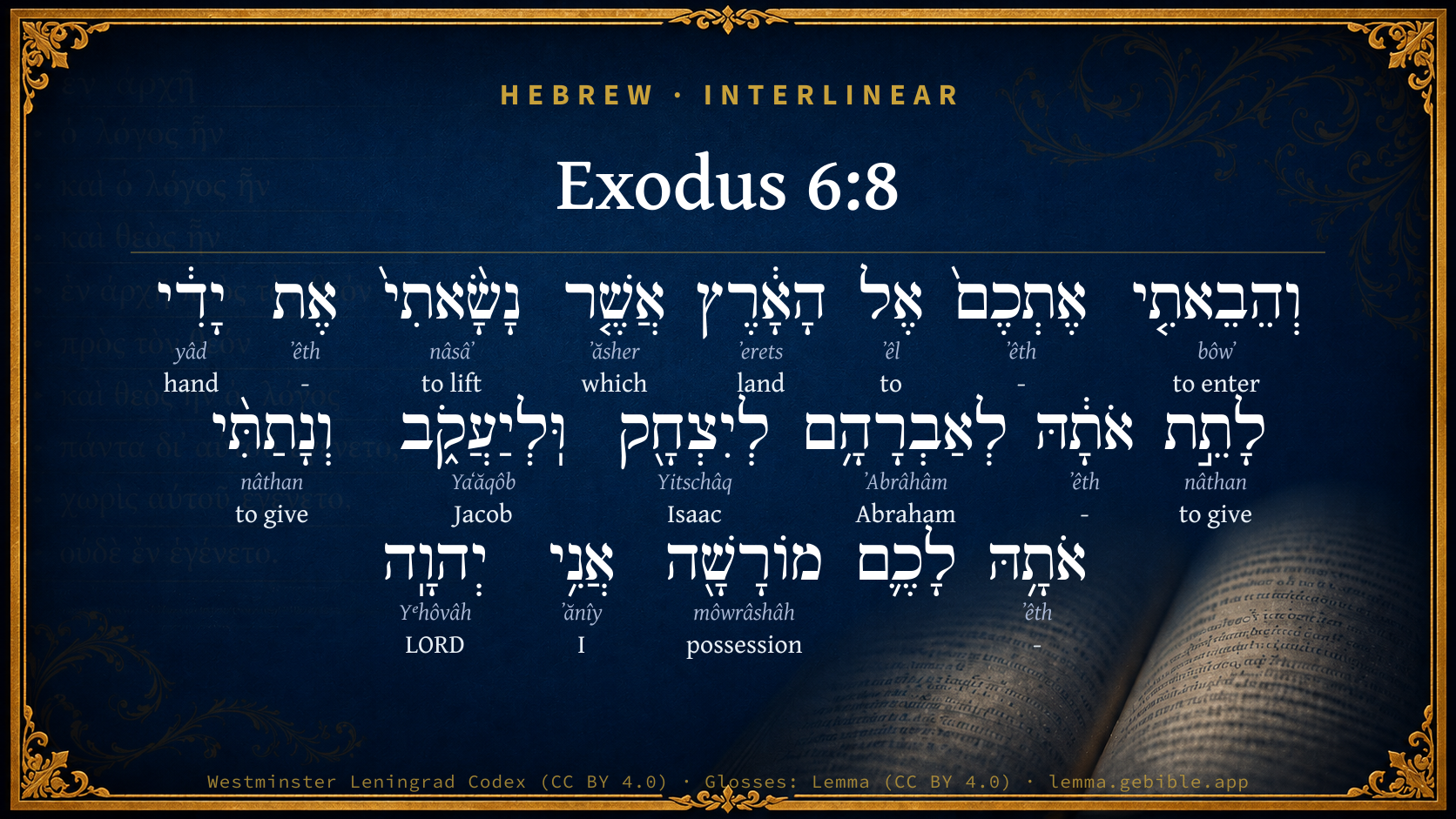
Hebrew (Westminster Leningrad Codex) Exodus 6:8 appears in the Hebrew Old Testament. The text above is from the Westminster Leningrad Codex. Each word links to its Strong’s number, a concise gloss, and parsing drawn from the Open Scriptures Hebrew Bible morphology. Click any word for its full Brown-Driver-Briggs (BDB) entry.
Download image
Cite this verse

Exodus 6:8 (World English Bible). Public Domain. Lemma interlinear Bible study tool, https://lemma.gebible.app/v/exodus/6/8.

Show BibTeX & RIS
BibTeX
RIS
English Translation
I will bring you into the land which I swore to give to Abraham, to Isaac, and to Jacob; and I will give it to you for a heritage: I am Yahweh.'"
World English Bible · Public Domain
Highlights
  • 1 first appearance in the Hebrew Bible
Full analysis ↓
Download a study sheet

One document with this verse’s original text, its word-by-word gloss line, the meaning frame, cross-references with their text, attributed commentary, and full source and license credits — printable, and it pastes into notes with its structure intact.

This verse Autodidact and up

Study sheet (.html) Plain text (.txt)

A passage Seminary Student

Up to 50 verses in one chapter. A passage sheet keeps up to 6 commentary sources and 12 cross-references per verse, in the order this page ranks them, and says so on the sheet whenever that leaves anything out. Ask for a single verse and you get the Autodidact verse sheet above.

Everything on this page stays free to read, with no account — the sheet is a download of what is already on screen, not access to it.

Want to remove ads? Support Godless Engineer
Compare translations 3

The same verse in 3 English versions, stacked beneath the original-language interlinear above. Click any original word for its lexicon entry.

Each is an independent rendering of the whole verse — the interlinear is not word-aligned to these translations.

Highlighted words mark where these versions differ — a whole-verse word diff, not a word-by-word alignment.

  • World English Bible Public Domain
    I will bring you into the land which I swore to give to Abraham, to Isaac, and to Jacob; and I will give it to you for a heritage: I am Yahweh.'"
  • King James Version Public Domain
    And I will bring you in unto the land, concerning the which I did swear to give it to Abraham, to Isaac, and to Jacob; and I will give it you for an heritage: I am the LORD.
  • unfoldingWord Literal Text CC BY-SA 4.0
    And I will bring you to the land that I raised my hand to give it to Abraham, to Isaac, and to Jacob. And I will give it to you as a possession. I am Yahweh.’”

unfoldingWord Literal Text — © unfoldingWord, licensed CC BY-SA 4.0. Word-aligned USFM3 via Door43 (git.door43.org/unfoldingWord/en_ult).

Versions to compare (up to 4)

3 of 4 selected

Show all 18 translations

Every available English version of this verse, each an independent rendering of the whole verse.

  • World English Bible Public Domain
    I will bring you into the land which I swore to give to Abraham, to Isaac, and to Jacob; and I will give it to you for a heritage: I am Yahweh.'"
  • Berean Standard Bible Public Domain
    And I will bring you into the land that I swore to give to Abraham, Isaac, and Jacob. I will give it to you as a possession. I am the LORD!’”
  • Majority Standard Bible Public Domain
    And I will bring you into the land that I swore to give to Abraham, Isaac, and Jacob. I will give it to you as a possession. I am the LORD!’”
  • King James Version Public Domain
    And I will bring you in unto the land, concerning the which I did swear to give it to Abraham, to Isaac, and to Jacob; and I will give it you for an heritage: I am the LORD.
  • American Standard Version (1901) Public Domain
    And I will bring you in unto the land which I sware to give to Abraham, to Isaac, and to Jacob; and I will give it you for a heritage: I am Jehovah.
  • Revised Version (1885) Public Domain
    And I will bring you in unto the land concerning which I lifted up my hand to give it to Abraham, to Isaac, and to Jacob; and I will give it you for an heritage: I am Jehovah.
  • Geneva Bible (1599) Public Domain
    And I will bring you into the land which I sware that I woulde giue to Abraham, to Izhak, and to Iaakob, and I will giue it vnto you for a possession: I am the Lord.
  • Douay-Rheims (1899) Public Domain
    And brought you into the land, concerning which I lifted up my hand to give it to Abraham, Isaac, and Jacob and I will give it you to possess, I am the Lord.
  • Young's Literal Translation Public Domain
    and I have brought you in unto the land which I have lifted up My hand to give it to Abraham, to Isaac, and to Jacob, and have given it to you -- a possession; I `am' Jehovah.'
  • Literal Standard Version CC BY-SA 4.0
    and I have brought you to the land which I have lifted up My hand to give it to Abraham, to Isaac, and to Jacob, and have given it to you—a possession; I [am] YHWH.”
  • Unlocked Literal Bible CC BY-SA 4.0
    I will bring you into the land that I swore to give to Abraham, to Isaac, and to Jacob. I will give it to you as a possession. I am Yahweh.'”
  • unfoldingWord Literal Text CC BY-SA 4.0
    And I will bring you to the land that I raised my hand to give it to Abraham, to Isaac, and to Jacob. And I will give it to you as a possession. I am Yahweh.’”
  • Darby Bible Public Domain
    And I will bring you into the land concerning which I swore to give it unto Abraham, unto Isaac, and unto Jacob; and I will give it you for a possession: I am Jehovah.
  • World Messianic Bible Public Domain
    I will bring you into the land which I swore to give to Abraham, to Isaac, and to Jacob; and I will give it to you for a heritage: I am the LORD.’”
  • Webster's Bible Public Domain
    And I will bring you into the land, concerning which I swore to give it to Abraham, to Isaac, and to Jacob; and I will give it to you for a heritage: I am the LORD.
  • Free Bible Version CC BY-SA 4.0
    I will take you to the land that I solemnly promised to give to Abraham, Isaac, and Jacob. I will give it to you to own. I am the Lord!’”
  • Bible in Basic English Public Domain
    And I will be your guide into the land which I made an oath to give to Abraham, to Isaac, and to Jacob; and I will give it to you for your heritage: I am Yahweh.
  • JPS Tanakh (1917) Public Domain
    And I will bring you in unto the land, concerning which I lifted up My hand to give it to Abraham, to Isaac, and to Jacob; and I will give it you for a heritage: I am the LORD.'

Literal Standard Version (2020), Covenant Press — licensed CC BY-SA 4.0. Text via the HelloAO Bible API (eBible.org). Unlocked Literal Bible (unfoldingWord) — licensed CC BY-SA 4.0. Text via the HelloAO Bible API (eBible.org). unfoldingWord Literal Text — © unfoldingWord, licensed CC BY-SA 4.0. Word-aligned USFM3 via Door43 (git.door43.org/unfoldingWord/en_ult). Free Bible Version, Dr. Jonathan Gallagher — licensed CC BY-SA 4.0. Text via the HelloAO Bible API (eBible.org).

Word by word

More ways to search: Search by grammar → Find every occurrence → Compare this word →

Practice this passage: Drill this verse → Learn its vocabulary →

מוֹרָשָׁ֖ה
môwrâshâh
H4181
“possession”
Noun, Common, Feminine, Singular, Absolute
Part of Speech
Noun
Type
Common
Gender
Feminine
Number
Singular
State
Absolute
Full BDB Definition

Origin: from H4180

TWOT: 920e

a possession
  1. וְהֵבֵאתִ֤י bôwʼ H935 “and · to enter” Conjunction + Verb, Hiphil, Sequential Perfect, 1st Person, Common, Singular
  2. אֶתְכֶם֙ ʼêth H853 “- · you” Particle, Direct Object + Suffix, Personal, 2nd Person, Masculine, Plural
  3. אֶל ʼêl H413 “to” Preposition
  4. הָאָ֔רֶץ ʼerets H776 “the · land” Particle, Definite Article + Noun, Common, Both, Singular, Absolute
  5. אֲשֶׁ֤ר ʼăsher H834 “which” Particle, Relative
  6. נָשָׂ֨אתִי֙ nâsâʼ H5375 “to lift” Verb, Qal, Perfect, 1st Person, Common, Singular
  7. אֶת ʼêth H853 “-” Particle, Direct Object
  8. יָדִ֔י yâd H3027 “hand · my” Noun, Common, Both, Singular, Construct + Suffix, Personal, 1st Person, Common, Singular
  9. לָתֵ֣ת nâthan H5414 “to give” Preposition + Verb, Qal, Infinitive Construct
  10. אֹתָ֔הּ ʼêth H853 “- · her” Particle, Direct Object + Suffix, Personal, 3rd Person, Feminine, Singular
  11. לְאַבְרָהָ֥ם ʼAbrâhâm H85 “to/for · Abraham” Preposition + Noun, Proper
  12. לְיִצְחָ֖ק Yitschâq H3327 “to/for · Isaac” Preposition + Noun, Proper
  13. וּֽלְיַעֲקֹ֑ב Yaʻăqôb H3290 “and · to/for · Jacob” Conjunction + Preposition + Noun, Proper
  14. וְנָתַתִּ֨י nâthan H5414 “and · to give” Conjunction + Verb, Qal, Sequential Perfect, 1st Person, Common, Singular
  15. אֹתָ֥הּ ʼêth H853 “- · her” Particle, Direct Object + Suffix, Personal, 3rd Person, Feminine, Singular
  16. אֲנִ֥י ʼănîy H589 “I” Pronoun, Personal, 1st Person, Common, Singular
  17. יְהוָֽה Yᵉhôvâh H3068 “LORD” Noun, Proper

About this verse

These counts appear in no published source. They are computed here, from the morphology-tagged text and Lemma’s own curated glosses. What Lemma adds →

19
words
14
distinct lemmas
Pentateuch
section

Notable vocabulary

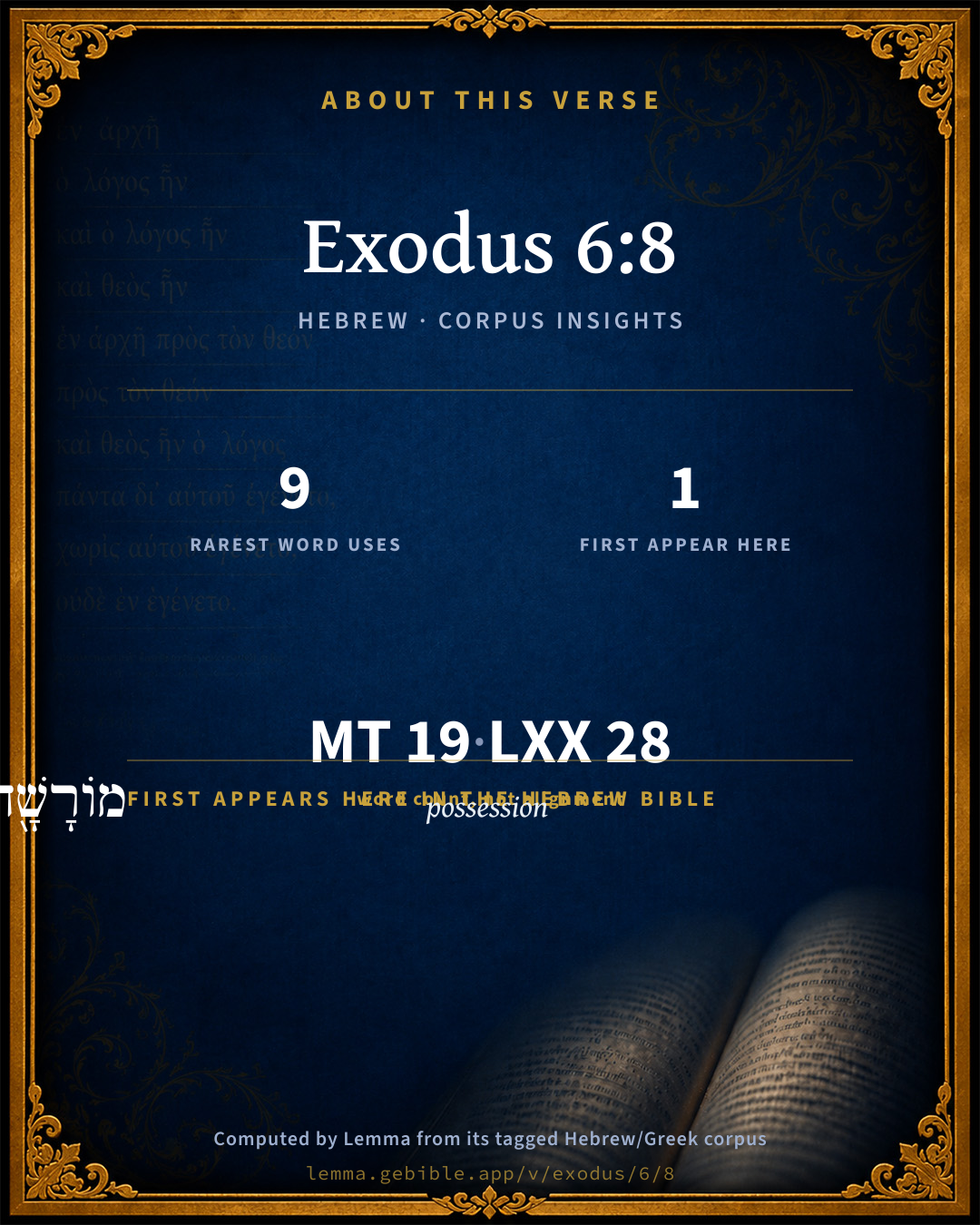
The rarest word here is מוֹרָשָׁ֖ה possession H4181 — appearing just 9 times in the whole Hebrew Bible.

First appearance in Scripture

This word makes its first canonical appearance in the Hebrew Bible here:

  • מוֹרָשָׁ֖ה possession H4181

Shared distinctive vocabulary

מוֹרָשָׁ֖ה possession H4181 occurs in 9 verses of the Hebrew Bible. Also found in:

Grammatical profile

  • 4 verbs
  • 7 nouns
  • 1 pronoun
  • 2 prepositions
  • 5 particles

Verb forms

  • וְהֵבֵאתִ֤י Hiphil · Sequential Perfect
  • נָשָׂ֨אתִי֙ Qal · Perfect
  • לָתֵ֣ת Qal · Infinitive Construct
  • וְנָתַתִּ֨י Qal · Sequential Perfect

Repetition

A word recurs within this verse — often emphatic in Hebrew:

  • לָתֵ֣ת to give H5414 ×2

Hebrew & Septuagint length

In English translation the verse runs 32 words from the Hebrew and 37 from the Septuagint (LXX English) — closely comparable.

A rough comparison of the two English renderings, which tokenize alike — not a word-level alignment.

Word counts can differ between the Hebrew and the Greek without any difference in meaning — e.g. the Hebrew direct-object marker אֵת has no separate Greek word, and Greek often adds the article ὁ.

In the original languages it is 19 Hebrew tokens and 28 Greek tokens — but the two are counted differently (Hebrew bundles its prefixes and suffixes into one token; the Greek is in lemma form), so that isn’t a like-for-like length.

Cross-references

20

Topical passages linked to Exodus 6:8 in the Treasury of Scripture Knowledge — connected by theme and wording, ordered by reader-vote popularity; previews shown in the World English Bible.

  • Genesis 15:18 In that day Yahweh made a covenant with Abram, saying, "To your seed have I given this land, from the river of Egypt to the great river, the river Euphrates:
  • Genesis 26:3 Sojourn in this land, and I will be with you, and will bless you. For to you, and to your seed, I will give all these lands, and I will establish the oath which I swore to Abraham your father.
  • Genesis 14:22 Abram said to the king of Sodom, "I have lifted up my hand to Yahweh, God Most High, possessor of heaven and earth,
  • Ezekiel 20:5–6 and tell them, Thus says the Lord Yahweh: In the day when I chose Israel, and swore to the seed of the house of Jacob, and made myself known to them in the land of Egypt, when I swore to them, saying, I am Yahweh your God;
  • Ezekiel 20:42 You shall know that I am Yahweh, when I shall bring you into the land of Israel, into the country which I swore to give to your fathers.
  • Genesis 28:13 Behold, Yahweh stood above it, and said, "I am Yahweh, the God of Abraham your father, and the God of Isaac. The land whereon you lie, to you will I give it, and to your seed.
  • Genesis 35:12 The land which I gave to Abraham and Isaac, I will give it to you, and to your seed after you will I give the land."
  • Exodus 32:13 Remember Abraham, Isaac, and Israel, your servants, to whom you swore by your own self, and said to them, 'I will multiply your seed as the stars of the sky, and all this land that I have spoken of I will give to your seed, and they shall inherit it forever.'"
  • Deuteronomy 32:40 For I lift up my hand to heaven, And say, As I live forever,
  • Ezekiel 47:14 You shall inherit it, one as well as another; for I swore to give it to your fathers: and this land shall fall to you for inheritance.
  • Genesis 22:16–17 and said, "I have sworn by myself, says Yahweh, because you have done this thing, and have not withheld your son, your only son,
  • Exodus 6:2 God spoke to Moses, and said to him, "I am Yahweh;
  • Exodus 6:6 Therefore tell the children of Israel, 'I am Yahweh, and I will bring you out from under the burdens of the Egyptians, and I will rid you out of their bondage, and I will redeem you with an outstretched arm, and with great judgments:
  • Numbers 23:19 God is not a man, that he should lie, Neither the son of man, that he should repent: Has he said, and will he not do it? Or has he spoken, and will he not make it good?
  • 1 Samuel 15:29 Also the Strength of Israel will not lie nor repent; for he is not a man, that he should repent.
  • Psalms 136:21–22 And gave their land as an inheritance; For his loving kindness endures forever;
  • Ezekiel 20:15 Moreover also I swore to them in the wilderness, that I would not bring them into the land which I had given them, flowing with milk and honey, which is the glory of all lands;
  • Ezekiel 20:23 Moreover I swore to them in the wilderness, that I would scatter them among the nations, and disperse them through the countries;
  • Ezekiel 20:28 For when I had brought them into the land, which I swore to give to them, then they saw every high hill, and every thick tree, and they offered there their sacrifices, and there they presented the provocation of their offering; there also they made their sweet savor, and they poured out there their drink-offerings.
  • Ezekiel 36:7 therefore thus says the Lord Yahweh: I have sworn, [saying], Surely the nations that are round about you, they shall bear their shame.

Cross-references courtesy of OpenBible.info (CC BY 4.0).

Hebrew and Greek witnesses Masoretic Hebrew ↔ Greek Septuagint

The same verse in the two great witnesses to the Old Testament, shown verse-for-verse.

These are two independent witnesses, not word-aligned to each other, and the Septuagint is shown in lemma (dictionary) form.

Hebrew Exodus 6:8 Masoretic · Westminster Leningrad Codex

וְהֵבֵאתִ֤י אֶתְכֶם֙ אֶל הָאָ֔רֶץ אֲשֶׁ֤ר נָשָׂ֨אתִי֙ אֶת יָדִ֔י לָתֵ֣ת אֹתָ֔הּ לְאַבְרָהָ֥ם לְיִצְחָ֖ק וּֽלְיַעֲקֹ֑ב וְנָתַתִּ֨י אֹתָ֥הּ לָכֶ֛ם מוֹרָשָׁ֖ה אֲנִ֥י יְהוָֽה

I will bring you into the land which I swore to give to Abraham, to Isaac, and to Jacob; and I will give it to you for a heritage: I am Yahweh.'"

World English Bible · Public Domain

Greek LXX Exodus 6:8 Septuagint · lemma form

καί εἰςἄγω σύ εἰς ὁ γῆ εἰς ὅς ἐκτείνω ὁ χείρ ἐγώ δίδωμι αὐτός ὁ αβρααμ καί ισαακ καί ἰακώβ καί δίδωμι σύ αὐτός ἐν κλῆρος ἐγώ κύριος

And I will bring you into the land concerning which I stretched out my hand to give it to Abraam and Isaac and Jacob, and I will give it you for an inheritance: I am the Lord.

LXX2012 (modern English Septuagint) · Public Domain

Hebrew: Westminster Leningrad Codex (CC BY 4.0). Greek: Septuagint (public domain); English from LXX2012 (modern English Septuagint) (Public Domain). How the Septuagint differs from the Hebrew →

Targum (Aramaic paraphrase)

2

The Targum is the ancient Jewish Aramaic paraphrase of the Hebrew Scriptures — an interpretive translation, not the Hebrew text itself. Onkelos (literal) and Pseudo-Jonathan (expansive) render the Torah, and Jonathan the Prophets. Coverage is partial: where no permissively-licensed English translation exists for a verse, only the Aramaic is shown. This is verse-level text, not a word-by-word alignment to the Hebrew.

  1. Targum Onkelos Torah (Genesis–Deuteronomy)
    וְאָעֵיל יָתְכוֹן לְאַרְעָא דִי קַיֵמִית בְּמֵימְרִי לְמִתַּן יָתַהּ לְאַבְרָהָם לְיִצְחָק וּלְיַעֲקֹב וְאֶתֵּן יָתַהּ לְכוֹן יְרֻתָּא אֲנָא יְיָ:

    (no public-domain English translation for this verse)

    Targum Onkelos — Aramaic: “Onkelos Genesis” (public domain); “Onkelos Exodus” (public domain); “Onkelos Leviticus” (public domain); “Onkelos Numbers” (public domain); “Onkelos Deuteronomy” (public domain). English: “Sefaria Community Translation” (CC0 1.0 (public-domain dedication)); “J.W. Etheridge. The Targums of Onkelos and Jonathan Ben Uzziel on the Pentateuch. London: Longmans, Green, 1862” (public domain). Text via Sefaria.

  2. Targum Pseudo-Jonathan Torah (Genesis–Deuteronomy)
    וְאָעִיל יַתְכוֹן דְקַיְימִית בְּמֵימְרִי לְמִתַּן יָתָהּ לְאַבְרָהָם לְיִצְחָק וּלְיַעֲקב וְאֶתֵּן יָתָהּ לְכוֹן יְרוּתָא אֲנָא יְיָ

    And I will bring you into the land which I covenanted by My Word to give unto Abraham, to Izhak, and to Jakob; and I will give it to you for an inheritance. I Am the Lord.

    Targum Pseudo-Jonathan — Aramaic: “Targum Jonathan on Genesis” (public domain); “Targum Jonathan on Exodus” (public domain); “Targum Jonathan on Leviticus” (public domain); “Targum Jonathan on Numbers” (public domain); “Targum Jonathan on Deuteronomy” (public domain). English: “The Targum of Jonathan ben Uzziel, trans. J. W. Etheridge, London, 1862” (public domain). Text via Sefaria.

Commentary

Notes on Exodus 6:8 from classic Christian and Jewish commentators (each source and its license shown beneath its notes). The classic Christian expositions comment on the surrounding passage and are grouped to its opening verse, so a note may address several verses; the Jewish commentaries on the Tanakh (Rashi and others) are per-verse, so they appear only where the commentator wrote on this verse.

Lemma curates 59 commentaries, every one of them public domain or Creative Commons licensed, each selected and text-cleaned for this edition rather than reprinted as found. About our sources →

Trapp's Complete Commentary

John Trapp

Exo 6:8 And I will bring you in unto the land, concerning the which I did swear to give it to Abraham, to Isaac, and to Jacob; and I will give it you for an heritage: I [am] the LORD.

Ver. 8. And I will bring you.]. {See Trapp on "Exo 5:4"}

John Trapp, A Commentary or Exposition upon All the Books of the Old and New Testament (1647–1656) — public domain. Text from a community e-Sword module.

Geneva Bible (1599)

Geneva Bible translators

Hebrew, Lift up mine hand.

Geneva Bible (1599) marginal notes — public domain. Text via Bolls.life.

Adam Clarke's Commentary

Verse 8. Which I did swear] נשאתי את ידי nasathi eth yadi, I have lifted up my hand. The usual mode of making an appeal to God, and hence considered to be a form of swearing. It is thus that Isa 62:8 is to be understood: The Lord hath sworn by his right hand, and by the arm of his strength.

Adam Clarke's Commentary on the Bible (1810–1826) — public domain. Text from a community e-Sword/MySword module.

Ellicott's Commentary for English Readers

(8) I will give it you for an heritage: I am the Lord.—Heb., I will give it to you for an heritage, I Jehovah. The whole is one sentence, and implies that, as being Immutable and Eternal, He would assuredly give it them.

A Bible Commentary for English Readers, edited by Charles John Ellicott (1878–1897) — public domain. Text from a community e-Sword module.

The Cambridge Bible for Schools and Colleges

gen. ed. J. J. S. Perowne

8. lifted up my hand] i.e. sware; the expression being derived from the custom of raising the hand to heaven when taking an oath. So Num_14:30 (P), Deu_32:40 (the Song); and esp. in Eze_20:5-6; Eze_20:15; Eze_20:23; Eze_20:28; Eze_20:42; Eze_36:7; Eze_47:14; Psa_106:26 (misrendered in PBV. ‘against’). Also, with a different verb for ‘lift up,’ Gen_14:22. The reference is no doubt to Gen_24:7 J (cf. Exo_15:18 J).

heritage] not the usual word (naḥãlâh), but môrâshâh: elsewhere only Deu_33:4 (the Blessing), and in Eze_11:15; Eze_25:4; Eze_25:10; Eze_33:24; Eze_36:2-3; Eze_36:5.

I am Yahweh] a solemn asseverative formula, closing a Divine utterance. It occurs with remarkable frequency in the ‘Law of Holiness’ (Leviticus 17-26), as Lev_18:5; Lev_18:21; Lev_19:12; Lev_19:14; Lev_19:16; Lev_19:18, &c.; sometimes also elsewhere in P, Exo_12:12; Exo_29:46 (with the addition of ‘their God’), Num_3:13; Num_3:41; Num_3:45. It is never found in J or E.

The Cambridge Bible for Schools and Colleges (gen. ed. J. J. S. Perowne; Cambridge University Press, 1878–1918) — public domain. Text from a community e-Sword module.

John Gill's Exposition

And Moses spake so unto the children of Israel,.... After this manner, and in the above words, declaring all that the Lord made known to him, and promised to do for them; which one would have thought would have revived their spirits, and refreshed and comforted their hearts under their troubles, and encouraged a lively exercise of faith and hope of deliverance:

but they hearkened not unto Moses; being disappointed of deliverance by him, and their afflictions being increased, and lying heavy upon them, they were heartless and hopeless:

for anguish of spirit; trouble of mind and grief of heart, with which they were swallowed up; or "for shortness of breath" (b), being so pressed that they could hardly breathe, and so were incapable of attending to what was spoken to them:

and for cruel bondage; under which they laboured, and from which they had scarce any respite, and saw no way of deliverance from it.

(b) "ob brevem anhelitum", Munster.

John Gill's Exposition of the Whole Bible (1746–1763) — public domain (CC PDM 1.0). Text via the HelloAO Bible API.

Haydock's Catholic Bible Commentary

Hand; swearing. (Chap. xiv. 22; 2 Esdras. ix. 15.)

George Leo Haydock (1774–1849), Haydock's Catholic Family Bible and Commentary, 1859 edition — public domain. Excludes Psalms (Douay-Rheims chapter numbering differs from Protestant) and Deuterocanonical books (Catholic canon only).

Matthew Poole's English Annotations

And therefore, have authority and power to dispose of lands and kingdoms as I please; and faithful to give you what I have promised.

Matthew Poole's English Annotations on the Holy Bible (1683–1685) — public domain. Text from a community e-Sword/MySword module.

The Pulpit Commentary

The land which I did swear to give it to Abraham etc. See Gen_22:16-18 Gen_26:3, etc. The only formal oath is recorded in Gen_22:16; but an oath is perhaps implied in every covenant between God and man. God"s faithfulness is pledged to the performance of the terms of the covenant on his part. I will give it you for a heritage: I am the Lord. Rather, "I will give it you for a heritage, I the Lord" (or "I Jehovah," or "I the Eternal One") "You have the pledge of my Eternity and Immutability that it shall be yours.

HOMILIES BY D. YOUNG Ver. 8. God encourages Moses in his despondency.

We have here

I MOSES QUESTIONING THE PROCEDURE OF JEHOVAH. Observe

1. Moses in all his perplexity still acts upon the firm assurance that there is a Jehovah to resort to. "He returned unto the Lord." Neither the reproaches of the people nor his own disappointment made him at all to doubt that he was dealing with a glorious, awful, and Divine existence outside of himself. It seems just as much a matter of course for Moses to meet with Jehovah, as it had been for the Israelite officers to meet with Moses. This is one good result of all the discussion (for hardly any other term will sufficiently indicate it) which Moses has had with Jehovah concerning his own fitness. Every time God spoke he stood out before the mind of his servant more distinctly and impressively as a real existence. The troubled heart of Moses leads him here into a set of very ignorant questions; but these were a small evil compared with what might have happened, viz. a lapse into utter atheism.

2. Moses, like the Israelite officers makes the mistake of going by first consequences. He does not rebuke the officers for wrong expectations and hasty conclusions. By his language in approaching God, he admits to the full that these officers have reason for their reproaches. They have appealed to Jehovah as against Moses; Moses in turn can only appeal to Jehovah, not against them, but to justify himself. How easy it is for a man, even though fully persuaded of God"s existence, to have utterly erroneous thoughts of his purposes and of his ways of working. Evidently it will need a gradual process and not without temporary retrogressions in order to lift Moses above such conceptions of deity as he had gainedin Egypt and Midian, and by all his acquaintance with current idolatries. It is easier to remember the name I AM than to understand the thing signified by the name.

3. In particular, Moses blundered in thinking of deliverance, not as a process, but as an act something to be achieved by a miracle as instantaneous and complete as those which he had wrought before Israel. One of the most pernicious misapprehensions of the Gospel is that which looks on salvation as an instantaneous thing which speaks of the saved, instead of using the more exact description, "those who are being saved". (Rom_5:10; 1Co_1:18; Php_2:12; 1Pe_1:9) First of all, we put our shallow, unspiritual notions into the Word of God, and then turn round in amazement, because his actions do not correspond with our ideas of what they should be.

4. We see from this utterance of Moses, how a man may make the first step towards freedom and Divine fulfilments of gracious purposes to him, and yet not know it. Moses having gone to Pharaoh, had met with nothing but rebuff; and was further compelled to see his brethren treated more cruelly than ever. He thinks nothing has been done, because he can see nothing, but he is utterly mistaken. The Israelites, had they only known it, were nearer salvation a great deal nearer than when they first believed. "Wherefore hast thou so evil entreated this people?" says Moses to Jehovah. Wherefore? indeed! only we should ever ask all-important questions in their proper order. First, Is it so?" and then, "Why is it so?" It was not true that Jehovah was evilly entreating the people. The liberating work was really begum, even though Moses could see no sign of it. When, from the point of view given by the catastrophe of the Red Sea, we look back on this first interview, then we see that it was also the first step in a solemn gradation for Moses and Israel, the first step upwards; and just as surely for Pharaoh, the first step downwards.

II GOD GIVES AN ANSWER FULL OF ENCOURAGEMENT.

1. Notice the absence of anything in the shape of rebuke. These words of Moses had a very offensive and dishonouring sound, but we do not read that Jehovah"s anger was kindled against Moses, (Exo_4:14) or that he sought to kill him. (Exo_4:24) When there is a want of due and prompt submission to the commandments of God, especially when they are plain and decisive ones, then God begins to threaten. But when the thing lacking is a want of understanding as to God"s way, then he patiently extends sympathy, and endeavours to give light and truth. A commander severely punishes a subordinate when he neglects plain orders at a critical juncture; but he would be very unreasonable if he expected him all at once to appreciate the plan of a campaign. Moses would have been very differently treated, if, after the reproaches of the officers, be had shown a spirit of disobedience towards Jehovah.

2. As to the substance of God"s reply, what can be said that he has not saidalready; save that he puts the old truths and promises more emphatically, more comprehensively than ever? The first appeal to Moses is, to rest as far as he can in an undisturbed sense of the power of God. That power belongs to Jehovah is the one thing which Moses has seen most clearly, felt most deeply; and God began by assuring him that he will yet be convinced how strong the Divine hand is. The strong man, violently and wastefully laying hold of Jehovah"s possessions, will be utterly subdued by a far stronger than himself. The next point to be noticed is that though, as we have said, there was no expressed rebuke, yet there are elements in this reply of God, out of which Moses, reflecting on what was expressed, could construct a rebuke for himself. Moses is not showing a faith equal to that of Abraham, Isaac, and Jacob; and yet they were without the revelation of this name JEHOVAH. Moses, who had been told more of the Divine nature than Abraham was told, ought to have believed not less readily and steadily than Abraham. Rest if you can, Moses, in all the comforts that flow from a due consideration of this great and exhaustless Name! Then God goes on to speak of his own faithfulness, of the covenant which was constantly in the Divine mind. Was it for Moses to speak as if God was unmindful of that covenant; he to speak, who but lately had shown his own want of regard to the human side of it, and been in deadly pork because of his uncircumcised son! The God of Abraham, Isaac, and Jacob, is Jehovah, the great I Am. If, then, he made a covenant with all its promises yesterday, be sure that to-day he is doing something to carry that covenant out. If, yesterday, he expressed compassion for the oppressed, and wrath with the oppressor, be sure that he has not relapsed into cold indifference to-day. These capricious sympathies are reserved for men and women who will weep over the mimic and exaggerated sorrows of the stage, and then go home to harden their hearts against the terrible sorrows of real life. When we read over the words of Moses here, and compare them with the words of God, we see how contracted were the views of Moses, and how gloriously enlarged were the views of God. Moses is thinking simply of deliverance how to get the present generation from under the yoke of the oppressor; but God has in his mind a great plan, of which the deliverance from Pharaoh is but one stage in the development, and that a very brief stage. To the completion of this plan the liberation of Israel was necessary, and therefore this liberation would assuredly be achieved. Moses, so to speak, was low down in a hollow; he could get no proper view of the distances; he could not get a due impression of all this tract of time, from God"s first appearing to Abraham down to the securing of the inheritance; and therefore he may well be excused if he speaks hastily. But God looks down from his throne.in eternity. The whole stretch of the work lies before him, and thus beholding it, he can but reiterate his promises, exhibit the great features of his plan, and counsel Moses and Israel to do the one thing needful, i.e. continue obediently waiting upon him in the generation in which they live. Let us do what God tells us, being perfectly sure that he sees what we cannot see, and that, because he is the God who cannot lie, he sets all things before us just as they are.

3. Another thing is to be considered here, which, though omitted fromJehovah"s answer to Moses, ought not to be neglected by us. For typical purposes, the welfare and future of Israel is the great thing spoken of; Pharaoh is looked at simply as the cruel adversary and oppressor of Israel. Hence just those things are stated which most effectively show his complete downfall. But we must remember that the things which are stated at any particular time are only a small part of what are in the mind of God. He states not all the considerations which inspire his acts, but only such as it may be well for us to know. Pharaoh had to be dealt with as a man, even though the record is emphatically constructed so as to set him forth merely as a type. It would have been manifestly unjust to bring upon him sudden and terrible destruction of all his power, without an appearance of appeal to his voluntary action. Y.

The Pulpit Commentary (1880–1919), ed. H.D.M. Spence-Jones & Joseph S. Exell — public domain. Text from a community e-Sword module.

John Wesley's Explanatory Notes

I am the Lord - And therefore have power to dispose of lands and kingdoms as I please.

John Wesley, Explanatory Notes Upon the Whole Bible (1754–1765) — public domain. Text via the GEBible commentary corpus.

unfoldingWord translationNotes

Door43 World Missions Community

I swore

"I promised" or "I said I would"

translationWords

oath

unfoldingWord translationNotes — © Distant Shores Media and the Door43 World Missions Community, licensed CC BY-SA 4.0. Source: git.door43.org/Door43/en_tn.

Rashi

Rabbi Shlomo Yitzchaki (Rashi)

נשאתי את ידי I HAVE LIFTED UP MY HAND — I have lifted it up to swear by My Throne.

Rashi on the Tanakh — English translations: “The Judaica Press complete Tanach with Rashi, translated by A. J. Rosenberg” (CC BY 4.0); “Pentateuch with Rashi's commentary by M. Rosenbaum and A.M. Silbermann, 1929-1934” (public domain); “The Metsudah Tanach series, Lakewood, N.J” (CC BY 4.0); and “The Book of Joshua, Metsudah Publications, 1997” (CC BY 4.0). Text via Sefaria.

Ramban (Nachmanides)

Rabbi Moshe ben Nachman (Ramban / Nachmanides)

AND I WILL BRING YOU IN UNTO THE LAND CONCERNING WHICH I LIFTED UP MY HAND. “I have lifted it up to swear by My throne.” Thus the language of Rashi. Rabbi Abraham ibn Ezra said that it is an idiom [denoting the exercise of power], just like a man who lifts his hand to the heavens and swears, such as: For I lift up My hand to heaven, Verse 40. [to take an oath of vengeance]; And he lifted up his right hand and his left hand unto heaven, and swore. By way of the Truth, [the mystic lore of the Cabala], I lifted up My hand means that “I have raised the strength of My arm to Myself that I will give them the Land.” Similarly, For I lift up My hand to heaven, Verse 40. means that “I will lift up the great hand to the heavens since it abounds in eternal life.” But the verse, And he lifted up his right hand and his left hand unto heaven, has no relevance here, for that was said concerning the angel clothed in linen, who swore by Him that liveth for ever.

Ramban (Nachmanides) on the Tanakh — English translation: “Commentary on the Torah by Ramban (Nachmanides). Translated and annotated by Charles B. Chavel. New York, Shilo Pub. House, 1971-1976” (CC BY 4.0). Text via Sefaria.

Lesson kit

Teaching starters — assembled from the data on this page, not authored interpretation. Every prompt links to the verse data it draws on. Edit before teaching.

Exodus, in the Pentateuch, opens this verse with 19 words (14 distinct Hebrew lemmas). Its most distinctive word is môwrâshâh (“possession”). A historical commentator’s framing appears above. Read the whole chapter for the surrounding context.

Discussion questions

  1. What does “possession” (môwrâshâh) contribute to the verse as a whole?
  2. The word “possession” first appears here in Scripture. What is being introduced at this debut?
  3. Deuteronomy 33:4 shares the word «possession» with this verse. How do the two illuminate each other?
  4. “to give” occurs 2× in this one verse. What is the effect of the repetition?
  5. The translations on this page render this verse differently — a whole-verse word diff, not a word-by-word alignment. What might account for the different wordings?
  6. The verb «וְהֵבֵאתִ֤י» is Hiphil Sequential Perfect. How does its form color the action?
  7. Reading how Trapp's Complete Commentary and Geneva Bible (1599) read this verse, where do the two commentators agree and where do they part?

Things to notice

Reading settings

Reading text

Shown beneath each verse's original-language words.

Old Testament
Old Testament edition

Read the OT as the Masoretic Hebrew (MT) or the Greek Septuagint (LXX).

English shown for the Greek Septuagint (in the Hebrew ↔ Greek comparison).

Comparing translations? Open the Compare panel on any verse page to stack up to four side by side.