
Genesis 25:6

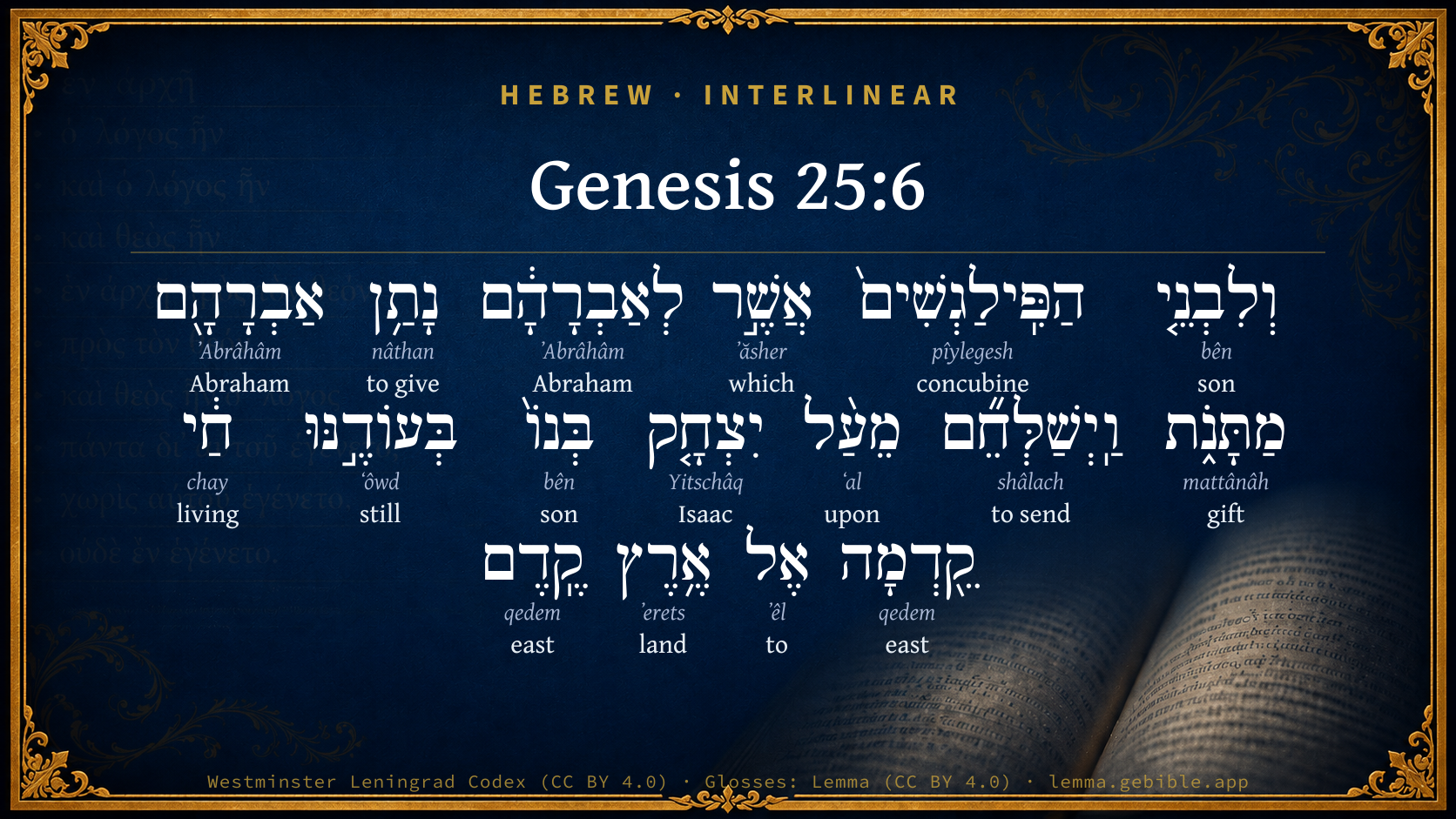
Hebrew (Westminster Leningrad Codex) Genesis 25:6 appears in the Hebrew Old Testament. The text above is from the Westminster Leningrad Codex. Each word links to its Strong’s number, a concise gloss, and parsing drawn from the Open Scriptures Hebrew Bible morphology. Click any word for its full Brown-Driver-Briggs (BDB) entry.
Download image
Cite this verse

Genesis 25:6 (World English Bible). Public Domain. Lemma interlinear Bible study tool, https://lemma.gebible.app/v/genesis/25/6.

Show BibTeX & RIS
BibTeX
RIS
English Translation
but to the sons of the concubines who Abraham had, Abraham gave gifts. He sent them away from Isaac his son, while he yet lived, eastward, to the east country.
World English Bible · Public Domain
Highlights
  • 1 first appearance in the Hebrew Bible
Full analysis ↓
Download a study sheet

One document with this verse’s original text, its word-by-word gloss line, the meaning frame, cross-references with their text, attributed commentary, and full source and license credits — printable, and it pastes into notes with its structure intact.

This verse Autodidact and up

Study sheet (.html) Plain text (.txt)

A passage Seminary Student

Up to 50 verses in one chapter. A passage sheet keeps up to 6 commentary sources and 12 cross-references per verse, in the order this page ranks them, and says so on the sheet whenever that leaves anything out. Ask for a single verse and you get the Autodidact verse sheet above.

Everything on this page stays free to read, with no account — the sheet is a download of what is already on screen, not access to it.

Want to remove ads? Support Godless Engineer
Compare translations 3

The same verse in 3 English versions, stacked beneath the original-language interlinear above. Click any original word for its lexicon entry.

Each is an independent rendering of the whole verse — the interlinear is not word-aligned to these translations.

Highlighted words mark where these versions differ — a whole-verse word diff, not a word-by-word alignment.

  • World English Bible Public Domain
    but to the sons of the concubines who Abraham had, Abraham gave gifts. He sent them away from Isaac his son, while he yet lived, eastward, to the east country.
  • King James Version Public Domain
    But unto the sons of the concubines, which Abraham had, Abraham gave gifts, and sent them away from Isaac his son, while he yet lived, eastward, unto the east country.
  • unfoldingWord Literal Text CC BY-SA 4.0
    And to the sons of the concubines who to Abraham, Abraham gave gifts, and while he was still alive he sent them eastward to the land of Kedem, away from Isaac his son. Abraham’s Death and Burial 25:7-11

unfoldingWord Literal Text — © unfoldingWord, licensed CC BY-SA 4.0. Word-aligned USFM3 via Door43 (git.door43.org/unfoldingWord/en_ult).

Versions to compare (up to 4)

3 of 4 selected

Show all 18 translations

Every available English version of this verse, each an independent rendering of the whole verse.

  • World English Bible Public Domain
    but to the sons of the concubines who Abraham had, Abraham gave gifts. He sent them away from Isaac his son, while he yet lived, eastward, to the east country.
  • Berean Standard Bible Public Domain
    But while he was still alive, Abraham gave gifts to the sons of his concubines and sent them away from his son Isaac to the land of the east.
  • Majority Standard Bible Public Domain
    But while he was still alive, Abraham gave gifts to the sons of his concubines and sent them away from his son Isaac to the land of the east.
  • King James Version Public Domain
    But unto the sons of the concubines, which Abraham had, Abraham gave gifts, and sent them away from Isaac his son, while he yet lived, eastward, unto the east country.
  • American Standard Version (1901) Public Domain
    But unto the sons of the concubines, that Abraham had, Abraham gave gifts. And he sent them away from Isaac his son, while he yet lived, eastward, unto the east country.
  • Revised Version (1885) Public Domain
    But unto the sons of the concubines, which Abraham had, Abraham gave gifts; and he sent them away from Isaac his son, while he yet lived, eastward, unto the east country.
  • Geneva Bible (1599) Public Domain
    But vnto the sonnes of the concubines, which Abraham had, Abraham gaue giftes, and sent them away from Izhak his sonne (while he yet liued) Eastward to the East countrey.
  • Douay-Rheims (1899) Public Domain
    And to the children of the concubines he gave gifts, and separated them from Isaac his son, while he yet lived, to the east country.
  • Young's Literal Translation Public Domain
    and to the sons of the concubines whom Abraham hath, Abraham hath given gifts, and sendeth them away from Isaac his son (in his being yet alive) eastward, unto the east country.
  • Literal Standard Version CC BY-SA 4.0
    and to the sons of the concubines whom Abraham has, Abraham has given gifts, and sends them away from his son Isaac (in his being yet alive) eastward, to the east country.
  • Unlocked Literal Bible CC BY-SA 4.0
    However, while he was still living, he gave gifts to the sons of his concubines and sent them to the land of the east, away from Isaac, his son.
  • unfoldingWord Literal Text CC BY-SA 4.0
    And to the sons of the concubines who to Abraham, Abraham gave gifts, and while he was still alive he sent them eastward to the land of Kedem, away from Isaac his son. Abraham’s Death and Burial 25:7-11
  • Darby Bible Public Domain
    And to the sons of the concubines that Abraham had, Abraham gave gifts, and, while he yet lived, sent them away from Isaac his son, eastward to the east country.
  • World Messianic Bible Public Domain
    but Abraham gave gifts to the sons of Abraham’s concubines. While he still lived, he sent them away from Isaac his son, eastward, to the east country.
  • Webster's Bible Public Domain
    But to the sons of the concubines which Abraham had, Abraham gave gifts, and sent them away from Isaac his son (while he yet lived) eastward, to the east country.
  • Free Bible Version CC BY-SA 4.0
    But while he was still alive, he gave gifts to the sons of his concubines and sent them to live in the east, well away from Isaac.
  • Bible in Basic English Public Domain
    But to the sons of his other women he gave offerings, and sent them away, while he was still living, into the east country.
  • JPS Tanakh (1917) Public Domain
    But unto the sons of the concubines, that Abraham had, Abraham gave gifts; and he sent them away from Isaac his son, while he yet lived, eastward, unto the east country.

Literal Standard Version (2020), Covenant Press — licensed CC BY-SA 4.0. Text via the HelloAO Bible API (eBible.org). Unlocked Literal Bible (unfoldingWord) — licensed CC BY-SA 4.0. Text via the HelloAO Bible API (eBible.org). unfoldingWord Literal Text — © unfoldingWord, licensed CC BY-SA 4.0. Word-aligned USFM3 via Door43 (git.door43.org/unfoldingWord/en_ult). Free Bible Version, Dr. Jonathan Gallagher — licensed CC BY-SA 4.0. Text via the HelloAO Bible API (eBible.org).

Word by word

More ways to search: Search by grammar → Find every occurrence → Compare this word →

Practice this passage: Drill this verse → Learn its vocabulary →

מַתָּנֹ֑ת
mattânâh
H4979
“gifts”
Noun, Common, Feminine, Plural, Absolute
Part of Speech
Noun
Type
Common
Gender
Feminine
Number
Plural
State
Absolute
Full BDB Definition

Origin: from H4976

TWOT: 1443c

gift
  1. וְלִבְנֵ֤י bên H1121 “and · to/for · sons of” Conjunction + Preposition + Noun, Common, Masculine, Plural, Construct
  2. הַפִּֽילַגְשִׁים֙ pîylegesh H6370 “the · concubines” Particle, Definite Article + Noun, Common, Feminine, Plural, Absolute
  3. אֲשֶׁ֣ר ʼăsher H834 “which” Particle, Relative
  4. לְאַבְרָהָ֔ם ʼAbrâhâm H85 “to/for · Abraham” Preposition + Noun, Proper
  5. נָתַ֥ן nâthan H5414 “to give” Verb, Qal, Perfect, 3rd Person, Masculine, Singular
  6. אַבְרָהָ֖ם ʼAbrâhâm H85 “Abraham” Noun, Proper
  7. וַֽיְשַׁלְּחֵ֞ם shâlach H7971 “and · to send · them” Conjunction + Verb, Piel, Sequential Imperfect, 3rd Person, Masculine, Singular + Suffix, Personal, 3rd Person, Masculine, Plural
  8. מֵעַ֨ל ʻal H5921 “from · upon” Preposition + Preposition
  9. יִצְחָ֤ק Yitschâq H3327 “Isaac” Noun, Proper
  10. בְּנוֹ֙ bên H1121 “son · his” Noun, Common, Masculine, Singular, Construct + Suffix, Personal, 3rd Person, Masculine, Singular
  11. בְּעוֹדֶ֣נּוּ ʻôwd H5750 “in/at · still · his” Preposition + Adverb + Suffix, Personal, 3rd Person, Masculine, Singular
  12. חַ֔י chay H2416 “living” Adjective, Adjective, Masculine, Singular, Absolute
  13. קֵ֖דְמָה qedem H6924 “east · toward” Noun, Common, Masculine, Singular, Absolute + Suffix, Demonstrative
  14. אֶל ʼêl H413 “to” Preposition
  15. אֶ֥רֶץ ʼerets H776 “land of” Noun, Common, Both, Singular, Construct
  16. קֶֽדֶם qedem H6924 “east” Noun, Common, Masculine, Singular, Absolute

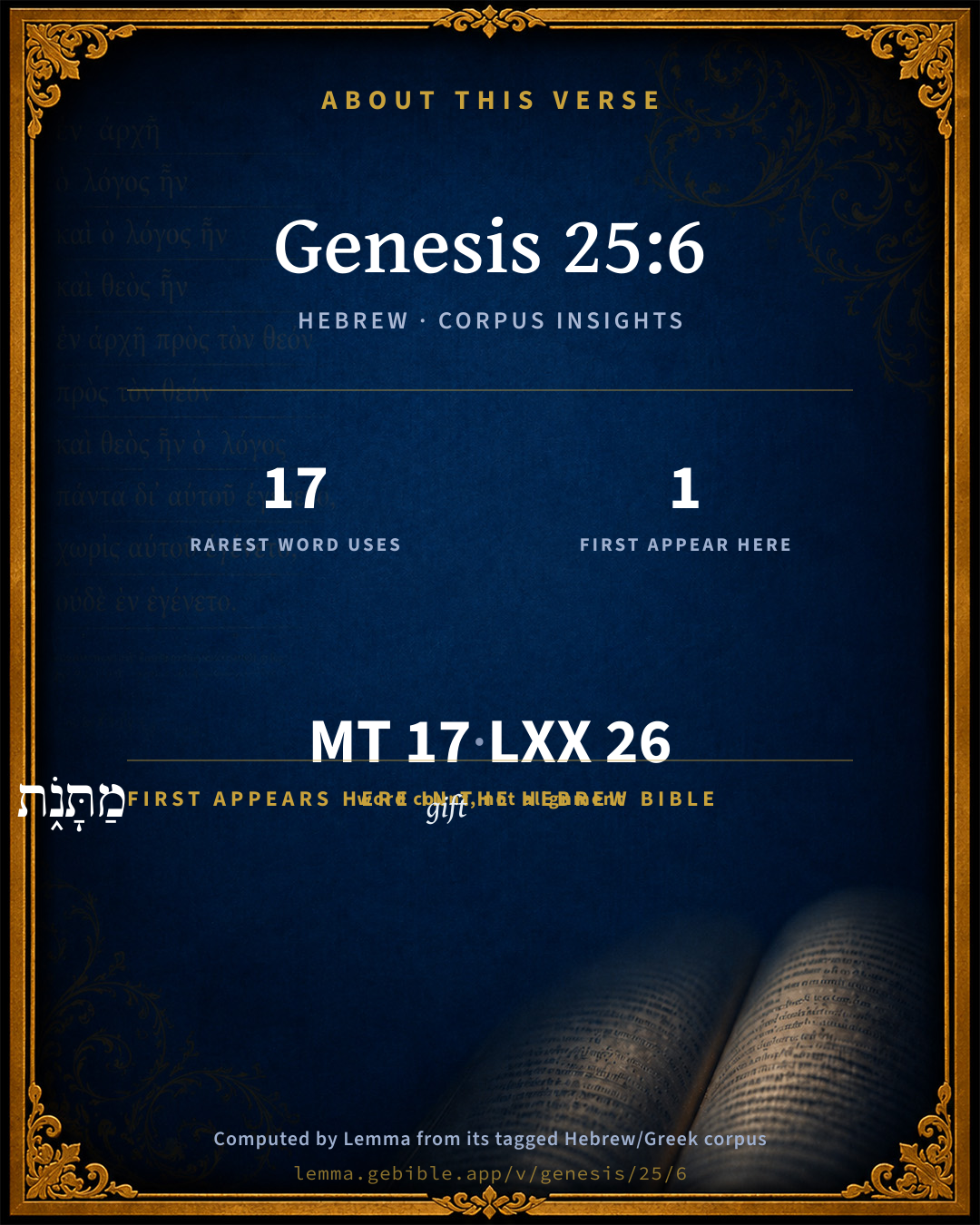
About this verse

These counts appear in no published source. They are computed here, from the morphology-tagged text and Lemma’s own curated glosses. What Lemma adds →

17
words
14
distinct lemmas
Pentateuch
section

Notable vocabulary

The rarest word here is מַתָּנֹ֑ת gift H4979 — appearing just 17 times in the whole Hebrew Bible.

First appearance in Scripture

This word makes its first canonical appearance in the Hebrew Bible here:

  • מַתָּנֹ֑ת gift H4979

Shared distinctive vocabulary

מַתָּנֹ֑ת gift H4979 occurs in 17 verses of the Hebrew Bible. Also found in:

Grammatical profile

  • 2 verbs
  • 10 nouns
  • 1 adjective
  • 2 prepositions
  • 1 adverb
  • 1 particle

Verb forms

  • נָתַ֥ן Qal · Perfect
  • וַֽיְשַׁלְּחֵ֞ם Piel · Sequential Imperfect

Repetition

Words recur within this verse — often emphatic in Hebrew:

  • וְלִבְנֵ֤י son H1121 ×2
  • לְאַבְרָהָ֔ם Abraham H85 ×2
  • קֵ֖דְמָה east H6924 ×2

Hebrew & Septuagint length

In English translation the verse runs 30 words from the Hebrew and 33 from the Septuagint (LXX English) — closely comparable.

A rough comparison of the two English renderings, which tokenize alike — not a word-level alignment.

Word counts can differ between the Hebrew and the Greek without any difference in meaning — e.g. the Hebrew direct-object marker אֵת has no separate Greek word, and Greek often adds the article ὁ.

In the original languages it is 17 Hebrew tokens and 26 Greek tokens — but the two are counted differently (Hebrew bundles its prefixes and suffixes into one token; the Greek is in lemma form), so that isn’t a like-for-like length.

Cross-references

16

Topical passages linked to Genesis 25:6 in the Treasury of Scripture Knowledge — connected by theme and wording, ordered by reader-vote popularity; previews shown in the World English Bible.

  • Genesis 21:14 Abraham rose up early in the morning, and took bread and a bottle of water, and gave it to Hagar, putting it on her shoulder, and gave her the child, and sent her away. She departed, and wandered in the wilderness of Beersheba.
  • Judges 6:3 So it was, when Israel had sown, that the Midianites came up, and the Amalekites, and the children of the east; they came up against them;
  • Acts 14:17 Yet he didn't leave himself without witness, in that he did good and gave you rains from the sky and fruitful seasons, filling our hearts with food and gladness."
  • Genesis 16:3 Sarai, Abram's wife, took Hagar the Egyptian, her handmaid, after Abram had lived ten years in the land of Canaan, and gave her to Abram her husband to be his wife.
  • Genesis 25:1 Abraham took another wife, and her name was Keturah.
  • Genesis 32:22 He rose up that night, and took his two wives, and his two handmaids, and his eleven sons, and passed over the ford of the Jabbok.
  • Genesis 35:22 It happened, while Israel lived in that land, that Reuben went and lay with Bilhah, his father's concubine, and Israel heard of it. Now the sons of Jacob were twelve.
  • Judges 19:1–2 It happened in those days, when there was no king in Israel, that there was a certain Levite sojourning on the farther side of the hill-country of Ephraim, who took to him a concubine out of Bethlehem Judah.
  • Judges 19:4 His father-in-law, the young lady's father, retained him; and he abode with him three days: so they ate and drink, and lodged there.
  • Job 1:1 There was a man in the land of Uz, whose name was Job. That man was blameless and upright, and one who feared God, and turned away from evil.
  • Job 1:3 His possessions also were seven thousand sheep, three thousand camels, five hundred yoke of oxen, five hundred she-donkeys, and a very great household; so that this man was the greatest of all the children of the east.
  • Psalms 17:14–15 From men by your hand, Yahweh, From men of the world, whose portion is in this life. You fill the belly of your cherished ones. Your sons have plenty, And they store up wealth for their children.
  • Matthew 5:45 that you may be children of your Father who is in heaven. For he makes his sun to rise on the evil and the good, and sends rain on the just and the unjust.
  • Luke 11:11–13 "Which of you fathers, if your son asks for bread, will give him a stone? Or if he asks for a fish, he won't give him a snake instead of a fish, will he?
  • Genesis 30:4 She gave him Bilhah her handmaid as wife, and Jacob went in to her.
  • Genesis 30:9 When Leah saw that she had finished bearing, she took Zilpah, her handmaid, and gave her to Jacob as a wife.

Cross-references courtesy of OpenBible.info (CC BY 4.0).

Hebrew and Greek witnesses Masoretic Hebrew ↔ Greek Septuagint

The same verse in the two great witnesses to the Old Testament, shown verse-for-verse.

These are two independent witnesses, not word-aligned to each other, and the Septuagint is shown in lemma (dictionary) form.

Hebrew Genesis 25:6 Masoretic · Westminster Leningrad Codex

וְלִבְנֵ֤י הַפִּֽילַגְשִׁים֙ אֲשֶׁ֣ר לְאַבְרָהָ֔ם נָתַ֥ן אַבְרָהָ֖ם מַתָּנֹ֑ת וַֽיְשַׁלְּחֵ֞ם מֵעַ֨ל יִצְחָ֤ק בְּנוֹ֙ בְּעוֹדֶ֣נּוּ חַ֔י קֵ֖דְמָה אֶל אֶ֥רֶץ קֶֽדֶם

but to the sons of the concubines who Abraham had, Abraham gave gifts. He sent them away from Isaac his son, while he yet lived, eastward, to the east country.

World English Bible · Public Domain

Greek LXX Genesis 25:6 Septuagint · lemma form

καί ὁ υἱός ὁ παλλακή αὐτός δίδωμι αβρααμ δόμα καί ἐκ ἀποστέλλω αὐτός ἀπό ισαακ ὁ υἱός αὐτός ἔτι ζάω αὐτός πρός ἀνατολή εἰς γῆ ἀνατολή

But to the sons of his concubines Abraam gave gifts, and he sent them away from his son Isaac, while he was yet living, to the east into the country of the east.

LXX2012 (modern English Septuagint) · Public Domain

Hebrew: Westminster Leningrad Codex (CC BY 4.0). Greek: Septuagint (public domain); English from LXX2012 (modern English Septuagint) (Public Domain). How the Septuagint differs from the Hebrew →

Targum (Aramaic paraphrase)

2

The Targum is the ancient Jewish Aramaic paraphrase of the Hebrew Scriptures — an interpretive translation, not the Hebrew text itself. Onkelos (literal) and Pseudo-Jonathan (expansive) render the Torah, and Jonathan the Prophets. Coverage is partial: where no permissively-licensed English translation exists for a verse, only the Aramaic is shown. This is verse-level text, not a word-by-word alignment to the Hebrew.

  1. Targum Onkelos Torah (Genesis–Deuteronomy)
    וְלִבְנֵי לְחֵינָתָא דִּי לְאַבְרָהָם יְהַב אַבְרָהָם מַתְּנָן וְשַׁלְחִנּוּן מֵעַל יִצְחָק בְּרֵהּ בְּעוֹד דְּהוּא קַיָּם קִידוּמָא לַאֲרַע מַדִינְחָא

    (no public-domain English translation for this verse)

    Targum Onkelos — Aramaic: “Onkelos Genesis” (public domain); “Onkelos Exodus” (public domain); “Onkelos Leviticus” (public domain); “Onkelos Numbers” (public domain); “Onkelos Deuteronomy” (public domain). English: “Sefaria Community Translation” (CC0 1.0 (public-domain dedication)); “J.W. Etheridge. The Targums of Onkelos and Jonathan Ben Uzziel on the Pentateuch. London: Longmans, Green, 1862” (public domain). Text via Sefaria.

  2. Targum Pseudo-Jonathan Torah (Genesis–Deuteronomy)
    וְלִבְנֵיהוֹם דִפְלַקְתּוּן דִלְאַבְרָהָם יְהַב אַבְרָהָם נִכְסִין וּמְטַלְטְלִין לְמַתְּנָן וְתַרְכִינוּן מֵעִילוֹי יִצְחָק בְּרֵיהּ עַד דְהוּא בְּחַיֵי וְאָזְלַן לְמֵיתַב קִידוּמָא לְאַרַע מַדִינְחָא

    And to the sons of the concubines of Abraham gave Abraham riches and moveable property as gifts, and sent them away from Izhak his son while he (yet) lived; and they went and dwelt eastward in the land of the orient.

    Targum Pseudo-Jonathan — Aramaic: “Targum Jonathan on Genesis” (public domain); “Targum Jonathan on Exodus” (public domain); “Targum Jonathan on Leviticus” (public domain); “Targum Jonathan on Numbers” (public domain); “Targum Jonathan on Deuteronomy” (public domain). English: “The Targum of Jonathan ben Uzziel, trans. J. W. Etheridge, London, 1862” (public domain). Text via Sefaria.

Commentary

Notes on Genesis 25:6 from classic Christian and Jewish commentators (each source and its license shown beneath its notes). The classic Christian expositions comment on the surrounding passage and are grouped to its opening verse, so a note may address several verses; the Jewish commentaries on the Tanakh (Rashi and others) are per-verse, so they appear only where the commentator wrote on this verse.

Lemma curates 59 commentaries, every one of them public domain or Creative Commons licensed, each selected and text-cleaned for this edition rather than reprinted as found. About our sources →

Trapp's Complete Commentary

John Trapp

Gen 25:6 But unto the sons of the concubines, which Abraham had, Abraham gave gifts, and sent them away from Isaac his son, while he yet lived, eastward, unto the east country.

Ver. 6. Abraham gave gifts.] So doth God to reprobates; but they are giftless gifts, better be without them. {a} Saepe Deus dat iratus quod negat propitius. God gives wealth to the wicked, non aliter ac siquis crumenam auto plenam latrinae inieciat. {b} The Turkish empire, saith Luther, as great as it is, is but a crust cast to the dogs by the rich householder, {c} or as Joseph’s cup, &c.

Eastward, to the east country.] To both the Arabias, which were countries rough but rich; looked rudely, but, searched regularly, afforded great store of fine gold, precious stones, and pleasant odours.

{a} Eχθρων αδωπα δωπα και οικ ονησιμα - Soph.

{b} Gasp. Ens.

{c} Panis mica quam dives pater familias proiecit canibus.

John Trapp, A Commentary or Exposition upon All the Books of the Old and New Testament (1647–1656) — public domain. Text from a community e-Sword module.

Joseph Benson's Commentary

Gen 25:6. Abraham gave gifts — Or portions. Abraham may be an example to us in almost every circumstance of life: we find him, with great prudence: making, in his lifetime, proper provision for his sons by his secondary wives, Hagar and Keturah, and sending them away from Isaac; whereby, in all probability, he prevented great animosities and dissensions.

How happy would it be if all parents, in the time of health, would take care to settle, by will, the division of their goods among their children! What confusion! what quarrels! what discord! what never to be reconciled animosity among brethren, might this prevent! These sons of the concubines, as they are here called, were sent into the country that lay east of Canaan, and their posterity were termed the children of the east, famous for their number. Their great increase was the fruit of the promise made to Abraham, that God would multiply his seed.

Joseph Benson's Commentary on the Old and New Testaments (1811–1818) — public domain. Text from a community e-Sword module.

Geneva Bible (1599)

Geneva Bible translators

To avoid the dissention that else might have come because of the heritage.

For by the virtue of God’s word he had not only Isaac, but begat many more.

Read Gen. 22:24.

Geneva Bible (1599) marginal notes — public domain. Text via Bolls.life.

Adam Clarke's Commentary

Verse 6. Unto the sons of the concubines] Viz., Hagar and Keturah, Abraham gave gifts. Cattle for breed, seed to sow the land, and implements for husbandry, may be what is here intended.

And sent them away - while he yet lived] Lest after his death they should dispute a settlement in the Land of Promise with Isaac; therefore he very prudently sent them to procure settlements during his lifetime, that they might be under no temptation to dispute the settlement with Isaac in Canaan. From this circumstance arose that law which has prevailed in almost all countries, of giving the estates to the eldest son by a lawful wife; for though concubines, or wives of the second rank, were perfectly legitimate in those ancient times, yet their children did not inherit, except in case of the failure of legal issue, and with the consent of the lawful wife; and it is very properly observed by Calmet, that it was in consequence of the consent of Leah and Rachel that the children of their slaves by Jacob had a common and equal lot with the rest. By a law of Solon all natural children were excluded from the paternal inheritance, but their fathers were permitted to give them any sum not beyond a thousand drachma by way of present.

Eastward, unto the east country.] Arabia Deserta, which was eastward of Beer-sheba, where Abraham lived.

Adam Clarke's Commentary on the Bible (1810–1826) — public domain. Text from a community e-Sword/MySword module.

John Calvin's Commentaries

6. But unto the sons of the concubines. Moses relates, that when Abraham was about to die, he formed the design of removing all cause of strife among his sons after his death, by constituting Isaac his sole heir, and dismissing the rest with suitable gifts. This dismissal was, indeed, apparently harsh and cruel; but it was agreeable to the appointment and decree of God, in order that the entire possession of the land might remain for the posterity of Isaac. For it was not lawful for Abraham to divide, at his own pleasure, that inheritance which had been granted entire to Isaac. Wherefore, no course was left to him but to provide for the rest of his sons in the manner here described. If any person should now select one of his sons as his heir, to the exclusion of the others, he would do them an injury; and, by applying the torch of injustice, in disinheriting a part of his children, he would light up the flame of pernicious strifes in his family. Wherefore, we must note the special reason by which Abraham was not only induced, but compelled, to deprive his sons of the inheritance, and to remove them to a distance; namely, lest by their intervention, the grant which had been divinely made to Isaac should, of necessity, be disturbed. We have elsewhere said that, among the Hebrews, she who is a partaker of the bed, but not of all the goods, is styled a concubine. The same distinction has been adopted into the customs, and sanctioned by the laws of all nations. So, we shall afterwards see, that Leah and Rachel were principal wives, but that Bilhah and Zilpah were in the second rank; so that their condition remained servile, although they were admitted to the conjugal bed. Since Abraham had made Hagar and Keturah his wives on this condition, it seems that he might lawfully bestow on their sons, only a small portion of his goods; to have transferred, however, from his only heir to them, equal portions of his property, would have been neither just nor right. It is probable that no subsequent strife or contention took place respecting the succession; but by sending the sons of the concubines far away, he provides against the danger of which I have spoken, lest they should occupy a part of the land which God had assigned to the posterity of Isaac alone.

John Calvin's Commentaries (1540-1563) — public domain. Text from the Calvin Translation Society English edition (1840s-50s) via the Christian Classics Ethereal Library (ccel.org). Calvin's coverage is partial (roughly two-thirds of the Bible); uncommented books and verses are honest gaps, never fabricated. The 19th-century editor's footnotes and remarks are omitted so the notes are faithfully Calvin's own voice.

Ellicott's Commentary for English Readers

(6) The east country.—By this is meant Arabia and Southern Mesopotamia, where, by their superior vigour and organisation, the descendants of Abraham were able to establish their supremacy over the natives. Burckhardt tells us that the Bedaween still follow Abraham’s practice. When their children are grown up, they give each of the younger sons his share of their goods (Luk_15:12), whereupon they move to a distance, and leave the eldest brother in quiet possession of the home.

A Bible Commentary for English Readers, edited by Charles John Ellicott (1878–1897) — public domain. Text from a community e-Sword module.

The Cambridge Bible for Schools and Colleges

gen. ed. J. J. S. Perowne

6. the concubines] i.e. Hagar and Keturah; although in Gen_16:3 Hagar is called Abraham’s wife, as also is Keturah in Gen_25:1 of this chapter.

sent them away] The present passage belongs to J, a different source of tradition from chap. 21 (E). It ignores the account of the expulsion of Hagar and Ishmael related in that chapter, and of the dwelling of Ishmael in the wilderness of Paran (Gen_21:21).

unto the east country] i.e. the Syro-Arabian desert, on the east of Palestine. Gen_29:1; Jdg_6:3; Jdg_6:33; Jdg_7:12; Jdg_8:10; Isa_11:14; Jer_49:28; Eze_25:4; Eze_25:10 are passages in which “the children of the east” (b’nê ḳedem) are mentioned as the nomad occupants of this region.

The Cambridge Bible for Schools and Colleges (gen. ed. J. J. S. Perowne; Cambridge University Press, 1878–1918) — public domain. Text from a community e-Sword module.

John Gill's Exposition

But unto the sons of the concubines which Abraham had,.... These were Hagar and Keturah, though they are both called his wives, Gen 16:3; yet they were concubines; so Keturah, Ch1 1:32; they were, as some render the word, "concubine wives" (e); they were half wives or secondary ones: the Jewish writers say that they were espoused, but not by writing, as wives were; they were under the lawful wife, when there were any, and a kind of head servants in the family, and their children did not inherit; now the sons of the concubines of Abraham were Ishmael by Hagar, and the six above mentioned by Keturah: to these

Abraham gave gifts; money, gold and silver, of which he had plenty: the Targum of Jonathan calls them substance and movable goods; by this it appears, that though he had sent Ishmael away without anything, yet he afterwards remembered him, and gave him a portion with the rest of the children of his, concubines:

and sent them away from Isaac his son; that they might not be troublesome to him and his family; and that there, might be no contention among them about inheriting the land of Canaan given to him and his seed: and this Abraham did

while he yet lived; or otherwise after his death a separation would not have been easily made; but his authority had weight with them: and they were sent by him

eastward, into the east country; into Arabia, and the parts thereabout, which lay east from the place where Abraham was; these are the children of the east, mentioned along with the Midianites, who sprung from Keturah, Jdg 6:3.

(e) "concubinarum uxorum", Junius & Tremellius, Piscator.

John Gill's Exposition of the Whole Bible (1746–1763) — public domain (CC PDM 1.0). Text via the HelloAO Bible API.

Haydock's Catholic Bible Commentary

Concubines. Agar and Cetura are here called concubines, (though they were lawful wives, and in other places are so called) because they were of an inferior degree: and such in Scripture are usually called concubines. (Challoner) --- The solemnities of marriage were omitted on these occasions, and the children were not entitled to a share in the inheritance. Jacob’s two wives consented that all his children, by their handmaids, should be placed on the same footing with their own. (Calmet) --- Abraham contented himself with making suitable presents to the children, whom he had by these secondary wives, reserving the bulk of his property to Isaac, chap. xxiv. 36. He also provided for their establishment himself, that there might be no contest after his departure.

George Leo Haydock (1774–1849), Haydock's Catholic Family Bible and Commentary, 1859 edition — public domain. Excludes Psalms (Douay-Rheims chapter numbering differs from Protestant) and Deuterocanonical books (Catholic canon only).

Matthew Poole's English Annotations

The concubines, Hagar and Keturah. Concubines are sometimes called wives, as Gen 16:3; Jdg 19:1-3,29, but their children had no right to the inheritance. For though the children of Jacob’s concubines did equally partake of the inheritance with the other children, that was done by Divine appointment, and Jacob’s voluntary act, and upon special reason, because of the vast inheritance promised, and afterwards given to them, which made it no loss, but a great convenience and advantage to the children of the chief wives to have their half-brethren, the sons of the concubines, seated so near to them.

Sent them away from Isaac; partly, that the entire possession of that land might be reserved to the children of Isaac; and partly, lest nearness of relation joined with cohabitation or neighbourhood should beget a great familiarity between them, whereby Isaac’s seed were likely to be infected by their brethren, whose degeneration and apostacy Abraham might easily foresee from the evil inclinations of their own hearts, and God’s exclusion of them from that covenant of grace and life, which was the only effectual remedy against that powerful and universal corruption.

Eastward, unto the east country; into Arabia, and other parts of Asia the Greater, which were situate eastward from the southern part of Canaan where Abraham now was, whence these people are oft called the children of the east, as Jdg 6:3; 7:12; Job 1:3.

Matthew Poole's English Annotations on the Holy Bible (1683–1685) — public domain. Text from a community e-Sword/MySword module.

Whedon's Commentary on the Bible

Daniel D. Whedon

6. The concubines — Hagar and Keturah.

Sent them away — Some have objected that Keturah’s sons, if born after Sarah’s death, were too young to be thus sent away. But Ishmael was only a lad of fifteen or seventeen years when sent away with his mother into the wilderness of Beer-sheba.

Gen_21:14. But the time of bestowing these gifts on the sons of his concubines, and sending them away, is uncertain. The different facts stated in Gen_25:5-6 may have occurred at very different dates.

From Isaac — Abraham would not have his son and heir troubled by claims or disputes after his death, so he was careful to see that all disposition of his possessions, and of the sons of his concubines, was made while he yet lived. A wise example to fathers who have large estates, and many possible claimants.

Unto the east country — And they became known thereafter as the Easterns, or Bene-Kedem, sons of the East. See Jdg_6:3; 1Ki_4:30; Job_1:3; Isa_11:14.

Daniel D. Whedon (gen. ed.), Commentary on the Old and New Testaments (1874–1909) — public domain. Text from a community e-Sword module.

John Wesley's Explanatory Notes

He gave gifts - Or portions to the rest of his children, both to Ishmael, though at first he was sent empty away, and to his sons by Keturah. It was justice to provide for them; parents that do not that, are worse than infidels. It was prudence to settle them in places distant from Isaac, that they might not pretend to divide the inheritance with him. He did this while he yet lived, lest it should not have been done, or not so well done afterwards. In many cases it is wisdom for men to make their own hands their executors, and what they find to do, to do it while they live. These sons of the concubines were sent into the country that lay east from Canaan, and their posterity were called the children of the east, famous for their numbers. Their great increase was the fruit of the promise made to Abraham, that God would multiply his seed.

John Wesley, Explanatory Notes Upon the Whole Bible (1754–1765) — public domain. Text via the GEBible commentary corpus.

Rashi

Rabbi Shlomo Yitzchaki (Rashi)

הפילגשים THE CONCUBINES — The word is written deficient, (without י, but our texts have a י in both places) because he had only one concubine, Hagar, who is identical with Keturah. Wives are those whom a man marries with a marriage-contract (Ketubah): concubines have no marriage contract, as we explain in the Talmud (Sanhedrin 21a) in reference to David’s wives and concubines.

נתן אברהם מתנות ABRAHAM GAVE GIFTS — Our Rabbis explained (Sanhedrin 91a) that he transmitted to them the names of impure things. Another explanation is: all that he had received as gifts because of Sarah — and other gifts that people had given him — all these he gave to them because he did not wish to derive any benefit from these.

Rashi on the Tanakh — English translations: “The Judaica Press complete Tanach with Rashi, translated by A. J. Rosenberg” (CC BY 4.0); “Pentateuch with Rashi's commentary by M. Rosenbaum and A.M. Silbermann, 1929-1934” (public domain); “The Metsudah Tanach series, Lakewood, N.J” (CC BY 4.0); and “The Book of Joshua, Metsudah Publications, 1997” (CC BY 4.0). Text via Sefaria.

Ramban (Nachmanides)

Rabbi Moshe ben Nachman (Ramban / Nachmanides)

BUT UNTO THE SONS OF THE CONCUBINES, THAT ABRAHAM HAD. By way of the plain meaning of Scripture, since it was said to Abraham, For in Isaac shall seed be called to thee, and in no other seed, all his consorts were concubines to him, not as wives since their children would not be among his heirs. Thus, Hagar, Sarah’s handmaid, was his concubine. However, Keturah he took unto himself as a wife for if she whom he took as a concubine had been a handmaid in his house, Scripture would not have said, And Abraham took a wife, and her name was Keturah. She is called “concubine” in Scripture — it is written in Chronicles, And the sons of Keturah, Abraham’s concubine — only for the reason that I have explained, [namely, that it had been said to Abraham, For in Isaac shall seed be called to thee]. Thus we note that Abraham took unto himself a wife from the daughters of Canaan! And should you say that she was an Egyptian or from the land of the Philistines, we may yet question why he did not send to his country and to his kindred as he did in the case of his son. But the answer is that he guarded only the seed of Isaac since it was concerning him that the Covenant was made. Furthermore, Scripture does not say, “And Abraham took a wife by the name of Keturah, the daughter of a certain Hivite or Philistine or Egyptian from a certain land,” as it says concerning Esau’s wives and similar cases. Rather, Scripture mentions only Keturah’s name because she was a Canaanite, and therefore it cut short her genealogy. Scripture does so in many places where it is not concerned with the genealogy.Perhaps Keturah was called “concubine” because she was a handmaid who was descended from a family of slaves. And if she was a handmaid in his [Abraham’s] household and he had connection with her, Scripture would not mention her genealogy since even among the matriarchs, such as Zilpah and Bilhah, it mentions only their names.Now Rashi wrote, “Wives are those whom a man marries with a marriage-contract; concubines have no marriage-contract, as it says in reference to the wives and concubines of David, in Tractate Sanhedrin.” But the matter is not so. A woman is called a concubine only when there is no betrothal, for a marriage-contract is only a Rabbinic ordinance. And the correct text in Tractate Sanhedrin is: “A concubine has no marriage-contract or betrothal.” However, it is possible that the sons of Noah, Note 222. too when they married wives, as is their law, by intercourse, were accustomed to write them a marriage-contract which granted dowry and gift. However, for one who wished to be a concubine to them, whom he could send away when he pleased and whose children would not be among his heirs, he would not write anything. But according to the opinion of our Rabbis that Keturah is Hagar, she was certainly a concubine [since it clearly says that Hagar was Sarah’s handmaid].

Ramban (Nachmanides) on the Tanakh — English translation: “Commentary on the Torah by Ramban (Nachmanides). Translated and annotated by Charles B. Chavel. New York, Shilo Pub. House, 1971-1976” (CC BY 4.0). Text via Sefaria.

Sforno

Rabbi Ovadia Sforno

Avraham gave gifts. He did not wish to rely on a will, so he distributed his property while he was alive.

Sforno on the Tanakh — English translation: “Yalkut, Sifsei Chachomim Chumash, Metsudah Publications, 2009” (CC BY 4.0). Text via Sefaria.

Radak

Rabbi David Kimhi (Radak)

ולבני הפילגשים he had no concubines from whom he had fathered children, but the concubines in his household were concubines of male servants in his household. Their children were, of course, members of Avraham’s household who had been of service to Avraham and who had adopted his lifestyle. He gave them gifts consisting of silver and gold and livestock according to his own evaluation of who deserved how much. He most certainly gave even more valuable gifts to Ishmael and to the sons of Keturah even though the Torah does not specifically mentions this. If he gave gifts to people towards whom he had no legal obligation at all, it is obvious that people towards whom he did have such an obligation would receive their due.

מעל יצחק בנו, in order that they should not interfere with him after his death and could not quarrel with him about the inheritance.

קדמה אל ארץ קדם, he sent them off in an easterly direction. According to another interpretation, the words refer to a specific country among the countries of the East. It could well refer to Charan or Ur Casdim or both, regions which were generally loosely known as ארץ קדם, [just as we speak about the regions of the Middle East, or the Far East in our time. Ed.]

Radak on the Tanakh — English translations: “Sefaria Community Translation” (CC0 1.0 (public-domain dedication)); “Eliyahu Munk, HaChut Hameshulash” (CC BY 4.0); “Rabbi Mike Feuer, Jerusalem Anthology” (CC BY 4.0); and “R. David Kimhi on the first book of Psalms, Translated by R.G. Finch, London, 1919” (public domain). Text via Sefaria.

Lesson kit

Teaching starters — assembled from the data on this page, not authored interpretation. Every prompt links to the verse data it draws on. Edit before teaching.

Genesis, in the Pentateuch, opens this verse with 17 words (14 distinct Hebrew lemmas). Its most distinctive word is mattânâh (“gift”). A historical commentator’s framing appears above. Read the whole chapter for the surrounding context.

Discussion questions

  1. What does “gift” (mattânâh) contribute to the verse as a whole?
  2. This is the first place “gift” appears in Scripture (first appears here). What does its debut here establish?
  3. How does Exodus 28:38, which shares the word «gift», read alongside this verse?
  4. What does the repetition of “son” (2× in this one verse) do in this verse?
  5. The translations on this page render this verse differently — a whole-verse word diff, not a word-by-word alignment. What might account for the different wordings?
  6. «נָתַ֥ן» is a Qal Perfect verb. How does that grammatical form shape the action described?
  7. Compare how Trapp's Complete Commentary and Joseph Benson's Commentary read this verse. Where do they agree or differ?

Things to notice

Reading settings

Reading text

Shown beneath each verse's original-language words.

Old Testament
Old Testament edition

Read the OT as the Masoretic Hebrew (MT) or the Greek Septuagint (LXX).

English shown for the Greek Septuagint (in the Hebrew ↔ Greek comparison).

Comparing translations? Open the Compare panel on any verse page to stack up to four side by side.