
Exodus 7:9

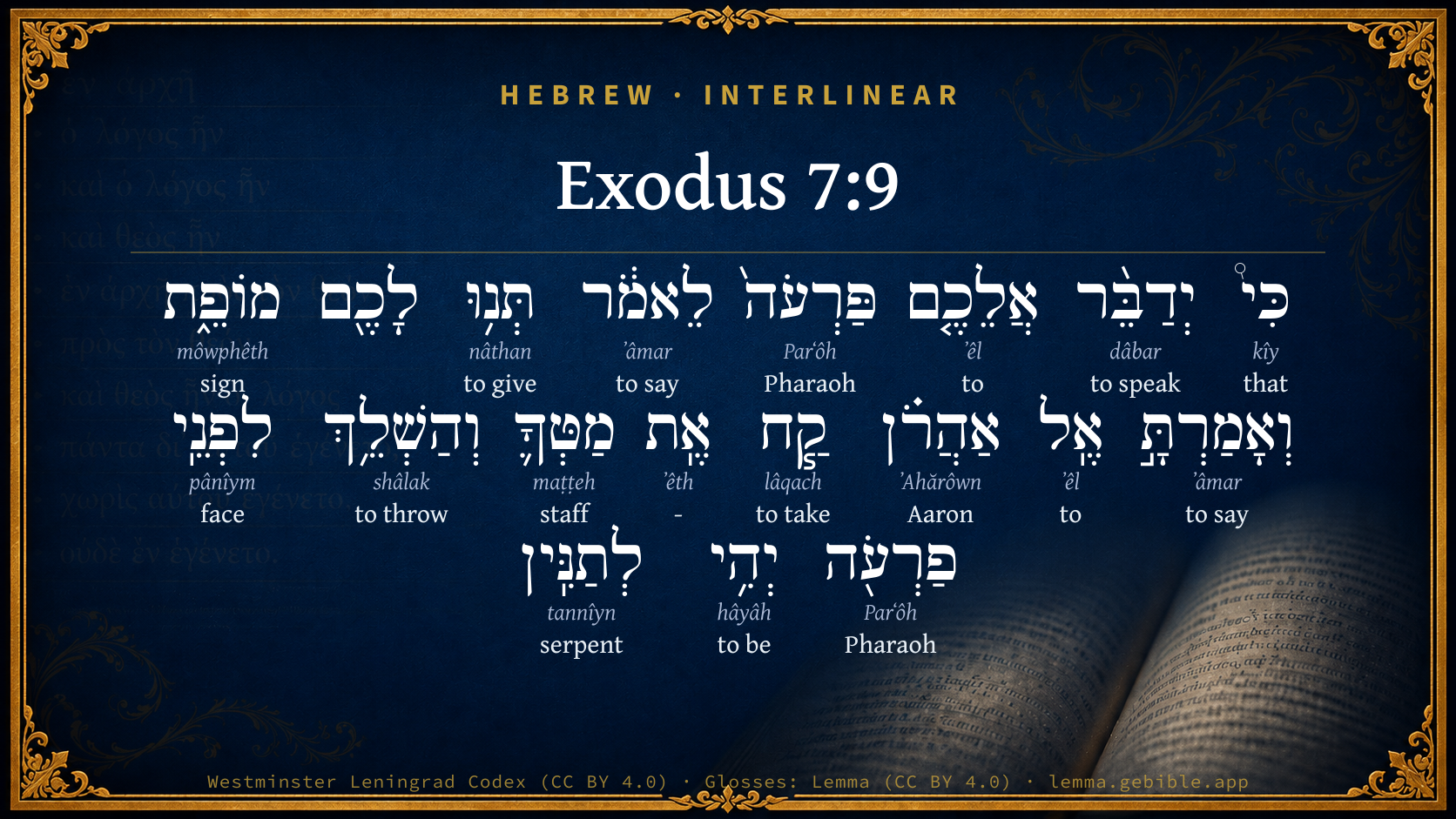
Hebrew (Westminster Leningrad Codex) Exodus 7:9 appears in the Hebrew Old Testament. The text above is from the Westminster Leningrad Codex. Each word links to its Strong’s number, a concise gloss, and parsing drawn from the Open Scriptures Hebrew Bible morphology. Click any word for its full Brown-Driver-Briggs (BDB) entry.
Download image
Cite this verse

Exodus 7:9 (World English Bible). Public Domain. Lemma interlinear Bible study tool, https://lemma.gebible.app/v/exodus/7/9.

Show BibTeX & RIS
BibTeX
RIS
English Translation
"When Pharaoh speaks to you, saying, 'Perform a miracle!' then you shall tell Aaron, 'Take your rod, and cast it down before Pharaoh, that it become a serpent.'"
World English Bible · Public Domain
Download a study sheet

One document with this verse’s original text, its word-by-word gloss line, the meaning frame, cross-references with their text, attributed commentary, and full source and license credits — printable, and it pastes into notes with its structure intact.

This verse Autodidact and up

Study sheet (.html) Plain text (.txt)

A passage Seminary Student

Up to 50 verses in one chapter. A passage sheet keeps up to 6 commentary sources and 12 cross-references per verse, in the order this page ranks them, and says so on the sheet whenever that leaves anything out. Ask for a single verse and you get the Autodidact verse sheet above.

Everything on this page stays free to read, with no account — the sheet is a download of what is already on screen, not access to it.

Want to remove ads? Support Godless Engineer
Compare translations 3

The same verse in 3 English versions, stacked beneath the original-language interlinear above. Click any original word for its lexicon entry.

Each is an independent rendering of the whole verse — the interlinear is not word-aligned to these translations.

Highlighted words mark where these versions differ — a whole-verse word diff, not a word-by-word alignment.

  • World English Bible Public Domain
    "When Pharaoh speaks to you, saying, 'Perform a miracle!' then you shall tell Aaron, 'Take your rod, and cast it down before Pharaoh, that it become a serpent.'"
  • King James Version Public Domain
    When Pharaoh shall speak unto you, saying, Show a miracle for you: then thou shalt say unto Aaron, Take thy rod, and cast it before Pharaoh, and it shall become a serpent.
  • unfoldingWord Literal Text CC BY-SA 4.0
    “For Pharaoh will speak to you, saying, ‘Create a miracle yourself,’ and you shall say to Aaron, ‘Take your staff and throw it down before the face of Pharaoh; let it become a serpent.’”

unfoldingWord Literal Text — © unfoldingWord, licensed CC BY-SA 4.0. Word-aligned USFM3 via Door43 (git.door43.org/unfoldingWord/en_ult).

Versions to compare (up to 4)

3 of 4 selected

Show all 18 translations

Every available English version of this verse, each an independent rendering of the whole verse.

  • World English Bible Public Domain
    "When Pharaoh speaks to you, saying, 'Perform a miracle!' then you shall tell Aaron, 'Take your rod, and cast it down before Pharaoh, that it become a serpent.'"
  • Berean Standard Bible Public Domain
    “When Pharaoh tells you, ‘Perform a miracle,’ you are to say to Aaron, ‘Take your staff and throw it down before Pharaoh,’ and it will become a serpent.”
  • Majority Standard Bible Public Domain
    “When Pharaoh tells you, ‘Perform a miracle,’ you are to say to Aaron, ‘Take your staff and throw it down before Pharaoh,’ and it will become a serpent.”
  • King James Version Public Domain
    When Pharaoh shall speak unto you, saying, Show a miracle for you: then thou shalt say unto Aaron, Take thy rod, and cast it before Pharaoh, and it shall become a serpent.
  • American Standard Version (1901) Public Domain
    When Pharaoh shall speak unto you, saying, Show a wonder for you; then thou shalt say unto Aaron, Take thy rod, and cast it down before Pharaoh, that it become a serpent.
  • Revised Version (1885) Public Domain
    When Pharaoh shall speak unto you, saying, Shew a wonder for you: then thou shalt say unto Aaron, Take thy rod, and cast it down before Pharaoh, that it become a serpent.
  • Geneva Bible (1599) Public Domain
    If Pharaoh speake vnto you, saying, Shewe a miracle for you, then thou shalt say vnto Aaron, Take thy rod, and cast it before Pharaoh, and it shalbe turned into a serpent.
  • Douay-Rheims (1899) Public Domain
    When Pharao shall say to you, Shew signs: thou shalt say to Aaron: Take thy rod, and cast it down before Pharao, and it shall be turned into a serpent.
  • Young's Literal Translation Public Domain
    `When Pharaoh speaketh unto you, saying, Give for yourselves a wonder; then thou hast said unto Aaron, Take thy rod, and cast before Pharaoh -- it becometh a monster.'
  • Literal Standard Version CC BY-SA 4.0
    “When Pharaoh speaks to you, saying, Give a wonder for yourselves; then you have said to Aaron, Take your rod and cast [it] before Pharaoh—it becomes a dragon.”
  • Unlocked Literal Bible CC BY-SA 4.0
    “When Pharaoh says to you, 'Do a miracle,' then you will say to Aaron, 'Take your staff and throw it down before Pharaoh, so that it may become a snake.'”
  • unfoldingWord Literal Text CC BY-SA 4.0
    “For Pharaoh will speak to you, saying, ‘Create a miracle yourself,’ and you shall say to Aaron, ‘Take your staff and throw it down before the face of Pharaoh; let it become a serpent.’”
  • Darby Bible Public Domain
    When Pharaoh shall speak to you, saying, Do a miracle for yourselves, -- then thou shalt say unto Aaron, Take thy staff and cast [it] before Pharaoh -- it will become a serpent.
  • World Messianic Bible Public Domain
    “When Pharaoh speaks to you, saying, ‘Perform a miracle!’ then you shall tell Aaron, ‘Take your rod, and cast it down before Pharaoh, and it will become a serpent.’”
  • Webster's Bible Public Domain
    When Pharaoh shall speak to you, saying, Show a miracle for you: then thou shalt say to Aaron, Take thy rod, and cast it before Pharaoh, and it shall become a serpent.
  • Free Bible Version CC BY-SA 4.0
    “When Pharaoh asks you, ‘Why don't you perform a miracle, then?’ tell Aaron, ‘Take your walking stick and throw it down in front of Pharaoh,’ and it will turn into a snake.”
  • Bible in Basic English Public Domain
    If Pharaoh says to you, Let me see a wonder: then say to Aaron, Take your rod and put it down on the earth before Pharaoh so that it may become a snake.
  • JPS Tanakh (1917) Public Domain
    'When Pharaoh shall speak unto you, saying: Show a wonder for you; then thou shalt say unto Aaron: Take thy rod, and cast it down before Pharaoh, that it become a serpent.'

Literal Standard Version (2020), Covenant Press — licensed CC BY-SA 4.0. Text via the HelloAO Bible API (eBible.org). Unlocked Literal Bible (unfoldingWord) — licensed CC BY-SA 4.0. Text via the HelloAO Bible API (eBible.org). unfoldingWord Literal Text — © unfoldingWord, licensed CC BY-SA 4.0. Word-aligned USFM3 via Door43 (git.door43.org/unfoldingWord/en_ult). Free Bible Version, Dr. Jonathan Gallagher — licensed CC BY-SA 4.0. Text via the HelloAO Bible API (eBible.org).

Word by word

More ways to search: Search by grammar → Find every occurrence → Compare this word →

Practice this passage: Drill this verse → Learn its vocabulary →

לְתַנִּֽין
tannîyn
H8577
“to/for · serpent”
Preposition + Noun, Common, Masculine, Singular, Absolute
Part of Speech
Preposition + Noun
Type
Common
Gender
Masculine
Number
Singular
State
Absolute
Full BDB Definition

Origin: intensive from the same as H8565

TWOT: 2528b

dragon, serpent, sea monster - dragon or dinosaur - sea or river monster - serpent, venomous snake
  1. כִּי֩ kîy H3588 “that” Conjunction
  2. יְדַבֵּ֨ר dâbar H1696 “to speak” Verb, Piel, Imperfect, 3rd Person, Masculine, Singular
  3. אֲלֵכֶ֤ם ʼêl H413 “to · you” Preposition + Suffix, Personal, 2nd Person, Masculine, Plural
  4. פַּרְעֹה֙ Parʻôh H6547 “Pharaoh” Noun, Proper
  5. לֵאמֹ֔ר ʼâmar H559 “to say” Preposition + Verb, Qal, Infinitive Construct
  6. תְּנ֥וּ nâthan H5414 “give” Verb, Qal, Imperative, 2nd Person, Masculine, Plural
  7. מוֹפֵ֑ת môwphêth H4159 “sign” Noun, Common, Masculine, Singular, Absolute
  8. וְאָמַרְתָּ֣ ʼâmar H559 “and · to say” Conjunction + Verb, Qal, Sequential Perfect, 2nd Person, Masculine, Singular
  9. אֶֽל ʼêl H413 “to” Preposition
  10. אַהֲרֹ֗ן ʼAhărôwn H175 “Aaron” Noun, Proper
  11. קַ֧ח lâqach H3947 “take” Verb, Qal, Imperative, 2nd Person, Masculine, Singular
  12. אֶֽת ʼêth H853 “-” Particle, Direct Object
  13. מַטְּךָ֛ maṭṭeh H4294 “staff · your” Noun, Common, Masculine, Singular, Construct + Suffix, Personal, 2nd Person, Masculine, Singular
  14. וְהַשְׁלֵ֥ךְ shâlak H7993 “and · throw” Conjunction + Verb, Hiphil, Imperative, 2nd Person, Masculine, Singular
  15. לִפְנֵֽי pânîym H6440 “to/for · face(s) of” Preposition + Noun, Common, Both, Plural, Construct
  16. פַרְעֹ֖ה Parʻôh H6547 “Pharaoh” Noun, Proper
  17. יְהִ֥י hâyâh H1961 “to be” Verb, Qal, Jussive, 3rd Person, Masculine, Singular

About this verse

These counts appear in no published source. They are computed here, from the morphology-tagged text and Lemma’s own curated glosses. What Lemma adds →

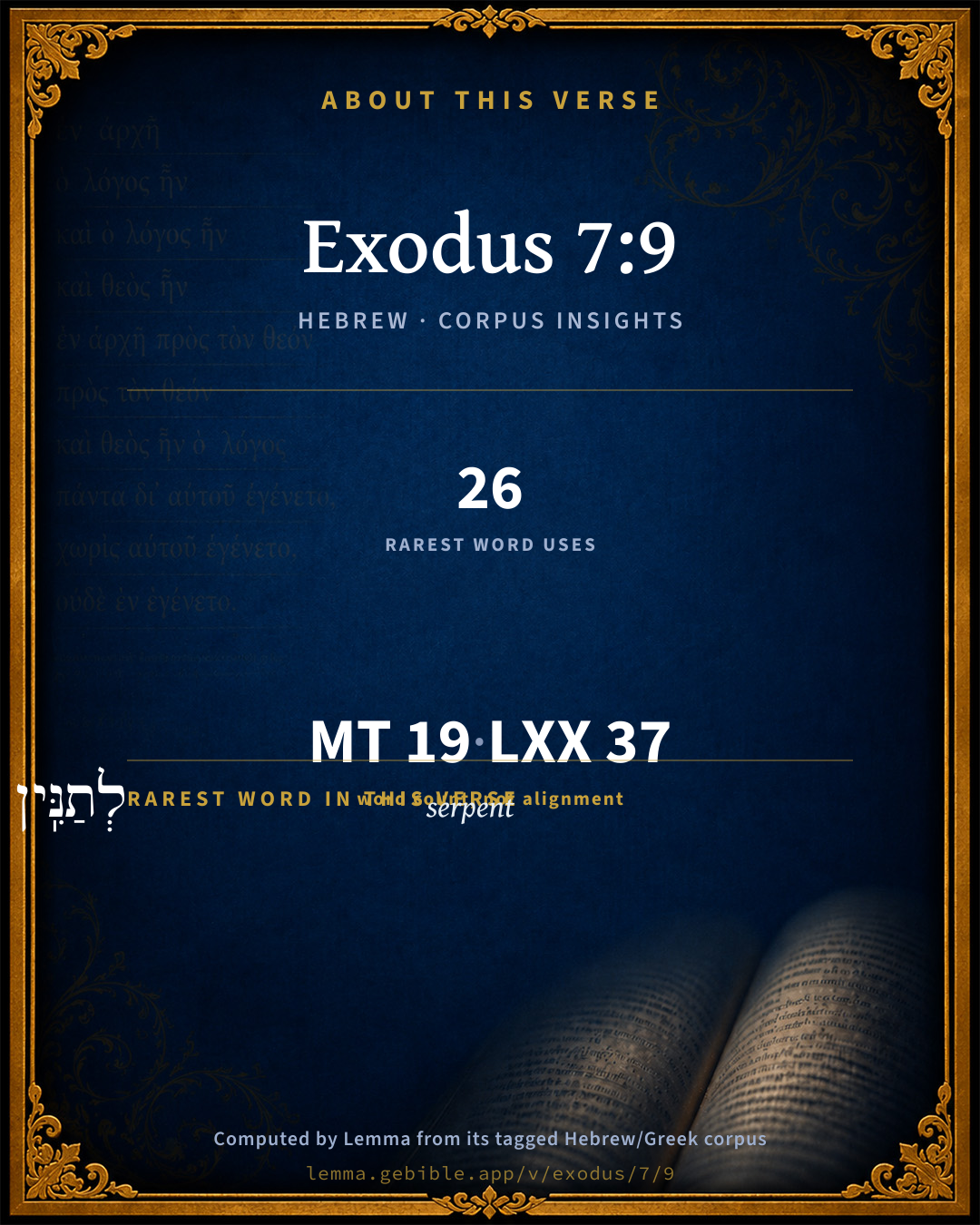
19
words
15
distinct lemmas
Pentateuch
section

Shared distinctive vocabulary

לְתַנִּֽין serpent H8577 occurs in 26 verses of the Hebrew Bible. Also found in:

Grammatical profile

  • 7 verbs
  • 7 nouns
  • 3 prepositions
  • 1 conjunction
  • 1 particle

Verb forms

  • יְדַבֵּ֨ר Piel · Imperfect
  • לֵאמֹ֔ר Qal · Infinitive Construct
  • תְּנ֥וּ Qal · Imperative
  • וְאָמַרְתָּ֣ Qal · Sequential Perfect
  • קַ֧ח Qal · Imperative
  • וְהַשְׁלֵ֥ךְ Hiphil · Imperative
  • יְהִ֥י Qal · Jussive

Repetition

Words recur within this verse — often emphatic in Hebrew:

  • פַּרְעֹה֙ Pharaoh H6547 ×2
  • לֵאמֹ֔ר to say H559 ×2
  • אֲלֵכֶ֤ם to H413 ×2

Hebrew & Septuagint length

In English translation the verse runs 28 words from the Hebrew and 44 from the Septuagint (LXX English) — the Septuagint runs noticeably longer here. See the side-by-side →

A rough comparison of the two English renderings, which tokenize alike — not a word-level alignment.

Word counts can differ between the Hebrew and the Greek without any difference in meaning — e.g. the Hebrew direct-object marker אֵת has no separate Greek word, and Greek often adds the article ὁ.

In the original languages it is 19 Hebrew tokens and 37 Greek tokens — but the two are counted differently (Hebrew bundles its prefixes and suffixes into one token; the Greek is in lemma form), so that isn’t a like-for-like length.

Cross-references

13

Topical passages linked to Exodus 7:9 in the Treasury of Scripture Knowledge — connected by theme and wording, ordered by reader-vote popularity; previews shown in the World English Bible.

  • Exodus 4:2 Yahweh said to him, "What is that in your hand?" He said, "A rod."
  • Isaiah 7:11 "Ask a sign of Yahweh your God; ask it either in the depth, or in the height above."
  • John 2:18 The Jews therefore answered him, "What sign do you show us, seeing that you do these things?"
  • Exodus 4:17 You shall take this rod in your hand, with which you shall do the signs."
  • John 6:30 They said therefore to him, "What then do you do for a sign, that we may see, and believe you? What work do you do?
  • Exodus 10:13 Moses stretched forth his rod over the land of Egypt, and Yahweh brought an east wind on the land all that day, and all the night; and when it was morning, the east wind brought the locusts.
  • Exodus 4:20 Moses took his wife and his sons, and set them on a donkey, and he returned to the land of Egypt. Moses took God's rod in his hand.
  • Exodus 7:10–12 Moses and Aaron went in to Pharaoh, and they did so, as Yahweh had commanded: and Aaron cast down his rod before Pharaoh and before his servants, and it became a serpent.
  • Exodus 9:23 Moses stretched forth his rod toward the heavens, and Yahweh sent thunder, hail, and lightning flashed down to the earth. Yahweh rained hail on the land of Egypt.
  • Psalms 74:12–13 Yet God is my King of old, Working salvation in the midst of the earth.
  • Ezekiel 29:3 speak, and say, Thus says the Lord Yahweh: Behold, I am against you, Pharaoh king of Egypt, the great monster that lies in the midst of his rivers, that has said, My river is my own, and I have made it for myself.
  • Matthew 12:39 But he answered them, "An evil and adulterous generation seeks after a sign, but no sign will be given it but the sign of Jonah the prophet.
  • John 10:38 But if I do them, though you don't believe me, believe the works; that you may know and believe that the Father is in me, and I in the Father."

Cross-references courtesy of OpenBible.info (CC BY 4.0).

Hebrew and Greek witnesses Masoretic Hebrew ↔ Greek Septuagint

The same verse in the two great witnesses to the Old Testament, shown verse-for-verse.

Here the Septuagint runs noticeably longer than the Hebrew — LXX2012 (modern English Septuagint) 44 words vs World English Bible 28. A rough length comparison of the two English translations, not a word-level alignment — read both below.

These are two independent witnesses, not word-aligned to each other, and the Septuagint is shown in lemma (dictionary) form.

Hebrew Exodus 7:9 Masoretic · Westminster Leningrad Codex

כִּי֩ יְדַבֵּ֨ר אֲלֵכֶ֤ם פַּרְעֹה֙ לֵאמֹ֔ר תְּנ֥וּ לָכֶ֖ם מוֹפֵ֑ת וְאָמַרְתָּ֣ אֶֽל אַהֲרֹ֗ן קַ֧ח אֶֽת מַטְּךָ֛ וְהַשְׁלֵ֥ךְ לִפְנֵֽי פַרְעֹ֖ה יְהִ֥י לְתַנִּֽין

"When Pharaoh speaks to you, saying, 'Perform a miracle!' then you shall tell Aaron, 'Take your rod, and cast it down before Pharaoh, that it become a serpent.'"

World English Bible · Public Domain

Greek LXX Exodus 7:9 Septuagint · lemma form

καί ἐάν λαλέω πρός σύ φαραώ λέγω δίδωμι ἐγώ σημεῖον ἤ τέρας καί εἶπον ααρων ὁ ἀδελφός σύ λαμβάνω ὁ ῥάβδος καί ῥίπτω αὐτός ἐπί ὁ γῆ ἐναντίον φαραώ καί ἐναντίον ὁ θεράπων αὐτός καί εἰμί δράκων

Now if Pharao should speak to you, saying, Give us a sign or a wonder, then shall you say to your brother Aaron, Take your rod and cast it upon the ground before Pharao, and before his servants, and it shall become a serpent.

LXX2012 (modern English Septuagint) · Public Domain

Hebrew: Westminster Leningrad Codex (CC BY 4.0). Greek: Septuagint (public domain); English from LXX2012 (modern English Septuagint) (Public Domain). How the Septuagint differs from the Hebrew →

Targum (Aramaic paraphrase)

2

The Targum is the ancient Jewish Aramaic paraphrase of the Hebrew Scriptures — an interpretive translation, not the Hebrew text itself. Onkelos (literal) and Pseudo-Jonathan (expansive) render the Torah, and Jonathan the Prophets. Coverage is partial: where no permissively-licensed English translation exists for a verse, only the Aramaic is shown. This is verse-level text, not a word-by-word alignment to the Hebrew.

  1. Targum Onkelos Torah (Genesis–Deuteronomy)
    אֲרֵי יְמַלֵל לְוָתְכוֹן פַּרְעֹה לְמֵימַר הָבוּ לְכוֹן אָתָא וְתֵימַר לְאַהֲרֹן סַב יָת חוּטְרָךְ וּרְמֵי קֳדָם פַּרְעֹה יְהִי לְתַנִינָא:

    (no public-domain English translation for this verse)

    Targum Onkelos — Aramaic: “Onkelos Genesis” (public domain); “Onkelos Exodus” (public domain); “Onkelos Leviticus” (public domain); “Onkelos Numbers” (public domain); “Onkelos Deuteronomy” (public domain). English: “Sefaria Community Translation” (CC0 1.0 (public-domain dedication)); “J.W. Etheridge. The Targums of Onkelos and Jonathan Ben Uzziel on the Pentateuch. London: Longmans, Green, 1862” (public domain). Text via Sefaria.

  2. Targum Pseudo-Jonathan Torah (Genesis–Deuteronomy)
    אֲרוּם יְמַלֵיל עִמְכוֹן פַּרְעה לְמֵימַר הָבוּ לְכוֹן תִּימְהָא וְתֵימַר לְאַהֲרן סַב יַת חוּטְרָךְ וּטְלוֹק יָתֵיהּ קֳדָם פַּרְעה יְהֵי לְחִיוִי חוּרְמַן אֲרוּם עֲתִידִין כָּל דַיְירֵי אַרְעָא לְמִשְׁמַע קַל צְוָוחַתְהוֹן דְמִצְרַיִם בְּתַבְרוּתִי יַתְהוֹן הֵיכְמָא דִשְׁמָעַן כָל בִּרְיָיתָא יַת קַל צְוָוחַת חִוְיָא כַּד אִיתְעַרְטִיל מִן שֵׁירוּיָא

    When Pharoh talketh with you, saying, Give us a miracle, thou shalt say to Aharon, Take thy rod, and cast it down before Pharoh, and it shall become a basilisk-serpent; for all the inhabiters of the earth shall hear the voice of the shriek of Mizraim when I shatter them, as all the creatures heard the shriek of the serpent when made naked at the beginning.

    Targum Pseudo-Jonathan — Aramaic: “Targum Jonathan on Genesis” (public domain); “Targum Jonathan on Exodus” (public domain); “Targum Jonathan on Leviticus” (public domain); “Targum Jonathan on Numbers” (public domain); “Targum Jonathan on Deuteronomy” (public domain). English: “The Targum of Jonathan ben Uzziel, trans. J. W. Etheridge, London, 1862” (public domain). Text via Sefaria.

Commentary

Notes on Exodus 7:9 from classic Christian and Jewish commentators (each source and its license shown beneath its notes). The classic Christian expositions comment on the surrounding passage and are grouped to its opening verse, so a note may address several verses; the Jewish commentaries on the Tanakh (Rashi and others) are per-verse, so they appear only where the commentator wrote on this verse.

Lemma curates 59 commentaries, every one of them public domain or Creative Commons licensed, each selected and text-cleaned for this edition rather than reprinted as found. About our sources →

Trapp's Complete Commentary

John Trapp

Exo 7:9 When Pharaoh shall speak unto you, saying, Shew a miracle for you: then thou shalt say unto Aaron, Take thy rod, and cast [it] before Pharaoh, [and] it shall become a serpent.

Ver. 9. Show a miracle for you.] A persuading wonder, an admirable work, above the power of nature, as being a kind of creation, and such as requires omnipotency. But Pharaoh’s heart was such a nether millstone, as neither miracle, nor ministry, nor misery, nor mercy could possibly mollify. At the burning of Bainham the martyr, when his arms and legs were half consumed, he cried out to the bystanders and said, O ye Papists, behold you look for miracles! here now you may see a miracle: for in this fire I feel no more pain than if I were in a bed of down, or of roses. {a} Thus he: sed surdis fabulam.

{a} Act. and Mon., fol. 940.

John Trapp, A Commentary or Exposition upon All the Books of the Old and New Testament (1647–1656) — public domain. Text from a community e-Sword module.

Joseph Benson's Commentary

Exo 7:9. Say unto Aaron, Take thy rod — This Moses ordinarily held in his hand, and delivered to Aaron, upon occasion, for the execution of his commands. For this and some other miracles were to be done, not by Moses immediately, but by Aaron, partly, perhaps, to preclude or take off the suspicion that these miracles were wrought by some magic arts of Moses, and partly for the greater honour of Moses, that he might be what God had said, (Exo 7:1,) a god to Pharaoh, who not only could work miracles himself, but also give power to others to do so. Perhaps the conjecture of Grotius upon this place may be worth mentioning here, which is, that the custom of ambassadors bearing a caduceus, or rod, in their hands, had its origin in this event, being taken up first by the neighbouring nations, and from them communicated to the Greeks and Romans. And it is remarkable that the caduceus of Mercury, the messenger of the gods of Greece and Rome, was formed of two serpents twisted round a rod.

Joseph Benson's Commentary on the Old and New Testaments (1811–1818) — public domain. Text from a community e-Sword module.

Tyndale Open Study Notes

Tyndale Open Resources

7:9 Serpent (Hebrew tannin) is a different word than the word translated “snake” in 4:3. Tannin often refers to a sea monster. Egypt is often portrayed as an ultimately impotent sea monster (Isa 30:7; Ezek 29:3). The image of a cobra’s head was on the pharaoh’s headdress.

Tyndale Open Study Notes — © Tyndale Open Resources, licensed CC BY-SA 4.0. Text via the HelloAO Bible API.

Geneva Bible (1599)

Geneva Bible translators

Or, dragon.

Geneva Bible (1599) marginal notes — public domain. Text via Bolls.life.

Jamieson, Fausset & Brown

Robert Jamieson, A. R. Fausset & David Brown

When Pharaoh shall speak unto you, &c.--The king would naturally demand some evidence of their having been sent from God; and as he would expect the ministers of his own gods to do the same works, the contest, in the nature of the case, would be one of miracles. Notice has already been taken of the rod of Moses (Exo 4:2), but rods were carried also by all nobles and official persons in the court of Pharaoh. It was an Egyptian custom, and the rods were symbols of authority or rank. Hence God commanded His servants to use a rod.

Jamieson, Fausset & Brown — Commentary Critical and Explanatory on the Whole Bible (1871) — public domain (CC PDM 1.0). Text via the HelloAO Bible API.

Adam Clarke's Commentary

Verse 9. Show a miracle for you] A miracle, מופת mopheth, signifies an effect produced in nature which is opposed to its laws, or such as its powers are inadequate to produce. As Moses and Aaron professed to have a Divine mission, and to come to Pharaoh on the most extraordinary occasion, making a most singular and unprecedented demand, it was natural to suppose, if Pharaoh should even give them an audience, that he would require them to give him some proof by an extraordinary sign that their pretensions to such a Divine mission were well founded and incontestable. For it appears to have ever been the sense of mankind, that he who has a Divine mission to effect some extraordinary purpose can give a supernatural proof that he has got this extraordinary commission.

Take thy rod] This rod, whether a common staff, an ensign of office, or a shepherd's crook, was now consecrated for the purpose of working miracles; and is indifferently called the rod of God, the rod of Moses, and the rod of Aaron. God gave it the miraculous power, and Moses and Aaron used it indifferently.

Adam Clarke's Commentary on the Bible (1810–1826) — public domain. Text from a community e-Sword/MySword module.

Ellicott's Commentary for English Readers

(9) Shew a miracle for you.—Pharaoh had perhaps heard of the miracles wrought by Aaron before the people of Israel (Exo_4:30), and was curious to be an eye-witness of one, as was Herod Antipas (Luk_23:8). Or he may have thought that if Moses and Aaron “shewed a miracle,” his own magicians would be able to show greater ones, and he would then dismiss the brothers as charlatans and impostors. He certainly did hot intend to be influenced by any miracle which they might show, or to accept it as evidence that their message to him was a command from God.

Thy rod.—The rod is now called Aaron’s, because Moses had entrusted him with it. (Comp. Exo_7:19, and Exo_8:5; Exo_8:16-17.)

A serpent.—Or, a snake. The word is not the same as that used in Exo_4:3, but appears to be a synonym.

A Bible Commentary for English Readers, edited by Charles John Ellicott (1878–1897) — public domain. Text from a community e-Sword module.

The Cambridge Bible for Schools and Colleges

gen. ed. J. J. S. Perowne

9. shall speak unto you] when you come before him, as directed (Exo_6:11; Exo_6:13, Exo_7:2).

Give (Deu_6:22, Joe_2:30 Heb.) a portent (v. 3) for you] Or, ‘Give for yourselves a portent’: the pronoun is reflexive, according to very common Heb. idiom, Gen_6:14 ‘make thee,’ v. 21 ‘take thee,’ Deu_1:13 ‘give you,’ &c. (Lex. p. 515b).

thy rod] the rod, which in P Aaron regularly bears, v. 19, Exo_8:5; Exo_8:16-17.

a serpent] The marg. is added to shew that the word here, and vv. 10, 12, is different from the one below, v. 15, and in Exo_4:3 (which is the ordinary one for ‘serpent’). Tannin is a large reptile, generally used of a sea-or river-monster (Gen_1:21, Psa_74:13), but occasionally also of a land-reptile (Deu_32:33 EVV. ‘dragon,’ Psa_91:13 b ‘serpent’). Here the writer will mean either a land-reptile, or possibly a young crocodile.

The Cambridge Bible for Schools and Colleges (gen. ed. J. J. S. Perowne; Cambridge University Press, 1878–1918) — public domain. Text from a community e-Sword module.

John Gill's Exposition

When Pharaoh shall speak unto you, saying, show a miracle for you,.... To prove that they came from God, the Jehovah they said they did, and that they were his ambassadors, and came in his name, and made the demand for him; which when he seriously reflected on things, he would be ready to require, hoping they would not be able to show any, and then he should have somewhat against them, and treat them as impostors:

then thou shalt say unto Aaron, take thy rod; the same that Moses had in his hand at Horeb, and brought with him to Egypt; this he had delivered into the hand of Aaron, who was to be his agent, and with this rod do signs and wonders as he did, and on account of them it is sometimes called the rod of God:

and cast it before Pharaoh, and it shall become a serpent; as it became one before at Horeb, when Moses by the order of God cast it on the ground, and afterwards became a rod again, as it now was, Exo 4:2 Hence Mercury, the messenger of the gods with the Heathens, is represented as having a "caduceus", a rod or wand twisted about with snakes (p).

(p) Vid. Chartar. de Imag. Deorum, p. 136. imag. 48.

John Gill's Exposition of the Whole Bible (1746–1763) — public domain (CC PDM 1.0). Text via the HelloAO Bible API.

Albert Barnes' Notes on the Bible

Thy rod - Apparently the rod before described Exo 4:2, which Moses on this occasion gives to Aaron as his representative.

A serpent - A word different from that in Exo 4:3. Here a more general term, תנין tannı̂yn, is employed, which in other passages includes all sea or river monsters, and is more specially applied to the crocodile as a symbol of Egypt. It occurs in the Egyptian ritual, nearly in the same form, “Tanem,” as a synonym of the monster serpent which represents the principle of antagonism to light and life.

Albert Barnes' Notes on the Bible (1834–1885) — public domain. Text from a community e-Sword/MySword module.

Matthew Poole's English Annotations

Say unto Aaron, by whose hands this and other miracles were to be done, and not by Moses immediately; partly to take off the some suspicion that these miracles were wrought by magical artifice of Moses; and partly for the greater honour of Moses, that he might be what God had said, Exo 7:1, a god to Pharaoh, who not only could work wonders himself, but also give power to others to do so.

Take thy rod: the same rod is called the rod of God, and of Moses, and of Aaron, here and Exo 7:12, because it was appointed, and as it were consecrated by God, and used both by Moses and Aaron in their great works. And this rod Moses ordinarily held in his hand, and delivered it to Aaron upon occasion for the execution of his commands.

A serpent; Heb. a dragon, which is a great serpent. Others, a crocodile, to whose jaws he had exposed the Israelitish infants.

Matthew Poole's English Annotations on the Holy Bible (1683–1685) — public domain. Text from a community e-Sword/MySword module.

The Pulpit Commentary

When Pharaoh shall speak to you, saying, Shew a miracle. It is obvious that there would have been an impropriety in Moses and Aaron offering a sign to Pharaoh until he asked for one. They claimed to be ambassadors of Jehovah, and to speak in his name. (Exo_5:1) Unless they were misdoubted, it was not for them to produce their credentials. Hence they worked no miracle at their former interview. Now, however, the time was come when their credentials would be demanded, and an express command was given them to exhibit the first "sign.

Miracles the credentials of an ambassador from God.

It is not easy to see any way in which God could authenticate a message as coming from him, except by giving the messenger supernatural powers. Conceivably, he might proclaim his will from heaven directly, in terms of human speech. But even then doubts would be raised as to the words uttered; men"s recollections of them would differ; some would question whether words were used at all, and would hold that it had "thundered". (Joh_12:29) If, to avoid such results, he speaks to man through man, how is he to make it clear that his prophet has indeed been sent by him? He cannot make his messenger impeccable, if he is still to be man. He cannot give him irresistible eloquence, for eloquence is at once suspected; the reason rises up against it and resists it. What other course is there, but to impart to his messenger a portion of his own command over nature in other words, to give him the power of working miracles? The light of nature seems to have taught Pharaoh to ask for this proof. The same light taught Nicodemus to accept it man can do these miracles that thou doest, except God be with him". (Joh_3:2) So it will ever be with simple men in simple times. It is only when men have become sophisticated, when they have darkened the light that is in them by "foolish questionings" and "oppositions of science falsely so called," that they begin to see specious objections to miracles, and regard them as "difficulties in the way of receiving a revelation" rather than as convincing evidences of it. We may properly call upon an opponent to tell us what evidence of a Divine mission he would accept, if he rejects miracles as an evidence, and wait for his answer. We shall probably find that oJ ajnairwn tauthn thstin ouj panutera ejrei ("he who destroys this basis of belief will not discover a surer one"). Aristotle.

The Pulpit Commentary (1880–1919), ed. H.D.M. Spence-Jones & Joseph S. Exell — public domain. Text from a community e-Sword module.

John Wesley's Explanatory Notes

Say unto Aaron, Take thy rod - This Moses ordinarily held in his hand, and delivered it to Aaron upon occasion, for the execution of his commands.

John Wesley, Explanatory Notes Upon the Whole Bible (1754–1765) — public domain. Text via the GEBible commentary corpus.

Rashi

Rabbi Shlomo Yitzchaki (Rashi)

מופת A WONDER — a sign to prove that there is power in Him who is sending you.

Rashi on the Tanakh — English translations: “The Judaica Press complete Tanach with Rashi, translated by A. J. Rosenberg” (CC BY 4.0); “Pentateuch with Rashi's commentary by M. Rosenbaum and A.M. Silbermann, 1929-1934” (public domain); “The Metsudah Tanach series, Lakewood, N.J” (CC BY 4.0); and “The Book of Joshua, Metsudah Publications, 1997” (CC BY 4.0). Text via Sefaria.

Lesson kit

Teaching starters — assembled from the data on this page, not authored interpretation. Every prompt links to the verse data it draws on. Edit before teaching.

Exodus, in the Pentateuch, opens this verse with 19 words (15 distinct Hebrew lemmas). Its most distinctive word is tannîyn (“serpent”). The Greek Septuagint runs longer here. A historical commentator’s framing appears above. Read the whole chapter for the surrounding context.

Discussion questions

  1. What does “serpent” (tannîyn) contribute to the verse as a whole?
  2. Genesis 1:21 shares the word «serpent» with this verse. How do the two illuminate each other?
  3. “Pharaoh” occurs 2× in this one verse. What is the effect of the repetition?
  4. Compared with the Hebrew, the Septuagint runs longer here. What questions does that raise?
  5. These translations render this verse differently; the difference is in the English rendering, not the original. What questions does that raise?
  6. The verb «יְדַבֵּ֨ר» is Piel Imperfect. How does its form color the action?
  7. Reading how Trapp's Complete Commentary and Joseph Benson's Commentary read this verse, where do the two commentators agree and where do they part?

Things to notice

Reading settings

Reading text

Shown beneath each verse's original-language words.

Old Testament
Old Testament edition

Read the OT as the Masoretic Hebrew (MT) or the Greek Septuagint (LXX).

English shown for the Greek Septuagint (in the Hebrew ↔ Greek comparison).

Comparing translations? Open the Compare panel on any verse page to stack up to four side by side.