
Ecclesiastes 1:13

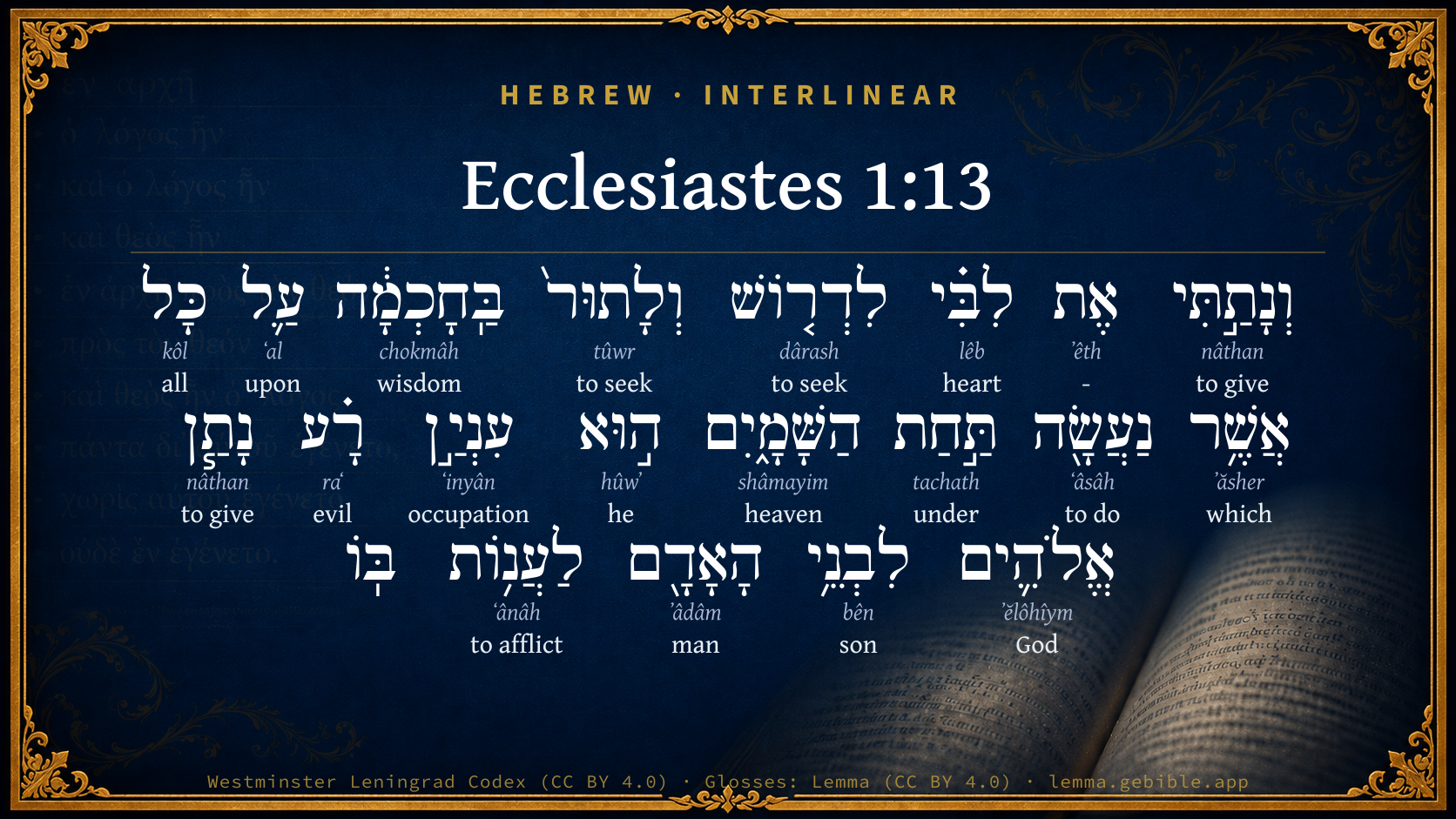
Hebrew (Westminster Leningrad Codex) Ecclesiastes 1:13 appears in the Hebrew Old Testament. The text above is from the Westminster Leningrad Codex. Each word links to its Strong’s number, a concise gloss, and parsing drawn from the Open Scriptures Hebrew Bible morphology. Click any word for its full Brown-Driver-Briggs (BDB) entry.
Download image
Cite this verse

Ecclesiastes 1:13 (World English Bible). Public Domain. Lemma interlinear Bible study tool, https://lemma.gebible.app/v/ecclesiastes/1/13.

Show BibTeX & RIS
BibTeX
RIS
English Translation
I applied my heart to seek and to search out by wisdom concerning all that is done under the sky. It is a heavy burden that God has given to the sons of men to be afflicted with.
World English Bible · Public Domain
Highlights
  • 1 first appearance in the Hebrew Bible
Full analysis ↓
Download a study sheet

One document with this verse’s original text, its word-by-word gloss line, the meaning frame, cross-references with their text, attributed commentary, and full source and license credits — printable, and it pastes into notes with its structure intact.

This verse Autodidact and up

Study sheet (.html) Plain text (.txt)

A passage Seminary Student

Up to 50 verses in one chapter. A passage sheet keeps up to 6 commentary sources and 12 cross-references per verse, in the order this page ranks them, and says so on the sheet whenever that leaves anything out. Ask for a single verse and you get the Autodidact verse sheet above.

Everything on this page stays free to read, with no account — the sheet is a download of what is already on screen, not access to it.

Want to remove ads? Support Godless Engineer
Compare translations 3

The same verse in 3 English versions, stacked beneath the original-language interlinear above. Click any original word for its lexicon entry.

Each is an independent rendering of the whole verse — the interlinear is not word-aligned to these translations.

Highlighted words mark where these versions differ — a whole-verse word diff, not a word-by-word alignment.

  • World English Bible Public Domain
    I applied my heart to seek and to search out by wisdom concerning all that is done under the sky. It is a heavy burden that God has given to the sons of men to be afflicted with.
  • King James Version Public Domain
    And I gave my heart to seek and search out by wisdom concerning all things that are done under heaven: this sore travail hath God given to the sons of man to be exercised therewith.
  • unfoldingWord Literal Text CC BY-SA 4.0
    So, I gave my heart to seek and to explore with wisdom concerning all that is done under the heavens. It an unpleasant business God has given to the sons of humanity to be busy with it.

unfoldingWord Literal Text — © unfoldingWord, licensed CC BY-SA 4.0. Word-aligned USFM3 via Door43 (git.door43.org/unfoldingWord/en_ult).

Versions to compare (up to 4)

3 of 4 selected

Show all 18 translations

Every available English version of this verse, each an independent rendering of the whole verse.

  • World English Bible Public Domain
    I applied my heart to seek and to search out by wisdom concerning all that is done under the sky. It is a heavy burden that God has given to the sons of men to be afflicted with.
  • Berean Standard Bible Public Domain
    And I set my mind to seek and explore by wisdom all that is done under heaven. What a heavy burden God has laid upon the sons of men to occupy them!
  • Majority Standard Bible Public Domain
    And I set my mind to seek and explore by wisdom all that is done under heaven. What a miserable task God has laid upon the sons of men to occupy them!
  • King James Version Public Domain
    And I gave my heart to seek and search out by wisdom concerning all things that are done under heaven: this sore travail hath God given to the sons of man to be exercised therewith.
  • American Standard Version (1901) Public Domain
    And I applied my heart to seek and to search out by wisdom concerning all that is done under heaven: it is a sore travail that God hath given to the sons of men to be exercised therewith.
  • Revised Version (1885) Public Domain
    And I applied my heart to seek and to search out by wisdom concerning all that is done under heaven: it is a sore travail that God hath given to the sons of men to be exercised therewith.
  • Geneva Bible (1599) Public Domain
    And I haue giuen mine heart to search and finde out wisdome by all things that are done vnder the heauen: (this sore trauaile hath GOD giuen to the sonnes of men, to humble them thereby)
  • Douay-Rheims (1899) Public Domain
    And I proposed in my mind to seek and search out wisely concerning all things that are done under the sun. This painful occupation hath God given to the children of men, to be exercised therein.
  • Young's Literal Translation Public Domain
    And I have given my heart to seek and to search out by wisdom concerning all that hath been done under the heavens. It `is' a sad travail God hath given to the sons of man to be humbled by it.
  • Literal Standard Version CC BY-SA 4.0
    And I have given my heart to seek and to search out by wisdom concerning all that has been done under the heavens. It [is] a sad travail God has given to the sons of man to be humbled by it.
  • Unlocked Literal Bible CC BY-SA 4.0
    I applied my mind to study and to search out by wisdom everything that is done under heaven. That search is a burdensome task that God has given to the children of mankind to be busy with.
  • unfoldingWord Literal Text CC BY-SA 4.0
    So, I gave my heart to seek and to explore with wisdom concerning all that is done under the heavens. It an unpleasant business God has given to the sons of humanity to be busy with it.
  • Darby Bible Public Domain
    And I applied my heart to seek and search out by wisdom concerning all that is done under the heavens: this grievous occupation hath God given to the children of men to weary themselves therewith.
  • World Messianic Bible Public Domain
    I applied my heart to seek and to search out by wisdom concerning all that is done under the sky. It is a heavy burden that God has given to the sons of men to be afflicted with.
  • Webster's Bible Public Domain
    And I gave my heart to seek and search out by wisdom concerning all things that are done under heaven: this grievous labor hath God given to the sons of man to be exercised with it.
  • Free Bible Version CC BY-SA 4.0
    I decided to focus my mind to explore, using wisdom, everything that happens here on earth. This is a tough assignment that God has given people to keep them busy!
  • Bible in Basic English Public Domain
    And I gave my heart to searching out in wisdom all things which are done under heaven: it is a hard thing which God has put on the sons of men to do.
  • JPS Tanakh (1917) Public Domain
    And I applied my heart to seek and to search out by wisdom concerning all things that are done under heaven; it is a sore task that God hath given to the sons of men to be exercised therewith.

Literal Standard Version (2020), Covenant Press — licensed CC BY-SA 4.0. Text via the HelloAO Bible API (eBible.org). Unlocked Literal Bible (unfoldingWord) — licensed CC BY-SA 4.0. Text via the HelloAO Bible API (eBible.org). unfoldingWord Literal Text — © unfoldingWord, licensed CC BY-SA 4.0. Word-aligned USFM3 via Door43 (git.door43.org/unfoldingWord/en_ult). Free Bible Version, Dr. Jonathan Gallagher — licensed CC BY-SA 4.0. Text via the HelloAO Bible API (eBible.org).

Word by word

More ways to search: Search by grammar → Find every occurrence → Compare this word →

Practice this passage: Drill this verse → Learn its vocabulary →

עִנְיַ֣ן
ʻinyân
H6045
“occupation”
Noun, Common, Masculine, Singular, Absolute
Part of Speech
Noun
Type
Common
Gender
Masculine
Number
Singular
State
Absolute
Full BDB Definition

Origin: from H6031

TWOT: 1651a

occupation, task, job
  1. וְנָתַ֣תִּי nâthan H5414 “and · to give” Conjunction + Verb, Qal, Perfect, 1st Person, Common, Singular
  2. אֶת ʼêth H853 “-” Particle, Direct Object
  3. לִבִּ֗י lêb H3820 “heart · my” Noun, Common, Masculine, Singular, Construct + Suffix, Personal, 1st Person, Common, Singular
  4. לִדְר֤וֹשׁ dârash H1875 “to seek” Preposition + Verb, Qal, Infinitive Construct
  5. וְלָתוּר֙ tûwr H8446 “and · to seek” Conjunction + Preposition + Verb, Qal, Infinitive Construct
  6. בַּֽחָכְמָ֔ה chokmâh H2451 “in/at the · wisdom” Preposition, Determined + Noun, Common, Feminine, Singular, Absolute
  7. עַ֛ל ʻal H5921 “upon” Preposition
  8. כָּל kôl H3605 “all” Noun, Common, Masculine, Singular, Absolute
  9. אֲשֶׁ֥ר ʼăsher H834 “which” Particle, Relative
  10. נַעֲשָׂ֖ה ʻâsâh H6213 “to do” Verb, Niphal, Perfect, 3rd Person, Masculine, Singular
  11. תַּ֣חַת tachath H8478 “under” Preposition
  12. הַשָּׁמָ֑יִם shâmayim H8064 “the · heaven(s)” Particle, Definite Article + Noun, Common, Masculine, Plural, Absolute
  13. ה֣וּא hûwʼ H1931 “he” Pronoun, Personal, 3rd Person, Masculine, Singular
  14. רָ֗ע raʻ H7451 “evil” Adjective, Adjective, Masculine, Singular, Absolute
  15. נָתַ֧ן nâthan H5414 “to give” Verb, Qal, Perfect, 3rd Person, Masculine, Singular
  16. אֱלֹהִ֛ים ʼĕlôhîym H430 “God(s)” Noun, Common, Masculine, Plural, Absolute
  17. לִבְנֵ֥י bên H1121 “to/for · sons of” Preposition + Noun, Common, Masculine, Plural, Construct
  18. הָאָדָ֖ם ʼâdâm H120 “the · man” Particle, Definite Article + Noun, Common, Masculine, Singular, Absolute
  19. לַעֲנ֥וֹת ʻânâh H6031 “to afflict” Preposition + Verb, Qal, Infinitive Construct

About this verse

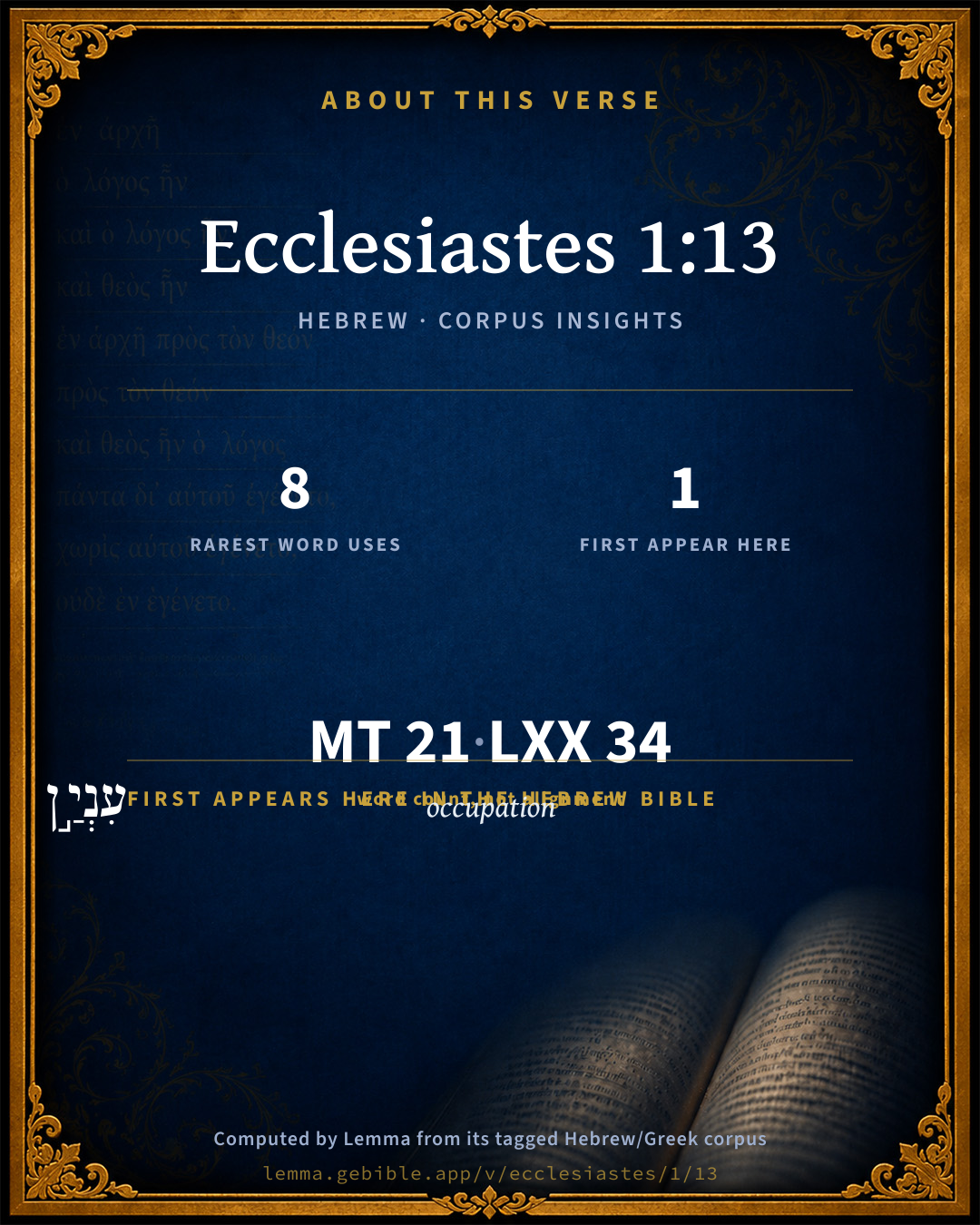
These counts appear in no published source. They are computed here, from the morphology-tagged text and Lemma’s own curated glosses. What Lemma adds →

21
words
19
distinct lemmas
Wisdom
section

Notable vocabulary

The rarest word here is עִנְיַ֣ן occupation H6045 — appearing just 8 times in the whole Hebrew Bible.

First appearance in Scripture

This word makes its first canonical appearance in the Hebrew Bible here:

  • עִנְיַ֣ן occupation H6045

Shared distinctive vocabulary

עִנְיַ֣ן occupation H6045 occurs in 8 verses of the Hebrew Bible. Also found in:

Grammatical profile

  • 6 verbs
  • 8 nouns
  • 1 adjective
  • 1 pronoun
  • 3 prepositions
  • 2 particles

Verb forms

  • וְנָתַ֣תִּי Qal · Perfect
  • לִדְר֤וֹשׁ Qal · Infinitive Construct
  • וְלָתוּר֙ Qal · Infinitive Construct
  • נַעֲשָׂ֖ה Niphal · Perfect
  • נָתַ֧ן Qal · Perfect
  • לַעֲנ֥וֹת Qal · Infinitive Construct

Repetition

A word recurs within this verse — often emphatic in Hebrew:

  • וְנָתַ֣תִּי to give H5414 ×2

Hebrew & Septuagint length

In English translation the verse runs 38 words from the Hebrew and 36 from the Septuagint (LXX English) — closely comparable.

A rough comparison of the two English renderings, which tokenize alike — not a word-level alignment.

Word counts can differ between the Hebrew and the Greek without any difference in meaning — e.g. the Hebrew direct-object marker אֵת has no separate Greek word, and Greek often adds the article ὁ.

In the original languages it is 21 Hebrew tokens and 34 Greek tokens — but the two are counted differently (Hebrew bundles its prefixes and suffixes into one token; the Greek is in lemma form), so that isn’t a like-for-like length.

Cross-references

17

Topical passages linked to Ecclesiastes 1:13 in the Treasury of Scripture Knowledge — connected by theme and wording, ordered by reader-vote popularity; previews shown in the World English Bible.

  • Ecclesiastes 3:10 I have seen the burden which God has given to the sons of men to be afflicted with.
  • Genesis 3:19 By the sweat of your face will you eat bread until you return to the ground, for out of it you were taken. For you are dust, and to dust you shall return."
  • Ecclesiastes 8:16–17 When I applied my heart to know wisdom, and to see the business that is done on the earth (for also there is that neither day nor night sees sleep with his eyes),
  • 1 Timothy 4:15 Be diligent in these things. Give yourself wholly to them, that your progress may be revealed to all.
  • Ecclesiastes 1:17 I applied my heart to know wisdom, and to know madness and folly. I perceived that this also was a chasing after wind.
  • Ecclesiastes 7:25 I turned around, and my heart sought to know and to search out, and to seek wisdom and the scheme of things, and to know that wickedness is stupidity, and that foolishness is madness.
  • Ecclesiastes 12:12 Furthermore, my son, be admonished: of making many books there is no end; and much study is a weariness of the flesh.
  • Psalms 111:2 Yahweh's works are great, Pondered by all those who delight in them.
  • Proverbs 2:2–4 So as to turn your ear to wisdom, And apply your heart to understanding;
  • Proverbs 4:7 Wisdom is supreme. Get wisdom. Yes, though it costs all your possessions, get understanding.
  • Proverbs 18:1 An unfriendly man pursues selfishness, And defies all sound judgment.
  • Proverbs 18:15 The heart of the discerning gets knowledge. The ear of the wise seeks knowledge.
  • Proverbs 23:26 My son, give me your heart; And let your eyes keep in my ways.
  • Ecclesiastes 2:23 For all his days are sorrows, and his travail is grief; yes, even in the night his heart takes no rest. This also is vanity.
  • Ecclesiastes 2:26 For to the man who pleases him, God gives wisdom, knowledge, and joy; but to the sinner he gives travail, to gather and to heap up, that he may give to him who pleases God. This also is vanity and a chasing after wind.
  • Ecclesiastes 4:4 Then I saw all the labor and achievement that is the envy of a man's neighbor. This also is vanity and a striving after wind.
  • Ecclesiastes 8:9 All this have I seen, and applied my mind to every work that is done under the sun. There is a time in which one man has power over another to his hurt.

Cross-references courtesy of OpenBible.info (CC BY 4.0).

Hebrew and Greek witnesses Masoretic Hebrew ↔ Greek Septuagint

The same verse in the two great witnesses to the Old Testament, shown verse-for-verse.

These are two independent witnesses, not word-aligned to each other, and the Septuagint is shown in lemma (dictionary) form.

Hebrew Ecclesiastes 1:13 Masoretic · Westminster Leningrad Codex

וְנָתַ֣תִּי אֶת לִבִּ֗י לִדְר֤וֹשׁ וְלָתוּר֙ בַּֽחָכְמָ֔ה עַ֛ל כָּל אֲשֶׁ֥ר נַעֲשָׂ֖ה תַּ֣חַת הַשָּׁמָ֑יִם ה֣וּא עִנְיַ֣ן רָ֗ע נָתַ֧ן אֱלֹהִ֛ים לִבְנֵ֥י הָאָדָ֖ם לַעֲנ֥וֹת בּֽוֹ

I applied my heart to seek and to search out by wisdom concerning all that is done under the sky. It is a heavy burden that God has given to the sons of men to be afflicted with.

World English Bible · Public Domain

Greek LXX Ecclesiastes 1:13 Septuagint · lemma form

καί δίδωμι ὁ καρδία ἐγώ ὁ ἐκζητέω καί ὁ κατασκέπτομαι ἐν ὁ σοφία περί πᾶς ὁ γίγνομαι ὑπό ὁ οὐρανός ὅτι περισπασμός πονηρός δίδωμι ὁ θεός ὁ υἱός ὁ ἄνθρωπος ὁ περισπάω ἐν αὐτός

And I applied my heart to seek out and examine by wisdom concerning all things that are done under heaven, for God has given to the sons of men an evil trouble to be troubled therewith.

LXX2012 (modern English Septuagint) · Public Domain

On this verse, Keil & Delitzsch discusses the Septuagint’s reading. Read the note in Commentary ↓

Hebrew: Westminster Leningrad Codex (CC BY 4.0). Greek: Septuagint (public domain); English from LXX2012 (modern English Septuagint) (Public Domain). How the Septuagint differs from the Hebrew →

Commentary

Notes on Ecclesiastes 1:13 from classic Christian and Jewish commentators (each source and its license shown beneath its notes). The classic Christian expositions comment on the surrounding passage and are grouped to its opening verse, so a note may address several verses; the Jewish commentaries on the Tanakh (Rashi and others) are per-verse, so they appear only where the commentator wrote on this verse.

Lemma curates 59 commentaries, every one of them public domain or Creative Commons licensed, each selected and text-cleaned for this edition rather than reprinted as found. About our sources →

Trapp's Complete Commentary

John Trapp

Ecc 1:13 And I gave my heart to seek and search out by wisdom concerning all [things] that are done under heaven: this sore travail hath God given to the sons of man to be exercised therewith.

Ver. 13. And I gave my heart to seek and search out by wisdom.] God had given Solomon a large heart, and great store of wisdom; and this made him not more idle, but more industrious, more sedulous and serious in seeking and …

Searching out by wisdom,] i.e., By the best skill that he had, maturely and methodically, the causes, properties, and effects, with the reason of all things that are, and are done under heaven. Neither did he this in pride and curiosity (as Hugo de Sancto Victore here sharply censureth him), but soberly and modestly, setting down his disquisitions and observations of things political and natural for the use of posterity. And forasmuch as these {a} are now lost - because haply too much admired and trusted to, by those that had the use of them under the first temple, in and with the which some Jews say they were burnt - what a high price we all set upon this and the other two books of Solomon, the wisest of men, as, not Apollo, but the true God of heaven hath called him, and commended him unto us! Surely, as in the Revelation, heaven never opened but some great mystery was revealed, some divine oracle uttered; so we may be confident that the Holy Ghost never sets any penman of Scripture a work but for excellent purpose. And if we disregard it, he will complain of us as once, - "I have written for them the great things of nay law, but they were counted as a strange thing." {Hos 8:12} As for those other worthy works of Solomon (the fruits of this privy search into the natures of the creatures here mentioned), that the injury of time bereft us of, how much better may we say of them, than a godly and learned man {b} once did of Origen’s Octapla, Huius operis iacturam deplorare possumus, compensare non possumus, This great loss we may well bewail, but cannot help.

{a} 1Ki 4:32-33.

{b} Rolloc., De Vocatione, p. 130.

John Trapp, A Commentary or Exposition upon All the Books of the Old and New Testament (1647–1656) — public domain. Text from a community e-Sword module.

The Biblical Illustrator

Joseph S. Exell

Ecc_1:13-14

I gave my heart to seek and search out by wisdom concerning all things that are done under heaven.

The mysteries of human life

Now, there has never been any book which can be compared to this marvellous book of Ecclesiastes. It is the laboratory in which the penitent gathers bitter herbs, the garden in which the wise man gathers sweet flowers. It is the laboratory to which the greatest sage of old times deliberately puts his hand and his head to try experiments, in order to get a little acquaintance with the mysteries of human life. The scale upon which he experimented is as vast as the power of man; as we may see when we consider the discoveries of Sir Isaac Newton, the speculations of Priestley, the anatomists among the bones, and the geologists among the stones, as also that most sublime of men, full of animal life, sensual desire, and full of wisdom, who obtained a knowledge of all times. What was the object of his experiments? They were deliberately entered upon to try what life could do for his soul, and he tried it in the most philosophical way. How splendid to read his experiment. I builded me a house. How many men thus see if they can satisfy the desires of their souls. I know of one man who built one of the greatest houses of modern times, and when he had finished it he said, If I could find as much pleasure in pulling it down as I have done in rearing, I would begin to pull it down. The charm was in the experiment, and not in the thing which was got. So Solomon tried houses; and we know the style in which he built. The very cedars of Lebanon trembled, for there was to be an axe among them; the far-off stones were to be brought, for there was a king building. He tried gardening also--the loveliest of all human pleasures, the sweetest and most innocent, the most lasting, and one from which men get more pure pleasure than anything else. Then he tried society. I gathered me also silver and gold, and the peculiar treasure of kings and of the provinces. And then he came to the result of all his experiments: It is all vanity and vexation of spirit. Now, it is a subject worth pondering upon, what is meant by this endless search; whether there be a remedy for this perpetual discontent, and where it is to be found. We never do meet with a contented people. The more cultivated they are, the more real will be the discontent. In which country of Europe do you suppose are there the most suicides--the stupidest or the most cultivated? You will say in the former, of course; but you are entirely wrong. The most elevated districts are more disturbed than others. Solomon also tried whether books and study would give him what he sought; and he came down with a great library and among his parchments, but eventually comes to the conclusion that much study is a weariness to the flesh. Now, it will be found that there are more suicides in Prussia than in Spain; for these reasons, that in one country, they think, and in the other they drink; in one country they lead, and in the other they are driven. Wherever there is but a little looking into its problems, according to the ability they have for making experiments, there is the same result. I envy the souls that never are weary. Is there anything much more touching than this great desire which is upon me, this impatience of the dull routine of things, this great clement of weariness, of always seeing the same things over and over again I It is so wonderful! Solomon had seen all the wonderful things that were-to be seen, and come to the conclusion that there is nothing new under the sun. Ask a man who is perpetually reading and studying, and he will tell you he gets fearfully weary: he finds the same stereotyped state of things. We toil and fever after wealth, and leave it to somebody, we know not what sort of person he may be--whether a fool or not. We put by a little, and know not what manner of person will have it. We rejoice in building up something beautiful and commanding, and know not what kind of creature will inhabit it. We erect a house, perhaps, to be occupied by beggars; we leave an orchard to be used by fools, gather books to be scattered over the world: or, perhaps, we collect a magnificent gallery of pictures, and leave them to a progeny who cannot understand them. Looking at his own work, and of the labour which his hand had wrought, Solomon said, as he walked through his palaces, This is a weariness to the flesh. He was conscious of understanding the infinite forms of human weariness; such was the result of his analysis of the experiments he made in Jerusalem, and he ends by showing that nothing would satisfy him. In the effort to get quit of this fearful discontent, men are always trying to get something new, to get something that will satisfy them. One man says he will retire, and fancies for himself some little island in the sweet Mediterranean Sea, where the scene is ever fair, the sky ever blue--where the women are beautiful and never commonplace, and the men classical in contour, and the children sweet little cherubs, never growing vulgar. He dreams of some sweet paradise, and he goes to find it. But he finds that black care, all haunting care, in the saddle behind the horseman. The man carries himself wheresoever he goes. How touching to read of the humble experiment of poor Charles Lamb, longing for the day when he should have nothing to do, no longer confined to the hateful India House, sitting and working sadly and wearyingly at those ledgers, The thing that has been will be, when I have stood at the banks and other places and seen the marble-like figures who have toiled there: such fearful repetition, the manner in which they spend their lives, in adding up the day-books, counting up the figures, with a view to the dividends! What would poor Lamb have given to get out of this condition? What a tragedy that was when he went down to Brighton to enjoy himself, and lay down the burden of his daily routine for a little while; when the coach got half-way and met the one coming in the opposite direction, he got out of the one he was in and stepped into the other! That was vanity and vexation of spirit. What was the secret of Byron, of the strange opinions of that spoiled child of fashion? Now, all this weariness comes very much out of the impatience of the condition by which we are surrounded. Then the majority of people are so fond of the proprieties of life, asking the ordinary questions and receiving the eternal answers. Where have you been? Where are you going? What has happened? So that everything even in friendship gets tiresome. (G. Dawson.)

The pursuit of wisdom and knowledge

1. This wisdom and knowledge, if a man is determined to go far beyond his fellows in the acquisition of it, must be discovered, and examined, and appropriated, by much study: and this, as Solomon observes, is a weariness of the flesh. The incessant stretch of the minds faculties, frequent harassing and anxious perplexity, studious days and sleepless nights, must be his portion, who sets his heart on the attainment of unusual eminence, in science in general, or in any of its various departments.

2. In this pursuit, as in others, there are many disappointments to be expected, to fret, and mortify, and irritate the spirit:--such as, experiments failing, some of them perhaps long-continued, promising, and costly;--facts turning out contradictory, and unsettling or overturning favourite theories;--the means of prosecuting a train of discovery falling short, at the very moment, it may be, when they are most desirable;--trifling and worthless results arising, after much labour, long-tried patience, and sanguine expectation;--the anticipated honour and pleasure of introducing a new and important invention or discovery, the product of the experiments and investigations of years, lost on the very eve of arrival, by the priority of an unknown competitor.

3. There are some parts of knowledge which are, in their very nature, painful and distressing. In a world where sin reigns, many must be the scenes of misery, many the afflicting occurrences and facts, which present themselves to the observant and investigating mind, that is in quest of general and extensive information. They abound both in the past and present history of mankind. They are fitted to fill the heart with grief and sorrow: and the more a mans knowledge extends,--the more he reads, and hears, and observes, the more copious will this source of bitterness become.

4. There is to be taken into account the mortification of pride that must be experienced, in consequence of the limited nature o! the human faculties.

5. There is a similar feeling of mortification, arising from the very circumstance, that, with all the knowledge and wisdom that are acquired, there is still a blank,--still a consciousness of want and deficiency, in regard to true happiness.

6. The man of much wisdom and increased knowledge, generally, if not universally, becomes the marked object of the scorn of some, and the envy of others. Some depreciate his studies and all their results, laugh at them, and hold them up to contempt and ridicule. Others are stung with secret jealousy; which is the odious parent of all the hidden arts of detraction and calumny, and of injurious and unworthy attempts to deprive him of his well-earned honours, and to cast him down from his excellency.

7. The man who occupies his powers in the pursuit and acquisition of human wisdom alone, careless of God, and uninfluenced by regard to His authority and to His glory, is leaving eternity a wretched blank; has no solid and satisfactory support in the anticipation of it, when the thought intrudes itself upon his mind; and is treasuring up grief and sorrow for the close of his career. (R. Wardlaw, D. D.)

The Biblical Illustrator, edited by Joseph S. Exell (c. 1880s–1900s) — public domain. Text from a community e-Sword module.

Joseph Benson's Commentary

Ecc 1:13. I gave my heart — Which phrase denotes his serious and fixed purpose, and his great industry in it. To search out by wisdom — To seek diligently and accurately, by the help of that wisdom wherewith God had endowed me. Concerning all things, &c. — Concerning all the works of God and men in this lower world; the works of nature; the works of divine providence; and the works and depths of human policy. This sore travail — This difficult and toilsome work of searching out these things, God hath inflicted as a just punishment upon man for his eating of the tree of knowledge. To be exercised therewith — To employ themselves in the painful study of these things.

Joseph Benson's Commentary on the Old and New Testaments (1811–1818) — public domain. Text from a community e-Sword module.

Keil & Delitzsch

C. F. Keil & F. Delitzsch

"Is there anything whereof it may be said: See, this is new? - it was long ago through the ages (aeons) which have been before us." The Semit. substantive verb ישׁ (Assyr. isu) has here the force of a hypothetical antecedent: supposing that there is a thing of which one might say, etc. The זה, with Makkeph, belongs as subject, as at Ecc 7:27, Ecc 7:29 as object, to that which follows. כּבר (vid., List, p. 193) properly denotes length or greatness of time (as כּברה, length of way). The ל of לע is that of measure: this "long ago" measured (Hitz.) after infinitely long periods of time. מלּ, ante nos, follows the usage of מלּף, Isa 41:26, and lpaa', Jdg 1:10, etc.; the past time is spoken of as that which was before, for it is thought of as the beginning of the succession of time (vid., Orelli, Synon. der Zeit u. Ewigkeit, p. 14f.). The singular היה may also be viewed as pred. of a plur. inhumanus in order; but in connection, Ecc 2:7, Ecc 2:9 (Gesen. 147, An. 2), it is more probable that it is taken as a neut. verb. That which newly appears has already been, but had been forgotten; for generations come and generations go, and the one forgets the other.

Ecclesiastes 1:11

ecc 1:11

"There is no remembrance of ancestors; and also of the later ones who shall come into existence, there will be no remembrance for them with those who shall come into existence after them." With זכּרון (with Kametz) there is also זכרון, the more common form by our author, in accordance with the usage of his age; Gesen., Elst., and others regard it here and at Ecc 2:16 as constr., and thus לרא as virtually object-gen. (Jerome, non est priorum memoria); but such refinements of the old syntaxis ornata are not to be expected in our author: he changes (according to the traditional punctuation) here the initial sound, as at Ecc 1:17 the final sound, to oth and uth. אין ל is the contrast of היה ל: to attribute to one, to become partaker of. The use of the expression, "for them," gives emphasis to the statement. "With those who shall come after," points from the generation that is future to a remoter future, cf. Gen 33:2. The Kametz of the prep. is that of the recompens. art.; cf. Num 2:31, where it denotes "the last" among the four hosts; for there הא is meant of the last in order, as here it is meant of the remotely future time.

Ecclesiastes 1:12

ecc 1:12

"I, Koheleth, have been king over Israel in Jerusalem." That of the two possible interpretations of הייתי, "I have become" and "I have been," not the former (Grtz), but the latter, is to be here adopted, has been already shown. We translate better by "I have been" - for the verb here used is a pure perfect - than by "I was" (Ew., Elst., Hengst., Zck.), with which Bullock (Speaker's Comm., vol. IV, 1873) compares the expression Quand j'tois roi ! which was often used by Louis XIV towards the end of his life. But here the expression is not a cry of complaint, like the "fuimus Troes," but a simple historical statement, by which the Preacher of the vanity of all earthly things here introduces himself, - it is Solomon, resuscitated by the author of the book, who here looks back on his life as king. "Israel" is the whole of Israel, and points to a period before the division of the kingdom; a king over Judah alone would not so describe himself. Instead of "king על (over) Israel," the old form of the language uses frequently simply "king of Israel," although also the former expression is sometimes found; cf. Sa1 15:26; Sa2 19:23; Kg1 11:37. He has been king, - king over a great, peaceful, united people; king in Jerusalem, the celebrated, populous, highly-cultivated city, - and thus placed on an elevation having the widest survey, and having at his disposal whatever can make a man happy; endowed, in particular, with all the means of gaining knowledge, which accorded with the disposition of his heart searching after wisdom (cf. Kg1 3:9-11; Kg1 5:9).

But in his search after worldly knowledge he found no satisfaction.

Ecclesiastes 1:13

ecc 1:13

"And I gave my heart to seek and to hold survey with wisdom over all that is done under the sun: a sore trouble it is which God has given to the children of men to be exercised therewith." The synonyms דּרשׁ(to seek) and תּוּר (to hold survey over) do not represent a lower and a higher degree of search (Zck.), but two kinds of searching: one penetrating in depth, the other going out in extent; for the former of these verbs (from the root-idea of grinding, testing) signifies to investigate an object which one already has in hand, to penetrate into it, to search into it thoroughly; and the latter verb (from the root-idea of moving round about)

(Note: Vid., the investigation of these roots (Assyr. utîr, he brought back) in Eth's Schlafgemach der Phantasie, pp. 86-89.)

signifies to hold a survey, - look round in order to bring that which is unknown, or not comprehensively known, within the sphere of knowledge, and thus has the meaning of bǎkkēsh, one going the rounds. It is the usual word for the exploring of a country, i.e., the acquiring personal knowledge of its as yet unknown condition; the passing over to an intellectual search is peculiar to the Book of Koheleth, as it has the phrase ל לב נתן, animum advertere, or applicare ad aliquid, in common only with Dan 10:12. The beth of bahhochemah is that of the instrument; wisdom must be the means (organon) of knowledge in this searching and inquiry. With על is introduced the sphere into which it extends. Grotius paraphrases: Historiam animalium et satorum diligentissime inquisivi. But נעשׂה does not refer to the world of nature, but to the world of men; only within this can anything be said of actions, only this has a proper history. But that which offers itself for research and observation there, brings neither joy nor contentment. Hitzig refers הוּא to human activity; but it relates to the research which has this activity as its object, and is here, on that account, called "a sore trouble," because the attainment and result gained by the laborious effort are of so unsatisfactory a nature. Regarding ענין, which here goes back to ענה ב, to fatigue oneself, to trouble oneself with anything, and then to be engaged with it. The words ענין רע would mean trouble of an evil nature (vid., at Psa 78:49; Pro 6:24); but better attested is the reading ענין רע "a sore trouble." הוּא is the subj., as at Ecc 2:1 and elsewhere; the author uses it also in expressions where it is pred. And as frequently as he uses asher and שׁ, so also, when form and matter commend it, he uses the scheme of the attributive clause (elliptical relative clause), as here (cf. Ecc 3:16), where certainly, in conformity with the old style, נתנו was to be used.

Ecclesiastes 1:14

ecc 1:14

He adduces proof of the wearisomeness of this work of research: "I saw all the works that are done under the sun; and, behold, all is vanity and striving after the wind." The point of the sentence lies in והנּה = וארא וה, so that thus rathi is the expression of the parallel fact (circumst. perfect). The result of his seeing, and that, as he has said Ecc 1:13, of a by no means superficial and limited seeing, was a discovery of the fleeting, unsubstantial, fruitless nature of all human actions and endeavours. They had, as hevel expresses, not reality in them; and also, as denoted by reuth ruahh (the lxx render well by προαίρεσις πνεύματος), they had no actual consequences, no real issue. Hos 12:1 also says: "Ephraim feedeth on wind," i.e., follows after, as the result of effort obtains, the wind, roěh ruahh; but only in the Book of Koheleth is this sentence transformed into an abstract terminus technicus (vid., under Reth).

Ecclesiastes 1:15

ecc 1:15

The judgment contained in the words, "vanity and a striving after the wind," is confirmed: "That which is crooked cannot become straight; and a deficit cannot be numerable," i.e., cannot be taken into account (thus Theod., after the Syro-Hex.), as if as much were present as is actually wanting; for, according to the proverb, "Where there is nothing, nothing further is to be counted." Hitzig thinks, by that which is crooked and wanting, according to Ecc 7:13, of the divine order of the world: that which is unjust in it, man cannot alter; its wants he cannot complete. But the preceding statement refers only to labour under the sun, and to philosophical research and observation directed thereto. This places before the eyes of the observer irregularities and wants, brings such irregularities and wants to his consciousness, - which are certainly partly brought about and destined by God, but for the most part are due to the transgressions of man himself, - and what avails the observer the discovery and investigation? - he has only lamentation over it, for with all his wisdom he can bring no help. Instead of לתקן (vid., under תקן), לתקן was to be expected. However, the old language also formed intransitive infinitives with transitive modification of the final vowels, e.g., יבשׁ, etc. (cf. ישׁון, Ecc 5:11).

Having now gained such a result in his investigation and research by means of wisdom, he reaches the conclusion that wisdom itself is nothing.

Ecclesiastes 1:16

ecc 1:16

"I have communed with mine own heart, saying: Lo, I have gained great and always greater wisdom above all who were before me over Jerusalem; and my heart hath seen wisdom and knowledge in fulness. And I gave my heart to know what was in wisdom and knowledge, madness and folly - I have perceived that this also is a grasping after the wind." The evidence in which he bears witness to himself that striving after wisdom and knowledge brings with it no true satisfaction, reaches down to the close of Ecc 1:17; ידעתּי is the conclusion which is aimed at. The manner of expression is certainly so far involved, as he speaks of his heart to his heart what it had experienced, and to what he had purposely directed it. The אני leads us to think that a king speaks, for whom it is appropriate to write a capital I, or to multiply it into we; vid., regarding this "I," more pleonastic than emphatic, subordinated to its verb.

It is a question whether עם־לבּי, after the phrase (את) עם דּבּר, is meant of speaking with any one, colloqui, or of the place of speaking, as in "thou shalt consider in thine heart," Deu 8:5, it is used of the place of consciousness; cf. Job 15:9, (עמּדי) עמּי היה = σύνοιδα ἐμαυτῷ, and what is said in my Psychol. p. 134, regarding συνείδησις, consciousness, and συμμαρτυρεῖν. בּלבּי, interchanging with עם־לבּי, Ecc 2:1, Ecc 2:15, commends the latter meaning: in my heart (lxx, Targ., Jerome, Luther); but the cogn. expressions, medabběrěth ǎl-libbah, Sa1 1:13, and ledabbēr ěl-libbi, Gen 24:45, suggest as more natural the former rendering, viz., as of a dialogue, which is expressed by the Gr. Venet. (more distinctly than by Aquila, Symm., and Syr.): διείλεγμαι ἐγὼ ξὺν τῇ καρδίᾳ μου. Also לאמר, occurring only here in the Book of Koheleth, brings it near that the following oratio directa is directed to the heart, as it also directly assumes the form of an address, Ecc 2:1, after בלבי. The expression, הג הך, "to make one's wisdom great," i.e., "to gain great wisdom," is without a parallel; for the words, הג תו, Isa 28:29, quoted by Hitzig, signify to show and attest truly useful (beneficial) knowledge in a noble way. The annexed והו refers to the continued increase made to the great treasure already possessed (cf. Ecc 2:9 and Kg1 10:7). The al connected therewith signifies, "above" (Gen 49:26) all those who were over Jerusalem before me. This is like the sarrâni âlik maḥrija, "the kings who were my predecessors," which was frequently used by the Assyrian kings. The Targumist seeks to accommodate the words to the actual Solomon by thus distorting them: "above all the wise men who have been in Jerusalem before me," as if the word in the text were בירושלם,

(Note: In F. the following note is added: "Several Codd. have, erroneously, birushalam instead of al-jerushalam." Kennicott counts about 60 such Codd. It stands thus also in J; and at first it thus stood in H, but was afterwards corrected to al-yerushalam. Cf. Elias Levita's Masoreth hamasoreth, II 8, at the end.)

as it is indeed found in several Codd., and according to which also the lxx, Syr., Jerome, and the Venet. translate. Rather than think of the wise (הכּימיּא), we are led to think of all those who from of old stood at the head of the Israelitish community. But there must have been well-known great men with whom Solomon measures himself, and these could not be such dissimilarly great men as the Canaanitish kings to the time of Melchizedek; and since the Jebusites, even under Saul, were in possession of Zion, and Jerusalem was for the first time completely subdued by David (Sa2 5:7, cf. Jos 15:63), it is evident that only one predecessor of Solomon in the office of ruler over Jerusalem can be spoken of, and that here an anachronism lies before us, occasioned by the circumstance that the Salomo revivivus, who has behind him the long list of kings whom in truth he had before him, here speaks.

Regarding היה אשׁר, qu'il y uet, for היו אשׁר, qui furent, vid., at Ecc 1:10. The seeing here ascribed to the heart (here = νοῦς, Psychol. p. 249) is meant of intellectual observation and apprehension; for "all perception, whether it be mediated by the organs of sense or not (as prophetic observing and contemplating), comprehends all, from mental discernment down to suffering, which veils itself in unconsciousness, and the Scripture designates it as a seeing" (Psychol. 234); the Book of Koheleth also uses the word ראה of every kind of human experience, bodily or mental, Ecc 2:24; Ecc 5:17; Ecc 6:6; Ecc 9:9. It is commonly translated: "My heart saw much wisdom and knowledge" (thus e.g., Ewald); but that is contrary to the gram. structure of the sentence (Ew. 287c). The adject. harbēh

(Note: Regarding the form הרבה, which occurs once (Jer 42:2), vid., Ew. 240c.)

is always, and by Koheleth also, Ecc 2:7; Ecc 5:6, Ecc 5:16; Ecc 6:11; Ecc 9:18; Ecc 11:8; Ecc 12:9, Ecc 12:12, placed after its subst.; thus it is here adv., as at Ecc 5:19; Ecc 7:16. Rightly the Venet.: ἡ καρδία μου τεθέαται κατὰ πολὺ σοφίαν καί γνῶσιν Chokma signifies, properly, solidity, compactness; and then, like πυκνότης, mental ability, secular wisdom; and, generally, solid knowledge of the true and the right. Dǎǎth is connected with chokma here and at Isa 33:6, as at Rom 11:33, γνῶσις is with σοφία. Baumggarten-Crusius there remarks that σοφία refers to the general ordering of things, γνῶσις to the determination of individual things; and Harless, that σοφία is knowledge which proposes the right aim, and γνῶσις that which finds the right means thereto. In general, we may say that chokma is the fact of a powerful knowledge of the true and the right, and the property which arises out of this intellectual possession; but dǎǎth is knowledge penetrating into the depth of the essence of things, by which wisdom is acquired and in which wisdom establishes itself.

Ecc 1:17

By the consecutive modus ואתּנה (aor. with ah, like Gen 32:6; Gen 41:11, and particularly in more modern writings; vid., p. 198, regarding the rare occurrence of the aorist form in the Book of Koheleth) he bears evidence to himself as to the end which, thus equipped with wisdom and knowledge, he gave his heart to attain unto (cf. 13a), i.e., toward which he directed the concentration of his intellectual strength. He wished to be clear regarding the real worth of wisdom and knowledge in their contrasts; he wished to become conscious of this, and to have joy in knowing what he had in wisdom and knowledge as distinguished from madness and folly. After the statement of the object lādǎǎth, stands vedaath, briefly for ולדעת. Ginsburg wishes to get rid of the words holēloth vesikluth, or at least would read in their stead תּבוּנית ושׂכלוּת (rendering them "intelligence and prudence"); Grtz, after the lxx παραβολὰς καὶ ἐπιστήμην, reads משׁלות ושׂכלות. But the text can remain as it is: the object of Koheleth is, on the one hand, to become acquainted with wisdom and knowledge; and, on the other, with their contraries, and to hold these opposite to each other in their operations and consequences. The lxx, Targ., Venet., and Luther err when they render sikluth here by ἐπιστήμη, etc. As sikluth, insight, intelligence, is in the Aram. written with the letter samek (instead of sin), so here, according to the Masora סכלות, madness is for once written with ס, being everywhere else in the book written with שׂ; the word is an ἐναντιόφωνον,

(Note: Vid., Th. M. Redslob's Die Arab. Wrter, u.s.w. (1873).)

and has, whether written in the one way or in the other, a verb, sakal (שׂכל, סכל), which signifies "to twist together," as its root, and is referred partly to a complication and partly to a confusion of ideas. הללות, from הלל, in the sense of "to cry out," "to rage," always in this book terminates in th, and only at Ecc 10:13 in th; the termination th is that of the abstr. sing.; but th, as we think we have shown at Pro 1:20, is that of a fem. plur., meant intensively, like bogdoth, Zep 2:4; binoth, chokmoth, cf. bogdim, Pro 23:28; hhovlim, Zac 11:7, Zac 11:14; toqim, Pro 11:15 (Bttch. 700g E). Twice vesikluth presents what, speaking to his own heart, he bears testimony to before himself. By yādǎ'ti, which is connected with dibbarti (Ecc 1:16) in the same rank, he shows the facit. זה refers to the striving to become conscious of the superiority of secular wisdom and science to the love of pleasure and to ignorance. He perceived that this striving also was a grasping after the wind; with רעוּת, 14b, is here interchanged רעיון. He proves to himself that nothing showed itself to be real, i.e., firm and enduring, unimpeachable and imperishable. And why not?

Ecc 1:18

"For in much wisdom is much grief; and he that increaseth knowledge increaseth sorrow." The German proverb: "Much wisdom causeth headache," is compared, Ecc 12:12, but not here, where כּעס and מכאוב express not merely bodily suffering, but also mental grief. Spinoza hits one side of the matter in his Ethics, IV 17, where he remarks: "Veram boni et mali cognitionem saepe non satis valere ad cupiditates coercendas, quo facto homo imbecillitatem suam animadvertens cogitur exclamare: Video meliora proboque, deteriora sequor." In every reference, not merely in that which is moral, there is connected with knowledge the shadow of a sorrowful consciousness, in spite of every effort to drive it away. The wise man gains an insight into the thousand-fold woes of the natural world, and of the world of human beings, and this reflects itself in him without his being able to change it; hence the more numerous the observed forms of evil, suffering, and discord, so much greater the sadness (כּעס, R. כס, cogn. הס, perstringere) and the heart-sorrow (מכאוב, crve-cour) which the inutility of knowledge occasions. The form of 18a is like Ecc 5:6, and that of 18b like e.g., Pro 18:22. We change the clause veyosiph daath into an antecedent, but in reality the two clauses stand together as the two members of a comparison: if one increaseth knowledge, he increaseth (at the same time) sorrow. "יוסיף, Isa 29:14; Isa 38:5; Ecc 2:18," says Ewald, 169a, "stands alone as a part. act., from the stem reverting from Hiph. to Kal with י instead of ." But this is not unparalleled; in הן יוסיף the verb יוסף is fin., in the same manner as יסּד, Isa 28:16; תּומיך, Psa 16:5, is Hiph., in the sense of amplificas, from ימך; יפיח, Pro 6:19 (vid., l.c.), is an attribut. clause, qui efflat, used as an adj.; and, at least, we need to suppose in the passage before us the confusion that the ē of kātēl (from kātil, originally kātal), which is only long, has somehow passed over into î. Bttcher's remark to the contrary, "An impersonal fiens thus repeated is elsewhere altogether without a parallel," is set aside by the proverb formed exactly thus: "He that breathes the love of truth says what is right," Pro 12:17.

Next: Ecclesiastes Chapter 2

Keil & Delitzsch — Biblical Commentary on the Old Testament (1861–1891) — public domain (CC PDM 1.0). Text via the HelloAO Bible API. (Old Testament only.)

MacLaren's Expositions of Holy Scripture

Alexander MacLaren

Ecclesiastes

TWO VIEWS OF LIFE

Ecc 1:13. - Heb 12:10.

These two texts set before us human life as it looks to two observers. The former admits that God shapes it; but to him it seems sore travail, the expenditure of much trouble and efforts; the results of which seem to be nothing beyond profitless exercise. There is an immense activity and nothing to show for it at the end but wearied limbs. The other observer sees, at least, as much of sorrow and trouble as the former, but he believes in the ‘Father of spirits,’ and in a hereafter; and these, of course, bring a meaning and a wider purpose into the ‘sore travail,’ and make it, not futile but, profitable to our highest good.

I. Note first the Preacher’s gloomy half-truth.

The word rendered in our text ‘travail’ is a favourite one with the writer. It means occupation which costs effort and causes trouble. The phrase ‘to be exercised therewith,’ rather means to fatigue themselves, so that life as looked upon by the Preacher consists of effort without result but weariness.

If he knew it at all, it was very imperfectly and dimly; and whatever may be thought of teaching on that subject which appears in the formal conclusion of the book, the belief in a future state certainly exercises no influence on its earlier portions. These represent phases through which the writer passes on his way to his conclusion. He does believe in ‘God,’ but, very significantly, he never uses the sacred name ‘Lord.’ He has shaken himself free, or he wishes to represent a character who has shaken himself free from Revelation, and is fighting the problem of life, its meaning and worth, without any help from Law, or Prophet, or Psalm. He does retain belief in what he calls ‘God,’ but his pure Theism, with little, if any, faith in a future life, is a creed which has no power of unravelling the perplexed mysteries of life, and of answering the question, ‘What does it all mean?’ With keen and cynical vision he looks out not only over men, as in this first chapter, but over nature; and what mainly strikes him is the enormous amount of work that is being done, and the tragical poverty of its results. The question with which he begins his book is, ‘What profit hath a man of all his labour wherein he laboureth under the sun?’ And for answer he looks at the sun rising and going down, and being in the same place after its journey through the heavens; and he hears the wind continually howling and yet returning again to its circuits; and the waters now running as rivers into the sea and again drawn up in vapours, and once more falling in rain and running as waters. This wearisome monotony of intense activity in nature is paralleled by all that is done by man under heaven, and the net result of all is ‘Vanity and a strife after wind.’

The writer proceeds to confirm his dreary conclusion by a piece of autobiography put into the mouth of Solomon. He is represented as flinging himself into mirth and pleasure, into luxury and debauchery, and as satisfying every hunger for any joy, and as being pulled up short in the midst of his rioting by the conviction, like a funeral bell, tolling in his mind that all was vanity. ‘He gave himself to wisdom, and madness, and folly’; and in all he found but one result-enormous effort and no profit. There seemed to be a time for everything, and a kind of demonic power in men compelling them to toil as with equal energy, now at building up, and now at destroying. But to every purpose he saw that there was ‘time and judgment,’ and therefore, ‘the misery of man was great upon him.’ To his jaundiced eye the effort of life appeared like the play of the wind in the desert, always busy, but sometime busy in heaping the sands in hillocks, and sometimes as busy in levelling them to a plain.

We may regard such a view of humanity as grotesquely pessimistic; but there is no doubt that many of us do make of life little more than what the Preacher thought it. It is not only the victims of civilisation who are forced to wearisome monotony of toil which barely yields daily bread; but we see all around us men and women wearing out their lives in the race after a false happiness, gaining nothing by the race but weariness. What shall we say of the man who, in the desire to win wealth, or reputation, lives laborious days of cramping effort in one direction, and allows all the better part of his nature to be atrophied, and die, and passes, untasted, brooks by the way, the modest joys and delights that run through the dustiest lives. What is the difference between a squirrel in the cage who only makes his prison go round the faster by his swift race, and the man who lives toilsome days for transitory objects which he may never attain? In the old days every prison was furnished with a tread-mill, on which the prisoner being set was bound to step up on each tread of the revolving wheel, not in order to rise, but in order to prevent him from breaking his legs. How many men around us are on such a mill, and how many of them have fastened themselves on it, and by their own misreading and misuse of life have turned it into a dreary monotony of resultless toil. The Preacher may be more ingenious than sound in his pessimism, but let us not forget that every godless man does make of life ‘Vanity and strife after wind.’

II. The higher truth which completes the Preacher’ s.

Of course the fragmentary sentence in our second text needs to be completed from the context, and so completed will stand, ‘God chastens us for our profit, that we should be partakers of His holiness.’ Now let us consider for a moment the thought that the true meaning of life is discipline. I say discipline rather than ‘chastening,’ for chastening simply implies the fact of pain, whereas discipline includes the wholesome purpose of pain. The true meaning of life is not to be found by estimating its sorrows or its joys, but by trying to estimate the effects of either upon us. The true value of life, and the meaning of all its tears and of all its joys, is what it makes us. If the enormous effort which struck the Preacher issues in strengthened muscles and braced limbs, it is not ‘vanity.’ He who carries away with him out of life a character moulded as God would have it, does not go in all points ‘naked as he came.’ He bears a developed self, and that is the greatest treasure that a man can carry out of multitudinous toils of the busiest life. If we would think less of our hard work and of our heavy sorrows, and more of the loving purpose which appoints them all, we should find life less difficult, less toilsome, less mysterious. That one thought taken to our hearts, and honestly applied to everything that befalls us, would untie many a riddle, would wipe away many a tear, would bring peace and patience into many a heart, and would make still brighter many a gladness. Without it our lives are a chaos; with it they would become an ordered world.

But the recognition of the hand that ministers the discipline is needed to complete the peacefulness of faith. It would be a dreary world if we could only think of some inscrutable or impersonal power that inflicted the discipline; but if in its sharpest pangs we give ‘reverence to the Father of spirits,’ we shall ‘live.’ Of course, a loving father sees to his children’s education, and a loving child cannot but believe that the father’s single purpose in all his discipline is his good. The good that is sought to be attained by the sharpest chastisement is better than the good that is given by weak indulgence. When the father’s hand wields the rod, and a loving child receives the strokes, they may sting, but they do not wound. The ‘fathers of our flesh chasten us after their own pleasure,’ and there may be error and arbitrariness in their action; and the child may sometimes nourish a right sense of injustice, but ‘the Father of spirits’ makes no mistakes, and never strikes too hard. ‘He for our profit’ carries with it the declaration that the deep heart of God doth not willingly afflict, and seeks in afflicting for nothing but His children’s good.

Nor are these all the truths by which the New Testament completes and supersedes the Preacher’s pessimism, for our text closes by unveiling the highest profit which discipline is meant to secure to us as being that we should be ‘partakers of His holiness.’ The Biblical conception of holiness in God is that of separation from and elevation above the creature. Man’s holiness is separation from the world and dedication to God. He is separated from the world by moral perfection yet more than by His other attributes, and men who have yielded themselves to Him will share in that characteristic. This assimilation to His nature is the highest ‘profit’ to which we can attain, and all the purpose of His chastening is to make us more completely like Himself. ‘The fathers of our flesh’ chasten with a view to the brief earthly life, but His chastening looks onwards beyond the days of ‘strife and vanity’ to a calm eternity.

Thus, then, the immortality which glimmered doubtfully in the end of his book before the eyes of the Preacher is the natural inference for the Christian thought of moral discipline as the great purpose of life. No doubt it might be possible for a man to believe in the supreme importance of character, and in all the discipline of life as subsidiary to its development, and yet not believe in another world, where all that was tendency, often thwarted, should be accomplished result, and the schooling ended the rod should be broken. But such a position will be very rare and very absurd. To recognise moral discipline as the greatest purpose of life, gives quite overwhelming probability to a future. Surely God does not take such pains with us in order to make no more of us than He makes of us in this world. Surely human life becomes ‘confusion worse confounded’ if it is carefully, sedulously, continuously tended, checked, inspired, developed by all the various experiences of sorrow and joy, and then, at death, broken short off, as a man might break a stick across his knee, and the fragments tossed aside and forgotten. If we can say, ‘He for our profit that we might be partakers of His holiness,’ we have the right to say ‘We shall be like Him, for we shall see Him as He is.’

Alexander MacLaren, Expositions of Holy Scripture (1904–1910) — public domain. Text from a community e-Sword module.

Tyndale Open Study Notes

Tyndale Open Resources

1:13 God has dealt a tragic existence: The grim realities of human experience remind us of the Fall in Eden (Gen 3). Ecclesiastes does not dodge depressing descriptions of death, oppression, and loneliness; it meets them head-on and incorporates them into realistic conclusions.

Tyndale Open Study Notes — © Tyndale Open Resources, licensed CC BY-SA 4.0. Text via the HelloAO Bible API.

Geneva Bible (1599)

Geneva Bible translators

Man of nature hath a desire to know, and yet is not able to come to the perfection of knowledge, which is the punishment of sin, to humble man, and to teach him to depend only upon God.

Geneva Bible (1599) marginal notes — public domain. Text via Bolls.life.

Jamieson, Fausset & Brown

Robert Jamieson, A. R. Fausset & David Brown

this sore travail--namely, that of "searching out all things done under heaven." Not human wisdom in general, which comes afterwards (Ecc 2:12, &c.), but laborious enquiries into, and speculations about, the works of men; for example, political science. As man is doomed to get his bread, so his knowledge, by the sweat of his brow (Gen 3:19) [GILL].

exercised--that is, disciplined; literally, "that they may thereby chastise, or humble themselves."

Jamieson, Fausset & Brown — Commentary Critical and Explanatory on the Whole Bible (1871) — public domain (CC PDM 1.0). Text via the HelloAO Bible API.

Adam Clarke's Commentary

Verse 13. And I gave my heart to seek and search] While Solomon was faithful to his God, he diligently cultivated his mind. His giving himself to the study of natural history, philosophy, poetry, c., are sufficient proofs of it. He had not intuitive knowledge from God but he had a capacity to obtain every kind of knowledge useful to man.

This sore travail] This is the way in which knowledge is to be acquired; and in order to investigate the operations of nature, the most laborious discussions and perplexing experiments must be instituted, and conducted to their proper results. It is God's determination that knowledge shall be acquired in no other way.

Adam Clarke's Commentary on the Bible (1810–1826) — public domain. Text from a community e-Sword/MySword module.

Ellicott's Commentary for English Readers

(13) Gave my heart.—The phrase occurs again in this book (Ecc_1:17; Ecc_7:25; Ecc_8:9; Ecc_8:16) and often elsewhere. (See Dan_10:12; 2Ch_11:16, &c) The heart among the Hebrews is regarded as the seat, not merely of the feelings, but of the intellectual faculties, and so the word is constantly used in what follows. “I gave my heart” is the same as “I applied my mind.”

To seek.—Deu_13:14; Lev_10:16.

Search out.—Num_14:36; Num_14:38; Ecc_7:25.

Travail.—The word occurs again in this book (Ecc_2:23; Ecc_2:26; Ecc_3:10; Ecc_4:8; Ecc_5:3; Ecc_5:14; Ecc_8:16) but no-where else in the Old Testament, though kindred forms are common. The word itself is common in Rabbinical Hebrew, in the sense of business.

“To afflict them” (margin). This is too strong a translation; better, to travail therein.

A Bible Commentary for English Readers, edited by Charles John Ellicott (1878–1897) — public domain. Text from a community e-Sword module.

The Cambridge Bible for Schools and Colleges

gen. ed. J. J. S. Perowne

13. I gave my heart] The phrase, so expressive of the spirit of an earnest seeker, is eminently characteristic of this book and meets us again in Ecc_1:17, chaps. Ecc_7:25, Ecc_8:9; Ecc_8:16. Like forms are found in Isai. 41:42; Psa_48:14. “Heart” with the Hebrews, it may be noticed, is the seat of the intellect as well as the affections, and “to give the heart” is therefore specially expressive of an act of concentrated mental energy. The all that is done under heaven (we note the variation of phrase from the “under the sun” of Ecc_1:9) takes in the whole range of human action as distinct from the cosmical phenomena of Ecc_1:5-7. The enquiry of the seeker was throughout one of ethical rather than physical investigation.

this sore travail] The words express the feeling with which the writer looked back on his inquiry. It had led to no satisfying result, and the first occurrence of the name of God in the book is coupled with the thought that this profitless search was His appointment. He gave the desire but, so the preacher murmurs in his real or seeming pessimism, not the full Truth in which only the desire can rest. The word for “travail” is peculiar to this book. That for “exercised” is formed from the same root.

The Cambridge Bible for Schools and Colleges (gen. ed. J. J. S. Perowne; Cambridge University Press, 1878–1918) — public domain. Text from a community e-Sword module.

Albert Barnes' Notes on the Bible

Wisdom - As including both the powers of observation and judgment, and the knowledge acquired thereby (1Ki 3:28; 1Ki 4:29; 1Ki 10:8, ...). It increases by exercise. Here is noted its application to people and their actions.

Travail - In the sense of toil; the word is here applied to all human occupations.

God - God is named as אלהים 'elohı̂ym thirty-nine times in this book; a name common to the true God and to false gods, and used by believers and by idolators: but the name Yahweh, by which He is known especially to the people who are in covenant with Him, is never once used.

Perhaps the chief reason for this is that the evil which is the object of inquiry in this book is not at all unique to the chosen people. All creation Rom. 8 groans under it. The Preacher does not write of (or, to) the Hebrew race exclusively. There is no express and obvious reference to their national expectations, the events of their national history, or even to the divine oracles which were deposited with them. Hence, it was natural for the wisest and largest-hearted man of his race to take a wider range of observation than any other Hebrew writer before or after him. It became the sovereign of many peoples whose religions diverged more or less remotely from the true religion, to address himself to a more extensive sphere than that which was occupied by the twelve tribes, and to adapt his language accordingly. See the Ecc 5:1 note.

Albert Barnes' Notes on the Bible (1834–1885) — public domain. Text from a community e-Sword/MySword module.

Matthew Poole's English Annotations

I gave my heart, which phrase notes his serious and fixed purpose, his great industry and alacrity in it,

to seek and search out, to seek diligently and accurately, by wisdom, wisely, or by the help of that wisdom wherewith God had endowed me, concerning all things that are done under heaven; concerning all the works of God and men in this lower world; the works of nature, and their causes, effects, properties, and operations; the works of Divine providence, and God’s counsels and ends in them; the work and depths of human policy in the conduct of personal, and domestical, and public affairs.

This sore travail, this difficult and toilsome work of searching out these things,

hath God given to the sons of man; God hath inflicted this as a just punishment upon man for his eating of the tree of knowledge, that instead of that sweet and perfect knowledge which God had freely infused into man at his first creation, he should now grope after some small parcels or fragments of it, and those too not to be gotten without the sweat of his brows and brains.

To be exercised therewith; to employ themselves in the painful study of these things, which now is both their duty and their punishment. Or, as it is rendered in the margin, and by many others, to afflict them in or by it, to chastise their former curiosity, and to give them matter of continual humiliation and vexation. And therefore knowledge is so far from making men happy, that it exposeth them to trouble and infelicity.

Matthew Poole's English Annotations on the Holy Bible (1683–1685) — public domain. Text from a community e-Sword/MySword module.

The Pulpit Commentary

I gave my heart (ver. 17; Ecc_7:25; Dan_10:12) The heart, in the Hebrew conception, was the seat, not of the affections only, but of the understanding and intellectual faculties generally. So the expression here is equivalent to "I applied my mind." To seek and search out. The two words are not synonymous. The former verb (vrD; darash) implies penetrating into the depth of an object before one; the other word (rWT, tur) taking a comprehensive survey of matters further away; so that two methods and scopes of investigation are signified. By wisdom; ejn th sofia (Septuagint). Wisdom was the means or instrument by which he carried on his researches, which were directed, not merely to the collecting of facts, but to investigating the causes and conditions of things. Concerning all things that are done under heaven; i.e. men"s actions and conduct, political, social, and private life. We have "under the sun" in ver. 9, and again in ver. 14. Here there is no question of physical matters, the phenomena of the material world, but only of human circumstances and interests. This sore travail (rather, this is a sore travail that) God hath given to the sons of man to be exercised therewith. The word rendered "travail" (yni, inyan) occurs often in this book (e.g., Ecc_2:23, Ecc_2:26, etc.) and nowhere else in the Old Testament. The same root is found in the word translated "exercised;" hence Wright has, "It is a woeful exercise which God has given to the sons of men wherewith to exercise themselves." If we keep to the word "travail," we may render, "to travail therein." It implies distracting business, engrossing occupation. Septuagint, perispasmon; Vulgate, occupationem. Man feels himself constrained to make this laborious investigation, yet the result is most unsatisfactory, as the next verse shows. "God" is here Elohim, and so throughout the book, the name Jehovah (the God of the covenant, the God of Israel) never once occurring. Those who regard Solomon as the author of the book account for this on the plea that the king, in his latest years, reflecting sadly on his backsliding and fall, shrank from uttering with his polluted lips the adorable Name once so often used with filial reverence and beloved. But the true reason is found in the design of Koheleth, which was to set forth, not so much Israel"s position under the covenant, as the condition of man in the face of the God of nature. The idiosyncrasies and peculiar features of the chosen people are not the subject of his essay; he deals with a wider sphere; his theme is man in his relation to Divine providence; and for this power he uses that name, common alike to the true and false religions, Elohim, applied to the Supreme Being by believers and idolaters.

The Pulpit Commentary (1880–1919), ed. H.D.M. Spence-Jones & Joseph S. Exell — public domain. Text from a community e-Sword module.

John Wesley's Explanatory Notes

I gave my heart - Which phrase denotes his serious and fixed purpose, and his great industry in it. To search - To seek diligently and accurately. By wisdom - By the help of that wisdom wherewith God had endowed me. Concerning - Concerning all the works of God and men in this lower world; the works of nature; the works of Divine providence; and the works and depths of human policy. This travel - This difficult and toilsome work of searching out these things, God hath inflicted as a just punishment upon man for his eating of the tree of knowledge. To be exercised - To employ themselves in the painful study of these things.

John Wesley, Explanatory Notes Upon the Whole Bible (1754–1765) — public domain. Text via the GEBible commentary corpus.

Rashi

Rabbi Shlomo Yitzchaki (Rashi)

And I applied my heart to inquire in the Torah, which is wisdom, and to ponder over it concerning all the evil deeds mentioned above, which are committed under the sun, and I pondered that it is a sore task that the Holy One, blessed be He, set before the children of men. (Deut. 30: 15): “life and good, and also death and evil.”

a sore task Heb. עִנְיַן רַע. They have evil behavior.

with which to occupy themselves Heb. לַעֲנוֹת בּוֹ, to behave with it. עִנְיַן may be interpreted as an expression of an abode (מָעוֹן) and a dwelling, and it may also be interpreted as an expression of study (עִיוּן) and thought, and the same is true of לַעֲנוֹת בּוֹ.

has given has placed before them.

Rashi on the Tanakh — English translations: “The Judaica Press complete Tanach with Rashi, translated by A. J. Rosenberg” (CC BY 4.0); “Pentateuch with Rashi's commentary by M. Rosenbaum and A.M. Silbermann, 1929-1934” (public domain); “The Metsudah Tanach series, Lakewood, N.J” (CC BY 4.0); and “The Book of Joshua, Metsudah Publications, 1997” (CC BY 4.0). Text via Sefaria.

Lesson kit

Teaching starters — assembled from the data on this page, not authored interpretation. Every prompt links to the verse data it draws on. Edit before teaching.

Ecclesiastes, in the Wisdom, opens this verse with 21 words (19 distinct Hebrew lemmas). Its most distinctive word is ʻinyân (“occupation”). A historical commentator’s framing appears above. Read the whole chapter for the surrounding context.

Discussion questions

  1. What does “occupation” (ʻinyân) contribute to the verse as a whole?
  2. This is the first place “occupation” appears in Scripture (first appears here). What does its debut here establish?
  3. How does Ecclesiastes 2:23, which shares the word «occupation», read alongside this verse?
  4. What does the repetition of “to give” (2× in this one verse) do in this verse?
  5. These translations render this verse differently. What is at stake in choosing one wording over another?
  6. «וְנָתַ֣תִּי» is a Qal Perfect verb. How does that grammatical form shape the action described?
  7. Compare how Trapp's Complete Commentary and The Biblical Illustrator read this verse. Where do they agree or differ?

Things to notice

Reading settings

Reading text

Shown beneath each verse's original-language words.

Old Testament
Old Testament edition

Read the OT as the Masoretic Hebrew (MT) or the Greek Septuagint (LXX).

English shown for the Greek Septuagint (in the Hebrew ↔ Greek comparison).

Comparing translations? Open the Compare panel on any verse page to stack up to four side by side.