Amos 9:15

Hebrew (Westminster Leningrad Codex) Amos 9:15 appears in the Hebrew Old Testament. The text above is from the Westminster Leningrad Codex. Each word links to its Strong’s number, a concise gloss, and parsing drawn from the Open Scriptures Hebrew Bible morphology. Click any word for its full Brown-Driver-Briggs (BDB) entry.
Download image
Cite this verse

Amos 9:15 (World English Bible). Public Domain. Lemma interlinear Bible study tool, https://lemma.gebible.app/v/amos/9/15.

Show BibTeX & RIS
BibTeX
RIS
English Translation
I will plant them on their land, And they will no more be plucked up out of their land which I have given them," says Yahweh your God.
World English Bible · Public Domain
Download a study sheet

One document with this verse’s original text, its word-by-word gloss line, the meaning frame, cross-references with their text, attributed commentary, and full source and license credits — printable, and it pastes into notes with its structure intact.

This verse Autodidact and up

Study sheet (.html) Plain text (.txt)

A passage Seminary Student

Up to 50 verses in one chapter. A passage sheet keeps up to 6 commentary sources and 12 cross-references per verse, in the order this page ranks them, and says so on the sheet whenever that leaves anything out. Ask for a single verse and you get the Autodidact verse sheet above.

Everything on this page stays free to read, with no account — the sheet is a download of what is already on screen, not access to it.

Want to remove ads? Support Godless Engineer
Compare translations 3

The same verse in 3 English versions, stacked beneath the original-language interlinear above. Click any original word for its lexicon entry.

Each is an independent rendering of the whole verse — the interlinear is not word-aligned to these translations.

Highlighted words mark where these versions differ — a whole-verse word diff, not a word-by-word alignment.

  • World English Bible Public Domain
    I will plant them on their land, And they will no more be plucked up out of their land which I have given them," says Yahweh your God.
  • King James Version Public Domain
    And I will plant them upon their land, and they shall no more be pulled up out of their land which I have given them, saith the LORD thy God.
  • unfoldingWord Literal Text CC BY-SA 4.0
    I will plant them upon their land, and they will never again be uprooted from the land that I have given them,” says Yahweh your God.

unfoldingWord Literal Text — © unfoldingWord, licensed CC BY-SA 4.0. Word-aligned USFM3 via Door43 (git.door43.org/unfoldingWord/en_ult).

Versions to compare (up to 4)

3 of 4 selected

Show all 17 translations

Every available English version of this verse, each an independent rendering of the whole verse.

  • World English Bible Public Domain
    I will plant them on their land, And they will no more be plucked up out of their land which I have given them," says Yahweh your God.
  • Berean Standard Bible Public Domain
    I will firmly plant them in their own land, never again to be uprooted from the land that I have given them,” says the LORD your God.
  • Majority Standard Bible Public Domain
    I will firmly plant them in their own land, never again to be uprooted from the land that I have given them,” says the LORD your God.
  • King James Version Public Domain
    And I will plant them upon their land, and they shall no more be pulled up out of their land which I have given them, saith the LORD thy God.
  • American Standard Version (1901) Public Domain
    And I will plant them upon their land, and they shall no more be plucked up out of their land which I have given them, saith Jehovah thy God.
  • Revised Version (1885) Public Domain
    And I will plant them upon their land, and they shall no more be plucked up out of their land which I have given them, saith the LORD thy God.
  • Geneva Bible (1599) Public Domain
    And I wil plant them vpon their land, and they shall no more bee pulled vp againe out of their lande, which I haue giuen them, sayeth the Lord thy God.
  • Young's Literal Translation Public Domain
    And I have planted them on their own ground, And they are not plucked up any more from off their own ground, That I have given to them, said Jehovah thy God!
  • Literal Standard Version CC BY-SA 4.0
    And I have planted them on their own ground, || And they are not plucked up anymore from off their own ground, || That I have given to them,” said your God YHWH!
  • Unlocked Literal Bible CC BY-SA 4.0
    I will plant them upon their land, and they will never again be uprooted from the land that I have given them,” says Yahweh your God.
  • unfoldingWord Literal Text CC BY-SA 4.0
    I will plant them upon their land, and they will never again be uprooted from the land that I have given them,” says Yahweh your God.
  • Darby Bible Public Domain
    And I will plant them upon their land, and they shall no more be plucked up out of their land which I have given them, saith Jehovah thy God.
  • World Messianic Bible Public Domain
    I will plant them on their land, and they will no more be plucked up out of their land which I have given them,” says the LORD your God.
  • Webster's Bible Public Domain
    And I will plant them upon their land, and they shall no more be pulled up out of their land which I have given them, saith the LORD thy God.
  • Free Bible Version CC BY-SA 4.0
    I will plant them in their own land, and they shall never be uprooted again from the land I have given them, declares the Lord your God.
  • Bible in Basic English Public Domain
    And I will have them planted in their land, and never again will they be uprooted from their land which I have given them, says the Lord your God.
  • JPS Tanakh (1917) Public Domain
    And I will plant them upon their land, and they shall no more be plucked up out of their land which I have given them, saith the LORD thy God.

Literal Standard Version (2020), Covenant Press — licensed CC BY-SA 4.0. Text via the HelloAO Bible API (eBible.org). Unlocked Literal Bible (unfoldingWord) — licensed CC BY-SA 4.0. Text via the HelloAO Bible API (eBible.org). unfoldingWord Literal Text — © unfoldingWord, licensed CC BY-SA 4.0. Word-aligned USFM3 via Door43 (git.door43.org/unfoldingWord/en_ult). Free Bible Version, Dr. Jonathan Gallagher — licensed CC BY-SA 4.0. Text via the HelloAO Bible API (eBible.org).

Word by word

More ways to search: Search by grammar → Find every occurrence → Compare this word →

Practice this passage: Drill this verse → Learn its vocabulary →

יִנָּתְשׁ֜וּ
nâthash
H5428
“to uproot”
Verb, Niphal, Imperfect, 3rd Person, Masculine, Plural
Part of Speech
Verb
Stem
Niphal
Form
Imperfect
Person
3rd Person
Gender
Masculine
Number
Plural
Full BDB Definition

Origin: a primitive root

TWOT: 1451

to pull up, expel, root out, pluck up - (Qal) to pull or pluck up - (Niphal) to be plucked up - (Hophal) to be plucked up
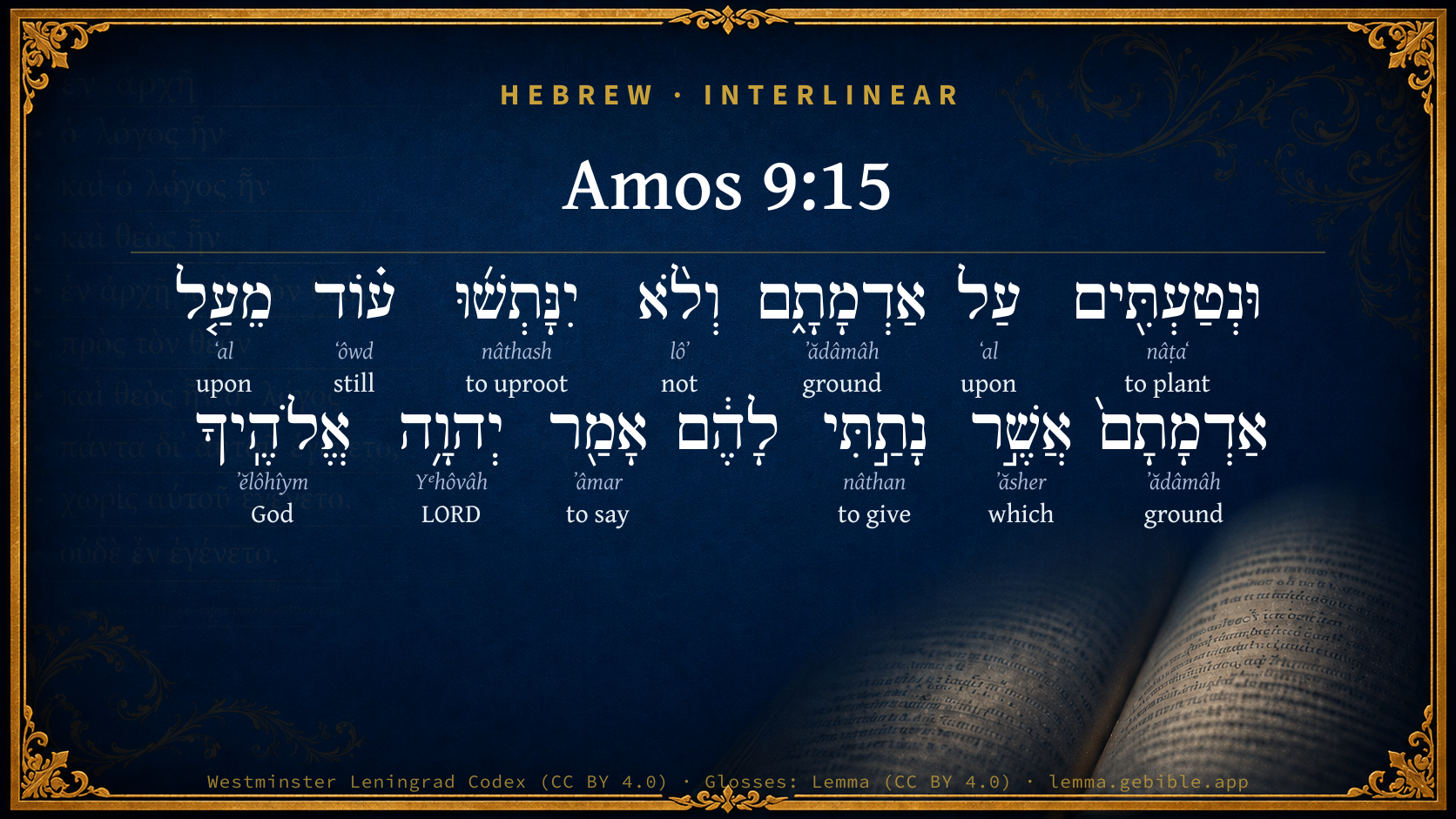
  1. וּנְטַעְתִּ֖ים nâṭaʻ H5193 “and · to plant · them” Conjunction + Verb, Qal, Sequential Perfect, 1st Person, Common, Singular + Suffix, Personal, 3rd Person, Masculine, Plural
  2. עַל ʻal H5921 “upon” Preposition
  3. אַדְמָתָ֑ם ʼădâmâh H127 “ground · their” Noun, Common, Feminine, Singular, Construct + Suffix, Personal, 3rd Person, Masculine, Plural
  4. וְלֹ֨א lôʼ H3808 “and · not” Conjunction + Particle, Negative
  5. ע֗וֹד ʻôwd H5750 “still” Adverb
  6. מֵעַ֤ל ʻal H5921 “from · upon” Preposition + Preposition
  7. אַדְמָתָם֙ ʼădâmâh H127 “ground · their” Noun, Common, Feminine, Singular, Construct + Suffix, Personal, 3rd Person, Masculine, Plural
  8. אֲשֶׁ֣ר ʼăsher H834 “which” Particle, Relative
  9. נָתַ֣תִּי nâthan H5414 “to give” Verb, Qal, Perfect, 1st Person, Common, Singular
  10. אָמַ֖ר ʼâmar H559 “to say” Verb, Qal, Perfect, 3rd Person, Masculine, Singular
  11. יְהוָ֥ה Yᵉhôvâh H3068 “LORD” Noun, Proper
  12. אֱלֹהֶֽיךָ ʼĕlôhîym H430 “God(s) · your” Noun, Common, Masculine, Plural, Construct + Suffix, Personal, 2nd Person, Masculine, Singular

About this verse

These counts appear in no published source. They are computed here, from the morphology-tagged text and Lemma’s own curated glosses. What Lemma adds →

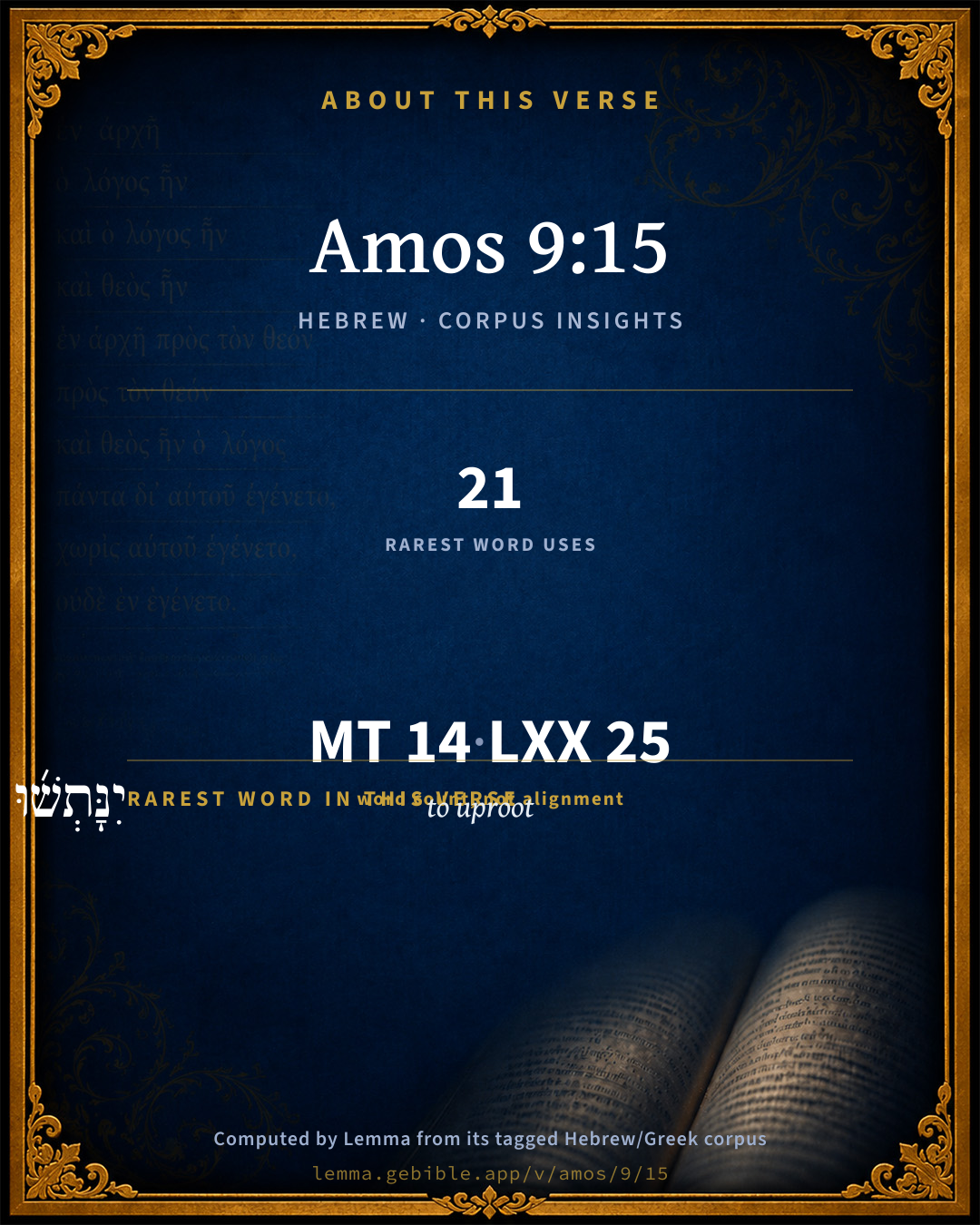
14
words
11
distinct lemmas
Prophets
section

Notable vocabulary

The rarest word here is יִנָּתְשׁ֜וּ to uproot H5428 — appearing just 21 times in the whole Hebrew Bible.

Shared distinctive vocabulary

יִנָּתְשׁ֜וּ to uproot H5428 occurs in 19 verses of the Hebrew Bible. Also found in:

Grammatical profile

  • 4 verbs
  • 4 nouns
  • 3 prepositions
  • 1 adverb
  • 2 particles

Verb forms

  • וּנְטַעְתִּ֖ים Qal · Sequential Perfect
  • יִנָּתְשׁ֜וּ Niphal · Imperfect
  • נָתַ֣תִּי Qal · Perfect
  • אָמַ֖ר Qal · Perfect

Repetition

Words recur within this verse — often emphatic in Hebrew:

  • עַל upon H5921 ×2
  • אַדְמָתָ֑ם ground H127 ×2

Hebrew & Septuagint length

In English translation the verse runs 28 words from the Hebrew and 29 from the Septuagint (LXX English) — closely comparable.

A rough comparison of the two English renderings, which tokenize alike — not a word-level alignment.

Word counts can differ between the Hebrew and the Greek without any difference in meaning — e.g. the Hebrew direct-object marker אֵת has no separate Greek word, and Greek often adds the article ὁ.

In the original languages it is 14 Hebrew tokens and 25 Greek tokens — but the two are counted differently (Hebrew bundles its prefixes and suffixes into one token; the Greek is in lemma form), so that isn’t a like-for-like length.

Cross-references

7

Topical passages linked to Amos 9:15 in the Treasury of Scripture Knowledge — connected by theme and wording, ordered by reader-vote popularity; previews shown in the World English Bible.

  • Jeremiah 24:6 For I will set my eyes on them for good, and I will bring them again to this land: and I will build them, and not pull them down; and I will plant them, and not pluck them up.
  • Ezekiel 37:25 They shall dwell in the land that I have given to Jacob my servant, in which your fathers lived; and they shall dwell therein, they, and their children, and their children's children, forever: and David my servant shall be their prince for ever.
  • Isaiah 60:21 Your people also shall be all righteous; they shall inherit the land forever, the branch of my planting, the work of my hands, that I may be glorified.
  • Ezekiel 34:28 They shall no more be a prey to the nations, neither shall the animals of the earth devour them; but they shall dwell securely, and none shall make them afraid.
  • Joel 3:20 But Judah will be inhabited forever, And Jerusalem from generation to generation.
  • Jeremiah 32:41 Yes, I will rejoice over them to do them good, and I will plant them in this land assuredly with my whole heart and with my whole soul.
  • Micah 4:4 But they will sit every man under his vine and under his fig tree; And no one will make them afraid: For the mouth of Yahweh of Hosts has spoken.

Cross-references courtesy of OpenBible.info (CC BY 4.0).

Hebrew and Greek witnesses Masoretic Hebrew ↔ Greek Septuagint

The same verse in the two great witnesses to the Old Testament, shown verse-for-verse.

These are two independent witnesses, not word-aligned to each other, and the Septuagint is shown in lemma (dictionary) form.

Hebrew Amos 9:15 Masoretic · Westminster Leningrad Codex

וּנְטַעְתִּ֖ים עַל אַדְמָתָ֑ם וְלֹ֨א יִנָּתְשׁ֜וּ ע֗וֹד מֵעַ֤ל אַדְמָתָם֙ אֲשֶׁ֣ר נָתַ֣תִּי לָהֶ֔ם אָמַ֖ר יְהוָ֥ה אֱלֹהֶֽיךָ

I will plant them on their land, And they will no more be plucked up out of their land which I have given them," says Yahweh your God.

World English Bible · Public Domain

Greek LXX Amos 9:15 Septuagint · lemma form

καί καταφυτεύω αὐτός ἐπί ὁ γῆ αὐτός καί οὐ μή ἐκσπάω οὐκέτι ἀπό ὁ γῆ αὐτός ὅς δίδωμι αὐτός λέγω κύριος ὁ θεός ὁ παντοκράτωρ

And I will plant them on their land, and they shall no more be plucked up from the land which I have given them, says the Lord God Almighty.

LXX2012 (modern English Septuagint) · Public Domain

Hebrew: Westminster Leningrad Codex (CC BY 4.0). Greek: Septuagint (public domain); English from LXX2012 (modern English Septuagint) (Public Domain). How the Septuagint differs from the Hebrew →

Targum (Aramaic paraphrase)

1

The Targum is the ancient Jewish Aramaic paraphrase of the Hebrew Scriptures — an interpretive translation, not the Hebrew text itself. Onkelos (literal) and Pseudo-Jonathan (expansive) render the Torah, and Jonathan the Prophets. Coverage is partial: where no permissively-licensed English translation exists for a verse, only the Aramaic is shown. This is verse-level text, not a word-by-word alignment to the Hebrew.

  1. Targum Jonathan Prophets (Joshua–Malachi)
    וַאֲקַיְמִינוּן עַל אַרְעֲהוֹן וְלָא יְטַלְטְלוּן עוֹד מֵעַל אַרְעֲהוֹן דִיהָבִית לְהוֹן אֲמַר יְיָ אֱלָהָךְ:

    (no public-domain English translation for this verse)

    Targum Jonathan — Aramaic: “Mikraot Gedolot” (public domain). English: “Sefaria Community Translation” (CC0 1.0 (public-domain dedication)); “London "Chaldee Paraphrase," 1871” (public domain). Text via Sefaria.

Commentary

Notes on Amos 9:15 from classic Christian and Jewish commentators (each source and its license shown beneath its notes). The classic Christian expositions comment on the surrounding passage and are grouped to its opening verse, so a note may address several verses; the Jewish commentaries on the Tanakh (Rashi and others) are per-verse, so they appear only where the commentator wrote on this verse.

Lemma curates 59 commentaries, every one of them public domain or Creative Commons licensed, each selected and text-cleaned for this edition rather than reprinted as found. About our sources →

Trapp's Complete Commentary

John Trapp

Amo 9:15 And I will plant them upon their land, and they shall no more be pulled up out of their land which I have given them, saith the LORD thy God.

Ver. 15. And I will plant them upon their land] As "trees of righteousness, the planting of the Lord, that he might be glorified," Isa 61:3; Isa 61:11, being well-rooted and no worse fruited, Php 1:6.

And they shall no more be pulled up] None shall pull them out of Christ’s hand; for he and the Father are one, Joh 10:29-30. None shall separate them from the love of God in Christ Jesus, Rom 8:39, they shall be sure of continual supplies of sap and safety, being kept by the power of God through faith unto salvation, 2Pe 1:3. The paradise of God was so planted, that it was watered on all sides with most noble rivers, to keep it flourishing; how much more will the Lord do this in his heavenly garden, the Church! see Psa 92:13-14, when it comes to be transplanted especially.

Saith the Lord thy God] "Thy God," O prophet, who will ratify and verify what promises soever thou hast uttered in his name. Or "thy God," O people, now reconciled unto thee in Christ, Joh 20:17, and therefore ready to heap upon thee all things needful for life and godliness.

John Trapp, A Commentary or Exposition upon All the Books of the Old and New Testament (1647–1656) — public domain. Text from a community e-Sword module.

Jamieson, Fausset & Brown

Robert Jamieson, A. R. Fausset & David Brown

plant them . . . no more be pulled up-- (Jer 32:41).

thy God--Israel's; this is the ground of their restoration, God's original choice of them as His.

Next: Obadiah Introduction

Jamieson, Fausset & Brown — Commentary Critical and Explanatory on the Whole Bible (1871) — public domain (CC PDM 1.0). Text via the HelloAO Bible API.

Adam Clarke's Commentary

Verse 15. I will plant them upon their land] They shall receive a permanent establishment there.

And they shall no more be pulled up] Most certainly this prophecy has never yet been fulfilled. They were pulled out by the Assyrian captivity, and by that of Babylon. Many were planted in again, and again pulled out by the Roman conquest and captivity, and were never since planted in, but are now scattered among all the nations of the earth. I conclude, as the word of God cannot fail, and this has not yet been fulfilled, it therefore follows that it will and must be fulfilled to the fulness of its spirit and intention. And this is established by the conclusion: "Saith the Lord thy God." He is JEHOVAH, and cannot fail; he is THY GOD, and will do it. He can do it, because he is JEHOVAH; and he will do it, because he is THY GOD. Amen.

Adam Clarke's Commentary on the Bible (1810–1826) — public domain. Text from a community e-Sword/MySword module.

John Calvin's Commentaries

The Prophet further mentions here a quiet dwellings in the land, for it was not enough for the people to be restored to their country, except they lived there in safety and quietness; for they might soon afterwards have been removed again. It would have been better for them to pine away in exile, than to be restored for the sake, as it were, of sporting with them, and in a short time to be again conquered by their enemies, and to be led away into another country. Therefore the Prophet says, that the people, when restored, would be in a state of tranquillity.

And he uses a most suitable comparison, when he says, I will plant them in their own land, nor shall they be pulled up any more: for how can we have a settled place to dwell in, except the Lord locates us somewhere? We are indeed as it were flitting beings on the earth, and we may at any moment be tossed here and there as the chaff. We have therefore no settled dwelling, except as far as we are planted by the hand of God, or as far as God assigns to us a certain habitation, and is pleased to make us rest in quietness. This is what the Prophet means by saying, I will plant them in their own land, nor shall they any more be pulled up How so? “Because, he says, I have given to them the land”. He had indeed given it to them before, but he suffered them to be pulled up when they had polluted the land. But now God declares that his grace would outweigh the sins of the people; as though he said, “However unworthy the people are, who dwell in this land, my gift will yet be effectual: for I will not regard what they deserve at my hands, but as I have given them this land, they shall obtain it.” We now apprehend the meaning of the Prophet.

Now, if we look on what afterwards happened, it may appear that this prophecy has never been fulfilled. The Jews indeed returned to their own country, but it was only a small number: and besides, it was so far from being the case, that they ruled over neighboring nations, that they became on the contrary tributaries to them: and further still, the limits of their rule were ever narrow, even when they were able to shake off the yoke. In what sense then has God promised what we have just explained? We see this when we come to Christ; for it will then be evident that nothing has been in vain foretold: though the Jews have not ruled as to the outward appearance, yet the kingdom of God was then propagated among all nations, from the rising to the setting of the sun; and then, as we have said in other places, the Jews reigned.

Further, what is here said of the abundance of corn and wine, must be explained with reference to the nature of Christ’s kingdom. As then the kingdom of Christ is spiritual, it is enough for us, that it abounds in spiritual blessings: and the Jews, whom God reserved for himself as a remnant, were satisfied with this spiritual abundance.

If any one objects and says, that the Prophet does not speak here allegorically; the answer is ready at hand, even this, — that it is a manner of speaking everywhere found in Scripture, that a happy state is painted as it were before our eyes, by setting before us the conveniences of the present life and earthly blessings: this may especially be observed in the Prophets, for they accommodated their style, as we have already stated, to the capacities of a rude and weak people. But as this subject has been discussed elsewhere more at large, I only touch on it now as in passing and lightly. Now follows the Prophecy of Obadiah, who is commonly called Abdiah.

End of the Commentaries on Amos.

John Calvin's Commentaries (1540-1563) — public domain. Text from the Calvin Translation Society English edition (1840s-50s) via the Christian Classics Ethereal Library (ccel.org). Calvin's coverage is partial (roughly two-thirds of the Bible); uncommented books and verses are honest gaps, never fabricated. The 19th-century editor's footnotes and remarks are omitted so the notes are faithfully Calvin's own voice.

The Cambridge Bible for Schools and Colleges

gen. ed. J. J. S. Perowne

15. Israel will moreover remain permanently settled in its own land.

And I will plant them … and they shall no more be pulled up, &c.] Cf. Jer_24:6 (“I will plant them and not pull them up”); Jer_42:10. For similar promises, see Jer_32:41; Eze_34:28; Isa_60:21; Joe_3:20; and elsewhere. On the question of the non-fulfilment of such promises, see Riehm, Messianic Prophecy (ed. 2, 1891), pp. 238–268. It is to be remembered (1) that they are conditional upon Israel’s worthiness; (2) that the question forms part of a larger one, viz. the nature and extent of the ideal element in the prophets’ pictures of the future, and the degree to which those pictures were coloured by the national and local limitations peculiar to their religion. Cf. p. 32 f., above, with the passages referred to in the footnotes; and comp. also F.H. Woods, The Hope of Israel (1896), chaps. 4 5 10.

thy God] the title, expressive of consolation and affection, as Isa_41:10; Isa_52:7; Isa_54:6; Isa_66:9. The restored nation is pictured naturally by the prophet as penitent and reformed (cf. pp. 31 f., 121); hence Jehovah is no longer its foe (Amo_9:4; Amo_9:8), but can acknowledge it again as His own.

The Cambridge Bible for Schools and Colleges (gen. ed. J. J. S. Perowne; Cambridge University Press, 1878–1918) — public domain. Text from a community e-Sword module.

John Gill's Exposition

And I will plant them upon their land,.... The land of Israel, as trees are planted; and they shall take root and flourish, and abound with all good things, temporal and spiritual:

and they shall no more be pulled up out of their land which I have given them, saith the Lord thy God; by which it appears that this is a prophecy of things yet to come; since the Jews, upon their return to their own land after the Babylonish captivity, were pulled up again, and rooted out of it by the Romans, and remain so to this day; but, when they shall return again, they will never more be removed from it; and of this they may he assured; because it is the land the Lord has, "given" them, and it shall not be taken away from them any more; and, because he will now appear to be the "Lord their God", the "loammi", Hos 1:9, will he taken off from them; they will be owned to be the Lords people, and he will be known by them to be their covenant God; which will ensure all the above blessings to them, of whatsoever kind; for this is either said to the prophet, "the Lord thy God", or to Israel; and either way it serves to confirm the same thing.

Next: Obadiah Introduction

John Gill's Exposition of the Whole Bible (1746–1763) — public domain (CC PDM 1.0). Text via the HelloAO Bible API.

Albert Barnes' Notes on the Bible

And I will plant them upon their own land - The promises and threatenings of God are, to individuals, conditional upon their continuing to be of that character, to which God annexes those promises or threats. Theodoret: “The God of all often promises, when those who receive the promises, by joying in iniquity hinder those promises from taking effect. At times also he threatens heavy things, and they who for their offences were the objects of those threats, being, through fear of them, converted, do not in act experience them.” The two tribes received some little shadow of fulfillment of these promises on the return from Babylon. “They were planted in their own land.” The non-fulfillment of the rest, as well as the evident symbolic character of part of it, must have shown them that such fulfillment was the beginning, not the end. Their land was “the Lord’s land;” banishment from it was banishment from the special presence of God, from the place where He manifested Himself, where alone the typical sacrifices, the appointed means of reconciliation, could be offered.

Restoration to their own land was the outward symbol of restoration to God’s favor, of which it was the fruit. it was a condition of the fulfillment of those other promises, the coming of Him in whom the promises were laid up, the Christ. He was not simply to be of David’s seed, according to the flesh. Prophecy, as time went on, declared His birth at Bethlehem, His revelation in Galilee, His coming to His Temple, His sending forth His law from Jerusalem. Without some restoration to their own land, these things could not be. Israel was restored in the flesh, that, after the flesh, the Christ might be born of them, where God foretold that He should be born. But the temporal fulfillment ended with that event in time in which they were to issue, for whose sake they were; His coming. They were but the vestibule to the spiritual. As shadows, they ceased when the Sun arose. As means, they ended, when the end, whereto they served, came.

There was no need of a temporal Zion, when He who was to send forth His law thence, had come and sent it forth. No need of a temple when He who was to be its glory, had come, illumined it, and was gone. No need of one of royal birth in Bethlehem, when “the Virgin” had “conceived and borne a Son,” and “God” had been “with us.” And so as to other prophecies. All which were bound to the land of Judah, were accomplished. As the true Israel expanded and embraced all nations, the whole earth became “the land” of God’s people. Palestine had had its prerogatives, because God manifested Himself there, was worshiped there. When God’s people was enlarged, so as “to inherit the pagan,” and God was worshiped everywhere, His land too was everywhere. His promises accompanied His people, and these were in all lands. His words then, “I will plant them upon their own land, and they shall no more be pulled up out of their land which I have given them,” expanded with their expansion. It is a promise of perpetuity, like that of our Lord; “Lo! I am with you alway, even to the end of the world. The gates of hell shall not prevail against” the Church, the people of God. The world may gnash its teeth; kings may oppress; persecutors may harass; popular rage may trample on her; philosophy may scoff at her; unbelief may deny the promises made to her; the powers of darkness may rage around her; her own children may turn against her. In vain! Jerome: “She may be shaken by persecutions, she cannot be uprooted; she may be tempted, she cannot be overcome. For the Lord God Almighty, the Lord her God, hath promised that He will do it, whose promise is the law to nature.”

Saith the Lord thy God - Rib.: “O Israel of God, O Catholic Church, to be gathered out of Jews and Gentiles, doubt not, he would say, thy promised happiness. For thy God who loveth thee and who from eternity hath chosen thee, hath commanded me to say this to thee in His Name.” Rup.: “He turneth too to the ear of each of us, giving us joy, in His word, ‘saith the Lord thy God.’” “They too who are plants which God hath planted, and who have so profited, that through them many daily profit, “shall be planted upon their own ground,” that is, each, in his order and in that kind of life which he has chosen, shall strike deep roots in true piety, and they shall be so preserved by God, that by no force of temptations shall they be uprooted, but each shall say with the holy prophet, “I am like a green olive tree in the house of God; I trust in the mercy of God forever and ever” Psa 52:9. Not that every tree, planted in the ground of the Church militant, is so firm that it cannot be plucked up, but many there are, which are not plucked up, being protected by the Hand of Almighty God. O blessed that land, where no tree is plucked up, none is injured by any worm, or decays through any age. How many great, fruit-bearing, trees do we see plucked up in this land of calamity and misery! Blessed day, when we shall be there, where we need fear no storm!” Yet this too abideth true; “none shall be plucked up.” Without our own will, neither passions within, nor temptations without, nor the malice or wiles of Satan, can “pluck” us “up.” None can “be plucked up,” who doth not himself loose his hold, whose root is twisted round the Rock, which is Thou, O Blessed Jesus. For Thou hast said, “they shall never perish, neither shall any pluck them out of My Hand” Joh 10:28.

Albert Barnes' Notes on the Bible (1834–1885) — public domain. Text from a community e-Sword/MySword module.

Matthew Poole's English Annotations

I will plant, or settle them, as trees that are well rooted,

upon their land, by ancient gift, and by late restitution to it by the Lord.

They shall no more be pulled up by the violence of their enemies which promise is an implicit condition that they seek, and not forsake the Lord, and was on God’s part with admirable constancy and patience to that sinful nation performed through six hundred years, perhaps the longest time of freedom from captivity they ever knew.

Which I have given, of free gift, without their merit.

Saith the Lord thy God; God, thy God and thy Lord, will do it for his covenant’s sake, therefore surely and fully will he do it.

Matthew Poole's English Annotations on the Holy Bible (1683–1685) — public domain. Text from a community e-Sword/MySword module.

Whedon's Commentary on the Bible

Daniel D. Whedon

15. The enjoyment of these blessings will be forever.

I will plant them — A picture of firm and permanent establishment.

Their land — The promise given to Abraham (Gen_12:7) is transferred to the remnant. Never again will they be disturbed in their possessions.

Thy God — The pronoun is meant emphatically (see on Hos_2:1; Hos_2:23).

The nonfulfillment of the Messianic promises in Amo_9:11-15 (see pp. 209, 210) must be interpreted in the light of what is said at the close of the comments on Mic_4:5; Mic_5:15. On the authorship of Amo_9:8-15, see Introduction, p. 215ff.

Daniel D. Whedon (gen. ed.), Commentary on the Old and New Testaments (1874–1909) — public domain. Text from a community e-Sword module.

The Pulpit Commentary

The blessing shall last forever. They shall no more be pulled up. This was not true of the literal Israel; it must be taken of the spiritual seed, planted in God"s land, the Church of Christ, against which the gates of hell shall not prevail. "Lo," says Christ, "I am with you alway, even unto the end of the world" (Mat_28:20)

The Pulpit Commentary (1880–1919), ed. H.D.M. Spence-Jones & Joseph S. Exell — public domain. Text from a community e-Sword module.

John Wesley's Explanatory Notes

Pulled up - On condition that they seek the Lord. This was on God's part with admirable constancy performed through six hundred years, perhaps the longest time of freedom from captivity they ever knew.

John Wesley, Explanatory Notes Upon the Whole Bible (1754–1765) — public domain. Text via the GEBible commentary corpus.

Lesson kit

Teaching starters — assembled from the data on this page, not authored interpretation. Every prompt links to the verse data it draws on. Edit before teaching.

Amos, in the Prophets, opens this verse with 14 words (11 distinct Hebrew lemmas). Its most distinctive word is nâthash (“to uproot”). A historical commentator’s framing appears above. Read the whole chapter for the surrounding context.

Discussion questions

  1. What does “to uproot” (nâthash) contribute to the verse as a whole?
  2. How does Deuteronomy 29:28, which shares the word «to uproot», read alongside this verse?
  3. What does the repetition of “upon” (2× in this one verse) do in this verse?
  4. These translations render this verse differently. What is at stake in choosing one wording over another?
  5. «וּנְטַעְתִּ֖ים» is a Qal Sequential Perfect verb. How does that grammatical form shape the action described?
  6. Compare how Trapp's Complete Commentary and Jamieson, Fausset & Brown read this verse. Where do they agree or differ?

Things to notice

Reading settings

Reading text

Shown beneath each verse's original-language words.

Old Testament
Old Testament edition

Read the OT as the Masoretic Hebrew (MT) or the Greek Septuagint (LXX).

English shown for the Greek Septuagint (in the Hebrew ↔ Greek comparison).

Comparing translations? Open the Compare panel on any verse page to stack up to four side by side.