
Exodus 26:33

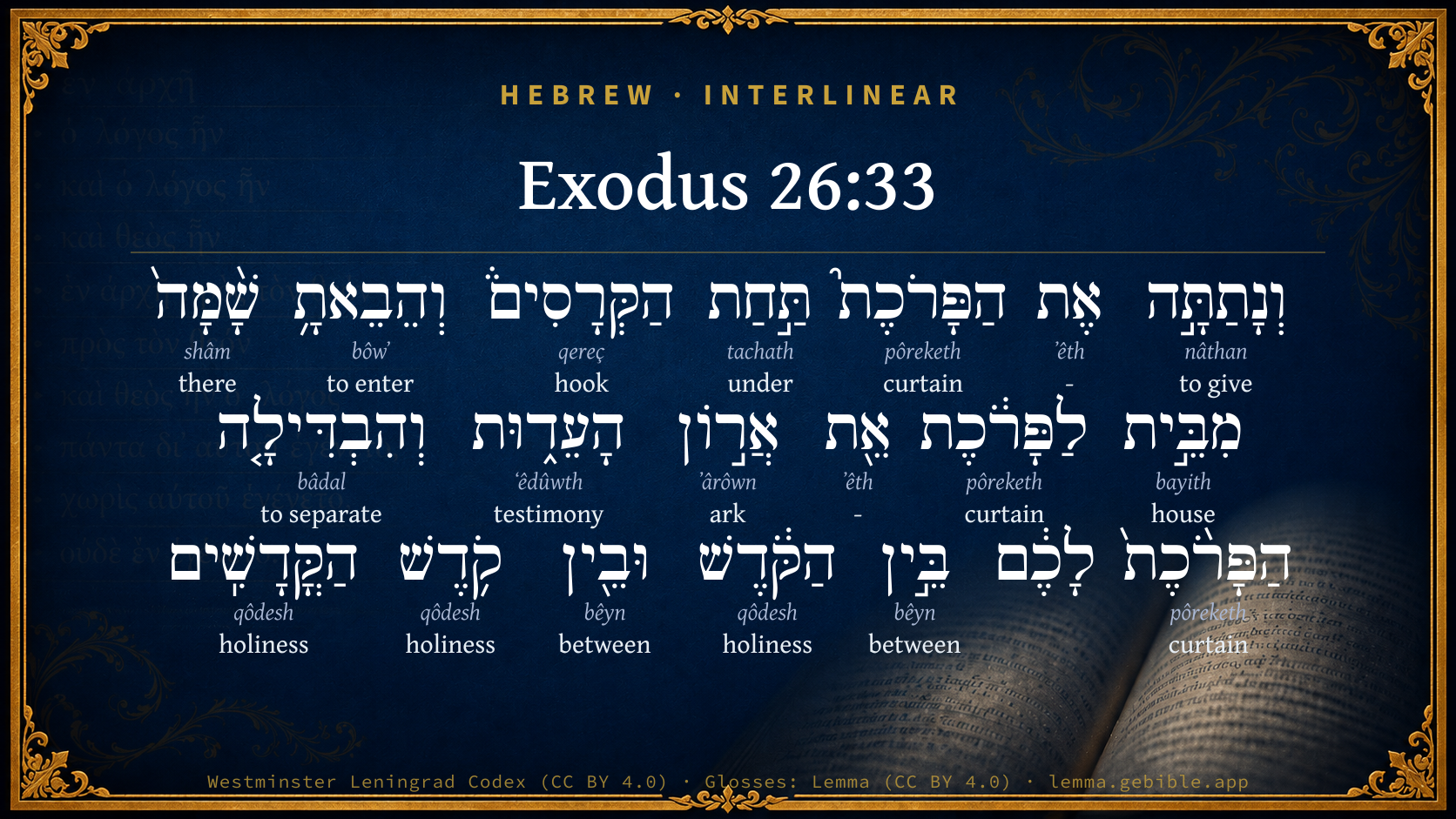
Hebrew (Westminster Leningrad Codex) Exodus 26:33 appears in the Hebrew Old Testament. The text above is from the Westminster Leningrad Codex. Each word links to its Strong’s number, a concise gloss, and parsing drawn from the Open Scriptures Hebrew Bible morphology. Click any word for its full Brown-Driver-Briggs (BDB) entry.
Download image
Cite this verse

Exodus 26:33 (World English Bible). Public Domain. Lemma interlinear Bible study tool, https://lemma.gebible.app/v/exodus/26/33.

Show BibTeX & RIS
BibTeX
RIS
English Translation
You shall hang up the veil under the clasps, and shall bring the ark of the testimony in there within the veil: and the veil shall separate the holy place from the most holy for you.
World English Bible · Public Domain
Download a study sheet

One document with this verse’s original text, its word-by-word gloss line, the meaning frame, cross-references with their text, attributed commentary, and full source and license credits — printable, and it pastes into notes with its structure intact.

This verse Autodidact and up

Study sheet (.html) Plain text (.txt)

A passage Seminary Student

Up to 50 verses in one chapter. A passage sheet keeps up to 6 commentary sources and 12 cross-references per verse, in the order this page ranks them, and says so on the sheet whenever that leaves anything out. Ask for a single verse and you get the Autodidact verse sheet above.

Everything on this page stays free to read, with no account — the sheet is a download of what is already on screen, not access to it.

Want to remove ads? Support Godless Engineer
Compare translations 3

The same verse in 3 English versions, stacked beneath the original-language interlinear above. Click any original word for its lexicon entry.

Each is an independent rendering of the whole verse — the interlinear is not word-aligned to these translations.

Highlighted words mark where these versions differ — a whole-verse word diff, not a word-by-word alignment.

  • World English Bible Public Domain
    You shall hang up the veil under the clasps, and shall bring the ark of the testimony in there within the veil: and the veil shall separate the holy place from the most holy for you.
  • King James Version Public Domain
    And thou shalt hang up the vail under the taches, that thou mayest bring in thither within the vail the ark of the testimony: and the vail shall divide unto you between the holy place and the most holy.
  • unfoldingWord Literal Text CC BY-SA 4.0
    And you shall hang the curtain under the clasps, and you shall bring the Box of the Testimony there inside the curtain. And the curtain shall separate for you between the Holy and the Holy of Holies.

unfoldingWord Literal Text — © unfoldingWord, licensed CC BY-SA 4.0. Word-aligned USFM3 via Door43 (git.door43.org/unfoldingWord/en_ult).

Versions to compare (up to 4)

3 of 4 selected

Show all 18 translations

Every available English version of this verse, each an independent rendering of the whole verse.

  • World English Bible Public Domain
    You shall hang up the veil under the clasps, and shall bring the ark of the testimony in there within the veil: and the veil shall separate the holy place from the most holy for you.
  • Berean Standard Bible Public Domain
    And hang the veil from the clasps and place the ark of the Testimony behind the veil. So the veil will separate the Holy Place from the Most Holy Place.
  • Majority Standard Bible Public Domain
    And hang the veil from the clasps and place the ark of the Testimony behind the veil. So the veil will separate the Holy Place from the Most Holy Place.
  • King James Version Public Domain
    And thou shalt hang up the vail under the taches, that thou mayest bring in thither within the vail the ark of the testimony: and the vail shall divide unto you between the holy place and the most holy.
  • American Standard Version (1901) Public Domain
    And thou shalt hang up the veil under the clasps, and shalt bring in thither within the veil the ark of the testimony: and the veil shall separate unto you between the holy place and the most holy.
  • Revised Version (1885) Public Domain
    And thou shalt hang up the veil under the clasps, and shalt bring in thither within the veil the ark of the testimony: and the veil shall divide unto you between the holy place and the most holy.
  • Geneva Bible (1599) Public Domain
    Afterward thou shalt hang the vaile on the hookes, that thou mayest bring in thither, that is (within the vaile) the arke of the Testimonie: and the vaile shall make you a separation betweene the Holy place and the most holy place.
  • Douay-Rheims (1899) Public Domain
    And the veils shall be hanged on with rings, and within it thou shalt put the ark of the testimony, and the sanctuary, and the holy of holies shall be divided with it.
  • Young's Literal Translation Public Domain
    `And thou hast put the vail under the hooks, and hast brought in thither within the vail the ark of the testimony; and the vail hath made a separation for you between the holy and the holy of holies.
  • Literal Standard Version CC BY-SA 4.0
    And you have put the veil under the hooks, and have brought in the Ark of the Testimony there within the veil; and the veil has made a separation for you between the holy and the Holy of Holies.
  • Unlocked Literal Bible CC BY-SA 4.0
    You must hang up the curtain under the clasps, and you must bring in the ark of the testimony. The curtain is to separate the holy place from the most holy place.
  • unfoldingWord Literal Text CC BY-SA 4.0
    And you shall hang the curtain under the clasps, and you shall bring the Box of the Testimony there inside the curtain. And the curtain shall separate for you between the Holy and the Holy of Holies.
  • Darby Bible Public Domain
    And thou shalt bring the veil under the clasps, and bring in thither, inside the veil, the ark of the testimony; and the curtain shall make a division to you between the holy [place] and the holiest of all.
  • World Messianic Bible Public Domain
    You shall hang up the veil under the clasps, and shall bring the ark of the covenant in there within the veil. The veil shall separate the holy place from the most holy for you.
  • Webster's Bible Public Domain
    And thou shalt hang the vail under the buttons, that thou mayst bring in thither within the vail the ark of the testimony: and the vail shall divide to you between the holy place and the most holy.
  • Free Bible Version CC BY-SA 4.0
    Place the veil under the clips and take the Ark of the Testimony inside behind the veil. The veil will separate the Holy Place from the Most Holy Place.
  • Bible in Basic English Public Domain
    And you are to put up the veil under the hooks, and put inside it the ark of the law: the veil is to be a division between the holy place and the most holy.
  • JPS Tanakh (1917) Public Domain
    And thou shalt hang up the veil under the clasps, and shalt bring in thither within the veil the ark of the testimony; and the veil shall divide unto you between the holy place and the most holy.

Literal Standard Version (2020), Covenant Press — licensed CC BY-SA 4.0. Text via the HelloAO Bible API (eBible.org). Unlocked Literal Bible (unfoldingWord) — licensed CC BY-SA 4.0. Text via the HelloAO Bible API (eBible.org). unfoldingWord Literal Text — © unfoldingWord, licensed CC BY-SA 4.0. Word-aligned USFM3 via Door43 (git.door43.org/unfoldingWord/en_ult). Free Bible Version, Dr. Jonathan Gallagher — licensed CC BY-SA 4.0. Text via the HelloAO Bible API (eBible.org).

Word by word

More ways to search: Search by grammar → Find every occurrence → Compare this word →

Practice this passage: Drill this verse → Learn its vocabulary →

הַקְּרָסִים֒
qereç
H7165
“the · hooks”
Particle, Definite Article + Noun, Common, Masculine, Plural, Absolute
Part of Speech
Particle + Noun
Type
Common
Gender
Masculine
Number
Plural
State
Absolute
Full BDB Definition

Origin: from H7164

TWOT: 2073a

hook
  1. וְנָתַתָּ֣ה nâthan H5414 “and · to give” Conjunction + Verb, Qal, Sequential Perfect, 2nd Person, Masculine, Singular
  2. אֶת ʼêth H853 “-” Particle, Direct Object
  3. הַפָּרֹכֶת֮ pôreketh H6532 “the · curtain” Particle, Definite Article + Noun, Common, Feminine, Singular, Absolute
  4. תַּ֣חַת tachath H8478 “under” Preposition
  5. וְהֵבֵאתָ֥ bôwʼ H935 “and · to enter” Conjunction + Verb, Hiphil, Sequential Perfect, 2nd Person, Masculine, Singular
  6. שָׁ֨מָּה֙ shâm H8033 “there · toward” Adverb + Suffix, Demonstrative
  7. מִבֵּ֣ית bayith H1004 “from · house of” Preposition + Noun, Common, Masculine, Singular, Construct
  8. לַפָּרֹ֔כֶת pôreketh H6532 “to/for the · curtain” Preposition, Determined + Noun, Common, Feminine, Singular, Absolute
  9. אֵ֖ת ʼêth H853 “-” Particle, Direct Object
  10. אֲר֣וֹן ʼârôwn H727 “ark of” Noun, Common, Both, Singular, Construct
  11. הָעֵד֑וּת ʻêdûwth H5715 “the · testimony” Particle, Definite Article + Noun, Common, Feminine, Singular, Absolute
  12. וְהִבְדִּילָ֤ה bâdal H914 “and · to separate” Conjunction + Verb, Hiphil, Sequential Perfect, 3rd Person, Feminine, Singular
  13. הַפָּרֹ֨כֶת֙ pôreketh H6532 “the · curtain” Particle, Definite Article + Noun, Common, Feminine, Singular, Absolute
  14. בֵּ֣ין bêyn H996 “between” Preposition
  15. הַקֹּ֔דֶשׁ qôdesh H6944 “the · holiness” Particle, Definite Article + Noun, Common, Masculine, Singular, Absolute
  16. וּבֵ֖ין bêyn H996 “and · between” Conjunction + Preposition
  17. קֹ֥דֶשׁ qôdesh H6944 “holiness of” Noun, Common, Masculine, Singular, Construct
  18. הַקֳּדָשִֽׁים qôdesh H6944 “the · holy things” Particle, Definite Article + Noun, Common, Masculine, Plural, Absolute

About this verse

These counts appear in no published source. They are computed here, from the morphology-tagged text and Lemma’s own curated glosses. What Lemma adds →

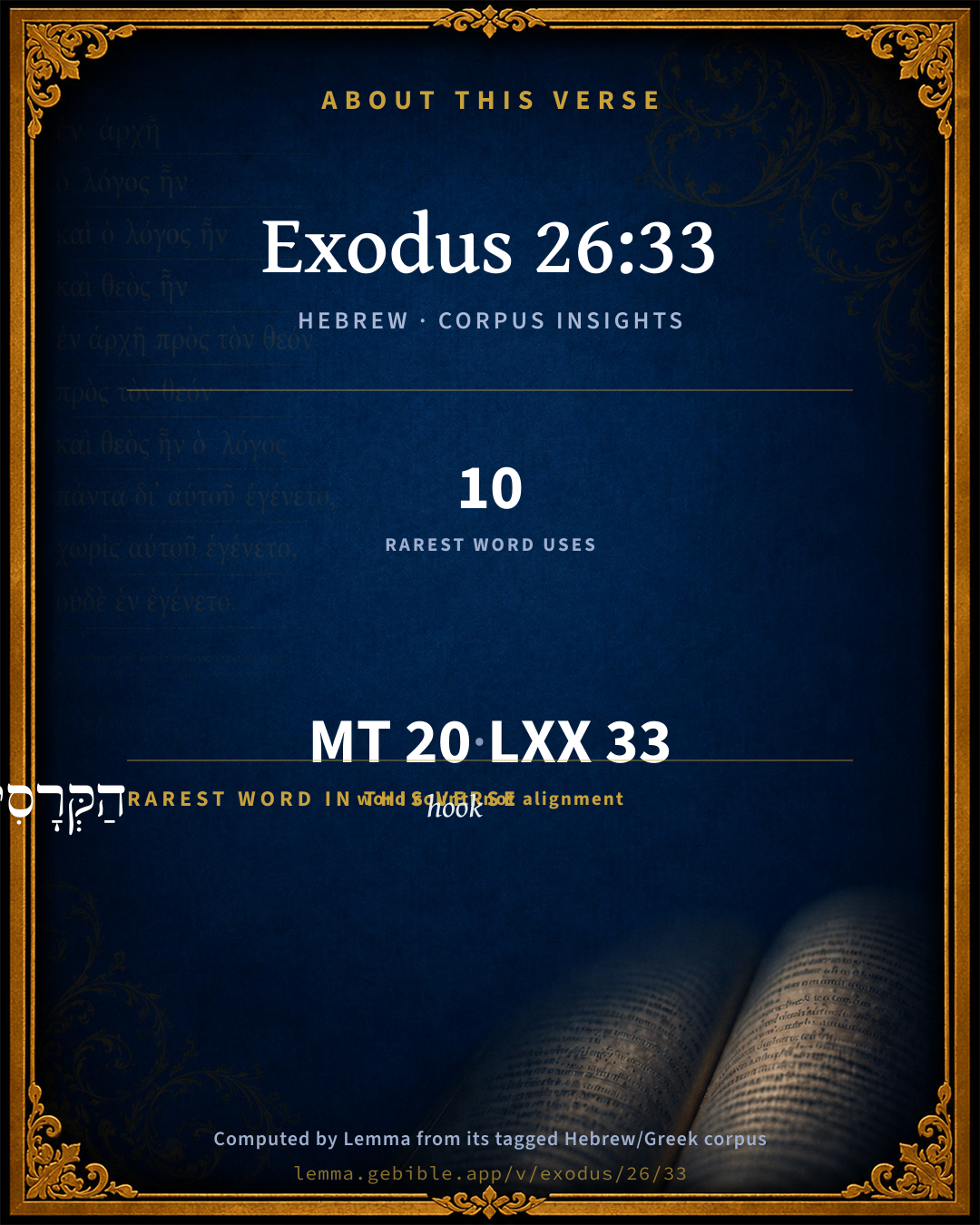
20
words
13
distinct lemmas
Pentateuch
section

Notable vocabulary

The rarest word here is הַקְּרָסִים֒ hook H7165 — appearing just 10 times in the whole Hebrew Bible.

Shared distinctive vocabulary

הַקְּרָסִים֒ hook H7165 occurs in 7 verses of the Hebrew Bible. Also found in:

Grammatical profile

  • 3 verbs
  • 10 nouns
  • 4 prepositions
  • 1 adverb
  • 2 particles

Verb forms

  • וְנָתַתָּ֣ה Qal · Sequential Perfect
  • וְהֵבֵאתָ֥ Hiphil · Sequential Perfect
  • וְהִבְדִּילָ֤ה Hiphil · Sequential Perfect

Repetition

Words recur within this verse — often emphatic in Hebrew:

  • הַפָּרֹכֶת֮ curtain H6532 ×3
  • הַקֹּ֔דֶשׁ holiness H6944 ×3
  • בֵּ֣ין between H996 ×2

Hebrew & Septuagint length

In English translation the verse runs 36 words from the Hebrew and 40 from the Septuagint (LXX English) — closely comparable.

A rough comparison of the two English renderings, which tokenize alike — not a word-level alignment.

Word counts can differ between the Hebrew and the Greek without any difference in meaning — e.g. the Hebrew direct-object marker אֵת has no separate Greek word, and Greek often adds the article ὁ.

In the original languages it is 20 Hebrew tokens and 33 Greek tokens — but the two are counted differently (Hebrew bundles its prefixes and suffixes into one token; the Greek is in lemma form), so that isn’t a like-for-like length.

Cross-references

10

Topical passages linked to Exodus 26:33 in the Treasury of Scripture Knowledge — connected by theme and wording, ordered by reader-vote popularity; previews shown in the World English Bible.

  • Exodus 40:21 He brought the ark into the tent, and set up the veil of the screen, and screened the ark of the testimony, as Yahweh commanded Moses.
  • Leviticus 16:2 and Yahweh said to Moses, "Tell Aaron your brother, not to come at all times into the Most Holy Place within the veil, before the mercy seat which is on the ark; lest he die: for I will appear in the cloud on the mercy seat.
  • Hebrews 9:2–3 For there was a tabernacle prepared. In the first part were the lampstand, the table, and the show bread; which is called the Holy Place.
  • Exodus 25:16 You shall put the testimony which I shall give you into the ark.
  • Genesis 9:4–5 But flesh with the life of it, the blood of it, you shall not eat.
  • Exodus 27:10 and the pillars of it shall be twenty, and their sockets twenty, of brass; the hooks of the pillars and their fillets shall be of silver.
  • Exodus 36:36 He made four pillars of acacia for it, and overlaid them with gold. Their hooks were of gold. He cast four sockets of silver for them.
  • 1 Kings 8:6 The priests brought in the ark of the covenant of Yahweh to its place, into the oracle of the house, to the most holy place, even under the wings of the cherubim.
  • 1 Kings 8:10 It came to pass, when the priests were come out of the holy place, that the cloud filled the house of Yahweh,
  • 2 Chronicles 5:7–10 The priests brought in the ark of the covenant of Yahweh to its place, into the oracle of the house, to the most holy place, even under the wings of the cherubim.

Cross-references courtesy of OpenBible.info (CC BY 4.0).

Hebrew and Greek witnesses Masoretic Hebrew ↔ Greek Septuagint

The same verse in the two great witnesses to the Old Testament, shown verse-for-verse.

These are two independent witnesses, not word-aligned to each other, and the Septuagint is shown in lemma (dictionary) form.

Hebrew Exodus 26:33 Masoretic · Westminster Leningrad Codex

וְנָתַתָּ֣ה אֶת הַפָּרֹכֶת֮ תַּ֣חַת הַקְּרָסִים֒ וְהֵבֵאתָ֥ שָׁ֨מָּה֙ מִבֵּ֣ית לַפָּרֹ֔כֶת אֵ֖ת אֲר֣וֹן הָעֵד֑וּת וְהִבְדִּילָ֤ה הַפָּרֹ֨כֶת֙ לָכֶ֔ם בֵּ֣ין הַקֹּ֔דֶשׁ וּבֵ֖ין קֹ֥דֶשׁ הַקֳּדָשִֽׁים

You shall hang up the veil under the clasps, and shall bring the ark of the testimony in there within the veil: and the veil shall separate the holy place from the most holy for you.

World English Bible · Public Domain

Greek LXX Exodus 26:33 Septuagint · lemma form

καί τίθημι ὁ καταπέτασμα ἐπί ὁ στῦλος καί εἰςφέρω ἐκεῖ ἐσώτερον ὁ καταπέτασμα ὁ κιβωτός ὁ μαρτύριον καί διαὁρίζω ὁ καταπέτασμα σύ ἀνά μέσος ὁ ἅγιος καί ἀνά μέσος ὁ ἅγιος ὁ ἅγιος

And you shall put the veil on the posts, and you shall carry in there within the veil the ark of the testimony; and the veil shall make a separation for you between the holy and the holy of holies.

LXX2012 (modern English Septuagint) · Public Domain

Hebrew: Westminster Leningrad Codex (CC BY 4.0). Greek: Septuagint (public domain); English from LXX2012 (modern English Septuagint) (Public Domain). How the Septuagint differs from the Hebrew →

Targum (Aramaic paraphrase)

2

The Targum is the ancient Jewish Aramaic paraphrase of the Hebrew Scriptures — an interpretive translation, not the Hebrew text itself. Onkelos (literal) and Pseudo-Jonathan (expansive) render the Torah, and Jonathan the Prophets. Coverage is partial: where no permissively-licensed English translation exists for a verse, only the Aramaic is shown. This is verse-level text, not a word-by-word alignment to the Hebrew.

  1. Targum Onkelos Torah (Genesis–Deuteronomy)
    וְתִתֵּן יָת פָּרֻכְתָּא תְּחוֹת פּוּרְפַיָא וְתָעֵיל תַּמָן מִגָּו לְפָרֻכְתָּא יָת אֲרוֹנָא דְסַהֲדוּתָא וְתַפְרֵשׁ פָּרֻכְתָּא לְכוֹן בֵּין קוּדְשָׁא וּבֵין קֹדֶשׁ קוּדְשַׁיָא:

    (no public-domain English translation for this verse)

    Targum Onkelos — Aramaic: “Onkelos Genesis” (public domain); “Onkelos Exodus” (public domain); “Onkelos Leviticus” (public domain); “Onkelos Numbers” (public domain); “Onkelos Deuteronomy” (public domain). English: “Sefaria Community Translation” (CC0 1.0 (public-domain dedication)); “J.W. Etheridge. The Targums of Onkelos and Jonathan Ben Uzziel on the Pentateuch. London: Longmans, Green, 1862” (public domain). Text via Sefaria.

  2. Targum Pseudo-Jonathan Torah (Genesis–Deuteronomy)
    וְתִתֵּן יַת פַּרְגוֹדָא תְּחוֹת פּוּרְפַּיָא וְתֵיעוֹל לְתַמָּן מִלְגֵיו לְפַרְגוֹדָא יַת אֲרוֹנָא דְסַהֲדוּתָא וְתַפְרֵישׁ פַּרְגוֹדָא לְכוֹן בֵּינֵי קוּדְשָׁא וּבֵינֵי קוֹדֶשׁ קוּדְשָׁא

    And thou shalt place the veil under the taches, and bring in thither within the veil the ark of the testament: and thou shalt spread the veil for you between the Holy and the Holy of Holies.

    Targum Pseudo-Jonathan — Aramaic: “Targum Jonathan on Genesis” (public domain); “Targum Jonathan on Exodus” (public domain); “Targum Jonathan on Leviticus” (public domain); “Targum Jonathan on Numbers” (public domain); “Targum Jonathan on Deuteronomy” (public domain). English: “The Targum of Jonathan ben Uzziel, trans. J. W. Etheridge, London, 1862” (public domain). Text via Sefaria.

Commentary

Notes on Exodus 26:33 from classic Christian and Jewish commentators (each source and its license shown beneath its notes). The classic Christian expositions comment on the surrounding passage and are grouped to its opening verse, so a note may address several verses; the Jewish commentaries on the Tanakh (Rashi and others) are per-verse, so they appear only where the commentator wrote on this verse.

Lemma curates 59 commentaries, every one of them public domain or Creative Commons licensed, each selected and text-cleaned for this edition rather than reprinted as found. About our sources →

Tyndale Open Study Notes

Tyndale Open Resources

26:33 The Most Holy Place was the earthly dwelling of the Lord. It contained the Ark of the Covenant, from which the Lord would give his commands for the people of Israel (25:22). The Most Holy Place was approximately 15 feet wide, 15 feet deep, and 15 feet high.

Tyndale Open Study Notes — © Tyndale Open Resources, licensed CC BY-SA 4.0. Text via the HelloAO Bible API.

Geneva Bible (1599)

Geneva Bible translators

Whereinto the high Priest only entered once a year.

Hebrew, Under the hooks: meaning that it should hang downward from the hooks.

Geneva Bible (1599) marginal notes — public domain. Text via Bolls.life.

Ellicott's Commentary for English Readers

(33) Thou shall hang up the vail under the taches.—The “taches” meant are the links whereby the two portions of the inner covering were connected together (Exo_26:6). If “under the taches” means directly under them, we must regard the mishkân as divided into two chambers of equal size. It is possible, however, that “under” may be used with some vagueness, and that the “Holy of Holies” may in the tabernacle, as well as in the Temple, have been only half the size of the outer chamber.

That thou mayest bring in.—Heb., and thou shalt bring in.

A Bible Commentary for English Readers, edited by Charles John Ellicott (1878–1897) — public domain. Text from a community e-Sword module.

The Cambridge Bible for Schools and Colleges

gen. ed. J. J. S. Perowne

33. under the clasps] the clasps mentioned in v. 6, which must have been (vv. 2, 3) at a distance of 5 × 4 (= 20) cubits from the front of the Dwelling, and (as the Dwelling Isaiah 30 cubits long) 10 cubits from its back. The Holy place is thus 20 cubits long, and the Most Holy place 10 cubits; as the latter is also Exodus 10 cubits high and 10 cubits wide, it forms a cube. The length and breadth of the Dwelling are exactly half those of Solomon’s Temple (60 × 20 cubits): the Holy of holies is also half the height of that in the Temple (20 × 20 × 20 cubits), but the Holy place is only a third as high as that in the Temple (40 × 20 × 30 cubits): see 1Ki_6:2; 1Ki_6:16-17; 1Ki_6:20 [for ‘oracle,’ read hindmost part, or shrine, and for ‘temple,’ Heb. hêkâl, read hall; see p. 259].

The Cambridge Bible for Schools and Colleges (gen. ed. J. J. S. Perowne; Cambridge University Press, 1878–1918) — public domain. Text from a community e-Sword module.

John Gill's Exposition

And thou shalt make an hanging for the door of the tent,.... At the east end of the tabernacle, which lay open and exposed, and for which as yet there was no provision; the west end of it, where stood the holy of holies, was enclosed with six boards, and two corner ones, Exo 26:22 and the linen curtains hung down there to the silver bases, and so did the curtains of goats' hair, even to the ground, and half a curtain to spare, see Exo 26:12 but for the east end, or entrance into the tabernacle, there was nothing till now ordered, only the sixth curtain of the goats' hair curtains was there turned up double, Exo 26:9, but now here an "hanging" is ordered, or rather a "covering" (z), as the word signifies; Jarchi calls it a vail; and this was instead of a door to the tabernacle, and divided the holy place, into which only the priests might enter, from the place where the people stood and worshipped: and this also was made

of blue, and purple, and scarlet, and fine twined linen; as was the vail between the holy and the holy of holies; only with this difference, this was

wrought with needle work, and that was of "cunning work": the difference between these two, "Rokem" and "Chosheb", was, as Ben Melech from the Misnah relates, that "Rokem" is the work of a needle, and therefore but one face or figure is seen, that is, it is only seen on one side; but "Chosheb" is the work of a weaver, and therefore two faces or figures are seen, that is, they are seen on both sides; and with this account Maimonides agrees; see Gill on Exo 26:1, besides this hanging, Josephus (a) tells us there was another of linen, of the same size with this, and which covered it, and preserved it from the weather, and which on festival days was turned back, that the people might have a prospect of the other; just as there were curtains of goats' hair to preserve the linen ones.

(z) "operimentum", Montanus; "tegumentum", Junius & Tremellius, Piscator; "velum", Tigurine version, Drusius. (a) Antiqu. l. 3. c. 6. sect. 4.

John Gill's Exposition of the Whole Bible (1746–1763) — public domain (CC PDM 1.0). Text via the HelloAO Bible API.

Haydock's Catholic Bible Commentary

The sanctuary, &c. That part of the tabernacle, which was without the veil, into which the priests daily entered, is here called the sanctuary, or holy place; that part which was within the veil, into which no one but the high priest ever went in, and he but once a year, is called the holy of holies, (literally, the sanctuaries of the sanctuary,) as being the most holy of all holy places. (Challoner) --- It occupied only one-third of the tabernacle. (Menochius)

George Leo Haydock (1774–1849), Haydock's Catholic Family Bible and Commentary, 1859 edition — public domain. Excludes Psalms (Douay-Rheims chapter numbering differs from Protestant) and Deuterocanonical books (Catholic canon only).

Matthew Poole's English Annotations

Under the taches, or, in the place (as the Hebrew tacheth oft signifies) of the taches, to wit, where the two curtains are joined together by taches, Exo 26:6.

Matthew Poole's English Annotations on the Holy Bible (1683–1685) — public domain. Text from a community e-Sword/MySword module.

Whedon's Commentary on the Bible

Daniel D. Whedon

33. Hang up the vail under the taches — What taches are here meant? The only use of this word has been to describe the gold and brass hooks which were to couple the tabernacle and tent curtains. Exo_26:6; Exo_26:11. If these are referred to, the gold taches of Exo_26:6 would be most naturally understood, and the vail that separated the two holy places would have hung directly under the coupling of the great tabernacle-cloth. This again would indicate that the sanctuary was divided into two rooms of equal size, which appears to be contrary to all tradition. There seems, however, no insuperable objection to making these taches identical with the hooks mentioned in the preceding verse. There is nothing in the immediate context to suggest the taches of the tabernacle curtain, mentioned Exo_26:6; so that, if they were intended, there should have been added here some qualifying word. In the absence of such word the most natural reference seems to be to the hooks (ווים) just mentioned. The innermost room formed by this dividing vail was the appointed place for the ark of the testimony, (see Exo_25:10-22, notes,) and was known as the most holy, or, more literally, the holy of holies. Like “the oracle,” the corresponding apartment in the temple, it has been commonly supposed to have been in the form of a perfect cube, (see 1Ki_6:20, note,) and this is believed to have prompted the description of “the holy Jerusalem” in Rev_21:16.

Daniel D. Whedon (gen. ed.), Commentary on the Old and New Testaments (1874–1909) — public domain. Text from a community e-Sword module.

The Pulpit Commentary

Thou shalt hang up the veil under the taches. If the "taches" of ver. 6 or even of ver. 11, are intended, and" under" is to be taken strictly as" immediately under," the mishkan must have been divided by the veil into two equal, or very nearly equal parts; and the tabernacle must in an important particular have completely differed from the temple. In the temple the holy place was twice the length of the holy of holies. (1Ki_6:16, 1Ki_6:17) It is possible that "under "may be used vaguely, or that the "taches" of this verse are the "hooks" of ver. 32. That thou mayest bring in. Rather, "And thou shalt bring in." The clause is directive. The most holy. Literally, "the holy of holies the inner chamber, that within the veil, which constituted the adytum, or innermost recess of the tabernacle. The ark and the mercy-seat were the special furniture of this inner sanctuary. To these is added later (Exo_30:1-10) the altar of incense.

The Pulpit Commentary (1880–1919), ed. H.D.M. Spence-Jones & Joseph S. Exell — public domain. Text from a community e-Sword module.

Keil & Delitzsch

C. F. Keil & F. Delitzsch

"Thither (where the curtain hands under the loops) within the curtain shalt thou bring the ark of testimony (Exo 25:16-22), and the curtain shall divide unto you between the holy place and the most holy" (הקּדשׁים קדשׁ the holy of holies). The inner compartment was made into the most holy place through the ark of the covenant with the throne of grace upon it.

Keil & Delitzsch — Biblical Commentary on the Old Testament (1861–1891) — public domain (CC PDM 1.0). Text via the HelloAO Bible API. (Old Testament only.)

Ramban (Nachmanides)

Rabbi Moshe ben Nachman (Ramban / Nachmanides)

AND THOU SHALT BRING IN THITHER WITHIN THE VEIL THE ARK OF THE TESTIMONY. He did not now command Moses to do it in this particular order, to hang up the veil under the clasps and only afterwards to bring in the ark inside the veil, for the commandment now does not refer to the erection of the Tabernacle but to the making thereof. Similarly, And thou shalt put the ark-cover upon the ark of the Testimony in the most holy place, does not mean that he is to put the ark-cover upon the ark of the Testimony when the ark has already been brought into the Holy of Holies [screened by the veil]. (further 40:3), and then thou shalt screan the ark with the veil (ibid.). It is so explained in the Tur based upon Ramban’s words further on. But the purport of the verse is to command Moses to hang up the veil under the clasps in order that the ark be there within the veil, and the veil will thus divide between the holy place and the most holy. Similarly He says, And thou shalt put the ark-cover upon the ark of the Testimony in the most holy place, in order to inform us that the ark-cover with its cherubim on the ark should all be there in the Holy of Holies mentioned, which means within the veil. But when He came to command the erection of the Tabernacle He said, And thou shalt put therein the ark of the Testimony, and afterwards, thou shalt screen the ark with the veil. Similarly, at the actual construction it is said, and he put the ark-cover above the ark. And he brought the ark into the Tabernacle, and afterwards, he set up the veil of the screen., 20-21.Tetzaveh

Ramban (Nachmanides) on the Tanakh — English translation: “Commentary on the Torah by Ramban (Nachmanides). Translated and annotated by Charles B. Chavel. New York, Shilo Pub. House, 1971-1976” (CC BY 4.0). Text via Sefaria.

Lesson kit

Teaching starters — assembled from the data on this page, not authored interpretation. Every prompt links to the verse data it draws on. Edit before teaching.

Exodus, in the Pentateuch, opens this verse with 20 words (13 distinct Hebrew lemmas). Its most distinctive word is qereç (“hook”). A historical commentator’s framing appears above. Read the whole chapter for the surrounding context.

Discussion questions

  1. What does “hook” (qereç) contribute to the verse as a whole?
  2. Exodus 26:6 shares the word «hook» with this verse. How do the two illuminate each other?
  3. “curtain” occurs 3× in this one verse. What is the effect of the repetition?
  4. These translations render this verse differently. What is at stake in choosing one wording over another?
  5. The verb «וְנָתַתָּ֣ה» is Qal Sequential Perfect. How does its form color the action?
  6. Reading how Tyndale Open Study Notes and Geneva Bible (1599) read this verse, where do the two commentators agree and where do they part?

Things to notice

Reading settings

Reading text

Shown beneath each verse's original-language words.

Old Testament
Old Testament edition

Read the OT as the Masoretic Hebrew (MT) or the Greek Septuagint (LXX).

English shown for the Greek Septuagint (in the Hebrew ↔ Greek comparison).

Comparing translations? Open the Compare panel on any verse page to stack up to four side by side.