Exodus 10:25

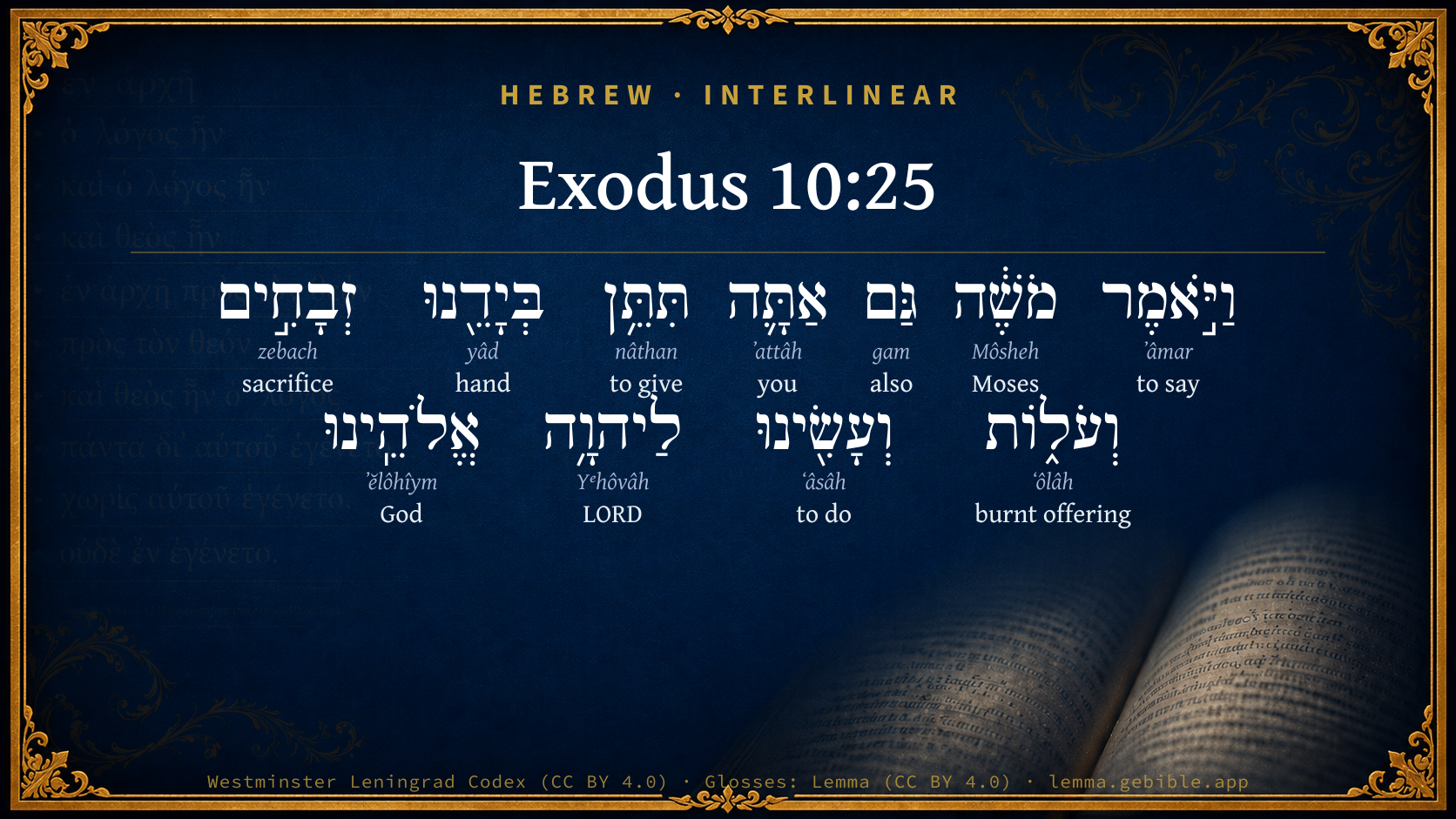
Hebrew (Westminster Leningrad Codex) Exodus 10:25 appears in the Hebrew Old Testament. The text above is from the Westminster Leningrad Codex. Each word links to its Strong’s number, a concise gloss, and parsing drawn from the Open Scriptures Hebrew Bible morphology. Click any word for its full Brown-Driver-Briggs (BDB) entry.
Download image
Cite this verse

Exodus 10:25 (World English Bible). Public Domain. Lemma interlinear Bible study tool, https://lemma.gebible.app/v/exodus/10/25.

Show BibTeX & RIS
BibTeX
RIS
English Translation
Moses said, "You must also give into our hand sacrifices and burnt-offerings, that we may sacrifice to Yahweh our God.
World English Bible · Public Domain
Download a study sheet

One document with this verse’s original text, its word-by-word gloss line, the meaning frame, cross-references with their text, attributed commentary, and full source and license credits — printable, and it pastes into notes with its structure intact.

This verse Autodidact and up

Study sheet (.html) Plain text (.txt)

A passage Seminary Student

Up to 50 verses in one chapter. A passage sheet keeps up to 6 commentary sources and 12 cross-references per verse, in the order this page ranks them, and says so on the sheet whenever that leaves anything out. Ask for a single verse and you get the Autodidact verse sheet above.

Everything on this page stays free to read, with no account — the sheet is a download of what is already on screen, not access to it.

Want to remove ads? Support Godless Engineer
Compare translations 3

The same verse in 3 English versions, stacked beneath the original-language interlinear above. Click any original word for its lexicon entry.

Each is an independent rendering of the whole verse — the interlinear is not word-aligned to these translations.

Highlighted words mark where these versions differ — a whole-verse word diff, not a word-by-word alignment.

  • World English Bible Public Domain
    Moses said, "You must also give into our hand sacrifices and burnt-offerings, that we may sacrifice to Yahweh our God.
  • King James Version Public Domain
    And Moses said, Thou must give us also sacrifices and burnt offerings, that we may sacrifice unto the LORD our God.
  • unfoldingWord Literal Text CC BY-SA 4.0
    And Moses said, “Also you, you must give in our hands sacrifices and burnt offerings, and we will do to Yahweh our God.

unfoldingWord Literal Text — © unfoldingWord, licensed CC BY-SA 4.0. Word-aligned USFM3 via Door43 (git.door43.org/unfoldingWord/en_ult).

Versions to compare (up to 4)

3 of 4 selected

Show all 18 translations

Every available English version of this verse, each an independent rendering of the whole verse.

  • World English Bible Public Domain
    Moses said, "You must also give into our hand sacrifices and burnt-offerings, that we may sacrifice to Yahweh our God.
  • Berean Standard Bible Public Domain
    But Moses replied, “You must also provide us with sacrifices and burnt offerings to present to the LORD our God.
  • Majority Standard Bible Public Domain
    But Moses replied, “You must also provide us with sacrifices and burnt offerings to present to the LORD our God.
  • King James Version Public Domain
    And Moses said, Thou must give us also sacrifices and burnt offerings, that we may sacrifice unto the LORD our God.
  • American Standard Version (1901) Public Domain
    And Moses said, Thou must also give into our hand sacrifices and burnt-offerings, that we may sacrifice unto Jehovah our God.
  • Revised Version (1885) Public Domain
    And Moses said, Thou must also give into our hand sacrifices and burnt offerings, that we may sacrifice unto the LORD our God.
  • Geneva Bible (1599) Public Domain
    And Moses sayd, Thou must giue vs also sacrifices, and burnt offrings that wee may doe sacrifice vnto the Lord our God.
  • Douay-Rheims (1899) Public Domain
    Moses said: Thou shalt give us also sacrifices and burnt offerings, to the Lord our God.
  • Young's Literal Translation Public Domain
    and Moses saith, `Thou also dost give in our hand sacrifices and burnt-offerings, and we have prepared for Jehovah our God;
  • Literal Standard Version CC BY-SA 4.0
    and Moses says, “You also give sacrifices and burnt-offerings in our hand, and we have prepared for our God YHWH;
  • Unlocked Literal Bible CC BY-SA 4.0
    But Moses said, “You must also give us animals for sacrifices and burnt offerings so that we may sacrifice them to Yahweh our God.
  • unfoldingWord Literal Text CC BY-SA 4.0
    And Moses said, “Also you, you must give in our hands sacrifices and burnt offerings, and we will do to Yahweh our God.
  • Darby Bible Public Domain
    And Moses said, Thou must give also sacrifices and burnt-offerings into our hands, that we may sacrifice to Jehovah our God.
  • World Messianic Bible Public Domain
    Moses said, “You must also give into our hand sacrifices and burnt offerings, that we may sacrifice to the LORD our God.
  • Webster's Bible Public Domain
    And Moses said, Thou must give us also sacrifices, and burnt-offerings, that we may sacrifice to the LORD our God.
  • Free Bible Version CC BY-SA 4.0
    But Moses replied, “You must also let us have animals for sacrifices and burnt offerings, so we can offer them to the Lord our God.
  • Bible in Basic English Public Domain
    But Moses said, You will have to let us take burned offerings to put before the Lord our God.
  • JPS Tanakh (1917) Public Domain
    And Moses said: 'Thou must also give into our hand sacrifices and burnt-offerings, that we may sacrifice unto the LORD our God.

Literal Standard Version (2020), Covenant Press — licensed CC BY-SA 4.0. Text via the HelloAO Bible API (eBible.org). Unlocked Literal Bible (unfoldingWord) — licensed CC BY-SA 4.0. Text via the HelloAO Bible API (eBible.org). unfoldingWord Literal Text — © unfoldingWord, licensed CC BY-SA 4.0. Word-aligned USFM3 via Door43 (git.door43.org/unfoldingWord/en_ult). Free Bible Version, Dr. Jonathan Gallagher — licensed CC BY-SA 4.0. Text via the HelloAO Bible API (eBible.org).

Word by word

More ways to search: Search by grammar → Find every occurrence → Compare this word →

Practice this passage: Drill this verse → Learn its vocabulary →

זְבָחִ֣ים
zebach
H2077
“sacrifices”
Noun, Common, Masculine, Plural, Absolute
Part of Speech
Noun
Type
Common
Gender
Masculine
Number
Plural
State
Absolute
Full BDB Definition

Origin: from H2076

TWOT: 525a

sacrifice - sacrifices of righteousness - sacrifices of strife - sacrifices to dead things - the covenant sacrifice - the passover - annual sacrifice - thank offering
  1. וַיֹּ֣אמֶר ʼâmar H559 “and · to say” Conjunction + Verb, Qal, Sequential Imperfect, 3rd Person, Masculine, Singular
  2. מֹשֶׁ֔ה Môsheh H4872 “Moses” Noun, Proper
  3. גַּם gam H1571 “also” Particle, Accusative
  4. אַתָּ֛ה ʼattâh H859 “you” Pronoun, Personal, 2nd Person, Masculine, Singular
  5. תִּתֵּ֥ן nâthan H5414 “to give” Verb, Qal, Jussive, 2nd Person, Masculine, Singular
  6. בְּיָדֵ֖נוּ yâd H3027 “in/at · hand · our” Preposition + Noun, Common, Both, Singular, Construct + Suffix, Personal, 1st Person, Common, Plural
  7. וְעֹל֑וֹת ʻôlâh H5930 “and · burnt offerings” Conjunction + Noun, Common, Feminine, Plural, Absolute
  8. וְעָשִׂ֖ינוּ ʻâsâh H6213 “and · to do” Conjunction + Verb, Qal, Sequential Perfect, 1st Person, Common, Plural
  9. לַיהוָ֥ה Yᵉhôvâh H3068 “to/for · LORD” Preposition + Noun, Proper
  10. אֱלֹהֵֽינוּ ʼĕlôhîym H430 “God(s) · our” Noun, Common, Masculine, Plural, Construct + Suffix, Personal, 1st Person, Common, Plural

About this verse

These counts appear in no published source. They are computed here, from the morphology-tagged text and Lemma’s own curated glosses. What Lemma adds →

11
words
11
distinct lemmas
Pentateuch
section

Grammatical profile

  • 3 verbs
  • 6 nouns
  • 1 pronoun
  • 1 particle

Verb forms

  • וַיֹּ֣אמֶר Qal · Sequential Imperfect
  • תִּתֵּ֥ן Qal · Jussive
  • וְעָשִׂ֖ינוּ Qal · Sequential Perfect

Hebrew & Septuagint length

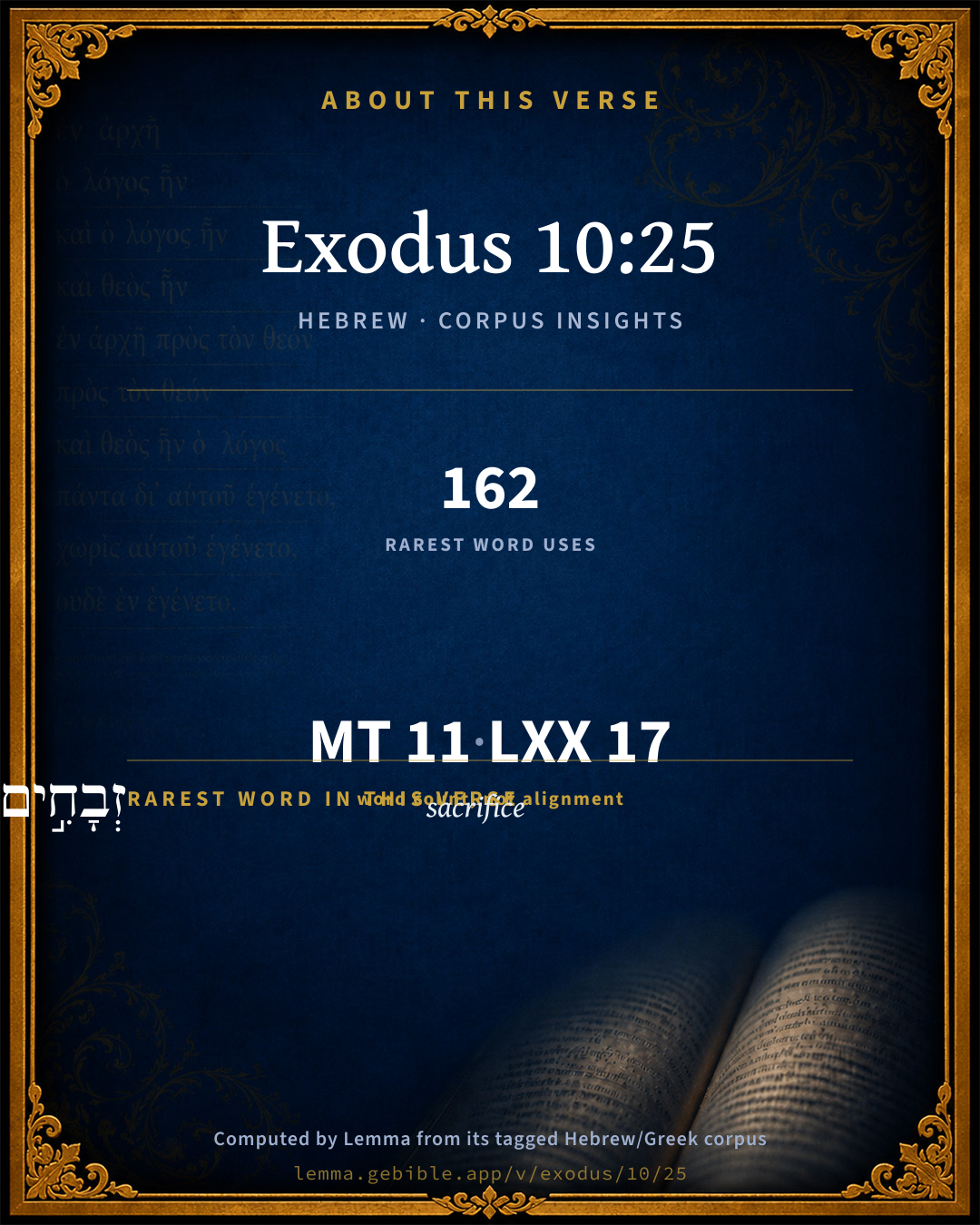
In English translation the verse runs 20 words from the Hebrew and 24 from the Septuagint (LXX English) — closely comparable.

A rough comparison of the two English renderings, which tokenize alike — not a word-level alignment.

Word counts can differ between the Hebrew and the Greek without any difference in meaning — e.g. the Hebrew direct-object marker אֵת has no separate Greek word, and Greek often adds the article ὁ.

In the original languages it is 11 Hebrew tokens and 17 Greek tokens — but the two are counted differently (Hebrew bundles its prefixes and suffixes into one token; the Greek is in lemma form), so that isn’t a like-for-like length.

Cross-references

4

Topical passages linked to Exodus 10:25 in the Treasury of Scripture Knowledge — connected by theme and wording, ordered by reader-vote popularity; previews shown in the World English Bible.

  • Exodus 29:1–46 "This is the thing that you shall do to them to make them holy, to minister to me in the priest's office: take one young bull and two rams without blemish,
  • Leviticus 9:22 Aaron lifted up his hands toward the people, and blessed them; and he came down from offering the sin offering, and the burnt offering, and the peace offerings.
  • Leviticus 16:9 Aaron shall present the goat on which the lot fell for Yahweh, and offer him for a sin offering.
  • Exodus 36:1–38 "Bezalel and Oholiab shall work with every wise-hearted man, in whom Yahweh has put wisdom and understanding to know how to work all the work for the service of the sanctuary, according to all that Yahweh has commanded."

Cross-references courtesy of OpenBible.info (CC BY 4.0).

Hebrew and Greek witnesses Masoretic Hebrew ↔ Greek Septuagint

The same verse in the two great witnesses to the Old Testament, shown verse-for-verse.

These are two independent witnesses, not word-aligned to each other, and the Septuagint is shown in lemma (dictionary) form.

Hebrew Exodus 10:25 Masoretic · Westminster Leningrad Codex

וַיֹּ֣אמֶר מֹשֶׁ֔ה גַּם אַתָּ֛ה תִּתֵּ֥ן בְּיָדֵ֖נוּ זְבָחִ֣ים וְעֹל֑וֹת וְעָשִׂ֖ינוּ לַיהוָ֥ה אֱלֹהֵֽינוּ

Moses said, "You must also give into our hand sacrifices and burnt-offerings, that we may sacrifice to Yahweh our God.

World English Bible · Public Domain

Greek LXX Exodus 10:25 Septuagint · lemma form

καί εἶπον μωυσῆς ἀλλά καί σύ δίδωμι ἐγώ ὁλοκαύτωμα καί θυσία ὅς ποιέω κύριος ὁ θεός ἐγώ

And Moses said, Nay, but you shall give to us whole burnt offerings and sacrifices, which we will sacrifice to the Lord our God.

LXX2012 (modern English Septuagint) · Public Domain

Hebrew: Westminster Leningrad Codex (CC BY 4.0). Greek: Septuagint (public domain); English from LXX2012 (modern English Septuagint) (Public Domain). How the Septuagint differs from the Hebrew →

Targum (Aramaic paraphrase)

2

The Targum is the ancient Jewish Aramaic paraphrase of the Hebrew Scriptures — an interpretive translation, not the Hebrew text itself. Onkelos (literal) and Pseudo-Jonathan (expansive) render the Torah, and Jonathan the Prophets. Coverage is partial: where no permissively-licensed English translation exists for a verse, only the Aramaic is shown. This is verse-level text, not a word-by-word alignment to the Hebrew.

  1. Targum Onkelos Torah (Genesis–Deuteronomy)
    וַאֲמַר משֶׁה אַף אַתְּ תִּמְסַר בִּידָנָא נִכְסַת קֻדְשִׁין וַעֲלָוָן וְנַעְבֵּד קֳדָם יְיָ אֱלָהָנָא:

    (no public-domain English translation for this verse)

    Targum Onkelos — Aramaic: “Onkelos Genesis” (public domain); “Onkelos Exodus” (public domain); “Onkelos Leviticus” (public domain); “Onkelos Numbers” (public domain); “Onkelos Deuteronomy” (public domain). English: “Sefaria Community Translation” (CC0 1.0 (public-domain dedication)); “J.W. Etheridge. The Targums of Onkelos and Jonathan Ben Uzziel on the Pentateuch. London: Longmans, Green, 1862” (public domain). Text via Sefaria.

  2. Targum Pseudo-Jonathan Torah (Genesis–Deuteronomy)
    וַאֲמַר משֶׁה אוּף אַנְתְּ תִּתֵּן בִּידָנָא נִכְסַת קוּדְשִׁין וְעַלְוָון וְנַעֲבֵיד קֳדָם יְיָ אֱלָהָנָא

    But Mosheh said, Thou must also give into our hands holy oblations and burnt offerings, that we may perform service before the Lord our God.

    Targum Pseudo-Jonathan — Aramaic: “Targum Jonathan on Genesis” (public domain); “Targum Jonathan on Exodus” (public domain); “Targum Jonathan on Leviticus” (public domain); “Targum Jonathan on Numbers” (public domain); “Targum Jonathan on Deuteronomy” (public domain). English: “The Targum of Jonathan ben Uzziel, trans. J. W. Etheridge, London, 1862” (public domain). Text via Sefaria.

Commentary

Notes on Exodus 10:25 from classic Christian and Jewish commentators (each source and its license shown beneath its notes). The classic Christian expositions comment on the surrounding passage and are grouped to its opening verse, so a note may address several verses; the Jewish commentaries on the Tanakh (Rashi and others) are per-verse, so they appear only where the commentator wrote on this verse.

Lemma curates 59 commentaries, every one of them public domain or Creative Commons licensed, each selected and text-cleaned for this edition rather than reprinted as found. About our sources →

Trapp's Complete Commentary

John Trapp

Exo 10:25 And Moses said, Thou must give us also sacrifices and burnt offerings, that we may sacrifice unto the LORD our God.

Ver. 25. Thou must give us also sacrifices.] God gave Noah of every clean beast seven, for sacrifice likely, but of every unclean two only. {Gen 7:2}

John Trapp, A Commentary or Exposition upon All the Books of the Old and New Testament (1647–1656) — public domain. Text from a community e-Sword module.

Tyndale Open Study Notes

Tyndale Open Resources

10:25-26 Moses was unrelenting. He knew that the Israelites, far from leaving any of their possessions behind, would be receiving gifts from the Egyptians, who would hurry them away (3:21-22). He also kept the focus on the worship of God. This continual refrain about the purpose for leaving Egypt (see study note on 8:26-27) reflects the key purpose of their exodus, to become the people of God.

Tyndale Open Study Notes — © Tyndale Open Resources, licensed CC BY-SA 4.0. Text via the HelloAO Bible API.

The Cambridge Bible for Schools and Colleges

gen. ed. J. J. S. Perowne

25. Thou also must, &c.] The pron. is emphatic. Pharaoh, besides letting the Israelites’ cattle go, must also himself contribute to the sacrifices which will be offered. By ‘sacrifices’ (lit. slaughterings) are meant the most common kind of sacrifice, called elsewhere for distinction ‘peace-offerings’ (see on Exo_20:24): they are often, esp. in the historical books, mentioned together with burnt-offerings (see ibid.).

sacrifice] Heb. do,—used in a sacrificial sense, like ῥέζειν and facere, and the Ass. epêshu. So Exo_29:36; Exo_29:38, Deu_12:27, 1Ki_3:15, and frequently (the instances in the OT. have been collected by the writer in DB. s.v. Offer, Offering, No. 7, iii. 588b).

The Cambridge Bible for Schools and Colleges (gen. ed. J. J. S. Perowne; Cambridge University Press, 1878–1918) — public domain. Text from a community e-Sword module.

John Gill's Exposition

But the Lord hardened Pharaoh's heart,.... Yet more and more:

and he would not let them go; his heart was set against it, his will was resolute, and he was determined never to let them go.

John Gill's Exposition of the Whole Bible (1746–1763) — public domain (CC PDM 1.0). Text via the HelloAO Bible API.

Matthew Poole's English Annotations

Thou must give us, i.e. suffer us to take of our own stock

Matthew Poole's English Annotations on the Holy Bible (1683–1685) — public domain. Text from a community e-Sword/MySword module.

Whedon's Commentary on the Bible

Daniel D. Whedon

25, 26. Thou must give us also sacrifices — That is, Thou must allow our flocks and herds to go for sacrifice. Even up to this moment only a three days’ journey into the wilderness was demanded; and a frank, fair compliance with Jehovah’s will would have saved Pharaoh from destruction and Egypt from disgrace. Pharaoh’s sin was no necessary link in the chain of God’s providences; but the sin being in his heart, God used it for his glory.

Daniel D. Whedon (gen. ed.), Commentary on the Old and New Testaments (1874–1909) — public domain. Text from a community e-Sword module.

The Pulpit Commentary

Vers. 25, 26. Moses absolutely refuses the suggested compromise. He had already declared on a former occasion, "With our young and with our old we will go; with our sons and with our daughters, with our flocks and with our herds we will go" (ver. 9). He is not inclined to retract now, after two additional plagues, what he had demanded before them. He does not refuse, however, to set forth his reasons. The cattle must go because the feast which they are about to keep requires sacrifices they must all go, because the Israelites do not as yet know what animals, or how many of each, will be required of them. The feast was a new thing, without precedent; its ritual was not yet laid down. No exact directions were to be expected, until the place was reached where God intended that it should be celebrated.

Bad men, when unable to overcome good men"s scruples, throw off the mask of friendliness, and show themselves in their true colours.

The circumstances of human life are continually bringing good men and bad men into contact and intercourse. Three results may follow:

1. The bad may corrupt the good. This is the result too often. "Evil communications corrupt good manners." Few can touch pitch and not be defiled.

2. The good may convert the bad. The first Christians converted a world that lay in wickedness. Esther softened the heart of Ahasuerus. St. Ambrose, by long withstanding his will, converted Theodosius.

3. Neither may make any impression upon the other. In this case, while the good man merely regrets his inability to turn the bad man to righteousness, the bad man, baffled in his attempts to overcome the scruples of the good man and lead him astray, is apt to be greatly provoked, and to threaten, or even proceed to violence. "Take heed to thyself in the day thou seest my face thou shalt die." What a spring of bitterness wells up from the evil heart of the sinner who feels himself opposed successfully, thwarted in his schemes, and baffled! While he still hopes to succeed all is smooth speaking. "I have sinned." "Forgive my sin this once only." "Go ye, serve the Lord." When he finds that he cannot prevail, there is a sudden and complete change. Benefits are forgotten; friendliness is a thing of the past; even the prescribed forms of politeness are set aside. The wild beast that lies hid in each unregenerate man shows itself, and the friendly acquaintance of months or years is ready to tear his opposer to pieces.

The Pulpit Commentary (1880–1919), ed. H.D.M. Spence-Jones & Joseph S. Exell — public domain. Text from a community e-Sword module.

Rashi

Rabbi Shlomo Yitzchaki (Rashi)

גם אתה תתן THOU MUST GIVE ALSO — It will not be enough for you that our cattle will go with us but you will give also of yours.

Rashi on the Tanakh — English translations: “The Judaica Press complete Tanach with Rashi, translated by A. J. Rosenberg” (CC BY 4.0); “Pentateuch with Rashi's commentary by M. Rosenbaum and A.M. Silbermann, 1929-1934” (public domain); “The Metsudah Tanach series, Lakewood, N.J” (CC BY 4.0); and “The Book of Joshua, Metsudah Publications, 1997” (CC BY 4.0). Text via Sefaria.

Ramban (Nachmanides)

Rabbi Moshe ben Nachman (Ramban / Nachmanides)

THOU MUST ALSO GIVE INTO OUR HAND SACRIFICES AND BURNT-OFFERINGS. Moses did not make this a condition, neither did Pharaoh. Rather, these are words to impress Pharaoh. In effect Moses was saying to him that G-d’s power will be so heavy upon him and his people that even sacrifices and burnt — offerings and all that he hath will he give for his life. Indeed, when Pharaoh said to Moses and Aaron [at the time that he gave the people permission to go], And bless me also, he would willingly have given all his cattle in atonement for his sin [of rebelling against G-d’s command till then]. Moses however had no intention to do so, for the sacrifice of the wicked is an abomination, as it pleased the Eternal to crush him, not to forgive him but instead to punish him and to overthrow him with all his host in the midst of the sea.Now our Rabbis have said that Pharaoh’s expression [to Moses and Aaron], Take both your flocks and your herds, as ye have said, refers to their saying to him, Thou must also give into our hand sacrifices and burnt-offerings. Perhaps the Rabbis intended to say that Pharaoh hinted to Moses and Aaron that he is ready to give them whatever they say, but not at all that they took anything from him. It may be that he supplied them with sacrifices and burnt-offerings for their use so that the Israelites would fulfill their own obligation [in the observance of G-d’s feast]. But this also is not correct. ] — it could not be correct to say that they later took sacrifices for themselves from Pharaoh. We must therefore conclude that Pharaoh only hinted to them that he was ready to give them whatever they demand, but actually they took no animals from him for sacrifice.

Ramban (Nachmanides) on the Tanakh — English translation: “Commentary on the Torah by Ramban (Nachmanides). Translated and annotated by Charles B. Chavel. New York, Shilo Pub. House, 1971-1976” (CC BY 4.0). Text via Sefaria.

Lesson kit

Teaching starters — assembled from the data on this page, not authored interpretation. Every prompt links to the verse data it draws on. Edit before teaching.

Exodus, in the Pentateuch, opens this verse with 11 words (11 distinct Hebrew lemmas). Its most distinctive word is zebach (“sacrifice”). A historical commentator’s framing appears above. Read the whole chapter for the surrounding context.

Discussion questions

  1. The word zebach carries the sense “sacrifice.” How does it shape the verse?
  2. Exodus 29:1–46 shares this passage’s theme. How do the two illuminate each other?
  3. The translations on this page render this verse differently — a whole-verse word diff, not a word-by-word alignment. What might account for the different wordings?
  4. The verb «וַיֹּ֣אמֶר» is Qal Sequential Imperfect. How does its form color the action?
  5. Reading how Trapp's Complete Commentary and Tyndale Open Study Notes read this verse, where do the two commentators agree and where do they part?

Things to notice

Reading settings

Reading text

Shown beneath each verse's original-language words.

Old Testament
Old Testament edition

Read the OT as the Masoretic Hebrew (MT) or the Greek Septuagint (LXX).

English shown for the Greek Septuagint (in the Hebrew ↔ Greek comparison).

Comparing translations? Open the Compare panel on any verse page to stack up to four side by side.