
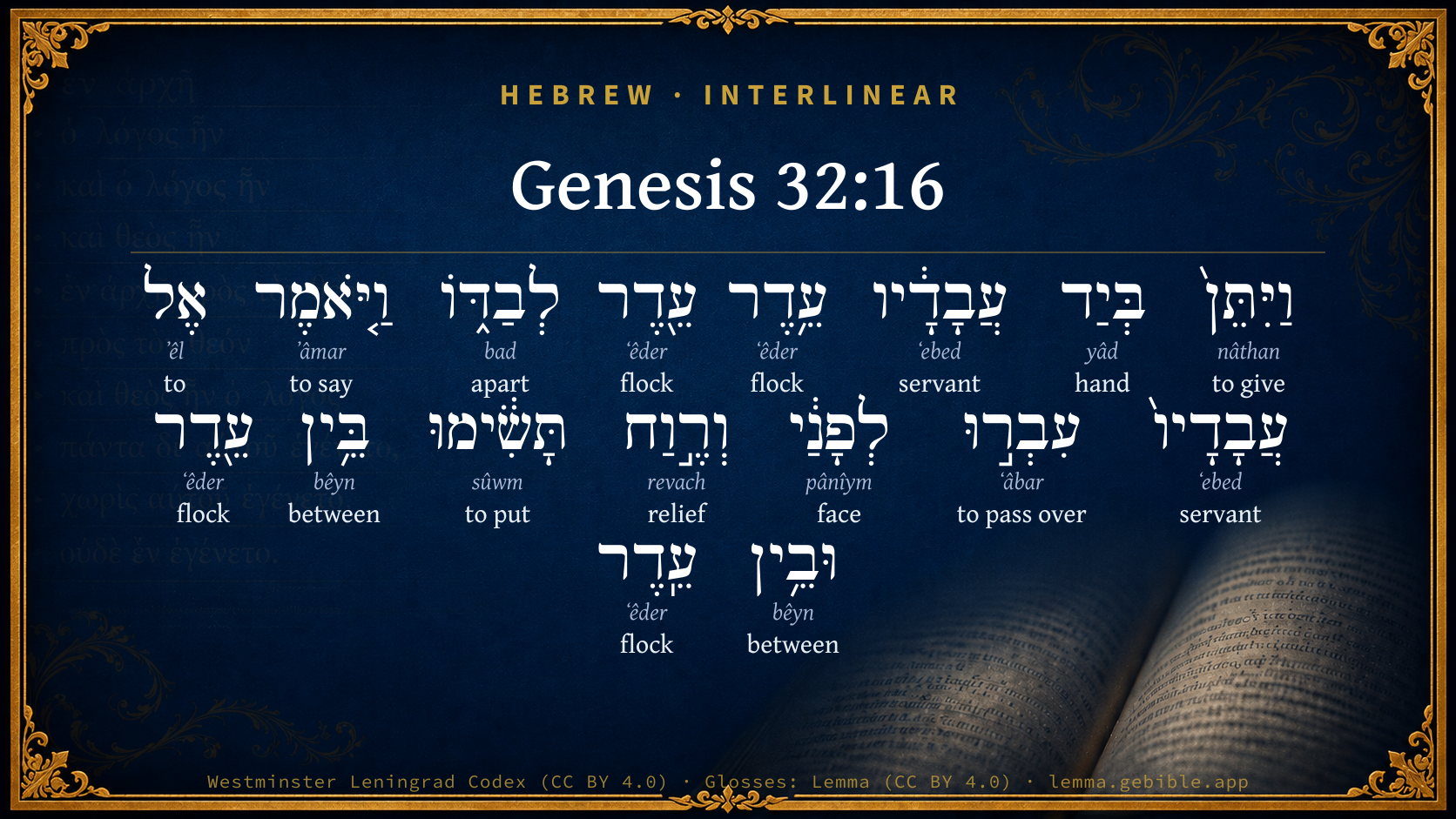
Genesis 32:16

Hebrew (Westminster Leningrad Codex) Genesis 32:16 appears in the Hebrew Old Testament. The text above is from the Westminster Leningrad Codex. Each word links to its Strong’s number, a concise gloss, and parsing drawn from the Open Scriptures Hebrew Bible morphology. Click any word for its full Brown-Driver-Briggs (BDB) entry.
Download image
Cite this verse

Genesis 32:16 (World English Bible). Public Domain. Lemma interlinear Bible study tool, https://lemma.gebible.app/v/genesis/32/16.

Show BibTeX & RIS
BibTeX
RIS
English Translation
He delivered them into the hands of his servants, every herd by itself, and said to his servants, "Pass over before me, and put a space between herd and herd."
World English Bible · Public Domain
Highlights
  • 1 first appearance in the Hebrew Bible
Full analysis ↓
Download a study sheet

One document with this verse’s original text, its word-by-word gloss line, the meaning frame, cross-references with their text, attributed commentary, and full source and license credits — printable, and it pastes into notes with its structure intact.

This verse Autodidact and up

Study sheet (.html) Plain text (.txt)

A passage Seminary Student

Up to 50 verses in one chapter. A passage sheet keeps up to 6 commentary sources and 12 cross-references per verse, in the order this page ranks them, and says so on the sheet whenever that leaves anything out. Ask for a single verse and you get the Autodidact verse sheet above.

Everything on this page stays free to read, with no account — the sheet is a download of what is already on screen, not access to it.

Want to remove ads? Support Godless Engineer
Compare translations 3

The same verse in 3 English versions, stacked beneath the original-language interlinear above. Click any original word for its lexicon entry.

Each is an independent rendering of the whole verse — the interlinear is not word-aligned to these translations.

Highlighted words mark where these versions differ — a whole-verse word diff, not a word-by-word alignment.

  • World English Bible Public Domain
    He delivered them into the hands of his servants, every herd by itself, and said to his servants, "Pass over before me, and put a space between herd and herd."
  • King James Version Public Domain
    And he delivered them into the hand of his servants, every drove by themselves; and said unto his servants, Pass over before me, and put a space betwixt drove and drove.
  • unfoldingWord Literal Text CC BY-SA 4.0
    And he gave them into the hand of his servants, each herd by itself. And he said to his servants, “Go before me, and put space between each herd.”

unfoldingWord Literal Text — © unfoldingWord, licensed CC BY-SA 4.0. Word-aligned USFM3 via Door43 (git.door43.org/unfoldingWord/en_ult).

Versions to compare (up to 4)

3 of 4 selected

Show all 18 translations

Every available English version of this verse, each an independent rendering of the whole verse.

  • World English Bible Public Domain
    He delivered them into the hands of his servants, every herd by itself, and said to his servants, "Pass over before me, and put a space between herd and herd."
  • Berean Standard Bible Public Domain
    He entrusted them to his servants in separate herds and told them, “Go on ahead of me, and keep some distance between the herds.”
  • Majority Standard Bible Public Domain
    He entrusted them to his servants in separate herds and told them, “Go on ahead of me, and keep some distance between the herds.”
  • King James Version Public Domain
    And he delivered them into the hand of his servants, every drove by themselves; and said unto his servants, Pass over before me, and put a space betwixt drove and drove.
  • American Standard Version (1901) Public Domain
    And he delivered them into the hand of his servants, every drove by itself, and said unto his servants, Pass over before me, and put a space betwixt drove and drove.
  • Revised Version (1885) Public Domain
    And he delivered them into the hand of his servants, every drove by itself; and said unto his servants, Pass over before me, and put a space betwixt drove and drove.
  • Geneva Bible (1599) Public Domain
    So he deliuered them into the hande of his seruants, euery droue by themselues, and saide vnto his seruants, Passe before me, and put a space betweene droue and droue.
  • Douay-Rheims (1899) Public Domain
    And he sent them by the hands of his servants, every drove by itself, and he said to his servants: Go before me, and let there be a space between drove and drove.
  • Young's Literal Translation Public Domain
    and he giveth into the hand of his servants, every drove by itself, and saith unto his servants, `Pass over before me, and a space ye do put between drove and drove.'
  • Literal Standard Version CC BY-SA 4.0
    and he gives into the hand of his servants every drove by itself, and says to his servants, “Pass over before me, and a space you put between drove and drove.”
  • Unlocked Literal Bible CC BY-SA 4.0
    These he gave these into the hand of his servants, every herd by itself. He said to his servants, “Go on ahead of me and put a space between each of the herds.”
  • unfoldingWord Literal Text CC BY-SA 4.0
    And he gave them into the hand of his servants, each herd by itself. And he said to his servants, “Go before me, and put space between each herd.”
  • Darby Bible Public Domain
    And he delivered [them] into the hand of his servants, every drove by itself; and he said to his servants, Go on before me, and put a space between drove and drove.
  • World Messianic Bible Public Domain
    He delivered them into the hands of his servants, every herd by itself, and said to his servants, “Pass over before me, and put a space between herd and herd.”
  • Webster's Bible Public Domain
    And he delivered them into the hand of his servants, every drove by themselves; and said to his servants, Pass over before me, and put a space betwixt drove and drove.
  • Free Bible Version CC BY-SA 4.0
    He put his servants in charge of each of the separate herds and told them, “Go on ahead of me, and keep a good distance between the herds.”
  • Bible in Basic English Public Domain
    These he gave to his servants, every herd by itself, and he said to his servants, Go on before me, and let there be a space between one herd and another.
  • JPS Tanakh (1917) Public Domain
    (32-17) And he delivered them into the hand of his servants, every drove by itself; and said unto his servants: 'Pass over before me, and put a space betwixt drove and drove.'

Literal Standard Version (2020), Covenant Press — licensed CC BY-SA 4.0. Text via the HelloAO Bible API (eBible.org). Unlocked Literal Bible (unfoldingWord) — licensed CC BY-SA 4.0. Text via the HelloAO Bible API (eBible.org). unfoldingWord Literal Text — © unfoldingWord, licensed CC BY-SA 4.0. Word-aligned USFM3 via Door43 (git.door43.org/unfoldingWord/en_ult). Free Bible Version, Dr. Jonathan Gallagher — licensed CC BY-SA 4.0. Text via the HelloAO Bible API (eBible.org).

Word by word

More ways to search: Search by grammar → Find every occurrence → Compare this word →

Practice this passage: Drill this verse → Learn its vocabulary →

וְרֶ֣וַח
revach
H7305
“and · relief”
Conjunction + Noun, Common, Masculine, Singular, Absolute
Part of Speech
Conjunction + Noun
Type
Common
Gender
Masculine
Number
Singular
State
Absolute
Full BDB Definition

Origin: from H7304

TWOT: 2132a

space - space, interval - respite, relief
  1. וַיִּתֵּן֙ nâthan H5414 “and · to give” Conjunction + Verb, Qal, Sequential Imperfect, 3rd Person, Masculine, Singular
  2. בְּיַד yâd H3027 “in/at · hand of” Preposition + Noun, Common, Both, Singular, Construct
  3. עֲבָדָ֔יו ʻebed H5650 “servants · his” Noun, Common, Masculine, Plural, Construct + Suffix, Personal, 3rd Person, Masculine, Singular
  4. עֵ֥דֶר ʻêder H5739 “flock” Noun, Common, Masculine, Singular, Absolute
  5. עֵ֖דֶר ʻêder H5739 “flock” Noun, Common, Masculine, Singular, Absolute
  6. לְבַדּ֑וֹ bad H905 “to/for · apart · his” Preposition + Noun, Common, Masculine, Singular, Construct + Suffix, Personal, 3rd Person, Masculine, Singular
  7. וַ֤יֹּאמֶר ʼâmar H559 “and · to say” Conjunction + Verb, Qal, Sequential Imperfect, 3rd Person, Masculine, Singular
  8. אֶל ʼêl H413 “to” Preposition
  9. עֲבָדָיו֙ ʻebed H5650 “servants · his” Noun, Common, Masculine, Plural, Construct + Suffix, Personal, 3rd Person, Masculine, Singular
  10. עִבְר֣וּ ʻâbar H5674 “pass over” Verb, Qal, Imperative, 2nd Person, Masculine, Plural
  11. לְפָנַ֔י pânîym H6440 “to/for · face(s) · my” Preposition + Noun, Common, Both, Plural, Construct + Suffix, Personal, 1st Person, Common, Singular
  12. תָּשִׂ֔ימוּ sûwm H7760 “to put” Verb, Qal, Imperfect, 2nd Person, Masculine, Plural
  13. בֵּ֥ין bêyn H996 “between” Preposition
  14. עֵ֖דֶר ʻêder H5739 “flock” Noun, Common, Masculine, Singular, Absolute
  15. וּבֵ֥ין bêyn H996 “and · between” Conjunction + Preposition
  16. עֵֽדֶר ʻêder H5739 “flock” Noun, Common, Masculine, Singular, Absolute

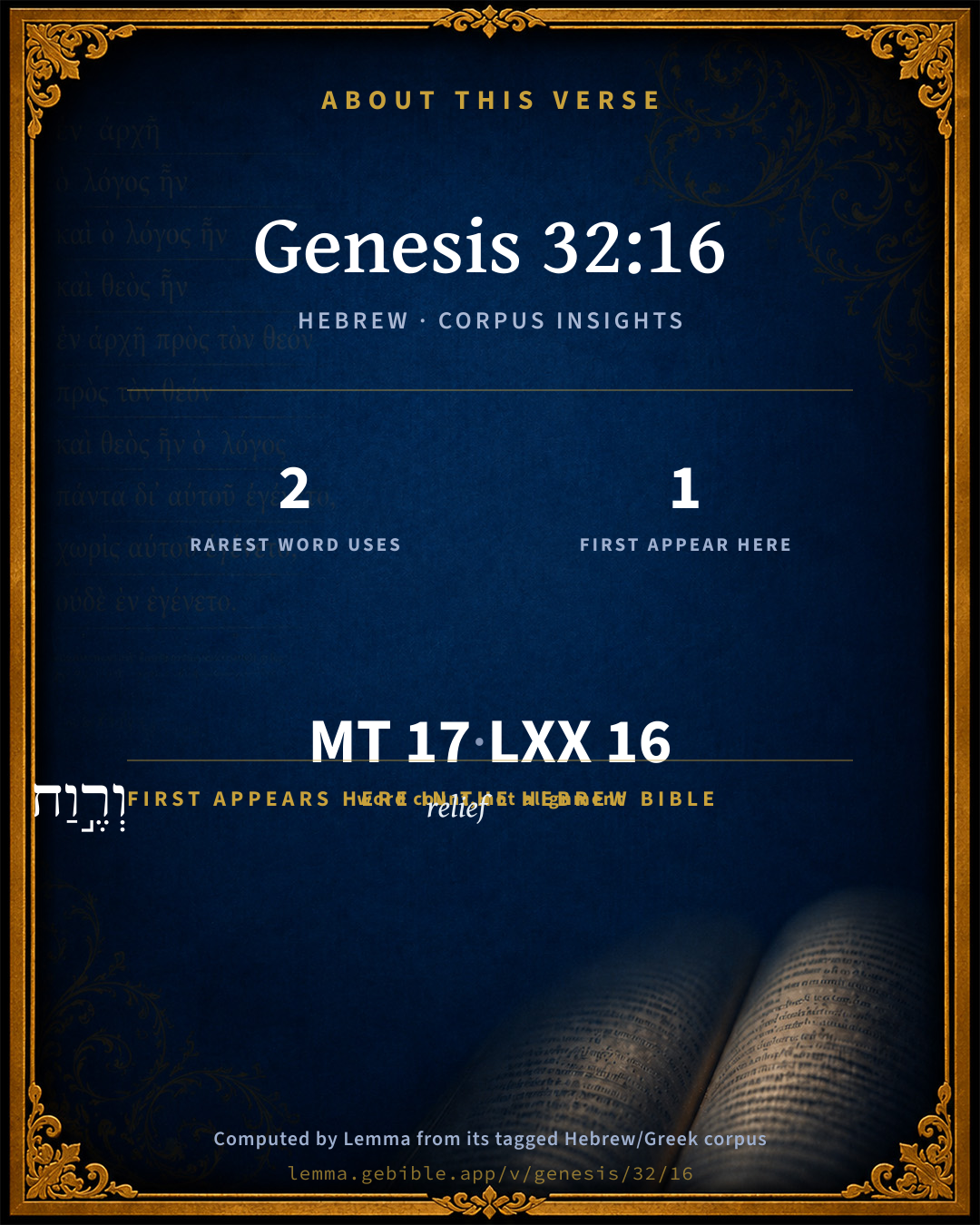
About this verse

These counts appear in no published source. They are computed here, from the morphology-tagged text and Lemma’s own curated glosses. What Lemma adds →

17
words
12
distinct lemmas
Pentateuch
section

Notable vocabulary

The rarest word here is וְרֶ֣וַח relief H7305 — appearing just 2 times in the whole Hebrew Bible.

First appearance in Scripture

This word makes its first canonical appearance in the Hebrew Bible here:

  • וְרֶ֣וַח relief H7305

Shared distinctive vocabulary

וְרֶ֣וַח relief H7305 occurs in 2 verses of the Hebrew Bible. Also found in:

Grammatical profile

  • 4 verbs
  • 10 nouns
  • 3 prepositions

Verb forms

  • וַיִּתֵּן֙ Qal · Sequential Imperfect
  • וַ֤יֹּאמֶר Qal · Sequential Imperfect
  • עִבְר֣וּ Qal · Imperative
  • תָּשִׂ֔ימוּ Qal · Imperfect

Repetition

Words recur within this verse — often emphatic in Hebrew:

  • עֵ֥דֶר flock H5739 ×4
  • עֲבָדָ֔יו servant H5650 ×2
  • בֵּ֥ין between H996 ×2

Hebrew & Septuagint length

In English translation the verse runs 30 words from the Hebrew and 28 from the Septuagint (LXX English) — closely comparable.

A rough comparison of the two English renderings, which tokenize alike — not a word-level alignment.

Word counts can differ between the Hebrew and the Greek without any difference in meaning — e.g. the Hebrew direct-object marker אֵת has no separate Greek word, and Greek often adds the article ὁ.

In the original languages it is 17 Hebrew tokens and 16 Greek tokens — but the two are counted differently (Hebrew bundles its prefixes and suffixes into one token; the Greek is in lemma form), so that isn’t a like-for-like length.

Cross-references

6

Topical passages linked to Genesis 32:16 in the Treasury of Scripture Knowledge — connected by theme and wording, ordered by reader-vote popularity; previews shown in the World English Bible.

  • Genesis 32:20 You shall say, 'Not only that, but behold, your servant, Jacob, is behind us.'" For, he said, "I will appease him with the present that goes before me, and afterward I will see his face. Perhaps he will accept me."
  • Genesis 33:8–9 Esau said, "What do you mean by all this company which I met?" Jacob said, "To find favor in the sight of my lord."
  • Psalms 112:5 It is well with the man who deals graciously and lends. He will maintain his cause in judgment.
  • Proverbs 2:11 Discretion will watch over you. Understanding will keep you,
  • Isaiah 28:26 For his God does instruct him aright, [and] does teach him.
  • Matthew 10:16 "Behold, I send you out as sheep in the midst of wolves. Therefore be wise as serpents, and harmless as doves.

Cross-references courtesy of OpenBible.info (CC BY 4.0).

Hebrew and Greek witnesses Masoretic Hebrew ↔ Greek Septuagint

The same verse in the two great witnesses to the Old Testament, shown verse-for-verse.

These are two independent witnesses, not word-aligned to each other, and the Septuagint is shown in lemma (dictionary) form.

Hebrew Genesis 32:16 Masoretic · Westminster Leningrad Codex

וַיִּתֵּן֙ בְּיַד עֲבָדָ֔יו עֵ֥דֶר עֵ֖דֶר לְבַדּ֑וֹ וַ֤יֹּאמֶר אֶל עֲבָדָיו֙ עִבְר֣וּ לְפָנַ֔י וְרֶ֣וַח תָּשִׂ֔ימוּ בֵּ֥ין עֵ֖דֶר וּבֵ֥ין עֵֽדֶר

He delivered them into the hands of his servants, every herd by itself, and said to his servants, "Pass over before me, and put a space between herd and herd."

World English Bible · Public Domain

Greek LXX Genesis 32:16 Septuagint · lemma form

κάμηλος θηλάζω καί ὁ παιδίον αὐτός τριάκοντα βοῦς τεσσαράκοντα ταῦρος δέκα ὄνος εἴκοσι καί πῶλος δέκα

And he gave them to his servants each drove apart; and he said to his servants, Go on before me, and put a space between drove and drove.

LXX2012 (modern English Septuagint) · Public Domain

Hebrew: Westminster Leningrad Codex (CC BY 4.0). Greek: Septuagint (public domain); English from LXX2012 (modern English Septuagint) (Public Domain). How the Septuagint differs from the Hebrew →

Targum (Aramaic paraphrase)

2

The Targum is the ancient Jewish Aramaic paraphrase of the Hebrew Scriptures — an interpretive translation, not the Hebrew text itself. Onkelos (literal) and Pseudo-Jonathan (expansive) render the Torah, and Jonathan the Prophets. Coverage is partial: where no permissively-licensed English translation exists for a verse, only the Aramaic is shown. This is verse-level text, not a word-by-word alignment to the Hebrew.

  1. Targum Onkelos Torah (Genesis–Deuteronomy)
    גַּמְלֵי מֶנְקָתָא וּבְנֵיהוֹן תְּלָתִין תּוֹרְתָא אַרְבְּעִין וְתוֹרֵי עַסְרָא אַתְנָן עֶסְרִין וְעִירֵי עַסְרָא

    (no public-domain English translation for this verse)

    Targum Onkelos — Aramaic: “Onkelos Genesis” (public domain); “Onkelos Exodus” (public domain); “Onkelos Leviticus” (public domain); “Onkelos Numbers” (public domain); “Onkelos Deuteronomy” (public domain). English: “Sefaria Community Translation” (CC0 1.0 (public-domain dedication)); “J.W. Etheridge. The Targums of Onkelos and Jonathan Ben Uzziel on the Pentateuch. London: Longmans, Green, 1862” (public domain). Text via Sefaria.

  2. Targum Pseudo-Jonathan Torah (Genesis–Deuteronomy)
    גַמְלַיָא נוּקְבָן עִם בְּנֵיהוֹן הֲווֹ תְּלָתִין תּוֹרַיְתָא אַרְבְּעִין וְתוֹרֵי עֲשָרָה אַתְנַיי עֶשְרִין וִילָדִין דַקִין עֲשָרָה

    milch camels with their young ones thirty; cows forty, and bulls ten, small colts ten.

    Targum Pseudo-Jonathan — Aramaic: “Targum Jonathan on Genesis” (public domain); “Targum Jonathan on Exodus” (public domain); “Targum Jonathan on Leviticus” (public domain); “Targum Jonathan on Numbers” (public domain); “Targum Jonathan on Deuteronomy” (public domain). English: “The Targum of Jonathan ben Uzziel, trans. J. W. Etheridge, London, 1862” (public domain). Text via Sefaria.

Commentary

Notes on Genesis 32:16 from classic Christian and Jewish commentators (each source and its license shown beneath its notes). The classic Christian expositions comment on the surrounding passage and are grouped to its opening verse, so a note may address several verses; the Jewish commentaries on the Tanakh (Rashi and others) are per-verse, so they appear only where the commentator wrote on this verse.

Lemma curates 59 commentaries, every one of them public domain or Creative Commons licensed, each selected and text-cleaned for this edition rather than reprinted as found. About our sources →

Trapp's Complete Commentary

John Trapp

Gen 32:16 And he delivered [them] into the hand of his servants, every drove by themselves; and said unto his servants, Pass over before me, and put a space betwixt drove and drove.

Ver. 16. Every drove by themselves.] That Esau, having occasion of viewing the present, questioning the servants, and hearing Jacob’s submission, might be somewhat mollified, and his anger abated. "Be wise as serpents". {Mat 10:16}

“Ut fragilis glacies, occidit ira mora.”

John Trapp, A Commentary or Exposition upon All the Books of the Old and New Testament (1647–1656) — public domain. Text from a community e-Sword module.

Jamieson, Fausset & Brown

Robert Jamieson, A. R. Fausset & David Brown

every drove by themselves--There was great prudence in this arrangement; for the present would thus have a more imposing appearance; Esau's passion would have time to cool as he passed each successive company; and if the first was refused, the others would hasten back to convey a timely warning.

Jamieson, Fausset & Brown — Commentary Critical and Explanatory on the Whole Bible (1871) — public domain (CC PDM 1.0). Text via the HelloAO Bible API.

Ellicott's Commentary for English Readers

(16) A space.—Heb., a breathing place. These paration of the droves would be a matter of course, as each kind would travel peaceably onward only by itself. But Jacob rightly concluded that the repeated acknowledgment of Esau as his lord, added to the great value of the gift, would fill his brother’s heart with friendly feelings, and perhaps therefore he put a longer space than usual between the successive droves.

A Bible Commentary for English Readers, edited by Charles John Ellicott (1878–1897) — public domain. Text from a community e-Sword module.

John Gill's Exposition

And he delivered them into the hand of his servants,.... To present them to Esau as from him:

every drove by themselves; there seems to have been three droves, see Gen 32:19; very probably the two hundred and twenty goats, male and female, were in the first drove; and the two hundred and twenty sheep, ewes, and rams, were in the second drove; and the thirty camels, with their colts, and the fifty cows and bulls, with the twenty she asses and ten foals, which made in all one hundred and forty, were in the third drove: though Aben Ezra thinks there were five droves; nor is it improbable, the goats in one drove, the sheep in another, the camels and colts in a third, and the kine and bulls might make a fourth, and the asses with their foals a fifth:

and saith unto his servants, pass over before me: over the brook Jabbok, Gen 32:22, a day's journey or less before him, as Jarchi observes, or rather a night's journey, as seems by the context; for these were sent out at evening, and Jacob stayed behind all night, as appears by what follows:

and put a space betwixt drove and drove; his meaning is, that they should not follow each other closely; but that there should be a considerable distance between them, and which he would have them careful to keep: his view in this was, partly to prolong time, Esau stopping, as he supposed he would, at each drove, and asking questions of the men; and partly that he might the better and more distinctly observe the largeness of his present, and his munificence in it, and so, both by the present, and by the frequent repetition of his submission to him as his servant, his wrath, if he came out in it, would be gradually abated, and before he came to him he would be in a disposition to receive him with some marks of affection and kindness, as he did.

John Gill's Exposition of the Whole Bible (1746–1763) — public domain (CC PDM 1.0). Text via the HelloAO Bible API.

Matthew Poole's English Annotations

That his gift might be represented to Esau with most advantage, and his mind might by little and little be sweetened towards him.

Matthew Poole's English Annotations on the Holy Bible (1683–1685) — public domain. Text from a community e-Sword/MySword module.

The Pulpit Commentary

And he delivered them into the Band of his servants, every drove by themselves (literally, drove and drove separately); and said unto his servants, Passover (the river Jabbok) before me, and put a space (literally, a breathing-place) betwixt drove and drove as is still the manner with Oriental shepherds (cf. "Land and Book," p. 331).

The Pulpit Commentary (1880–1919), ed. H.D.M. Spence-Jones & Joseph S. Exell — public domain. Text from a community e-Sword module.

Rashi

Rabbi Shlomo Yitzchaki (Rashi)

גמלים מיניקות MILCH CAMELS שלשים THIRTY, ובניהם means AND THEIR COLTS with them — A Midrashic explanation of ובניהם is that it is the same as וּבַנָּאֵיהֶם their builders (those that build them up) i.e., one male for each female. Because, however, it (the camel) is chaste in its ways Scripture does not state this plainly (Genesis Rabbah 76:7) but employs a term from which it may be inferred.

ועירים means MALE ASSES.

Rashi on the Tanakh — English translations: “The Judaica Press complete Tanach with Rashi, translated by A. J. Rosenberg” (CC BY 4.0); “Pentateuch with Rashi's commentary by M. Rosenbaum and A.M. Silbermann, 1929-1934” (public domain); “The Metsudah Tanach series, Lakewood, N.J” (CC BY 4.0); and “The Book of Joshua, Metsudah Publications, 1997” (CC BY 4.0). Text via Sefaria.

Radak

Rabbi David Kimhi (Radak)

גמלים מיניקות, we did not know why Yaakov sent along young camels that were so tender that they still depended on mothers’ milk. (according to the words of the author Yaakov also sent such young male calves and male donkeys with their mother animals.) ובניהם together with their young there were a total of 30 camels. The number of animals in each herd was proportionate to the respective size of Yaakov’s total herds of that category of animal. Seeing that he owned relatively few camels, his gift of camels represented a certain percentage of the total number of camels he owned. The reason why the Torah bothered to give us the details of the gift Yaakov sent to his brother was to show us that he sent a substantial gift, and to teach us that if we ever need to atone for having deeply hurt someone and to hope that he will forgive us, it is appropriate to demonstrate our contriteness not so much with words as with a gift of substantial proportions. Yaakov enhanced the impression his gift made upon Esau by leaving a good amount of space between each of the flocks, making Esau feel repeatedly that he had already seen the whole gift, only to find that more was to follow. Bereshit Rabbah 76,8 also addresses the question of the space between the herds which Yaakov insisted the messengers must allow for. According to the Midrash he wanted Esau to feast his eyes on the size of the gift. When one part of the gift had been received and he thought that he had seen it all, another messenger with another herd would appear and request that Esau accept his herd as a gift from Yaakov.

Radak on the Tanakh — English translations: “Sefaria Community Translation” (CC0 1.0 (public-domain dedication)); “Eliyahu Munk, HaChut Hameshulash” (CC BY 4.0); “Rabbi Mike Feuer, Jerusalem Anthology” (CC BY 4.0); and “R. David Kimhi on the first book of Psalms, Translated by R.G. Finch, London, 1919” (public domain). Text via Sefaria.

Lesson kit

Teaching starters — assembled from the data on this page, not authored interpretation. Every prompt links to the verse data it draws on. Edit before teaching.

Genesis, in the Pentateuch, opens this verse with 17 words (12 distinct Hebrew lemmas). Its most distinctive word is revach (“relief”). A historical commentator’s framing appears above. Read the whole chapter for the surrounding context.

Discussion questions

  1. How does “relief” (revach) shape what this verse is saying?
  2. The word “relief” first appears here in Scripture. What is being introduced at this debut?
  3. Esther 4:14 shares the word «relief» with this verse. How do the two illuminate each other?
  4. “flock” occurs 4× in this one verse. What is the effect of the repetition?
  5. The translations on this page render this verse differently — a whole-verse word diff, not a word-by-word alignment. What might account for the different wordings?
  6. The verb «וַיִּתֵּן֙» is Qal Sequential Imperfect. How does its form color the action?
  7. Reading how Trapp's Complete Commentary and Jamieson, Fausset & Brown read this verse, where do the two commentators agree and where do they part?

Things to notice

Reading settings

Reading text

Shown beneath each verse's original-language words.

Old Testament
Old Testament edition

Read the OT as the Masoretic Hebrew (MT) or the Greek Septuagint (LXX).

English shown for the Greek Septuagint (in the Hebrew ↔ Greek comparison).

Comparing translations? Open the Compare panel on any verse page to stack up to four side by side.