
Exodus 16:29

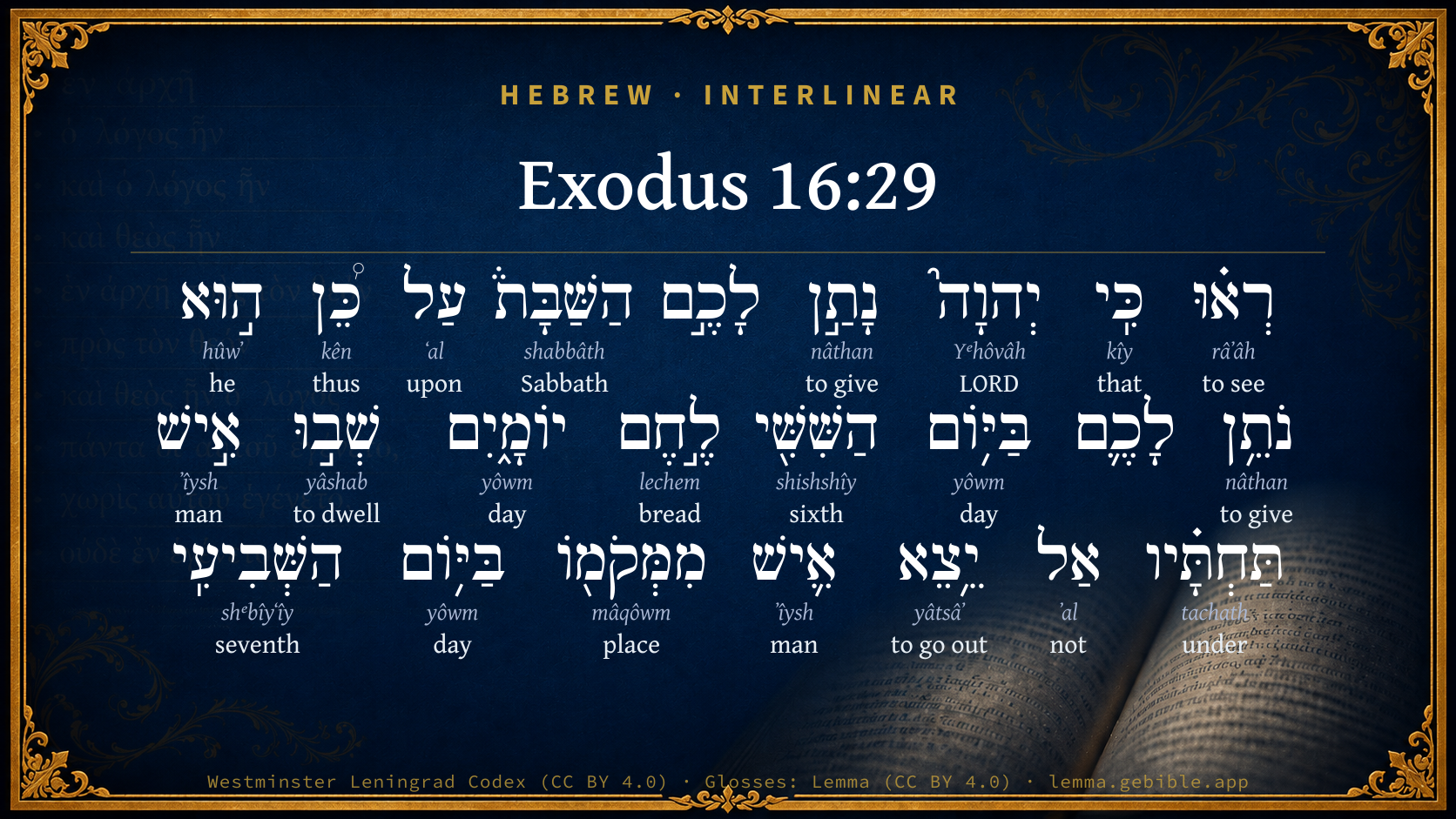
Hebrew (Westminster Leningrad Codex) Exodus 16:29 appears in the Hebrew Old Testament. The text above is from the Westminster Leningrad Codex. Each word links to its Strong’s number, a concise gloss, and parsing drawn from the Open Scriptures Hebrew Bible morphology. Click any word for its full Brown-Driver-Briggs (BDB) entry.
Download image
Cite this verse

Exodus 16:29 (World English Bible). Public Domain. Lemma interlinear Bible study tool, https://lemma.gebible.app/v/exodus/16/29.

Show BibTeX & RIS
BibTeX
RIS
English Translation
Behold, because Yahweh has given you the Sabbath, therefore he gives you on the sixth day the bread of two days. Everyone stay in his place. Let no one go out of his place on the seventh day."
World English Bible · Public Domain
Download a study sheet

One document with this verse’s original text, its word-by-word gloss line, the meaning frame, cross-references with their text, attributed commentary, and full source and license credits — printable, and it pastes into notes with its structure intact.

This verse Autodidact and up

Study sheet (.html) Plain text (.txt)

A passage Seminary Student

Up to 50 verses in one chapter. A passage sheet keeps up to 6 commentary sources and 12 cross-references per verse, in the order this page ranks them, and says so on the sheet whenever that leaves anything out. Ask for a single verse and you get the Autodidact verse sheet above.

Everything on this page stays free to read, with no account — the sheet is a download of what is already on screen, not access to it.

Want to remove ads? Support Godless Engineer
Compare translations 3

The same verse in 3 English versions, stacked beneath the original-language interlinear above. Click any original word for its lexicon entry.

Each is an independent rendering of the whole verse — the interlinear is not word-aligned to these translations.

Highlighted words mark where these versions differ — a whole-verse word diff, not a word-by-word alignment.

  • World English Bible Public Domain
    Behold, because Yahweh has given you the Sabbath, therefore he gives you on the sixth day the bread of two days. Everyone stay in his place. Let no one go out of his place on the seventh day."
  • King James Version Public Domain
    See, for that the LORD hath given you the sabbath, therefore he giveth you on the sixth day the bread of two days; abide ye every man in his place, let no man go out of his place on the seventh day.
  • unfoldingWord Literal Text CC BY-SA 4.0
    Look! For Yahweh has given you the Sabbath. So on the sixth day he is giving you bread for two days. Each one stay where he is; a man shall not be going out from his place on the seventh day.”

unfoldingWord Literal Text — © unfoldingWord, licensed CC BY-SA 4.0. Word-aligned USFM3 via Door43 (git.door43.org/unfoldingWord/en_ult).

Versions to compare (up to 4)

3 of 4 selected

Show all 18 translations

Every available English version of this verse, each an independent rendering of the whole verse.

  • World English Bible Public Domain
    Behold, because Yahweh has given you the Sabbath, therefore he gives you on the sixth day the bread of two days. Everyone stay in his place. Let no one go out of his place on the seventh day."
  • Berean Standard Bible Public Domain
    Understand that the LORD has given you the Sabbath; that is why on the sixth day He will give you bread for two days. On the seventh day, everyone must stay where he is; no one may leave his place.”
  • Majority Standard Bible Public Domain
    Understand that the LORD has given you the Sabbath; that is why on the sixth day He will give you bread for two days. On the seventh day, everyone must stay where he is; no one may leave his place.”
  • King James Version Public Domain
    See, for that the LORD hath given you the sabbath, therefore he giveth you on the sixth day the bread of two days; abide ye every man in his place, let no man go out of his place on the seventh day.
  • American Standard Version (1901) Public Domain
    See, for that Jehovah hath given you the sabbath, therefore he giveth you on the sixth day the bread of two days; abide ye every man in his place, let no man go out of his place on the seventh day.
  • Revised Version (1885) Public Domain
    See, for that the LORD hath given you the sabbath, therefore he giveth you on the sixth day the bread of two days; abide ye every man in his place, let no man go out of his place on the seventh day.
  • Geneva Bible (1599) Public Domain
    Beholde, howe the Lord hath giuen you the Sabbath: therefore he giueth you the sixt day bread for two dayes: tary therefore euery man in his place: let no man goe out of his place the seuenth day.
  • Douay-Rheims (1899) Public Domain
    See that the Lord hath given you the sabbath, and for this reason on the sixth day he giveth you a double provision: let each man stay at home, and let none go forth out of his place the seventh day.
  • Young's Literal Translation Public Domain
    see, because Jehovah hath given to you the sabbath, therefore He is giving to you on the sixth day bread of two days; abide ye each `in' his place, no one doth go out from his place on the seventh day.'
  • Literal Standard Version CC BY-SA 4.0
    See, because YHWH has given the Sabbath to you, therefore He is giving to you on the sixth day bread of two days; each abide [in] his place, no one goes out from his place on the seventh day.”
  • Unlocked Literal Bible CC BY-SA 4.0
    See, Yahweh has given you the Sabbath. So on the sixth day he is giving you bread for two days. Each of you must stay in his own place; no one must go out from his place on the seventh day.”
  • unfoldingWord Literal Text CC BY-SA 4.0
    Look! For Yahweh has given you the Sabbath. So on the sixth day he is giving you bread for two days. Each one stay where he is; a man shall not be going out from his place on the seventh day.”
  • Darby Bible Public Domain
    See, for Jehovah hath given you the sabbath; therefore he giveth you on the sixth day the bread for two days. Abide every man in his place: let no man go from his place on the seventh day.
  • World Messianic Bible Public Domain
    Behold, because the LORD has given you the Sabbath, therefore he gives you on the sixth day the bread of two days. Everyone stay in his place. Let no one go out of his place on the seventh day.”
  • Webster's Bible Public Domain
    See, for that the LORD hath given you the sabbath, therefore he giveth you on the sixth day the bread of two days: abide ye every man in his place, let no man go out of his place on the seventh day.
  • Free Bible Version CC BY-SA 4.0
    You need to understand that the Lord has given you the Sabbath, so on the sixth day he will provide you with food for two days. On the seventh day, everyone has to stay where they are—no one needs to go out.”
  • Bible in Basic English Public Domain
    See, because the Lord has given you the Sabbath, he gives you on the sixth day bread enough for two days; let every man keep where he is; let no man go out of his place on the seventh day.
  • JPS Tanakh (1917) Public Domain
    See that the LORD hath given you the sabbath; therefore He giveth you on the sixth day the bread of two days; abide ye every man in his place, let no man go out of his place on the seventh day.'

Literal Standard Version (2020), Covenant Press — licensed CC BY-SA 4.0. Text via the HelloAO Bible API (eBible.org). Unlocked Literal Bible (unfoldingWord) — licensed CC BY-SA 4.0. Text via the HelloAO Bible API (eBible.org). unfoldingWord Literal Text — © unfoldingWord, licensed CC BY-SA 4.0. Word-aligned USFM3 via Door43 (git.door43.org/unfoldingWord/en_ult). Free Bible Version, Dr. Jonathan Gallagher — licensed CC BY-SA 4.0. Text via the HelloAO Bible API (eBible.org).

Word by word

More ways to search: Search by grammar → Find every occurrence → Compare this word →

Practice this passage: Drill this verse → Learn its vocabulary →

הַשִּׁשִּׁ֖י
shishshîy
H8345
“the · sixth”
Particle, Definite Article + Adjective, Ordinal number, Masculine, Singular, Absolute
Part of Speech
Particle + Adjective
Type
Ordinal number
Gender
Masculine
Number
Singular
State
Absolute
Full BDB Definition

Origin: from H8337

TWOT: 2336b

sixth - sixth (ordinal number) - sixth (as fraction)
  1. רְא֗וּ râʼâh H7200 “see” Verb, Qal, Imperative, 2nd Person, Masculine, Plural
  2. כִּֽי kîy H3588 “that” Conjunction
  3. יְהוָה֮ Yᵉhôvâh H3068 “LORD” Noun, Proper
  4. נָתַ֣ן nâthan H5414 “to give” Verb, Qal, Perfect, 3rd Person, Masculine, Singular
  5. הַשַּׁבָּת֒ shabbâth H7676 “the · Sabbath” Particle, Definite Article + Noun, Common, Both, Singular, Absolute
  6. עַל ʻal H5921 “upon” Preposition
  7. כֵּ֠ן kên H3651 “thus” Particle, Demonstrative
  8. ה֣וּא hûwʼ H1931 “he” Pronoun, Personal, 3rd Person, Masculine, Singular
  9. נֹתֵ֥ן nâthan H5414 “giving” Verb, Qal, Participle Active, Masculine, Singular, Absolute
  10. בַּיּ֥וֹם yôwm H3117 “in/at the · day” Preposition, Determined + Noun, Common, Masculine, Singular, Absolute
  11. לֶ֣חֶם lechem H3899 “bread of” Noun, Common, Both, Singular, Construct
  12. יוֹמָ֑יִם yôwm H3117 “days” Noun, Common, Masculine, Dual, Absolute
  13. שְׁב֣וּ yâshab H3427 “dwell” Verb, Qal, Imperative, 2nd Person, Masculine, Plural
  14. אִ֣ישׁ ʼîysh H376 “man” Noun, Common, Masculine, Singular, Absolute
  15. תַּחְתָּ֗יו tachath H8478 “under · him” Preposition + Suffix, Personal, 3rd Person, Masculine, Singular
  16. אַל ʼal H408 “not” Particle, Negative
  17. יֵ֥צֵא yâtsâʼ H3318 “to go out” Verb, Qal, Jussive, 3rd Person, Masculine, Singular
  18. אִ֛ישׁ ʼîysh H376 “man” Noun, Common, Masculine, Singular, Absolute
  19. מִמְּקֹמ֖וֹ mâqôwm H4725 “from · place · his” Preposition + Noun, Common, Masculine, Singular, Construct + Suffix, Personal, 3rd Person, Masculine, Singular
  20. בַּיּ֥וֹם yôwm H3117 “in/at the · day” Preposition, Determined + Noun, Common, Masculine, Singular, Absolute
  21. הַשְּׁבִיעִֽי shᵉbîyʻîy H7637 “the · seventh” Particle, Definite Article + Adjective, Ordinal number, Masculine, Singular, Absolute

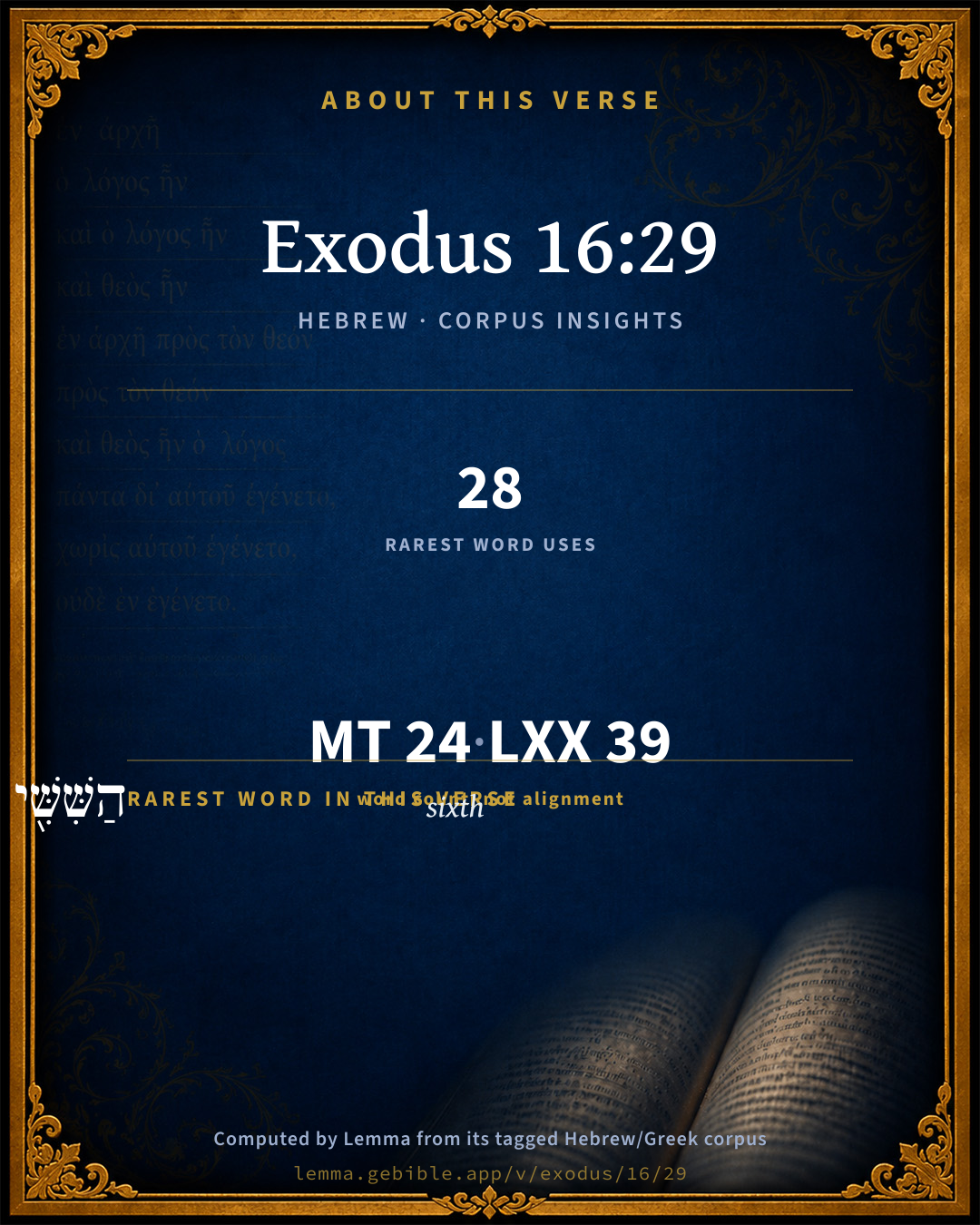
About this verse

These counts appear in no published source. They are computed here, from the morphology-tagged text and Lemma’s own curated glosses. What Lemma adds →

24
words
18
distinct lemmas
Pentateuch
section

Shared distinctive vocabulary

הַשִּׁשִּׁ֖י sixth H8345 occurs in 26 verses of the Hebrew Bible. Also found in:

Grammatical profile

  • 5 verbs
  • 9 nouns
  • 2 adjectives
  • 1 pronoun
  • 4 prepositions
  • 1 conjunction
  • 2 particles

Verb forms

  • רְא֗וּ Qal · Imperative
  • נָתַ֣ן Qal · Perfect
  • נֹתֵ֥ן Qal · Participle Active
  • שְׁב֣וּ Qal · Imperative
  • יֵ֥צֵא Qal · Jussive

Repetition

Words recur within this verse — often emphatic in Hebrew:

  • בַּיּ֥וֹם day H3117 ×3
  • נָתַ֣ן to give H5414 ×2
  • אִ֣ישׁ man H376 ×2

Hebrew & Septuagint length

In English translation the verse runs 38 words from the Hebrew and 47 from the Septuagint (LXX English) — closely comparable.

A rough comparison of the two English renderings, which tokenize alike — not a word-level alignment.

Word counts can differ between the Hebrew and the Greek without any difference in meaning — e.g. the Hebrew direct-object marker אֵת has no separate Greek word, and Greek often adds the article ὁ.

In the original languages it is 24 Hebrew tokens and 39 Greek tokens — but the two are counted differently (Hebrew bundles its prefixes and suffixes into one token; the Greek is in lemma form), so that isn’t a like-for-like length.

Cross-references

5

Topical passages linked to Exodus 16:29 in the Treasury of Scripture Knowledge — connected by theme and wording, ordered by reader-vote popularity; previews shown in the World English Bible.

  • Exodus 31:13 "Speak also to the children of Israel, saying, 'Most assuredly you shall keep my Sabbaths: for it is a sign between me and you throughout your generations; that you may know that I am Yahweh who sanctifies you.
  • Isaiah 58:13–14 If you turn away your foot from the Sabbath, from doing your pleasure on my holy day; and call the Sabbath a delight, [and] the holy of Yahweh honorable; and shall honor it, not doing your own ways, nor finding your own pleasure, nor speaking [your own] words:
  • Ezekiel 20:12 Moreover also I gave them my Sabbaths, to be a sign between me and them, that they might know that I am Yahweh who sanctifies them.
  • Luke 23:56 They returned, and prepared spices and ointments. On the Sabbath they rested according to the commandment.
  • Nehemiah 9:14 and made known to them your holy Sabbath, and commanded them commandments, and statutes, and a law, by Moses your servant,

Cross-references courtesy of OpenBible.info (CC BY 4.0).

Hebrew and Greek witnesses Masoretic Hebrew ↔ Greek Septuagint

The same verse in the two great witnesses to the Old Testament, shown verse-for-verse.

These are two independent witnesses, not word-aligned to each other, and the Septuagint is shown in lemma (dictionary) form.

Hebrew Exodus 16:29 Masoretic · Westminster Leningrad Codex

רְא֗וּ כִּֽי יְהוָה֮ נָתַ֣ן לָכֶ֣ם הַשַּׁבָּת֒ עַל כֵּ֠ן ה֣וּא נֹתֵ֥ן לָכֶ֛ם בַּיּ֥וֹם הַשִּׁשִּׁ֖י לֶ֣חֶם יוֹמָ֑יִם שְׁב֣וּ אִ֣ישׁ תַּחְתָּ֗יו אַל יֵ֥צֵא אִ֛ישׁ מִמְּקֹמ֖וֹ בַּיּ֥וֹם הַשְּׁבִיעִֽי

Behold, because Yahweh has given you the Sabbath, therefore he gives you on the sixth day the bread of two days. Everyone stay in his place. Let no one go out of his place on the seventh day."

World English Bible · Public Domain

Greek LXX Exodus 16:29 Septuagint · lemma form

ὁράω ὁ γάρ κύριος δίδωμι σύ ὁ ἡμέρα οὗτος ὁ σάββατον διά οὗτος αὐτός δίδωμι σύ ὁ ἡμέρα ὁ ἕκτος ἄρτος δύο ἡμέρα καταἧμαι ἕκαστος εἰς ὁ οἶκος σύ μηδείς ἐκπορεύομαι ἐκ ὁ τόπος αὐτός ὁ ἡμέρα ὁ ἕβδομος

See, for the Lord has given you this day as the sabbath, therefore he has given you on the sixth day the bread of two days: you⌃ shall sit each of you in your houses; let no one go forth from his place on the seventh day.

LXX2012 (modern English Septuagint) · Public Domain

Hebrew: Westminster Leningrad Codex (CC BY 4.0). Greek: Septuagint (public domain); English from LXX2012 (modern English Septuagint) (Public Domain). How the Septuagint differs from the Hebrew →

Targum (Aramaic paraphrase)

2

The Targum is the ancient Jewish Aramaic paraphrase of the Hebrew Scriptures — an interpretive translation, not the Hebrew text itself. Onkelos (literal) and Pseudo-Jonathan (expansive) render the Torah, and Jonathan the Prophets. Coverage is partial: where no permissively-licensed English translation exists for a verse, only the Aramaic is shown. This is verse-level text, not a word-by-word alignment to the Hebrew.

  1. Targum Onkelos Torah (Genesis–Deuteronomy)
    חֲזוֹ אֲרֵי יְיָ יְהַב לְכוֹן שַׁבְּתָא עַל כֵּן הוּא יָהֵב לְכוֹן בְּיוֹמָא שְׁתִיתָאָה לְחֵם תְּרֵין יוֹמִין תִּיבוּ אֲנַשׁ תְּחוֹתוֹהִי לָא יִפּוֹק אֲנַשׁ מֵאַתְרֵהּ בְּיוֹמָא שְׁבִיעָאָה:

    (no public-domain English translation for this verse)

    Targum Onkelos — Aramaic: “Onkelos Genesis” (public domain); “Onkelos Exodus” (public domain); “Onkelos Leviticus” (public domain); “Onkelos Numbers” (public domain); “Onkelos Deuteronomy” (public domain). English: “Sefaria Community Translation” (CC0 1.0 (public-domain dedication)); “J.W. Etheridge. The Targums of Onkelos and Jonathan Ben Uzziel on the Pentateuch. London: Longmans, Green, 1862” (public domain). Text via Sefaria.

  2. Targum Pseudo-Jonathan Torah (Genesis–Deuteronomy)
    חָמוּן אֲרוּם יְיָ יְהַב לְכוֹן יַת שַׁבְּתָא בְּגִין כֵּן הוּא יָהִיב לְכוֹן בְּיוֹם שְׁתִיתָאָה לְחֵם לִתְּרֵין יוֹמִין שְׁרוֹן גְּבַר בְּאַתְרֵיהּ וְלָא תְטַלְטְלוּן מִדַּעַם מִרְשׁוּתָא לִרְשׁוּתָא בַּר מֵאַרְבָּעָה גַרְמִידֵי וְלָא יִפּוֹק אֵינַשׁ מֵאַתְרֵיהּ לְטַיְילָא לְבַר מִתְּרֵין אַלְפִין גַּרְמִידֵי בְּיוֹמָא שְׁבִיעָאָה

    Behold, because I have given you the Sabbath, I gave you on the sixth day bread for two days. Let every man abide in his Place, and not wander from one locality to another, beyond four yards; nor let any man go forth to walk beyond two thousand yards on the seventh day;

    Targum Pseudo-Jonathan — Aramaic: “Targum Jonathan on Genesis” (public domain); “Targum Jonathan on Exodus” (public domain); “Targum Jonathan on Leviticus” (public domain); “Targum Jonathan on Numbers” (public domain); “Targum Jonathan on Deuteronomy” (public domain). English: “The Targum of Jonathan ben Uzziel, trans. J. W. Etheridge, London, 1862” (public domain). Text via Sefaria.

Commentary

Notes on Exodus 16:29 from classic Christian and Jewish commentators (each source and its license shown beneath its notes). The classic Christian expositions comment on the surrounding passage and are grouped to its opening verse, so a note may address several verses; the Jewish commentaries on the Tanakh (Rashi and others) are per-verse, so they appear only where the commentator wrote on this verse.

Lemma curates 59 commentaries, every one of them public domain or Creative Commons licensed, each selected and text-cleaned for this edition rather than reprinted as found. About our sources →

Trapp's Complete Commentary

John Trapp

Exo 16:29 See, for that the LORD hath given you the sabbath, therefore he giveth you on the sixth day the bread of two days; abide ye every man in his place, let no man go out of his place on the seventh day.

Ver. 29. Hath given you the Sabbath.] And a great gift is was. {Neh 9:14} Were it not for the weekly Sabbath we should all run wild.

Abide ye every man in his place.] Sabbath, coming from Shabath, to cease or rest, hath some affinity with Jashabh, to sit still, and with Shabach, to worship and give praise; to show that this rest must be sanctified: for else it is but asinorum sabbatum, as one saith, the Sabbath of the ox and ass; for these also must rest.

John Trapp, A Commentary or Exposition upon All the Books of the Old and New Testament (1647–1656) — public domain. Text from a community e-Sword module.

Joseph Benson's Commentary

Exo 16:29. The Lord hath given you the sabbath — Hath granted to you and to your fathers the great privilege of it, and the command to observe it. Let no man go out of his place — Out of his house or tent into the field to gather manna, as appears from the occasion and reason of the precept here before mentioned. For otherwise, they might and ought to go out of their houses to the public assemblies, Lev 23:3; Act 15:21; and to lead their cattle to watering, or to help them out of a pit, Luk 13:15; and a sabbath day’s journey was permitted, Act 1:12.

Joseph Benson's Commentary on the Old and New Testaments (1811–1818) — public domain. Text from a community e-Sword module.

Adam Clarke's Commentary

Verse 29. Abide ye every man in his place] Neither go out to seek manna nor for any other purpose; rest at home and devote your time to religious exercises. Several of the Jews understood by place in the text, the camp, and have generally supposed that no man should go out of the place, i.e., the city, town, or village in which he resides, any farther than one thousand cubits, about an English mile, which also is called a Sabbath day's journey, Ac 1:12; and so many cubits they consider the space round the city that constitutes its suburbs, which they draw from Nu 35:3-4. Some of the Jews have carried the rigorous observance of the letter of this law to such a length, that in whatever posture they find themselves on the Sabbath morning when they awake, they continue in the same during the day; or should they be up and happen to fall, they refuse even to rise till the Sabbath be ended! Mr. Stapleton tells a story of one Rabbi Solomon, who fell into a slough on the Jewish Sabbath, Saturday, and refused to be pulled out, giving his reason in the following Leonine couplet: -

Sabbatha sancta colo De stereore surgere nolo.

"Out of this slough I will not rise

For holy Sabbath day I prize."

The Christians, finding him thus disposed determined he should honour their Sabbath in the same place, and actually kept the poor man in the slough all Sunday, giving their reasons in nearly the same way: -

Sabbatha nostra quidem, Solomon, celebrabis ibidem.

"In the same slough, thou stubborn Jew,

Our Sabbath day thou shalt spend too."

This might have served to convince him of his folly, but certainly was not the likeliest way to convert him to Christianity.

FABYAN, in his Chronicles, tells the following story of a case of this kind. "In this yere also (1259) fell that happe of the Iewe of Tewkysbury, which fell into a gonge upon the Satyrday, and wolde not for reverence of his sabbot day be pluckyd out; whereof heryng the Erle of Gloucetyr, that the Iewe dyd so great reverence to his sabbot daye, thought he wolde doo as moche unto his holy day, which was Sonday, and so kepte hym there tyll Monday, at whiche season he was foundyn dede." Then the earl of Gloucester murdered the poor man.

Adam Clarke's Commentary on the Bible (1810–1826) — public domain. Text from a community e-Sword/MySword module.

Ellicott's Commentary for English Readers

(29) Abide ye every man in his place.—Some Jews took this direction absolutely literally, and remained all the Sabbath Day in the position in which they found themselves at waking; but this slavish adherence to the letter was in general repudiated, and the command understood as having forbidden persons to leave the camp on the Sabbath. Hence the “Sabbath Day’s journey,” which was fixed at six stadia, because that was (traditionally) the extreme distance from the centre of the camp to its furthest boundary.

A Bible Commentary for English Readers, edited by Charles John Ellicott (1878–1897) — public domain. Text from a community e-Sword module.

The Cambridge Bible for Schools and Colleges

gen. ed. J. J. S. Perowne

29. in his place] where he is: see in the Heb_10:23, Hab_3:16 al. (Lex. 1065b 2a). His place in the following clause is in the Heb. quite different.

The Cambridge Bible for Schools and Colleges (gen. ed. J. J. S. Perowne; Cambridge University Press, 1878–1918) — public domain. Text from a community e-Sword module.

John Gill's Exposition

So the people rested on the seventh day. Did not attempt to go out of their tents in quest of manna, as on other days, and observed it as a day of rest from labour, and so they continued to do in successive generations.

So the people rested on the seventh day. Did not attempt to go out of their tents in quest of manna, as on other days, and observed it as a day of rest from labour, and so they continued to do in successive generations.

Exodus 16:31

exo 16:31

exo 16:31

exo 16:31And the house of Israel called the name thereof manna,.... For till now they had given it no name; which shows that the words are not to be read as we render them in Exo 16:15 it is manna, unless this is to be considered as a confirmation of that name; but rather as an interrogation, "what is it?" though, from thence, "man" being the first word they made use of on sight of it, might so call it; or as others, from its being now an appointed, prepared, portion and gift, which they every day enjoyed; see Gill on Exo 16:15,

and it was like coriander seed, white that the colour of the manna was white is not only here asserted, but is plain from other passages, it being like the hoar frost, which is white, Exo 16:14 and its colour is the colour of bdellium, Num 11:7 or pearl, which is of a white bright colour, as the word is interpreted by the Jews; and who say (u), that the manna was round as a coriander seed, and white as a pearl; but then if it is here compared to the coriander seed on that account, some other seed than what we call coriander seed must be meant, since that is off darkish colour; though it is thought by most that the comparison with it is not on account of the colour, but its form being round, as a coriander seed is, and as the manna is said to be, Exo 16:14. Josephus (w) thinks it is compared to the coriander seed for its being about the size of that seed; though I must confess it seems to me to be compared to the coriander seed for its colour, and therefore "Gad", the word used, must signify something else than what we call coriander seed; but what that is, is not easy to say: Ben Gersom is of the same mind, and thinks it refers to colour, and fancies the "Gad" had his name from his whiteness, Gen 20:11. Artapanus (x), the Heathen, makes mention of this food of the Jews in the wilderness, where, he says, they were thirty years; during which time God rained upon them meal like to panic (a sort of grain like millet), in colour almost as white as snow: and the taste of it was like wafers made with honey; or cakes that had honey mixed in them: though in Num 11:8 the taste of it is said to be as the taste of fresh oil, which Saadiah Gaon, Aben Ezra, and others, account for thus; that if a man ate of it as it came down, it was as cakes of honey, but, when dressed, it was as the taste of fresh oil; however, it was very palatable and agreeable to the taste; honey that drops from palm trees is said to be not much different in taste from oil: the Jews (y) have a notion that there were all kinds of tastes in the manna, suited to the ages and appetites of persons, and that as they would have it, so it tasted; which notion the author of the book of Wisdom seems to give into,"Instead whereof thou feddest thine own people with angels' food, and didst send them from heaven bread prepared without their labour, able to content every man's delight, and agreeing to every taste. For thy sustenance declared thy sweetness unto thy children, and serving to the appetite of the eater, tempered itself to every man's liking.'' (Wisdom 16:20-21)Leo Africanus (z) speaks of a sort of manna found in great plenty in the deserts in Libya, which the inhabitants gather in vessels every morning to carry to market, and which being mixed with water is drank for delight, and being put into broth has a very refreshing virtue: of the round form and white colour of manna, as applicable to Christ, notice has been taken on Exo 16:14 and the sweetness of its taste well agrees with him the antitype: his person is so to them who have tasted that the Lord is gracious; his word or Gospel is sweeter than the honey or the honeycomb; his mouth is most sweet, the doctrines that proceed from it, and the exceeding great and precious promises of it; his fruits and the blessings of his grace, peace, pardon, righteousness, &c. are sweet to those that sit under his shadow, where faith often feeds sweetly and with delight upon him,

(u) T. Bab. Yoma, fol. 75. 1. (w) Antiqu. l. 3. c. 1. sect. 6. (x) Apud Euseb. Praepar. Evangel. l. 9. c. 27. p. 436. (y) Shemot Rabba, sect 25. fol. 108. 4. & Bemidar Rabba, sect. 7. fol. 188. (z) Descriptio Africae, l. 7. p. 631.

John Gill's Exposition of the Whole Bible (1746–1763) — public domain (CC PDM 1.0). Text via the HelloAO Bible API.

Albert Barnes' Notes on the Bible

Abide ye every man in his place - The expression in Hebrew is unique and seems almost to enjoin a position of complete repose: “in his place” is literally under himself, as the Oriental sits with his legs drawn up under him. The prohibition must however be understood with reference to its immediate object; they were not to go forth from their place in order to gather manna, which was on other days without the camp. The spirit of the law is sacred rest. The Lord gave them this Sabbath, as a blessing and privilege. It was “made for man.” Mar 2:27.

Albert Barnes' Notes on the Bible (1834–1885) — public domain. Text from a community e-Sword/MySword module.

Haydock's Catholic Bible Commentary

Place. Onkelos allows a person to travel 2000 cubits on the sabbath. Some heretics understand this literally, and would not alter the posture in which they were found by the festival. (Origen, Philos. 1.)

George Leo Haydock (1774–1849), Haydock's Catholic Family Bible and Commentary, 1859 edition — public domain. Excludes Psalms (Douay-Rheims chapter numbering differs from Protestant) and Deuterocanonical books (Catholic canon only).

Matthew Poole's English Annotations

Hath given you the sabbath; hath given to you, and to your fathers, that great command and privilege of the sabbath. Let no man go out of his place, out of his house or tent, into the field to gather manna, as appears from the occasion and reason of the law here before mentioned. For otherwise they might and ought to go out of their houses to the public assemblies, as appears from Lev 23:3; Act 15:21; and to lead their cattle to watering, Luk 13:15; or to help them out of a pit, Mat 12:11; and a sabbath day’s journey was permitted, Act 1:12.

Matthew Poole's English Annotations on the Holy Bible (1683–1685) — public domain. Text from a community e-Sword/MySword module.

The Pulpit Commentary

See, for that, etc. Rather, "See, that." Consider that God has given you the Sabbath, or the holy rest: and therefore it is that he gives you on the sixth day the food for two days that the rest may not be interfered with. abide ye every man in his place. One Jewish sect, the Masbothei, took this command absolutely literally, and held that in whatsoever position a man was at the commencement of the Sabbath day, he was bound to retain it to the close. But generally it was held that the "place" intended was the camp, which the Israelites were forbidden to quit; and hence was derived the idea of the "sabbath day"s journey," which was reckoned at six stadia the supposed distance of the furthest bounds of the camp from its centre.

The Pulpit Commentary (1880–1919), ed. H.D.M. Spence-Jones & Joseph S. Exell — public domain. Text from a community e-Sword module.

Rashi

Rabbi Shlomo Yitzchaki (Rashi)

ראו SEE with your very eyes (i. e. the word is used literally and not figuratively in the sense of “consider”) that the Lord in His glory (i. e. the Lord Himself) admonishes you regarding the Sabbath, for, behold, a miracle is performed for you on the eve of every Sabbath in that He gives you then bread for two days.

שבו איש תחתיו ABIDE YE EVERY MAN IN HIS PLACE (lit., beneath himself) — From here the Sages derived a support for the permission that a person who has gone beyond the Sabbath limit may move within a space of four cubits (Mekhilta; Eruvin 51a).

אל יצא איש ממקמו LET NO MAN GO OUT OF HIS PLACE — These are the 2,000 cubits of the Sabbath limit (Mekhilta); but this is not expressly mentioned here, because the command relating to the Sabbath limits is only an institution of the Sopherim. The text itself was really spoken about those who gathered the Manna (i. e., it does not constitute a prohibition regarding the Sabbath for all men and at all periods but was intended to forbid anyone to go out into the field to gather the Manna; cf. Sotah 30b).

Rashi on the Tanakh — English translations: “The Judaica Press complete Tanach with Rashi, translated by A. J. Rosenberg” (CC BY 4.0); “Pentateuch with Rashi's commentary by M. Rosenbaum and A.M. Silbermann, 1929-1934” (public domain); “The Metsudah Tanach series, Lakewood, N.J” (CC BY 4.0); and “The Book of Joshua, Metsudah Publications, 1997” (CC BY 4.0). Text via Sefaria.

Lesson kit

Teaching starters — assembled from the data on this page, not authored interpretation. Every prompt links to the verse data it draws on. Edit before teaching.

Exodus, in the Pentateuch, opens this verse with 24 words (18 distinct Hebrew lemmas). Its most distinctive word is shishshîy (“sixth”). A historical commentator’s framing appears above. Read the whole chapter for the surrounding context.

Discussion questions

  1. The word shishshîy carries the sense “sixth.” How does it shape the verse?
  2. Genesis 1:31 shares the word «sixth» with this verse. How do the two illuminate each other?
  3. “day” occurs 3× in this one verse. What is the effect of the repetition?
  4. These translations render this verse differently. What is at stake in choosing one wording over another?
  5. The verb «רְא֗וּ» is Qal Imperative. How does its form color the action?
  6. Reading how Trapp's Complete Commentary and Joseph Benson's Commentary read this verse, where do the two commentators agree and where do they part?

Things to notice

Reading settings

Reading text

Shown beneath each verse's original-language words.

Old Testament
Old Testament edition

Read the OT as the Masoretic Hebrew (MT) or the Greek Septuagint (LXX).

English shown for the Greek Septuagint (in the Hebrew ↔ Greek comparison).

Comparing translations? Open the Compare panel on any verse page to stack up to four side by side.